NASA MSFC Astrobiologist Claims He’s Found Life in A Meteorite

Life in meteorites? Study stirs debate, MSNBC

"Many scientists have examined thousands of meteorites in detail over the past 50 years without finding any evidence of fossil life," David Morrison, senior scientist at the NASA Astrobiology Institute at Ames Research Center, told me in an e-mail. "Further, we know a great deal about the conditions on the parent objects of the meteorites, which (not counting the few meteorites from the moon and Mars) were rather small, not at all like planets. "I would therefore invoke Carl Sagan's famous advice that extraordinary claims require extraordinary evidence. At a bare minimum this would require publication in a prestigious peer-refereed scientific journal -- which this is not. Cyanobacteria on a small airless world sounds like a joke. Perhaps the publication came out too soon; more appropriate would have been on April 1," Morrison said."

NASA Scientist Sees Signs of Life in Meteorites, New York Times

"The buzz is building over a paper by Richard Hoover, an award-winning astrobiologist at NASA's Marshall Space Flight Center, concluding that filaments and other features found in the interior of three specimens of a rare class of meteorite appear to be fossils of a life form strongly resembling cyanobacteria. Chemical analysis, Hoover argues, shows no evidence that the fossils are of organisms that infiltrated the meteorites after they arrived on Earth."

NASA Scientist Claims Evidence of Alien Life on Meteorite, Fox

"Other scientists tell FoxNews.com the implications of this research are shocking, describing the findings variously as profound, very important and extraordinary. But Dr. David Marais, an astrobiologist with NASA's AMES Research Center, says he's very cautious about jumping onto the bandwagon. These kinds of claims have been made before, he noted -- and found to be false. "It's an extraordinary claim, and thus I'll need extraordinary evidence," Marais said."

Keith's note: Richard Hoover is a NASA employee - and has received NASA funds to do astrobiology research. Hoover cites several NASA employees and NASA facilities used in support of this research. Yet NASA has been silent thus far about the claims Hoover makes in this latest paper - claims he makes overtly using his "NASA" affiliation. Did Hoover fill out NASA Form 1676 or get internal review or permission at NASA MSFC to publish this paper?

Given the way that NASA SMD stumbled and mishandled recent stories related to Arsenic-based life forms and "habitable planets" found by Kepler, it will be curious to see if SMD and/or the NASA Astrobiology Institute say anything at all. Not doing so now will allow media speculation (and misinformation) to run rampant by default - thus leading to the inevitable big public mea culpa down the road. The question remains: Does NASA support Hoover's research? If so, then is there a proposal he submitted to NASA to obtain funding - and why is NASA silent? If not, then why is this research being done with a NASA affiliation using NASA facilities - and (again) why is NASA silent?

There is another thing that has me a little confused. This NASA MSFC web page from 2007 lists Hoover as having a Bachelor's degree and working in the Astrobiology Laboratory as a "scientist". Yet this NASA MSFC web page from 2005 (two years earlier) refers to him as "Dr. Richard Hoover". Which is it? Usually one gets their B.Sc. degree before their Ph.D. - not the other way around. In his paper Hoover refers to himself as "Richard B. Hoover, Ph.D. NASA/Marshall Space Flight Center, Huntsville, AL". I cannot seem to find an online CV for Hoover that lists where he got his Ph.D. This 1992 NASA press release only says that he "graduated with honors from Henderson State University in Arkadelphia, Ark., in 1964 with a bachelor of science degree in physics and mathematics." He was hired by NASA in 1966. Its always possible to get a Ph.D. later in life but it would seem a little odd that NASA MSFC would put someone in charge of their astrobiology work and fund them if they only had a Bachelors degree - in Physics and Mathematics.

Clever Engine Design.

it is very clever engien disign, compact and efesiant, but where does it stand from the engineering point of view, can i get your coment on it. but just to be clear it is not my design i found it on youtube

Trying To See If My Airplane Design Idea Will Work

I am thinking about making a pedal airplane, i would like to know how many rpm's must the prop (I don't know the prop, any suggestions there?) must spin at to move the aircraft at 5-10 mph. I just want 2 wings connected with just enough space inbetween for me to set and pedal, all i expect to cary i

Squatters Live in a 45-Story Skyscraper with No Elevator. They Have DirecTV Though [Homeless]

Squatters in Venezuela have found a home in an unfinished 45-story skyscraper in Venezuela. They call their home the "Tower of David", after the financier who tried to build it in the '90s. People live up to the 28th floor in the elevator-less building and have jury-rigged electricity and water to every inhabited floor. Some of the squatters even have DirecTV satellite dishes set up. More »


(Belated) NSRC Day 3 highlights: suborbital markets and training

The final day of the the Next-Generation Suborbital Researchers Conference in Orlando wound down with a grab bag of sessions on research, markets, and other issues. One interesting presentation was by Paul Guthrie of the Tauri Group, who discussed a study they had done in cooperation with Space Florida to identify markets for suborbital vehicles. That work has identified seven potential markets: commercial human spaceflight, aerospace technology test and demonstration, basic and applied science, education, remote sensing, media and public relations, and point-to-point travel. This study is not intended to determine the sizes of those markets (that being left to a future study) or their timing, as some, like point-to-point travel, would presumably emerge much later than tourism and research.

The conference’s concluding panel examined training and roles for payload specialists who might fly with their experiments on suborbital flights. This panel covered again some of the ground of a session the previous day on crew training, with some of the same participants. Although some, like Astronaut4Hire’s Erik Seedhouse, have proposed rather rigorous training regimens for suborbital crews, others, like Alan Stern of the Southwest Research Institute, believe that only a modest amount of training will be needed for suborbital payload specialists: on the order of one to three weeks, spread out over a larger period of time. “If we turn this into training where it looks like you’re going on an International Space Station mission, we’re really going to be in trouble. We’re defeating the purpose of low-cost spaceflight,” Stern said.

That discussion helped identify one of the themes of the 2011 NSRC. While the first NSRC last year in Colorado was primarily designed to helped put this market—research and education—on the map, the second one transitioned from the “why” of suborbital research to the “how”: how to fly payloads on suborbital vehicles, how to train payload specialists for the flights, and related topics. The next NSRC is scheduled for the February 2012 in the San Francisco Bay Area, hosted by NASA Ames. By then, perhaps, we’ll start hearing about results from payloads that have actually flown on suborbital vehicles.

Brick Making

i need help with designing a brick machine that can produce about 8000 to 10000 bricks on a given day. my budget is $2500.00 and i will greatly appreciate the help.

No Fun For Bolden On The Hill

Lawmakers Question Choices in NASA Budget Request, Space News

"But despite the bleak fiscal forecast, Wolf and other House lawmakers questioned NASA's decision to request less funding than recommended in the authorization bill for the new heavy-lift launch vehicle and space capsule that the law says should be operational by 2016. "Your request has certainly sacrificed progress on the development of the Space Launch System and Multi-Purpose Crew Vehicle," Wolf said, referring to the $2.8 billion NASA requested for the efforts next year, $1.2 billion less than the roughly $4 billion authorized in the law. "The levels provided in your budget for these activities virtually guarantee that NASA won't have core launch and crew capabilities in place by 2016."

Lawmakers questions NASA's budget proposal, The Hill

"[Rep. Ralph] Hall was joined in his criticism by ranking member Eddie Bernice Johnson (D-Texas), who said she was disappointed by the president's budget request. "I had thought that the Administration agreed with the compromise that was enacted into law, but I am afraid that I do not see it reflected in the proposed NASA budget request," Johnson said, telling Bolden he needs to work with lawmakers, "not simply tell us what you can't do." "The most constructive approach for all of us here is to consider the budget request that you will present today as the beginning of the discussion, not the end."

NASA chief defends space budget in Congress, Space.com

"Bolden argued that the 2012 budget request does follow the guidance of the bill. "I get your message loud and clear and so does the president," Bolden said. "I think the budget does, in fact. reflect following your guidance."

Automatic Tattoo Machine Randomly Chooses Which Tattoo You’ll Get [Art]

In a statement art piece, Chris Eckert created this automatic tattoo machine that chooses what kind of tattoo you'll get for you. That's right, you won't have a say at all. On top of that, the machine only tattoos religious symbols from the major religions. Why? Because Eckert believes that many people don't choose their religion and are rather born into it. Is anyone up for it? [Chris Eckert via MAKE] More »


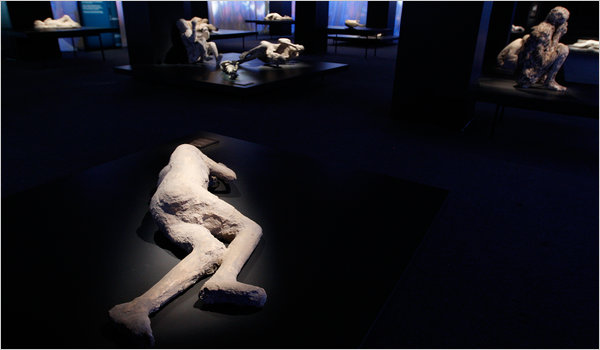
Pompeii in Times Square: “Pompeii the Exhibit: Life and Death in the Shadow of Vesuvius,” Discovery Times Square, New York City


"Experience Pompeii before and after the epic eruption 2,000 years ago. Imagine the moment their world vanished and discover the miraculous artifacts unearthed since. Witness the life and death of those frozen in time by ash - including the largest collection of body casts ever presented.

  • Over 250 artifacts – includes some never-before-seen objects and the largest collection of body casts ever on display including a dramatic skeleton collection
  • A brand-new, immersive movie experience depicting a timelapsed representation starting from the moment of Vesuvius’ massive explosion"

--From the “Pompeii the Exhibit" Website

More than a museum, Discovery Times Square is New York’s destination for discovery through unique and immersive exhibits
--Website for Discovery Times Square

"There is a lot of traffic these days in well-preserved bodies, human and otherwise. They are sliced and pickled for artistic effect or uncannily dissected and plasticized, with every blood vessel visible. They have toured the world, wrapped and mummified in the manner of ancient Egypt, or have been displayed, more modestly preserved by the dry desert sands of the Silk Road. And there are many, many more mummies yet to come.

Why this onslaught of the almost-living dead in museums? Are we latter-day Ezekiels seeking prophetic messages from ancient skeletal remnants? Has the technology used to prepare the dead for world travel suddenly advanced? Or has the need for income by the overseers of mummies suddenly increased?"

--From "When the Dead Arise and Head to Times Square," Edward Rothstein, the New York Times

“Pompeii the Exhibit: Life and Death in the Shadow of Vesuvius”--a new exhibition at Discovery Times Square--activates the same tension between spectacle and education, prurience and propriety, which was exploited to such great financial reward by Gunther von Hangens in Body Worlds and which characterized many 19th Century popular amusements such as tourist visits to the Paris Morgue, popular anatomical museums, and the scores of death- and destruction-themed spectaculars to be found at Coney Island in the late 19th and early 20th Centuries.

In fact, "Pompeii the Exhibit" of 2011 has much in common with a particular Coney Island attraction of 1889--the spectacular “The Last Days of Pompeii”--if not in the particulars than in the shared drive to offer the paying public a fully immersive recreation of the destruction of Pompeii, and in their use of over-the-top hyperbolic detail in describing the wonders of their respective exhibitions.

"The Last Days of Pompeii" of 1889--an immersive spectacle that combined historical vignette, theatre performance, and a pyrotechnic display in recreating the destruction of Pompeii by the fires of Vesuvius--boasted in its press about the number and variety of its cast (over 400 people! "a ballet troupe of 36 dancers trained by Batiste Cherotte... a male chorus..., soldiers, acrobats, jugglers, tumblers, [and] wire-walkers"!)

2011's "Pompeii the Exhibit," on the other hand, focuses on the numbers and authenticity of its artifacts (over 250! Some never seen before! The largest number of body casts ever on display!), bringing to mind the press for such Coney Island Spectaculars such as "The Boer War" (Real British and Boer veterans!) and the "Streets of Delhi" (300 authentic Indian natives in costume! Elephants! Camels! Horses!). To further blur the line between "legitimate museum" and popular attraction, "Pompeii the Exhibit" is hosted at a popular exhibition hall sponsored by a television channel--Discovery Times Square--rather than an "ordained" museum such as AMNH; Also, Pompeii the Exhibit" provides visitors not just artifacts and other traditional ways of experiencing history but also what its website describes as a "brand-new, immersive movie experience" reenacting "the moment of Vesuvius’ massive explosion."

So what to make of it all? I see this new exhibition as excitingly in the tradition of 19th Century popular educational amusements--dime museums, popular anatomical museums, and Coney Island recreations--spaces where spectacle and education, prurience and propriety, coexisted for mass consumption. Fun, didactic, spectacular, and a resounding and thoughtful endorsement in today's Times to boot. I, for one, can't wait to go see it.

You can read a fascinating review of "Pompeii the Exhibit"--as quoted above--by Edward Rothstein in today's New York Times by clicking here. You can find out more about Coney Island's “The Last Days of Pompeii" by clicking here. You can find out more about "Pompeii the Exhibit" by clicking here.

Thanks so much to GF Newland for alerting me to this!

Image: Ruth Fremson/The New York Times

Plaster casts made from hollowed-out molds of rock, where bodies had been captured a moment before they ceased to be.

RIM’s Marketing Chief Resigns [BlackBerry]

WSJ is reporting that Keith Pardy, RIM's Chief Marketing Officer, has resigned and will leave the company over a six-month transition period. WSJ's sources cite "personal reasons" but given the timeframe, the BlackBerry PlayBook is expected to release soon (and BlackBerry needs a bonafide hit), it's a peculiar move that may speak to RIM's growing problems. [WSJ] More »


Has life been found in a meteorite? | Bad Astronomy

Richard Hoover, an astrobiologist at NASA’s Marshall Space Flight Center, thinks he may have found bacteria in a meteorite.

Yes, you read that right. The question is, is he right?

I don’t know. Dr. Hoover has published his findings in the online Journal of Cosmology (see below for more about this journal), and it was reported today by Fox News (thanks to Sheril at The Intersection for the tip).

Basically, Hoover found structures inside a rare type of meteorite — the Orgueil meteorite which fell in France in 1864 — that look very much like microbes of some sort. Here’s an example from the paper:

Those are odd and intriguing formations, to be sure. If I were scanning through a meteorite and saw those, I’d be pretty surprised too.

But appearances can be deceiving. Are these actually fossilized microscopic life forms?

Hoover makes several claims to show that a non-biotic origin for these structures is very unlikely. I am not an expert and won’t cast my vote either way here. This is not the first time Hoover has made such claims; he gave ...


Pathologist Could Be Held Liable for Remote Review of Biopsy

This case on the surface appears to deal with the issue of appropriate state licensure for remote reads of pathology material.  Pending the outcome of this case, it emphasis the scrutiny and need for ensuring that practioners have met appropriate state licensure requirements and local credentialing requirements.  The problem is that every state has their own requirements concerning telemedicine requirements (and interstate commerce).  

One needs to insure the laws of the both the state where the case is received from as well as the state where a reading is performed are understood and followed.  Issues such as these and potential CLIA implications remain a barrier for digital pathology and in particular an "anytime, anywhere" model.

----------------------------------------------------------------------------------------------------------------------------

A Washington pathologist and her group practice may be subject to liability for the unlicensed practice of medicine under Idaho law stemming from the remote review in Washington of a biopsy from a patient in Idaho, a federal court ruled Dec. 30, 2010 (Smith v. Laboratory Corp. of America, W.D. Wash., No. C09-1662, 12/30/10).

The U.S. District Court for the Western District of Washington said Idaho’s Medical Practices Act (MPA) potentially applies to the Washington pathologist, Dr. Jane J. Yin, if she is found to have rendered a medical diagnosis for an Idaho resident without holding a license to practice medicine in that state.

Source: http://www.ioma.com/issues/GCR/2011_3/1625571-1.html


One Fun, Fast Riddle

UPDATE:  SOLVED by Sean at 12:02 CDT


Tom and I are getting ready to run a bonus riddle later this month.  I’ll have an announcement for you in a couple of days.

In the meanwhile, I think it’s about time to ring your chimes with another Sci Fi subject.  I wouldn’t want you to get bored and complacent over there.  Besides, I like playing around with Sci Fi subjects, and it’s all about me, right?  Me, me, me, me, me… oh!  Sorry about that.  I had a moment.

Today’s answer is a Sci Fi concept.

NASA image - you know who this is, right?

Like all good Sci Fi concepts, you’ll find this rooted in reality.

This concept has been kicked around since about 700 BCE.

It became more familiar to us in the late 19th century.

Image by Ferdinand Schmutzer 1921

This concept shows up in a lot of strange places; like through a looking glass.

This might be a one-way street.

Sometimes this happens spontaneously in fiction; just don’t take a nap at a mountain.

This iconic image has been around for a while

You’ll find this concept in places where you wouldn’t expect it to be lurking; like in a Dickens novel.

It’s even made an appearance in pop music.

Lots of people today - but you should know this one

There you go – one fun, fast riddle.  I’m hanging out in the comments, so don’t abandon me!