Waiting Forever For Webb

NASA Chief Suggests JWST Won't Launch before 2018, Space News

"Last November, an independent review ordered by Mikulski and led by John Casani of NASA's Jet Propulsion Laboratory, concluded that the JWST was at least $1.5 billion over budget and 15 months behind schedule. The Casani report said NASA would need to add $500 million to JWST's budget in 2011 and 2012 in order to keep the telescope on track for a September 2015 launch. NASA's 2012 budget request, sent to Congress in February, includes $375 million or less for JWST for each of the next five years. NASA said at the time that those were placeholder budget figures likely to be revised once NASA completes its own assessment of the program's cost and schedule. Bolden indicated during the hearing that NASA would not be seeking the amount of money recommended in the Casani report and would accept a lengthier launch delay instead."

Students Shoot for 2,500 MPG. Seriously

From Wired Top Stories:

The car runs, so there is that. But as the Cal Super Mileage Vehicle Team loaded its ultralight carbon-fiber three-wheeler into a trailer for the long haul from Berkeley to Houston, Murphy was definitely in the driver's seat. Anything that could go wrong did -

Can Social Networking Help You at Work?

Specialized groups on certain social networking sites are designed specifically to share knowledge; some groups focus on automation knowledge. Engineers and technicians can help solve each other's problems. What tips can you share about using social networks to get advice on technical problems?

The

Do You Feel Overworked and Overstressed?

When a company downsizes, many employees feel compelled to produce more than is humanly possible to avoid jeopardizing the company's health or the jobs of the people who remain. The resulting pressure may prove counter-productive, because it can serve as a distraction that can reduce workers' concen

The Watched Pot and Fast CMEs

If you've ever stood in front of a hot stove, watching a pot of water and waiting impatiently for it to boil, you know what it feels like to be a solar physicist.

Back in 2008, the solar cycle plunged into the deepest minimum in nearly a century. Sunspots all but vanished, solar flares subsided, and the sun was eerily quiet.

"Ever since, we've been waiting for solar activity to pick up," says Richard Fisher, head of the Heliophysics Division at NASA Headquarters in Washington DC. "It's been three long years."

Quiet spells on the sun are nothing new. They come along every 11 years or so—it's a natural part of the solar cycle. This particular solar minimum, however, was lasting longer than usual, prompting some researchers to wonder if it would ever end.

News flash: The pot is starting to boil. "Finally," says Fisher, "we are beginning to see some action."

As 2011 unfolds, sunspots have returned and they are crackling with activity. On February 15th and again on March 9th, Earth orbiting satellites detected a pair of "X-class" solar flares--the most powerful kind of x-ray flare. The last such eruption occurred back in December 2006.

Another eruption on March 7th hurled a billion-ton cloud of plasma away from the sun at five million mph (2200 km/s). The rapidly expanding cloud wasn't aimed directly at Earth, but it did deliver a glancing blow to our planet's magnetic field. The off-center impact on March 10th was enough to send Northern Lights spilling over the Canadian border into US states such as Wisconsin, Minnesota, and Michigan.

"That was the fastest coronal mass ejection in almost six years," says Angelos Vourlidas of the Naval Research Lab in Washington DC. "It reminds me of a similar series of events back in Nov. 1997 that kicked off Solar Cycle 23, the solar cycle before this one."

"To me," says Vourlidas, "this marks the beginning of Solar Cycle 24."

The slow build-up to this moment is more than just "the watched pot failing to boil," says Ron Turner, a space weather analyst at Analytic Services, Inc. "It really has been historically slow."

There have been 24 numbered solar cycles since researchers started keeping track of them in the mid-18th century. In an article just accepted for publication by the Space Weather Journal, Turner shows that, in all that time, only four cycles have started more slowly than this one. "Three of them were in the Dalton Minimum, a period of depressed solar activity in the early 19th century. The fourth was Cycle #1 itself, around 1755, also a relatively low solar cycle," he says.

In his study, Turner used sunspots as the key metric of solar activity. Folding in the recent spate of sunspots does not substantially alter his conclusion: "Solar Cycle 24 is a slow starter," he says.

Better late than never.

For more information visit http://www.nasa.gov/mission_pages/sunearth/news/watchedpot-fastCME.html

NASA Telescopes Help Discover Surprisingly Young Galaxy

Astronomers have uncovered one of the youngest galaxies in the distant universe, with stars that formed 13.5 billion years ago, a mere 200 million years after the Big Bang. The finding addresses questions about when the first galaxies arose, and how the early universe evolved.

NASA's Hubble Space Telescope was the first to spot the newfound galaxy. Detailed observations from the W.M. Keck Observatory on Mauna Kea in Hawaii revealed the observed light dates to when the universe was only 950 million years old; the universe formed about 13.7 billion years ago.

Infrared data from both Hubble and the post-coolant, or "warm," phase of NASA's Spitzer Space Telescope mission revealed the galaxy's stars are quite mature, which means they must have formed when the universe was just a toddler.

"This challenges theories of how soon galaxies formed in the first years of the universe," said Johan Richard of the Centre de Recherche Astronomique de Lyon, Université Lyon 1 in France, lead author of a new study accepted for publication in the Monthly Notices of the Royal Astronomical Society. "It could even help solve the mystery of how the hydrogen fog that filled the early universe was cleared."

This galaxy is not the most distant ever observed, but it is one of the youngest to be observed with such clarity. Normally, galaxies like this one are extremely faint and difficult to study, but, in this case, nature has provided the astronomers with a cosmic magnifying glass. The galaxy's image is being magnified by the gravity of a massive cluster of galaxies parked in front of it, making it appear 11 times brighter. This phenomenon is called gravitational lensing.

"Without this big lens in space, we could not study galaxies this faint with currently available observing facilities," said co-author Eiichi Egami of the University of Arizona in Tucson. "Thanks to nature, we have this great opportunity to see our universe as it was eons ago."

The findings may help explain how the early universe became "reionized." At some point in our universe's early history, it transitioned from the so-called dark ages to a period of light, as the first stars and galaxies began to ignite. This starlight ionized neutral hydrogen atoms floating around in space, giving them a charge. Ultraviolet light could then travel unimpeded through what had been an obscuring fog.

The discovery of a galaxy possessing stars that formed only 200 million years after the big bang helps astronomers probe this cosmic reionization epoch. When this galaxy was developing, its hot, young stars would have ionized vast amounts of the neutral hydrogen gas in intergalactic space. A population of similar galaxies probably also contributed to this reionization, but they are too faint to see without the magnifying effects of gravitational lensing.

NASA's James Webb Space Telescope (JWST), scheduled to launch later this decade, will be able to see these faint galaxies lacking magnification. A successor to Hubble and Spitzer, JWST will see infrared light from the missing population of early galaxies. As a result, the mission will reveal some of our universe's best-kept secrets.

"Seeing a galaxy as it appeared near the beginning of the universe is an awe-inspiring feat enabled by innovative technology and the fortuitous effect of gravitational lensing," said Jon Morse, NASA's Astrophysics Division director at the agency's headquarters in Washington. "Observations like this open a window across space and time, but more importantly, they inspire future work to one day peer at the stars that lit up the universe following the big bang."

NASA's Jet Propulsion Laboratory, Pasadena, Calif., manages the Spitzer Space Telescope mission for NASA's Science Mission Directorate, Washington. Science operations are conducted at the Spitzer Science Center at the California Institute of Technology in Pasadena.

For more information visit http://www.nasa.gov/mission_pages/spitzer/news/spitzer20110412.html

Do Cosmic Strings of Gas Come From Sonic Booms?

The Herschel Space Observatory has revealed that clouds between stars contain networks of tangled gaseous filaments. Intriguingly, each filament is approximately the same width, hinting that they may result from interstellar sonic booms throughout our Milky Way galaxy.

The filaments are huge, stretching for tens of light years through space, and Herschel has shown that newborn stars are often found in the densest parts of them. One filament imaged by Herschel in the Aquila region contains a cluster of about 100 infant stars.

Such filaments in interstellar clouds have been glimpsed before by other infrared satellites, but they have never been seen clearly enough to have their widths measured. Now, Herschel has shown that, regardless of the length or density of a filament, the width is always roughly the same.

The team suggests that as sonic booms from exploding stars travel through the clouds, they lose energy and, where they finally dissipate, they leave these filaments of compressed material.

Herschel is a European Space Agency cornerstone mission, with science instruments provided by consortia of European institutes and with important participation by NASA. NASA's Herschel Project Office is based at NASA's Jet Propulsion Laboratory, Pasadena, Calif. JPL contributed mission-enabling technology for two of Herschel's three science instruments. The NASA Herschel Science Center, part of the Infrared Processing and Analysis Center at the California Institute of Technology in Pasadena, supports the United States astronomical community. Caltech manages JPL for NASA.

For more information visit http://www.nasa.gov/mission_pages/herschel/herschel20110413.html

Mars Rover’s ‘Gagarin’ Moment Applauded Exploration

A flat, light-toned rock on Mars visited by NASA's Mars Exploration Rover in 2005 informally bears the name of the first human in space, Yuri Gagarin, who rode into orbit in the Soviet Union's Vostok-1 spacecraft on April 12, 1961.

The team using Opportunity to explore the Meridiani Planum region of Mars since 2004 chose "Gagarin" for what they would call the rock that the rover examined beside "Vostok" crater. A target for close-up examination on Gagarin is called "Yuri."

To commemorate Gagarin's flight, a color image of the rock on Mars has been posted, here. The image combines frames taken through three different filters by Opportunity's panoramic camera.

Early accomplishments in the Space Age inspired many of the researchers exploring other planets robotically today, who hope their work can, in turn, help inspire the next generation.

"The 50th anniversary of mankind's first fledgling foray into the cosmos should serve as an important reminder of the spirit of adventure and exploration that has propelled mankind throughout history," said Mars rover science team member James Rice of NASA Goddard Space Flight Center, Greenbelt, Md. "We are a species of explorers; it is encoded into our very DNA."

Rice continued, "Half a century ago Yuri Gagarin was lofted into a totally unknown, remote and hostile environment and in doing so opened up a new limitless frontier of possibilities for mankind. A mere 23 days later another brave human, Alan Shepard, climbed aboard a rocket and ventured into the starry abyss. Their courage and vision continue to inspire and lead us into the unknown. Hopefully, one day in the not too distant future it will lead humanity on a voyage to Mars."

Opportunity and its twin, Spirit, completed their three-month prime missions on Mars in April 2004. Both rovers continued in years of bonus, extended missions. Both have made important discoveries about wet environments on ancient Mars that may have been favorable for supporting microbial life. Spirit has not communicated with Earth since March 2010. Opportunity remains active. This month, it has passed both the 27-kilometer and 17-mile marks in its total driving distance on Mars.

NASA's Jet Propulsion Laboratory, a division of the California Institute of Technology in Pasadena, manages the Mars Exploration Rover Project for the NASA Science Mission Directorate, Washington.

For more information visit http://www.nasa.gov/mission_pages/mer/news/mer20110411.html

WISE Mission Spots ‘Horseshoe’ Asteroid

An asteroid recently discovered by NASA's Wide-field Infrared Survey Explorer (WISE) may be a bit of an oddball. Most near-Earth asteroids -- NEAs for short -- have eccentric, or egg-shaped, orbits that take the asteroids right through the inner solar system. The new object, designated 2010 SO16, is different. Its orbit is almost circular such that it cannot come close to any other planet in the solar system except Earth.

However, even though the asteroid rides around with Earth, it never gets that close.

"It keeps well away from Earth," said Apostolos "Tolis" Christou, who, together with David Asher of the Armagh Observatory in Northern Ireland, analyzed the orbit of the body after it was discovered in infrared images taken by WISE. "So well, in fact, that it has likely been in this orbit for several hundred thousand years, never coming closer to our planet than 50 times the distance to the moon."

The asteroid is one of a few that trace out a horseshoe shape relative to Earth. As the asteroid approaches Earth, the planet's gravity causes the object to shift back into a larger orbit that takes longer to go around the sun than Earth. Alternately, as Earth catches up with the asteroid, the planet's gravity causes it to fall into a closer orbit that takes less time to go around the sun than Earth. The asteroid therefore never completely passes our planet. This slingshot-like effect results in a horseshoe-shaped path as seen from Earth, in which 2010 SO16 takes 175 years to get from one end of the horseshoe to the other.

"The origins of this object could prove to be very interesting," said Amy Mainzer of NASA's Jet Propulsion Laboratory, Pasadena, Calif., the principal investigator of NEOWISE, which is the asteroid- and comet-hunting portion of the WISE survey mission. "We are really excited that the astronomy community is already finding treasures in the NEOWISE data that have been released so far."

NEOWISE finished its one complete sweep of the solar system in early February of this year. Data on the orbits of asteroids and comets detected by the project, including near-Earth objects, are catalogued at the NASA-funded International Astronomical Union's Minor Planet Center, at the Smithsonian Astrophysical Observatory in Cambridge, Mass.

A full story from the Armagh Observatory, including animations, is online at http://www.arm.ac.uk/press/2011/aac_horseshoe_orbit.html.

JPL manages and operates the Wide-field Infrared Survey Explorer for NASA's Science Mission Directorate, Washington. The principal investigator, Edward Wright, is at UCLA. The mission was competitively selected under NASA's Explorers Program managed by the Goddard Space Flight Center, Greenbelt, Md. The science instrument was built by the Space Dynamics Laboratory, Logan, Utah, and the spacecraft was built by Ball Aerospace & Technologies Corp., Boulder, Colo. Science operations and data processing take place at the Infrared Processing and Analysis Center at the California Institute of Technology in Pasadena. Caltech manages JPL for NASA.

For more information visit http://www.nasa.gov/mission_pages/WISE/news/wise20110408.html

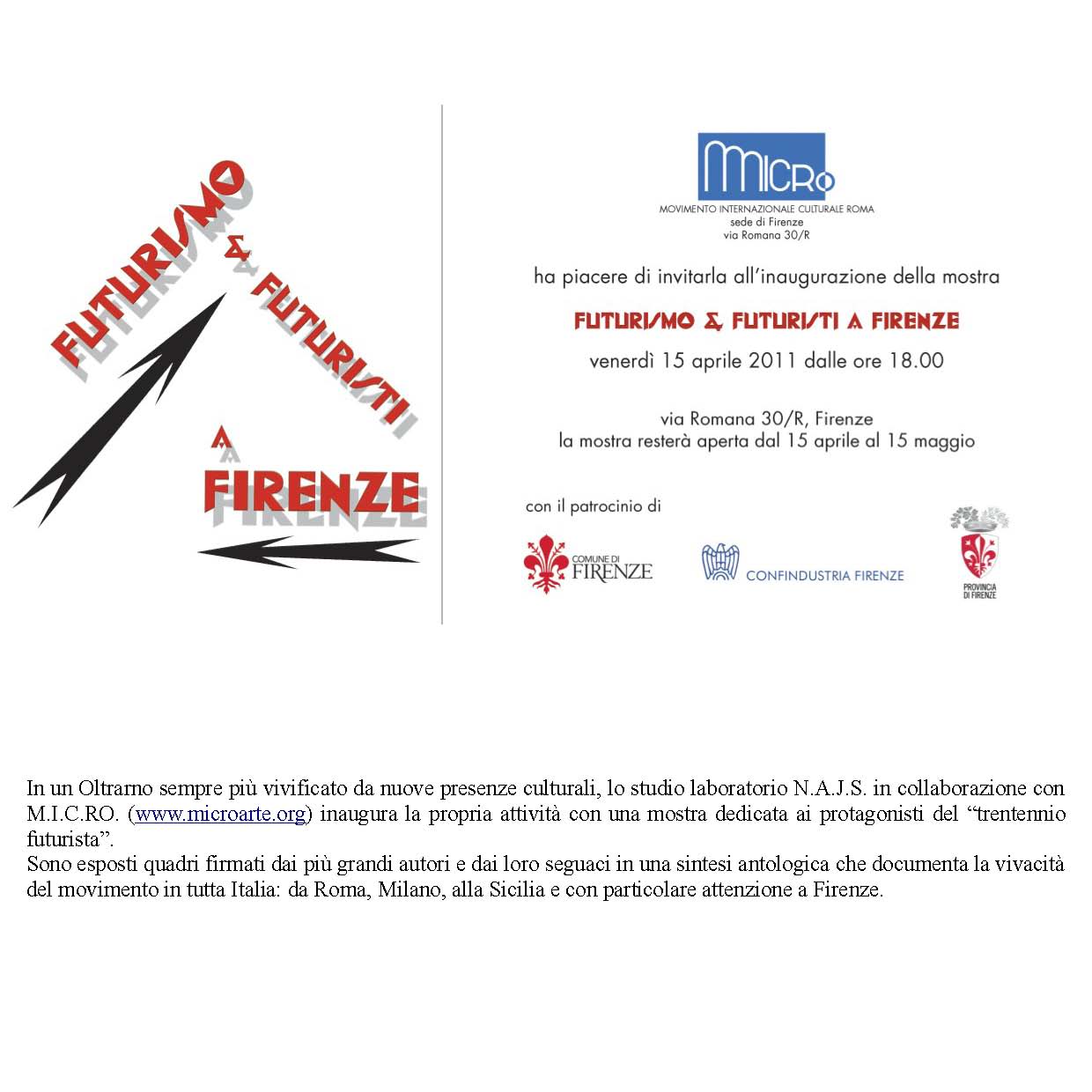
Futurismo e Futuristi a Firenze

Futurismo e Futuristi a Firenze

April 15 – May 15, 2011
*opening April 15th at 6pm
Studio laboratorio N.A.J.S (No Art Just Sign)

C’era anche l’assessore all’università e politiche giovanili Cristina Giachi stamani alla presentazione alla stampa della mostra “Futurismo e futurismi a Firenze”, che aprirà domani nello studio laboratorio N.A.J.S (No Art Just Sign) in via Romana 30/r, un nuovo ed inedito spazio dell’Oltrarno fiorentino. Il Futurismo dunque torna a Firenze dopo molti anni, con una esposizione che presenta opere firmate dai più grandi autori del movimento e dai loro seguaci, in una sintesi antologica che documenta la loro attività in tutta Italia, da Roma a Milano alla Sicilia, con una particolare attenzione per Firenze.

“Non poteva mancare il sostegno dell’Amministrazione Comunale a un’iniziativa come questa – ha dichiarato l’assessore Giachi -. Un’associazione di ‘folli’, anzi, due, la Micro e la Najs, aprono un nuovo spazio culturale privato e lo festeggiano offrendo generosamente alla città una mostra che potrebbe benissimo trovarsi in un museo. Una follia culturale, che è pura vita per la nostra città e realizza quella cultura diffusa che può restituire energia a Firenze. Il futurismo, al di là di tutte le valutazioni, può ben raccontare oggi questa energia. Firenze ha uno straordinario bisogno di scoprire disseminati nel cuore della sua bellezza questi salutari semi di follia”.

La mostra, patrocinata da Comune di Firenze, Provincia di Firenze e Confindustria Firenze, è organizzata dall’associazione culturale M.I.C.RO e curata da Maurizio Scudiero e Anna Maria Ruta; il Comitato Scientifico è formato da Maurizio Scudiero, Anna Maria Ruta, Francesca Barbi Marinetti, Elena Gigli, e Giancarlo Carpi; è realizzata in collaborazione con Futur-Ism Roma.

Il catalogo è edito dalla casa editrice D’Anna ed è introdotto dagli assessori Giuliano da Empoli e Cristina Giachi.

La mostra resterà aperta dal 15 aprile al 15 maggio. Info: http://www.futur-ism.it

Share