Hubble Views the Star That Changed the Universe

Though the universe is filled with billions upon billions of stars, the discovery of a single variable star in 1923 altered the course of modern astronomy. And, at least one famous astronomer of the time lamented that the discovery had shattered his world view.

The star goes by the inauspicious name of Hubble variable number one, or V1, and resides in the outer regions of the neighboring Andromeda galaxy, or M31. But in the early 1900s, most astronomers considered the Milky Way a single "island universe" of stars, with nothing observable beyond its boundaries. Andromeda was cataloged as just one of many faint, fuzzy patches of light astronomers called "spiral nebulae."

Were these spiral nebulae part of the Milky Way or were they independent island universes lying outside our galaxy? Astronomers didn't know for sure, until Edwin Hubble found a star in Andromeda that brightened and faded in a predictable pattern, like a lighthouse beacon, and identified it as V1, a Cepheid variable. This special type of star had already been proven to be a reliable distance marker within our galaxy.

The star helped Hubble show that Andromeda was beyond our galaxy and settled the debate over the status of the spiral nebulae. The universe became a much bigger place after Hubble's discovery, much to the dismay of astronomer Harlow Shapley, who believed the fuzzy nebulae were part of our Milky Way.

Nearly 90 years later, V1 is in the spotlight again. Astronomers pointed Edwin Hubble's namesake, NASA's Hubble Space Telescope, at the star once again, in a symbolic tribute to the legendary astronomer's milestone observation.

Astronomers with the Space Telescope Science Institute's Hubble Heritage Project partnered with the American Association of Variable Star Observers (AAVSO) to study the star. AAVSO observers followed V1 for six months, producing a plot, or light curve, of the rhythmic rise and fall of the star's light. Based on this light curve, the Hubble Heritage team scheduled telescope time to capture images of the star.

"V1 is the most important star in the history of cosmology," says astronomer Dave Soderblom of the Space Telescope Science Institute (STScI) in Baltimore, Md., who proposed the V1 observations.

"It's a landmark discovery that proved the universe is bigger and chock full of galaxies. I thought it would be nice for the Hubble telescope to look at this special star discovered by Hubble, the man."

But Hubble Heritage team member Max Mutchler of the STScI says that this observation is more than just a ceremonial nod to a famous astronomer.

"This observation is a reminder that Cepheids are still relevant today," he explains. "Astronomers are using them to measure distances to galaxies much farther away than Andromeda. They are the first rung on the cosmic distance ladder."

The Hubble and AAVSO observations of V1 will be presented at a press conference May 23 at the American Astronomical Society meeting in Boston, Mass.

Ten amateur astronomers from around the world, along with AAVSO Director Arne Henden, made 214 observations of V1 between July 2010 and December 2010. They obtained four pulsation cycles, each of which lasts more than 31 days. The AAVSO study allowed the Hubble Heritage team to target Hubble observations that would capture the star at its brightest and dimmest phases.

The observations were still tricky, though. "The star's brightness has a gradual decline followed by a sharp spike upward, so if you're off by a day or two, you could miss it," Mutchler explains.

Using the Wide Field Camera 3, the team made four observations in December 2010 and January 2011.

"The Hubble telescope sees many more and much fainter stars in the field than Edwin Hubble saw, and many of them are some type of variable star," Mutchler says. "Their blinking makes the galaxy seem alive. The stars look like grains of sand, and many of them have never been seen before."

For Soderblom, the Hubble observations culminated more than 25 years of promoting the star. Shortly after Soderblom arrived at the Institute in 1984, he thought it would be fitting to place a memento of Edwin Hubble's aboard the space shuttle Discovery, which would carry the Hubble Space Telescope into space.

"At first, I thought the obvious artifact would be his pipe, but [cosmologist] Allan Sandage [Edwin Hubble's protege] suggested another idea: the photographic glass plate of V1 that Hubble made in 1923," Soderblom recalls.

He made 15 film copies of the original 4-inch-by-5-inch glass plate. Ten of them flew onboard space shuttle Discovery in 1990 on the Hubble deployment mission. Fittingly, two of the remaining five film copies were part of space shuttle Atlantis's cargo in 2009 for NASA's fifth servicing mission to Hubble. One of those copies was carried aboard by astronaut and astronomer John Grunsfeld, now the STScI's deputy director.

Telltale Star Expands the Known Universe

Prior to the discovery of V1 many astronomers thought spiral nebulae, such as Andromeda, were part of our Milky Way galaxy. Others weren't so sure. In fact, astronomers Shapley and Heber Curtis held a public debate in 1920 over the nature of these nebulae. During the debate, Shapley championed his measurement of 300,000 light-years for the size of the Milky Way. Though Shapley overestimated its size, he was correct in asserting that the Milky Way was much larger than the commonly accepted dimensions. He also argued that spiral nebulae were much smaller than the giant Milky Way and therefore must be part of our galaxy. But Curtis disagreed. He thought the Milky Way was smaller than Shapley claimed, leaving room for other island universes beyond our galaxy.

To settle the debate, astronomers had to establish reliable distances to the spiral nebulae. So they searched for stars in the nebulae whose intrinsic brightness they thought they understood. Knowing a star's true brightness allowed astronomers to calculate how far away it was from Earth. But some of the stars they selected were not dependable milepost markers.

For example, Andromeda, the largest of the spiral nebulae, presented ambiguous clues to its distance. Astronomers had observed different types of exploding stars in the nebula. But they didn't fully understand the underlying stellar processes, so they had difficulty using those stars to calculate how far they were from Earth. Distance estimates to Andromeda, therefore, varied from nearby to far away. Which distance was correct? Edwin Hubble was determined to find out.

The astronomer spent several months in 1923 scanning Andromeda with the 100-inch Hooker telescope, the most powerful telescope of that era, at Mount Wilson Observatory in California. Even with the sharp-eyed telescope, Andromeda was a monstrous target, about 5 feet long at the telescope's focal plane. He therefore took many exposures covering dozens of photographic glass plates to capture the whole nebula.

He concentrated on three regions. One of them was deep inside a spiral arm. On the night of Oct. 5, 1923, Hubble began an observing run that lasted until the early hours of Oct. 6. Under poor viewing conditions, the astronomer made a 45-minute exposure that yielded three suspected novae, a class of exploding star. He wrote the letter "N," for nova, next to each of the three objects.

Later, however, Hubble made a startling discovery when he compared the Oct. 5-6 plate with previous exposures of the novae. One of the so-called novae dimmed and brightened over a much shorter time period than seen in a typical nova.

Hubble obtained enough observations of V1 to plot its light curve, determining a period of 31.4 days, indicating the object was a Cepheid variable. The period yielded the star's intrinsic brightness, which Hubble then used to calculate its distance. The star turned out to be 1 million light-years from Earth, more than three times Shapley's calculated diameter of the Milky Way.

Taking out his marking pen, Hubble crossed out the "N" next to the newfound Cepheid variable and wrote "VAR," for variable, followed by an exclamation point.

For several months the astronomer continued gazing at Andromeda, finding another Cepheid variable and several more novae. Then Hubble sent a letter along with a light curve of V1 to Shapley telling him of his discovery. After reading the letter, Shapley was convinced the evidence was genuine. He reportedly told a colleague, "Here is the letter that destroyed my universe."

By the end of 1924 Hubble had found 36 variable stars in Andromeda, 12 of which were Cepheids. Using all the Cepheids, he obtained a distance of 900,000 light-years. Improved measurements now place Andromeda at 2 million light-years away.

"Hubble eliminated any doubt that Andromeda was extragalactic," says Owen Gingerich, professor emeritus of Astronomy and of the History of Science at Harvard-Smithsonian Center for Astrophysics in Cambridge, Mass. "Basically, astronomers didn't know the distance to novae, so they had to make a rough estimate as to where they were and therefore what their absolute luminosity was. But that is on very treacherous ground. When you get a Cepheid that's been reasonably calculated, the period will tell you where it sits on the luminosity curve, and from that you can calculate a distance."

Shapley and astronomer Henry Norris Russell urged Hubble to write a paper for a joint meeting of the American Astronomical Society and American Association for the Advancement of Science at the end of December 1924. Hubble's paper, entitled "Extragalactic Nature of Spiral Nebulae," was delivered in absentia and shared the prize for the best paper. A short article about the award appeared in the Feb. 10, 1925, issue of The New York Times. Gingerich says Hubble's discovery was not big news at the meeting because the astronomer had informed the leading astronomers of his result months earlier.

Edwin Hubble's observations of V1 became the critical first step in uncovering a larger, grander universe. He went on to find many galaxies beyond the Milky Way. Those galaxies, in turn, allowed him to determine that the universe is expanding.

Could Hubble ever have imagined that nearly 100 years later, technological advances would allow amateur astronomers to perform similar observations of V1 with small telescopes in their backyards? Or, could Hubble ever have dreamed that a space-based telescope that bears his name would continue his quest to precisely measure the universe's expansion rate?

The Hubble Space Telescope is a project of international cooperation between NASA and the European Space Agency. NASA's Goddard Space Flight Center manages the telescope. The Space Telescope Science Institute (STScI) conducts Hubble science operations. STScI is operated for NASA by the Association of Universities for Research in Astronomy, Inc., in Washington, D.C.

Bayes: The Theory That Would Not Die [book]

A new book on Bayes Theorem has just been published: The Theory That Would Not Die: How Bayes' Rule Cracked the Enigma Code, Hunted Down Russian Submarines, and Emerged Triumphant from Two Centuries of Controversy by Sharon Bertsch McGrayne. From the SciAm review, Why Bayes Rules: The History of a Formula That Drives Modern Life:

Discovered by English clergyman Thomas Bayes, the formula is a simple one-liner: Initial Beliefs + Recent Objective Data = A New and Improved Belief. A modern form comes from French mathematician Pierre-Simon Laplace, who, by recalculating the equation each time he got new data, could distinguish highly probable hypotheses from less valid ones. One of his applications involved explaining why slightly more boys than girls were born in Paris in the late 1700s. After collecting demographic data from around the world for 30 years, he concluded that the boy-girl ratio is universal to humankind and determined by biology.

Many theoretical statisticians over the years have assailed Bayesian methods as subjective. Yet decision makers insist that they bring clarity when information is scarce and outcomes uncertain. During the 1970s John Nicholson, the U.S. submarine fleet commander in the Mediterranean, used Bayesian computer analysis to figure out the most probable paths of Soviet nuclear subs. Today Bayesian math helps sort spam from e-mail, assess medical and homeland security risks and decode DNA, among other things.

Now Bayes is revolutionizing robotics, says Sebastian Thrun, director of Stanford University’s Artificial Intelligence Laboratory and Google’s driverless car project. By expressing all information in terms of probability distributions, Bayes can produce reliable estimates from scant and uncertain evidence.


Crystal Pite’s Dark Matters [dance]

Canadian dancer/choreographer Crystal Pite's newest piece, Dark Matters, addresses some transhumanist themes, namely the creation of artificial progeny and its potentially grave and unpredictable implications. The title refers both to astrophysics and human impulses, exploring the idea of undetectable forces at work in cosmology and human affairs.

Dark Matters is a theatrical hybrid of puppetry and dance that opens as a sinister fable in which an inventor creates a puppet (or is that a robot?) with fateful results—and all expressed through contemporary ballet.


Designer Psychologies: Moving beyond neurotypicality

Designer psychologies, or customized cognitive processing modalities, describes the potential for future individuals to selectively alter the specific and unique ways in which they take in, analyze and perceive the world. Cognitive modalities are the psychological frameworks that allow for person-to-person variances in subjectivity, including such things as emotional responses, social engagement, aesthetics and prioritization. The day is coming when we'll be able to decide for ourselves how it is exactly that we want to process our world.

Most of us have the so-called neurotypical cognitive response. We know, however, mostly through our interactions with those outside of the cognitive norm, that neurotypicality is not the be-all and end-all of psychological experience. As the Autism Rights Movement has demonstrated, our tendency to describe anyone outside the neurotypical norm as being abnormal, pathological or broken in some way is not entirely accurate or fair. Impairment is in the eye of the beholder, and in many cases, we are finding considerable value in the neurodiverse experience.

Indeed, autism is a great example of this. While it can largely be characterized as a social communication disorder, this definition of autism is clearly an expression of the neurotypical bias which, rightly or wrongly, places great value on person-to-person interactions and social conventions; autistics don’t necessarily see this as a problem and are often quite content to focus on their own thoughts and pursuits. Moreover, it’s through the autistic lens that the world can be processed, understood and appreciated in a way that’s qualitatively different than that of the neurotypical mind.

Society benefits from neurodiversity. It carries an intrinsic worth. It’s through “different kinds of thinking” that we get alternative perspectives on the world, and as a result, unique and often astounding forms of expression. Famous autistics, for example, have produced great works of art, scientific theories, and even such unorthodox inventions as cattle calming chutes thanks to Temple Grandin.

Now, as I address the potential for designer psychologies, I am not necessarily saying we should develop technologies to help us all become autistics—but if that’s your cup of tea, then go for it. What I am suggesting is that autistics provide a glimpse into the “other,” that there is huge potential for other cognitive modalities outside of neurotypicality, and that we should consider developing our neurosciences such that we can individually tailor our psychologies in accordance with our values, changing environments, technologies, capacities and social arrangements.

From neurotypicality to neurodiversity

Okay, so why do we need to reach outside the bounds of neurotypicality? What’s so wrong with our brains that we can’t leave well enough alone?

As just mentioned, there is intrinsic personal and societal worth to neurodiversity. But in addition, it is an expression of our cognitive liberty and our right to modify our minds as we see fit. Moreover, it is a way for us to re-jig and improve upon an increasingly outdated piece of equipment, namely our Paleolithic brains.

While there is significant variance within neurotypicality, we tend to agree that it defines a strict band of cognitive traits and normal functioning that, when transgressed, leads to pathology, or in some cases extreme giftedness. Now, while we may think that there is considerable diversity within neurotypicality, it is nothing compared to the potential space of possibilities that exist outside it.

It’s within this small patch of “normalcy” that Homo sapiens, for the most part, currently dwells. We are a species that finds itself in a post-industrialized information era civilization — a situation far removed from the environment in which we evolved over the course of hundreds of thousands of years. It’s for this reason that neurotypicality should also be thought of as Paleoneurology. Our minds are most suited to life in Paleolithic tribal environments; our psychological tendencies are all adaptive traits that have resulted in such characteristics as tribalism, hierarchic social arrangements, the Dunbar limit (maximum number of social connections), cognitive biases, strictly calibrated emotional responses, an aesthetic appreciation for nature, organic forms, and human things.

We obviously don’t live in a Paleolithic society (except in my household), and many of these traits have resulted in a number of maladaptive behaviors, including proclivities for addiction, and modern diseases like depression, obesity, ADHD, and stress. It has resulted in environmental and social alienation, in which we have great difficulty dealing with noise and light pollution, or through social arrangements far removed from tribal and familial settings.

This is a problem that is not getting better anytime soon. In fact, we, as biological creatures, have created a civilization that is increasingly complex and even postbiological. We stand to become even further distanced and alienated from our settings as time passes. Sure, many of the things we have are deliberately designed to please, but that’s also part of the problem, leading to such things as web and video game addiction. And yet other things that surround us are completely outside of intentional design — the products of brute utilitarianism (think concrete slabs, roads, telephone poles, computer code, massive data sets, and so on).

The processing mind

From a certain vantage point the designer psychologies initiative could be seen as a kind of cognitive enhancement, and I don’t really have a huge problem with that. But this is more than just enhancement—it’s more than such things as increased attention spans, intelligence, and memory—traits that can clearly be labeled as improvements.

It’s through designer psychologies that we can strive to be different, and not just better; this is why the neurodiversity movement is so important. It’s about creating alternatives. Consequently, alternative psychologies may actually result in the voluntary onset of impairment — or at least an impairment as viewed through the lens of other modalities. This will be a very tricky area to navigate in terms of the ethics, but it’s a conversation that needs to be had.

And by alternative psychologies I am referring to fundamental changes in the ways our brains perceive and process information. Our brains are largely preconfigured to help us interpret and operate in the world, much like a computer processes information. This computer analogy goes back to the mathematician Claude Shannon who described information processing as the conversion of latent information into manifest information. This is basically the process of having unprocessed or pre-processed information, whether sent out by the environment or through an intentional agent, delivered to a receiver, and having the intended receiver transform, process, and potentially respond and act on that information. Along the way our brains do such things as data filtering and prioritization to help us distinguish signal from noise. We have little to no control over what we think is important, valuable or aesthetically pleasing; these are largely autonomous responses.

How wonderful would it be to recalibrate these information processes according to our needs as a transhuman species. Thankfully we have a good idea as to how we might be able to make this possible.

Back in the 1970s, it was Abraham Moles and Frieder Nake who established and analyzed the links between information processing and aesthetics. They argued that the subjective experience of interpreting incoming data is dependent on the software set up in the brain. Thus, it’s here where we can work to change our seemingly innate preferences.

Cognitive customization and design

So, what kinds of thing would we want to do. What are some examples of designer psychologies?

The space of all possible viable and worthwhile psychologies is absolutely massive. Neurotypicality is but a tiny speck of what’s possible. While it would be impossible for me to predict the various ways in which we might want to alter our cognitive modalities, there are a number of areas we might want to consider:

A. Aesthics

It’s time that we started to adapt our minds to our environment rather than the other way around. A human, transhuman or posthuman mind needs to be able to interpret contemporary things. Consequently, we need to re-think our aesthetic appreciation of those artifacts not traditionally present in the human palate of taste. Consider a world in which we find greater appreciation and deeper worth in everyday objects, mundane tasks, and abstract things (e.g. numbers, patterns and data sets). Or in things we can’t possibly imagine. We would essentially be expanding the space of subjective evaluation and appreciation.

As an aside, this could work in conjunction with the strengthening and weakening of our sensory capacities, and even the deliberate onset of synesthesia (which is the blending and intermingling of sensory experience). These new senses would have to be carefully calibrated to ensure that that (1) the extreme ends of the bandwidth scale are safe and not overwhelming to the receiver and (2) can be appropriately interpreted and reacted upon (i.e. all points of the emotional spectrum, including such things as a sense of disgust or repugnance where such a reaction is warranted).

B. Emotions and mood

Cognitive processing is very closely tied to our emotional responses. We are reflexively drawn to or repulsed by certain things simply because we’re hardwired that way. We could re-design our psychologies such that certain tendencies are strengthened or weakened in ways described earlier.

But emotional response can also refer to our default brain-state, the so-called normal frame of our day-to-day dealings. This is often referred to as our psychological baseline. When we’re below the baseline we’re depressed and when above we’re elevated or even manic. This is an incredibly important area for consideration, especially the prospect of permanently raising the baseline above the default state.

C. Biases

One of the most wonderful, if not sobering pages, in all of Wikipedia is the list of cognitive biases. This page lists over a hundred biases, which are defined as “a pattern of deviation in judgment that occurs in particular situations.” These deviations in judgment are like software bugs in the human mind that are difficult to overcome and often lead to perceptual distortion, inaccurate judgment or illogical interpretation.

Cognitive biases are instances of evolved mental behavior. Some biases were adaptive, for example, because they resulted in more effective actions in given contexts or because they enabled faster decisions when faster decisions were of greater value. Others might be on account of insufficient mental faculties, or from the misapplication of a mechanism that is adaptive under different circumstances. We are very poor at math and probabilistic reasoning, for example, which has given rise to a host of cognitive biases, including those that lead to such behaviors as gambling.

Through designer psychologies, we could alleviate (if not eliminate) the impacts of these biases, which would result in clearer thinking and improved rationality.

D. Social engagement

Some individuals may wish to strengthen the attachments they feel to other persons. Shyness, introversion and inhibitions could be overcome. Drugs like MDMA cause the user to feel closer, more in-tune and empathetic towards others. But these feelings don’t last and there tend to be other side-effects. It’s through designer psychologies that such a modality could be maintained more consistently. The strengthening of our mirror neurons, for example, could make us more capable of considering other minds.

E. Moral enhancement

Which leads to another promising area, that of moral enhancement. Moral enhancement is the speculative study of how we could modify and enhance the ways in which humans act as moral agents.

Morality is clearly a relative term that’s subject to both individual, social and cultural norms, but it’s a fascinating area of inquiry as transhumanists try to figure out the best ways to modify themselves to improve their moral behaviour.

Admittedly, this is a short list of the kinds of mods that may someday be possible. There are likely many other traits, including those factors that we’re still unsure about and how they might impact on personality and conscious awareness. These examples are also all arguably within neurotypical experience. I would imagine that the kind of designer psychologies that will come into existence will be profoundly different than anything we have ever experienced.

Getting there

Up to this point there’s been lot of handwaving on my part to describe the ways in which we could actually tweak our brains to such a degree. Thankfully, there are in fact a number of promising areas that may make the vision of designer psychologies possible.

A. Targeted psychopharmaceuticals

We already have a number of drugs at our disposal that can modify our psychologies in the ways I’ve described, but they often co-incide with impairment, poor judgement, side-effects, and of course, they don’t last. Future pharmaceuticals may be developed that are safer, work with greater cognitive specificity, are customized to the user, and are longer-lasting.

These drugs could work by boosting or alleviating the impacts of existing neurotransmitters, or as novel neurotransmitters altogether. They will impact on hormone levels and other chemical and cellular reactions that impact on human psychology.

B. Adaptive harnessing

Evolutionary neurobiologist Mark Changizi argues that we shouldn’t think about introducing externalities to the human brain, but to rework and re-adapt its mechanisms instead. As an example, he refers to neuronal recycling. In his words, “To harness our brains, we want to let the brain’s brilliant mechanisms run as intended—i.e., not to be twisted. Rather, the strategy is to twist Y into a shape that the brain does know how to process.” Simply stated, Changizi is suggesting that we work with what we got.

C. Genomics

There’s no question that human psychology has a genetic underpinning. We know that certain traits and tendencies “run in the family.” It will be through the maturation of genomic technologies that we will eventually be able to identify and modify those genetic elements that are responsible for our behavior.

D. Cognitive implants

Cognitive implants are exactly that: assistive devices that can be implanted in the brain. There are a number of promising areas (or soon to be) in development:

  • Brain pacemakers: Brain pacemakers are implants in the brain which send small electric signals to brain tissue, with the results being effective treatments for epilepsy, Parkinson’s and depression. Clearly there’s potential here for using more sophisticated and targeted pacemakers to do much more.
  • Artificial neurons: As opposed to adaptive harnessing, artificial neurons could introduce novel capacities into the brain altogether. While most have their eye on this technology for the purposes of treating neurodegeneration, it could also be used to boost the capacity of the human brain and establish ancillary cognitive systems altogether.
  • Molecular nanotechnology: And of course there’s molecular nanotechnolgy in which all bets are off. Nano, if it can be actualized to the degree we think it can, could radically rework and cyborgize the human brain. All cognitive functions could be altered — everything from the sensory inputs that convert incoming data into brain-readable format, through to all cognitive interactions that cause shifts in mood, perception and emotional response.

Transhuman diversity

Given the incredible possibilities for designer psychologies and the implicit understanding that its adoption will be driven by individual choice, the potential for neurodiversity to explode in the future is astounding.

Designer psychologies will increase diversity and result in greater tolerance for different types of minds. It will vastly increase and expand subjective awareness, resulting in greater potential, creativity, scientific and technological breakthroughs and forms of expression. It will further the cause of cognitive liberties and ultimately result in less suffering as we gain greater control over our mental faculties.

In a society that decries transhumanism and human enhancement as a way to homogenize humans, I hope that the prospect of designer psychologies will show our detractors that the posthuman future will be more diverse and inclusive than anyone can possibly imagine.


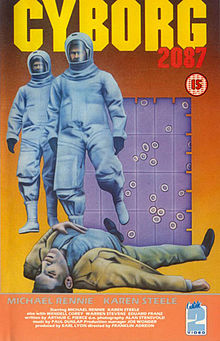
Cyborg 2087 (1966) Trailer

Wow, how is it possible that I've gone my entire life without knowing about this movie: Cyborg 2087 (1966)? The plot is surprisingly Terminatoresque:

Garth (Michael Rennie), a cyborg from the future, travels back in time to 1966 to prevent Professor Sigmund Marx (Eduard Franz) from revealing his new discovery, an idea that will make mind control possible and create a tyranny in Garth's time. He is pursued by two "Tracers" (also cyborgs) out to stop him.

Garth enlists the help of Dr. Sharon Mason (Karen Steele), Marx's assistant. He gets her to summon her friend, medical doctor Zeller (Warren Stevens) to operate on him, to remove a homing device used by the Tracers to track him. The local sheriff (Wendell Corey) also becomes involved.

Garth succeeds in defeating the Tracers and convincing Professor Marx to keep his discovery secret. Then, with his future wiped out as a result, Garth ceases to exist; the people who helped him do not even remember him.

Check out the trailer:


HuffPo: Will Artificial Intelligence Replace Your Family Doctor?

Sounds like Helene Pavlov, MD, is concerned for her job: From her Huffington Post article, "Will Artificial Intelligence Replace Your Family Doctor?":

How concerned or thrilled should I be that the intelligence designated to my future health care decisions will be potentially limited or artificial?

What does the practice of medicine mean? What makes a "good doctor?" What is it you want in your physician? For me, I want him/her to listen to my complaints/concerns. Not all patients know what symptoms to prioritize or what signs and symptoms might be significant or related. Personally, I need a physician to ask appropriate and sometimes probing questions. For instance, a complaint of being tired and unable to sleep should prompt questions such as are you going to the bathroom all the time? This additional information might mean the difference between getting a B12 shot or being evaluated and treated for diabetes or a prostate condition.

In the past, a good physician knew his/her patients. He/she was there at your birth and then at the birth of your children -- the Marcus Welby, M.D. or Dr. Kildare who did it all. As medicine and science and technology evolved, the medical specialist was born. That was actually necessary given the accelerated influx of information and research discoveries. To know all areas of medicine thoroughly is virtually impossible. The problem with the specialist scenario, however, is making sure you are going to the "right" one. It is more than a matter of competence. Specialists tend to be very focused and may "listen" only to those symptoms/signs relative to their specialty and assume some other specialist is dealing with "everything else." In most instances, triage from an astute general internist or primary physician or other health care provider is required.

A couple of quick comments:

  1. It's more likely than not that future doctors will use AI expert systems to assist in their diagnoses and not replace them altogether
  2. The qualitative way in which a doctor and a Watson-like system will make their diagnoses are one in the same. There's nothing inherently special about human data processing and decision making relative to what a future medical expert system will do.


Chris Chatham: 10 Important Differences Between Brains and Computers

Chris Chatham has penned an article in which he outlines 10 important differences between brains and computers. It's an interesting post and I recommend that you give it a read. Here's a quick overview:

  1. Brains are analogue; computers are digital
  2. Computers access information in memory by polling a memory address, brains search memories using cues
  3. The brain is a massively parallel machine; computers are modular and serial
  4. Processing speed is not fixed in the brain; there is no system clock
  5. Short-term memory is not like RAM
  6. Computers are hardware that runs software, there is no “mind software” running on brains
  7. Synapses are far more complex (electrochemical) than computer logic gates (electrical)
  8. Computers use processors and memory for different functions, there is no such distinction in the brain
  9. Computers are designed, built and are of fixed architecture, the brain is a self-organizing system
  10. Computers have no body, brains do

Okay, fair enough. But there's something deeply unsatisfying about Chatham's distinctions. It's an apples and oranges kind of thing in which we're still largely talking about fruit.

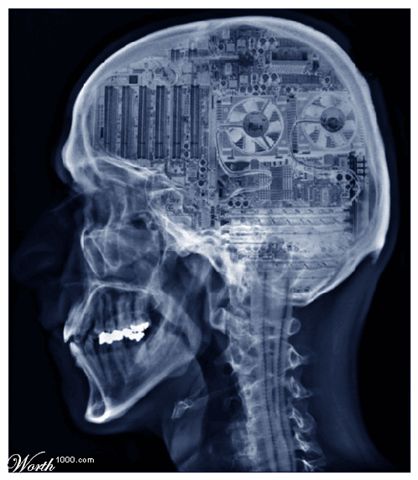
Sure, computers today can't really be compared to human brains for exactly the reasons Chatham outlines. Computers don't create minds in the ways that brains do (at least not yet). But it's folly to suggest that brains aren't a kind of computer—a computer for the lack of a better word that we haven't quite figured out yet. And it's very likely that, as our information technologies and artificial intelligence theories progress, our computers will increasingly come to resemble human brains.

It's still computation, after all. The functionalist approach to cognition suggests that the brain is likely churning away just like any other Turing Machine; it's still adhering to the Church-Turing theory of computational universality. It just happens to crunch numbers exceptionally well with meat and produce this remarkable thing we call mind.


Sprechen sie dolphin?

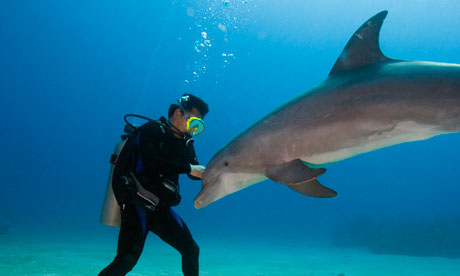
A new approach combining marine biology with artificial intelligence reveals that we may be be closer to conversing with dolphins than we think. Denise Herzing of the Wild Dolphin Project in Florida, and Thad Starner, an artificial intelligence expert at Georgia Institute of Technology in Atlanta, are working on a project called CHAT (Cetacean Hearing and Telemetry project) that may finally allow for our two species to communicate:

Starner and some of his students are now developing a smartphone-sized computer, that will be worn across a diver's chest in a waterproof case. The device will be connected to two hydrophones, capable of picking up dolphin sounds underwater - including those beyond the range of human hearing. As it can be difficult for humans to identify the source of underwater sounds, an arrangement of LED lights within the diver's mask will indicate the direction from which the various clicks and squeals are originating.

Not only will the computer hopefully be able to decode and indicate what the dolphins are saying, but by using a handheld Twiddler (sort of a combination mouse and keyboard), the diver will be able to select and send out audible dolphin-ese responses.

Before any interspecies conversations can take place, however, the team first needs to figure out the animals' vocabulary. In order to do so, they plan on running recordings of dolphin vocalizations through a pattern detection algorithm, designed by Starner. The system analyzes data, picks out deviations from the norm, then groups similar deviations together. It is hoped that by observing dolphins, and seeing which recurring deviant sounds accompany which behaviors and situations, the researchers will be able to identify specific "fundamental units" of dolphin speech.

Link.


Catherine Mayer: Live long. Stay healthy. Join the immortals

The seven ages of man are a thing of the past, says Catherine Mayer, and we're never too old to find a new lover, start a business or even have a baby. Now, we're ready for anything–except death. Welcome to what Mayer calls the world of "amortality."

The problem is that not even scientists can agree on the causes of ageing or the possibilities of an antidote. A majority of mainstream scientists are pessimistic about the possibilities for unabated life extension. The world's verifiably longest-lived person, Jeanne Calment, died at 122 in 1997, and that may be close to the edge of the possible human span. But there have been flurries of excitement around discoveries that seem to hold out the promise of slowing ageing. Last November, Nature magazine published a study showing that mice with suppressed production of an enzyme called telomerase aged swiftly but could be rejuvenated if the telomerase supply was restored. And there is a chorus of dissenting voices promising that if we work out ways to live long enough, we'll be able to live for ever. Ray Kurzweil, for example, puts his faith in nanotechnology, the development of machines tinier than atoms that could be deployed in the human body to repair the ravages of time. Kurzweil's impressive record as an inventor (he developed the first flatbed scanners, optical character-recognition software, print-to-speech and speech-recognition technologies, as well as making fine keyboards found in many music studios), together with his unnerving habit of issuing outlandish predictions that later prove true, mean only the foolhardy would dismiss his forecasts out of hand.

He has signed up to have his head cryonically frozen after death, envisaging resuscitation in a more technologically advanced future, but he's not "super-enthusiastic" about refrigeration; it is, he says, a back-up plan. He is perched on a sofa in his office in Wellesley, near Boston, surrounded by awards, posters for two films centred on his transhumanist ideas, photos with people even more successful than he. "I have enough trouble pursuing my interests while I'm alive and kicking," he says. "It's hard to imagine doing that when you're frozen, but proponents of it say it's better than the alternative. Really, my plan is to avoid dying, I think that's the best approach."

For Kurzweil – 62 at the time of the interview last year, "biologically more like 41" – that effort involves a Spartan diet, exercise and handfuls of vitamins and around 150 supplements daily. Many amortals can't be bothered to put the work into staying vibrant, trusting instead to boffins like Kurzweil to deliver us from the clutches of our own biology.

Unfortunately there's no firm evidence that they will do so, even in our longer lifetimes. Amortals may be assailed by depression or left unprepared when the gap between our ageless sense of self and the reality of ageing yawns. I would urge my family and friends to drink elixirs or open their veins to restorative swarms of nanobots if I thought that would grant them even a few additional years. Instead I cling to the hope that by eating well and taking exercise, engaging and being engaged, they will at the very least challenge Jeanne Calment's record for longevity.

Catherine Mayer's Amortality: The Pleasures and Perils of Living Agelessly was published on 12 May 2011 by Vermilion.


Depero’s Camparisoda Bottle Continues to Inspire

File under ‘just for fun‘:

Camparitivo Time!

Italian designer Matteo Ragni, influenced by Fortunato Depero’s design of the Camparisoda bottle, designed the Campari Bar, including ‘Talent Capsules’  and campari bottle-inspired glasses at the La Triennale Design Museum in Milan.

via Cool Hunting
See also “Campari: Is America finally ready for Italy’s favorite aperativo?”
New York Art Resources Consortium post on Campari

Cheers to my Campari-and-design-adoring friend, James Campbell Taylor!

Share

Works by Soffici and Carrà on display in Milan

Ardengo Soffici, Natura morta con fruttiera e colomba, 1914, Fondazione Carima, Macerata

Lo stupore nello sguardo. La fortuna di Rousseau in Italia da Soffici e Carrà a Breveglieri

March 24 – June 1, 2011
Fondazione Stelline, Milan
Curated by Elena Pontiggia
Catalog

Il percorso espositivo si apre con opere emblematiche di Henri Rousseau, il Doganiere, come Veduta della Passerelle de Passy , 1890-91 (Collezione Città di Lugano, Donazione Milich-Fassbind), definito dalla critica francese “di eleganza eccezionale”, o come Pavillon (1901), appartenuto a Soffici, e l’inedito disegno Testa di cane, 1901 ca., già appartenuto a Carrà.

Seguono le opere di Ardengo Soffici, tra cui le monumentali Decorazioni di Bulciano, (1914), eseguite per la casa di Papini, e i famosi Trofeini (1914-1915), le poetiche nature morte ispirate alle insegne dei venditori di cocomero. A lui si affianca Carlo Carrà con alcuni dei suoi massimi capolavori “rousseauiani”, come La stella del Cafè-chantant, Ricordi d’infanzia e La carrozzella (MART di Rovereto), tutti del 1916; quindi Tullio Garbari, Gigiotti Zanini e Ottone Rosai con i suoi omini, le osterie e le vie d’Oltrarno dei primi anni Venti.

La mostra indaga poi l’influsso di Rousseau a Roma, su Antonio Donghi e Riccardo Francalancia , e a Milano, dove negli anni Trenta si sviluppa un vasto movimento “primitivista”, con Renato Birolli, qui con il suggestivo Arlecchino suonatore(1931), Umberto Lilloni con Arenzano(1931), mai esposto dopo il 1933, e su artisti come Antonio Calderara, Giovanni Fumagalli, Atanasio Soldati, Francesco Speranza, Fiorenzo Tomea, Gianfilippo Usellini .

Un omaggio particolare è riservato a Cesare Breveglieri (1902-1948), a trent’anni dalla sua ultima antologica. Dell’artista milanese sono esposte tutte le opere più importanti, nelle quali dipinge una Milano “ingenua”, trasognata e magica .

Share

Carlo Carrà Retrospective Planned

Carlo Carrà

October 27, 2012 – January 27, 2013
Fondazione Ferrero, Alba

Roma, 21 mag. (Adnkronos) – E’ a Carlo Carra’ che sara’ dedicata la prossima grande retrospettiva promossa dalla Fondazione Ferrero. La mostra e’ in calendario dal 27 ottobre del 2012 al 27 gennaio del 2013, nella sede della Fondazione ad Alba. Lo annuncia la Fondazione Ferrero che ne ha affidato la curatela a Maria Cristina Bandera, studiosa che ha ‘firmato’ anche la recente mostra sui paesaggi di Giorgio Morandi, esposizione accolta con entusiasmo dal pubblico e molto apprezzata dalla critica.

Nella nuova impresa culturale, la Fondazione Ferrero sara’ affiancata dalla Fondazione di Studi di Storia dell’Arte Roberto Longhi di Firenze e dalla Soprintendenza per i Beni Storici, Artistici ed Etnoantropologici del Piemonte.

Sono passati vent’anni dall’ultima grande mostra monografica dedicata all’artista (Carlo Carra’, Roma, Galleria Nazionale d’Arte Moderna, 1994) e gli studi che sono proseguiti in questi due decenni consentono oggi di mettere ancor meglio a fuoco la vicenda artistica di Carra’ che questa mostra intende rileggere in tutte le sue diverse fasi. Dalle prime prove ‘divisioniste’, ai capolavori del Futurismo, l’ ‘antigrazioso’, la Metafisica, il ‘Realismo mitico’ e i paesaggi a partire dagli anni Venti, le composizioni monumentali di figura degli anni Trenta e una selezione di nature morte, cosi’ da arrivare fino agli ultimi anni della sua attivita’.

Share

Great Moments in Autopen History [Timelines]

Minutes before midnight, after a landslide House vote of 250-153, President Obama signed legislation backing a four-year extension on the controversial USA PATRIOT Act. (Did you know that's an acronym for Uniting and Strengthening America by Providing Appropriate Tools Required to Intercept and Obstruct Terrorism? Now you do.) Yay, habeas corpus denials, warrantless searches and carte blanche wiretapping! Four more years! Four more years! More »