Mimics of Prostate Cancer

http://www.oncopathology.info.

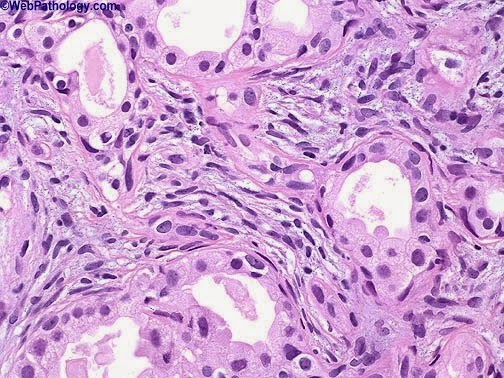
Atrophy

  • looks suspicious for adenocarcinoma at first glance.
  • the nuclei are small and hyperchromatic.
  • No prominent nucleoli are seen.
  • Some glands are lined by obviously benign flattened atrophic epithelium.
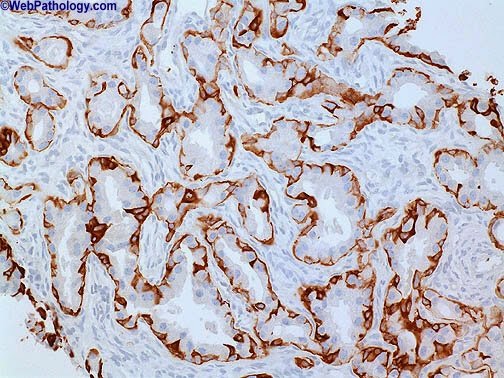
  • The immunostain for high molecular weight cytokeratin can be helpful in distinguishing between atrophy (fragmented basal cell layer) from atrophic variant of prostatic adenocarcinoma (no basal cell layer).


Atypical adenomatous hyperplasia
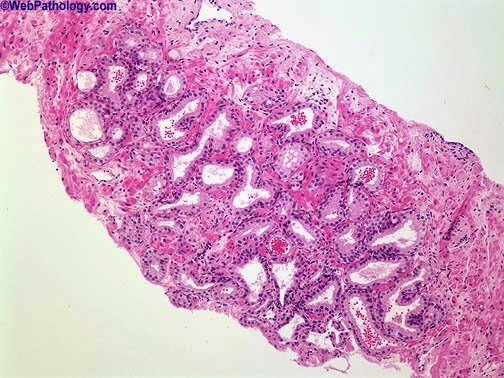

  • It may show the infiltrative architecture of cancer,
  • lacks the cytologic features such as prominent nucleoli.
  • The immunostain for high mol. wt. Cytokeratin will show fragmented basal cell layer in most cases.

Post-Atrophic Hyperplasia

  • Post-atrophic hyperplasia architecturally mimics adenocarcinoma
  • lacks the cytologic features.
  • In difficult cases, the immunostain for high mol. wt. cytokeratin can be performed which would show at least a few basal cells in post-atrophic hyperplasia.

Sclerosing Adenosis


  • small glands with infiltrative growth pattern in a cellular spindled stroma.
  • The plump spindle cells in the stroma are nicely seen here.
  • The lining acinar epithelial cells lack cytologic atypia – no significant nuclear or nucleolar enlargement is seen
  • Myoepithelial differentiation in basal cells of the acini of Sclerosing adenosis is illustrated with the immunostain for muscle specific actin.

Cowper’s Glands


  • They have a lobular configuration and are often associated with skeletal muscle fibers
  • The glands are lined by goblet cells distended with mucin.
  • The small hyperchromatic nuclei are pushed to the periphery.
  • Sometimes ducts lined by cuboidal cells are present in the center of the lobules.


Mucinous Metaplasia

  • Mucinous metaplasia is seen in about 1% of prostates.
  • It may occasionally resemble prostatic adenocarcinoma. However, it lacks prominent nucleoli and the does not show immunoreactivity for PSA and PAP.
  • The cells are positive for PAS, mucicarmine and Alcian blue.


Prostatic xanthoma
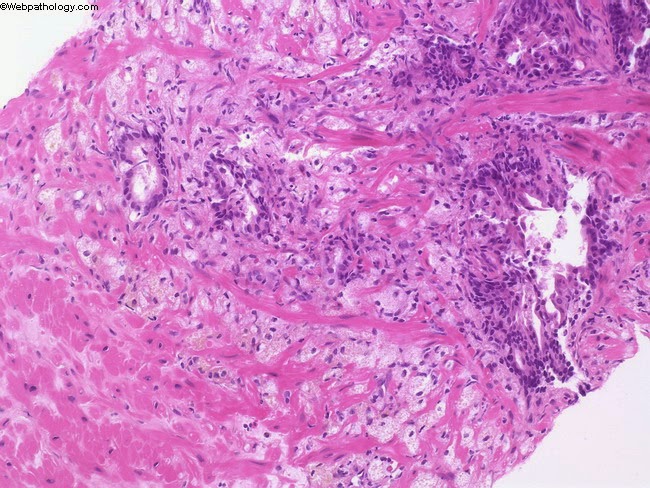


  • Prostatic xanthoma is an uncommon benign lesion that may mimic high-grade prostatic adenocarcinoma.
  • It consists of lipid-laden macrophages that may be arranged in small circumscribed nodules or infiltrating cords extending into the stroma
  • diffusely positive for CD68 (shown here), and negative for CAM5.2, PSA, and PSAP.
Thanks to Dr.Dharam Ramani for the images.


Source:
http://feeds2.feedburner.com/pathtalk

i-Path Undergoes Corporate Rebrand to PathXL

Ipath_logoREDlong      Pathxl incl logo


i-Path Diagnostics will complete its global corporate rebrand to PathXL on 27th August 2011 following the PathXL launch in the USA earlier this summer.

PathXL is a global pioneer in the use of web-based solutions for digital pathology and provides innovative software for use in education, research and clinical sectors worldwide.

The rebrand reflects the company’s expansion on two fronts. Geographically PathXL has announced a number of strategic partnerships in recent months which strengthen its position to achieve rapid growth outside the UK and Europe - more announcements to follow.  PathXL has also broadened the development and promotion of its workflow capabilities to create a comprehensive digital pathology platform that is web-based, open, and affordable.  PathXL is committed to delivering digital workflow excellence.

The company will rebrand to PathXL at the European Congress of Pathologists in Helsinki on 27th August. If you are visiting the conference, please join us at our new PathXL stand 5C46.

Des Speed, CEO of PathXL commented:

    “Our company is already recognised as being the leader in digital pathology education software, with an estimated 60% of UK trainee pathologists using PathXL’s innovative web-based platform each year.   We recognise that digital pathology is moving from an era of point solutions to much greater maturity - transforming entire workflows in education, research and ultimately clinical use.    We intend to become recognised as the visionaries and leaders in digital workflow excellence.”

http://www.pathxl.com

Source:
http://feeds.feedburner.com/DigitalPathologyBlog

Recent review article published on current state of whole slide imaging in pathology

A group of us recently summarized our thoughts from respective talks presented at the College of American Pathologists Companion Society meeting at this years' United States and Canadian Academy of Pathology.

I previously summarized who spoke at the actual meeting (see: Thoughts on CAP Companion Society Meeting at USCAP 2011).  

The publication is avaialble free of charge from the Journal of Pathology Informatics (see links) or you can download the PDF here.

Review of the current state of whole slide imaging in pathology

Liron Pantanowitz1Paul N Valenstein2Andrew J Evans3Keith J Kaplan4John D Pfeifer5David C Wilbur6Laura C Collins7Terence J Colgan8
1 Department of Pathology, University of Pittsburgh Medical Center, Pittsburgh, PA, USA
2 Department of Pathology, St. Joseph Mercy Hospital, Ann Arbor, MI, USA
3 Department of Pathology, (UHN) Toronto General Hospital, Toronto, ON, Canada
4 Carolinas Pathology Group, Charlotte, NC, USA
5 Department of Pathology, Washington University School of Medicine, Saint Louis, MO, USA
6 Department of Pathology, Massachusetts General Hospital, Boston, MA, USA
7 Department of Pathology, Beth Israel Deaconess Medical Center, Boston, MA, USA
8 Department of Laboratory Medicine and Pathology, Mt. Sinai Hospital, Toronto, ON, Canada


Correspondence Address:
Liron Pantanowitz
Department of Pathology, University of Pittsburgh Medical Center, Pittsburgh, PA 
USA

© 2011 Pantanowitz et al; This is an open-access article distributed under the terms of the Creative Commons Attribution License (http://creativecommons.org/licenses/by/2.0), which permits unrestricted use, distribution, and reproduction in any medium, provided the original work is properly cited.

DOI: 10.4103/2153-3539.83746

Get Permissions

   Abstract  

Whole slide imaging (WSI), or "virtual" microscopy, involves the scanning (digitization) of glass slides to produce "digital slides". WSI has been advocated for diagnostic, educational and research purposes. When used for remote frozen section diagnosis, WSI requires a thorough implementation period coupled with trained support personnel. Adoption of WSI for rendering pathologic diagnoses on a routine basis has been shown to be successful in only a few "niche" applications. Wider adoption will most likely require full integration with the laboratory information system, continuous automated scanning, high-bandwidth connectivity, massive storage capacity, and more intuitive user interfaces. Nevertheless, WSI has been reported to enhance specific pathology practices, such as scanning slides received in consultation or of legal cases, of slides to be used for patient care conferences, for quality assurance purposes, to retain records of slides to be sent out or destroyed by ancillary testing, and for performing digital image analysis. In addition to technical issues, regulatory and validation requirements related to WSI have yet to be adequately addressed. Although limited validation studies have been published using WSI there are currently no standard guidelines for validating WSI for diagnostic use in the clinical laboratory. This review addresses the current status of WSI in pathology related to regulation and validation, the provision of remote and routine pathologic diagnoses, educational uses, implementation issues, and the cost-benefit analysis of adopting WSI in routine clinical practice.

Keywords: Consultation, diagnosis, digital, education, frozen section, imaging, informatics, telepathology, validation, virtual microscopy, whole slide imaging

How to cite this article:
Pantanowitz L, Valenstein PN, Evans AJ, Kaplan KJ, Pfeifer JD, Wilbur DC, Collins LC, Colgan TJ. Review of the current state of whole slide imaging in pathology. J Pathol Inform 2011;2:36

How to cite this URL:
Pantanowitz L, Valenstein PN, Evans AJ, Kaplan KJ, Pfeifer JD, Wilbur DC, Collins LC, Colgan TJ. Review of the current state of whole slide imaging in pathology. J Pathol Inform [serial online] 2011 [cited 2011 Aug 23];2:36. Available from: http://www.jpathinformatics.org/text.asp?2011/2/1/36/83746


Source:
http://feeds.feedburner.com/DigitalPathologyBlog

Learn the Latest About Telemedicine, Neuropathology, and Image Analysis of Biomarkers

Courtesy of the Digital Pathology Association.

I think this years' program will be among the best line up of speakers, topics (including update from the FDA on their thoughts), exhibitors, posters and networking opportunities this meeting has had.  The talks and meeting come at an important time for digital pathology including new vendors in the space, regulatory issues and new business models, all of which will be discussed. 

2011 PATHOLOGY VISIONS CONFERENCE

OCT. 30 – NOV. 2, San Diego, CA

Pathology_visions_top

A distinguished field of 41 speakers will highlight the hot topics in the world of digital pathology at the 2011 Pathology Visions Conference. Telemedicine, neuropathology, and the image analysis of biomarkers are just some of the subjects experts will discuss at the 7th annual Digital Pathology Association Conference.

Click Here to Register

Telemedicine and Neuropathology

In the clinical arena, Clayton Wiley, M.D., Ph.D., will discuss inter-institutional and interstate tele-neuropathology. Dr. Wiley will share his knowledge on telemedicine and its emersion as an efficient means of distributing professional medical expertise to geographically dispersed sites. He’ll also share his expertise on neuropathology and why it’s well-suited to utilize telepathology.

Image Analysis of Biomarkers

Tony Magliocco, M.D., will highlight the development of quantitative microscopy methods as prognostic and predictive cancer biomarkers. The digital pathology research expert will discuss three emerging analytical methods that hold promise for routine diagnostic pathology, including fractal analysis, analysis of DAB stained ki67 tissues with a focus on breast cancer, and the use of multiplex fluorescent imaging to study "functional tissue dynamics."

Guest Discount

The Pathology Visions Conference is also offering a special discounted rate for conference guests. For a reduced registration fee, your spouse or special guest can attend all meals, take part in the Sunday evening welcome reception and enjoy all that San Diego has to offer.

Poster Competition Extended Deadline Aug. 31

See contest details ?
Share your knowledge with others in a dynamic, interactive collegial environment and be rewarded! Submit your abstract for the poster competition at the Pathology Visions Conference. The deadline has been extended to Aug. 31.

"Access to sub-specialist pathologists using telepathology and image analysis of biomarkers are two of the strongest value propositions for why institutions adopt digital pathology," said Dirk Soenksen, President of the Digital Pathology Association and Chair of the Pathology Visions Program Committee. "Attendees at this year's conference will learn best practices for these and other applications of digital pathology, as well as how digital pathology can improve patient care and enable personalized medicine."

History Lesson

Did you know early pathologists started laying the groundwork for the digital pathology industry nearly a century and a half ago? Dr. Clive Taylor, M.D.,D. Phil., will give the audience a history lesson about the journey from microscopy to whole slide images. Dr. Taylor’s insight into how the past has shaped our industry will give attendees a firmer grasp on the important role they will play in the future of digital pathology.

Click Here to Register

These three speakers offer just a sneak peek at a line-up filled with distinguished presenters. The Pathology Visions Conference will host 38 additional research, education and clinical experts. Click here for a complete list of the speakers and details of their presentations.

Conference attendees will also have the opportunity to earn up to 13 CME credits, take part in an FDA panel discussion, and participate in cutting-edge industry workshops. DPA white paper and scientific poster sessions, roundtable discussions, networking events, and dozens of exhibitor displays will round out the three day conference.

Pathology_visions_top


About the DPA

The mission of the Digital Pathology Association is to facilitate education and awareness of digital pathology applications in health care. Members will be encouraged to share best practices and promote the use of the technology among colleagues in order to demonstrate efficiencies, awareness, and its ultimate benefits to patient care.


Source:
http://feeds.feedburner.com/DigitalPathologyBlog

OMNYX: Meet the Startup with Big Backing that is Digitizing Pathology

By Matt Pross, TEQ Staff Writer

Nice piece on Omnyx and their approach.  Digital pathology is often cited as a $2 billion market as is mentioned a couple times in this story.  

"Leave it to the big boys to go and carve out a $2 billion global market with the goal to redefine pathology worldwide. That’s exactly what GE Healthcare and the University of Pittsburgh Medical Center (UPMC) set out to do when they partnered to form Omnyx™. Focused on developing an entirely digital, integrated pathology solution, the joint venture has made significant progress toward this formidable goal since its founding in March 2008.

OMNYX_5951

“The technology that was in use before OMNYX had a very niche focus and was used mainly in low volume/niche applications,” Tony Melanson, Vice President, Strategy & Marketing for OMNYX, said. “We saw the shortcomings of this technology and asked ourselves ‘what would it take to create a solution that would enable the high quality and high throughput necessary for pathology to evolve from an analog workflow into a digital practice?’ With its foundation in information technology systems for radiology, GE saw digitizing pathology as a natural progression and a great fit into the company’s existing portfolio. 

We also knew pathology was uncharted territory and decided to solicit the help of Carnegie Mellon University and their leading Human Computer Interaction teams to help us design an efficient workflow and appealing user interface with the help of UPMC pathologists.""

Read full story.


Source:
http://feeds.feedburner.com/DigitalPathologyBlog

White Paper – Laboratory Information Systems (LIS) in the 21st Century: The Challenges and the Promises

FREE Special Edition White Paper

download your report now!

Download Your FREE Special Report Today!
Simply Complete the Form Below


Laboratory Information Systems (LIS) in the 21st Century: The Challenges and the Promises

Increasingly LIS’s offer what laboratories need: modular-based LIS’s with customizable functionality, scalability and a high level of adaptable connectivity for both institutional EMRs and physician access. In addition, laboratories increasingly expect high levels of customer service from LIS vendors. The environment for health information technology, specifically LIS’s, requires adherence to a number of national and international standards including CLIA, CCHIT, ANSI, HL7, HITSP, and LOINC.

A modern medium to large clinical diagnostic laboratory is made up of numerous specialized laboratory units – microbiology, chemistry, hematology, anatomic pathology, etc. – which all have unique needs and workflows. This presents challenges for LIS’s, which can be handled through modular systems that utilize a single database, are flexible and scalable, and can be customized for each laboratory unit or institution’s needs. Many laboratories also require customizable non-clinical applications like billing and client connectivity.

The Dark Report is happy to offer our readers a chance to download our recently published FREE White Paper “Laboratory Information Systems (LIS) in the 21st Century: The Challenges and the Promises” at absolutely no charge. This free download looks at all of these topics and present solutions presented by New Jersey-based NeTLIMS through two case studies involving NICL Laboratories in Illinois and Shiel Medical Laboratory in New York.

download your report now!

Among other topics, this FREE White Paper specifically addresses:

  1. Unique lab work flow needs
  2. Some common interface challenges
  3. Off the shelf LIS vs custom LIS solutions
  4. Implementing LIS into your lab, a sample case study

For more about LIS and NeTLIMS, please CLICK HERE

download your report now!

Table of Contents

Executive Summary & Objectives — Page 3

Chapter 1.
What is a Laboratory Information System? — Page 7

Chapter 2.
Standards and the Interface Challenge — Page 12

Chapter 3.
The Multiple Component Challenge — Page 18

Chapter 4.
Off-The-Shelf Versus Customizable LIS’s — Page 22

Chapter 5.
The Implementation Challenge — Page 24

Chapter 6.
Case Studies: Implementing a Laboratory Information System — Page 27

Chapter 7. Conclusion — Page 32

Appendices

A-1 About Gerald Choder — Page 36
A-2
About NeTLIMS — Page 37
A-3 About DARK DAILY— Page 38
A-4 About The Dark Intelligence Group, Inc., and The Dark Report — Page 39
A-5 About Executive War College on Laboratory and Pathology Management— Page 40
A-6 About Mark Terry — Page 42

Terms of Use — Page 44

download your report now!

Source:
http://feeds.feedburner.com/DigitalPathologyBlog

Kokdu Museum, Seoul, Korea


A few days ago, I paid a visit to The Kokdu Museum, a small and charming museum here in Seoul devoted to the Korean tradition of kokdu, or painted wooden figures created to accompany the deceased on their treacherous journey through the afterlife. These figures would be placed--by the dozen, as it appears--on the ornate traditional funeral biers which carried the dead to their final resting place. From what I understand, all of the pieces on view in the museum were created in the late Joseon Dynasty, which dominated Korea from 1392 – 1897.

The kokdu figurines, as the museum text explains, are other-worldy creatures intended to assist the deceased in their transition through the afterlife. Some are guides, some protectors, some entertainers. They help to "soothe and calm our bewildered emotions while traveling the path of bereavement..." so long as the deceased "still remains in the area of between the 'already' and the 'yet.'"

Dragon and goblin heads are placed on the front and the back of the bier. The are intended to frighten evil spirits and signify the circularity of life and death.

The museum also had a wonderful miniature diorama depicting a funeral procession.


And a terrific (though small) temporary exhibition entitled "Afterlife, The Journey to the Other World." As the wall text explained:

The exhibition "Afterlife, The Journey to the Other World," was derived from traditional Korean belief, called Siwangsasang, which described that the deceased must go through ten after-death trials about his/her previous life.

Among those ten were seven commonly known trials, and people counted those days accordingly and had a memorial ritual on the 49th days of death.

Joseon dynasty was a strictly Confucianist era which greatly valued filial duites. Other religions such as Buddhism, Taoism and Shamanism were able to retain their power because Joseon people saw a great deal of filial duties in ancestral rites.

By studying Joseon dynasty (1392-1910)'s religious movement, we've learned that all these different religions and cultures melted in together and brought our culture a cultural synergy, which is known as the Medici Effect.

It is very interesting to learn how all these different religions and cultures combined and developed a new cultural nuance on the subject, the other world.

As mentioned earlier, this exhibition is based on these cultural influences regarding the other world and the afterlife. This exhibition was also greatly influenced by "With God," a web cartoon that depicts this other world as an interesting and realistic place.

With "With God" and KOKDU MUSEUM's old antiquities, this exhibition also introduced augmented reality technique and media art so that visitors can experience a mixture of art and science throughout the show.

This exhibit allowed visitors to travel through the afterlife, meeting each King of Hell and discovering both what traits he would judge you on and what were the possible punishments. Each stop on the journey was illustrated by traditional artworks depicting these Kings and their punishments as well as images from the "With God" web comic.

You can find out more about the The Kokdu Museum, by clicking here. Thanks very much to Professor Choi Tae Man of Kookmin University for recommending this museum to me!

For those interested in finding out more, I purchased a book from the museum--in English!--which will be available for viewing at The Morbid Anatomy Library when it reopens in early October.

Source:
http://morbidanatomy.blogspot.com/feeds/posts/default?alt=rss

Quay Brothers Mütter Museum Film Premiere in Philadelphia, New York and Los Angeles This September!


I have some exciting news! The details for the premiere of Through the Weeping Glass--the Quay Brothers' new documentary based on the collections of books, instruments, and medical anomalies at The College of Physicians of Philadelphia and the Mütter Museum--have just been announced!

The film will launch with three epic premieres--one in Philadelphia at the Mütter Museum, one in New York at MoMA, and one in Los Angeles hosted by The Museum of Jurassic Technology. Each city's event will feature a moderated talk with the Quays, while the Mütter Philadelphia opening will also--excitingly!--be accompanied by an exhibition at the museum on the making of the film guest curated by MoMA's Barbara London.

Full details from the press release follow; tickets are, I am warned, selling fast, so act quickly if you want to attend! Hope to see you there.

Through the Weeping Glass: On the Consolations of Life Everlasting (Limbos & Afterbreezes in the Mütter Museum)

New Quay Brothers short film to premiere September 2011 in Philadelphia, New York, and Los Angeles

“To call the Quays’ work the most original and rapturously vivid image-making on the planet might sound like hyperbole until you see the films. . . .” —Michael Atkinson, Village Voice

Through the Weeping Glass: On the Consolations of Life Everlasting (Limbos & Afterbreezes in the Mütter Museum) is a documentary on the collections of books, instruments, and medical anomalies at The College of Physicians of Philadelphia and the Mütter Museum. This short film (running time: 31 minutes) is the first made by the internationally recognized Quay Brothers in the United States.

As Malcolm Jones (Newsweek) has commented, “the Mütter Museum teaches you indelibly how strange life can be, how unpredictable and various [and] will revise and enlarge your idea of what it is to be human.” The coupling of the Quay Brothers’ vision with the collections of the College’s Historical Medical Library and Museum has produced a riveting experience of contemplative set pieces exploring the College and Mütter Museum. Adding to the film’s visual strength is a powerful musical score by composer Timothy Nelson and a resonant voice-over by Derek Jacobi.

The film premieres in three locations in September 2011, with a moderated conversation with the artists:

  • September 22, The College of Physicians of Philadelphia, 6:30 PM (more here)
  • September 24, The Museum of Modern Art, New York. 8:00 PM (more here)
  • September 27, Cary Grant Theater, SONY Pictures Studios, hosted by The Museum of Jurassic Technology, Los Angeles, 8:00 PM (more here)

An exhibition guest curated by Barbara London, Associate Curator, Department of Media and Performance Art, The Museum of Modern Art, on the making of the film opens in September 2011 in the Mütter Museum of The College of Physicians of Philadelphia.

Subsequent to the premiere screenings, the film will be available for purchase on DVD with an accompanying booklet.

ABOUT THE QUAY BROTHERS

Two of the world’s most original filmmakers, the Quay Brothers are identical twins who were born outside Philadelphia in 1947. The Quays studied illustration in Philadelphia before going on to the Royal College of Art in London, where they began making animated shorts in the 1970s. They have lived in London ever since.

They are best known for their classic 1986 film Street of Crocodiles, which filmmaker Terry Gilliam selected as one of the ten best animated films of all time. In 1994 they made their first foray into live-action feature-length filmmaking with Institute Benjamenta. The Quays’ work also includes set design for theatre and opera, including their 1998 Tony-nominated set designs for Ionesco’s The Chairs on Broadway. The Quays have also directed pop promos for His Name Is Alive, Michael Penn, Sparklehorse, 16 Horsepower, and Peter Gabriel (contributing to his celebrated “Sledgehammer” video), and have also directed ground-breaking commercials for, Honeywell Computers, ICI Wood, K. P. Skips, Nikon, BBC, Coca-Cola, Northern Rock, Dorritos, Roundup, Kellogs, Badoit water, Galaxy, MTV, Nikon, Murphy’s beer and Slurpee, amongst others.

In 2000 they made In Absentia, an award-winning collaboration with Karlheinz Stockhausen, as well as two dance films, Duet and The Sandman. In 2002 they contributed an animated dream sequence to Julie Taymor’s film Frida. The following year the Quays made four short films in collaboration with composer Steve Martland for a live event at the Tate Modern in London and in 2005 premiered their second feature film, The Piano Tuner of Earthquakes, at the Locarno Film Festival.

In addition to Through the Weeping Glass, the Quay Brothers’ other commissioned films over the past twenty years include Anamorphosis (1991), The Phantom Museum (2003), and Inventorium of Traces (2009).

ABOUT THE COLLEGE OF PHYSICIANS OF PHILADELPHIA AND THE MÜTTER MUSEUM

The College of Physicians of Philadelphia, the oldest professional medical organization in the country, was founded in 1787 when twenty-four physicians gathered “to advance the science of medicine and to thereby lessen human misery.” Today more than 1,400 Fellows (elected members) continue to convene at the College and work towards better serving the public.

Throughout its two-hundred-year history, the College has provided a place for both medical professionals and the general public to learn about medicine as both a science and as an art. The College is home to the Historical Medical Library and the Mütter Museum, America’s finest museum of medical history, which displays its beautifully preserved collections of anatomical specimens, models, and medical instruments in a nineteenth-century setting. The museum helps the public understand the mysteries and beauty of the human body and to appreciate the history of diagnosis and treatment of disease.

With an attendance exceeding 105,000 today, the Museum has become internationally well known, has been featured in a documentary on the Discovery Channel, and is the subject of two best-selling books.

This project has been supported by The Pew Center for Arts & Heritage through the Philadelphia Exhibitions Initiative.

You can find out more about the opening in Philadelphia by clicking here, New York by clicking here, and Los Angeles by clicking here. You can find out more about the film itself and the accompanying exhibition guest curated by MOMA's Barbara London by by clicking here.

All images above are frame grabs from the film.

Source:
http://morbidanatomy.blogspot.com/feeds/posts/default?alt=rss

Tim Minchin in Boulder! | Bad Astronomy

I’m really excited: the flippin’ brilliant musician Tim Minchin is playing in Boulder on October 9th!

Tim is a skeptic, and a very, um, outspoken one. He is an amazing piano player, and his songs are a combination of devilish music and even more diabolic lyrics. His song Storm (embedded below) became an instant skeptic classic. When he performed at TAM London the audience practically carried him away on their shoulders.

So yeah, I’m pretty happy he’s coming here. As I write this tickets are still available at the Boulder Theater. I’ll be there! I hope to see lots of BABloggees there too. NOTE: his lyrics are NSFW, and I mean that really and truly. But they’re awesome.

Come to think of it, it’ll be interesting to see how Storm will play here in Boulder, where you can’t throw a crystal without hitting a place to get your chakras aligned. Hmmm.

Related posts:

- A Storm has arrived
- TAM London in review


Walter Potter's Museum Video Newsreel, British Pathé, 1955

<p>Your browser does not support iframes.</p>

This is truly an embarrassment of riches. A second film record of Walter Potter's museum of curious taxidermy (see first one here), from the British Pathé website, this one from 1955. Click on the image to view the film!

Caption reads:

Bramber, Sussex.

M/S Walter Collins, grandson of original owner Walter Potter, arranging kittens which are all dressed in wedding clothes. A cat's wedding tableau. C/U Walter Collins with a cup from the kitten's tea party. He gives it a clean and then gives the whole tableaux a clean with a brush. (The narration says that he gives the collection two cleans a year to keep them in good condition)

C/U Walter cleaning the rats from "The Rat's Gambling Den Raid". C/U shots stuffed rats playing cards and dominoes. C/U shots of rabbits' village school. All the rabbits are in different poses at their desks with pens or books and some have different expressions on their faces.

Note: Potter's Museum is a bizarre collection from the Victorian period of mainly stuffed animals.

Thanks so much, Live in Your Head, for sending this one my way! Let this bring cheers to my compatriots on the East Coast who are weathering a hurricane right now!

Source:
http://morbidanatomy.blogspot.com/feeds/posts/default?alt=rss

The liberal religious and astrology | Gene Expression

In the comments below a weird fact came to light: it does not seem that liberal/Democrat reduced skepticism toward astrology vs. conservatives/Republicans can be explained just by a secularization, and therefore diminished Christian orthodoxy. There are two reasons for this. First, on a priori grounds most people are religious, liberals and conservatives. The difference between the religious and irreligious on this issue would have to be rather large, and the different apportionment across ideology to be striking, for it to drive the division which seems so robust. Second, within the results it seems rather clear that the gap between liberals and conservatives is most evident amongst the religious of both! In other words, secular liberals and conservatives tend to agree (and be skeptical) in relation to astrology. While religious conservatives are skeptical of astrology, as one would expect from orthodox conservative Christians, religious liberals are not. The table below shows some results.

Astrology is….

Very scientific
Sort of scientific
Not at all scientific

Protestant
Liberal
5
31
64

Conservative
5
18
77

Catholic
Liberal
3
35
62

Conservative
6
25
69

No religion
Liberal
6
22
72

Conservative
9
31
60

Atheist & agnostic
Liberal
7
19
74

Conservative
3
22
75

Believe in higher power
Liberal
3
26
71

Conservative
3
31
66

Believe in god sometimes
Liberal
1
28
71

Conservative
19
18
63

Believe in god with doubts
Liberal
3
29
68

Conservative
3
20
77

Know god exists
Liberal
6
35
59

Conservative
6
21
73

Southern Baptist
Liberal
11
33
56

Conservative
7
16
77

United Methodist
Liberal
4
13
83

Conservative
4
23
73

Episcopal
Liberal
4
23
72

Conservative
5
16
80

Bible is Word of God
Liberal
8
41
51

Conservative
6
22
72

Bible is Inspired Word of God
Liberal
5
28
67

Conservative
5
21
74

Bible is Book of Fables
Liberal
3
23
73

Conservative
8
21
71

Humans developed from animals
Liberal
4
25
71

Conservative
8
25
67

Humans did not develop from animals
Liberal
7
37
56

Conservative
5
16
79

Observe the huge ...

Beware of scientific revolutions! | Gene Expression

Above is the Ngram result for paradigm shift, a ubiquitous descriptive concept which can be quite slippery when applied to contemporary science. For example, every few years there is always a new “revolution” which is going to overturn “Darwinism.” Be it punctuated equilibrium, symbiogenesis, or epigenetics. But over time revolutionary fervor abates, and the orthodoxy remains standing, albeit with modifications and alterations, making it all the more robust.

I thought of this when I saw Andrea Cantor’s comment below in relation to twin studies:

Twin studies underestimate heritability only if you subscribe to the crude notion that the effect of genes is additive, i.e., keeping “environments” the same, the more similar two people are genetically the more alike they will be. This ignores everything we now know about the way genes work.

Genes are not self-activating: they do not turn themselves on and produce traits. Genes do not, in fact, produce anything. Genes are turned on and off by the epigenome in response to environmental inputs. If you are inclined to doubt this, then consider: If all the cells in our body are supposed to contain identical ...