Master Pieces from Itinerant Art, Auction Sale of the Fabienne & François Marchal Collection of Fairground Art at Drouot Montaign, Paris


PARIS, FRANCE – Auction sale of the Fabienne & François Marchal Collection of Fairground Art at Drouot Montaigne on September 28-29, 2011. Held by Cornette de Saint-Cyr with nearly 900 lots including a portable Alfred Chanvin & anon. carousel with wooden horses. Selected auction pieces will be shown at Drouot Montaigne from Sept. 7-18. The entire collection will be displayed at the Porte de Versailles exhibition centre from Sept. 23-26.

The Fairground was a major vector of communication in the 19th century, popularizing scientific and medical inventions, as epitomized here by wax anatomical figures from the Palace Museum. The Fabienne & François Marchal Collection is the fruit of many years devoted to the safeguard of a specific aspect of our artistic and cultural heritage.

Among the historic and/or rare items will be some 80 wooden horses and 160 other carousel animals, dating from 1850-1960, including a Van Guyse Noah’s Ark; Spooner centaurs; and rare animals by Mathieu & Bayol. Various target games, wheels of fortune and a music hall shy or bouffes-balles will be among the historic fairground games. There will also be numerous decorative items (monumental figures, caryatides, stall fronts, merry-go-round elements), including large triumphant figures by Alexandre Devos, and salon carousel decorative elements by Anton Benner.

All images from the Cornette de Saint Cyr auction house website; text from The Carousel News and Trader. You can find out more--and bid on these lots and many, many more!--by clicking here.

Source:
http://morbidanatomy.blogspot.com/feeds/posts/default?alt=rss

The Midnight Archive Episode 2: Occult New York Part 1, Online and Available for Viewing!

As mentioned in this previous post, The Midnight Archive is a new web-based documentary series "centered around the esoteric and always exotic personalities that spring from Observatory," the Brooklyn-based event/gallery space I founded a few years ago. The series is created and directed by film-maker Ronni Thomas, who has plans to upload approximately one new episode per week to the new Midnight Archive website.

Episode two of The Midnight Archive--entitled Occult New York Part 1, and featuring the ever fascinating and many-time Observatory presenter Mitch Horowitz--has just been uploaded is now available for viewing! You can view it above or on The Midnight Archive website.

For more on the series, to see former episodes, or to sign up for the mailing list so as to be alerted to future uploads, visit The Midnight Archive website by clicking here. You can also "like" it on Facebook--and thus be alerted--by clicking here.

Source:
http://morbidanatomy.blogspot.com/feeds/posts/default?alt=rss

Theatrum Anatomicum, Caspar Bauhin, 1605


Caspar Bauhin Theaturm Anatomicum 1605
Description: [xvi], 1314 pp. Engraved title page with engraved portrait on verso, engraved armorial device on verso of following leaf; 129 engraved plates included in pagination. (8vo) 7½x4¾, contemporary full vellum, yapp edges, lacking closure ties. First Edition.Page 175, intended for Plate 20 of Book 1 curiously left unprinted, perhaps a prudish expurgation of a depiction of the male reproductive system. Bauhin (1560-1624) was born at Basel and studied medicine at Padua, Montpellier, and Tubingen (under the botanist Leonhard Fuchs). On his return to Basel in 1580, he was admitted to the degree of doctor, and gave private lectures in botany and anatomy. In 1582 he was appointed to the Greek professorship in that university, and in 1588 to the chair of anatomy and botany. He was later made city physician, professor of the practice of medicine, rector of the university, and dean of his faculty. His anatomical publications drew criticism from the followers of Galen, as did his work on human anatomical nomenclature, particularly of the muscles, but his system was adopted by subsequent anatomists. This work has fine dissection plates in greater number than his earlier books. GM-379
Place Published:
Date Published: Frankfurt

Click on images to see larger versions. Text and most images from Live Auctioneers; other image from Elettrogenica.

Source:
http://morbidanatomy.blogspot.com/feeds/posts/default?alt=rss

Upcoming Observatory Events This September

19th century-inspired immersive amusements at Coney Island! Kraftwerk multi-media presentation! Erotic Death in Victorian Art and Fashion! Hope to see you at one or more of these great upcoming Observatory events.

The Making of a 19th Century Spectacle: Artist Talk at The Coney Island Museum
Date: Thursday, September 22
Time: 7:30 PM
Admission: $5
Presented by Morbid Anatomy and The Coney Island Museum
***Location: Off-site at The Coney Island Museum (1208 Surf Avenue, Brooklyn)

On an average day in Coney Island around 1900, a visitor might be able to experience: A midget village modeled on 16th century Nuremberg and featuring its own parliament, hotel, stables with midget ponies, vaudeville house, and midget fire department rushing off to put out imaginary fires; A recreation of the destruction of Pompeii by volcano, San Francisco by earthquake, Galveston by flood, and/or Titanic by iceberg; A recreation village of the head-hunting Bontac Tribe of the Philippines with real tribes-people on display; An immersive spectacular which staged tenement fires every half hour and featured a cast of 2,000; A Boer War reenactment featuring real Boer War veterans; A trip to the moon, under the sea, or to heaven and hell by way of being buried alive in a glass coffin; and, as they say, much, much more.

In the exhibition The Great Coney Island Spectacularium, Observatory's Joanna Ebenstein and artist Aaron Beebe seek--via installation, artifacts, and newly commissioned artworks--to explore, celebrate, and evoke turn of the 20th Century Coney Island as the pinnacle of pre-cinematic immersive and spectacular amusement. The centerpiece of the exhibition is The Cosmorama of the Great Dreamland Fire, an immersive 360 degree spectacle based on the great panoramas and cosmoramas that populated Coney Island in the 19th century. It tells the story--in an immersive blend of image, sound, and light--of the most spectacular disaster in Coney Island history: the complete and dramatic destruction of Dreamland, one of the three great parks that made up turn of the century Coney Island, by fire 100 years ago in 1911. Dreamland was never rebuilt, but had it been, Ebenstein and Beebe are certain it would have given pride of place to a disaster spectacle that allowed visitors to experience the great fire that had once destroyed it. The Cosmorama of the Great Dreamland Fire is their attempt to create this attraction that should have been, and to allow contemporary audiences to experience a 19th century-style immersive spectacle of the sort celebrated in the exhibition.

This Thursday September 22, the crew behind the conception and construction--which include Observatory's Joanna Ebenstein and Wythe Marschall as well as sound engineers, scenic painters, lighting designers, and artisans from the Metropolitan Opera and other institutions--will be on hand at The Coney Island Museum to discuss the making of the piece, answer your questions, and lead guided tours of the exhibition.

World of Kraftwerk: A Journey In Music
Multimedia presentation with musician and writer Stephen Vesecky
Date: Friday, September 23
Time: 8:00 PM
Admission: $5
Presented by Morbid Anatomy

The Autobahn; The Man Machine; The Model. Rising from the ruins of post-war Germany, Kraftwerk created a new artform of sound and light, drawing not on the dominant American culture, but instead looking back to the utopian futurism of Fritz Lang and the Bauhaus architects. Defiant of the rock 'n' roll leviathan, they fashioned their own electronic instruments, with which they invented a new language for pop music. In so doing, they created a blueprint for the musical landscape that we see around us today; hip hop, synth pop, global dj culture, modern dance music--all were inspired by Kraftwerk's obsessive electronic poetry.

Tonight, join musician and writer Stephen Vesecky for a multimedia presentation celebrating and elucidating the unlikely but true story of this incredible band. Dr Maz of Mondo and DeLuxe will spin Kraftwerk-inspired records for the after-party.

Stephen Vesecky has played and toured with many new wave/indie bands including Poundsign, Mahogany, the Aisler's Set, and Still Flyin'. He now writes music for his current project, Strega, DJs at Lolita Bar in Manhattan and Bar Reis in Brooklyn, and creates music for soundtracks and promotional videos.

Erotic Death in Victorian Art and Fashion
An Illustrated Lecture with Professor Deborah Lutz
Date: Friday, September 30th
Time: 8:00 PM
Admission: $5
Presented by Morbid Anatomy

The Victorians had a different relationship to the dead body and dying than we do today. Painters in the late-Romantic style created beautiful men and women ravaged by death; they depicted dying as a moment of climax and aesthetic perfection. Locks of hair were snipped from the corpse and woven into jewelry: a form of mourning that revered the body and its parts, even after death. Body-part stories told of the deep desire to possess the pieces of the famous dead. We will look at some of these paintings and objects, with a view toward recuperating this willingness to dwell with loss itself, to linger over the evidence of death’s presence woven into the texture of life.

Deborah Lutz is an Associate Professor at Long Island University, C.W. Post. Her first book—The Dangerous Lover: Gothic Villains, Byronism, and the Nineteenth-Century Seduction Narrative—traces a literary history of the erotic outcast. Her second book—Pleasure Bound: Victorian Sex Rebels and the New Eroticism—explores mid-Victorian sexual rebellion. She is currently working on a book about the materialism of Victorian death culture and “secular relics”: little things treasured because they belonged to the dead.

Image: Victorian hair plume palette work brooch with seed pearls and curled wire work, circa 1870. Found on the Morning Glory Antiques website.

To be alerted to future events, "like" Morbid Anatomy on Facebook by clicking here or sign up for the Obesrvatory mailer by clicking here. More on all events here. Touy can find out more about these events by clicking here.

Source:
http://morbidanatomy.blogspot.com/feeds/posts/default?alt=rss

Up, up, and away | Bad Astronomy

I was in my home office yesterday morning, sipping my coffee and trying to wake up while perusing the latest news from Twitter and Google+. It took a second, but the sound coming from outside worked its way into my head… a rushing, roaring sound. "GGGGggggggshhhhhh! GGGGggggggshhhhhh!"

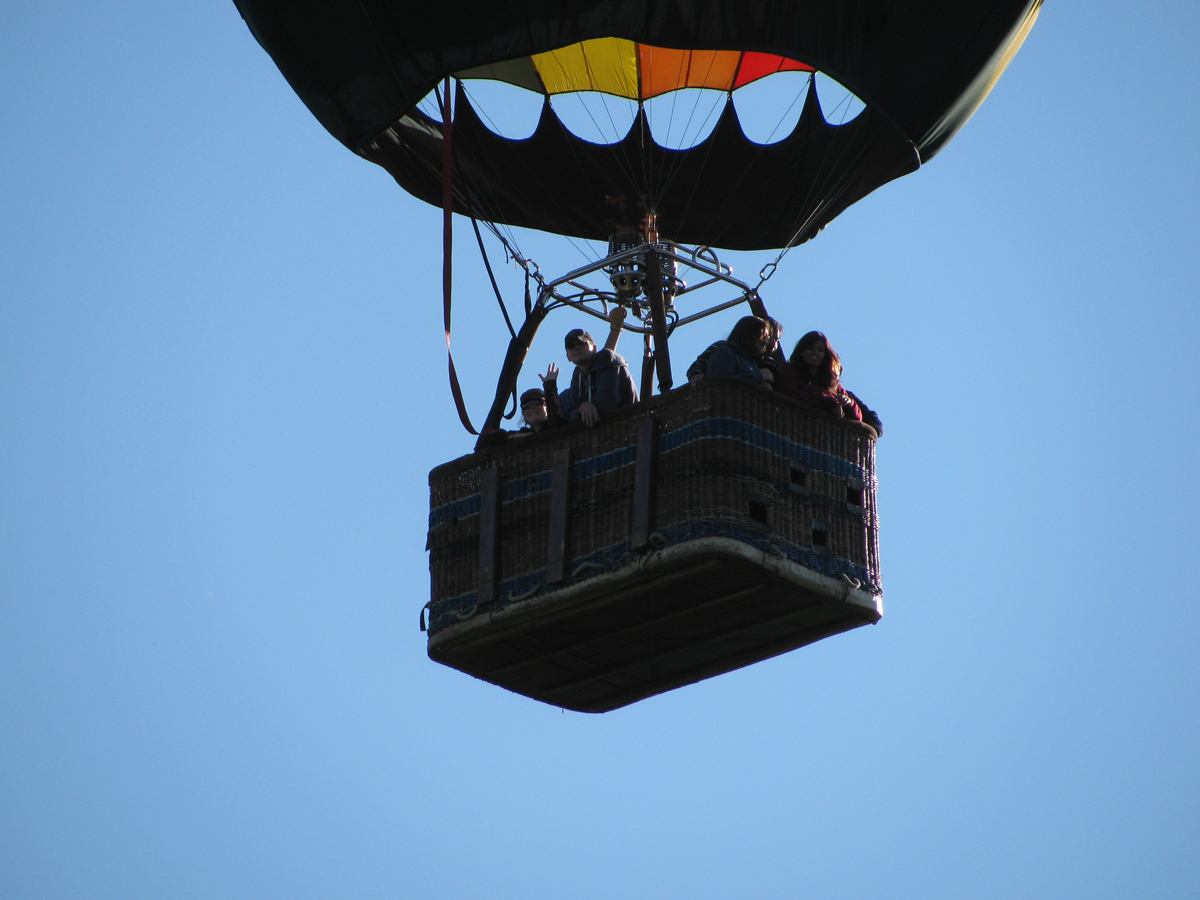
I knew what it was right away: the flame from a hot air balloon, the pilot giving the bag some gas. We get a lot of balloons here in Boulder; the cool air in the summer mornings coupled with the spectacular view of the mountains makes them really popular. But this time was different; the sound was much louder than usual. Hmph, I thought, better grab the camera.

I ran outside, and yeah, it was close:

Wow! [Click to fifthdimensionate.]

It actually rose up from behind my house, so I ran down the street to get a good view. It flew past me (where I got this shot) then passed overhead where I got that shot.

How close was it? Close enough to wave at the passengers in the gondola, and have them wave back. That was cool.

It slipped out of sight, and landed in a field across from my neighborhood. I went back inside, but a few minutes later my wife called out, "We’ve got two more!" I went into my back yard, and one was landing in the field behind my house, too:

I have to say, this is a great way to wake up in the morning. It’s simply delightful. And I have a sneaky suspicion that sometime in the next year or so I’ll have to taker a ride like this myself with my family. I’d love to be able to take pictures like this from the other side.


Related posts:

- Moon balloon
- Making new anniversaries
- Boulder fire damage seen from space
- Ephemeral snow and ancient rock


Bicycle Oriented Development in Portland

bicycle oriented development
Photo by Steve Allen, The Environmental Blog

Portland is nationally recognized as a leader in the movement to create bicycle-friendly cities. Portland is so nationally recognized as a transit leader that it lands on the New York Times media publication quite often as can be read in "Developers Cater to Two-Wheeled Traffic in Portland, Ore." and "Portland Plans for Transit All Powered by Electricity" and "36 Hours in Portland, Ore.". About 7 percent of commuters here travel by bike (the national average is under 1 percent) and the city has an ambitious plan, adopted last year, to increase that proportion to 25 percent by 2030, which can be read on another blog post we wrote about here.

Bicycle oriented development is beginning to appear around the city as can be seen by residential and commercial projects built near popular bikeways, green streets, and cycle tracks. Businesses and residential developments are increasingly catering to the bicycle community by outfitting with cycling-related services and amenities such as increased bicycle parking and storage and some businesses will lend you a bike lock if you forgot yours at home.

The change seems to be coming from private businesses who recognize that a really strong market exists with the bicycle community or phenomenon in Portland. Some people say that the development that spurred from the streetcar being built in the Pearl District by means of transit oriented development, is also occurring with bicycles in North Portland because of high bike traffic, particularly, N. Williams which continues to bring businesses oriented for the bicycle community.

The city of Portland's ambition plan to increase bicycle ridership in the city include:

Attract new riders
Plan and design for people who are not yet riding by developing safe and comfortable low-stress bikeways (such as bicycle boulevards and trails) that reduce conflicts between people riding bicycles and people driving.

Strengthen bicycle policies
Adopt policy changes outlined in the Plan, including a new bicycle transportation policy of making bicycling more attractive than driving for short trips.

Form a denser bikeway network
Expand the network of bikeways in Portland to achieve a fine-grained system that offers riders an array of route choices.

Increase bicycle parking
Implement measures to satisfy the growing demand for bike parking.

Expand programs to support bicycling
Expand established programs, and develop new programs, to encourage and support bicycling.

Increase funding for bicycle facilities
Pursue multiple strategies to increase funding for bicycle facilities and other green transportation modes.

People who think that investing in bicycle infrastructure is a waste of time and money should try hopping on a bike sometime and experience how liberating it can be. Also, it would help those that oppose bike infrastructure understand the ways it can be improved and why it should be improved. Some of the reasons bike infrastructure investment should be a line item in the city budget include:

Streets can carry far more people with far less wear and tear if people are riding bicycles instead of driving cars. That means the streets and bridges of Portland will work better for moving goods and for buses and streetcars.

Forty percent of Oregon’s carbon dioxide emissions come from transportation, the fastest growing source. Meanwhile, about half of all trips in Portland are three miles or less — a distance easily covered on a bicycle without breaking a sweat.

The Centers for Disease Control say that “automobile trips that can be safely replaced by walking or bicycling offer the first target for increased physical activity in communities. “ Studies suggest getting more people bicycling instead of driving helps make everyone safer.

With the average cost of owning and operating a car now estimated at more than $7,000 a year, bicycling is the most affordable form of personal transportation. Improved bikeways will give even more Portlanders the choice to bicycle to jobs, school, shopping, and transit.

Each year, about $800,000,000 circulates in Portland’s local economy that would leave the region if we drove as much as the U.S. average. The bicycle industry itself annually contributes about $100,000,000 to the city’s economy and now accounts for nearly 1,000 green jobs.

Bicycling is distinctly Portland! Bicycle trips promote interaction between neighbors, strengthen the rider’s connection to the community, increase the chance of shopping locally, put more “eyes on the street,” and contribute to a sense of place.

What Does DC Current do to AC Only Devices

For those of you that are true engineers please pardon the simplicity of my questions. I am about to plug in a AC current surge protector with some electrical devices that are also AC. In my building there is a backup generator that sometimes sends DC current through at start up before converting to

Floor Plate Source?

I would like to find a source for floor plate with a raised pattern of squares on it. Similar to diamond plate / tread plate / 4-way plate / etc, except with raised squares. I thought Ryerson or McMaster-Carr would have it, but can't find it. I would also like to know a generic name to make searchin

SpaceX Is Building the "Grasshopper" RLV

Draft Environmental Assessment for Issuing an Experimental Permit to SpaceX for Operation of the Grasshopper Vehicle at the McGregor Test Site,Texas

"The Federal Aviation Administration (FAA) Office of Commercial Space Transportation (AST) proposes to issue an experimental permit to Space Exploration Technologies Corporation (SpaceX) to conduct suborbital launches and landings of the Grasshopper reusable launch vehicle (RLV) at the McGregor, Texas test site. ... The Grasshopper RLV consists of a Falcon 9 Stage 1 tank, a Merlin-1D engine, four steel landing legs, and a steel support structure. Carbon overwrapped pressure vessels (COPVs), which are filled with either nitrogen or helium, are attached to the support structure. The Merlin- 1D engine has a maximum thrust of 122,000 pounds. The overall height of the Grasshopper RLV is 106 feet, and the tank height is 85 feet."

Can Neutrinos Kill Their Own Grandfathers? | Cosmic Variance

Building in part on my talk at the time conference, Scott Aaronson has a blog post about entropy and complexity that you should go read right now. It’s similar to one I’ve been contemplating myself, but more clever and original.

Back yet? Scott did foolishly at the end of the post mention the faster-than-light neutrino business. Which of course led to questions, in response to one of which he commented thusly:

Closed timelike curves seem to me to be a different order of strangeness from anything thus far discovered in physics—like maybe 1000 times stranger than relativity, QM, virtual particles, and black holes put together. And I don’t understand how one could have tachyonic neutrinos without getting CTCs as well—would anyone who accepts that possibility be kind enough to explain it to me?

The problem Scott is alluding to is that, in relativity, it’s the speed-of-light barrier that prevents particles (or anything) from zipping around and meeting themselves in the past — a closed loop in spacetime. On a diagram in which time stretches vertically and space horizontally, the possible paths of light from any event define light cones, and physical particles have to stay inside these light cones. “Spacelike” trajectories that leave the light cones simply aren’t allowed in the conventional way of doing things.

What you don’t see in this spacetime diagram is a slice representing “the universe at one fixed time,” because that kind of thing is completely observer-dependent in relativity. In particular, if you could move on a spacelike trajectory, there would be observers who would insist that you are traveling backwards in time. Once you can go faster than light, in other words, you can go back in time and meet yourself in the past. This is Scott’s reason for skepticism about the faster-than-light neutrinos: if you open that door even just a crack, all hell breaks loose.

But rest easy! It doesn’t necessarily follow. Theorists are more than ingenious enough to come up with ways to allow particles to move faster than light without letting them travel along closed curves through spacetime. One minor technical note: if some particle moves faster than light, it’s not “closed timelike curves” that we should be worried about, it’s “closed spacelike curves on which physical particles move.”

But we shouldn’t necessarily even worry about that. The usual argument that faster than light implies the ability to travel on a closed loop assumes Lorentz invariance; but if we discover a true FTL particle, your first guess should be that Lorentz invariance is broken. (Not your only possible guess, but a reasonable one.) Consider, for example, the existence of a heretofore unobserved fluid pervading the universe with a well-defined rest frame, that neutrinos interact with but photons do not. Or a vector field with similar properties. There are various ways we could imagine some background that actually picks out a preferred frame of reference, violating Lorentz invariance spontaneously.

If that’s true, the argument that FTL implies closed loops through spacetime no longer works. Even if neutrinos are able to sneak outside light cones, there may nevertheless be “neutrino cones” to which they are still confined. These neutrino cones could be a little bit broader than ordinary light cones, but they could still define a fixed notion of “going forward in time” that even neutrinos couldn’t violate.

There’s a nice (although technical) discussion of this in a short paper by Robert Geroch. Read Section 2 for the math, Section 3 for the words. From the discussion:

In short, the causal cones of special relativity, from this perspective, have no special place over and above the cones of any other system. This is democracy of causal cones with a vengeance. This, of course, is not the traditional view. That view — that the special relativity causal cones have a preferred role in physics — arises, I suspect, from the fact that a number of other systems — electromagnetism, the spin-s ?elds, etc — employ precisely those same cones as their own. And, indeed, it may be the case that the physical world is organized around such a commonality of cones. On the other hand, it is entirely possible that there exist any number of other systems — not yet observed (or maybe they have been!) — that employ quite di?erent sets of causal cones. And the cones of these “other systems” could very well lie outside the null cones of special relativity, i.e., these systems could very well manifest superluminal signals. None of this would contradict our fundamental ideas about how physics is structured: An initial-value formulation, causal cones governing signals, etc.

The odds are still long against the OPERA result being right at face value. But even if it’s right, it doesn’t immediately imply that neutrinos are time-travelers.


Enceladus

A Cassini view of Enceladus. Click for larger (full res below). Image Credit: NASA/JPL/Space Science Institute

Don’t know what happened to Marian, nary a peep from her.  I assume she has lost internet.

So, being out of town most of the day so far, no time to put a riddle together.  How about a nice Cassini image of Enceladus?

This one was taken on september 13th from a distance of 26,709 miles or 42,823 km.

Want to see a full res version?  Click here (links to NASA).

About Pneumatics

how to control stroke lengths of pneumatics. we want that air cylinder to be stopped at different positions even by increasing the load on it. we it to be controlled electrically or mechanically in simple manner. as simple as possible..please... send it my mail.... please....

UARS Update

NASA Upper Atmosphere Research Satellite Reentry Update #16 Sat, 24 Sep 2011 11:37:25 AM EDT

"NASA's decommissioned Upper Atmosphere Research Satellite fell back to Earth between 11:23 p.m. EDT Friday, Sept. 23 and 1:09 a.m. EDT Sept. 24. The Joint Space Operations Center at Vandenberg Air Force Base in California said the satellite entered the atmosphere over the North Pacific Ocean, off the west coast of the United States. The precise re-entry time and location of any debris impacts are still being determined. NASA is not aware of any reports of injury or property damage. This is your source for official information on the re-entry of UARS. All information posted here has been verified with a government agency or law enforcement. NASA will conduct a media telecon at 2 p.m. ET to discuss the re-entry. The telecon will be streamed live at http://www.nasa.gov/newsaudio."

More information

Keith's note: NASA PAO's Beth Dickey, who has a history of playing favorites with the media and denying access to those she does not like, refused to allow Nick Johnson to answer my second question. Let me summarize it:

While Johnson made constant references to the "success" of his international effort to track UARS, in all honesty, they still do not know where or when it landed. Various media outlets have shown the animations of orbital debris - produced by NASA - a problem that is only going to get worse in the future. Alas, attempts have been made to cut Johnson's budget in the past. Based on his own comments, it seems that NASA had to rely on amateurs and volunteers to look for the satellite and indeed, the only ground-based video taken of UARS in orbit was taken by a gifted amateur in Europe.

I was wondering why Johnson (i.e. NASA) does not seek to enlist more participation from the public in future activities since its resources seem to be stretched. They might want to do this for no other reason than this would help further a better understanding among the public of what these re-entries (which occur at a rate of one per day) entail and maybe cut back on the crazy "it landed in my back yard and hit my cat" reports that have been swirling around.

But Beth Dickey refused to allow Johnson to answer stating that the telecon was about UARS. Well, DUH Beth, did you even listen to my question? The audio from this teleconference will be posted around 3:45 pm EDT. Lets see if they edit out the second question I asked.

I’ve got your missing links right here (24 September 2011) | Not Exactly Rocket Science

Top picks

In India’s lush Kaziranga National Park, a new policy allows rangers to shoot rhino poachers on sight. As a result, rhinos and tigers are thriving. An absolutely stonking piece of journalism.

Plant RNAs switch genes on and off in mammals. Wow. We really are what we eat.

“Somebody else can clean up this mess.” But no one did.” New study challenges the role of so-called longevity genes

Robert Krulwich’s paean to the awesome bar-tailed godwit, the toughest little bird you’ve never heard of

A useful rape analogy.

Singapore is growing by importing sand, at other nations’ environmental expense

Science “partially retracts” XMRV-chronic fatigue paper, and a nine-lab study fails to confirm the link. More from the NYT

This week a team of London surgeons separated twins joined at the head. How did they do it? Great explainer by Ferris Jabr

Premature particles perplex physicists. Phil Plait pontificates

Data – what the military have and what scientists get to see, from Geoff Brumfiel

Why being relaxed makes us spend more money, by Jonah Lehrer

With “utter disregard for the extraordinary environment”, a shrimp swims through liquid CO2. By Calbeb Scharf

“Don’t start bathing in the blood of virgins just yet,” advises Scicurious. Could a single injection make your older or younger? No. But the science is still awesome.

“In many respects, the history of technology is a history of failed machines”- Alice Bell on how the fridge got its hum

Good debate here on whether journos should ever fact-check content with sources. Hosted by David Kroll.

Science museums are failing grown-ups. And it’s a failure we can’t afford. Spot-on piece by Maggie Koerth-Baker

Brain scanner can recreate movie scenes you’ve watched. What this does do: after recording your brain activity as you watch movies, it can predict what scenes you’re watching later based on your brain activity. What this doesn’t do: record fresh brain activity and tell you what you’re looking at. Cool though.

Pretty. Emission spectra of the elements. Check out thallium and tungsten.

Science/news/writing

“It’s not the bad apples, it’s the bad barrels that corrupt good people.” Philip Zimbardo on evil  

Neuroscience of the intense Amazonian hallucinogen ayahuasca. Featuring a vomiting Vaughan Bell

NASA monitors over 20,000 bits of space junk circling Earth?

Heh. 50 Reasons I Reject Evolution

Neutrino stories move faster than the speed of science, by Martin Robbins

Don’t believe what other people think they see. Eyes (and Minds) Deceive: Witness Unreliability Casts Doubt on Death Penalty Rulings.

Newly Discovered Plant Bows Down and Buries Its Own Seeds

“No fewer than seven possible explanations for eggshell color

The first Aboriginal genome has been sequenced.

Scientists Successfully Induce Hibernation in Animals for the First Time

Chemistry’s 10 grand challenges. Misses out No. 11, which is getting people to care about chemistry.

“Eye movement is one sign that things have gone wrong.” On unvetted drugs & the death penalty

Pack Your Umbrella: Friday’s Weather is Sunny, with a 1-in-21-Trillion Chance of Getting Hit by Orbital Debris

Measles cases in California reach 10-year high, mostly due to unvaccinated kids.

DEET scrambles insects’ sense of smell

Resurrected Woolly Mammoth Protein Proves to Work Well in the Cold

Too Hard For Science? Might investigating brains of conjoined twins helps shed light on consciousness?

How to Resurrect a Terror Croc.

The mind-blowing cost of patent trolling – £500bn since 1990.

Former Trainer Says Killer Whale Captivity Causes Attacks. Or mebbe making an apex apex predator do tricks is bad idea?

“How should we make hard decisions?” asks Jonah Lehrer.  I DON’T KNOW, JONAH. WHAT ARE MY OPTIONS?

Stubbornness Increases the More People Tell You You’re Wrong. And thus was the internet explained HT

How do you sequence bacteria that you cannot grow, without relying on Macgyver?

Why does the antlion make a larger deathtrap during the full moon? (Spoiler: We don’t know)

Synchronized Swimming: Patrolling for Pollution with Robotic Fish. We’ve come a long way since Billy Bigmouth

5 antique versions of modern social media – from Edison’s YouTube to Voltaire’s Facebook

Smartphone EEG

Doodle app turns your Kindle into An Etch-a-Sketch

Deborah Blum’s post on Dr Oz is great for this line: “the higher the valence bond number, the grabbier the compound”

41% of primatologists have been bitten by a non-human primate; 10% injured by needles containing bodily fluids/tissue

Global map of the world’s submarine cables

Researchers Find Out How Pigeons Make the “Milk” They Barf Into the Mouths of Their Young. This is all sounding a little “molecular”. I wonder if pigeon milk could make pigeon cheese? Or if pigeon cheese would go with pigeon?

How quirks of language can reveal subtle ‘Daily Mail’ racism. I say “subtle”. It’s all relative.

How do you counter a honeybee’s waggle dance? With a waggle song, of course

I’m a Scientist – the film.

On Oct 31, the 7 billionth human being will be born. Where, who?

Bottom of Form

There are nine US medical insurance codes for being attacked by a killer whale. Here are some other good ones.

The brain as a slum – nice metaphor via David Dobbs.

Genomics research by twitter: we need people who’ve had severe altitude sickness.

The Psychology Of Yogurt, or what probiotics can teach us about the mind-body problem

New ways to fund research, including crowdfunding and SciFund.


Heh/wow/huh

A phylogeny of bread clips

Things I like: misrepresenting airline safety cards. “In emergency, throttle your baby. Then grieve”

We really have to start doing this (XKCD on neutrinos)

A swimming feather-star. Utterly mesmeric

Hobbit homes!

Around World In 60 secs on International Space Station. Love the yellow line of the ionosphere

New Yorker cartoon made me laugh.

Beauty in mundanity. A Year of Mornings – how photographers do long-distance friendships

New life ambition

AskReddit’s “Hotel Workers, What’s The Weirdest Thing You’ve Ever Caught Guests Doing?”

Heh. “Scientists assume pupils are listening


Journalism/internet/society

A journalist’s guide to Google+

A sad but fascinating tale about the human punching bag – a boxer who wasn’t very good but simply couldn’t be knocked out

Jay Rosen versus “he said, she said” journalism at NPR The Guardian live-blogs reading a book. I should live-blog reading their live-blog. No. No I shouldn’t.

Facebook is killing taste… it’s somehow eluded Zuckerberg that sharing is fundamentally about choosing”

Amazon lets you borrow Kindle books from your local public library

Is Branded Journalism Still Journalism? No. Why not just call it PR?

Is Amazon Running a Sweatshop in Pennsylvania?

A woman next to me on a plane excitedly raved at her husband about this Daily Express headline: NEW ARTHRITIS JAB GIVES HOPE TO MILLIONS. She didn’t read paragraph 18, where you learn that it’s based on mouse experiments, or paragraph 21, which mentions an increased risk of bone cancer.

Nearly 40% of people online look for health info, but 90% think what we find is accurate!

What does getting “off the beaten path” really mean? Great travel blogging.

Astonishingly bad coverage from misogynistic media. Somehow, this study turns into bollocks about bossy women.


Respiratory Physiology Part 2

Part two of a three part video discussing the physiology of respiration. The ultimate goal of respiration is to transport oxygen to the mitochondria of the cells. This involves getting oxygen into the lungs (ventilation), getting the oxygen into the blood (external respiration), transporting the oxygen through the blood (transport), moving the oxygen out of the blood into the tissue (internal respiration) and then using the oxygen to make the body's energy molecule, ATP (cellular respiration)

Go here to see the original:
Respiratory Physiology Part 2