A new day, from space | Bad Astronomy

Imagine sitting in a gossamer structure 100 meters long, 400 kilometers off the Earth’s surface, and hurtling through space at nearly 30,000 kilometers per hour.

Now imagine facing east while doing so, looking out the window, and seeing this:

ISS astronaut Ron Garan took this shot on Saturday morning, August 27, 2011, as the Sun rose over South America… of course, when you see the sunrise, it’s always morning, right? Not necessarily, especially when you outrace the rotating Earth and see 18 such sunrises and sunsets every day*.

Around the same time Ron took this shot, I was getting up to start my own day, and find out just what the Sun can do given a couple of hours to heat up the desert near Yuma, Arizona. Why? Well, without giving anything away, that’s a story that’ll have to wait for a few more sunrises in the future.

[Note: I'm still waiting for more news about the reinstatement of launches to the ISS now that the Soyuz flaw has been found. If there's some metaphor to be had here with the picture above, feel free to consider it.]

Image credit: NASA


* <pedant>Actually, in the winter at extreme latitudes, the Sun doesn’t rise until afternoon, and may set shortly thereafter. But that’s if you’re stuck here on the surface of the planet.</pedant>


Related posts:

- Moon over Afghanistan
- Squishy moonrise seen from space!
- What a falling star looks like… from space!
- Crescent Moonset from space


Resurrected Woolly Mammoth Protein Proves to Work Well in the Cold | 80beats

Scientists have often wondered how woolly mammoths survived and thrived in the frigid climes of the far north in Earth’s last ice age. The hemoglobin in elephant (and human) blood cannot easily transfer oxygen to other cells in the body at low temperatures. Instead, the blood’s hemoglobin holds onto its oxygen in icy extremities and the tissue eventually dies; that’s the main reason we get frostbite. There must, then, have been something special about mammoth hemoglobin.

Enter researcher Kevin Campbell, who published the genetic code of the mammoth hemoglobin last year after taking tissue from three animals that died in Siberia more than 25,000 years ago. Now, in a new study in the journal Biochemistry, Campbell’s team went a step further and actually recreated mammoth hemoglobin, starting with the code from the African elephant’s protein and introducing three changes unique to the mammoth using site-directed mutagenesis. They then compared the biochemical properties of the protein from the mammoth, elephant, and human, and found that the mammoth hemoglobin was less sensitive to temperature fluctuations and better able to unload oxygen at cold temperatures. Researchers say insights into the compound’s structure could lead to the design of new artificial blood products for use in hypothermia induced during brain and heart surgeries.

[Via Scientific American]

Reference: Yue Yuan, Tong-Jian Shen, Priyamvada Gupta, Nancy T. Ho, Virgil Simplaceanu, Tsuey Chyi S. Tam, Michael Hofreiter, Alan Cooper, Kevin L. Campbell, Chien Ho. A Biochemical–Biophysical Study of Hemoglobins from Woolly Mammoth, Asian Elephant, and Humans. Biochemistry, 2011; 50 (34): 7350 DOI: 10.1021/bi200777j

Image: rpongsaj / Flickr


Arctic ice at second-lowest extent since 1979 | Bad Astronomy

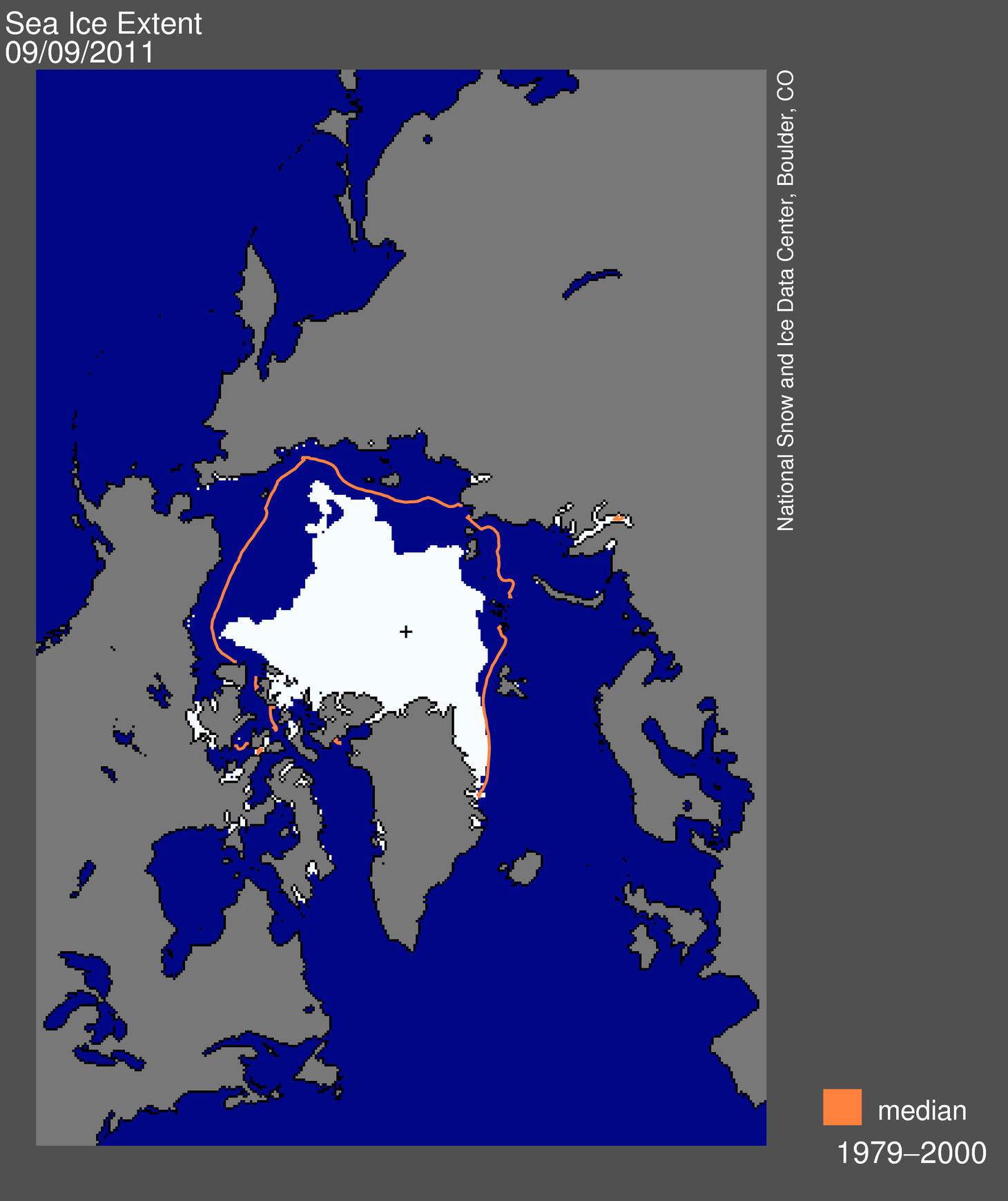
In late August, sea ice extent was way below average for that time of year, and it was predicted we were headed for at least a near-record low this year. Those predictions have, unfortunately, turned out to be true. On September 9, sea ice extent reached its yearly minimum, the second lowest since satellite records began in 1979 — and so close to the record low in 2007 that it’s a statistical tie.

NASA has posted series of pictures of sea ice this year taken by its Aqua Earth-observing satellite. Here’s the Arctic ice as it was in March (top) and September 2011 (bottom):

They put together a series of the images into an animation that really gives you a clear picture of what’s going on:

Of course, you expect more ice in the winter and less in the summer and fall, so by itself those pictures don’t tell you what this means. You need to compare the current extent with how things were in the past. As it happens, the National Snow and Ice Data Center in Boulder does just that.

This graphic by the NSIDC shows the north pole (you can see North America at the bottom, Greenland to the right, and Asia at the top) with the ice extent on September 9, 2011 marked in white. The orange line marks the median extent of the ice from 1979 to 2000 as measured on September 9 of each of those years. Putting a number on this, the current extent is nearly a million square miles less than that median value.

Yikes.

How bad is this? Well, from what I can tell, it’s not good. In 2007, the sea ice cleared enough that the Northwest Passage became navigable by ship without the help of an icebreaker for the first time in recorded history. We’re there again right now. And it’s not just extent — that is, the area covered by ice — it’s also the volume: that’s at the lowest amount on record this year as well.

As pointed out above, the lack of ice means that the northernmost latitudes are able to be plied by ships in the summer. But every year there is less ice even at maximum, meaning more and more area is accessible year-round. It’s well-known that there are deposits of oil and natural gas up there, and of course the oil companies want access to them. That’s why it’s particularly interesting that Exxon is investing billions of dollars in offshore drilling there, in places previously not accessible due to ice (full disclosure: that article was written by my nephew-in-law Chris Jones). In other words, even Exxon is putting its money where its mouth is, saying not only is global warming real, but that its effects will be around for a while.

I have no grand conclusions here, no line in the sand to draw. This is simply yet another data point in an increasingly long line of evidence showing global warming is real, along with all the evidence that it’s getting worse, we’re causing it, and the spin against it by the deniers is approaching light speed. The Related Posts links below make all that clear.

I just hope that by talking about this, more and more voters will listen. In a very real sense, what happens next is up to us.

Image and video credits: NASA’s Scientific Visualization Studio, Goddard Space Flight Center; National Snow and Ice Data Center


Related posts:

- Arctic sea level ice will be below average again this year
- Sea level rise has slowed… temporarily
- NASA talks global warming
- Our ice is disappearing
- Dramatic glacial retreat caught by NASA satellite
- Case closed: “ClimateGate” was manufactured


Cells Repairing Themselves | Cosmic Variance

Speaking of self-repair, here’s a fascinating new finding from Malin Hernebring in Sweden. Here’s the technical paper, from a few years ago; it’s part of Hernebring’s Ph.D. thesis work. (Via Richard Dawkins’s site.)

As we age, our cells gradually decay; the DNA stays relatively intact, but proteins degrade with time. This is a big part of the aging process, leading to wrinkled skin as well as more serious consequences. When you think about it a bit, that raises a puzzle. A newborn baby arises out of the cells of its parents. So if the proteins simply decay without repair, every generation would get handed down a degraded set of proteins. At some point, therefore, there has to be some repair job, so that the baby gets fully functioning proteins.

If this idea is right, you might guess that the repairs happen at the level of ovum and sperm; maybe when these cells are created, extra effort goes into tuning up their proteins into working order. But the new research says no — it’s actually after conception that the clean-up crew arrives. The newly conceived embryo consists of stem cells that soon begin differentiating themselves into the different kind of mature cells. It turns out that it’s during this differentiation process that proteasomes go to work, breaking down the damaged proteins and generally tuning up the engine. (Maybe this is when the soul is implanted in the embryo?)

The next obvious question is: why can’t these cellular clean-up crews be active all the time? There are clear implications for studies of (and therapeutic approaches to) aging. Nature wants all the individual animal organisms to die, making room for new generations; but there’s no reason we have to go along with the plan.


God is intuitive | Gene Expression

Update: An ungated version of the paper.

I used to spend a lot more time talking about cognitive science of religion on this weblog. It was an interest of mine, but I’ve come to a general resolution of what I think on this topic, and so I don’t spend much time discussing it. But in the comments below there was a lot of fast & furious accusation, often out of ignorance. I personally find that a little strange. I’ve been involved in freethought organizations in the past, and so have some acquaintance with “professional atheists.” Additionally, I’ve also been a participant and observer of the internet freethought websites since the mid-1990s (yes, I remember when alt.atheism was relevant!). In other words, I know of whom I speak (and I am not completely unsympathetic to their role in the broader ecology of ideas).

But the bigger issue is a cognitive model of how religiosity emerges. Luckily for me a paper came out which speaks to many of the points which I alluded to, Divine intuition: Cognitive style influences belief in God:

Some have argued that belief in God is intuitive, a natural (by-)product of the human mind given its cognitive structure and social context. If this is true, the extent to which one believes in God may be influenced by one’s more general tendency to rely on intuition versus reflection. Three studies support this hypothesis, linking intuitive cognitive style to belief in God. Study 1 showed that individual differences in cognitive style predict belief in God. Participants completed the Cognitive Reflection Test (CRT; Frederick, 2005), which employs math problems that, although easily solvable, have intuitively compelling incorrect answers. Participants who gave more intuitive answers on the CRT reported stronger belief in God. This effect was not mediated by education level, income, political orientation, or other demographic variables. Study 2 showed that the correlation between CRT scores and belief in God also holds when cognitive ability (IQ) and aspects of personality were controlled. Moreover, both studies demonstrated that intuitive CRT responses predicted the degree to which individuals reported having strengthened their belief in God since childhood, but not their familial religiosity during childhood, suggesting a causal relationship between cognitive style and change in belief over time. Study 3 revealed such a causal relationship over the short term: Experimentally inducing a mindset that favors intuition over reflection increases self-reported belief in God.

Recall that in many social domains where neurotypicals rely on innate, intuitive, and “fast” cognition, high functioning autistic individuals must reflect and reason. I don’t have access to the original paper, but there’s a nice piece in Harvard Gazette on the research. Here’s the last sentence: ““How people think about tricky math problems is reflected in their thinking — and ultimately their convictions — about the metaphysical order of the universe,” Shenhav said.”

NASA satellite due to burn up some time in the next few days | Bad Astronomy

[UPDATE: Alan Boyle at Cosmic Log is reporting that the satellite will definitely come down on Friday, though NASA is not sure yet exactly when and where.]

[UPDATE 2: Emily Lakdawalla at The Planetary Society blog has lots of detailed info now.]

By now you’ve probably heard that NASA’s Upper Atmospheric Research Satellite (UARS, pronounced YOO-arz, though in my head it’s always "You arse!") will burn up in our atmosphere some time between Thursday and Saturday. The satellite was decommissioned in 2005 and they used the remaining fuel to lower the orbit. It’s been slowly getting lower since then, but recently reached the part of our air where it slows and drops dramatically. As you can see from this plot (click to embiggen), it’s dropped from about 375 km to 200 in just the last few months, and down it’ll come later this week.

No one knows where or when it will hit, since the final flight path will depend on changing atmospheric conditions, orientation of the satellite, and so on. Most of the 6 ton satellite will burn up, but some two dozen or so pieces are expected to survive re-entry.

Speaking of which: I’m seeing some concern over people getting hit by this thing. The odds of that are extremely low. It’s possible — NASA rates the odds at about 1 in 3200 — but highly unlikely. Mind you, those are the odds of anyone getting hit by debris. The odds of a specific person, say me, getting hit are far lower — if I’m doing this math correctly, you’d multiply that number by the population of the Earth, nearly seven billion people. So the odds of me (or you, or pick someone) specifically getting hit are about 1 in 20 trillion. Pretty long odds.

In the meantime, on September, 15th, "amateur" astronomer Thierry Legault was able to capture video of the satellite while it passed over his location:

Cool, eh? You can see the rotation; it’s tumbling, apparently. Out of power, it can’t keep the correct attitude, and over time something has caused it to spin. Maybe it was a collision, or maybe it’s from other subtle but persistent forces over the years (solar wind, light pressure, drag through our tenuous upper atmosphere, slow fuel leak, what have you). Here are some stills from Thierry’s video to make that more clear:

Pretty cool. So stay tuned. I’ll update with more info when I get it; we’ll know the re-entry time and location much better as the week progresses. I’ll be tweeting about it as well as soon as I find anything out.

Credits: Orbit plot: Jonathan McDowell; UARS images: Thierry LeGault.


Related posts:

- YouTube video where I explain a satellite re-entry
- BREAKING: SpySat successfully hit by missile
- The return of Stardust
- Spy sat to come home… not too secretly


Shark-Produced Steroid Shows Promise for Fighting Human Viruses | 80beats


The spiny dogfish

What’s the News: Researchers found that squalamine, a steroid present in the bodies of the dogfish shark, has a protective effect against several human viruses, all of which are difficult or impossible to cure with existing drugs. The chemical has so far been shown to be relatively safe in humans and can be synthesized, suggesting it could have promise as an antiviral drug in humans.

How the Heck: 

  • In one test, scientists injected hamsters with the yellow fever virus, which kills 30,000 people per year. Half of the hamsters got squalamine and half got nothing (a placebo). By day 11, all of the untreated hamsters were dead, but 60 percent of the squalamine-treated rodents survived.
  • Next, researchers bathed lab-grown human endothelial cells—the type that line blood vessels—in varying concentrations of squalamine before introducing dengue virus. At the highest concentration of the chemical, none of the human cells became infected, nor suffered any visible ill effects from the squalamine.
  • Researchers also tested squalamine’s ability to prevent replication of the hepatitis B and D viruses in cultured human liver cells. In cells treated with squalamine, viral replication was reduced 10-fold.

What’s the Context: 

  • Squalamine has antibiotic, fungicidal, and anti-protozoan properties. It kills a wide variety of pathogens and one study found it could be used to treat multidrug-resistant bacteria. Researchers are also investigating its ability to treat cancer and fight macular degeneration.
  • A positively charged steroid similar in structure to cholesterol, squalamine binds to cell surfaces and deactivates the membrane’s negative charge before entering the cell. Researchers suspect this activity may interfere with viruses’ ability to bind to and replicate within their host.
  • The chemical was first found in the spiny dogfish, or Squalus acanthias, in 1993 and named for it. Dogfish and other sharks show a remarkable resistance to viruses and other pathogens that scientists think may be due in part to squalamine.
Not So Fast: 
  • As with any research at this stage, results from tests in animals and lab-grown cells may not translate as expected to humans, and many steps remain before using squalamine as a antiviral drug in people.
  • Squalamine only binds to certain cell types, such as liver and endothelial cells. This limits the number of bugs it might be able to fight. It also has a relatively short half-life of one to five hours in humans, potentially limiting its usefulness in certain conditions.
  • Researchers don’t know the exact mechanism by which squalamine inhibits or fights viruses, and it may turn out to cause unforeseen limitations or side effects at certain dosages, although it has generally been well-tolerated in trials to date.
  • Squalamine doesn’t cross the blood-brain barrier and thus is unlikely to treat viruses that affect the brain. Curiously, the researchers did test the chemical’s impact on hamsters infected with Eastern equine encephalitis virus, a pathogen that attacks the central nervous system of horses and people. Although hamsters given squalamine lived slightly longer on average than their untreated brethren, all of them still died within two weeks.

The Future Holds:

  • Squalamine shows promise as a potential antiviral drug in humans, but many questions must be answered and steps taken before that can happen. In the near term, if current tests pan out, it will probably first be used to treat certain cancers or macular degeneration—which would in itself be impressive.
  • If squalamine is to be used widely in the future, it’s important that it is synthesized and doesn’t come from the sharks themselves. (Squalamine used in the study was synthesized, as pointed out in the comments.) Once one of the world’s most abundant sharks, the dogfish is now listed by the IUCN Red List of Threatened Species as vulnerable, one step above “endangered.” And yet very little is being done to prevent its further decline.

Reference: Michael Zasloff et al. Squalamine as a broad-spectrum systemic antiviral agent with therapeutic potential. Proceedings of the National Academy of Sciences, 2011; DOI: 10.1073/pnas.1108558108

Image: OCVA / Flickr


Indiscriminate squid just implanting everyone with sperm | Not Exactly Rocket Science


In the dark abyss of the ocean, animals cannot afford to be choosy. The odds of bumping into another individual are low, and appropriate willing mates are even harder to come by. To deal with this problem, the deep-sea squid Octopoteuthis deletron has become somewhat indiscriminate. The males will mate with any squid they come across, whether they’re male or female.

Hendrik  Hoving from the Montery Bay Aquarium Research Institute found evidence of these same-sex matings with a robot submarine. Controlled from a surface ship, these vehicles can explore depths that humans cannot. The subs have captured videos of O.deletron since 1992 (videos here), but the team have only just revealed the nature of the squid’s sex life by studying the archival footage.

O.deletron is a handsome red squid, around five inches long, with hook-lined arms and flashing patches on its flanks and arm tips. Most squid and octopuses deliver their sperm along one of their arms – a modified limb called a hectocotylus. O.deletron is unusual in having a separate penis, distinct from its arms. It uses this long organ to dab a female’s body, attaching a pouch called a spermatophore, which contains millions of sperm. The pouch discharges sacs called spermatangia, which implant themselves in the female’s body. The sacs are visible from the outside, marking out recently mated individuals for observant scientists to see.

Hoving found these sacs on the bodies of both male and female squid in equal proportions. Both sexes had been implanted with sperm.

This is just one of thousands of examples of homosexual behaviour in animals, and there have already been a few reports among cephalopods – the group that includes octopuses, squids and cuttlefish. The famous giant squid might even partake in gay sex from time to time. Of the twelve mature males that have been found, seven had spermatangia implanted on their arms.

However, Hoving notes that some of these squid were caught in nets, and in their distress, they may have mistakenly implanted themselves with their own sperm. He also says, “Accidental self-implantation during mating with a female is also a possibility.” But that’s not the case for O.deletron. Hoving noticed sperm sacs on parts of the males’ bodies that lie beyond the reach of their penises. They must have been stuck there by another male.

But why would O.deletron males waste their sperm on other males? Hoving thinks that speed is the answer. Many species of squid live fast and die young. They only have a narrow window in which to have sex before they perish, so they do so very quickly. There is little time for an elaborate courtship when your reproductive life is quickly ticking away.

A male O.deletron that encounters another individual has mere seconds to decide whether to implant its spermataphore or not. That choice isn’t helped by the fact that males and females are roughly the same size with only minor physical differences. If the male chooses poorly, and misses out on a suitable female, it could well die before it stumbles across another mate. Better to ejaculate on everyone, and ask questions later.

Reference: Hoving, Bush & Robson. 2011. A shot in the dark: same-sex sexual behaviour in a deep-sea squid. Biol Letters http://dx.doi.org/10.1098/rsbl.2011.0680

Image copyright of MBARI

More on squid:

Overestimating Your Own Abilities May Be an Evolutionary Boost | 80beats

What’s the News: We may strive for humility, but we benefit from a little hubris, too, according to a study published last week in Nature. Overconfidence in your abilities can help you triumph in competitions you might not have won otherwise, the study found, and can impart an evolutionary advantage when the potential payoff is high compared to the cost of conflict.

How the Heck:

  • To investigate the effects of overconfidence, the researchers set up a game theory-based computer model. In this model, two individuals could each “decide” (through computer algorithms) whether or not to lay claim to a desired resource. If they both claimed it, the stronger individual won the resource, but both individuals incurred a small cost, the toll of competition. If only one individual decided to go after the resource, that individual got the prize without incurring a cost from conflict; if neither did, neither got it.
  • Each competitor decided whether or not to claim the resource based on what they knew of their abilities compared to their opponents’. But, as is usually the case in real life, the individuals didn’t have a complete, unbiased view of the situation: The model varied whether each individual was overconfident or underconfident in their own abilities, and how uncertain they were about their competitors’ abilities.
  • The computer simulation went through thousands of generations of these competitions. To mimic natural selection, strategies with high fitness—meaning they resulted in more rewards, fewer costs—were passed down to the next generation.
  • The researchers found that being overconfident in one’s own abilities paid off, and the trait got passed down. In particular, being overconfident was an advantage when there was uncertainty about an opponent’s strength, and when the reward for winning was high relative to the cost of competing. In other words, being overconfident helped competitors make the right—that is, the most profitable—decision [$].
  • When the researchers tweaked the model to have three competitors instead of two, the same effect appeared: Overconfidence still led to success.

What’s the Context:

  • A large body of research has shown that people are routinely overconfident, overestimating their financial acumen, leadership skills,driving abilities, and even attractiveness. If overconfidence sometimes confers an evolutionary benefit, as this study suggests, that could help explain why it’s so widespread.
  • But, the researchers point out, these findings only apply to conflict and overconfidence on a small scale. Our tendency to have too much faith in our abilities may help explain current events caused in part by overconfidence—wars in which one side overestimated their power, the recent economic collapse—but it doesn’t have the same benefit in large, complex societies that it might in one-on-one competition. Overconfidence is like the body’s tendency to crave extra calories, the researchers say: an advantage at the time modern humans evolved, but sometimes a pitfall in today’s world.

References: 

  • Dominic D. P. Johnson & James H. Fowler. “The evolution of overconfidence.” Nature, September 15, 2011. DOI: 10.1038/nature10384
  • Matthijs van Veelen & Martin A. Nowak. “Evolution: Selection for Positive Illusions.” Nature, September 15, 2011. DOI: 10.1038/477282a


Cosmic designs | Bad Astronomy

One of the more fascinating meta-qualities of the intertubez is how it’s opened up a bunch of sub-cultures to people who would otherwise have no idea they exist. Sure, we all know about Trekkers and Whovians and Steampunkers, but until the advent of Twitter, Facebook and the other social nets I was not aware of the popularity of crafters: people who make things. I mean people who knit, do papercraft, create clothes, and so on.

Oh sure, I knew it was a fun hobby and all that — what I didn’t know is how devoted some folks are to it. It’s pretty cool; they make cozies, socks, hats, skirts, dresses, sweaters… it’s amazing. And of course, this being the web and all, a lot of these folks are also space/math/science/scifi nerds. Still I never, ever, ever would’ve predicted this. I present to you The Vitruvian Dalek:

EXTERMIKNIT!*

Spoonflower, the site that hosts this pattern, has tons of other nerdy ones, like math equations, a solar system diagram, and even the odd Ood or two.

Winter’s coming… I could use a quilt. Hmmm.

Tip o’ the sewing needle to Mary Firestone.


* I know, it’s not knitting, and I used that joke once before. But it’s still funny.


Related posts:

- Extermiknit Part II
- FELIXTERMINATE!
- Oh, Ood grief!
- PRECIPITATE! PRECIPITATE!


NASA Releases SLS Acquisition Materials

Space Launch System Acquisition Overview

"The SLS vehicle procurements will be structured to meet the Agency's requirement for an affordable and evolvable vehicle within a schedule that supports various mission requirements. Procurements will include utilization of existing assets to expedite development, as well as further development of technologies and future competitions for advanced systems and key technology areas specific to SLS evolved vehicle needs. Detailed synopses will be issued in the near future for the individual procurements as required by regulation."

NASA Posts Space Launch System Acquisition Overview

"NASA has released the acquisition overview for the Space Launch System (SLS). SLS is an entirely new advanced, heavy-lift launch vehicle that will take the agency's astronauts farther into space than ever before, create high-quality jobs here at home and provide the cornerstone for America's future human space exploration efforts."

Hearing on Polar Weather Satellites

House Committee on Science, Space, and Technology Committee Democrats See Some Progress on JPSS, Urge Stable Funding

"The National Polar Orbiting Satellite System (NPOESS) was to be the United States' next-generation satellite system to monitor the Earth's weather, atmosphere, oceans, land and near-space environment, replacing the Department of Defense's (DOD's) and NOAA's polar orbiting satellites. However, the polar orbiting satellite acquisition program was neglected and mismanaged."

Troubled Weather Satellite's Future Uncertain, Witnesses Say

"The ability to do timely and accurate weather forecasting is not at question here, and should not be compromised," said E&E Chairman Andy Harris (R-MD). "However, given the number of problems this program has experienced, the time has come to talk about what is the best way for NOAA to obtain the necessary data to do these forecasts. And by best way, I mean the most efficient and cost effective way."

- Polar Satellites: Agencies Need to Address Potential Gaps in Weather and Climate Data Coverage, GAO
- Statement by Rep. Paul Broun
- Statement by Rep. Andy Harris
- Statement by Rep. Miller
- Statement by Rep. Donna Edwards
- Testimony by Kathryn Sullivan
- Testimony by Christopher Scolese
- Hearing Charter

Rep. Adams’ Odd Line of Questioning

Adams Looks for Answers on NASA Human Spaceflight (with YouTube clip)

"- Questions directed to Dr. Griffin: When you were Administrator at NASA did you or your deputies ever ignore one of the authorization bills?
- Did you ever get subpoenaed by a House or Senate committee for outright ignoring their requests for information?
- Were you or your deputies ever accused by a Senator in your own party of sabotaging a NASA project just because you didn't agree with Congress?
- Did you ever decide to ignore the role or will of Congress when they asked for your plans to implement the next step in President Bush's vision for NASA?
- Can you think of any reason to slow roll a project that has been authorized and demanded by Congress in Federal law?
- Can you think of any reason why it would be acceptable for a NASA Administrator or his or her deputy to ignore Congress?"

Keith's note: It would seem that Rep. Adams and her staff see her as some sort of crusader on this issue. They have gleefully posted her 5 minutes of questions on YouTube. Alas, she doesn't seem to be willing or able to directly accuse the current NASA Administrator, his staff - or the White House - of sabotage, ignoring Congress, etc. Instead, she used this odd line of questioning - one that can only elicit an answer of "No" from Griffin (or anyone else). The implication (apparently) being that if he didn't do these things then perhaps someone else (not in the room) may have. Mike Griffin seemed to be caught off guard by this line of questioning and answered curtly "no" each time - as if he was being interrogated by some snarky TV lawyer.

I guess Rep. Adams was hoping that Griffin would use the opportunity to dump on Bolden and the White House - but he did not. Indeed, Griffin went on to note that the NASA Administrator serves the Executive branch and that the Executive branch directs the agency's direction and for a NASA Administrator not to do what he was directed to do would be "mutinous". In other words, Bolden is doing what his boss wants him to do.

In the future, it might be more efficient for Rep. Adams to just fire her accusations directly at the Obama Administration and not try to do the indirect insinuation by proxy TV lawyer thing and try to get a former NASA Administrator to say the things she is reluctant to say herself.

NASA Statement on Armstrong & Cernan’s Testimony

NASA Statement on Today's House Hearing Featuring Testimony by Neil Armstrong and Gene Cernan

According to a statement by NASA Associate Administrator for the Office of Communications, David Weaver: "We respect the contributions Neil Armstrong and Gene Cernan have made in service to our country, and thank them for helping to pave the way for our exciting future forward. Just as their ambitious missions captivated the nation's attention nearly a half-century ago, today's American space explorers are leading the way to even farther destinations that will one day allow the first astronauts to set foot on Mars. ...

Bolden is "Rooting" For Chinese Success in Space

Top NASA official 'rooting for' China's success in space exploration, Daily Caller (with audio)

"We haven't talked about the Chinese," Bolden said. "We can't work with the Chinese right now. But I'm rooting for them. They're probably going to put a spacecraft called Shenzhou into orbit here, hopefully by the end of the year. It's going to be the first capsule of their space station. And the reason they are doing that is that we are not allowing them to be partners right now. So they're going alone. They need to be successful to drive us."

Keith's note: Bolden's comments are in stark contrast to the picture that astronaut Andy Thomas included in an official NASA presentation recently that showed Chinese astronauts trampling on a U.S. flag on the lunar surface.

Global Exploration Roadmap Released

NASA Posts Global Exploration Roadmap

"NASA is releasing the initial version of a Global Exploration Roadmap (GER) developed by the International Space Exploration Coordination Group. This roadmap is the culmination of work by 12 space agencies, including NASA, during the past year to advance coordinated space exploration. The GER begins with the International Space Station and expands human presence throughout the solar system, leading ultimately to crewed missions to explore the surface of Mars."

Statements & Testimony From Today’s House Hearing

Committee Democrats Urge Sustained Support for Renewed Human Space Exploration Program

"Today the House Committee on Science, Space, and Technology held a hearing entitled, "NASA Human Spaceflight Past, Present, and Future: Where Do We Go From Here?" The purpose of the hearing was to assess NASA's human space exploration goals, plans and capabilities, and examine related issues affecting the Nation's leadership in space and the state of the aerospace industrial base."

Apollo Astronauts Neil Armstrong and Eugene Cernan Testify

"The witnesses agreed that a robust human spaceflight effort is vital to the strength of our nation now and in the future. Human spaceflight serves a number of important purposes, including building a strong economy, supporting a high-skilled workforce, ensuring our national security and inspiring the nation. A national commitment to this effort, led by the President and Congress, is essential, particularly in an era of budget austerity. The witnesses further agreed that NASA's recent announcement that it had selected a design for the Space Launch System (SLS) is an important step forward."

- Statement by Rep. Jerry Costello
- Statement by Rep. Eddie Bernice Johnson
- Testimony by Neil Armstrong
- Testimony by Eugene Cernan
- Testimony by Maria Zuber
- Testimony by Michael Griffin

Griffin, Armstrong, and Cernan Vs White House/NASA Once Again

House Hearing NASA Human Spaceflight Past, Present, and Future: Where Do We Go From Here?

"- Mr. Neil A. Armstrong, Commander, Apollo 11
- Captain Eugene A. Cernan USN (ret.), Commander, Apollo 17
- Dr. Michael D. Griffin, Eminent Scholar and Professor, Mechanical and Aerospace Engineering, University of Alabama in Huntsville"

Keith's note: Once again Rep. Hall has stacked the deck without even the slightest attempt at being objective and allowing opinions that differ from his own. Oh well, at least we know what Griffin, Armstrong, and Cernan will say since they keep saying the same thing over and over again - all pre-coordinated with each other. And Rep. Hall will ask them the same questions he has asked them a dozen times before. This is nothing more than pre-staged political theater.

Keith's update: Maria Zuber from MIT has been added to the panel. Odds are she will be the only one not drinking Mike Griffin's Koolaid.

Hearing charter

"Neither the administration nor NASA provided Congress with any plans or programs to accomplish those goals. In fact, the funding available for human space exploration in the administration's FY2011 budget request was essentially the same as the FY2010 budget that was deemed "not viable" by the Augustine committee just months earlier."

Live webcast

- Cernan Calls On Bolden To Resign, earlier post
- Bolden Vs Armstrong and Cernan: Clash of the Titans Round 2, earlier post
- Mike Griffin, Master Manipulator, earlier post
- Today's Senate Hearing on Space Policy, earlier post

Students Provide Neil Armstrong With Some Advice For His Hearing

Letter from Hundreds of College Students to Neil Armstrong, President Obama, and Congress About Space Policy

"We strongly believe that NASA and the nation both benefit greatly from investing in commercial spaceflight programs that will allow astronauts to fly on commercial vehicles; and we urge you to fully fund and support those programs. They offer a win-win situation: we ensure that the nation has a way--or, better yet, several independent ways--to get its astronauts into space following the impending retirement of the Space Shuttle, while the commercial sector will benefit from the support of NASA to grow faster and to hire more of us future graduates."