
Many people who eat meat want factory farming and industrial agriculture to change their slaughterhouse practices to ensure the humane treatment of animals. There are some new technologies on the market that promise just that, including the use of low atmospheric pressure to stun chickens. Proponent
Space Observatory Provides Clues to Creation of Earth’s Oceans

Astronomers have found a new cosmic source for the same kind of water that appeared on Earth billions of years ago and created the oceans. The findings may help explain how Earth's surface ended up covered in water.
New measurements from the Herschel Space Observatory show that comet Hartley 2, which comes from the distant Kuiper Belt, contains water with the same chemical signature as Earth's oceans. This remote region of the solar system, some 30 to 50 times as far away as the distance between Earth and the sun, is home to icy, rocky bodies including Pluto, other dwarf planets and innumerable comets.
"Our results with Herschel suggest that comets could have played a major role in bringing vast amounts of water to an early Earth," said Dariusz Lis, senior research associate in physics at the California Institute of Technology in Pasadena and co-author of a new paper in the journal Nature, published online today, Oct. 5. "This finding substantially expands the reservoir of Earth ocean-like water in the solar system to now include icy bodies originating in the Kuiper Belt."
Scientists theorize Earth started out hot and dry, so that water critical for life must have been delivered millions of years later by asteroid and comet impacts. Until now, none of the comets previously studied contained water like Earth's. However, Herschel's observations of Hartley 2, the first in-depth look at water in a comet from the Kuiper Belt, paint a different picture.
Herschel peered into the comet's coma, or thin, gaseous atmosphere. The coma develops as frozen materials inside a comet vaporize while on approach to the sun. This glowing envelope surrounds the comet's "icy dirtball"-like core and streams behind the object in a characteristic tail.
Herschel detected the signature of vaporized water in this coma and, to the surprise of the scientists, Hartley 2 possessed half as much "heavy water" as other comets analyzed to date. In heavy water, one of the two normal hydrogen atoms has been replaced by the heavy hydrogen isotope known as deuterium. The ratio between heavy water and light, or regular, water in Hartley 2 is the same as the water on Earth's surface. The amount of heavy water in a comet is related to the environment where the comet formed.
By tracking the path of Hartley 2 as it swoops into Earth's neighborhood in the inner solar system every six-and-a-`half years, astronomers know that it comes from the Kuiper Belt. The five comets besides Hartley 2 whose heavy-water-to-regular-water ratios have been obtained all come from an even more distant region in the solar system called the Oort Cloud. This swarm of bodies, 10,000 times farther afield than the Kuiper Belt, is the wellspring for most documented comets.
Given the higher ratios of heavy water seen in Oort Cloud comets compared to Earth's oceans, astronomers had concluded that the contribution by comets to Earth's total water volume stood at approximately 10 percent. Asteroids, which are found mostly in a band between Mars and Jupiter but occasionally stray into Earth's vicinity, looked like the major depositors. The new results, however, point to Kuiper Belt comets having performed a previously underappreciated service in bearing water to Earth.
How these objects ever came to possess the telltale oceanic water is puzzling. Astronomers had expected Kuiper Belt comets to have even more heavy water than Oort Cloud comets because the latter are thought to have formed closer to the sun than those in the Kuiper Belt. Therefore, Oort Cloud bodies should have had less frozen heavy water locked in them prior to their ejection to the fringes as the solar system evolved.
"Our study indicates that our understanding of the distribution of the lightest elements and their isotopes, as well as the dynamics of the early solar system, is incomplete," said co-author Geoffrey Blake, professor of planetary science and chemistry at Caltech. "In the early solar system, comets and asteroids must have been moving all over the place, and it appears that some of them crash-landed on our planet and made our oceans."
Herschel is a European Space Agency cornerstone mission, with science instruments provided by consortia of European institutes. NASA's Herschel Project Office is based at the agency's Jet Propulsion Laboratory in Pasadena, Calif., which contributed mission-enabling technology for two of Herschel's three science instruments. The NASA Herschel Science Center, part of the Infrared Processing and Analysis Center at Caltech in Pasadena, supports the U.S. astronomical community. Caltech manages JPL for NASA.
For More information visit http://www.nasa.gov/mission_pages/herschel/news/herschel20111005.html

Save electricity bills by using radiant barriers
Householders own multitude of choices for enhancement that may bump up the value of their home even as improving its comfort.
Are you a home owner and thinking to improve your house completely either by repainting a room or have you thought about projects which could add aesthetic value?
Reduce your house’s heat with the help of radiant barrier as it is easy to use, safe to handle and effectual at plummeting heat loss and it can also turn back the extreme rays of the sun during the summer time and keeping the house cooler too.
Radiant barrier is a comparatively latest item for consumption that consumers are gradually becoming aware of. It has a reflective opus placed in your attic that reflects heat before it enters your home. Just by applying a coat of paint under the decking surface heat could be transferred and it also seals up the cracks and crevices in the wall.
Radiant barriers are materials installed in buildings to condense summer heat gain and winter heat loss, also to cut building heating and cooling energy usage.
The main advantage of attic radiant barrier is that it helps in reducing air-conditioning cooling in warm or hot climates. Radiant barriers generally consist of a slight sheet or veneer of an extremely reflective material, typically aluminum applied to one or double sides of a number of substrate supplies. These substrates consist of Kraft paper, plastic films, cardboard, plywood sheathing, and air infiltration barrier material.
It is expected that a radiant barrier have the potential to slab 97% of the radiant heat immersed through a roof's surface; this can result in a 30-degree cutback in attic or creep space temperature.
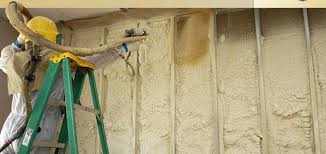
Spray foam insulation: It is a general and an essential thing that we insulate our homes to condense speed of heat loss. The insulation is carried by using spray foam in the opening, chink and the crevice such that there is no amend of heat linking the walls of the house and the environment.
Some of the Benefits of Spray Foam Insulation Include:
Reduction in sound diffusion, better environment, Keep Pests Outdoors, reduction in noise levels, Reduction in moisture and the development of Mold, apart from this it also has certain benefits like generating improved environment by plummeting dust, dirt, and pollen, Saving Energy structuring effectiveness & a Green Environment, produces air tight thermal seal, stops air and dampness penetration, Makes your home more comfortable, trim down capacity requirements, maintenance and wear of HVAC equipment.
Attic ventilation keeps the loft cooler in the summer and dry in the winter. Attic ventilation keeps the loft cooler in the summer and dry in the winter. Good exposure to air boosts the act of your insulation, expands the life of your HVAC unit and saves you even more money on energy bills.
Benefits of attic ventilation: it extends the life of your roof, cut downs the load on your HVAC system, stops ice damming in colder regions, and diminishes moisture build-up in the loft.
Source : Know More Details About Radiant Barrier by Visiting

A Read up About Attic insulation
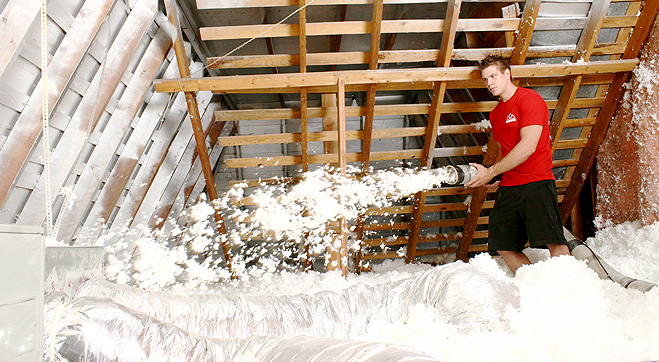
When we are considering attic insulation, there are several factors that we should keep in mind. There are two main types of blow in attic insulation. These two are most commonly used. They are cellulose and fiberglass insulation. Also there is the blow in rock wool insulation but the use of it is not so common. 
Cellulose, which is most commonly used, is a natural product of wood. It is primarily made out of natural newspaper. To meet the smoke development and flame spread requirements of today’s building codes; a fire retardant chemical is added to the cellulose.
The fiberglass insulation material that is used is the same material that batts or roles of the fiberglass insulation except for the fact that it is chopped or cubed so that it can be easily installed with the help of the insulating blowing machine. The fiber glass insulation will typically consist of 20% to 30% of recycled glass.
The r value of the cellulose that is used is R-3.2 to 3.8 per square inch. The loose filled fiberglass will have an R-value of R-2.2 to 2.7 per inch cube. To achieve the desired R value, you will have to depend on both the depth of the insulation as well as the density.
There are varying R values for ceiling insulation based upon the energy codes as well the climate of your locality. Based on the type of attic that you have, the code requirements may also vary. For example for joist assembled roof assemblies as well as for attics with single rafter may vary. There is a typically a chart on the insulation bag that will have the accurate depths for the various R values.

There are depth markers that are required to be placed in attic space which the WSEC requires to help the inspector and the installer verify the depth of the insulation. These depth markers should be placed within every three hundred square feet of the attic area and these must face towards the attic.
The depth of the insulation is very important; however, checking the density of the insulation is also equally important. The blow in insulation type can be fluffed up after it is installed. This is done so that it meets the required depth without actually meeting the required R value. This will settle over time so that the desired R value is achieved as the R value is lowered after it settles down.
The attic card is the easiest way to document the amount of R value installation. These are usually found stapled near the attic access to the truss. This card will also have information that is cited by the federal trade commission. Sometimes a chart is also attached with this.
Source: If you’re Still Unclear about Attic Insulation Visit Our Website http://www.aaffordableinsulators.com

XKCD’s resolution to the Fermi Paradox


My one sentence response to Paul Allen’s claim that the Singularity isn’t near
The Singularity has virtually nothing to do with matching or even approximating human cognition, and everything to do with the unpredictable and uncontrollable impacts of superscale computing.
Read more of my perspective, Hear that? It's the Singularity coming.
Read Paul Allen's post, The Singularity Isn't Near.


Dada – Futurismo. Dalle collezioni milanesi
Dada – Futurismo. Dalle collezioni milanesi
September 29, 2011 – January 15, 2012
Museo del Novecento, Milan
Curated by Vicente Todolì and Italo Rota

The iPhone 4S Cheat Sheet [IPhone]

So you managed to get an iPhone 4S today. Congratulations! But once you finish having sex with it and get it cleaned off, ask yourself: What do you really know about your new phone, in an empirical and (sort of) scientifically tested fashion? Not much, right? Giz has your back. More »


This Week’s Top Web Comedy Video: Meatball Sub 4S [Video]

You know what, Apple? You're not the only ones with a revolutionary new product that actually looks the same but maybe there's some different stuff in there. Subway's coming strong with a hot beef-injected Meatball Sub 4S. More »


The Story of the Greatest Cheeseburger of All Time: How the Nuclear Bomb Led to a Chile-Cheese Explosion [Food]

My mouth is jealous of Jason Sheehan's mouth. It got to taste the tastiest burger ever, and tell the best burger story of all time. I won't ruin it for you, but it involves a-bombs, Oppenheimer, and green chiles. Yum. [Gilt Taste] More »


iPhone 4S Test Notes: App Speed [Video]

It's faster. Screens slide smoother, apps launch quicker and stuff just works better. But that shouldn't really come as a surprise—we've seen the difference between an A4 and an A5 processor before. What IS surprising is just how fast the 4S' camera is. That thing KILLS. More »


iPhone 4S Test Notes: Data Speed (It’s Slow) [IPhone]

The iPhone 4S is here. One of new, not-so-visible features? A re-spiffed antenna, and stuffed inside the AT&T 4S, new guts that (should) mean faster data speeds. But theoretical max speeds are not real world experiences. So which iPhone is the fastest: AT&T, Sprint or Verizon? And how does the 4S stack up against the most jacked Android phones? More »


iPhone 4S Test Notes: Asking Siri for Sex and Drugs [Video]

After a little while it gets boring asking Siri to text people and convert gallons to quarts. It's been a long day. I'm a little delirious. Help me, Siri. God, just help me. More »


Scientists have used carbon nanotubes to engineer the most powerful artificial muscles ever [Bioengineering]

Will the wonders of carbon nanotubes never cease? Engineers have now used everyone's favorite cylindrical übermolecules to create artificial muscles that can contract and twist, in a manner not unlike like the muscles found in elephant trunks and squid tentacles. The upshot? Researchers say these tiny little motors could soon be used to propel microscopic nanobots throughout your bloodstream. More »


Actually, Google Might Still Buy Hulu [Hulu]


An F1 Racing Barbecue Grill for No Reason Other Than Being Amazing [Desired]

I can't think of a single thing I'd rather F1 engineers doing with their downtime than building grills designed with F1 dynamics in mind. They only thing that could make Brennwagen grills more desirable would be guns to shoot your meat while you cook it. More »


Ugh. God. Why Is Apple Making Everything Look Like an Ugly Wild West? [Apple]

Yeee-haw, Apple buckaroos! Whooz ready for some good timin', multitaskin'? Who wants their iPhone served up with a hot bucket'a grits? HOOOOOOOOOOO BOY. Jonny Ive's deep in the hooch pan again? Saddle up, grab yer partner, and let's make some truck-ugly apps! More »


Apple Shares Hit an All-Time High [Apple]

On the heels of the iPhone 4S release, Apple's stock rose 3.3 percent today to close at $422 a share. The Cupertino company is now worth $391 billion, passing once again Exxon as the world's most valuable public company. More »


iPhone 4S Test Notes: Apple Earbuds [IPhone]


Watch Two Siris Confuse the Hell Out of Each Other [Video]

We're finding Siri—smart as she/he/it is—has some trouble understanding us mere mortals. But what about two formidable AIs matched against one another? They converse like two mental patients. More »


