Taxi to the ISS

An artist concept of the Dream Chaser® by Sierra Nevada Corp. Image: SNC

Perhaps we won’t be without a local ride to the International Space Station at least if the Sierra Nevada Corporation has anything to say about it.

Enter the Dream Chaser® Space System.  The Dream Chaser® is in development offering a commercial solution to crew and cargo transportation to low Earth orbit.  The primary mission is to provide the United States with the capability to transport seven crew and cargo to the ISS and return them home safely.

Some of the features of the Dream Chaser®:

  • Reusable lifting-body spacecraft carries up to seven crew and cargo to and from low Earth orbit Including the transportation of NASA astronauts to and from the International Space Station
  • Vehicle design derived from NASA’s HL-20 , which has years of development, analysis, and wind tunnel testing by the Langley Research Center
  • Launches vertically on a United Launch Alliance (ULA) Atlas V Launch Vehicle
  • Capable of free flight in low Earth orbit and of docking to the International Space Station & other orbital destinations
  • Low-g reentry (< 1.5 gs) protects crew & science experiment return samples
  • Low-impact horizontal landing on a conventional runway
  • Large cross-range with frequent landing opportunities
  • Exceptional crew safety features, such as non-toxic propulsion systems
  • On-board propulsion system derived from  SNC’s SpaceShipOne & SpaceShipTwo hybrid rocket motor technology
  • Designed for simple maintenance and quick turnaround
  • Winner of Two NASA Commercial Crew Development Awards, totaling $100 Million
  • Space Exploration Systems has successfully completed all Commercial Crew Development Program milestones on time and within budget

The Dream Chaser® begins high altitude testing next summer – have a look at a press release.
Visit Sierra Nevada Corporation.

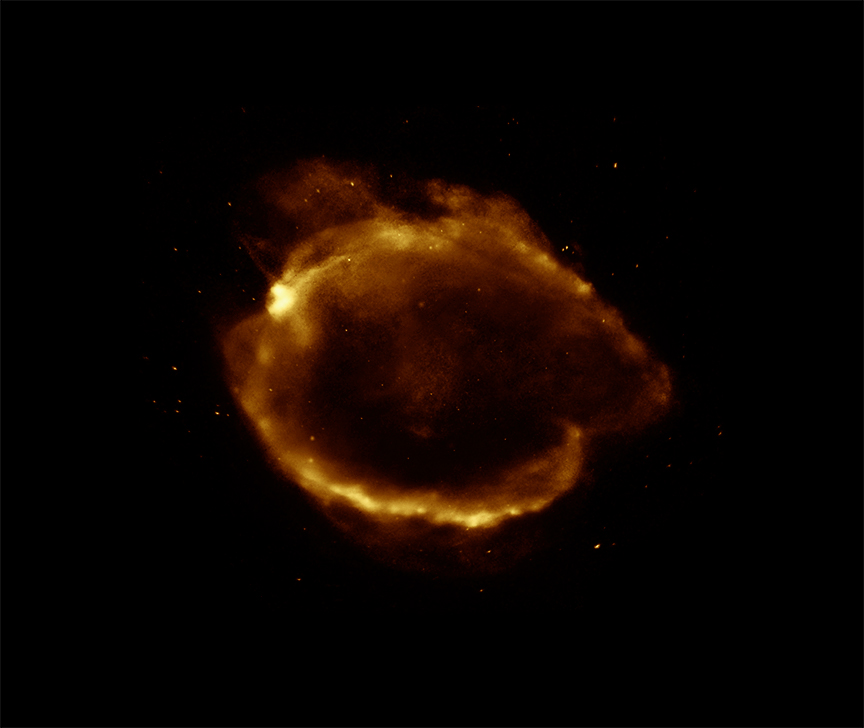
Supernova G299.2-2.9

A look at supernova G299.2-2.9 from Chandra/ROSAT and 2MASS. Scale: Image is about 24 arcmin across (about 114 light years). Image credit: X-ray: NASA/CXC/U.Texas/S.Park et al, ROSAT; Infrared: 2MASS/UMass/IPAC-Caltech/NASA/NSF

Catchy name eh?  Click the image to see the Chandra only image (hot linked to Chandra so it goes off site).

A look at supernova G299.2-2.9 from Chandra/ROSAT and 2MASS. Scale: Image is about 24 arcmin across (about 114 light years). Image credit: X-ray: NASA/CXC/U.Texas/S.Park et al, ROSAT; Infrared: 2MASS/UMass/IPAC-Caltech/NASA/NSF

Get more versions and sizes at the Chandra website:

G299.2-2.9 is an intriguing supernova remnant found about 16,000 light years away in the Milky Way galaxy . Evidence points to G299.2-2.9 being the remains of a Type Ia supernova, where a white dwarf has grown sufficiently massive to cause a thermonuclear explosion. Because it is older than most supernova remnants caused by these explosions, at an age of about 4500 years, G299.2-2.9 provides astronomers with an excellent opportunity to study how these objects evolve over time. It also provides a probe of the Type Ia supernova explosion that produced this structure.

This composite image shows G299.2-2.9 in X-ray light from Chandra, along with data from the ROSAT satellite (orange), that has been overlaid on an infrared image from the Two Micron All-Sky Survey (2MASS). The faint X-ray emission from the inner region reveals relatively large amounts of iron and silicon, as expected for a remnant of a Type Ia supernova. The outer shell of the remnant is complex, with at least a double shell structure. Typically, such a complex outer shell is associated with a star that has exploded into space where gas and dust are not uniformly distributed.

Since most theories to explain Type Ia supernovas assume they go off in a uniform environment, detailed studies of this complicated outer shell should help astronomers improve their understanding of the environments where these explosions occur. It is very important to understand the details of Type Ia explosions because astronomers use them as cosmic mile markers to measure the accelerated expansion of the universe and study dark energy. The discovery of this accelerated expansion in the late 1990s led to the recent award of the Nobel Prize in Physics.

Vesta’s Cliffs

A very nice look at the south polar region of Vesta. Click for larger. Image credit: NASA/JPL-Caltech/UCLA/MPS/DLR/IDA/

Here is one of the latest images of the asteroid Vesta to come from data from the Dawn spacecraft.  This has to be one of my favorites so far.

The image is an oblique view of the south pole of Vesta.  The image was created by a digital elevation model based on stereo images taken by the framing camera from an altitude of 1,700 miles (2,700 km).  This image has a resolution of about 260 meters per pixel.

The cliffs are several miles high and you can see deep grooves or canyons and the ever popular assortment of craters.  The mechanism creating the topography is unclear; possibly collisions with other asteroids.

Click here to see the original image and larger sizes.

A Rover’s Rovings

Click here to view the embedded video.

Source
The NASA press release:

While NASA’s Mars Exploration Rover Opportunity was traveling from Victoria crater to Endeavour crater, between September 2008 and August 2011, the rover team took an end-of-drive image on each Martian day that included a drive. A new video compiles these 309 images, providing an historic record of the three-year trek that totaled about 13 miles (21 kilometers) across a Martian plain pocked with smaller craters.

The video featuring the end-of-drive images is now available online, at http://www.nasa.gov/multimedia/videogallery/index.html?media_id=114782241 . It shows the rim of Endeavour becoming visible on the horizon partway through the journey and growing larger as Opportunity neared that goal. The drive included detours, as Opportunity went around large expanses of treacherous terrain along the way.

The rover team also produced a sound track for the video, using each drive day’s data from Opportunity’s accelerometers. The low-frequency data has been sped up 1,000 times to yield audible frequencies.

“The sound represents the vibrations of the rover while moving on the surface of Mars,” said Paolo Bellutta, a rover planner at NASA’s Jet Propulsion Laboratory, Pasadena, Calif., who has plotted many of Opportunity’s drives and coordinated production of the video. “When the sound is louder, the rover was moving on bedrock. When the sound is softer, the rover was moving on sand.”

Opportunity and its rover twin, Spirit, completed their three-month prime missions on Mars in April 2004. Both rovers continued for years of bonus, extended missions. Both have made important discoveries about wet environments on ancient Mars that may have been favorable for supporting microbial life. Spirit stopped communicating in 2010. Opportunity continues its work at Endeavour. NASA will launch the next-generation Mars rover, car-size Curiosity, this autumn, for arrival at Mars’ Gale crater in August 2012.

A New Look At Hubble Images

This is straight from NASA’s home page:

In a painstaking re-analysis of Hubble Space Telescope images from 1998, astronomers have found visual evidence for two extrasolar planets that went undetected back then.

Finding these hidden gems in the Hubble archive gives astronomers an invaluable time machine for comparing much earlier planet orbital motion data to more recent observations. It also demonstrates a novel approach for planet hunting in archival Hubble data.

NASA/Hubble

The left image shows the star HR 8799 as seen by Hubble’s Near Infrared Camera and Multi-Object Spectrometer (NICMOS) in 1998. The center image shows recent processing of the NICMOS data with newer, sophisticated software. The processing removes most of the scattered starlight to reveal three planets orbiting HR 8799. Based on the reanalysis of NICMOS data and ground-based observations, the illustration on the right shows the positions of the star and the orbits of its four known planets. (Credit: NASA; ESA; STScI, R. Soummer)

Four giant planets are known to orbit the young, massive star HR 8799, which is130 light-years away. In 2007 and 2008 the first three planets were discovered in near-infrared ground-based images taken with the W.M. Keck Observatory and the Gemini North telescope by Christian Marois of the National Research Council in Canada and his team. Marois and his colleagues then uncovered a fourth innermost planet in 2010. This is the only multiple exoplanetary system for which astronomers have obtained direct snapshots.

The three outer gas-giant planets have approximately 100-, 200-, and 400-year orbits. This means that astronomers need to wait a very long time to see how the planets move along their paths. The added time span from the Hubble data helps enormously. “The archive got us 10 years of science right now,” he says. “Without this data we would have had to wait another decade. It’s 10 years of science for free.”

There’s no telling what we’ll see when we analyze those “old” Hubble images with new technology.

NCBI ROFL: Smells like safe sex: olfactory pathogen primes increase intentions to use condoms. | Discoblog

Introduction: When ecological cues for pathogen threat are salient, cognitive and motivational systems appear to encourage myriad pathogen-avoidance behaviors (Ackerman et al., 2009; Faulkner, Schaller, Park, & Duncan, 2004; Mortensen, Becker, Ackerman, Neuberg, & Kenrick, 2010). Operating from the presumption that fundamental motivations to avoid pathogens can influence prophylactic behaviors, we aimed to test a novel hypothesis related to condom use: that ecological cues for the presence of pathogens would increase intentions to use condoms…

Method: At the beginning of the experimental session, an experimenter informed participants that pipes in the building were sporadically emitting unpleasant odors because of plumbing issues. Participants were then asked to leave the study room to drink at a nearby water fountain in preparation for providing a saliva sample. After returning, they completed a series of questionnaires on a laptop. … In the pathogen-prime condition, while participants were out of the room, the experimenter sprayed the wall of the room with a single pump of “Liquid ASS,” a novelty odor liquid that smells strongly of common bacterial threats (e.g., feces). In the control condition, the experimenter did not administer the spray. After returning from getting water, participants reported their intentions to purchase and use condoms over the next 6 months. Participants were asked to use a scale from 1 (not at all likely) to 7 (extremely likely) to rate the likelihood of their buying condoms, carrying condoms, discussing condoms with a sex partner, and using condoms during every event of sexual intercourse….

Results: An independent-samples t test demonstrated that participants in the pathogen-prime condition reported greater intentions to use condoms (M = 4.48, SD = 1.70) than did participants in the control condition (M = 3.74, SD = 1.85), t(97) = 2.06, p < .05, d = 0.42. The effect was identical across individuals who had and had not had sexual intercourse in the past year, F(1, 95) = 0.13, p = .72, and persisted after controlling for gender, SOI-R, and baseline condom attitudes, norms, and self-efficacy, t(92) = 2.03, p < .05, semipartial r = .17 (see Table 1).”

Photo: flickr/gotosira

Related content:
Discoblog: NCBI ROFL: Disgusting smells cause decreased liking of gay men.
Discoblog: NCBI ROFL: Smelly Week: The science of “the stinkface”.
Discoblog: NCBI ROFL: I’m a lumberjack, and I’m OK, I smell like pine and get chicks all day!

WTF is NCBI ROFL? Read our FAQ!


U.S. Air Force is opening up rocket contracts for competition | Bad Astronomy

The U.S. Air Force, in cooperation with NASA and the National Reconnaissance Office, has announced their certification strategy to allow competition for rocket launch contracts. This is after a Letter of Intent was signed by the three groups last year, and a Memorandum of Understanding earlier this year. What it means is that another necessary step has been taken in allowing private companies to compete for the lucrative contracts.

I think this is a good thing. Right now, the Air Force contracts all its launches with the United Launch Alliance, a union of Boeing and Lockheed Martin that started in 2006. These are the folks who make rockets like the very reliable Delta II, which has sent a large number of probes to destinations in the solar system, and the Atlas V, which will launch the Mars Science Lab to the Red Planet in November.

I wouldn’t necessarily say ULA has a monopoly, since in many ways they are the only game in town to launch such rockets (though others don’t hesitate to call it that). But Space X, a private company, has successfully launched its Falcon 9 rocket, capable of taking supplies and humans to orbit (though it’s not human-rated yet; it has to be certified to take people up, which should happen in the next couple of years). The future for Space X looks pretty good. This new announcement by the USAF/NRO/NASA means that companies like Space X have a chance to elbow their way into this billion-dollar opportunity.

And again, this is just one more step toward this open contract; it may be some time before any money exchanges hands. This situation is interesting; Elon Musk, head of Space X, has made it clear he is gunning for ULA; Space X filed an antitrust suit against the formation of ULA in 2005 (which ultimately was denied), and has made many announcements in the past that he can launch rockets cheaper and better than competitors. I think he may very well be right. ULA makes a huge amount of money in defense launches, and if Space X can get a piece of that then things will get very interesting indeed.

I’m a big fan of competition, when the playing field is level. I’m not an expert in this area, but this sounds like a good direction for the government to go. If Space X — and a handful of other companies coming up now — can launch rockets reliably and less expensively, then that makes access to space easier for everybody. And that is something I’d very much like to see.

Again, I am no expert here. If you agree or disagree, or better yet have information about this, I’d be curious to see it; please leave it in the comments. This is a fairly complex situation, and I’d like to learn more.

Image credit: Space X


An Infective Arm #scienceink | The Loom

Nuria Gonzalez-Montalban, a post-doctoral researcher at the University of Maryland, writes: My name is Núria and I am a biologist working with prions. Since the structure of prions has not been described yet (at least completely), I would not want to tattoo a possibly-wrong prion. Instead, I chose a T4 virus since part of my [...]


Scottish Doctors Are Applying Ultrasound to Broken Bones. Does That Really Help? | 80beats

A team of doctors in Glasgow, Scotland, have begun using ultrasound to help heal patients’ broken bones, claiming the technique can reduce recovery time by up to 40 percent with especially bad fractures. Developed in the 1950s by physicians in the same city, ultrasound is widely used in sonograms to produce images of developing fetuses. Sonograms are made by emitting sound waves into the body and recording the reflected patterns. To heal fractures, sound is emitted at a slightly different frequency and stimulates the development and activity of osteoblasts, which lay down new bone.

So does it work? So far the physicians only have anecdotal evidence to support their claims, like the surprisingly quick recovery of a Scottish man who fell off a 20-foot water tank and broke his ankle into eight pieces. A recent review of more than 40 years of research into ultrasound’s bone-healing abilities determined there’s good evidence the technology can help heal “fresh” fractures, i.e., within one to two weeks after the injury. While the study found some hints that ultrasound could help heal older fractures, the authors determined there wasn’t enough evidence to decide one way or another. An earlier review also concluded that ultrasound therapy can help recent fractures heal, but only found “preliminary evidence” it could help fix difficult or slowly-healing fractures.

[Via BBC]

Image: rearl / Flickr


100,000-Year-Old Paint Factory Suggests Early Humans Knew Chemistry | 80beats

spacing is important
The ochre paint found in the abalone shells
seems to have been made from a specific recipe.

As archaeologists unearth scattered artifacts from the early years of our species, one of the questions they ask themselves is, when did early humans start thinking and behaving like modern humans? The recent discovery of 100,000-year-old site where paint was manufactured—equipped with mixing containers and tools—suggests that even very distant ancestors had something of our ability to plan, as well as a basic sense of chemistry.

The paint makers, who lived in South Africa 20,000-30,000 years before archaeologists had previously thought such complex thought processes possible, used a specific recipe and brought in ochre, the red mineral, from a whopping 20 kilometers away before mixing it in abalone shells with melted fat from bone marrow and a fluid that might be urine. Bringing ochre all that way indicates forethought and planning, the researchers believe, and the mixture in the different shells they found is the same, suggesting that the paint makers followed a standard recipe. As the lead researcher told Nature News:

“This isn’t just a chance mixture, it is early chemistry. It suggests conceptual and probably cognitive abilities which are the equivalent of modern humans,” he says.

Lyn Wadley, an archaeologist at the University of the Witwatersrand who was not involved in the research, adds that it implies that people at that time could “think in abstract terms” about the quality and quantity of their ingredients. “Making compounds of any kind implies complex cognition,” she says.

Exactly what the red paint was used for is still unclear, but it could have been for body decorations or, less whimsically, for insect repellent. Read more at Nature News.

Image courtesy of F. d’Errico and C. Henshilwood, Science/AAAS.


A window into Titan | Bad Astronomy

I know I just posted a global color map of Saturn’s moon Titan, but sometimes it’s cool just to take a step back and look at a picture that gives a little context… and it doesn’t hurt that it’s a moody grayscale shot, too:

[Click to encronosenate.]

This shot of Titan was taken by the Cassini spacecraft back in August, and shows the moon superposed on Saturn’s rings, seen here almost — but not quite — edge-on.

The fact that you can see surface detail on Titan is a dead giveaway this shot was taken in the infrared: optical light, the kind we see, can’t penetrate the thick, hazy, nitrogen/methane atmosphere blanketing this moon. Infrared light gets through, though, so surface features can be seen. In fact, this image was taken using a filter that lets through light at 938 nanometers (the reddest light the human eye can see is about 750 nm). Methane is pretty good at absorbing light at a bunch of different wavelengths, but at 938 nm it’s transparent, so this is a particularly good place in the spectrum to look at Titan — astronomers call it the "methane window". Not only that, but this image also employed a polarizing filter, which blocks a lot of light from the atmospheric haze, making the surface easier to see (it also makes rainbows appear and disappear, too).

Not that the atmosphere is completely invisible in this picture: look around the moon’s edge and you can just see some of the upper atmospheric layers, and at the top you can easily spot the north polar hood, which may have water ice crystals in it.

And that dark region on Titan’s surface? It may have once been the bed of a methane sea, but now it’s a dry, vast area of wind-blown dunes, hydrocarbon grains collected by the Titanian winds. It’s called Shangri-La, and that makes me smile. I’m not sure anything at -180°C could be called a human paradise, but for astronomers, it’s certainly a scientific one.


Related posts:

- Polarized rainbow, what does this mean???
- In astronomy, a polarizing view is good
- Watch out, Titan! Vader’s onto you!
- A hidden world revealed: Titan


Galaxies swarm and light bends under dark matter’s sway | Bad Astronomy

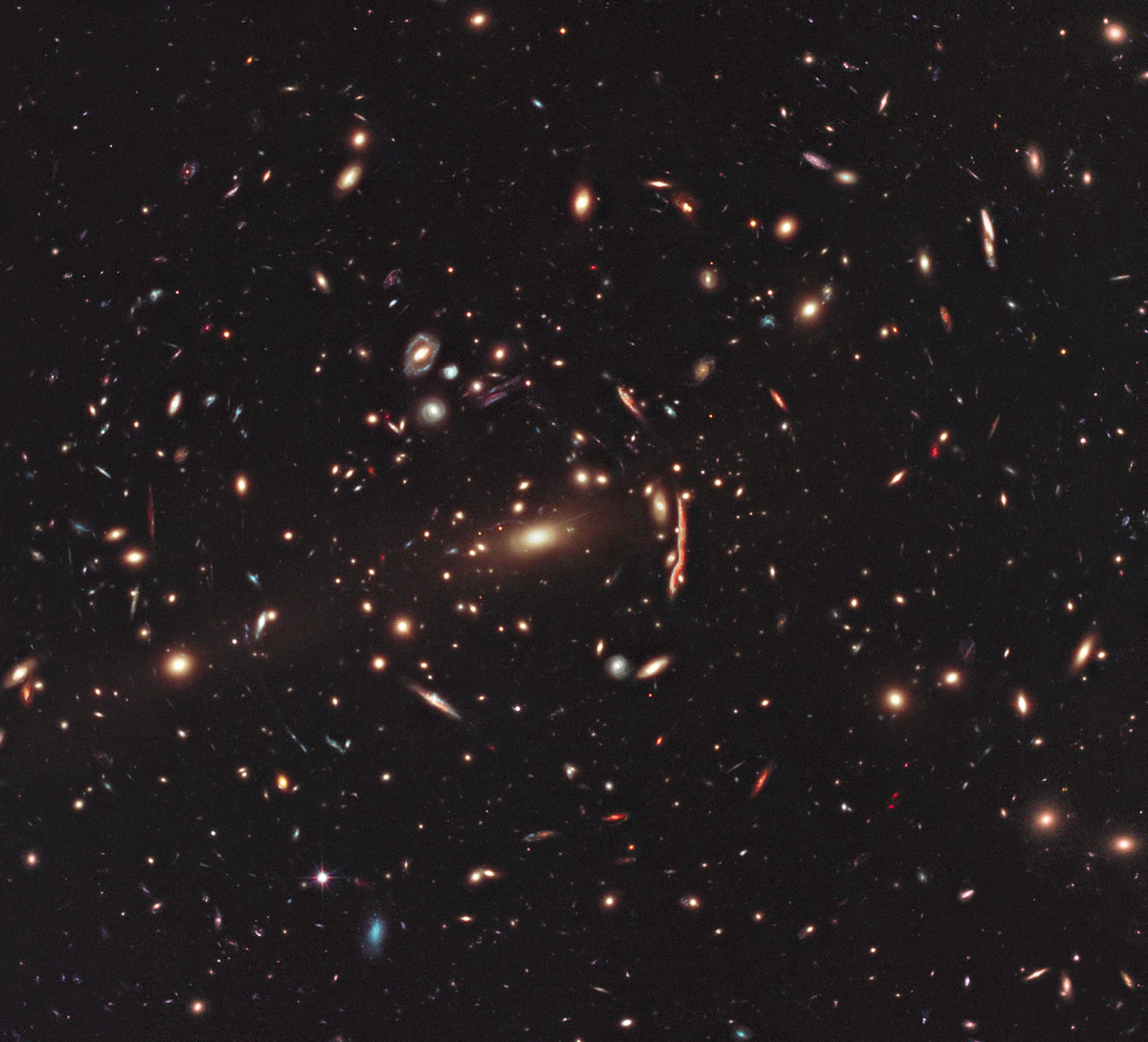
Before I do anything else, I simply have to present this insanely cool Hubble image of the galaxy cluster MACS J1206, which lies at the mind-numbing distance of 4.5 billion light years from Earth:

[Click to enclusternate, or grab the bigger 2564 x 2328 pixel version.]

Like I said, insanely cool. The cluster has thousands of galaxies in it, and a total mass of something like a quadrillion — that’s 1,000,000,000,000,000 — times the mass of our Sun!

The image was taken as part of a program called CLASH, for Cluster Lensing And Supernova survey with Hubble. A large group of astronomers from ten different countries are observing more than two dozen such distant clusters to look for many interesting things, including exploding stars (which help us gauge the expansion rate of the Universe), very distant galaxies (to help us understand the early Universe), and to look for dark matter.

Dark matter is stuff that doesn’t emit light, but has mass. Careful observations over the years have ruled out pretty much every form of normal matter we can think of, from simple hydrogen clouds to black holes. Whatever this stuff is, it’s weird, not matter as we know it.

But we do know it’s there. Its gravity affects how spiral galaxies rotate, how clusters like MACS 1206 stay together, and can even bend light from more distant galaxies as it passes through. That last bit is the big deal here.

Take a look at the cluster again. See those bright, weirdly drawn-out smears, as if someone grabbed a galaxy at both ends and stretched? Those are galaxies on the other side of the cluster from us, farther away. As the light from those galaxies passes through the cluster on the way to Earth, it gets distorted by the gravity of the galaxies in the cluster, and so we see the shape distorted. This is called gravitational lensing, and by carefully mapping that distortion, the distribution and amount of dark matter in MACS 1206 can be determined!

And that’s the whole point.

Now take another look at the picture. See how so many of the galaxies appear to lie perpendicular to the galaxy center? That’s another effect of the dark matter distortion; the smearing is tangential to the direction to the cluster center. So a lot of those distorted galaxies aren’t just smeared out, they look like little arcs, centered on the cluster center. Again, by measuring this, we can figure out a lot about the dark matter in the cluster.

I also got a kick out of this wiggly galaxy off to the right of the cluster center. How weird is that thing? It appears to snake around those two galaxies I marked, and I have to wonder if they have enough gravity to actually distort the light from that more distant galaxy that much, or if it’s just a coincidence. I’m having a hard time thinking it’s anything but the gravitational influence of those two galaxies doing that, but I’ve never seen anything like it! The astronomers published a paper about the program, but didn’t mention that squirmy guy in particular.

Also, if you look at the embiggened picture of the cluster, you’ll see it dotted with tiny red galaxies (I’ve cropped out a section here and marked three of them; many more can be found). I’m really wondering about those. Are they smaller cluster members, galaxies with so much dust that the starlight from them is reddened (the same way sunlight is redder at sunset), or are they big galaxies so far away they’re diminished in size through sheer distance, their light red shifted to that ruddy glow?

I don’t know. But the astronomers running CLASH will find out. Part of the program is to use the Very Large Telescope to get spectra of some of the galaxies in the survey, and I would bet a lot of money some of those little red dudes will be targeted. If they really are very far away, then they could prove very useful in understanding a lot about the early Universe.

I’m really impressed with this work so far, and in the ambitious nature of the survey. I literally gasped when I read that CLASH will get 524 orbits of Hubble to do this survey! That’s at least 300 hours of solid observing time, which is incredible. When I worked on Hubble, I was on some projects that got two orbits, and we were happy to get them! So 524 is an astonishing amount, and indicates pretty clearly that the folks in charge of giving astronomers time on Hubble think very highly of this project.

Given how much data they’ll be getting, I expect we’ll learn a lot about the mid- to very distant Universe in this survey, including how galaxies behave when they’re young, how the invisible fingers of dark matter shape normal matter, and even how the Universe itself is expanding on large scales. All of that, and much more, by taking a telescope, putting it up above our atmosphere, and letting it stare at one target after another for a long, long time.

That, plus the human ability to make sense of nature — which is what science is. That goes a long way, too.

Image credit: Credit: NASA, ESA, M. Postman (STScI) and the CLASH Survey Team


Related posts:

- Opening the lid on Pandora’s Cluster
- Astronomers have found when and how the cosmic fog was lifted
- Dark matter is alive and well, thankyouverymuch
- Found: 90% of the distant Universe
- Fermi may have spotted dark matter


Training the Immune System May Turn Off Peanut Allergies | 80beats

What’s the News: For someone with severe peanut allergies, the tiniest trace of the nut makes their immune system go into overdrive, attacking what it perceives as an intruder so vehemently that the person can go into anaphylactic shock. Scientists may have found a way to calm that immune overreaction, a new study in rats shows, by tacking peanut proteins onto certain immune cells, effectively teaching the whole system that peanuts aren’t a threat.

How the Heck:

  • The research team drew blood from mice bred to have a condition much like severe human food allergies: a tiny taste of peanut, and their hypersensitive immune system would ramp up, causing their airways to swell shut.
  • From the blood sample, the researchers isolated the leukocytes, white blood cells that help the immune system protect against microbes and other invaders, and attached peanut proteins to the cells’ surface. They then reintroduced each rat’s cells—now with the peanut-protein addition—into its blood stream.
  • In people (and rats) with peanut allergies, a particular type of helper T cell, a cell that signals the immune system to attack, sounds the alarm when it comes across a peanut protein. But since peanut proteins were attached to the immune system’s own cells, the T helper cells in these rats learned to tolerate the peanut protein, no longer treating it as a threat.
  • Once they’d gotten two doses of the modified leukocytes, the rats ate peanut extract. They didn’t show any serious ill effects, even though a similar snack would have dangerously swollen their airways prior to the transfusions.
  • The researchers then did a similar test, with rats bred to be allergic to an egg protein, and got the same result: tacking a bit of the offending molecule onto an immune cell ahead of time meant the rats’ immune system could handle egg protein later.

Not So Fast: The study was in rats, not humans. It will take a lot more testing, and a lot more time, to know whether this sort of treatment will allow people with severe peanut allergies can safely eat foods with trace amounts of peanuts, much less enjoy a PB&J.

The Future Holds: The ultimate goal is, of course, to develop a treatment for people with severe allergies to peanuts or other food. The researchers also hope that tacking on proteins from multiple allergens—say peanuts, egg, and soy—could be used to treat multiple food allergies at once.

Reference: Charles B. Smarr, Chia-Lin Hsu, Adam J. Byrne, Stephen D. Miller & Paul J. Bryce. “Antigen-Fixed Leukocytes Tolerize Th2 Responses in Mouse Models of Allergy.” Journal of Immunology, published online October 5, 2011. DOI: 10.4049/?jimmunol.1100608

Photo courtesy of EuroMagic / Flickr


NCBI ROFL: Why overheard cell phone conversations are extra annoying. | Discoblog

Overheard cell-phone conversations: when less speech is more distracting.

“Why are people more irritated by nearby cell-phone conversations than by conversations between two people who are physically present? Overhearing someone on a cell phone means hearing only half of a conversation–a “halfalogue.” We show that merely overhearing a halfalogue results in decreased performance on cognitive tasks designed to reflect the attentional demands of daily activities. By contrast, overhearing both sides of a cell-phone conversation or a monologue does not result in decreased performance. This may be because the content of a halfalogue is less predictable than both sides of a conversation. In a second experiment, we controlled for differences in acoustic factors between these types of overheard speech, establishing that it is the unpredictable informational content of halfalogues that results in distraction. Thus, we provide a cognitive explanation for why overheard cell-phone conversations are especially irritating: Less-predictable speech results in more distraction for a listener engaged in other tasks.”

Photo: icanhascheezburger

Related content:
Discoblog: NCBI ROFL: f u cn read dis it means ur gud @ sp.
Discoblog: NCBI ROFL: OMG! ur cell phone is mkng u impotent.
Discoblog: NCBI ROFL: Garlic: a sensory pleasure or a social nuisance?

WTF is NCBI ROFL? Read our FAQ!


Australia on fire | Gene Expression

Fascinating, Orbital cycles, Australian lake levels, and the arrival of aborigines:

But the other big feature is that the lake-filling events that occurred after 50,000 years ago were much smaller than those which occurred before. Climactically, the conditions 10,000 years ago should have been the same as the conditions 115,000 years ago. But the lake was only a fraction of the size. The authors find no natural causes which can explain this. So they suggest that the aridity starting around 50,000 years ago is related to the reduction in forest and increase in grasslands which occurred at this time. This vegetation change was a result of a huge increase in the frequency of fire in central Australia, which allowed fire-adapted plants to prosper at the expense of moisture-retaining forest. The increase in fire at this time is generally associated with the arrival of the first people on the Australian continent. It is known that of Australia’s megafauna went extinct at this time, but Magee et al. (2004) show that even the tropical rains were effected by human migration, with drastic changes to the continent’s largest river basin.

If you read some of the academic literature on fire ecology you have a hard time not coming to the conclusion that modern humans terraformed the planet Earth! The hallmark of modern H. sapiens seems to be extinction of large organisms, a propensity to go where no hominin has gone before, and copious utilization of the “red flower.”

People’s Choice podcast awards | Bad Astronomy

Every year at this time the People’s Choice Podcast Awards are held. This year, three different podcasts with which I am involved in some way are nominated in the Science category!

Big Picture Science (what used to be Are We Alone) is the SETI podcast/radio show where I do the (roughly) monthly Brains on Vacation segment with astronomer Seth Shostak. My friends Fraser Cain and Pamela Gay do the Astronomy Cast podcast (I’ve been on it a few times). And the Skeptics Guide to the Universe podcast, where I’m a frequent guest and general rabble-rouser, is also nominated.

I like all three, so I have no problem if my readers vote for any of these. You can vote every day, once per day, until October 27. Voting resets at midnight Eastern US time.


The future is not impossible | Gene Expression


Alexander Dumas, of mixed race

One of the reasons I post regularly on the genetics of mixed-race people and their physical appearance is that I don’t think the media does a good job. There’s a “freak show” element which titillates but does not illuminate. This in a period in the United States where the absolute number of people of mixed origin is increasing rapidly due to intermarriage. In fact for years I’ve gotten inquiries from the parents of mixed-race children about the scientific details of the genetics, because they are regularly questioned in depth as to how the children came to look how they look (the emails are always from women, more on that later). A relatively well written article in The New York Times illustrates some of the issues, insofar as the focus is totally on social context and dynamics, with not even a small nod to the science. The story is about a mixed-race woman (mother white and father black) who is married to a white man, whose children don’t “look black.” Specifically, her two daughters are very light-skinned, and the younger one is boldly blonde.

Here’s the jump off point of the piece:

“How come she’s so white and you’re so dark?”

The question tore through Heather Greenwood as she was about to check out at a store here one afternoon this summer. Her brown hands were pushing the shopping cart that held her babbling toddler, Noelle, all platinum curls, fair skin and ice-blue eyes.

The woman behind Mrs. Greenwood, who was white, asked once she realized, by the way they were talking, that they were mother and child. “It’s just not possible,” she charged indignantly. “You’re so…dark!”

It was not the first time someone had demanded an explanation from Mrs. Greenwood about her biological daughter, but it was among the more aggressive….

Of course it’s possible. The science behind this is trivially plain. The biological mother has alleles which code phenotypes distinctive of Europeans and Africans. Because her father is African American she is even likely to have more European ancestry than African ancestry (median African American is ~80% African and ~20% European). Genes which control variation in skin pigmentation at the scale of racial differences are distributed across half a dozen loci, but with blue vs. brown eye color there’s really only one locus which explains most (though not all) of the variation. That probably explains how both the daughters have blue eyes. The mother is probably a heteozygote, and the father is a homozygote. That means that any one of their children has a ~50% chance of having blue eyes and a ~50% chance of having brown eyes. So the chance of both daughters turning out to have blue eyes is ~25%. But obviously the science isn’t the meat of the piece. I just wish they’d given a quick explicit nod to it so that people would know why the outcome is as it is. It’s not rocket science.

In terms of the experiences of this family, there are a few issues that come to mind. First, it would be nice to clarify the ages of the individuals who ask her rude questions. My personal experience is that people who compliment me on my ability to speak English well have invariably been born before 1970. No matter one’s politics or current life situation formative experiences matter. These are people who grew up in the United States before there were large numbers of children in their classrooms who “didn’t look American” (i.e., they weren’t black or white). In contrast, people who are younger had some of these kids in their classes growing up, so the fact that we don’t have accents and can speak English fluently isn’t an amazing feat which requires a compliment.

Second, I wonder as to the dynamics in this specific case, a mixed-race women who is coded as black in the United States. It doesn’t seem implausible that the experiences of Asian American and Latino women who have very light-skinned children would be somewhat different, because there’s a lot less fraught history there. The power of hypodescent still looms large in black-white relations, in a way it necessarily does not with other groups.

Finally, there’s the issue of mothers versus fathers. These stories always seem to focus on mothers who are assumed to be nannies of their own children. This is a very specific fear which I’ve read some black women have when it comes to interracial dating and the “think of the children” angle. But what about the fathers? It seems that paternity is something which is going to be much more plausible to challenge. In the few cases where black American families have adopted white children I’ve read that they have to be very cautious in public lest people get the wrong impression, and this is a particular problem with black males (like some gay couples keeping adoption papers on one’s person can be handy in these instances).

But that’s all sociology. There’s a lot of moving parts. But the genetics of this isn’t too complex. Quite possible indeed.

How Scarily Sloppy DNA Evidence Convicted, Then Released, Amanda Knox | 80beats

You wouldn’t know it from crime shows, but DNA evidence can have more holes in it than Swiss cheese. And the Amanda Knox murder appeal, in which the DNA evidence that led to Knox and former-boyfriend Sollecito’s convictions in 2009 was thrown out, provided a great example of how a powerful tool, when used incompetently, can be worse than useless.

Getting a DNA fingerprint—matching a particular piece of DNA to a specific individual—is a very delicate process. Samples from the crime scene must be taken immediately, and the object they’re found on must be pristine, not touched by anyone else for quite a while. John Timmer at Ars Technica deftly explains the science behind DNA fingerprinting  and asks experts how the DNA evidence in the Knox trial, taken from the victim’s bra clasp and a knife, measures up. It ain’t pretty:

The experts were not kind to the evidence. The bra clasp, it turned out, had sat on the floor for more than six weeks after the murder before being secured and processed; photographs show that it had been moved between the murder and its eventual collection. The clasp was the only DNA evidence placing Sollecito at the scene of the crime; no DNA put Knox on the scene at all.

The supposed murder weapon, a long kitchen knife, was found in the home of Sollecito, in his kitchen knife drawer. The knife held little DNA and, according to the experts, the local authorities had not handled the tests properly to compensate.

The tiny bit of DNA on the knife produced results so spotty that they would be legally barred from being introduced in a US court. But not, evidently, an Italian one. Yeesh. Read more at Ars Technica.

Image courtesy of Kuzma / istockphoto


Why Spontaneous Human Combustion is Really About Human Candles | 80beats

candle

Last month when British papers reported on the “first Irish case of death” by spontaneous human combustion—going up in flames with no apparent cause—many eyebrows were raised in the scientific regions of the Internet. Apparently the coroner in the case had never heard of the “wick effect,” in which a flaming object like a cigarette dropped on a sleeping person can slowly melt all their (quite flammable) fat until it leaks out and saturates the body, forming, in effect, a human candle or torch. It’s what forensic scientists think happens in cases of so-called “spontaneous” human combustion.

Blogger Jennifer Ouellette, it turns out, is a font of knowledge on the wick effect and the various other explanations people have come up with over the years for the gruesome discovery of a pair of legs leaning against a chair full of ash and grease. Dickens, along with the rest of the Victorians, thought it happened because of heavy drinking. But these explanations really take the cake:

A man named John Heymer wrote a book called The Entrancing Flame in 1996, in which he advanced his hypothesis that SHC victims are loners who fall into a strange kind of trance that triggers a chain reaction of “mitochrondrial explosions” by “freeing hydrogen and oxygen within the body.” That hypothesis might make sense if hydrogen and oxygen actually existed in gas form inside a mitochrondrial cell, but they don’t — and a good thing, too, otherwise the very act of inhaling could cause spontaneous ignition.

Even more far-fetched is the take of a man named Larry Arnold, who thinks that occasionally human cells get hit by a mysterious particle — he calls it a “pyrotron” — that causes a nuclear chain reaction inside the body. We give Arnold points for creativity and coming with a really cool moniker for his imaginary new particle.

Read more at Cocktail Party Physics.

Image courtesy of puzzledmonkey / flickr