Our Future in Space – panel at TAM 9 | Bad Astronomy

In July 2011, at the JREF’s TAM 9 meeting in Las Vegas, I moderated a panel discussing the future of space exploration. On that panel were some familiar faces: Bill Nye (the Science Guy), astronomers Neil Tyson and Pamela Gay, and theoretical physicist Lawrence Krauss. All of us have, ah, some experience talking to the public about matters spacey, so I knew it would be a fun panel to moderate.

I had no idea. The video of the panel has been made available by the JREF, so you can see it for yourself! I’ve embedded it below. It’s an hour long, but I think you’ll find it absolutely worth your time to watch all the way through. A lot of people came up to me afterwards and said it was the best panel at the meeting, and one of the best we’ve ever had at TAM! As a participant, modesty forbids me from saying more, but then, who am I to disagree?

It was a rollicking discussion, and very interesting. Neil was in rare form, and I think my favorite moment was when Pamela was making a point, and Neil jumped in to give an opinion… and Pamela held up a finger and "shusshed" him! It was extremely funny, especially when Neil got this, "OK, fine, you got me" expression on his face. After the panel, Neil was signing books, and I got Pamela to sit down next to him and recreate the moment:

Someone else was able to capture it during the actual moment on the panel, too.

I do want to comment on one thing. At about 44:00 minutes in, during a discussion about dark energy and the James Webb Space Telescope — which in July was already in trouble — I said that JWST would help characterize dark energy, allowing us understand it better. Lawrence then said that this wasn’t true, and that we need to be careful about overhyping the capability of JWST. I was about to reply to him when Neil jumped in, and I decided to let Lawrence’s comment go; as moderator I didn’t want to derail the flow of the conversation, and at the time thought it better to let things move on.

However, I disagree somewhat with what Lawrence said. Extremely distant supernovae are what were used to discover dark energy in the first place, and JWST will be able to to get better observations of them than we could previously. I think part of Lawrence’s point was that our observations have already nailed down some of the characteristics of dark energy pretty well, and the way JWST will work won’t add much to what we already know. I suspect that’s mostly true, but then when it comes to really distant supernovae our observations get a bit shaky. The better we nail them down, the more we can say about them, and JWST would be able provide cleaner data from those distant exploding stars.

I did say that JWST "would go a long way" in helping us understand dark energy, and looking back on that I probably should’ve phrased this as it simply being able to help us. Although it is a very powerful observatory, JWST isn’t optimized for that sort of thing, so it probably wouldn’t be able to do as much to increase our knowledge of dark energy as much as, say, Hubble did. I would add though that whenever we increase our capability to observe in a new way, we learn new things. This point was made both by Lawrence and Neil a moment later; but we should be careful before the fact not to rely on a telescope showing us something we didn’t know. It’ll happen in some ways but not others, and we can’t know until we build the thing and find out! So in that way, I agree with both Neil and Lawrence.

[UPDATE: Hmm, perhaps I wrote too soon. Adam Riess, who just won the Nobel prize for his part in the discovery of dark energy, gave a talk recently where discusses how JWST can help characterize dark energy. The important part starts about 29 minutes in, and is a bit technical. Thanks to Jason Kalirai for the tip!]

I actually enjoyed this discussion for another reason: I like it when people can disagree on big issues and do so intelligently and with evidence to back up their claims. There were some points being made by panelists that I agreed with, and some I didn’t. But I found myself thinking about space exploration in different ways, seeing other perspectives. That always gives insight into an issue, and whether you ultimately agree with the point or not, you’ll wind up thinking better about it.

I’d argue that’s one of the major benefits of skepticism.

Image credits: me; Jamie Bernstein.


Early hunters killed mastodons with mastodons (Also, you can chuck a bone spear through a car. Who knew?) | Not Exactly Rocket Science

To round off my brief stint at the Guardian, here’s a piece about a mastodon specimen with what looks like a spear-tip stuck in its rib. This specimen, the so-called “Manis mastodon” has been a source of controversy for several decades. Is that fragment man-made or simply one of the animal’s own bone splinters? Does it imply that humans hunted large mammals hundreds of years earlier than expected, or not?

Having re-analysed the rib in an “industrial-grade” CT scanner, Michael Waters thinks it’s definitely a man-made projectile. He even extracted DNA from the rib and the fragment and found that both belonged to mastodons. So these early hunters were killing mastodons and turning them into weapons for killing more mastodons. How poetically gittish.

Anyway, read the piece for more about why this matters. In the meantime, I want to draw your attention to this delicious tete-a-tete at the end between Waters and Gary Haynes, who doesn’t buy the interpretation. Note, in particular, the very last bit from Waters, which made my jaw drop.

But despite Waters’ efforts, the fragment in the Manis mastodon’s rib is still stoking debate. “It’s not definitely proven that it is a projectile point,” says Prof Gary Haynes from the University of Nevada, Reno. “Elephants today push each other all the time and break each other’s rib so it could be a bone splinter that the animal just rolled on.”

Waters does not credit this alternative hypothesis. “Ludicrous what-if stories are being made up to explain something people don’t want to believe,” he says. “We took the specimen to a bone pathologist, showed him the CT scans, and asked if there was any way it could be an internal injury. He said absolutely not.”

Waters adds, “If you break a bone, a splinter isn’t going to magically rotate its way through a muscle and inject itself into your rib bone. Something needed to come at this thing with a lot of force to get it into the rib.”

The spear-thrower must have had a powerful arm, for the fragment would have punctured through hair, skin and up to 30 centimetres of mastodon muscle. “A bone projectile point is a really lethal weapon,” says Waters. “It’s sharpened to a needle point and little greater than the diameter of a pencil. It’s like a bullet. It’s designed to get deep into the elephant and hit a vital organ.” He adds, “I’ve seen these thrown through old cars.”

Doomed ROSAT captured in video | Bad Astronomy

I actually kinda half-expected this would happen: the fantastic "amateur" astronomer Thierry Legault was able to observe and get video of the astronomical satellite ROSAT as it’s making its final orbits around the Earth:

He also observed it on October 16th, but I think the video above from late September shows it better.

To show you how good this is, I took an image he provided of stills from his video and added a drawing of the satellite below them:

Amazingly, in Thierry’s images you can clearly see the boom extending from the satellite’s main body (at the bottom of the photos, and off to the left in the drawing). That boom holds a magnetometer (to measure the Earth’s magnetic field) and an antenna used to communicate with Earth. From what I can tell, the boom is about 4.4 meters (14.4 feet) in length. In that September image, ROSAT was over 450 km (270 miles) away from Thierry when he took it!

Current models predict ROSAT will plunge to Earth on October 23rd, sometime around 11:00 UTC (7:00 a.m. Eastern US time). Follow ROSAT_reentry on Twitter for the latest info.


Related posts:

- YouTube video where I explain a satellite re-entry
- BREAKING: SpySat successfully hit by missile
- Atlantis, one last time in the Sun
- SERIOUSLY jaw-dropping pictures of Endeavour and the ISS!


New comment policy | Not Exactly Rocket Science

I’m getting somewhat inundated with spam and it’s a pain, so I’m going to click the little button that says “Comment author must have a previously approved comment”. If you’ve commented before, there shouldn’t be any problems. Otherwise, I’ll have to approve, which I will do frequently.

Let’s see how that works for the moment.

“Living fossil” cycad plants are actually evolution’s comeback kings | Not Exactly Rocket Science

Living fossils” abound in popular science writing. The phrase refers to modern species that are uncannily similar to extinct ones. Their bodies seem to have gone unchanged over millions of years, as if evolution took its foot off the pedal and allowed them to coast. These species are painted as either relics desperately clinging onto existence, or great survivors triumphing against the odds. They range from the famous coelacanth, to the horseshoe crab, to a new eel discovered just months ago.

But one classic example – a group of plants called the cycads – shows just how slippery the concept of the “living fossil” can be.

Cycads look superficially like palm trees, but they belong to a very different group. They first appeared on the planet around 280 million years ago, but they really hit their stride in the Jurassic and Cretaceous period, between 200 and 65 million years ago. But their time would soon be over. Out-competed by flowering plants, and suffering from the decline of their dinosaur polliantors, the cycads started to disappear.

Today, the cycads are a mere shadow of their former glory. There are just 300 species, commonly thought to have endured since their heyday in the dinosaur era. But Nathalie Nagalingum from the Arnold Arboretum of Harvard University has found evidence that this narrative is a fiction. The cycads are indeed an ancient group, but the living species aren’t much older than 12 million years. They would never have been nibbled by dinosaur teeth. Living? Yes. Fossils? Hardly.

Naganlingum sequenced a gene called PHYP from 199 living cycads and used it to build a family tree for the group. The tree showed that the modern cycad lineages have “long fuses” – most of them arose during the Cretaceous period. But these major groups only diversified into today’s species during a recent five million year window. The family tree looks like a set of rakes, with long poles representing the deep ancestry of the groups, and several tiny prongs at the end, representing the youth of the individual species.  And Naganlingum found the same pattern when she looked at different genes.

Other scientists have used genetic analyses to suggest that modern cycads are evolutionarily young, but they sampled far fewer species than Naganlingum has now done. There were other clues too. Several cycad species have very low genetic diversity, as do the insects that pollinate them, like weevils. As the cycads started branching out into new species, so did the weevils and their genes bear the legacy of these recent radiations.

This perfectly illustrates why the term “living fossil” is so tricky. The term has a rich history: it was coined by Darwin himself, referring to the platypus and the South American lungfish; Richard Dawkins uses it in his books; and working scientists use it in their papers. But the term is misleading. Modern cycads have the appearance of being ancient, but they’re recent arrivals. They retain the basic shape and form of their long-extinct ancestors, but they weren’t around at the same time.

In fact, the cycads aren’t so much living fossils as comeback kings. Greatly diminished from their Cretaceous prime, they enjoyed a second bout of expansion around 12 million years ago. They did so simultaneously across four continents – Australia, Africa, Asia and central America – as if they were racing to a common starting pistol. Naganlingum thinks that they were responding to a changing climate.

Whatever the cause, the cycad comeback was short-lived. No new species have emerged in the last two million years and two thirds of the group are now endangered. It would be wrong to call them living fossils because the “fossils” bit is wrong. Soon, the “living” part may be inaccurate too.

Reference: Nagalingum, Marshall, Quental, Rai, Little & Mathews. 2011. Recent Synchronous Radiation of a Living Fossil. Science http://dx.doi.org/10.1126/science.1209926

More on cycads: Ancient plants manipulate insects for hot, smelly sex

Photos by Nathalie Nagalingum

Superconductors + Flux Tubes = Levitating Frozen Puck | 80beats

When you freeze a chunk of sapphire coated in yttrium barium copper oxide, what do you get? A puck that can whiz around a magnetic track like a hovercraft. When the oxide gets very cold, it becomes a superconductor and actively repels magnets, with the result that when it’s placed over a large enough magnet, it levitates.

As the Tel Aviv University team behind this video explains, despite the puck’s aversion to magnetic fields, the thinness of the oxide layer on it means that the field does manage to penetrate it a little. But only in tiny columns called flux tubes. The puck doesn’t like having those flux tubes moved around in it, which happens whenever it moves. And in order to minimize the shifting of the flux tubes, it…floats. It’s a phenomenon called quantum locking.

No alien tech or magic required.

We do wonder, though, if the levitating puck has ever met the levitating frog, pictured below. Or his buddy, the levitating (heavily sedated) mouse.


White Roofs May Actually Add to Global Warming | 80beats


A new study published in the Journal of Climate claims that painting rooftops white—a method championed by energy secretary Steven Chu and others to combat climate change—only minimally reduces local cooling, and actually causes a slight increase in overall global warming.

How the Heck:

  • The researchers used a global climate model called GATOR-GCMOM [PDF], which incorporates a host of data from satellites and weather stations worldwide. It models how relationships between various environmental conditions, like the presence of clouds or pollutants, will affect local and global climate.
  • The model found that more white roofs means less surface heat in cities (which is obvious enough to anyone who’s sat in a car with a black interior in the sun). Lower local temperature means less water evaporates and rises up to eventually form clouds, says lead author and Stanford University researcher Mark Jacobson. The decrease in clouds allows more sunlight to reach the Earth’s surface, leading to higher temperatures overall.
  • The model also predicts that much of the light reflected by rooftops will eventually be absorbed by dark carbon soot and particulates that are especially prevalent in the air above urban areas. This could limit local cooling and cause warming elsewhere as the particles drift away.

Not so Fast:

  • One possible benefit to white roofs is the reduction of cooling costs for the buildings painted white, which isn’t explicitly addressed in this paper. This could make the practice useful in warmer climates, but at least one study has found that a switch to white roofs wouldn’t lead to energy savings on a global scale.
  • The study didn’t calculate how the change would impact energy use, or how such a change could impact emissions and their effect on climate.
  • Even with switch to 100% white roofs, the predicted increase in global temperature (0.13 F over 20 years) is quite small, and dwarfed by expected effects of greenhouse gases and carbon soot.

To Paint or Not to Paint:

  • Jacobson speculates that any energy savings in white-roofed buildings would be eaten up by increased energy use elsewhere (i.e., for cooling) from overall warming caused by white roofs. So it’s probably not a great measure for widespread use, he says. But in a warm, sunny climate, a white roof almost certainly doesn’t hurt on an individual basis and may help reduce the need for air-conditioning (as inhabitants of sultry climes have known for a long time).
  • Conversion to white roofs is a bad idea globally, Jacobson says. Instead, if you want to make a difference, install a photovoltaic system or solar panels on your roof, which reflects light and also generates clean electricity.

Reference: Mark Z. Jacobson and John E. Ten Hoeve. Effects of Urban Surfaces and White Roofs on Global and Regional Climate. Journal of Climate. 2011. DOI: 10.1175/JCLI-D-11-00032.1

Image: Christopher Dick / Flickr


Which Hispanics identify as white? | Gene Expression


I wanted to clarify a few issues with the Census’ American Community Survey. These data come from the interval of 2006-2008, and they allowed me to query the proportional of various Latino/Hispanic groups who identified as white. I knew in the aggregate that the majority of America’s Latinos identified as white, but I was curious about two things:

1) The variation in white identification by group (by national origin)

2) The variation in white identification of Mexican Americans by selected states

Results below. There are stories in these data….

WhiteBlackOther raceWhite and blackWhite & Native American
300: Cuban87.33.58.60.50.1
420: Argentinean86.30.313.20.10.2
450: Spaniard80.51.315.50.62.1
427: Uruguayan79.30.120.30.30
422: Chilean77.30.621.50.20.4
428: Venezuelan77.1219.80.90.3
423: Colombian69.71.727.70.70.2
425: Paraguayan68.40.131.100.4
414: Nicaraguan68229.30.60.2
411: Costa Rican65.45.728.10.50.2
421: Bolivian63.40.535.30.30.4
100: Mexican59.40.639.30.20.5
426: Peruvian58.30.640.10.40.6
424: Ecuadorian55.50.843.20.30.2
413: Honduran53.84.241.10.60.2
200: Puerto Rican53.16.139.11.50.2
412: Guatemalan49.3148.90.40.5
416: Salvadoran48.90.849.40.70.2
415: Panamanian41.327.628.32.50.4
460: Dominican29.19.259.620.1
Mexican Americans by state
WhiteBlackOther raceWhite and blackWhite & Native American
63: Idaho74.70.223.10.21.8
66: New Mexico72.20.525.90.21.2
67: Utah71.70.826.50.40.6
65: Nevada71.20.627.50.50.3
68: Wyoming70.20.525.60.33.4
49: Texas68.60.430.70.20.2
62: Colorado68.40.6300.20.7
61: Arizona670.4320.20.4
72: Oregon640.733.50.51.4
64: Montana59.54.831.70.23.9
71: California53.80.445.30.20.4
73: Washington510.647.40.40.6
21: Illinois45.20.553.80.20.3
12: New Jersey43.11.354.50.60.4
13: New York41.32.155.50.70.3

Gene Expression DonorsChoose | Gene Expression

I haven’t raised that much money this year on DonorsChoose. No idea why that is. Perhaps I didn’t pick projects appealing to my readers? Also, I’ve frankly been too busy to bring notice to it very often. It’s great that Phil is doing the heavy lifting for Discover, but I’d like to help a little more. Especially since I got this notification:

The DonorsChoose.org Board of Directors wants to thank you for your hard work, and to encourage readers to give, by matching all donations to Science Bloggers for Students between the first moment of Thursday October 20th and the last moment of Saturday, October 22nd (midnight to midnight Eastern time).

If you were involved in last year’s campaign, the mat ch will work the same way the HP match did:

-At the end of the three day period, all dollars donated will be totaled, and the Board of Directors will match those dollars.

-The number of dollars will be divided by the number of people who donated, and gift codes will be issued to every donor (via e-mail) for an equal share of the matching dollars. So, if 100 people donate $10,000, each donor will receive a $100 DonorsChoose.org gift code.

-Individuals will, in turn, have the chance to apply the funds to whatever classroom project they choose.

In other financial news, John Wilkins of Evolving Thoughts is going through a rough patch. He’s asking for donations via PayPal. John has produced a lot of great content over the years. Tipping him some would be more of a payment for services rendered than a charitable contribution.

Teens with fluctuating IQ, and worms that inherit a “memory of longevity” | Not Exactly Rocket Science

This week, I’m filling in for one of the Guardian’s science correspondents (the excellent Alok Jha), and I’ve been asked to cover a few stories that I would otherwise do here. So, let me direct you to the Guardian website where you’ll find the two pieces I filed today.

Worms can inherit a ‘memory of longevity’ from long-lived parents

Long-lived worms can transmit their extended lifespan to the next generation by passing on changes in the way their genes are used, rather than differences in DNA itself.

A study has shown that nematode worms can inherit a “memory of longevity” from their parents, even though their genome remains unchanged.

It is not clear if the same processes apply to humans, but Anne Brunet from Stanford University, who led the study, noted that some genes that affect the lifespan of nematodes were later found to influence human longevity too. “In several cases, the worm has proved to be a good model for humans, who live 2,000 times longer,” she said.

Her team is now looking to see if the results in the worm Caenorhabditis elegans translate to species that are evolutionarily closer to humans, such as fish and mice.

The discovery is an example of “epigenetic inheritance”, where organisms pass on changes in the way genes are used rather than in the genes themselves. As animals develop, their DNA and proteins become annotated by molecular marks that act like Post-It notes, dictating which genes are read without changing the underlying text. The marks are meant to be stripped away with each new generation, but some stay behind.

[I'm glad the editors kept the bit at the end where I patiently explain why epigenetic inheritance isn't some sort of death knell for Darwinian evolution, and, in fact, fits snugly within it]

Teenagers’ IQ scores can rise or fall sharply during adolescence

IQ scores can change dramatically in teenage years in parallel with changes to the brain, according to a study that suggests caution in using the 11+ exam for grammar school entrance to predict academic ability.

IQ is thought to be stable across a person’s life. Childhood scores are often used to predict education outcome and job prospects as an adult. But the study suggests scores are surprisingly variable.

Robert Sternberg from Oklahoma State University, who studies intelligence but was not in the research team, said: “A testing industry has developed around the notion that IQ is relatively fixed and pretty well set in the early years of life. This study shows in a compelling way that meaningful changes can occur throughout the teenage years.”

Our mental faculties are not fixed, he said: “People who are mentally active and alert will likely benefit, and the couch potatoes who do not exercise themselves intellectually will pay a price.”

[Note: Redundant headline is redundant. I don't write 'em]

NCBI ROFL: Socially awkward? Just take a Tylenol. | Discoblog

Acetaminophen reduces social pain: behavioral and neural evidence.

“Pain, whether caused by physical injury or social rejection, is an inevitable part of life. These two types of pain-physical and social-may rely on some of the same behavioral and neural mechanisms that register pain-related affect. To the extent that these pain processes overlap, acetaminophen, a physical pain suppressant that acts through central (rather than peripheral) neural mechanisms, may also reduce behavioral and neural responses to social rejection. In two experiments, participants took acetaminophen or placebo daily for 3 weeks. Doses of acetaminophen reduced reports of social pain on a daily basis (Experiment 1). We used functional magnetic resonance imaging to measure participants’ brain activity (Experiment 2), and found that acetaminophen reduced neural responses to social rejection in brain regions previously associated with distress caused by social pain and the affective component of physical pain (dorsal anterior cingulate cortex, anterior insula). Thus, acetaminophen reduces behavioral and neural responses associated with the pain of social rejection, demonstrating substantial overlap between social and physical pain.”

Photo: knowyourmeme

Related content:
Discoblog: NCBI ROFL: Effects of playing video games on pain response during a cold pressor task.
Discoblog: NCBI ROFL: The calming effect of a maternal breast milk odor on the human newborn infant.
Discoblog: NCBI ROFL: Do it for your health (and by “it” we mean sex).

WTF is NCBI ROFL? Read our FAQ!


Virgin Galactic spaceport dedicated | Bad Astronomy

On Monday, billionaire space advocate Richard Branson and New Mexico Governor Susana Martinez dedicated a new building devoted to commercial access to sub-orbital space: Spaceport America. This will be the new home of Virgin Galactic, Branson’s company that will take people into space.

Technically, this was simply a press event. There were no launches, and there’s nothing really new here. However, I do think this was important. Virgin Galactic is using vehicles built by Scaled Composites, the company that built SpaceShip One, the first private rocket that took a human into space (in 2004). Shortly thereafter they won the Ansari $10 million prize by being the first privately built rocket to get back into space after a 14 day turnaround. Tickets for SpaceShip Two are for sale at a mere $200,000 a piece.

I know. The thing is, a lot of folks have bought those tickets, and this is for real. Two of my friends, Dan Durda and Alan Stern, astronomers with very serious resumes, are holding tickets. They know that a lot of science can be done even on a short suborbital flight, and they’re hoping to be among the first scientists to take that ride. You can read all about that in two articles I wrote last year: Part 1 and Part 2. I’ll note NASA has contracted for research flights on SS2 as well.

While this rocket doesn’t go into orbit — you get a journey 100+ km (60 miles) essentially straight up, to what’s called the Kármán line, the official point where you’re in space — it’s still a big ride, and you’re weightless for several minutes. And who knows? If this business takes off (har har) then there will be more money available to improve on it. And it means there will be more interest in space in general, I think, and that’s good for everyone. How long will it be before private companies like Space X sell tickets on their orbital vehicles? They’re already prepping to take crew and supplies up to the Space Station (in fact, Alan Stern created a Facebook page about getting commercial access to the ISS).

NASA’s future is anyone’s guess right now, as I’ve pointed out before. But I’ve also tried to hammer home the idea that NASA is not and should not be the only American-built way of getting to space. I think that private companies will fill a niche in space travel, and the next few years may see far cheaper and more reliable access to space.


Related posts:

- Researching at the edge of space
- Barnstorming the final frontier
- U.S. Air Force is opening up rocket contracts for competition
- SpaceX reveals plans for heavy lift rocket


Star Light, People Bright | Bad Astronomy

I love unusual photographs. Sure, the advent of digital imagery has made it a lot easier folks to play with photographs, manipulate them, make them surprise or delight us. But as someone who used to spend many, many hours in the darkroom when I was in high school, I still have an affinity for just being old-fashioned clever.

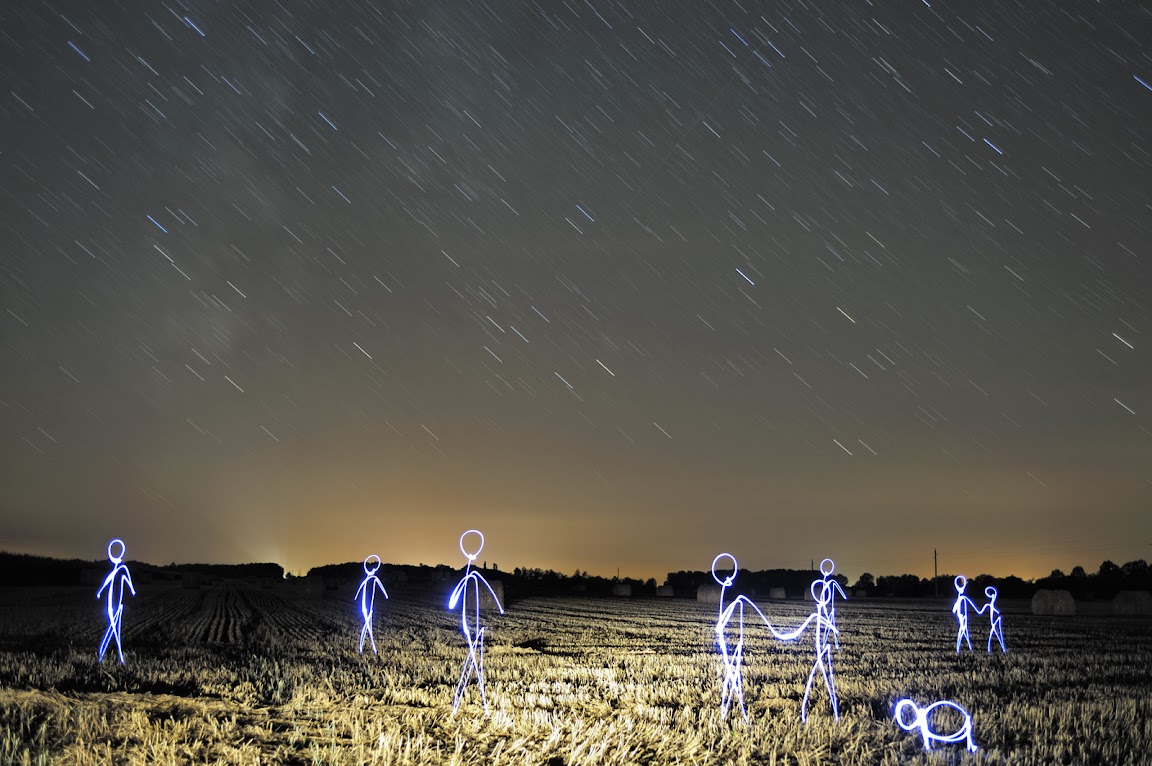
That’s why I really like a lot of the shots taken by French photographer Christopher Hibbert, who is clearly very clever indeed. Check out this photo, called "Field Walk" — which he created without software manipulation!

[Click to anthropophotonate.]

How cool is that? You can tell from the stars this is a time exposure, and while the shutter was open he used flashlights to create the human figures. I don’t want to read too much into the photo, but I like the way it ties the light from the stars in with the figures made from light. After all, as Carl Sagan loved to say — correctly — we are star stuff.

This image is part of a collection on Google+ by Christopher called Light is Life, and I highly recommend checking it out. G+ is really attracting a lot of great photographers, since they can post their work in good resolution and can discuss the sets as well. I’m following quite a few now, especially since so many also work in astrophotography.

I’ll note I post things on G+ that don’t fit the blog here, or are too long for Twitter. Follow me there if you’re interested.

Tip o’ the lens cap to Robert Scoble on Google+. Image credit: Christopher Hibbert, used by permission.


Malaria Vaccine Cuts Risk of Infection By Half | 80beats

Blood smear of the Plasmodium falciparum parasite

Preliminary results from the largest ever field trial of a malaria vaccine show the vaccine cut infant’s risk of getting the disease by half. In development for more than 25 years by GlaxoSmithKline and others, the vaccine cut the risk of catching severe malaria by 47 percent amongst infants ages 5 months to 17 months in the year after receiving it. 6,000 kids enrolled in the study, whose early results were published yesterday in the The New England Journal of Medicine and announced at a Seattle conference organized by the Bill and Melinda Gates Foundation, a major funder of the study and other efforts to combat malaria. The vaccine represents the first against a parasite-borne infection and has been notoriously difficult to develop since the protozoan that causes the illness (mainly Plasmodium falciparum) changes shape as it moves from the blood to the liver and back again.

While 47 percent isn’t very effective—most vaccines aren’t approved until they reach 90 percent or better—even this level of protection could save millions of lives, Glaxo’s chief executive Andrew Witty tells the New York Times. Malaria kills an estimated 780,000 per year, despite being preventable and treatable, mostly claiming the lives of African children.

[Via The Guardian]

Image: CDC / Wikimedia


For Kids Under Two, Steer Clear of Screen Time, Pediatricians Say | 80beats

Parents should strictly limit how much children under two years old watch television or videos, says the American Academy of Pediatrics in a new policy statement, since TV time not only doesn’t seem to benefit babies, it may come with developmental drawbacks. (Activities like computer and touchscreen games, where the babies interact with what’s happening on the screen rather than passively watch it, aren’t included in the statement.) The academy issued a similar statement in 1999, discouraging screen time for kids less than 24 months old—and in the intervening decade, there’s been more research to back up that recommendation.

Time spent watching TV is, scientists point out, time away from the independent play known to be important for healthy cognitive development, and increased screen time is linked to developmental delays. But even if babies aren’t simply sitting and watching a video, a TV or movie playing in the background—as one researcher calls it, “secondhand TV”—could have downsides. Not only does it distract babies, who look up at a video on average three times a minute even if they’re otherwise occupied by play, it distracts parents, as well, leading them to talk to their little ones less—not good news for babies’ language development, which, research suggests, gets a big boost from parental talk time.

What’s more, there’s no good evidence that children under two get anything out of videos, even ones billed as educational. Kids younger than 18 months, one study found, don’t even seem to care whether a video is played backward or forward—a sign they’re not really following what they’re seeing.

Read more at Wired, Scientific American, and LiveScience.

 Image courtesy of iandeth / Flickr


New, From the Makers of Stuxnet: The Duqu Virus | 80beats

virus

On October 14, security company Symantec got word from a research lab that they’d discovered a piece of malware that looked a lot like Stuxnet, the sophisticated computer virus that made headlines last year after its anonymous designers used it to attack Iran’s nuclear program. This new malware, called Duqu by the researchers who discovered it, shares much of Stuxnet’s code, suggesting that it came from the same people who built the first virus, or at least people who had access to the source code.

Found in computer systems in Europe, Duqu isn’t intended to destroy a physical object, the way Stuxnet was, but rather is gathering information by recording users’ keystrokes and collecting details from the infected system. While Stuxnet contained instructions for hijacking industrial control systems in order to wreck uranium-purification centrifuges, Duqu is searching for plans and specifications that will let its designers launch an attack on such a system in the future. Launched after Stuxnet was discovered, Duqu doesn’t replicate, and appears to have been directed to a very limited number of European targets, including companies that make industrial control systems. It self-destructs after 36 days, presumably to avoid detection.

Read Symantec’s blog post and full report here; check out all our Stuxnet coverage here.

Image courtesy of techknowbutler / flickr


Adam Rogers and the Mystery of the Canadian Whiskey Fungus | Not Exactly Rocket Science

For the residents of Lakeshore, Ontario, the black fungus caking their homes was a problem, and they blamed the local distillery. For James Scott, the Sherlock Holmes of fungi, the identity of the unsightly mold was a mystery waiting to be solved. And for Adam Rogers, senior editor at WIRED, Scott’s quest was a story that needed to be told. Rogers spent three days tailing the fungus detective, and the result is a beautiful, sensory, fungal whodunit, with a brief history of alcohol on the side.

I was recently asked if I wanted to contribute anything to the Open Notebook, a site where science writers write about science writing. It specialises in taking big, important stories and dissecting how they were conceived, crafted and refined. It’s about the stories behind the stories. I’ve been a fan of the Open Notebook from the beginning. Not only does it highlight the best science writing around but we get a wonderful look at how the best professionals in the field do their work. It’s an antidote to the caricature of the lazy, uninformed science journalist, and it helps those of us who care about the profession to aspire to higher standards.

When I was thinking which story to delve into, Adam’s whiskey tale was an obvious choice. It was one of my favourite pieces of the year. All of the elements of a great science feature are here. It’s a story, not a review, and it uses a compelling central character to explore the fascinating and overlooked world of fungal science.  The explanatory element is crystal clear without skimping on detail. The prose is vivid with sensory detail and has a light, lilting cadence to it. And more than any piece I have recently read, it bares open the process of science, and the curiosity and passion that drives its practitioners. It’s science as a quest: frustrating and never-ending, but always captivating.

Check out Adam’s story if you haven’t already, and then read about how he built it at the Open Notebook.

Image by Shadle

Scientists are from Mars, the public is from Earth | Bad Astronomy

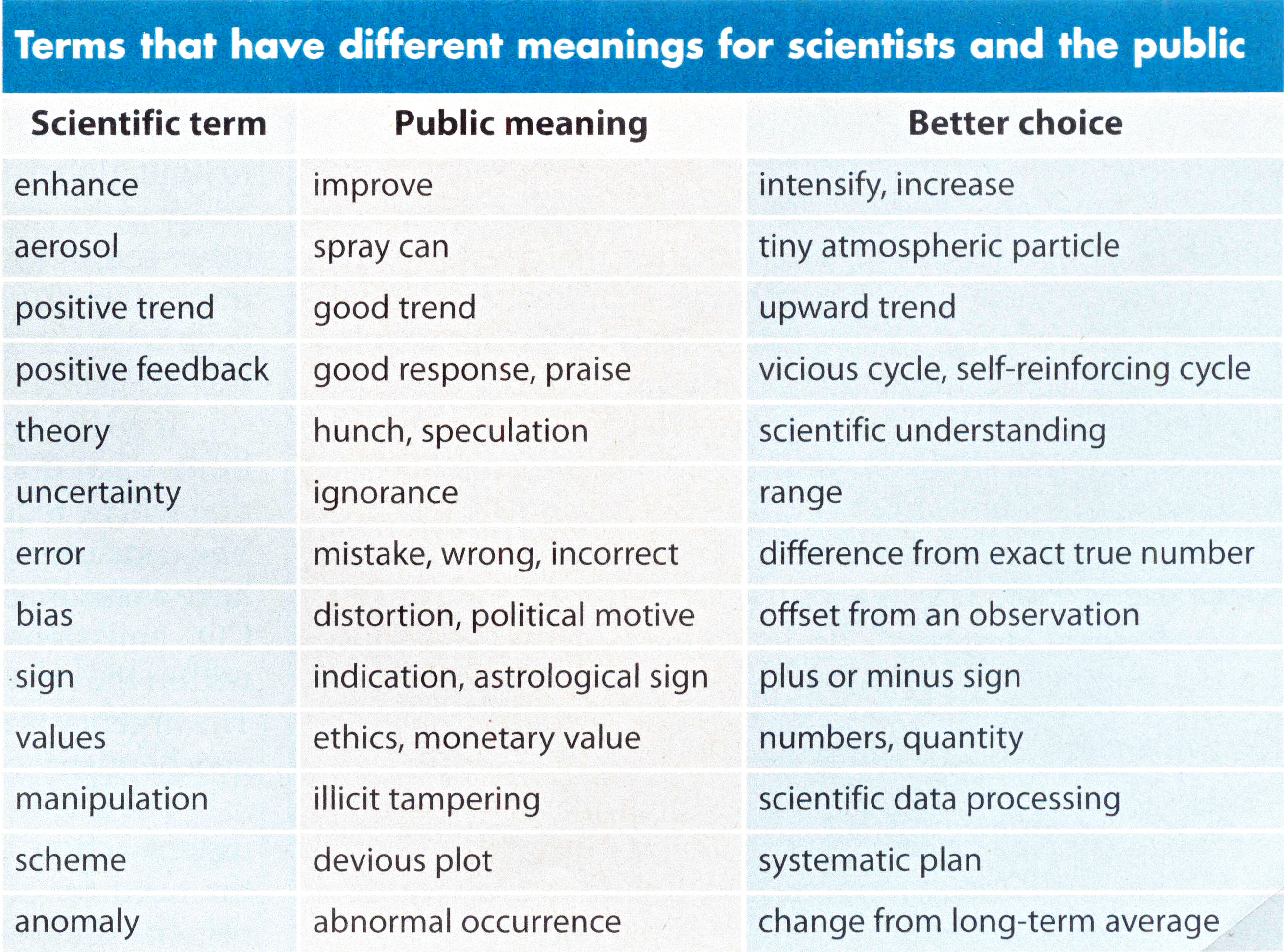
The American Geophysical Union blog has a link up to a very interesting table, and I feel strongly enough about this topic that I want to share it with you. It’s a list of words scientists use when writing or otherwise communicating science, what the scientists mean when they use that word, and most importantly what the public hears.

[Click to enverbumnate.]

I’ll admit, when I read it I laughed. But then my chuckle dried up when I realized just how dead accurate this is. And the smile pretty much left my face when I read that this table is from an article called "Communicating the Science of Climate Change," by Richard C. J. Somerville and Susan Joy Hassol, from the October 2011 issue of Physics Today.

Yup. I think they have a pretty good point.

My career at the moment could pretty much be called "Science Communicator". I do it here on this blog, I do it on Blastr and in Discover magazine, and when I give talks. Before that (and I guess it’s an occupation that never really leaves you) I was a professional scientist for many years. My training ran deep: 4 years undergrad, 6-7 in grad school, then a decade or so of research after that. I could toss around the phrase "Don’t over-iterate the Lucy-Richardson deconvolution algorithm or else you’ll amplify the noise and get spurious data spikes" with the best of ‘em.

As a science writer, though, I can’t use that! I have to say, "Cleaning up a digital image means using sophisticated mathematical techniques that can sometimes mess the image up and fool you into thinking something’s there that really isn’t."

I hope you can appreciate the difference.

So when I write, I try pretty hard to make the science topic accessible without "dumbing it down". I assume my reader is intelligent, but unfamiliar with the concepts I might be discussing. I try to define words if a reader might not know them, or link to someplace they can get more info if they need it.

But as that table shows, there are plenty of words I use all the time that someone else might know, and think means something else. And this is incredibly important, especially if a science writer — as happens more and more often these days — needs to defuse some sort of political spin thrust upon a topic. A classic example in the wholly-manufactured Climategate "controversy". A lot of hot air was generated over the use of the word "trick" in the stolen emails — which most people interpreted as meaning the scientists did something underhanded and sneaky to hide something important. In reality, we use that word to just mean a method of doing something that’s clever. It’s like saying, "The trick in never losing your car keys is to always hang them on a hook by the door that leads outside." See the difference?

But over that, political battles are won or lost.

There are times I fret over a word in a post. It took me a while to start using the word "denier" instead of "skeptic", for example, but the difference is important. I’ve fought for years to teach people that skepticism is not cynicism or denial; it’s asking for and looking at evidence logically and rationally (in a nutshell). What’s funny is that now the media uses phrases like "climate skeptic" when talking about some people who are not skeptics, in that they are not looking at the evidence logically and rationally. They look at evidence so they can figure out how to spin it, cast doubt in the mind of the public over something that is actually a fact.

That’s why I call it "denial". The word fits, and I intend to continue using it when it does.

I could go on and on.

But here’s the point: communication isn’t simply casting out information from atop a tower. There are two parts to it: presenting an idea to someone, and them understanding it. Sometimes we have to change the way we word things to make that second half happen. Otherwise we’re shouting all the facts in the Universe to an empty room.

Tip o’ the thesaurus to Joanne Manaster.