Saturn, raw | Bad Astronomy

There are times when I see an astronomical image so powerful that Im momentarily stunned, my brain kicked hard enough that all I can do is stare at it and soak it in.

This picture of Saturn is the latest to affect me this way:

[Click to embiggen.]

This astonishing image was taken on June 13, 2012 by the Cassini spacecraft when it was 2.6 million kilometers (1.6 million miles) from the ringed planet thats more then six times farther than the Moon is from the Earth. Even then Saturns rings span too broad a space to see completely. But artistically, perhaps, it works even better; their vast size is intimated instead of spoken aloud, the thousands of thinner component rings only hinted at. You can see their shadow on the tops of Saturns southern clouds thousands of kilometers below, the Sun shining down from the north to the left as seen in this oddly-angled shot. The clouds themselves are almost featureless, but you can still see some boundaries between oppositely-blowing wind belts, and even the long, snaking remnants of a titanic storm that raged in the north last year. Its incredible.

Moreover, this image has not been processed in any way: its raw, taken right off Cassinis detectors and sent home to Earth (I shrank it a bit to fit the blog, but otherwise didnt touch it). The sky behind the planet isnt entirely dark, there are a handful of hot pixels you can see on the planet, and there are other defects here and there that catch the eye. But even that takes nothing away from the power of this image to me, and in many senses actually adds to it.

Cassini is out there. Its well over a billion kilometers away from Earth and the Suns warmth, moving through space, enthralled by the deep and long-reaching gravity of this huge planet. Quietly, obediently, and with hardly any glitches or complaints, it takes picture after picture, reads and records the environment around it, saves the data, and then sends it via radio waves back to Earth, no more than a blue dot in its sprawling sky.

This is what I see, this is how my mind reacts once my brain has a moment to compose itself. Its a fantastic tableau, a static shot of a magnificent planet such a long, long way away. And always, when I see these, I also think: we did this. We flung this complex machine into the distant solar system to study Saturn, and we did it because we want to find things out.

It is among the best things we do.

Image credit: NASA/JPL/Space Science Institute. Thanks to Michael Interbartolo for posting about this latest batch of raw images in his Google+ stream.

Continue reading here:

Saturn, raw | Bad Astronomy

Fiberglass fibers cause lung diseases and cancer

By Paul Fassa

The case against asbestos in building materials was finalized after decades of research traced several severe lung cancer incidents to asbestos poisoning. Now fiberglass, the replacement for asbestos, is under similar scrutiny for the same reasons.

Independent researchers at Cornell University discovered that sick building syndrome (SBS), which causes many occupants to suffer similar health issues, occurred mostly in recently built airtight structures without adequate internal air cleaning systems. They ran out of research funds and couldn't continue.

A couple of decades ago, the National Institute for Occupational Safety and Health (NIOSH), a medical wing of the Department of Labor, made an alarming discovery regarding man made mineral fibers (fiberglass). They determined that the fibers created DNA damage, which leads to chronic illness and is carcinogenic.

An anti-regulatory Congress that encouraged the rapid rise of biotech industries, such as Monsanto, threatened to abolish NIOSH around that time. Meanwhile, the large suppliers of fiberglass insulation claim they've done their own research. Read more…

Cardiofy Heart Care Supplement

Source:
http://anti-aging-for-today.blogspot.com/feeds/posts/default?alt=rss

Global Telemedicine

Global TelemedicineTelemedicine has truly become a global industry. According to a report by BCC Research, the global telemedicine market reached $11.6 billion in 2011, and is expected to triple to $27.3 billion by 2016. In the U.S., the passage of new health insurance laws has sparked an increased focus on the use of telemedicine as a tool to reduce healthcare costs and streamline patient care. Telemedicine technologies can help healthcare providers meet the expected increase in demand for medical care without causing unnecessary delays in treatment or requiring cutbacks in other areas. With the use of telecare devices, software and services, physicians can diagnose and treat patients quickly and efficiently – from anywhere in the world.

The use of telemedicine technology, which is steadily growing in popularity in the U.S., has far-reaching applications worldwide. Telecare equipment, such as examination camerasremote monitoring devicesdigital scopes, and mobile telemedicine carts, allow patients in remote locations greater access to quality healthcare. By bringing the physician to the patient, telemedicine is truly transforming the way we think about traditional patient care. It is no longer necessary for rural patients, who often have limited resources, to travel great distances in order to receive quality medical care.

GlobalMed is poised to help medical care providers worldwide improve patient care with innovative telemedicine products, software and services. Whether you are just getting started with telemedicine, upgrading your existing technology or simply want more information about the products and services we offer, contact GlobalMed today to learn how we can help you. No matter where you are located in the world, we have a telemedicine representative near you.


Source:
http://feeds.feedburner.com/DigitalPathologyBlog

Ventana takes Digital Pathology to a new level with the new VENTANA iScan HT Scanner

TUCSON, Ariz., June 13, 2012 /PRNewswire via COMTEX/ -- Ventana Medical Systems, Inc. (Ventana), a member of the Roche Group, today announces commercial availability of the VENTANA iScan HT slide scanner(1) in North America to be followed by Europe, the Middle East and Africa in July, 2012.

"The launch of the VENTANA iScan HT scanner is a significant milestone for the pathology industry. Digital pathology can increase diagnostic confidence, reduce subjectivity and ultimately improve patient care with consistent and reproducible results," says Mara G. Aspinall, President of Ventana Medical Systems, Inc. "This newest instrument exemplifies the latest advancements in digital technology that I believe will continue to transform the industry."

The VENTANA iScan HT slide scanner is the most powerful high-throughput brightfield scanner in the anatomic pathology market today, enabling pathologists and lab managers to optimize their digital pathology workflow with efficiency, convenience, speed, throughput and reliability for unprecedented results.

"I have put the VENTANA iScan HT through its paces in a thorough evaluation and find the instrument produces crisp, sharp digital images at both 20X and 40X. The intuitive user interface and consistently accurate detection of regions of interest provide a practical whole slide scanner for walk-away scanning in high volume environments," says Dr. John W. Bishop M.D., Sacramento, California.

Incorporating cutting-edge optical focus and slide handling technologies, the VENTANA iScan HT features include:

Unprecedented throughput: the new system holds up to 360 slides and scans up to 80 slides per hour

Superior quality images at 20X and 40X (580 and 1160 times actual magnification respectively)

Intuitive, efficient and flexible workflow management, enabling a lab manager to load and unload slides while the scanner is in active operation

"Pathology labs clearly have a need for a high throughput scanner. They work with hundreds, sometimes thousands, of glass slides a day," says Steve Burnell, Ph.D., Ventana Digital Pathology and Workflow Lifecycle Leader. "The growing VENTANA portfolio of integrated digital solutions including slide scanners, CE-IVD and FDA-cleared algorithms and VIRTUOSO image management and workflow software, underscores our commitment to providing the most innovative and advanced digital pathology solutions available globally."

The VENTANA iScan HT slide scanner is ideal for high throughput, high volume applications and complements the VENTANA complete suite of digital pathology solutions which also includes the iScan Coreo Au slide scanner, VIRTUOSO image and workflow management software, and a portfolio of RUO, CE-IVD and FDA-cleared 510(k) image analysis algorithms. The iScan Coreo Au slide scanner best supports low to mid-volume pathology labs and specific applications such as frozen sections. Both the VENTANA iScan HT and the iScan Coreo Au slide scanners are integrated with VIRTUOSO for complete workflow management software functionality from image acquisition through reporting.

The VENTANA iScan HT instrument was showcased at CAP 2011 and USCAP 2012. For more information, visit http://www.ventanadigitalpathology.com

(1) The VENTANA iScan HT slide scanner is for research use only in the US and is not for use in diagnostic procedures.

About Ventana Medical Systems, Inc.

Ventana Medical Systems, Inc. ("VMSI") (six:RO)(six:ROG)(otcqx:RHHBY), a member of the Roche Group, innovates and manufactures instruments and reagents that automate tissue processing and slide staining for cancer diagnostics. VENTANA solutions are used in clinical histology and drug development research laboratories worldwide. The company's intuitive, integrated staining, workflow management platforms, and digital pathology solutions optimize laboratory efficiencies to reduce errors, support diagnosis and inform treatment decisions for anatomic pathology professionals. Together with Roche, VMSI is driving Personalized Healthcare through accelerated drug discovery and the development of "companion diagnostics" to identify the patients most likely to respond favorably to specific therapies. Visit http://www.ventana.com to learn more.

via MarketWatch

Source:
http://feeds.feedburner.com/DigitalPathologyBlog

Experienced Researcher Wanted for Image Analysis Application and Development–OncoMark Limited

We are looking for an experienced researcher to join OncoMark Limited (http://www.oncomark.com). Our offices are based at NovaUCD, which is a Technology Transfer and Innovation Centre at University College Dublin, Ireland (http://www.ucd.ie/nova). OncoMark is currently involved in an EU funded project entitled ‘Fast-Tracking Pathology via Automated Image Analysis and High-Performance Computing: Application to Prostate Cancer Diagnostics’ or FAST-PATH. This project is a Marie-Curie Industry-Academia Pathways and Partnership (IAPP) project, and involves 5 other partners around Europe.

Description

The researcher recruited to OncoMark will perform aspects of this project and will be responsible for developing and applying automated image analysis approaches for quantitation of prognostic biomarkers in prostate cancer. The researcher be involved in tailoring current proprietary algorithms for this specific project, and be a key driver in the commercial development of this software. The fellow will also be responsible for scanning of glass slides to create digital slides and performing automated image analysis. FAST-PATH is centred on taking advantage of the convergence between image informatics, high performance computing and tissue diagnostics, which is central to the emergent arena of digital pathology. Our consortium brings a range of advanced digital pathology expertise and approaches from both academic and industrial sectors to address some of the key issues in prostate cancer diagnostics.

Nr of positions available : 1

Research Fields

Biological sciences - Biology

Career Stage

Experienced researcher or 4-10 yrs (Post-Doc) 

Research Profile

Recognised Researcher (R2) 

Comment/web site for additional job details

Minimum Requirements:
- BSc in biological discipline or computer science
Jobs - EURAXESS - European Commission Page 1 of 5
http://ec.europa.eu/euraxess/index.cfm/jobs/jobDetails/33763943 21/03/2012
- MSc or PhD
- >4 years full-time research experience (including time spent doing post-graduate degree)
- Proven experience of image analysis algorithm development and computer programming (knowledge of C++ a requirement)
Desired:
- Knowledge of histology or tissue structure an advantage
- Knowledge of histological techniques (immunohistochemistry, tissue microarrays etc.)
- Ability to multi-task and work on different projects simultaneously
- Highly effective verbal and written communications skills
- Self-motivated and driven
- Experience working as part of a team
- Fast learner that requires minimal supervision
- Willingness to travel abroad to interact with collaborators and partners
Eligibility:
For recruitment under the Marie Curie IAPP, there are several rules regarding mobility:
• Researchers must not have resided or carried out their main activity in Ireland for more than 12 months in the last 3 years.
Contract:
- 1 year in OncoMark, Dublin, Ireland
Possible start date: May/June 2012
Salary: Salary subject to experience
Contact: To apply for this position please send a comprehensive CV and Cover Letter to jobs@oncomark.com.

Courtesy of The European Commission

Source:
http://feeds.feedburner.com/DigitalPathologyBlog

An internist, surgeon and pathologist go duck hunting

This is an old joke but a recent experience with a surgeon taking out a long segment of bowel worried about a tumor without mentioning a site for the tumor or a solid reason why he thought there was a tumor reminded me of how true this can sometimes can be.

An internist, a surgeon and a pathologist decided that they were working too hard and that they should go duck hunting together.

A couple of mornings later found them sitting in a duck blind waiting for the birds. Pretty soon a bird appeared on the horizon.

The internist watched it carefully as it came over and said, "Gentlemen, observe the colorful plumage, the quacking call and the web feet trailing behind."

As the bird disappeared out of range, he said, "Based on my observation, I would venture that we have seen a duck, but further tests may be necessary before we decide on a course of action."

The surgeon was furious.  He told the internist, "It looked like a duck, it quacked like a duck, it was probably a duck."

The other doctors looked blankly at him, but there was a slight sneer from the surgeon.

It wasn't long until another bird appeared. They waited until it came closer and then the surgeon leaped to his feet with his gun. He started shooting wildy.

Feathers and pieces of feet, blood and guts and bill exploded overhead.

A sorry looking carcass fell to the ground.  

The surgeon turned to the pathologist and said "Go over there and tell me if that is a duck."


Source:
http://feeds.feedburner.com/DigitalPathologyBlog

“By the year 2015, half of all medical images will be in the cloud”

Dell to Host Agfa Medical Imaging Database in the Cloud

Dell's cloud infrastructure will host Agfa's imaging archive to allow doctors to incorporate images into electronic health records.

Dell has announced it will host Agfa Healthcare's medical imaging archive in the cloud.

The cloud will provide the storage capacity and processing power as doctors look for ways to make medical images compatible with electronic health records (EHRs).

Cloud computing will be an essential factor in this effort, especially when IT budgets are tight, according to Dr. Jamie Coffin, vice president and general manager of Dell Healthcare and Life Sciences.

"The world is moving to a patient-centric view of the [EHR]," Coffin told eWEEK. "You have to start to think about digital radiology, pathology, genomics and figure out how to store this in a format where you take and use it wherever your clinician is."

Agfa's medical imaging archive, called Imaging Clinical Information System (ICIS), is a central repository that allows doctors to capture, store and exchange medical images.

Using ICIS in Dell's cloud, clinicians can capture a medical image and related metadata and "marry" it with the patient demographics in an EHR, Lenny Reznik, director of enterprise imaging and information solutions for Agfa HealthCare, told eWEEK. "Their clinical information system allows you to image-enable all of the data that they have in their [picture archiving and communications systems, or PACS] into the [EHR]," said Coffin. "The idea is that they store it in the cloud, and customers can access it from wherever they are and whatever platform they're on."

Dell and Agfa announced their partnership on June 7.

ICIS incorporates the Impax Data Center, which unifies patient records across regions, hospital facilities and departments. As a vendor-neutral system, ICIS can store images from various PACS.

The Agfa platform also includes the Xero Technology Viewer, a tool that allows doctors to stream the images from any Web-enabled device. The image viewer lets doctors embed images directly into an EHR.

Agfa customers will be able to access images either in Agfa's ICIS or Dell's Cloud Clinical Archive, said Coffin.

Dell announced a similar agreement with Siemens in February in which the two companies would collaborate on a vendor-neutral image archive in the cloud.

In addition, Dell will offer its Cloud Clinical Recovery platform to Agfa customers to provide disaster protection. Medical facilities using Agfa's imaging archive will be able to access additional analytics and data services in the future, said Coffin.

Hospitals with 300 to 400 beds that can't afford a data center infrastructure or the personnel to operate it will be able to manage their images and data in the cloud, said Coffin.

"By the year 2015, half of all medical images will be in the cloud," Reznik predicted.

By allowing ICIS to manage the archiving of radiology images, doctors are free to concentrate on treating patients, according to Agfa. Storing images in the cloud allows providers to track patients over time and maintain longitudinal medical imaging record access, Michael Green, Agfa HealthCare's president and CEO of Americas region, said in a statement.

Storing the medical images in the cloud will allow doctors' offices or medical centers to manage data-intensive images when they lack physical space to store their own servers.

"A single pathology slide can be like 6GB of data because it's a high-resolution image," Coffin noted. "It really brings an ROI to the customers they've never been able to get before [from] on-site image management."

In addition, archiving medical images in the cloud allows health care providers to meet the Stage 2 requirements on meaningful use of EHRs, according to Dell. Medical image viewing is an optional menu measure for achieving Stage 2 compliance.

As health information exchanges (HIEs) continue to connect data from diverse EHR platforms, the cloud will be an important foundation as data elements such as imaging, pathology and genomics are incorporated into the exchanges, Coffin suggested.


Source:
http://feeds.feedburner.com/DigitalPathologyBlog

"X-ray Visions: Drawings and Prints from an Artist Residency at the NYU School of Medicine," Works by Laura Ferguson, Through August 13

On through August 13th at MSB Gallery at the NYU Health Sciences Libraries:

X-ray Visions: Drawings and Prints from an Artist Residency at the NYU School of Medicine
MSB Gallery, June 11 - August 13, 2012

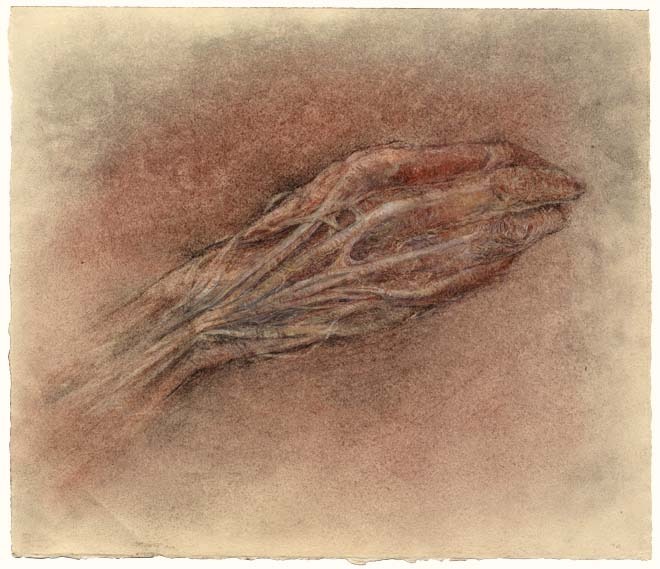
What if we could look into the body’s inner space with a kind of enhanced x-ray vision, without the need for dissection or medical imaging – perhaps lit by candlelight, with an eye to the beauty within? As an artist at NYU’s School of Medicine I’ve worked to create this kind of personal vision, making drawings in the Anatomy Lab and from 3D radiology images of my own body.

Art looks beneath the surface of life, and for me the place to look has always been the body. A curving spine – asymmetry at my core – means that for me, walking, moving and even breathing require conscious effort, an engagement with the workings of my bones and muscles, nerves, and senses. Drawing myself lets me work from the inside out, to visually convey the feeling of inhabiting this particular, individual body, and the many ways that personal identity and even consciousness are rooted in physical experience.

I see my work as following in the Renaissance tradition of Leonardo da Vinci and his great anatomy drawings, informed by the new ways of seeing made possible by contemporary medical imaging technologies. As a patient with a lifetime of x-rays, I was always fascinated by these mysterious, shadowy pictures – but felt disconnected from a part of me that seemed to belong more to my doctors than to me. As an artist I’ve been able to reclaim this hidden territory for myself, and hope my work can bring viewers to feel a deeper sense of connection with their own unique inner spaces.

Learn more about the floating colors process.

You can find out more by clicking here.

Source:
http://morbidanatomy.blogspot.com/feeds/posts/default?alt=rss

A Few More Slots Left: "Drawing from the Bestiary: Animal Anatomy of Real and Imagined Creatures," Class with Artist Saul Chernick, Observatory, June 25-July 16

We still have just a few more slots available for the upcoming class "Drawing from the Bestiary: Animal Anatomy of Real and Imagined Creatures" with one of our favorite artists, Saul Chernick. This class will teach students--via illustrated lectures and in-class projects including paper puppets and the creation of bestiary pages--"to use observational and imaginative drawing skills in tandem to capture the essential qualities of their subject" and "learn to draw animals (real, mythic, and otherwise) with greater skill and sensitivity."

You can see some of Chernick's wonderful artworks above; you can see more of them by clicking here. The class will take place on 4 consectutive Mondays, from June 25 to July 16th. The full class description follows. Also, please note that the class size is limited to 15, so if you are interested, please RSVP as soon as possible to morbidanatomy [at] gmail.com.

Drawing from the Bestiary: Animal Anatomy of Real and Imagined Creatures with Saul Chernick
A 4-part class with Artist Saul Chernick, M.F.A., Rutgers University
Dates: Mondays June 25, July 2, July 9 and July 16th (4 consecutive Mondays)
Time: 6:30-9:00 PM
Class Fee: $120
***Class size limited to 15; Must RSVP to morbidanatomy [at] gmail.com
This class is part of The Morbid Anatomy Art Academy

Contemporary artist and arts educator Saul Chernickis renowned for gorgeous artworks featuring convincingly corporeal depictions of imaginary or mythical creatures rendered in the style of Medieval and early Renaissance woodcuts from Northern Europe. Observatory is very pleased to announce a new workshop developed by Saul Chernick specially for the Morbid Anatomy Art Academy. In this class, Chernick will teach students--via illustrated lectures and in-class projects including paper puppets and bestiary pages--"to use observational and imaginative drawing skills in tandem to capture the essential qualities of their subject" and "learn to draw animals (real, mythic, and otherwise) with greater skill and sensitivity."

Full class description follows; you can see more of Chernick's fantastic work by clicking here. Class size limited to 15; Please RSVP to morbidanatomy [at] gmail.com.

Course Description
Open to artists of all levels, the goal of this workshop is help participants learn to draw animals (real, mythic, and otherwise) with greater skill and sensitivity. Through exercises in drawing and paper puppetry, participants will gain a deeper understanding of the skeletal/muscular structures of most mammals, reptiles, and birds. Participants will also learn to use observational and imaginative drawing skills in tandem to capture the essential qualities of their subject and create works of convincing visual fiction!
What to expect

  • Participants will cull images from the web to create a dossier on the animal(s) that interest them
  • Participants will fashion movable paper puppets to understand how their chosen animal moves
  • Participants will draw studies of the skeletal and muscular structures of animals
  • Participants will use the medium of their choice to create a Bestiary page entry that depicts an animal situated in an environment

Materials
What to bring to the first class:

  • Choose 1-3 animals and gather pictures on the web. Be sure to get images of their skeletons in profile. Please print these as they may be hard to use on a phone screen.
  • 3-5 sheets of Bristol Board Paper 9" x 12" or larger
  • Pencils & erasers
  • Scissors
  • Xacto or utility knife
  • Glue

What to bring for subsequent classes:

  • White or tinted drawing paper 16" x 20" or 18" x 24"
  • Tracing paper (same size as drawing paper)
  • Mechanical and/or regular pencils (2h, hb, 2b, 4b)

Optional:

  • Markers, watercolors, gouache, ink, brushes, chalk/oil pastels, colored pencils, Caran D’Ache, collage papers, etc (we’ll discuss further in detail!)

Saul Chernick, M.F.A., Rutgers University, is a visual artist and educator. Chernick has exhibited internationally in galleries and museums including the Aldrich Museum of Contemporary Art, the Bronx Museum of Art, the Jewish Museum of Art, as well as Max Protetch and Meulensteen Galleries in New York City. He has taught art for the public school system, the 92nd Street Y, Cooper Union, Parson's School of Design, and the Museum of Modern Art. He is currently the Professional Development Coordinator for the Joan Mitchell Foundation where he coaches New York artists in teaching art to young people throughout city. His work can be seen at http://www.saulchernick.com.

All images are by Saul Chernick and include, top to bottom:

  1. Field Urchin, 2011, from a series of studies in which he attempted to impose the proportions of cherubs onto horses.
  2. Desktop 2013, 2010, Ink, Watercolor, & Opaque White on Paper
  3. Heavenly Touch , 2009, Ink, Watercolor, & Opaque White on Paper
  4. Guilty Pleasures, 2010, Ink, Watercolor, & Opaque White on Paper
  5. Ars Gratia Artis, 2010, Ink on Paper

You can found out more here. As mentioned above, class size is limited to 15, so if you are interested, please RSVP as soon as you are able to morbidanatomy [at] gmail.com.

Source:
http://morbidanatomy.blogspot.com/feeds/posts/default?alt=rss

The Art of Illusions: Pre-cinematic Entertainment in Mexico, Velaslavasay Panorama, Los Angeles, June 16th


If only I lived in Los Angeles....

This Saturday, at the fantastic Velaslavasay Panorama:

The Art of Illusions
Pre-cinematic Entertainment in Mexico
An Illustrated Lecture by José Antonio Rodríguez
Saturday, June 16th
8 o ’clock pm
Tickets $12 {$10 VPES Members}
Advance tickets are highly recommended and are available at
https://www.brownpapertickets.com/event/242705
_____________________

The Velaslavasay Panorama welcomes José Antonio Rodríguez, who will be here to present an illustrated lecture about pre-cinematic entertainment in Mexico.

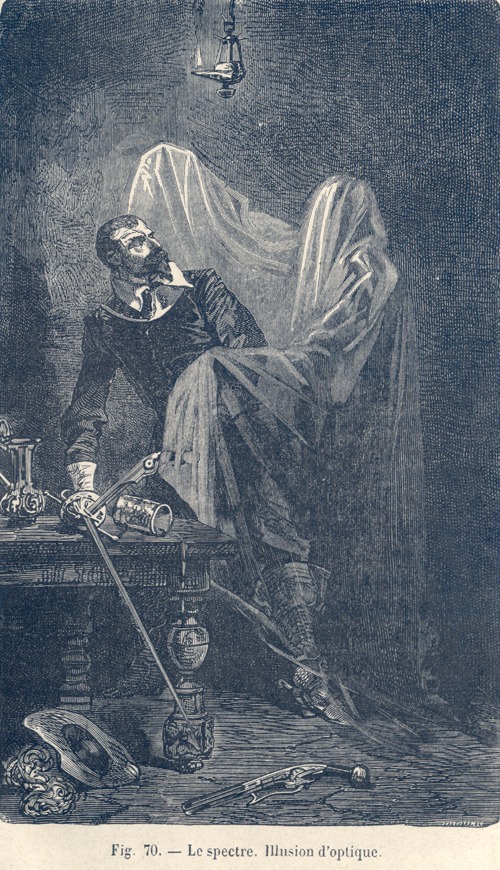
Having conducted research on the subject for many years, José Antonio Rodríguez will talk about the multitudinous forms of optical magic, including the magic lantern, diorama, cosmorama, panorama and scientific spectacles which were once popular throughout Mexico and beyond. Professor Rodríguez will discuss the entertainments and forms of visual culture in the eighteenth century as they were experienced in Mexico, which inspired and made possible the proliferation of moving images. He will also address the archaeology of visual media which encouraged the later popularity of the Kinetoscope and the Cinematograph in nineteenth century Mexico. In essence, "The Art of Illusions" will present ideas about how our encounters with visual spectacles guide us in constructing our own vision of the world.

José Antonio Rodríguez is an Art History professor of at the Universidad Nacional Autónoma de México (UNAM) and the author of the landmark publication The Art of Illusions: Pre-cinematic Entertainment in Mexico published through the National Institute of Anthropology and History in Mexico. He is also the author of Edward Weston: The Look of Rupture; Bernice Kolko: Photographer; Ruth D. Lechuga: A Mexican Memory; and Agustin Jimenez: Memories of the Avant-Garde. He is also the editor of the magazine Alquimia, amongst other works. This will be Professor Rodríguez's first appearance in Los Angeles.
This presentation has been funded in part by The Department of Cultural affairs of the City of Los Angeles, The Andy Warhol Foundation for the Visual Arts and The Velaslavasay Panorama Enthusiast Society.

You can find out more by clicking here.

Source:
http://morbidanatomy.blogspot.com/feeds/posts/default?alt=rss

Should Physicians Invest in Facebook?

via Medscape

Physicians and other investors often kick themselves for not having grabbed the opportunity to invest early in Microsoft, Google, or other companies whose stock price skyrocketed. Many doctors think that Facebook shares present the same type of once-in-a-lifetime opportunity. Are they right?

The debacle of Facebook's initial public offering should make anyone leery of jumping into an IPO, if they weren't already skeptical about them.

But it begs the question of whether one should invest in the social networking site that has revolutionized how people communicate with each other.

The much-anticipated IPO, which offered 421 million shares at $38 and valued Facebook at more than $100 billion, was the subject of incredible hype beforehand and an emotional backlash afterwards as the price plummeted nearly 20% in the first few days of trading.

Analysts branded it a "broken IPO" and one compared the stock to a "falling knife" that no one wanted to grab.

MarketWatch commentator Chuck Jaffe scolded anyone who believed the hype by labeling the IPO "the stupid investment of the week," and said that the experience should teach investors once and for all that the letters IPO really stand for "it's probably overpriced."

Subsequent trading seemed to drive that point home as Facebook shares continued to dive, declining more than 30% from the IPO price of $38. The head of Morgan Stanley, which was the lead manager on the share sale, said investors were "naive" if they thought they would profit on the first day of trading.

Inspired by Other Tech Stock Winners

But optimists had visions of another Google dancing in their heads, which saw its share price double in the first few months of trading and quintuple within 2 years (though it has oscillated around $600 since then, with occasional bigger dips).

Apple, whose share price has risen steadily over the past 5 years, quintupling in value, probably ranks as the most successful big tech share. Apple, however, makes things that people buy -- iPhones, iPads, laptops, PCs -- and also makes a ton of money raking off part of the proceeds from content that gets sold to people using these devices.

Facebook, and Google for that matter, have more intangible assets -- hundreds of millions of Internet users who leave behind useful traces about what they're interested in buying.

Google, though, has proven that it knows how to deliver advertising messages to people who are interested in them, while Facebook has yet to figure out just how to insert commercials into the social networking experience.

General Motors drove home that point with the announcement just before Facebook's IPO that it was pulling its advertising from the site because it had seen no measurable return on that investment.

Facebook is nonetheless the 800-pound gorilla in a social networking phenomenon that has swept the globe. And while many still think it is just a passing fad, you'd have a hard time convincing anyone under 30 that such networking is not a permanent fixture in their lives.

Why You Should or Shouldn't Snap Up the Stock

For now, it seems likely that Facebook stock will be buffeted by high-frequency traders looking for quick profits in a volatile issue. More shares will be hitting the market in coming months as IPO lockups expire, so that it will be some time before a reliable price picture emerges. Some analysts see a chance of the stock going as low as $10, while others are tipping $44 in the short term.

Obviously nobody knows. Every investor has to make his or her own decision, and you will probably want to consult with your financial advisor in figuring it out for yourself. But answering the question of whether you should invest in Facebook makes for an interesting case study in which to review some tried-and-true rules on investing.

1. Don't invest in IPOs

Jaffe is right. Pricing IPOs has always involved balancing the desire of the sellers (the founders and investors who got the new company off the ground) for the highest possible price and the preference of the buyers (institutions and individuals) for the price that will allow the greatest chance for future gains. That balance has tilted decidedly in favor of the sellers in recent years, and many analysts are saying that Facebook's $38 IPO price was too high and will make it difficult for other tech companies to go public.

Although some institutional investors may feel it is necessary to get in on the ground floor with a stock that could become a must-own issue, there's very little reason for retail investors to feel that way.

There was a time when a stock that sold for $38 might never look back and you wouldn't have a chance to get it below $50 or $75. But that hasn't happened in a while, and your chances of getting lucky on one of those issues are not great.

In this case, you would have been better off waiting a day or two and picking up the stock for $31 -- if you think it's a good investment.

2. Invest in what you know

It would almost certainly be foolish to invest in Facebook unless you were an active user on the network or could talk to friends, children, or grandchildren who are. Facebook's main asset is its 900 million active users, so it's very important to have a feel for what they're thinking to understand the future of the company.

Rupert Murdoch's News Corp. missed the boat when it acquired MySpace, an early Facebook rival and the market leader at the time, for $580 million in 2005 only to sell it just 6 years later for $35 million after MySpace lost out to Facebook.

Analysts say that Facebook users -- the college generation that first embraced it a decade ago -- are already "aging" and that younger people today have numerous alternatives, such as Twitter, Pinterest, and Flickr, among others. Will members continue to use Facebook as faithfully as they have done, or will the switch from PCs to mobile phones as the main communication device favor some of these other formats?

Facebook has had some difficulty making the transition to smart phones, and the company's purchase of the photo-sharing service Instagram for $1 billion this spring was designed to help close that gap.

In a case like Facebook, your view of the company's future will depend a lot on what you think of Mark Zuckerberg, the young man who founded it and masterminded its rise as the premier social networking site. Can Zuckerberg continue to reinvent Facebook in a fast-moving tech environment in the way that Steve Jobs kept reinventing Apple? Reports out just this week say that Facebook is getting serious about developing its own smart phone and may spend another $1 billion buying the Norwegian developer of a versatile browser.

Other Important Considerations

3. Limit your exposure

Where does an investment in Facebook fit into your portfolio? Is it a purely speculative stock or do you see it as a key component of a 21st century portfolio? What is your timeframe? Do you want to see a strong gain and early exit or is this a buy-and-hold stock?

Because Facebook is not only a new company but basically a whole new industry -- social networking -- it is difficult to evaluate its performance so far or to make any forecasts. There is no track record or benchmark for this industry.

The phenomenon of social networking could vanish as quickly as it appeared, or Facebook could begin to look like a dinosaur as newer, nimbler rivals appear on the scene. For that reason, you have to be ready to lose your entire stake in Facebook or set a strict limit for selling if it reaches the price marking how much you're willing to lose. "Strict" means that you really sell at that price and don't fall into the retail investor's trap of holding out for the stock to come back.

If you go into the stock for a relatively quick gain, set a deadline depending on the timeframe for this investment. Is "quick" 1 year or 5 years? You could have sold Google after 2 years, for instance, and booked the same gains as if you had held it and sold now.

4. What is your opportunity cost?

If you invest in Facebook now, will it make more money for you than other investments would? Value investors look for stocks that are undervalued. A lot of people concluded that Facebook was overvalued when it plummeted in the first few days of trading, but some analysts felt that it was undervalued at the IPO price of $38 and really undervalued at $31.

Facebook has no track record, so it might be easier to identify other stocks as undervalued based on their performance. David Rolfe of the RiverPark/Wedgewood Fund suggested at the time of the Facebook IPO that investors would be better off putting their money into proven stocks such as Warren Buffett's Berkshire Hathaway and Apple, which seem to be undervalued now based on their past performance.

5. Know what you're looking for in an investment

Some retail investors are abandoning the stock market, which they see as a casino rigged in favor of the house. The Facebook IPO seems to be a poster child for everything that's wrong with Wall Street now -- institutional investors getting better information, technology favoring the big investors over small investors, greed overcoming fairness.

But the very size of the company and of the initial float of more than 400 million shares should make Facebook less volatile once the waves from the IPO finally subside. In other words, if Facebook has a future, buying shares is probably a good way to benefit from it, regardless of the IPO glitches.

Many investors would prefer to hit a home run with a great stock pick than play the small ball of eking out gains through a well-balanced mutual fund. But that can lead to a lot of attempts and failures. Are you in a position now in your career or your retirement planning that you can afford to take a big loss if it means you could potentially have a huge win? If so, maybe you will want to step up to the plate and take a swing.

via Medscape - Medscape Business of Medicine © 2012 WebMD, LLC


Source:
http://feeds.feedburner.com/DigitalPathologyBlog

Amber Parle not your typical UCDavis grad

Animal biology major Amber Parle, selected the student commencement speaker for the UC Davis College of Agricultural and Environmental Sciences' afternoon ceremony on Sunday, is not your usual graduate.

In 2011 Parle completed her first full marathon, only a year and two weeks after being hit by a car while walking in downtown Davis. And, beginning this fall, she will "follow her dream" by traveling the world for 10 years.

After being hit by a car, "I realized that life is too fragile to let dreams slip away, and so I decided that after college I would travel the world -- spending a year in each country for a total of ten years," she said.

Parle will speak at the 2 p.m. commencement in the Activities and Recreation Center Pavilion, where the College of Ag will confer degrees to students from 21 departments, including animal biology and entomology.

The other College of Ag commencement ceremony starts at 9 a.m. at the same site, and encompasses the other nine departments, including plant sciences and environmental horticulture and forestry.

Forensic entomologist Robert Kimsey serves as the master advisor of the animal biology program, which includes some 350 students. "Amber has a first-rate mind," he said, "and she led her study group."

Parle, born and reared in Southern California, is a 2008 graduate of Big Bear High School, Big Bear City, San Bernardino County. The valedictorian of her class, she was one of seven students, countywide, selected

Parle enrolled at UC Davis immediately after high school. During her time at UC Davis she explored several interests including painting, acting, drawing, photography, fitness, writing, and singing. She is currently working on her first novel and a collection of poems -- both of which she hopes to get published soon.

Parle will be leaving for South Korea in fall of 2012, where she has a yearlong contract to teach English.

After that "I will go wherever my heart takes me," she said.

Go here to see the original:
Amber Parle not your typical UCDavis grad

Miss Davis County crowned Miss Utah 2012

Kara Arnold, Miss Davis County, was crowned Miss Utah 2012 on Saturday night at the Capitol Theater in Salt Lake City.

Arnold, of Bountiful, is a biochemistry major at the University of Utah and was recently accepted into the universitys medical school. Along with the title she won Saturday, she will receive a $10,000 scholarship to help her toward her goal of becoming a physician. She received a preliminary award for academic excellence, which is sponsored by and decided upon by the Miss America organization.

During her reigning year, Arnold will travel the state promoting her chosen platform "Discover Your Potential Step Up with STEM," serving as an ambassador for the Childrens Miracle Network Hospitals. She will also be the official spokeswoman for the Child Protection Registry, which is dedicated to protecting Utah families from adult-oriented solicitations.

First runner-up was Miss Duchesne County, Brittani Reinhardt; second runner-up was Miss Pioneer Valley, Ciera Pekarcik; and third runner up was Miss Orem, Hannah Harkness. All will receive varying amounts of scholarship money.

Copyright 2012 The Salt Lake Tribune. All rights reserved. This material may not be published, broadcast, rewritten or redistributed.

Read the original post:
Miss Davis County crowned Miss Utah 2012

Centenary College hosts tactical interview program

Centenary Colleges Institute for Law Enforcement & Emergency Services Education (ILEESE) held its fourth annual major in-service training event to educate the law enforcement community, on The Tactical Interview Program, on June 5 at Centenary College in the David and Carol Lackland Center. A total of 252 members of law enforcement were in attendance. The seminar was funded at no cost to participants through a grant from the United States Department of Justice.

Jerry Lewis, who is a consultant in the areas of behavioral science and statement analysis, led the seminar. Topics included a psychological analysis of the interview from the viewpoints of the investigator as well as the subject and how an investigator may determine truthfulness, deception and their relative value in an interview. The strategies are designed to enhance interviewing skills through the application of scientific principles and persuasive techniques.

Lewis specializes in the areas of law enforcement and education. He spent 25 years in the New Jersey State Police. During his tenure, he supervised the Violent Crime Analysis and Polygraph Unit. He currently maintains a relationship with law enforcement agencies throughout the United States as both a consultant and instructor in his areas of expertise. He possesses a Masters Degree in Education from Seton Hall University, holds an adjunct faculty position with Northwestern University and has been a guest lecturer at the Delaware State Police Homicide School, New Jersey Homicide Investigators Association Conference and the New Jersey Missing Persons School.

He has conducted interviews and analyzed statements in thousands of cases involving every type of criminal case. The techniques he developed over 30 years of experience are based on the science of the mind and result in confessions from 90 percent of guilty subjects, regardless of culture, upbringing, or intelligence. In 1988, he developed the five day New Jersey State Police Interviewing and Interrogation School. He has customized training for numerous federal, state, county and local law enforcement agencies such as U.S. Customs, IRS, Chicago Police Department, Delaware State Police, Anne Arundel County Maryland, Royal Canadian Mounted Police, Ontario Provincial Police, Magloclen, and regularly presents his four-day course at police academies through New Jersey.

This program will be extremely useful for these professionals, says Mark Noll, director of the Institute for Law Enforcement & Emergency Services Education at Centenary College. The seminar not only illustrated what to ask and what not to ask, it also outlined how one may analyze statements so as to determine truth and deceit.

Read the original post:
Centenary College hosts tactical interview program

"Imagine" examines the anatomy of brilliance

Imagine How Creativity Works By Jonah Lehrer Houghton Mifflin Harcourt. 252 pp. $26

Reviewed by Rickie Roberts

What do Bob Dylan, MIT, 3M, Tel Aviv, and the "I 0 New York" logo have in common?

In Imagine, author Jonah Lehrer weaves all of these people, places, and things into a brilliant narrative about well, simply put brilliance.

Lehrer is the author of two other equally engaging books, Proust Was a Neuroscientist (2007) and How We Decide (2009). Here, in only his third decade on this Earth, Lehrer has found a recipe for interpreting the insights, impulses, and creative possibilities of the most complex species on the planet. A graduate of Columbia University, he did a double major in neuroscience and English. In this unlikely pairing of disciplines, he has found a calling putting the highly intricate processes of the human mind into a language and a narrative that bring home his ideas to the more narrowly educated reader. In Proust Was a Neuroscientist, he explored the connection between the literary and scientific communities, and in How We Decide, he tackled the multifarious issue of decision-making by tying neuro-mechanics, context, culture, emotions, and history into a combination "how-do-we" and "how-to" book.

In Imagine, Lehrer has gone one step further. By exploring the common thread of imagination in the divergent worlds of song-writing, tape manufacturing, city building, play-writing, animation producing, mop inventing, and so much more, he is able to draw upon his unique combination of skills, knowledge, and experience to welcome the reader to a creative process that is becoming more and more critical in our society.

In chapter after chapter, he brings forward case studies of the contributions that creativity and imagination have made in success stories, ranging from bartending to pharmaceutical manufacturing. But he doesn't stop there. Through careful analysis of each case he helps us to understand the process that has taken place. From what is happening in neurotransmitters at the time of insight to the paint color on the walls, he guides us through these stories as if the lessons we learn here will make each one of us somehow capable of great things.

While he makes great use of his own scientific education and background in the narrative, Lehrer is able to do so in a way that makes even us common folk comfortable. He neither speaks over our heads in scientific matters nor does he seem to assume that the reader doesn't understand how the brain functions. He speaks of the right- and left-side brain functions without over-explanation, giving his readers credit for knowing enough about these topics to put the pieces together. Many a reader will appreciate this because once you accept that we are not all Ph.D,s you can relax and take this thrilling ride through the relationships between failure and accomplishment, brilliance and biochemistry.

Smartly, Lehrer begins the books with two studies that immediately put you at ease and suck you in with the curiosity that a well-crafted book can generate: the invention of the Swiffer Sweeper and the ubiquitous musings of Bob Dylan. Who wouldn't want to read on?

His tale of how Bob Dylan "hit the creative wall" in 1965 and retreated to isolation before producing some of his most brilliant work is antithetical to his account of how Pixar Studios uses collaboration and criticism to support the creative process that has driven so many of the most heralded animated classics of the last 30 years. Yet, Lehrer makes it work. He neither prescribes nor lectures, allowing that both isolation and collaboration have value in the creative process and must be examined in the context of the task.

Read this article:
"Imagine" examines the anatomy of brilliance

What people are saying about Mississippi travel

"If I was in business -- which I am, for the state of Mississippi -- I couldn't justify (keeping the state jet). I sold it ... For me to compete with the (Louisiana Gov.) Bobby Jindals of the world, I do have to hustle, and go meet with some international partners. But the best way I can think to put it is that if you're going to go have a vacation and make it look like work, that just doesn't work any more. Whenever I travel, I assure you I come back exhausted ... Sure, we want to be involved in international business, particularly areas like Japan, but we have to make sure we're not wasting taxpayers' dollars on travel. That's the bottom line."

-- Gov. Phil Bryant

"All travel is not bad travel. There are times when state officials need to be traveling and by most accounts (former) Gov. Barbour traveled a lot, but he had a lot of results to show for it ... Of those 300 employees who did travel out of the country, were each and every one of those trips justified for the benefit of the state and its taxpayers? That's a question that needs to be answered ... Those are the kind of hard questions I think you will see this Joint Legislative Budget Committee asking."

-- Lt. Gov. Tate Reeves

"I can certainly understand the need for some (out-of-country) travel. Case in point: Gov. Barbour and MDA going to Japan to recruit Toyota or Nissan. This amount of travel really raises a red flag in my mind, especially in tough economic times ... With this amount of volume, I'm curious about the locations and the type of conferences and events."

-- State Auditor Stacey Pickering

"It certainly seems excessive. I can't imagine a justification for that much travel out of the country when the technology we have now should allow for video conferencing and other ways to participate in meetings or training. Businesses and families have had to cut back on their travel."

-- Forest Thigpen, Mississippi Center for Public Policy

"Why would all these agencies need to go out of the country? They could be down here at the Convention Center in Biloxi ... Every penny counts. Every dollar counts and we need to continue to curtail spending. I think our chairman will be having us look at all of this and I know he also wants to look into the amount agencies are spending on advertising."

-- State Rep. Carolyn Crawford, R-Pass Christian, vice chair of the House Accountability, Efficiency and Transparency Committee

Read the rest here:

What people are saying about Mississippi travel

Travel Notes: June 17, 2012

Contemporary theater

SHEPHERDSTOWN, W.Va. -- The Contemporary American Theater begins its 22nd season in historic Shepherdstown July 6 with five new plays that will rotate through July 29.

The plays are: "Gidion's Knot," by Johnna Adams; "The Exceptionals," by Bob Clyman; "In a Forest Dark and Deep," by Neil LaBute; "Captors," by Evan M. Wiener; and "Barcelona," by Bess Whol.

Single tickets range from $30 to $55. For more information on shows, prices and to order tickets, visit http://www.catf.org or call toll-free 800-999-2283.

TripAdvisor notes Stonewall

WESTON, W.Va. -- Lewis County's Stonewall Resort recently was presented the 2012 Certificate of Excellence Award by TripAdvisor, the world's largest travel website.

Mike Hager, general manager of Stonewall Resort, said, "The award is based on true guest experiences and their personal reviews of their visit to Stonewall Resort. We work hard every day to assure each guest enjoys their stay."

TripAdvisor, the world's largest travel site, said its travelers consistently commend the resort with the highest praise.

For more information or reservations, contact Stonewall Resort at 888-278-8150 or visit http://www.stonewallresort.com.

Camden Park kids' festival

Read the original post:

Travel Notes: June 17, 2012

Happenings in the travel world

Paddle Out for the Whales at Hervey Bay - pets optional. Picture: Supplied Source: National Features

ANGELA Saurine looks at what's going on in the world of travel including a special paddle out to the whales event in mecca Hervey Bay and a new funky hotel for Sydney.

1 See KI from a high

VISITORS to Kangaroo Island off the coast of South Australia will be able to take part in helicopter flights from September.

Heli Experiences will become the first permanent helicopter touring operation on the island, offering flights from Hanson Bay.

Each flight will showcase different aspects of the region's spectacular views, including Cape Borda Lighthouse, Admirals Arch, Snelling Beach and Vivonne Bay.

Ph 8582 6500 or see heliexperiences.com

2. Make sweet music with a range of holiday packages

VIRGIN Australia's holiday program Blue Holidays has introduced a range of cultural and musical event packages so travellers can book airfares, accommodation and show tickets in one hit.

It will include tickets to theatre events such as Agatha Christie's play The Mousetrap and Legally Blonde and the 18th Biennale of Sydney.

Continued here:

Happenings in the travel world