
First Ship Set of Magellan Aerospace F-35A Horizontal Tail Assemblies Installed

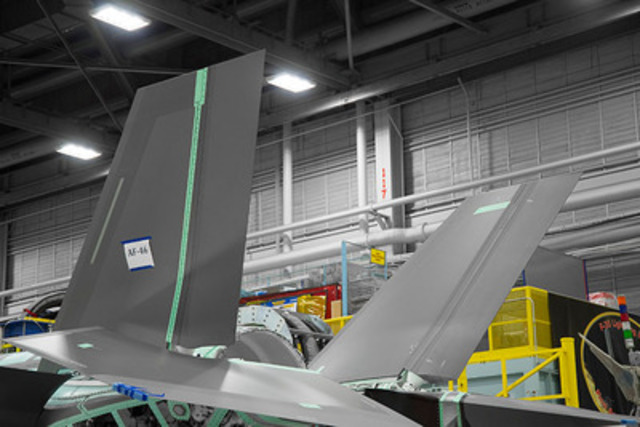
The first Magellan Aerospace-manufactured F-35 horizontal tail assemblies were installed at Lockheed Martin's final

TORONTO , Oct. 16, 2013 /CNW/ - Magellan Aerospace announced today, that the first complete ship set of F-35A Lightning II horizontal tail assemblies produced at its Winnipeg manufacturing division was successfully installed onto the aircraft at Lockheed Martin's final assembly line in Fort Worth, Texas . This successful installation of Magellan's horizontal tail assemblies is a key program milestone for the Corporation and demonstrates the many contributions being made by Canadian aerospace companies in the early stages of the F-35 program.

Magellan is under contract with BAE Systems, a principal member of the Lockheed Martin-led F-35 industry team, to produce horizontal tail assemblies for the Conventional Take Off and Landing (CTOL) variant of F-35. Magellan is expected to produce more than 1,000 sets of the components for the program over, approximately, a 20-year period. "The reports we have received from Lockheed and BAES indicate that the product we delivered to the assembly line was installed without complication," said Mr. James Butyniec , President and Chief Executive Officer of Magellan Aerospace. "We are pleased to see another of our F-35 assemblies preparing to take flight for the first time." In addition to the horizontal tail, Magellan has produced the vane box assemblies and transition ducts for all of the F-35B Short Take Off and Landing variants flying today.

Magellan's proactive investment in facilities, equipment, and processes in support of the F-35 Lightning II program has positioned Magellan to realize sales approaching $2.0B Cdn over the life of the F-35 program. Magellan's revenues to date on the F-35 program exceed $100M Cdn .

Since the inception of Canada's participation in the F-35 program in 1997, Canadian companies like Magellan Aerospace have been invited to compete for significant opportunities in support of this international program. This program milestone validates that companies such as Magellan can be successful and competitive in todays globalized aerospace supply chain.

About Magellan Aerospace

Magellan Aerospace is a global, integrated aerospace company that provides complex assemblies and systems solutions to aircraft and engine manufacturers, and defence and space agencies worldwide. Magellan designs, engineers, and manufactures aeroengine and aerostructure assemblies and components for aerospace markets, advanced products for military and space markets, industrial power generation, and specialty products. Magellan is a public company whose shares trade on the Toronto Stock Exchange (MAL.TO), with operating units throughout Canada , the United States , the United Kingdom , India , and Poland .

SOURCE Magellan Aerospace Corporation

Image with caption: "The first Magellan Aerospace-manufactured F-35 horizontal tail assemblies were installed at Lockheed Martin's final assembly line in Fort Worth, Texas. (CNW Group/Magellan Aerospace Corporation)". Image available at: http://photos.newswire.ca/images/download/20131016_C4394_PHOTO_EN_32105.jpg

See original here:

First Ship Set of Magellan Aerospace F-35A Horizontal Tail Assemblies Installed

Aerospace Veteran Vern Raburn Joins Atmospheric Satellite Innovator Titan Aerospace as Chairman and CEO

MORIARTY, N.M.--(BUSINESS WIRE)--

Titan Aerospace, a producer of solar-powered atmospheric satellites (atmosats), today announced that Vern Raburn has joined the company as Chairman and CEO. An accomplished high technology and aerospace leader, Raburn will bring to Titan an invaluable blend of real-world experience in business development, technology innovation and market creation.

A conflux of advanced technologies are finally enabling a dream that a lot of people have chased over the past three decades the vision of an atmospheric satellite to become a practical reality, said Vern Raburn. By delivering the value of a space satellite at a staggeringly low cost, Titan is poised to re-imagine and expand the satellite industry. I look forward to collaborating with my new colleagues at Titan to grow this important market.

Founded in 2012, Titan designs and manufactures atmosats a new type of unmanned aerial vehicle (UAV) that does the work of near-earth satellites at a fraction of the cost. Payloads could include equipment that provide real-time high-resolution images of the earth, voice and data services, navigation and mapping services and atmospheric-based monitoring systems. In August, Titan unveiled its first atmosat platform, SOLARA. Unlike traditional satellites, SOLARA is far less expensive to buy and fly, and it can easily be brought back for maintenance or payload upgrades. In contrast to other high-altitude UAVs, Titans solar-powered atmosats offer much longer endurance, staying aloft for one to five years, depending on the payload. Titan intends to leverage these breakthrough capabilities to unlock new applications that put commercial satellite services within reach of dozens of industries.

Verns passion for our mission is infectious and his leadership experience will be instrumental in helping us realize the tremendous market opportunity ahead for Titan, said Max Yaney, founder and CTO of Titan Aerospace. Were looking forward to working with Vern to bring our entrepreneurial vision to market.

Prior to joining Titan, Raburn was most recently founder and CEO of Eclipse Aviation, creator of the very light jet (VLJ) market and manufacturer of the Eclipse 500 jet. In his quest to change the way people traveled, Raburn led the Eclipse team to a number of notable achievements including pioneering the use of friction stir welding in aircraft structures and developing the PhostrEx fire suppression agent to replace the greenhouse gas Halon in aviation applications. In 2005, Eclipse Aviation was honored with the Robert J. Collier Trophy for leadership, innovation and the advancement of general aviation.

Earlier in his career, Raburn spent more than 25 years as a senior executive helping to shape the course of the high technology industry. He was among the first Microsoft employees and, as the president of Microsofts Consumer Products Division, was responsible for the companys entry into the retail channel. Following his tenure at Microsoft, Raburn served as executive VP and general manager of Lotus Development Corporation, where he played an integral role in the successful launch of Lotus 1-2-3. He has also served as chairman and CEO of Symantec Corporation and Slate Corporation. Raburn also worked as president of the Paul Allen Group, overseeing high technology investments for Microsoft co-founder Paul Allen.

Whether I was working at the inception of the PC industry, the packaged software business or the VLJ marketplace, it has been my personal mission to push the boundaries of technological innovation to redefine markets and make the impossible possible, said Raburn. At Titan I have found a home with like-minded colleagues that understand that change is not only possible, its inevitable. Im thrilled to join this stellar team and eager to get going on this next challenge as we bring new value to the satellite landscape.

Titan is a privately held venture with manufacturing facilities in New Mexico. The company is funded through staged equity financing from experienced venture capitalists, aviation investors and successful entrepreneurs. Titans Series A and A-1 rounds of financing have closed and its Series B financing round will open soon.

About Titan Aerospace

Original post:

Aerospace Veteran Vern Raburn Joins Atmospheric Satellite Innovator Titan Aerospace as Chairman and CEO

Stanford MOOC goes to extremes to teach physiology

By Aja Couchois Duncan

Video introducing Anne Friedlander's Environmental Physiology course.

The human body is amazing, as is the video that accompanies Anne Friedlander's Environmental Physiology course which will be offered as a free Massive Open Online Course (MOOC) to the public this winter.

To dramatically demonstrate the body's mysteries and its amazing adaptations, Friedlander, a consulting professor in human biology at Stanford as well as an athlete and scientist, created a series of stories and endurance tests, with the video camera rolling.

She was joined by the experimental subject of the course and the protagonist of the environmental physiology story, Where's Corey Now? or even more accurately, What in the World Is Happening to Corey Now?

Corey Dysick, teaching assistant for the course as well as a decathlete and Stanford alumnus, was exposed to a number of extreme environments to explore the impact these environments have on his and, by extension, everyone's body.

For one chapter, Dysick and Friedlander spent 48 hours at central Colorado's Pikes Peak, which tops out at 14,114 feet above sea level, to study the impact of high altitude on the body. In another, they flew in fighter jets to experience the effects of g-forces, or extra gravities.

In the chapter on stress, Dysick and Friedlander jumped from a plane at 15,000 feet over the Nevada desert to explore physiological responses to extreme stress on heart rate, cognition and pain threshold.

Students in the class will be immersed in the resulting sensory-rich videos.

Each of the chapters is followed by interviews with experts on the impact of environmental stressors on the body and with master athletes who have accomplished extraordinary feats such as scaling Mount Everest. These interviews are coupled with Friedlander's lectures covering the latest scientific findings about the impact of extreme environments on the human body, with practical tips on how people can mitigate some of these effects.

Read this article:
Stanford MOOC goes to extremes to teach physiology

Canadian scientists fine-tuning possible Ebola virus therapy

Helen Branswell, The Canadian Press Published Wednesday, October 16, 2013 7:12PM EDT

TORONTO -- Scientists at Canada's National Microbiology Laboratory are continuing to fine-tune a possible treatment for Ebola virus infection, one of the deadliest known to humankind.

In a newly published article, the Winnipeg-based scientists reported that their combination therapy saved three of four cynomolgus macaques and four of four rhesus macaques when it was given three days after the animals were infected with Ebola Zaire, the deadliest strain.

The scientists hope to test the drug cocktail in humans beginning in late 2014 or early 2015, if they can get approval from Canadian and U.S. drug regulators.

The work builds on earlier research which showed a cocktail of three cloned antibodies saved four of four primates when given 24 hours after infection and two of four treated 48 hours after infection.

This time the researchers added interferon-alpha, a chemical made by the immune system, to the treatment regime.

Two of four primates survived when they were given the chemical one day after infection, and then the antibody cocktail four days later.

In order for a treatment to be useful against the five types of Ebola viruses or their cousin, the Marburg virus, it must be something that can enhance survival when given days after infection, which is when cases would typically come to light.

"The concept of combining different treatments to improve efficacy and extend the treatment window is certainly interesting and the data look promising," Tom Geisbert, an expert in viral hemorrhagic fevers, said of the work. Geisbert is a researcher at the University of Texas Medical Branch in Galveston.

The senior author of the study is Gary Kobinger, head of the special pathogens program at the Winnipeg lab. The laboratory is part of the Public Health Agency of Canada.

Read more here:
Canadian scientists fine-tuning possible Ebola virus therapy

Winnipeg lab fine-tunes Ebola virus therapy

;

Gary Kobinger works in a mobile laboratory installed by specialists of the National Public Health Agency of Canada, in Mweka, Congo, Friday, Sept. 28, 2007. Scientists at Canada's National Microbiology Laboratory are continuing to fine-tune a possible treatment for Ebola virus infection, one of the deadliest known to humankind.

TORONTO Scientists at Canadas National Microbiology Laboratory are continuing to fine-tune a possible treatment for Ebola virus infection, one of the deadliest known to humankind.

In a newly published article, the Winnipeg-based scientists reported that their combination therapy saved three of four cynomolgus macaques and four of four rhesus macaques when it was given three days after the animals were infected with Ebola Zaire, the deadliest strain.

The scientists hope to test the drug cocktail in humans beginning in late 2014 or early 2015, if they can get approval from Canadian and U.S. drug regulators.

The work builds on earlier research which showed a cocktail of three cloned antibodies saved four of four primates when given 24 hours after infection and two of four treated 48 hours after infection.

This time the researchers added interferon-alpha, a chemical made by the immune system, to the treatment regime.

Two of four primates survived when they were given the chemical one day after infection, and then the antibody cocktail four days later.

In order for a treatment to be useful against the five types of Ebola viruses or their cousin, the Marburg virus, it must be something that can enhance survival when given days after infection, which is when cases would typically come to light.

The concept of combining different treatments to improve efficacy and extend the treatment window is certainly interesting and the data look promising, Tom Geisbert, an expert in viral hemorrhagic fevers, said of the work. Geisbert is a researcher at the University of Texas Medical Branch in Galveston.

More:
Winnipeg lab fine-tunes Ebola virus therapy

Canadian scientists work to fine-tune possible Ebola virus therapy

Helen Branswell, The Canadian Press Published Wednesday, October 16, 2013 7:12PM EDT

TORONTO -- Scientists at Canada's National Microbiology Laboratory are continuing to fine-tune a possible treatment for Ebola virus infection, one of the deadliest known to humankind.

In a newly published article, the Winnipeg-based scientists reported that their combination therapy saved three of four cynomolgus macaques and four of four rhesus macaques when it was given three days after the animals were infected with Ebola Zaire, the deadliest strain.

The scientists hope to test the drug cocktail in humans beginning in late 2014 or early 2015, if they can get approval from Canadian and U.S. drug regulators.

The work builds on earlier research which showed a cocktail of three cloned antibodies saved four of four primates when given 24 hours after infection and two of four treated 48 hours after infection.

This time the researchers added interferon-alpha, a chemical made by the immune system, to the treatment regime.

Two of four primates survived when they were given the chemical one day after infection, and then the antibody cocktail four days later.

In order for a treatment to be useful against the five types of Ebola viruses or their cousin, the Marburg virus, it must be something that can enhance survival when given days after infection, which is when cases would typically come to light.

"The concept of combining different treatments to improve efficacy and extend the treatment window is certainly interesting and the data look promising," Tom Geisbert, an expert in viral hemorrhagic fevers, said of the work. Geisbert is a researcher at the University of Texas Medical Branch in Galveston.

The senior author of the study is Gary Kobinger, head of the special pathogens program at the Winnipeg lab. The laboratory is part of the Public Health Agency of Canada.

Read more here:
Canadian scientists work to fine-tune possible Ebola virus therapy

Canadian national lab scientists in Winnipeg work to fine-tune possible Ebola virus therapy

By Helen Branswell, The Canadian Press Published Wednesday, October 16, 2013 5:42PM CST Last Updated Wednesday, October 16, 2013 5:44PM CST

TORONTO -- Scientists at Canada's National Microbiology Laboratory are continuing to fine-tune a possible treatment for Ebola virus infection, one of the deadliest known to humankind.

In a newly published article, the Winnipeg-based scientists reported that their combination therapy saved three of four cynomolgus macaques and four of four rhesus macaques when it was given three days after the animals were infected with Ebola Zaire, the deadliest strain.

The scientists hope to test the drug cocktail in humans beginning in late 2014 or early 2015, if they can get approval from Canadian and U.S. drug regulators.

The work builds on earlier research which showed a cocktail of three cloned antibodies saved four of four primates when given 24 hours after infection and two of four treated 48 hours after infection.

This time the researchers added interferon-alpha, a chemical made by the immune system, to the treatment regime.

Two of four primates survived when they were given the chemical one day after infection, and then the antibody cocktail four days later.

In order for a treatment to be useful against the five types of Ebola viruses or their cousin, the Marburg virus, it must be something that can enhance survival when given days after infection, which is when cases would typically come to light.

"The concept of combining different treatments to improve efficacy and extend the treatment window is certainly interesting and the data look promising," Tom Geisbert, an expert in viral hemorrhagic fevers, said of the work. Geisbert is a researcher at the University of Texas Medical Branch in Galveston.

The senior author of the study is Gary Kobinger, head of the special pathogens program at the Winnipeg lab. The laboratory is part of the Public Health Agency of Canada.

Excerpt from:
Canadian national lab scientists in Winnipeg work to fine-tune possible Ebola virus therapy

Antimicrobial Test Laboratories Cites Benefits to Modified AOAC Disinfectant Test

Round Rock, TX (PRWEB) October 16, 2013

Antimicrobial Test Laboratories (ATL) - a contract microbiology lab founded in 2006 by microbiologist Dr. Benjamin Tanner - has announced that AOAC Internationals altered passing criteria for two key methods used for disinfectant registration will benefit companies needing testing in major ways.

According to Dr. Tanner: AOAC International, a standards-setting organization, recently published changes to test methods used by disinfectant manufacturers to register their products with the United States Environmental Protection Agency (EPA), notably the Use-Dilution Method (UDM) for Pseudomonas aeruginosa and Staphylococcus aureus. The methods now permit a greater number of failures per test, reducing the impact of ordinary variability on failure rates. This is a big change that will positively impact companies seeking testing.

This is a great development for industry, said Jason Williams, Microbiology Manager at Antimicrobial Test Laboratories. Previously, manufacturers were only allowed one failing test surface per each set of 60 tested. Now, they are allowed up to three failing surfaces for Staph and Six for Pseudomonas.

Recent changes to AOAC methods are the direct result of years of hard work by members of industry and employees of EPA, and represent a shining example of industry and regulators working together to improve registration criteria, noted Dr. Tanner. Improved performance standards will enable new disinfectants to enter the market while at the same time making efficacy determinations more clear and reliable for EPA.

One interesting outcome of the change is its effect on test-method-choice by makers of spray disinfectants.

According to Tanner: Liquid spray products can be tested for registration using either the Use-Dilution Method or the Germicidal Spray Products Method. Historically, spray product manufacturers would choose the Germicidal Spray Products Method, because it had the same pass/fail criteria but demonstrated less variability. Now that the performance standard has been changed for the Use-Dilution Method, we expect most companies to use it for registration instead.

Prospective disinfectant registrants should be aware that recent changes to the Use-Dilution Method performance standard come with a catch, noted Mr. Williams. Now all three required batches of product must be tested on different days.

Further, the Use-Dilution method is technique-sensitive, added Tanner: Despite the new performance standard, companies will benefit from working with laboratories that have conducted the method for years and have well-trained personnel who are experienced with regard to the delicate technique involved in transferring the contaminated surfaces into and out of the disinfectant solutions.

Experienced laboratories, such as Antimicrobial Test Labs, are familiar with the full range of requirements to ensure successful registration with EPA. For a complimentary needs assessment, visit Use-Dilution Method (UDM) or call 512-310-TEST (8378).

Continued here:
Antimicrobial Test Laboratories Cites Benefits to Modified AOAC Disinfectant Test

Premiere: See Yeasayer’s New Music Video Shot in the World’s Trippiest Laboratory

The tower of Naturalis in the Dutch province of Leiden is like something sprung from the mind of Terry Gilliam: seven stories of shelves lined with preserved animals, insects, and fossils. Row upon row of jars containing discomfiting specimens. The tower houses the largest collection of natural history objects in Holland, and its sealed from the public unless youre Ruben van Leer, and you want to film the music video for the latest Yeasayer single, Glass of the Microscope. In which case you get the whole place to yourself.

For a moment, among these scientific objects, we felt the entire history of the city, van Leer, a Dutch filmmaker and artist, told WIRED. We wanted to fuse that history with ideas of an evolutionary future. After technology saves the world as Silicon Valley wants us to believe what then?

The last track on Yeasayers acclaimed 2012 album Fragrant World, Glass of the Microscope is heavy with the bands characteristic silky synths and torpid melodies. Theres a post-apocalyptic vibe in the video that is subtle but persistent, imagining band members Chris Keating, Ira Wolf Tuton, and Anand Wilder as scientists struggling to find a cure for an unnamed global affliction. In addition to the Naturalis tower, the band filmed in molecular biologist Hans Tankes lab at Leiden University, one of the oldest research universities in Europe and the place where the 17th-century Dutch microbiologist Antoine van Leeuwenhoek developed an early prototype of the electron microscope.

Van Leer specializes in the refraction of the scientific through art. His in-progress opera film, Symmetry, was the first project selected by the arts@CERN program in Geneva, where he spent time shooting film at the Large Hadron Collider and thinking about how concepts in high-energy particle physics inform narratives of bodies in motion on a macroscopic scale.

Through technology, we can observe our world from an increasing number of perspectives, and interact with its data, said van Leer. In this way, storytelling becomes a part of reality. Pop culture becomes science becomes culture again.

Theres a tension between analog and digital as well as the scientific and the philosophical throughout the new video, which layers film shot through microscopes with 3-D computer animation created using a Microsoft Kinect motion sensor camera. As objects preserved in jars merge with objects pressed between plates of glass beneath the microscope, human bodies dance through those same microscopic images.

What if the causes of certain material manifestations that seem so big in our world can be found on a microscopic scale within ourselves? asked van Leer. Through the pressure and response of our environment, well be forced to think in more symbiotic ways. In the end, this cure for what ails the world is left to the imagination of the audience.

A final, delicious fact about van Leer: his father is the lead vocalist and guitarist for the prog-rock group Focus, whose instrumental cut Hocus Pocus blew up in the U.S. in the early 70s. As a kid, van Leer says he would ask his father why he became a musician, and his dad would reply, I make music for the spheres. Van Leer is similarly enigmatic when he speaks about his own work and what he hopes to achieve with it. The power of art, for me, lies in aspiration, he said. We already have the power to create. What world will we make?

Read the original:
Premiere: See Yeasayer's New Music Video Shot in the World's Trippiest Laboratory

Switch-on for Most Powerful University Super Computer in England

The University of Southampton has switched on the Idiris 4 super computer, making the University the proud owner of the most powerful university-based super computer in England.

Staying ahead of the game in High Performance Computing is vital to help the University stay competitive. Simulation and computation enabled by HPC are recognised globally as the third pillar of modern research and this investment will ensure we remain world leaders in this field.

Professor Philip Nelson

Pro Vice-Chancellor, University of Southampton

The machine, which is also the third largest academic super computer in the UK and in the global top 30 for academic super computers,goes into service alongside the rest of the Universitys IT systems rather than replacing them. Idiris 4 is four times more powerful than its predecessor Idiris 3, which launched in 2010, was upgradedlast year and will remain in operation.The system, which is separate from the normal University servers, is used by academics and research students to run programmes that would be too much for a normal PC.

The new super computer has disc space equating to one petabyte, or one million gigabytes, a 50 terabyte memory and is powered by 12, 200 of the latest processors. Each part is designed to handle advanced mathematical and theoretical problems, witheach coprocessor being able to handle one trillion calculations a second. This investment, the pride and joy of the Universitys Computational Modelling Group, is part of a 3.2 million deal that includes OCF plc, who provide data handling, analytical and storage services, and computing giant IBM.

The growth of Big Data and the availability of computing power like Iridis4 means that the range of research areas that are enabled by supercomputing continues to grow. We look forward to seeing its impact on the Universitys research, already recognised for the range and importance of the science conducted on the supercomputers predecessor, Iridis3.

Steve Legg

UK University Programs Manager, IBM

It has been hailed by the Universitys Pro Vice-Chancellor, Professor Philip Nelson, as vital in ensuring that the University remains competitive. Steve Legg, University Programs manager at IBM UK, commented that the new computer would allow more research areas to benefit from the powers of a super computer.

See the original post:

Switch-on for Most Powerful University Super Computer in England

Mathew Blurton Jones – New Hope: Stem Cell Therapy in Alzheimer’s Disease – Video


Mathew Blurton Jones - New Hope: Stem Cell Therapy in Alzheimer #39;s Disease
"New Hope: Stem Cell Therapy in Alzheimer #39;s Disease" Mathew Blurton-Jones, Ph.D. -- University of California, Irvine 24th Annual Southern California Alzheime...

By: UCITLTC

Read this article:

Mathew Blurton Jones - New Hope: Stem Cell Therapy in Alzheimer's Disease - Video