
SCC hosts robotics camp – Elkin Jonesville Tribune

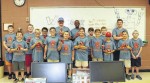
Seventeen boys recently participated in Surry Community Colleges Robotics Camp. The campers are, from left, front row, Kyler Terry of Pilot Mountain, KJ Haynie of Pilot Mountain, Carter Utt of Pilot Mountain, Kaden Haynie of Pilot Mountain, Benjamin Hiatt of Ararat, Virginia, Benjamin Delacruz of Cana, Virginia, Andrew Johnson of Dobson, Jack Baker of Westfield, Alex Jenkins of Dobson; back row, Hunter Pavlansky of Yadkinville, Nathan Dowell of Cana, Shelton Rook of White Plains, Daniel Durham of Elkin, Javontaa Cox of Asheville, Chandler Pharr of Mount Airy, Micah Russell of Lowgap, and Hunter Terrell of Mount Airy.

Submitted photo | Surry Community College

These seven girls recently participated in Surry Community Colleges Robotics Camp. The campers are, from left, front row, are Cadence Wilkins of Pilot Mountain, Anna Dowell and Jessi Delacruz of Cana, Virginia; back, Isabella Martin of Stuart, Virginia, Lisbeidy Sanchez of Boonville, Abby Moser of Mount Airy, and Payton Howell of Boonville.

Submitted photo | Surry Community College

DOBSON Russell Joness classroom was full June 27 through 30. Thats not uncommon for Surry Community Colleges lead electronics engineering instructor, but this time the students in Joness class were much younger than those he usually teaches.

Thats because he was working with local youths from elementary and middle schools as part of a summer program.

Jones excitedly welcomed children ages 10 through 15 with an interest in robotics and electronics engineering to Surrys Robotics Camp. The camp, broken into one section for girls and one for boys, gave participants an opportunity to work with some of the equipment that Surrys electronics engineering students learn on every day.

Not only did children leave the camp with a robot they built on their own, but they also left with a camp T-shirt, engineering skills, and memories.

The seven female campers were Abby Moser of Mount Airy; Lisbeidy Sanchez of Boonville; Cadence Wilkins of Pilot Mountain; Jessi Delacruz and Anna Dowell, both of Cana, Virginia; Payton Howell of Boonville, and Isabella Martin of Stuart, Virginia.

The 17 male campers were Hunter Terrell and Chandler Pharr of Mount Airy; Kyler Terry, Carter Utt, Kaden Haynie and K.J. Haynie, all of Pilot Mountain; Benjamin Hiatt of Ararat, Virginia; Alex Jenkins and Andrew Johnson of Dobson, Hunter Pavlanksy of Yadkinville; Jack Baker of Westfield; Javontaa Cox of Asheville; Benjamin Delacruz and Nathan Dowell of Cana, Virginia; Daniel Durham of Elkin; Shelton Rook of White Plains; Micah Russell of Lowgap;

Surry is also hosting an Art Camp, Volleyball Camp, and an Old Time and Traditional Music Camp this month. To learn more about SCCs camp offerings, visit http://www.surry.edu or contact Student and Community Engagement Coordinator Kasey Martin at (336) 386-3468 or martinkr@surry.edu. To view the photos from Robotics Camp, visit Surrys Electronics Engineering Facebook page @surryelectronics.

Seventeen boys recently participated in Surry Community Colleges Robotics Camp. The campers are, from left, front row, Kyler Terry of Pilot Mountain, KJ Haynie of Pilot Mountain, Carter Utt of Pilot Mountain, Kaden Haynie of Pilot Mountain, Benjamin Hiatt of Ararat, Virginia, Benjamin Delacruz of Cana, Virginia, Andrew Johnson of Dobson, Jack Baker of Westfield, Alex Jenkins of Dobson; back row, Hunter Pavlansky of Yadkinville, Nathan Dowell of Cana, Shelton Rook of White Plains, Daniel Durham of Elkin, Javontaa Cox of Asheville, Chandler Pharr of Mount Airy, Micah Russell of Lowgap, and Hunter Terrell of Mount Airy.

http://www.elkintribune.com/wp-content/uploads/2017/07/web1_Robotics-Camp2.jpgSeventeen boys recently participated in Surry Community Colleges Robotics Camp. The campers are, from left, front row, Kyler Terry of Pilot Mountain, KJ Haynie of Pilot Mountain, Carter Utt of Pilot Mountain, Kaden Haynie of Pilot Mountain, Benjamin Hiatt of Ararat, Virginia, Benjamin Delacruz of Cana, Virginia, Andrew Johnson of Dobson, Jack Baker of Westfield, Alex Jenkins of Dobson; back row, Hunter Pavlansky of Yadkinville, Nathan Dowell of Cana, Shelton Rook of White Plains, Daniel Durham of Elkin, Javontaa Cox of Asheville, Chandler Pharr of Mount Airy, Micah Russell of Lowgap, and Hunter Terrell of Mount Airy. Submitted photo | Surry Community College

These seven girls recently participated in Surry Community Colleges Robotics Camp. The campers are, from left, front row, are Cadence Wilkins of Pilot Mountain, Anna Dowell and Jessi Delacruz of Cana, Virginia; back, Isabella Martin of Stuart, Virginia, Lisbeidy Sanchez of Boonville, Abby Moser of Mount Airy, and Payton Howell of Boonville.

http://www.elkintribune.com/wp-content/uploads/2017/07/web1_RoboticsCamp1.jpgThese seven girls recently participated in Surry Community Colleges Robotics Camp. The campers are, from left, front row, are Cadence Wilkins of Pilot Mountain, Anna Dowell and Jessi Delacruz of Cana, Virginia; back, Isabella Martin of Stuart, Virginia, Lisbeidy Sanchez of Boonville, Abby Moser of Mount Airy, and Payton Howell of Boonville. Submitted photo | Surry Community College

.
More here:

SCC hosts robotics camp - Elkin Jonesville Tribune

Westford teen’s robotics dream? An ‘extra hand’ for those with nerve damage – Lowell Sun

"I wanted to be able to help these people and basically give them an extra hand they can use," said Westford Academy senior Alekh Beri, working Friday on data and graphs for flex sensors that will allow him to develop a device to help patients with diabetic neuropathy. See video at lowellsun.com. SUN / Caley McGuane

Sun staff photos can be ordered by visiting our SmugMug site.

WESTFORD -- When 16-year-old Alekh Beri's grandmother comes from India to visit next year, he hopes a device he has been developing in his garage and kitchen will bring her some relief.

Beri's grandmother has diabetic neuropathy, a type of nerve damage in the extremities affecting millions of diabetes patients. In response, the Westford Academy senior has been designing a soft-robotics assistive device that patients could use as a sort of individualized prosthetic, complete with the ability to grip objects even when the nerves in their hands are too damaged to do so.

"I saw her struggle with everyday tasks," Beri said. "And I'd recently come across soft robotics, so I just had an epiphany: that molding soft robotics to fit this purpose would be a very good way to treat this condition.

Sun staff photos can be ordered by visiting our SmugMug site.

Beri has been working on the device for more than a year and a half, researching and designing and building in his free time from schoolwork or extracurriculars. He has developed seven or eight different prototypes so far, and a few weeks ago, he filed a provisional patent, meaning he hopes to have his design fully patented next year once he finishes optimizing it.

The device is still in the early stages, but Beri's general idea is to use a silicon rubber base -- the "soft" portion of the "soft robotics" involved -- that molds to a patient's hand. His early iterations are activated with air pressure, causing the rubber to move and grab onto surfaces.

Beri also added several sensors to the inside of the device, hoping that physicians might be able to use them to monitor data points such as temperature and pressure on the patient's hand.

He said many patients of diabetic neuropathy suffer limited functionality in their hands, and he hopes the device will help address that need.

"I wanted to be able to help these people and basically give them an extra hand they can use," he said. "There's a lot of people who suffer from (diabetic neuropathy) and don't get the treatment they need."

Beri has attended several conventions to showcase his work so far. In March, he participated in the Southern New England Junior Science and Humanities Symposium in Boston, and his work there landed him one of 10 invitations to the symposium's national level.

Even though his grandmother lives in India, Beri said she has always been the inspiration and is "very proud" of his work. So when she arrives next year for Beri's graduation from high school, he hopes to honor that.

Until then, there's more work to be done.

Follow Chris on Twitter @ChrisLisinski.

Read more:

Westford teen's robotics dream? An 'extra hand' for those with nerve damage - Lowell Sun

Conway praises Trump for getting all-girl Afghan robotics team to United States. Critics disagree. – Washington Post

A team of Afghan girls arrived at Dulles International Airport to compete in an academic robotics competition in D.C. after U.S. officials agreed to allow them to enter the country despite initially denying them visas. (Reuters)

President Trump's last-minute intervention allowed an all-girl robotics team from Afghanistan to come to the United States.More important, it enabled the high schoolers to achieve what few female Afghans are able to: represent their country on an international stage.

I feel so happy that I cant describe in words, team member Fatemah Qaderyantold The Post at Washington Dulles International Airport Saturday.

We felt so disappointed (when we were denied visa) because our team members had worked very hard for six months, the 14-year-old added.

Trump's involvement drew praise from White House counselorKellyanne Conway, who saidin a tweet Saturday morning that while others talk, the president acts. But critics pointed out that selectively allowing a small group of people to come to the United States, while denying many others, is not deserving of credit.

In response to Conway's tweet, Paul Musgrave, an international relations expert who teaches political science at the University of Massachusetts at Amherst, said, Selective enforcement of laws and displays of 'mercy' are monarchical, not democratic, tendencies.

He told The Washington Postthat while Trump did the right thing,making an exception here and there for people who are particularly charismatic and particularly visible is indicative of an administration that takes action because popular opinion, not rational policy, necessitates doing so.

Think about all the other charismatic groups that we haven't had this kind of mobilization about. Conway's tweet is in this vein of the good president saving innocent people from the government. Well, if he cares that much about these young women, what is he doing to make sure that we have a just process in place for all the many thousands of people affected by his other policies? Musgrave said, referring to the Trump administration's travel ban, which places restrictions on people from six predominantly Muslim countries. Afghanistan is not among those countries.

Conway is traveling and is unavailable to comment, her chief of staff said.

The story of the high school girls from the city of Herat in western Afghanistan and their uphill battle in trying to come to the United States first attracted worldwide sympathya few weeks ago.

The Afghan girls' robotic team will be allowed to travel to the United States to participate in an international robotics competition after their visa applications were denied twice. (Taylor Turner/The Washington Post)

They scrambled for months to build a ball-sorting robot that will compete in theFIRST Global Challenge, an international robotics competition in Washington. The team was supposed to receive equipment from the United States, but it was held up for months amid terrorism concerns. So the team members improvised and built motorized machines out of household materials,The Post reported.

To be able to come to the United States, theytwice made the dangerous 500-mile journey to the U.S. Embassy in Kabul to apply for their visas.

[U.S. denies visas for Afghanistans all-girl robotics team]

But their applications were denied.

The hurdles punctuated by the fact that nearly all teams, including those from countries barred under Trump's travel ban, were allowed to come drew criticism from human rights activists and questions about whether U.S. agencies were pulling back efforts to advocate for young women in Afghanistan,The Post reported.

Today, many Afghan women feel betrayed. The Trump administration is formulating a new Afghanistan strategy, but the talk is all about troop numbers, not school books and certainly not girls, Heather Barr, senior researcher for the Human Rights Watch's women's rights division,wrote last week.

On Wednesday, days before the competition was scheduled to start,Politicobroke the newsof Trump's intervention.The Department of Homeland Security had granted the Afghan team members and their chaperon a parole, which allows them a one-time, temporary entry into the country for humanitarian reasons or significant public benefit,The Post reported.

The reason the girls' visas were initially denied is unclear.

The State Department has cited privacy laws in declining to explain the decision. A spokesman told the Associated Press this week that visa applications are adjudicated on a case-by-case basis.

Critics on Twitter pointed to the administration's travel ban, saying it's the reason the team was barred in the first placeand suggesting that the president shouldn't take credit for reversing the consequences of his own policies.

But theban is not the reason the girls' visas were denied. The latest version of the ban affects Iran, Libya, Somalia, Sudan, Syria and Yemen three of which have robotics teams that weren't blocked from coming to the United States. Another team, from Gambia, Africa, also was previously deniedbut has since been granted visas.

Others defended Trump and questioned why critics weren't as outraged when the African team's visas were denied.

Musgrave said tyingthe travel ban to the Afghan team's difficulty in entering the country is a misplaced criticism and is probably because of confusion over the administration's policies on Muslim countries.

Still, he maintains there's a connection at least indirectly.

Although Afghanistan is not among the restricted countries, the obstacles the team faced in coming to theUnited Statesarereflective of the kind of policy errors you get from the administration that imposes the travel ban,Musgravesaid. Praising the president for intervening is akin to snatching victory from the jaws of your defeat,he added.

[Afghan girls team can travel to U.S. for robotics contest after being denied visas twice]

It wasn't a surprise to anybody that a team like this one coming from a country like Afghanistan would be caught up in this, Musgrave said, adding later:You don't get credit for cleaning this up when you foster this kind of atmosphere.

Had the girls not been allowed to come to the United States, they would've had to participate in the competition via Skype.

They landed at Washington Dulles International Airport early Saturday. The three-day robotics competition, which involves participants from nearly 160 countries, starts Sunday.

Seventeen years ago, this would not have been possible at all. They represent our aspirations and resilience despite having been brought up in perpetual conflict. These girls will be proving to the world and the nation that nothing will prevent us from being an equal and active member of the international community,Afghan Ambassador Hamdullah Mohib told the AP after the girls arrived.

Sharif Hassan, Amanda Erickson, and Derek Hawkins contributed to this report.

READ MORE:

Afghan girls robotics team arrives in U.S. just in time

Travel ban takes effect as State Department defines close family

Heres one way to help women in science: Support international collaborations

Read this article:

Conway praises Trump for getting all-girl Afghan robotics team to United States. Critics disagree. - Washington Post

Limestone robotics students compete in international contest – The Decatur Daily

ATHENS The Lost Rockets, an underwater robotics team from Limestone County Career Technical Center, was ranked 28th among 65 teams from 17 countries taking part in an international competition for remotely operated vehicles.

The Lost Rockets advanced to the Marine Advanced Technology Education international ROV contest last month at Long Beach City College in California. The teamtookfirst placein the Ranger class in a regional MATE competition in April at Dauphin Island Sea Lab.

The Lost Rockets, the only Alabama team in the international competition, represented MATEs Northern Gulf Coast Region, which includes Mississippi, Georgia, Florida and Alabama, said Monica McConnell, the teams coach and a Limestone County Schools gifted teacher.

Im very proud of the team, said McConnell. A presentation is part of the competition, and theyhave great public speaking skills anddid a great job demonstrating the robot.

The MATE competition requires students to think as entrepreneurs and transform their teams into companies that manufacture, market and sell their products. Students operate their ROVs, and also prepare technical reports, poster displays and engineering presentations that are presented to working professionals who serve as competition judges.

We built an underwater ROV, or remotely operated vehicle, designed to explore and maintaincommercial docks under the water, said Coleman Cook, the teams captain. He said it took the team about four months to build the ROV using high-density polyethylene, stainless steel brackets and 3-D printed plastic. The ROV is about 13 inches by 6 inches by 6 inches and weighs about 18 pounds, he said.

The theme of this years competition was Port Cities of the Future, and students designed and tested their ROVs to handle underwater jobs similar to real-world tasks an ROV would perform in a seaport.

Team members included Cook, Tyler Pressnell, David Sanchez and Preston Lewis, all seniors who have graduated; and Baylee Brewer and Bailey Webb, upcoming seniors.

Casey Wigginton, a former engineering instructor at the career center, previously had been the teams coach.

See original here:

Limestone robotics students compete in international contest - The Decatur Daily

Allowed in by Trump, Afghan girls robotics team lands in DC – ABC News

Twice rejected for U.S. visas, an all-girls robotics team from Afghanistan arrived in Washington early Saturday after an extraordinary, last-minute intervention by President Donald Trump.

The six-girl team and their chaperone completed their journey just after midnight from their hometown of Herat, Afghanistan, to enter their ball-sorting robot in the three-day high school competition starting Sunday in the U.S. capital. Awaiting them at the gate at Washington Dulles International Airport were a U.S. special envoy and Afghan Ambassador Hamdullah Mohib, who described it as a rare moment of celebration for his beleaguered nation.

"Seventeen years ago, this would not have been possible at all," Mohib said in an interview. "They represent our aspirations and resilience despite having been brought up in a perpetual conflict. These girls will be proving to the world and the nation that nothing will prevent us from being an equal and active member of the international community."

In the short time since their visa dilemma drew global attention, the girls' case has become a flashpoint in the debate about Trump's efforts to tighten entrance to the U.S., including from many majority-Muslim countries. Afghanistan isn't included in Trump's temporary travel ban, but critics have said the ban is emblematic of a broader effort to put a chill on Muslims entering the U.S.

The girls' story has also renewed the focus on the longer-term U.S. plans for aiding Afghanistan's future, as Trump's administration prepares a new military strategy that will include sending more troops to the country where the U.S. has been fighting since 2001. Defense Secretary Jim Mattis said Friday the strategy was moving forward but "not finalized yet."

Trump's personal intervention earlier in the week using a rare "parole" mechanism to sidestep the visa system ended a dramatic saga in which the team twice traveled from their home in western Afghanistan through largely Taliban-controlled territory to Kabul, where their visa applications were denied twice.

The U.S. won't say why the girls were rejected for visas, citing confidentiality. But Mohib said that based on discussions with U.S. officials, it appears the girls were rebuffed due to concerns they would not return to Afghanistan. It's a fate that has beset many Afghans seeking entry to the U.S. in recent years as continuing violence and economic challenges lead many to seek asylum in America, or to travel through the U.S. to Canada to try to resettle there.

As their case gained attention, Trump intervened by asking National Security Council officials to find a way for them to travel, officials said. Ultimately the State Department, which adjudicates visa applications, asked the Homeland Security Department to let them in on "parole," a temporary status used only in exceptional circumstances to let in someone who is otherwise ineligible to enter the country. The U.S. granted parole after determining that it constituted a "significant public benefit."

Ambassador Alice Wells, the acting U.S. special envoy for Afghanistan and Pakistan, downplayed concerns that the girls might use the parole to stay in the U.S. or go to Canada. As she drove to the airport to greet the girls, she said by phone that they were proud to represent Afghanistan and "proud to return to be role models to others around them."

Competing against entrants from more than 150 countries, the girls will present a robot they devised that can recognize blue and orange and sort balls into correct locations. They'll also be feted at a hastily arranged reception at the Embassy of Afghanistan attended by supporters who had petitioned the U.S. to let them in.

The Taliban, ousted by the U.S.-led coalition in 2001, denied schooling to girls when they ruled the war-torn country. Wells said that since 2002, the number of Afghan children attending school has increased from about 900,000 virtually all boys to 9 million today including 40 percent girls.

"We're looking to ensure that Afghanistan continues its trajectory to stabilizing politically and economically," Wells said. "It's young women like these that are going to be the future of Afghanistan."

Reach Josh Lederman on Twitter at http://twitter.com/joshledermanAP

Read more here:

Allowed in by Trump, Afghan girls robotics team lands in DC - ABC News

Afghan girls robotics team arrives in US following Trump’s visa intervention – ABC News

The all-girl robotics team from Afghanistan which was twice denied visas to enter the U.S. for a competition, but were then given the go-ahead earlier this week after President Trump intervened, arrived shortly after midnight on Saturday at Dulles International Airport outside Washington, D.C.

The young women are in the U.S. for the inaugural FIRST Global Challenge, in which teams of young women and men from around the world showcase robots they created. The three-day competition kicks off Sunday at Washington's DAR Constitution Hall.

The team arrived at Dulles to a crowd of supporters, as well as the U.S. State Department's acting assistant secretary for south and central Asian affairs, Alice G. Wells, and Afghanistan's Ambassador to the U.S., Hamdullah Mohib.

"The plane just landed," Mohib tweeted at 12:13 a.m. "The girls will be out soon to begin their journey through D.C. in a few minutes."

The Afghan embassy also tweeted photos of the team's supporters awaiting their arrival at Dulles.

The six girls from western Afghanistan's Herat region had twice been denied visas to enter the country by the U.S. State Department, although the reason was never publicly disclosed. Still, many critics pointed to Trump's travel ban executive order and his administration's policies, which some perceive as hostile to some foreigners, for the girls' denial of entry.

On Wednesday, a senior administration official told ABC News that President Trump had intervened on the girls behalf to allow them to compete.

"The State Department worked incredibly well with the Department of Homeland Security to ensure that this case was reviewed and handled appropriately," Dina Powell, deputy national security adviser for strategy, said in a statement following the president's intervention. "We could not be prouder of this delegation of young women who are also scientists -- they represent the best of the Afghan people and embody the promise that their aspirations can be fulfilled. They are future leaders of Afghanistan and strong ambassadors for their country."

See original here:

Afghan girls robotics team arrives in US following Trump's visa intervention - ABC News

Malden robotics team goes global before going home – Daily Item

July 14, 2017

COURTESY PHOTO Malden High Robotics Club advisor Chris Bazzinotti and Malden students are shown at the International Botball Tournament held this past week in Norman, Okla.

MALDEN They fell short in the end, but the citys high school robotics team marched over global competitors during this weeks International Botball Tournament.

They had already pushed the envelope by winning the schools first New England Regional Botball Championship. Little did they know they would not only knock off the top-seeded team in the world and then advance to the Elite Eight in the world before bowing to a former, recent World Champion.

What a week in Norman, Okla., for the students from Malden.

It was a great showing and despite the intensity, it was a lot of fun and very satisfying for our students, said Chris Bazzinotti, a Malden High technology teacher who serves as advisor to the Robotics Team.

When the students won the New England title in May, they immediately began a fundraising drive which raised nearly $8,000 to fund the trip to the Midwest to participate in the International Botball Championship, where teams from around the world battled for the world crown in a competition hosted by the Global Conference on Educational Robotics (GCER).

According to the Botball Educational Robotics Program Botball competitions revolve around using student-made robots to complete a series of tasks, such as collecting objects and moving them to another location or recognizing certain color objects and sorting them, within a set time limit of two minutes. Sensors and cameras give input to the robots, which help to identify objects.

Between competitions, participants program the robots using an Integrated Development Environment.

The Malden High Robotics team was seeded 33rd in the 64-team competition and came out of the gate with a win over a team from a Peoples Republic of China middle school affiliated with Qingdao University. The Chinese team came in as the 32nd seed.

Up next for Malden was the tall task of facing off against the number one-seeded team in the competition, former two-time world champion Los Altos (Calif.) Community School.

They were aware of the competition, but our students were in there with confidence, Bazzinotti said.

Malden High ended up with a huge win when the top-seeded Los Altos team and Malden advanced to the Sweet Sixteen, this time against Talenthaus from Germany. Malden again prevailed and moved on to the fabled Elite Eight where they faced off against the Dead Robots Society team of northern Virginia.

Maldens luck finally ran out as the Dead Robots Society squad prevailed and moved into the Final Four. The local students could take some consolation knowing the team that knocked them out of the International Tournament, Dead Robots Society, advanced all the way to the final and were crowned World Champions for the first time since 2013.

All in all, quite a summer feat with an international flair for some students from Malden out in the Midwest.

See the rest here:

Malden robotics team goes global before going home - Daily Item

Hogan visit highlights Gaithersburg’s firm’s robotics lineup (Video) – Washington Business Journal


Washington Business Journal
Hogan visit highlights Gaithersburg's firm's robotics lineup (Video)
Washington Business Journal
Maryland Gov. Larry Hogan may have quite a bit of sway in the state. But he doesn't often get a chance to control a robotic unmanned ground vehicle designed for the military. During a visit with Gaithersburg robotics company Roboteam Inc., Hogan tested ...

View post:

Hogan visit highlights Gaithersburg's firm's robotics lineup (Video) - Washington Business Journal

Better, Faster, Smarter: Making Agile Robots – USC Viterbi School of Engineering (press release) (blog)

USC Center for Advanced Manufacturing team comes in first at the Agile Robotics for Industrial Automation Competition (ARIAC)

The first place team from USCs Center for Advanced Manufacturing. From left to right: Matthew Buckley, Professor S.K. Gupta, and Brual Shah. Photo/S.K. Gupta

The National Institute of Standards and Technology (NIST), in collaboration with the Institute of Electrical and Electronics Engineers (IEEE) and the Open Source Robotics Foundation (OSRF), held their first annual Agile Robotics for Industrial Automation Competition (ARIAC), concluding earlier this month. First place was awarded to a team from USCs Center for Advanced Manufacturing (CAM), including CAM Founding Director Satyandra K. (S.K.) Gupta, post-doctoral researcher Brual Shah, and undergraduate student Matthew Buckley (Computer Science 18).

The world of manufacturing is no stranger to robotics. These programmable machines are perfect for the repetitive tasks often necessary in the production process. However, they are currently limited to pre-programmed moves, meaning they are unable to be quickly modified or reconfigured when an error occurs traits that fall in the category of robotic agility.

Robot agility refers to the ability of the robot to change its behavior in response to product change, production volume change and manufacturing facility changes. It is needed to reduce product realization time, said Gupta, Smith International Professor in the Department of Aerospace and Mechanical Engineering (AME).

If we can have researchers like S.K.s group start to address challenges that industry is facing when incorporating robotics in their industrial systems, then we can find solutions for them to be able to solve their challenges and make them more productive and be able to do better in the global economy Schlenoff

As a part of the Department of Commerce, NIST works to promote industry and make the U.S. more competitive in the global market. Teaming up with IEEE and OSRF, they developed ARIAC as a way to start addressing these current obstacles in industrial robotics.

We talked with various people from industry and we tried to understand the challenges that they were facing in using robots, said Craig Schlenoff, associate program manager of robotics program at NIST and competition chair for ARIAC. We then included those challenges in the competition to see how well teams could come up with interesting approaches in order to address those challenges.

The entire competition was performed virtually, using a computer simulation of a robotic arm on a manufacturing shop floor, allowing teams to participate from home. They were tasked with writing a software program that gave the robot autonomy while completing pick-and-place kit assembly tasks. The robot needed to be able to overcome agility challenges, such as the suction gripper failing, the notification of faulty parts, and the reception of high-priority orders.

Simply put, The main objective was to develop next generation robots that are intelligent and flexible, said Gupta. Though the actual competition, consisting of three rounds of qualifiers before the final competition with 15 different challenge scenarios, was not so simple.

We had to arrange parts on trays as quickly as possible, using as few sensors as possible, said Buckley, who was responsible for writing the teams software code. The major challenges were getting everything working in a simulated environment, which can be unreliable and error-prone, as well as creating a solution that had a clear advantage over other teams.

Submitted software was scored based on performance, efficiency and cost. The USC team, Realization of Robotics Systems, used the latter of which to optimize their system. By using less cameras, they were able to greatly reduce cost.

The rules were such that a one camera solution was advantageous and enabled us to score more points. However, this solution was difficult to implement and increased the overall cycle or completion time, said Shah, whose role in developing the logic and planning for their software is reflected in his research at CAM.

The 56 teams that registered for the competition consisted of researchers from educational institutions as well as representatives within industry, spanning three continents and bringing a world-wide perspective to the challenges at hand.

Thats why we had this competition, Schlenoff said. If we can have researchers like S.K.s group start to address challenges that industry is facing when incorporating robotics in their industrial systems, then we can find solutions for them to be able to solve their challenges and make them more productive and be able to do better in the global economy.

See the original post:

Better, Faster, Smarter: Making Agile Robots - USC Viterbi School of Engineering (press release) (blog)

How Do Isaac Asimov’s Laws Of Robotics Hold Up 75 Years Later? – Newsy

ByTyler Adkisson July 13, 2017

Imagine sitting in a self-driving car that's about tocrash into a crowd. The car has to choose between hitting everyone or running off the road, putting your life at risk. So how does it make that decision?

For simple bots, Isaac Asimov's "Three Laws of Robotics" might help. But, for more complex machines, researchers aren't so sure the 75-year-old set of rules will work.

According to Asimov's laws, robots can't injure humans or allow them to be harmed; they have to obey orders humans give them; and they must protect themselves. But there's a caveat. If the laws conflict, the earlier law takes precedent.

Single-function robots something with a straightforward job, like a Roomba could in theory follow those laws. But with some of the robots engineers are working on, like the U.S. military'srobot army, it gets complicated.

Robots may not function properly even if they're built to follow the laws. In one experiment, for example, researchers programmed a robot to save another bot if it got too close to a "danger zone."

Related StoryThis Robotic Exoskeleton Helps You Stay On Your Feet

Saving one robot was easy, but when two were in danger, the rescue bot got confused. In about 40 percent of trials, it couldn't decide which to save and did nothing.

So while Asimov's laws might help retain some order between humans and robots, it doesn't seem like our futurewill line upwith hismostly subservientrobots at least for now.

Read the rest here:

How Do Isaac Asimov's Laws Of Robotics Hold Up 75 Years Later? - Newsy

Intuition Robotics raises another $14 million, this time from Toyota Research Institute – TechCrunch

Intuition Robotics, maker of the ElliQ robotic elder care assistant, and opened an office in San Francisco. As it looks to grow staff and ramp up testingof the product, the company has raised another $14 million, this time from Toyota Research Institute (TRI).

ElliQ, which the company likes to call an active aging companion, ismade up of an interactive robot attached to a tablet, and is designed to help older adults age in place. The robot was built to keep the elderly engaged, active, and connected to the outside world, first byallowing families to video chat with older relatives and second by acting as a companion to suggest activities and remind elderly users to take their medicine.

Intuition Robotics recently entered the initial testing phase of the companion robot with users in the Bay Area, and is actively hiring a team there. With those plans underway, the company was looking to add more funding to its war chest and add some expertise along the way because, well, hardware is hard.

With the Toyota Research Institute investment, the company got both. According toIntuition Robotics CEO Dor Skuler, Toyota approached the robotics company after learning what it was working on and immediately provided value by helping to replace some of the motors in the ElliQ prototype.

At this stage of the product, we do need help, and its very refreshing to be approached by an investor that has studied this space and has some expertise, Skuler told me.

The new funding follows$6 million that Intuition Robotics raised from investors that include Roomba maker iRobot, Terra Venture Partners, Bloomberg Beta and Maniv Mobility. The company also raised money through crowdfunding platform OurCrowd.

The rest is here:

Intuition Robotics raises another $14 million, this time from Toyota Research Institute - TechCrunch

Afghan girls will be allowed into US for robotics contest after Trump intervenes – Minneapolis Star Tribune

Rahmat Gul, Associated Press Members of a female robotics team arrive from Herat province to receive visas from the U.S. embassy, at the Hamid Karzai International Airport, in Kabul, Afghanistan, Thursday, July 13, 2017.

KABUL, Afghanistan The third time's the charm for Afghanistan's all girl robotics team, who will be allowed entry into the U.S. to compete in a competition after President Donald Trump personally intervened to reverse a decision twice denying them enter into the country.

The six girls will now be able to participate next week against entrants from 157 countries. The Afghan girls have devised a ball-sorting robot, which has the ability to recognize orange and blue colors, and can move objects to put them in their correct places.

"I am very happy. This is such an important trip for us," said 15-year-old team member Lida Azizi, who was excited at the prospect of being able to compete.

Excerpt from:

Afghan girls will be allowed into US for robotics contest after Trump intervenes - Minneapolis Star Tribune

Kids have fun learning how to fail at robotics camp – KWQC – KWQC-TV6

ELLSWORTH, Maine (WABI) -- There were a lot of frustrated sighs and grunts from kids participating in a LEGO Robotics Camp.

Billy Wall, Ellsworth, the camp director said, "What the kids are learning mostly is how to fail repeatedly, so we give them a chance to fail over and over and over again and have fun."

Dawson Peterson, a camper, said, "We're building robots and we're trying to put them through different sets of obstacles."

Max Harmon, another camper, said, "At the moment we're doing a maze, which is kind of irritating."

But according to camp staff, that's all part of learning.

Wall said, "We're asking them to learn to combine programming and some structural mechanical stuff and a whole lot of persistence which is mostly what the camp is about. We want kids to try something different within some guidelines and some support from us."

During the week-long camp, kids worked with LEGO MindStorms robotics kits . They built and programmed the robots to perform tasks using a laptop.

The camp is meant to teach kids skills linked to engineering and computer programming, as well as team work and logic. All of these experiences prepare them for the future.

Wall said, "It's unlikely that any of them will have any kind of a career that does not involve some sort of telling a machine what to do. Whether that's a desk top computer or a piece of sensory automation on a building or they become an engineer or a scientist. If they just put together plumbing, they're going to be interfacing with electronic instrumentation, so they get a taste of all of that."

And while there are many failures in learning, there are also many triumphs.

Follow this link:

Kids have fun learning how to fail at robotics camp - KWQC - KWQC-TV6

MIT’s Daniela Rus is leading a robotics revolution | TechCrunch – TechCrunch

Daniela Russ morning is packed. My arrival appears to come as a bit of a surprise, as she readies herself to enter the gauntlet of wall-to-wall meetings. She considers the situation for a moment before inviting me into her office, where a group of students are already patiently waiting to talk self-driving cars. You cant report about any of the findings, Rus says with a smile. But you can come in.

Rus has allowed me to sit in for a packed morning of team meetings. Its a generous gesture, but more to the point, its the only way to manage some face-to-face time with the head of MITs groundbreaking Computer Science and Artificial Intelligence Library (otherwise known as CSAIL).Its a non-stop job, heading up the largest lab on MITs Cambridge, Massachusetts campus and, from the looks of it, Rus never rests. Theres no time for an interview, she explains, as we settle into the meeting. Maybe during lunch.

Inside the office, a half-dozen students are seated in a circle around a coffee table. Theres an award of some kind and an upside-down, 3D-printed robot with six legs standing up straight in the air though both have mostly disappeared beneath piles of paperwork. A nearby bookshelf is filled with titles about electrical engineering and coding and robotics the usual fare for a computer science professor. Near the top, however, theres a copy ofThe Art of War turned on its side, sandwiching a book of JFK quotations and a Gary Shteyngart novel.

Various groups of students cycle in and out of the office over the next couple of hours. Its a morning of problem solving, as Rus checks in on the status of a wide range of ongoing projects, from robotics to self-driving wheelchairs. She tackles every imaginable angle of the research, from coding complications, to methods for promoting CSAIL among the student body, to where the best location is in Boston for testing an autonomous boat.

She extols the virtues of both complicated theorems and common sense. We need a robot, she tells one of the teams. We need a handsome, happy robot.

I attempt to make myself scarce an impossible task in such a small group. As I quietly peck away at my keyboard in an awkward attempt to take notes, Rus regularly points out which parts of the meeting are on- and off-the-record. You can talk about the problems, Rus says, slightly modifying her earlier sentiment, but not the solutions.

The solutions, after all, have yet to appear in print. Thats the end goal of so many of these conversations: the acknowledgement among peers that comes with the publication of an academic paper. But in Russ role, the isolation of the problem is every bit as important a part of the process. Its her job to keep the trains running here, overseeing the 750 students and 110 professors/supervising research scientists who make up the 54-year-old research institute.

I have to make sure that they solve the right problem, Rus explains, when we finally have a few free minutes between meetings. As the adviser of these students, I need to make sure that their work invents the future. That their work is scientifically solid, wellgrounded, correct. What problems are we working on? Are they impactful? Are we on tangents? Are we really focused on the most salient and critical aspects of the problem? Its very important to think about that, because honestly, we have only so many hours in a day, and we can spend them in so many ways.

Russ own day is a testament to this. As the head of CSAIL, she helps lead the research and the outreach, serving as chief problem solver and cheerleader for some of the most exciting research in the fields of robotics and computer science. That shes managed to carve out a chunk of a day to entertain me feels like something of a minor miracle, before she leaves for a two-week trip to Asia to spread the CSAIL gospel.

She finally carves out a few minutes to speak at lunch but not before giving an impromptu speech to the staff. She walks to the front of the room, a strange space with geometrically erratic wood paneling that reflects the architectural chaos of the buildings Frank Gehry-designed exterior. The lunch is, among other things, a weekly check-in though this week its sparsely attended, with many of the professors off-campus for the summer. Rus floats the idea of intramural sports to help keep the students engaged outside class during the break.

Reactions are mixed. What about a Call of Duty tournament? one of the professors suggests, with a laugh.

CSAIL was officially formed in 2003, when MITs Laboratory for Computer Science (LCS) and the AI Lab merged, forming the schools largest interdepartmental research lab. Its origins, however, date back to the late-50s, when the school began its first official research into artificial intelligence. Over the past 50-plus years, the programs various iterations have played a pivotal role in robotics and computer science.

The labs website proudly boasts a laundry list of accomplishments, from the creation of Multics, which laid the foundation for modern operating systems, to early file sharing systems and mobile robotics, to some of the underlying technologies for the World Wide Web. In fact, Tim Berners-Lee is among the 110 team leads, with CSAIL serving as the current home for the World Wide Web Consortium.

Russ own history with the lab dates back to 2008, fresh off a stint as a professor at Dartmouths Computer Science Department. She received her PhD a decade earlier at Cornell, under the guidance of pioneering theoretical computer scientist John Hopcroft. It was there that Rus, who had previously studied math and astronomy, fell in love with robotics.

[Professor Hopcroft] gave this really inspiring talk where he said that many of the problems in classical graph algorithms, which was the core of computer science at the time, were done and it was time for grand applications, Rus explains. He said, We shall take computing into the world. We should work on robots.

Her work shifted from the large, industrial robots that dominated research in the mid-90s, to the notion that robots could become more portable and modular. The idea was to make a robot out of cells, just like living organisms are made out of cells, Rus explains. If you have cells, you can create whatever shape you want. She formed the Distributed Robotics Lab at Dartmouth, taking it with her as she made the jump.

The labs projects have diversified greatly in the last decade. As with all of CSAILs sub-laboratories, work is driven by its head researchers passions and Rus, unsurprisingly, has many. The Distributed Robotics Laboratorys current slate of projects covers the gamut of bleeding-edge robotics. One project makes it possible to 3D-print a robot, hydraulics and all, in a single step. In another impressive demo, an origami robot folds into a predetermined structure when heat is applied and then walks away with the help of magnets. There are a number of biologically inspired soft robots and a brain-controlled industrial bot programmed to learn from its own mistakes.

I love the fact that here at CSAIL, everyone lives in the future, explains Rus. Everyone thinks about how to make the future better, what kinds of things we need in the future. People have wild and crazy ideas and people are fun. We are excited, we are full of life and we love what we do, most importantly. I think we have tremendous students. We have tremendous faculty members. We have extraordinary staff, so its a very special community that has the role of inventing the future of computing.

Between meetings, we sit and chat. You have to take advantage of the brief moments of down time, and Rus is more than happy to fill each moment of silence with ideas about robotics, computer science and her thoughts on leading a happy life. She tells me, off-handedly, that shes becoming really interested in the science of sleep though between lab work, travel and talks, its hard to imagine Rus gets much in the way of it. And its clear that every moment shes awake, her mind is working overtime.

She tells me about her commute how the time she spent driving to jobs influenced her own passion for autonomous vehicles. I became interested in transportation when I moved from Dartmouth where my commute was about one minute, Rus explains. MIT, where my commute was anywhere between 20 minutes and an hour and minutes, that is the huge difference. I found myself in the early 2000s, so 10 years ago I found myself just mentally collecting data.

As we talk, soft music twinkles in through her open door. Its Beethoven. Rus stands up and beckons me to follow. She disappears around the corner and then pops back in, beckoning me to follow. Theres a small piano just outside her office, where a student sits, playing a familiar piece of classical music.

Rus explains that she bought a piano for her own kids a few years ago and the movers dropped it off at the lab before they were able to deliver it to her home. The students flocked to it during its temporary CSAIL residence. I would be sitting here, and all of a sudden, there would be beautiful Chopin.

The students were, naturally, bummed when the piano went back home with her. Ultimately, she explains, she made the decision to make the instrument a permanent fixture. I love to see the students take a break and get in touch with the other side of their brains, she says, listening as the student finishes the piece. As a professor, your objective is to help people be the best that they can in the paths that they choose.

Rus will be appearing at TC Sessions: Robotics on July 17 in Cambridge, MA.

Continue reading here:

MIT's Daniela Rus is leading a robotics revolution | TechCrunch - TechCrunch

Code @ TACC robotics camp delivers on self-driving cars – Phys.Org

July 12, 2017 by Jorge Salazar Code @ TACC Robotics camp gave 34 high school students mostly from underserved Central Texas hands-on experience assembling and programming internet-connected robotic cars. Credit: TACC

On a hot and breezy June day in Austin, parents, friends, brothers and sisters navigated through main campus at The University of Texas at Austin and helped carry luggage for the new arrivals to their dorm rooms. Thirty-four high school students from mostly low-income Title I schools in Central Texas, some from as far away as Houston, said good-bye to their families.

The students came for a different kind of summer camp, where for one week they became part of a science team that used computer programming and internet-connected technologies to solve a real-world problem. They had high hopes to walk away with experiences that would help them become future scientists and engineers.

From June 11 to 16, 2017, the Texas Advanced Computing Center (TACC) hosted Code @TACC Robotics, a week-long summer camp funded by the Summer STEM Funders Organization under the supervision of the KDK Harmon Foundation. The 34 students received instruction from five staff scientists at TACC and two guest high school teachers from Dallas and Del Valle, as well as round-the-clock supervision from five undergraduate proctors. Leading the camp was Joonyee Chuah, Outreach Coordinator at the TACC.

"The goal of the camp is to provide these students with their first experiences with programming, to jumpstart them and get them further ahead to things that are current in the computing world," Chuah said.

The students divided themselves into teams, each with specific roles of principal investigator, validation engineer, software developer, and roboticist. They assembled a robotic car from a kit and learned how to program the software that controls it. The robotic cars had sensors that measured the distance to objects in front, and they could be programmed to respond to that information by stopping or turning or even relaying that information to another car near it. Teams were assigned a final project based on a real-world problem, such as what action to take when cars arrive together at a four-way stop.

The Code @TACC Robotics camp went a step further than the typical introductory Lego-based robotics program by using maker-based electronics that connected to the cloud using the Particle platform. The robots assembled for the camp were three-wheeled cars that communicated via the internet and could relay events and interact with services such as Gmail, Twitter, and Facebook.

"The platform allows these robots to do a lot of communication with each other that facilitates projects that you wouldn't normally be able to do in a standard high school classroom using off-the-shelf toy robotics," Chuah said. The robotic cars presented a simplified version of the cutting-edge autonomous vehicles being developed today by leading companies such as Google.

Industry outreach was an important part of the camp, and the students toured the offices of IBM in Austin, where they participated in student activities that explored the IBM Watson supercomputer and robotics connected to it. The students also visited engineering departments and computer science departments at UT Austin, as well as TACC's world-renowned Visualization Laboratory. "They get a full experience of both college as well as future industry," Chuah said. "It's important for students to understand that there are economic and intellectual opportunities out there."

High school teachers sometimes lack the training needed to teach the more difficult programming languages like C++. Code @ TACC Robotics developed curricula and training for two guest high school teachers. "These individuals are working with us because they're excited to learn about robotics and they want to get jumpstarted on learning how to teach coding and robotics themselves," Chuah said.

Lashonda Petty of DeSoto High School and Katrina Van Houten of Del Valle High School were the guest teachers at Code @ TACC Robotics. "The camp has been really good for a lot of them. I've been talking to the students, and most of them are not pre-AP (Advanced Placement). They're not the type of kids who end up taking the harder courses, the higher sciences in their school. But they are way above in their ability to do it. They have all done amazingly well," Van Houten said.

Communicating the results of their research formed an important part of the Code @ TACC Robotics experience. They delivered their final presentations to an audience made up of TACC staff and the students' families, with translations provided in Spanish.

Central Texas student Guadalupe Oca, the software engineer for one team, explained their problem of the vehicle-to-vehicle communication at stop lights. Like the other teams, they arrived at a solution by breaking the problem down into small, and codable, bites.

"Our code was designed to make the robots stop at the stop sign. And they would decide who would be going first, just like in the real world. Humans expect the first person to go. There are those crazy drivers that just go whenever (audience laughs). They don't wait for the other person. Our initial solution was that whenever the robots get to the stop sign, they would tell each other, "I got here at nine seconds." Then the second robot gets here, and he says, "I got here two seconds after you. Go ahead and go first," said Oca.

The video will load shortly

The crowd gathered around the improvised four-way intersection marked by blue tape in the middle of the classroom. The student team looked intently into their laptops, and with a few keystrokes two robot cars whirred to life and advanced toward the intersection. One stopped at the intersection, then the other. Like a model driver, the last one to get there yielded to the first one, which then crossed the intersection safely followed by the second. The crowd cheered. If only the real-world could always behave so perfectly.

Funding for Code @ TACC Robotics camp was provided by the Summer STEM Investment Hub pooled funding comprised of the following organizations: Andy Roddick Foundation, Austin Community Foundation, KDK-Harman Foundation, and Webber Family Foundation.

Explore further: Researchers adapt a DIY robotics kit to automate biology experiments

Elementary and secondary school students who later want to become scientists and engineers often get hands-on inspiration by using off-the-shelf kits to build and program robots. But so far it's been difficult to create robotic ...

Children from age four can become robot programmers rather than waiting for the higher years in schooling, says a QUT education researcher.

(PhysOrg.com) -- Sixty-six national and international high school teams will take their robots to the courts this weekend to compete in the 21st season of the Los Angeles regional FIRST (For Inspiration and Recognition of ...

Whizzing around a green felt table chasing a soccer ball beaming infrared light, the boxy robot shootsand scoresand wins its Taiwanese teenage creators first prize at this year's student robot games.

An open-source 3D-printed fingertip that can 'feel' in a similar way to the human sense of touch has won an international Soft Robotics competition for its contribution to soft robotics research.

Robots are increasingly being used to teach students in the classroom for a number of subjects across science, maths and language. But our research shows that while students enjoy learning with robots, teachers are slightly ...

Dutch researchers unveiled Tuesday a model of what could become within two decades a floating mega-island to be used as a creative solution for accommodating housing, ports, farms or parks.

Microsoft wants to extend broadband services to rural America by turning to a wireless technology that uses the buffer zones separating individual television channels in the airwaves.

What's the point of smart assistants and intelligent electricity meters if people don't use them correctly? In order to cope with the energy transition, we need a combination of digital technologies and smart user behaviour ...

The US newspaper industry on Monday warned of a "duopoly" in online news by Google and Facebook, and called for legislation that would relax antitrust rules allowing collective negotiations with the internet giants.

Can you imagine fully charging your cell phone in just a few seconds? Researchers in Drexel University's College of Engineering can, and they took a big step toward making it a reality with their recent work unveiling of ...

In their work toward 3-D printing transplantable tissues and organs, bioengineers and scientists from Rice University and Baylor College of Medicine have demonstrated a key step on the path to generate implantable tissues ...

Please sign in to add a comment. Registration is free, and takes less than a minute. Read more

Continued here:

Code @ TACC robotics camp delivers on self-driving cars - Phys.Org

Robotics: Human meets machine – The Sydney Morning Herald

Mechanical and robotic exoskeletons hold considerable promise, both as aids to the disabled and machines to increase the lifting power of worked in heavy industry, but so far the reality has lagged considerably behind the dream.

Mechanical and robotic exoskeletons hold considerable promise, both as aids to the disabled and machines to increase the lifting power of worked in heavy industry, but so far the reality has lagged considerably behind the dream.

One of the principle obstacles faced by designers in the need for frequent recalibration of exoskeleton settings. Each system, of course, has to be tweaked to suit its individual user, but it must also be adjusted to accommodate changes in movement styles or speed as the user becomes tired or switches from one function to another. Although technically possible, such alterations, done in downtime by a technician, are costly and tedious.

Scientists at the College of Engineering at Carnegie Mellon Universityin the US, however, have developed an exoskeleton system that incorporates feedback mechanisms powered by the person using it, allowing it to self-adjust to changing mechanical demands in real time.

The researchers call the system "human-in-the-loop optimisation" and have published their findings in the journal Science.

Led by DrJuanjuan Zhang, the scientists tested their new system by developinga ankle exoskeleton, suitable for use as either a prosthetic or to increase efficiency in jobs where lifting or climbing is a requirement.

When adjusted for optimum efficiency the ankle apparatus reduced the wearer's metabolic energy consumption by around 25 per cent. The device was tried on a range of volunteers, all of whom were asked to move in 32 different patterns over the course of an hour.

"When we walk, we naturally optimise coordination patterns for energy efficiency," said team member Steven Collins. "Human-in-the-loop optimisation acts in a similar way to optimise the assistance provided by wearable devices. We are really excited about this approach, because we think it will dramatically improve energy economy, speed, and balance for millions of people, especially those with disabilities."

See the original post here:

Robotics: Human meets machine - The Sydney Morning Herald

Meet Israel’s next top robots – TNW

This post was originally published by NoCamels. Check out theirexcellent coverageand follow them down here: Imagine this: youre sitting in your house. Next to you, your companion robot turns its head and begins to converse, suggesting a TED talk you might like. A helper robot brings you a cup of tea. Your smart home control robot warns you that the iron is still on, and security bots climb the walls.

While it may sound like sci-fi, Israeli companies have already created robots that can do all of these tasks.

The robotics industry is exploding worldwide. Market research and intelligence firm, Tractica, predicts that the industry will grow from $34.1 billion in 2016 to $226.2 billion by 2021, with the growth driven primarily by non-industrial robots.

Its not hard to see why. Decreased costs of hardware and the free provision of software such as Amazon Alexa are making robotic development easier than ever.

Artificial intelligence, which is the ability of machines to learn from their environment and complete human-like tasks, is also transforming the robotics industry. Since IBMs supercomputer, Watson, defeated humans in the quiz show Jeopardy in 2011, resources and brain power have been poured into progressing AI to create more sophisticated robots.

With strengths in mathematics and hi-tech, companies and researchers in Israel are contributing more than their fair share of this brain power.

Mobileye, an Israeli company that uses AI to allow autonomous vehicles to navigate safely, was recently acquired by Intel for $15 billion. Mazor Robotics, an Israeli medical robot company, has revolutionized spinal surgery with their robotic system. Gal Kaminka, a professor at Bar-Ilan University and national robotics expert, is advancing robotic minds with funding from international organizations such as the U.S. Airforce.

In 2016, Prime Minister Benjamin Netanyahu expressed that, Just as we have become a leader in cybersecurity, we must also propel forward the robotics and automation industry in order to take a place at the forefront of the sector.

Here are some of the coolest robots developed by companies and researchers in Israel:

In the field of companion robots, Intuition RoboticsElliQstands out for its human-like persona.

The artificially intelligent robot improves the lives of the elderly by suggesting activities to keep them active, connecting them with family and friends, and reminding them about appointments and medication.

ElliQ can sense its environment, recognize faces, and communicate with people by talking and processing speech. Its advanced body language, gestures, and emotional range give it a personality that seems to transcend machinery.

Founded in 2015 by Roy Amir, Itai Mendelsohn, and Dor Skuler, the company has raised a total of $7 million from seed and Series A funding. While ElliQ hasnt yet been released on the market, avid consumers can sign up to be part of the testing phase.

Israeli robotics company Roboteam is planning to launch 10,000 consumer robots this year. Previously focused on military robots, Roboteam wants to create a new robot that helps people around the house.

Seven years ago I went to visit my dear grandma, says Yosi Wolf, cofounder of the company. When I saw her trying to carry a cup of tea and cookies and she was shaking.. I knew we could provide services to help elderly people.

According to Wolf, the robot will be 3 feet high with an interactive 10-inch display. It will be able to navigate around objects using 40 sensors, and it even has a tray to carry items.

Roboteam wants its robot to be the iPhone of consumer robotics, with a similar price point and sophisticated capabilities.

Founded in 2009 by Yosi Wolf and Elad Levy, the company has raised a total of $62 million in two funding rounds, with personal investment from the ex-CTO of Alibaba and co-founder of the Fenghe Investment Group, John Wu.

Guy Hoffman, a researcher at the Inter Disciplinary Center in Herzliya, has developed a social robot to control smart homes.

Shaped like a microscope,Vyomanages smart homes by turning devices on and off, providing status updates, and monitoring the house for security purposes. Vyo has facial recognition, and interacts through voice commands and verbal responses.

It also has an appealing personality. Hoffman is known for his work on robots that act like humans: he was catapulted to fame in 2009 for his engaging TED Talk onRobots with Soul.

Vyo is still in the developmental phase, but Hoffman already has a range of other robots with similar human-like personalities. For example, Travis is a speaker robot that dances to music.

Hoffmans work could change the way we interact with machines: research conducted by Hoffman and a team of robotics experts showed that people felt better about themselves after interacting with a robot that responded emotionally to them.

Professor Amir Ayali and a team of researchers at Tel Aviv University have developed a robot that could transform the way surveillance is conducted.

The four-inch longLocust Robotmimics the biological mechanism of jumping, and can reach a height of 11 feet more than twice the height of similar-sized robots, according to the researchers.

Able to be cheaply 3D printed (costing only around $100 USD), the robot is part of a wave of 3D printed robot designs that can easily be mass produced.

The robot would be useful in search and rescue missions and reconnaissance operations in rough terrain.

It has not yet been released on the market, and the team are working on developing the robots capacity to jump higher, fly, and even move with other robots in a swarm.

The Ben-Gurion University Robotics Lab, led by Dr. Amir Shapiro, is creating robots inspired by science fiction films. Designed to mimic animals (a technique known as biomimetics), the autonomous robots do work that is too dangerous or trivial for humans.

Snake-like robots have been designed to go into tight spaces on search and rescue missions. A fruit-picking robot, which Dr. Shapiro received a $1.3 million grant to develop, uses visual feedback to find and pick specific fruit. A wall-climbing robot, inspired by snails, can climb on almost any surface and has wide-ranging applications in intelligence gathering.

Although these dont seem as if they will be provided for consumer use, it might not be long before we see packs of animal robots deployed by larger organizations to complete tasks around us.

International investment and local talent continue to be funneled into the robotics industry. Given what this country has already achieved, we should expect a lot more exciting robotic developments in the future.

Israeli Technology News on NoCamels

Read next: Know Apples iOS 11 before its even released for only $29

Read more:

Meet Israel's next top robots - TNW

NASA robotics summer camp coming to Beckley July 17-21 – Beckley Register-Herald

The NASA IV&V Educator Resource Center, NASA WV Space Grant Consortium, and Mountaineer Area Robotics (MARS) 2614 have teamed up with their partners in West Virginia to bring forward a robotic summer camp July 17-21 at the WV State Extension NASA SEMAA Lab in Beckley.

In a press release fromWorld Robot Olympiad (WRO), officials said this is the largest camp initiative ever, and will be a team-based program centered around learning to build, document, and program the LEGO EV3 robot and compete in the WRO.

Individuals or two- or three-person can register together for the camp, and students will work in teams of three at the camp.

The intent is for students who are new to LEGO Robotics or who are on existing First LEGO League (FLL) teams to form themselves into smaller groups so they can develop their technical and teamwork skills while competing.

Jim Higgins, president of Southern West Virginia's Robotics Club, said instead of children working alone, they will get to bounce ideas off of each other to form the proper outcome.

"I believe it's important for them to work in groups because they get to explore ideas different from their own and realize there is almost always more than one solution," Higgins said.

Robots and iPads will be provided for teams who need one. Although a robot is not required, if you are an existing FLL team or have a LEGO EV3 robot,camp organizers prefer you bring your own laptop or tablet.

The camp will be organized in two different age categories: Elementary, for 9-12 year olds, and Junior, for 13-15 year olds.

Cost is $125 per student and includes four full days of camp from 9 a.m. to 5 p.m., snacks and lunch each day, WRO team registration and a tournament Friday from 9 a.m. to 3 p.m. with awards.

Huggins said if there are students interested in attending the camp and are not able to pay the $125 fee, NASA partners and the Robotics Club will work together to waive the fee if necessary.

"It's short notice, and we are still wanting several students to sign up," Higgins said. "This is something some kids won't want to miss. They'll work with several STEM initiatives and get to work with LEGOs, it's going to be a really interesting time."

To register a student or team for the camp, contact Annelise Williams at 304-367-8215 or visithttps://www.wro-usa.org/register. Registration is required before students arrive at the camp so staff will know the amount of resources necessary for the week.

"We're all really excited for the week," Higgins said. "It'll be a great chance for kids to work together and solve something great."

Email: jnelson@register-herald.com; follow on Twitter @jnelsonRH

Read the rest here:

NASA robotics summer camp coming to Beckley July 17-21 - Beckley Register-Herald

Seahawks Cornerback Richard Sherman Faces Off Against Compton Robotics Team – NBC Bay Area

WATCH LIVE

Seattle Seahawks All-Pro cornerback and Compton native Richard Sherman returned to the football field in Compton Tuesday to compete against one of the most accomplished teams to date in the Los Angeles area the Compton High Robotics Club.

The Seahawks cornerback competed against a different type of quarterback than he's used to as part of Oberto Beef Jerky's "The Jerky Challenge." A football-throwing robot created by the robotics team attempted to throw footballs past Sherman and hit targets that hung from the goalposts.

"I love getting involved with initiatives that highlight positive programs in communities like my hometown of Compton, and I relish the opportunity to shut down this robot," Sherman said prior to the event.

While Sherman did catch a few balls, he didn't catch enough to win.

"The goal was to beat Richard Sherman, which we did," Robotics Club member Mario Gonzalez said.

"You guys came and beat me at my own sport!" Sherman said.

After the event, Sherman delivered words of motivation during heartfelt comments to the Compton High students.

"I had a lot of days where I didn't know what I was going to do or where I was going to go, didn't know if I was good enough," said the NFL player. "A lot of self-doubt, a lot of people doubting me."

Angelica Hernandez, a student on the team, was impacted by Sherman's visit.

"It's inspiring to know that people like him know that there's more potential in us and more potential in Compton," she said. "Not just in sports but technology as well."

Despite being a new team with limited resources, the Compton High Robotics club continues to upstage other clubs in competitions across the state.

Published 5 hours ago

See the article here:

Seahawks Cornerback Richard Sherman Faces Off Against Compton Robotics Team - NBC Bay Area

Five reasons to attend TC Sessions: Robotics next week at MIT – TechCrunch

Next week TechCrunch is hosting its first ever one-day event centered around robotics. Called TC Sessions: Robotics, there are still a few general admission tickets left which grant the holder access to the conference, workshops, and networking events. Plus there are going to be robots as far as the eye can see. We hope you can make it and heres why.

Join us next Monday, July 17, and get your ticket now before Kresges limited seating is sold out.

9:00 am 9:05 am Opening Remarks from Matthew Panzarino

9:05 am 9:25 am Whats Next at MITs Computer Science and Artificial Intelligence Laboratory with Daniela Rus (MIT CSAIL)

9:25 am 9:50 am Is Venture Ready for Robotics? with Manish Kothari (SRI), Josh Wolfe (Lux Capital) and Helen Zelman (Lemnos)

9:50 am 10:10 am The Future of Industrial Robotics with Sami Atiya (ABB)

10:10 am 10:35 am Collaborative Robots At Work with Clara Vu (VEO), Jerome Dubois (6 River Systems) and Holly Yanco (UMass Lowell)

10:30 am 11:15 am WORKSHOP: Fresh Out of the MIT Lab with Robert Katzschmann, Claudia Perez DArpino and Andrew Spielberg

10:35 am 10:55 am Coffee Break

10:55 am 11:20 am Robots, AI and Humanity with David Barrett (Olin), David Edelman (MIT) and Dr. Brian Pierce (DARPA)

11:20 am 11:45 am Building A Robotics Startup from Angel to Exit with Helen Greiner (CyPhy Works), Andy Wheeler (GV) and Elaine Chen (Martin Trust Center for MIT Entrepreneurship)

11:45 am 12:05 pm Imagineering Disney Robotics with Martin Buehler (Disney Imagineering)

12:15 pm 1:00 pm WORKSHOP: Educating the Next Generation of Roboticists with David Barrett (Olin College), Ryan Keenan (Udacity), and Dr. Robert McMahan (Kettering University)

1:00 pm 1:20 pm Robots at Amazon with Tye Brady (Amazon Robotics)

1:20 pm 1:55 pm Building The Robot Brain with Heather Ames (Neurala), Brian Gerkey (Open Robotics) and Deepu Talla (Nvidia)

1:55 pm 2:20 pm When Robots Fly with Buddy Michini (Airware), Andreas Raptopoulos (Matternet) and Jan Stumpf (Intel)

2:20 pm 2:40 pm Bringing Robots Home with Colin Angle (iRobot)

2:40 pm 2:50 pm Demo with Carl Vause (Soft Robotics)

2:50 pm 3:00 pm Demo with David Perry (Harvard University SEAS)

3:05 pm 3:25 pm Coffee Break

3:15 pm 4:00 pm WORKSHOP: Getting the Most Out of DARPA with Dr. Brian Pierce

3:35 pm 4:15 pm Robotics Startup Pitch-off

Contestants: CP Robotics, Hand4Help, Tangible Media Group and Franklin Robotics // Judges: Jeremy Conrad (Lemnos Labs), Helen Greiner (CyPhy Works), Daniel Theobald (Vecna Technologies) andMelonee Wise (Fetch Robotics).

4:15 pm 4:35 pm The Age Of The Household Robot with Gill Pratt (Toyota Research Institute)

4:35 pm 4:55 pm Fireside Chat with Rodney Brooks (Rethink Robotics)

4:55 pm 5:05 pm Demo with Bruce Welty (Locus Robotics)

5:05 pm 5:15 pm Demo with Sangbae Kim (MIT Biomimetic Robotics Laboratory)

5:15 pm 5:20pm Wrap Up

5:20 pm 7:00 pm Reception

DARPA The mission of the Defense Advanced Research Projects Agency (DARPA) is to prevent and create strategic surprise by developing breakthrough technologies for national security. The agencys project-oriented approach to science and engineering, however, is different both in approach and execution from other U.S. governmental funding agencies. In this workshop, DARPA leadership will discuss the Agencys vision and goals, provide overviews of each of the organizations technical offices, in addition to an explanation of the mechanics of working with DARPA. The objective of the workshop is to elicit help in fomenting institutional evolution in Americas broader science and technology ecosystem that is needed to better and more rapidly respond to future challenges.

MIT CSAIL MIT Computer Science and Artificial Intelligence Laboratory is tasked with researching activities around the bleeding edge of technology. Attendees of this workshop will get an insiders look at some of the hottest projects being developed in CSAILs labs and engineering bays. Robert Katzschmann will present Soft Robotics and the teams creative approach to allowing robots to manipulate objects. Claudia Perez DArpinos presentation will demonstrate how robots can learn from a single demo and Andrew Spielberg will explain a novel process to create and fabricate robots.

Building Roboticists David Barrett, a professor of mechanical engineering at Olin College, Ryan Keenan, curriculum lead for Udacity, and Dr. Robert McMahan, President of Kettering University will lead a workshop discussing their views on the best way to train the next generation of roboticists. Each of these educators leads vastly different programs, but the aim is universal: to train the next generation of globally competitive engineers. Its important that these students learn through hands-on experience how to not only write code, but deploy code in a viable manner that results in a sustainable product.

See the original post:

Five reasons to attend TC Sessions: Robotics next week at MIT - TechCrunch