Being Negative Is Not So Bad

A new study published in PLOS Biology looks at the potential magnitude and effect of publication bias in animal trials. Essentially, the authors conclude that there is a significant file-drawer effect – failure to publish negative studies – with animal studies and this impacts the translation of animal research to human clinical trials.

SBM is greatly concerned with the technology of medical science. On one level, the methods of  individual studies need to be closely analyzed for rigor and bias. But we also go to great pains to dispel the myth that individual studies can tell us much about the practice of medicine.

Reliable conclusions come from interpreting the literature as a whole, and not just individual studies. Further, the whole of the literature is greater than the sum of individual studies – there are patterns and effects in the literature itself that need to be considered.

One big effect is the file-drawer effect, or publication bias – the tendency to publish positive studies more than negative studies. A study showing that a treatment works or has potential is often seen as doing more for the reputation of a journal and the careers of the scientists than negative studies. So studies with no measurable effect tend to languish unpublished.

Individual studies looking at an ineffective treatment (if we assume perfect research methodology) should vary around no net effect.  If those studies that are positive at random are more likely to be published than those studies that are neutral or negative, than any systematic review of the published literature is likely to find a falsely positive effect.

Of course, we do not live in a perfect world and many studies have imperfect methods and even hidden biases. So in reality there is likely to be a positive bias to the studies.  This positive bias magnifies the positive publication bias.

There are attempts in the works to mitigate the problem of publication bias in the clinical literature. For example, clinicaltrials.gov is a registry of all trials involving human subjects – before the trials are completed and the results known. This way reviewers can have access to all the data – not just the data researchers and journal editors deem worthy.

This new study seeks to explore if publication bias is similarly a problem with animal studies. The issues are similar to human trials. There is an ethical question, as sacrificing animals in research is justified by the data we get in return. If that data is hidden and does not become part of the published record, than the animals were sacrificed for nothing.

And also, publication bias can lead to false conclusions. This in turn can, for example, lead to clinical trials of a drug that seems promising in animal studies. This could potentially expose human subjects to a harmful or just worthless drug that would not have made it to human trials if all the negative animal data were published.

The study itself looked at a database of animal models of stroke. They examined 525 publications involving 16 different stroke interventions. There are a few different types of statistical analysis that can be done to infer probable publication bias. Basically, without publication bias there should be a certain distribution of findings in terms of effect sizes. If only positive or larger effect sizes are being published, then the distribution will be skewed.

This type of analysis provides an estimation only. They found that:

Egger regression and trim-and-fill analysis suggested that publication bias was highly prevalent (present in the literature for 16 and ten interventions, respectively) in animal studies modelling stroke. Trim-and-fill analysis suggested that publication bias might account for around one-third of the efficacy reported in systematic reviews, with reported efficacy falling from 31.3% to 23.8% after adjustment for publication bias. We estimate that a further 214 experiments (in addition to the 1,359 identified through rigorous systematic review; non publication rate 14%) have been conducted but not reported. It is probable that publication bias has an important impact in other animal disease models, and more broadly in the life sciences.

So there was some disagreement between the methods used, but both showed that there is likely to be a significant publication bias. If their analysis is correct, about one third of systematic reviews of animal studies in stroke that conclude an intervention works may be due to publication bias rather than a real effect. The authors also speculate that this effect is likely not unique to stroke, and may be generalizable to animal studies in general.

Of course, this is just an individual study, and further analysis using different data sets are needed to confirm these results.

Conclusion

The results of this study are not surprising and are in line with what is known from examining clinical trials. They suggest that similar methods to minimize publication bias are necessary for animal studies in addition to human trials.

Hopefully, this kind of self-critical analysis will lead to improvement in the technology of medical research. It should further lead to more caution in interpreting not only single studies but systematic reviews.

Also, in my opinion, it highlights the need to consider basic science and plausibility in evaluating animal and clinical trials.


[Slashdot]
[Digg]
[Reddit]
[del.icio.us]
[Facebook]
[Technorati]
[Google]
[StumbleUpon]

SBM Live Event – April 17th

A panels of bloggers from SBM will be taking part in the Northeast Conference on Science and Skepticism – NECSS 2010, April 17th beginning 10:00AM in New York.

There will be a 70 minute panel discussion moderated by John Snyder and featuring David Gorski, Kimball Atwood, Val Jones, and myself – Steven Novella. The topic of discussion will be the infiltration of pseudoscience into academic medicine.

This will be part of a full day of science featuring other excellent speakers, including James Randi, D. J. Grothe, Steve Mirsky, George Hrab, and Julia Galef. There will also be a live recording of the wildly popular science podcast, The Skeptics’ Guide to the Universe.

Go to http://www.NECSScon.org to register.


[Slashdot]
[Digg]
[Reddit]
[del.icio.us]
[Facebook]
[Technorati]
[Google]
[StumbleUpon]

Genetic Testing for Patients on Coumadin

Anticoagulation is advised for patients who have had a blood clot or who are at increased risk of blood clots because of atrial fibrillation, artificial heart valves, or other conditions. Over 30 million prescriptions are written every year in the US for the anticoagulant warfarin, best known under the brand name Coumadin. Originally developed as a rat poison, warfarin has proved very effective in preventing blood clots and saving lives; but too much anticoagulation leads to the opposite problem: bleeding. A high level of Coumadin might prevent a stroke from a blood clot only to cause a stroke from an intracranial bleed. The effect varies from person to person and from day to day depending on things like the amount of vitamin K in the diet and interactions with other medications. It requires careful monitoring with blood tests, and it is tricky because there is a delay between changing the dose and seeing the results.

In his book The Language of Life, Francis Collins predicts that Coumadin will be the first drug for which the so-called Dx-Rx paradigm — a genetic test (Dx) followed by a prescription (Rx) — will enter mainstream medical practice. FDA economists have estimated that by formally integrating genetic testing into routine warfarin therapy, the US alone would avoid 85,000 serious bleeding events and 17,000 strokes annually.
A recent news release from the American College of Cardiology described a paper at their annual meeting reporting a study of

896 people who, shortly after beginning warfarin therapy, gave a blood sample or cheek swab that was analyzed for expression of two genes — CYP2C9 and VKORC1 — that revealed sensitivity to warfarin. People with high sensitivity were put on a reduced dose of warfarin and had frequent blood tests. People with low sensitivity were given a higher dose of warfarin.

During the first six months that they took warfarin, those who underwent genetic testing were 31 percent less likely to be hospitalized for any reason and 29 percent less likely to be hospitalized for bleeding or thromboembolism than were a group that did not have genetic testing.

Epstein said that the cost of the genetic testing — $250 to $400 — would be justified by reduced hospitalization costs.

At this point, I don’t believe this study. I’ll explain why I’m skeptical.

It seems to me something is wrong with the whole idea of using genetic testing to adjust Coumadin dosage. It doesn’t matter whether a patient has low sensitivity or high sensitivity to warfarin, since the same trial-and-error process of monitoring and dose adjustment will result in a safe dose for either. 

In the typical scenario for a patient who is given warfarin, he is in the hospital where he is first given heparin by injection, usually in the form of low molecular weight heparins like Lovenox. Heparin works by binding to antithrombin and does not require monitoring with blood tests. Warfarin works by an entirely different mechanism. It reduces the amount of vitamin K dependent clotting factors. The heparin provides immediate protection while the warfarin gradually takes effect, a process that lasts for several days and lags behind the blood test used to monitor it: prothrombin time with calculation of the International Normalized Ratio (INR). After the INR reaches the target levels (usually 2-3 times normal), the injectable drug is stopped.

Apparently some providers are in a hurry to get the patient stabilized on Coumadin, so they start with a high “loading” dose and then back off as needed. This may have made sense when patients had to be off the heparin before they could be discharged from the hospital; but today they are commonly taught to give themselves subcutaneous injections and they are sent home, continuing the Lovenox until the Coumadin kicks in. There’s no reason they couldn’t start everyone on a low dose of Coumadin and adjust upwards as needed. Blood tests are done very frequently at first (as often as every day or two) and then can be cut back to as infrequently as once a month if the INR remains stable on a constant dose of warfarin. In the medical facility where I get my care, a Coumadin Clinic directed by a clinical pharmacologist monitors all patients on Coumadin.

A start low/adjust upwards protocol will result in a safe dose for all patients regardless of their DNA. I don’t see how that management plan would be improved by knowing the gene expressions. It takes time to get the genetic test results, and the provider has to start the patient on Coumadin before the test results are even available. Genetics is only estimated to contribute about 70% to dose requirements, and variations in the other 30% could outweigh simplistic dose estimates based on DNA. And testing costs money that I see no need to spend.

It will be interesting to read the actual study when it is published. I will be looking closely for confounding factors that might have influenced results. Could the tested patients have been treated differently in some way because of expectations raised by the DNA test? Did the non-tested patients have optimal management by someone experienced in adjusting Coumadin dosage? Was the study population somehow different from the population the average doctor sees in his practice? How exactly was the Coumadin dose adjusted differently because of the DNA findings? What was the target INR level? Did any of the complications occur in patients who were in the target range? Was compliance assessed? Could alcohol and drug use have affected the INR? The reported 29% reduction of re-hospitalization for bleeding or clotting complications is a relative risk. What was the absolute risk? According to a review article in American Family Physician, the median annual rate of major bleeding in patients on Coumadin ranges from 0.9 to 2.7 percent, and in this study the rate of complications in the highest risk group was only 6.3%. Complications were more likely in elderly patients, patients with co-existing illnesses, and patients with INRs outside the target range. How many of these complications could have been avoided by optimal management?

My common sense tells me patients on Coumadin can be managed just as well without knowing genetic test results. Genetic testing and pharmacogenetics hold great promise for improving individualized patient care decisions, but I don’t think Coumadin is a good example of such benefits. The DNA only confirms what our patient’s response to therapy has already told us.


[Slashdot]
[Digg]
[Reddit]
[del.icio.us]
[Facebook]
[Technorati]
[Google]
[StumbleUpon]

“Vaccines didn’t save us” (a.k.a. “vaccines don’t work”): Intellectual dishonesty at its most naked

If there’s one thing about the anti-vaccine movement I’ve learned over the last several years, it’s that it’s almost completely immune to evidence, science, and reason. No matter how much evidence is arrayed against it, its spokespeople always finds a way to spin, distort, or misrepresent the evidence to combat it and not have to give up the concept that vaccines cause autism. Not that this is any news to readers of this blog, but it bears repeating often. It also bears repeating and emphasizing examples of just the sort of disingenuous and even outright deceptive techniques used by promoters of anti-vaccine pseudoscience to sow fear and doubt about vaccines among parents. These arguments may seem persuasive to those who have little knowledge about science or epidemiology. Sometimes they even seemed somewhat persuasive to me; that is, at least until I actually took the time to look into them.

One example of such a myth is the claim that “vaccines didn’t save us,” also sometimes going under the claim that “vaccines don’t work.” The anti-vaccine website Vaccine Liberation has a large set of graphs purporting to show that the death rates of several vaccine-preventable diseases, including whooping cough, diptheria, measles, and polio were falling before the vaccines for each disease were introduced. The the article quotes Andrew Weil:

Scientific medicine has taken credit it does not deserve for some advances in health. Most people believe that victory over the infectious diseases of the last century came with the invention of immunisations. In fact, cholera, typhoid, tetanus, diphtheria and whooping cough, etc, were in decline before vaccines for them became available – the result of better methods of sanitation, sewage disposal, and distribution of food and water.

Bill Maher has said similar things about vaccines, and the “vaccines didn’t save us” gambit has become a staple of anti-vaccine websites. For example, one particularly ignorant blogger wrote:

The mythology surrounding vaccines is still pervasive, the majority of the population still believes, in faith like fashion, that vaccines are the first line of defense against disease. The true story is that nutrition and psychological/emotional health are the first line of defense against disease.

Vaccines are a concoction of chemical adjuvants and preservatives coupled with virus fragments and have clearly been implicated in the astounding rise in neurological disorders around the world, yet the ‘popular’ media has embedded itself as a spokesperson for the pharmaceutical cartel and simply does not report in any responsible way the real situation.

Ah, yes, the “toxins” gambit! Of course, it is true that better sanitation is a good thing and has decreased the rate of transmission of some diseases for which sanitation can do so, many infectious diseases are transmitted person-to-person through the air from aerosolized drops of saliva from coughs and sneezes or from being deposited on objects that people touch frequently, like doorknobs and other fomites.

The “vaccines didn’t save us” strategy is a distortion, as I will show. The best way to demonstrate this is to go on to the very first website that currently shows up on a Google search for “vaccines didn’t save us.” Although the post is from November, it’s the main post that’s been spreading this lie since then. Entitled Proof That Vaccines Didn’t Save Us, it’s one of the most breathtakingly spectacularly intellectually dishonest bits of anti-vaccine propaganda that I’ve ever seen. I say that not because it uses a common anti-vaccine distortion, but rather because it ups the ante by adding a new one clearly designed to address the criticism of the old one. That new distortion hides it in plain sight, too, which is why I have to give the blogger props for sheer chutzpah. Actually, I have to give some backhanded kudos to the person who devised the graphs used in this post, Raymond Obomsawin, PhD. They represent the classic anti-vaccine lie, combined with some very clever cherry picking. I won’t take them all on in this post. Maybe I’ll take some of them on in a future post. In the meantime, what I will do is to take on the first several, because they represent a common anti-vaccine theme that is very similar to the one sounded by the this disingenuous post.

In fact, let’s look at the Vaccination Library claims first. Notice that there are six graphs, four of which are for vaccine-preventable diseases for which widespread vaccination was undertaken, two for which it was not. All of them show decreasing death rates from various diseases. Wow! It seems like slam dunk evidence, doesn’t it? Vaccines didn’t save us! After all, death rates were declining years before the vaccine, and they were declining for the diseases that didn’t even need a vaccine!

Death rates.

Here’s the problem. It’s not surprising that death rates were declining before introduction of the vaccines. Medicine was improving. More importantly, supportive care was improving. For example, take the case of polio. Before the introduction of the iron lung and its widespread use, for example, if a polio patient developed paralysis of the respiratory muscles, he would almost certainly die. The iron lung allowed such patients to live. Some even survived in an iron lung for decades. No doubt improved nutrition also played a role as well. However, if you want to get an idea of the impact of vaccines on infectious disease, take a look at this graph from the CDC of measles incidence, not death rates:

CDC Measles Incidence Graph

Similar results were seen most recently from several other vaccines, including the Haemophilus influenza type B vaccine, as the CDC points out:

Hib vaccine is another good example, because Hib disease was prevalent until just a few years ago, when conjugate vaccines that can be used for infants were finally developed. (The polysaccharide vaccine previously available could not be used for infants, in whom most cases of the disease were occurring.) Since sanitation is not better now than it was in 1990, it is hard to attribute the virtual disappearance of Haemophilus influenzae disease in children in recent years (from an estimated 20,000 cases a year to 1,419 cases in 1993, and dropping) to anything other than the vaccine.

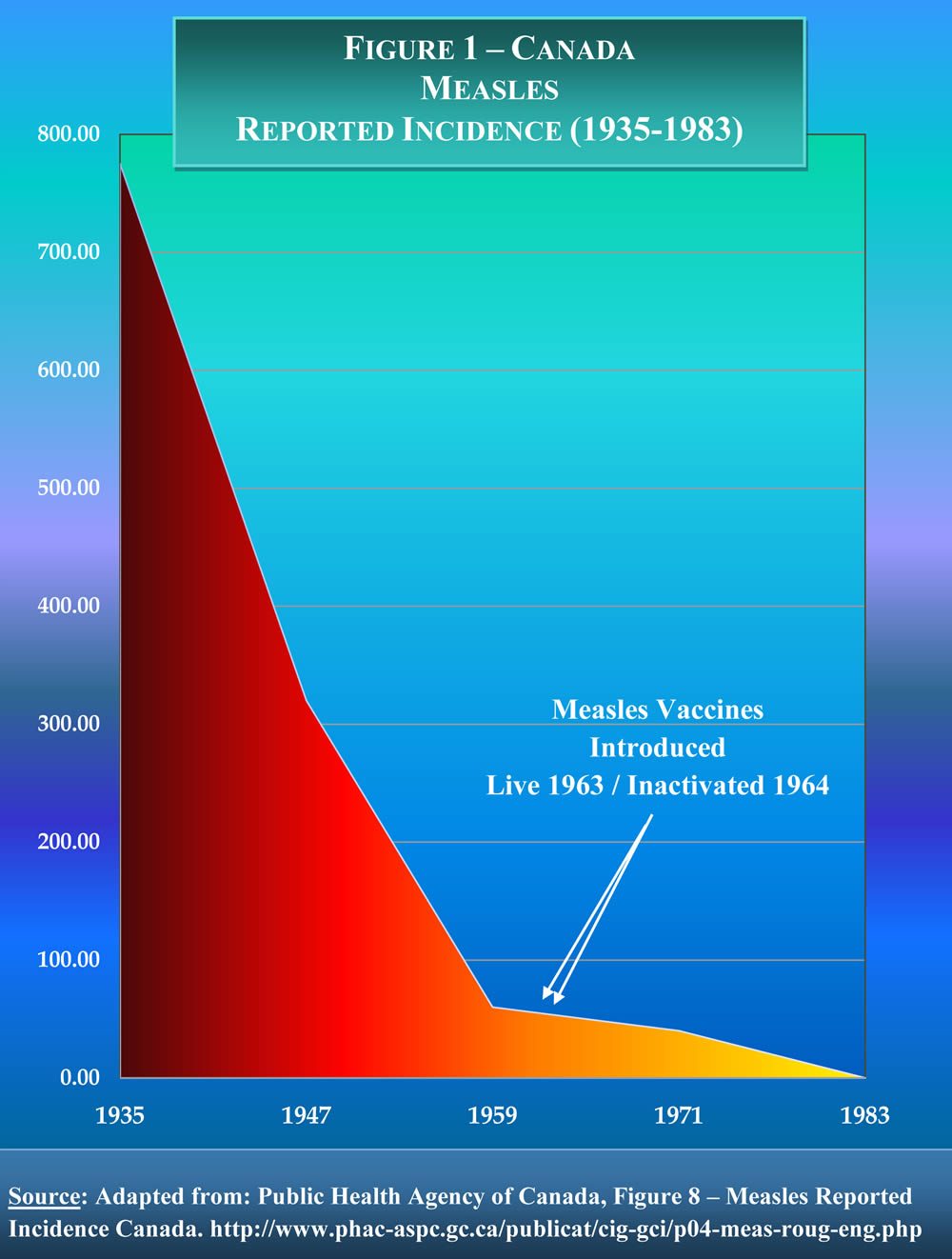
In the post to which I referred, the most intellectually dishonest graph is this one:

Fake Measles Graph
(Click to see full size figure.)

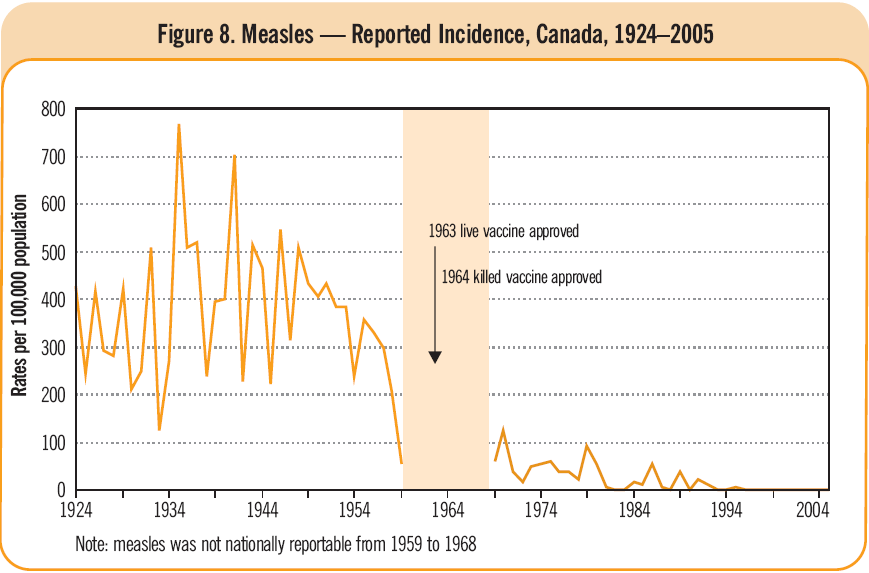
Note how this graph, unlike all the other graphs used to make the claim that “vaccines didn’t save us” actually uses incidence data, in this case from Canada from 1935 to 1983. I was immediately suspicious of this graph, though. The reason should be obvious; the decline in measles incidence is far too smooth. Measles incidence typically varies greatly from year to year. Fortunately, in his chutzpah, Obomsawin included a link to the actual source of the graph. Naturally, I couldn’t resist checking it out, and I found that the link leads to the Canadian Immunization Guide section on the measles vaccine. And this is the actual graph from which Obomsawin allegedly extracted his data:

MeaslesCanada
(Click for full-sized version.)

Note how Obomsawin left out a section of ten years when measles was not nationally reportable. Also note how he has, to be charitable, cherry picked the years to produce the impression of a smoothly declining measles incidence from 1935 to 1959. As I said, it doesn’t get much more intellectually dishonest than that. But it’s even worse than that. The graph above still gives the impression that measles incidence was falling before the ten years for which there is no data. Steve Novella points out that there is a better version of the graph in this reference, and he was kind enough to send it to me, given that, for whatever reason, my university doesn’t have a subscription to the relevant journal:

measles canada
(Click for full-sized version.)

Note how this graph looks at raw case numbers and shows 40,000 cases of measles in Canada the year before the ten year interruption in the data. All in all, it’s a much clearer representation of the data than the first graph, showing a clear drop that occurred during the ten year period, in the middle of which the measles vaccine was introduced. It also shows another obvious drop in measles incidence later on in the 1990s, when the two-dose measles vaccine program was started. As for why it appears that there is a steep dip in the first graph before the ten year gap, that actually appears to be an artifact. There is no data for 1959, the first year that measles was not nationally reportable in Canada, but the line appears to go to a datapoint at 1959 or 1960. My guess is that whoever made the graph decided to set the value for the beginning of the ten year gap to equal the first datapoint at the end of the ten year gap. In other words, the graph a rather poor representation of the data, and the Canadian government would do well to replace it on its website with something more like the second graph, which makes the point much more clearly.

As intellectually dishonest as Obomsawin’s graph is, this description of Obomsawin matches it:

He has produced academically and/or professionally over eighty-five (85) articles, reports, policy documents, presentations, and publications.

A search of Pubmed reveals only one peer-reviewed publication from 1978, and it’s only a commentary. In any case, apparently served as Director National Office of Health Development of the National Indian Brotherhood (AFN); Founding Chairman of NIB’s National Commission Inquiry on Indian Health; Executive Director in the California Rural Indian Health Board; Supervisor of Native Curriculum, Government of the Yukon Territory; and Evaluation Manager – Department of Indian and Northern Affairs Canada. None of these are scientific positions. More tellingly, he is “currently engaged with government funding as Senior Researcher relative to establishing a Public Sector Policy on Traditional Medicine in Canada.” My translation? He’s somehow managed to get a government grant to try to promote “traditional medicine” in Canada. Apparently, the Canadian government has its own problems with government money going to promote unscientific and pseudoscientific nonsense of the type that NCCAM promotes. In any case, besides Obomsawin’s disingenuous and intellectually bankrupt distortions of incidence data used to serve his apparently anti-vaccine agenda, he has no qualifications to speak of with regard to science or epidemiology that I can find.

It also turns out that Dr. Obomsawin has some other–shall we say?–unconventional beliefs as well. For instance, he is approvingly featured on that aggregator of all things quackery and pseudoscience, Whale.to, where he expresses anti-vaccine views, HIV/AIDS denialism, and admiration for Royal Rife. So what we have here is a woo-meister using cherry picked points on a graph to give a false impression that the measles vaccine was not responsible for the dramatic decline in measles incidence in Canada in the 1960s. Shocking, I know.

Another rebuttal to the idea that vaccines didn’t reduce the incidence of the diseases against which they were designed comes from the simple observation that, as vaccine uptake falls, the disease vaccinated against returns. Always. This is described by the CDC quite well:

Finally, we can look at the experiences of several developed countries after they let their immunization levels drop. Three countries – Great Britain, Sweden, and Japan – cut back the use of pertussis vaccine because of fear about the vaccine. The effect was dramatic and immediate. In Great Britain, a drop in pertussis vaccination in 1974 was followed by an epidemic of more than 100,000 cases of pertussis and 36 deaths by 1978. In Japan, around the same time, a drop in vaccination rates from 70% to 20%-40% led to a jump in pertussis from 393 cases and no deaths in 1974 to 13,000 cases and 41 deaths in 1979. In Sweden, the annual incidence rate of pertussis per 100,000 children 0-6 years of age increased from 700 cases in 1981 to 3,200 in 1985. It seems clear from these experiences that not only would diseases not be disappearing without vaccines, but if we were to stop vaccinating, they would come back.

The United Kingdom is an excellent illustration of this trend. Back in the mid-1990s, it declared measles as under control, thanks to the MMR vaccine. Then came Andrew Wakefield in 1998 with his trial lawyer-funded, incompetent, and possibly even fraudulent study claiming to link the MMR vaccine to “autistic enterocolitis,’ and a credulous, sensationalistic British press to spread his message that the MMR vaccine causes autism. The result was that measles came roaring back in the U.K. to the point that two years ago measles was declared endemic again there.

The Vaccine Liberation graphs and the even more deceptive graphs produced by “Dr.” Obomsawin to claim that vaccine-preventable diseases were already plummeting before the introduction of the relevant vaccines are typical of anti-vaccine arguments. First, they contain enough of a grain of truth to them to sound plausible. After all, better nutrition and better sanitation have in general contributed to better health and contributed to a decreasing toll from various infectious diseases. But they were not enough. Indeed, part of the reason we vaccinated against some diseases is because sanitation wasn’t enough. Was sanitation so much worse in the late 1980s before the Hib vaccine was introduced than it is now? No. Was it probably even that much worse in the 1960s, when the measles vaccine was introduced? Probably not. Yet, such is the myth that the anti-vaccine movement would have parents believe. Such is the intellectually dishonest nonsense they promote.

Why do they do this? J.B. Handley himself has told us why: To bring the U.S. vaccine program to its knees. Or the U.K. program. Or whatever program where the anti-vaccine program has taken hold. The reason is that, no matter how much science says it isn’t, to the anti-vaccine activist, it’s first and foremost always all about the vaccines.


[Slashdot]
[Digg]
[Reddit]
[del.icio.us]
[Facebook]
[Technorati]
[Google]
[StumbleUpon]

The case of John Lykoudis and peptic ulcer disease revisited: Crank or visionary?

One of the themes of SBM has been, since the very beginning, how the paradigm of evidence-based medicine discounts plausibility (or, perhaps more appropriately, implausibility) when evaluating whether or not a given therapy works. One of our favorite examples is homeopathy, a therapy that is so implausible on a strictly scientific basis that, for it to work, huge swaths of well-established science supported by equally huge amounts of experimental and observational evidence would have to be found to be all in serious error. While such an occurrence is not per se impossible, it is incredibly unlikely. Moreover, for scientists actually to start to doubt our understanding of chemistry, biochemistry, pharmacology, and physics to the point of thinking that our understanding of them is in such serious error that homeopathy is a valid description of reality, it would take a lot more than a bunch of low-quality or equivocal studies that show no effect due to homeopathy detectably greater than placebo.

On Friday, Kim Atwood undertook an excellent discussion of this very issue. What really caught my attention, though, was how he educated me about a bit of medical history of which I had been completely unaware. Specifically, Kim discussed the strange case of John Lykoudis, a physician in Greece who may have discovered the etiology of peptic ulcer disease (PUD) due to H. pylori more than a quarter century before Barry Marshall and Robin Warren discovered the bacterial etiology of PUD in 1984. One reason that this story intrigued me is the same reason that it intrigued Kimball. Lykoudis’ story very much resembles that of many quacks, in particular Nicholas Gonzalez, in that he claimed results far better than what medicine could produce at the time, fought relentlessly to try to prove his ideas to the medical authorities in Greece at the time, and ultimately failed to do so. Despite his failure, however, he had a very large and loyal following of patients who fervently believed in his methods. The twist on a familiar story, however, is that Lykoudis may very well have been right and have discovered a real, effective treatment long before his time.

Kimball is right to point out that discoveries require context. Medicine can be prone to dogma. Of that, there is no doubt. Sometimes, physicians resist challenges to prevailing medical dogma. Of that, too, there is no doubt. However, reading the story of John Lykoudis, I couldn’t help but wonder the full context of his activities and efforts to convince the Greek medical authorities of the 1950s and 1960s that he was on to something. It also allows me to indulge myself in a bit of my surgical training, the bulk of which, ironically enough, occurred during the time period when the discoveries of Warren and Marshall were first revolutionizing the treatment of PUD and becoming increasingly accepted in the 1990s. When evaluating a story like that of Dr. Lykoudis and why he was unable to convince the medical profession of 50 years ago that his findings had merit, it’s very important to understand (1) the prevailing notion at the time of PUD etiology and, even more importantly, (2) how PUD was diagnosed and treated in the 1950s and 1960s.

Throughout most of the 20th century, PUD was thought to be caused by stress and dietary factors. The primary treatment for disease that had not yet developed complications was bed rest and prescription of bland diets. Towards the mid-20th century it became increasingly appreciated that gastric acid is a major factor in the etiology of PUD, and increasingly antacids, then later H2 receptor antagonists like cimetidine and ranitidine, and then still later proton pump inhibitors like omeprazole. Cimetidine and ranitidine were the mainstays of PUD treatment when I was a medical student and a resident. For complicated PUD that either was not adequately managed by drugs, sometimes surgery would be necessary. Endless were the discussions and arguments among surgeons fo the time what operation was best for PUD management, a Bilroth I or Bilroth II, vagotomy and pyloroplasty, and, at the time I was finishing my residency, the highly selective vagotomy. Then, of course, there were the discussions of what to do in the case of a bleeding ulcer that couldn’t be stopped using endoscopy or what operation to perform in the case of a perforated ulcer.

One must also remember that in the 1950s and 1960s, the diagnosis of PUD was much different than it was even in Marshall and Warren’t time in the 1980s. That’s because in the 1970s and 1980s fiberoptic endoscopy became the dominant method of diagnosing PUD. Not only did it allow for direct visualization of the ulcer, but it also allowed for potential therapy without laparotomy. More relevant for purposes of this discussion, endoscopy allows isolation of the H. pylori that causes PUD. Prior to that, the methods of diagnosis were not as accurate. In general, PUD would be diagnosed by history, physical, and then an upper GI X-ray series, in which the patient would swallow barium-containing slurries, after which fluoroscopy would visualize the stomach and duodenum.

Consequently, if you imagine yourself back in the 1950s and 1960s, the time when Dr. Lykoudis practiced, the diagnosis of PUD was less certain than it was in the 1980s. Unless it was severe, it might not even show up on upper GI series, given the limitations of the imaging technology of the time. It wasn’t always possible to distinguish between gastritis and true PUD. Consequently, a lot of diagnosis and treatment of PUD in pre-endoscopy times ended up being a lot more empiric than it is now. The diagnosis was arrived at clinically, and it was symptomatic relief that was used as the main measure of treatment success.

So what would it have taken to demonstrate, given the technology of the time, that Dr. Lykoudis’ treatment was effective? It would have taken pretty much what it would take today, minus the use of endoscopy. Consequently, we could envision a clinical trial in which standard of care at the time (bland diet, antacids, etc.) was tested against the standard of care plus Dr. Lykoudis’ antibiotic regimen. The design would be simple: Two groups, one receiving standard of care plus placebo, one receiving standard of care plus antibiotics. Alternatively, although it probably wouldn’t be considered ethically acceptable now, back in the 1960s, it probably would have been considered ethical to do an alternative study, directly comparing the then standard of care to Dr. Lykoudis’ antibiotic regimen. Whichever design were chosen, before entry in the study, each patient would have to undergo upper GI to document the presence of PUD and measure its severity. They would also have to undergo upper GI at the end of the study to document healing. Throughout the study, pain scores would be measured, and patient outcomes tracked to see what proportion of patients end up requiring surgery for their PUD and which proportion can go back to eating a regular diet. Unfortunately, Dr. Lykoudis didn’t have data anywhere near that level of rigor.

On the other hand, what I’m describing above is the equivalent of what we would call today a phase III clinical trial. In general, phase III trials aren’t started without preliminary data. But what sort of preliminary data are usually needed to provide adequate scientific justification for a phase III trial? Today, we require preclinical evidence in the form of cell culture and animal studies, as well as lesser levels of clinical evidence, such as smaller trials like phase I or phase II trials. The preclinical data provide scientific justification and plausibility, and the human data bolster that. Of course, we can’t apply today’s standards to the science of 50 years ago. Back then, the methodology and ethics of randomized clinical trials were not as advanced and well-worked out as they are today.

So what happens if we look at Dr. Lykoudis’s story and whether he might have had enough data to justify a large phase III-like clinical trial in the time in which he was practicing? By today’s standards, he probably did not. As Kimball pointed out, although plausibility does not mean understanding the mechanism, it does mean that there should be a potentially plausible mechanism, as there does not exist, for example, for homeopathy. The concept that there might be a bacterial cause of PUD is not, on the surface, incredibly implausible. But was it plausible enough to justify a clinical trial of the sort that Dr. Lykoudis proposed? What would it take? This is what Dr. Lykoudis proposed:

In 1967, Lykoudis succeeded in getting the attention of the Prime Minister’s office. His correspondence with the Minister of Health on 21 August, 1967, a sad document indeed, is revealing. He registers his frustration that medications with apparently no effect on PUD were approved, whereas Elgaco was repeatedly rejected. He proposes, in essence, a phase III trial: 100 PUD patients to be treated at a State hospital by the eminent professors, 50 with conventional treatment and 50 with Elgaco. ‘Their refusal to approve it is understandable, but their refusal to test it is not!’ he writes.

A not unreasonable assertion. Unfortunately, as Kimball pointed out, the technology to isolate and culture H. pylori didn’t exist at the time. Absent that, providing strong evidence for a bacterial etiology for PUD would require an obvious and strong response to antibiotics in the form of unambiguous symptom relief and healing documented on followup upper GI imaging studies. Even if Lykoudis had had that, he would have been unable to culture the organism responsible for PUD, which would have left scientists in a quandary. Response to antibiotics is storngly suggestive of an infectious etiology, but, absent an organism, one can never determine for sure whether it is in fact a bacteria causing a disease or the antibiotic has an activity other than its ability to kill bugs, an additional activity. For example, erythromycin increases GI motility. Thus, in the context of the time, it’s not surprising that Lykoudis’ ideas were considered highly implausible, and it would have required very strong evidence to make the idea seem plausible.

Steve Novella made a cogent observation:

But taken at face value, I think the real lesson is that process is more important than whether or not one turn’s out to be correct. Science is about process.

The problem with Lykoudis is that his behavior was indistinguishable from the myriad quacks and charlatans that existed then and exist today. That in hind sight one turned out to be on the right track is not all that surprising, and their contemporaries should not be faulted for their inability to predict the future.

The question is – what did Lykoudis do to convince the scientific community of his claims. Did he perform carefully controlled double-blind placebo-controlled trials? Did he attempt to enlist the help of a microbiologist to try to isolate the organism? Or did he just expect people to take his word for it?

What did he do to deserve being taken seriously? Being right in the hindsight of history is not enough.

And I think that this is the key point. Science is a process. It is by its very nature constrained by what is known at any given time in history. In the context of Dr. Lykoudis’s time and given what was known then, it is not surprising that his idea would have encountered heavy resistance from the scientific orthodoxy of the time. Another issue to consider is regional variation in physicians’ attitudes. One example I like to use to illustrate this is the reaction of European physicians to the ideas of Ignaz Semmelweis. Semmelweis, as most readers will recall, first demonstrated that the high rate of puerperal fever in the obstetrics ward run by physicians was due to physicians not washing their hands after doing autopsies, going straight from the morgue to the delivery room. Semmelweis’ findings were far more favorably received in England, for example, than they were on the continent. It is possible, although by no means assured, that Lykoudis’ ideas might have been better received if he had lived in a different part of the world.

Here’s one final consideration. Science is performed by human beings. Although it is a process designed to overcome human biases, communicating the results of scientific research is subject to the same idiosyncracies to which any human communication is subject. Anyone who’s ever been to a scientific conference knows that. It is quite possible to be right and, to put it bluntly, to piss off the very scientists that need to be convinced so much that they harden their positions protecting the scientific consensus. One example is Semmelweis himself. Sherwin Nuland, in his book The Doctors’ Plague: Germs, Childbed Fever and the Strange Story of Ignac Semmelweis, suggested that if Semmelweis had communicated his findings more effectively and managed not to antagonize the medical establishment so thoroughly he might not have been marginalized and dismissed in the manner that he was. At the very least, he may not have been met with as much hostility. Galileo, although apparently not intentionally, alienated the Pope at the time by putting his words in the mouth of a character named Simplicio defending the Aristotelian Geocentric view in Dialogue Concerning the Two Chief World Systems. Reading between the lines, one can see echoes of this sort of antagonism in Lykoudis’s story. Indeed, Michael Phillips of St. Vincent’s Medical Center wrote in an letter to The Lancet:

I propose a less dramatic metaphor: medicine is a marketplace of ideas, with sellers and buyers. Sellers (innovators with new ideas) advertise their intellectual property to potential buyers (other physicians). This buying public is highly sophisticated and sceptical. Quite correctly, physicians will only accept the highest quality new ideas because the lives of their patients are at risk. So physicians buy only when they see the hallmark of quality: publication in a respected peer-reviewed journal.

That in a nutshell explains the tragedy of John Lykoudis. He had a wonderful intellectual product: the insight that peptic ulcer disease is infectious, supported by the evidence that it can be cured with antibiotics. But he lacked the ability (or the training) to sell this insight to his colleagues. He was a retail trader who treated individual patients instead of targeting the wholesale market of other physicians.

Of course, this is the problem. Most physicians are not scientists, and many physicians are very prone to being swayed by anecdotal evidence. Without well-designed clinical trials based on the best basic and translational science available, way to validate or refute anecdotal data. I find Lykoudis’s story to be a cautionary tale. Whether he was correct and thus the true “Galileo” of H. pylori, rather than Warren and Marshall or whether he was just another crank, his story demonstrates that we scientists should be very careful to guard against excessive smugness. As has been repeated by many skeptics in many variants over the years, it is not sufficient to claim the mantle of Galileo as a persecuted martyr for science. You must also be right. Even though it is not clear whether, taken in the context of the time, Lykoudis was a crank or a misunderstood physician who was ahead of his time, Warren and Marshall’s vindication of his ideas that PUD is bacterial in etiology reminds us that not all who claim the mantle of Galileo are necessarily cranks. The vast majority usually are, but on very rare occasions we do see a real Galileo.


[Slashdot]
[Digg]
[Reddit]
[del.icio.us]
[Facebook]
[Technorati]
[Google]
[StumbleUpon]

Brief Note: Followup on Spinal Decompression Machines

In September 2008 I wrote a post on Misleading Ads for Back Pain Treatment. with particular attention to the bogus claims for the DRX 9000.

The Canadian Broadcasting Company (CBC) show “Marketplace” has just done a scathing exposé of so-called nonsurgical spinal decompression treatment with machines like the DRX 9000 and of some of the unscrupulous practitioners who offer it.  Between the hidden camera footage and the weasel words of the chiropractor they interview, it’s quite entertaining.


[Slashdot]
[Digg]
[Reddit]
[del.icio.us]
[Facebook]
[Technorati]
[Google]
[StumbleUpon]

My NCCAM Wish List

For a number of reasons, well-argued many times here on SBM, it would be beneficial to American citizens if the National Center for Complementary and Alternative Medicine (NCCAM) were abolished. This does not seem to be in the cards anytime soon. Here, then, are my suggestions for making the Center less dangerous and less of a marketing tool for pseudomedicine than it has been since its inception. Some suggestions might even make the Center somewhat useful. They are listed in order of priority. The Center should:

1. Abandon all unethical trials, beginning with the Trial to Assess Chelation Therapy (TACT, which is under the joint auspices of the NHLBI). This should be done in a very public manner. The reasons for abandoning the TACT, in summary, are as follows.

  • The TACT was conceived and approved not because of any scientific or medical promise, but because of pressure from a powerful demagogue in Congress, Rep. Dan Burton (R-IN). Burton was acting on behalf of a tiny, fringe group of physicians whom the editor of Chest and Archives of Internal Medicine had correctly called “pseudoscientific zealots” whose practices were “an abuse of the physician’s freedom of choice.” Barely 15 years later, TACT literature emanating from the NIH renamed the same practitioners “respected experts.” Their organization, the American Association for Advancement in Medicine (ACAM), actively lobbied for the TACT.
  • The TACT Principal Investigator (PI) made numerous false statements in his application for the grant and in his subsequent protocol submission, the effect of which was to give the erroneous impression that chelation is a promising treatment for coronary artery disease. I believe that those false statements constitute scientific misconduct. If the PI had offered an accurate review of the existing literature, any scientific review board or IRB worth its salt would have refused to approve the trial. In the event, the “Special Emphasis Panel” that the NCCAM convened to review the application included the very practitioner who, as President of the ACAM, had been instrumental in securing Rep. Burton’s influence. That practitioner was also named, in the application that he reviewed, as a member of a TACT committee, and would shortly thereafter become a TACT investigator. This is a violation of the NIH conflict of interest policy.
  • We have shown, and both the federal Office of Human Research Protections (OHRP) and the University of Miami IRB have acknowledged, that the TACT proceeded with a misleading consent form—so misleading that any change now, more than 6 years after the trial began, couldn’t possibly reverse the damage already done. Misleading statements in the consent form included a strong implication that the study drug was the relatively less dangerous calcium-sodium ETDA, not the very dangerous disodium EDTA used in the trial. The consent form also failed to state important risks, including death.
  • Almost 2 years ago the FDA withdrew its approval for disodium EDTA, which it had previously approved only for emergency treatments of digitalis toxicity and hypercalcemia. The FDA cited the dangers of the drug, including recent deaths associated with unapproved uses by ACAM members. Thus there is now no point in studying this drug because it is, for practical purposes, illegal.
  • We also showed, and the OHRP and U. Miami IRB also agreed, that many of the investigators in the TACT have criminal records, histories of discipline by state medical boards, histories of membership in IRBs disciplined by the FDA, and other indications of incompetent practices or worse. They are the pseudoscientific zealots mentioned above. I have argued on SBM that at least 2 deaths of human subjects in the TACT can be attributed to incompetent care at the hands of such investigators.
  • The TACT protocols, including far-too-biased investigators, inadequate blinding methods, multiple primary and secondary endpoints, and more (discussed here), are so tainted that whatever the reported outcome, it is unlikely that it will solve the very problem that it was intended to solve. The outcome will likely be equivocal, but even if it is reported as confirming or disconfirming, either conclusion will almost certainly be rejected by those who disagree.
  •  This suggestion—to abandon the TACT—isn’t really optional, although I am not so naïve as to think that NIH policy-makers will agree. It is not optional because the TACT violates numerous tenets of internationally recognized human studies ethics and numerous articles of the U.S. Federal Code of Regulations, and those violations are not retroactively remediable. As Henry Beecher wrote in his seminal article on human studies ethics, “an experiment is ethical or not at its inception; it does not become ethical post hoc…”

Thus to continue the trial, now that such violations are known, is not an ethically viable option for the NIH. Nor should the NIH succumb to political pressure framed as the “legislative mandate” of the NCCAM, which is its usual justification for such mischief. The reason is found in the Helsinki Declaration:

Physicians should consider the ethical, legal and regulatory norms and standards for research involving human subjects in their own countries as well as applicable international norms and standards. No national or international ethical, legal or regulatory requirement should reduce or eliminate any of the protections for research subjects set forth in this Declaration.

The NCCAM should also publicly address the horribly unethical trial of the Gonzalez regimen for cancer of the pancreas, even though that trial is over. It was spawned by much the same political pressure as was the TACT, it involved NIH-sponsored torture of hapless subjects, and its disconfirming outcome has done nothing to dissuade Gonzalez himself or his champions, including Burton and long time NCCAM advisee (and “Harkinite”) Ralph Moss.

Finally, the NCCAM must reconsider one of its recurrent public justifications for such trials: popularity. I have written about this several times (including in both the TACT article linked above and the Gonzalez regimen series here on SBM, also linked above) so I won’t go into detail here. In summary, “popularity”—which is almost always exaggerated, as it was in both of those cases—is a weak basis for a human trial: it should not trump a lack of scientific promise, and it never trumps welfare of individual subjects.

2. Stop using its public information function as an advertisement for fanciful, implausible claims. That it does this is apparent from even a passing glance at its website, but if examples are sought I refer you to a previous discussion.

3. Start using its public information function for some good, such as informing citizens that homeopathy is nonsense, or that those who claim a vaccine-autism link are both wrong and dangerous. It needs to confront the longstanding, close affiliation between “CAM” proponents and antivax hysteria.

4. Stop putting the cart before the horse by giving grants to medical schools to create “integrative medicine” centers, and stop promoting puff treatments of “CAM” for medical students.

5. Stop funding studies of “CAM” use and popularity, and begin trying to find out why it is that some people are drawn to implausible treatments, even in the face of compelling, contradictory evidence. Such investigations might begin by looking at the work of Beyerstein and Alcock, for example.

That’s it for now.


[Slashdot]
[Digg]
[Reddit]
[del.icio.us]
[Facebook]
[Technorati]
[Google]
[StumbleUpon]

Less salt: it’s that simple

It has been known for decades that dietary sodium is significantly associated with hypertension and coronary heart disease.  Despite this knowledge, Americans continue to consume more sodium, most of it coming from processed foods.  Various approaches have been used to help individuals modify their behavior, one of the most popular of which is the DASH diet.  Given what we know, you would think that a low-sodium diet would be especially popular with “alternative” practitioners.  After all, what could be more “natural” than lifestyle modification (a mainstay of real medicine since…well…forever).

But as any clinician knows, it’s much easier to get someone to take something than to eliminate something.  Lifestyle modification is difficult, but achievable to a degree as experience has shown with cholesterol, smoking, and other modifiable risk factors.  A recent study in the New England Journal of Medicine evaluated what the possible effect would be of lowering U.S. sodium consumption to 3g/day.  The authors found that, “Modest reductions in dietary salt could substantially reduce cardiovascular events and medical costs and should be a public health target.”

It really could be that simple: a combination of education and regulation could save lives and money.  And you would think the altmed folks could get behind something like this.  But taking simple, cheap recommendations and turning them into something “alternative” (and profitable) is a specialty of modern shamans.

A good example of this is a “holistic family practice” in the Midwest U.S. From the FAQs on their website:

Q:Should I eliminate salt in my diet?
A:The correct form of salt is an extremely important substance for our body. There is a big difference between refined salt and unrefined salt. As I discuss in Salt: Your Way To Health, refined salt is a toxic substance that needs to be avoided. Refined salt has no minerals and is contaminated with substances such as ferrocyanide. Unrefined salt has over 80 minerals in it. I have found unrefined salt a wonderful addition to a healthy holistic regimen.

If that sounds fishy to you, good.  You have probably already noticed the most glaring error: that refined salt contains “no minerals”.  Of course, sodium chloride is a mineral (as are potassium chloride, potassium iodide, etc.).  Following the link to his book is revealing because his special salt can cure all kinds of problems. And, to make your life easier, he sells just the right salt.  One of his special salts is called “Celtic Sea Salt”, which, at $6.00/lb, “balances the body and can help with adrenal exhuastion, low blood pressure, and mineral deficiencies.”  Links to evidence?  None.  Price of typical American table salt? Less than a dollar per pound (not that you should be using added salt in any significant quantity anyway).

This is typical of the altmed movement.  They accuse real medicine of being a profit-driven juggernaut that ignores simple treatments, but then promote their own useless and expensive nostrums. It would be comical if it weren’t real people who suffer.

References

Bibbins-Domingo K, Chertow GM, Coxson PG, Moran A, Lightwood JM, Pletcher MJ, & Goldman L (2010). Projected effect of dietary salt reductions on future cardiovascular disease. The New England journal of medicine, 362 (7), 590-9 PMID: 20089957


[Slashdot]
[Digg]
[Reddit]
[del.icio.us]
[Facebook]
[Technorati]
[Google]
[StumbleUpon]

H. Pylori, Plausibility, and Greek Tragedy: the Quirky Case of Dr. John Lykoudis

Mark Crislip is on vacation, but through an arduous series of shakings and succussions (beating his head against the wall?) we have channeled part of his essence: This post mostly concerns itself with infectious diseases, thanks to several recent posts on SBM that discussed the plausibility of health claims and that touched on the recent discovery that most peptic ulcer disease (PUD) is caused by a bacterium, Helicobacter pylori. Several comments and statements quoted in those posts reveal recurrent questions regarding both plausibility itself and the history of the H. pylori hypothesis. In this post I’ll attempt to answer some of those questions, but I’ll also insert some new confusion.

Plausibility ? Knowing the Mechanism

Let’s first dispense with a simple misunderstanding: We, by which I mean We Supreme Arbiters of Plausibility (We SAPs) here at SBM, do not require knowing the mechanism of some putative effect in order to deem it plausible. This seems so obvious that it ought not be necessary to repeat it over and over again, and yet the topic can’t be broached without some nebbishy South Park do-gooder chanting a litany of “just because you don’t know how it works doesn’t mean it can’t work,” as if that were a compelling or even relevant rebuttal. Let’s get this straight once and for all: IT ISN’T.

Steve Novella explained why at the Yale conference and again here. We talked about it at TAM7 last summer. For a particularly annoying example, read the three paragraphs beginning with “Mr. Gagnier’s understanding of biological plausibility” here.

OK, I’ll admit that I’m beginning to learn something from such frustration. Perhaps we’ve not been so good at explaining what we mean by plausibility. The point is not that we don’t know a particular mechanism for homeopathy, for example; the point is that any proposed mechanism would necessarily violate scientific principles that rest on far more solid ground than any number of equivocal, bias-and-error-prone clinical trials could hope to overturn. The same is true for “energy medicine” and for claims based on non-existent anatomical structures (iridology, reflexology, auricular acupuncture, meridians, chiropractic “subluxations”), non-existent physiologic functions (”craniosacral rhythms“), or non-existent anatomic-physiologic relations (”neurocranial restructuring,” “detoxification” with coffee enemas, dissolving tumors with orally administered pancreatic enzymes). The spectrum of implausible health claims euphemistically dubbed “CAM” is full of such nonsense.

Reader daedalus2u proposed a useful way to clarify the point:

I think the idea of prior plausibility should actually be reframed into one of a lack of prior implausibility. It isn’t that one should have reasons to positively think that something is plausible before testing it, but rather that one should not be able to come up with reasons (actually data) why it is fatally implausible.

Some of what We deem implausible will not be fatally so, of course. Implausibility can be based not only on established physical and biological knowledge, but also on studies, as is the case for sticking needles into people, injecting them with chelating agents, or claiming that autism is caused by childhood immunizations.

Plausibility and History

A second theme, though not as simple, concerns the historical role of plausibility. Reader anoopbal introduced the point:

am not sure if you can apply biological plausibility to every situation. It is usually considered as a weak criterion because it is limited by our knowledge.

If we used plausibility 300 years back, nobody would have used citrus fruits for scurvy nor people would have believed mosquitoes are linked with black water fever.

I think that daedalus’s “reframing” proposal deals with that objection to a large extent. I also don’t think that anoopbal’s examples are all that revealing. It seems to me that empiricism was the main source, other than myth, for plausibility at the time. Plausibility in the biomedical sense is not something that can be usefully discussed for the period prior to about the mid-19th century, when enough was finally known about biology and chemistry to hatch science-based medicine in its full form. Prior to that, most useful diagnostic and treatment methods had been discovered empirically (accidentally).

This is not to say that someone living before the mid-19th century could not have applied plausibility to a medical question—obviously that could happen at any time—but that to attempt to do so, when so much was still mysterious (how cowpox pus worked, microbiology, Avagadro’s number, energy flux in living organisms, physiology, pharmacology, etc.) or ‘explained’ by magic (the Vital Force, miasmas, sympathetic magic, the 4 humors, etc.) would have meant very little by today’s standards. And I do believe that there is a fundamental difference—not merely a foolish conceit about modernity—between what we know today and what we knew 300 years ago. Thus I don’t think that biological plausibility is a weak criterion now, even if it was then.

To give anoopbal his or her due, he seemed to partially agree when he later noted:

And that‘s exactly the limitation of biological plausibility. It is limited by what we currently know. Centuries back our knowledge about earth was limited, and you can’t blame them for believing the earth [was] a flat disc.

On to H. Pylori

Daedalus offered another interesting take on plausibility:

An idea does not have low prior plausibility if it does not agree with prior explanations, it has low prior plausibility if it does not agree with prior data.

Many (most?) scientists make this confusion too. That is because they are thinking on the level of the explanations, not on the level of the data that led to those explanations. The explanations may be wrong, the data that led to them is not.

Given the presumption that the data are accurate, we would all probably agree with this. Daedalus, however, then got a little tripped up:

The idea of using antibiotics to treat ulcers was incompatible with the idea that ulcers were due to too much acid. It was not incompatible with any of the data surrounding ulcer treatment.

So did Harriet Hall:

The idea of treating ulcers with antibiotics was not incompatible with any of the data about ulcers; it was only incompatible with the idea that ulcers were caused by too much acid.

At the time that Barry Marshall and Robin Warren proposed their bacterial hypothesis, there were data suggesting that ulcers were caused by too much acid: acid neutralization or suppression of acid formation resulted in better than 90% healing of peptic ulcers, compared with about 30% for placebo. If such therapies were discontinued after healing, the ulcers typically relapsed, only to be healed again by renewed acid suppression. This did not rule out the possibility of some other factor also being involved, of course, but it would seem to have come pretty close to throwing down the gauntlet of Ockham’s Razor.

Why not just Treat with Antibiotics?

What might it have taken prior to 1984, short of what was subsequently done, to convince the world that peptic ulcer disease could be effectively treated with antibacterial agents? A reader sent just such a question to Steve Novella:

What would Science Based Medicine do if H. pylori was not known, but a study showed that antibiotics given to patients with stomach ulcers eliminated symptoms? I assume that SBM wouldn’t dismiss it outright saying that it couldn’t possibly be helping because antibiotics don’t reduce stomach acid. I assume a SBM approach would do further studies trying to discover why antibiotics work. But, in the meantime, would a SBM practitioner refuse to give antibiotics to patients because he doesn’t have a scientific explanation as to why it works?

A straightforward answer is as follows. Although the question may raise an interesting general point about plausibility, the example is not a good one. Antibiotics are not one medicine but many. They all have side effects, some quite serious. Bacteria are also not one species but many; they have widely differing sensitivities to various antibiotics. Which antibiotic(s) would the study have used, and on what basis? Responsible MDs would not have accepted such a scheme for PUD, because they would have needed to know what they were treating and how to treat it (H. pylori turns out to require three different antibiotics given simultaneously).

A predictable rejoinder to this is that many physicians routinely treat upper respiratory tract infections, most commonly caused by viruses, with an antibiotic. Without going into detail, let me assure you that this does not refute my point: in many cases MDs should not be treating these URIs with antibiotics, and in cases where it makes a bit of sense to do so it is done with a single, short-term antibiotic with a benign risk/benefit profile, known to be effective against the most common community-acquired bacterial culprits of the respiratory tract. This is quite different from attempting to treat a mysterious bacterium that might not even exist, for a disease that already has effective treatments that are safer and have fewer side effects than antibiotics.

Mikerattlesnake got the point:

I think it’s a wise addendum to directly address the logical misstep in the question you received. Those who understand SBM would get the answer from the broad approach taken in your post, but those people aren’t the ones likely to parrot the fallacy.

To put it simply: finding that an antibiotic was effective against an ulcer would indicate a bacterial cause for ulcers that would warrant further study. The reason for that has entirely to do with prior plausibility. Antibiotics are known to fight bacteria. If an antibiotic cures ulcers, it gives us a plausible answer for the mechanism causing ulcers. The questioner makes the mistake of assuming that we would never abandon the assumed cause of ulcers, but SBM looks for mechanisms of action for ailments as well as cures.

So did BillyJoe, with the appropriate caveat:

I like it.

Only one thing though: this could never have happened. As I understand it, the treatment involves taking three different tablets – two antibiotics and an acid suppressing drug – twice a day for a week. How likely is that to have happened by chance?

Discoveries Require Context

Some might assume that Robin Warren and Barry Marshall were the first to discover bacteria apparently living in the human stomach and duodenum, and the first to propose that the bacteria might be involved in diseases of these tissues, but this isn’t the case. Such bacteria were first observed in the 19th century. Over subsequent decades there were sporadic reports of similar bacteria, but they were not necessarily associated with diseases and their presence could not be reliably reproduced. The table of contents of Helicobacter Pioneers: Firsthand Accounts from the Scientists who Discovered Helicobacters 1892 – 1982, edited by Barry Marshall, gives a hint of just how close some investigators came to the truth:

  1. Helicobacters were discovered in Italy in 1892: An episode in the scientific life of an eclectic pathlogist, Giulio Bizzozero. Natale Figura and Laura Bianciardi
  2. The discovery of Helicobacter pylori in Japan. Yoshihiro Fukuda, Tadashi Shimoyama, Takahashi Shimoyana and Barry J Marshall
  3. An early study of human stomach bacteria. A. Stone Freedberg
  4. Gastric urease in ulcer patients in the 1940’s: The Irish connection. Humphrey J O’Connor and Colm A O’Morian
  5. How it was discovered in Belgium and the USA (1955 -1976) that gastric urease was caused by a bacterial infection. Charles S Lieber
  6. A personal history of giving birth to the cohort phenomenon of peptic ulcer disease. Amnon Sonnenberg
  7. John Lykoudis: The general practitioner in Greece who in 1958 discovered the etiology and a treatment of peptic ulcer disease. Basil Rigas and Efstathios D Papavassiliou
  8. How I discovered helicobacters in Boston in 1967. Susumu Ito
  9. How we discovered in China in 1972 that antibiotics cure peptic ulcer. Shu-Dong Xiao, Yao Shi and Wen-Zheng Liu
  10. Helicobacter pylori was discovered in Russia in 1974. Igor A Morozov
  11. The discovery of Helicobacter pylori in England in the 1970’s. Howard W Steer
  12. We grew the first Helicobacter and didn’t even know it!. Adrian Lee, Michael Phillips and Jani O’Rourke
  13. The Dallas experience with acute Helicobacter pylori infection. Walter L Peterson, William Harford and Barry J Marshall
  14. The discovery of Helicobacter pylori in Perth, Western Australia. J Robin Warren
  15. The discovery of Helicobacter pylori, a spiral bacterium, caused peptic ulcer disease. Barry J Marshall
  16. Helicobacter pylori treatment in the past and in the 21st Century. Peter Unge

Prior to Marshall and Warren, human gastric bacteria were not only inconsistently seen, but were never cultured and hence never characterized in a useful way (for a more basic treatment of this topic, please see my 2004 essay in Skeptical Inquirer). At least two distinct technological advances were necessary to set the stage for the discovery and characterization of H. pylori in humans: first, a simple and safe method for obtaining gastric mucosa specimens from live patients had to be devised; second, the field of bacteriology had to appreciate the existence of highly fastidious organisms and devise methods for growing them in culture. The first of these requirements was satisfied only by the late 1970s, when flexible, fiberoptic endoscopy became widely available.

I am not enough of an historian of bacteriology to state, with certainty, when H. pylori might have first been cultured, if only its existence had been fully appreciated, but it is doubtful that it could have occurred much sooner than it did. Helicobacter Pioneers reports that the first successful culture of any helicobacter species—isolated from mice—occurred in 1968. Other examples of fastidious bacteria have also been characterized relatively recently: mycoplasma pneumoniae and chlamydophila pneumoniae, two organisms that cause atypical pneumonia, were still thought to be viruses until the 1960s; several new species of helicobacter and campylobacter, some of which are human pathogens, have been discovered only in the last 10-15 years.

The culture requirements of H. pylori, moreover, are esoteric: it grows best in an atmosphere of 5% oxygen and is helped by the presence of certain antibiotics to discourage overgrowth by more hardy contaminants, which are almost impossible to avoid when collecting specimens from the stomach via the mouth. Helicobacter takes much longer to grow than most bacteria, and but for serendipity Warren and Marshall almost missed it. They abandoned their first 34 culture attempts (or, more precisely, “junior microbiology staff” abandoned them) in spite of multiple variations of media and temperatures, after no growth had occurred within 48 hours. It was only after a five-day Easter vacation, during which the 35th attempt was left undisturbed, that tiny, transparent colonies appeared.

John Lykoudis: the Real Galileo of PUD?

An intriguing story in Helicobacter Pioneers is found in chapter 7: John Lykoudis: The general practitioner in Greece who in 1958 discovered the etiology and a treatment of peptic ulcer disease. You can read most of this chapter at the Google Books website. If it is accurate, it makes the answer to the question that the reader posed to Dr. Novella not so straightforward as Mikerattlesnake, BillyJoe, and I argued above: it inserts the “new confusion” that I promised at the beginning of this post. Lykoudis’s story has all the necessary tragic elements:

a general practitioner in a small, isolated town in Greece, prompted by a single clinical observation, developed on his own the concept that PUD and gastritis had an infectious etiology. As if this was not enough, this most unlikely student of PUD proceeded to devise an apparently effective treatment, based on the antibiotics of his time.

Lykoudis’s treatment, apparently developed by trial and error, consisted of 3 antibiotics (2 quinolines and streptomycin, for you microbiology/infectious disease enthusiasts out there) and vitamin A, taken orally. He patented this regimen in a pill that he named Elgaco, “from the Greek word for ulcer (= elkos), gastritis and colitis” (for which he also asserted that his treatment was effective). He eventually claimed to have treated 30,000 patients with nearly perfect results and no toxicity. According to the authors of the chapter,

The success of Elgaco cannot be quantified from extant notes on thousands of patients, because the outcome of each patient is not recorded. We have concluded, however, that his treatment was successful, based on the following considerations. First, our current understanding of the etiology and treatment of PUD makes it plausible that his treatment was effective. Second, there is the written testimony (some of it sworn, as explained later) of many of the patients who were treated by Lykoudis. All report prompt responses to his therapy. In some cases, patients even detail that radiographically proven ulcers were cured following treatment with Elgaco and that such cure was confirmed by repeat radiological series. Third, Lykoudis had a large following and despite fierce opposition from the establishment, patients flocked to him from all over Greece.

In spite of this, his attempts to make his discovery known to the world were rebuffed at every turn:

He encounter[ed] formidable obstacles in convincing the medical establishment, the Greek regulatory authorities and the pharmaceutical industry. In fact, Lykoudis spent the rest of his life engaged in incessant activity to propagate his treatment of PUD and gastritis. His archives, some made recently available by his family, make it clear that he was fully aware of the importance of his discoveries. They also convey an almost suffocating sense of frustration…

[He was] completely shunned by the medical establishment of his time, or at best, considered an eccentric provincial physician…

In 1966, Lykoudis attempted to publish his observations in the Journal of the American Medical Association, but his manuscript entitled “Ulcer of the Stomach and Duodenum” was rejected…Unfortunately, no copy of this manuscript survives for re-evaluation in the light of current knowledge.

Lykoudis did, however, publish his own booklet, “The Truth about Gastric and Duodenal Ulcer.” In it he wrote:

There is no doubt that gastritis and duodenitis, which have gastric and duodenal ulcer as their complication, are inflammations due to an infectious agent…

Lykoudis made numerous attempts to get his remedy approved by the Greek Drug and Pharmacies Administration, to no avail. He even managed to enlist the aid of influential politicians:

In 1967, Lykoudis succeeded in getting the attention of the Prime Minister’s office. His correspondence with the Minister of Health on 21 August, 1967, a sad document indeed, is revealing. He registers his frustration that medications with apparently no effect on PUD were approved, whereas Elgaco was repeatedly rejected. He proposes, in essence, a phase III trial: 100 PUD patients to be treated at a State hospital by the eminent professors, 50 with conventional treatment and 50 with Elgaco. ‘Their refusal to approve it is understandable, but their refusal to test it is not!’ he writes.

Lykoudis continued:

If the study proves them correct, they will be vindicated and I will become a laughing stock…It is dramatically urgent to clarify this issue…Too much, endless talking, which leads nowhere, while it is simple to resolve this in a practical way. Only facts constitute the truth.

Yet again he was refused. Lykoudis also tried, unsuccessfully, to interest several drug companies in his regimen. The final insults were these:

…he was referred for disciplinary action to the Athens Medical Association, of which he was a member, ‘because (a) he prepared and distributed an unapproved medicinal preparation…and (b) he made his method publicly known to attract patients’…On 6 November 1968…the Disciplinary Committee, presided over by a neurology professor, fined him 4000 drachmas…

A more serious problem for Lykoudis was his indictment in the Greek Courts…

In the latter instance numerous former patients came to his support; one of them testified that Lykoudis “treated also many poor ulcer patients free of charge.”  We are not told the outcome of the indictment.

Lykoudis died in 1980 without knowing that he would soon be vindicated. His story is disturbing because it is an almost perfect hybrid of two entirely different possibilities: on the one hand, a legitimate innovator who is unfairly rejected and persecuted, in spite of heroic efforts over more than 2 decades to prove his theory; on the other, a classical example of unwitting foolishness, bordering upon quackery or sociopathy.

It is only in hindsight that we can grant that there is a good chance that it wasn’t the latter. Consider the striking parallels, however, to Nicholas Gonzalez, whose main arguments have consisted of patient testimonials and case reports selected by himself, who claims that his regimen is nontoxic, who claims to treat some patients for free, who was hounded by regulatory boards for a time, who found political allies to help defend him, and who for years pleaded that all he wanted was a chance to test his regimen:

I believe in research. I don’t want this to be out there until we prove it works by the strictest standards of orthodox medicine. What I have wanted from the day I began researching this under Dr. Goode at Cornell in 1981, was to do appropriate clinical trials.

Again: Discoveries Require Context

My sense, reading the story of John Lykoudis, is that he was treated unfairly, and I think that most people would agree. A major caveat is that the authors of the chapter are clearly sympathetic to him, and it’s quite possible that another account would read differently.

Whether fair or not, it seems to me that the major weakness in Lykoudis’s case is that he never characterized the putative bacteria in any way: he didn’t see them, he didn’t provide direct evidence of them for others to examine, and he didn’t culture them.

Even his sympathetic biographers recognized this. Although they attributed his failure to “his lack of academic credentials” and even more to “his thesis [being] contrary to established, albeit unsubstantiated, dogma,” they also observed:

Unfortunately, when he was compelled to identify these elusive organisms, particularly when dealing with regulatory agencies, he meandered around known pathogens, unable to build a strong case for any of them. His main argument, and the strongest one he could marshal in all his writings in favor of the infectious etiology of these clinical entities, was the response to treatment that he had witnessed.

A good argument can be made that characterizing the “bug” not only is, but ought to be a sine qua non for treating a putative infectious disease with drugs. This is true because the drugs are not benign or universally effective, as argued above, but also because there are precedents suggesting that to do otherwise opens the door to mistreatments. Bacteria or viruses are frequently offered as potential etiologic agents for all sorts of diseases whose causes are poorly understood, particularly when there is an inflammatory component (that is one reason that the H. pylori hypothesis didn’t represent a new “paradigm”). Osteoarthritis and rheumatoid arthritis are examples, but these have, so far, eluded attempts at proof.

When I first learned about sarcoidosis and Crohn’s disease in medical school in the 1970s, I would have bet dollars-to-donuts that they, and rheumatoid arthritis and a few other diseases for that matter, would eventually be shown to have infectious etiologies. I would still almost make that bet, my only hesitation being that after 30+ more years of investigations and impressive advances in microbiology (including vastly more powerful methods of detecting well-veiled foreign invaders, from electron microscopy to nucleic acid amplification), no apparent culprits have feen found.

During that same time, moreover, not only peptic ulcer disease but also Lyme disease, Legionnaire’s disease, and Toxic Shock Syndrome were shown to have bacterial origins, and AIDS was shown to be caused by a virus. Thus on the basis of what has been learned about infectious diseases it can’t be argued, with a straight face, that biomedical progress is hampered by stodginess or petty jealousies or dogmatic thinking or conflicts of interest or any of the other usual suspects, even though they certainly all exist among individual scientists. What hampers progress, in cases such as Likoudis’s, is what hampers all scientific progress: the context is not prepared.

Instances in which at least some people have become convinced of a spurious infectious etiology, on the other hand, have not been pretty. In the early 20th century, prior to the discovery of antibiotics, some psychiatrists became convinced that “insanity” was caused by bacteria in the mouth and that the appropriate treatment was “surgical bacteriology”: tooth extractions, tonsillectomies, and in intractable cases removal of “testicles, ovaries, gall bladders, stomachs, spleens, cervixes, and especially colons.” More recently a putative bacterial cause of atherosclerosis has spawned a small quack industry.

Even if any of the diseases mentioned above is eventually found to be infectious in origin, this will not necessarily vindicate those whose premature exuberance put patients in harm’s way. Such exuberance ought to motivate legitimate investigations, not half-assed, ill-conceived treatments. Still, I seem to hear a ghostly voice in my ear, speaking Italian with a thick Greek accent…

E pur si muove!


[Slashdot]
[Digg]
[Reddit]
[del.icio.us]
[Facebook]
[Technorati]
[Google]
[StumbleUpon]

Vaccinations and autism: are we number 1?

It has been alleged by Great Minds such as Jenny McCarthy that the US recommends far more vaccinations than other countries.  Her precise statement was, “How come many other countries give their kids one-third as many shots as we do?” She put this into the context of wondering if our current vaccine schedule should be less rigid.  The entire piece was filled with what could charitably called less-than-truthful assertions, but examining simply this one assertion might be useful.  Dr. John Snyder has an excellent analysis of the most important assertion, that of the possible benefits of an “alternative vaccination schedule”  which I would encourage you to read.

First, we need to parse out this “more shots than everyone else” statement.  Some countries–Haiti, for example–give far fewer vaccines due not to fewer recommendations but to adverse economic conditions. Because of this, they have very high rates of vaccine-preventable diseases.  They want to vaccinate more, but can’t.  Then there are countries who can afford to vaccinate. Let’s look at what three industrialized nations recommend before six years of age.

Vaccinations, by disease and country, 0-6 years of age

Vaccine FranceGermanyUSAIceland
Hepatitis BYesYesYesNo
RotavirusNoNoYesNo
Diphtheria, tetanus, and pertusisYesYes YesYes
HibYesYesYesYes
PneumococcusYesYesYesNo
PolioYesYesYesYes
InfluenzaNot reportedNot reportedYesNo
Meales, mumps, rubellaYesYesYesYes
VaricellaNoYesYesNo
Hepatitis ANoNoYesNo
BCG (disseminated TB)YesNoNoNo
MeningococcusNoYesFor someYes

The chart, as I’ve presented it, is somewhat imprecise.  Some vaccinations are given in a single shot, others in multiple shots, but these generally represent the childhood vaccinations in each country, and the links provided will take you to the more detailed information. 

If I understand Dr. McCarthy correctly, she is using the alleged difference in national vaccine recommendations to show that it is safe to vary vaccination schedules by some method or another.  I would not disagree: vaccination schedules should not be immutable but should (and do) change based on available evidence. But changes should not be based on one or another person’s “feelings”. 

The other implication is that other countries, by having one-third fewer vaccinations (sic), will have lower rates of autism.  She bases her assertions about international vaccination rates and autism on a report self-published by her anti-vaccination group Generation Rescue.  In this screed, they allege that the number of “mandatory vaccines” are much greater in the U.S. (there are no “mandatory” vaccines in the US, only those that are recommended or those required for various jobs or schools).  It’s not clear to me how they arrive at their numbers.  Perhaps they count the total number of vaccinations given for each disease (i.e., each DPT counts as three vaccinations, given five times for “15 vaccinations).  Using this method, by my count France “mandates” 35 vaccinations by year six (they report 17) and the U.S. has 36, as they reported.  But this isn’t the counting method they say they used.  In the footnotes they say that:

All vaccine schedules are as of 2006. Some countries use combination vaccines. All schedule counts have been
normalized to compare to the US schedule. For example, if a country uses an MMR-Varicella combination vaccine, it
counts as “2” vaccines.

The report then goes on to try to link these supposedly vastly different vaccine schedules to supposedly vastly different autism rates in the EU vs. the U.S. (If you understand their “methods” better than I do, feel free to explain in the comments.)

European autism statistics are scarce, but high end estimates place them at up to 63/10,000, or 0.9/150, compared to a US estimate of 1/150.  This is hardly a smoking gun, and the “study’s” so-called multipliers are simply error multipliers, given the large range in prevalence estimates.

Jenny McCarthy’s senseless ramblings on health are based on more formal senseless ramblings from a special interest group whose “special interest” appears to be the promotion of infectious diseases.


[Slashdot]
[Digg]
[Reddit]
[del.icio.us]
[Facebook]
[Technorati]
[Google]
[StumbleUpon]

Placebo Effects Revisited

In the Wall Street Journal last week was a particularly bad article by Melinda Beck about acupuncture. While there was token skepticism (by Edzard Ernst, of course, who is the media’s go-to expert for CAM), the article credulously reported the marketing hype of acupuncture proponents.

Toward the end of the article Beck admits that “some critics” claim that acupuncture provides nothing more than a placebo effect, but this was followed by the usual canard:

“I don’t see any disconnect between how acupuncture works and how a placebo works,” says radiologist Vitaly Napadow at the Martinos center. “The body knows how to heal itself. That’s what a placebo does, too.”

That is a bold claim, and very common among CAM proponents, especially acupuncturists. As the data increasingly shows that acupuncture (and other implausible treatments) provides no benefit beyond placebo, we hear the special pleading that placebos work also.

But is that true? It turns out there is a literature on the placebo effect itself, and the evidence suggests that placebos generally do not work.

That may seem counter-intuitive, since the gold standard of clinical trials is placebo-controlled, because placebo effects can be quite large. However, most such trials do not contain a no-treatment arm (comparing a placebo intervention to nothing at all). What this means, as I have written about before, is that placebo effects, as measured in clinical trials, includes a host of factors – everything other than a physiological response to an active treatment.

These placebo effects include the bias of the researchers, the desire of the subjects to please the researchers and to get well, non-specific effects of receiving medical intervention and attention, and other artifacts of the research process. When we remove all of these biases and artifacts, is there a real effect left behind – what most people think of when they think of “the” placebo effect: a mind-over-matter but real improvement?

Proponents of so-called CAM would like you to believe that “the” placebo effect is all a real biological effect resulting from the body’s self-healing ability. But it turns out, this is simply not true.

Hróbjartsson  and Gøtzsche have been studying the placebo effect for years, reviewing the literature, especially for trials that contain a no-treatment arm. Their most recent review is very illuminating. They conclude:

We did not find that placebo interventions have important clinical effects in general. However, in certain settings placebo interventions can influence patient-reported outcomes, especially pain and nausea, though it is difficult to distinguish patient-reported effects of placebo from biased reporting. The effect on pain varied, even among trials with low risk of bias, from negligible to clinically important. Variations in the effect of placebo were partly explained by variations in how trials were conducted and how patients were informed.

Let’s break this down a bit. First, they found that when you look at any objective or clinically important outcome – the kinds of things that would indicate a real biological effect – there is no discernible placebo effect. There is no mind-over-matter self healing that can be attributed to the placebo effect.

What the authors found is also most compatible with the hypothesis that placebo effects, as measured in clinical trials, are mostly due to bias. Specifically, significant placebo effects were found only for subjectively reported symptoms. Further, the size of this effect varied widely among trials.

This latter feature is very important. If there were a significant physiological placebo effect we would expect to see a consistent or baseline effect among trials. The tremendous variability suggests that it was the rigor of trial design that allowed for lesser or greater bias resulting in a measured placebo effect.

Further:

Meta-regression analyses showed that larger effects of placebo interventions were associated with physical placebo interventions (e.g. sham acupuncture), patient-involved outcomes (patient-reported outcomes and observer-reported outcomes involving patient cooperation), small trials, and trials with the explicit purpose of studying placebo.

So the more patients were involved in the reporting of outcomes (as opposed to measuring outcomes) the greater the placebo effect. This is most consistent with bias as a cause. Also, as has been reported before, physical interventions result in a large placebo effect.

Some have hypothesized that time and attention provided by some “alternative” practitioners result in a greater placebo effect, justifying the intervention. However, that was not a factor apparent in this study. Another study, comparing placebo effect sizes for homeopathic treatments and mainstream treatments (which are comparable in terms of the physical intervention) found no difference in placebo effect sizes.

Conclusion

Existing evidence strongly suggests that placebo effects are mostly comprised of bias in reporting and observation and non-specific effects. There is no measurable physiological benefit from placebo interventions for any objective outcome. There is a measured benefit for some subjective outcomes (mostly pain, nausea, asthma, and phobias), but the wide variation in effect size suggests this is due to trial design (and therefore bias) rather than a real effect.

In any case, any perceived benefit in subjective symptoms seems to be greater for physical interventions (perhaps a hands-on benefit) but is the same for mainstream vs novel treatments.

Therefore, there is no justification to be found in the placebo effect for using unscientific or dubious interventions. Placebo medicine is a sham. And any potential placebo benefit worth having can be fully realized with science-based interventions.

Which means that Dr. Napadow may have been unwittingly correct when he said that acupuncture is no different from placebo.


[Slashdot]
[Digg]
[Reddit]
[del.icio.us]
[Facebook]
[Technorati]
[Google]
[StumbleUpon]

J.B. Handley and the anti-vaccine movement: Gloating over the decline in confidence in vaccines among parents

One of the key talking points of the anti-vaccine movement is to repeat the claim, “I’m not ‘anti-vaccine.’” Indeed, one of Jenny McCarthy’s favorite refrains has been “I’m not ‘anti-vaccine.’ I’m pro-safe vaccine,” or “I’m ‘anti-toxin.’” In doing so, the anti-vaccine movement tries very hard to paint itself as being made up of defenders of vaccine safety, as if the Centers for Disease Control (CDC), the American Academy of Pediatrics (AAP), and all the regulatory agencies don’t support safe vaccines. Many are the times that we have seen examples of this particular denial, both on this blog and elsewhere. For which specific anti-vaccine activists this is self-deception, delusion, or outright lie is a complicated question, but one thing that is clear to me is that the very existence of this talking point demonstrates that, at least for now, being anti-vaccine is still viewed unfavorably by the vast majority of people. If it were not, there would be no need for vaccine conspiracy theorists to use this particular line over and over again. Also, if the rhetoric from the anti-vaccine movement didn’t demonize vaccines so viciously as the One True Cause of autism, asthma, and a variety of other conditions, diseases, and disorders, leaders of the anti-vaccine movement wouldn’t be so anxious to assure us at every turn that, really and truly, they aren’t “anti-vaccine.” Oh, no, not at all.

Unfortunately for them, their rhetoric and activities betray them. For one thing, the anti-vaccine movement is not monolithic. There are indeed anti-vaccine zealots who are not afraid to admit that they are against vaccines. Many of them showed up to Jenny McCarthy’s Green Our Vaccines march on Washington two years ago with signs bearing slogans such as “Danger: Child Vaccine (Toxic Waste)”; “We found the weapons of mass destruction”; “Stop poisoning our children”; and, of course, “No forced vaccination! Not in America!” In the run-up to that march, I lurked on several anti-vaccine discussion forums, and I saw first hand how the organizers of the march were trying to keep people with these signs in line and less visible, not so much because they don’t agree with them but because they promoted the “wrong” message. In this, they remind me of political parties trying to rein in their most radical elements.

Among these groups, Generation Rescue has supplanted the former most influential anti-vaccine group, the National Vaccine Information Center (NVIC). It has achieved this largely through somehow attracting a scientifically ignorant washed-up model, actress, and comedienne named Jenny McCarthy who, most recently before having a son diagnosed as being on the autistic spectrum had been promoting “Indigo Child” woo on her IndigoMoms.com website, complete with a “quantum prayer wheel” invented by William Nelson, inventor of the quackalicious EPFX-SCIO. Back in 2007, just prior to the release of her first autism book, Louder Than Words: A Mothers’ Journey in Healing Autism, McCarthy’s “indigo” website disappeared from the web in a futile attempt to send it down the memory hole, but thankfully The Wayback Machine knows all. In any case, thanks to Jenny McCarthy and, at least as much to her boyfriend, the massively more famous Jim Carrey, Generation Rescue has been tranformed from an ignored fringe anti-vaccine group to a famous and influential fringe anti-vaccine group with all sorts of ins among the Hollywood elite, just as it’s been tranformed from just Generation Rescue to Jenny McCarthy and Jim Carrey’s Autism Organization – Generation Rescue.

Its increasing fame and influence notwithstanding, Generation Rescue has been playing the “pro-safe vaccine” game for at least five years now. Indeed, J.B. Handley himself, founder of Generation Rescue, wrote just last year:

I have vaccinated my children. I encourage others to vaccinate. But when I question vaccine safety, or rather the lack thereof, I’m called “anti-vax” by people like you.

Tell me, how am I anti-vaccine? How am I endangering other people by encouraging them to read up on vaccine injuries. How am I endangering them by giving them as much information as possible in the hopes that their children will not have the same reaction as my son?

Of course, in the five years since I first learned of J.B. Handley, during which time I’ve been following his exploits, I have never once heard him say or seen him write anything that encouraged parents to vaccinate, that expressed anything other than regret or anger at having vaccinated his children and, apparently in his view, caused their autism, or that said anything good about vaccines at all. Quite the contrary, in fact. Last year, for example, J.B. Handley began April, which is Autism Awareness Month, by releasing a truly incompetent attempt at a “study” and then launching Generation Rescue’s deceptive Fourteen Studies website. All the while, I have seen J.B. paint himself as a guardian or watchdog of vaccine safety time and time again, while using familiar denialist tactics of sowing fear and doubt; misinterpreting, cherrypicking, or misrepresenting existing science; highlighting bogus science like that of Andrew Wakefield and Mark and David Geier; and demonizing his opponents, the last of which he is particularly talented at.

Consistent with this, it would appear that J.B has finally let his “I’m not anti-vaccine” mask drop. Last week, Handley laid down an unusually candid bit of his typical braggadocio about a recent study that appeared in the journal Pediatrics about parental attitudes towards vaccination. Tellingly, he entitled it Tinderbox: U.S. Vaccine Fears up 700% in 7 years, in which he gloated about having been responsible for the increasing mistrust of vaccines among parents. Since Handley prominently mentions yours truly, I felt that a bit of a friendly rejoinder was in order.

J.B. Handley starts off his post by boasting:

With less than a half-dozen full-time activists, annual budgets of six figures or less, and umpteen thousand courageous, undaunted, and selfless volunteer parents, our community, held together with duct tape and bailing wire, is in the early to middle stages of bringing the U.S. vaccine program to its knees.

Cue the “Star Wars” music, with a rag-tag band of rebels fighting off an evil galactic empire. Citing the study (Freed et al), which found that 25% of parents surveyed believe that vaccines “can cause autism in healthy children” and that 60% of mothers agree or strongly agree that “I am concerned about serious adverse effects of vaccines,” Handley then gloats by congratulating his people:

Community, prepare to take a bow, America is listening.

I can’t help but make three points here. First, I’m not sure why anyone would want to “take a bow” for spreading misinformation based on ignorance, outright pseudoscience, and paranoid conspiracy theories about vaccines because it has started to have some traction among the public. In my book, that’s nothing to be proud of at all. Second, if J. B. Handley is “not anti-vaccine,” why on earth would he think it’s a good thing that, if the study he cites first is to be believed, parents are becoming more afraid of vaccines, so much so that he blusters and brags about his “success” in his typical fashion? J.B. clearly believes he and his ilk are the responsible for a huge increase in fear and doubt about vaccines and goes so far as to take the credit for it in the name of the “autism community” and lays out his anti-vaccine belief very clearly in a typically testosterone-laced style. Third, although the survey does raise some cause for concern, it is not as bad for supporters of science-based medicine and good for the anti-vaccine movement as Handley tries to paint it. Before I get to explaining why, let’s first note the full reason that Handley is gloating:

Taking a very different approach from the average journalist, I started doing some of my own research, and came across this study, Parental Vaccine Safety Concerns, Results from the National Immunization Survey, 2001-2002.

I was floored.

I remember 2001-2002. My son was born in 2002. I’d barely heard of autism. I’d heard the faintest whispers about vaccines causing autism, but wrote it off as hippy-conspiracy stuff. Not surprisingly, the 2001-2002 report, unlike the 2009 report, does not even mention the word “autism.”

And, in 2001-2002, what percent of parents expressed any concerns about the safety of vaccines? Seven. 7%. Less than 10. Five plus two. A full 93% of parents said vaccines were “completely safe.” In fact, the 2001-2002 study was exceptionally proud of the “low prevalence of vaccine safety concerns.”

What a difference seven years has made. Folks, the U.S. vaccine program literally has its hair on fire. 56% of parents today are concerned about the serious adverse effects of vaccines, and 60% of moms. 56% of parents is an 8-fold, or 700% increase from 2001-2002.

That’s right. J.B. Handley is taking credit on behalf of the movement he leads for cranking up hysteria about vaccines, concluding, “Parents, you can now take a bow. It’s way worse than we thought.”

Well, yes and no. You’ll see why this is a typical bit of J.B. Handley hyperbole in a minute. On the other hand, it is very difficult to argue that fear and loathing of vaccines haven’t increased during the last decade or so. This increase in mistrust of vaccines is particularly evident in the United Kingdom, where Andrew Wakefield’s shoddy, trial lawyer-purchased, incompetent, and possibly even fraudulent 1998 Lancet study linking the MMR vaccine to bowel problems in children, coupled with the aid of the credulous media, both witting and unwitting, has driven down MMR uptake in the U.K. to far below the level necessary for herd immunity. This decline in MMR uptake rates has predictably resulted in measles incidence skyrocketing over the last decade to the point where it has become endemic again. Although it took 12 years, the results of Wakefield’s malfeasance finally came home to roost last month, when, in rapid succession, Wakefield was found guilty of research misconduct by the U.K. General Medical Council, saw his Lancet paper retracted by The Lancet’s editors, saw his infamous “monkey study” withdrawn by NeuroToxicology, and was then forced to resign from Thoughtful House by its board of directors, led, ironically enough, by Jane Johnson, heiress to the Johnson & Johnson pharmaceutical fortune. If 2009 was a bad year for the anti-vaccine movement in many ways, 2010 looks to be potentially as bad, starting with the latest ruling from the Vaccine Court against the second batch of test cases, one year after the first batch also failed.

All of the above developments, and more, have led the anti-vaccine movement in general and J.B. Handley in particular to lash out, and I see this latest bit of braggadocio as part of that lashing out. I was particularly amused by this passage:

Referring again to the 2009 Pediatrics report that “current public health education campaigns on this issue have not been effective,” I am pleased to lay the blame for that on four people: Dr. Paul Offit, Dr. David Gorski, Amanda Peet, and Ms. Alison Singer. The data clearly shows that the efforts of these four to stem the tide of public opinion away from vaccines has been a miserable failure.

I must say, there’s nothing like being mentioned in the same sentence with Dr. Paul Offit, Alison Singer, and Amanda Peet as defenders of the vaccination program to give a nice little boost to one’s ego! And J.B. even called me “Dr.,” something he often apparently intentionally avoids doing! Seriously, I’m profoundly honored that in J.B.’s mind I deserve to be viewed as being on the same level. Think about it. Here I am, an itty-bitty blogger. Well, not exactly itty-bitty. This blog has a healthy and respectable traffic, as does my other, more infamous blog, so much so that to my shock when I traveled to St. Louis a couple of weeks ago the Skeptical Society of St. Louis thought enough of me to arrange an impromptu get together on short notice at a local bar. Even so, to compare my feeble efforts to combat the anti-vaccine movement to those of Paul Offit, who has been a vaccine researcher for decades and made real scientific and medical contributions to eliminating infectious disease, is ridiculous. To compare me to Amanda Peet, who has many orders of magnitude more name recognition that I have, either under my real name or my more infamous pseudonym, does seem a stretch, as does comparing me to Alison Singer, who was forced out of Autism Speaks because she doesn’t share the belief that vaccines cause autism and ended up forming a new autism charity called the Autism Science Foundation. Unrealistic or not, ridiculous or not, being considered to be on par with such people puts me in very good company indeed, although, in the words of Wayne and Garth from a couple of decades ago, “I’m not worthy, I’m not worthy!”

we're not worthy

In comparison, all I’ve done is to have been a persistent thorn in J.B. Handley’s side through my blogging for the last five years about the vaccine pseudoscience promoted by Generation Rescue (and later Age of Autism), written one relatively popular blog, edited another popular group blog, and participated in a panel discussion about the anti-vaccine movement at TAM7 last year. All of these are worthy activities, but I can only conclude that it is a measure of J.B.’s fixation with me that he would be deluded enough to include me in such a list. Whatever influence I’ve garnered through my personal blog and, with the help of my cobloggers,though SBM is on the order of several thousand readers. That influence is not even close to being of the same order of magnitude as that of the mainstream media or of someone like Jim Carrey or Jenny McCarthy, which makes “blaming” me for whatever failure there has been in combatting the tide of misinformation spread by various anti-vaccine organizations rather silly. I also wonder why J.B. didn’t also target Steve Novella, who’s done at least as much, if not more, than I, as he’s done in the past.

Perhaps this is why:

Did Hollywood cast this guy as a villain? He’s perfect! Of course, Offit found Amanda Peet, who let the world know we were all parasites (anyone hear from her lately?). Go online to get the other side, and your likely to find Dr. Gorski’s blog, where a dozen anonymous commentators echo Dr. Gorski’s venomous invective – just the thing to build trust with a new mommy! The newest entrant, Ms. Peet’s replacement, is Ms. Singer, who looks like she stepped out of the morgue to take each interview and tell everyone that vaccines are safe and we all barely exist. Keep talking, Ms. Singer, keep Paul Offit on your board, and keep publicizing the “National Immunizations Conference” on your “autism science” website.

I’ll admit that my other persona is a tad more–shall we say?–blunt (insolent, even!) than I am when I write for SBM, but to hear J.B. complain about “venomous invective” nuked my irony meter. Generation Rescue and its propaganda arm Age of Autism specialize in “venomous invective,” particularly against Paul Offit and anyone else who opposes its anti-vaccine agenda. After all, this is the same man who launched personal attacks on Steve Novella that can only be viewed as more than venomous. This is the same man whose misogynistic attacks on Amy Wallace, a journalist who wrote an excellent article on the anti-vaccine movement, made him infamous throughout the science-based blogosphere. This is the same man who periodically blasts away at me1,2,3 whenever I get under his skin too much. This the same man whose blog posted a Photoshopped picture of Steve Novella, Amy Wallace, Paul Offit, and Trine Tsouderos sitting around the table for a Thanksgiving feast, the main course of which was a baby, as shown by this screenshot taken from my computer around the time the post showed up:

cannibal

That was so over-the-top that even AoA ended up deleting it after a firestorm of criticism. I can’t compete with venom like that even if I wanted to, and I don’t want to.

But let’s get to the study touted by Handley. It did indeed show that 25% of parents polled think that vaccines can cause autism in healthy children, a disturbingly high rate, but, quite honestly, much lower than I feared it would be when I first heard about the story. However, what Handley neglects to mention is that, despite the 54% of parents expressing concern about serious adverse events due to vaccines, 90% of parents agreed that “getting vaccines is a good way to protect my child(ren) from disease” and that 88% agreed that “generally I do what my doctor recommends about vaccines for my child(ren).” These responses suggest that, although more than half of parents express concern about adverse events, most of these same parents don’t find the worries they have about vaccines compelling enough to refuse vaccination. In other words, they have heard about the concerns, most likely thanks to anti-vaccine groups and activists like Generation Rescue and J.B. Handley, but the concerns haven’t “stuck” enough to make them refuse vaccination. Unfortunately, J.B. Handley and his ilk are certainly doing their best to change that.

More disturbing is the finding that nearly 1 in 8 parents have refused certain vaccines for their children, with newer vaccines being more likely to be refused than older vaccines. This figure suggests to me that the “too many too soon” propaganda of Generation Rescue and others, and the “alternative vaccination schedules” touted by people like Drs. Bob Sears and Jay Gordon may be gaining traction. How much of that can be attributed to the propaganda of the anti-vaccine movement is impossible to say for sure, but certainly other factors are at play, including a general trend of questioning medicine more, along with the rise of the Internet, which has allowed people with no particular expertise in a topic to attend “Google U.” and conclude that they know more about a topic than researchers who have studied an issue all of their lives. While it’s true that science does advance and scientific consensuses do change, they do so through data, experimentation, and clinical research, not through conspiracy theories and misrepresentation of science. Moreover, changing public opinion has nothing to do with the validity of a position. Many more people believe in ghosts than in the scientifically discredited idea that vaccines cause autism. That does not mean ghosts exist.

In the end, I have to wonder whether the anti-vaccine movement has reached its high water mark in terms of public influence and J.B.’s gloating is a tad premature. After all, the last year or so has been very bad for him and his organization. Before 2009 started, study after study have failed to find a link between vaccines and autism or thimerosal and autism, many of which we’ve collected right here. In February 2009, strong evidence showing that Andrew Wakefield had committed scientific fraud came to light, and that was followed by a ruling against the first three Autism Omnibus test cases. A series of excellent reports by Trine Tsouderos and Pat Callahan of the Chicago Tribune demonstrated the depths of autism quackery driven largely by anti-vaccine ideas, while exposes of the anti-vaccine movement came fast and furious from Chris Mooney for DISCOVER (Why Does the Vaccine/Autism Controversy Live On?) and Amy Wallace for WIRED (An Epidemic of Fear: How Panicked Parents Skipping Shots Endangers Us All), leading to the aforementioned misogynistic attacks against Amy Wallace and a recent hilarious invocation of the “pharma shill” gambit against Chris Mooney. Since 2010 began, not only has Andrew Wakefield been completely discredited that he was forced to resign from Thoughtful House, but the Vaccine Court ruled against the second set of test cases. Meanwhile, later this year Paul Offit is scheduled to release a book about the anti-vaccine movement that paints it in a very unfavorable light. Increasingly, people are (correctly, in my estimation) viewing Jenny McCarthy as a dangerous loon abusing her celebrity.

I’ve been very critical of the AAP and CDC before. I and many others have been sounding the alarm against the anti-vaccine movement for at least five years now, and the AAP and CDC remained tone deaf to the growing vaccine denialism movement fronted by J.B. Handley and, since 2007, Jenny McCarthy and Jim Carrey. To me, it seemed that it wasn’t until 2009 (2008, to be generous) that health authorities in the U.S. seemed to wake up to the threat. So, since 2002, the anti-vaccine movement had the playing field to itself by and large. Now it does not. I may be the eternal optimist in this (either that, or I’m bipolar, cycling between extremes of pessimism and optimism), but for the first time since 2005, the year I first started paying attention to vaccine issues in a big way, I sense a positive shift in the national zeitgeist against the anti-vaccine movement. That’s one reason why I consider it important to mention two things. First, the questionnaires for this survey were administered in January 2009. Second, I’ve sensed this change most strongly beginning in late 2008/early 2009, and accelerating in early 2010, meaning that this survey could indeed represent the high water mark of mistrust of vaccines. I also note that the spectacular flameout of Andrew Wakefield in January and February, in particular as evidenced by the retraction of his 1998 Lancet paper, has seriously hurt the anti-vaccine movement, and don’t think they aren’t feeling it.

I do have to thank Mr. Handley though. His article did do more for my already inflated ego than anything since finding out at TAM7 that I’m not just an itty-bitty blogger anymore. I also thank him for laying it on the line: The goal of the anti-vaccine movement is to spread fear and doubt about vaccines among parents, to “bring the U.S. vaccine program to its knees,” as J.B. so aptly put it. Now that we know that, we know that, for all the disclaimers of “I’m not anti-vaccine” notwithstanding, J.B. Handley and Generation Rescue are anti-vaccine to the core.

ADDENDUM:

I can’t resist pointing out a perfect case of crank magneticism by an AoA commenter who left a doozy of a comment after the post above that amused me greatly:

First off Keebler count me in the quarter that denies the 18th century evolution theory that even the theorist decried before his death as he turned to God. His theory was just a 4 centuries removed from the 14th century world is flat group.

Also count me in the group that says global warming is Horse Sh– and the students paper it is based on, the emails that exposed the conspiracy of lies and the revelation that Al Gore used photos from a Hollyweird movie did not have anything to do with my firm conclusion. Anybody who is even remotely aware of the weather man/woman and the accuracy of their predictions clearly knows that the weather cannot be accurately predicted from Monday to Wednesday with any consistency therefore to take the word of these same people that the planet will be warmed significantly from CO2 from SUV’S and cars is beyond laughable. As any grade schooler can tell you the earth has more water than land, almost 72%, and the greatest emission of green house gases is from the ocean, God sort of planned it that way and you can take for granted that he is a wee bit smarter than you are ok genius.

Also Keebler the hysteria from people like you screaming that the glaciers are melting and that this will cause floods all over the world is nothing short of histrionics spawned by true ignorance, you see according to Archimedes principal, another high school physics tid bit, when an object displaces water, like ice does, even if it melts the water level does not rise because of the volume displaced by the ice is equal to it’s volume when melted.

By the way, water is the ONLY substance that when solid is less dense than when it is a liquid. If this were not true then the plants in the bottom of lakes, rivers and oceans in cold areas would die and not make oxygen and the fish would die and then we would eventually die. Again God planned it that way and when you know everything because you actually created everything it works really well.

Finally the vaccine scam will come to an end. Physicians and surgeons everywhere outside of pediatrics and psychiatry are telling people not to vaccinate. I stand straight up and tall and look parents in the eye and tell them not to vaccinate and give them my card and tell them to tell their pediatrician to call me if he has the guts to.

Evolution denial, anthropogenic global warming denial, and vaccine denial, all in one comment! Truly, we have the crank trifecta!

Less amusing is this:

After this scam comes to an end, and it most certainly will come to an end because ALL SCAMS COME TO AN END. I personally am hoping it is through mob violence so I can get my licks in. I am going to have all of these ass wipe fraudulent studies along with the pictures of the authors printed on toilette paper of my choice, with raised lettering( so it catches more fecal material when I clean myself) on double ply paper because I want to be real comfortable when these “peer reviewed” articles and their authors from Pediatrics, Elsevier the CDC and the New England journal of Medicine do their real job. I am certain they will be great at it and that this is what their true purpose in life is.

When J.B. talks about “venomous invective,” perhaps he should look at his own blog. Nowhere do I ever advocate (or even just hope for) “mob violence.”


[Slashdot]
[Digg]
[Reddit]
[del.icio.us]
[Facebook]
[Technorati]
[Google]
[StumbleUpon]

A Sleep Remedy with Proprietary Secrets

A new product, Dream Water, is designed to help one relax, fall asleep and improve the quality of sleep using the all natural ingredients melatonin, GABA and 5-HTP (tryptophan). A single-dose 2.5 oz bottle retails for $2.99. They also offer a more dilute formulation in an 8 oz bottle. They suggest drinking half a bottle, keeping it at your bedside, and drinking more if you wake during the night. What dosage will you get from half a bottle? From a whole bottle? There’s no way to know. They offer a money back guarantee, free shipping, free samples, and lots of testimonials; but they refuse to disclose how much of what is in their product.

The DSHEA only permits structure and function claims like “supports prostate health,” but this product is clearly being promoted as a remedy for insomnia. The “Quack Miranda warning” is not displayed on the home page, but the “Dream Responsibly” page says “These statements have NOT been evaluated by the Food and Drug Administration. This product is NOT intended to diagnose, treat, prevent or cure any disease.”

Is it legal to sell this as a remedy for insomnia? I guess the legality depends on whether you define insomnia as a disease. Maybe they define it as an impairment in a function that needs supporting. Maybe they can get away with it.

What’s the scientific evidence?

It’s a “perfect blend” of three ingredients that they say produce relaxation and sleep. Do these three natural medicines really work for insomnia? I looked up the ingredients in The Natural Medicines Comprehensive Database.

  • Melatonin: For primary insomnia, melatonin reduces the time it takes to fall asleep by 12 minutes but does not improve sleep efficiency. There have been reports of adverse effects like elevated blood pressure and increased bleeding tendency in patients taking Coumadin. There are concerns about possible interactions with 11 categories of drugs, from antidiabetes drugs to contraceptives. The Dream Water website doesn’t mention any of this.
  • Tryptophan is rated as “possibly unsafe” and there is “insufficient reliable evidence to rate” effectiveness for insomnia. There is a long list of possible interactions with several other categories of drugs.
  • GABA – insomnia is not even on the NMCD’s list of things that “people use this for.” They found insufficient reliable information about safety and effectiveness to even give it a rating. We don’t think GABA even crosses the blood-brain barrier.

Inquiring Minds Want to Know

I wrote their representative and asked:

I’m wondering about the dosage. Can you tell me how much melatonin, tryptophan and GABA are in each bottle? Have any placebo-controlled studies been done?

She answered:

Unfortunately we cannot share specifics as the formula is proprietary. We also don’t have any formal placebo testing as of yet.

I replied:

So you’re suggesting that I use something with an unknown amount of active drugs, something that has not been properly tested, and that I simply take your word for it that the company has found a “perfect blend” without knowing how they found it or what exactly they found? No thanks, I’m not that gullible.

She answered:

I completely understand your concerns.

Gee, knowing that she understands makes me feel so much better….

Double Standard?

ConsumerLab tests dietary supplements to assess purity and to determine if they contain the amount of ingredient claimed on the container label. How can they determine whether the amount in the container matches amount listed on the label if there is no amount listed on the label? And if they test Dream Water and measure the amounts of the 3 components, wouldn’t that reveal the proprietary secret?

I wonder about the folks who are selling Dream Water. If they had an infection, would they be willing to take a new pharmaceutical product that was not FDA approved, that was an untested mixture of 3 prescription antibiotics, two of which had not been proven effective for that infection? Would they buy it if the dosage of the ingredients was kept secret, and would they be willing to trust the word of some unidentified person in the pharmaceutical company that it was an optimal mixture (someone who was claiming to somehow know it was optimal without bothering to test it)?

For crying out loud, even my food labels specify how many grams of fat are in a serving!


[Slashdot]
[Digg]
[Reddit]
[del.icio.us]
[Facebook]
[Technorati]
[Google]
[StumbleUpon]

An update on our search for new SBM bloggers

Three and a half weeks ago, Amy Tuteur announced her departure from SBM. Three weeks ago, I announced that we were recruiting new bloggers to replace Amy, to bolster areas of weakness among our bloggers, and expand our repertoire. I thank those of you who have responded.

Given that none of you have heard anything from us other than perhaps an acknowledgment of receiving your application, I thought it reasonable to give a brief update. Due to a combination of the death crud (of which those of you who are my Facebook friends may be aware), a challenging couple of weeks at work, and various other concerns, I haven’t made as much progress in evaluating potential new bloggers as I had hoped. I had hoped that we would have at least been able to start sending out an offer or two by now. All I can ask is: Be patient. And, if you know of any quality bloggers who haven’t been proposed already, please let me know. We are evaluating candidates, and it shouldn’t be long before I start communicating with the top applicants.


[Slashdot]
[Digg]
[Reddit]
[del.icio.us]
[Facebook]
[Technorati]
[Google]
[StumbleUpon]

J.B. Handley and the anti-vaccine movement: Gloating over the decline in confidence among parents about vaccines

One of the key talking points of the anti-vaccine movement is to repeat the claim, “I’m not ‘anti-vaccine.’” Indeed, one of Jenny McCarthy’s favorite refrains has been “I’m not ‘anti-vaccine.’ I’m pro-safe vaccine,” or “I’m ‘anti-toxin.’” In doing so, the anti-vaccine movement tries very hard to paint itself as being made up of defenders of vaccine safety, as if the Centers for Disease Control (CDC), the American Academy of Pediatrics (AAP), and all the regulatory agencies don’t support safe vaccines. Many are the times that we have seen examples of this particular denial, both on this blog and elsewhere. For which specific anti-vaccine activists this is self-deception, delusion, or outright lie is a complicated question, but one thing that is clear to me is that the very existence of this talking point demonstrates that, at least for now, being anti-vaccine is still viewed unfavorably by the vast majority of people. If it were not, there would be no need for vaccine conspiracy theorists to use this particular line over and over again. Also, if the rhetoric from the anti-vaccine movement didn’t demonize vaccines so much as the One True Cause of autism, asthma, and a variety of other conditions, diseases, and disorders, leaders of the anti-vaccine movement wouldn’t be so anxious to assure us at every turn that, really and truly, they aren’t “anti-vaccine.” Oh, no, not at all.

Unfortunately for them, their rhetoric and activities betray them. For one thing, the anti-vaccine movement is not monolithic. There are indeed anti-vaccine zealots who are not afraid to admit that they are against vaccines. Many of them showed up to Jenny McCarthy’s Green Our Vaccines march on Washington two years ago with signs bearing slogans such as “Danger: Child Vaccine (Toxic Waste)”; “We found the weapons of mass destruction”; “Stop poisoning our children”; and, of course, “No forced vaccination! Not in America!” In the run-up to that march, I lurked on several anti-vaccine discussion forums, and I saw first hand how the organizers of the march were trying to keep people with these signs in line and less visible, not so much because they don’t agree with them but because they promoted the “wrong” message. In this, they remind me of political parties trying to rein in their most radical elements.

Among these groups, Generation Rescue has supplanted the former most influential anti-vaccine group, the National Vaccine Information Center (NVIC). It has achieved this largely through somehow attracting a scientifically ignorant washed-up model, actress, and comedienne named Jenny McCarthy who, most recently before having a son diagnosed as being on the autistic spectrum had been promoting “Indigo Child” woo on her IndigoMoms.com website, complete with a “quantum prayer wheel” invented by William Nelson, inventor of the quackalicious EPFX-SCIO. Back in 2007, just prior to the release of her first autism book, Louder Than Words: A Mothers’ Journey in Healing Autism, McCarthy’s “indigo” website disappeared from the web in a futile attempt to send it down the memory hole, but thankfully The Wayback Machine knows all. In any case, thanks to Jenny McCarthy and, at least as much to her boyfriend, the massively more famous Jim Carrey, Generation Rescue has been tranformed from an ignored fringe anti-vaccine group to a famous and influential fringe anti-vaccine group with all sorts of ins among the Hollywood elite, just as it’s been tranformed from just Generation Rescue to Jenny McCarthy and Jim Carrey’s Autism Organization – Generation Rescue.

Its increasing fame and influence notwithstanding, Generation Rescue has been playing the “pro-safe vaccine” game for at least five years now. Indeed, J.B. Handley himself, founder of Generation Rescue, wrote just last year:

I have vaccinated my children. I encourage others to vaccinate. But when I question vaccine safety, or rather the lack thereof, I’m called “anti-vax” by people like you.

Tell me, how am I anti-vaccine? How am I endangering other people by encouraging them to read up on vaccine injuries. How am I endangering them by giving them as much information as possible in the hopes that their children will not have the same reaction as my son?

Of course, in the five years since I first learned of J.B. Handley, during which time I’ve been following his exploits, I have never once heard him say or seen him write anything that encouraged parents to vaccinate, that expressed anything other than regret or anger at having vaccinated his children and, apparently in his view, caused their autism, or that said anything good about vaccines at all. Quite the contrary, in fact. Last year, for example, J.B. Handley began April, which is Autism Awareness Month, by releasing a truly incompetent attempt at a “study” and then launching Generation Rescue’s deceptive Fourteen Studies website. All the while, I have seen J.B. paint himself as a guardian or watchdog of vaccine safety time and time again, while using familiar denialist tactics of sowing fear and doubt; misinterpreting, cherrypicking, or misrepresenting existing science; highlighting bogus science like that of Andrew Wakefield and Mark and David Geier; and demonizing his opponents, the last of which he is particularly talented at.

Consistent with this, it would appear that J.B has finally let his “I’m not anti-vaccine” mask drop. Last week, Handley laid down an unusually candid bit of his typical braggadocio about a recent study that appeared in the journal Pediatrics about parental attitudes towards vaccination. Tellingly, he entitled it Tinderbox: U.S. Vaccine Fears up 700% in 7 years, in which he gloated about having been responsible for the increasing mistrust of vaccines among parents. Since Handley mentions singles out yours truly for his bile, I felt that a bit of friendly analysis was in order.

J.B. Handley starts off the article by boasting:

With less than a half-dozen full-time activists, annual budgets of six figures or less, and umpteen thousand courageous, undaunted, and selfless volunteer parents, our community, held together with duct tape and bailing wire, is in the early to middle stages of bringing the U.S. vaccine program to its knees.

Cue the “Star Wars” music, with a rag-tag band of rebels fighting off an evil galactic empire. Citing the study (Freed et al), which found that 25% of parents surveyed believe that vaccines “can cause autism in healthy children” and that 60% of mothers agree or strongly agree that “I am concerned about serious adverse effects of vaccines,” Handley then gloats by congratulating his people:

Community, prepare to take a bow, America is listening.

I can’t help but make three points here. First, I’m not sure why anyone would want to “take a bow” for spreading misinformation with no basis in science, outright pseudoscience, and paranoid conspiracy theories about vaccines that appear to have had some traction among the public. In my book, that is nothing to be proud of at all. Second, if J. B. Handley is “not anti-vaccine,” why on earth would he think it’s a good thing that, if this study is to be believed, parents are becoming more afraid of vaccines, so much so that he blusters and brags about it in his typical fashion? J.B. clearly believes he and his ilk are the responsible for a huge increase in fear and doubt about vaccines and goes so far as to take the credit for it in the name of the “autism community.” He lays out his anti-vaccine belief very clearly in a typically testosterone-laced style. Third, although the survey does raise some cause for concern, it is not as bad for supporters of science-based medicine and good for the anti-vaccine movement as Handley tries to paint it. Before I get to explaining why, let’s first note the full reason that Handley is gloating:

Taking a very different approach from the average journalist, I started doing some of my own research, and came across this study, Parental Vaccine Safety Concerns, Results from the National Immunization Survey, 2001-2002.

I was floored.

I remember 2001-2002. My son was born in 2002. I’d barely heard of autism. I’d heard the faintest whispers about vaccines causing autism, but wrote it off as hippy-conspiracy stuff. Not surprisingly, the 2001-2002 report, unlike the 2009 report, does not even mention the word “autism.”

And, in 2001-2002, what percent of parents expressed any concerns about the safety of vaccines? Seven. 7%. Less than 10. Five plus two. A full 93% of parents said vaccines were “completely safe.” In fact, the 2001-2002 study was exceptionally proud of the “low prevalence of vaccine safety concerns.”

What a difference seven years has made. Folks, the U.S. vaccine program literally has its hair on fire. 56% of parents today are concerned about the serious adverse effects of vaccines, and 60% of moms. 56% of parents is an 8-fold, or 700% increase from 2001-2002.

That’s right. J.B. Handley is taking credit on behalf of the movement he leads for cranking up the hysteria about vaccines, concluding, “Parents, you can now take a bow. It’s way worse than we thought.”

Well, yes and no. You’ll see why this is a typical bit of J.B. Handley hyperbole in a minute. On the other hand, it is hard to argue that fear and loathing of vaccines has increased over the last decade or so. This is particularly evident in the United Kingdom, where Andrew Wakefield’s shoddy, trial lawyer-purchased, incompetent, and possibly even fraudulent 1998 Lancet study linking the MMR vaccine to bowel problems in children, coupled with the aid of the credulous media, both witting and unwitting, has driven down MMR uptake in the U.K. to far below the level necessary for herd immunity. This decline in MMR uptake rates has predictably resulted in measles incidence skyrocketing over the last decade to the point where it has become endemic again. Although it took 12 years, the results of Wakefield’s malfeasance finally came home to roost last month, when, in rapid succession, Wakefield was found guilty of research misconduct by the U.K. General Medical Council, saw his Lancet paper retracted by The Lancet’s editors, saw his infamous “monkey study” withdrawn by NeuroToxicology, and was then forced to resign from Thoughtful House by its board of directors, led, ironically enough, by Jane Johnson, heiress to the Johnson & Johnson pharmaceutical fortune. If 2009 was a bad year for the anti-vaccine movement in many ways, 2010 looks to be potentially as bad, starting with the latest ruling from the Vaccine Court against the second batch of test cases, one year after the first batch also failed.

All of the above developments, and more, have led the anti-vaccine movement in general and J.B. Handley in particular to lash out, and I see this latest bit of braggadocio as part of that lashing out. I was particularly amused by this passage:

Referring again to the 2009 Pediatrics report that “current public health education campaigns on this issue have not been effective,” I am pleased to lay the blame for that on four people: Dr. Paul Offit, Dr. David Gorski, Amanda Peet, and Ms. Alison Singer. The data clearly shows that the efforts of these four to stem the tide of public opinion away from vaccines has been a miserable failure.

I must say, there’s nothing like being mentioned in the same sentence with Dr. Paul Offit, Alison Singer, and Amanda Peet as defenders of the vaccination program to give a nice little boost to one’s ego! And J.B. even called me “Dr.,” something he often apparently intentionally avoids doing! Seriously, I’m profoundly honored that in J.B.’s mind I deserve to be viewed as being on the same level. Think about it. Here I am, an itty-bitty blogger. Well, not exactly itty-bitty. This blog has a healthy and respectable traffic, as does my other, more infamous blog, so much so that to my shock when I traveled to St. Louis a couple of weeks ago the Skeptical Society of St. Louis thought enough of me to arrange an impromptu get together on short notice at a local bar. Even so, to compare my feeble efforts to combat the anti-vaccine movement to those of Paul Offit, who has been a vaccine researcher for decades and made real scientific and medical contributions to eliminating infectious disease, is ridiculous. To compare me to Amanda Peet, who has many orders of magnitude more name recognition that I have, either under my real name or my more infamous pseudonym, does seem a stretch, as does comparing me to Alison Singer, who was forced out of Autism Speaks because she doesn’t share the belief that vaccines cause autism and ended up forming a new autism charity called the Autism Science Foundation. Unrealistic or not, ridiculous or not, being considered to be on par with such people puts me in very good company indeed, although, in the words of Wayne and Garth from a couple of decades ago, “I’m not worthy, I’m not worthy!”

In comparison, all I’ve done is been a persistent thorn in J.B. Handley’s side through my blogging for the last five years about the vaccine pseudoscience promoted by Generation Rescue (and later Age of Autism), written one relatively popular blog, edited another popular group blog, and participated in a panel discussion at TAM7 last year. All of these are worthy activities, but I can only conclude that it is a measure of J.B.’s fixation with me that he would be deluded enough to include me in such a list. Whatever influence I’ve garnered through my own personal blog and, with the help of my cobloggers, through SBM is on the order of several thousand readers, that influence is not even close to being of the same order of magnitude compared to that of the mainstream media or someone like Jim Carrey or Jenny McCarthy, which makes “blaming” me for whatever failure there has been in combatting the tide of misinformation spread by various anti-vaccine organizations rather silly. I also wonder why J.B. didn’t also target Steve Novella, who’s done at least as much, if not more, than I, as he’s done in the past.

Perhaps this is why:

Did Hollywood cast this guy as a villain? He’s perfect! Of course, Offit found Amanda Peet, who let the world know we were all parasites (anyone hear from her lately?). Go online to get the other side, and your likely to find Dr. Gorski’s blog, where a dozen anonymous commentators echo Dr. Gorski’s venomous invective – just the thing to build trust with a new mommy! The newest entrant, Ms. Peet’s replacement, is Ms. Singer, who looks like she stepped out of the morgue to take each interview and tell everyone that vaccines are safe and we all barely exist. Keep talking, Ms. Singer, keep Paul Offit on your board, and keep publicizing the “National Immunizations Conference” on your “autism science” website.

I’ll admit that my other persona is a tad more–shall we say?–blunt (insolent, even!) than I am when I write for SBM, but to hear J.B. complain about “venomous invective” nuked my irony meter. Generation Rescue and its propaganda arm Age of Autism specialize in “venomous invective,” particularly against Paul Offit and anyone else who opposes its anti-vaccine agenda. After all, this is the same man who launched personal attacks on Steve Novella that can only be viewed as more than venomous. This is the same man whose misogynistic attacks on Amy Wallace, a journalist who wrote an excellent article on the anti-vaccine movement, made him infamous throughout the science-based blogosphere. This is the same man who periodically blasts away at me1,2,3 whenever I get under his skin too much. This the same man whose blog posted a Photoshopped picture of Steve Novella, Amy Wallace, Paul Offit, and Trine Tsouderos sitting around the table for a Thanksgiving feast, the main course of which was a baby, as shown by this screenshot taken from my computer around the time the post showed up:

cannibal

That was so over-the-top that even AoA ended up deleting it after a firestorm of criticism. I can’t compete with venom like that even if I wanted to, and I don’t want to.

But let’s get to the study touted by Handley. It did indeed show that 25% of parents polled think that vaccines can cause autism in healthy children, a disturbingly high rate, but, quite honestly, much lower than I feared it would be when I first heard about the story. However, what Handley neglects to mention is that, despite the 54% of parents expressing concern about serious adverse events due to vaccines, 90% of parents agreed that “getting vaccines is a good way to protect my child(ren) from disease” and that 88% agreed that “generally I do what my doctor recommends about vaccines for my child(ren).” These responses suggest that, although more than half of parents express concern about adverse events, most of these same parents don’t find the worries they have about vaccines compelling enough to refuse vaccination. In other words, they have heard about the concerns, most likely thanks to anti-vaccine groups and activists like Generation Rescue and J.B. Handley, but the concerns haven’t “stuck” enough to make them refuse vaccination. Unfortunately, J.B. Handley and his ilk are certainly doing their best to change that.

More disturbing is the finding that nearly 1 in 8 parents have refused certain vaccines for their children, with newer vaccines being more likely to be refused than older vaccines. This figure suggests to me that the “too many too soon” propaganda of Generation Rescue and others, and the “alternative vaccination schedules” touted by people like Drs. Bob Sears and Jay Gordon may be gaining traction. How much of that can be attributed to the propaganda of the anti-vaccine movement is impossible to say for sure, but certainly other factors are at play, including a general trend of questioning medicine more, along with the rise of the Internet, which has allowed people with no particular expertise in a topic to attend “Google U.” and conclude that they know more about a topic than researchers who have studied an issue all of their lives. While it’s true that science does advance and scientific consensuses do change, they do so through data, experimentation, and clinical research, not through conspiracy theories and misrepresentation of science. Moreover, changing public opinion has nothing to do with the validity of a position. Many more people believe in ghosts than in the scientifically discredited idea that vaccines cause autism. That does not mean ghosts exist.

In the end, I have to wonder whether the anti-vaccine movement has reached its high water mark in terms of public influence and J.B.’s gloating is a tad premature. After all, the last year or so has been very bad for him and his organization. Before 2009 started, study after study have failed to find a link between vaccines and autism or thimerosal and autism, many of which we’ve collected right here. In February 2009, strong evidence showing that Andrew Wakefield had committed scientific fraud came to light, and that was followed by a ruling against the first three Autism Omnibus test cases. A series of excellent reports by Trine Tsouderos and Pat Callahan of the Chicago Tribune demonstrated the depths of autism quackery driven largely by anti-vaccine ideas, while exposes of the anti-vaccine movement came fast and furious from Chris Mooney for DISCOVER (Why Does the Vaccine/Autism Controversy Live On?) and Amy Wallace for WIRED (An Epidemic of Fear: How Panicked Parents Skipping Shots Endangers Us All), leading to the aforementioned misogynistic attacks against Amy Wallace and a recent hilarious invocation of the “pharma shill” gambit against Chris Mooney. Since 2010 began, not only has Andrew Wakefield been completely discredited that he was forced to resign from Thoughtful House, but the Vaccine Court ruled against the second set of test cases. Meanwhile, later this year Paul Offit is scheduled to release a book about the anti-vaccine movement that paints it in a very unfavorable light. Increasingly, people are (correctly, in my estimation) viewing Jenny McCarthy as a dangerous loon abusing her celebrity.

I’ve been very critical of the AAP and CDC before. I and many others have been sounding the alarm against the anti-vaccine movement for at least five years now, and the AAP and CDC remained tone deaf to the growing vaccine denialism movement fronted by J.B. Handley and, since 2007, Jenny McCarthy and Jim Carrey. To me, it seemed that it wasn’t until 2009 (2008, to be generous) that health authorities in the U.S. seemed to wake up to the threat. So, since 2002, the anti-vaccine movement had the playing field to itself by and large. Now it does not. I may be the eternal optimist in this (either that, or I’m bipolar, cycling between extremes of pessimism and optimism), but for the first time since 2005, the year I first started paying attention to vaccine issues in a big way, I sense a positive shift in the national zeitgeist against the anti-vaccine movement. That’s one reason why I consider it important to mention two things. First, the questionnaires for this survey were administered in January 2009. Second, I’ve sensed this change most strongly beginning in late 2008/early 2009, and accelerating in early 2010, meaning that this survey could indeed represent the high water mark of mistrust of faccines. I also note that the spectacular flameout of Andrew Wakefield in January and February, in particular as evidenced by the retraction of his 1998 Lancet paper, has seriously hurt the anti-vaccine movement, and don’t think they aren’t feeling it.

I do have to thank Mr. Handley though. His article did do more for my already inflated ego than anything since finding out at TAM7 that I’m not just an itty-bitty blogger anymore. I also thank him for laying it on the line: The goal of the anti-vaccine movement is to spread fear and doubt about vaccines among parents, to “bring the U.S. vaccine program to its knees,” as J.B. so aptly put it. Now that we know that, we know that, for all the disclaimers of “I’m not anti-vaccine” notwithstanding, J.B. Handley and Generation Rescue are anti-vaccine to the core.

ADDENDUM:

I can’t resist pointing out a perfect case of crank magneticism by an AoA commenter who left a doozy of a comment after the post above that amused me greatly:

First off Keebler count me in the quarter that denies the 18th century evolution theory that even the theorist decried before his death as he turned to God. His theory was just a 4 centuries removed from the 14th century world is flat group.

Also count me in the group that says global warming is Horse Sh– and the students paper it is based on, the emails that exposed the conspiracy of lies and the revelation that Al Gore used photos from a Hollyweird movie did not have anything to do with my firm conclusion. Anybody who is even remotely aware of the weather man/woman and the accuracy of their predictions clearly knows that the weather cannot be accurately predicted from Monday to Wednesday with any consistency therefore to take the word of these same people that the planet will be warmed significantly from CO2 from SUV’S and cars is beyond laughable. As any grade schooler can tell you the earth has more water than land, almost 72%, and the greatest emission of green house gases is from the ocean, God sort of planned it that way and you can take for granted that he is a wee bit smarter than you are ok genius.

Also Keebler the hysteria from people like you screaming that the glaciers are melting and that this will cause floods all over the world is nothing short of histrionics spawned by true ignorance, you see according to Archimedes principal, another high school physics tid bit, when an object displaces water, like ice does, even if it melts the water level does not rise because of the volume displaced by the ice is equal to it’s volume when melted.

By the way, water is the ONLY substance that when solid is less dense than when it is a liquid. If this were not true then the plants in the bottom of lakes, rivers and oceans in cold areas would die and not make oxygen and the fish would die and then we would eventually die. Again God planned it that way and when you know everything because you actually created everything it works really well.

Finally the vaccine scam will come to an end. Physicians and surgeons everywhere outside of pediatrics and psychiatry are telling people not to vaccinate. I stand straight up and tall and look parents in the eye and tell them not to vaccinate and give them my card and tell them to tell their pediatrician to call me if he has the guts to.

Evolution denial, anthropogenic global warming denial, and vaccine denial, all in one comment! Truly, we have the crank trifecta!

Less amusing is this:

After this scam comes to an end, and it most certainly will come to an end because ALL SCAMS COME TO AN END. I personally am hoping it is through mob violence so I can get my licks in. I am going to have all of these ass wipe fraudulent studies along with the pictures of the authors printed on toilette paper of my choice, with raised lettering( so it catches more fecal material when I clean myself) on double ply paper because I want to be real comfortable when these “peer reviewed” articles and their authors from Pediatrics, Elsevier the CDC and the New England journal of Medicine do their real job. I am certain they will be great at it and that this is what their true purpose in life is.

When J.B. talks about “venomous invective,” perhaps he should look at his own blog. Nowhere do I ever advocate (or even just hope for) “mob violence.”


[Slashdot]
[Digg]
[Reddit]
[del.icio.us]
[Facebook]
[Technorati]
[Google]
[StumbleUpon]

KA at Boston Skeptics in the Pub March 29

Yers truly will speak at Tommy Doyle’s, Harvard Square, Cambridge. 7:00 PM on March 29.

Title:

Implausible Health Claims and Human Studies Ethics: A Collision Course

Description:

A broad international consensus regarding protections for subjects in human trials emerged during the 2nd half of the 20th century. It can be summarized in several tenets, most of which pertain explicitly or implicitly to scientific considerations. Recent projects involving human trials of implausible health claims (”CAM”) have been at odds with some of those tenets. I’ll discuss one trial in detail and mention a few others. I will argue that all such trials are likely to be unethical.


[Slashdot]
[Digg]
[Reddit]
[del.icio.us]
[Facebook]
[Technorati]
[Google]
[StumbleUpon]

The Evolving Science and Guidelines of CPR

Pearl of wisdom for the day: If given the option, don’t let your heart stop.  Very Bad Things soon follow if your heart stops.

In spite of what the entertainment industry would have you believe, it is extremely difficult to save the life of someone in cardiac arrest.  A few random breaths, slow rocking chest compressions, even the ever-so-dramatic overhand blow to the chest accompanied by the scream “Don’t you die on me, dammit!” are unlikely to successfully resuscitate someone following an arrest, and even if it does, they won’t be in any shape to go chase Locke across the island with Jack and Kate five minutes later.

Even with properly performed CPR, started within seconds of an arrest, in a hospital with all the required expertise and support equipment, only roughly half survive their initial arrest event.  Even fewer (25-33%) survive to discharge from the hospital, and ~75% have a good neurologic outcome.  For arrests out of the hospital, where there can be huge delays in treatment, mere survival is significantly lower, often measured in the single digits.

The Limitations Of CPR

Why doesn’t CPR save more people?  Well, it really isn’t meant to; at least, not on its own.  Cardio-respiratory arrest is the common pathway of death, but it isn’t in itself a diagnosis.  The essential question to be answered is why someone stopped breathing, or why their heart stopped in the first place.  Unless you can answer that question and address the problem, even if CPR manages to restore a heartbeat it’s likely to stop again in short order.

It’s clearly unrealistic though to expect a random bystander to diagnose and treat another random stranger who happened to arrest in their vicinity.  The rescue breaths and chest compressions of CPR are therefore primarily designed to buy time, hopefully enough time to get to the EMTs and Emergency/Critical Care team whose job it is to figure out what caused the arrest in the first place and reverse it before permanent damage is done.

In spite of the availability of public CPR training courses and the widespread knowledge of the existence of CPR, most people remain untrained, and the vast majority of those who have been trained (even medical personnel) rarely have cause to think about the skill, much less practice it.  The result is that complete novices in CPR are the first responders to the overwhelming majority of arrests.  Should we be surprised, then, that in no more than half of all arrests is any CPR provided by bystanders, and that the quality of CPR when it is given is often sub-par?

I don’t mean that as an indictment of innocent bystanders of an arrest.  Simply witnessing an arrest is traumatic enough; to be in such a situation and asked to recognize the emergency, remember distant and somewhat arcane training, to have the initiative and courage to step forward and act, and to do so quickly and effectively is an immense amount to expect from anyone.  Nevertheless, if the goal is to reduce the amount of time a victim of an arrest is without circulation, we needed to find some way to enable more people to provide quality CPR.

K.I.S.S.

The desire to reduce these impediments to good CPR delivery, combined with improved understanding of the physiology of people during arrests and CPR, led the American Heart Association (AHA) to make some significant revisions to its CPR guidelines in 2005.  The revised guidelines were notably more streamlined, focusing less on tools, drugs, and advanced skills used by professionals, and even reducing the emphasis of breathing to focus instead on simply maintaining circulation of blood.  Instead of a variety of age stratified ratios of compressions to rescue breaths, the AHA began to teach a single universal guideline for single bystander CPR: 30 compressions at a rate of 100/minute, then 2 breaths, then repeat until either help arrives or the person is breathing on their own.  Compared to the prior CPR guidelines, it was simpler, easier to remember, and easier to execute.

In 2008 this was simplified even further.  For adult cardiac arrests, it was demonstrated that “compression-only” or “hands-only” CPR was equally effective to CPR using both compressions and rescue breathing, yet was simpler, even easier to remember, had fewer interruptions, and eliminated the aversion to mouth-to-mouth that some people experience.  All of this is thought to make people more likely to intervene and provide quality CPR, improving the odds of a dire situation.

Though it may seem counterintuitive not to provide rescue breaths for someone in cardio-respiratory arrest, the rationale is solid.  “Deoxygenated” or venous blood still has a good amount of oxygen in it (usually about 75% of oxygenated blood), and it carries a lot more than just oxygen.  The blood content of the nutrients that cells require is largely the same no matter whether the blood has been oxygenated or not, and blood flow also removes harmful metabolic byproducts that build up rapidly in its absence.  Though breathing is necessary in the long run, but you can get by without breathing a lot longer than you can survive without blood flow.

Studies have confirmed that “compression-only” and conventional CPR are equally efficacious in adult cardiac arrests, and that the “compression-only” method is easier to learn and remember.  By reducing the complexity of CPR to something that essentially fits on a bumper sticker, we are likely to improve the overall odds for adults who arrest out of the hospital.

…But Maybe Not That Simple

Have we made it too simple though?  Children arrest too, but for very different reasons than adults.  Most kids suffer respiratory arrests that then cause cardiac arrest, not primary cardiac arrests like most adults.  Eliminating rescue breathing from childhood resuscitations could in fact result in worse outcomes.  The AHA and medical community at large are aware of this, which is why the “compressions-only” CPR has not been recommended for children.  Even so, it is likely that in advocating for “compression-only” CPR to benefit adults, some children will inadvertently be subjected to sub-optimal CPR.

A new study out of Japan and published last month in The Lancet provides some sobering but powerful information that may guide future CPR guidelines.  The investigators examined all arrests of children over a 3-year span in Japan, documenting the type of arrest, presence and type of CPR, and short and long-term outcomes among other measures.

Out of 5158 childhood arrests, 2719 (53%) had no CPR attempted by anyone prior to EMS arrival.  Survival rates were abysmally poor without CPR at ~7% alive one month after arrest.  Though still depressingly low, CPR significantly improved survival to ~11%.  Of equal importance, those above 1 year of age who did get CPR, any type of CPR, also had markedly better odds of having favorable neurologic function at one month from the arrest.  As with the adult experience, an arrest out of the hospital is a dire situation, but any type of CPR is better than nothing, and can have a marked improvement in the (unfortunately small) likelihood of having a positive outcome.

The concern I had, however, was whether inappropriate “compression-only” CPR was inferior to conventional CPR with both compressions and rescue breaths, and whether we need to keep this in mind when designing our CPR program for the public.  The authors of this study were able to make just such a comparison.  Both forms of CPR were equally effective when the arrest had a cardiac origin, just as we’ve seen in adults.  However, as suspected, victims of arrests of a non-cardiac origin provided “compressions-only” CPR did no better than those given no CPR; only the combination of compressions and rescue breathing affected a significant benefit.

Furthermore, of the 2,439 children who did receive CPR, 36% received “compression-only” CPR.  Since 71% of all of the arrests in this study were non-cardiac in origin, this means that 25% of the CPR administered was inappropriate and ineffective.

Clearly, this study has limitations in being observational in design, and there are obvious issues generalizing from the Japanese population to that of the US, among other smaller concerns.  Nevertheless, this study provides a few important lessons to be considered.

First, it shines the harsh light of reality on the overly optimistic expectations of CPR sometimes provided but the news media and frequently by the entertainment industry.

Second, it demonstrates the efficacy of CPR in improving both survival and the quality of outcomes from out of hospital arrests, and the potential benefits of further enabling the public to perform appropriate CPR.

Third, it reinforces the decision of the AHA to restrict “compression-only” CPR to adults with suspected cardiac arrest, and not to apply it to children.

Finally, it seems to validate my concern that the introduction of “compression-only” CPR may be detrimental to the pediatric population.  Recall that the two CPR techniques were equally efficacious in adults (and apparently children) with an arrest of cardiac origin.  The AHA has therefore assumed that there was no detriment to the further simplification of the CPR guidelines, while yeilding a theoretical benefit derived from better quality of compressions and a greater percentage of bystanders willing and able to provide CPR.  If, however, “compression-only” CPR is only equal to conventional CPR in the adult population yet generates a negative impact on the quality of CPR provided to children, the AHA may choose to reconsider the wisdom of advocating “compression-only” CPR.  Obviously, this is still an open question, and further studies are needed (and are currently being performed), but I am curious how this information may affect the new guidelines due for release late 2010.

We will continue to refine the CPR guidelines to improve the outcomes from out of hospital arrests using the best available science, but the largest area for improvement is in the number of people in the community trained and willing to perform basic CPR.  It’s cheap, it’s easy, and the classes are actually fun.  Though you will hopefully never use the skill, you have the ability to help save a life.  Please, if you are at all inclined, get CPR certified.


[Slashdot]
[Digg]
[Reddit]
[del.icio.us]
[Facebook]
[Technorati]
[Google]
[StumbleUpon]

Mainstream Media’s Sub-Par Health Coverage, Part 2

I recently wrote about an experience that I had with a reporter (Erica Mitrano) who interviewed me about energy healing at Calvert Memorial Hospital in southern Maryland. Erica was very friendly and inquisitive, and we had a nice conversation about the lack of scientific evidence supporting any energy healing modality. I thought it would be fun to post what we had discussed at SBM, and then wait to see what trickled down into the finished piece.

When the final article appeared I was very disappointed. Not only was I not quoted, but there was no skeptical counter-point at all. The story read like an unquestioning endorsement of junk science, and I wondered if it was worth it to continue speaking to journalists to offer expert advice. It seemed to me that this experience was emblematic of all that’s wrong with health reporting these days. (Just ask Gary Schwitzer – who has recently given up on reviewing TV health stories in mainstream media since they are generally so inaccurate.)

But I want to apologize to Erica, because part of the problem in this case was her editors.  The online version of her story was substantially different from her printed version – and in this case the printed version was much more balanced. About 1/3 of an entire newspaper page (The Enterprise, Friday, February 19, 2010, St. Mary’s County, Maryland) was devoted to my counter arguments. Here’s a short excerpt:

“I’m honestly not aware of any scientific evidence that supports anything beyond the placebo effect with the energy healing modalities, including Reiki,” Jones said. “There is nothing we can measure that suggests there is a special force that needs to be balanced…”

Success stories are anecdotal and can generally be accounted for by a person getting better from something like an infection on his own. Patients tend to report success from energy work more often for subjective ailments, especially pain and emotional problems, she said…

Jones opposes untested therapies’ inclusion in hospitals.

“I think it’s misleading to the patients because they’re going to a hospital, they’re trusting the hospital will offer them treatments that have proof that they work and they don’t realize that these nurses are offering nonscientific therapies,” Jones said.

“I would rather that the nurses be given time to sit and talk to patients, go into the room and say, ‘Mrs. Smith, I’m sure you feel completely stressed out right now, and I don’t blame you.’ That would be more effective than concocting this pseudoscientific excuse for having nurses lay hands on people when really the patient needs a listening ear and a compassionate soul to talk to.”

But I think this case still serves as a reminder that traditional media’s approach to health story coverage can be flawed. Specifically, my concerns are these:

1. “Balance” – While I recognize the importance of impartiality in news reporting, the quest for balance can go too far. Some facts are incontrovertible, so regularly insisting that the truth is “somewhere in between” can be both misleading and dangerous.

2. Editing – Reporters can write an excellent piece of journalism that becomes nearly unrecognizable after their editors are finished with it.

3. Inability to crowd source – The advantage of blogs is that readers can correct the original article or add their valuable views. Without a community of virtual editors/contributors, any one news article is limited by the point of view and skills of the journalist.

4. Sensationalism – Mainstream media outlets are slaves to ratings and traffic. This means that they are under constant pressure to exaggerate the truth or misrepresent scientific research. Attention-grabbing headlines sell papers, and “good science makes bad television.” So readers must take what they read with a grain of salt.

5. Author credentials – Sadly, highly trained science journalists are being laid off in record numbers due to the economic realities of the failing newspaper business. Remaining writers often do not have the depth of experience to handle complicated health topics and do not represent important scientific nuances correctly.

In conclusion, I’d like to thank Erica for the opportunity to weigh in on energy healing and apologize for any distress that my blog post (expressing my frustration with the apparent bias revealed in the final online article) may have caused her. I know that Erica received a pointed letter of complaint regarding the story because of my post. I think it’s a good thing that people care enough about bias and misinformation to send formal complaints… because when those cease, we’ll be in serious trouble!


[Slashdot]
[Digg]
[Reddit]
[del.icio.us]
[Facebook]
[Technorati]
[Google]
[StumbleUpon]

How bad can health reporting get?

A couple of years ago, a number of us raised concerns about an “investigative reporter” at a Detroit television station.  At the time I noted that investigative reporters serve an important role in a democracy, but that they can also do great harm, as when Channel 7’s Steve Wilson parroted the talking points of the anti-vaccine movement.  Wilson has since been canned but apparently, not much has changed.  While performing my evening ablutions, I stumbled upon the latest abomination.

The story is about a surgeon turned faith healer.  I can think of about a half-dozen different ways to make an interesting story out of this.  But Channel 7, rather than doing the harder but more interesting story about the chicanery of faith healers, presented an infomercial.

Dr. Issam Nemeh claims to be a surgeon and anesthesiologist.  I don’t know how much he charges for that sort of work, but he charges twenty dollars a ticket for his faith healing services.  The deceptions used by faith healers have been well-documented elsewhere but one of their methods, like all altmed folks, is to claim to have cured a self-limited condition.  One of the conditions whose improvement the reporter credited to Nemeh was optic neuritis.  The report incorrectly calls optic neuritis a form of multiple sclerosis.  Optic neuritis is a common manifestation of MS, but it is also common in isolation.  In either case, it often improves spontaneously or with medication.  Like many alternative medicine gurus, Nemeh can take advantage of the natural history of a disease by taking credit for its natural remission.

And he is an altmed guru, not some conventional doc with a religious streak.  In addition to his faith-healing business, Issam runs a medical practice.  The news report calls him a “certified” surgeon, anesthesiologist, and acupuncturist.  I’m not sure what that means.  He is licensed to practice medicine by the state of Ohio.  He is not, however, certified by any board listed by the American Board of Medical Specialties.  But a medical license lets you treat  just about anything, and according to the first hit on google, that’s just what he does, offering treatment to “all patients with any type of physical, mental or emotional disorder.”  This includes children.  Dr. Nemeh offers two types of treatments: “meridian regulatory acupuncture” (tranlation:  ”some impossible, lucrative needle thing that suckers will pay out of pocket for”) and faith healing (translation: “some impossible, lucrative talky thing that suckers will pay out of pocket for”).  He may be licensed to practice medicine, and Ohio may recognize acupuncture as something “medical”, but in the educated opinion of this internist, what he does has nothing to do with the practice of medicine.

Nemeh is a shaman.  He uses the smoke and mirrors of some sort of acupuncture machine on any condition in any patient.  This is a hallmark of quackery—claiming that one modality can treat anything, when really, it’s most efficient effect is to remove money from the pockets of its victims.  But Nemeh is pretty damned cleaver.   Some folks like modern-sounding shamanism, with its needles hooked up to bells, whistles, and pretty lights.  But others prefer that old time religion, and Nemeh’s got that covered with his faith heeling business.

I have rarely seen such an efficient combination of modern and ancient healthcare thievery (in, of course, my humble opinion).   And despite the execrable nature of TV health reporting, I have never seen such a credulous infomercial presented as news.

Shame on you Dr. Nemeh, and shame on you Channel 7.


[Slashdot]
[Digg]
[Reddit]
[del.icio.us]
[Facebook]
[Technorati]
[Google]
[StumbleUpon]