Breast implants and anaplastic large cell lymphoma (ALCL): Is there a link?

I must admit that I have a bit of a love-hate relationship with breast implants. On the one hand, as a breast cancer surgeon, I see them as a major benefit to my patients who are unfortunate enough to require mastectomy in order to control their disease. The armamentarium of techniques for reconstructing breasts after mastectomy generally falls into one of two categories, either various form of muscle flaps or breast implants. However, some women are, for various reasons, not eligible for various muscle flap reconstructions. That leaves either breast implants–or nothing. Certainly, some women are perfectly fine with no reconstruction after mastectomy, but many, if not most, women are not. For these women, it would be difficult to overstate how much of a boon to body image and self-esteem reconstruction can be, particularly given how much better at it plastic surgeons have become over the last couple of decades.

On the other hand, breast implants make my life as a breast cancer surgeon more difficult for a variety of reasons. First, they tend to make mammography more difficult by obscuring part of the breast, thus decreasing the sensitivity of mammography. Good mammography facilities can get around this to some extent by using various displacement techniques, but it takes some effort, and it doesn’t completely correct the problems that implants cause for mammographic screening. Moreover, when a woman who has had implants placed for cosmetic reasons comes to see me for a breast mass or an abnormal mammogram, the presence of the implants can complicate treatment decisions. If the abnormality or mass is close to the implant, we worry about rupturing it in the process, particularly if the implant is not below the pectoralis major muscle. Even when the implant is subpectoral, the muscle overlying it frequently ends up being so stretched out that the muscle in essence forms part of the capsule around the implant and ends up being a lot thinner than you might expect. Let me tell you, my anal sphincter tone is always much tighter when operating near an implant, particularly a silicone implant. True, I’m perfectly capable of removing an implant if it’s accidentally ruptured, but such an outcome is not desirable, particularly with silicone implants, where cleaning up the leaking silicone can be difficult.

It doesn’t help that silicone breast implants have been the subject of controversy since the late 1980s and early 1990s, when thousands of women with silicone implants reported a variety of ailments, including autoimmune disease and a variety of other systemic illnesses. These reports led to a rash of lawsuits and, ultimately, the banning of silicone breast implants for general use in 1992. After that, silicone breast implants were only permitted in women requiring breast reconstruction or women enrolled in clinical trials studying breast implants. This ban was partially lifted in 2006, as evidence accumulated that the claims of autoimmune diseases and increased cancer risk due to silicone breast implants were not supported by clinical and scientific evidence and two products made by Allergan Corp. (formerly Inamed Corp.) and Mentor Corp. Not surprisingly, given that the furor over silicone breast implants as a cause of autoimmune and other systemic diseases is based on about as much solid scientific evidence as the antivaccine furor over vaccines as a cause of the “autism epidemic,” there was widespread criticism of this decision. Even now, it is not difficult to find articles about breast implants with titles like Breast Implants: America’s Silent Epidemic and websites like the Humantics Foundation and Toxic Breast Implants . I do note, however, that the number of such sites and articles does appear to be declining and, at least to my impression, seems to have decreased markedly over the last 10 years or so.

Having reviewed the literature and found evidence for a link between silicone breast implants and the systemic diseases attributed to them to be incredibly weak at best, I had little problem with the FDA’s decision. Actually, the only thing I had a problem with at the time, my opinions of how breast implants interfere with breast cancer detection and treatment notwithstanding, is that the FDA was probably being more cautious than the evidence warranted after 14 years.

Was I wrong?

Breast Cancer and anaplastic large cell lymphoma (ALCL): The FDA steps in

I ask this question because last week there was a widely reported story about a warning that the FDA issued regarding breast implants. Indeed, on Wednesday, our press people were circulating copies of the advisory and asking if any of us were available to comment to the press before the evening news deadlines. Unfortunately (or fortunately, depending on your point of view), I was holed up for our NCI site visit rehearsal and thus in essence unavailable. So it was that the national media missed its opportunity to hear me opine my wisdom on the matter to a breathlessly waiting nation. Talk about dodging a proverbial bullet (our nation, that is). Be that as it may, this FDA advisory led to stories in the media like this one by ABC News, FDA Reports Link Between Breast Implants and a Rare Cancer:

The FDA advisory states:

After an intensive review of known cases of a rare form of cancer in breast implant recipients, the Food and Drug Administration says women with implants may have a very small, but increased risk of developing anaplastic large cell lymphoma, or ALCL.

FDA scientists reached that conclusion after examining scientific literature that focused on cases of ALCL in 34 women with breast implants, as well as information from agency reports, international regulatory agencies, scientific experts, and breast implant manufacturers.

But with an estimated five to 10 million breast implant recipients worldwide, agency experts say the known ALCL cases are too few to say conclusively that breast implants cause the disease. FDA believes there are about 60 of these ALCL cases worldwide, though that number is difficult to verify because not all of them were chronicled in scientific publications and some reports may have been duplicated.

This is the sort of epidemiological question that drives physicians and scientists crazy. The reason is quite simple. ALCL is a rare type of non-Hodgkin’s lymphoma (NHL). Indeed, it is classified as a “rare disease,” which for purposes of U.S. policy is defined as affecting less than 200,000 Americans. In actuality, ALCL affects far fewer Americans than that. According to the Surveillance, Epidemiology, and End Results (SEER) Program of the National Cancer Institute (NCI), approximately 1 in 500,000 women is diagnosed with ALCL in the the U.S. every year. ALCL of the breast is even more rare, with 3 in 100 million women per year being diagnosed with the disease. Not surprisingly, that means it’s incredibly hard to get enough patient numbers to make firm conclusions regarding whether the risk of ALCL is truly higher in women with breast implants, and the FDA report, Anaplastic Large Cell Lymphoma (ALCL) In Women with Breast Implants: Preliminary FDA Findings and Analyses, reflects this uncertainty.

Reading the FDA’s report, I was struck by how little there evidence is one way or the other because of the relative rarity of the disease. Basically, the evidence portion of the FDA report concentrates on case studies and the three existing studies that tried to determine whether there is an association between breast implants and ALCL. Given that the report strikes me as being pretty accessible to the lay person, I recommend reading it, because it reveals a careful sifting of the thin gruel of evidence and how the FDA came to its decision to issue this warning. I’ll try to summarize its 21 pages for you and give you my take on the studies used to justify the warning, but go to the full report for details.

Breast implants and ALCL: The evidence

The FDA performed a review of the scientific literature. This included a search of PubMed, Embase, Web of Science, Cambridge Scientific Abstracts (CSA), EBSCO, and BIOSIS for published papers and abstracts about ALCL and breast implants. After duplicates were accounted for, the FDA found that the entire world scientific literature has reports of 34 women with breast implants who were diagnosed with ALCL of the breast. As pointed out above, the number might be as high as 60, as is described in the report:

In a thorough review of scientific literature published from January 1997 through May 2010, the FDA identified 34 unique cases of ALCL in women with breast implants throughout the world. The FDA’s adverse event reporting systems also contain 17 reports of ALCL in women with breast implants. Additional cases have been identified through the FDA’s contact with other regulatory authorities, scientific experts, and breast implant manufacturers. In total, the FDA is aware of approximately 60 case reports of ALCL in women with breast implants worldwide. The exact number is difficult to verify because reports from regulatory agencies and scientific experts often duplicate those found in the scientific literature.

It’s estimated that there are between 5 and 10 million women in the world with breast implants. Given these numbers, the number of women with breast implants who have developed ALCL of the breast is higher than would be expected from SEER data alone. Moreover, another thread of association that is concerning derives from the spatial pattern noticed in these case reports:

Of the 34 cases, the median time from breast implant placement to ALCL diagnosis was 8 years, with a range from 1 year to 23 years. Most patients were diagnosed when they sought medical treatment for implant-related symptoms such as persistent seromas, capsular contractures, or peri-implant masses warranting breast implant revision operations. In each case, lymphoma cells were found in the effusion fluid (seroma) surrounding the implant, in the fibrous capsule, or within a peri-implant mass. Typically, there was no invasion beyond the fibrous capsule into the breast parenchyma.

It should also be noted that it couldn’t be determined whether there was a higher risk of ALCL that could be attributed to silicone versus saline implants, as twenty-four had silicone implants, seven had saline, and the type of implants was unknown. Similarly, there didn’t appear to be a correlation between the indication for implant placement and the risk of ALCL. Of the 34 cases, eleven patients had their implants placed for breast reconstruction, nineteen patients received implants for breast augmentation, and in four cases no reason for placement of the implants was reported.

Unfortunately, these case reports are not particularly illuminating.

Given that, perhaps the epidemiology will be more revealing. Except that it isn’t. There are only three studies cited looking at whether there is an association between the presence of breast implants and ALCL of the breast. There were no prospective cohort studies. Indeed, all three studies were in essence retrospective studies. Of these, only one of them was designed to look specifically at a correlation between breast implants and ALCL of the breast, rather than observations of non-Hodgkin’s lymphoma and other cancers in women with breast implants. This study (de Jong et al, 2008) is an individually matched case-control study that mined a nationwide population cancer database from the Netherlands. Since 1971, all reports on cytological and pathological diagnoses generated by every pathology department in the Netherlands have been stored in a central database (PALGA, Pathologisch Anatomisch Landelijk Geautomatiseerd Archief).

Going to show that lymphoma of the breast is a rare entity, between 1990 and 2006, only 429 cases of histologically proven lymphoma of the breast were found, and, of the 389 women eleven had a diagnosis of ALCL. Using these cases as the basis, de Jong et al performed an individually matched case-control study thusly:

Subsequently, we performed an individually matched case-control study, nested in the same cohort of 389 female patients. For each case patient with ALCL in the breast, we attempted to select 3 to 7 controls with other lymphomas in the breast, matched on age at diagnosis (±5 years) and year of diagnosis (±2 years). For all 47 potential controls, we obtained pathology reports. Furthermore, for all cases and controls, we sent a standardized questionnaire to the treating physician to obtain information on medical history, including previous malignancies, staging results, and presence of a breast prosthesis, including mammography results.

Conditional logistic regression analysis was performed to estimate the odds ratio (OR) of ALCL associated with breast prosthesis, using EGRET for Windows, 1999 (CYTEL Inc, Cambridge, Massachusetts).21? The OR was used as a valid risk estimate of relative risk and is therefore referred to as such. An estimate for absolute risk was made based on breast prosthesis sales figures for 1999 to extrapolate the number of women with breast prostheses.

Based on this analysis, de Jong et al estimated the odds ratio of ALCL associated with breast implants to be 18.2 (95% CI 2.1-156.8). What this means is that the odds of having a breast implant were 18.2 times higher in ALCL patients than in the control lymphoma patients. Personally, I have a few problems with this analysis. First, the matching was done on only two criteria, age and year of diagnosis. Although there was no statistically significant difference in age between the groups, there’s no way of knowing if there were any confounding factors that were associated with ALCL of the breast. The numbers are just too small. Consequently, it’s hard to say much about this series except that it is suggestive that there is an elevated risk of ALCL due to breast implants. As the authors themselves say:

Although an 18-fold increased odds for the development of a specific lymphoma in the breast may cause significant concern among women with breast prostheses, it should be realized that the absolute risk remains very low due to the exceedingly rare occurrence of ALCL in the population (estimated incidence at all sites 0.1/100,000 per year).

Which is about one in a million. Even if the estimate made by de Jong et al is accurate, that would put the risk at around 18 in a million.

As for the other two studies, they’re not exactly studies. One (Brinton et al) is a systematic review of the literature looking for evidence of an association between breast implants and cancers at other sites. Brinton et al concluded that breast lymphomas in women with breast implants tend to be associated with the periprosthetic capsule, or in proximity to the implant. Moreover, in the general population, breast lymphomas tend to be a rare entity and most are of B-cell origin. In contrast, breast lymphomas in women with implants tend to be of T-cell origin. The second, Lipworth et al, examined five long term studies of women with breast implants including 43,000 women to assess the risk of lymphoma in these women. This review actually found that there was a slightly decreased risk of lymphoma in women with breast implants, but, as the FDA report noted, it had a at least two weaknesses. First, all the studies began following women more than 35 years before the study, and the entity of ALCL was not defined pathologically until 1985. Second, the number of women studied was inadequate to rule out a rare relationship between breast implants and ALCL.

As you can see, the evidence for a link between ALCL and breast implants is fairly sparse. Of the evidence, de Jong et al is probably the most suggestive, but even it is relatively weak, at least based on numbers alone. However, another piece of evidence comes from the characteristics of implant-associated lymphomas. The FDA report includes a good illustration to show where the lymphoma cells were typically found. In all cases, they were either found in fluid surrounding the implant (it’s not uncommon for implants to have a fluid collection surrounding them) or in the connective tissue capsule that develops around many breast implants:
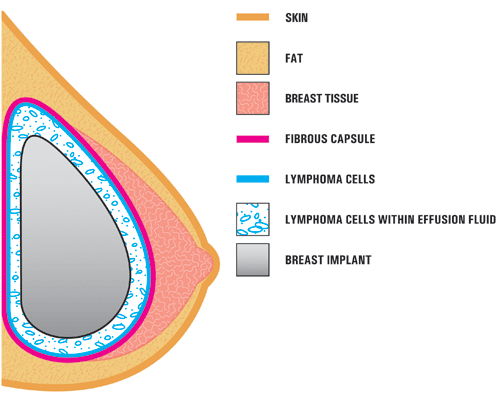
Add this to the seeming statistical association between breast implants and ALCL, and there might just be something there. It’s not possible to conclude with any degree of certainty that there is such a risk right now; there are simply too few cases and ALCL is too rare, both in the general population and in women with breast implants.

What should be done?

Despite the controversy over the years over breast implants, particularly silicone breast implants, there has been no convincing evidence of a link between systemic diseases, such as autoimmune diseases or cancer. Indeed, since the 1990s, there have been at least a dozen comprehensive systematic reviews looking at a potential link between silicone breast implants and systemic diseases (conveniently listed at Wikipedia), none of which have found convincing evidence for a link. In 2006, Brinton et al found an increased risk of death from lung cancer and suicide in women with implants, but these risks were attributed to increased smoking and psychiatric disorders in women who have implants placed.

This report from the FDA suggests that there might be an increased risk of a rare cancer in women with breast implants, but the numbers are so low that it’s difficult to conclude anything with much certainty, which is why the FDA concludes:

  1. There is a possible association between breast implants and ALCL.
  2. At this time, it is not possible to identify a specific type of implant associated with a lower or higher risk of ALCL.
  3. There is uncertainty about the true cause of ALCL in women with breast implants.

Adding:

Based on available information, it is not possible to confirm with statistical certainty that breast implants cause ALCL. Because ALCL is so rare, even in breast implant patients, a definitive study would need to collect data on hundreds of thousands of women for more than 10 years. Even then, causality may not be conclusively established.

These are reasonable conclusions based on the current state of the evidence, which is inconclusive at best, weak at worst. Given the high degree of uncertainty, what the FDA has done is not entirely unreasonable, although one could argue that it’s a tad alarmist. Basically, the FDA wants clinicians to consider ALCL in women with implants who have persistent seromas (fluid collections) around their implants, recommending that seroma fluid be sent for cytological analysis to rule out lymphoma. In addition, the FDA recommends that any confirmed cases of ALCL associated with implants be reported and is establishing a registry in collaboration with the American Society of Plastic Surgeons to track cases of implant-associated lymphoma. Even this might not be able to detect or confirm a link between implants and ALCL, given the rarity of the disease, but it is a start.

Even accepting the most pessimistic assumption, namely that there really is a significantly elevated risk of ALCL in women with breast implants due to the implants, which has been suggested but not by any means established, this risk, if it exists, should be put into perspective. For example, it should also be noted that, based on what we know, in women who choose implants for reconstruction after breast cancer surgery, the risk of recurrence of their breast cancer is orders of magnitude greater than any theoretical risk of ALCL due to implants. Indeed, in women who have never had cancer and choose implants for breast augmentation, the risk of developing breast cancer is also orders of magnitude higher than of developing ALCL. There is no evidence that implants increase the risk of breast cancer or breast cancer recurrence after breast cancer surgery.

In fact, the most significant risk due to breast implants is not the risk of systemic diseases, such as autoimmune diseases or cancer. Far more significant is the rate of local complications, such as capsular contracture or implant rupture. Due to such complications, many women with implants require reoperation. Indeed, reoperation rates have been estimated to be as low as 3% after seven years to as high as 20% over three years. These are by far the most significant risks due to breast implants.

While I am not a big fan of elective breast augmentation or cosmetic surgery in general (that’s just me, I guess, in that my assessment of the risk-benefit ratio of having a surgeon cut into me to make me better looking probably won’t come down on the side of surgery unless I eer suffer some sort of traumatic injury that leaves me disfigured enough to require reconstructive surgery), if there is informed consent in which the risks of breast augmentation are clearly explained based on science and clinical evidence and not inflated by the addition of claimed risks that are not supported by science, women should be free to choose implants if they so desire. From my perspective as a clinician, more importantly I strongly believe that, for women with breast cancer, implants are an important option to be made available for reconstruction after mastectomy. In particular, given how small the risk would be even if it is confirmed, this new information from the FDA regarding breast implants and ALCL does not change that.

Facebook Google Buzz Digg LinkedIn StumbleUpon LiveJournal Share

Rambling Musings on Using the Medical Literature

For those who are new to the blog, I am nobody from nowhere. I am a clinician, taking care of patients with infectious diseases at several hospitals in the Portland area. I am not part of an academic center (although we are affiliated with OHSU and have a medicine residency program). I have not done any research since I was a fellow, 20 years ago. I was an excellent example of the Peter Principal; there was no bench experiment that I could not screw up.

My principal weapon in patient care is the medical literature, accessed throughout the day thanks to Google and PubMed. The medical literature is enormous. There are more than 21,000,000 articles referenced on Pubmed, over a million if the search term ‘infection’ is used, with 45,000 last year.

I probably read as much of the ID literature as any specialist. Preparing for my Puscast podcast, I skim several hundred titles every two weeks, usually select around 80 references of interest and read most of them with varying degrees of depth. Yet I am still sipping at a fire hose of information

The old definition of a specialist is someone who knows more and more about less and less until they everything about nothing. I often feel I know less and less about more and more until someday I will know nothing about everything. Yet I am considered knowledgeable by the American Board of Internal Medicine (ABIM), who wasted huge amounts of my time, a serious chunk of my cash, and who have declared, after years of testing, that I am recertified in my specialty. I am still Board Certified, but the nearly pointless exercise has left me certified bored. But I can rant for hours on Bored Certification and how out of touch with the practice of medicine the ABIM is.

My concept of an expert is a combination of experience and understanding of the literature. I used to say mastery of the literature, but no one can master a beast that large; I am just riding on the Great A’Tuin of medical writings. Experience comes with time, and I have read that it takes 10 years to become competent in a field. Whether true or not, it matches my experience. I remember as a resident reading notes on patients I had cared for as an intern, and being appalled with what an ignorant dufus I was. In my first year of practice I had a patient who died of miliary tuberculosis, and the diagnosis was, unfortunately, made at autopsy. It was an atypical manifestation of a rare (in the US) disease. About a decade later the case was presented as an unknown to a visiting professor; I had completely forgotten the case, but I piped up from the audience to pontificate on how this had to be miliary Tb. Afterwards I was shown the chart and nice documentation as to how clueless I had been a decade earlier. When it comes to being a diagnostician, there is not substitute for experience.

When it comes to treatment? That is where I tell the residents that the three most dangerous words in medicine are ‘In. My. Experience.’ You cannot trust experience when deciding on therapy, especially for relatively unusual diseases. Sometimes I will ask a doc why they use a given antibiotic, usually in a situation where it is being used in a way that is, shall we say, old fashioned. Often the response is “I like it”‘ as if the choice of a drug is like choosing a beer.

I rely on the literature — such as it is, and limited by my lack of an Ethernet jack in my brain — in deciding the best course of therapy for a patient. The literature is always unsatisfactory. That has always been known. Even with the best studies, there is always the issue of wondering if the literature applies to your patient and their particular co-morbidities, and, perhaps, genetics. As an example, it is becoming evident that the literature on the presentation and treatment of Cryptococcus, which is based on the experience with C. neoformans, is not applicable to C. gattii, a new strain of the fungus in the NW. So how to use a literature that may not be totally relevant to my local conditions? I wing it. It is an educated and experienced winging, but winging it I do.

Given the breadth and depth of the literature, it is nice to have systematic reviews, meta-analysis, and guidelines. As a practicing physician, I find them helpful as they provide an overarching understanding, a conceptual framework, for understanding a disease or a treatment. They are the Reader’s Digest abridged version of a topic, and the references are invaluable. Usually most of the relevant literature is collected in these reviews and make it easier, especially in the era of the Googles and on-line references, to find the original literature.

All three have their flaws, and if you are well versed in a field, you recognize the issues and try and compensate.

As was noted in the recent Archives, the literature to support the recommendations of the Infectious Disease Society America are not necessarily based on the best of evidence. Really? I’m shocked. Next up, water is wet, fire is hot, and the Archives confirms the obvious.

Results In the 41 analyzed guidelines, 4218 individual recommendations were found and tabulated. Fourteen percent of the recommendations were classified as level I, 31% as level II, and 55% as level III evidence. Among class A recommendations (good evidence for support), 23% were level I (1 randomized controlled trial) and 37% were based on expert opinion only (level III). Updated guidelines expanded the absolute number of individual recommendations substantially. However, few were due to a sizable increase in level I evidence; most additional recommendations had level II and III evidence.

Conclusions: More than half of the current recommendations of the IDSA are based on level III evidence only. Until more data from well-designed controlled clinical trials become available, physicians should remain cautious when using current guidelines as the sole source guiding patient care decisions.

Big duh. Anyone who is a specialist understands the weaknesses in all guidelines, but we also understand their importance. When I was a fellow, one of my attending was, and still is, one of the foremost experts in the US on Candida, and anothers areas of expertise is S. aureus infections and endocarditis.

Both have spent a career thinking deeply on their respective areas of expertise. You learn that while no one is perfect, the breadth and depth of their knowledge and experience gives their recommendations extra weight. Who would you want at the controls of your plane in a unexpected and unusual weather conditions? An experienced pilot, or someone who spent a few days on the X-Plane simulator? The same with all the guidelines. When someone with a lifetimes of work in a field helps write a guideline, you pay attention to their expertise. You know the recommendations are not necessarily right, but odds are their opinions are better than mine, just as my opinion is usually better than a hospitalist, as least as far as infections are concerned. With residents, I try make a point of differentiating when my recommendation is no better than the next doc, and when my recommendation is the Truth, big T, and based on the best understanding of the literature at the moment.

This attitude, trusting authority, held by many in medicine, goes against the University of Google approach where a day of searching and a quick misreading of the abstracts renders everyone an expert. I wonder if other fields are plagued with these quick pseudo-experts. Law is, when the accused attempt to defend themselves.

I certainly would be in favor of more money being spent on infectious disease research, and, one hopes, infectious disease doctors. In a perfect world, every disease would be subjected to careful, extensive clinical trials and I would know, for example, the best therapy for invasive Aspergillus pneumonia in a neutropenic leukemia patient. Until that time, I am, in part, going to rely on the guidelines written by those who have spent a career thinking about the diseases I have to treat. To quote Dr Powers,

“Guidelines may provide a starting point for searching for information, but they are not the finish line…Evaluating evidence is about assessing probability,” Dr. Powers commented in a news release. “Perhaps the main point we should take from the studies on quality of evidence is to be wary of falling into the trap of ‘cookbook medicine,’” Dr. Powers continues. “Although the evidence and recommendations in guidelines may change across time, providers will always have a need to know how to think about clinical problems, not just what to think.”

I was struck by a recent Medscape headline:

Cochrane Review Stirs Controversy Over Statins in Primary Prevention

Having been irritated of late by Cochrane reviews in my area of expertise, I clicked the link. The first three paragraphs are

A new Cochrane review has provoked controversy by concluding that there is not enough evidence to recommend the widespread use of statins in the primary prevention of heart disease.

The authors of the new Cochrane meta-analysis, led by Dr Fiona Taylor (London School of Hygiene and Tropical Medicine, UK), issued a press release questioning the benefit of statins in primary prevention and suggesting that the previous data showing benefit may have been biased by industry-funded studies. This has led to headlines in many UK newspapers saying that the drugs are being overused and that millions of people are needlessly exposing themselves to potential side effects.

This has angered researchers who have conducted other large statin meta-analyses, who say the drugs are beneficial, even in the lowest-risk individuals, and their risk of side effects is negligible. They maintain that the Cochrane reviewers have misrepresented the data, which they say could have serious negative consequences for many patients currently taking these agents.

Newsweek and The Atlantic both refer to the Cochrane review as a “study.” A review is not what I would consider a study, usually synonymous with a clinical trial. The use of the term makes it sound like the Cochrane folks were doing a clinical trial, patients being randomized to one treatment or another. My sloppy non scientific poll of people (all people in the medical field, but that is who I have contact with) suggests the no one considers a review of clinical trials to be a study. A review of a novel is not the same as writing a novel.

Sloppy and potentially misleading language from major news outlets. What a surprise.

I have always liked meta-analysis for the same reason I like guidelines: they provide an overarching conceptual framework for understanding a topic. But only a fool would make clinical decisions based upon a meta-analysis. Yet, meta-analysis seem to be creeping to the top of the list of the clinical information rankings to be believed.

There are issues with meta-analysis.

The studies included in a meta-analysis are often of suboptimal quality. Many spend time bemoaning the lack of quality studies they are about to stuff into their study grinder. Then, despite knowing that the input is poor quality, the go ahead and make a sausage. The theory, as I said last week, is that if you collect many individual cow pies into one big pile, the manure transmogrifies into gold. I still think it as a case of GIGO: Garbage In, Garbage Out.

It has always been my understanding that a meta-analysis was used in lieu of a quality clinical trial. Once you had a few high quality studies, you could ignore the conclusions of a meta-analysis.

Evaluations of the validity of the conclusions of meta-analysis have demonstrated that the results of a meta-analysis usually fail to predict the results of future good clinical trials. The JREF million is safe from the Cochrane, I suppose. Their conclusions are no more reliable than the studies they collect and are no more valid than the rest of the medical literature.

We identified 12 large randomized, controlled trials and 19 meta-analyses addressing the same questions. For a total of 40 primary and secondary outcomes, agreement between the meta-analyses and the large clinical trials was only fair (kappa= 0.35; 95 percent confidence interval, 0.06 to 0.64). The positive predictive value of the meta-analyses was 68 percent, and the negative predictive value 67 percent. However, the difference in point estimates between the randomized trials and the meta-analyses was statistically significant for only 5 of the 40 comparisons (12 percent). Furthermore, in each case of disagreement a statistically significant effect of treatment was found by one method, whereas no statistically significant effect was found by the other.

Once there was a quality definitive trial or three, the meta-analysis becomes, I thought, moot. A quality clinical trial trumps the meta. I guess. I am not so certain that is the attitude anymore given the freak-out in the media about Cochrane and statins.

It seems that the producers of meta-analysis have characteristics like the March of Dimes. Polio was conquered, but rather than folding up their tents and stealing away, they continue to march. That may be a good thing too, as there could be a polio resurgence if some anti-vaccine wackaloons have their way.

If there is a definitive trial, rather than declaring the question settled, the new, perhaps higher-quality, study is folded in with the prior studies and a new meta-analysis is generated. But newer studies are diluted by the older, less robust trials, so the more reliable results are lost in the wash. The best drowned in a sea of mediocrity.

For example, I see no need for a meta-analysis on the efficacy of Echinacea. The last several trials, combined with basic science/prior probability, provides sufficient evidence to conclude Echinacea does not work. Good trials win. Ha.

As a practicing specialist, no matter how much I read, I rely in part on guidelines, meta-analyses and systematic reviews as nice overviews to be used as flawed stopgaps awaiting large high quality clinical trials, that, like Godot, may never come.

I have sick patients who need treatment. I need to know what to do. I have to fight the battles with the weapons I have. I have the medical literature and I am not afraid to use it.

Facebook Google Buzz Digg LinkedIn StumbleUpon LiveJournal Share

The English government cracks down on alternative pet remedies

One cannot play charades forever.

European veterinary groups have long been more skeptical about “alternative” veterinary practices than their American counterparts. For example, the European Board of Veterinary Specialties refuses to grant continuing education credits for non-scientific endeavors attempting to masquerade as a way to improve one’s clinical knowledge, and the practice of veterinary homeopathy is forbidden in Sweden.

Now comes good news (for pets, and pet owners), out of the UK. In an effort to improve animal health and welfare, the Veterinary Medicines Directorate’s (VMD) has targeted “alternative” remedies, which, of course, pose both real and potential dangers to pets. The VMD is the body responsible for the authorization of veterinary medicinal products in the United Kingdom.

Specifically, the VMD is targeting a number of unauthorized products that lack scientific proof of effectiveness, including:

  • homeopathic “nosodes” (substances that are the homeopathic equivalent of vaccination, with the notable exception being that they don’t work)
  • various herbal products
  • “neutraceuticals,” the cleverly coined combination of “nutrition” and “pharmaceutical,” which really aren’t either, a fact which, of course, hasn’t dented their popularity, nor dampened their claims (including improved mental ability in pets)
  • Herbal deworming products, which may claim to irritate the bowel and make it less inviting for parasites (an absurd claim)

Giving a pet an ineffective remedy invites direct harm, if a sick animal is treated with an ineffective remedy, as well as indirect harm, if an effective therapy is avoided in favor of the heavily advertised ineffective one.

Director of Operations of the VMD, John FitzGerald, said, “Animal owners have a right to know if a product does what it claims. The products claim to treat diseases which can cause serious welfare problems and in some circumstances kill animals if not properly treated. So in some cases owners are giving remedies to their pets which don’t treat the problem.” British Veterinary Association President Harvey Locke, in support of the VMD, noted, “As veterinary surgeons we rely on the use of safe, effective and quality medicines for the health and welfare of animals under our care – and there must always be sound scientific evidence to back up medicinal claims made by the manufacturer of any product.”

The VMD intends to contact manufacturers of “alternative” products to make sure that they are safe, and provide the claimed benefits. If they don’t (which they won’t), the VMD will make the manufacturers rebrand the products so that consumers will know that the products are not medicinal.

Now one might legitimately ask, “Why don’t the US veterinary authorities and organizations take some action such as this?” Well, in my opinion, veterinary authorities are more interested in getting animals to be treated by veterinarians than they are in the particular remedies that are being used. So far, in the US, it’s been a triumph of economics over science. How long that stance holds up, particularly in light of the legitimate strides at curbing non-scientific practices in other countries, remains to be seen.

Facebook Google Buzz Digg LinkedIn StumbleUpon LiveJournal Share

Statins – The Cochrane Review

A recent Cochrane review of the use of cholesterol-lowering statin drugs in primary prevention has sparked some controversy.  The controversy is not so much over what the data says, but in what conclusions to draw from the data.

Statin drugs have been surrounded by controversy for a number of reasons. On the one hand they demonstrably lower cholesterol, and the evidence has shown that they also reduce the incidence of heart attacks and strokes. The data on whether or not they reduce mortality has been less clear, although this latest data actually supports that claim. However, statins have also been blockbuster drugs for pharmaceutical companies and this has spawned concerns (some might say paranoia) that drug companies are pushing billions of dollars worth of marginally effective drugs onto the public.

So are statins a savior or a scam? Life does not always provide nice clean answers to such simple dichotomies. The evidence clearly shows that statins work and are safe. However, pharmaceutical companies do like to present their data in the best light possible, and they need to be watched closely for this. The recent review does call them on some practices that might tend to exaggerate the utility of statins. Finally, the real question comes down to – where should we draw the line in terms of cost-benefit of a preventive measure like statins.

Let’s look as this recent review of the data to see what it actually shows.

First, for context, this Cochrane review looked specifically at statins for primary prevention – prevention of vascular events (mainly heart attacks, strokes, and overall mortality) in those who are at low risk for heart disease and who have not already had any vascular event. The evidence for statins for secondary prevention, after a heart attack, is more robust – decreasing risk of a second heart attack by about one-third. This makes sense, and is generally what we see. The higher the risk of disease the greater the potential benefit for any preventive measure, and the easier it is to measure this benefit in clinical trials.

Further, as the risk of the disease becomes smaller, the risk-benefit ratio and cost-benefit ratio of preventive measures goes down. At some point the side effects from the treatment become greater than the risk of the disease being prevented. Generally clinical trials divide risk into two broad categories – primary prevention and secondary prevention. However, in reality there is a spectrum of risk. A person without a history of a vascular event may still be at high risk if they have a lot of risk factors – hypertension, age, high cholesterol, diabetes, and smoking. And of course, since statins are cholesterol lowering agents, high cholesterol at baseline is a reasonable marker for the potential of benefit from statins.

Statins also have to be compared to other measures – like diet and exercise – for relative effectiveness and cost-effectiveness. No one doubts that it would be best if every patient had a healthy diet and weight and exercised regularly. Some argue that statins should be reserved for those who fail these lifestyle interventions, or who have genetically high cholesterol refractory to diet and exercise. The reality is that it is very difficult to get individual patients to change their behavior. In fact, a recent Cochrane review concluded:

Interventions using counselling and education aimed at behaviour change do not reduce total or CHD mortality or clinical events in general populations but may be effective in reducing mortality in high-risk hypertensive and diabetic populations. Risk factor declines were modest but owing to marked unexplained heterogeneity between trials, the pooled estimates are of dubious validity. Evidence suggests that health promotion interventions have limited use in general populations.

This is not very encouraging. Clearly we need to work on societal interventions and improving patient interventions to achieve a healthier lifestyle as a society. But also it is clear that lifestyle intervention is not a quick or easy fix, and so there will continue to be a role for medical intervention in vascular prevention.

Statins for Primary Prevention

When the Cochrane reviewers looked at the evidence for primary prevention they found that many trials included patients at high risk, or did not measure LDL levels. Essentially they felt that the data was contaminated in such a way as to exaggerate the benefit for primary prevention. Their review sought to correct those biases. They reviewed the data from 14 trials involving 34 272 patients. What they found was that total mortality had a relative risk reduction of 17%, risk of heart attacks was reduced by 28%, and strokes by 22%. In low risk patients the number needed to treat in order to prevent one death per year was 1000. The review also did not show any additional adverse events in those treated vs placebo groups.

The authors do not challenge the legitimacy of these results. The data is fairly robust – there is a reduction in risk of death and vascular events from statins in primary prevention. Study author, Dr. Shah Ebrahim, is quoted by Heartwire as saying:

“If you look at the hard end points of all deaths and coronary deaths, the effects are consistent with both benefit and with the play of chance. But importantly, the absolute benefits are really rather small—1000 people have to be treated for one year to prevent one death. It is probably a real effect, but it means a lot of people have to be treated to gain this small benefit. As we don’t know the harms, it seems wrong-minded to me to treat everyone with a statin. In these circumstances, lifestyle changes and stopping smoking would be far preferable.”

And that is where the controversy comes in. Other researchers think the authors are making conclusions that go beyond their own evidence. Heartwire also quoted Dr. Colin Baigent, a clinical researcher from Oxford, as saying:

“I object to the conclusions they have drawn from their review. They say there is not good evidence of benefit, but their own data show significant reductions in deaths and cardiac events. They didn’t show any increase in adverse events in their review, but they then say the benefit is not worth the risk. That doesn’t make sense.”

This does make for an interesting science-based medicine conversation. In this case the two sides largely agree on the data, but differ in terms of how to apply that data to the practice of medicine. This, I feel, can be a very constructive controversy. This is exactly the kind of question that should be agonized over by experts. While I think the Cochrane reviewers are displaying a negative bias against statins, they do provide balance to the pro-statin bias of pharmaceutical companies who sell statins. In the end, the data is out there and practitioners and patients will be better informed in making decisions about statin use. I am concerned about media reporting of this issue. It is easy to oversimplify the take-home message as “statins do not work” and I have already read commentaries quoting this study to support that position.

My read of this evidence is that there is solid evidence that statins have a real benefit for primary prevention. This benefit is small, which is exactly what I would predict for a preventive measure in a low-risk population. The data also show that statins are safe. The major risk is for the development of an inflammatory muscle disease, but that is very rare. For interventions that prevent death – that lower mortality – I think even small benefits are worthwhile. Further, having a heart attack or stroke, even if it is not a fatal event, has a very negative effect on quality of life. Taken together, one person per year out of several hundred taking statins for primary prevention will avoid a heart attack, stroke, or death. From a purely medical point of view, that sound pretty good to me.

What seems reasonable is to use statins for primary prevention in those who have some risk factors for vascular disease, in patients with genetically high cholesterol, and in those with high cholesterol or significant risk factors in whom lifestyle counseling has not yielded adequate results. Try diet and exercise first – and always in conjunction with medication, but statins are a reasonable choice in selected patients, even for primary prevention. We could use more studies to better delineate where to draw that line, but that will be difficult as any difference in outcome is likely to be slight and therefore massive trials will be needed to get statistically significant results.

Cost effectiveness is a tougher issue, because we then have to arbitrarily decide what a human life is worth in terms of medical expense. This issue has become more acute as health-care costs rise and everyone is looking for ways to cut back. What I have not seen is a calculation of the cost of statins for primary prevention vs the cost savings from reduced vascular events. Having a stroke or heart attack is expensive, and pays for a lot of prevention. The question is – exactly where is the line crossed in terms of the vascular risks of the population being treated.

The good news is that many statins are now becoming available as generics, with a marked reduction in cost. There is already a Spanish analysis showing that the availability of generics is making statin treatment more cost effective.

Conclusion

This recent Cochrane review of statin use for primary prevention supports the conclusion that statins are safe and effective in reducing vascular events and overall mortality even in primary prevention. The benefits are statistically small, which is expected for a preventive measure in a low risk population. It is still unclear where to draw the line in terms of which patients should receive statins, but these data will help practitioners and patients make individualized decisions about cholesterol management and vascular prophylaxis.

Because this is ultimately a judgment call, the results of this study can be spun to a variety of conclusions. The study authors chose to present an overall negative conclusion – that the effect size is too small to be worth it. While other experts, looking at the same data, have come to the opposite conclusion – that statins are worth it. It is important to emphasize that the debate is not about whether or not statins have a real effect – they do, but about the cost-benefit of statins as an intervention for primary prevention.

One could also argue that Cochrane reviewers, given that their purpose is to provide objective and thorough reviews of existing evidence for specific clinical questions, should take a more neutral approach to interpreting the data. This is not the first Cochrane review discussed on SBM that can be criticized for taking a decidedly biased approach to the evidence in their conclusions. This should prompt some soul-searching, in my opinion, on the pat of the Cochrane collaboration.

Facebook Google Buzz Digg LinkedIn StumbleUpon LiveJournal Share

One Hump or Two? Camel’s Milk as a New Alternative Medicine

I wasn’t really surprised to learn that camel milk is being promoted as a medicine. I long ago realized that the human power of belief is inexhaustible. The news did make me laugh, probably because camels are rather funny-looking animals, because I am easily amused, because it reminded me of some of my favorite camel jokes, and because it wouldn’t do any good to cry.

Camel milk has been claimed to cure or benefit patients with diabetes, tuberculosis, stomach ulcers, gastroenteritis, cancer, allergies, infections, parasites, autism, even AIDS.  This isn’t really quite as silly as it might sound.  PubMed does list several studies showing health benefits from camel milk. A handful of studies have suggested that camel milk improves control of blood sugar in diabetes, but they are preliminary studies that typically compare standard treatment to standard treatment plus camel milk rather than using a blinded control. There are also a few small, poor quality studies suggesting a possible benefit in allergies, in peptic ulcers, in infections such as hepatitis, and in schistosomiasis. All in all, the research doesn’t amount to much. Camel milk can only be classed as experimental treatment. The existing studies justify doing more (and better quality) research, but they don’t justify prescribing it to treat patients.

Among other properties, camel’s milk is high in vitamin C, low in vitamin A, and low in fat compared to cow’s milk, and it is tolerated by those who are lactose intolerant. It is different from cow’s milk in many other ways that I won’t attempt to list, but the clinical significance of those differences is not clear.

A couple of studies suggested reasons for caution. A study in Saudi Arabia, where brucellosis is endemic, showed that the main source of brucellosis infection was unpasteurized camel milk  and there is a report of anaphylaxis to camel’s milk in a child with atopy.

The founder of the American Camel Coalition, Millie Hinkle, ND, says

The high levels of insulin in camel’s milk and the antibodies, which are much simpler in structure than human milk antibodies, enable it to penetrate deeper into the human tissue and cells [whaat?], which means that the milk has the potential to serve as a major weapon against many human illnesses.

She thinks that studies done in other countries on autism, diabetes, cancer, heart disease, Crohn’s, Parkinson’s, food allergies and a variety of other illnesses have been “impressive.” I couldn’t locate the studies she cites for some of these claims, and I didn’t think the ones I did find were “impressive.”  The one she cites for autism is not original research but just a speculative rumination that includes brief, unconvincing reports of three patient observations and talks about highly controversial and disproven hypotheses as if they were proven facts. She wants to repeat previous studies using pasteurized camel milk; obviously pasteurization is a wise move, but rather than repeating previous studies, why not do better designed, controlled studies?

I didn’t know what to make of one study I found on PubMed. Its abstract said

Camels’ milk, women’s milk and cows’ milk were kept at 30 degrees C and refrigerated at 4 degrees C. This explains the necessity to immediately freeze milk if it needs to be kept even for a few days. Cows’ milk remained good for days if stirred and then turned sour, enabling the making of cheeses and butter. Camels’ milk did not sour at 4 degrees C for up to 3 months. This means that camels’ milk is mainly good only for drinking, as was promised to this animal by the Prophet.

Isn’t it inappropriate to make religious comments in scientific articles? Is religious support pertinent? In Sunni Islam, the Sahih Bukhari, one of the six major Hadith collections, does include several verses where the prophet Muhammad is said to have advocated drinking camel’s milk and urine as medicine. For instance,

The climate of Medina did not suit some people, so the Prophet ordered them to follow his shepherd, i.e. his camels, and drink their milk and urine (as a medicine). So they followed the shepherd that is the camels and drank their milk and urine till their bodies became healthy. Then they killed the shepherd and drove away the camels.

The Sahih Bukhari’s medical advice is not reliable or even consistent. It also says

Healing is in three things: A gulp of honey, cupping, and branding with fire (cauterizing). But I forbid my followers to use (cauterization) branding with fire.

Does that mean Muslims shouldn’t bother with any medical treatment but honey and cupping?

I’m not just picking on Muslims. Other religious texts also give questionable medical advice.  In the Essene Gospel of Peace, Jesus gave detailed instructions for colon cleansing using river water and a long-necked gourd:

Seek, therefore, a large trailing gourd, having a stalk the length of a man; take out its inwards and fill it with water from the river which the sun has warmed. Hang it upon the branch of a tree, and kneel upon the ground before the angel of water, and suffer the end of the stalk of the trailing gourd to enter your hinder parts, that the water may flow through your bowels.

I’d rather drink camel milk than do that.

There is even a book Love Thine Enemas and Heal Thyself. One of the customer reviews on Amazon.com says “This book helps people understand the love of God, in a very intimate area.”  You can find the darnedest things on the Internet! But I digress…

There is a website, Camel Milk for Health that recounts one (only one!?) story about a young man who had an undiagnosed condition that allegedly made him “allergic to all foods…unable to eat or digest any foods, unable to absorb any food nutrients” so that he was “subsisting on a tablespoon of rice and a tablespoon of rice milk per day.” Do you believe that? His parents claim he was cured by drinking camel milk, and they tell how they had to battle the authorities to get special permits to import the milk into Canada. The website announces a symposium to be held in Vancouver BC on February 9th with 3 panelists entitled “Camel Milk: A New Alternative Medicine.” The main speaker is a retired professor of veterinary medicine from Israel who has done some of the research. The symposium is sponsored by an orthodox Jewish congregation, the oldest and largest synagogue in Vancouver. I am puzzled, because camels and camel milk are trayf (not kosher) and are forbidden to orthodox Jews.

While looking for evidence of possible health benefits, I came across some intriguing camel trivia in the Wikipedia article:

  • Camel milk can’t be made into butter by conventional churning methods.
  • The Abu Dhabi Officer’s Club serves camelburgers. Bubonic plague has been transmitted by eating camel liver.
  • The ancient Roman emperor Heliogabalus enjoyed eating camel’s heel.
  • Camel blood is consumed in Northern Kenya.
  • Camel lasagna is available in Alice Springs, Australia.

It’s nice to know these things. Forgive the digression.

If you want to try camel milk, you can’t. Selling it is illegal in the US. According to a CBS news report in July 2010,

The FDA allows people to drink camel milk, but it can’t be imported or sold in the U.S. until a test for drug residues is validated, said FDA spokesman Michael Herndon.

Could this be a conspiracy by Big Dairy to prevent competition?

The Camel Milk for Health website links to the Oasis Camel Dairy website, which is interesting and has some cool pictures. The OCD is producing camel milk but is not legally allowed to sell it. What they can and do sell is camel milk soap for $5.00 in varieties like “gold frankincense and myrrh” and “rosemary mint.” They also sell camel milk chocolate bars.

All of the research seems to be on one-hump camels. It’s not clear whether Bactrian camel milk is equally efficacious. The “one hump or two” question remains to be answered; but there’s no rush, since we can’t get either kind of milk. Jabalicious and other brands have recently come on the market in the UK, but those of us who live in the US will have to either wait for FDA approval or buy our own camel and milk it ourselves.

Facebook Google Buzz Digg LinkedIn StumbleUpon LiveJournal Share

Molecular breast imaging (MBI): A promising technology oversold in a TED Talk?

Occasionally, there are topics that our readers want — nay, demand — that I cover. This next topic, it turns out, is one of them. It’s a link to a TED Talk. I’m guessing that most of our readers have either viewed (or at least heard of) TED talks. Typically, they are 20-minute talks, with few or no slides, by various experts and thought leaders. Many of them are quite good, although as the TED phenomenon has grown I’ve noticed that, not unexpectedly, the quality of TED Talks has become much more uneven than it once was. Be that as it may, beginning shortly after it was posted, readers of both this blog and my other super-not-so-secret other blog started peppering me with links to a recent TED Talk by Dr. Deborah Rhodes at the Mayo Clinic entitled A tool that finds 3x more breast tumors, and why it’s not available to you.

At first, I resisted.

After all, I’ve written about the issues of screening mammography, the USPSTF guideline changes (here, too), the early detection of cancer (including lead time and length time bias, as well as the Will Rogers effect), and a variety of other topics related to the early detection of breast cancer, such as overdiagnosis and overtreatment. Moreover, to put it bluntly, there really isn’t anything radically new in Dr. Rhodes’ talk, at least not to anyone who’s been in the field of breast cancer for a while. Certainly, there’s no new conceptual breakthrough in breast imaging and screening described. As I will discuss in more depth later in this post, there’s an interesting application of newer, smaller, and more sensitive detectors with a much better spatial resolution. It’s cool technology applied to an old problem in breast cancer, but something radical, new, or ground-breaking? Not so much. What Dr. Rhodes describes in her talk is the sort of device that, when I read about it in a medical journal, produces a reaction along the lines of, “Nice technology. Not ready for prime time. I hope it works out for them, though. Could be good.” So it was with molecular breast imaging (MBI), which is the topic of Dr. Rhodes’ talk. So I continued to resist for about two or three weeks.

Then our very own Harriet Hall sent me the link. I cannot resist Harriet. When she suggests that perhaps I should blog about a topic, it’s rare that my response would be anything other than, “Yes, ma’am. How soon would you like that post and how many words?” I keed, of course, but only just. The best I could come up with was a wishy-washy “But this isn’t really anything all that new,” which is true enough, but the way Dr. Rhodes tried to sell the audience on the idea of her technology brings up a lot of issues important to our audience. I also thought it was important to put this technology in perspective. So here I go. First, I’ll start by describing what really set my teeth on edge about Dr. Rhodes’ talk. Then I’ll go to the primary literature (namely her brand, spankin’ new article in Radiology describing the technology) and discuss the technique itself.

The truth? You can’t handle the truth!

What irritates me about Dr. Rhodes’ TED Talk starts right at the beginning:

There are two groups of women when it comes to screening mammography — women in whom mammography works very well and has saved thousands of lives and women in whom it doesn’t work well at all. Do you know which group you’re in? If you don’t, you’re not alone. Because the breast has become a very political organ. The truth has become lost in all the rhetoric coming from the press, politicians, radiologists and medical imaging companies. I will do my best this morning to tell you what I think is the truth. But first, my disclosures. I am not a breast cancer survivor. I’m not a radiologist. I don’t have any patents, and I’ve never received any money from a medical imaging company. And I am not seeking your vote.

Later in the talk, Dr. Rhodes says:

If this technology is widely adopted, I will not benefit financially in any way. And that is very important to me, because it allows me to continue to tell you the truth.

I bet you can guess what irritates me about these statements. Actually, it’s two things. First, it’s Dr. Rhodes’ invocation of “The Truth.” Strictly speaking, there is no “truth” in science or medicine. There are hypotheses that are supported by evidence, experimentation, and, in medicine, clinical trials, and there are hypotheses that are not. Most scientific hypotheses are not black and white “true” or “false,” either. Rather, individual hypotheses fall somewhere closer to being true or false, based on the evidence, and they can move closer to or father away from being “true” as new evidence comes in. Indeed, the object of scientific investigation is to falsify hypotheses. Hypotheses that are easily falsified fall by the wayside quickly. Those that are not advance to more intense testing. Those that have withstood the most attempts to falsify them and provide highly useful explanatory and predictive value might eventually graduate to being full-fledged theories.

The next thing that irritates me is Dr. Rhodes’ implication that everyone else has an ax to grind (and is therefore probably lying to you), where as she does not because she doesn’t receive money from medical imaging companies, isn’t a breast cancer survivor, and is not a radiologist. Don’t get me wrong; financial conflicts of interest (COIs), particularly undisclosed ones, are very, very important to know about, because they can (and all too often do) warp the perspective of even the most diligent, honest, rigorous scientist. However, financial COIs are not the only COIs. Just because someone proclaims that she has no financial COIs (or professional COIs) does not mean that she does not have biases or COIs that can be just as strong as the financial COIs of scientists who stand to make a lot of money if their research results in a marketable drug, treatment, or medical device.

Before I examine Dr. Rhodes’ invention (and her claims for it) in a bit more detail, in the interests of full disclosure, I’ll point out that I actually have a non-financial interest in a competing imaging technology for the breast. Researchers at our cancer institute have developed what I consider to be a truly innovative and promising breast imaging device. It’s based on ultrasound and can produce images of the breast almost as striking as those produced by breast MRI. This device has even resulted in a startup company that was featured in our governor’s state of the state address last week. As you can see, it’s a big deal to our cancer center. Since, through some fluke of flukes, I’ve somehow managed to find myself in leadership positions within the clinical and research breast cancer programs at my cancer center (obviously, the cancer center director hasn’t realized his mistake yet), I have a stake in the success of this device. More importantly, not only do we see the chance to have a major positive impact on women’s health if this device is validated but it would bring all sorts of prominence to our institution in general and my programs in particular, just as the success of Dr. Rhodes’ MBI device would improve women’s breast screening and bring all sorts of glory to the Mayo Clinic and her programs. None of this means that either Dr. Rhodes or I are likely to be lying or stretching the truth, but we both have COIs based on our belief in our respective devices. Arguably, my COI is less intense, because this device had been developed before I accepted my current job, and I am not directly involved in its commercialization. A COI does, however, exist nonetheless, and I acknowledge it.

Another thing that bugs me about Dr. Rhodes’ talk is her implication that the radiology world is somehow closing ranks to keep her from bringing this technology to the masses. While she does have a point that some radiologists were utterly shameless in protecting their turf and launching what can only be called histrionic attacks on the new guidelines (the quote by Dr. Daniel Kopans, a very prominent breast imaging radiologist at Harvard, about the USPSTF guidelines that Dr. Rhodes cites at 2:49 in the video being an excellent example), it’s a bit of a stretch to claim that somehow radiologists are so biased against her technology that they won’t give her a fair shake. Before I explain, I mention a couple of points that Dr. Rhodes makes that are correct. First, Dr. Rhodes is correct that breast density appears to be an independent risk factor for breast cancer that has only relatively recently been appreciated as such. Unfortunately, it is in dense breasts where mammography has the biggest problem in detecting cancer. Indeed, that’s part of the reason why it’s not as good in women under 50; their breasts tend to be denser. Second, she is most likely correct that digital mammography is probably not more sensitive or specific for detecting breast cancer, particularly in women with dense breasts, although I will point out that the evidence is not as cut and dried for this assertion as Dr. Rhodes makes it out to be.

Dr. Rhodes also fails to mention that digital mammography does have some major advantages over conventional film mammography and that they are not inconsequential advantages, either. These include permanent storage and duplication of as many copies of a study as needed. In other words, if a woman goes for a second opinion, instead of taking a jacket full of films (what I was used to until relatively recently), she can take a CD and provide an exact copy of her suspicious mammogram to the consulting surgeon. In the old days, she would have to sign out her jacket or bring an inferior film copy. Lost films are a thing of the past, and instead of huge rooms full of large manila envelopes stuffed with X-ray films, the studies can now be stored on hard drives and backed up off site. Digital mammography also allows for the digital manipulation of the image, not to mention the development of image analysis algorithms that can assist the radiologist in detecting suspicious lesions. Finally, digital mammography probably requires less radiation, particularly in women with dense breasts, the very group in whom Dr. Rhodes is trying to increase sensitivity and specificity of breast cancer detection, although this benefit hasn’t been fully verified yet.

Now, I wouldn’t be all that surprised if there was some skepticism over her idea. I’ll explain why in a bit more detail in the next section. However, I really do think Dr. Rhodes goes overboard in implying in at least two parts of her talk that the radiology world and the mammography world are somehow conspiring (or at least so resistant to new ideas that the practical effect is the same as conspiring) to prevent new breast imaging technologies (like hers) from gaining a foothold. Perhaps the most egregious example is this passage, where she talks about having submitted her article to four different journals and having it rejected by each one:

After achieving what we felt were remarkable results, our manuscript was rejected by four journals. After the fourth rejection, we requested reconsideration of the manuscript, because we strongly suspected one of the reviewers who had rejected it had a financial conflict of interest in a competing technology. Our manuscript was then accepted and will be published later this month in the journal Radiology.

At least she didn’t mention Galileo or Ignaz Semmelweis. I’m grateful for small favors.

In any case, this is a highly explosive charge to make so casually, without describing the evidence that led the authors to suspect that one of the reviewers had a financial COI in a competing technology. In fact, if three journals rejected her manuscript before Radiology apparently rejected it and then reconsidered it, did it ever occur to her that perhaps her manuscript just wasn’t very novel? Actually, the manuscript that ultimately was published in Radiology was pretty decent, but there are other reasons that papers, sometimes even good papers, have trouble being published. For instance, she didn’t say which journals she tried first before settling on Radiology. For instance, if she had tried the New England Journal of Medicine, The Lancet, and the Journal of the American Medical Association (JAMA), the reason her manuscript was rejected would be fairly obvious. It’s an interesting new technology with promising preliminary results, but not interesting enough to a broad enough audience to be likely to be published in such high impact journals. None of this implies that Dr. Rhodes’ work isn’t solid work, but the reluctance of journals to publish her results doesn’t suggest that MBI is a technology “they” don’t want you to know about, either.

Everything old is new again

There is no doubt that Dr. Rhodes is charming and a very effective advocate for her preferred breast imaging technology. Nowhere is that more clear than the middle portion of her talk, where she describes the genesis of the MBI. Who wouldn’t be moved at her description of a friend who found a lump in her breast while she was pregnant (and Dr. Rhodes was pregnant as well), the fear it engendered, and how that event inspired Dr. Rhodes to wonder if there was a better way to detect breast cancer? Who didn’t find her account of serendipitously bumping into physicists, who told her about a new kind of gamma detector that was much smaller than previous generations of such devices, compelling? Who wasn’t appreciative of her description of the first device the medical physicists and Dr. Rhodes cobbled together with duct tape and those early primitive tests of its ability to detect radiotracer concentration in the breast? Certainly not me. The image of a bunch of brand new tiny gamma detectors cobbled together with duct tape was priceless. Nor do I in any way want to detract from the hard work and development that went into her MBI device. I do, however, have a small problem with how Dr. Rhodes discussed it in her TED Talk.

That problem is that scanning the breast with radiotracers as a means of looking for breast cancer is not a new technology at all. It’s been around for at least three or four decades. Go back to the 1960s, in fact, and it’s not difficult to find references to the detection of breast cancer using various injected radioisotopes. Since then, at various times such techniques been called scintimammography or sestamibi breast imaging, and they’re all based on the same concept as many nuclear medicine imaging modalities: Inject a small amount of radiotracer that is differentially taken up (or not taken up) by the cell of interest or by cells exhibiting the disease process of interest (i.e., cancerous cells), and then take pictures. Positron emission tomography (PET) scans work this way. So do MUGA scans and bone scans. About 20 years ago, 99mTechnetium sestamibi became the most commonly used radioisotope for breast cancer detection in the breast (as opposed to looking for metastatic disease).

Indeed, if you read Dr. Rhodes’ recently published study in Radiology, you’ll quickly see that what Dr. Rhodes and her team are doing is nothing more than sestamibi breast scanning. Specifically, she is using technetium (99mTc) sestamibi scanning combined with mammography. Currently, only one 99mTc sestamibi compound, Miraluma, which is manufactured by DuPont Pharmaceuticals, is FDA-approved for breast imaging in the United States, which is why such scans are sometimes referred to as Miraluma scans. The same isotope is sold for cardiac imaging under a different name (Cardiolite). The problem with the various nuclear medicine breast scans for screening purposes has always boiled down to an unacceptable lack of specificity and sensitivity. That’s why I have to wonder if the reason for the skepticism that greeted Dr. Rhodes’ results isn’t at least in part due to a collective shrug of the shoulders, as reviewers thought, “Been there, done that.” Certainly, fair or unfair, that probably would have been my initial reaction if this paper had come across my desk.

Not that it’s a bad study or a technology without promise. Neither is true. In fact, as a proof-of-principle study it’s perfectly acceptable, and that’s all it’s billed as in the paper. The findings of the paper are summarized quite well in this figure (click to enlarge):

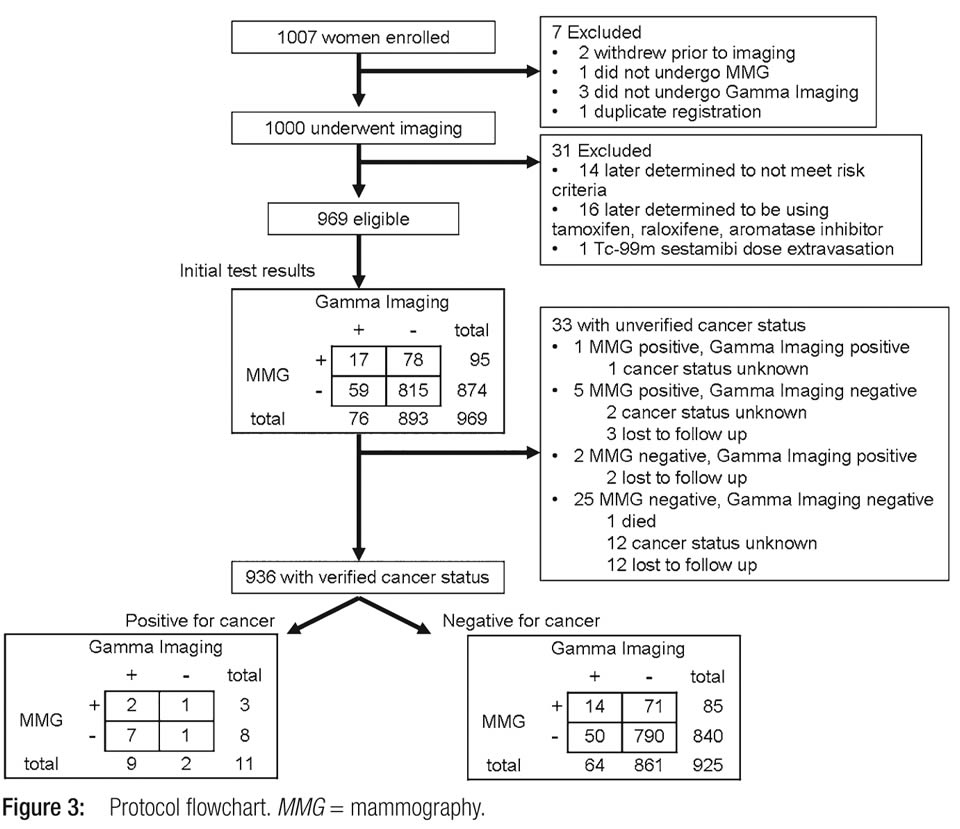
As you can see, the study started out with 1,007 women with heterogeneously dense breasts enrolled and ended up with 936 women who completed all imaging whose data were available for analysis and whose cancer status was verified. Positive cancer status was defined as a positive biopsy showing cancer, while negative cancer status was defined as women who had a subsequent negative mammogram in the following year, a negative biopsy, or a negative prophylactic mastectomy. Reported sensitivities were 27% for mammography alone, 82% for gamma imaging (MBI) alone, and 91% for a combination of mammography and gamma imaging. The corresponding specificities were 91%, 93%, and 85%. All in all, these are good numbers, particularly when compared to mammography alone in women with dense breasts. Diagnostic yield was 3.2 per 1,000 for mammography alone, 9.6 per 1,000 for gamma imaging alone, and 10.7 per 1,000 for both. Finally, the positive predictive value (the chance of having cancer if the test is abnormal) was 3% for mammography, 12% for gamma imaging, and 8% for both. Basically, the study suggests that the addition of MBI with 99mTc sestamibi can increase the sensitivity and specificity of breast cancer detection in women with dense breasts.

Still, it has to be pointed out that there were only 11 women with breast cancer in the entire population. This is lower than one would normally expect for a typical study of mammography, likely because of the large number of younger women (as young as 25) in the population studied. The reason for this was in order to include a lot of women with dense breasts. Unfortunately, this means that it doesn’t take very much to skew the numbers one way or another. What this implies is that a much larger study is very much indicated in order to get a more precise estimate of what the sensitivity and specificity of this test is and how much it really adds to mammography. My guess is that it will add something to the mammographic screening of dense breasts, but probably not as much as this initial study suggests. Sadly, the decline effect will likely rear its ugly head.

There is another consideration here, namely the question of radiation. Dr. Rhodes touches on this issue in her talk:

So now that we knew that this technology could find three times more tumors in a dense breast, we had to solve one very important problem. We had to figure out how to lower the radiation dose. And we have spent the last three years making modifications to every aspect of the imaging system to allow this. And I’m very happy to report that we’re now using a dose of radiation that is equivalent to the effective dose from one digital mammogram. And at this low dose, we’re continuing this screening study, and this image from three weeks ago in a 67 year-old woman shows a normal digital mammogram, but an MBI image showing an uptake that proved to be a large cancer. So this is not just young women that it’s benefiting. It’s also older women with dense tissue. And we’re now routinely using one-fifth the radiation dose that’s used in any other type of gamma technology.

When I heard this, I wondered something. What is the effective total body dose? Injecting a radioisotope is a different thing than aiming an X-ray beam at the breast. 99mTc has a half-life of around six hours, which means that it takes 24 hours for the radiation levels to fall to 1/16 of the original. In this study, Dr. Rhodes administered 99mTc equivalent to 20 mCi. According to the chart included in this drug information, the estimated radiation dosimetry for a dose of 30 mCi of this tracer is 0.2 rads (approximately 0.2 cGy) to the breast, meaning that the dose used in this study was approximately 0.13 rads. Dr. Rhodes is correct that this is approximately the same amount of radiation as a single mammogram administers. However, she leaves out consideration of the dose of radiation to which other organs are exposed. For instance, 20 mCi of Miraluma results in a dose of approximately 2 rads to the small intestinal wall, 2.6 to 3.6 rads to the wall of the large intestine, 1.0 rads to the ovaries, and 0.3 rads to the bone marrow. In a single dose, these doses are not very high, but remember that we are talking about a screening test that is meant to be administered repeatedly, possibly even yearly, to women with dense breasts. Over the course of 30 years (or even more) of screening, the radiation dose to tissues other than the breast could rapidly add up, in addition to also adding to the dose of radiation to the breasts. These are not trivial concerns, particularly the potential for a significant cumulative whole body dose of ionizing radiation over decades of screening.

The return of the revenge of the Will Rogers effect

Finally, I hate to be a spoilsport, but some of the images that Dr. Rhodes displayed to me did not impress me that much. For example, she showed an image where a mass was not seen on mammography but showed up on MBI. Here’s what bugged me: It was a 5 cm tumor, and, quite frankly, the signal from MBI was not that impressive at all. I also wonder if anyone actually — oh, you know — examined the patient. Most 5 cm tumors are palpable as masses. True, I’ve seen the occasional patient where such a large tumor is difficult to detect, but these patients are relatively uncommon. In another part of the talk, Dr. Rhodes showed one slide in which the mammogram showed one lesion, but the MBI showed three, one of which was only 3 mm in diameter. Unfortunately, she did not say whether pathology of the resected tissue verified that these were indeed separate foci of cancer.

What this leads me to believe is that Dr. Rhodes either doesn’t acknowledge or doesn’t seem to understand the concept of the Will Rogers effect, more formally known as stage migration. This is the phenomenon where a new imaging modality detects tumor that couldn’t be detected before. The name is based on Will Rogers’ famous joke: “When the Okies left Oklahoma and moved to California, they raised the average intelligence level in both states.” This little joke describes very well what can happen after a new imaging modality is introduced into cancer diagnosis. Basically, the increased sensitivity of a new technique (like MBI) can result in a migration of patients from one stage to another that does the same thing for cancer prognosis that Will Rogers’ famous quip did for intelligence. For example, patients who would formerly have been classified as stage II cancer (any cancer) have additional disease or metastases detected that wouldn’t have been detected in the past, thanks to the new imaging modality. They are now, under the new conditions and using the new test, classified as stage III, even though in the past they would have been classified as stage II. This leads to a paradoxical effect in which the survival of both groups (stage II and III) appears better, even though there has not been any actual change in the overall survival of the group as a whole. This paradox comes about because the patients who “migrate” to stage III tend to have a lower volume of disease or less aggressive disease compared to the average stage III patient and thus a better prognosis. Adding them to the stage III patients from before thus improves the apparent survival of stage III patients as a group. Meanwhile, the patients who have extra disease detected by the new technology tend to be the stage II patients who would have recurred and done more poorly compared to the average patient with stage II disease; i.e., the worst prognosis stage II patients. But now, they have “migrated” to stage III, leaving behind stage II patients who truly do not have as advanced disease and thus in general have a better prognosis. Thus, the prognosis of the stage II group also ends up appearing to be better with no real change in the overall survival from this cancer.

There’s another effect, as well, an effect that was first noticed when breast MRI began to be widely used for the preoperative workup of breast cancer. Because of the greater sensitivity of MRI, frequently more disease was discovered than expected, leading to more extensive surgery. The mastectomy rate, which had been falling for decades as a result of the greater understanding among surgeons that breast conserving surgery resulted in the same survival rate as mastectomy, began to rise again. Over the last few years, evidence has been accumulating that the routine use of preoperative MRI does not improve survival rates or increase the rate of lumpectomies with negative surgical margins but does increase the rate of mastectomies (blogged here). In other words, when it comes to screening, as I have described many times before, more sensitivity is not always better. It might be better in the case of MBI because the sensitivity of mammography in women with dense breasts is pretty low, but we won’t know until we do the studies.

Which brings me to another part of this talk that irritated me:

Mammography isn’t perfect, but it’s the only test that’s been proven to reduce mortality from breast cancer. But this mortality banner is the very sword which mammography’s most ardent advocates use to deter innovation. Some women who develop breast cancer die from it many years later. And most women, thankfully, survive. So it takes 10 or more years for any screening method to demonstrate a reduction in mortality from breast cancer. Mammography’s the only one that’s been around long enough to have a chance of making that claim.

Elsewhere, on the TED Blog, Dr. Rhodes says that she thinks we should stop debating mammography:

So the problem is whenever a new technology comes around, the mammography mafia, as we call them, says, “Your test is no good, because you can’t demonstrate a mortality benefit.” Well, of course we can’t demonstrate a mortality benefit. Mammography’s been around since the 1960s; they’re the only ones who have a prayer of demonstrating a mortality benefit, because it takes that long to demonstrate.

First, we need to stop debating mammography and put our resources into developing and evaluating alternative screening techniques for women with dense breasts. MBI is certainly a very promising technique, and there are other promising techniques. Second, we need to accept an endpoint for success that is not strictly mortality-based. Although mortality is the most important outcome, there are intermediate outcomes that can serve as acceptable proxies for mortality. For example, instead of insisting that each technique must demonstrate a reduction in mortality from breast cancer, I believe it is acceptable instead to evaluate whether one technique can find tumors at an earlier stage – in other words, small tumors that have not spread to the lymph nodes.

The “mammography mafia”? Nice. I also wonder if Dr. Rhodes has considered the possibility of lead time bias and length bias in her screening test. Whatever the case, in essence, Dr. Rhodes’ argument boils down to a case of special pleading, wherein she insists that a different, more lenient, standard be applied to her favorite technology than was applied to mammography and than is applied to any other screening test. I can’t agree. MBI should be subject to the same standards as any other screening test for breast cancer. If there’s one thing we’ve learned over the last 30 years or so of mammographic screening is that it’s harder than it seems it should be to save lives with a screening test and that screening tests have unintended costs and produce unintended harms. These have to be balanced against the benefits. We will never know for sure what these risks and benefits are for MBI if we don’t do the studies, and if it takes a decade or more to find out what they are, then so be it, particularly given that there is potential for harm as well as benefit. That’s how long it will take. Also remember this: MBI subjects the entire body to radiation in order to try to save lives from breast cancer. How do we know that repeated doses of 99mTc sestamibi won’t result in the increased incidence of, for example, colorectal or ovarian cancer that cancel out any decrease in mortality observed that is attributable to better screening for breast cancer?

We don’t. And we won’t unless we do the studies.

Dr. Rhode’s MBI methodology is an example of a test that is evolutionary, not revolutionary. There is nothing whatsoever wrong with that, either. That’s how science advances, building incrementally on what has gone before. In fact, Dr. Rhodes and her coworkers are to be commended for taking a test that never caught on widely because of its low sensitivity and specificity and recognizing that the technology had developed to the point where it might be possible to overcome these limitations. I just wish she wouldn’t sell it to the general public as though it were some radical new test that the “mammography mafia” don’t want you to know about.

Facebook Google Buzz Digg LinkedIn StumbleUpon LiveJournal Share

Why haven’t we cured cancer yet?

Why haven’t we cured cancer yet?

If we can put a man on the moon, why can’t we cure cancer?

If we can harness the atom, why can’t we cure cancer?

How many times have you heard these questions, or variants thereof? How many times have you asked this question yourself? Sometimes, I even ask this question myself. Saturday was the two year anniversary of the death of my mother-in-law from a particularly nasty form of breast cancer, and, even though I am a breast cancer surgeon, I still wonder why there was nothing in the armamentarium of science-based medicine that could save her from a several month decline followed by an unpleasant death. That’s why, to me at least, the timing of the publication of a study examining the genome of prostate cancer that was published in Nature and summarized in this Science Daily news story a couple of days before my sad anniversary. Performed as part of the National Cancer Institute’s Cancer Genome Project, the study undertook complete genome sequencing of seven advanced and aggressive prostate cancers. The results, as ERV put it, revealed what can be describe as a “train wreck.”

Personally, I’d describe it as looking as though someone threw a miniature grenade into the nucleus of a prostate epithelial cell. You’ll see what I mean shortly.

Of course, although that image does give you an idea of the chromosomal chaos in the heart of prostate cancer cells, it is inaccurate in that it implies a sudden explosion, after which the damage is done, and if there’s one thing we know about cancer it’s that in most cases it takes many years for a normal cell to progress to a cancer cell fully capable of metastasizing and killing its host. I’ve written in detail about the complexity of cancer before, of course, and have even pointed out before that when President Nixon launched the “war on cancer” 40 years ago scientists had no idea how difficult it would be. Indeed, before I discuss the current study, it’s probably useful to reiterate a bit why, in order to put the study in context.

Cancer is not a single disease, and cancers are different

I’m sure that it probably becomes tiresome for readers to read this time and time again, and, believe me, sometimes I find it tiresome to keep repeating it, but it must be said: Cancer is not a single disease. It’s hundreds of diseases. Although there are many common themes in cancer, such as loss of responsiveness to growth signals with a resultant ability to grow unchecked. Other common capabilities of cancer cells include evasion of programmed cell death (apoptosis), inducing the surrounding tissue to provide a blood supply (angiogenesis), evading the immune system, and invading the blood or lymphatic systems to travel elsewhere in the body and take up shop in other organs, such as liver, lung, or bone. Although there are, again, common molecular themes by which cancers do this, individual cancers acquire these necessary (to the cancer) abilities by many different ways.

Even cancers arising from the same cell type can be quite different. For instance, the breast cancer that killed my mother-in-law was a rare spindle cell variant, which is quite different from the much more common invasive ductal carcinoma that is estrogen and progesterone receptor positive. Indeed, even within individual cancers, different populations of cells can be quite different. In many solid tumors, there are cells now referred to as “stem cells.” Personally, I consider this term a bit of a misnomer that I really don’t like because these cells are not really pluripotent, and the cell types into which they can differentiate are rather limited. Moreover, this nomenclature has also made the concept of the cancer stem cell more controversial scientifically than it really needs to be. What we are really talking about are a relatively small population of cells in many tumors that are endlessly self-renewing and, in general, resistant to chemotherapy. In mice, these are the only cells that can actually form a new tumor when transplanted into a new mouse, and these are the cells that appear to be responsible for relapse after chemotherapy and radiation therapy. Indeed, cancer progression can be viewed as being due to a case of evolution in which the tumor cells that survive selection to continue to grow are the ones that become best at doing all the things that tumor cells need to do to evade the body’s defenses and overcome its growth control signals.

One of my favorite examples of how cancer progression can be understood using evolutionary principles was a study of esophageal cancer by Carlo Maley, PhD, a researcher at The Wistar Institute, that was published nearly five years ago. In essence, Maley applied population biology principles, specifically the Shannon Diversity Index, to predict which cases of Barrett’s esophagus (a precancerous condition in which the cells lining the lower esophagus are changed by chronic inflammation such that they look more like the cells that line the inside of the stomach) are most likely to progress to invasive esophageal cancer.

Not only is cancer not a single disease, but individual cancers are made up of multiple different clones of cancer cells under selective pressure to become ever more invasive and deadly. Looking at it this way, it’s a wonder we don’t all die of cancer. We do, however, virtually all have small foci of cancer within us, as I’ve pointed out before. Yet most of us do not develop cancer, and fewer of us end up dying of cancer, even though cancer is currently duking it out with heart disease as the number one cause of death in industrialized societies. Fortunately, the steps required for cancer to become deadly are difficult and numerous, and the body’s defenses against cancer are formidable.

Mechanisms of carcinogenesis are not simple

Let’s take a trip in a time machine back to 40 years ago, around the time that Nixon signed the National Cancer Act of 1971. I was a child, and molecular biology was in its infancy. Few of the fancy tools that scientists take for granted these days when it comes to studying genes, proteins, and how they interact even existed. Heck, polymerase chain reaction (PCR)–at least, as we know it now–wasn’t even invented for another 12 years and didn’t become widespread until the late 1980s and early 1990s. (Nearly 20 years later, I still chuckle at the memory of the monster of a PCR machine, the only one in our department, that I occasionally tried to use in graduate school. The thing took up the better part of a benchtop.) In 1971, the very first oncogene discovered, src, had only been reported the previous year, and it hadn’t even been demonstrated that oncogenes were defective protooncogenes; i.e., genes involved in cell growth that were mutated in cancers. That discovery would not come until 1976. Tumor suppressor genes were not discovered until nearly 10 years later, when the retinoblastoma (Rb) gene was characterized in 1986. An even more famous tumor suppressor gene, p53 (or TP53), had been discovered in 1979 by Lionel Crawford, David P. Lane, Arnold Levine, and Lloyd Old, but had initially been thought to be an oncogene. Burt Vogelstein demonstrated its function as a tumor suppressor gene in 1989, and ultimately it was demonstrated to be a critical gene for responding to DNA damage. How that ten-year voyage from oncogene from oncogene to tumor suppressor played out is described in detail here. It makes interesting reading how a scientific concept can change as new evidence comes in.

Thus, over the first 25 years or so after the National Cancer Act of 1971, it was all about the genes and mutations. The picture that began to emerge was that oncogenes drove tumor growth along with loss of tumor suppressor gene activity. This seemed to fit in nicely with Alfred G. Knudson’s “two-hit” hypothesis, which stated that not only were “hits” required in oncogenes to cause cancer but in tumor suppressors as well. Later, Burt Vogelstein developed a model of multi-stage carcinogenesis that required at least six mutations:

As you can see, things were getting pretty complicated. Even so, based on what we know now, even Vogelstein’s increasingly sophisticated models in retrospect turn out to have been fairly simplistic. We discovered this over the last decade or so, because, with the advent of expression array profiling (a.k.a. “gene chips” or “cDNA microarrays”) in the late 1990s, it became possible to measure the level of expression of thousands of genes at the same time. Before then, we did not have the computational power or the technology necessary to do this, but over the last decade or so, it’s become more apparent than ever before that it is not primarily individual genes that determine cancer, or even a handful of genes, but hundreds or even thousands of genes that form complex networks of interactions. Also, around 1998 it was discovered that there is a whole new class of RNA, known as microRNAs (miRNAs), which regulate gene expression. More recent evidence suggests that miRNA expression patterns might actually tell us more about how cancer develops than whole genome expression array profiling because individual miRNAs often regulate the expression of hundreds of genes.

And I’m not even getting into deep sequencing of whole genomes in cancer yet, or the metabolic derangements that characterize cancers and allow them to grow where normal cells cannot, derangements that are probably just as critical to the process of carcinogenesis as

So, putting it all together as we understand it in 2011, cancer cells not only have mutations that result in dysregulated expression of oncogenes and tumor suppressors, but these changes result in the alteration of expression of hundreds of genes, and in different types of cancer it will be different batteries of genes and miRNAs that are messed up in different ways. In fact, in individual tumors, there will be different populations of cells with different sets of genes and miRNAs messed up in different ways. Even worse, as a tumor progresses, it tends to become more heterogeneous, meaning that the number of different populations of cells tends to increase. Looking at it this way, it’s amazing that we have been able to do as well as we have with various forms of “targeted” therapy directed at specific single molecular targets or a class of molecular targets in cancer cells. Gleevec®, for instance, has been amazingly successful as a targeted agent directed against several members of a class of enzyme known as a tyrosine kinase, and by that mechanism it has been phenomenally successful as a treatment for gastrointestinal stromal tumors and certain types of leukemia. Even hoary old Tamoxifen is a targeted therapy directed at the estrogen receptor, and it still remains a mainstay of treatment for estrogen receptor-positive cancers to this day, along with a newer class of drugs known as aromatase inhibitors. Unfortunately, in the grand scheme of things relatively few tumors are responsive to the targeting of single agents.

The prostate cancer genome

So what does this study tell us? Basically, scientists working at the Broad Institute, Weill Cornell Medical College, the Weizmann Institute of Science, Yale University, and Harvard University completely sequenced the entire genome of seven different prostate cancers and catalogued the abnormalities found by comparing the genome in prostate cancer with that found in the white blood cells of each patient, which were used as the normal control. Of course, this is what’s known as a “hypothesis-generating” study (a.k.a. a “fishing expedition” to those more inclined to disparagement). Personally, I have no problems with “fishing expeditions,” because without them we would have a serious lack of hypotheses to test. Moreover, this sort of fishing expedition is one where, almost no matter what scientists found, they would learn something useful about prostate cancer. True, it may not be the sort of knowledge that can be translated into therapy quickly. In fact, going in I would have predicted that it almost certainly would not be the sort of understanding that would lead to rapid improvement in prostate cancer treatment, and the results of this study show that it is not. What it does show is just how messed up the genome of cancer cells tends to be.

So what did the investigators find? Rearrangements and translocations. Lots and lots of intrachromosomal rearrangements and interchromosomal translocations. In fact, they found a median of 90 rearrangements and translocations per cancer genome (range: 43–213). They even included a pretty picture to represent the rearrangements. Known as a Circos plot, this graph shows the genomic location in the outer ring and chromosomal copy number in the inner ring (red, copy gain; blue, copy loss). Interchromosomal translocations and intrachromosomal rearrangements are shown in purple and green, respectively. (click on the picture to go to the Nature website and see the full size version):

These rearrangements were, as noted above, both within chromosomes (intrachromosomal) and between chromosomes (interchromosomal). These are represented in the following figure (again, click on the figure to see the full-size version):

Panel a shows an idealized picture of how these translocations work, with chromosomal breaks and rejoining with pieces of other chromosomes. It’s not necessary for me to go into the details other than to point out that in panels b an c we see that the break points have a disturbing propensity to be located right smack dab in the middle of important genes, like tumor suppressors. For instance, in PR-2832, break points appear in the middle of TP53 and ABL1. In other tumors, investigators found recurrent rearrangements that involved CADM2 and PTEN. PTEN is a known tumor suppressor gene, but CADM2 (cell adhesion molecule 2). This result appears to be confirmatory of recent results implicating CADM2 as a tumor suppressor gene in prostate cancer. Overall, scientists observed some new rearrangements, and ones that had been detected before.

Or, to put it even more simply, as William Phelps, program director for Translational and Preclinical Cancer Research at the American Cancer Society, put it:

Here’s one way to conceptualize the alteration, Phelps said: “If the genome was a book, instead of just looking for out-of-place letters or misspelled words, whole genome sequencing looks for whole paragraphs that are in the wrong place.

“Because [the researchers] sequenced everything, they were able to map not only individual base changes but also how whole genes or segments of the chromosomes had moved around,” Phelps said. “By sequencing everything and comparing the normal DNA (in white blood cells), they could see that not only were there individual base changes in the genes, but the genes themselves had been reshuffled in the tumor as part of the process of becoming cancer,” he explained.

“If we could use those changes as a diagnostic tool that would be tremendously valuable,” he added.

Whole genome sequencing also enables scientists to look not only at “coding” genes, but also “noncoding” DNA around the genes that was once thought to be “junk” but is now known to play an important regulatory role within cells, Phelps said.

I’ll admit that when it was announced, I was skeptical of the utility of the cancer genome project. I still am, actually. Basically, it’s one massive fishing expedition. However, as the years have gone by, I’ve become less skeptical, although I can’t say that I’ve exactly embraced it. This study leads me to consider that perhaps I was wrong in my original assessment.

More interesting than whether I screwed up five years ago when I first heard of this project, these sorts of rearrangements have long been appreciated as being important in leukemias and lymphomas, but in solid tumors they had not–until relatively recently. One thing that is important to keep in mind is that these scientists focused on aggressive, advanced pancreatic cancer. Consequently, they were selecting for most “messed up” genomes. As more and more cancer genomes are sequenced,, scientists will be able to make comparisons between aggressive and indolent tumors. It is possible that one day doctors will be able to sequence a patient’s tumor and use what is learned from this to tell whether the tumor is aggressive or not–or potentially whether it even needs treatment or not. I’ve written extensively about the problem of overtreatment and even about spontaneous regression. Wouldn’t it be great if we could identify patterns of rearrangements and mutations (or lack thereof) that are associated with slow growing, indolent tumors compared to patterns associated with fast-growing, deadly tumors like the one that killed my mother-in-law, and then be able to use that information to target therapy or to decide that a cancer patient can be safely treated with watchful waiting? Until the last few years, we really didn’t have the technology and computing power to make such a dream a possibility, but now we do.

So why haven’t we cured cancer, anyway?

I close with the same question with which I opened. Why haven’t we cured cancer yet, anyway? Yes, I know it’s a bit of a misleading question, given that we can actually cure quite a few cancers, including several leukemias and lymphomas, which are curable with chemotherapy and radiation) and solid tumors like breast and colorectal cancer (which are curable) with a combination of surgery, chemotherapy, and radiation. Unfortunately, although we do fairly well (and in some cases very well) against early stage cancer, we don’t do so well against stage IV metastatic disease, particularly solid tumors. The vast majority of these are not curable, and, very likely, the vast majority are much like the prostate cancer specimens studied by these researchers, full of chromosomal rearrangements and mutations leading to abnormalities in many different signaling pathways.

Last year, the tenth anniversary of the announcement of the results of the Human Genome Project provoked a veritable flood of “Why haven’t we cured cancer yet?” or “Why haven’t we cured this disease yet?” For example, Nicholas Wade wrote a painfully simplistic article last June entitled A Decade Later, Genetic Map Yields Few New Cures. It’s an article I should have blogged about; perhaps even eight months later it would be worth doing, although you could always read this perspective instead. Let’s put it this way: The technology, techniques, and knowledge developed during the Human Genome Project laid the groundwork that has made it possible to sequence the entire genome of prostate cancer tumors and compare them this way. You know, I’m really dreading December 23 this year. That will mark the 40th anniversary of Richard Nixon’s signing of the National Cancer Act of 1971. You know that the month of December will be filled with stories lamenting, “Why haven’t we cured cancer yet?” or proclaiming the “war on cancer” to have been a failure. That’s one prediction you don’t have to be a psychic to make. I also predict a whole bunch of articles and blog posts trying to claim that we’d be able to cure cancer “if only,” as in “if only” we’d be less conservative” (never mind that there are lots of high-risk approaches, and the ones that work only appear obvious in hindsight), “if only” we’d educate our kids in science better, “if only” we’d get rid of the FDA, or “if only” doctors didn’t make so much money treating cancer with drugs and wouldn’t make any money treating it with “natural” therapies.

In preparation for this landmark event, I’ll begin with a pre-emptive answer (which I’ll no doubt have to repeat in December). Why haven’t scientists cured cancer yet? Leaving aside the trite answer of “Which cancer?” I can say this: Because it’s hard. It’s very, very hard. It’s harder than going to the moon; it’s harder than building the nuclear bomb; it’s harder than wiping out smallpox. All of those were, of course, also very, very hard too, but cancer is a harder nut to crack still. It’s hundreds, perhaps thousands, of diseases. Each type of cancer can be many, even dozens, of different diseases in itself. Each tumor can be many diseases that are constantly evolving, both in response to the environment in which the cancer cells grow and to treatments that are thrown at them.

And most cancer cell genomes probably look like the prostate cancer genomes analyzed in this paper. There’s a less thorough study that suggests that the breast cancer genome does.

Does that mean I have no hope? Of course not! Otherwise, I wouldn’t keep doing what I’m doing. I am simply expressing humility in the face of a protean foe that has thus far withstood our best efforts to eradicate it. That does not mean that it will continue to do so. After all, never before have we had the tools that we have now to probe deeply into the biology of cancer at the whole genome level as we do today.

Still, it will be hard.

Facebook Google Buzz Digg LinkedIn StumbleUpon LiveJournal Share

Chronic Pain: A Disease in its Own Right

Melanie Thernstrom has written a superb book based on a historical, philosophical, and scientific review of pain: The Pain Chronicles: Cures, Myths, Mysteries, Prayers, Diaries, Brain Scans, Healing, and the Science of Suffering. Herself a victim of chronic pain, she brings a personal perspective to the subject and also includes informative vignettes of doctors and patients she encountered at the many pain clinics she visited in her investigations. She shows that medical treatment of pain is suboptimal because most doctors have not yet incorporated recent scientific discoveries into their thinking, discoveries indicating that chronic pain is a disease in its own right, a state of pathological pain sensitivity.

Chronic pain often outlives its original causes, worsens over time, and takes on a puzzling life of its own… there is increasing evidence that over time, untreated pain eventually rewrites the central nervous system, causing pathological changes to the brain and spinal cord, and that these in turn cause greater pain. Even more disturbingly, recent evidence suggests that prolonged pain actually damages parts of the brain, including those involved in cognition.

Sometimes the original problem creates new ones as the patient distorts posture and avoids exercise in an attempt to reduce the pain.  In chronic pain, the protective mechanism of avoidance becomes maladaptive. Muscles atrophy from disuse and new sources of pain develop. Jerome Groopman, MD, in The Anatomy of Hope, told how he conquered years of chronic back pain by realizing that his pain was not a warning to avoid further damage but a false message that he could refuse to listen to; with exercise and physical therapy he rebuilt his muscles and became pain-free.

Dr. John Sarno believes that chronic musculoskeletal pain is a manifestation of “tension myositis syndrome” due to repressed negative emotions. He recommends renouncing all treatments, accepting that pain is only in the mind, and resuming normal activities. I don’t accept his psychosomatic premise, but there is a grain of truth in his method. If patients can re-frame their thinking and resume normal activities despite the pain, they are more likely to improve than if they maintain the self-image of a sick, disabled victim.

Distraction is effective in removing the awareness of pain. Thernstrom tells us that as she got better,

I wasn’t aware of being in pain all the time, but whenever I thought about whether I had pain, I always did. There were pain-free moments owing to my being preoccupied — happily or unhappily — with something else, but I was never able to “catch” a pain-free moment and enjoy it, which meant that, in some sense, I was always in pain.

Pain perception in the brain involves two different pain systems: one of pain perception and one of pain modulation. Acute injuries always hurt more later as the modulation effects diminish and the brain releases neurotransmitters into the spinal cord that amplify incoming signals and augment pain. This serves the adaptive purpose of enabling flight at first and then enforcing rest. It is possible to induce complete analgesia in humans and animals by electrically stimulating pain-modulating areas of the brain. Various cognitive and affective states activate the two systems, especially attention and expectation. Simply asking patients to think about their pain activates the pain-perception circuits. Anticipation of a placebo effect causes the pain-modulating release of endorphins in the brain.

One medication requires the placebo effect for all of its effectiveness. An intriguing 1995 clinical trial proved an analgesic called proglumide to be a more effective pain reliever than a placebo when both groups were told they were being given an exciting new painkiller. But then subjects were slipped proglumide without their knowledge, thus ensuring they had no placebo effect, they felt no relief at all. None.

It turns out proglumide enhances the endorphin response by blocking cholecystokinin receptors.  Thernstrom speculates that drugs could be designed to enhance or create a placebo effect. Hmm… what would medical ethicists have to say about that? For that matter, how can a treatment still be called a placebo if it is shown to have the effect of producing endorphins in the brain?

Opioids relieve pain, but they are both under-used and over-used. If acute pain were better controlled, fewer patients would develop chronic pain. On the other hand, many chronic pain patients develop opioid-induced hyperalgesia, where their body becomes more sensitive to pain stimuli or even ordinary stimuli; they develop pain in parts of their bodies remote from the original injury site.

Caution is required. Relieving pain sometimes causes harm. A phase 3 study of tanezumab was recently halted by the FDA. Although the drug relieved the pain of osteoarthritis, it also resulted in more joint failure, presumably because there was more wear and tear on the joints when pain was absent.

The Pain Chronicles is a fascinating glimpse into the world of pain sufferers as well as a good overview of our current scientific knowledge. It suggests avenues of investigation that may vastly improve our management of pain. I highly recommend it to anyone who wants to know more about any aspect of the pain experience and the science.

Vitamin E and Stroke

One of the recurrent themes of science-based medicine is that any medical intervention that can plausibly cause physiological benefit can also plausibly cause physiological harm.  There is no such thing as “it can’t hurt.” Sometimes the risk may be minuscule – but we should never assume that it is zero. Being “natural” or “holistic” or being blessed with some other alleged marketable virtue does not affect the risk vs benefit calculation of an intervention.

Vitamins are an excellent example. There is widespread sentiment that vitamins are harmless, and that supplementing with vitamins is therefore a no risk-possible benefit scenario. It is certainly reasonable to conclude from the evidence that vitamins (at usual supplemental levels) are low risk, compared to many other types of medical interventions. High doses, or megadoses, of vitamins, however, risk toxicity and this risk increases with the dose.

But even at sub-toxic doses vitamins should not be assumed to be risk free. This is especially true when we take a public health perspective – what is the net effect of large scale supplementation on the population? A new meta-analysis looking at the net effects of Vitamin E supplementation on stroke risk reinforces this caution.

Vitamin E has received a lot of attention recently because of its antioxidant effects. Oxidative stress plays a role in tissue damage, aging, and various disease processes, and so supplementing with anti-oxidants seems like an obvious treatment to mitigate this damage. However, biology is complex, and oxygen free radicals also play a role in cell signaling, for example, so that exogenously suppressing them may have negative unintended consequences.

For example, the emerging research regarding Vitamin E and heart disease is mixed and complex. Vitamin E supplements actually seem to increase total mortality and heart failure. However, observational studies show a decreased risk of cardiac disease in those who take Vitamin E. The difference may be that foods rich in Vitamin E come with a health benefit (which may be from the foods that are not eaten with such a diet), but vitamin pills do not convey this benefit. There may also be a difference between primary prevention (in those without prior cardiac events) where there is a net benefit and secondary prevention (in those who have suffered a cardiac event) where there is net risk. There may be subpopulations, like diabetics, who benefit more.

The bottom line at this time is that eating a healthful diet rich in fruits and vegetables is consistently associated with decreased risk of various diseases, including heart disease. However taking vitamin E supplements may not have this same benefit, and in fact may come with a net risk of increased heart disease and mortality.

What about stroke risk? While there are differences, stroke is also a vascular disease, like myocardial infarction, and the risk factors tend to be similar. In the new meta-analysis the researchers found:

In this meta-analysis, vitamin E increased the risk for haemorrhagic stroke by 22% and reduced the risk of ischaemic stroke by 10%. This differential risk pattern is obscured when looking at total stroke. Given the relatively small risk reduction of ischaemic stroke and the generally more severe outcome of haemorrhagic stroke, indiscriminate widespread use of vitamin E should be cautioned against.

Again we see a bottom line caution against supplementing with vitamin E. It is important to note that even a small increase in net stroke incidence has a huge effect on the general population. Stroke is a debilitating disease, potentially fatal, and a huge financial burden on the health care system. Even small percentage increases therefore have a huge societal effect. A 22% increased in hemorrhagic stroke is a very large clinical effect.

Conclusion

The research on vitamins in general and vitamin E in particular is messy and complicated. My overall impression of this research is that there is no consistent signal of net benefit for routine supplementation. There are many specific conditions in which specific supplementation is of benefit, but not routine supplementation for general health.

At the same time there is a consistent signal of benefit to having a healthful diet, the primary feature of which is to have a diet rich in fruits and vegetables. So in the end, after decades of research, what your mother always told you turns out to be the best advice – eat your vegetables.

CAM and the Law Part 2: Licensure and Scope of Practice Laws

This post is intended to illustrate a bit about how medicine, including alternative medicine, is defined and limited legally by state licensure. This is, of course, an enormous topic, especially given the variety of laws and regulations among the 50 states and District of Columbia, and the many, often mutually inconsistent, court decisions interpreting them. A comprehensive survey would resemble Gibbon’s history of Rome and would likely be out-of-date the moment it was finished. My more modest goal here is to highlight a few of the ways in which licensure and scope of practice laws intersect the practice of CAM and give a few representative examples. 

The Rise of Medical Licensure

In the 19th century, a bewildering variety of different approaches to maintaining health and treating disease competed for the trust, and dollars, of prospective patients (or their owners, in the case of animal patients). Caveat emptor was the rule in an unregulated medical marketplace. Mainstream medicine was a competitor in this marketplace, though it was hardly science-based to any great extent compared to conventional medical practices today. Homeopathy was another pretty big player, along with osteopathy and numerous other more or less organized schools, as well as many individual snake oil salesmen, faith healers, local providers of folk remedies, and so on.1,2

Throughout the 19th and early 20th centuries, state legislatures passed medical practice acts defining the practice of medicine, the criteria for medical licensure, and the criminal penalties for the unlicensed practice of medicine. The American Medical Association, founded in 1846, played a powerful role in driving and shaping these early enactments of the state police authority to regulate medicine. The AMA-sponsored Flexner Report on medical education released in 1910 did much to shape the criteria states used to award licensure, and thus to shape the content of accepted medical practices. Veterinary medicine lagged a bit behind in this initial licensure movement, with California apparently being the first state to license vets in 1893, but the general legal trend has been much the same as for regulation of human medicine.1,3

What is the Practice of Medicine?

There is some variation in the details of how the practice of medicine is defined in different state practice acts, but all the definitions are quite broad. They give physicians great latitude in the therapies they provide, but  they also leave some uncertainty as to what actually constitutes practicing medicine, and there is room for the courts to interpret and clarify the law.

In New York, for example, the law reads:

The practice of medicine is defined as diagnosing, treating, operating or prescribing for any human disease, pain, injury, deformity or physical condition.4

In California, the definition is even broader:

[A]ny person who practices or attempts to practice, or who advertises or holds himself or herself out as practicing, any system or mode of treating the sick or afflicted in this state,  or who diagnoses, treats, operates for, or prescribes for any ailment, blemish, deformity, disease, disfigurement, disorder, injury, or other physical or mental condition of any person…5

State veterinary practices acts are also very broad, sometimes even more so than medical practice acts. For example, in California:

A person practices veterinary medicine, surgery, and dentistry, and the various branches thereof, when he or she does any of the following:
(a) Represents himself or herself as engaged in the practice of veterinary medicine, veterinary surgery, or veterinary dentistry in any of its branches.
(b) Diagnoses or prescribes a drug, medicine, appliance, application, or treatment of whatever nature for the prevention, cure or relief of a wound, fracture, bodily injury, or disease of animals.
(c) Administers a drug, medicine, appliance, application, or treatment of whatever nature for the prevention, cure, or relief of a wound, fracture, bodily injury, or disease of animals…
(d) Performs a surgical or dental operation upon an animal.
(e) Performs any manual procedure for the diagnosis or pregnancy, sterility, or infertility upon livestock or Equidae.
(f) Uses any words, letters or titles in such connection or under such circumstances as to induce the belief that the person using them is engaged in the practice of veterinary medicine…6

With such general legal language, it might seem that physicians and veterinarians could do almost anything and call it practicing medicine. And it might also seem dangerous for people who are not licensed to practice medicine to do anything at all to a sick person or animal for fear of violating their state’s medical practice act. However, the states and the courts have created numerous exceptions and limitations to these very general standards. 

Some common exceptions are quite sensible and obvious. For example, nurses and other healthcare providers working under physician supervision, physicians working for federal agencies, properly supervised students, lay people providing reasonable first aid or lifesaving care or using widely accepted over-the-counter remedies, and many other similar activities are defined as legitimate and not the unlawful practice of medicine.1 

Other exceptions are sometimes less obvious, and they may provide loopholes for alternative medical providers to ply their trades. For example, animals are considered property, not persons, under the law, so their owners and anyone they authorize can do almost anything they like to treat them, within only the limitations of animal cruelty laws, which have very high standards of proof and lax enforcement.3 Some states, such as California, also provide other specific exemptions, such as this one:

Nothing in this chapter [the Medical Practice Act] shall.…regulate, prohibit, or apply to any kind of treatment by prayer, nor interfere in any way with the practice of religion.7

In addition to defining the practice of medicine, the state practice acts also define the criteria required to obtain and maintain a medical license. These often include graduation from an approved educational program with coverage of specified subject matter, practical clinical training, a passing score on licensing examinations, and ongoing professional education. In the early days of medical licensure, it was the development of these criteria that had the greatest impact in terms of promoting scientific medicine and limiting the ability of practitioners of alternative approaches to continuing practicing their forms of medicine. 

Licensure of Non-Physicians

In addition to physicians, states also license a number of other medical professions, including providers of alternative therapies. The relevant legislative acts define the scope of practice and criteria for licensure for these providers just as they do for physicians and veterinarians, though the scope of acceptable activities is often far more limited and narrowly defined. 

The major CAM methods are the most commonly licensed. Chiropractors are licensed in all 50 states, non-M.D. acupuncturists are licensed in 37 states, naturopaths are licensed in 17 states (though they are specifically prohibited from practicing in 2 states), and “homeopathic physicians” are licensed in 3 states.8 States that do not license such providers do sometimes still explicitly regulate the more common alternative methods, such as acupuncture, within other health or professions statues. 

Laws licensing alternative therapists are often very specific, while still leaving a surprising amount of room for subsequent interpretation and controversy. In California, for example, the Acupuncture Licensure Act defines acupuncture directly while also managing to fit in a much broader ideological statement:

In its concern with the need to eliminate the fundamental causes of illness, not simply to remove symptoms, and with the need to treat the whole person, the Legislature intends to establish in this article, a framework for the practice of the art and science of Asian medicine through acupuncture…

“Acupuncture” means the stimulation of a certain point or points on or near the surface of the body by the insertion of needles to prevent or modify the perception of pain or to normalize physiological functions, including pain control, for the treatment of certain diseases or dysfunctions of the body and includes the techniques of electroacupuncture, cupping, and moxibustion.9

The relevant legislation in California concerning chiropractic licensure defines the scope of practice for chiropractors very specifically:

(1) A duly licensed chiropractor may manipulate and adjust the spinal column and other joints of the human body and in the process thereof a chiropractor may manipulate the muscle and connective tissue related thereto. 

(2) As part of a course of chiropractic treatment, a duly licensed chiropractor may use all necessary mechanical, hygienic, and sanitary measures incident to the care of the body, including, but not limited to, air, cold, diet, exercise, heat, light, massage, physical culture, rest, ultrasound, water, and physical therapy techniques in the course of chiropractic manipulations and/or adjustments. 

(3) Other than as explicitly set forth….a duly licensed chiropractor may treat any condition, disease, or injury in any patient, including a pregnant woman, and may diagnose, so long as such treatment or diagnosis is done in a manner consistent with chiropractic methods and techniques and so long as such methods and treatment do not constitute the practice of medicine by exceeding the legal scope of chiropractic practice as set forth in this section. 

(4) A chiropractic license issued in the State of California does not authorize the holder thereof: 
(A) to practice surgery or to sever or penetrate tissues of human beings, including, but not limited to severing the umbilical cord; 
(B) to deliver a human child or practice obstetrics; 
(C) to practice dentistry; 
(D) to practice optometry; 
(E) to use any drug or medicine included in materia medica; 
(F) to use a lithotripter; 
(G) to use ultrasound on a fetus for either diagnostic or treatment purposes; or 
(H) to perform a mammography.

(5) A duly licensed chiropractor may employ the use of vitamins, food supplements, foods for special dietary use, or proprietary medicines, if the above substances are also included in section 4057 of the Business and Professions Code, so long as such substances are not included in materia medica as defined in section 13 of the Business and Professions Code…

(6) Except as specifically provided in section 302(a)(4), a duly licensed chiropractor may make use of X-ray and thermography equipment for the purposes of diagnosis but not for the purposes of treatment. A duly licensed chiropractor may make use of diagnostic ultrasound equipment for the purposes of neuromuscular skeletal diagnosis. 

(7) A duly licensed chiropractor may only practice or attempt to practice or hold himself or herself out as practicing a system of chiropractic….A chiropractor may not hold himself or herself out as being licensed as anything other than a chiropractor or as holding any other healing arts license or as practicing physical therapy or use the term “physical therapy” in advertising unless he or she holds another such license.10

The Devil in the Details

Despite the specificity of such laws and regulations, there is a fair bit of ambiguity as to exactly who is allowed to do what, and state attorneys general and the courts are frequently called upon to interpret these laws. In some states, physicians have been held to be legally permitted to practice alternative therapies even without specific licenses in those approaches, under the general provisions of medical practice. Other states, however, have required physicians to be licensed in these approaches before offering them. And, of course, given the controversial nature of many CAM therapies, physicians run some risk of being sanction for “unprofessional conduct” by their state medical board for offering some unconventional therapies. 

In one well-known example, a North Carolina doctor was disciplined by the state medical board or administering homeopathic treatments. The board concluded that since homeopathy “does not conform to the standards of acceptable and prevailing medical practice,” using it constituted unprofessional conduct. After this sanction was reversed by two lower courts (one asserting there was not sufficient evidence to support the board’s conclusions about homeopathy, and the other arguing that it didn’t matter because homeopathy was harmless), the state supreme court upheld the board’s decision.11

The majority argued, quite sensibly, that “a general risk of endangering the public is inherent in any practices which fail to conform to the standards of ‘acceptable and prevailing’ medical practice” regardless of whether the specific treatment was directly harmful. The justices also recognized that “certain aspects of regulating the medical profession plainly require expertise beyond that of a layman” and that “while questions as to the efficacy of homeopathy….may be open to debate among members of the medical profession….the courts are not the proper forum for that debate.”12 

Unfortunately, the legislature of North Carolina took a different view, preferring to protect consumer choice and the autonomy of individual providers, and the law was subsequently amended to specifically protect physicians who offer treatments that are “experimental, nontraditional, or that [depart] from acceptable and prevailing medical practices” unless they can be clearly shown to be more harmful than conventional treatments.12

A variety of legal opinions and rulings also exist that clarify (or sometimes obscure) the limits of acceptable therapies licensed alternative practitioners can provide as well. For example, in some states chiropractors can legally provide colonic irrigation, perform pelvic and rectal exams, perform electrocardiograms, provide herbal remedies or nutritional supplements, or perform acupuncture under generous interpretations of the definition of chiropractic.13 However, other states have ruled it a violation of their scope of practice limitations for chiropractors to utilize herbal or nutritional substances in treating patients, perform pelvic exams, perform or order diagnostic blood or urine tests, and engage in other such practices deemed outside of their licensed activities.13 There are similar inconsistencies in the interpretation of what therapies are permissible for other licensed alternative providers as well.

Faith Healing and Secular Spiritual Practices

A particularly interesting area of medical jurisprudence is the relationship of licensing laws to spiritual and religious practices. The tension between individual liberty and freedom of economic activity on the one hand and the role of government in protecting the public health on the other is weak tea compared to the conflict between government police powers and the legal and cultural imperatives in the U.S. to protect religious freedom. Religion may be specifically excluded from medical regulation, as in the California code above or in states like Minnesota and Ohio, which specifically exempt Christian Science faith healing from the definition of medical practice for example.14 And even in the absence of specific exemptions for religious activity, medical regulations are often required to meet a very high standard of justification if they are perceived to interfere with religious practices. The decisions made by courts and state legislatures on such matters often hinge more on the issue of religious liberty versus state police powers than on the question of whether spiritual healing practices have any medical benefit.

This controversy also has implications for so-called “secular spiritual” approaches, such as the various energy therapies like Reiki, Thought Field Therapy, Healing Touch, some meditation or mind-body therapies, and so on. Are such methods the practice of medicine? Are they religious practices and so protected to some extent from regulation? Does it matter if they work? Or if they are harmless? These are questions that have been raised by advocates of these approaches and legal scholars but which have not often been directly or clearly addressed in law or judicial rulings.

In cases involving ostensibly religious healing practices, courts have both supported and overruled restrictions imposed by medical regulations. In one Florida case, a man who claimed to heal through prayer and laying on hands was accused of practicing medicine. He claimed his activity was protected under the provision indicating the state practice act did not apply to “the practice of the religious tenets of any church.” The state supreme court ruling in the defendant’s favor did point out that his actions did not “invade the province of the medical profession and assume the ability to diagnose diseases and prescribe drugs or other medical or surgical or mechanical means to restore the health” of his clients. However, the bulk of the opinion was concerned with the issue of religious liberty and with the apparent lack of any direct harm done by the healing practice, as well as the more general epistemological argument that science doesn’t know everything:

…from ancient times down to this modern and so called materialistic age, there have always been quite a large percentage of people who believed in the efficacy and availability of Divine power, not only to save the souls but also the bodies and lives of men and to heal all the ills that flesh is heir to….And if this class of people hear and believe that some person can and does invoke the power of Most High to heal people of their ills, or that in his own person such individual possesses some strange mental, magnetic or psychic power to banish disease from the human body….[they] will seek him out. And it is not the policy of our laws to prevent them; nor to punish those to whom they go, and who endeavor to heal the ills of men by such mental or spiritual means…

The reason for this policy is founded upon the liberty of the individual citizen under our bill of rights, and the fact that so long as these faith healers or spirit mediums rely upon their power, by prayer or faith, to invoke the exercise of the power of the Almighty, if indeed they fail to cure, they at least can do no harm…

Now this appellant testified that the power which he invoked was not his own, but that it was the power of God. And if some of the uncontradicted witnesses are to be believed, he was instrumental in accomplishing some remarkable cures….Now, to most of us, this matter of healing ‘by faith and the laying on of hands,’ ancient as it is, is still beyond us. But according to Shakespeare’s Hamlet, ‘There are more things in heaven and earth, Horatio, than are dreamt of in your philosophy.’ And in that magnificent speech of St. Paul’s before King Agrippa, he said to the king: ‘Why shuld it be thought a thing incredible with you, that God should raise the dead?’ So the legislature and the courts might well accord our citizens the liberty to decide such questions as these for themselves.”15

Other rulings on the question of whether religious practices are subject to the regulations that govern the practice of medicine have been more pragmatic and less prolix. A California case concerned a healer who imposed on people not only prayer and laying on of hands but strict fasting and dietary requirements and a prohibition on conventional medical diagnostics or treatment. He attempted to defend his practices as religious rather than medical, even after the death of one person and significant injury to others following his approach. Despite the state’s exemption of religious practices from the medical practice act, the court ruled that the methods used went well beyond protected religious activity and invaded the domain of secular medicine. 

There is no question that the described activities constitute the practice of medicine; that the Board has a substantial interest in preventing such activities, which are demonstrably harmful on this record; …[and] there is [no] serious argument made that the injunction infringes appellants’ constitutional rights of free exercise of religion under the First Amendment. Cases are legion which hold that freedom of religious belief may be absolute but freedom of action is not.[citations omitted] The state may legitimately regulate dangerous conduct regardless of religious content. It is therefore universally held that in the interest of protecting its citizens’ health, the state may regulate health treatments which are potentially dangerous to the patient….In reaching this decision we do not deem it necessary to question the bona fides of appellant Andrews’ religious faith; that fact is not relevant…16

Of course, there are salient differences in the facts in these cases, as well as the historical moments in which they were heard. The practical question of whether direct harm is done by a spiritual healing approach is weighed by the courts in adjudicating such cases. However, as is frequently the case, the reasoning that informs the courts’ decisions often fail to address the scientific question of the efficacy of such treatments or the potential indirect harm they may do in discouraging effective medical care. And the issues of individual and religious liberty are often given as much or more weight than the question of whether the interventions are demonstrably effective or not.

Is Medical Licensure Fair and Does It Protect the Public?

Medical licensure is widely accepted as a legitimate use of state authority to protect the public health by preventing people from being exposed to dangerous and ineffective therapies in an unrestrained medical market. Proponents of CAM, as well as opponents of government regulation generally, sometimes cast the promulgation of medical licensing laws as a straightforward protectionist campaign by “allopathic” doctors to wipe out the competition. While it would be disingenuous to suggest that professional organizations such as the AMA or the American Veterinary Medical Association (AVMA) have no political or economic agendas beyond the protection of the public good, it is a convenient but inaccurate exaggeration to say that concerns for territory or income have been the prime motivators of efforts to license and regulate medicine. Concerns for the actual, verifiable scientific truth behind medical practices and the welfare of patients have always been a genuine and important reason for encouraging government to regulate healthcare. 

Even in the notorious antitrust case Wilk v. American Medical Association, in which chiropractors succeeded in using anti-trust laws and allegations of protectionism to weaken the ability of the AMA, and other professional organizations, to marginalize unscientific medical practices, the court was “persuaded that the dominant factor [in the AMA's efforts] was patient care and the AMA’s subjective belief that chiropractic was not in the best interests of patients.”17

Licensure and scope of practice limitations do leave enormous room for physicians and others to engage in ineffective and dangerous medical practices, and the spirit and letter of the law is subject to wide-ranging interpretations in different states and courts. And while licensing CAM professions arguably gives the state some ability to enforce reasonable standards of training and practice, there is an element of Tooth Fairy Regulation in this (with apologies to Dr. Hall). 

For example, the California law regulating acupuncturists requires a minimum of 2250 hours of clinical training and 1548 hours of theoretical and didactic training to apply for a license. Some of this, such as how to avoid transmitting infectious diseases with needles, is legitimate training that protects public health. But it is debatable how helpful it is to require many hours of study of Qi Gong, Traditional Oriental Medicine Theory, Moxibustion, Ear Acupuncture theory, and so on.
And, of course, licensure creates a perception of legitimacy and accuracy to the claims of CAM providers in the minds of the public, who generally don’t appreciate the extent to which decisions about medical regulation are made less on the basis of scientific facts than on the basis of political and philosophical issues. 

On balance, the regulation of conventional medical practice, and to a lesser extent alternative therapies, probably is reasonably effective in protecting the public. The popularity and availability of dangerous and clearly ineffective approaches is certainly less than it was during the age of medical anarchism, and such laws have doubtless played a role in this. 

Why We Should Understand Medical Licensing Laws

While we must always maintain our emphasis on verifiable scientific facts about the safety and efficacy of proposed therapeutic approaches, those of us dedicated to science-based medicine may also be able to play a role as a constituency in shaping the writing and interpretation of medical laws and regulation to better protect the public. And we must certainly be aware of what our own state’s laws are, and participate in seeing that they are properly executed. 

In researching this subject, for example, I became aware that the California veterinary practice act has very strict requirements for veterinary supervision of chiropractic applied to animals, and also a requirement that “the veterinarian shall obtain as part of the patient’s permanent record, a signed acknowledgment from the owner of the patient or his or her authorized representative that [musculoskeletal manipulation] is considered to be an alternative (nonstandard) veterinary therapy.”18 I am certain most of the vets I know who refer patients for chiropractic treatment do not comply with these guidelines, and if wider compliance can be achieved it would likely reduce the utilization and potential harm of this unproven, and possibly dangerous, therapeutic approach. 

A familiarity with the laws govern medical practice is an important element in advocating for good quality scientific medicine and discouraging unproven or unsafe interventions. Part of my goal in this series is to encourage such familiarity. The references I cite in these posts are a good starting point, though they have their limitations and biases. Most relevant state laws and regulations are easily accessible on the internet. 

Proponents of alternative therapies are aware of the importance of understanding and helping to shape medical laws and regulations, and they explicitly encourage CAM practitioners to be knowledgeable and involved (see, for example,  these resources for acupuncturists, naturopaths, and chiropractors). Since professional organizations such as the AMA and AVMA are limited by political and legal considerations from aggressively working to shape legislation and public policies that discourage alternative therapies, those of us who would promote science-based medicine would do well to be as familiar with medical laws and the agendas that influence them as we try to be with the scientific facts concerning questionable medical practices. 

References

  1. Jesson LE, Tovino SA. Complementary and alternative medicine and the law. Durham (NC), USA: Carolina Academic Press, 2010.  Return to text.
  2. Ramey DW, Rollin BE. Untested therapies and medical anarchism. In: Complementary and alternative veterinary medicine considered. Ames (IA), USA: Iowa State Press, 2004. p.168-9. Return to text.
  3. Wilson JF, Rollin BE, Garbe, JAL. Law and ethics of the veterinary profession.Morrisville (PA), USA: Priority Press Ltd, 1993. Return to text.
  4. N.Y. Educ. Law § 6521. Cited in Jesson LE, Tovino SA. Complementary and alternative medicine and the law. Durham (NC), USA: Carolina Academic Press, 2010. p. 36. Return to text.
  5. Cal. Bus. & Prof. Code § 2052(a). Cited in Jesson LE, Tovino SA. Complementary and alternative medicine and the law. Durham (NC), USA: Carolina Academic Press, 2010. p. 36. Return to text.
  6. Cal. Bus. & Prof. Code § 4826. Cited In: California Veterinary Medicine Practice Act. 2010 Ed. Charlottesville (VA), USA: LexisNexis, Matthew Bender & Company, Inc, 2010. p. 5-6. Return to text.
  7. Cal. Bus. & Prof. Code § 2063. Retrieved Sept. 9, 2010 from California Law Website: http://www.leginfo.ca.gov/cgi-bin/displaycode?section=bpc&group=02001-03000&file=2050-2079 Return to text.
  8. Jesson LE, Tovino SA. Complementary and alternative medicine and the law. Durham (NC), USA: Carolina Academic Press, 2010. p.56. Return to text.
  9. Cal. Bus. & Prof. Code § 4026-4027. Retrieved Sept. 9, 2010 from California Law Website: http://www.leginfo.ca.gov/cgi-bin/displaycode?section=bpc&group=04001-05000&file=4925-4934.2 Return to text.
  10. Cal. Admin. Code tit. 16, § 302 Retrieved Sept. 9, 2010 from webite: http://weblinks.westlaw.com/result/default.aspx?cite=16CAADCS302&db=1000937&findtype=L&fn=%5Ftop&ifm=NotSet&pbc=4BF3FCBE&rlt=CLID%5FFQRLT2612239251299&rp=%2FSearch%2Fdefault%2Ewl&rs=WEBL10%2E08&service=Find&spa=CCR%2D1000&sr=TC&vr=2%2E0 Return to text.
  11. Guess v. Board of Medical Examiners 393 S.E.2d 833 (1990). Cited in Jesson LE, Tovino SA. Complementary and alternative medicine and the law. Durham (NC), USA: Carolina Academic Press, 2010. p. 42-44. Return to text.
  12. Jesson LE, Tovino SA. Complementary and alternative medicine and the law. Durham (NC), USA: Carolina Academic Press, 2010. p.50. Return to text.
  13. Jesson LE, Tovino SA. Complementary and alternative medicine and the law. Durham (NC), USA: Carolina Academic Press, 2010. p.87-88. Return to text.
  14. Jesson LE, Tovino SA. Complementary and alternative medicine and the law. Durham (NC), USA: Carolina Academic Press, 2010. p.61-62. Return to text.
  15. Curley v. State of Florida Supreme Court of Florida, en Bacn 16 So. 2d 440 (1943). Cited in Jesson LE, Tovino SA. Complementary and alternative medicine and the law. Durham (NC), USA: Carolina Academic Press, 2010. p. 58-60. Return to text.
  16. Board of Medical Quality Assurance v. Arthur Andrews Court of Appeal, Sixth Distr., California 211 Cal. App. 3d 1346 (1989). Cited in Jesson LE, Tovino SA. Complementary and alternative medicine and the law. Durham (NC), USA: Carolina Academic Press, 2010. p. 60-63. Return to text.
  17. Wilk v. American Medical Association 671 F. Supp 1465 (N.D. Ill.) 1987. Cited in: Jesson LE, Tovino SA. Complementary and alternative medicine and the law. Durham (NC), USA: Carolina Academic Press, 2010. p. 230-241. Return to text.
  18. Cal. Code of Regulations § 2038. Cited In: California Veterinary Medicine Practice Act. 2010 Ed. Charlottesville (VA), USA: LexisNexis, Matthew Bender & Company, Inc, 2010. p173. Return to text.

Of SBM and EBM Redux. Part I: Does EBM Undervalue Basic Science and Overvalue RCTs?

During the most recent kerfuffle about whether or not Evidence-Based Medicine can legitimately claim to be science-based medicine, it became clear to me that a whole, new round of discussion and documentation is necessary. This is frustrating because I’ve already done it several times, most recently less than a year ago. Moreover, I’ve provided a table of links to the whole series at the bottom of each post…Never mind, here goes, and I hope this will be the last time it is necessary because I’ll try to make this the “go to” series of posts for any future such confusions.  

The points made in this series, most of which link to posts in which I originally made them, are in response to arguments from statistician Steve Simon, whose essay, Is there something better than Evidence Based Medicine out there?, was the topic of Dr. Gorski’s rebuttal on Monday of this week, and also from several of the comments following that rebuttal. Mr. Simon has since revised his original essay to an extent, which I’ll take into account. I’ll frame this as a series of assertions by those who doubt that EBM is deficient in the ways that we at SBM have argued, followed in each case by my response.

First, a disclaimer: I don’t mean to gang up on Mr. Simon personally; others hold opinions similar to his, but his essay just happens to be a convenient starting point for this discussion. FWIW, prior to this week I perused a bit of his blog, after having read one of his comments here, and found it to be well written and informative.  

 What’s in a Name?

 One of Mr. Simon’s objections, in his revision, is this:

What is SBM? Here’s a definition found on the opening entry in the SBM blog:

“the use of the best scientific evidence available, in the light of our cumulative scientific knowledge from all relevant disciplines, in evaluating health claims, practices, and products.” http://www.sciencebasedmedicine.org/?p=1

But how does this differ from David Sackett’s definition of EBM?

“the conscientious, explicit, and judicious use of current best evidence in making decisions about the care of individual patients.” http://www.bmj.com/content/312/7023/71.full

The only substantial difference I see is the adjective “scientific” that appears twice in the definition of SBM. The claim on the SBM blog is that EBM ignores scientific plausibility. Actually, ignores is too strong a word.

“EBM ‘levels of evidence’ hierarchy renders each entry sufficient to trump those below it. Thus a ‘positive’ clinical trial is given more weight than ‘physiology, bench research or “first principles”,’ even when the latter definitively refute the claim.”  http://www.sciencebasedmedicine.org/?p=42

 (I agree that “ignore” is too strong a word, but I didn’t actually write it that way, as Dr. Gorski pointed out and as I think Mr. Simon was acknowledging above.)

A difference between Sackett’s definition and ours is that by “current best evidence” Sackett means the results of RCTs. I realize that this assertion requires documentation, which will come below. A related issue is the definition of “science.” In common use the word has at least three, distinct meanings: 1. The scientific pursuit, including the collective institutions and individuals who “do” science; 2. The scientific method; 3. The body of knowledge that has emerged from that pursuit and method (I’ve called this “established knowledge”; Dr. Gorski has called it “settled science”).

I will argue that when EBM practitioners use the word “science,” they are overwhelmingly referring to a small subset of the second definition: RCTs conceived and interpreted by frequentist statistics. We at SBM use “science” to mean both definitions 2 and 3, as the phrase “cumulative scientific knowledge from all relevant disciplines” should make clear. That is the important distinction between SBM and EBM. “Settled science” refutes many highly implausible medical claims—that’s why they can be judged highly implausible. EBM, as we’ve shown and will show again here, mostly fails to acknowledge this fact.

Finally, Mr. Simon has misinterpreted our goal at SBM:

But if someone wants to point out that EBM needs work, I’m fine with that. I dislike that they think that EBM needs to be replaced with something better.

You see EBM as being wrong often enough that you see value in creating a new label, SBM. I see SBM as being that portion of EBM that is being done thoughtfully and carefully, and don’t see the need for a new label.

I generally bristle when people want to create a new and improved version of EBM and then give it a new label.

I am as harshly critical of the hierarchy of evidence as anyone. I see this as something that will self-correct over time, and I see people within EBM working both formally and informally to replace the rigid hierarchy with something that places each research study in context. I’m staying with EBM because I believe that people who practice EBM thoughtfully do consider mechanisms carefully. That includes the Cochrane Collaboration.

Mr. Simon, we agree! Yes, we are pointing out that EBM needs work. Yes, SBM is that (tiny) portion of EBM that is being done thoughtfully and carefully, and if it were mainly done that way there would be no need to call attention to the point. Our goal is not to change the name of EBM (“give it a new label”). Our goal is to convince EBM to live up to its current name. Yes, it may self-correct over time, but we are trying to shorten that time. Bad things have unnecessarily happened, in part due to EBM’s scientific blind spot: As currently practiced, it doesn’t rationally consider all the evidence. We don’t see much evidence that people at the highest levels of EBM, eg, Sackett’s Center for EBM or Cochrane, are “working both formally and informally to replace the rigid hierarchy with something that places each research study in context.”

We chose to call our blog “science-based medicine” only because the term “evidence-based medicine” had already been taken, and we needed to distinguish ourselves from the inaccurate use of the word “evidence” in “EBM.” I’ve written about this before, and have made the point utterly clear:

These are the reasons that we call our blog “Science-Based Medicine.” It is not that we are opposed to EBM, nor is it that we believe EBM and SBM to be mutually exclusive. On the contrary: EBM is currently a subset of SBM, because EBM by itself is incomplete. We eagerly await the time that EBM considers all the evidence and will have finally earned its name. When that happens, the two terms will be interchangeable.

Plausibility Misinterpreted

Mr. Simon’s interpretation of our view of plausibility, like that of many others, is wrong:

I would argue further that it is a form of methodolatry to insist on a plausible scientific mechanism as a pre-requisite for ANY research for a medical intervention. It should be a strong consideration, but we need to remember that many medical discoveries preceded the identification of a plausible scientific mechanism.

I think, from his revision, that Mr. Simon understood Dr. Gorski’s explanation of why this was wrong, but I’m not certain. The misrepresentation of scientific plausibility is an issue that I’ve faced for years, as explained previously here:

Plausibility ? Knowing the Mechanism

Let’s first dispense with a simple misunderstanding: We, by which I mean We Supreme Arbiters of Plausibility (We SAPs) here at SBM, do not require knowing the mechanism of some putative effect in order to deem it plausible. This seems so obvious that it ought not be necessary to repeat it over and over again, and yet the topic can’t be broached without some nebbishy South Park do-gooder chanting a litany of “just because you don’t know how it works doesn’t mean it can’t work,” as if that were a compelling or even relevant rebuttal. Let’s get this straight once and for all: IT ISN’T.

Steve Novella explained why at the Yale conference and again here. We talked about it at TAM7 last summer. For a particularly annoying example, read the three paragraphs beginning with “Mr. Gagnier’s understanding of biological plausibility” here.

OK, I’ll admit that I’m beginning to learn something from such frustration. Perhaps we’ve not been so good at explaining what we mean by plausibility. The point is not that we don’t know a particular mechanism for homeopathy, for example; the point is that any proposed mechanism would necessarily violate scientific principles that rest on far more solid ground than any number of equivocal, bias-and-error-prone clinical trials could hope to overturn. The same is true for “energy medicine” and for claims based on non-existent anatomical structures (iridology, reflexology, auricular acupuncture, meridians, chiropractic “subluxations”), non-existent physiologic functions (“craniosacral rhythms“), or non-existent anatomic-physiologic relations (“neurocranial restructuring,” “detoxification” with coffee enemas, dissolving tumors with orally administered pancreatic enzymes). The spectrum of implausible health claims euphemistically dubbed “CAM” is full of such nonsense.

Reader daedalus2u proposed a useful way to clarify the point:

I think the idea of prior plausibility should actually be reframed into one of a lack of prior implausibility. It isn’t that one should have reasons to positively think that something is plausible before testing it, but rather that one should not be able to come up with reasons (actually data) why it is fatally implausible.

Some of what We deem implausible will not be fatally so, of course. Implausibility can be based not only on established physical and biological knowledge, but also on studies, as is the case for sticking needles into people, injecting them with chelating agents, or claiming that autism is caused by childhood immunizations.

EBM, Basic Science, and RCTs

Steve Simon wrote, “I have not seen any serious evidence of EBM relying exclusively on RCTs. That’s certainly not what David Sackett was proposing in the 1996 BMJ editorial…” And: “No thoughtful practitioner of EBM, to my knowledge, has suggested that EBM ignore scientific mechanisms.”

Want serious evidence? Consider these quotations from Cochrane reviews, originally posted here:

In view of the absence of evidence it is not possible to comment on the use of homeopathy in treating dementia.

There is not enough evidence to reliably assess the possible role of homeopathy in asthma. As well as randomised trials, there is a need for observational data to document the different methods of homeopathic prescribing and how patients respond.

There is currently little evidence for the efficacy of homeopathy for the treatment of ADHD. Development of optimal treatment protocols is recommended prior to further randomised controlled trials being undertaken.

Though promising, the data were not strong enough to make a general recommendation to use Oscillococcinum for first-line treatment of influenza and influenza-like syndromes. Further research is warranted but the required sample sizes are large.

Yes, EBM undervalues basic science and overvalues RCTs when the former is sufficient to reject a claim. EBM also undervalues experimental evidence other than RCTs when the former is sufficient to reject a claim, as will be discussed. Here is how a truly evidence-based review might conclude a discussion of homeopathy for dementia:

The probability that homeopathy is specifically therapeutic for dementia is, for all practical purposes, zero.

The following is from my first post on the topic, in which I reviewed the overwhelming evidence—from basic science and pre-clinical research—that homeopathic ‘remedies’ have no, specific therapeutic actions, and wondered why the most esteemed exponents of EBM have written that such treatments are “promising” and that “further randomized trials are needed.” I included the Center for Evidence-based Medicine’s formal “Levels of Evidence” scheme (not copied here), the pertinent quotation from Sackett’s 1996 editorial, my opinion that this failure of EBM was initially unintended, how Sackett et al eventually did address “CAM,” and the Cochrane abstracts quoted above:

It wasn’t meant to be like this. When I first discussed with my fellow bloggers the curious absence of established knowledge in the EBM “levels of evidence” hierarchy, at least one insisted that this could not be true, and in a sense he was correct. David Sackett and other innovators of EBM do include basic science in their discussions, but they recommend invoking it only when there are no clinical trials to consider:

Evidence based medicine is not restricted to randomised trials and meta-analyses. It involves tracking down the best external evidence with which to answer our clinical questions…And sometimes the evidence we need will come from the basic sciences such as genetics or immunology. It is when asking questions about therapy that we should try to avoid the non-experimental approaches, since these routinely lead to false positive conclusions about efficacy. Because the randomised trial, and especially the systematic review of several randomised trials, is so much more likely to inform us and so much less likely to mislead us, it has become the “gold standard” for judging whether a treatment does more good than harm.

That statement is consistent with EBM’s formal relegation of established knowledge to “level 5,” as seen in the Figure. I am not a historian of EBM and don’t care to be, but I suspect that the explanation for this choice is that “they never saw ‘CAM’ coming.” In other words, it probably didn’t occur to Sackett and other EBM pioneers that anyone would consider performing clinical trials of methods that couldn’t pass the muster of scientific plausibility. Their primary concern was to emphasize the insufficiency of basic science evidence in determining the safety and effectiveness of new treatments. In that they were quite correct, but trials of “CAM” have since reminded us that although established knowledge may be an insufficient basis for accepting a treatment claim, it is still a necessary one.

Take note: Sackett wrote, “we should try to avoid the non-experimental approaches, since these routinely lead to false positive conclusions about efficacy.” My point is that pre-RCT evidence does not routinely (if ever) lead to false negative conclusions. In that passage, moreover, Sackett seems to suggest that the only alternative to a “non-experimental approach” is an RCT; yet there are often other types of experiments that can definitively refute treatment claims, as will be discussed. Eventually Sackett et al did catch wind of “CAM,” but they got it exactly wrong:

Lacking that perspective, Sackett’s Center for Evidence-Based Medicine promulgates an “Introduction to evidence-based complementary medicine” by “CAM” researcher Andrew Vickers. There is not a mention of established knowledge in it, although there are references to several claims, including homeopathy, that are refuted by things that we already know. Vickers is also on the advisory board of the Cochrane CAM Field, along with Wayne Jonas and several other “CAM” enthusiasts.

In another post I cited the 2006 Cochrane Review of Laetrile:

A 2006 Cochrane Review of Laetrile for cancer would, if its recommendations were realized, stand the rationale for RCTs on its head:

The most informative way to understand whether Laetrile is of any use in the treatment of cancer, is to review clinical trials and scientific publications. Unfortunately no studies were found that met the inclusion criteria for this review.

Authors’ conclusions

The claim that Laetrile has beneficial effects for cancer patients is not supported by data from controlled clinical trials. This systematic review has clearly identified the need for randomised or controlled clinical trials assessing the effectiveness of Laetrile or amygdalin for cancer treatment.

Why does this stand the rationale for RCTs on its head? A definitive case series led by the Mayo Clinic in the early 1980s had overwhelmingly demonstrated, to the satisfaction of all reasonable physicians and biomedical scientists, that not only were the therapeutic claims for Laetrile baseless, but that the substance is dangerous. The subjects did so poorly that there would have been no room for a meaningful advantage in outcome with active treatment compared to placebo or standard treatment… The Mayo case series “closed the book on Laetrile,” the most expensive health fraud in American history at the time, only to have it reopened more than 20 years later by well-meaning Cochrane reviewers who seemed oblivious of the point of an RCT.

Is that review not serious evidence that the Cochrane Collaboration overvalues RCTs? In this case, moreover, it wasn’t only basic science that Cochrane ignored, but a definitive piece of clinical research that was not an RCT. Sure, I know that Cochrane is not the only pinnacle of EBM, but it’s one of them.

In both that post and another, I called attention to a statement that Edzard Ernst, the most prolific EBM-style “CAM” researcher of the past 20 years, had made in 2003:

A couple of years ago I was surprised to find that one of the authors of [the Cochrane Laetrile] review was Edzard Ernst, a high-powered academic who over the years has undergone a welcomed transition from cautious supporter to vocal critic of much “CAM” research and many “CAM” methods. He is now a valuable member of our new organization, the Institute for Science in Medicine, and we are very happy to have him. I believe that his belated conversion to healthy skepticism was due, in large part, to his allegiance to the formal tenets of EBM. I recommend a short debate published in 2003 in Dr. Ernst’s Focus on Alternative and Complementary Therapies (FACT), pitting Jacqueline’s countryman Cees Renckens against Dr. Ernst himself. Dr. Ernst responded to Dr. Renckens’s plea to apply science to “CAM” claims with this statement:

In the context of EBM, a priori plausibility has become less and less important. The aim of EBM is to establish whether a treatment works, not how it works or how plausible it is that it may work. The main tool for finding out is the RCT. It is obvious that the principles of EBM and those of a priori plausibility can, at times, clash, and they often clash spectacularly in the realm of CAM.

I’ve discussed that debate before on SBM, and I consider it exemplary of what is wrong with how EBM weighs the import of prior probability. Dr. Ernst, if you are reading this, I’d be interested to know whether your views have changed. I hope that you no longer believe that human subjects ought to be submitted to a randomized, controlled trial of Laetrile!

Uh, talk about “suggesting that EBM ignore scientific mechanisms”! When the principles of EBM and those of a priori plausibility clash spectacularly in the realm of CAM, it is a priori plausibility that should take precedence—not merely because the latter renders RCTs unnecessary, but because for such questions RCTs tend to confuse rather than clarify, as will be discussed further in the next part of this series.

I am happy to report that Dr. Ernst wrote me privately about that passage, with the answer that I’d mostly hoped for:

Have I changed my mind? I am not as sure as the sceptics seem to be that I ever was a supporter of CAM and I am still a bit sceptic about the sceptics [which perhaps makes me the "ueber-sceptic"]. Would I argue for more Laetrile studies? NO.

Even more to the point, perhaps, is a recent editorial by Dr. Ernst in which he calls homeopathy “absurd” and compares it to other, obvious absurdities, which I doubt he’d have done only a few years ago:

Should we keep an open mind about astrology, perpetual motion, alchemy, alien abduction, and sightings of Elvis Presley? No, and we are happy to confess that our minds have closed down on homeopathy in the same way.

This kind of clear thinking, as easy as it ought to be for intelligent people, seems oddly difficult for those steeped in EBM. I’ll offer another example in part 2, as part of my response to Mr. Simon’s assertion that “There is some societal value in testing therapies that are in wide use, even though there is no scientifically valid reason to believe that those therapies work.”

Answering a criticism of science-based medicine

Attacks on science-based medicine (SBM) come in many forms. There are the loony forms that we see daily from the anti-vaccine movement, quackery promoters like Mike Adams and Joe Mercola, those who engage in “quackademic medicine,” and postmodernists who view science as “just another narrative,” as valid as any other or even view science- and evidence-based medicine as “microfascism.” Sometimes, these complaints come from self-proclaimed champions of evidence-based medicine (EBM) who, their self-characterization otherwise, show signs of having a bit of a soft spot for the ol’ woo. Then sometimes there are thoughtful, serious criticisms of some of the assumptions that underlie SBM.

The criticism I am about to address tries to be one of these but ultimately fails because it attacks a straw man version of SBM.

True, the criticism of SBM I’m about to address does come from someone named Steve Simon, who vocally supports EBM but doesn’t like the the criticism of EBM implicit in the very creation of the concept of SBM. Simon has even written a very good deconstruction of postmodern attacks on evidence-based medicine (EBM) himself, as well as quite a few other good discussions of medicine and statistics. Unfortunately, in his criticism, Simon appears to have completely missed the point about the difference between SBM and EBM. As a result, his criticisms of SBM wind up being mostly the application of a flamethrower to a Burning Man-sized straw man representing what he thinks SBM to be. It makes for a fun fireworks show but is ultimately misdirected, a lot of heat but little light. For a bit of background, Simon’s post first piqued my curiosity because of its title, Is there something better than Evidence Based Medicine out there? The other reason that it caught my attention was the extreme naiveté revealed in the arguments used. In fact, Simon’s naiveté reminds me very much of my very own naiveté about three years ago.

Here’s the point where I tell you a secret about the very creation of this blog. Shortly after Steve Novella invited me to join, the founding members of SBM engaged in several e-mail frank and free-wheeling exchanges about what the blog should be like, what topics we wanted to cover, and what our philosophy should be. One of these exchanges was about the very nature of SBM and how it is distinguished from EBM, the latter of which I viewed as the best way to practice medicine. During that exchange, I made arguments that, in retrospect, were eerily similar to the ones by Simon that I’m about to address right now. Oh, how epic these arguments were! In retrospect, I can but shake my head at my own extreme naiveté, which I now see mirrored in Simon’s criticism of SBM. Yes, I was converted, so to speak (if you’ll forgive the religious terminology), which is why I see in Simon’s article a lot of my former self, at least in terms of how I used to view evidence in medicine.

The main gist of Simon’s complaint comes right at the beginning of his article:

Someone asked me about a claim made on an interesting blog, Science Based Medicine. The blog claims that Science Based Medicine (SBM), that tries to draw a distinction between that practice and Evidence Based Medicine (EBM). SBM is better because “EBM, in a nutshell, ignores prior probability (unless there is no other available evidence and falls for the p-value fallacy; SBM does not.” Here’s what I wrote.

No. The gist of the science based medicine blog appears to be that we should not encourage research into medical therapies that have no plausible scientific mechanism. That’s quite a different message, in my opinion, that the message promoted by the p-value fallacy article by Goodman.

First off, Simon’s complaint makes me wonder if he actually read Dr. Atwood’s entire post. To show you what I mean, I present here the whole quote from Dr. Atwood in context:

EBM, in a nutshell, ignores prior probability† (unless there is no other available evidence) and falls for the “p-value fallacy”; SBM does not. Please don’t bicker about this if you haven’t read the links above and some of their own references, particularly the EBM Levels of Evidence scheme and two articles by Steven Goodman (here and here). Also, note that it is not necessary to agree with Ioannidis that “most published research findings are false” to agree with his assertion, quoted above, about what determines the probability that a research finding is true.

Simon, unfortunately, decides to bicker. In doing so, he builds a massive straw man. I’m going to jump ahead to the passage the most reveals Simon’s extreme naiveté:

No thoughtful practitioner of EBM, to my knowledge, has suggested that EBM ignore scientific mechanisms.

Talk about a “no true Scotsman” fallacy!

You know, about three years ago I can recall writing almost exactly the same thing in the aforementioned epic e-mail exchange arguing the very nature of EBM versus SBM. The problem, of course, is not that EBM completely ignores scientific mechanisms. That’s every bit as much of a straw man characterization of SBM as the characterization that Simon skewered of EBM being only about randomized clinical trials (RCTs). The problem with EBM is, rather, that it ranks basic science principles as being on either very lowest rung or the second lowest rung on the various hierarchies of evidence that EBM promulgates as the way to evaluate the reliability of scientific evidence to be used in deciding which therapies work. The most well-known of these is the that published by the Centre for Evidence-Based Medicine, but there are others. Eddie Lang, for instance, places basic research second from the bottom, just above anecdotal clinical experience of the sort favored by Dr. Jay Gordon (see Figure 2). Duke University doesn’t even really mention basic science; rather it appears to lump it together at the very bottom of the evidence pyramid under “background information.” When I first started to appreciate the difference between EBM and SBM, I basically had to be dragged, kicking and screaming, by Steve and Kimball, to look at these charts and realize that, yes, in the formal hierarchies of evidence used by the major centers for EBM, basic science and plausible scientific mechanisms do rank at or near the bottom. I didn’t want to accept that it was true. I really didn’t. I didn’t want to believe that SBM is not synonymous with EBM, which would be as it should be in an ideal world. Simon apparently doesn’t either:

Everybody seems to criticize EBM for an exclusive reliance on randomized clinical trials (RCTs). The blog uses the term “methodolatry” in this context. A group of nurses who advocate a post-modern philosophical approach to medical care also criticized EBM and used an even stronger term, micro-fascism, to describe the tendency of EBM to rely exclusively on RCTs.

But I have not seen any serious evidence of EBM relying exclusively on RCTs. That’s certainly not what David Sackett was proposing in the 1996 BMJ editorial “Evidence based medicine: what it is and what it isn’t”. Trish Greenhalgh elaborates on quite clearly in her book “How to Read a Paper: The Basics of Evidence Based Medicine” that EBM is much more than relying on the best clinical trial. There is, perhaps, too great a tendency for EBM proponents to rely on checklists, but that is an understandable and forgivable excess.

I must to admit to considerable puzzlement here. EBM lists randomized clinical trials (RCTs) and meta-analyses or systematic reviews of RCTs as being the highest form of evidence, yet Simon says he sees no serious evidence of EBM relying exclusively on RCTs. I suppose that’s true in a trivial sort of way, given that there are conditions and questions for which there are few or no good RCTs. When that is the case, one has no option but to rely on “lower” forms of evidence. However, the impetus behind EBM is to use RCTs wherever possible in order to decide which therapies are best. If that weren’t true, why elevate RCTs to the very top of the evidence hierarchy? Simon is basically misstating the the complaint anyway. We do not criticize EBM for an “exclusive” reliance on RCTs but rather for an overreliance on RCTs devoid of scientific context.

Simon then decides to try to turn the charge of “methodolatry,” or as revere once famously called it, the profane worship of the randomized clinical trial as the only valid method of investigation, against us.This misinterpretation of what SBM is leads Simon, after having accused SBM of leveling straw man attacks against EBM, to building up that aforementioned Burning Man-sized straw man himself, which he then begins to light on fire with gusto:

I would argue further that it is a form of methodolatry to insist on a plausible scientific mechanism as a pre-requisite for ANY research for a medical intervention. It should be a strong consideration, but we need to remember that many medical discoveries preceded the identification of a plausible scientific mechanism.

While this is mostly true, one might point out that, once the mechanisms behind such discoveries were identified, all of them had a degree of plausibility in that they did not require the overthrow of huge swaths of well-settled science in order to be accepted as valid. Let’s take the example of homeopathy. I use homeopathy a lot because it is, quite literally, water and because its proposed mechanism of action goes against huge swaths of science that has been well-characterized for centuries. I’m not just talking one scientific discipline, either. For homeopathy to be true, much of what we currently understand about physics, chemistry, and biology would have to be, as I am wont to say, not just wrong, but spectacularly wrong. That is more than just lacking prior plausibility. It’s about as close to being impossible as one can imagine in science. Now, I suppose there is a possibility that scientists could be spectacularly wrong about so much settled science at once. If they are, however, it would take compelling evidence on the order of the mass of evidence that supports the impossibility of homeopathy to make that possibility worth taking seriously. Extraordinary claims require extraordinary evidence. RCTs showing barely statistically significant effects do not constitute extraordinary evidence, given that chance alone will guarantee that some RCTs will be positive even in the absence of an effect and the biases and deficiencies even in RCTs. Kimball explains this concept quite well:

When this sort of evidence [the abundant basic science evidence demonstrating homeopathy to be incredibly implausible] is weighed against the equivocal clinical trial literature, it is abundantly clear that homeopathic “remedies” have no specific, biological effects. Yet EBM relegates such evidence to “Level 5”: the lowest in the scheme. How persuasive is the evidence that EBM dismisses? The “infinitesimals” claim alone is the equivalent of a proposal for a perpetual motion machine. The same medical academics who call for more studies of homeopathy would be embarrassed, one hopes, to be found insisting upon “studies” of perpetual motion machines. Basic chemistry is still a prerequisite for medical school, as far as I’m aware.

Yes, Simon is indeed tearing down a straw man. As Kimball himself would no doubt agree, even the most hardcore SBM aficianado does not insist on a plausible scientific mechanism as a “pre-requisite” for “ANY” research, as Simon claims. Rather, what we insist on is that the range of potential mechanisms proposed do not require breaking the laws of physics or that there be highly compelling evidence that the therapy under study actually has some sort of effect sufficient to make us doubt our understanding of the biology involved.

Simon then appeals to there being some sort of “societal value” to test interventions that are widely used in society even when those interventions have no plausible mechanism. I might agree with him, except for two considerations. First, no amount of studies will convince, for example, homeopaths that homeopathy doesn’t work. Witness Dana Ullman if you don’t believe me. Second, research funds are scarce and likely to become even more so over the next few years. From a societal perspective, it’s very hard to justify allocating scarce research dollars to the study of incredibly implausible therapies like homeopathy, reiki, or therapeutic touch. (After all, reiki is nothing more than faith healing based on Eastern mystic religious beliefs rather than Christianity.) Given that, for the foreseeable future, research funding will be a zero sum game, it would be incredibly irresponsible to allocate funds to studies of magic and fairy dust like homeopathy, knowing that those are funds that won’t be going to treatment modalities that might actually work.

When it all comes down to it, I think that Simon is, as I was, in denial. When confronted with the whole concept of SBM compared to EBM, I denied what I didn’t want to believe. To me, it seemed so utterly obvious that the scientific plausibility of the hypothesis under study has to be taken into account in evaluating the evidence. I just couldn’t imagine that any system of evaluating evidence could be otherwise; it made no sense to me. So I imposed this common-sense view on EBM, and I rather suspect that many other advocates of EBM like Simon labor under the same delusion I did. The problem is, though, that critics of EBM are basically correct on this score. Still, realizing it or admitting it did not come easy. For me to accept that EBM had a blind spot when it came to basic science, it took having my face rubbed in unethical and scientifically dubious trials like that of the Gonzalez therapy for pancreatic cancer or chelation therapy for cardiovascular disease. Let’s put it this way. To be willing to waste money studying something that is nothing but water and has as its “scientific basis” a hypothesis that is the equivalent of claiming that a perpetual motion machine can be constructed tells me that basic science basically means close to nothing. Ditto wasting money on studying a therapy whose major component is coffee enemas used to treat a deadly cancer. Simon cheekily suggests at the end of his post that “maybe we should distinguish between EBM and PIEBM (poorly Implemented Evidence Based Medicine). The problem is, trials of therapies like the Gonzalez regimen, homeopathy, and reiki are a feature of, not a bug in EBM. In fact, I challenge Simon to provide a rationale under EBM as it is currently constituted to justify not having to do a clinical of these therapies. There is none.

I realize that others have said it before here (and probably said it better than I), but we at SBM are not hostile to EBM at all. Rather, we view EBM as incomplete, a subset of SBM. It’s also too easily corrupted to provide an air of scientific legitimacy to fairy dust like homeopathy and reiki. These problems, we argue, can be ameliorated by expanding EBM into SBM. Personally, I suspect that the originators of EBM, as I do (and, I suspect, Simon does), never thought of the possibility of EBM being applied to hypotheses as awe-inspiringly implausible as those of CAM. It simply never occurred to them; they probably assumed that any hypothesis that reaches a clinical trial stage must have good preclinical (i.e., basic science) evidence to support its efficacy. But we know now that this isn’t the case. I can’t speak for everyone else here, but after agreeing with Kimball that EBM ought to be synonymous with SBM I also express the hope that one day there will be no distinction between SBM and EBM. Unfortunately, we aren’t there yet.

NOTE: There will be one more post later today; so don’t go away just yet.

Integrating patient experience into research and clinical medicine: Towards true “personalized medicine”

We advocate science-based medicine (SBM) on this blog. However, from time to time, I feel it necessary to point out that science-based medicine is not the same thing as turning medicine into a science. Rather, we argue that what we do as clinicians should be based in science. This is not a distinction without a difference. If we were practicing pure science, we would be theoretically able to create algorithms and flowcharts telling us how to care for patients with any given condition, and we would never deviate from them. It is true that we do have algorithms and flowcharts suggesting guidelines for care for a wide variety of conditions, but there is wide latitude in them, and often a physician’s “judgment” still ends up trumping the guidelines. While it is also true that sometimes physicians have an overinflated view of the quality of their own “clinical judgment,” sometimes to the point of leading them to reject well-established science, as Dr. Jay Gordon frequently does, what I consider to be physician’s judgment is knowing how to apply existing medical science to individual patients based on their circumstances and, yes, even desires and values.

Indeed, if there’s one area where SBM has all too often fallen short in the past, it’s in taking into account the patient’s experience with various treatments. What got me thinking (again) about this issue was an article by Dr. Pauline Chen in the New York Times last Thursday entitled Listening to Patients Living With Illness. She begins her article with an anecdote:

Wiry, fair-haired and in his 60s, the patient had received a prostate cancer diagnosis a year earlier. When his doctors told him that surgery and radiation therapy were equally effective and that it was up to him to decide, he chose radiation with little hesitation.

But one afternoon a month after completing his treatment, the patient was shocked to see red urine collecting in the urinal. After his doctors performed a series of tests and bladder irrigations through a pencil-size catheter, he learned that the bleeding was a complication of the radiation treatment.

He recalled briefly hearing about this side effect three months earlier, but none of the reports he had been given or collected mentioned it, and once he had recovered from the angst of the emergency room and the doctor’s office visits and the discomfort of the clinical work-up, he didn’t give it more thought — until a few weeks later, when he started bleeding again.

By the time I met him, he was in the middle of his third visit to the hospital. “I feel like I’m tied to this place,” he said. He showed me a plastic jug partly filled with urine the color of fruit punch, and he described a post-treatment life marked by fear of going to the bathroom and discovering blood. “If I had known that my life would be like this after radiation,” he sighed, “I would have chosen the surgery.”

To this, I’ll add a little random bit of personal experience of my own. No, I wasn’t a patient who had to face something like this patient, but I do see something similar in my patients. Back when I was in my surgical oncology fellowship — and before that, in my general surgery fellowship — I was always taught that lumpectomy was preferable to mastectomy because it saves the breast and most women want to save their breasts. After all, lumpectomy plus radiation therapy results in the same chance of survival as mastectomy; so we should offer lumpectomy whenever tumor characteristics (the main one being size relative to the rest of the breast) permit it. Yet this assessment often neglects to acknowledge that, for some women, undergoing six or seven weeks of radiation is horribly inconvenient, and that there are often complications. It also often neglects to acknowledge that there is a price for saving the breast besides having to undergo radiation therapy: there’s the possibility of more surgery to achieve clear surgical margins, not to mention a higher risk of local recurrence in the breast. For some women, this latter possibility is a deal-breaker. Even though they acknowledge that their chances of survival would be the same with lumpectomy or mastectomy, the thought of an approximately 8% local recurrence rate eats at them to the point that they opt for mastectomy.

Then there is the issue of chemotherapy. We frequently recommend cytotoxic chemotherapy for women with relatively early stage breast cancer, even though the addition of chemotherapy in such patients only increases the chance of survival by perhaps 2–3% on an absolute basis, depending upon the tumor. Of course, as I’ve pointed out before, the benefits of chemotherapy are more marked in more advanced operable tumors, but in early stage tumors they are rather modest. This is therapy that causes hair loss, increased risk of infections, and can cause damage to the heart, but it is the standard of care. Most women are willing to undergo this sort of therapy, too; I can’t locate the study, but I’ve seen one survey where women respond that they would be willing to undergo chemotherapy for a 1% increased chance of survival.

The point is that these sorts of questions are value judgments that often depend upon what patients consider important. The patient described by Dr. Chen, for instance, would apparently prefer risks of surgery rather than peeing blood all the time and having to go back to the doctor’s office and hospital time and time again for this problem. Science can tell a physician and patient like this that radiation or surgery will produce an equivalent chance of surviving his cancer. It can tell them what the complications of each choice are likely to be, and what the odds are of each complication. That’s part of what I mean when I refer to science-based medicine. What it can’t tell the patient and doctor is which constellation of risks would be more easily bearable by the patient. The same is true for whether to choose mastectomy or radiation or whether to opt for chemotherapy after breast cancer. Science provides the numbers and the “price” of each choice, but it can’t — nor should it — tell the patient what to value. Moreover, what the patient values may not be what the physician values. As Dr. Chen points out:

Whether conducted at a laboratory bench or in clinical trials, medical research has long been driven by a single overriding goal — the need to find a cure. Usually referred to more modestly as a search for “the most effective treatment,” this standard has served as both a barometer of success and a major criterion for funding. Most published studies are marked by a preponderance of data documenting even minor blips in laboratory values or changes in the size of a spot of cancer or area of heart muscle damage on specialized X-rays. Some studies bolster the apparent success of their results with additional data on societal effects like treatment costs or numbers of workdays missed.

Few studies, however, focus on the patient experience.

She then refers to a study by Dr. Albert W. Wu, lead author and a general internist and professor of health policy and management at the Johns Hopkins Bloomberg School of Public Health in Baltimore published in the journal Health Affairs entitled Adding The Patient Perspective To Comparative Effectiveness Research. In this study, Wu et al argue for the inclusion of the patient’s perspective in comparative effectiveness research. What this involves is patient-reported outcomes. To illustrate the concept, Wu et al use this chart for patients with chronic obstructive pulmonary disease (COPD).

These sorts of measures are particularly appropriate for comparative effectiveness research (CER). For the reason, consider what CER is: basically CER compares existing treatment modalities already determined to be effective in prior clinical trials in order to determine which is more effective. Other important measures include cost-effectiveness. However, although some efforts go into assessing patient-reported quality of life outcomes of the sort listed above, all too often it’s hit-or-miss whether these sorts of measurements are included in clinical trials. One initiative that this article describes is the Patient-Centered Outcomes Research Institute, whose mandate is to:

  • Establish an objective research agenda;
  • Develop research methodological standards;
  • Contract with eligible entities to conduct the research;
  • Ensure transparency by requesting public input; and
  • Disseminate the results to patients and healthcare providers.

Wu et al suggest that the PCORI can only realize its potential if it supports initiatives that integrate measures of patient experience into not just research but into routine clinical care. A number of possibilities are suggested, including how to integrate general and disease-specific tools into clinical trials in order to measure patient-reported outcomes. Also suggested are various means of integrating these tools not just into clinical research but into routine clinical care, including using them in administrative claims data, linking this data to electronic medical records, and even promoting the collection of such data as being required for reimbursement.

One problem I can perceive immediately in trying to use the PCORI is that it has no real power. In fact, the health insurance reform bill known as the Patient Protection and Affordable Care Act (PPACA), which mandated the creation of the Patient-Centered Outcomes Research Institute, provides no power to it. Indeed, its main charge is to assess “relative health outcomes, clinical effectiveness, and appropriateness” of different medical treatments, both by evaluating existing studies and conducting its own. Even given that huge mandate, the law also states that the PCORI does not have the power to mandate or even endorse coverage rules or reimbursement for any particular treatment. Indeed, so toothless is the PCORI, at least in its present form, that it has been disdainfully described as being like the UK’s NICE but without any teeth, which is all too true. Basically, the law says that Medicare may take the institute’s research into account when deciding what procedures it will cover, as long as the new research is not the sole justification and the agency allows for public input. Moreover, if the political reaction to the USPSTF’s revision of the guidelines for mammographic screening last year is any indication, if politicians don’t like a PCORI recommendation, you can be quite sure that they’ll behave similarly. After all the ranting about “rationing” that was used to attack the PPACA, it was not politically feasible to make the PCORI a government agency or to imbue it with any real authority.

Politics aside, let’s get back to the sorts of initiatives suggested by Wu et al. One that in particular interests me is the concept of using patient portals to collect this information. Patient portals are websites that offer a variety of services to patients, including secure e-mail communication with the clinician, the ability to schedule appointments and request prescription refills, as well as the opportunity to complete intake and other forms that used to be completed on paper in the office. The authors propose using such portals to collect patient-centered quality of life measurements and give an example of how this might be done in the case of a hypothetical breast cancer patient:

In one possible scenario, a woman with breast cancer is being followed by an oncologist who would like to know how she is doing on the chemotherapy regimen she is receiving. The oncologist logs on to PatientViewpoint.org, enters the patient’s number, and orders the BR-23 Breast Cancer–Specific Quality of Life Questionnaire for her to complete online before her next visit. The patient receives an e-mail notification to do this, logs on to PatientViewpoint.org, and completes the survey.

The patient’s results are automatically calculated and are made available both on the website and within the hospital’s electronic health record alongside all of her other laboratory test results. At the visit, the oncologist pulls up the results and asks the patient about an increase in her depression scores. It would also be possible to aggregate all of the patient’s questionnaire results with those of other patients receiving chemotherapy for similar breast cancer cases and to use these data to help compare the effectiveness of different regimens.

Dr. Wu’s site is currently only set up to accommodate breast and prostate cancer patients, but it could be expanded. There now exist a large number of tools like the BR-23 to assess quality of life, and, with what appears to be the nigh inevitable infiltration of the electronic medical record into medicine over the next several years, integrating such tools into routine clinical care should become increasingly easy and inexpensive. On the other hand, one problem with such tools is that clinicians are already buried in “information overload.” Whether they would actually read and use the results of such studies outside the context of clinical trials is not assured, at least not if there is no incentive to do so. If this sort of approach is going to work, the government and insurance companies are going to have to pony up. Another problem is that a lot of doctors don’t like this sort of measurement. They consider it unscientific and “squishy” or they don’t know what to do with the information. Whether these attitudes will change or not as CER becomes increasingly embedded in clinical research is impossible to say.

Dr. Wu’s article leads me to reflect upon two things. First, it’s important to remember that the reason these “softer,” “squishier” measures are becoming more important is precisely because SBM has been so successful. Diseases that were once fatal are now chronic. A prime example is HIV/AIDS. Back when I was in medical school, HIV was invariably fatal. AIDS patients died rapidly — and in most unpleasant ways. Thanks to SBM, which developed the cocktails of antiretroviral drugs, HIV/AIDS has become a chronic disease, so much so that babies born with HIV are now approaching adulthood. What this success means is that, although not completely, by and large mortality is no longer the be-all and end-all of HIV treatment. Now, we are seeing quality of life issues coming to the fore. The same is true for some cancers, and it’s certainly true for diabetes and heart disease. As Wu et al point out:

Patient-reported outcomes directly support the primary goal of much of health care: to improve health-related quality of life, particularly for people with chronic illnesses. No one can judge this better than the patient. For example, the main objective of hip replacement surgery is to reduce pain and improve the capacity to get around. The main goal of cataract extraction is to improve visual functioning—that is, the ability to perform activities that require eyesight, such as reading, walking without falls, and working on a computer.

In addition, there are often trade-offs between the length and quality of life. Important considerations are the side effects of treatment of HIV disease, the temporary diminution of functioning after coronary bypass surgery, or fatigue resulting from cancer chemotherapy. Even for life-saving treatments, this kind of trade-off can influence a patient’s decision making among alternative courses of care.

Once again, these decisions and the trade-offs patients decide to accept should be informed by the science. The options presented to the patient and their cost in terms of potential complications and impact on the patient’s ability to go about his daily activities and in essence live his life must be based on science. However, that does not mean that the final determination will always be purely based on estimates of efficacy. If the patient decides, for instance, that the survival advantage that chemotherapy will provide after her breast cancer surgery is not sufficient to be worth months of hair loss, fatigue, and the risk of heart damage, then that is her choice. The key is that we as clinicians must make sure that she has accurate, science-based information upon which to base that choice. Informed consent must be based on sound, scientifically verified information. Anything else, such as the sorts of “informed consent” advocated by “health freedom” groups is in reality misinformed consent. It is our responsibility as science-based practitioners to do our best to make sure that the treatments we offer our patients are based in science and that the information about the relative benefits, risks, and costs about these treatments is also based in science.

The second thing that comes to my mind is the complete contrast between the sorts of efforts that Wu et al are undertaking and what purveyors of unscientific so-called “complementary and alternative medicine” (CAM) do. SBM is, through CER, undertaking systematic measurements of quality of life measures, and the use of genetic tests that provide information about prognosis and predict response to therapy, making its first real steps towards truly “personalized” medicine. Yes, these steps are halting — stumbling at times, even — but they are steps towards the day when SBM can offer patients treatment options based on science and personalized to the characteristics of the biology of their disease that are unique to them, all while taking the patients’ own values and desires into account. Contrast that to so-called CAM, where “personalized medicine” basically means making it up as the practitioner goes along, and I think you’ll see what I mean. Whatever the deficiencies and faults of SBM (and it’s impossible not to concede that there are many), SBM is far closer to true “personalized medicine” than any CAM, and it is using CER to come even closer still. CAM has nothing to compare.

CAM and the Law, Part 1: Introduction to the issues

When I write or talk about the scientific evidence against particular alternative medical approaches, I am frequently asked the question, “So, if it doesn’t work, why is it legal?” Believers in CAM ask this to show that there must be something to what they are promoting or, presumably, the government wouldn’t let them sell it. And skeptics raise the question often out of sheer incredulity that anyone would be allowed to make money selling a medical therapy that doesn’t work. It turns out that the answer to this question is a complex, multilayered story involving science, history, politics, religion, and culture. 

While we science types tend to be primarily interested in what is true and what isn’t, that is a sometimes surprisingly minor factor in the process of constructing laws and regulations concerning medicine. What I hope to do in this series of essays is look at some of the major themes involved in the regulation of medical practice, particularly as they relate to alternative medicine. I will begin by touching on some of the general philosophical and legal issues that have defined the debate among the politicians and lawyers responsible for shaping the legal environment in which medicine is practiced. The I will review some of the specific domains within this environment, including: medical licensure and scope-of-practice laws; malpractice law; FDA regulation of drugs, homeopathic remedies, and dietary supplements; truth-in-advertising law; and anti-trust law.

But first…

The Disclaimer

Obviously, an exhaustive and comprehensive look at the Byzantine and unstable landscape of medical law is beyond the scope of both this blog and my own knowledge and expertise. I am no lawyer, and for the details of the laws and judicial opinions concerning this subject I must rely on sources whose accuracy I am not qualified to verify independently. Much of the published material I have found on CAM and the law seems written from a political and ideological perspective sympathetic to the postmodernist notion of multiple equally legitimate “ways of knowing,” and also to a laissez-faire approach to regulation generally. So clearly the details provided and the interpretations given in such writings may not fairly represent the legal or regulatory environment. In any case, while I hope to provide some useful insight into how CAM fits into the system of medical law and regulation in the United States,  nothing I say should be taken as the definitive word on the law or as legal advice.  

Caveat Emptor v. Caveat Venditor

There is a deep ideological divide in America on the subject of who is responsible for ensuring that the products we buy are safe and perform as advertised, and the area of medicine is not exempt from this political debate. On one extreme is the self-identified “health freedom” lobby, which argues that the consumer and the market should be the only forces to regulate healthcare products and services. As an example, economist Randall Holcombe has written:

An auto mechanic does not have to be a medical expert to use market information to find good health care, any more than a doctor has to be an automobile expert to find a good car…Deregulation not only provides incentives for patients to look for, and physicians to offer, better care, it permits all parties concerned the freedom to decide what better care is. For instance, in the debate over alternative medicine, such as herbal treatments, chiropractors, acupuncture, and so on, the question is not only whether alternative medicine is effective, but whether people should be allowed to use these alternatives even if their physical health may not improve or may even suffer….In a free country, people should be free to choose whatever health care options they want for whatever purpose…even if healthcare professionals believe that care is substandard.1

Those more sympathetic to laws and regulations intended to protect consumers from unsafe and ineffective therapies argue against this concept of “medical anarchism:”

Why not let the market decide? Why not trust the citizenry to sort out what works from what doesn’t work in medicine as we do in other aspects of life?

The answer has to do with knowledge and risk. People do let the market decide with regard to goods like ice cream cones and baseball bats, and services like travel booking. If the ice cream is not good, people won’t buy it; if the service is defective, people will go elsewhere. However, in such situations, people are easily able to evaluate the quality and value of the goods and services they receive…Nor are such services administered under duress, nor are they represented as necessary for one’s health or well-being…

But in the area of medicine, too much is at stake. If one chooses the wrong therapeutic modality, once can lose health, life, and limb. Furthermore, few individuals are sufficiently wealthy, educated, or possessed of the resources to test putative medical therapies. In fact, there are so many putative therapies, that it is impossible for an individual to try them all. When people are ill, they do not have time to test even a handful.2

These arguments tend to run in parallel, and to be only tenuously connected, with the usual focus of this blog; the question of how one evaluates medical therapies and what the evaluation indicates about safety and efficacy. Of course, many proponents of  CAM who invoke the “health freedom” position do actually believe the therapies they promote are beneficial. But the fundamental position itself does not hinge on this, since from a perspective such as Dr. Holcombe’s people should be free to choose even therapies that are ineffective or harmful without “burdensome” government regulatory interference. The self-evident notion that it is the role of government to protect the public from quackery turns out not to be self-evident to many Americans, and thus demonstrating that a given approach is quackery may not be sufficient to convince them that it should be prohibited or even officially discouraged. 

The Right to Privacy v. State Police Powers

In the legal arena, the political conflict between those favoring or opposing aggressive consumer protection regulations in the area of healthcare takes the form of statutes and judicial opinions balancing the competing constitutional principles of an individual right to privacy and a governmental authority, or even mandate, to protect the public health. Neither a right to privacy or absolute authority over one’s own body nor a government role in regulating healthcare are specifically mentioned in the U.S. Constitution, but both are held to exist by long-standing interpretation. A right to privacy, including control over one’s own body and the care of it, is generally believed to be established by a broad reading of the 14th Amendment, though there is some controversy about this as about most areas of constitutional law. The authority of the state to abrogate this right in the process of protecting the public health is usually understood to be based in the “police powers” established by the 10th Amendment.

In 1824, the Supreme Court made reference to “health laws of every description” as encompassed within the “state police powers,” those powers not specifically delegated to the federal government nor prohibited to the States which are thus held, under the Tenth Amendment, to be the prerogative of the individual states.3 The court cited and expanded this opinion in a subsequent case in 1905, in which a state mandate to protect the public health was held to override, at least in some circumstances, the individual right to control one’s own body. The case involved a man prosecuted for refusing a mandatory smallpox vaccination. The opinion stated:

The authority of the state to enact this statute is to be referred to what is commonly called the police power…this court …distinctly recognized the authority of a state to enact quarantine laws and “health laws of every description…”

The defendant insists that his liberty is invaded when the state subjects him to fine or imprisonment for neglecting or refusing to submit to vaccination…and that the execution of such a law…is nothing short of an assault upon his person. But the liberty secured by the Constitution of the United States…does not import an absolute right in each person to be, at all times and in all circumstances, wholly freed from restraint. There are manifold restraints to which every person is necessarily subject for the common good.4

The court went on to specifically balance the “liberty secured by the 14th Amendment,” including “the control of one’s body” against “the power of the public to guard itself against imminent danger” and concluded that under at least some circumstances the authority to protect the public health trumps he right of an individual to control his or her own body. 

This precedent was further developed and expanded in subsequent cases to validate the state’s authority to define and regulate medical practices, to control what practices could be offered and by whom via licensing and scope-of-practice laws, and to prohibit individual’s from choosing specific medical treatments if these were considered to be ineffective or dangerous. I will discuss the specifics of these cases in subsequent posts. But for now I simply want to illustrate that the legal basis for the regulations of medical practice which today pertain to CAM, as well as scientific medicine, is generally seen by the courts as a balance between the individual right to privacy and the state authority to protect public health.1,5

Just the Facts, Ma’am?*

I feel it is important to emphasize again that the question of the medical facts in such cases, and how these are established, are not always seen by the courts to be as relevant as the legal or political issues. For example, in Jacobson v. Massachusetts the court specifically addressed the factual claims by the defendant that the vaccine was ineffective and unsafe. The court’s reasoning will seem familiar, and disturbing, to those of us dealing with the anti-vaccination movement today:

The appellant claims that vaccination does not tend to prevent smallpox, but tends to bring about other diseases, and that it does much harm, with no good. It must be conceded that some laymen, both learned and unlearned, and some physicians of great skill and repute, do not believe that vaccination is a preventative of smallpox. The common belief, however, is that it has a decided tendency to prevent the spread of this fearful disease…While not accepted by all, it is accepted by the mass of the people, as well as by most members of the medical profession…A common belief, like common knowledge, does not require evidence to establish its existence, but may be acted upon without proof by the legislature and the courts…The fact that the belief may be wrong, and that science may yet show it to be wrong, is not conclusive; for the legislature has the right to pass laws which, according to the common belief of the people, are adapted to prevent the spread of contagious diseases. In a free country, where the government is by the people, through their chosen representatives, practical legislation admits of no other standard of action, for what the people believe is for the common welfare must be accepted as tending to promote the common welfare, whether it does in fact or not. Any other basis would conflict with the spirit of the Constitution, and would sanction measures opposed to a Republican form of government.4

While the decision in this case, to support the authority of the state to enforce mandatory vaccination as a public health measure, might be welcomed by supporters of science-based public health policy, the decision itself was by no means based in science or scientific reasoning. 

The laws and judicial opinions which govern the practice of medicine may sometimes support and sometimes oppose legitimate, science and evidence-based medicine. But the legislators, lawyers, and judges responsible for these laws and opinions are not scientists, and their reasoning about scientific and medical issues often has a philosophical and epistemological basis often incompatible with the scientific approach. Such policy mistakes as DSHEA and NCCAM are much easier to understand, and hopefully prevent, if we clearly understand this.

If we are to be effective at promoting scientific medicine and containing unscientific approaches and ineffective or unsafe therapies, we must be aware of the limitations of scientific and fact-based arguments in persuading legislators and judges, as well as the general public. Though science and facts derived from scientific knowledge and investigation must be the foundation of our medical approach, they are not always the most effective means of making the case for this approach, even with our colleagues much less with the citizens, politicians, and legal professionals who ultimately control what sort of influence and oversight government has on medicine. Non-scientists tend to view debates about regulation of CAM in terms of individual rights, consumer protection, truth-in-advertising, fair competition in the marketplace, and other such political and philosophical frames which are as important, or even more important, to them as the issue of what is factually true about CAM and whether particular therapies help or harm. 

In this series of essays, I will look at laws and regulations concerning CAM primarily from these perspectives. The kinds of questions that arise in this process may initially seem odd to those of us accustomed to a straightforward emphasis on the relevant facts and evidence. Are doctors allowed to offer unproven or even clearly bogus therapies? Are they required to offer them if a patient wants them? Can a mainstream doctor, be sued for providing or failing to provide an alternative therapy? Can an alternative practitioner be sued for providing, or failing to provide, mainstream scientific medical care? Can and should patients have whatever care they want regardless of whether science supports it? And from my perspective as a veterinarian, since pets are legally property not persons, is there any legal or regulatory control over alternative veterinary medicine at all? Such questions and the reasoning behind asking and answering them, shapes the landscape within which we operate as healthcare providers and advocates for science-based medicine, so I hope an examination of them will be interesting and useful.

* Our friends at snopes.com tell me that Joe Friday never actually said this, but due to its cultural resonance I choose to invoke the phrase anyway. Oh, I hope all this exposure to legal argument and reasoning hasn’t damaged my respect for actual facts! Return to text.

References

  1. Jesson LE, Tovino SA. Complementary and alternative medicine and the law. Durham (NC), USA: Carolina Academic Press, 2010. p. 279. Return to text.
  2. Ramey DW, Rollin BE. Untested therapies and medical anarchism. In: Complementary and alternative veterinary medicine considered. Ames (IA), USA: Iowa State Press, 2004. p.168-9. Return to text.
  3. Gibbons v. Ogden, 22 U.S. 1, 78 (1824). cited in Jesson LE, Tovino SA. Complementary and alternative medicine and the law. Durham (NC), USA: Carolina Academic Press, 2010. p. 26. Return to text.
  4. Jacobson v. Massachusetts, 197 U.S. 11 (1905). cited in Jesson LE, Tovino SA. Complementary and alternative medicine and the law. Durham (NC), USA: Carolina Academic Press, 2010. p. 26-29. Return to text.
  5. Cohen MH. Legal issues in alternative medicine: A guide for clinicians, hospitals, and patients. Victoria (BC), Canada: Trafford Publishing, 2003. Return to text.

Improving Our Response to Anti-Vaccine Sentiment

As Vaccine Awareness Week draws to a close, I thought it might be instructive to step back and look at the tactics, impact, and successes of the anti-vaccine movement. Yesterday, Orac questioned the best approach to counter the anti-vaccine movement. With today’s post, I’ll summarize two pertinent papers on the effectiveness of their tactics, and suggest some possible approaches.

There’s overwhelming evidence that vaccines have provided us with tremendous health benefits. Smallpox has been eliminated (except, apparently, for homeopathic nosodes), polio is almost gone, and occurrences of diseases like measles or rubella are now rare. In use for over a century, they are a public health triumph: diseases that terrified us a generation ago are now never seen.  Epidemiologic evidence demonstrates that vaccines have a remarkable safety record, and are exceptionally cost-effective interventions. Yet in spite of this, concerns about vaccine safety seemingly continue to mount.  And as we see time and time again, when vaccination levels drop, diseases reappear. So what’s driving anti-vaccine sentiment, and why is it successful?

The H1N1 pandemic of 2009/10 is now about a year past its peak, and is instructive as a case study on communication on  vaccine safety and efficacy. Remember the H1N1 vaccine? Judging by the anti-vaccine rhetoric of just last year, by now we should all have been rounded up by the army, given forced injections, and if the vaccine didn’t kill us right away, or make us walk backwards, we’d be immunosupressed (from the aluminum adjuvant), or have Gulf War Syndrome (from the squalene). And not only did it not work, it doubled our odds of getting H1N1.  All we needed was vitamin D and a proprietary supplement formula to avoid the flu, they said.

There’s a new paper that attempted to evaluate population-level sentiment about the vaccine, as well as the key sources of antivaccination information that circulated at the time. Neil Seeman, Alton Ing, and Carlos Rizo recently published Assessing and Responding in Real Time to Online Anti-vaccine Sentiment during a Flu Pandemic in the journal Healthcare Quarterly. The authors had two objectives: evaluate Canadian attitudes about the safety of the H1N1 vaccine during the fall of 2009; and to aggregate and quantify the vaccine-related information that was being circulated online.

Percieved Safety of the H1N1 Vaccine

The authors wanted to understand how perceptions of safety were changing during the flu season by surveying Canadians on a daily basis. They used a commercial program that redirects visitors to nonsense URLs that would be reached by random accidents in entering web addresses. URL names used had no commercial or English name. This process is similar to random-digit dialing for internet users, as any user could conceivably enter an incorrect web address and land on a tracked site. There was no intent to track users seeking vaccine information – the process would simply identify a random sampling of internet users. Users that landed on a tracked site were asked “Is the H1N1 flu vaccine safe?” and answers were restricted to “yes”, “no”, “I don’t know”, or “skip”. Basic demographic information was also collected. Only Canadian IP addresses were exposed to the survey.

Over 27,000 respondents (1,141 visitors per day) completed the survey out of 175,000 that landed on a URL, a decent response rate of 15.6%.  Response was evenly distributed from across Canada, but was predominately female (61%) and, compared to known internet user demographics, skewed towards younger Canadians, with older adults significantly underrepresented.

Here’s how vaccine safety was perceived by the survey population over time:


There’s no statistical analysis conducted, but it seems reasonable to assume that concerns about the vaccine’s safety were substantial, and possibly even increased slightly over time. During the survey period, 23.4% of Canadians considered the vaccine safe, compared to 41.4% who indicated it was unsafe, and 35.2% who expressed no opinion.

What Drives Perceptions of Safety?

In the second part of the paper (unrelated to the survey) the authors describe their attempts to understand information being circulated online about H1N1 vaccine safety. They identified and tracked over 17,000 Google search results based on (English language) Google searches, and then ranked them based on how frequently the information was shared via social networks like Digg, Facebook, YouTube and Twitter. On a daily basis, trending articles were reported and ranked in real time in their Flu Chat Lab. The authors aggregated the most shared links overall in an appendix to the paper.

Here are the results. Round up the usual suspects:

  1. YouTube video: Convenience store clerk touting Vitamin C and fish oil
  2. YouTube video: “Girl gets ‘Flu’ shot & now can only walk backwards”
  3. Mercola article: “Critical Alert: The Swine Flu Pandemic – Fact or Ficton?”
  4. Atlantic article: “Does the Vaccine Matter?”
  5. Prison Planet article: “CDC warns neurologists to watch for nerve disease following swine flu shots”
  6. Informationisbeautiful.net: “Is the H1N1 swine flu vaccine safe? What if I’m pregnant?”
  7. Mercola article: “Swine Flu – One of the Most Massive Cover-ups in American History”
  8. Flu.gov article: Assistant Surgeon General Dr. Anne Schuchat dispels myths about the H1N1 flu virus on The Doctors
  9. Mercola article: “Warning: Swine Flu Shot Linked to Killer Nerve Disease”
  10. Mercola article: “Alert: Special Swine Flu Update”
  11. Newscientist.com article: “Swine Flu: Eight Myths That Could Endanger Your Life”
  12. CDC.gov article: CDC’s Questions and Answers: “Vaccine against 2009 H1N1 Influenza Virus”
  13. Mercola article: “Squalene: The Swine Flu Vaccine’s Dirty Little Secret Exposed”
  14. Mercola article: “Flu Vaccine Exposed”
  15. Mercola article: “CBS Reveals That Swine Flu Cases Seriously Overestimated”
  16. Natural News article: “Ten Swine Flu Lies Told by the Mainstream Media”
  17. Mercola article: “Expert Pediatrician Exposes Vaccine Myths”
  18. WebMD article: “Swine Flu FAQ”
  19. Natural News article: “”Vaccine Revolt! Swine Flu Vaccine Support Crumbles”
  20. “Fact sheet” from the Arizona government’s news release on H1N1

Not very inspiring, is it?

Now there’s inadequate information in the paper to evaluate how accurately the survey method used tracked actual sites shared. But based on the methodology used, articles questioning the safety of the H1N1 were circulated widely, and anti-vaccine articles and sources dominated.

Are the anti-vaccine tactics effective?

If we accept that decisions to vaccinate are based on an evaluation of the risks of both commission and omission, then we should ask if exposure to anti-vaccine information has a meaningful impact on perceptions of the safety of vaccines. There is some literature that has studied this question. An interesting paper published earlier this year by Betsch and colleagues set out to prospectively measure the impact of anti-vaccination websites. They recruited 517 internet users (from sites for parents or those interested in medical information) and compared risk judgment and vaccination intentions before and after viewing different websites. (The evaluation was in German and used German websites. ) Users were directed to view a vaccine-critical website, or a neutral website, and then evaluated again.  The authors found that viewing anti-vaccine material for only five to ten minutes increased the perception of risk of vaccination, and decreased the perception of risk of omitting vaccines, compared to viewing neutral websites. It also lowered vaccination intentions.

Overwhelmingly, policy analyses of the anti-vaccine movement have centered on the need to address fears by providing reliable, accurate understandable information. But if H1N1 taught us anything, it’s that traditional public health advocacy and messaging is probably insufficient to deal with anti-vaccine tactics used today. We believe that providing the facts alone will be effective, but this tactic is probably ineffective when responding to unfounded fears. Providing factual information, and correcting misinformation needs to be at the core of our advocacy, but it alone does not address the strategies used by anti-vaccine advocates.  It’s the reality we need to accept if we’re going to effectively counter these messages.

Conclusion

One of the biggest drivers of health behaviors is risk perceptions. Anti-vaccine information effectively shapes this, and science advocates need more effective responses. The opportunity to get a real-time understanding of popular anti-vaccine sentiment could help us improve our responsiveness. But unless we focus on prospectively influencing the key factors that drive decisions about vaccination, we’ll continue to struggle.


Homeopathic Vaccines.

It is probably of no surprise to anyone who has read my blog entries, I am a proponent of vaccines.  They give the most bang for the infection prevention buck, and many of the childhood illnesses covered by the vaccine are now so rare that many physicians, even in Infectious Diseases, have never taken care of cases of measles or mumps or German measles, etc.  It is  a remarkable triumph of modern medicine.  Of course, the decline of infectious diseases is always multifactorial: good nutrition, understanding of diseases epidemiology, and good hygiene all have contributed to the decline of many diseases, vaccine preventable or not,  The application of science has resulted in an almost inconceivable decline in contagions that have killed and injured millions.

It is always better to prevent an illness than to have to treat it.  An ounce of prevention is worth a pound of cure.  Even those who erroneously believe that standard vaccines are not effective and/or dangerous understand that it is better to prevent illness with some sort vaccine.  But rather than use an effective vaccine, they choose, instead, other options.  Like homeopathic vaccines.

Vaccines offer a small, fixed amount of a pathogen (antigen)  to the immune system.  A touch of  bacterial carbohydrate here, a smidgen of viral protein there.  Something that the immune system can recognize and respond to, so that when the patient is exposed to the real infection, with its relatively massive amounts of antigen, the immune system is prepared and can react immediately to minimize the damage, rather than the usual delay it takes before immunity kicks in.  You know, like FEMA and New Orleans.  Or maybe not.  Perhaps my metaphorableness is lacking today.

There has to be something there, a real molecule of some sort, for the immune system to recognize and respond to. There is a threshold below which foreign material will not be recognized.  Tetanus is an interesting example.  An  impressively awful disease in those suffering from it, with every muscle contracting due to the tetanus toxin.  But interestingly, there is sometimes not enough toxin causing the disease to result in  an immune response, and those who get tetanus still need the vaccine after they recover to prevent recurrence.

Homeopathy is the art of giving absolutely nothing and believing that it is something. Kind of like election year promises.  A reader sent me an article on homeopathic vaccinations, which is one of the more bizarro concepts I have yet to discover in my wanderings in SCAMs.  I sometimes feel like someone is pulling an elaborate prank on me.

The first ‘law’ behind vaccines and homeopathy is the same: like cures like. Vaccines are the only medical validation of the first  ‘law’ of homeopathy of which I am aware.  It is the second ‘law’ of homeopathy where medicine, and reality, part company with homeopathy, the ‘law’ of dilutions.  Where vaccines are given with a well characterized concentration of antigen, homeopathic nostrums are often diluted long past the point where anything remains behind.  If a homeopathic nostrum is  20X, then there is no longer even a molecule of the original substance in the mixture.   Which can be a good thing, since homeopaths  use nosodes as their vehicle for imaginary vaccination.

A  nosode “is a homeopathic remedy prepared from a pathological specimen. The specimen is taken from a diseased animal or person and may consist of saliva, pus, urine, blood, or diseased tissue.”

And people complain about the alleged toxins in real vaccines.

Nosodes are cargo cult medicine at its finest. The trappings of real medicine with none of the efficacy. Thank goodness they are diluted to the point of nothingness.  At least with serial dilutions, HIV, Hepatitis B and C are unlikely to be  spread from injecting the patient with concoctions derived from various and sundry body fluids.  At least we left the techniques of Jenner behind with modern medicine.   Fortunately nosodes are used primarily in veterinary homeopathy.

One can purchase nosodes for human use for everything from Anthrax to Variola (smallpox) at either 30 or 200 dilution.  In a rare burst of honesty, one site notes

There are no whole molecules of the actual substance in 30C potency” and another notes “(homeopathic vaccines) do not contain Thimerosal, Aluminum, Borax (used to kill ants) and other chemical elements. Also in the studies that have been able to proceed, no child has had a any severe side effects from the homeopathic vaccines given.

Since they contain nothing, it would seem unlikely that they could have any side effects at all.

And they have a nosode for smallpox?  It is supposedly derived from the ripened pustule of a smallpox patient and I have to wonder about their source.  There has been no smallpox in the world since the mid 1970′s,  either they have a stock of smallpox that they feed like sourdough starter or they are not really selling the real deal.  Although even Twinkies have expiration dates, I guess the ‘energy’ in homeopathic remedies lasts for decades, with the smallpox nostrums maintaining their potency through the ages.

Are there any studies or case reports  to support the use of nosodes? As best I can discover there are two clinical trials in animals of nosodes: one in calves that did not show benefit and one in mice that did, and both are in journals too obscure for my library to have subscriptions. There are two cases of fatal polio after receiving homeopathic vaccinations. That is it in Pubmed.  Not a convincing literature for effectiveness.

One site does recognize that homeopathic vaccinations do not work like standard vaccines: by leading to the development of antibodies

Homeopathic preparations have not been shown to raise antibody levels. Smits tested the titre of antibodies to diphtheria, polio and tetanus in ten children before and one month after giving homeopathic preparations of these three vaccines (DTPol 30K and 200K). He found no rise in antibody levels (Smits, 1995). He speculates that protection afforded by a homeopathic remedy acts on a “deeper” level than that of antibodies. Other homeopaths have stated similar opinions. Golden says, “unlike conventional vaccines, the Homeopathic alternative does not rely on antibody formation.

Of interest, homeopaths argue the validity of the homeopathic vaccinations, since their nostrums are classically supposed to be effective only after symptoms have occurred.  It does make for a curious reading, one group of nonsense arguing that another group of nonsense is, well, nonsense.

The sad thing is parents will be fooled into thinking that their children are protected from infectious diseases, when, in fact, they are not.  Vaccines do not provide perfect protection; neither do seat belts.  But a vaccine is superior to the nothing of homeopathy and I would bet that parents would not rely on a child car restraint made by the same process as homeopathy.

A Shot in the Dark Revisited

Most shots in the dark miss. Scientists learn this early in their career – most of the guesses we make as to how things work will turn out to be wrong. In fact, a proper understanding of science requires thorough knowledge of all the ways in which humans deceive themselves into believing things that are not true. In fact, most shots in well-lit conditions (informed by prior knowledge) miss. Ignoring prior knowledge results in chances that are all but hopeless.

Therefore the title of the 1985 book DPT: A Shot in the Dark by Harris Coulter and Barbara Loe Fisher, is perhaps unintentionally ironic. The book sparked the first modern popular concern about the risk of neurological damage from vaccines, in this case the pertussis vaccine that is part of the DTP vaccine.Fisher, of the National Vaccine Information Center (NVIC) still promotes the book and its content, even though the science has progressed in the last 25 years.

At the time the whole cell pertussis vaccine was part of the diptheria, tetanus, pertussis vaccine (DTwP). This combination has been largely replaced with the DTaP vaccine, which contains an acellular pertussis component. This change was partly due to safety issues, rare cases of neurological disease (seizures and encephalopathy) following DTwP being given. DTaP has a lower incidence of fever, seizures, and other side effects.

In the 1980s reports were surfacing of seizure and encephalopathy following DTwP. A 1991 review of these reports concluded that there was a possible association, but there was insufficient data to establish causation. It was also unclear if these reactions were causing any long term consequences. The safety of DTwP was therefore further studied, and as the evidence was examined it did not appear to support an actual link between DTwP and neurological injury. A 1990 review found:

There clearly is an increased risk of a convulsion after diphtheria-tetanus-pertussis immunization but no evidence that this produces brain injury or is a forerunner of epilepsy. Studies have also not linked immunization with either sudden infant death syndrome or infantile spasms.

In 1993 the Institute of Medicine conducted their own review of the evidence and concluded.

The committee concluded that the evidence is insufficient to indicate either the presence or absence of a causal relationship between DTP vaccine and permanent neurological damage.

But a later (1994) extensive population-based case control study found:

This study did not find any statistically significant increased risk of onset of serious acute neurological illness in the 7 days after DTP vaccine exposure for young children.

The DTwP has largely been replaced by the DTaP vaccine, and so there is little research into DTwP safety in the last decade. However, there is still some data from countries other than the US, that continued to use the DTwP after it was abandoned in the US. A 2008 Polish study, for example, compared reported side effects following DTwP and DTaP and found:

Comparisons done in children less then 2-years-old show in general about twice as high incidence of adverse effects following the whole-cell than the acellular vaccine. The biggest rate of proportions (RR = 4,75) was observed for high pitch cry. There was no significant difference in incidence of the most severe reactions, including encephalopathy and nonfebrile seizures, and there was no significant difference in allergic reactions.

So while there were more minor reactions to DTwP, there was no increase in seizures or encephalopathy compared to DTaP, which supports the conclusion that DTwP does not increase the risk of these neurological events. However, a Canadian study found a decrease in hospital admissions for febrile seizures following the transition to DTaP, suggesting that DTwP did increase the risk of febrile seizures. It should be noted, however, that febrile seizures do not generally increase the risk of developing epilepsy or permanent neurological damage.

Researchers are not done with the whole cell pertussis vaccine question. It is the nature of research to continually ask questions, to take shots at the truth (in whatever lighting conditions are available). A 2010 paper argues:

We argue that these reactions may have occurred in metabolically vulnerable children, specifically those with defects in fatty acid oxidation. In these children the combination of anorexia and fever that could be caused by the vaccine may have resulted in hypoglycemic episodes and possibly death. We believe that this association was not detected because these conditions were not recognized at the time and because these conditions are uncommon. Nevertheless, at a population level, enough events could have occurred to cause concern amongst parents.

This is a typical follow up question after negative findings – perhaps the effect (whether good or bad) exists only in a subpopulation and therefore was statistically missed by studies of the general population. This is a common question that can be applied to any negative study, and therefore is a fairly generic alternate hypothesis, which most of the time turns out to be false.

Conclusion

The DTwP story is a fairly typical one in the world of medicine. Anecdotal reports indicated a possible adverse reaction to the whole-cell pertussis vaccine. Researchers therefore looked at the question in various ways and eventually concluded that no significant signal or pattern could be detected. In short, there does appear to be an increased incidence of adverse events, such as irritability and maybe even febrile seizures, but no evidence of long term neurological harm. Never-the-less, a newer safer version of the vaccine, the acellular pertussis vaccine, became available and was adopted because it was probably safer. Even still researchers continue to drill down into the question of pertussis vaccine safety.

It is not possible to ever prove zero risk from any medical intervention. The data will always be limited. But we can demonstrate that the risk must be below certain upper limits, and that benefits outweigh risks – that net outcomes are improved with the intervention.

What we also see in this story is that anti-vaccine activists, like Fisher, froze their opinions about DTwP back in the early stages of anecdotal reports. The book, Shot in the Dark, was written prior to the informative research as to the safety of DTwP. The same appears to be true for those who continue to promote the myth that vaccines (MMR or thimerosal specifically) are associated with autism. The science has spoken even more clearly on this question – there is no detectable link between vaccines or mercury toxicity and autism. But the myth persists.

Skeptically Speaking with Dr. Gorski

I have been very, very remiss about this, but I totally forgot to pimp my appearance a week and a half ago on Skeptically Speaking. Part of the reason was that I tend to be rather shy about interviews, and part of the reason was that I just plain forgot. Given our having dedicated this week to the discussion of vaccines on Science-Based Medicine, I thought it would be the perfect time to point out to Skeptically Speaking #82 Vaccines.

Why science reporters should do their homework

One of the most significant medical advancements of the last few decades has been the use of cholesterol-lowering medications called statins.  These drugs, when used properly, have been shown over and over to lower the risk of heart attacks, strokes, and death.  But like all drugs, they have many effects, both those we like (preventing heart attacks) and those we don’t (in this case, rare liver and muscle problems); the latter we call “side-effects”.  Studies done on drugs before they hit the market can identify common side-effects, but it’s not until many more people are exposed for a long period of time that rare side-effects show up.

A recent Scientific American article wondered if one of these rare side-effects could be memory problems.  At first glance, the idea seems pretty improbable, but the SI article takes some sketchy anecdotes and runs with the idea, managing to cobble together an interesting hypothesis:

It is not crazy to connect cholesterol-modifying drugs with cognition; after all, one quarter of the body’s cholesterol is found in the brain. Cholesterol is a waxy substance that, among other things, provides structure to the body’s cell membranes. High levels of cholesterol in the blood create a risk for heart disease, because the molecules that transport cholesterol can damage arteries and cause blockages. In the brain, however, cholesterol plays a crucial role in the formation of neuronal connections—the vital links that underlie memory and learning. Quick thinking and rapid reaction times depend on cholesterol, too, because the waxy molecules are the building blocks of the sheaths that insulate neurons and speed up electrical transmissions.

It’s not crazy to connect cholesterol-modifying drugs with cognition, but it’s quite a stretch.  We do know that statins affect the central nervous system.  They’ve been proven to reduce the risk of stroke, a devastating central nervous system disease.  If they can prevent brain disease, might they also cause it?  We have some ideas about why statins prevent strokes: they lower cholesterol and stabilize arterial plaques, perhaps by reducing inflammation in these plaques.  They can even cause plaques in some arteries to shrink.  Is there a plausible hypothesis as to why statins might cause memory problems?  What is being posited is that statins actually reduce cholesterol levels so much that cell membranes are damaged and neuronal saltatory conduction* is impaired.  If this were the case, we might also expect to find cognitive differences  when comparing people with high and low cholesterol levels, or to see cognition affected by cholesterol-lowering diets.  This is not the case.

Still, dementia—the most common and severe form of memory loss— is a devastating disease, so if there is even a chance, maybe we should ask the question.   A large  cohort study published in Archives of Neurology in 2005 looked into whether statins might actually help prevent dementia.  They groups of elderly patient who took statins, and those who did not and compared the incidence of dementia in each group. There found neither a protective effect nor a harmful effect.

The idea that lipids (fat molecules) can affect brain function has been supported by certain epidemiologic studies and some animal models.  Omega-3-fatty acids have been touted for possible use in preventing and treating dementia.  Last week, a randomized controlled trial of a particular omega-3-fatty acid was published in JAMA.  The study design was strong, and the study found no evidence that this particular molecule helped dementia patients.

The two most common types of dementia are vascular dementia and Alzheimer’s disease.  The cause of Alzheimer’s disease isn’t known, making prevention difficult.  Vascular dementia, however,  is to a certain extent preventable.  It is caused by a variety of factors that affect blood vessels such as hypertension, and studies have shown that many of the same interventions that prevent stroke can help prevent vascular dementia.  One of the most potent risks for vascular disease is cigarette smoking, so it would make sense that smoking would be a risk factor for vascular dementia.  A surprising result of a study recently published in Archives of Internal Medicine was that smoking is a risk factor not only for vascular dementia but also for Alzheimer’s dementia.

The story of dementia risk is complex, and there is a rich vein of literature to mine.   I was disappointed that the SI article presented anecdotes rather than data, case-reports rather than good studies, and highlighted “experts” who presented fear-mongering testimony rather than the measured caution that we can expect from real experts.

___________________________________

*“Saltatory conduction” describes a way that nerve signals travel quickly.  Nerve cells can function as a sort of wire for electrical signals, and the myelin sheath allows electrical signals to jump from node to node, increasing the speed of conduction when compared to an un-myelinated neuron.  Certain diseases, such as multiple sclerosis, involve destruction of the myelin sheath, decreasing nerve conduction velocity, leading to weakness and other symptoms.    Myelin contains cholesterol, among other things.

References

Rusanen, M., Kivipelto, M., Quesenberry, C., Zhou, J., & Whitmer, R. (2010). Heavy Smoking in Midlife and Long-term Risk of Alzheimer Disease and Vascular Dementia Archives of Internal Medicine DOI: 10.1001/archinternmed.2010.393

Quinn, J., Raman, R., Thomas, R., Yurko-Mauro, K., Nelson, E., Van Dyck, C., Galvin, J., Emond, J., Jack, C., Weiner, M., Shinto, L., & Aisen, P. (2010). Docosahexaenoic Acid Supplementation and Cognitive Decline in Alzheimer Disease: A Randomized Trial JAMA: The Journal of the American Medical Association, 304 (17), 1903-1911 DOI: 10.1001/jama.2010.1510

Rea, T. (2005). Statin Use and the Risk of Incident Dementia: The Cardiovascular Health Study Archives of Neurology, 62 (7), 1047-1051 DOI: 10.1001/archneur.62.7.1047

Forette F, Seux ML, Staessen JA, Thijs L, Birkenhäger WH, Babarskiene MR, Babeanu S, Bossini A, Gil-Extremera B, Girerd X, Laks T, Lilov E, Moisseyev V, Tuomilehto J, Vanhanen H, Webster J, Yodfat Y, & Fagard R (1998). Prevention of dementia in randomised double-blind placebo-controlled Systolic Hypertension in Europe (Syst-Eur) trial. Lancet, 352 (9137), 1347-51 PMID: 9802273