The Synaptic Leap Experiments on Reaction Attempts

Andrew Lang and I recently reported on the first edition of the Reaction Attempts book and database. Part of the motivation for this was to structure the experiments from the UsefulChem project in both a machine readable format and one that could be browsed as a physical copy. However, we also had in mind the easy integration of other open experiments, especially those labeled as "failed", since these are unlikely to be found by searching conventional reaction archives.

As a demonstration, we have added a series of experiments from The Synaptic Leap, which Michael Wolfle (working as a post-doc with Mat Todd) has posted. All of these reactions involve intermediates in the synthesis of praziquantel, which is a major focus of the Todd group. One group of these reactions involved the attempted synthesis of praziquanamine via a Pictet-Spengler cyclization. Most of these are failed attempts and one successful one.

Adding these experiments to Reaction Attempts was very simple - since the minimum information required is the ChemSpiderIDs (CSIDs) of all the reactants and the product, which a hyperlink to more details. We also added a few more details provided by Michael - such as the solvent, reaction conditions and outcome.

Andy has provided a simple mechanism to pull up all Reaction Attempts for a given reactant with the following url structure:

http://showme.physics.drexel.edu/onsc/databook/ucdatabook.php?reactants=9099925

The number at the end is the CSID for the reactant. Multiple reactants can be pulled from the database by adding more CSIDs separated by commas.

Successful runs in Reaction Attempts are identified with a green check mark:


Again the main idea here is not to exhaustively abstract all pertinent information for an experiment. Rather it is to connect up researchers who are working on similar reactions. Since it requires so little effort to come up with the minimum required information we are hoping to get contributions from other sources.

We will focus next on coming up with more sophisticated ways to retrieve information - such as substructure searching or by reaction type, solvent, etc. We will also periodically publish hard copies of future Reaction Attempts editions.

ChemSpider SyntheticPages

I recently mentioned the Reaction Attempts project, which aims to collect organic chemistry experiments - especially those that are "failed", in progress or somehow incomplete.

For reactions where the desired product has been obtained and fully characterized, ChemSpider SyntheticPages also offers a very convenient publication vehicle. As I mentioned previously there is a need for enabling the publication of single experiments, especially when these are unlikely to become part of a traditional article.

We are in the process of submitting suitable reactions from the UsefulChem project to CS|SP. This will require some re-formatting of procedures and characterization data as they currently appear in the lab notebook.

Here is an example of one of our Ugi reactions: SyntheticPage 406 (UCEXP176C)


A nice feature of these pages is the automatic rendering of 2D structures upon hovering on top of chemical names.


Here are a few more reasons to use ChemSpider SyntheticPages:

* ChemSpider SyntheticPages takes you directly to a procedure. When you get a hit - you get a procedure.
* ChemSpider SyntheticPages provides information that may not generally be found elsewhere, such as frequently encountered problems, trouble-shooting tips, the number of times the reaction has been carried out, scale-variation etc.
* ChemSpider SyntheticPages is the only interactive chemistry database. Information is constantly updated and validated by comments from the user community (Peer Review in the Public Domain™).
* ChemSpider SyntheticPages can provide you with the most up-to-date method, we aim for 95% of submissions to be processed within 48 hours of submission.
* ChemSpider SyntheticPages is free of charge.

[Disclaimer: I am a member of the editorial group at CS|SP]

ONS Books Wiki

I recently reported on our use of Nature Precedings to archive different editions of the ONS Solubility Challenge book. One of the advantages is that Precedings automatically alerts visitors if more recent editions exist.

However, today I learned that there is a glitch to this system: it is not possible to link individual versions on Precedings to a corresponding book edition on LuLu. That means that if you find yourself on the Nature Precedings entry and want to order the book from LuLu it isn't obvious at all how to do so.

To resolve this issue once and for all I just created a wiki page (ONSbooks.wikispaces.com) to track every edition of the book. This is actually better because I can also provide links to all the available data archives and blog posts corresponding to each edition.

This is also the page where we will keep track of every edition of other Open Notebook Science books. The next one to be published shortly is for the UsefulChem project.

Reaction Attempts Book Edition 1 and UsefulChem Archive

I am pleased to report that Andrew Lang and I have published the first edition of the Reaction Attempts book. It currently contains most of the Ugi reactions from the UsefulChem project and is associated with an April 27, 2010 snapshot archive of the entire UsefulChem project, including NMR spectra, spreadsheets, images and the entire lab notebook from Wikispaces.


At 582 pages the printing cost from LuLu amounts to $26.28. Not meant to replace electronic searches, it should prove to be a handy reference book for the lab to quickly browse through what was attempted for a given reactant, what the outcome was and the researcher involved.

We are hoping to include reaction attempts from other groups in future editions. More details can be found in the preface, reproduced below:

Reaction Attempts First Edition

Data Source: the UsefulChem project

Introduction

Open Notebook Science (ONS) refers to the practice of making the full contents of a laboratory notebook and all associated raw data files available in near real time.[1] This represents an opportunity for everyone to benefit from work in progress in an open research group. However, in order to make use of the information, it must be easily discoverable. A simple strategy to increase discoverability is redundancy over multiple communication platforms.

In another project - the Open Notebook Science Solubility Challenge[2] - we published non-aqueous solubility data in the form of physical and downloadable (PDF) books.[3] Although it is possible to search the solubility database using web query interfaces, exploration of a Google Spreadsheet, an XML feed, etc.[4], having a physical copy in the laboratory has proved to be very convenient in several instances. A similar format for reactions will also be useful.

The UsefulChem Project

UsefulChem started in 2005 as an organic chemistry Open Notebook Science project with a main goal of discovering new anti-malarial agents that can be prepared by simple and cheap syntheses.[5] Most of the reactions on UsefuChem are Ugi reactions, which involve the mixing of an amine, aldehyde, carboxylic acid and isonitrile in a solvent at room temperature generally for a few hours to days.[6] The multicomponent design of the Ugi reaction and the simple reaction conditions make it ideal for exploring large virtual libraries and selecting compounds of interest to make.[7]

Isolation of the Ugi products can be immensely simpler, cheaper and readily scalable if they precipitate in pure form from the reaction mixture. To this end, much of the research in the UsefulChem project focuses on reaction conditions that lead to this outcome.[8] This is in fact the origin of the ONS Solubility Challenge discussed above.[9]

The Reaction Attempts Database

In order to look for patterns in the reaction conditions which led to Ugi product precipitation, the CombiUgiResults Google Spreadsheet was set up.[10] Reactions indexed there can be sorted by precipitation outcome, solvent, reactant, concentration, etc. and links to the laboratory notebook pages can be followed for full details. However, this sheet is designed specifically for Ugi reactions and contains columns specifically for the aldehyde, amine, carboxylic acid and isonitrile.

In order to enable the tracking of other types of reactions, the information in the CombiUgiResults sheet was reformatted into two other sheets: ReactionAttempts[11] (containing reagents and reactants) and RXIDsReactionAttempts[12] (containing reaction conditions and results, such as solvent, concentration of limiting reactant, appearance of a precipitate, yield, etc.). The two sheets are connected via the use of a common ReactionID. This format permits the representation of any type of reaction, with an unlimited number of reactants and products.[13]

By definition, any Open Notebook Science project in a work in progress. The listing of a reaction in this database only means that the researcher attempted or is in the process of attempting it. Whatever the situation, a link to the laboratory notebook page is provided, where the most recent information is available. The philosophy used here is that partial information is always better than no information at all. Thus a researcher investigating the prior use a particular reactant in a Ugi reaction might find the report that a precipitate was obtained in methanol helpful for designing their own reactions, even if the characterization of the precipitate is still pending. At the very least, knowing that a certain researcher has at least attempted a similar reaction is enough information for initiating a discussion, which may lead to valuable insights.

Reaction Attempts on Chemspider

Although SMILES[14] are provided in the spreadsheets, the primary key to identify compounds is the ChemSpider ID (CSID)[15]. This allows us to render molecule images in the book automatically. In the case of the ONS Solubility Challenge book[3], use of the CSID enables a convenient way to calculate various descriptors for displaying values in the book.

In addition, the compounds in the Reaction Attempts database are indexed on ChemSpider as two Data Sources: ReactantsAttemptedReactions and ProductsAttemptedReactions[13]. In this way a substructure search for either reactants or products will identify indexed molecules. Clicking on the Syntheses tab in the ChemSpider record for a selected molecule will then reveal a list of hyperlinks to the relevant laboratory notebook pages.

Organization of the Book

In keeping with the layout of the ONS Solubility Challenge Book, the reactants are listed in alphabetical order. Each entry displays the list of reactions where the reactant was used. This includes a scheme with all reactants and product as well as key metadata: the researcher, reaction type, solvent, limiting reactant concentration, observation of a precipitate, comments and a reference (links to the laboratory notebook page).

In this edition, only Ugi reactions are included. The reaction schemes are laid out in the following order: carboxylic acid, amine, aldehyde and isonitrile. This should allow for easy comparison between schemes within a given record. Reactions where the Ugi product was isolated and characterized are marked with a green check and the percent yield is noted. Since the Ugi products do not have simple common names, they are not included as separate entries. However, all reactions where the synthesis of a specific Ugi product was attempted can be found by looking up the entries for any of the four reactants.

Although this compilation is not exhaustive, it does cover the vast majority of reactions in the UsefulChem project to date. Future editions will include other reactions from UsefulChem and other sources.

Archive

This edition is linked to the UsefulChem data archive (ZIP)[16], (DVD)[17] and interactive hosted archive format[18], ReactionAttempts (XLS)[19] and RXIDsReactionAttempts(XLS)[20] taken on 2010-04-27.

References

1. Open Notebook Science Wikipedia Entry http://en.wikipedia.org/wiki/Open_Notebook_Science
2. Open Notebook Science Solubility Challenge Wiki http://onschallenge.wikispaces.com
3. Bradley, J.-C. First Edition of ONS Solubility Challenge Book UsefulChem Blog (2009)
http://usefulchem.blogspot.com/2009/12/first-edition-of-ons-solubility.html
4. Open Notebook Science Solubility Challenge List of Experiments page http://onschallenge.wikispaces.com/list+of+experiments
5. UsefulChem Wiki http://usefulchem.wikispaces.com
6. Ugi Reaction Wikipedia Entry http://en.wikipedia.org/wiki/Ugi_reaction
7. Dömling, A., & Ugi, I. (2000). Multicomponent Reactions with Isocyanides. Angewandte Chemie International English Edition, 39(18), 3168-3210. http://www3.interscience.wiley.com/journal/73500473/abstract.
8. UsefulChem List of Experiments http://usefulchem.wikispaces.com/All+Reactions
9. Bradley, J.-C. Open Notebook Science Challenge UsefulChem Blog (2008)
http://usefulchem.blogspot.com/2008/09/open-notebook-science-challenge.html
10. CombiUgiResults Google Spreadsheet http://spreadsheets.google.com/ccc?key=plwwufp30hfpUERhse9y5Kw
11. ReactionAttempts Google Spreadsheet
http://spreadsheets.google.com/ccc?key=0Ak1R8T6wt4YQdG9NejNLcDNUMkVBVURGM01TR0NxdXc
12. RXIDsReactionAttempts Google Spreadsheet
http://spreadsheets.google.com/ccc?key=0Ak1R8T6wt4YQdGVENVFMWjdzaGd2REJTTnA4RG5vblE
13. Bradley, J.-C. Reaction Attempts on ChemSpider UsefulChem Blog (2010)
http://usefulchem.blogspot.com/2010/03/reaction-attempts-on-chemspider.html
14. SMILES Wikipedia Entry http://en.wikipedia.org/wiki/Simplified_molecular_input_line_entry_specification
15. ChemSpider Web Site http://www.chemspider.com/
16. UC archive Drexel server (ZIP) http://showme.physics.drexel.edu/usefulchem/archives/usefulchem2010-04-27.zip
17. UC archive on lulu.com (DVD) http://www.lulu.com/product/dvd/usefulchem-archive/10791847
18. UC interactive hosted format http://showme.physics.drexel.edu/usefulchem/archives/usefulchem2010-04-27/All%20Reactions.html
19. Bradley, J.-C.; Lang, A.. Reaction Attempts Reactants and Products. UsefulChem. 2010-04-27.

(Archived by WebCite® at http://www.webcitation.org/5pIsFEbT9)
20. Bradley, J.-C.; Lang, A.. Reaction Attempts RXIDs. UsefulChem. 2010-04-27.
(Archived by WebCite® at http://www.webcitation.org/5pIs2eh62)

NMR integration web service expanded

The ONS Challenge has extensively used a web service created by Andrew Lang to automatically calculate solubility from NMR spectra. One of the constraints of the service was that the JCAMP-DX file had to be deposited in a special folder on a server at Drexel.

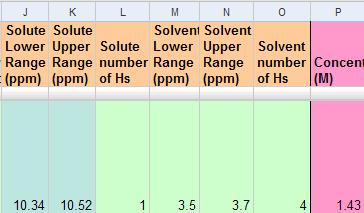
Andy has now modified the script so that the JCAMP-DX file can be located anywhere on the internet. I have prepared a modified Google Spreadsheet to serve as a template for SAMS calculations (Semi-Automated Measurement of Solubility). Simply enter the url to the JCAMP-DX file in the appropriate column and fill in the ppm ranges and corresponding hydrogen numbers for the solvent and solute, and molecular weight and density data. (The predicted density of solids can be found on Chemspider). The concentration of the solute will then be automatically calculated based on an assumption of volume additivity.

The web service (which handles baseline correction) could be used for any other purpose involving the integration of spectra. Just make a copy of the Google Spreadsheet and modify.

Note that the JCAMP-DX files must be in XY format. If your instrument saves spectra in a compressed format they must be converted to XY. The desktop version of Robert Lancashire's JSpecView can be used to carry out the conversion.

This template spreadsheet also features a service in a cell to display the NMR spectrum by simply clicking on the link inside the cell. This is very handy because it obviates the need to create an HTML file which must normally accompany the JCAMP-DX file for viewing. Being able to quickly view a spectrum from a particular row within the Google Spreadsheet makes tracking data provenance very intuitive and errors easy to spot.

ONS t-shirts from Zazzle

Inspired by Graham Steel, I just received my t-shirt with an Open Notebook Science Logo and a picture of our crystal on the cover of our ONS Solubility Challenge book.

I was going to set up an ONS store but Zazzle does not permit zero royalties (don't see the logic there). But making up t-shirts on Zazzle is super simple - just grab a logo of your choice from the ONSclaims wiki.

Any other pic is your choice - this is the crystal from UCEXP150C


You can also order all kinds of other personalized things, including coffee cups.

Scientists Embrace Openness Article in Science Careers

Chelsea Wald just published an article in Science Careers: Scientists Embrace Openness (April 9, 2010). She interviewed several people in the Open Science movement including Jonathan Eisen, Steve Koch, Anthony Salvagno, Carl Boettiger and myself.

The article covers Open Notebook Science, Open Data and associated themes. I think it presents a view of the most commonly discussed advantages and disadvantages very well.

One section was particularly relevant to an issue I recently posted about - (and discussed on FriendFeed):

Open Notebook Science advocates claim that being open may protect a scientist's ideas rather than exposing them to theft. Newton's decision to conceal his findings within an anagram made it harder for him to prove priority over rival Gottfried Leibniz. Open Notebook scientists say all they need to do is point to their open notebooks to show that they had an idea or found a result first.