Two posts about denialism, climate change and otherwise | Bad Astronomy

Because I love to write about climate change and watch the misinformation and noise fly in the comments, I will direct your attention to two very interesting articles about denialism:

1) My friend and noted skeptic Steve Novella writes about the meaning of scientific consensus and denialism, whether that’s over global warming or vaccines.

2) An article on lies.com likens global warming denialism to the O. J. Simpson trial, saying that when faced with overwhelming evidence, Simpson’s lawyers attacked the court process instead of the actual case. It’s a fascinating analogy and one that strikes me as being very apt.

lalalala_beavercanthearyouI’ll add as a bonus a link to something I wrote a while back: the difference between skepticism and denialism. I wrote it a year or so ago, and don’t see anything I would change today.


Endangered Frogs Encouraged to Get Amorous in an Amphibian “Love Shack” | Discoblog

Lemur_leaf_frog_3We know that dim lights, a little Marvin Gaye, and a lot of red wine usually do the trick to get humans in the mood for some nookie. But what encourages endangered frogs to get it on?

Apparently, they are a fussy lot, and demand that the temperature be just right and that the humidity and day length be just so; only then will they kick off their slippers for a little bit of action. So, the Bristol Zoo obliged a few endangered frogs by building them a love shack, a specially designed “AmphiPod” with controlled natural conditions that will hopefully encourage the endangered frogs to breed.

Scientific American reports:

In addition to mimicking the frogs’ natural habitat, AmphiPod will also help to protect them against disease, including the deadly chytrid fungus that is rapidly devastating frog populations around the world.

Right now, the AmphiPod is housing the lemur leaf frog (Hylomantis lemur) from Panama and Costa Rica, and Madagascar’s golden mantella frog (Mantella aurantiaca). The leaf frog has already lost almost 80 percent of its population to the deadly chytrid fungus while the golden mantella’s home is being destroyed due to rapid deforestation.

Bristol Zoo authorities will be watching the love shack closely to see if these amphibians get amorous. If the scheme seems to work, other frog couples from different endangered species could be given honeymoons in the love getaway.

F Join Discover Magazine on Facebook

Related Content:
DISCOVER: Frogs Legs Up
80BEATS:A Gentleman Frog That Takes Monogamy & Parenting Seriously
80beats: Frogs Pee Away Scientists’ Attempts To Study Them
Discoblog: Video: How Male Frogs Kick up a Frog Froth to Protect Their Young
80beats: Commitment-Phobic Men Can Blame Their DNA
DISCOVER: Sex and the Female Agenda
DISCOVER: Sex and Control
DISCOVER: Mating Like an Animal: The Real Story

Image: Bristol Zoo


This Is The Dawning of Aquarius–In South Dakota | The Loom

South Dakota, are you kidding me? Astrology in the classroom?

In the fine tradition of creationist legislation that claims that evolution is “just” a theory and that requires the teaching of alternatives, the South Dakota legislature has passed a resolution on the teaching of climate change. Here’s how it starts.

NOW, THEREFORE, BE IT RESOLVED, by the House of Representatives of the Eighty-fifth Legislature of the State of South Dakota, the Senate concurring therein, that the South Dakota Legislature urges that instruction in the public schools relating to global warming include the following: (1) That global warming is a scientific theory rather than a proven fact;
(2) That there are a variety of climatological, meteorological, astrological, thermological, cosmological, and ecological dynamics that can effect [sic] world weather phenomena and that the significance and interrelativity of these factors is largely speculative…

That red color is mine. This resolution was not just offered, folks. It was approved by a majority of the legislature. Astrology and all.

At least I know what astrological means. Someone’s going to have to help me with thermological, though. It’s not even in the dictionary. (Whoops–I found it in the Oxford English Dictionary. Having to do with heat. Still, though–what about cosmological? Is global warming from the Big Bang?)

Wow. That is all.

Update: Thanks to Loree for pointing out that this original language was amended before the vote. Here’s what it ended up as:

A CONCURRENT RESOLUTION, Calling for a balanced approach for instruction in the public schools relating to global climatic change.

WHEREAS, evidence relating to global climatic change is complex and subject to varying scientific interpretations; and
WHEREAS, there are a variety of climatological and meteorological dynamics that can affect world weather phenomena, and the significance and interrelativity of these factors remain unresolved; and
WHEREAS, the debate on global warming has subsumed political and philosophical viewpoints, which has complicated and prejudiced the scientific investigation of global climatic change phenomena:

NOW, THEREFORE, BE IT RESOLVED, by the House of Representatives of the Eighty-fifth Legislature of the State of South Dakota, the Senate concurring therein, that the South Dakota Legislature urges that all instruction in the public schools relating to global climatic change be presented in a balanced and objective manner and be appropriate to the age and academic development of the student and to the prevailing classroom circumstances.”.

Thankfully, those who don’t know the difference between astrology and astronomy didn’t get their way. But the “balanced” rhetoric that remains is straight out of the creationist playbook. For more, see Science Progress.

[via Think Progress]


Spacecraft-Collected Comet Dust Reveals Surprises From the Solar System’s Boondocks | 80beats

stardustcometSince NASA’s Stardust mission returned in 2006 from its trip of billions of miles collecting the dust of a comet called Wild2 and dropped it samples down to Earth in the Utah desert, the samples have raised all sorts of questions about how comets formed and what the early solar system was like. In a study this week in Science, there’s a new surprise. Scientists say that the comet sample contains chemicals that must have formed in our home turf, the inner solar system.

Lead researcher Jennifer Matzel studies a tiny particle taken from Stardust’s sample, a piece just five micrometers across. In it her team found the mark of materials that would have formed under high temperatures. Matzel, who specializes in using the decay rates of radioactive chemical elements to assess ancient dates, determined that the Stardust particle must have crystallized just 1.7 million years after the oldest solid rocks in the solar system were forming [San Francisco Chronicle]. After that, the researchers says, the particle must have been flung out to the Kuiper Belt, the region of icy comets revolving around the sun at a distance far past Neptune.

Matzel doesn’t know for sure how this migration would have happened, but she’s excited about it. “The new and interesting thing about this paper is it’s the first time we’ve been able to get some estimate of the timing,” Matzel says. “Even though it’s a very old object and it formed very close to the sun, it had some longer history in the inner solar system before it got flung out to the comet-forming region” [Scientific American]. The trip would not have been easy. NASA’s Joseph Nuth notes that Jupiter would be forming by this time in the early solar system’s history, and that would have been a major obstacle that outwardly-migrating material would have had to overcome.

Once again, Stardust has proven to be great at providing the unexpected. Earlier findings showed that the comet’s cloud unexpectedly contains the same rocky materials as the asteroids that orbit the sun between Mars and Jupiter, as well as molecules of glycine, an organic compound essential for life [San Francisco Chronicle]. More hints about the early solar system probably await in the stardust it brought back.

And while the Stardust “mothership” successfully dropped its sample capsule to Earth in 2006, the spacecraft’s voyage isn’t done. Stardust is now on its way to the comet Tempel 1, the comet impacted by the Deep Impact spacecraft in 2005, where it will take photographs of the crater produced by that impact.

Related Content:
80beats: Dust Collected From Comet Contains a Key Ingredient For Life
80beats: Meteorite, Maybe Older Than The Sun, Shows Chemistry of Ancient Solar System
DISCOVER: NASA Takes a Wild Comet Ride

Image: NASA


Snow Day Special: Warbling Scientists on the Newest Symphony of Science | Discoblog

Scientific superstars like Carl Sagan and Richard Dawkins are sounding better and better. In the series Symphony of Science, creator John Boswell uses the auto-tune program so beloved by R&B and pop stars to tweak such nerdy delights as Carl Sagan’s monologues from “Cosmos,” and sets them to electro-funk music. The result? Highly watchable videos of Sagan and other guest scientists expounding on the magic of the cosmos and our place in the universe. Boswell has put four videos out previously, but here is his latest offering, “The Poetry of Reality.”

FB Join Discover Magazine on Facebook

Related Content:
Discoblog: Carl Sagan Sings Again: Symphony of Science, Part 4
Discoblog: Sounds of the Universe: Making Music From the Supernova Cassiopeia A


An Iceberg the Size of Luxembourg Breaks Free From Antarctica | 80beats

iceA giant iceberg has broken free from Antarctica, and scientists say the massive ice chunk could interfere with ocean circulation and wildlife–particularly Antarctica’s iconic residents, the emperor penguins.

The piece of ice broke free when another huge iceberg struck Antarctica’s Mertz glacier; now the two icebergs, with a combined weight of 700 million tons, are floating along the Antarctic coast. The iceberg collision and break-off is a rare event and occurs naturally every 50 to 100 years, scientists say. The new iceberg, which is 49 miles long and about 24 miles wide, holds enough fresh water to supply all of the earth’s human needs for a year [ABC News].

Scientists are keeping a close eye on the situation, as both icebergs could potentially change the salinity of the water in the area, which could alter the flow of ocean currents.

Since breaking off, both icebergs have moved into an area called a polynya or polynia, where an expanse of open water is surrounded by sea-ice. Distributed across the Southern ocean, polynyas are the zones that produce dense water, super cold and rich in salt that sinks to the bottom of the sea and drives the conveyor-belt like circulation around the globe [Agence France-Presse]. Now, with the icebergs possibly lodged in this area, they could reduce the production of the cold salty water, called bottom water, which feeds oxygen into the deep ocean currents. Mario Hoppema, chemical oceanographer at the Alfred Wegener Institute for Polar and Marine Research in Germany, said that as a result “there may be regions of the world’s oceans that lose oxygen, and then of course most of the life there will die” [Guardian].

In the short-term, scientists say the new iceberg will impact the colonies of emperor penguins and other wildlife that use the area for feeding. Says Antarctic researcher Neal Young: “There are emperor penguin colonies about 200-300km away to the west. They come to this area to feed, and seals in the area also come to get access to the open water.” … He suggested that a change in the availability of open water could affect the rate of food production, which would have an impact on the amount of wildlife it could sustain [BBC News].

While the so-called “calving” of this new iceberg was extremely dramatic, scientists have clarified that it was a natural event, in contrast to recent rapid ice shelf break-off on the Antarctic peninsula where the climate is warming [The Sydney Morning Herald]. Here is Neal Young, a glaciologist at the Antarctic Climate and Ecosystems Research Centre in Tasmania, explaining the significance of the event.

FB Join Discover Magazine on Facebook

Related Content:
80beats: Is the Once-Stable Part of Antarctica Starting to Melt?
80beats: Fossils of Shrimp-Like Creatures Point to Warmer Antarctica in the Distant Past
80beats: Floods Beneath Antarctica’s Ice Sheet Create a Glacial Slip-and-Slide
80beats: Antarctica is Definitely Feeling the Heat from Global Warming

Image: Australian Antarctic Division


Symphony of Science, Movement #4 | Bad Astronomy

The Symphony of Science is a wonderful project taking words from famous scientists and using an autotuner to create music. It’s pretty popular; the first one has over 3 million views on YouTube!

The newest version has statements by a dozen different scientists, all talking about what science is and what it does. As Richard Dawkins says, science is the Poetry of Reality:

Pretty cool. I love the sentiment, and it’s fun to see how many friends are in there, too. And you know what? Everything they say in there is true.

Tip o’ the semiquaver to Julia Sherred.


Sharp-Eyed Fish Can Tell Friend From Foe via Facial UV Markings | 80beats

DamselfishWe know that there’s a whole spectrum of different wavelengths of light beyond the puny band of visible light we humans can see. And we knew that some animals, like certain species of fish and birds, have vision that extended beyond ours into wavelengths like ultraviolet. But a new study in Current Biology demonstrates that not only can damselfish see in UV, but that they can discern specific patterns in UV light, which is much more than we ever gave them credit for.

The findings are the first to show an animal “that is able to discriminate between fine-scale UV patterns using only their short-wavelength receptors (UV cones),” the researchers wrote in their study. These fish seem to use the UV cues to distinguish their own from other similar-looking species [Scientific American]. Prior to this, many researchers thought the fish’s UV vision just allowed them to detect the presence of UV light, and wasn’t refined enough to detect any kind of patterns.

The team, led by Ulrike Siebeck, made the find by studying two species of damselfish, Ambon and lemon, which have different UV sensitive markings on their faces. When the two species were put together, most of the males Ambons would defend their territory by attacking other male Ambons, but wouldn’t pay much attention to their lemon cousins. However, when the experiment was run with UV filters so the fish couldn’t see the UV facial patterns, this same preference for attacking kin wasn’t found [LiveScience]. Without the UV markings, the scientists propose, perhaps the Ambon damselfish couldn’t easily tell the nearly identical lemon damselfish apart from its own species.

While both these species of damselfish see in UV, plenty of their major predators, such as wrasses and cod, typically can’t, Siebeck says. So she argues that damselfish could use their spots to send a covert message [Science News]. UV light also scatters in water more than visible light, so even if predators could see in UV, it wouldn’t do them much good from afar. Thus, these UV face markings could be a clever way for the fish to send bright signals to potential mates or rivals without attracting unwanted attention.

Related Content:
80beats: Male Cleaner Fish Punish Females Who Piss Off the Boss Fish
80beats: DNA Scanner Proves That NYC Sushi Contains Endangered Bluefin Tuna
Discoblog: Was This Fish the Inspiration for Alien?
DISCOVER: The Most Important Fish in the Sea
DISCOVER: 8 Marine Creatures That Light Up the Sea

Image: U. Siebeck et al. / Current Biology 2010


A Word On Tilikum | The Intersection

Picture 6On Monday, experienced Sea World trainer Dawn Brancheau drowned when a 12,300-pound orca named Tilikum pulled her into a tank after the popular Dine with Shamu show. The tragedy took place in front of dozens of tourists with varying accounts of what exactly occurred.

In the days since, I’ve received many questions about orcas like Tilikum. Several of you want to hear my take on the ethics of captive lifestyles for animals. Some use terms like “compassionate conservation” while others talk about “cruel imprisonment.” Meanwhile, lots of advocacy groups have been speaking out by making lump judgments on all zoos and aquariums–which is not right. To be fair, there is a very broad spectrum in terms of the value of–and responsibility at–each. Further, most handlers I’ve personally met are well-intentioned, and focus on conservation and science. So rather than go into a lengthy discussion on the merits and faults of parks, let’s stick to orcas and this very sad story.

Orcas have evolved to be highly intelligent, social animals, communicating to pod members using sounds that travel underwater. They are also powerful hunters. Tilikum was born wild off the coast of Iceland, where he could travel vast distances until he was captured in 1983. Since then, he’s lived in a comparatively small enclosure, siring offspring, and performing simple tricks for us, over and over and over again.

It’s relatively simple to understand why something might go wrong in this situation.


What Is A Bird (a k a Euornithine Ornithothoracine Pygostylian…etc.)? | The Loom

My post on birds and dinosaurs yesterday led to a little debate on Facebook, including this, from paleontologist Thomas Holtz:

All living birds share a common ancestor that would also be considered a bird, so they are a monophyletic group. Nevertheless, that group is deeply nested among euornithine ornithothoracine pygostylian avialian eumaniraptoran paravian metornithine maniraptoran maniraptoriform tyrannoraptoran coelurosaurian avetheropodan tetanurine averostran neotheropod theropod saurischian dinosaurs.

…and breathe.


Beauty in violence | Bad Astronomy

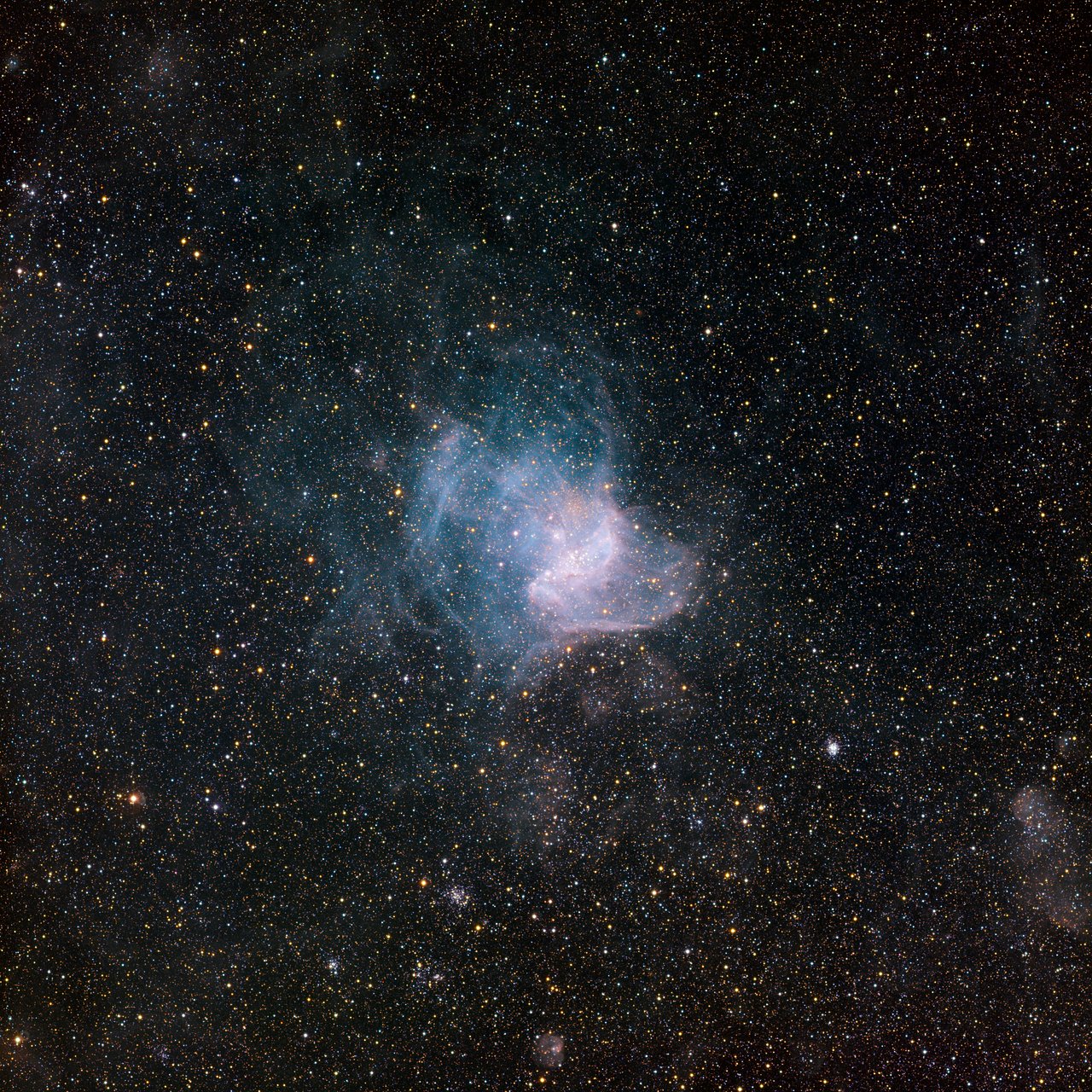
The European Southern Observatory just released a very pretty picture of the nebula NGC 346. Check this out:

eso_ngc346

I strongly urge you to click that to ennebulanate to the higher-res version; I had to shrink and compress it quite a bit to fit it here.

The picture is lovely, showing a star-forming region in the Small Magellanic Cloud, a satellite galaxy to our own. The nebula’s about 200 light years across, and 200,000 light years away.

I won’t go into details; you can go to the ESO site for that. But there’s something I want to point out. The sharp wisps you see strewn this way and that inside the gas are due to vast and powerful winds of subatomic particles blowing from the surfaces of massive stars that are newly-born from that very gas. These streams slam into the gas, compressing it across trillions of kilometers, producing storm fronts that are thinner than a laboratory vacuum but are still so voluminous that the mass adds up to many times that of the Sun’s. Added to that is a flood of high-energy ultraviolet light from these massive stars, energy blasting out as they furiously churn out energy in their cores, leading ultimately to their demise in supernovae explosions.

So while you gaze at this nebula and wonder at its beauty, remember that in our Universe, beauty is borne by great violence. If there’s a life lesson in there I’m unaware of it. But it is worth pondering.


Black holes and white slopes | Cosmic Variance

I spent last week attending the “Formation and Evolution of Black Holes” conference at the Aspen Center for Physics, organized by Andrea Ghez, Vicky Kalogera, Fred Rasio, and Steinn Sigurdsson (who blogs over at the Dynamics of Cats). It was a great mix of observers and theorists, and we covered the full range, from stellar-mass black holes in our galaxy to supermassive black holes on the far side of the Universe. I was particularly interested in two topics: gravitational-wave recoil and black hole binary inspiral (I’ll blog about both soon enough). And I made another pilgrimage to the Highlands bowl, this time with 15″ of virgin powder.

The Aspen Center runs a public lecture series in conjunction with each conference. So last Wednesday Andrea Ghez gave a lecture on the black hole at the center of our galaxy. It’s our closest big black hole, roughly 25,000 light years (2×10¹⁷ kilometers) away, and four million times the mass of our Sun. Andrea has been leading a team studying the motion of stars orbiting around this black hole. These orbits are one of the best ways (short of the detection of gravitational waves from black hole mergers) of confirming that black holes exist. The orbits tell us the mass of the central object. And the innermost passage of the closest orbit gives us an upper limit on the size of the central object. Combining these numbers gives us a lower limit to the density of the “dark object” at the center of our galaxy. At this point, a black hole is the only viable model for what we see. There is no way to make sense of the orbits using a cluster of (dark) stars at the center, or a massive gas cloud, or anything else we can think of. Gravity tells us that any normal stuff we put there (including “conventional” dark matter) will evaporate or collapse to a black hole. We are not yet probing the horizon of the black hole (in some sense, its surface), but we are getting closer and closer with each passing year.

But, more importantly, Andrea is responsible for one of the coolest movies in all of science:

This shows the orbits of stars around our galactic center. This isn’t an artist’s conception. This isn’t some abstraction of other data. This is a real movie of stars circling the black hole over the last 15 years. In particular, watch S-02. It loops around the black hole, and closes its orbit; we have watched it over one full S-02 “year”. It is an incredible feat of observational astronomy to make these movies. It requires adaptive optics on the largest telescopes in the world (the Keck telescopes on Mauna Kea). We used to think of the heavens as eternal and unchanging. Now we watch movies of stars orbiting black holes.


NASA talks global warming | Bad Astronomy

The Earth is warming up. That’s a fact. Denialists will deny (and no doubt will amp up the noise in the comments below) but the truth is the Earth has warmed on average over a degree Fahrenheit in the past century or so, and the past decade, 2000 – 2009, was the warmest on record.

nasa_awarmingworld

NASA is not taking this lightly. Our space agency has a fleet of satellites in orbit which examine the Earth, taking its temperature and measuring the effects of this global rise in heat. They have a website called A Warming World, which does a really good job discussing the reality of global warming, and debunking some of the bigger claims of the denialists.

A video they put online discusses things like how changing solar input might affect the Earth, how much of this energy from the Sun is reflected, and how much is trapped. It’s done simply, elegantly, and with excellent graphics that show just how the Earth is warming up.

They’ve also put online a devastating series of images depicting what’s happening on our warming world. Here’s one of the Bering Glacier, taken by Landsat 7 in 2002:

nasa_beringglacier

In the past century, rising temperatures have caused this glacier’s terminus to retreat 12 km (7+ miles), and the ice has thinned by several hundred meters. They have many other images there as well showing what’s going on.

If I were to say what the biggest problem we have with all this, it’s that, ironically, while the warming is happening rapidly on a geological timescale, and too rapidly for us to wait much longer to take action, the changes are happening too slowly to shake people out of their complacence. I’m certainly not wishing the effects were accelerated! But it’s far too easy for political maneuvering and loud noise-making to distract people from a very real and very serious issue.

I have a lot of confidence in humans. We’re smart, and even better, we’re clever. There are solutions to global warming, and a lot of them are engineering and technology-driven — I think we can advance technology greatly while actually fighting the climate change. But we also have to change our behavior, and part of that is facing reality and accepting that this really is happening, and that we have to get off our fat cans and do something about it.

The noise machine will rattle cages and distract and sling mud and do a grave disservice to everyone. But I’ll be here to fight them along with thousands and thousands of other scientists. And you know what? I have a hope: if we must battle over this for the next hundred years, we’ll have a nice, cool world in which to do it.

Credit: NASA/Goddard Space Flight Center


Virtual Book Party on Thursday–Win Copies of Unscientific America | The Intersection

unscientific-america-smallMy laziness notwithstanding, I will not be outdone by this timely post of Carl’s. Participants in this virtual book party, sponsored by the American Institute of Biological Sciences, may stand the chance to win a copy of Carl’s The Tangled Bank–but I have just confirmed that 3-5 publisher’s copies of Unscientific America will also be on offer.

Let’s quote Carl on all the event details, so I don’t have to try to write them up better than he does:

What’s a virtual book party you ask? In this case, fellow Discover blogger Chris Mooney and I will each give a 15 minute talk about our new books. From the slipper-and-pajama’d comfort of your home or office (if you wear slippers and pajamas at the office), you can listen to us speak and behold our slide presentations in real time. After we’re through, there will be time for a virtual conversation between you and us. The event (which will last about an hour) is hosted by the American Institute of Biological Sciences.

Carl speaks first, then me. And my slide show won’t have the usual bells and whistles. But, sign up now, I hear they are going fast….


Study: Bacteria Can Make Avatar-Like Electrical Connections in Mud | 80beats

ElectricMudOnce again, laziness pays off. When microbiologist Lars Peter Nielsen and his team were studying marine sediments, they got a little sloppy about cleaning their beakers. But after letting samples sit around in the lab for a few weeks, they began to see weird chemical patterns in them that you just wouldn’t expect. As they saw changes in the surface of the mud quickly trigger other changes down below, the scientists came upon a startling idea: that the bacteria in the top layer and those deep down were somehow electrically linked. Their paper appears this week in Nature.

Specifically, Nielsen saw that hydrogen sulfide buried below the sediment’s surface (the stuff that makes it smell bad) was oxidizing and changing color. One problem, though: That shouldn’t be happening. Below the sediment surface there is plenty of hydrogen sulfide and carbon for bacteria to consume via oxidation, or removing electrons [Scientific American]. But the reaction can’t be sustained without access to dissolved oxygen, which carries away electrons produced by the reaction, and in these samples the oxygen was all up at the sediment’s surface. So the researchers hypothesize that the buried bacteria form a conductive chain to ferry the electrons up to the surface.

At first the team tried alternative explanations, but none seemed to fit. The distance was so great, and the response time so quick, that usual methods of chemical transport — molecular diffusion, or a slow drift from high to low concentration — couldn’t explain it [Wired.com]. For him, only the electrical linkage could explain a connection between bacteria separated by as much as a half inch (if you compare distance to body size, that half inch for a bacterium feels like what 12 miles would feel like to us humans).

How is this even possible? Researchers recently discovered that some bacteria have so-called nanowires, hair-like extensions on the cells’ surface that can conduct electricity. Nielsen and his colleagues speculate that these nanowires are responsible for conducting the electrons [The Scientist]. However, those tiny wires don’t explain how the connection bridges such great distances (in bacterial terms). Researchers outside the study told The Scientist that pyrite grains embedded in the mud could aid conductivity, or that some yet to be discovered mechanism is responsible.

The discovery has raised comparisons to the biological networks that wire the forest in the 3D blockbuster Avatar, and Nielsen admits it’s pretty cool. “One of my colleagues saw this, and immediately sent me a message: ‘You’ve discovered the secret of Avatar! Go see it!’ The similarities are quite striking” [Wired.com].

Related Content:
80beats: Could a Deep Sea Snail’s Shell Inspire Next-Gen Body Armor?
80beats: Fiber-Optic Link Brings Undersea Science Data Onto the Web
DISCOVER: Their Game Is Mud

Image: Nils Risgaard-Petersen


Growing a mustache so others can read | Bad Astronomy

lindsey826My niece, Lindsey, is weird.

Shocker, I know, given her DNA. But there you go. And to prove my point, here’s what she’s doing: she’s growing a mustache, kinda, for charity. She works for a group called 826, which promotes reading and writing for local kids. Lindsey’s in Boston, and for the month of February she’s somehow going to increase her lip warmer to help get money for the program. You can read more about this program on the 826 main site, at Boston.com, and the Boston Phoenix.

So yes, I’m using my great and terrible powers of blogging to help a family member. But y’see, I already have a mustache. This is all I can do. My logic is infallible. And, of course, I’m all about promoting the hirsute of happiness.


Bear Fight! Grizzlies Are Creeping Into Polar Bears’ Canadian Turf | 80beats

GrizzlyUp north in the Canadian province of Manitoba, polar bears are receiving some unwelcome guests. Researchers have seen grizzly bears moving into the area for the first time, and that might not be good news for the already-troubled polar bears.

Linda Gormezano and her team, who are publishing the study (pdf) in Canadian Field-Naturalist, weren’t even looking for grizzlies when they started to spot the huge mammals; they were flying around counting fox dens. Before 1996, there was no evidence that grizzly bears encroached on polar bear territory. From that year on, however, there have been at least 12 sightings, negating the prior theory that the barren landscape north of the Hudson Bay was impassable, in terms of resources, for migrating grizzly bears [Discovery News]. If grizzlies can survive there, Gormezano says, they’ll probably want to stay, because there’s a bevy of caribou, fish, and other good things to eat.

This worries Gormezano. She says, “Grizzlies would likely hibernate in polar bear maternity denning habitat. They would come out of hibernation at the same time and can kill polar cubs” [BBC News]. In addition, the geographical proximity would make it more likely that polar and grizzly bears would produce hybrid offspring, labeled “pizzly,” “prizzly,” or “grolar” bears.

Of course, a story about competing grizzlies and polar bears can lead to only one place: nerd-tastic arguments over which would win in a fight. While debating this at length, Canada’s The Globe and Mail asks the experts. Manitoba Wildlands director Gaile Whelan Enns sees the grizzlies with the advantage: “The grizzly is more accustomed to the predator-prey relationship, whereas the polar bears are not quite as aggressive” [The Globe and Mail]. However, she notes, polar bears have the size advantage, outweighing their competitors by hundreds of pounds.

Study author Robert Rockwell says that the two bear species would most likely meet when the polar bears take to their dens to give birth, which could give the grizzlies an easy target. “If it’s a fight between a 1,200-pound male polar bear and a 600-pound grizzly, I think we know who would win,” Dr. Rockwell said. “But in this likeliest of cases, it’s debatable. There are actually reports in the literature where grizzlies have killed denning polar bear females” [The Globe and Mail].

Both kinds of bear receive protection from the province of Manitoba, and Canada lists both as species of special concern. Whether they have special concern for each other should their territories collide remains to be seen.

Related Content:
80beats: Obama Agrees With Bush: Polar Bears Won’t Drive Global Warming Policy
80beats: 2 Trillion Tons of Polar Ice Lost in 5 Years, and Melting Is Accelerating
DISCOVER: Polar Bears (Finally) Make the Endangered Species List
DISCOVER: The Electronic Grizzly, mapping the majestic creatures

Image: Wikimedia Commons / Shellie


Happy anniversary, Terra! | Bad Astronomy

No, not Terra the Earth, Terra the satellite. NASA’s Earth-observing bird first opened its eyes on February 24, 2000, and for the past decade has been dutifully watching our planet. It has looked upon us at different wavelengths, different resolutions, at different times of day, and different times of year. It has tracked changes, and reported back what it has seen.

And oh, what it has seen! Here is a map made almost entirely of Terra data (small gaps in some coverage were filled with data from GOES weather satellites):

terra_10th_first_light

Click to get the massive 85Mb 5400×2700 pixel image. It’s totally worth it. Our planet is very, very pretty.

But Terra is more than just a camera. The data it returns track a lot of key environmental factors for our world. Here are representations of some of the data it takes: growing vegetation, carbon monoxide, aerosols (pollution), elevation, and net radiation (energy in from the Sun and energy radiated away as heat).

terra_globes

Again, click through to see how lovely data can be, or at least how it can be represented.

These maps, these observations, help us understand our own world, how it works, and how we’re changing it. These are all matters related to our very survival, and I’m very glad we have tools like Terra helping us ensure that.

Image credits: Marit Jentoft-Nilsen (image) and Robert Simmon (globes)


NCBI ROFL: Nasal leech infestation: report of seven leeches and literature review. | Discoblog

Photo 123“Nasal leech infestation rarely occurs in society today and it is usually reported as an anecdote. In this study, we present seven nasal leeches in six patients from 1984 to 2008… Four patients were less than 8 years old and two patients were older than 60 years old. All patients had spent time in rural streams 2 weeks to 2 months before the symptoms occurred. All of the seven leeches were removed smoothly and one leech migrated to the oropharynx during the operation. The length of the leeches ranged from 2 to 12 cm with an average length of 4.6 cm. Attention should be given to nasal leech infestation, especially in children and senior citizens who have visited rural streams and have been exposed to freshwater. One of our patients had two leeches lodged in his nasal cavities. Therefore, it is also important to re-examine both nasal cavities after the removal of one leech.”

nasal_leech

Related content:
Discoblog: NCBI ROFL: Does garlic protect against vampires? An experimental study.
Discoblog: NCBI ROFL: health issues I wish I didn’t know about


Stupid Snow

Here’s a quick snapshot looking at my observatory. In the foreground you can see a generator and one of my bbq grills (yeah, I have a couple and am getting ready to build a chicken cooker, party sized  YAY!) anyway, you can kind of get sense of what’s been going on today.

At 5pm we had 17 inches and it contained 1.5 inches of water so you know it was heavy.

Between this snow and the boiler that blew up downstairs, it’s been a bit crazy.
We will get the snow all cleaned up in the morning and will wait for the next storm tomorrow night.