
E. coli that can count? In my new podcast, I talk to James Collins, an engineer-turned-biologist who helped usher in the science of synthetic biology ten years ago. We talk about the challenges of getting cells to do what you want them to, and what synthetic biology will look like in 2020. Check it out.
Category Archives: Astronomy


Spelunking the lunar landscape | Bad Astronomy
Need a little bit of jaw-droppiness today? Mwuahahaha. Let me show you something:
a hole in the Moon.
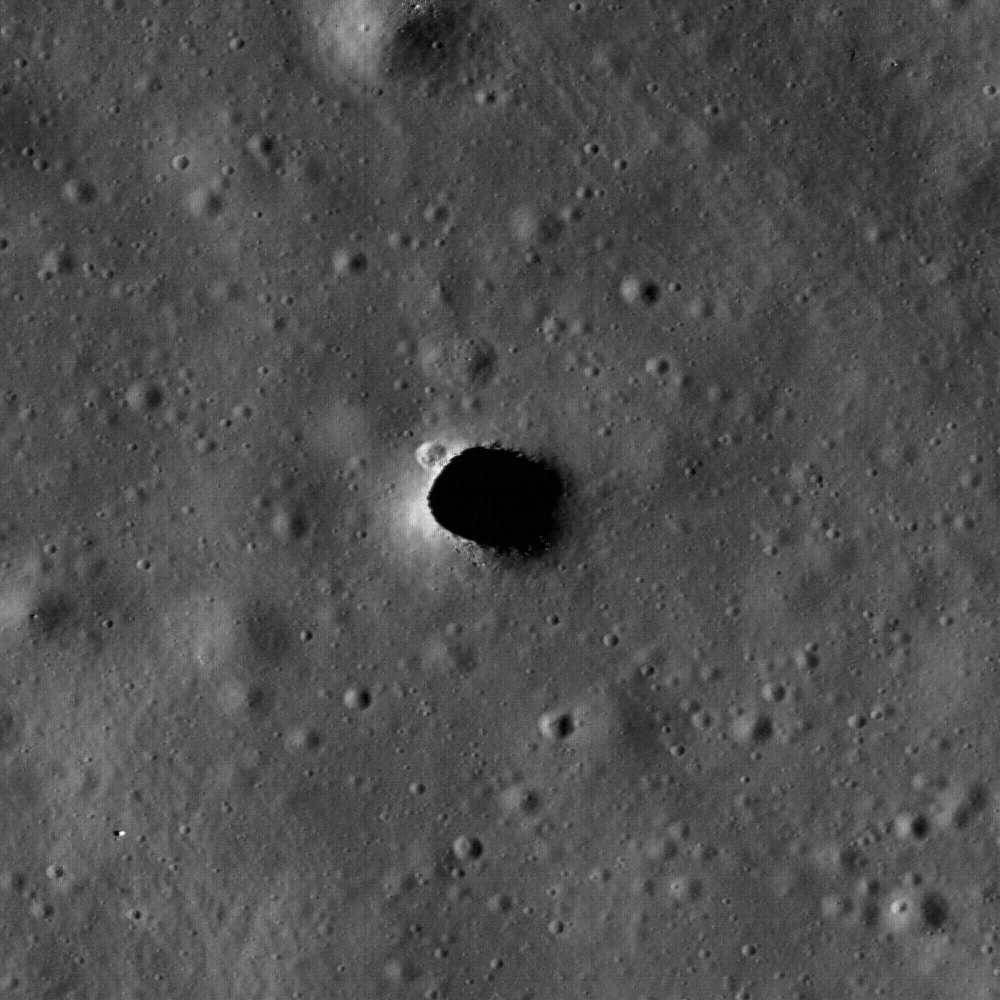
[Don't tell anyone, but that's where they faked the Moon landings!]
This is an image from the Lunar Reconnaissance Orbiter, one of my favorite spacecraft in existence. It’s been mapping the Moon at an incredible 50 cm/pixel resolution — that’s 19 inches, my pretties — for a while now, and revealing one astonishing thing after another.
 What you’re seeing here is indeed a hole in the Moon: what is almost certainly a skylight, a hole punctured in the roof of a lava tube, an underground tunnel carved by flowing molten material on the Moon. The hole is about 65 meters across — roughly 2/3rd the length of a football field. This region of the Moon is called Marius Hills, and is known to be volcanic in nature. The clincher is that the hole sits in a rille, a sinuous, snaking gully in the lunar surface.
The picture on the left provides a little context. The hole is the very dark feature near the top, and sunlight is coming from the left. The rille is pretty obvious here, snaking more or less top to bottom, and the hole is smack dab in the middle of it. The place is littered with craters, most of which are soft looking, with no rims and very smooth features, which are possible indicators of very great age (erosion from solar wind, newer impacts, and thermal stress from the large day/night temperature swings wear down sharp features over time), or perhaps the regolith (the ground up rocks making a loose soil-like composite) is just very thick here, softening the sides of craters.
Let me show you another view, a bit closer in:

This section is about 1 km (3000 feet) across; in other words, it might take you about 10 minutes to walk across it (here on Earth, that is; in a spacesuit YMMV). The arrow at the bottom shows you the direction of sunlight; the Sun is coming from the left. That’s important, because our eyes get fooled easily if sunlight is coming from below; it makes craters look like domes and vice-versa. A lot of softer craters look like domes to my eye in this shot, so I marked a nice sharp crater with a 2 (the hole itself is labeled 1). See how the right side of the crater is bright? That makes sense if the Sun is on the left.
I marked the top of the rille with a 3, and the base of the sloping side with a 4. Think of it as the top and bottom of a riverbank. The other side of the rille is off the picture to the right.
OK, still with me? Now look at the hole again. The bright crescent around the hole on the right and the dark part on the left must be due to a slope leading into the hole, as if the whole thing is not just a hole punched into the surface, but more like a funnel pushed into it. The hole probably started out somewhat smaller, and the sides collapsed down a bit. Think of digging a hole in dry sand and you’ll get the picture.
This means there’s a lava tube under the rille, probably carved out by an older lava flow. Observations by the Japanese probe SELENE indicate the hole is about 90 meters deep, and the roof — the top part of the tube — is about 25 meters thick. That explains why it hasn’t collapsed under the eons of meteoric bombardment forming all the craters in it. The hole may be a collapsed section, or it may have been punched by a larger meteorite. Given the size of the hole, the impactor couldn’t have been bigger than a few meters across itself. Had it been much bigger, I’d think more of the roof would’ve collapsed.
Incredible! And useful, too: radiation from the solar wind may be a problem for future lunar colonists. A good solar flare could sicken or kill them, so they’ll need protection. Building underground is one way to do that, and here we have a pre-fab cave! It’s unfurnished, a bit of a fixer-upper, but ready for occupants, and priced to move.
You may think a colony on the Moon is fantasy, but I disagree. It’s a matter of realty. And of course, location location location.


Why Can’t All Medications Come in Ice Cream-Form? | Discoblog
 I scream, you scream, we all scream… for the medicine given to recovering cancer patients.
The Scientist reports that LactoPharma, (a “collaborative research venture between the University of Aukland, the New Zealand government, and the country’s largest dairy company, Fonterra Ltd.”) has created a therapeutic, strawberry-flavored ice cream called ReCharge.
ReCharge ice cream has gone through a string of taste-tests to ensure that the product satisfies the palette. However, one ingredient is a mandatory keeper: Lactoferrin, a protein found in milk that possesses the power to impede tumor growth and improve intestinal immune response. Because side effects of chemotherapy include the destruction of neutrophils (while blood cells) and intestinal cells, which often leads to infection and digestive problems, University of Auckland biologist Geoff Krissansen decided to test bovine lactoferrin on chemotherapy patients to see whether it could counter these side effects.
The Scientist reports on the results:
Indeed, when fed to mice two weeks prior to chemotherapy, bovine lactoferrin helped increase immunoresponsive cytokines in the intestine, decreasing cell damage caused by chemo, and restored both red blood cell and neutrophil numbers…. The researchers also found that another bioactive component present naturally in milk—a type of “lipid fraction,” according to Krissansen—demonstrated similar results in mice. The scientists expect to publish these results in 2010.
But why serve up the lactoferrin in ice cream-form? Kate Palmano of the Fonterra Research Center explains: “We needed to formulate a product that was acceptable and palatable to patients, but that was also suitable for the bioactives.” The bioactive in question, lactoferrin, is a protein that can change form and function in warmer temperatures. “Plus,” Palmano adds, “people going through chemotherapy typically lose their appetite. Why not give them a treat like ice cream?”
LactoPharma plans to develop more foods and pharmaceuticals incorporating milk’s protective mechanisms.
Related Content:
Discoblog: Fiber-Filled, Antioxidant-Packed Ice Cream—Brilliant? Sacrilegious? Nasty?
Discoblog: NCBI ROFL: I scream! You scream! We all scream…from ice-cream headaches.
Discoblog: Not Freezing Ice Cream Would Help the Environment; Not Eating It Would, Too
Image: flickr / joyosity


Scientists Sequence DNA From the Teeming Bacterial Universe in Your Guts | 80beats
 The human genome may have been sequenced back in 2004, but that was a far cry from documenting all the genes inside us. Our bodies are home to a dizzying number and variety of bacteria, and in a study published in this week’s Nature, researchers have used metagenomic sequencing to catalog the genes that belong to the microbes living in our guts.
The project, which sampled 124 European people, found that each individual had at least 160 species of bacteria living in his or her digestive tract, and there’s a lot of overlap between our guts. At least 57 species of bacteria were present in just about everybody. Overall, the researchers cataloged about 1,000 different bacteria species and figure there’s another 150 or so they haven’t found [AP].
Researcher Jeroen Raes reminds us that no matter if we’re grossed out by the fact that bacteria infest our body, we depend on them. “The bacteria help digest food, provide vitamins, protect us from invading pathogens. If there’s a disturbance, people get all sorts of diseases such as Crohn’s disease, Ulcerative colitis, and a link has also been made to obesity” [BBC News]. In addition, he says, we have 10 times the number of bacterial cells in our bodies than human cells, and 100 times bacterial genes than our own. So we’re pretty much walking bacteria farms.
It’ll take time to sort out the tangled web of data from all those microbial species. Study coauthor Wang Jun says one of the ultimate goals is to pin down relationships between bacteria and diseases like those that Raes listed. “If you just tackle these bacteria, it is easier than treating the human body itself. If you find that a certain bug is responsible for a certain disease and you kill it, then you kill the disease,” Wang said [Reuters]. Wang is currently working on a similar study in China.
In the meantime, some, like outside researcher Elaine Holmes, were just impressed that this feat could be achieved. “It uses a large number of participants and therefore one assumes it is more representative of the ‘real’ microbial composition than previous studies. Also, it is an amazing feat of data processing” [BBC News].
Related Content:
80beats: Study: Bacteria Can Make Avatar-Like Electrical Connections In Mud
80beats: Did Your Morning Shower Spray You With Bacteria?
80beats: Your Belly Button Is a Lush Oasis for Bacteria, and That’s a Good Thing
80beats: Mutations That Kill: First Cancer Genomes Sequenced
DISCOVER: Your Genome, Now Available for a (Relative) Discount
Image: iStockphoto


Where astronomy and Trek collide: SETIcon! | Bad Astronomy
 I’m very excited to announce the advent of SETIcon, a convention about astronomy, SETI, and Star Trek!
Yeah, you read that right. SETIcon guests will include many astronomers from the Search for Extraterrestrial Intelligence, including David Morrison, Seth Shostak, Frank Drake, and Jill Tarter. Other astronomers will include my friends Alex Filippenko, Debra Fischer, and Kevin Grazier, and Apollo 9 astronaut Rusty Schweikart.
Oh! And me. I’ll be there, too.
But besides astronomers and astronomy and hardcore science talks, there will also be several actors from the scifi genre there, including John Billingsley (Dr. Phlox from Enterprise; I met him at Dragon*Con and he is smart, funny, and just a generally nice guy) and Tim Russ (Tuvok from Voyager, who is an amateur astronomer). More guests have been invited, and I’m hoping to have one or two cool announcements concerning them as they confirm.
There will be panels, talks (I’ll most likely give my Death from the Skies! talk) and I just bet Kevin and I will do one of our famous panels where we nitpick movies and each other. Mostly each other. That’s a lot of fun.
SETIcon will be August 13 – 15 in Santa Clara, California. Unbelievably, tickets are only $20 a day or $35 for the weekend. That’s really cheap for something like this! Of course, more expensive tickets get you more stuff, so explore your options. I’m really looking forward to it. It’ll be fun, and I hope to see lots of BABloggees there.


Hella Good: Mixing Science and California Slang to Name a Really Big Number | Discoblog
 If you came across the number 1,000,000,000,000,000,000,000,000,000, which is a one followed by 27 zeroes, won’t you say that’s a hella lot of numbers?
UC Davis student Austin Sendek seems to think so. He has initiated a Facebook campaign to designate a scientifically accepted prefix for this number, 10^27. The prefix he chose is “hella” because it is “a hell of a lot” of numbers. It is also his way of mixing homegrown California slang with science. Sendek thinks the new prefix would be the best way to acknowledge the Golden State’s hella hot contributions to science.
If Sendek’s proposal is accepted, then hella would come right after “yotta.”
Physics World reports:
Yotta (1024), which was established in 2001, is currently the largest number established in the International System of Units (SI) — the world’s most widely used system of measurement — with zeta (1021), exa (1018) and peta (1015) following close behind.
Already, Sendek’s Facebook fan page for the new designator has racked up a huge following, with more than 30,000 fans.
But what would you use hella for in science? DISCOVER’s Cosmic Variance explains that a hellasecond is ten billion times the age of the universe, and the mass of the earth is about 6 hellagrams. Sendek says you could also use hella to describe the wattage of the Sun, the space between galaxies, or the number of atoms in a sample.
Sendek has already written to the Consultative Committee for Units (CCU) which advises the International Committee for Weights and Measures–the body that makes the final decisions on the prefixes. However, CCU’s head, Ian Mills, has said that he’s skeptical that hella will win approval.
Related Content:
Cosmic Variance: Hella…yes!
Image: Facebook/ The official petition to establish “Hella”

Monitoring The World’s Oceans | The Intersection
This is the seventh in a series of guest posts by Joel Barkan, a previous contributor to “The Intersection” and a graduate student at the Scripps Institution of Oceanography. The renowned Scripps marine biologist Jeremy Jackson is teaching his famed “Marine Science, Economics, and Policy” course for what may be the last time this year (along with Jennifer Jacquet), and Joel will be reporting each week on the contents of the course.
I don’t want to write a post all about climate change on Chris and Sheril’s blog because my fire-retardant suit is at the cleaners. So I won’t. But I will write about what marine scientists can learn from what climate scientists are doing (no “Oceangate” jokes, please).
Each week, I write in this space about a different threat that will inevitably doom our oceans if we fail to act. But which threat is the most critical? At least climate scientists have agreed on a general consensus: most of the observed warming over the last 50 years is likely due to increased greenhouse gas concentrations as a result of human activities. UC San Diego’s own Naomi Oreskes, in a 2004 Science essay, analyzed nearly a thousand abstracts published in the ISI database between 1993 and 2003 that contained the keywords “climate change.” Three-quarters of them accepted the consensus view and not a single one challenged it. This means climate scientists know the problem (greenhouse gas emissions) and how to address it (reduce emissions). Of course, it’s not that simple, but it’s a basic cause and effect that advocates can rally behind.
It’s not quite so straightforward for marine scientists. Ask one why the oceans are in danger and he’ll say it’s because of overfishing. Ask another and she’ll say it’s because of pollution. Ask a third and the reason will be coastal development. We know we have problems, but we struggle to agree on the most pressing. Marine scientists also don’t have something like the Keeling Curve to present as a simple, obvious symbol of human impacts on the oceans. Most importantly, the world lacks something like the Intergovernmental Panel on Climate Change (IPCC) to assess ocean health and inform policy decisions. As a result, the marine conservation movement often feels as unorganized and unfocused as a third grade recess.
Dr. Jackson and Dr. Jacquet have challenged us to brainstorm creative solutions for marine management. The student presenters in this week’s class offered some thought-provoking ideas. They cooked up the “Intergovernmental Panel on the Degradation of the Marine Environment,” though Dr. Jacquet suggested substituting “Ocean” for “Marine Environment” to create the snazzy acronym IPDO. Like IPCC does for climate change, IPDO would evaluate the state of the marine environment as a basis for informed policy action. IPDO would also consolidate marine management into a single group, as opposed to the current bewildering myriad of agencies with jurisdiction. The students gave IPDO the hypothetical power to sanction or fine countries for violating certain standards of marine ecosystem health. IPDO would also maintain a points system to evaluate countries based on their protection (or abuse) of the oceans. Every five years or so, IPDO would publish a report on the state of our oceans, much like the IPCC’s Synthesis Report, and reveal which nations were champions of ocean conservation and which were the culprits for ocean degradation. Could the public, international shame of such a ranking motivate the offending countries to change their ways?
At one point, it was suggested that the IPDO could even collaborate with the International Olympic Committee to ban countries from the Games for particularly brazen acts of ocean destruction. Can you imagine if China had been barred from the Vancouver Games for its taste for shark fin soup, or Iceland for its high seas bottom trawling? It’s a crazy idea, but it’s going to take a lot of crazy ideas to thwart the barrage of threats to our oceans.

SMBC on TV science | Bad Astronomy
Yeah, Zach’s pretty close on this one…
 |
… but who knows? Maybe things’ll change for science on TV. Maybe sometime soon.


NCBI ROFL: Women’s bust size and men’s courtship solicitation. | Discoblog
 “Previous studies have found that women with larger breasts than the average were considered to be more physically attractive. In these studies attractiveness was measured with the help of silhouette figures or photographs and the effect of breast size on men’s behaviour was not considered. In this study two experiments were carried out in order to test the effect of a woman’s breast size on approaches made by males. We hypothesized that an increase in breast size would be associated with an increase in approaches by men. A young female confederate was instructed to wear a bra that permitted her to artificially vary her breast size. In the first experiment the female confederate was instructed to sit in a nightclub for one hour whereas in the second experiment she was instructed to take a seat in a pavement area of a bar. It was found that increasing the breast size of the female confederate was associated with an increasing number of approaches by men.”

Photo: flickr/Cane Rosso
Related content:
Discoblog: NCBI ROFL: Bust size and hitchhiking: a field study
Discoblog: NCBI ROFL: Eye Tracking of Men’s Preferences for Female Breast Size and Areola Pigmentation.


Globe-Warning Methane Is Gushing From a Russian Ice Shelf | 80beats
 Behind the ongoing back-and-forth fights over climate change that usually focus on carbon, there has lingered the threat of the powerful greenhouse gas methane being released into the atmosphere and causing even worse trouble. In August we reported on a study that noted methane bubbling up from the seafloor near islands north of Norway, giving scientists a scare. This week in Science, another team reports seeing the same thing during thousands of observations of the East Siberian Arctic Shelf on Russia’s north coast, which is even more worrisome because it’s a huge methane deposit.
The shelf, which covers about 800,00 square miles, was exposed during the last ice age. When the region was above sea level, tundra vegetation pulled carbon dioxide from the air as plants grew. That organic material, much of which didn’t decompose in the frigid Arctic, accumulated in the soil and is the source of modern methane [Science News]. Now underwater, it’s covered by a layer of permafrost. But that permafrost seems to be becoming unstable, thanks to the fact that the water on top of it is warmer than the air it was exposed to back when it was on dry land.
The study said about 8 million tonnes of methane a year, equivalent to the annual total previously estimated from all of the world’s oceans, were seeping from vast stores long trapped under permafrost [Reuters]. Study leader Natalia Shakhova says methane levels in the Arctic haven’t been this high in 400,000 years. While we’re not about to teeter off a cliff—that 8 million tons is a small portion of the global emissions of 440 million tons—we should be concerned, the scientists say. Methane is a far more powerful greenhouse gas than carbon dioxide, absorbing at least 25 times more heat, NOAA says.
It is possible that climate change could be contributing to the release, with warmer seas causing more methane to come out, creating a feedback loop. But methane has long been leaking, and there’s no record of the previous levels with which to verify how much methane emissions are increasing, or whether people are playing a part. While Shakhova says the warmer runoff into the Arctic ocean is probably contributing, the team can’t say that for sure.
What they can say for sure is that the methane levels there are extremely high. Most undersea methane oxidizes into CO2 as it enters the atmosphere, but Shakhova says the East Siberian Ice Shelf methane is too close to the surface for that to happen. As a result, she said, atmospheric levels of methane over the Arctic are 1.85 parts per million, almost three times as high as the global average of 0.6 or 0.7 parts per million. Concentrations over the shelf are 2 parts per million or higher [The New York Times].
Related Content:
80beats: Methane Seeps from the Arctic Seabed, Spooking Climate Scientists
80beats: 2 Trillion Tons of Polar Ice Lost in 5 Years, and Melting Is Accelerating
80beats: Arctic Tundra Surprises Scientists With Autumnal Methane Burps
80beats: Methane Bubbles in the Arctic Ocean Give Climate Scientists the Willies
DISCOVER: 10 Ways Methane Could Brake Global Warming–Or Break the Planet
DISCOVER: If Life Gives You Methane, Make Methane Energy
Image: University of Alaska Fairbanks


Anecdotal Reports: Birth Defects Have Spiked in War-Torn Fallujah, Iraq | 80beats
 The Iraq war and its aftermath have left physical and psychic wounds on both local residents who lived through the American invasion and many U.S. soldiers. But anecdotal reports suggest that another demographic may have suffered as well: unborn babies. Doctors in Fallujah, Iraq have reported a high number of children born with birth deformities ever since the massive battle between Iraqi insurgents and U.S. forces that raged there in 2004.
While no medical studies have been done or official reports have been issued, many Fallujah locals suspect that U.S. weaponry used in the assault has left a lingering effect.
A debate is expected to come up in the British parliament sometime next week on the subject. The call for debate came up after the latest report by BBC’s John Simpson, in which an Iraqi pediatrician said she was seeing two to three deformed babies each day; most of the children had cardiac complications. The doctor clarified that while she didn’t have any official figures, she had noted an increase in the number of cases since the American invasion. The current level of cardiac birth defects in Fallujah, said the BBC, is 13 times higher than that in Europe.
In his report, Simpson also encountered children who were missing limbs, who had extra fingers and toes, with six fingers on each hand and six toes on each limb and an other child with spinal cord deformities so severe, he couldn’t bear to have it filmed. Many Iraqis, says Simpson, blame American weapons for increasing birth defects in the area. At a clinic he visited, he was told the worst problems were to be found in the neighborhood of al-Julan, near the river. This was the heart of the resistance to the Americans during the two major offensives of April and September 2004, and was hit constantly by bombs and shells [BBC].
Local people told the BBC they suspect US forces used white phosphorus and depleted uranium (DU) [in the battle of Fallujah], although this has not been proved [New Scientist]. White phosphorous can be found in incendiary weapons but is more often used as a smokescreen, while depleted uranium, which is toxic and weakly radioactive, can be found in some armor-piercing shells.
The allegations aren’t new. In a 2009 investigation, The Guardian asked pediatrician Samira Abdul Ghani to keep precise records over a three-week period. Her records reveal that 37 babies with anomalies, many of them neural tube defects, were born during that period at Fallujah general hospital alone [The Guardian]. That report observed that Fallujah’s doctors were hesitant to link the deformities with the war, and suggested that they might be wary of embarrassing the government. Instead, Fallujah general hospital’s director and senior specialist, Dr Ayman Qais, listed other possible causes of the birth defects: “These include air pollution, radiation, chemicals, drug use during pregnancy, malnutrition, or the psychological status of the mother,” said Dr Qais. “We simply don’t have the answers yet” [The Guardian].
Related Content:
80beats: Gulf War Syndrome Is a Real Illness, Federal Study Finds
80beats: Solving a 50-Year Mystery: How Thalidomide Causes Birth Defects
Discoblog: New Video Game Teaches Soldiers How to Make Nice With the Locals
DISCOVER: Has Science Found a Way to End All Wars?
Image:Wikimedia


Sand dunes march across Mars | Bad Astronomy
I’ve said this before, but it bears repeating: when I was a kid, Mars was a dead planet. Dry, frozen, with hardly any atmosphere, I always figured it wasn’t very interesting.
Heh.
Mars may or may not be alive in the biological sense, but it’s certainly active geologically! And images from the Mars Reconnaissance Orbiter’s HiRISE camera verify it. It’s spotted migrating ripples across Martian sand dunes:

These before and after images (part of a trio of them) show the motion. The image on the left was taken June 30, 2007, and the one on the right in October of that year. During that time, just a few months, the ripples can clearly be seen to have moved by a few meters (the inset diagram shows the ridges on the dunes schematically). This means that the wind blowing in this part of the planet is not only actively pushing around the sand, but also doing it on a timescale we can measure.
And on a spatial scale, too. Note the scalebar in the images: it’s 20 meters long, about the size of a house! This strongly suggests that these dunes are loose piles of sand, and not heavily crusted over or cemented (the grains stuck together). That, plus the time and size of the migration, yields yet more clues about the way the surface of Mars is put together.
Amazingly, this comes at the same time as other news showing that dunes in another region of Mars haven’t moved for at least 100,000 years, and possibly as long as three times that age! So while some regions of Mars are dynamic, active, and changing on a timescale of weeks, other regions are static, unchanging, and rigid for hundreds of millennia.
I used to think Mars was uninteresting. I was dead wrong. Mars is weird, and in astronomy and space exploration, weird is always interesting.
Image Credit: NASA/JPL-Caltech/University of Arizona/International Research School of Planetary Sciences


The FDA Warns POM: Stop Saying Pomegranate Juice Cures Cancer | Discoblog
 The Web site for POM pomegranate juice makes some pretty extreme claims, strongly implying that the juice can prevent or help treat diseases like cancer, hypertension, diabetes, and even erectile dysfunction. Now, the Food and Drug Administration has said such claims are misleading and are not allowed on food products, according to a report in The New York Times. If POM wants to make such claims, the FDA stated, it will have to be regulated as a drug.
In a crackdown on companies with misleading labels, the FDA shot off warning letters asking 17 companies to clean up their act.
POM is not the only company to be chastised by the FDA for misleading labeling. Other offenders included several products whose labels trumpet the fact that they contain no transfats, even though they contain high levels of saturated fat, writes The New York Times:
The products included Gorton’s Fish Fillets, Spectrum Organic All Vegetable Shortening and two products from Dreyer’s, the Dibs bite-size ice cream snacks and the vanilla-fudge Drumsticks. According to Dreyer’s, the Dibs contain 17 grams of saturated fat per serving. Federal guidelines recommend that a person not consume more than 20 grams in a day.
The FDA also wagged its finger at some baby foods made by Gerber and Beech-Nut, saying those foods made several unwarranted health claims, because dietary levels for the nutrients cited on their labels haven’t been established for babies.
Related Content:
Discoblog:Fast Food Joints Lie About Calories (Denny’s, We’re Looking at You)
Discoblog: Food Fraud: High Schoolers Use DNA Tests to Expose Fake Caviar
Discoblog: Fiber-Filled, Antioxidant-Packed Ice Cream—Brilliant? Sacrilegious? Nasty?
Discoblog: Heart-Stopping Cinematic Excitement: Guess How Much Fat Is in Movie Popcorn?
Image: POM Juice


I For One Welcome Our Microbial Overlords | The Loom
 Can the bacteria in our bodies control our behavior in the same way a puppetmaster pulls the strings of a marionette? I tremble to report that this wonderfully creepy possibility may be true.
The human body is, to some extent, just a luxury cruise liner for microbes. They board the SS Homo sapiens when we’re born and settle into their assigned quarters–the skin, the tongue, the nostrils, the throat, the stomach, the genitals, the gut–and then we carry them wherever we go. Some of microbes deboard when we shed our skin or use the restroom; others board at new ports when we shake someone’s hand or down a spoonful of yogurt. Just as on a luxury cruise liner, our passengers eat well. They feed on the food we eat, or on the compounds we produce. While the biggest luxury lines may be able to carry a few thousand people, we can handle many more passengers. Although the total mass of our microbes is just a few pounds, the tiny size of their cells means that we each carry about 100 trillion microbes–outnumbering our own cells by more than ten to one.
It’s important to bear in mind that you can carry this galaxy of microbes around and enjoy perfect health. These microbes, for reasons that are not entirely clear, behave like well-mannered passengers. They do not barge into the kitchen, take a cleaver to the cooks, and then eat all the food. Aboard the SS Homo sapiens, the crew includes a huge staff of security guards armed with lethal chemical sprays and other deadly weapons, ready to kill any dangerous stowaway (also known as the immune system). For some reason, the immune system does not unleash its deadly fury on the microbes–even when the microbes are fairly close relatives to truly dangerous pathogens.
In fact, our microbial passengers may actually help out the cruise liner’s crew. They can close up the ecological space in our bodies, so that invading pathogens can’t get a solid foothold. Some species in our guts can break down our food in ways that we can’t, and synthesize certain vitamins and other compounds beyond our biochemistry. The genes that the microbes carry–millions of them–expand our biochemical powers enormously.
To understand the human microbiome better, scientists have been cataloging the microbes in and on people’s bodies, and they’ve been sequencing their DNA. (Listen to my recent podcast with biologist Rob Knight for more.) Yesterday, Nature published a head-spinningly huge study on the microbiome from a team of European and Chinese researchers. Lurking in the stool of 124 volunteers, the scientists found, were 3.3 million microbial genes. The scientists identified a core of bacteria species carried in most people’s guts, as well as other species that varied from person to person.
As Ed Yong rightly points out, this study is most impressive as a titanic database. It is not the Theory of Everything for the human microbiome. That will take a lot longer to build, because the microbial ecosystem inside of us is so complex. Individual species don’t just sit in isolation, surviving in their own special way. Microbes cooperate with one another to get the food they need and produce the conditions in which they can thrive. In Microcosm, for example, I write about research suggesting that E. coli–a minor member of the gut ecosystem–may keep oxygen levels low enough for other species to invade and dominate. And it’s not as if there is some Platonic ideal of a microbiome that we all carry around with us from birth to death. The diversity of microbes I carry is different from the one you carry, and they both change over our lifetimes. Every time we take a dose of antibiotics, for example, the balance can change dramatically. And as the diversity of microbes changes, so do its ecological functions.
Which brings me, at last, to the possibility that the human microbiome can become our puppetmaster.
First some background. A lot of parasites have evolved the ability to manipulate their hosts for their own benefit. (I get into more detail about this in my book Parasite Rex and in this segment of the show Radio Lab.)
Very often, the parasites cause hosts to do things that help the parasites, instead of themselves. For example, a protozoan called Toxoplasma needs to get from rats to cats, and to help the process along, it makes rats lose their fear of cats. Parasites can also change the diet of their host as well as the way in which their hosts digest their food. Parasitic wasps living inside caterpillars, for example, cause catepillars to convert the plants they eat into compounds that supply quick energy (good for wasp larvae growing quickly) instead of storing them as fat for their own metamorphosis.
I was reminded of this sinister manipulation by a paper that was published in Science today by Rob Knight and his colleagues. They built on previous research that revealed that mice genetically engineered to be obese have different kinds of microbial diversity in their guts than normal mice. Scientists have found that if they transfer microbes from an obese mouse to a regular mouse that has had all its own germs stripped out, the recipient mouse will develop extra fat. In the case of these obese mice, it appears that the microbes become less efficient at helping the animals digest food, triggering a series of changes that leads the mice to be fat.
Knight and his colleagues discovered a different–and more disturbing–way that microbes can make mice fat. They started out by engineering mice so that they didn’t produce a protein normally found on the surface of gut cells, called TLR5. TLR5 can recognize bacteria, and some studies suggest that the cells can then pass along signals to the immune system, possibly sending a stand-down command so that the immune system doesn’t start trying to kill the microbes (and end up killing gut cells too).
Born without TLR5, mice got 20% fatter than normal. Not only that, but the mice had lots of other familiar symptoms that go along with being overweight, such as high levels of triglyceride, cholesterol, and blood pressure. Without TLR5 exerting its soothing influence, the mice suffered from chronic inflammation, probably thanks to the low-level war they were waging on their microbes. And things got worse for the mutant mice when they had to eat a high-fat diet. They gained more weight on a high-fat diet than regular mice, suffered even more inflammation, and even ended up diabetic.
The obesity of these TLR5-deficient mice was not the result of inefficiency, as in previous studies. Instead, the mice wanted to eat more–about 10 percent more than regular mice. Knight and his colleagues restricted the diet of the mutant to what the regular mice ate. A lot of their symptoms went away. So the change in their behavior was critical to their weight change.
The scientists also discovered that the make-up of the microbial diversity changed significantly in the mutant mice. Were the microbes giving the mice their symptoms? To find out, Knight and his colleagues knocked out the microbes with antibiotics. The mice ate less, put on less fat, and showed less diabetes-like symptoms.
To isolate the effects of the microbes even more, the scientists transferred them from mutant mice into the bodies of ordinary mice that had first had all their own germs stripped out. Remember–these mice have a normal set of TLR5 receptors. The scientists found that the microbes made the recipient mice hungry–and also made them obese, insulin resistant, and so on.
So here we are. Mice with a genetic make-up that alters the diversity of their gut microbes get hungry, and that hunger makes them eat more. They get obese and suffer lots of other symptoms. Get rid of that particular set of microbes, and the mice lose their hunger and start to recover. And that distinctive diversity of microbes can, on its own, make genetically normal mice hungry–and thus obese, diabetic, and so on.
When I first learned of this work, I asked Knight–with a mix of dread and delight–whether the microbes were manipulating their hosts, driving them to change their diet for the benefit of the microbes. He said he thinks the answer is yes.
This discovery doesn’t just have the potential to change the way we think about why we eat what we eat. (Am I really hungry? Or are my microbes making me hungry?) It also provides a new target in the fight against obesity, diabetes, and related disorders. What may be called for is some ecological engineering.
[Update: Links to papers fixed.]


Massive Spanish Botnet Busted, but Hacker Mastermind Remains Unknown | 80beats
 Spanish authorities announced this week that they shut down what appears to be the largest botnet ever discovered.
The Mariposa botnet, which first appeared in 2008, was a network of nearly 13 million virus-infected PCs, remotely operated by thieves stealing private information from computers in half the Fortune 1000 companies and 190 countries. Though three men are now in custody, worries over the bot are far from over.
Juan Salon at the Spanish Civil Guard was relieved to catch the three men, aged between 25 and 31, whose names have not yet been released. But the guard was troubled to find that none of the three possessed the technical know-how to design something like the Mariposa. “We have not arrested the creator of the botnet. We have arrested the administrators of the botnet, the ones who spread it and were administering and controlling it,” Salon said [San Jose Mercury News]. They are following a fourth suspect, he says.
Just finding the first three alleged culprits was no easy task, as investigators dealt with international boundaries and the reluctance of service providers housing the command machines, or that have sold the rights to web addresses used in the infection process, to assist in them. In the case of the so-called Mariposa botnet, service providers helped private researchers, Spanish police and the American FBI [Financial Times]. By the time authorities shut down the botnet, it reportedly held 800,000 people’s private information.
But while Salon worries about not catching the mastermind, he’s happy that the three men apprehended weren’t criminal geniuses. “Thank God, their criminal mentality wasn’t very sophisticated,” said Salon, who said the men apparently tried to offer their botnet to criminal gangs for hire [Reuters]. Despite amassing so much potential for destruction—police say they could have brought down a whole country’s computers systems—the alleged operators lived just a “comfortable” life. Says Civil Guard Captain Cesar Lorenza: “They’re not like these people from the Russian mafia or Eastern European mafia who like to have sports cars and good watches and good suits. The most frightening thing is they are normal people who are earning a lot of money with cybercrime” [The Guardian].
Of course, there are still thousands of other botnets in operation, but this appears to be the largest ever brought down.
Related Content:
80beats: Code Protecting 80 Percent of Cellphone Convos Finally Cracked
80beats: A Hack of the Drones: Insurgents Spy on Spy Plans with $26 Software
80beats: Editing Goof Puts TSA Airport Screening Secrets on the Web
80beats: How to Prevent Heart Hackers from Turning Off Pacemakers
80beats: Electrical Espionage: Spies Hack Into the U.S. Power Grid
Image: Wikimedia Commons / Tom B.


How big is a BILLION? | Bad Astronomy
I love numbers. I have a decent grasp of them, including orders-of-magnitude: the idea that 1000 is ten times 100, and so on. This comes from long, long experience, especially in astronomy. Also, writing a book where the last chapter deals in practical terms with numbers like 1092 years kinda gives you a serious feel for big numbers.
Still, not everyone gets that kind of experience. In everyday life we deal with the number a billion, especially with computers, but honestly, do you have a real grasp of how much bigger a gigabyte is than a megabyte? Sure, it’s 1000x bigger, but that doesn’t really give you the visceral feeling of what kind of number a billion really is.
Enter Jay Epperhart. He decided to figure out just what a billion means, and put up a pretty cool page describing it.
 My favorite is the graphic depicting a million dots. They’re too small to see in the inline image, and even when I clicked it my browser didn’t display it at full resolution. When I finally displayed it in full res, the idea of just how big a million really is reached through my monitor and flicked my ear.
That was pretty nifty.
He goes on to talk about the number of stars in the galaxy and galaxies in the Universe… but I won’t spoil it. Head over there and give it a read. It’s megagigacool.


My Name Is Topeka, Kansas, but You Can Call Me Google | Discoblog
 What’s the best way to get the attention of Google, so that the wonder-company will choose to rig your town for experimental high-speed internet? Some people think that shameless groveling might do the trick.
That must be why Topeka, Kansas changed its name to “Google” for a month; the city hopes it will be chosen as a test site for Google’s new fiber-optic network, which would give Topeka residents Internet speeds 100 times faster than what average Americans have.
On Monday, the Mayor of Topeka announced that the city shall, henceforth, be referred to as Google, Kansas, through the month of March. Google is accepting entries from communities looking for an Internet upgrade till March 26th, after which it will decide which communities will get a bump up.
Topeka’s new name is just the beginning of the city going ga-ga for Google. The local baseball team decided to step up to the plate too; the Topeka Golden Giants baseball team announced it has changed its name for March to the Google Golden Giants. Congresswoman Lynn Jenkins (R-Kansas) tweeted “Can’t wait to get home to Google this weekend,” and The Topeka Capital Journal reported that even the local barbecue stop, Boss Hawg Barbecue, was renaming itself as Boss Hawg Google-Q.
However Topeka… sorry, Google, Kansas has stiff competition from other communities like Grand Rapids, Michigan, Duluth, Minnesota, and Columbia, Missouri.
Businessweek reports that other cities are planning their own stunts:
The city of Greensboro, N.C., is preparing an “Operation Google” gift package for delivery to Google headquarters and has earmarked $50,000 for promoting a Google broadband effort.
Not just that, the magazine reports that Greensboro plans to launch a channel on Google’s own YouTube to pitch why their town needs a net upgrade. The Assistant City Manager Denise Turner told Businessweek: “The city may even temporarily rechristen itself Googlesboro “if Google were willing to come here and talk to us.”
Google, meanwhile, is loving this. An unnamed Google spokeswoman was quoted as saying that community support is certainly one of the factors the company will consider when it makes its selection.
Related Content:
80beats: Italian Court Convicts Google Execs for Hosting Illegal Video
80beats: Google to China: No More Internet Censorship, or We Leave
80beats: Googlefest Can’t Stop, Won’t Stop: 3 New Ways Google Will Take Over Your Life
DISCOVER: Big Picture: 5 Reasons Science [Hearts] Google
DISCOVER: Google Taught Me How to Cut My Own Hair
DISCOVER: How Google Is Making Us Smarter
Image: The City of Topeka, Kansas


Labrador Retriever-Sized Herbivore Shakes up Theories of Dino Evolution | 80beats
 In this week’s Nature, researchers say they’ve analyzed a near-complete skeleton of one of the closest relatives to early dinosaurs, a silesaur called Asilisaurus. The fossil is more than 240 million years old, which is ten million years older than the earliest known fossils of true dinosaurs. The finding of this dino relative therefore suggests that dinosaurs emerged earlier than we previously believed, and it throws another surprise into the debate over their origins.
From the remains of 14 different individuals, the scientists managed to piece together what a whole skeleton looked like. However, the finished product didn’t look quite like they expected. After studying the bones for 3 years, the team concludes that Asilisaurus was about the size of a Labrador retriever. The animal walked on four legs, and the shape of its teeth suggests that it ate plants and maybe a little meat.[ScienceNOW]. That conflicted with the expectation of study coauthor Randy Irmis, who said the team would’ve thought small carnivores, and not mostly plant eaters walking on four legs, were the closest relatives to the dinosaurs.
 Indeed, that question remains open. According to the Nature editor’s summary, Asilisaurus is an early member of the Ornithodira line, the “avian” group that broke off from the crocodile group during the time before dinosaur emergence. What does that mean for the dinosaur ancestry? The balance of opinion has alternated between more reptilian ancestors, which walked on all fours, and two-legged animals that had bird-shaped bodies but couldn’t fly. Recently, the idea of two-legged dino ancestors had been winning out, but the new find yanks the trend back toward quadrupeds [ScienceNOW].
Paul Barrett of London’s Natural History Museum says: “The creatures share a lot of features with dinosaurs,” he said. “They show us an intermediate step between more primitive reptiles and the more specialised dinosaurs” [BBC News]. While dinos hung around for 165 million years or so, the silesaurs like Asilisaurus lived only 45 million years before extinction. However, since silesaurs and true dinosaurs diverged from a common ancestor, the two groups should have existed during the same time frame [National Geographic]. Thus, the earliest emerging dinos might stretch back even to the time frame of this Asilisaurus, more than 240 million years ago.
Related Content:
80beats: Frozen in Stone: Ancient Snake Posed to Devour Dinosaur Eggs
80beats: Scientists Blow Up Super-Hard Rock To Get To Dinosaur Skulls
80beats: Early Dino Had Crazy Colored Feathers, Resembled “Spangled Hamburg Chicken”
80beats: New Analysis Reveals Color of Dinosaur Feathers for the First Time
80beats: Model Suggests 4-Winged Dino Glided Like a Flying Squirrel
Images: Sterling Nesbitt, Marlene Hill Donnelly / Field Museum


Pretties For You
How about some “pretties” to decorate your Thursday? NASA sure puts out a tank-load of them, and most of them end up as wallpaper on my laptop. Here’s a few I thought you might like (wish I had inspiring music to go along with them):

NASA - Artist's conception
This is an artist’s concept of the Juno spacecraft, planned to launch in August 2011. It’ll go into polar orbit around Jupiter until at least 2018, and will probably return data beyond that. Here’s the Juno website, if you’re interested in reading about it.

Of course, this is the Hubble 2009 Deep Survey image. It has an amazing enlargement with all the tiny galaxies showing up very clearly.

NASA/ESA Hubble Heritage Team - The M13 Globular Cluster
Here’s another Hubble image with an amazing enlargement. I love this crowded star field. The M13 Globular Cluster, seen in the constellation of Hercules, is even visible with the unaided eye on very dark nights. The bright red stars are cooler red giants, and the blue-white stars are the hottest in the field.

NASA/ESA ISS Expedition 22 Crew
The ISS Expedition 22 crew took this image of Endeavour as it approached. That’s the Earth’s atmosphere behind the shuttle; blue is the mesosphere,white is the stratosphere, and orange is the troposphere.

NASA/JPL/USGS 12/07/92 Galileo's Moon
This color-enhanced beauty was taken by the Galileo Spacecraft as it passed the moon 12/07/92.
And speaking of the moon, here’s an archival photograph of spectators waiting for the Apollo 11 launch:

NASA Historical image - Apollo 11
I could do this all day, but I guess I’ll leave off with that one. Which is your favorite of this group? Mine is that moon shot from Galileo. Amazing…
JWST shade in the made | Bad Astronomy
The James Webb Space Telescope is NASA’s successor to Hubble. Mind you, it’s not a replacement: JWST will see in the infrared, peering deeper into the Universe with its ginormous 6 meter unfoldable mirror than Hubble can.
But that infrared part is important. Objects that are warm give off IR light, and if you don’t cool your telescope, it’ll glow in the wavelengths you’re trying to see. It would be like having a flashlight shining down your ’scope!
So JWST has to be cooled, and since it’ll be in a spot in space where the Sun shines 24/7 (the so-called L2 point, where the Sun’s and Earth’s gravity balances), it basically needs a sunshade. And also since the ’scope is pretty big, the shade itself has to be sizable.
What engineers came up with is a multi-layered blanket of material that will sit "underneath" the telescope, blocking the sunlight and passively cooling the whole thing. The shade will be pretty big, about the size of a tennis court! To make sure it works, they created 1/3 scale model of the actual shade. This diminutive has been built, and is now undergoing tests at Goddard Space Flight Center.

[Click to deployenate]
Cool! Um. Literally.
You can also keep up with the construction of JWST using a webcam mounted in the clean room. I remember that room well; though I never got in I used to watch them work on Hubble cameras there.
Also, to give you an idea of just how big JWST will be… In 2007, I was at an astronomy meeting where a frakkin’ full-scale JWST model made an appearance. Here’s a video I made about it:
I did my best with this video considering the day before I was dying from a norovirus. Man, I love Seattle, but that was a rough week.
Anyway, JWST is still planning a 2014 launch. If you like Hubble images, JWST will blow you away. Just the galaxy shots it will produce will be spectacular beyond compare. And the deep field images will go much farther than Hubble can, if you can imagine that! JWST is a revolution in astronomy waiting to happen, every bit as much as Hubble was. Let’s hope these tests go well, and we can get that bird flying.


