Soul Made Flesh–A Late, Late Rave! | The Loom

While perusing the latest issue of the Journal of the History of Neurosciences, I was surprised to discover a review of my book Soul Made Flesh. It’s been six years since it came out. I guess the stack by their nightstand is pretty tall!

But I certainly don’t mind the wait when it’s a review like this:

This book is a joy to read. Zimmer has crafted a pleasant style, leveraging his talents that were cultivated during his time as a newspaper journalist. The texture of the pages and the typesetting suggest an old-fashioned printing and binding for the book; it’s pleasant to handle and easy reading. Several chapters are adorned with period illustrations by Christopher Wren. For anyone interested in the birth of contemporary medicine, social philosophy, and religion, this is a wonderland of enticing history. In fact, most people interested in this period of history will find the book is an entertaining read; one that is difficult to put down.

Fortunately, the book is also still in print six years later, so you can get yourself a copy if you’re interested. Since the book looks at the birth of neurology 350 years ago, it’s not out of date!


NASA Successfully Tests Its Astronaut Capsule, But Will It Ever Be Used? | 80beats

OrionAbortTestThe Orion capsule is dead; long live the Orion capsule. Yesterday in the New Mexico desert, NASA successfully completed a test of the resurrected craft’s launch-abort system. Rockets blasting with 500,000 pounds of thrust carried it more than a mile into the sky before releasing it for a parachute-aided descent back to the Earth.

The launch-abort system is designed to pull the astronauts and the Orion capsule away from the launch pad in the event of a problem such as fire. It is also designed to catapult them away from the rocket if an emergency occurs during the climb to orbit [The Denver Post].

Orion, however, may never need this launch-abort system. The craft was originally intended to be the crew capsule in the Constellation program, riding into space atop heavy-lift rockets and ferrying astronauts back to the moon or to Mars. Like the rest of Constellation it was left out of President Obama’s January budget.

But when the President revised his plan in April he proposed re-purposing Orion as an escape vehicle for the International Space Station.

The aging US space shuttle fleet, which carries astronauts to the International Space Station, is due to be grounded at the end of the year, leaving US astronauts to hitch rides on Russian spacecraft to orbiting station until a replacement is developed.

Orion is now being considered as an escape module for the ISS so US astronauts do not have to rely on Russian craft for a return to Earth [AFP].

So even if President Obama’s plan comes to fruition, Orion still may not need this launch-abort system in its new role. However, NASA says the test’s success is still crucial for the future of space flight.

NASA personnel say elements of the abort system could find use somewhere, whether with Orion or on the privately operated rockets that Obama wants to hire to ferry astronauts to orbit after the shuttle’s phaseout [Scientific American].

Related Content:
Bad Astronomy: Obama lays out bold and visionary revised space policy
80beats: Neil Armstrong Slams Obama’s Space Plan; President Will Defend It Tomorrow
80beats: Obama’s NASA Plan Draws Furious Fire; The Prez Promises To Defend His Vision
80beats: Obama’s NASA Budget: So Long, Moon Missions; Hello, Private Spaceflight
80beats: Obama’s Space Speech: We’ll Go to Mars in This Lifetime

Image: NASA


Scientists Speak Out on Climate Science and Its Enemies | The Intersection

There is a powerful letter, signed by 225 National Academies members, in the latest Science. Not only does it explain why we accept the consensus of mainstream climate science (or mainstream evolutionary science, or planetary science, or cosmology), but it denounces Cuccinelli-style tactics:
We also call for an end to McCarthy- like threats of criminal prosecution against our colleagues based on innuendo and guilt by association, the harassment of scientists by politicians seeking distractions to avoid taking action, and the outright lies being spread about them. Read the whole statement. Bravo to the these scientists for taking such a stand. UPDATE: I now see that these scientists explicitly state they are not speaking on behalf of the National Academies. So I may have erroneously attributed the existence of the statement to the Academy in an earlier version of this post. It has been modified to remove this unwarranted assumption.


A Hundred Years Without A Malaria Vaccine | The Loom

mtsitunes220When I’ve traveled abroad, I’ve gotten my share of jabs for hepatitis and other diseases. But for malaria, the best I could hope for was to take malaria-blocking drugs like Lariam, which gave me weird dreams at night and made me feel as if someone was tugging my hair all day.

For people who live in countries with malaria, these prophylactic drugs just aren’t practical. Given that 800,000 people a year die of malaria, why don’t we have a good vaccine for it? It’s not for lack of trying–in fact, this year marks the 100th anniversary of the first attempts to make a malaria vaccine.

To understand this epic fail, I talked on my latest podcast with Irwin Sherman, a malaria expert and author of The Elusive Malaria Vaccine: Miracle or Mirage?.

Check it out.


Whales evolved from small aquatic hoofed ancestors | Not Exactly Rocket Science

This article is reposted from the old WordPress incarnation of Not Exactly Rocket Science.

Travel back in time to about 50 million years ago and you might catch a glimpse of a small, unassuming animal walking on slender legs tipped with hooves, by the rivers of southern Asia. It feeds on land but when it picks up signs of danger, it readily takes to the water and wades to safety.

Indohyus

The animal is called Indohyus (literally “India’s pig”) and though it may not look like it, it is the earliest known relative of today’s whales and dolphins. Known mostly through a few fossil teeth, a more complete skeleton was described for the first time last week by Hans Thewissen and colleagues from the Northeastern Ohio Universities. It shows what the missing link between whales and their deer-like ancestors might have looked like and how it probably behaved.Whales look so unlike other mammals that it’s hard to imagine the type of creature that they evolved from. Once they took to the water, their evolutionary journey is fairly clear. A series of incredible fossils have documented their transformation into the masterful swimmers of today’s oceans from early four-legged forms like Pakicetus and Ambulocetus (also discovered by Thewissen). But what did their ancestors look like when they still lived on land?

Hooves to flippers

Until now, we had little idea and their modern relatives have provided few clues. According to molecular evidence, the closest living relatives of whales are, quite surprisingly, the artiodactyls, a group of hoofed mammals that includes deer, cows, sheep, pigs, giraffes, camels and hippos.

They all have a characteristic even number of toes on each hoof and not a single one of them bears even a passing resemblance to whales and dolphins. Among the group, the hippos are evolutionarily closest and while they are at least at home in water, their family originated some 35 million years after the first whales and dolphins did.

Enter Indohyus, a small animal about 70cm long that lived 47 million years ago. It was a member of a family of mammals called the raoellids, prehistoric artiodactyls that lived at the same time as the earliest whales and hailed from the same place of origin – southern Asia. By analysing a fossilised skull and limbs collected from India, Thewissen found compelling evidence that the raoellids were a sister group to the ancestors of whales.

Even though Indohyus had the elegant legs of a small deer and walked around on hooves, it also had features found only in modern and fossil whales. Its jaws and teeth were similar to those of early whales, but the best evidence was the presence of a thickened knob of bone in its middle ear, called an involucrum. This structure helps modern whales to hear underwater, it’s only found in whales and their ancestors, and acts as a diagnostic feature for the group.

Based on these physical similarities, Thewissen suggests that the raoellids are a sister group to the whales. Both of these groups are evolutionary cousins to all modern artiodactyls. (As a note for journalists and creationists, Indohyus is not a direct ancestor of whales, as many news sites are claiming, and nor did whales ‘evolve from deer’!)

A swimming Indohyus

Life in the water

Indohyus‘s skeleton also suggests that it was partially adapted for life in the water. Its leg bones were unusually thick, a feature shared by other aquatic animals including hippos, sea otters and manatees. These heavier bones stop swimming mammals from floating by default and allow them to hang in the water and dive more easily.

Because Indohyus had slender legs and not paddle-shaped ones, Thewissen pictures it wading in shallow water, walking hippo-style along the river floor while its heavy bones provided ballast.

Thewissen found more clues about the animal’s lifestyle from its teeth, and particularly the levels of certain isotopes in their enamel. Levels of oxygen isotopes matched those of water-going mammals, providing further support for Indohyus‘s aquatic tendencies. Its large crushing molars are typical of plant-eaters and levels of carbon isotopes in them suggested that Indohyus either came onto land to graze (like hippos) or fed on plants and invertebrates in the water (like muskrats). In terms of behaviour, they were close to the modern mousedeer, a tiny, secretive deer that feeds on land but flees into streams when danger threatens.

Put together, this portrait of Indohyus‘s life also tells us about the changes that drove the evolution of whales, and it looks like it wasn’t a move to water. Whales and raoellids are evolutionary sisters and since early members of both groups were happy in the water, aquatic lifestyles must have pre-dated the origin of whales.

Instead, Thewissen suggests that the key step was a switch in diet. He speculates that whales developed from an Indohyus-like ancestor that fed on plants and possibly small invertebrates on land, but fled to water to escape predators. Over time, they slowly turned into meat-eaters and evolved to swim after nimble aquatic prey.

Video: Have a look at Thewissen talking about Indohyus and the origin of whales.

Images of Indohyus are painted by the extraordinary Carl Buell

Reference: Thewissen, J.G., Cooper, L.N., Clementz, M.T., Bajpai, S., Tiwari, B.N. (2007). Whales originated from aquatic artiodactyls in the Eocene epoch of India. Nature, 450(7173), 1190-1194. DOI: 10.1038/nature06343


Dramatic image of Eyjafjallajökull ash cloud | Bad Astronomy

Some volcanoes just don’t know when to stop. Like Eyjafjallajökull:

terra_Eyjafjallajokull

[Click to envulcanate.]

This image is from NASA’s Terra satellite, and was taken on May 6 (yesterday). The border of Iceland is outlined, and you can see the ash plume carries on for hundreds of kilometers. Air travel is being grounded yet again.

Interestingly, according to the NASA site, volcanoes this far north don’t affect global climate much. Air currents rise at low to mid-latitudes, and sink in the high latitudes, so the aerosol particles that can cool the atmosphere (like sulfur dioxide) don’t get spread globally in eruptions like this one. But the ash particles do make it to Europe, causing havoc there.


No scientists had to die for this paradigm shift! | Gene Expression

In Science Ann Gibbons has a very long reported piece, Close Encounters of the Prehistoric Kind. It’s well worth reading, but behind a pay wall. If you don’t have access though, I want to spotlight one particular section:

The discovery of interbreeding in the nuclear genome surprised the team members. Neandertals did coexist with modern humans in Europe from 30,000 to 45,000 years ago, and perhaps in the Middle East as early as 80,000 years ago (see map, p. 681). But there was no sign of admixture in the complete Neandertal mitochondrial (mtDNA) genome or in earlier studies of other gene lineages…And many researchers had decided that there was no interbreeding that led to viable offspring. “We started with a very strong bias against mixture,” says co-author David Reich of Harvard Medical School in Boston. Indeed, when Pääbo first learned that the Neandertal DNA tended to be more similar to European DNA than to African DNA, he thought, “Ah, it’s probably just a statistical fluke.” When the link persisted, he thought it was a bias in the data. So the researchers used different methods in different labs to confirm the result. “I feel confident now because three different ways of analyzing the data all come to this conclusion of admixture,” says Pääbo.

The finding of interbreeding refutes the narrowest form of a long-standing model that predicts that all living humans can trace their ancestry back to a small African population that expanded and completely replaced archaic human species without any interbreeding. “It’s not a pure Out-of-Africa replacement model—2% interbreeding is not trivial,” says paleoanthropologist Chris Stringer of the Natural History Museum in London, one of the chief architects of a similar model. But it’s not wholesale mixing, either: “This isn’t like trading wives from cave to cave; the amount of admixture is tiny,” says molecular anthropologist Todd Disotell of New York University in New York City. “It’s replacement with leakage.”

The power of data to overwhelm human prejudice is sometimes very awesome. And the bias which Reich and Pääbo exhibited was not unfounded; Pääbo was involved in the sequencing of the Neandertal mtDNA, and found no evidence of admixture there. These data were strong, and I believe they should now shift our assessment of probabilities in relation to earlier papers which claimed some admixture between the population which derives from the Out-of-Africa expansion, and the Others.

In the second section it is notable that Chris Stringer has discarded replacement as not viable. He uses the term “not trivial,” which means that it’s a significant finding of note which one can’t simply ignore when generating inferences from a set of facts which one takes as axiomatic. Disotell’s attempt to minimize the finding is more a matter of rhetoric. He does not dismiss the admixture, he simply consigns it to the undefined category “tiny.” To some extent this reminds me of the neutralist vs. selectionist arguments of the 1970s, and more recently of the Out-of-Africa vs. Multi-regionalism disputes in human evolutionary origins. An argument over the meaning of words is a matter of law, an argument grounded in empirical data and quantitative estimates is an argument about science. No one holds to the extreme caricatures of any four of the models at this point; we’ve established that all these paradigms are unchaste, now we’re just haggling over price. We know that humans and the Others did the deed, we’re now mapping out the what, where, and how often.

But this is not the closing of the gate of itjihad. Dienekes presents an alternative model which may explain the data:

There is an alternative explanation. It involves the emergence of Homo sapiens and Homo neanderthalensis from a common ancestor and the subsequent admixture of Homo sapiens with populations that have branched out before this divergence. This would account for increased similarity between Eurasians and Neandertals, but without the problem of explaining how “Neandertal” ancestry is so similar in Europeans and East Asians.

What about Africans? Why do they stand further away from Neandertals? The answer is simple: low-level of admixture with archaic humans in Africa itself. It is fairly clear to me that the sapiens line whose earliest examples are in East/South Africa must have been an offshoot of an older African set of populations. We are lucky that Neandertals lived in a climate conducive to bone (or even DNA) preservation, while the African populations inhabiting the tropics left no traces of their existence.

In conclusion: I am not at all convinced that the authors have uncovered evidence of Neanderthal admixture in Eurasians; the alternative explanation is that modern humans and Neandertals were related, modern humans spread from East Africa/West Asia and as they entered deeper into Africa, they interacted with archaic human populations there.

In his magisterial post John Hawks has hinted at more wheels within wheels. From a Kate Wong story in Scientific American:

Intermixing does not surprise paleoanthropologists who have long argued on the basis of fossils that archaic humans, such as the Neandertals in Eurasia and Homo erectus in East Asia, mated with early moderns and can be counted among our ancestors—the so-called multiregional evolution theory of modern human origins. The detection of Neandertal DNA in present-day people thus comes as welcome news to these scientists. “It is important evidence for multiregional evolution,” comments Milford H. Wolpoff of the University of Michigan, the leading proponent of the theory.

The new finding shows that “gene flow across taxonomic boundaries happens,” observes geneticist Michael F. Hammer of the University of Arizona. Hammer is among the minority of geneticists who have espoused the idea of gene flow between archaic and modern populations. His own studies of the DNA of people living today have uncovered, for example, a stretch of DNA that seems to have come from encounters between moderns and H. erectus.

I assume Wolpoff is exultant. I do not personally think that this finding necessarily is going to result in a renaissance in Multi-regionalism, but Wolpoff has been the subject of a rising tide of skepticism and dismissal these past few decades. But rather than a more robust discussion between a revived Multi-regionaism and Out-of-Africa, I think these findings, and those that are likely to follow, will force us to move past simplistic typologies and accept that human evolutionary history works itself out through the principles of population genetics, and so can only roughly be modeled in words. The devil is in the parameters.

Washington Post Editorial Page Condemns Cuccinelli | The Intersection

Here it is. It's damning, and the most powerful statement yet:
We hope that Gov. Robert F. McDonnell (R) and the University of Virginia have the spine to repudiate Mr. Cuccinelli's abuse of the legal code. If they do not, the quality of Virginia's universities will suffer for years to come. Importantly, the Post makes the point that there is no serious evidence to justify the inquiry. You would have to have good reasons for suspecting Mann of fraud; merely disagreeing with his results certainly doesn't suffice. But there is no good reason for suspecting Mann of fraud--misreading emails and taking them out of context does not constitute any such thing. Every inquiry that has looked closely and seriously into ClimateGate has found that there's no there there. Or as the Post recaps:
For Mr. Cuccinelli's "investigation" to have any merit, the attorney general must suppose that Mr. Mann "knowingly" presented "a false or fraudulent claim for payment or approval." Mr. Cuccinelli's justification for this suspicion seems to be a series of e-mails that surfaced last year in which Mr. Mann wrote of a "trick" he used in one of his analyses, a term that referred to a method of presenting data to non-experts, ...


Photo safari – lionfish | Not Exactly Rocket Science

LionfishI’ve just come back from a week holiday in Jordan, culminating in a few nights at Aqaba, a town bordering the Red Sea. On the first night, my wife and I walked to the jetty of our hotel and spent a glorious half-hour dangling our feet over the edge, toes tickling the water.

There was a school of small fish milling about the water beneath us but after about 15 minutes, a handful of them would periodically jump out of the water. They all seemed to be jumping in the same direction, and I suspected that a predator was behind it. Following the direction of the fish, we saw a small red blob in the water. The light wasn’t good enough to make a confident identification but the combination of size, shape and colour, and the fact that it was a very slow-moving predator screamed out “lionfish” to me.

Two days later, we went back to the jetty at sunset and saw the same school of fish being stalked by the same predator but, this time, in plentiful light. It was clearly a lionfish, and these photos were taken from the jetty looking downwards, hence the ripple distortions. Nonetheless, the water was clear and still enough to take some pretty cool snaps. In the one below, you can clearly see the small fish keeping their distance from the predator.

Lionfish_huntin

In this shot, you can just about make out the boundary of the school, with the lionfish at the middle of an empty circle. The edge of the school starts about halfway between the lionfish and the left edge of the photo and continues upwards and rightwards in a large sweeping arc.

Lionfish_hunting

Those beautiful fins aren’t just for show – those on the back are sharp and tipped with a very powerful venom. I’m just glad we didn’t dive into the water straight on top of it.

Lionfish_portrait

And then there were two. As a final treat, a second fish turned up, which I take to be a different species of lionfish. By this point, the water was getting choppier and this is the least distorted shot I could take of the two fish, practically on top of one another. If anyone can identify the exact species, I’d be grateful.

Lionfish_two_species

Hurry, It’ll Go Quick!

UPDATE:  SOLVED by Rob at 12:41 CDT

Yay, time for the riddle!  You know you like to be frustrated once a week; admit it.

This week’s riddle should be fun.  I know I had fun making it.   Then again, I have fun making all the riddles.  Anyway, I don’t expect it to remain up long, so get your guesses in quickly.

Ready?  Okay, the riddle subject is an object, and here are the clues:

This is a singular object, although it has lots of company.

It’s fairly common to find objects like today’s subject, but exciting nonetheless.

Then again, today’s subject is like none other.


It was not known to ancient man, but was well-known by modern times.

Today’s subject is famously two-faced.

Sometimes you see it, sometimes you don’t.

It’s unusual appearance is caused by something very famous.

It has an uncommon shape for what it is.

Everything is black or white with today’s subject; no shades of gray.

That should be enough to get you going.  If this riddle stays up longer than 20 minutes, I’ll be surprised.  Still, I wanted to give you a nice, easy, fun riddle to play with today.

You know where to find me.

Everybody loves lurking spiders. Right, Trudy?

Hoo barfed? | Bad Astronomy

It’s Caturday, which on my blog I’ve expanded to anything I feel like in the animal kingdom. Last week it was owls, and this is a followup.

I talked about the Great Horned Owl babies we saw in a tree stump along a creek near our house. Well, after school this week The Little Astronomer and I biked over to check them out, and one of them was out of the nest! It was on a branch with one of the parents, and they were sharing a meal. I suppose the Elder Owl was teaching its young paduwan how to eat. I’m not sure, but from 20 meters away I definitely saw something nasty hanging out of the youngling’s beak. Bigger than a mouse, so maybe a rat or some other smallish rodent.

The other, smaller baby was still in the nest. Sometimes, the smaller, weaker chick is killed by its bigger sibling, but this one looks healthy enough, just a bit smaller. I expect it’ll be out of the nest next time we check on it.

I’ve noticed that one of the parent owls sometimes likes to sit on one particular branch of a tree across the path from the stump. It wasn’t there that day, so on TLA’s suggestion we went over and started poking around under the branch. After about a minute, she found what she was looking for: owl pellets. Owls eat their prey either whole or tear it into parts, but their digestion isn’t a complete process. A little while after an owl eats, it regurgitates a little bolus of bones, fur, and other indigestibles. Yum!

And did I say "small"? Yeah, not so much:

owlpellets

Mrs. BA and TLA dissected the pellet, and that’s what you see there (I looked it up, and it’s safe enough to do, though sterilization is usually recommended). The pellet is about 10 centimeters long, 2 wide, and grey. That’s pretty big for an owl! The ladies worked on separating out the various, um, things in the pellets. After some careful investigative procedures, they found these:

owlpellets_detail

The thing on the left looks like part of a skull, though it’s hard to tell. Eventually, TLA found a little jaw bone, but it was hard to tell what it used to belong to. Something rodentlike and small is about all we could say.

I’m pretty proud of her, I have to say. She enjoys science, though of course at school it sometimes can be a little dry. But on her own initiative she enthusiastically and excitedly pursued science out in the field. Yeah, I know, it’s a squishy science, but still.

It’s spring in Boulder, and the trees, flowers, and other assorted plants are in serious bloom and smell fantastic. If the weather’s nice, then I think another trip to the creek is definitely in order.


It’s That Blue Planet… No, The Other One…

Seems like we don’t pay much attention to the 7th planet.  We know it’s out there, and it’s blue (but not as blue as Neptune).  We know it’s cold, and a gas giant, and … well … it’s cold, and blue, and it’s the 7th planet…

NASA/JPL, Voyager II 1986 image of Uranus

While it’s not a media star like Jupiter and Saturn, and doesn’t even get the attention Neptune and Pluto receive, Uranus is certainly no slouch when it comes to beauty or mystery.  While the 1986 Voyager II image is wonderful (lovely, startling, mysterious, remote), the Hubble has been showing us some even more breath-taking views of this magnificent giant.  Take a look at this:

This of course shows the rings and moons of Uranus, along with the false coloration to show altitude and atmospheric features.  And speaking of those rings, William Herschel (who discovered Uranus) described a possible ring system around the planet in 1789.  For the next 200 years, nobody else saw the rings around Uranus until 1977, when they were “discovered”.  We have so far counted 13 rings in the Uranian system, and 27 moons.  Quite a complex system.

Uranian ring system with inner moons, Image in public domain

Uranus has an axial tilt like none other in the solar system; it’s almost 98 degrees, making Uranus “lay over” on its side.  Its poles are positioned where its equator should be.  Scientists speculate that the dramatic axial tilt was caused by Uranus being impacted with an Earth-sized protoplanet early in the life of the solar system.

NASA/JPL Uranus/Earth to scale - Uranus showing true color variation

Although Uranus is visible to the unaided eye, just barely, it was not recognized as a planet because it’s so dim and its orbit is so slow.  It was the first planet to be discovered by telescope, March 13, 1781, but William Herschel thought he had discovered a comet or a new star.  It takes Uranus a little over 84 years to complete an orbit.  With the way its axial tilt works, each pole spends about 42  years in either total darkness or total sunlight.  Of course, Uranus only receives a tiny percentage of the sunlight the Earth receives.

NASA/ESA Hubble ST 2005, Uranus, natural color, showing rings and clouds

I’ve barely touched the surface of the mystery and beauty of our 7th planet.  We all knew it was out there, but hopefully we’ll take a longer look at this ancient Greek god of the sky.  It’s certainly worth our awe and our interest.

13 things that saved Apollo 13 | Bad Astronomy

Universe Today logoI waited until the series was complete so you could see all the posts at once: Nancy Atkinson of Universe Today has written a very cool series called 13 Things That Saved Apollo 13 (link goes to #13, which has links to the previous 12). From the team itself to measles to duct tape, this is a pretty interesting look into NASA’s most successful failure, and a great reminder of what NASA accomplished 40 years ago.


NCBI ROFL: Times New Roman may be funnier than Arial, but why does Comic Sans make me want to kill myself? | Discoblog

Emotional and persuasive perception of fonts. "The aim of this study was to explore the latent affective and persuasive meaning attributed to text when appearing in two commonly used fonts. Two satirical readings were selected from the New York Times. These readings (one addressing government issues, the other education policy) were each printed in Times New Roman and Arial fonts of the same size and presented in randomized order to 102 university students, who ranked the readings on a number of adjective descriptors. Analysis showed that satirical readings in Times New Roman were perceived as more funny and angry than those in Arial, the combination of emotional perception which is congruent with the definition of satire. This apparent interaction of font type with emotional qualities of text has implications for marketing, advertising, and the persuasive literature." Photo: flickr/micahdowty Related content:
Discoblog: NCBI ROFL: How extraverted is honey.bunny77@hotmail.de? Inferring personality from e-mail addresses.
Discoblog: NCBI ROFL: Why Facebook is ruining your marriage.


New Studies Link Too Few ZZZZs to Diabetes Warning Signs, Early Death | 80beats

alarm-clockWe know that skimping on sleep gives many of us heavy eyes and sends us on an early afternoon run for a large coffee (or, for those with an iron stomach who don’t mind ingesting 8,300 percent of our daily value of vitamin B12, an energy drink). But studies out this week outline possibly dire health consequences for depriving ourselves of lengthy slumber.

A small study In the Journal of Clinical Endocrinology and Metabolism says that even a single of night of sleep deprivation can cause the body to show signs of insulin resistance, a warning sign of diabetes. And in the journal Sleep, a long-term study by a different team chillingly suggests that continuously snoozing less than six hours per night can increase your risk for an early death.

First, the insulin study: Esther Donga and colleagues examined nine patients, first after the patients had slept a full eight hours and then again after they’d slept just four. The scientists say that insulin sensitivity was reduced by as much as 25 percent when the patients were sleep deprived.

“Our data indicate that insulin sensitivity is not fixed in healthy (people), but depends on the duration of sleep in the preceding night,” Donga wrote in the study. “In fact it is tempting to speculate that the negative effects of multiple nights of shortened sleep on glucose tolerance can be reproduced, at least in part, by just one sleepless night.” A study by U.S. scientists published last year found that people who slept less than six hours a night were 4.5 times more likely to develop abnormal blood sugar readings in six years compared with those who slept longer [Reuters].

Overeating typically takes the rap for contributing to the ballooning number of people with diabetes. But the scientists speculate that if their findings on insulin resistance in this small subset of people can be extrapolated to most people, then perhaps another unhealthy aspect of this modern life—sleeping too little—could contribute as well.

And then the second study, which deals with early death: British and Italian researchers compiled 16 studies done all over the world in the course of a quarter-century to see if there was a discernible connection between sleeping too little and the risk of dying too soon. They studies they looked at surveyed people about their sleep habits and then tracked when they met their bitter end. In all, more than 1,300,000 people were part of this meta-study.

It found that those who generally slept for less than six hours a night were 12% more likely to experience a premature death over a period of 25 years than those who consistently got six to eight hours’ sleep. Evidence for the link was unequivocal, the researchers concluded [The Guardian].

Some researchers outside the study, though, wondered whether sleep was truly the factor causing early death.

Professor Jim Horne, of the Loughborough Sleep Research Centre, said other factors may be involved rather than sleep per se. “Sleep is just a litmus paper to physical and mental health. Sleep is affected by many diseases and conditions, including depression,” he said [BBC News].

Indeed, the researchers involved with the study concluded the same thing might be at work with their other finding—that not only will too little sleep raise your risk for early death, too much sleep will also up the risk. But, they say, that “too much”—more than 9 hours—might just be a symptom of something else that’s already wrong.

If you’re a DISCOVER fan, check us out on Facebook.

Related Content:
80beats: Lack of ZZZZS Linked To Alzheimer’s in Mice
80beats: Sleep Experiment Shows the “Graveyard” Shift Is Aptly Named
80beats: Rare Genetic Mutation Lets People (And Fruit Flies) Get By with Less Sleep
DISCOVER: 20 Things You Didn’t Know About… Sleep

Image: iStockphoto


Dahlia Lithwick Trashes Cuccinelli’s Attack on Climate Research | The Intersection

I missed this late yesterday in Slate, but it is priceless. Among other things, Lithwick shows that Cuccinelli's investigation holds no benefit for Virginia taxpayers:
...State Sen. Donald McEachin estimates that the Cuccinelli lawsuit will cost Virginia taxpayers between $250,000 and $500,000 if it goes all the way to the Supreme Court. Spending half a million dollars of taxpayer funds to possibly recover some part of half a million dollars of misspent grant money doesn't even begin to make sense. But it's not just Mann on the hook here. "With a weapon like this in Cuccinelli's hands, any faculty member at a public university in Virginia has got to be thinking twice about doing politically controversial research or communicating with other scholars about it," says Rachel Levinson, senior counsel with the American Association of University Professors. UVA environmental science professor Howard Epstein, a former colleague of Mann's, puts it this way: "Who is going to want to be on our faculty when they realize Virginia is the state where the A.G. investigates climate scientists?" If researchers are really afraid to do cutting-edge research in Virginia, the state's flagship university is in enormous trouble.
Well, yeah. But is UVA standing up for itself and ...


In “Operation Blue Rage,” Sea Shepherd Activists Will Target Tuna Poachers | 80beats

sea-shepherd-smallThe media-savvy eco-pirates of the Sea Shepherd Conservation Society have a new target in their sights: commercial fishing boats that illegally scoop endangered bluefin tuna out of the sea.

The Sea Shepherd activists have become famous for harassing Japanese whaling ships; a reality TV show about their exploits documented the many tricks the activists used to slow down the whalers, including shooting stink bombs onto their ships and attempting to disable their propellers. With their new project, dubbed Operation Blue Rage, the activists hope to bring the same level of attention to the fight to save endangered tuna.

Stocks of bluefin tuna have fallen by roughly 85% since the industrial fishing era began…. Yet despite quotas that are arguably too high to begin with, quotas are still being ignored in many places [Ecopolitology].

Conservationists suffered a major setback this spring, when an international meeting failed to pass new protections for the bluefin tuna, which is highly valued by sushi chefs. In light of this political inaction, Sea Shepherd decided to act. Its flagship, the Steve Irwin, is now en route to the Mediterranean to begin a harassment campaign against ships that are illegally pulling the endangered fish from the sea.

Steve Irwin First Officer Locky Maclean acknowledges that it will be somewhat difficult to find tuna poachers among those fishing boats that comply with the lax laws, but says there are a few tricks the activists can use.

First, the legal season for bluefin tuna is just 30-days. “Where we come into play, where we can operate and enforce, is on vessels fishing outside that season, after the June 15th cutoff or before the May 15th start date. If we come across vessels purse seining outside of that time frame…we’re in a position to enforce [the law].” Second, there is the ICCAT list of vessels, “enables us to know the names of the vessels which cannot fish in that area” [Treehugger].

Related Content:
80beats: Is the Anti-Whaling Activist Who Boarded a Japanese Whaling Ship a Pirate?
80beats: Videos Show Collision Between Japanese Whaling Ship & Protesters
80beats: Bluefin Tuna Is Still on the Menu: Trade Ban Fails at International Summit
80beats: Scientists Say Ban Atlantic Bluefin Tuna Trade–and Sushi Chefs Shudder

Image: Wikimedia


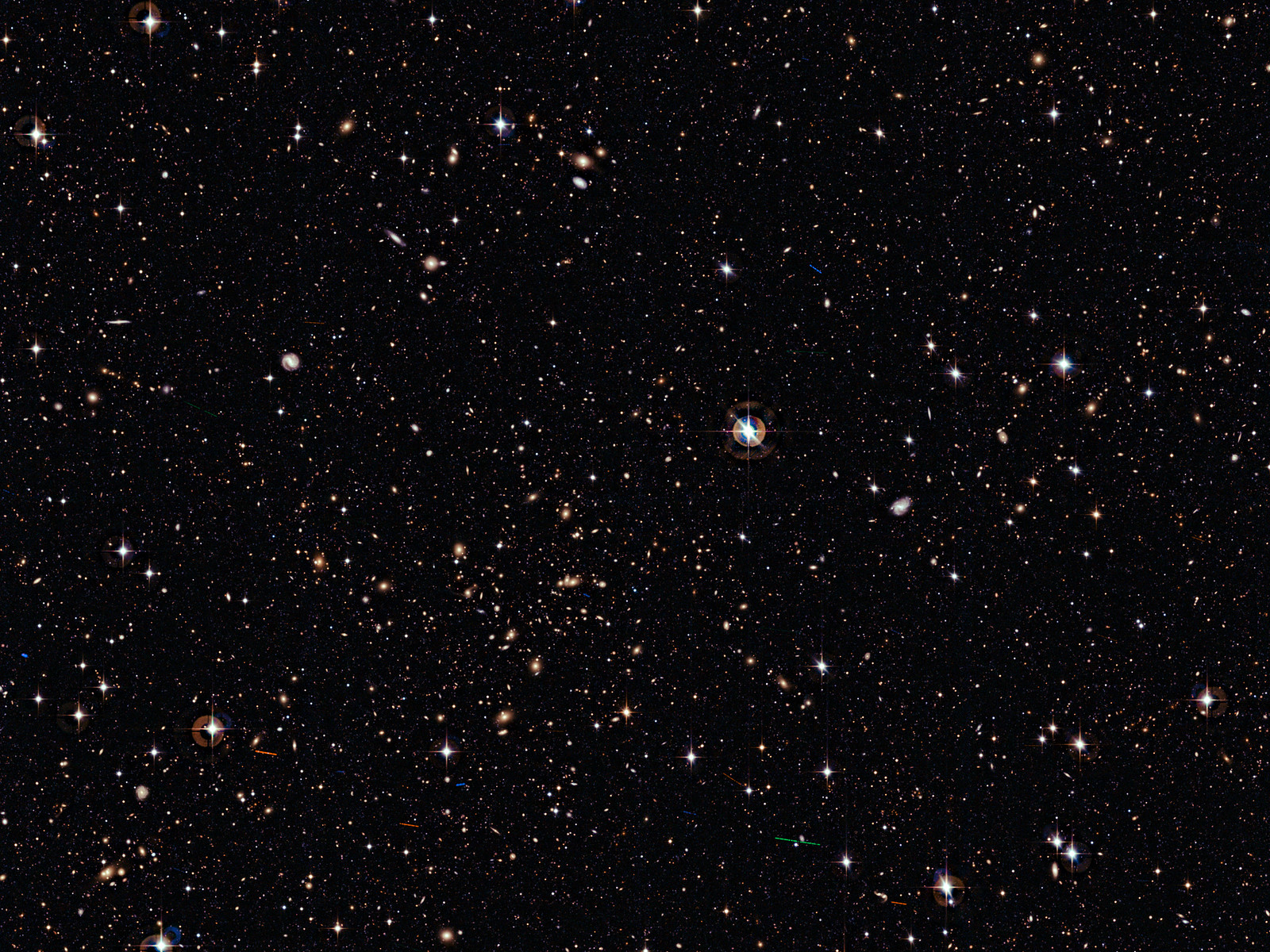
A thousand trillion suns | Bad Astronomy

What does it look like to stare into infinity? Like this:

eso_abell315

Oh yes, you need to click that to see it in its glory. Because there’s a lesson here…

When you look up at night, you might see a thousand stars. With binoculars, you might see tens of thousands. With a decent telescope, that number goes up to a seemingly amazing tens of millions.

This one image shows tens of thousands of trillions of stars. A million stars for every man, woman, and child on Earth, with more to spare. And it’s only one small part of the sky.

The stars are contained in thousands of galaxies, each so far away that their might and power is reduced to a smudge. Some are big enough to reveal some structure, a pretty splash of a spiral or a delicate swirl, but most are so distant they are mere points of light.

The image is dominated by Abell 315, a cluster of galaxies located two billion light years away. It’s a sprawling city of galaxies, hundreds of island universes bound by their mutual gravity. If each has 100 billion stars — a fair guess — then there are trillions of stars visible here in a glance… and that’s dwarfed, crushed, by the other galaxies scattered in this cosmic portrait.

The picture was taken by the European Southern Observatory’s 2.2-meter telescope at the La Silla Observatory in Chile. Incredibly, this picture is the combination of only about 2.5 hours’ worth of exposures! There are a handful of individual stars in the image; they are located in the foreground, in our own galaxy. They might be a few hundred or even a few thousand light years away. Everything else in the picture is millions or billions of light years away.

eso_abell315_asteroids… or, almost everything. See those colored streaks, the red, green, and blue lines? Those are asteroids, rocks a couple of kilometers across. They have different colors because this image is a composite of three separate exposures using a red, green, and blue filter. During each exposure, the asteroids moved a bit compared to the background stars and galaxies due to the combined motion of the rocks and the Earth, leaving streaks. The color of the streak corresponds to the filter used in the exposure.

Assuming these are main belt asteroids, they are perhaps 100 – 200 million kilometers away. Our space probes take months or years to get that far from Earth, yet these are the nearest objects by far in this picture! The most distant galaxy you can find in this image is something like 100,000,000,000,000 times farther away.

Every now and again, as does everyone, I find myself consumed with the drama in my life. Personal interactions, local troubles, global issues. These are all important, sometimes even crucial. But when I can, I try to remember to leverage myself out, to try to gain some perspective.

Gazing into the depths of space, plummeting into the environs of a hundred quadrillion suns… that’s where true perspective can be found.

Credit: ESO/J. Dietrich


Evolution in Action: Roundup Ready Crops Create Roundup-Resistant Superweeds | 80beats

CornIs the Roundup Ready revolution coming to a close? In the early 1990s, agribusiness giant Monsanto introduced its line of genetically modified crops that could tolerate the pesticide Roundup, allowing farmers to spray it far and wide without worrying about damaging their product.

Now, reports are bubbling up about the increased resistance some weeds are showing to Roundup, which could be the source of great worry, as 90 percent of the soybeans and 70 percent of corn currently grown in the United States are the Roundup Ready varieties.

[F]armers sprayed so much Roundup that weeds quickly evolved to survive it. “What we’re talking about here is Darwinian evolution in fast-forward,” Mike Owen, a weed scientist at Iowa State University, said [The New York Times].

And for the environmentally-minded, here’s something else to consider:

That threatens to reverse one of the agricultural advances bolstered by the Roundup revolution: minimum-till farming. By combining Roundup and Roundup Ready crops, farmers did not have to plow under the weeds to control them. That reduced erosion, the runoff of chemicals into waterways and the use of fuel for tractors [The New York Times].

For an in-depth take, and a historical reminder of how weeds have always evolved to thwart our means of killing them, check out DISCOVER blogger Carl Zimmer’s post.

Related Content:
The Loom: How To Make a Superweed
80beats: Biotech Potato Wins European Approval; May Signal a Larger Shift on GM Crops
80beats: India Says No to Genetically Modified Eggplants
80beats: GM Corn and Organ Failure: Lots of Sensationalism, Few Facts
80beats: Bee Killer Still at Large; New Evidence Makes Pesticides a Prime Suspect
DISCOVER: “Frankenfoods” That Could Feed the World

Image: flickr / Peter Blanchard