 The two-banded clownfish (Amphiprion bicinctus), photographed in the Red Sea, near Aqaba, Jordan



 A federal judge overseeing a case in Tennessee has rejected the use of functional MRI brain scans as evidence of a person’s veracity in court proceedings. As DISCOVER noted before, the Tennessee case follows one in Brooklyn where the judge also said no under New York State law. Together, the two rulings mean it could be a long time before lawyers can admit brain scans as evidence of truth-telling in courts.
Lorne Semrau was seeking to include the results of scans as part of his defense in a Medicare and Medicaid fraud case being heard in a federal court in Tennessee. But while Judge Pham agreed that the technique had been subject to testing and peer review, it flunked on the other two points suggested by the Supreme Court to weigh cases like this one: the test of proven accuracy and general acceptance by scientists [ScienceNOW].
Proponents of fMRI lie detection claim that monitoring a suspect’s brain while he answers questions about his behavior and the allegations against him can reveal whether he’s answering honestly or lying. But while the utility of fMRI brain scans is accepted in many areas of brain research, most neuroscientists say their usefulness as lie detectors is still an open question.
Wide acceptance among scientists is also a part of the New York standard with which Judge Robert H. Miller rejected fMRI as evidence in the Brooklyn case. So while fMRI lie detection experiments continue to undergo peer review, the technique likely won’t become admissible evidence anywhere until the scientific community begins to accept that such scans really could identify honesty at a reasonable level of confidence.
Besides the so-called “Daubert” standard for admitting scientific evidence, Judge Pham also included in the Tennessee decision a more damning dismissal of the brain scans that the defense had tried to introduce to bolster its client’s credibility:
Rule 403 of the Federal Rules of Evidence provides for the exclusion of evidence “on Grounds of Prejudice, Confusion, or Waste of Time.” In applying rule 403 to this case, Pham compared Semrau’s situation to the case law surrounding polygraphs that are obtained by defendants unilaterally, saying they presented “similar issues.” In those cases, courts did not look kindly on tests performed solely to bolster the credibility of the witness without both prosecution and defense having been involved [Wired.com].
In addition, Cephos—the company that did the fMRI scans in both cases—did three scans in the Tennessee case and got one scan that disagreed with the other two. That didn’t exactly bolster the credibility of the evidence.
Judge’s Pham ruling isn’t binding on other cases; other judges will have the opportunity to consider fMRI as lawyers continue to try to introduce it. But with this stiff rejection at the federal level providing legal precedent to say “no,” it could be a while before any judge says “yes.”
However, even Pham says that day could come. He writes in his opinion:
“In the future, should fMRI-based lie detection undergo further testing, development, and peer review, improve upon standards controlling the technique’s operation, and gain acceptance by the scientific community for use in the real world, this methodology may be found to be admissible even if the error rate is not able to be quantified in a real world setting.”
Related Content:
80beats: Neuroscience Goes To Court: Can Brain Scans Be Used As Lie Detectors?
80beats: Shiny New Neuroscience Technique (Optogenetics) Verifies a Familiar Method (fMRI)
Discoblog: Mind-Reading Machine Puts Woman in Jail For Murder
Discoblog: I’m Telling the Truth, Your Honor. Just Look at This Brain Scan!
Image: flickr / zoom zoom


This is a guest post from Vanessa Woods, author of the new book, Bonobo Handshake. Vanessa is a Research Scientist in Evolutionary Anthropology at Duke University and studies the cognition of chimpanzees and bonobos in Congo. In my new book Bonobo Handshake, I talk about a bonobo called Mimi who throws herself over the dead body of another bonobo. Lipopo was a seven year old bonobo who was new to the group. Mimi wasn't particularly fond of him, she just kindof ignored him most of the time. When Lipopo died, Mimi stood over the body and wouldn't let the keepers take him. The keepers turned up with long poles to take the body away, a scary sight for any bonobo - they are usually quite shy. But Mimi would not give up the body. She pushed at the poles and she held on to the body. She just kept grooming his face and trying to keep the flies away. It was as though she was mourning his death but still felt she had to protect him. The body was in a tight space, near the tunnel. She must have been afraid but she wouldn’t let him go. Then Crispin the vet turned up with the ...
I rather like this idea: the Climate Denial Crock of the Week, a video series debunking ridiculous (natch) claims by someone spinning the truth when it comes to climate change.
I don’t agree with everything therein; you can’t judge a site by its ads, for one thing. But he does a good dismantling of the claim that Phil Jones — a climatologist at the University of East Anglia, and a man who was at the center of the bogus "climategate" nonsense — says there’s been no warming since 1995. That claim is nothing less than an outright lie, a cherry-picked quotation taken out of context and basically the opposite of what Jones actually said.
This video is just one of many, and I’ll have to go through them all as I have time. Every time I post something on climate change, the noise machine swings into full mania, with comments that show beyond a doubt that a lot of people have no clue what they’re talking about, but still feel that scientists who have devoted their entire lives and careers to climatology are idiots. That is, sadly, the state of the "debate" today.
I'm sure a lot of students are praying right now:
Click here to view the embedded video.
The sun is getting active again so it’s time to be watching for the aurora. Yesterday I was all excited because conditions were right to be able to see an aurora from here. That was until it got dark and the conditions went to the devil. Oh well, at least there is progress.
Oops, almost forgot the source.

In the past, I have criticised science journalists for not providing enough background in their reports. Both news stories and scientific papers obviously focus on new events and achievements, but they do so in the knowledge that new discoveries stand on giant shoulders. For this reason, when I cover new papers for this blog, I try to describe some of the research that led up to it, a tactic that fits with the growing cries for more context in modern journalism.
And yet, it’s perhaps churlish to expect this to be a routine part of science journalism when many scientists themselves don’t take up the practice. I bring this up in the light of a new paper, published today in Nature Neuroscience, about the controversial topic of acupuncture. I was going to do this as a straight write-up but actually the omissions in the paper are probably just as interesting than the science within it.
The gist is this: Nanna Goldman from the University of Rochester Medical Center claims to have found a biological explanation for the pain-relieving effects of acupuncture. She worked with mice that had inflamed paws, and managed to alleviate their pain by using a needle to pierce a traditional acupuncture point near the knee. This painkilling effect only happened when she rotated the needles after insertion.
This effect depended on a chemical called adenosine, which typically surges in concentration after any stress or injury. Adenosine works by docking at a protein called the adenosine A1 receptor, which has well established roles in suppressing pain and is found on neurons that transmit pain signals. Indeed, other chemicals that stimulated this protein had the same pain-relieving effects as acupuncture. Drugs that prevent the body from breaking down adenosine led to even more potent pain relief. And mice that lacked the A1 receptor altogether experienced no pain relief from the needles.
Taken on its own merits, this is a nice piece of biochemistry. But what does it really tell us about acupuncture? Does it actually validate this ancient method as a way of relieving pain? After reading the paper, you might walk away with that idea that we’re one step closer to understanding how a treatment with real medical benefits really works. It’s littered with statements like “A1 receptor activation is both necessary and sufficient for the clinical benefits of acupuncture” and “medications that interfere with A1 receptors or adenosine metabolism may improve the clinical benefit of acupuncture”. In the study’s press release, lead scientist Maiken Nedergaard even says, “The new findings add to the scientific heft underlying acupuncture.”
But these results have to be considered in the light of those that came before it. As mentioned above, new scientific discoveries stand on the shoulders of giants and in the case of acupuncture – one of the most well-researched of all “alternative therapies” – those shoulders are particularly large.
Many trials have demonstrated that acupuncture does have some pain-relieving effects – that is not in doubt. And as Steven Novella notes, unlike things like homeopathy or reiki, with acupuncture “something physical is actually happening… so it is therefore not impossible that a physiological response is happening”. But the big questions are whether this effect is genuine of nothing more than a placebo.
To answer that, clinical trials have used sophisticated methods, including “sham needles”, where the needle’s point retracts back into the shaft like the blade of a movie knife. It never breaks the skin, but patients can’t tell the difference from a real, penetrating needle. Last year, one such trial (which was widely misreported) found that acupuncture does help to relieve chronic back pain and outperformed “usual care”. However, it didn’t matter whether the needles actually pierce the skin, because sham needles were just as effective. Nor did it matter where the needles were placed, contrary to what acupuncturists would have us believe.
Other trials have found similar results. Going beyond individual studies and looking at all of the available evidence doesn’t much change the verdict. Last year, scientists from the Nordic Cochrane review centre did an analysis of the available evidence and after considering the 13 trials that met their stringent quality criteria, they concluded:
“A small analgesic effect of acupuncture was found, which seems to lack clinical relevance and cannot be clearly distinguished from bias… Our findings question both the traditional foundation of acupuncture, which is based on the existence of meridians and Qi sensations, and the prevailing hypothesis that acupuncture has an important effect on pain in general. If this hypothesis is wrong, and our results point to that, then acupuncture would seem to be unlikely to have an effect on pain related only to certain conditions, but further studies may examine this question.”
Goldman doesn’t really address any of these points. The introduction to her paper focuses on acupuncture’s popularity, mentioning endorsements by the WHO, the NIH and, strangely, the US Internal Revenue Service. As to the bigger question about whether it is effective, there is no sign of the recent trials or reviews that I mentioned. Instead, she briefly says that the pain-killing effects of acupuncture are “well-documented” and that “Western medicine has treated acupuncture with considerable skepticism”, citing only an editorial published in 1972.
As I’ve said, this is not an area that’s lacking in earlier research to refer to or consider. The discussion is a bit better in that it at least references one trial which showed that acupuncture has no advantage over placebo sham-needle treatments. And if anything, the results seem entirely consistent with the idea of acupuncture as an elaborate placebo.
The tissue damage inflicted by the rotating needle triggers a local flood of adenosine. If the needle is stuck in the right general area, the extra adenosine reaches the receptors on the pain-transmitting neurons and shuts down their activity. There is no need to invoke ‘qi’ flowing through ‘meridians’. Indeed, all sorts of injuries and stresses will lead to a burst of adenosine. And Goldman even says that sham needles, by stimulating but not breaking the skin, could still trigger a burst of adenosine, leading to the same pain-killing effects.
There has been so much previous work in this area that the question “How does acupuncture work?” is better replaced by “Why are acupuncture’s effects largely indistinguishable from those of sham treatments?” The new study suggests some answers but it seems unfortunate to me that Goldman didn’t include any sham-needle controls in her experiments.
Brian Berman, who has been involved in previous Cochrane reviews of acupuncture, agrees. He described the study a “very interesting” but said that “some sort of a placebo control is needed”. Edzard Ernst, former professor of complementary medicine at the University of Exeter, has written extensively about acupuncture also concurs. He told me, “It’s an interesting study but it proves nothing. We need independent replication, better controls and studies in humans.”
This is the most frustrating part of what could have been a really fascinating study. Without building on the massive amount of work that’s already been done on acupuncture, it is hard to know what to make the new and admittedly interesting results. I also wonder whether your average health journalist will know how this study fits into the bigger picture – whether it vindicates the use of acupuncture or whether it actually fits with a skeptical stance. But I suspect we won’t have to wait long to find out.
PS: The paper notes that the authors have no competing financial interests that might have affected their work. However, it is worth noting that one of the co-authors, Jurgen Schnermann, is married to one Josephine Briggs. Briggs is the director of the National Center for Complementary and Alternative Medicine, an institute that has had its fair share of controversy in the past.
Update: Yeah, the mainstream media aren’t really covering themselves in glory here. See Stuff and Nonsense for a summary. The Times probably has the best piece, in that it actually mentions previous trial data and has some great commentary from Edzard Ernst.
Reference: Nature Neuroscience http://dx.doi.org/10.1038/nn.2562
More on pain:


Eli Kintisch, Point of Inquiry guest (listen) and the author of Hack the Planet, was on "All Things Considered" yesterday. Here's an excerpt from the show transcript:
Another scientist is taking a different approach to geoengineering. Instead of looking to the sky for solutions, he's looking to the ocean. Victor Smetacek, a German oceanographer, is trying to cool the planet by growing carbon-absorbing gardens in parts of the ocean with little life. In 2009, Smetacek and a team of Indian and German scientists added 6 tons of iron into a section of the Southern Ocean, which rings Antarctica, to see if they could get a massive bloom of algae to flourish. Algae growing in the ocean cools the planet by sucking in carbon dioxide. The team did get algae to grow, but it was the wrong kind of algae. The 10-week experiment, called project LOHAFEX, is the world's largest geoengineering project to date, and, like many other geoengineering attempts, was controversial. Greenpeace and other environmental organizations demanded that LOHAFEX be stopped from the start, saying that pouring iron into the ocean amounted to pollution and violated international agreements. Some scientists feared the unintended side effects of the project. "In the case of fertilizing the ...
The amazing pictures of the space station taken by ground-based amateur astronomers keeps on coming. On May 29th, Anthony Ayiomamitis used a 16 cm (6″) telescope to capture a phenomenal image of the International Space Station passing Jupiter… in broad daylight!
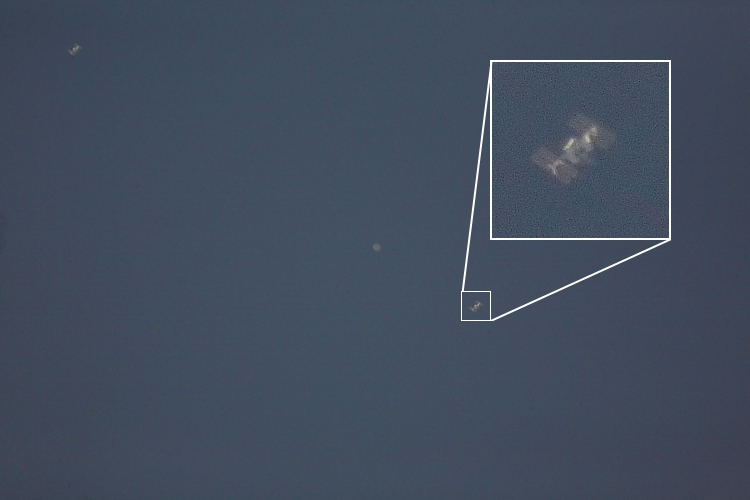
Wow! Note the color of the sky; it was about 9:00 a.m. local time when he took this shot, with the Sun well above the horizon. This is actually two images added together; the first shows the ISS to the lower right, and in the second shot it had moved to the upper left. Jupiter shows its disk near the center of the frame, it being easily bright enough to be seen using a telescope in daylight.
What an incredible picture! But it gets cooler…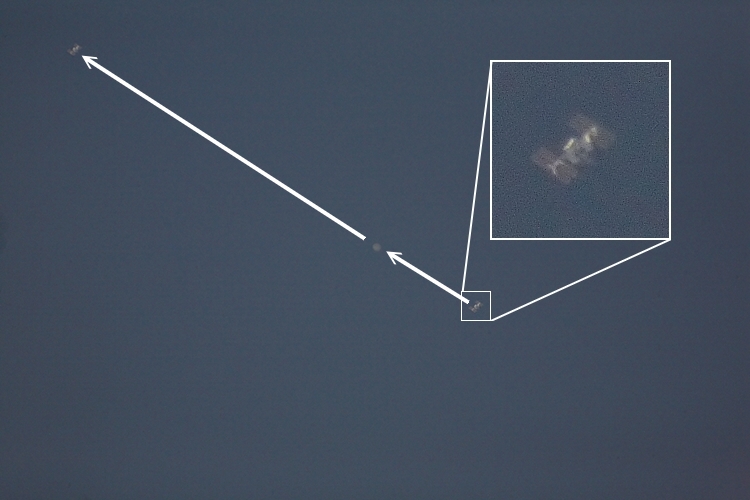 The picture on the right is the same shot, but this time he connected the two ISS images with a line. Given the size of both the ISS and Jupiter, it looks like the station flew directly in front of the planet from Anthony’s position! Had he taken that first shot literally a tenth of a second later, he would have had the picture of a lifetime. As it is, it’s still way cool.
Want more? I got more.
Robert Vanderbei, at Princeton University, took this picture of Jupiter, also in daylight. You can see the moons!

The picture has the moons labeled. Ganymede and Europa are faint, but visible. For an added coolness, Io was poised right on the limb of the planet’s disk. You can see the Red Spot, and also how the southern equatorial belt of Jupiter is missing (it should be at about the same latitude as the Red Spot). To get this Robert used a 9 cm (3.5″) Questar ’scope, which is small but has very nice optics.
And one more, but it’s a link: Universe Today is reporting that an amateur got shots of the Air Force X37-B in orbit!
All this goes to show that the word "amateur", as I’ve been saying for years, is losing its meaning. Like everything in nature, when you get near the boundary between two entities, the lines get blurry. I know lots of so-called amateurs who have a far keener grasp of the sky and the objects in it than some professionals. Astronomy is one of the few sciences where someone with even modest equipment can do phenomenal work in the field. I love it, and it’s a great time to be an astronomer!
Image credits: Anthony Ayiomamitis, Robert Vanderbei, used by permission.

Most of us will be all too familiar with the consequences of night of heavy drinking. But alcohol’s effects on our heads go well beyond a mere hangover. The brain suffers too. A penchant for incoherent slurring aside, alcohol abusers tend to show problems with their spatial skills, short-term memory, impulse control and ability to make decisions or prioritise tasks. Many of these skills are heavily influenced by a part of the brain called the hippocampus. Now, Michael Taffe and researchers from the Scripps Research Institute have shown how binge-drinking during adolescence can cause lasting damage to this vital area.
The hippocampus is one of only two parts of the brain that clearly produces new neurons throughout adult life. While other areas must make do with the set they had at birth, the hippocampus continually churns out a fresh supply. This process may be important for learning and memory but it’s seriously hampered by alcohol. Taffe found that not only does heavy boozing kill off the hippocampus’s neurons, it also weakens its ability to produce reinforcements.
Much like natural history documentaries and martial arts, Taffe’s research was inspired by the antics of drunken monkeys. Taffe gave seven adolescent rhesus macaques a tangy citrus alcoholic drink, which increased in strength from 1% to 6% alcohol over 40 days. Having established their alcohol preferences, he allowed four monkeys to stick with the strong cocktail for an hour a day over the next 11 months. The other three went back to a non-alcoholic version of the tangy beverage. For the study’s final two months, all of the monkeys went tee-total.
The blood alcohol limits of the four binge-drinkers clearly showed that they were knocking back their tipples. If they’d been humans, they would probably have been drunk, and certainly well over the legal limit for driving. And their brains revealed more worrying signs of damage.
Chitra Mandyam, who collaborated on the study, found that regular chugs of the demon drink severely slashed the numbers of neural stem cells in the monkeys’ hippocampi. These are the cells responsible for churning out fresh neurons. With alcohol cutting their numbers and compromising their ability to divide into more mature cell types, the monkeys’ production of hippocampal neurons more than halved in the course of 11 months.
Even after two months of complete abstinence, Taffe found that each monkey’s hippocampus had fewer traces of fresh, immature neurons. Worse still, he found signs that the existing supply had started to degenerate. By comparison, the tee-total trio had a healthy turnover of new hippocampal neurons and no detectable sign of neural death.
Studies with rats and mice have hinted at the same effect, but monkeys provide a far deeper understanding of the alcoholic brain. They’re incredibly similar to us, not just in terms of their mental skills, but also in the way that their hippocampuses produce new neurons, their lengthier window of adolescence, and the fact that they’ll happily drink alcohol to the point of drunkenness.
If the same thing happens in humans, it suggests that alcoholism starts to wreak damage in the brain after a relatively short amount of time. It starts to kill off the hippocampus’s neurons while nixing its ability to make more. This double-whammy could explain many of the mental problems that regular binge-drinkers experience. Most intriguingly of all, the turnover of neurons in the hippocampus affects our learning and memory skill, and Taffe suggests that problems with this process could help to explain alcohol’s addictive side.
Reference: PNAS http://dx.doi.org/10.1073/pnas.0912810107
Photo by Pauk
More on alcohol:


..

The Dance of the Pleiades, Elihu Vedder 02/26/1836 - 01/29/1923
Known since antiquity to cultures the world over, and containing over 1,000 members, the Pleiades star cluster is a prominent winter target in the Northern hemisphere, and summer target in the Southern hemisphere. Dominated by young, hot blue stars, the cluster is about 440 ly away from Earth. Nine of the stars are commonly named; Atlas and Pleione are the parents, the remaining seven the “sisters”.

NASA/JPL/ESA/CalTech PD-USgov - Brought to you by Hubble
By the way, the Reflection Nebula associated with the Pleiades is not part of the cluster, but only a dusty region of space the cluster is currently passing through (dust and hydrogen gas). The Pleiades itself is a physically related cluster; not just a chance alignment of stars. Its estimated age is about 115 million years.

NASA/ESA Reflection Nebula near Merope - As seen through the eyes of Hubble
Although young, blue stars dominate the Pleiades, it also contains a respectable resident population of brown dwarfs. Current estimates of the cluster population place brown dwarfs at 25%. Since they are still young and bright, scientists are able to study them with relative ease. This is also helpful in determining the age of the cluster (remember lithium?).
The Pleiades figure prominently in the mythology of almost every culture known since antiquity. To the Mayans, the universe itself comes from the Pleiades. There are almost as many stories as there are stars in the cluster. No mystery there; a large group of uncommonly beautiful blue stars is bound to attract attention. It’s certainly held our attention… for over four thousand years.
| Many a night I saw the Pleiads, rising thro’ the mellow shade, |
| Glitter like a swarm of fireflies tangled in a silver braid. |
| - Alfred, Lord Tennyson, 1837-8, |
 Hopefully by now the image to the left is familiar to you. It’s from a paper in Human Genetics, Self-reported ethnicity, genetic structure and the impact of population stratification in a multiethnic study. The paper is interesting in and of itself, as it combines a wide set of populations and puts the focus on the extent of disjunction between self-identified ethnic identity, and the population clusters which fall out of patterns of genetic variation. In particular, the authors note that the “Native Hawaiian” identification in Hawaii is characterized by a great deal of admixture, and within their sample only ~50% of the ancestral contribution within this population was Polynesian (the balance split between European and Asian). The figure suggests that subjective self assessment of ancestral quanta is generally accurate, though there are a non-trivial number of outliers. Dienekes points out that the same dynamic holds (less dramatically) for Europeans and Japanese populations within their data set.
All well and good. And I like these sorts of charts because they’re pithy summations of a lot of relationships in a comprehensible geometrical fashion. But they’re not reality, they’re a stylized representation of a slice of reality, abstractions which distill the shape and processes of reality. More precisely the x-axis is an independent dimension of correlations of variation across genes which can account for ~7% of the total population variance. This is the dimension with the largest magnitude. The y-axis is the second largest dimension, accounting for ~4%. The magnitudes decline precipitously as you descend down the rank orders of the principle components. The 5th component accounts for ~0.2% of the variance.
The first two components in these sorts of studies usually conform to our intuitions, and add a degree of precision to various population scale relations. Consider this supplement chart from a 2008 paper (I’ve rotated and reedited for clarity):

The first component separates Africans from non-Africans, the latter being a derived population from a subset of the former. The second component distinguishes West Eurasians from East Eurasians & Amerindians. These two dimensions and the distribution of individuals from the Human Genome Diversity Project reiterates what we know about the evolutionary history of our species.
And yet I wonder if we should be careful about the power of these two-dimensional representation’s in constraining us excessively when we think about genetic variation and dynamics. Naturally there is the sensitivity of the character of dimensions upon the nature of the underlying data set upon which they rely. But consider this thought experiment,
Father = Japanese
Mother = Norwegian
Child = Half Japanese & Half Norwegian
If you projected these three individuals upon the two-dimensional representation above of the worldwide populations the father would cluster with East Asians, the mother with Europeans, and the child with the groups who span the divide, Uyhgurs and Hazaras. So on the plot the child would be far closer to these Central Asian populations than to the groups from which its parents derive. And here’s a limitation of focusing too much on two-dimensional plots derived from population level data: is the child interchangeable with a Uyghur or Hazara genetically in relation to their parents? Of course not! If the child was a female, and the father impregnated her, the consequence (or probability of a negative consequence) would be very different than if he impregnated a Uyghur or Hazara woman.
The reason for this difference is obvious (if not, ask in the comments, many readers of this weblog know the ins & outs at an expert level). Abstractions which summarize and condense reality are essential, but they have their uses and limitations. Unlike physics biology can not rely too long on elegance, beauty, and formal clarity. Rather, it always has to dance back between rough & ready heuristics informed by the empirics and theoretical systems which emerge from axioms. Usually a picture has its own sense. But the key is to be precise in understanding what sense it makes to you.
Via Hemant Mehta comes this story that could not have happened at a more appropriate time.
 One of the most basic principles of the United States, written out in the very first Amendment of the Bill of Rights, is that the government will neither endorse nor deny any specific religion, or interfere with anyone’s ability to worship or not.
This is pretty straightforward. You have the right to your religion, and I have the right to mine. You even have the right to not have a religion. But no matter what, you have the right to not have your religion interfered with.
Eric Workman, a (now-graduated) high school student in Greenwood, Indiana, understood this. That’s why, when his school administration decided to let the seniors vote on whether they wanted to have an official school-sanctioned prayer at graduation, he tried to get it stopped. He wound up having to take the case to the ACLU, and a judge ordered that no school-sanctioned prayer could be held at the ceremony.
There’s a lot to discuss here, but the most important things to remember during any of it are these:
1) Eric is correct, and
2) Eric is Christian.
That’s right, he’s not some baby-eating atheist waiting to escort the souls of the graduating class to Satan’s doorstep. He’s a Christian, but even in that extremely conservative area he understands that the Constitution, and our Founding Fathers, got it right.
Another extremely important thing to remember is that no one was keeping these students from praying. They had the right to pray as much as they wanted to before, during, and after the ceremony. The class president stood up and thanked God in her speech, and she had every right to do so, just as Eric had the right to talk about how important secularism is in school (the complete text of his speech is on reddit).
The only thing being prevented here was state-sponsored support of religion. That’s it. With all this in mind, watch the coverage this got on the local news.
Today is Memorial Day in the United States, where we take time to remember those who have died, and specifically those who have fought and died for the country. In my opinion, they didn’t fight to protect our country, they fought to protect the idea of our country. The principles for which it stands, the ideas and ideals that give people the chance to reach their full potential. That’s what America is supposed to be about, and the framework that provides that chance is the Constitution. It does not limit what the people can do*, it limits how the government can in turn limit them. You are allowed to speak freely. You are allowed to vote.
And you are allowed your religion, or lack thereof. The government cannot stop that, but neither can it actively support it. That way, everyone has the same rights, and it keeps the government from turning into a theocracy. This should be something advocated by not just the non-religious, and, in fact, should be most loudly supported by the most religious. It’s their rights being protected too.
The administration of Greenwood High School lost track of that simple fact, but ironically, their own education system worked. One student did learn it, and schooled the administration.
So it makes me happy — and proud, as an American — to say:

Picture credit: functoruser’s Flickr photostream, used under Creative Commons licensing.
This is a guest post from Vanessa Woods, author of the new book, Bonobo Handshake. Vanessa is a Research Scientist in Evolutionary Anthropology at Duke University and studies the cognition of chimpanzees and bonobos in Congo. In the US, 600 women are sexually assaulted every day. One woman is beaten by her partner every 15 seconds. Despite education campaigns and law enforcement, and penalties, violence continues to threaten women throughout America. What can we do to make women safe? I believe bonobos may have the answer. Once I saw Tatango, an unusually aggressive bonobo male, run up to Mimi, the alpha female, and backhand her across the face. He hit her so hard he almost gave her whiplash. Within seconds, five females in the group ran to Mimi’s rescue. They chased Tatango around the night building until he fled into the forest. When he continued his aggressive outbursts, those five females beat him so badly, they damn near ripped off his testicles. After that, Tatango never caused another problem. One male is stronger than any one female. But no male is stronger than many females. As women, we tend to ...
Kenneth Chang covers the same basic ground as my Slate piece, and comes to the same conclusions. A slick is not going to slow down a storm, but a storm could fling a slick everywhere. Of course, it all depends on the particular path of the storm, etc. Granted, the story becomes more pressing now because of the failure of the "top kill" method of plugging the well. We're on to Plan C now, followed by Plan D, but if they all fail then the relief wells won't be finished (allegedly) til August. That's right when the serious part of hurricane season begins--although, again, if we're in for a mega year like 2005, then you can have an early forming Category 4 (like Dennis) in July. I'm trying to find the bright side in all of this...but I'm really not seeing it. Below, incidentally, is the track of Dennis in 2005. A storm along such a path might actually push oil away from land, given that it would be approaching the nearshore part of slick from the southeast. In this scenario, the winds over the bulk of the slick would (I believe, just by eyeballing it) be blowing back out to sea. That ...
…and it’s about time! Seemed like we were heading into another Maunder Minimum there for a while. Okay, maybe I’m exaggerating a little, but we did go through a long stretch of time when we should have been seeing sunspots and we were not.
So what? It’s not like sunspots do anything, right?

National Science Foundation, Dunn Solar Telescope, NSO, AR 10810
Wrong. There’s actually a lot going on with them.
Sunspots are in fact areas of intense magnetic activity. The increased activity inhibits convection, causing cooler areas to form on the surface. “Cooler” is, of course, relative. A sunspot is about 3,500 K; while the Sun’s average surface temperature is about 5,800 K. Sunspots only appear dark against the brilliant glare of the Sun. If you could hold a sunspot away from the surface you would see that it’s brighter than an electric arc.

NASA/TRACE 09/2000 Sunspot in UV
The frequency of sunspots follows an approximate 11-year cycle. The time period which has the most sunspots is the Solar Maximum, the least is the Solar Minimum. Variations in the cycle appear to coincide with climate variations on Earth. The Maunder Minimum (ca 1645-1715) was during a period of overall cooler temperatures known as The Little Ice Age. How or if sunspot activity and climate are linked is unknown, as is unknown which is the cause and which is the effect.
Records of solar cycles have been kept since March 1755 (cycle 1). We are currently in cycle 24, which began January 4, 2008. Sunspots don’t just pop up at random all over the Sun, but are concentrated in two latitude bands on either side of the equator. The bands form first at mid-latitude, widen, then move toward the equator as the cycle progresses. It’s plotted on a “butterfly diagram”, which shows every sunspot since March 1755. This is what it looks like:

We now know that all conditions on (and in) the Sun effect conditions on Earth; and not just whether or not your cell phone (or you) is going to get fried. From this site you can link to SOHO (far right) and get a picture of the Sun today, and you can go to SpaceWeather.com, or NASA anytime.
Isn’t it nice to be seeing spots again?

Kitt Peak Observatory, spiral sunspot

The Voyagers nearing the edge of the heliospheric bubble carved out by the solar wind. Art Credit: JPL / NASA
Voyager 2 was launched on August 20, 1977 and has since traveled 8,600 million miles from mother Earth.
The four-year mission to Saturn has lasted 33 years and Voyager 2 enjoys the distinction of being one of two man-made objects at the very edge of the solar system. Voyager 1 is a little further out than Voyager 2, if 1 or 2 billion miles can be called “a little further”.
Both Voyagers, built and operated by JPL, have been returning data. On April 22 changes in the return of data packets was noticed. At the time there was a moratorium on sending commands and a planned roll-maneuver and engineers were not able to send commands to the spacecraft until April 30th. Radio protocols are understandable, imagine, it takes 13 hours for a radio command to reach the spacecraft and another 13 hours to get return data. The returning signal must be astonishingly weak, being a ham radio operator, it boggles my mind.
At the moment we know by the preliminary engineering data from May 1, the spacecraft is basically healthy and the problem is in the flight data system which formats the data sent back. The change in the pattern of the returning data is being evaluated.

The May 24th, view of the BP oil leak from MODIS. Click for a larger version. Credit: Jeff Schmaltz, MODIS Land Rapid Response Team, NASA GSFC
This from the MODIS satellite today (taken on May 24th).
Scary stuff. I hate the way we go about these things, probably it would be a good idea to stop pointing fingers and covering butts and start doing some clean up. IMHO, it’s a little late but I think we need to get representation from all the potentially affected people/groups together and get a unified game plan worked out. It sounds to me like the right hand doesn’t know what the left hand is doing and we are winding up with a (insert your own adjective here) response to this mess.
From the MODUS page with this image, and by the way pay the MODIS site a visit for more versions of the image above:
Sunlight illuminated the lingering oil slick off the Mississippi Delta on May 24, 2010. The MODIS on NASA’s Terra satellite captured this image the same day.
Oil smoothes the ocean surface, making the Sun’s reflection brighter in some places, and reducing the scattering of sunlight in other places. As a result, the oil slick is brighter than the surrounding water in some places (image center) and darker than the surrounding water in others (image lower right). The tip of the Mississippi Delta is surrounded by muddy water that appears light tan. Bright white ribbons of oil streak across this sediment-laden water.
Tendrils of oil extend to the north and east of the main body of the slick. A small, dark plume along the edge of the slick, not far from the original location of the Deepwater Horizon rig, indicates a possible controlled burn of oil on the ocean surface.
To the west of the bird’s-foot part of the delta, dark patches in the water may also be oil, but detecting a manmade oil slick in coastal areas can be even more complicated than detecting it in the open ocean.
When oil slicks are visible in satellite images, it is because they have changed how the water reflects light, either by making the Sun’s reflection brighter or by dampening the scattering of sunlight, which makes the oily area darker. In coastal areas, however, similar changes in reflectivity can occur from differences in salinity (fresh versus salt water) and from naturally produced oils from plants.

Image of STS-132 Control Room 1. Click for larger. Image: Ken Buxton
I have a treat you today! One of our readers, Ken Buxton, was one of the lucky winners of NASA’s Tweetup! When I found out, I asked Ken if he could do a short write-up on the trip and his experience. I am pleased to say he agreed and what a great job he did too. I thank you for your wonderful effort Ken!
Before you start to read about Ken’s trip, I want to point you to the pictures he took on the trip and of course to his website: The Computerbugg.
Without further delay, here is Ken’s trip:
NASA Tweetup May 19, 2010 Johnson Space Flight Center, Houston TX
A couple weeks ago I received an email stating I had been selected to attend a tweetup at the Johnson Space Center in Houston. A tweetup is a special event sponsored by NASA for twitter followers. I read it over and over, was this for real? I remembered I had signed up for a tweetup that was posted by NASA on twitter. You know, all those things you sign up for and never win. As requested, I replied to the email and waited for confirmation. Sure thing, I got a response saying I was accepted for a behind the scenes tour of JCS during the flight of the Space Shuttle Atlantis on May 19th. I quickly made airplane, hotel and rental car reservation, and waited for the big day. I flew to Houston on the 17th, found my hotel, settled in and got ready for my tweetup.
The tweetup started with an informal meeting at a local restaurant the evening of the 18th. I got to meet others on the tweetup as well as several of the NASA ambassadors who would be with us on our adventure and help us along and answer questions. There’s nothing like a bunch of space geeks getting together.
Our morning of the tweetup started at 8:00 am by checking in at the Space Center Houston. Space Center Houston is adjacent to Johnson Space Flight Center and is an information and museum of manned space flight and is open to the public. After checking in and having some more coffee, I wandered about the museum. There were replicas of the Lunar Lander of Apollo, mock up of parts of the ISS and of the Space Shuttle. I looked around and was surprised by the size of these machines, they were huge. There was a Welcome Home sign for the crew of STS-132, which everyone was invited to sign. Also available to look at was a glove warn by space walkers and a helmet.
At 9:00 we all met in an auditorium for the formal part of the day. We were officially welcomed and introduced to NASA people who would help us through the day. NASA scientist Talat Hussain made a presentation on the new Ku band antenna that had just been installed on the ISS. This antenna will allow much more data to be transferred to and from the ISS, including better live television. Next, the main speaker of the morning was Astronaut Jeff Williams. Jeff had just returned from several months aboard the ISS. I especially enjoyed his descriptions of how it felt to be launched into space and then return. There is quite a difference between how it feels in the Shuttle and how it feels in the Russian Soyuz. Landing in the Shuttle is a breeze, while the Soyuz is a parachute landing with rockets that blast a moment before impact with the earth to give a “soft” landing. He said there is nothing “soft” about the landing. After his talk, I made sure I got my picture taken with him.
After lunch, we were off for a tour of the JCS. First stop was Mission Control Center. We sat in a gallery behind the STS Mission Control Center. We were not allowed on the main floor because they were working, with a live shuttle in space. Next we wound our way through a maze of corridors to the original Mission Control Center used for all the manned space flights of the 60’s and 70’s. It has been designated a National Historical Site. We were allowed on the main floor to look at the equipment that was used to monitor and control our mission to the moon. Each console had a little 8” TV screen and a rotary dial phone. On the wall was replica of the plaque left on the moon by Apollo 11. Along to walls were emblems of all the flights that were controlled by this center. A real walk through history as I have been following the space program from the 50’s and I remember sitting in English class in High School while they broadcast through the PA system, a radio broadcast of Alan Shepard’s first manned launch into space.
From Mission Control we went to Building 9. Building 9 is a huge structure, and inside are mock-ups of all the components of the ISS and Space Shuttle. These mock-ups are used to train new astronauts and are also used to simulate any problems that occur in space to help find a solution. Again, I was astounded by the immense size of everything. Here we met with astronaut Stephen Robinson. Dr Robinson has been with the shuttle program since 1975 and has served as CAPCOM for 13 shuttle missions. He has flown on 4 shuttle missions, logging 1156 hours in space and performed 20 hours EVA. He helped install piece of hardware to the Hubble space telescope and in 2005 performed the first repair of the shuttle heat shield. He was asked what the stars look like from space, and he replied he was surprised on how the stars shine with different colors.
Still in Building 9, we met Astronaut Clayton Anderson. In 2007 Mr Anderson spent 5 months aboard the ISS. He described day to day life aboard the ISS. He remembered getting to sleep and then waking up in the middle of the night and having to go to the bathroom, which was at the other end of the Space Station, then making that long fly from one end to the other and back again. He finally decided it was easier for him to just wear a diaper to bed, and use that. Someone asked about the food, and he said it wasn’t too bad, considering where they were. He would not like to eat it here on earth, but is space it tasted pretty good. He also said he preferred the Russian for over American food.
We looked at a mockup of the Russian Soyuz capsule. It is probably the smallest container for 3 men that is possible. While the “seats” in the shuttle resemble lawn chairs, the Russian seats are all custom molded to the person who will be using it. When someone will be using the Soyuz capsule, they must travel to Russia several months before and be “fitted” with a seat. You are immersed in a large vat of plaster of Paris and a mold is made of your body. And a space suit is also made for you. When sitting in the Soyuz capsule, you are lying on your back with your knees up against your chest. Fortunately a ride from the ISS to the ground takes only about 22 minutes.
When we were finished with Building 9, we loaded into busses and drove a few miles south of JCS to the Sonny Carter Training Facility. Sonny Carter was a popular astronaut who was killed in commercial airliner crash in 1991. The Sonny Carter Training Facility contains the Neutral Buoyancy Laboratory. The NBL is a large pool of water, 202 ft by 102 ft and 40 feet deep, containing 6.2 million gallons of water. The NBL is used to simulate the weightlessness of space. Astronaut space walkers train here so they will be able to function in space. They wear specially designed suits that are similar to space suits but are pumped up with air to give them a neutral buoyancy. In the pool are sections of the ISS and mock ups of the Shuttle.
Back on the buses, we headed back to JCS and, for me, the highlight of the day. We arrived at an area called Rocket Park. Rocket Park consists of a small area with a Redstone rocket and Mercury capsule, just like Alan Shepard’s vehicle. Next to that is an F-1 rocket engine, 5 of these engines powered the first stage of the Saturn V moon rocket, and next to them is the payload section of the Saturn V rocket. Then there is a large building, over 100 yards long that contains a complete Saturn V rocket. It is laying on its side with the sections separated, so you can see the rockets in each section. Once again, I was astounded by the enormity of this vehicle. In 1965, when I worked at NASA in Huntsville, AL, they did a static firing of the first stage of the Saturn V. I was about 10 miles away, but could still see the enormous smoke plume and the ground vibrated like I had never felt before. This is truly an awesome machine.
With the formal part of the tweetup ended, we adjourned to a local tavern to discuss and share our experiences of the day. It was wonderful to be with a group of people who are excited about space travel as I am.
 Fig 1: One of the authors (DM)
swallowing seven swords.
It’s BMJ week (again) on NCBI ROFL! After the success of our first BMJ week, we decided to devote another week to fun articles from holiday issues of the British Medical Journal. Enjoy!
“OBJECTIVE: To evaluate information on the practice and associated ill effects of sword swallowing. DESIGN: Letters sent to sword swallowers requesting information on technique and complications. SETTING: Membership lists of the Sword Swallowers’ Association International. PARTICIPANTS: 110 sword swallowers from 16 countries. RESULTS: We had information from 46 sword swallowers. Major complications are more likely when the swallower is distracted or swallows multiple or unusual swords or when previous injury is present. Perforations mainly involve the oesophagus and usually have a good prognosis. Sore throats are common, particularly while the skill is being learnt or when performances are too frequent. Major gastrointestinal bleeding sometimes occurs, and occasional chest pains tend to be treated without medical advice. Sword swallowers without healthcare coverage expose themselves to financial as well as physical risk. CONCLUSIONS: Sword swallowers run a higher risk of injury when they are distracted or adding embellishments to their performance, but injured performers have a better prognosis than patients who suffer iatrogenic perforation.”

Bonus quote from the full length article:
“Some respondents swallowed a sword easily, but mastery for most required daily practice over months or years. The gag reflex is desensitised, sometimes by repeatedly putting fingers down the throat, but other objects are used including spoons, paint brushes, knitting needles, and plastic tubes before the swallower commonly progresses to a bent wire coat hanger. The performer must then learn to align a sword with the upper oesophageal sphincter with the neck hyper-extended. The next step requires relaxation of the pharynx and oesophagus and particularly the horizontal fibres of cricopharyngeus, which are not usually under voluntary control. Devgan et al have shown that one swallower was able to reduce voluntarily the resting pressure of this sphincter by 10-20 mm Hg. This swallower described having to “relax the muscles of his neck,” and several swallowers mentioned not being able to perform when they could not “relax” or the throat “closing up” when sore. Huizinga described a swallower who “sucked in” the sword, and a lateral radiograph in Huizinga’s paper shows the pharynx filled with air, but preliminary air swallowing is not invariable. Force must not be used and the clean sword is usually lubricated at least with saliva. One performer used butter, and one had to retire because of a dry mouth caused by medication.
Once the swallower has got the sword past the cricopharyngeal sphincter and relaxed the oesophagus, he or she must learn to control retching so the sword can be passed down to the cardia. The cardia lies about 40 cm from the teeth and the sword straightens the flexible and distensible oesophagus. Further progress depends not only on the swallower learning to relax the lower oesophageal sphincter and controlling retching but also on the shape of the stomach. The angle of the gastro-oesophageal junction and lesser curve vary, being obtuse in the vertically oriented stomach, particularly when it is full, and more acute in the high horizontal stomach often present in thickset individuals (fig 2). A 220 cm giant is said to hold the record for the longest swallowed sword (82.5 cm) and body build should have a bearing on what length of sword can pass. Nevertheless, we did not find any correlation between the longest sword an individual could swallow and their size, suggesting other factors are important.”
Image: BMJ
Related content:
Discoblog: NCBI ROFL: Injuries due to falling coconuts.
Discoblog: NCBI ROFL: Impact of Yankee Stadium Bat Day on blunt trauma in northern New York City.
Discoblog: NCBI ROFL: Competitive speed eating: truth and consequences.
WTF is NCBI ROFL? Read our FAQ!


