Seals do it with whiskers, sharks do it with noses – tracking fish with supersenses | Not Exactly Rocket Science

Harbour_seal

Predators that swim after fish all have to accurately track the movements of fast-moving prey, often in murky waters. Different groups accomplish this feat with different abilities – sharks use their keen sense of smell, while seals depend on touch, thanks to their long, sensitive whiskers. Now, two new studies reveal just how good these supersenses are.

Fish might not leave any tracks when they swim, but they do leave behind turbulent wakes – even a 10cm long goldfish leaves behind a distinctive flow of water behind itself. While invisible to us, these trails are just as informative to any animal with the right tools to read them. And seals certainly have those – their faces are studded with long, sensitive whiskers that act as motion sensors.

At the University of Rostock, Guido Deinhardt has been studying the whiskers of seals for over a decade. In 1998, he was the first to show that seals use their whiskers to detect minute water movements. He later put paid to the idea that this was a short-range ability by showing that harbour seals could use their whiskers to track a mini-submarine for around 40 metres. Now, he’s at it again, blindfolding Henry the harbour seal at Cologne Zoo to test his skill at tracking a more fish-sized quarry.

To ensure calm water, graduate student Sven Wieskotten set up a closed box at the bottom of Henry’s pool with a small hole in the side. They trained Henry to stick his head through after they swept a rubber fin through the water. Henry’s task was to indicate which direction it was moving in, and to mask his other senses, his eyes were covered by a blindfold and his ears were covered by headphones playing white noise.

Regardless, he could still track the fin very well. After a 5 second delay, his accuracy was hovering around the 95% mark. And even after 35 seconds, he still tracked the fin with an accuracy of 70%, significantly better than chance. Only after 40 seconds did Henry lose the trail. That’s a remarkable achievement – in that time, a herring or a cod could cover around 30-40 metres, so tracking it would be invaluable to the seal.

By adding small particles to the water and filming their movements, Wieskotten showed that the moment Henry’s whiskers touched the fin’s wake, it took him just half a second to jerk his head in the right direction. Of course, it’s still unclear how exactly seals “read” the turbulence they encounter. Wieskotten suspects that they can sense the complex structure of the wake, from the central jet of water to the swirling vortices that surround it. He also reckons that seals should be able to distinguish between the trails produced by different fishes, so they can home in on their favourites. That’s a study for another time.

Smooth_dogfish

Meanwhile, Jayne Gardiner and Jelle Atema have focused their attention on the tracking skills of sharks. Sharks can famously detect the electric fields of living things, but they also hunt with a keen sense of smell. And it turns out that they can tell where an odour is coming from by working out which nostril picks it up first, even if the smell arrives at the other nostril just a tenth of a second later.

Many people believe that sharks are attuned to differences in the concentration of molecules hitting each nostril. But that would only work if underwater smells spread outwards in an even way. In real life, they are carried outwards in turbulent plumes with chaotic patches and swirls. Steering by concentration just wouldn’t work and attempts to do so with a robot only worked under very limited circumstances. Instead, Gardiner and Atema showed that the shark’s skill is all in the timing.

The duo fitted a smooth dogfish with headgear designed to deliver the enticing aroma of squid to its nostrils are different times and different concentrations. For delays of anywhere from 0.1 to 0.5 seconds, the shark turned its head towards the side that the smells first arrived from. If the delay was a second long, it might as well have been guessing. And as predicted, concentration didn’t matter. If both nostrils caught a whiff of squid at the same time, the shark turned to either side just as often even if one nostril received 100 times more odour.

Gardiner and Atema also noted that when following a smell, dogfish swim at a slow and steady pace of 1 metre per second, less than a third of their top speed. They reckon this is the optimal cruising speed for tracking an odour plume. Swim too fast, and it risks shooting out of the plume before its brain can steer it back. Swim too slowly, and the plume could diffuse before it can be tracked.

The ability to track such wafts of smell improves as the distance between the nostrils increases, and Gardiner and Atema suggest that this advantage may have driven the evolution of the distinctive heads of hammerhead sharks.

Their wide heads give them excellent binocular vision, but their widely spaced nostrils also allow them to sample a greater area of ocean in search of delectable smells. They could resolve subtler differences between the arrival of smells at either nostril, and they could perhaps swim faster while tracking such smells. For now, that’s just a hypothesis, but the duo are keen to test it by repeating their dogfish experiment on a variety of hammerheads with differently sized hammers.

References: Seal paper in J Experimental Biology http://dx.doi.org/10.1242/jeb.041699; and shark paper in Current Biology http://dx.doi.org/10.1016/j.cub.2010.04.053

Images: seal by Andreas Trepte; shark by NOAA

More on seals and sharks:

Twitter.jpg Facebook.jpg Feed.jpg Book.jpg

NCBI ROFL: The novel use of wooden spoons for control of massive intra-abdominal hemorrhage. | Discoblog

Photo on 2010-06-10 at 14.24“Massive intra-abdominal hemorrhage represents a challenging operative emergency. Temporary control of the aorta and inferior vena cava (IVC) using intra-luminal balloon occlusion, preemptive trans-thoracic clamping or infra-diaphragmatic clamping has been achieved with variable success. We report the use of wooden spoons with convex arches cut from their bases as a cheap and effective alternative. They can be used to compress the aorta or IVC against the vertebrae, giving vascular control while leaving good surgical access. This equipment requires minimal financial investment and only basic woodworking skills.”

spoons

Thanks to Neil for today’s ROFL!

Related content:
Discoblog: NCBI ROFL: The case of the disappearing teaspoons.
Discoblog: NCBI ROFL: Self-surgery: not for the faint of heart.
Discoblog: NCBI ROFL: Impact of Yankee Stadium Bat Day on blunt trauma in northern New York City.

WTF is NCBI ROFL? Read our FAQ!


What Happens When a BP Exec Spills His Coffee–and More Cathartic Comedy | Discoblog

BPNeed a little relief from oil-soaked pelicans and dead dolphins, angry Louisiana officials and ambiguous BP representatives, top kills and containment domes?

The following hope to entertain, amuse, and mitigate (temporarily) depression and despair.

A New Logo

Greenpeace has started a contest to create a more fitting BP logo, such as the one on the left, featured on flickr. The flickr page boasts almost 1,000 fury-fueled entries so far.

A PR Twitter Feed

Fictional updates all day long about BP’s goings-on.

“Wait, Oil PLUMES? We thought you asked about oil PLUMS in the ocean. How silly! Yes, yes, there are TONS of oil plumes!”

A Coffee Spill?

Upright Citizens Brigade Theatre has given viewers a look at what might happen after a BP executive spills his coffee.

“Everybody calm down. I’ve got Kevin Costner on the phone. He’ll know what to do for sure.”

Recent posts on the Gulf oil spill:
80beats: Meet the Oil-Covered Pelicans, Symbols of the BP Oil Spill
80beats: This Hurricane Season Looks Rough, And What If One Hits the Oil Spill?
80beats: We Did the Math: BP Oil Spill Is Now Worse Than the Exxon Valdez
80beats: “Top Kill” Operation Is Under Way in Attempt to Stop Gulf Oil Leak
80beats: Scientists Say Gulf Spill Is Way Worse Than Estimated. How’d We Get It So Wrong?

Image: flickr / Amy Phetamine


Tech Prize Goes to Inventor Who Wants to Turn Skyscrapers Into Generators | 80beats

leafMichael Gratzel has come clean and revealed that he stole his award-winning design for a new kind of solar cell–stole it from a leaf, that is. The Swiss inventor and first prize-winner of the $960,000 Millennium Technology Prize believes he has a cheap way to power everything from cell phones to street lamps, copying plants’ power to harness sunlight and turn it into energy.

“I was always intrigued with natural photosynthesis,” Gratzel says in a Millennium Technology Prize video (see below), “the way the plant uses molecules to generate charges.”

His solar cells aren’t as efficient as the current silicon photovoltaic panels, but they do use cheaper manufacturing materials.

“Gratzel’s innovation is likely to have an important role in low-cost, large-scale solutions for renewable energy,” Ainomaija Haarla, president of Finland’s Technology Academy, says in a prepared news release on the group’s website. [CNN]

Gratzel can also make his solar cells transparent or flexible. This means that designers might integrate them into existing structures, for example windows or even furniture.

“You can imagine using those cells as electricity producing windows…. What’s very exciting is that you collect light from all sides, so can capture electricity from the inside as well as the outside…. You could think that the glass of all high-rises in New York would be electricity generating panels,” he said. [BBC]

In 1991, Gratzel published a paper in Nature on how the cells, which use a mixture including a (not necessarily green) dye, absorb light and create an electric current.

Only 10 micrometers thick, the [dye] mixture is sandwiched between two glass plates or embedded in plastic. Light striking the dye frees electrons … [and] semiconducting titanium dioxide particles collect the electrons and transfer them to an external circuit, producing an electric current. [eWeek]

Gratzel believes the cheap cell will prove essential in India and Africa, where he foresees its use for communications and medical purposes.

Related content:
80beats: The Dream: Print-Out Solar Panels That Can Be Stapled to Your Roof
80beats: Glitter-Sized Solar Cells Could Be Woven into Your Power Tie
80beats: Self-Assembling Solar Panels Use the Vinaigrette Principle
DISCOVER: Sun Catcher Promises Cheaper Solar Power

Image: flickr / seeks2dream


Should We Just Euthanize the Gulf’s Oil-Soaked Birds? | 80beats

pelicansPeople have now recovered nearly 500 oiled-but-alive birds from the Gulf region. Many of these are the brown pelicans, which—adding insult to tragedy—is Louisiana’s state bird. They have become grimy symbols of BP’s catastrophe, and responders are racing to save the birds and clean them.

But increasingly, the disheartening but necessary question has arisen: Should we euthanize them instead of trying to save them?

YES

Ron Kendall, director of the Institute of Environmental and Human Health at Texas Tech University, told the AP that it might be hard to stomach the thought, but trying to save the brown pelicans and other oily birds could be futile. To help the birds, responders must capture them, hold them in captivity, go through the exhaustive process of cleaning them, and set them free somewhere where they won’t fly back to the oil. In the case of BP’s leak, oil has spread so far that rescuers are currently taking Louisiana birds all the way to Tampa Bay, Florida.

Kendall, for one, is skeptical that our efforts do much good, and the data aren’t encouraging.

The arm of the federal government that nominally oversees offshore rigs agrees with Kendall, and has for some time. “Studies are indicating that rescue and cleaning of oiled birds makes no effective contribution to conservation, except conceivably for species with a small world population,” the U.S. Minerals Management Service said in a 2002 environmental analysis of proposed Gulf oil drilling projects. “A growing number of studies indicate that current rehabilitation techniques are not effective in returning healthy birds to the wild” [AP].

UC-Davis Ornithologist Daniel Anderson points out that we can’t really address damage oil has done to internal organs, either, which is part of the reason the numbers show no significant survival rates for the hard-to-save animals over the long term. He says:

“It might make us feel better to clean them up and send them back out. But there’s a real question of how much it actually does for the birds, aside from prolong their suffering” [Newsweek].

NO

But, Anderson counters, maybe we just owe it to them.

“If nothing else, we’re morally obligated to save birds that seem to be savable,” Anderson said [AP].

And methods seem to be improving, at least slightly, as responders sadly get more practice.

In the past, birds were cleaned right away, and volunteers often worked through the night bathing rescued birds. But, as research has since shown, the stress of capture and cleaning can be profoundly deleterious to a bird’s health—knocking hormones out of balance and exacerbating organ damage. So now, captured birds are left to rest for a day or two before being cleaned, and only washed during the day, so as not to disrupt their circadian rhythms [Newsweek].

Part of the argument for euthanizing could be that time would be better spent on saving habitats or endangered species as opposed to cleaning doomed birds. But, as Anderson points out, citizens demand it and will try to do it themselves if organized responders don’t. If you care about birds, or devoted your life to them, how could you not?

“What do you want us to do? Let them die?” said Jay Holcomb, executive director of the International Bird Rescue Research Center, who has aided oiled animals for 40 years [AP].

Recent posts on the Gulf oil spill:
80beats: Meet the Oil-Covered Pelicans, Symbols of the BP Oil Spill
80beats: This Hurricane Season Looks Rough, And What If One Hits the Oil Spill?
80beats: We Did the Math: BP Oil Spill Is Now Worse Than the Exxon Valdez
80beats: “Top Kill” Operation Is Under Way in Attempt to Stop Gulf Oil Leak
80beats: Scientists Say Gulf Spill Is Way Worse Than Estimated. How’d We Get It So Wrong?

Image: flickr / IBRRC


Happy chair is happy | Bad Astronomy

happychairBABloggee John Kennedy (no relation, of course, to Jamie) sent me word about a fun pareidolia site: Happy Chair is Happy. It features inanimate objects that look like faces. It’s really a fun series to poke through, and it’s brought to you by the I Can Haz Cheezeburgers folks.

I’ll note with some amusement that in a recent entry they included a picture I featured here in March of an alien prickly pear cactus. They didn’t have the source, so I left a comment with a link. I do love that picture!


Comet McNaught

Comet McNaught on May 15, 2010 Credit: Michael Jager via aerith.net

There is a viewable comet out there as I mentioned yesterday.  It is named C/2009 R1 (McNaught) or as I called it here plain Comet McNaught.  For the sticklers out there I know there is more than one with the same “name” but for here and now I am referring to C/2009 R1.

I did mention Seiichi Yoshida had this at a mag. 5.5 and you might wonder why you would need a pair of binoculars (at least) and dark skies.  I have found the magnitude of a comet is about 2 magnitudes higher than an equivalent star.  So if they talk about a 5.5 magnitude comet, that would equate to a 7.5 star.  Could be it owes to the diffuse nature of a comet and this is just my observation.

So this is nice looking green colored comet (not sure why), located off the end of Pegasus.  The comet rises in the northeastern sky at about 01:00 AM your local time and I hate to tell you this but I think the best time to see it is going to be about 03:30 AM.  What really rots for me is I might not get a great look at it due to the mountains and a nearby Maple tree.   The comet isn’t all that far from the Sun so by the time it gets high enough for me daylight might be breaking.  So you know it’s not going to be real high in the sky anyways.

My saving grace is going to be putting my little scope in the car and go to a spot west of here to get a better look in that direction.   I also have to beat the clouds.

This comet is going to be around for a little bit and it could be a naked eye object pretty soon, I will let you know

Here is a finders chart for 0330 AM.  This should be valid for your local time zone.  You can see the Great Square of Pegasus on the right, and the comet to the left of it.  Find M34 and you will have find the comet.

Hunting Sharks Are the Mathematicians of the Seas | Discoblog

sharkSure, when blood hits the water, sharks know exactly where to go. But how do they hunt for less-obvious meals? New research says they use math.

How exactly the sharks move seems to vary with how much food is around.

Imagine yourself in a Walgreens, picking up a few necessities on your way home from work. You might make short movements, darting between aisles, crossing and recrossing your path as you debate between generic and name-brand. Apparently, sharks do the same thing when they have a lot of food in one area. Scientists even suggest their pattern is Brownian, no more intelligent than the aimless sway of microscopic particles buffeted by water molecules.

But in the vast expanses of a Walmart on a Saturday afternoon, your hunt might look a little different. After picking up a few items in one section of the store, you make a long traverse to another section, rolling your blue cart ahead of you. In food-sparse environments, the researchers argue that sharks also seem to make these long journeys. Here, the sharks appear to use Lévy flight search patterns, long suspected by mathematicians as the most effective way to hunt, but never before successfully traced to an animal’s actual search patterns.

The research team, including David W. Sims of the Marine Biological Association of the United Kingdom, used radio tags to study the hunting patterns of fourteen species of open-ocean predatory fish, including sharks, tuna, billfish, and ocean sunfish.

Though other studies have been quick to call animals’ motions Lévy-like, such as an investigation of albatross travels in 1996, previous scientists didn’t have enough data to fit the motion with the mathematical pattern. Sims’ team gathered more than 12 million data points over 5,700 days. He told Science News that this research is “the strongest evidence yet that these Lévy patterns are exhibited by wild animals.”

Related content:
Discoblog: Sea Section: Shark Bites Shark & 4 Babies Pop Out
Discoblog: New Shark Has “Retractable Sex Appendage” on Its Forehead
80beats: Rare Discovery About Mysterious, Giant-Mouthed Shark: Where It Winters
80beats: Female Shark Gets Pregnant on Her Own, No Male Required
80beats: Ancient “Big Tooth” Shark Had the Mightiest Bite in History

Image: Wikimedia / Levy Flight / flickr / Jeff Kubina


Prehistoric sea dragons kept themselves warm | Not Exactly Rocket Science

Ichthyosau

When dinosaurs ruled the land, other groups of prehistoric reptiles dominated the waters. Their bones have also fossilised and they reveal much about how these ‘sea dragons’ lived. They tell us about the shape of their bodies, the things they ate and even how they determined their sex. And according to Aurélien Bernard from the University of Lyon, they can tell us whether these reptiles could control their body temperature.

The majority of reptiles are ‘cold-blooded’. Unlike mammals and birds, they can’t generate and retain their own heat, and their body temperature depends on their surroundings. But Bernard thinks that at three groups of marine reptiles – the dolphin-shaped ichthyosaurs, the crocodile-shaped mosasaurs, and the the paddle-flippered plesiosaurs – bucked this trend. Whether in tropical or cold waters, they could maintain a constant body temperature that reached as high as 35-39 degrees Celsius.

Bernard estimated the body temperature of these ocean-going predators by studying their teeth. He took samples from 40 plesiosaurs, ichthyosaurs and mosasaurs as well as several prehistoric fish. The specimens came from five continents, and a range of periods from the Triassic to the Cretaceous. In every tooth, he measured the amount of different oxygen isotopes, a value that depends on the animal’s body temperature and the composition of the water it swallows.

The data from the fish helped to calibrate the reptile data. By and large, fish body temperatures reflect the temperatures of the surrounding seawater. If the reptiles’ teeth had the same composition of oxygen isotopes as those of the fish, their bodies were also similarly as warm as their surroundings and they were probably cold-blooded. Any differences reflect a different means of regulating body heat.

Plesiosaur_Mosasaur

Using a mathematical model, Bernard calculated that both ichthyosaurs and plesiosaurs managed to keep a constant balmy body temperature from around 24-35°C, even when swimming through waters as cold as 12°C. The abilities of mosasaurs were less clear, but it seems that they had at least some control over their body temperature.

These results fit with the portraits of ichthyosaurs and plesiosaurs as active, fast-swimming hunters, which needed warm bodies for their fast chases and deep dives. Likewise, the ambiguity around the body temperature of mosasaurs is consistent with the idea that they were ambush predators, whose sit-and-wait strategies wouldn’t have demanded such high metabolisms.

Other lines of evidence support Bernard’s conclusion. In an earlier study, Ryosuke Motani from the Royal Ontario Museum suggested that the ichthyosaur Stenopterygius had a cruising speed and metabolic rate similar to today’s tuna. Other scientists noted that ichthyosaurs grew incredibly quickly after birth, another sign of a high metabolic rate. And finally, fossils that probably came from plesiosaurs and ichthyosaurs have been recovered from southeastern Australia, a region that would have been bitterly cold when these animals were swimming about.

However, it’s still unclear how these giant reptiles managed their body heat. Today, the giant leatherback turtle is sort of warm-blooded – its massive size allows it to retain heat more effectively than its smaller cousins, an ability known as gigantothermy. If leatherbacks can pull of this trick, it’s entirely likely that even bigger animals like the mosasaur Tylosaurus did something similar.

Modern fish, including some of the ocean’s top predators, use different tricks to warm their blood. Swordfish can temporarily raise the temperature of their brains and eyes, which gives it an edge when hunting fast-moving prey.

Tuna go one step further. Like all fish, its hard-working muscles heat up the blood that flows through them. In other fish, that heat would be lost as the blood returns to the gills for a fresh load of oxygen. But the tuna’s blood vessels are arranged so that the warm blood flowing from the muscles travels past, and heats up, cold blood coming in from the gills. This set-up keeps the heat generated by the tuna’s muscles inside its own body. Some sharks rely on a similar heat exchanger; perhaps plesiosaurs and ichthyosaurs did the same.

Reference: Science http://dx.doi.org/10.1126/science.1187443

Photos by Captmondo, Sebastian Bergmann and Piotrus

More on prehistoric marine reptiles:

How prehistoric sea monsters sorted males from females

Astronomers see exoplanet orbiting its parent star! | Bad Astronomy

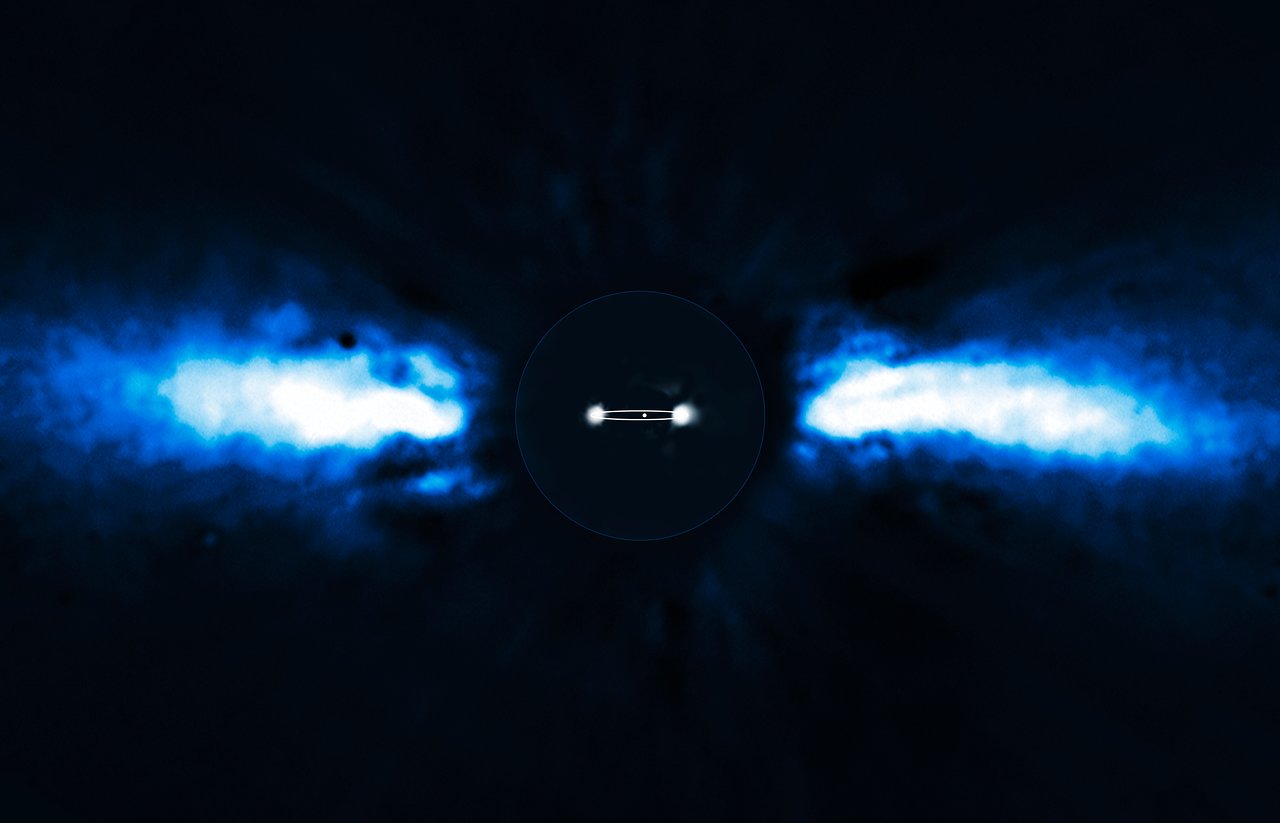
This is extremely cool news: astronomers have, for the first time, directly seen an exoplanet orbiting its star from one side to the other!

Here’s the incredible picture:

eso_betapicb

This makes me happy scientifically, of course, but also for personal reasons. Let me tell you a story. Two, in fact…

1) [Story the First] Beta Pic: the star, the planet, the disk

The star in question is Beta Pictoris (or just Beta Pic to its friends), a very young star — it’s only a few million years old, compared to the Sun’s advanced age of 4.56 billion — with about twice the Sun’s mass and 9 times its brightness. As stars go, Beta Pix is pretty close, just 63 light years away, and is easily bright enough to be seen with the unaided eye from the southern hemisphere.

In the above picture, taken using one of the European Southern Observatory’s ginormous 8.2 meter units of the Very Large Telescope, Beta Pic is represented by the dot in the center. The star is so bright its light swamps everything around it, so the star itself has been blocked by a piece of metal inside the camera that took the shot (that’s the reason for the dark circle in the center of the picture). This allows us to see much fainter stuff near the star.

This picture is actually a composite of three separate observations. The outer part with the blue fuzzy stuff was observed in 1996, and I’ll get back to that in a sec. The good stuff is in the center: two images of the planet, called Beta Pic b, are superposed in the picture; it was observed in 2003 (left blob), then again in late 2009 (right blob). Observations taken just months before in 2008 and 2009 observation didn’t show the blob at all — it must have been too close to the star to be seen clearly — indicating this really is a planet orbiting the star, and not just some background object like a star or galaxy. In other words, astronomers have captured the motion of the planet as it physically moved from one side of the star to the other!

eso_betapic_artworkVery cool. Using these observations, the orbit of the planet has been roughly estimated and is shown in the picture as well, though the tilt of it has been exaggerated for clarity. In reality, we see the orbit almost exactly edge-on. But we can see right away the orbit is not circular! The planet is clearly farther from the star on the left than on the right, meaning its orbit is pretty elliptical. In fact, it varies in distance from one billion to 2 billion kilometers from Beta Pic — roughly the distance of the Sun to Saturn and Uranus, respectively. That’s a huge variation. If this planet were in our solar system, there would be chaos as its gravity disturbed the orbits of all the outer planets.

Now, back to the weird wing-like things sticking out of either side. Those are from a 1996 observation, and what you’re seeing there is the actual disk of dust and junk from which that planet (and star) formed. Back in the 1980s, it was first determined that Beta Pic was blasting out a lot more infrared light than would be expected for its type of star. Astronomers took a better look, and found that bright disk you see in the picture. We see the disk almost exactly edge-on, so it looks like a thick, fuzzy line.

stis_betapicOver the years, more observations showed more detail. See how the disk is warped, bent, twisting up on the left side and down on the right? The false-colored rainbow-hued image here shows observations of the disk using my old camera STIS (bottom; on top is an earlier WFPC2 image) on board Hubble, and the bumps and wiggles in the inner disk are easy to see. That sort of thing can happen if a planet in the disk is tugging on the material as it orbits the star. Lots of other observations tantalizingly hinted at a planet buried in that mess, but unfortunately technology wasn’t up to the task of teasing out a faint planet from the bright star and disk.

But that’s changed now.

2) [Story the Second] Planets, disks, Hubble, and me

And that’s why this is such a personal story for me. When I was a kid, there were 9 planets, and that was it. In 1992 the first planets were detected around other stars, and in 1995 the first planets were detected around sun-like stars. But the disk around Beta Pic was first seen in the 1980s, when I was just starting out in college as a young astronomy major. It’s important to note that Beta Pic was the very first star to be seen surrounded by such a disk, basically confirming for the first time that stars formed from disks of material. Seeing the early pictures were fascinating, but maddening: they hinted at a planet being there, but we just didn’t have the tech to see it!

Finding a planet orbiting another star was one of the most fundamentally important and exciting goals of astronomy at the time. Every time a new image came out, we were just barely squeaking closer to that goal. I would read every new journal paper, every new popular level article that came out, and every time the conclusion was the same: we’re just a few more years away from finding other planets.

Arrrg! It was like an itch that couldn’t be scratched, except this itch was a combination of poison ivy, poison oak, and a thousand mosquito bites. Maddening!

hst_abaurigaeOver the years I was tangentially involved with Beta Pic; I didn’t directly work on the rainbow STIS image of it above, but my boss Don Lindler did. I remember sitting around the office with Don and Sally Heap (the woman who made that STIS observation), talking about those images, trying to figure out how best to squeeze information and detail out of them. I also worked extensively with other astronomers who had observations of stars surrounded by disks.

Of all the work I did on Hubble, those were my favorite observations, and the ones I most enjoyed working on. I got to know them really well, like friends: AB Aurigae (pictured above), HD 163296, HD 100546, and others. These all had spectacular and beautiful disks of material swirling around them, all had the ingredients necessary to make planets. But no planets were to be seen.

That’s all changed now. We’ve seen and confirmed a planet around the grand-daddy of all these stars, Beta Pic. And, as we had hoped, the newly-discovered planet has the right location and the right mass to explain the warping of the disk. Astronomers were right all along!

And now, finally, after all those years, we’ve finally been able to scratch that itch. Ahhhhhhhhhhhhh.

Beta Pic Image credits: ESO/A.-M. Lagrange; L. Calçada. Hubble image credits: Al Schultz (CSC/STScI, and NASA), Sally Heap (GSFC/NASA); C.A. Grady (National Optical Astronomy Observatories, NASA Goddard Space Flight Center), B. Woodgate (NASA Goddard Space Flight Center), F. Bruhweiler and A. Boggess (Catholic University of America), P. Plait (hey!) and D. Lindler (ACC, Inc., Goddard Space Flight Center), M. Clampin (Space Telescope Science Institute), and NASA.


Related posts:

- Another exoplanet imaged
- Huge exoplanet news: pictures!
- Planet imaged around a sunlike star?!


Today in Space: S. Korean Rocket Blows Up, Japanese Craft Spreads a Solar Sail | 80beats

JAXASolarSailSouth Korea’s attempt to jump into the space race met with disaster today. A little more than two minutes after takeoff today, the nation’s Naro rocket exploded. It had been carrying a satellite, and South Korea was vying to become the tenth country to put a satellite in orbit with rockets assembled at home.

South Korea has invested more than 500 billion won (400 million dollars) and much national pride in the 140-ton Naro-1. The liquid-fuelled first stage of the rocket was made in Russia, while the second stage was built domestically, as was the satellite [AFP].

In Japan, meanwhile, happier news: Last month its space agency, JAXA, launched a batch of new missions into space that included its solar sail project, called Ikaros. Today it unfurled the sail, seen above in the blinding light of the sun.

After separating from Akatsuki [a separate probe going on to Venus], Ikaros began unfolding four panels that, when fully unfurled, should look like a square kite measuring 66 feet (20 meters) along its diagonal. Pictures sent back by a camera mounted on the spacecraft’s hub show the extension of four booms holding the panels, plus the unfurling of sail material. This is the “primary deployment” of the sail. During the secondary stage of deployment, the sail is stretched out to its full extent [MSNBC].

The sail works in two ways, as we noted in previous coverage: It can ride the physical pressure of sunlight as a sailboat rides the wind, or it can use photovoltaic cells to produce solar electricity that powers thrusters.

And another plucky spacecraft from Japan is almost home. When we last saw the damaged and travel-weary Hayabusa, which attempted to gather samples from the surface of an asteroid, it was limping home under the power of a single remaining engine and some JAXA scientists warned that it might not make it. Now things look brighter, and it could arrive back on its home planet on Sunday.

When Hayabusa (“falcon” in Japanese) reaches an altitude of 190,000 feet, its heat shield will reach temperatures of more than 5,000 degrees Fahrenheit, while the gas surrounding the capsule will reach 13,000 degrees Fahrenheit – hotter than the surface of the sun, NASA says. It is planned to fall over a large unpopulated area of Australia called the Woomera Prohibited Area [Popular Science].

Check out DISCOVER on Facebook!

Related Content:
DISCOVER: Japan Stakes Its Claim in Space, on the Hayabusa mission
80beats: Japan’s Damaged Asteroid Probe Could Limp Back to Earth in June
80beats: Japan’s Venus-Bound Probe Will Hunt Volcanoes And Study Violent Storms
80beats: Japan’s “Solar Yacht” Is Ready to Ride Sunbeams Through Space

Image: JAXA


Oil In The Water | The Intersection

Click on the map to watch CNN's time-lapse video Now go read Nicholas Kristof's related Op-Ed in the NYTimes:
The national campaign to get President Obama to emote, throw crockery at oil executives and jump up and down in fury has failed. But here’s a long-term solution: Let’s anoint a king and queen. ....
[It] would give President Obama time to devise actual clean-up policies. He might then also be able to concentrate on eliminating absurd government policies that make these disasters more likely (such as the $75 million cap on economic damages when an oil rig is responsible for a spill). Our president is stuck with too many ceremonial duties as head of state, such as greeting ambassadors and holding tedious state dinners, that divert attention from solving problems. You can preside over America or you can address its problems, but it’s difficult to find time to do both.
Exactly. * Update: You can now vote for king and queen of America at Vanity Fair. *


The Ur-Sneaker? 5500-Year-Old Shoe Found in Armenian Cave | 80beats

old-shoeThree jaw-less heads and one really old shoe. These aren’t the clues in a Law and Order episode; they’re findings from a limestone cave in Armenia. As described in a paper published yesterday in PLoS ONE, archaeologists believe they have found the world’s oldest leather shoe: it’s 5,500 years old.

“It’s pretty weird,” said lead author Ron Pinhasi to CNN regarding the disembodied heads and the placement of the well-preserved shoe. The ancient sneaker was stuffed with grass, though archaeologists can’t say whether the grass was intended as insulation or whether it helped maintain the shoe’s shape.

“We thought originally it could be a discard, but at the same time, it’s very strange, because we have only one shoe, and it’s in very good shape,” Pinhasi said. “It looks like it was more than likely deliberately placed in this way.” [CNN]

The right-footed shoe–which looks a bit like a baked potato–has some features that might entice even modern buyers: for one, its maker fashioned it from a single piece of cow leather (like a pricey pair of today’s “whole cut” footwear), and it has leather laces. It’s about a women’s size seven, but, researchers say, it might have graced a small-footed man.

The shoe was discovered by Armenian PhD student, Ms Diana Zardaryan, of the Institute of Archaeology, Armenia, in a pit that also included a broken pot and sheep’s horns. “I was amazed to find that even the shoe-laces were preserved,” she recalled. [PLos ONE release]

Scientists determined the shoe’s age by cutting two small samples of the leather and sending it to radioactive dating centers at the Oxford Radiocarbon Accelerator Unit at the University of Oxford and the University of California–Irvine Accelerator Mass Spectrometry Facility. Others have discovered older sandals–the oldest are about 7,000 to 7,500 years old and were found in the Arnold Research Cave in Missouri–but this is the oldest full shoe ever discovered.

Fashion shoe designer, Manolo Blahnik, was impressed by how much the shoe looked like today’s models. He suspects that even 5,500 years ago, wearers wanted to look chic:

“The shoe’s function was obviously to protect the foot, but I am in no doubt that a certain appearance of a shoe meant belonging to a particular tribe,” Blahnik said. “I am sure it was part of the outfit which a specific tribe wore to distinguish their identity from another.” [National Geographic]

Preservation went well beyond the modern shoebox. The limestone cave itself had relatively stable temperatures and little humidity, and the shoe was covered in layers of sheep dung.

“We thought initially that the shoe and other objects were about 600-700 years old because they were in such good condition,” Pinhasi said. “It was only when the material was dated that we realized that the shoe was older by a few hundred years than the shoes worn by Oetzi, the Iceman,” he added, referring to Europe’s oldest natural human mummy, which dates back 5,300 years. [Discovery News]

Pinhasi is now waiting, metaphorically, for the other shoe to drop: He will return to explore another nearby cave this Friday and told CNN that he believes that his team has uncovered only two percent of the area’s findings.

Related content:
80beats: No Shoes, No Problem? Barefoot Runners Put Far Less Stress on Their Feet
80beats: “Pornographic” Statue Could Be World’s Oldest Piece of Figurative Art
80beats: World’s Oldest Flute Shows First Europeans Were a Musical Bunch
Discoblog: World’s Oldest Bible, Now Available on Your Laptop
DISCOVER: Archaeologists Find the World’s Oldest Arrowheads

Image: University of College, Cork — Media and Communications


AT&T Security Hole Let Hackers Steal Personal Info From Famous iPad Users | 80beats

ipad-220The hack that stole the email addresses of iPad users wasn’t even a hack in the truest sense, security experts are saying today. The Goatse Security team that pulled off the feat simply overpowered bad software.

The story broke yesterday that a leak in AT&T’s security had given away the email addresses of more than 100,000 people, including some of the famous and influential who were first to adopt the tablet—Diane Sawyer, New York Mayor Mike Bloomberg, and even White House Chief of Staff Rahm Emanuel.

The specific information exposed in the breach included subscribers’ email addresses, coupled with an associated ID used to authenticate the subscriber on AT&T’s network, known as the ICC-ID. ICC-ID stands for integrated circuit card identifier and is used to identify the SIM cards that associate a mobile device with a particular subscriber [Gawker].

The Praetorian Security Group, which got a copy of the script used to grab e-mail addresses from AT&T’s servers, says that it didn’t take a sophisticated hack to steal those email address, just a brute force attack:

“There’s no hack, no infiltration, and no breach, just a really poorly-designed Web application that returns e-mail address when ICC-ID is passed to it,” Praetorian said in a late Wednesday entry on its security blog [Computer World].

Happily for the aggrieved iPad users, the stolen info included only email addresses and not credit card or social security numbers. AT&T says it has fixed the issue and will notify anyone whose address was stolen. Interestingly, though, Goatse didn’t exactly play by the rules of white hat hacking here.

The true motive behind Goatse Security exposing this information is unknown. Had the group followed generally accepted vulnerability disclosure ethics, it would have contacted AT&T directly to notify them of the flaw, and allowed AT&T a reasonable amount of time to respond to the issue before announcing the discovery. And, of course, an ethical disclosure would not include exposing the compromised data. Perhaps Goatse Security simply wanted to embarrass AT&T or Apple [PC World].

Related Content:
Discoblog: DISCOVER’s iPad Arrived Early… And It’s AWESOME
80beats: Apple’ iPad Tablet: It’s Here, It’s Cool, and It’s Slightly Cheaper Than Expected
80beats: iPad Arrives: Some Worship It, Some Critique It, HP Tried To Kill It
80beats: Report: Chinese Hackers Stole Indian Missile Secrets & The Dalai Lama’s Email

Image: Apple


Science and Religion on the Cam, Part II | The Intersection

In my last post, I mentioned that I would be addressing some criticisms of the Templeton-Cambridge fellowship. There is, for instance, the take of former fellow John Horgan, which is widely cited and certainly critical (although it also acknowledges the value of the fellowship--which, after all, Horgan applied for and accepted). Among other things, Horgan writes the following:
My ambivalence about the foundation came to a head during my fellowship in Cambridge last summer. The British biologist Richard Dawkins, whose participation in the meeting helped convince me and other fellows of its legitimacy, was the only speaker who denounced religious beliefs as incompatible with science, irrational, and harmful. The other speakers— three agnostics, one Jew, a deist, and 12 Christians (a Muslim philosopher canceled at the last minute)— offered a perspective clearly skewed in favor of religion and Christianity. First, I do not agree that I have heard skewed perspectives here. I don't think any of the talks during the past two weeks could be said to have delivered arguments "in favor of religion and Christianity." If anything, some of them--a presentation by Petr Granqvist that interpreted religion from the viewpoint of "attachment theory," suggesting it might merely fulfill a psychological need from ...


Genetics & the Jews (it’s still complicated) | Gene Expression

After the post on Jewish genetics from a few days ago I was going to do a follow up clarifying a few issues. It was a big paper and I skipped over material which I thought might have benefited from further elaboration, but would have taken up too much time. But Dienekes alerts me to another paper which just came out in Nature of interest, The genome-wide structure of the Jewish people:

Contemporary Jews comprise an aggregate of ethno-religious communities whose worldwide members identify with each other through various shared religious, historical and cultural traditions…Historical evidence suggests common origins in the Middle East, followed by migrations leading to the establishment of communities of Jews in Europe, Africa and Asia, in what is termed the Jewish Diaspora…This complex demographic history imposes special challenges in attempting to address the genetic structure of the Jewish people…Although many genetic studies have shed light on Jewish origins and on diseases prevalent among Jewish communities, including studies focusing on uniparentally and biparentally inherited markers…genome-wide patterns of variation across the vast geographic span of Jewish Diaspora communities and their respective neighbours have yet to be addressed. Here we use high-density bead arrays to genotype individuals from 14 Jewish Diaspora communities and compare these patterns of genome-wide diversity with those from 69 Old World non-Jewish populations, of which 25 have not previously been reported. These samples were carefully chosen to provide comprehensive comparisons between Jewish and non-Jewish populations in the Diaspora, as well as with non-Jewish populations from the Middle East and north Africa. Principal component and structure-like analyses identify previously unrecognized genetic substructure within the Middle East. Most Jewish samples form a remarkably tight subcluster that overlies Druze and Cypriot samples but not samples from other Levantine populations or paired Diaspora host populations. In contrast, Ethiopian Jews (Beta Israel) and Indian Jews (Bene Israel and Cochini) cluster with neighbouring autochthonous populations in Ethiopia and western India, respectively, despite a clear paternal link between the Bene Israel and the Levant. These results cast light on the variegated genetic architecture of the Middle East, and trace the origins of most Jewish Diaspora communities to the Levant.

I doubt it’s a coincidence that this paper came out right on the heels of the previous one; papers are presented at conferences and word gets around, and I assume that the two groups were rushing to get their work published soon enough so as not to be totally overshadowed by the first past the post. The text of both papers is also an interesting window into the role of interpretation in science, as this one seems to emphasize the common Middle Eastern ancestry of Jews (excluding outliers such as the Ethiopian Jews), while the previous one highlighted structure within the Jewish community. Despite the similarities, this second paper is worth exploring for one major reason: it includes two populations of Jews, Moroccans and Yemenis, which were not in the previous research.


The methodology of both groups was similar. Take Jewish and non-Jewish populations of interest, and sequence them with a SNP-chip, and then try and extract out some useful patterns for the purposes of analytics. Here’s an important issue I want to reemphasize: the different methods of extracting out useful patterns give somewhat different results, and these results themselves are to a great extent human constructions which map only approximately onto the shape of reality. Measures of “genetic distance” are really just useful reifications and their biological reality as the differences amongst billions of base pairs is a somewhat different thing. This is why it is difficult to be more than trivial sometimes when it comes to what the “bottom line” on these studies are; the bottom lines represent human attempts to generate intuitive categories and representations on natural processes which are in some ways deeply alien to us. So with the cautions out of the way, let’s look at what the figures in this paper might indicate to our puny human intuitions.

First, here is a slice of a PCA where various Jewish groups have been mixed with a range of populations from the HGDP data set as well as a few extra ones. Specifically, I’ve focused on panel B which expands the region of the plot which contains populations of European and West Asian origin. Additionally, I’ve added a few extra labels and expanded the legend for clarity of viewing.

jewsnat1

The second figure constrains the variation to European and West Eurasian populations for the purposes of extracting out the two largest dimensions of variation. Observe that the general configurations of the relationships remains the same (if rotated a bit), but the magnitudes are now shifted. In the first plot the unadmixed African populations were the most diverse group, while in the second the Arab groups with appreciable African ancestry such as the Bedouin are. So eigenvector 1 seems to roughly rank order West Asian groups by their African ancestry, while the second eigenvector is a rough east-west axis within the various regional groups.

jewsnat2

The PCA aligns well with the previous paper. Ashkenazi Jews are roughly between European and Middle Eastern populations, as one would expect if they were in some sense an admixture between the groups. In the first paper the “Italian” group was from northern Italy. In this paper it is from Tuscany (Tus/T respectively for figure 1 and 2). The more interesting aspect are the non-Ashkenazi groups. This paper seems to confirm the east-west division evident in the earlier paper, whereby Ashkenazi & Sephardic groups form a natural cluster, as do the Mizrahi Jews of Iraq and Iran. Additionally, the Jews of Morocco seem to fall close to the Ashkenazi-Sephardic cluster (Moroccan Jews are Sephardic, but separated out a bit for the purposes of this paper). In the HGDP sample the closest thing to a “host” population for the Moroccan Jews are the Mozabites of Algeria, who are a Saharan Berber group. Unfortunately I don’t think this is the best proxy for the Berber groups because the Mozabites have a substantial proportion of Sub-Saharan African ancestry, more than is typical from what I can gather for populations from the Maghreb. But they added in their own group of Moroccans as well, though I didn’t track down the notation in the supplementary table 1 to ascertain the provenance of this sample.

The Yemeni Jews on the other hand are easier to understand. They seem to shake out as just another Middle Eastern population. They’re a subset of the Saudis in both plots. Since they’re regionally constrained to the southwest of the Arabian peninsula this makes sense, as the Saudi sample seems more regionally diverse in its recent ancestry (the next figure makes this clear to me). So the Yemeni Jews are roughly a third major cluster of “mainline” Jewish groups. Though their history is not as antique as that of the Jews of Iraq and Iran, who presumably go back to the period of the Persian Empire of the Achaemenids (earlier in the case of the Babylonian Jewry naturally), it does pre-date Islam. Additionally the genetic data suggest that this Jewish community has been relatively endogamous since the rise of Islam, as the next plot highlights.

It uses the ADMIXTURE method, with eight ancestral populations represented by each particular color. I’ve truncated the plot to populations of interest, in particular the Middle Eastern ones.

jewadmixplotThe inference that Middle Eastern Jews have been relatively endogamous since the rise of Islam is supported by this figure, the red-brown segment is pretty close to Sub-Saharan African ancestry in an individual’s genome. The Arab and North African Muslim groups tend to have some appreciable Sub-Saharan African ancestry, but the Jewish groups do not. This is probably due to the fact that the arrival of Sub-Saharan Africans as slaves was more a feature of the Islamic era states, which had far more pervasive trade links with Africa south of the Africa than any of the societies of antiquity. The Jews within the lands of Islam who did not convert were marginalized and did not participate fully in the commercial and cultural life of these societies. It seems plausible to assume then that there were few avenues for persons of slave ancestry and origin to enter into the Jewish community, as was common within Muslim society, where the offspring of slave women were recognized as free if the father was free. The Druze, a post-Muslim sect traditionally restricted to the mountains of Lebanon exhibit the same lack of Sub-Saharan African ancestry as Middle Eastern Jews, and this presumably is a pointer to their marginalization over the past one thousand years from the world of Arab Islam generally.

From this figure it looks as if the Moroccan Jews are fundamentally distinctive in some way from the non-Jewish population of Morocco. The green segment within the plot seems lacking in groups from the far western edge of the World Island of Africa-Eurasia. The full figure shows it is also lacking from populations on the eastern edge, as well as Sub-Saharan Africa, excluding those which have admixture. This component then point to origins within the center of the World Island, focused on the Mashriq and regions somewhat to the east. The magnitude of contribution of this segment to Moroccan Jews to me clinches the earlier observation of a close association between Ashkenazi, Sephardic and Moroccan Sephardic Jews, and a tie back to the Middle East in part for all these groups (though some of this may be of deeper origin, as the contrast between French and French Basques shows that different groups within the same nation can have different contributions, and the Moroccan non-Jewish samples may not be representative).

Finally, let’s look at the table which attempts to summarize genetic distances using allele sharing. The lower values indicate more genetic closeness.

jewsnat3

Throwing all the variation together in a grab bag doesn’t seem to really inform that much from what I can tell. Here are the authors:

Genetic relationships between our population samples were then explored with the measure of allele sharing distances (ASDs)…Table 1 provides genetic distances between each Jewish community and its corresponding host population, all Jewish communities, west Eurasian Jewish communities, their respective Jewish group inferred from the PCA, and non-Jewish Levantine populations. The Ashkenazi, Sephardi, Moroccan, Iranian, Iraqi, Azerbaijani and Uzbekistani Jewish communities have the lowest ASD values when compared with their PCA-based inferred Jewish sub-cluster…In all except the Sephardi Jewish community, this ASD difference is statistically significant … ASD values between Ashkenazi, Sephardi and Caucasus Jewish populations and their respective hosts are lower than those between each Jewish population and non-Jewish populations from the Levant. This might be the result of a bias inherent in our calculations as a result of the genetically more diverse non-Jewish populations of the Levant. The Ethiopian and Indian Jewish communities show the lowest ASD values when compared with their host population….

So what’s the bottom line here? I think the bottom line is that there isn’t a bottom line, and that we need to proceed on a case by case basis. I’ve focused on Middle Eastern Jews in this post, but let’s put the spotlight on the Indian Jews, the Bene Israel of Bombay, who were separated from the Jewish Diaspora, and the Cochin Jews, who were more well integrated (the Bene Israel did not have the Talmud, the Cochin Jews did). Both these groups resemble their Indian host populations genetically. Yet, Y chromosomal markers strongly imply that the Bene Israel are descended from male Middle Eastern Jews (many carry the Cohen Modal Haplotype). What likely occurred in India was that generations of admixture between Jews and non-Jews resulted in the elision of differences between the two groups, despite the persistence of a cultural distinction. Why the difference with other Jewish groups? I suspect that it has to do with the relative lack of a special relationship between Jews and the host culture in India as opposed to the world of Islam or Christendom. In India Jews were just another group, not subject to particular exclusion or marginalization. Non-Jews could, and did, move into the Indian Jewish community, while this was taboo in the Islamic or Christian world. A similar process seems to have occurred to the Jews of Kaifeng, who intermarried and eventually lost their identity because of their greater eventual isolation from the Jewish Diaspora in comparison to the Indian Jews, especially those of Cochin. The last generations of the Jews of Kaifeng, who likely descended from Middle Eastern traders, witnessed the sons of this community enter into the Chinese bureaucracy through cultivation of that culture’s classics, as well as the farce of Han wives of Jewish notables tending to pigs in their yards.

Citation: Behar, D., Yunusbayev, B., Metspalu, M., Metspalu, E., Rosset, S., Parik, J., Rootsi, S., Chaubey, G., Kutuev, I., Yudkovsky, G., Khusnutdinova, E., Balanovsky, O., Semino, O., Pereira, L., Comas, D., Gurwitz, D., Bonne-Tamir, B., Parfitt, T., Hammer, M., Skorecki, K., & Villems, R. (2010). The genome-wide structure of the Jewish people Nature DOI: 10.1038/nature09103

Resolving the iPhone resolution | Bad Astronomy

stevejobsWith much bruhaha, Steve Jobs and Apple revealed the new iPhone 4 yesterday. Among other features, Jobs said it has higher resolution than older models; the pixels are smaller, making the display look smoother. To characterize this, as quoted at Wired.com, he said,

It turns out there’s a magic number right around 300 pixels per inch, that when you hold something around to 10 to 12 inches away from your eyes, is the limit of the human retina to differentiate the pixels.

In other words, at 12 inches from the eye, Jobs claims, the pixels on the new iPhone are so small that they exceed your eye’s ability to detect them. Pictures at that resolution are smooth and continuous, and not pixellated.

eyephoneHowever, a display expert has disputed this. Raymond Soneira of DisplayMate Industries, was quoted both in that Wired article and on PC Mag (and other sites as well) saying that the claims by Jobs are something of an exaggeration: "It is reasonably close to being a perfect display, but Steve pushed it a little too far".

This prompted the Wired article editors to give it the headline "iPhone 4’s ‘Retina’ Display Claims Are False Marketing". As it happens, I know a thing or two about resolution as well, having spent a few years calibrating a camera on board Hubble. Having looked this over, I disagree with the Wired headline strongly, and disagree (mildly in one case and strongly in another) with Soneira. Here’s why.

First, let’s look at resolution*. I’ll note there is some math here, but it’s all just multiplying and dividing, and I give the answers in the end. So don’t fret, mathophobes! If you want the answers, just skip down to the conclusion at the bottom. I won’t mind. But you’ll miss all the fun math and science.

1) What is "resolution", really?

Imagine you see a vehicle coming toward you on the highway from miles away. Is it a motorcycle with one headlight, or a car with two? As the vehicle approaches, the light splits into two, and you see it’s the headlights from a car. But when it was miles away, your eye couldn’t tell if it was one light or two. That’s because at that distance your eye couldn’t resolve the two headlights into two distinct sources of light.

The ability to see two sources very close together is called resolution. It’s measured as an angle, like in degrees. For example, the Hubble Space Telescope has a resolution of about 0.00003 degrees. That’s a tiny angle! I’m simplifying here a bit, but you can think of this as saying that two stars farther apart than that are seen as two objects; if they are closer together, even with Hubble they appear as a single object.

Since we measure resolution as an angle, we can translate that into a separation in, say, inches at certain distance. A 1-foot ruler at a distance of about 57 feet (19 yards) would appear to be 1 degree across (about twice the size of the full Moon). If your eyes had a resolution of 1 degree, then the ruler would just appear to you as a dot.

resolution_angles

At a given distance, two objects closer together have a smaller angle separating them, making them harder to distinguish from each other. Note that in the image above, the circles on top are farther apart, with a bigger angle between them (imagine you are looking at them from the left, where the black lines intersect). At some point, the objects are so close together, and the angle so small, the two merge into one object as far as your eye is concerned. That’s your resolution limit.

What is the resolution of a human eye, then? Well, it varies from person to person, of course. If you had perfect vision, your resolution would be about 0.6 arcminutes, where there are 60 arcmin to a degree (for comparison, the full Moon on the sky is about 1/2 a degree or 30 arcmin across).

To reuse the ruler example above, and using 0.6 arcmin for the eye’s resolution, the 1-foot ruler would have to be 5730 feet (1.1 miles) away to appear as a dot to your eye. Anything closer and you’d see it as elongated (what astronomers call "an extended object"), and farther away it’s a dot. In other words, more than that distance and it’s unresolved, closer than that and it’s resolved.

This is true for any object: if it’s more than 5730 times its own length away from you, it’s a dot. A quarter is about an inch across. If it were more than 5730 inches way, it would look like a dot to your eye.

So you can think of this 5730 number as a scale factor; multiply an object’s size by that, and, if your vision is perfect (OOOooooo, foreshadowing!) you get how far away you can see it as more than a dot.

2) Power to the pixel

So what does all this mean for the iPhone? First, here are the claims.

Jobs claims the iPhone held at 12 inches from your face has pixels too small to be resolved by your eye. Soneira, the display expert quoted in the magazine articles, disputes that. He uses the 0.6 arcmin resolution for the human eye (so we use the scale factor = 5730). Let’s use that and run the numbers.

Something 12 inches away means your eye can resolve dots that are bigger than

12 inches / 5730 = 0.0021 inches

So if the pixels on the iPhone are smaller than 0.0021 inches in size, then Jobs is right. Your eye won’t resolve them. If the pixels are bigger, Soneira is right, and your eye can resolve them.

The actual iPhone 4 has 326 pixels per inch (the display is 960 pixels high, and about 2.9 inches in length). You have to flip that to get the size of the pixel in inches:

1 / 326 = 0.0031 inches

Uh oh! Things look bad for Jobs. The iPhone pixels are too big! At one foot away, your eye can resolve the pixels, and Jobs must be lying!

Or is he? Remember, Soneira used the 0.6 arcmin resolution of the eye, but that’s for perfect eyesight. Most people don’t have perfect eyesight. I sure don’t. A better number for a typical person is more like 1 arcmin resolution, not 0.6. In fact, Wikipedia lists 20/20 vision as being 1 arcmin, so there you go.

If I use 1 arcminute instead, the scale factor is smaller, about 3438. So let’s convert that to inches to see how small a pixel the human eye can resolve at a distance of one foot:

12 inches / 3438 = 0.0035 inches

Aha! This means that to a more average eye, pixels smaller than this are unresolved. Since the iPhone’s pixels are 0.0031 inches on a side, it works! Jobs is actually correct.

[Note: in the articles about all this, they used units of pixels per inch, whereas I've used the size of the pixels themselves. You can flip all these numbers to convert. The iPhone4 has a resolution of 326 ppi (pixels per inch). Soleira says the eye can resolve 1 / 0.0021 = 477 ppi. However, normal vision can see at 1 / 0.0035 = 286 ppi. So the density of pixels in the iPhone 4 is safely higher than can be resolved by the normal eye, but lower than what can be resolved by someone with perfect vision.]

3) So what does all this mean?

Let me make this clear: if you have perfect eyesight, then at one foot away the iPhone 4’s pixels are resolved. The picture will look pixellated. If you have average eyesight, the picture will look just fine.

So in a sense, both Jobs and Soneira are correct. At the very worst, you could claim Jobs exaggerated; his claim is not true if you have perfect vision. But for a lot of people, I would even say most people, you’ll never tell the difference. And if you hold the phone a few inches farther away it’ll look better.

So in my opinion, what Jobs said was fine. Soneira, while technically correct, was being picky. So I mildly disagree with him about that. I had to laugh, though: his dismissing (near the bottom of the Wired article) of the Quattro TV’s use of a fourth, yellow, pixel is dead on. When I first heard of that I knew right away it was a silly claim.

Still, the headline used by Wired.com was clearly incorrect; Jobs wasn’t falsely advertising the iPhone’s capabilities at all. I’ll note that I like Wired magazine quite a bit, and what we have here is most likely just an overzealous editor. But a lot of people read the headlines and it taints their view; someone reading that article may be more likely to think Jobs, once again, has overblown a product to excite people. He didn’t.

So, in this case, I hope I’ve…

[wait for it, wait for it]

… made things clear.


* "Look at resolution"! Haha! Man, I kill me.


Tip o’ the reading glasses to Slashdot.

Related posts:

- Moon Hoax: Why not use telescopes to look at the landers?
- My New Years Resolution


Live octopus lollipop | Cosmic Variance

Last week I visited the Institute for the Early Universe in Seoul, Korea, part of the World Class University project, an initiative of the Korean government to build forefront research institutions. It is situated on the Ewha Womens University campus, the world’s largest female-only University. I felt out-of-place walking around, not because I’m obviously a foreigner, but because I was male in a sea of women. The physics classes at Ewha are filled with women, which is (unfortunately) radically different from the majority of other institutions. In 18 months the IEU has built an impressive program, with a number of outstanding faculty (including George Smoot, Eric Linder, Uros Seljak, Bruce Grossan, and Changrim Ahn) and postdocs (including Reiko Nakajima, Scott Daniel, and Teppei Okumura) in both short and long-term residence, and a great visitor program (Ue-li Pen from CITA/Toronto was also in town last week). I’ve had productive collaborations with both Eric and Uros in the past, and it was great to get time with them. I’ve gotten temporarily excited about trying to test whether our Universe is described by a metric theory, but have been getting little traction thus far. Last Friday I wandered over to Yonsei and had a very interesting chat with Joe Silk, who was in town for a workshop.

George Smoot eats octopusMy inaugural dinner with the institute folk set the tone. We went out to a local seafood restaurant. Walking in one passed a number of tanks, filled with live fish, eels, octopus, and various other unrecognizable ocean dwellers. The table next to ours consisted of three Korean women enjoying octopus sashimi. We promptly ordered some for ourselves. The octopuses were extracted from their tank, hauled into the kitchen for a few minutes, and then presented neatly cubed. Octopuses have a fairly unusual autonomic nervous system, with many neurons present in the tentacles rather than the brain. This is a long-winded way of saying that a plate of fresh octopus is a writhing, tangled affair. You rapidly learn to coat the agitating bits in sesame oil before consuming, Octopus lollipopotherwise the suction cups stick to the interior of one’s mouth, somewhat compromising the whole experience. Needless to say, it is a strange sensation. But entirely delicious.

We were clearly amateurs. George managed to inveigle himself a personal lesson from one of the Korean women in how to eat octopus sashimi (only afterwards did she learn she was teaching a Nobel laureate). The lesson consisted of the woman taking an entire live octopus, carefully wrapping the tentacles around a wooden chopstick (metal doesn’t work), and then consuming the entire octopus popsicle in one fell swoop. As she indulged, there were tentacles coming out of her mouth and desperately grabbing her face, clearly displeased with the turn of events. It was starkly reminiscent of Aliens (with some amount of role reversal). It is one of the more unsettling things I’ve seen.


Thoughts On Stars

Stars.

We know a lot about stars, don’t we?  After all, we live 93 million miles away from a very nice one.  When our lovely star leaves the sky for the night, we see thousands more of them.  If we look at the NASA.gov site, or HubbleSite, we can look at billions of them.  We know how they are born, how they age, how they die.  We can go to websites like STEREO or SOHO and see what our star looks like right now.  Not too long ago, I did a post on sunspots, which you can read here if you’re curious.  And, by the way, as I’m writing this post, this is what our sun looks like right now (from SOHO).  I mean, RIGHT NOW:

..


Yes, it’s 1:06 am as I write this.  But that’s just our star.  Do all those billions of other stars act the same way as ours?  Do beings on other worlds see spots?  Flares?  Prominences?

To borrow someone’s (adjective deleted) phrase:  You betcha.

NASA conception of a red dwarf - looks familiar, doesn't it?

We only have to look at our star to visualize what’s happening on other stars.  After all; they’re basically the same things.  Using some very powerful telescopes, we’ve been able to see spots on Betelgeuse, flares on UV Ceti, and magnetic fluctuations on Proxima Centauri.


To be honest, some of those distant suns do things we should be very thankful ours hasn’t.  Not if we don’t want to be fried to a crisp where we stand.  Since our star rises every morning, shines, then sets every evening, we get to thinking we live next to a pretty tame little ball of fire.

Don’t you believe it.

NASA Wolf Rayet ejecting clumps of gas at about 100,000 mph

NCBI ROFL: Humor and death: a qualitative study of The New Yorker cartoons (1986-2006). | Discoblog

tweet“American’s experiences with dying and death have changed throughout the course of our history. As an agrarian society death, was seen first-hand on, often, a daily basis. Industrialization brought with it removal of the dying process to the hospital and burial became the responsibility of the undertaker. This separation of dying and death from society resulted in not only a physical barrier but a psychological one as well. Technology in health care once again raised issues of the dying process by asking people to make decisions about their health care in the realm of resuscitation, respirators, and the use of artificial food and fluids. One way that Americans have been known handle the difficult times in their lives is through humor. When it becomes difficult to cope, tears and laughter are both cathartic. This study analyzes cartoons from The New Yorker in an effort to categorize contemporary notions of death as well as establish the correlation between societal events related to dying and death and the overall percent of death-related cartoons in this media.

Bonus table and text:

table2

“Themes:

“Things you can’t avoid” (n = 14) depicted multiple iterations on the saying that “the two things you can’t avoid are death and taxes.” For example, one cartoon showed the Grim Reaper and an IRS tax man crouched at the starting line of a race. Another depicted the devil meeting with a politician with the caption, “Congressman, our people would look upon it favorably if you were to oppose any additional sin taxes” (from 1994; Mankoff, 2006, p. 23). The grouping also involved aspects relating tempest fugit (Latin for “time flies”).

“Wills” (n = 14) peaked in 1991, the year after the passage of the Patient Self-Determination Act of 1990 (which is an ammendment of the Omnibus Budget Reconciliation Act of 1990 [OBRA 90] combined depictions of Advance Health Directives, such as living wills, and also involved aspects of greed relating to insurance claims.

“Bad News” (n = 17) depicted informing loved ones of a recently deceased individual or letting people know that they were terminally ill; for example, an egg (carrying a purse) walks into a busy emergency room. The doctor says, “You might want to sit down, Mrs. Dumpty” (from 1993; Mankoff, 2006, p. 278).

“Things That Will Kill You” (n = 20) depicted activities that could affect life expectancy, including diets, alcohol and tobacco, and exercise. The grouping also included hobbies and examples of human traits (e.g., A cat lies on the autopsy table. Cause of death? Curiosity).

“Assisted Suicide” (n = 23) peaked between 1997 and 1998 and included all cartoons relating to Jack Kevorkian and the debate about self-determination and the right to die. One shows a Boy Scout helping an old woman across the street with the caption “I also do suicides” (from 1998; Mankoff, 2006, p. 310). Another shows an elderly couple buying gas with the caption, “Yes, Oregon’s lovely, but we’re just here for the suicide” (from 1998; Mankoff, 2006,p. 163). Lastly, a doctor is fielding phone calls in his office; the caption is, “Before we try assisted suicide, Mrs. Rose, let’s give the aspirin a chance” (from 1997; Mankoff, 2006. p. 647).

“Personification of Death” (n = 38) included a subtheme of “Bargaining with Death.” The main theme included representations of death with human attributes, such as the Grim Reaper. Examples are the Grim Reaper sitting in a bar talking to another man; the caption reads, “Sometimes I give myself the creeps” (from 2005; Mankoff, 2006. p. 28). The subtheme involved people negotiating for more time to live. Many of the cartoons in this theme show the Grim Reaper standing at someone’s door as he or she tries to negotiate his or her way out of dying. For example, one such caption read, “Couldn’t I do a couple of hundred hours of community service instead?” (from 1990; Mankoff, 2006. p. 46). This can be seen as the legacy of death (Elgee, 2003), that we are all its slaves.

“Punishment” (n = 55) included the subtheme of “Aggression.” Cartoons placed under the main category contained aspects related to suffering, such as people in Hell agonizing over pain. Many themes related to Hell included lawyers and writers. One cartoon shows people entering Hell with a sign by the entrance that reads, “Authors must be with their agents!” (from 1991; Mankoff, 2006. p. 736). The subtheme included depictions of murder, suicide, and domestic violence resulting in death. One shows movers moving a piano, a man dead on the floor, and a woman saying “I liked it better on top of my husband” (from 1995; Mankoff, 2006. p. 347).

“Finality” (n = 58) peaked during the period 1994–2000 and encompassed cartoons related to the final moments of life, including last words, actions, and confessions. Many of these cartoons show deathbed scenes where the family is gathered (typically with clergy present) and final thoughts are shared. For example, captions associated with this picture include, “Promise me, son, that you’ll never have anything to do with publishing” (from 1996; Mankoff, 2006, p. 368) and “And don’t go auctioning off my stuff” (from 1996; Mankoff, 2006, p. 157).

“Meaning of Life and Death” (n = 60) included a subtheme of the “Triviality of Life or Death.” Cartoons placed under the main theme contained depictions of philosophical statements, the circle of life, and an acceptance of death. One cartoon shows a man working on his computer and talking to his wife. He says, “If we take a late retirement and an early death, we’ll just squeak by” (from 2003; Mankoff, 2006, p. 459). Cartoons placed under the subtheme made light of deadly situations and included inconsistent statements and actions. For example, two doctors stand at a dying man’s bedside as one doctor says to the man, “So, could we have all your stuff after you die?” with the caption “Doctors without Boundaries” (from 2003; Mankoff, 2006, p. 321). Another shows a man in hospital admissions and the clerk says “Fill out this tag and attach it to your big toe” (from 2001; Mankoff, 2006, p. 544).

“Memorialization” (n = 128) included a subtheme of “Funerals.” The main theme involved cartoons depicting tombstones, the scattering of ashes, and obituaries, whereas the subtheme included graveyard humor and funeral gatherings; for example, two tattooed and pierced men with Mohawks are looking into a casket and visible at the head of the casket is a spiky Mohawk and the caption reads, “You’ve got to admit, he looks good” (from 1994; Mankoff, 2006, p. 364).

“Afterlife” (n = 206) included three subthemes: “Judgment,” “Postdeath,” and “Taking It with You.” The main theme involved cartoons relating to Heaven—such as one showing two people in heaven wearing black robes, wings, and sunglasses talking to an angel in white; the caption: “We’re from Manhattan” (from 2001; Mankoff, 2006, p. 396). The subtheme of “Judgment” contained depictions of entry into heaven or initiation into hell. All of these cartoons depicted either St. Peter at the gates of heaven or the devil at the gates of hell. One shows a man at the gates of hell standing at a podium with the devil and the devil is saying, “And, if you don’t have an attorney, we have millions of them” (from 2003; Mankoff, 2006, p. 11). Another shows a man being greeted at the gates of heaven with St. Peter saying, “I’d like to congratulate you on dying with dignity” (from 1997; Mankoff, 2006, p. 446). The subtheme of “Postdeath” included representations of human life carried into the afterlife. For example, a group of angels are talking and one says, “Does anyone else’s robe say ‘Hyatt’?” (from 2005; Mankoff, 2006, p. 636). Cartoons representing the theme “Taking It with You” involved earthly pleasures and objects in relation to life after death. One cartoon shows a man on his deathbed with the caption, “True, I can’t take it with me, but I can take the access codes to it” (from 1998; Mankoff, 2006, p. 418).”

newyorker_death

Image: The New Yorker

Related content:
Discoblog: NCBI ROFL: “Old people are useless”: representations of aging on the Simpsons.
Discoblog: NCBI ROFL: D’oh! An analysis of the medical care provided to the family of Homer J. Simpson.
Discoblog: NCBI ROFL: Times New Roman may be funnier than Arial, but why does Comic Sans make me want to kill myself?

WTF is NCBI ROFL? Read our FAQ!