Reluctance to Let Go | Cosmic Variance

There’s a movement afoot to frame science/religion discussions in such a way that those of who believe that the two are incompatible are labeled as extremists who can be safely excluded from grownup discussions about the issue. It’s somewhat insulting — to be told that people like you are incapable of conducting thoughtful, productive conversations with others — and certainly blatantly false as an empirical matter — I’ve both participated in and witnessed numerous such conversations that were extremely substantive and well-received. It’s also a bit worrisome, since whether a certain view is “true” or “false” seems to take a back seat to whether it is “moderate” or “extreme.” But people are welcome to engage or not with whatever views they choose.

What troubles me is how much our cultural conversation is being impoverished by a reluctance to face up to reality. In many ways the situation is parallel to the discussion about global climate change. In the real world, our climate is being affected in dramatic ways by things that human beings are doing. We really need to be talking about serious approaches to this problem; there are many factors to be taken into consideration, and the right course of action is far from obvious. Instead, it’s impossible to broach the subject in a public forum without being forced to deal with people who simply refuse to accept the data, and cling desperately to the idea that the Earth’s atmosphere isn’t getting any warmer, or it’s just sunspots, or warmth is a good thing, or whatever. Of course, the real questions are being addressed by some people; but in the public domain the discussion is blatantly distorted by the necessity of dealing with the deniers. As a result, the interested but non-expert public receives a wildly inaccurate impression of what the real issues are.

Over the last four hundred or so years, human beings have achieved something truly amazing: we understand the basic rules governing the operation of the world around us. Everything we see in our everyday lives is simply a combination of three particles — protons, neutrons, and electrons — interacting through three forces — gravity, electromagnetism, and the strong nuclear force. That is it; there are no other forms of matter needed to describe what we see, and no other forces that affect how they interact in any noticeable way. And we know what those interactions are, and how they work. Of course there are plenty of things we don’t know — there are additional elementary particles, dark matter and dark energy, mysteries of quantum gravity, and so on. But none of those is relevant to our everyday lives (unless you happen to be a professional physicist). As far as our immediate world is concerned, we know what the rules are. A staggeringly impressive accomplishment, that somehow remains uncommunicated to the overwhelming majority of educated human beings.

That doesn’t mean that all the interesting questions have been answered; quite the opposite. Knowing the particles and forces that make up our world is completely useless when it comes to curing cancer, buying a new car, or writing a sonnet. (Unless your sonnet is about the laws of physics.) But there’s no question that this knowledge has crucial implications for how we think about our lives. Astrology does not work; there is no such thing as telekinesis; quantum mechanics does not tell you that you can change reality just by thinking about it. There is no life after death; there’s no spiritual essence that can preserve a human consciousness outside its physical body. Life is a chemical reaction; there is no moment at conception or otherwise when a soul is implanted in a body. We evolved as a result of natural processes over the history of the Earth; there is no supernatural intelligence that created us and maintains an interest in our behavior. There is no Natural Law that specifies how human beings should live, including who they should marry. There is no strong conception of free will, in the sense that we are laws unto ourselves over and above the laws of nature. The world follows rules, and we are part of the world.

How great would it be if we could actually have serious, productive public conversations about the implications of these discoveries? For all that we have learned, there’s a tremendous amount yet to be figured out. We know the rules by which the world works, but there’s a lot we have yet to know about how to live within it; it’s the difference between knowing the rules of chess and playing like a grandmaster. What is “life,” anyway? What is consciousness? How should we define who is a human being, and who isn’t? How should we live together in a just and well-ordered society? What are appropriate limits of medicine and biological manipulation? How can we create meaning and purpose in a world where they aren’t handed to us from on high? How should we think about love and friendship, right and wrong, life and death?

These are real questions, hard questions, and we have the tools in front of us to have meaningful discussions about them. And, as with climate change, some people are having such discussions; but the public discourse is so badly distorted that it has little relationship to the real issues. Instead of taking the natural world seriously, we have discussions about “Faith.” We pretend that questions of meaning and purpose and value must be the domain of religion. We are saddled with bizarre, antiquated attitudes toward sex and love, which have terrible consequences for real human beings.

I understand the reluctance to let go of religion as the lens through which we view questions of meaning and morality. For thousands of years it was the best we could do; it provided social structures and a framework for thinking about our place in the world. But that framework turns out not to be right, and it’s time to move on.

Rather than opening our eyes and having the courage and clarity to accept the world as it is, and to tackle some of the real challenges it presents, as a society we insist on clinging to ideas that were once perfectly reasonable, but have long since outlived their usefulness. Nature obeys laws, we are part of nature, and our job is to understand our lives in the context of reality as it really is. Once that attitude goes from being “extremist” to being mainstream, we might start seeing some real progress.


Hubble sees no remains of the Jupiter impact | Bad Astronomy

A month ago, something big burned up in Jupiter’s atmosphere. The impact was seen by two amateur astronomers, and very quickly the big guns were turned to the giant planet.

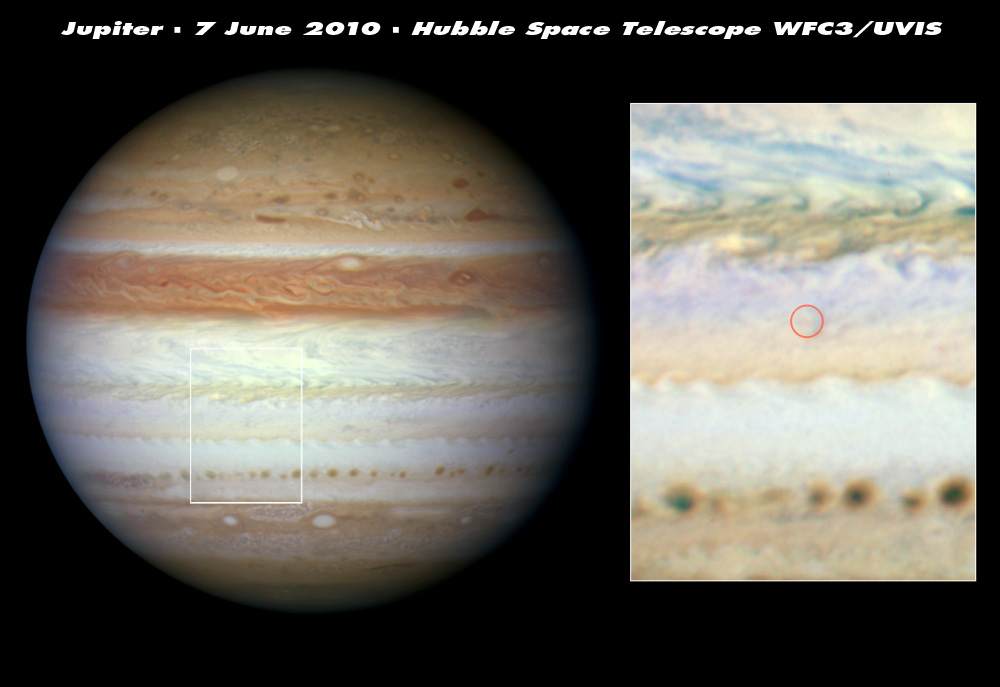
And what they saw was… nothing. Nada. Bupkis. Not even the powerful eye of Hubble saw anything. See for yourself:

hst_jupiter_noimpact

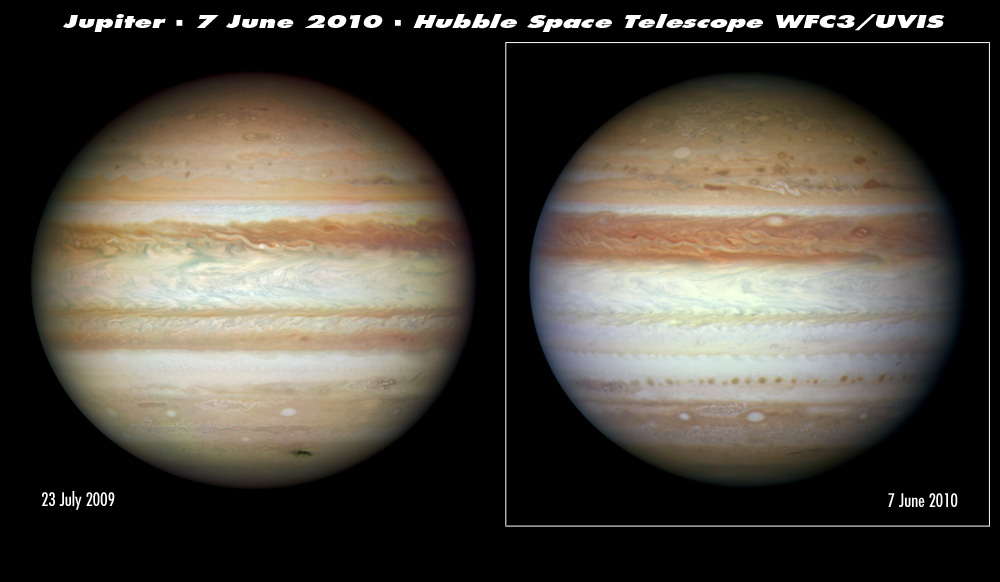
This picture of Jupiter was taken on June 7, just a few days after the impact. The image on the right is a closeup, and the circle represents where the impact took place, and there’s nothing there we can see. In previous impacts — most notably the one last year in July, and the Shoemaker-Levy 9 series of impacts in 1994 — nasty black bruises appeared on the planet’s cloud tops. Those were impact scars, plumes of material blasted up from deeper in Jupiter’s cloud, dredged up by the multi-megaton explosions. You can see this by comparing an image of Jupiter taken last year after the July impact with what they got this year:

hst_jupter_nobelt

The 2009 impact scar can be seen in the left hand image near the bottom of Jupiter. There is no such scar seen for the newer impact. That means that whatever hit Jupiter didn’t explode deep in the atmosphere. The observations imply strongly that whatever hit burned up high in the atmosphere, more like a giant fireball than an impact and explosion. Given how bright it was, I’m personally of the opinion that this may not have been a giant solid asteroid, like a piece of rock or metal. If it was that fragile, it may have been what’s called a rubble pile; a loose conglomeration of rocks held together by their own gravity.

At the moment, because we didn’t see anything it’s hard to say anything positive. We can eliminate a few possibilities, but it’s hard to know exactly what happens. These observations definitely help, but are also in their way a little maddening. What the heck happened on Jupiter?

As an added bonus, these observations also show (OK, don’t show) the missing southern equatorial belt; a planet-wide storm wrapped around Jupiter. In the older shot you can see it, but a few months ago it disappeared, and is missing in the newer shot. This has happened before, but it’s unclear why. In the new images you can see that the storms north and south of the missing belt look different now too, perhaps a clue as to what’s going on. There is a series of brownish circular storms all lined up, more or less, and other odd features as well.

All in all, I think we can sum all this up by saying Jupiter is a weird place. Mind you, it’s 140,000 kilometers across (86,000 miles), which is a heckuva lot of real estate to try to understand. I expect the questions and answers will change, but I bet that in a hundred years, astronomers studying Jupiter will still have plenty of mysteries on their hands.

Credit: NASA, ESA, M.H. Wong (University of California, Berkeley), H.B. Hammel (Space Science Institute, Boulder, Colo.), A.A. Simon-Miller (Goddard Space Flight Center), and the Jupiter Impact Science Team


iCop: Police to Use Facial Recognition App to Nab Criminals | Discoblog

Snapping iPhone pics may soon be an order for cops in Brockton, Massachusetts. But don’t expect these shots to end up on the Facebook page for COPS. Using a special app, officers plan to turn the iPhone into a crime-fighting gadget that will use facial and iris recognition to identify criminals on the streets.

As first reported by the Patriot Ledger, the iris recognition software looks for unique coloration in the area surrounding the subject’s pupils. The face recognition software measures the spacing between the suspect’s major facial features–comparing the outside distance between the person’s eyes and the distance between his nose and chin, for example.

These measurements will then go to a central database so that the officer can identify the suspect before bringing him into the station. The current system, called MORIS (Mobile Offender Recognition and Identification System), costs about $3,000 for each phone and currently only uses facial recognition, reports Popular Science. Future versions will incorporate the iris technology and may even have a fingerprinting app.

The phone will eventually be used by 28 police departments and 14 sheriff departments in the state, though the Patriot Ledger reports that other states also soon hope to employ the system.

Officers will only take shots when they have probable cause, Brockton Chief William Conlon says in the video above: “Were not going to just randomly stop people on the street and say, ‘Hey, come here, we want to take your picture and look in your eyes.’”

Follow DISCOVER on Facebook.

Related content:
Discoblog: Can an iPhone App Clear Up Your Acne?
Discoblog: First iPhone App to Feature in a Film Festival
Discoblog: Can an iPhone App Decipher Your Baby’s Cries?
Discoblog: NASA iPhone App Lets You Drive a Lunar Rover (Just Try Not to Get Stuck)


Obama’s Speech on the Oil Spill: What Do You Think of His “Battle Plan”? | 80beats

Last night, President Obama made his first Oval Office speech. In it, he described the BP oil spill as an assault on “our shores and our citizens” and outlined his “battle plan.” He discussed the immediate cleanup of the spill, the repayment he’ll insist on from BP for harm done, and the future of U.S. energy.

Katie Couric compared Obama’s speech to others issued from the Oval Office.

“The disaster in the Gulf may or may not be President Obama’s Katrina, but, tonight, it will be his Challenger explosion, his Cuban missile crisis, his Sept. 11. Unlike those events, this is a long simmering disaster, getting darker by the day.” [CBS]

Here are some of the major points covered in the speech:

Immediate Clean-up

Obama started by discussing BP’s current efforts to stop the leak and assuring the public that the company’s work will soon pay off. Obama wasn’t specific on how the company will finally stop the oil flow, but only said that the company will use “additional equipment and technology.”

“In the coming weeks and days, these efforts should capture up to 90 percent of the oil leaking out of the well. This is until the company finishes drilling a relief well later in the summer that’s expected to stop the leak completely.”

How BP Will Repay Victims

Though he didn’t specify an amount, the president also wants to put aside BP funds (The New York Times reports that Senate Democrats have called for $20 billion) in an account managed by a “third party” to fairly distribute to victims. BP has confirmed a meeting with the president at the White House today, in which this escrow account will be discussed. Said Obama:

“I will meet with the chairman of BP and inform him that he is to set aside whatever resources are required to compensate the workers and business owners who have been harmed as a result of his company’s recklessness. And this fund will not be controlled by BP. In order to ensure that all legitimate claims are paid out in a fair and timely manner, the account must and will be administered by an independent third party.”

Relationship Between Companies and Watchdogs

He spoke of earlier efforts to clean up corrupt relationships between big companies, like BP, and the agency meant to monitor them–the Minerals Management Service (MMS) within the Department of the Interior. Obama said his administration began cleaning out the MMS when he took office:

“But it’s now clear that the problem there ran much deeper, and the pace of reform was just too slow. And so Secretary [Ken] Salazar and I are bringing in new leadership at the agency — Michael Bromwich, who was a tough federal prosecutor and Inspector General. And his charge over the next few months is to build an organization that acts as the oil industry’s watchdog — not its partner.”

A Green Energy Future?

He also spoke of a need to adopt greener energy sources and described our slow transition to these energy sources compared to China, for example.

“We cannot consign our children to this future. The tragedy unfolding on our coast is the most painful and powerful reminder yet that the time to embrace a clean energy future is now. Now is the moment for this generation to embark on a national mission to unleash America’s innovation and seize control of our own destiny.”

Some have criticized Obama for not being more specific; others hope that his speech will incite change after the clean-up.

Still, some polls suggest a national willingness to make economic sacrifices for the sake of kicking the oil addiction. And the first step need not be too expensive. A new study from the Environmental Protection Agency shows that one proposed energy bill, which includes a carbon emission trading scheme, would cost the average American household only about $100 a year. [Reuters]

DISCOVER wants to know what you think. Please comment below.

Recent posts on the BP oil spill:
80beats: Should We Just Euthanize the Gulf’s Oil-Soaked Birds?
80beats: “Top Cap” Installed on BP Oil Leak; Effectiveness Remains to Be Seen
80beats: This Hurricane Season Looks Rough, And What If One Hits the Oil Spill?
80beats: We Did the Math: BP Oil Spill Is Now Worse Than the Exxon Valdez
80beats: Oil Spill Update: BP to Switch Dispersants; Will Kevin Costner Save Us All?


Astronomers Find a Bevy of Exoplanets; Won’t Discuss Most Interesting Ones | 80beats

KeplerCraftIt’s the 1840s. Rival astronomers in Britain and France separately toil away in their notebooks, fiercely guarding their calculations of just where a planet beyond Uranus might be hiding, hoping that they and their country will get the glory for finding it. When telescopes finally spot Neptune, the discovery leads to decades of debate over primacy, and scouring each man’s private data to determine who deserved the most credit.

Fast forward to the 21st century: Rivalries may have changed, but in the hunt for new planets—especially becoming the first to detect a new world like our own in a distant star system—defending one’s data to lay claim to discovery has not gone away.

This week the team behind NASA’s planet-hunting space telescope, Kepler, announced that it has found more than 700 new candidates for exoplanets. Given that the current tally of known planets beyond our solar system stands near 460, that’s a huge announcement. But what’s drawn some attention is that more than half of the candidates won’t be released publicly at this time. These include smallest planet candidates—those closest to our own world in size—which won’t be officially announced until February 2011.

It’s no secret why:

“The first astronomer who can prove they found an Earthlike planet around an Earthlike star will win many kudos and prizes,” said John Huchra of the Harvard-Smithsonian Center for Astrophysics, who led a NASA advisory committee that approved the deal. “It’s glory for NASA,” he added.“NASA would like to have one of its missions find an Earthlike planet” [The New York Times].

Given all the time and effort that went into developing Kepler, most astronomers seem to be all right with the team taking its time to analyze its data and get the credit they deserve. The best viewing time to confirm many of them as true exoplanets will take place over this summer. But given the tantalizing contents of Kepler’s catalog and the potential for finding an Earth-like planet it shouldn’t be surprising if people get impatient to have their own look.

The typical planet identified by transit observations (the method used by Kepler) was about 13 Re [Earth radii]. The data that has been released includes about 100 planets that are somewhere between two and four Earth radii—and that’s excluding up to 400 smaller objects [Ars Technica].

In the meantime, those planets Kepler scientists have now publicized should provide fodder for curious stargazers. One new paper says that five stars the telescope studied have multiple exoplanets in orbit. Also, Europe’s CoRoT Space Telescope has added six new giant exoplanets to its own tally, and even spotted a brown dwarf.

Perhaps more eyes would speed up the search for a second Earth. However, it’s hard to blame the Kepler scientists for trying to avoid the claim-to-fame wars of the past.

Related Content:
80beats: Kepler Telescope Spies Its First 5 Exoplanets, Including “Styrofoam World”
80beats: Kepler Sends Postcards Home: It’s Beautiful Out Here
DISCOVER: How Long Until We Find a Second Earth?
Bad Astronomy: Kepler Works!

Image: NASA


Megadroughts: What Causes, and What Solutions? | The Intersection

This is a guest post from a member of Science in the News (SITN), an organization of PhD students at Harvard University whose mission is to bring the newest and most relevant science to a general audience. For over a decade, SITN has been presenting a fall lecture series at Harvard Medical School, with talks on a diversity of current and newsworthy topics, such as stem cell biology and climate change. SITN also publishes the Flash, an online newsletter written by graduate students at Harvard, which presents current scientific discoveries and emerging fields in an accessible and entertaining manner. SITN engages in additional outreach activities such as "Science by the Pint", and hopes students at other institutions will also make the commitment to strengthen science communication. The following post is from Harvard graduate student Atreyee Bhattacharya. As devastating drought threatens sub-Saharan Africa, and millions are faced with starvation and socio-political conflict, a question might loom large on the minds of policy makers: “How do we prepare for a potentially several decade-spanning drought, in a region where survival of our population depends mainly on rain-fed agriculture?” Research has shown that dry spells spanning several decades, also known as megadroughts, have been regular ...


Wacky astrologer is wacky | Bad Astronomy

Terry Nazon is a professional astrologer. That really tells you right away most of what you need to know: she’s wrong, because her whole profession is based on misinterpretation, bad science, and human fallacy. Astrology doesn’t work.

Oddly, astrologers tend to flip out when you mention that to them (and they really freak when you go into details, as I did in that link above). They claim you don’t understand astrology, you’re in denial, and that besides, their flavor of astrology is The One True Flavor. Of course, when you ask for actual specifics, they lapse into goobledygook, spin, and anecdotes.

So I was not surprised at all to get an email from my friend, astronomer and nonsense-debunker Stuart Robbins, claiming he was getting threats from Ms. Nazon. He had the audacity to apply a little logic and reason to her claims (and it really only takes a little) and prove them to be totally wrong. You can read his reports here, here, and here.

What happened next, according to Stuart, is that she went on the attack. You can read all about it on Stuart’s site as well as a followup he posted. I’d say they were amusing, but I’ve been on the receiving end of such nonsense in the past, and it’s at best tiresome, and at worst very unsettling. While I’m sure her attacks are full of sound and fury — signifying nothing — things like that are a nuisance. It’s like having a cloud of non-biting insects around you; ultimately they won’t hurt you, but they’re darn irritating.

And if you plan on reading the comments below on this post, I suggest you gird your loins (or, for you Leos, gird your lions), because no doubt there will be a flood of astrologers coming in to leave their little tidbits of silliness. That’s fine; I appreciate it when they do, because it invariably demonstrates that they haven’t actually read my debunking of astrology linked in the first paragraph above, or, if they did read it, they didn’t actually absorb it.

Because if, they did, they’d understand the one single most fundamental thing about their field:


Related posts:

- Astrologers jump on Cox
- Dear Media: Hello, It’s me, Science
- Randi’s horoscope


A Gulf Coast Relief tee | The Intersection

I've long been a big fan of Threadless shirts. The creative images and phrases always spark interesting conversations, especially when meeting strangers while traveling. Now they have a new "Gulf Coast relief tee" called "peliCAN" and are:
donating all proceeds from the sale of this tee to the Gulf Restoration Network, a 15 year old environmental non-profit organization committed to uniting and empowering people to protect and restore the natural resources of the Gulf Region for future generations. They're the only environmental organization working Gulf-wide, and since the first days of BP's oil drilling disaster, they've provided independent monitoring and advocacy focused on holding BP accountable and ensuring an effective and transparent response to the crisis. Take action, stay informed, and donate to these efforts here. It's great to see a company get involved in local efforts to restore the Gulf. I'm not sure how I feel about the graphic, but it definitely succeeds in capturing the symbol of the oil spill. What do you think? You can read more about peliCAN here and visit the Gulf Restoration Network for other ways to help.


The OK Go Video: Playing With the Speed of Time | Discoblog

OK Go strikes again.

Their last video memorably featured a Rube Goldberg machine that filled a two-floor warehouse and took four minutes to complete its sequence of wonder and mayhem. This time, the tech-happy band recruited Jeff Lieberman and Eric Gunther–artists, musicians, and all-around interesting guys–to direct the video.

Together, the team warped time. Check out the video, and read below for some details about the project from Lieberman.

From Lieberman:

“The fastest we go is 172,800x, compressing 24 hours of real time into a blazing 1/2 second. The slowest is 1/32x speed, stretching a mere 1/2 second of real time into a whopping 16 seconds. This gives us a fastest to slowest ratio of 5.5 million. If you like averages, the average speed up factor of the band dancing is 270x. In total we shot 18 hours of the band dancing and 192 hours of LA skyline timelapse – over a million frames of video – and compressed it all down to 4 minutes and 30 seconds! Oh and don’t forget, it’s one continuous camera shot.”

“We also made a special friend in the process. Her name is Orange Bill and she’s a goose. You will agree that she clearly has a future in music videos.”

Related Content:
Discoblog: The Mother of all Rube Goldberg Machines!
Discoblog: Pixellated Video Game Beasties Attack Manhattan’s Streets
Discoblog: Video: Google Chrome Is Faster Than a Speeding Potato
DISCOVER: The Real Rules for Time Travelers


Sperm whale poo offsets carbon by fertilising the oceans with iron | Not Exactly Rocket Science

Sperm_whales

While the world wrangles over ways of reducing carbon emissions, some scientists are considering more radical approaches to mitigating the effects of climate change. Dumping iron dust into the world’s oceans is one such strategy. Theoretically, the iron should act as fertiliser, providing a key nutrient that will spur the growth of photosynthetic plankton. These creatures act as carbon dioxide pumps, removing the problematic gas from the air and storing the carbon within their own tissues. When the plankton die, they sink, trapping their carbon in the abyss for thousands of years.

It may seem like a fanciful idea, but as with much of our technology, nature beat us to it long ago. Trish Lavery from Flinders University has found that sperm whales fertilise the Southern Ocean in exactly this way, using their own faeces. Their dung is loaded with iron and it stimulates the growth of plankton just as well as iron dust does.

Sperm whales are prodigious divers, descending to great depths in search of prey like squid. When they’re deeply submerged, they shut down all their non-essential bodily functions. Excretion is one of these and the whales only ever defecate when they reach the surface. By happy coincidence, that’s where photosynthetic plankton (phytoplankton) make their home – in the shallow column of water where sunlight still penetrates. So by eating iron-rich prey at great depths and expelling the remains in the shallows, the whales act as giant farmers, unwittingly seeding the surface waters with fertiliser.

There are approximately 12,000 sperm whales left in the Southern Ocean. By modelling the amount of food they eat, the iron content of that food, and how much iron they expel in their faeces, Lavery calculated that these whales excrete around 50 tonnes of iron into the ocean every year. And based on the results of our own iron fertilisation experiments, the duo calculated that every year, this amount of iron traps over 400,000 tonnes of carbon in the depths, within the bodies of sinking plankton.

Previously, scientists assumed that whales (and their carbon dioxide-rich exhalations) would actually weaken the Southern Ocean’s ability to act as a CO2 pump. But according to Lavery, this isn’t true. She worked out that the whales pump out just 160,000 tonnes of carbon through their various orifices. All of these figures are probably conservative underestimates but even so, they suggest that sperm whales remove around 240,000 more tonnes of carbon from the atmosphere than they add back in. They are giant, blubbery carbon sinks.

However, their true potential will go largely unfulfilled thanks to our harpoons. Many sperm whales have been killed by industrial whalers, and the population in the Southern Ocean has declined by some 90%. On the bright side, the Southern Ocean’s population represent just 3% of the global total, so this species may have an even greater role as a warden for carbon than Lavery has suggested. Other seagoing mammals probably have a part to play too, provided that they feed at depth and excrete near the surface. Several other toothed whales do this, and some filter-feeding ones may do too.

Reference: Proc Roy Soc B http://dx.doi.org/10.1098/rspb.2010.0863

Image by Cianc

Soul Made Flesh Plus Four | The Loom

Uta Frith, a world expert on autism, has listed Soul Made Flesh as one of her favorite books about the mind over at the web site Five Books:

I admire communicators who tell you about complex matters, which you would otherwise have little hope of learning about. I write scientific books so I understand how difficult it is. This book is a book about science and at the same time a book about history, and I love reading about the history of science. Here he writes about the beginnings of the Royal Society in the 17th century.

Thomas Willis is the main hero of the book. He was a doctor who began studying the brain itself in the turbulent time of the Civil War. Christopher Wren, famed for building St Paul’s Cathedral after the Great Fire of London, did some beautiful anatomically accurate drawings of the brain, which was interesting to find out about. And you have the astonishing idea that the brain produces the mind – and in Zimmer’s words, the soul is made flesh – which even today many people find hard to accept.

What I like about this book is that it is not just about the early history of how people came to study the brain, but it is also about recent brain science, where scanners are used to watch what happens in the brain while it is thinking. One of the ideas he tells about is some research I myself was involved with, the brain’s ‘Theory of Mind’. It is a strange concept, which is historically linked with autism. This is the idea that one of the fundamental problems in autism is an inability to understand that other people have minds that explain and predict their behaviour. And I find Zimmer’s account very interesting. We need to find out how the mind can go wrong in such a way that autism results and what it is that stops the ability to socially interact and communicate.

Check out her other four picks here.


Video of Hayabusa’s return | Bad Astronomy

Emily Lakdawalla has been monitoring the return of Hayabusa feverishly, and tweeted a link to this amazing video of the Japanese space probe’s fiery return:

Wow! In this footage obtained from a DC-8 flying over Australia, you can see the probe breaking up, with individual pieces falling off and burning up as they ram through the Earth’s atmosphere at several kilometers per second. The last little piece you can see at the end is, I think, the hardened component that contains samples of the asteroid Itokawa, obtained when Hayabusa landed on its surface.

hayabusa_itokawaAs I mentioned in an earlier post, Itokawa is a 500-meter-long potato-shaped rubble pile, an asteroid that is not a solid rock like a boulder or mountain, but probably an assemblage of rubble held together by its own gravity. If one of these things were headed straight for us, we could lob nukes at it, even slam it with space probes at high speed to try to push it out of the way, and it would laugh at us. We need to understand these objects much better than we currently do if the time ever comes that we need to keep one from smacking into us. The sample of Itokawa contained inside that tiny glowing dot you saw in that video may just give us some of the answers we need to do that.

Science! It makes the world better, but it also just might save it, too.

Stay tuned to Emily’s blog for more information about Hayabusa as she gets it! She has already posted some great images and video, too.


Heart Kiss | The Intersection

This week’s featured Science of Kissing Gallery submission comes from artist Tamela. Her painting is titled "Heart Kiss" because of the shape of the couple's lips. See more of Tamela's work here and consider submitting your original photo or art for consideration in this growing collection of kisses across time, space, and species.


So, um, ist das gut? | Bad Astronomy

Tod aus dem All coverIn January, the German translation of my book Death from the Skies! came out. Over there, it’s got the cooler name Tod aus dem All, and has a cool cover, too.

I was wondering what people in Germany thought of the book, and (because my three years of German classes were a while back) even after seeing this young man review it, I’m still wondering:

So, um, is this good? He keeps holding up the book; does he want his money back? I hope not, since the guarantee on the book is only good for 1092 years, or until all its protons decay, whichever comes first.


Mr. Hayward Goes To Washington | The Intersection

The Oil Drum has posted and linked (pdf) to the letter sent by the Energy and Commerce Committee to BP CEO Tony Hayward in preparation for his upcoming testimony regarding concerns over risky practices related to the oil spill. It begins:
Dear Mr. Hayward: We are looking forward to your testimony before the Subcommittee on Oversight and Investigations on Thursday, June 17, 2010, about the causes of the blowout ofthe Macondo well and the ongoing oil spill disaster in the Gulf of Mexico. As you prepare for this testimony, we want to share with you some of the results of the Committee's investigation and advise you of issues you should be prepared to address. The Committee's investigation is raising serious questions about the decisions made by BP in the days and hours before the explosion on the Deepwater Horizon. On April 15, five days before the explosion, BP's drilling engineer called Macondo a "nightmare well." In spite of the well's difficulties, BP appears to have made multiple decisions for economic reasons that increased the danger of a catastrophic well failure. In several instances, these decisions appear to violate industry guidelines and were made despite warnings from BP's own personnel and its contractors. In ...


The State May Have Your Genome Sooner Than You Think | Gene Expression

Slate has an interesting article, O Brother, Where Art Thou? It’s time for legislators to look more closely at familial searches of DNA databases. The principle is simple. States and national governments are already collecting genetic material from persons who have had brushes with the criminal justice system and assembling databases. These individuals naturally have relatives, who share genetic material with them. One point not explicitly mooted in the Slate piece: if your relations have become entangled with the criminal justice system, you also are much more likely to be so entangled. I am skeptical that all of the government officials who are assembling these databases are totally ignorant of these behavior genetic findings.

Science is sufficient for any inference | Gene Expression

Because I’m a generally somewhat more anthropocentric in regards to my interest in the “squishy science” I am often amused by the wide range of inferences that people make when presented with a set of scientific results. Naturally, when I talk about the genetics of Jews it gets a lot more heated. You did not see most of the extremely bizarre comments which kept coming in as I simply marked them as spam. But I thought I would point to how different individuals can derive totally contradictory inferences from the same posts in two weblog reactions. These two bloggers link to my posts as summaries of the research. First:

…A recent study suggests that Jews are tied by more than common religion, we have the same genetics.

While even some Jews have fought the notion that there is a Jewish race, it is something I am happy to embrace. I am no scientist or geneticist, but it is clearly obvious through recent research that we do, in fact, have a common genetic link. This has been discussed in a second article as well.

While it is complex research, the data speaks for itself. Alan Dershowtiz has said it. Martin Luther King Jr. has said it. And I have said it again and again. If you hate Jews, you do not hate a set of beliefs. You do not hate a country. You are a racist. Period.

Conversely:

I knew Mr. Razib Khan will show his true self eventually, and he did. Despite his protestations to the contrary, he objectively is working for the goal of de-legitimatizing Israel by falsifying scientific data to prove that Jews are not a distinct people with shared identity but a collection of descendants of various South-European ethnic groups. Naturally, this theory is welcomed by various Arab scoundrels with their claim that Israelis are newcomers from Europe, and that Palestinians (Arabs, that is) are closer to original ancestors than “occupiers”-Jews, therefore they have legitimate right to kick Israelis from their homeland and take it for themselves….

I probably disagree with the details of the conclusion of the first post (I think there is something a bit weird personally about the importance of an anti-Israel stance in many circles if one isn’t a Palestinian or a Muslim, but I don’t think it has to do with racism). But the second post is plainly false in its assertions about my post. The individual probably didn’t read the post linked in the criticism, as I state that “Jewish groups share a lot of the genome identical by descent.” I doubt you have to be super well versed in scientific terminology to get the drift of what I’m talking about. But another issue in the second post is that the poster doesn’t seem to care much about Mizrahi Jews; it’s clear that this group has little European ancestry, and they obviously weren’t European colonizers. I know that Leftist and Arab/Muslim critics of Israel do focus on the state’s Ashkenazi Jewish secular Zionist origins, and many Leftists have applied to the white/non-white dichotomy onto Israeli society somewhat inappropriately (Jews being white, Arabs being non-white). One tendency which crops up in comments & questions about Jewish genetics which I’ve noticed is the implicit substitution Ashkenazi Jew for Jew. Again, as if non-European Jews are a triviality which can be dismissed out of the rhetorical equation (this is certainly not the case in Israel where about half the Jewish population is of non-European origin).

This is the sort of thing which makes me generally skeptical that any given scientific result necessarily entails a set of policy or value positions. Over and over I’ve seen the same scientific data leveraged into supporting diametrically opposing normative stances. Clearly then the science isn’t driving the logic of the core argument; rather, science is a handmaid which is brought on after the fact to lend an air of authority, and the glamor of its cultural prestige.

NCBI ROFL: Luke, I am your father…and suffering from borderline personality disorder. | Discoblog

518783895_7ee1d0a6a5Is Anakin Skywalker suffering from borderline personality disorder?

“Anakin Skywalker, one of the main characters in Star Wars, meets the criteria for borderline personality disorder (BPD). This finding is interesting for it may partly explain the commercial success of these movies among adolescents and be useful in educating the general public and medical students about BPD symptoms.”

Bonus quote from the full article:

“He presented impulsivity and difficulty controlling his anger and alternated between idealisation and devaluation (of his Jedi mentors). Permanently afraid of losing his wife, he made frantic efforts to avoid her abandonment and went as far as betraying his former Jedi companions. He also experienced two dissociative episodes secondary to stressful events. One occurred after his mother’s death, when he exterminated a whole tribe of Tuskan people, while the other one took place just after he turned to the dark side. He slaughtered all the Jedi younglings before voicing paranoid thoughts concerning his former mentor and his wife. Finally, the films depicted his quest to find himself, and his uncertainties about who he was. Turning to the dark side and changing his name could be interpreted as a sign of identity disturbance. Thus, even if developmental issues in a gifted child as he struggled with adolescence and young adulthood could also be discussed, Anakin Skywalker presents both psychodynamic and criteriological features suggesting BPD.”

darth_vader_borderline_personality

Thanks to Raymond for today’s ROFL!

Photo: flickr/Official Star Wars Blog

Related content:
Discoblog: NCBI ROFL: A long time ago in a galaxy far, far away, Jar Jar Binks had a fungal infection.
Discoblog: NCBI ROFL: The history of poisoning in the future: lessons from Star Trek.
Discoblog: NCBI ROFL: Did Gollum have schizophrenia or multiple personality disorder?

WTF is NCBI ROFL? Read our FAQ!