Riddles… Riddles… Riddles…

UPDATE:  SOLVED by Jerry

Good morning!  Don’t forget that Tom has the site down for “chores” tomorrow, so don’t be alarmed if it takes longer than usual.  I doubt that it will, since Tom is really, really good at doing this.

I’m going to jump straight into today’s riddle; clues are as follows:

This is a thing.

We think of this as a single thing, but it is actually composed of incalculable parts.

Although it’s a “thing”, its very nature implies motion.

What we see is NOT what we’re getting.

We’ve always been aware of this.

Something about today’s subject sets the “standard” for everything else.

Only a tiny part of this is visible to the unaided eye; but that part is extremely important.

Sounds mysterious, doesn’t it?   Okay, you know where to find me.  Hurry and get your guesses in, I imagine this “particular” riddle won’t be a mystery for long!

A spider with a plan - Copywrite The Far Side, All rights reserved

Small Microcosm [Science Tattoo] | The Loom

ecoliLuke writes, “I’m about to start postgrad studies in biochemistry but currently work in a bacteriology diagnostics lab. Working with the nasty side of E. coli all day long makes it easy to forget how important the little guy is to science – I definitely have a soft spot for it now though! I was recently in Amsterdam and wanted to get a tattoo done while I was there. I happened to be reading your book Microcosm at the time and decided to get an E. coli tattoo on my foot. I only found the Science Tattoo Emporium today and was quite surprised to discover that it’s curated by the same person who inspired the tattoo!”

Click here to go to the full Science Tattoo Emporium.


How (and Why) to Chuck a Quantum Physics Experiment Down a Drop Shaft | 80beats

towerIt’s a physics cliche: quantum mechanics looks at the really small, and general relativity looks at the really big, and never the twain shall meet.

In a study published yesterday in Science, physicists describe their attempts to study the overlap between these two theories–by dropping really cold rubidium (only billionths of a degree warmer than absolute zero) from a great height (480 feet). The cold rubidium behaves as an observable, quantum mechanical system and since gravity is a main driver in general relativity, watching gravity’s pull on that system might give researchers glimpses into how to tie the two theories together.

“Both theories cannot be combined,” said researcher [and coauthor of the paper] Ernst Rasel of the University of Hannover in Germany. “In that sense we are looking for a new theory to bring both together.” [Live Science]

Here’s what they did:

Step 1 — Cool it

Physicists first made super-cold Bose-Einstein condensates of rubidium. Since heat is really the random jostling of molecules, to cool things down, experimenters had to make those molecules sit still. They used an elaborate system of lasers to hold the molecules steady.

When rubidium atoms get that cold, they exhibit quantum mechanical behaviors that researchers can observe, acting like one giant particle-wave.

The idea is to chill a cluster of atoms to a temperature that is within a fraction of absolute zero. At that extreme, the atoms all assume the same quantum-mechanical state and begin to behave collectively as a sort of super-atom, known as a Bose-Einstein condensate (BEC). [Nature News]

In this study, researchers contained that complicated system in a two-foot diameter and seven-foot tall cylinder.

Step 2 — Drop it

To test the effects of gravity on that cold glob of atoms, researchers wanted to watch them as they experienced free fall. That’s why they dropped the experiment in a tower at the Center of Applied Space Technology and Microgravity in Bremen, Germany.

The drop shaft, located at the Center of Applied Space Technology and Microgravity in Bremen, is pictured . . . in all its phallic glory. The sample area is magnetically shielded and can have the air evacuated. Samples dropped from the top will experience nearly five seconds at 10-6g before experiencing a cushy landing in an eight meter deep pool of loose polystyrene packing foam. [Ars Technica]

Because the fall time is fairly short, researchers repeated the drop 180 times. During the tests they systematically eliminated other effects on the cold atoms, like magnetic fields in the laboratory, to make sure the atoms only felt gravity’s sway.

The idea was to see whether quantum objects break the rule that says that gravity works on all objects in the same way:

It explains why a pebble and a piano fall at the same speed if dropped from the same roof, despite their different masses. It’s also a necessary first step toward describing the effects of gravity as curvature in spacetime. “It’s a very important cornerstone,” said physicist Ernst Rasel of the Leibniz University of Hannover in Germany. But, he added, the equivalence principle “is just a postulate — it’s not coming out of a law.” So of course, physicists have spent the past century trying to break it. [Wired]

Step 3 — Send it into Space?

The experiment didn’t find evidence that gravity acted differently on a quantum scale–but Rasel and his colleagues are justly proud of creating the experimental conditions that can test such a thing. Because this research created a robust little setup of these very special quantum mechanically behaving atoms, one possible next step would be to watch the atoms during an even longer amount of time in free fall, for example, in orbit around the Earth on the International Space Station.

Rasel is just happy that the experiment survived the first drop:

“I was very worried,” Rasel says of the moments before his team first dropped their experiment. “It was coming towards the end of a PhD thesis of a student,” he adds, explaining that it would have caused serious problems if anything went wrong. [Nature News]

Wired has a video of the experiment, here.

Related content:
DISCOVER: A Slippery New State of Matter
80beats: Entangled Particles Seem to Communicate Instantly—and Befuddle Scientists
Cosmic Variance: Celebrity Throwdown? Einstein versus Newton
Cosmic Variance: Fun With Bose-Einstein Applets

Image: flickr / sludgegulper


Another perspective on Facebook | Gene Expression

From Ruchira Paul, who analyzes her own friend network. One issue which I think is relevant is that many people have several Facebook accounts for several different purposes. It’s an interesting window into the psychology of different individuals, as some seem happy to go along with Facebook’s preference of a unitary identity, while others resist it and suborn the intent with Facebook itself.

America in 2050 may still be majority white | Gene Expression

I have expressed some skepticism at the idea that in the year 2050 the United States of America will perceive itself as a majority-minority nation; that is, non-Hispanic whites will be be a minority. This projection is repeated and asserted so often that it’s a plausible background assumption when you’re making a model of the American future. But there are other factors which make this a shakier inference from current trends. A new article in The New York Times which has nothing to do with racial identity as such is a good tell as to the other factor at work, Plea to Obama Led to an Immigrant’s Arrest:

he letter appealing to President Obama was written in frustration in January, by a woman who saw her family reflected in his. She was a white United States citizen married to an African man, and the couple — college-educated professionals in Manhattan — were stymied in their long legal battle to keep him in the country.

One of the principals is introduced as white, but later on, you learn:

“I’ve been feeling very confused and ashamed as an American citizen,” she said, evoking her family’s eclectic immigrant origins.

Her father, an emeritus professor of East Asian languages and cultures at the University of California, Berkeley, is the son of Scottish immigrants; her mother’s family were refugees from North Korea; her stepmother is Chinese; and her sister’s husband is Egyptian.

Vanessa HugdensIf her mother is one of the tiny minority of white European-descended Koreans, she happens to be one of those who also has a Korean first name (it isn’t too hard to find these data on the internet). In other words, The New York Times felt that it was permissible for the purposes of this article to frame one of the individuals profiled as white despite the fact that more precisely she’s Eurasian as is clear within the text of the article itself (she may also have identified herself as white to the reporter). I am not sure that she would have been defined as white if her husband was not an African immigrant, as for narrative purposes that is probably a better contrast effect. But imagine if her mother’s family were black immigrants from Jamaica: The New York Times would not define her as white I would hazard in that case.

Image Source: Wikimedia Commons

Zoom in on a HUGE lunar bullseye | Bad Astronomy

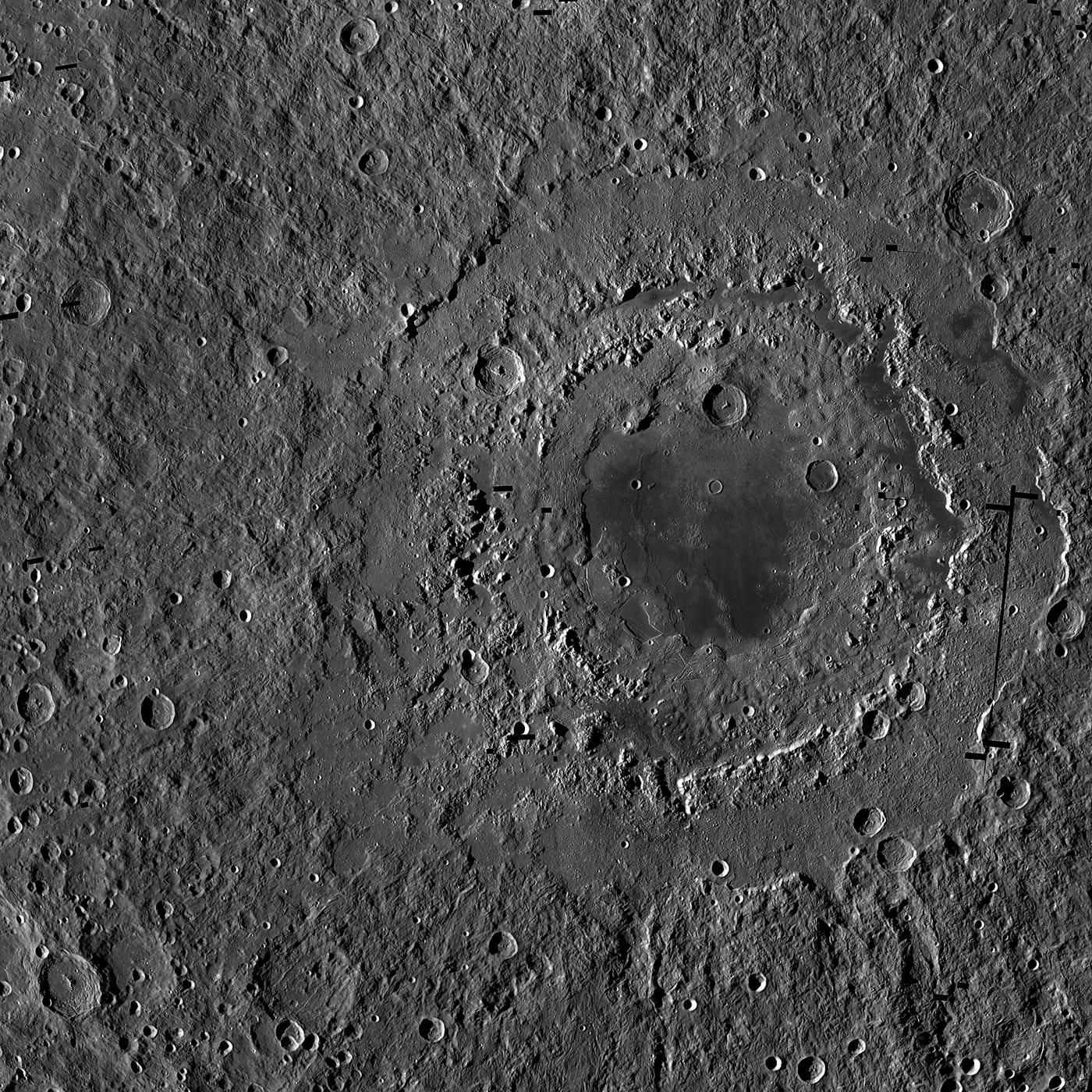
If you’ve ever wanted to download a ginormous image of the Moon and explore it, now’s your chance: the Lunar Reconnaissance Orbiter Camera folks have released a monster 185 megapixel image of one of the biggest smackdowns on the Moon: Orientale Basin.

lro_orientale

Yowza! Click to get the 1400 x 1400 pixel PNG, or you can try to swallow the 122 Mb TIF at the full resolution of 13,590 x 13,590 pixels!

Orientale is a vast impact basin, the hole left by an asteroid that hit the Moon about three billion years ago. Looking like a humongous bulls-eye, it’s a multi-ring crater, and the outer ramparts are a full 950 km (590 miles) across. That’s half again bigger than my home state of Colorado.

To give you an idea of just how big this is — and also, to be honest, to scare myself a little — I superimposed the picture of Orientale on a map of the United States. This is to scale, folks:

us_orientale

Holy. Frakking. Crap.

Whatever hit the Moon to create this basin must have been about 100 kilometers (60 miles) across. That would have made it 1000 times the mass of the asteroid that wiped out the dinosaurs. If something like that hit the Earth today, there would be no life left on our planet. At all. Happily, nothing that big is headed our way.

Oh, but what a sight that must have been. An impact that size would release the energy of 100 billion one-megaton hydrogen bombs. It would have been visible across the solar system! Amazingly, though, such events were a little more common back then; the solar system used to be filled with monster asteroids itching for a fight. That period of bombardment ended billions of years ago, though. Yay.

The image from LROC is pretty amazing. It’s actually a mosaic of quite a few individual images from the Wide Angle Camera. The resolution is about 100 meters per pixel in the full image. If you don’t want to download that big picture, you can interactively zoom in on the basin on the LROC website. The black areas are where data are missing (or where the Moon is modest, perhaps).

You can see that Orientale is not like other craters. The event was so huge that it punched right into the Moon, like a fist through a styrofoam sheet, and the crater left behind got partially filled up with lava. That’s why there’s no obvious rim and bowl shape you usually see in smaller craters. The multiple rings are not fully understood — it’s rather hard to model an impact that releases the energy of a few billion nuclear bombs — though they are common in giant impacts. It may be that waves of energy blasting out from the impact event ripple through the ground like earthquakes, and where they rebound and interact you get those rings.

Since the original event, other, smaller impacts have dotted it, but again I refer you to the map of the US above to see what "smaller" means in this case! Some are bigger than cities and counties. Surrounding the inner part of the basin is terrain loaded with scarps (steep cliffs), gullies cut by flowing lava, and cracks caused by the shifting landscape. It’s really worth your time to simply scroll around the interactive map and see what’s there. And remember, at highest zoom each pixel is about the size of a football stadium.

Friday, June 18, 2010 was the first anniversary of the launch of LRO. Consider this image a fantastic present to us!

Image credit: NASA/GSFC/Arizona State University


The green fire of the southern lights | Bad Astronomy

Check this out! The aurora australis — the southern lights — snakes its way across the Earth’s magnetic field as seen from above!

ISS_aurora_australis

Wow, that’s slick. It was taken on May 29th by an Expedition 23 astronaut aboard the International Space Station (it’s unknown which one; NASA and the astronauts decided to give the expedition the credit, not an individual crew member). At that moment, the ISS was 350 km (190 miles) above the Indian ocean, and the astronaut was looking south. You can see the limb of the Earth and some stars in the background as well. Click the picture to get a bigger version with more detail.

This aurora was probably caused by subatomic particles from an explosive event called a coronal mass ejection from the Sun five days earlier. The particles interact with our magnetic field, which channels them to the north and south poles. They slam into the air, ripping electrons off the atoms and molecules. When the atoms recombine, they give off light. The green glow seen here is characteristic of oxygen.

The aurorae are usually between 80 – 160 km (50 – 100 miles) above the Earth’s surface, so the ISS was actually higher up. However, the station was a couple of thousand kilometers away from the lights when this shot was taken.

I’ve only seen the northern lights (technically, the aurora borealis) once, when I lived in Maryland years ago… and it was just a faint red smear to the north. Someday I hope to see it in its full glory. But even then, it must pale — literally — to seeing such a thing from space.

Picture credit: NASA/Expedition 23


“Here be dragons” | Gene Expression

I just stumbled onto two amusing articles, Ancient legends once walked among early humans?, and The discovery of material evidence of a distinct hominin lineage in Central Asia as recently as 30,000 years ago is no surprise. The second is a letter from a folklorist:

Sir, The discovery of material evidence of a distinct hominin lineage in Central Asia as recently as 30,000 years ago (report, Mar 25) does not come as a surprise to those who have looked at the historical and anecdotal evidence of “wild people” inhabiting the region. The evidence stretches from Herodotus to the present day. The Russian historian Boris Porshnev suggested that they are relict Neanderthals, although the lack of evidence of material culture suggests a type closer to Home erectus.


Needless to say many are skeptical of folk memories persisting for 30,000 years, though a standard assumption in paleontology is that the earliest and last fossil find of any given species is going to underestimate their period of origin and overestimate the period of extinction. In other words the Denisova hominin lineage almost certainly persisted more recently than 41,000 years ago. But recently enough to spawn legends of Enkidu? I’m skeptical. Someone with a better grasp of the mutation rate in oral history can clarify, but it seems that tall tales would be so distorted over a few thousand years that the initial kernel of truth would quickly be obscured.

Here’s my model for why almost all cultures have tales of various semi-human groups: cross-cultural differences are stark enough that it isn’t too hard to dehumanize other populations. More specifically, I think the biggest gap is going to be between groups who practice different modes of production. Many of the “wild people” as perceived by agriculturalists were probably just marginalized hunter-gatherers who hadn’t taken up the ways of “humans.” Consider how many upper middle class white Americans perceive rural people from Appalachia even in our enlightened age. There are even biological differences, as agricultural populations seem smaller and more gracile in comparison to hunter-gatherers (who consume more fibrous food stuffs, and probably have a more balanced nutritional intake). How hard is to conceive of a small and malnourished agriculturalist being cowed by more robust hunter-gatherer group upon first contact?*

Combine real cultural and biological differences with human imagination, and it seems that this is the most likely explanation for the universality of wild people and strange semi-human folk. It is in other words simply an aspect of evoked culture, nothing that needs special triggers in the form of other human lineages. The main exception I can think of would be Flores Hobbits, who may have persisted down to a very recent period.

* The immediate objection to this possibility is that hunter-gatherer groups tend to get sick very quickly with the approach of high density humanity, and already pushed to less productive land by the time they’re confronting the agriculturists on a daily basis. So they are less likely to be robust.

Teddy | The Intersection

Having just adopted Happy from Austin Pets Alive!, I'm delighted to feature a shelter in this week's edition of the Science of Kissing Gallery. Paige Miller with Salt Lake County Animal Services submitted her photo of a volunteer socializing Teddy--a gorgeous pitt bull looking for his forever home. Of course, dogs make a notable appearance in The Science of Kissing and to those considering a new best friend, I highly recommend adopting from your local shelter! Submit your original photo or artwork for consideration in the gallery here.


Cuckoldry more common in past generations | Gene Expression

We have some data that in fact older generations were more sexually promiscuous, contrary to the moral panic perpetually ascendant. As a follow up to my previous post, there is some scholarship which suggests that misattributed paternity rates have been declining. Recent decline in nonpaternity rates: a cross-temporal meta-analysis:

Nonpaternity (i.e., discrepant biological versus social fatherhood) affects many issues of interests to psychologists, including familial dynamics, interpersonal relationships, sexuality, and fertility, and therefore represents an important topic for psychological research. The advent of modern contraceptive methods, particularly the market launch of the birth-control pill in the early 1960s and its increased use ever since, should have affected rates of nonpaternity (i.e., discrepant genetic and social fatherhood). This cross-temporal meta-analysis investigated whether there has been a recent decline in nonpaternity rates in the western industrialized nations. The eligible database comprised 32 published samples unbiased towards nonpaternity for which nonoverlapping data from more than 24,000 subjects from nine (mostly Anglo-Saxon heritage) countries with primarily Caucasian populations are reported. Publication years ranged from 1932 to 1999, and estimated years of the reported nonpaternity events (i.e., the temporal occurrence of nonpaternity) ranged from 1895 to 1993. In support of the hypothesis, weighted meta-regression models showed a significant decrease (r = -.41) of log-transformed nonpaternity rates with publication years and also a decrease, albeit not significant (r = -.17), with estimated years of nonpaternity events. These results transform into an estimated absolute decline in untransformed nonpaternity rates of 0.83% and 0.91% per decade, respectively. Across studies, the mean (and median) nonpaternity rate was 3.1% (2.1%). This estimate is consistent with estimates of 2 to 3% from recent reviews on the topic that were based on fewer primary studies. This estimate also rebuts the beliefs and hearsay data widespread among both the public and researchers which contend nonpaternity rates in modern populations might be as high as about 10%.

I don’t have academic access, so I can’t say much more than that (if someone wants to email me the paper, contactgnxp -at – gmail -dot- com will work). Obviously I don’t think this is implausible on the face it; the “good old days” were often a lot less “good” than we remember (or what our elders remember and tell us).

Addendum: If you are from the cuckold enthusiast community, yes, I am aware that your perspective on whether the good old days were good may differ….

The paternity myth: the rarity of cuckoldry | Gene Expression

An urban myth, often asserted with a wink & a nod in some circles, is that a very high proportion of children in Western countries are not raised by their biological father, and in fact are not aware that their putative biological father is not their real biological father. The numbers I see and hear vary, but 10% is a low bound. People are generally not convinced when I point out that this would mean that nearly 30% of paternal grandfathers are not paternal grandfathers. Most of my scientist acquaintances fancy up the myth by suggesting that they received this datum from research on family groups (where you have to take into account the error introduced by paternity misattribution) or organ matching for purposes of donation.

Evolutionary biologist Marlene Zuk has some informal survey data which she presents in an article in The Los Angeles Times:

With DNA tests now widely available, so-called paternity fraud has become a staple of talk shows and TV crime series. Aggrieved men accuse tearful wives who profess their fidelity, only to have their extramarital affairs brought to light. Billboards in Chicago and other cities provocatively ask, “Paternity questions?” and advise that the answers are for sale at your local pharmacy in the form of at-home DNA paternity tests. Some fathers’-rights groups in Australia have called for mandatory paternity testing of all children at birth, with or without the mother’s consent or even her knowledge.

And people are pretty well convinced there is a need for all this vigilance. When asked to estimate the frequency of misassigned paternity in the general population, most people hazard a guess of 10%, 20% or even 30%, with the last number coming from a class of biology undergraduates in a South Carolina university that I polled last year. I pointed out that this would mean that nearly 20 people in the class of 60-some students had lived their lives calling the wrong man Dad, at least biologically. They just nodded cynically, undaunted. Even scientists will quickly respond with the 10% figure, as a geneticist colleague of mine who studies the male sex chromosome found when he queried fellow biologists at conferences.

What are the real numbers? Zuck asserts that they’re more in the 1-5% range, with 3.7% being a high-bound figure for one study. This varies by culture and socioeconomic group, and the segment of the population being surveyed. Studies which rely on a data set consisting of men who have requested paternity tests are strongly sample biased toward those who have a reason to have suspicions. It’s somewhat like some of the critiques of the Kinsey Reports and deviant sexual behavior; if you survey sexual deviants (however you define that) to get a sense of the proportion of deviancy in the population you’re going to get a higher than representative figure. And yet even in the cases of men who have suspicions only a minority have misattributed paternity.

What is this telling us? As I said above my own interactions are with people of generally liberal inclinations and values, and the high paternity uncertainty numbers aren’t offered up as evidence of the lascivious nature of women or the degraded state of modern morals. Rather they’re presented as evidence of gender equality, sexual liberation, and a generally praiseworthy reflection on the weak emphasis of genetic ties as the root of the parenting bond. But what if both assessments (positive and negative) of perceived low paternity confidence emerge from the same evolutionary psychological bias: to weigh false positives much more highly than false negatives in terms of plausibility. In other words, it doesn’t hurt to be suspicious about something as important as paternity in fatherhood (from an evolutionary perspective; something which is going to be generalized across the kin group, not just for the male in question). More generally it doesn’t hurt to be suspicious or a little over-active in your imagination as a rule. This is one of the major models for why people see supernatural agents all around them, it’s evidence of an over-active agency detection module in your brain which incurs minimal cost for false positives (waste a lot of time propitiating ghosts and gods) in comparison to the deleterious consequences for false negatives (you ignore the threat of a dangerous animal or a hostile tribal band and get killed).

Since I’ve only presented assertion so far, let me point to one of the most thorough cross-cultural studies I’ve stumbled upon, How Well Does Paternity Confidence Match Actual Paternity?:

This survey of published estimates of nonpaternity suggests that for men with high paternity confidence, nonpaternity rates are typically 1.7% (if we exclude studies of unknown methodology) to 3.3% (if we include such studies). These figures are substantially lower than the “typical” nonpaternity rate of 10% or higher cited by many researchers, often without substantiation…or the median worldwide nonpaternity rate of 9% reported by Baker and Bellis…

Men who have low paternity confidence and have chosen to challenge their paternity through laboratory testing are much less likely than men with high paternity confidence to be the fathers of their putative children. Although these men presumably have lower paternity confidence than men who do not seek paternity tests, this group is heterogeneous; some men may be virtually certain that the putative child is not theirs, while others may simply have sufficient doubts to warrant testing. Most of these men are in fact the fathers of their putative genetic children; only 29.8% could be excluded as biological fathers of the children in question.

To me it’s striking that the majority of the men who have low paternity confidence and suspicion enough to submit to a paternity laboratory are still the biological fathers of their offspring! In fact, the rates of non-paternity among this set is closer to the urban myth proportions found among the lay public. Of course it is this set of men who show up on the Jerry Springer show, not men confident in their paternity, so the public may be getting a false cultural picture of frequencies which they’re projecting.

Since you want data, here are the relevant tables.

pat1

pat2

pat3

pat4

Obviously there’s some variation. The rule of thumb seems to be that males of higher socioeconomic status, and from more conventionally bourgeois societies, have greater warranted paternity confidence. Lower paternity confidence among those who are the principals for sensational media shouldn’t be surprising then. But if you’re a Bayesian you should “update” accordingly (if you know what Bayesian probability is, you are probably the type of person who shouldn’t worry*).

In fact, from what I know about contemporary genetic genealogy they’re reinforcing the the idea that when paternity confidence is high, it is high for a reason. Men who are interested in their patrilineage often get their Y chromosomes sequenced, and it turns out that in societies such as England where surnames have a relatively deep history in some families (generally high socioeconomic status ones) the vast majority of men share the same male ancestor hundreds of years in the past. The balance share many different other male ancestors (usually following a power law distribution) . What’s going on is that each generation some males will have misattributed paternity, so the original male with a particular Y chromosome and surname will pass on the surname, but not the Y chromosome. The disjunction between these two in a given generation from t = 0 can be used to infer approximate rates of cuckoldry. If for example only 1% of males in each generation are from genetic lineages outside of the primary one assumed in their family, then after 100 generations only 37% of males will be from the original lineage to which the surname was associated. In contrast if you assume a 10% figure then it will only take 10 generations to reach an equivalent proportion (10 generations is about 250 years, which is a short enough time period so that many males from Western nations could track their male ancestor and their distant relatives relatively easily through parish records, so these back-of-the-envelopes are easily checkable now).

With the spread of genetic sequencing for recreational and health reasons arguments by some groups for mandatory paternity testing will seem quaint as the information will be available as a matter of course. Nevertheless there is going to be the conventional hand-wring from bioethicists as to whether to share the data, in part to preserve the family unit. Here’s a somewhat dated survey result from 1998:

….On the issue of misattributed paternity, two thirds of US medical geneticists would not disclose this information to a woman’s partner, even if he asks, because the disclosure might jeopardize the marriage or endanger the woman. In contrast, three quarters of potential counselees believe that the physician should give this information to a partner who requests it, after informing the woman of the intent to do so…Possibly, the counselees presume that the unit of confidentiality is the family, not the individual, or are less aware of potential adverse consequences of disclosure.

In an interesting coda to this story, barring government action to make this information unavailable without professional assistance (I’m skeptical that this would happen), the ubiquity of genetic testing no matter its utility in the near future will make these disclosures by professionals only selectively relevant. If you’re intelligent it shouldn’t be that hard to analyze the data, skim the results, or find someone willing to do so for a nominal sum (I’m assuming there will be software which will do a lot of the analysis of your raw sequence which you can input from a file yourself). But it is the less intelligent and unsure who are the ones who have to worry most about paternity uncertainty, and the ones least likely or unable to understand the clear confirmation of misattributed paternity in the data (I’ve seen some papers which claim that some fathers who know their child has a recessive disease, and also find out they’re not a carrier of the recessively expressed allele, still can’t connect the dots!).**

* Yes, I’m making a normative assumption here that if you’re male you should be displeased if you find out that children whom you assumed were your biological offspring turn out not to be. If, on the other hand, you think it’s fun and adds more zest to your life, you’re just kind of weird. Sorry if I sound prejudiced, but I know that the cuckold community is going to link to this post, so I’m hoping you guys don’t start leaving angry comments for disabusing you of your fantasies, as has occurred before when I post on this.

** By the way, if misattributed paternity was very common in the past because men didn’t care one would assume that evolutionary pressures would have selected against it until it was rare. So if the urban myth figure was correct, it would be relatively new, or, there’s no heritable trait associated with getting cuckolded and it happened in a scattershot fashion across the population.

Citation: Anderson, K. (2006). How Well Does Paternity Confidence Match Actual Paternity? Evidence from Worldwide Nonpaternity Rates Current Anthropology, 47 (3), 513-520 DOI: 10.1086/504167


Penn’s – and the syringe’s – point | Bad Astronomy

Sure, you know Penn Jillette — the larger, louder half of Penn & Teller. Penn’s an interesting character — a vocal skeptic, to say the least, in that what’s on his mind is on his lips. He and I don’t always agree, but when we do, we do.

Such is the case with antivaxxer Dr. Andrew Wakefield, the long-discredited and now disbarred guy who started the whole modern craze of getting preventable diseases to resurge. I’ve been pretty clear about what I think of Dr. Wakefield, and now you can see what Penn thinks, too, on his new online show Penn Point:

[Warning: It's Penn, so duh, it's NSFW.]

Penn — the father of two cute, precocious kids, I’ll note — was gracious in mentioning one of my own blog posts eviscerating Wakefield, and there are plenty of others, too. I’m glad Penn’s putting his weight behind this as well. On his show, on stage, and online, he’s been loud and clear on his stance about "alternative" medicines, and his reach is long. I hope any parents even thinking of not vaccinating watch this video. You might save your own kid’s life, and the lives of many others.

I can’t think of a better message for Father’s Day, in fact.


A Sculptor VISTA

The new VISTA telescope takes a look at NGC 253. Click for larger. Credit: ESO

Looks like the new Visible and Infrared Survey Telescope (VISTA) at the ESO facility in Chile is doing quite nicely as this image of NGC 253, a member of the  Sculptor Galaxy group shows.  Seems like there’s been a few breakthroughs in imaging technology lately.

They didn’t mention any globular clusters around the halo, I wonder if they are any there and what the absence might say about the age of this beautify spiral galaxy.

Here’s the ESO press release:

The Sculptor Galaxy (NGC 253) lies in the constellation of the same name and is one of the brightest galaxies in the sky. It is prominent enough to be seen with good binoculars and was discovered by Caroline Herschel from England in 1783. NGC 253 is a spiral galaxy that lies about 13 million light-years away. It is the brightest member of a small collection of galaxies called the Sculptor Group, one of the closest such groupings to our own Local Group of galaxies. Part of its visual prominence comes from its status as a starburst galaxy, one in the throes of rapid star formation. NGC 253 is also very dusty, which obscures the view of many parts of the galaxy (eso0902). Seen from Earth, the galaxy is almost edge on, with the spiral arms clearly visible in the outer parts, along with a bright core at its centre.

VISTA, the Visible and Infrared Survey Telescope for Astronomy, the latest addition to ESO’s Paranal Observatory in the Chilean Atacama Desert, is the world’s largest survey telescope. After being handed over to ESO at the end of 2009 (eso0949) the telescope was used for two detailed studies of small sections of the sky before it embarked on the much larger surveys that are now in progress. One of these “mini surveys” was a detailed study of NGC 253 and its environment.

As VISTA works at infrared wavelengths it can see right through most of the dust that is such a prominent feature of the Sculptor Galaxy when viewed in visible light. Huge numbers of cooler stars that are barely detectable with visible-light telescopes are now also seen. The VISTA view reveals most of what was hidden by the thick dust clouds in the central part of the disc and allows a clear view of a prominent bar of stars across the nuclear region — a feature that is not seen in visible light pictures. The majestic spiral arms now spread over the whole disc of the galaxy.

The spectacular viewing conditions VISTA shares with ESO’s Very Large Telescope (VLT), located on the next mountain peak, also allow VISTA images to be exceptionally sharp for a ground-based telescope.

With this powerful instrument at their command astronomers wanted to peel away some of the mysteries of the Sculptor Galaxy. They are studying the myriad of cool red giant stars in the halo that surrounds the galaxy, measuring the composition of some of NGC 253’s small dwarf satellite galaxies, and searching for as yet undiscovered new objects such as globular clusters and ultra-compact dwarf galaxies that would otherwise be invisible without the deep VISTA infrared images. Using the unique VISTA data they plan to map how the galaxy formed and has evolved.

NCBI ROFL: Superglue in the ear double feature: pros and cons. | Discoblog

earsA new technique for removing foreign bodies of the external auditory canal.

“Foreign bodies of the external auditory canal are a common and challenging problem. Several techniques have been described and utilized to remove the many objects placed in ears. The tightly wedged smooth round foreign body remains one of the most difficult to remove. A new method, using a cyanoacrylate adhesive (Super Glue) was used successfully to remove a soy bean in a 16-year-old male. The glue was placed on the blunt end of a cotton swab, which was then introduced into the canal to make contact with the bean. Removal was easy, safe, and effective. This procedure avoided the morbidity associated with many well known techniques, eg, the use of forceps, and may have prevented removal under general anesthesia.”

glue 1

A novel approach to the removal of superglue from the ear.

“The ability of superglue (a cyanoacrylate adhesive) to bond strongly and quickly to skin presents considerable problems when it is inserted into the ear. A case of a patient who inadvertently self-administered Bostik superglue into her left external auditory meatus is reported. The superglue was removed successfully, in the form of a cast, with warm three per cent hydrogen peroxide without damaging the meatus or the typanic membrane. The use of hydrogen peroxide to remove superglue from the ear has not been described previously.”

glue 2

Photo: flickr/darkpatator

Related content:
Discoblog: NCBI ROFL: Nasal leech infestation: report of seven leeches and literature review.
Discoblog: NCBI ROFL: “Here’s egg in your eye”: a prospective study of blunt ocular trauma resulting from thrown eggs.
Discoblog: NCBI ROFL: Top 5 insensitive titles!

WTF is NCBI ROFL? Read our FAQ!


Your Clue Is: “This Robot Will Attempt to Crush Humans in ‘Jeopardy!’” | 80beats

jeopardyIs the human brain in final jeopardy?

Last April IBM announced its newest plan to crush humans in the gaming sphere: After taking us to task at chess, it would conquer us at “Jeopardy!” Since then the game show-playing robot, Watson, has been in development (cue 80’s training montage featuring computer programmers). J-Day approaches, and this fall the battle should commence.

The Game

In a lengthy New York Times Magazine feature on Watson this week, some of the details of the match became clear. It will take place this fall on national television.

Watson will not appear as a contestant on the regular show; instead, “Jeopardy!” will hold a special match pitting Watson against one or more famous winners from the past. If the contest includes Ken Jennings — the best player in “Jeopardy!” history, who won 74 games in a row in 2004 — Watson will lose if its performance doesn’t improve. It’s pretty far up in the winner’s cloud, but it’s not yet at Jennings’s level… The show’s executive producer, Harry Friedman, will not say whom it is picking to play against Watson, but he refused to let Jennings be interviewed for this story, which is suggestive [The New York Times].

The Preparation

If you’ve always yearned for “Jeopardy!” to feature the same kind of obsessive game-planning and secrecy as professional sports, this is your time. While folks on the show’s side won’t reveal the human contestants, the folks on the IBM side are busy testing Watson against humanity in mock “Jeopardy!” games. They even found a fake Alex Trebek (and no, it’s not Will Ferrell).

I.B.M.’s scientists began holding live matches last winter. They mocked up a conference room to resemble the actual “Jeopardy!” set, including buzzers and stations for the human contestants, brought in former contestants from the show and even hired a host for the occasion: Todd Alan Crain, who plays a newscaster on the satirical Onion News Network [The New York Times].

The Words

Deep Blue didn’t need words. Chess is a game of math and strategic logic, a game reducible to numbers and therefore ideally suited to an IBM supercomputer. “Jeopardy!” is something different: It may reward machine-like memorization of trivia, but you have to understand what you’re being asked before your brain can go get it. That’s the AI problem for Watson’s creators.

The biggest hurdle machines have to overcome in truly glorious human pursuits such as “Jeopardy!” is to gain an instinctive appreciation for natural language. It’s the puns, the jokes, the linguistic idiosyncrasies that have tended to stifle the most ambitious of machines. However, Harry Friedman, executive producer of “Jeopardy!,” was effusive in this IBM video. “I think we’ve gone from being impressed to blown away” [CNET].

Watson’s proficient even at those groan-inducing “Before and After” clues. Perhaps because it has no feelings.

The Potential

Winning on “Jeopardy!” is, of course, the pinnacle to a life’s work, but the supercomputer Watson might achieve more than racking up enough winnings to finally afford that New Zealand vacation. Computers that could just understand and correctly interpret your query and find answers would be an enormous advance, says IBM’s David Ferrucci.

Ferrucci was never an aficionado of “Jeopardy!” (“I’ve certainly seen it,” he said with a shrug. “I’m not a big fan.”) But he craved an ambitious goal that would impel him to break new ground, that would verge on science fiction, and this fit the bill. “The computer on ‘Star Trek’ is a question-answering machine,” he says. “It understands what you’re asking and provides just the right chunk of response that you needed. When is the computer going to get to a point where the computer knows how to talk to you? That’s my question” [The New York Times].

Computers that get subtlety? Humanity, I hope you enjoy parting gifts.

Related Content:
80beats: Watson, an IBM Supercomputer, Could Be the Next “Jeopardy!” Champion
Discoblog: First Chess, Now Poker? Computer Programmers Try To Crush Human Competitors
DISCOVER: Deeper Blue?

Image: Jeopardy!


Daily Data Dump – Thursday | Gene Expression

Eye Color Predicts and Doesn’t Predict Perceived Dominance. First, the study replicates the common finding of some differences in perceived dominance between blue vs. brown-eyed males. But, they observed that when the eye colors were digitally manipulated the dominance ranking did not change. In other words the eye colors seem to have correlated with other traits of masculinity, rather than been a causal signal. The authors offer up a model whereby socialization of blue eyed individuals for longer periods as children (because the trait is neotenous) produces less facial masculinization. But I don’t buy the idea that this couldn’t be genetically mediated by variation on the HERC2/OCA2 locus (where most blue vs. non-blue eye color variation is controlled). In particular, I believe there’s a body of literature that melanin and testosterone production pathways affect each other so that there is a positive correlation, though the exact causal connections are still to be worked out. Note that all this only applies within populations; between population complexion differences don’t necessarily predict dominance differences because the genetic variates are not controlled as they are within populations.

Were The Americas Settled Twice? In the USA this scientific question has social-political implications, as Native American/Amerindian political rights have become excessively (to my mind) connected to self-identity as primal autochthons. Doing a reductio ad absurdum on this is too easy.

Population size predicts technological complexity in Oceania. This sort of result has obvious general implications (see McNeill and McNeill’s The Human Web). I assume Garett Jones would not be surprised.

Google Scholar Blog.

How to always have interesting conversations. Interesting is obviously a relative term. Additionally, probably best to apply a two-tier strategy. Tier-1 involves avoiding expending time/energy talking to boring people outside of cognitive autopilot, and tier-2 involves seeking out those with common interests among the non-boring set.