Jeopardy Champion: Of Course Watson Kicked the Humans’ Butts—It Wasn’t a Fair Fight | Discoblog

This post is from Discoblog contributor LeeAundra Keany, a one-time Jeopardy Champion. After blowing all her winnings (a story for another blog post), she had to go back to work as an executive communications coach. In her spare time, LeeAundra has written written articles for Discover, including “Anatomy of a Brain Fart,” “20 Things You Didn’t Know About Death,” and “Can a Drunk Person Fly the Space Shuttle?

I haven’t watched Jeopardy! in years. Prepping a little too intensely for my 2005 appearance soured me on the show. (Who brings almanacs, Shakespeare for Dummies, and the periodic table to Burning Man?) It was only Watson that brought me back into the fold. And it was an unsettling reunion to say the least. Watson was flabbergastingly good and I knew within the first few minutes of Monday’s inaugural match that he would’ve cleaned my clock. But now, even as the mighty Brad Rutter bows in defeat and heretofore unstoppable Ken Jennings “welcomes our new computer overlords” (he actually wrote that under his answer in Final Jeopardy after the last game), I for one am urging humanity to not give ...


Supersymmetry Still In Hiding | Cosmic Variance

After a long and occasionally difficult road to turning on, most people are just thrilled that the Large Hadron Collider is up and running smoothly. But already in its young life the LHC has collected enough data to yield impressive physics results. Unfortunately, those have mostly been of the form “we haven’t seen anything new yet.”

One new thing we would like to see is supersymmetry. The two big multi-purpose detectors at the LHC, named ATLAS and CMS, have both done searches for SUSY in the new data and come up empty-handed. That doesn’t mean it’s not there, actually; a “search for SUSY” is typically a search for a particular kind of signal, often in a particular kind of model. There is so much data already that it’s takes time and more than a bit of ingenuity to search through it effectively. But we could have seen evidence by now, and we haven’t.

Here is a paper from CMS, and a paper from ATLAS. There’s also a great blog post describing the results by Flip Tanedo at US/LHC Blogs. If you like your exclusion plots a bit sassier, check out Résonaances, where Jester reproduces a plot from Alessandro Strumia.

Here’s one way of thinking about the results, from the ATLAS paper (via Flip’s blog post). They look at collisions that produce a particular kind of signal — one lepton, jets (collimated collections of strongly-interacting particles produced by quark or gluon decay), and missing energy (indicating particles like neutrinos that aren’t measured by the experiment directly).

Supersymmetry predicts lots of particles and lots of parameters, so you can’t realistically explore the whole parameter space and put it on a single plot. Instead, you fix some parameters and set others to zero, leaving a two-dimensional space of possibilities. In this case, the horizontal axis is a scalar mass parameter, and the vertical axis is a fermion mass parameter, in terms of which everything else is determined (within this highly constrained and frankly unrealistic parameterization).

The solid-color regions are the places where previous experiments (the Tevatron and LEP) had already ruled them out. The dark black line is the new limit from CMS, and the dark red line is the new limit from ATLAS. Everything below those lines is ruled out.

So: the LHC has ruled out a lot of parameter space that was previously allowed for supersymmetry. Which is too bad. Except that it’s very difficult to quantify what one means by “a lot” in this case. There are many different ways to parameterize the theories, and many different searches one can do. Nature could be surprising us; it wouldn’t be the first time. Bottom line: it’s too bad we haven’t found SUSY yet, but there’s certainly no reason to declare it dead.

But supersymmetry might just be out of reach, or completely irrelevant. Theorists have to keep an open mind, and watch what happens as the experimenters push forward. My hope has always been that we’ll discover something that nobody thought of ahead of time — that possibility is very much open!


“What Is Champion?” IBM’s Watson Seals Its Jeopardy Victory | 80beats


The scores (and the facial expressions of the beleaguered humans) say it all: Last night on Jeopardy, IBM’s Watson supercomputer completed its dominating victory over former champs Ken Jennings and Brad Rutter. The carbon-based life forms managed a few correct answers during the final game of the three-day match, but not nearly enough to overcome Watson’s smarts and speed.

Facing certain defeat at the hands of a room-size IBM computer on Wednesday evening, Ken Jennings, famous for winning 74 games in a row on the TV quiz show, acknowledged the obvious. “I, for one, welcome our new computer overlords,” he wrote on his video screen. [The New York Times]

Jennings, who spent much of the three-day extravaganza grimacing with frustration at not being able to buzz in ahead of Watson, wrote up his experiences for Slate today. Once the machine acquired the human skill of parsing Jeopardy questions, he writes, there was really no stopping it. If Watson knew the correct response, it was going to ring in first.

Jeopardy devotees know that buzzer skill is crucial—games between humans are more ...


The Milquetoasty Way | Bad Astronomy

I write about spiral galaxies here, and when I do it’s usually because they’re unusual. They’re really big, or small, or violent, or forming lots of stars.

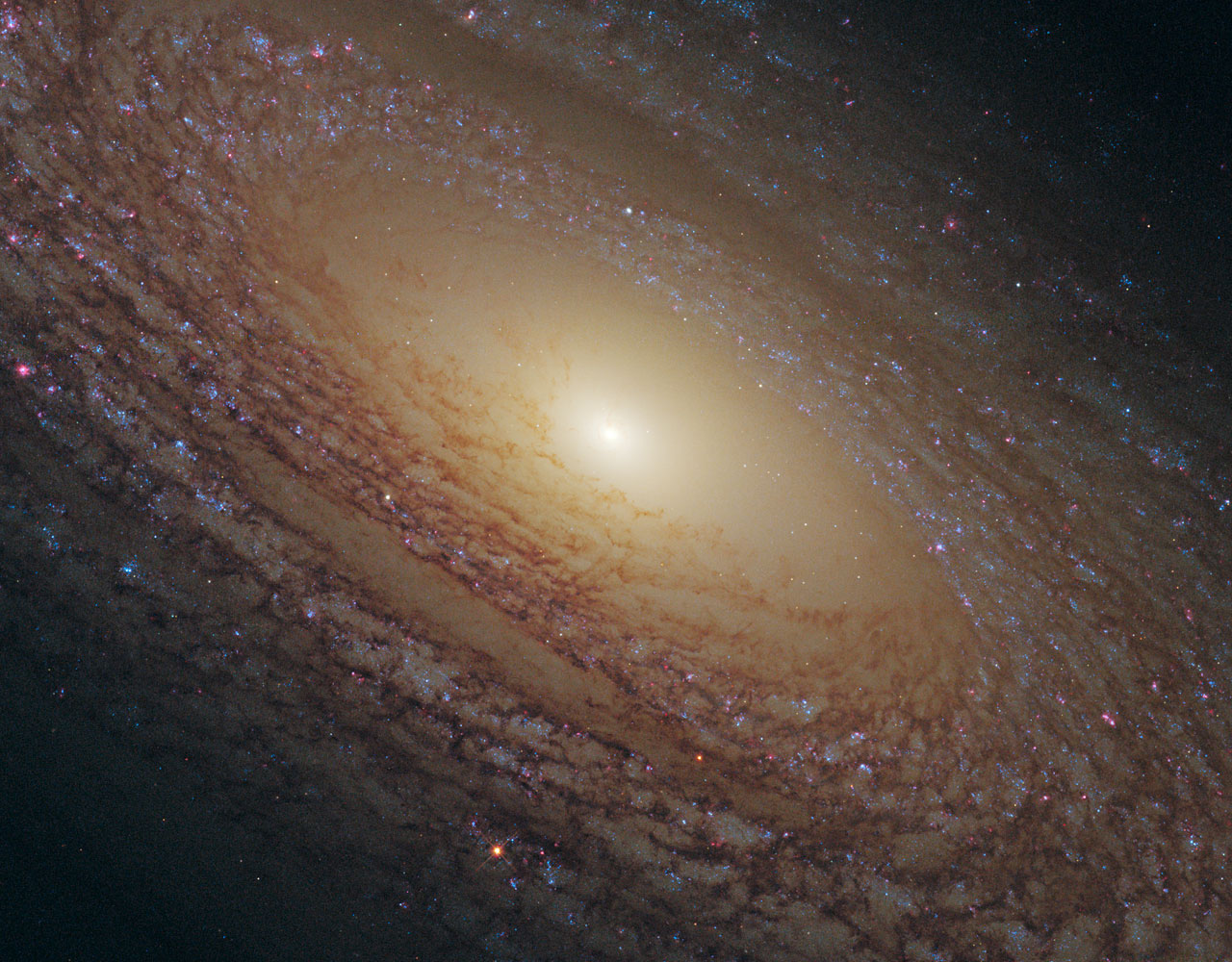
So how about one that’s entirely normal? But don’t let that fool you: it’s still gorgeous. Take a gander at NGC 2841, a perfectly normal spiral galaxy as seen by Hubble:

Breathtaking, isn’t it? Click it to galactinate, or grab the super-dooper 3400 x 3000 pixel high-res version.

NGC 2841 is about 45 million light years way. That kinda sorta close, but not too far, keeping with our theme of averageness. It’s not particularly extraordinary in any way — assuming that any time you see an object tens of thousands of light years across and possessing a hundred billion stars, you’re seeing something ordinary. This type of galaxy is called flocculent: with lots of short arms instead of a two or three long, grand, majestic ones.

It’s forming stars, but not many. Those blue patches are where stars are being born, and they seem small, well-behaved, and scattered evenly across the galaxy’s disk. Everything about this galaxy is, well, polite. It doesn’t ...


Montana Legislator Seeks to Repeal Physics (Unless it Benefits the State) | The Intersection

Via Peter Gleick, I come across this amazing story. Joe Read, a state legislator in Montana, has introduced a bill entitled “”AN ACT STATING MONTANA’S POSITION ON GLOBAL WARMING; AND PROVIDING AN IMMEDIATE EFFECTIVE DATE.” Here’s the text:

Section 1. Public policy concerning global warming. (1) The legislature finds that to ensure economic development in Montana and the appropriate management of Montana’s natural resources it is necessary to adopt a public policy regarding global warming.
(2) The legislature finds:
(a) global warming is beneficial to the welfare and business climate of Montana;
(b) reasonable amounts of carbon dioxide released into the atmosphere have no verifiable impacts on the environment; and
(c) global warming is a natural occurrence and human activity has not accelerated it.
(3) (a) For the purposes of this section, “global warming” relates to an increase in the average temperature of the earth’s surface.
(b) It does not include a one-time, catastrophic release of carbon dioxide.

So, as far as I’m concerned, this law would essentially repeal physics, because there is simply no doubt that carbon dioxide molecules in the atmosphere have an impact, and this is due to their basic radiative properties. Gleick agrees.

But drill down a bit, and the legislation becomes kind of interesting. Despite its incoherence, Read’s bill does suggest at points an awareness that carbon dioxide can be involved in climate change–but then offers this weird idea that “reasonable” amounts of carbon dioxide don’t matter, it’s only “a one time, catastrophic release” that matters.

Maybe it depends on what you mean by a “one time, catastrophic release.” From the perspective of the planet, the last 200 years are just the tiniest flicker in time. And there has been a catastrophic release.


Found: Human Skulls Used As Drinking Goblets 15,000 Years Ago | 80beats

From Ed Yong:

Stock fantasy villains might like to drink from the skulls of their enemies, but the practice has its roots in historical reality. For thousands of years, humans have turned each others’ skulls into containers and drinking cups. Now, Silvia Bello from London’s Natural History Museum has found the oldest skull-cups ever recorded in a cave in Somerset, England.

These include three skull-cups that Bello recovered in excellent condition. Two belonged to adults and one to a 3-year-old child. All of them were made by the Magdelanian culture, a group of prehistoric people who lived in Western Europe. No one knows how they used the grisly cups, but it’s clear that they manufactured them with great control. They all bear a large series of dents and cut-marks that were precisely inflicted.

For plenty more on this gruesome find—including a step-by-step guide to crafting a skull cup of your own, if you’re so inclined—check out the rest of Ed Yong’s post at Not Exactly Rocket Science.

Related Content:
DISCOVER: The Dawn of Civilization: Writing, Urban Life, And ...


AAAS Begins Today: International Climate Politics; Teaching Evolution in the Islamic World; Fracking Fractures; and much else | The Intersection

We are both here in Washington, D.C. (or will be soon) for the annual American Association for the Advancement of Science meeting. Some of the stuff happening is here. First off, John Holdren speaks tomorrow night, so everybody will be expecting pointed words on the science budget.

Meanwhile, let me pull a few threads–sessions that sound very cool and where I think I’d learn something:

Comparing National Responses to Climate Change: Networks of Debate and Contention
Friday, 18 February 1:30PM-4:30PM
Organized by: Jeffrey P. Broadbent, University of Minnesota, Minneapolis
SPEAKERS
Jeffrey P. Broadbent, University of Minnesota, Minneapolis
Comparing National Responses to Climate Change: Networks, Discourse, and Action
Dana R. Fisher, Columbia University, New York City
Understanding Political Discourse on Climate Change in U.S. Congressional Hearings
Sony Pellissery, Institute of Rural Management, Anand, India
Contestations on Climate Science in the Development Context: The Case of India
Sun-Jin Yun, Seoul National University, South Korea
Climate Change Media Debates in Korea
Jun Jin, Tsinghua University, Beijing, China
Role of Chinese Environmental NonGovernmental Organizations in International Talks
Koichi Hasegawa, Tohoku University, Sendai, Japan
Japan’s Climate Change Media and Politics: 2008–2009

Eugenie Scott has also organized a very cool session:

The Challenge of Teaching Evolution in the Islamic World
Friday, 18 February 3:00PM-4:30PM
Organized by: Eugenie C. Scott, National Center for Science Education, Oakland, CA
SPEAKERS
Taner Edis, Truman State University, Kirksville, MO
A Brief History of Islamic Creationism in Turkey
Jason R. Wiles, Syracuse University, NY
Teaching and Learning About Biological Evolution in the Muslim World
Salman Hameed, Hampshire College, Amherst, MA
The Future of Acceptance of Evolution in the Muslim World

And then there’s a study of this emerging environmental issue, which has the distinction of being at 8 am on a Sunday morning:

Fractures Developing: The Science, Policy, and Perception of Shale Gas Development
Sunday, 20 February 8:00AM-9:30AM
Organized by: John P. Martin, New York State Energy Research and Development Authority, Albany; Michele L. Aldrich, California Academy of Sciences, San Francisco
SPEAKERS
John P. Martin, New York State Energy Research and Development Authority, Albany
Gas Shales: Energy Rocks with Big Implications
Anthony W. Gorody, Universal Geoscience Consulting, Inc., Houston, TX
Addressing Environmental Angst: Baselines, Monitors, and Other Strategies
Abby Kinchy, Rensselaer Polytechnic University, Troy, NY
Fractious Citizens: Sociological Perspectives on the Hydraulic Fracturing Controversy

This is intellectual fare, but of course, AAAS is really a big party. Hope to see some folks there…


NCBI ROFL: Do aggressive people play violent computer games more aggressively? | Discoblog

Do aggressive people play violent computer games in a more aggressive way? Individual difference and idiosyncratic game-playing experience.

“This study investigates whether individual difference influences idiosyncratic experience of game playing. In particular, we examine the relationship between the game player’s physical-aggressive personality and the aggressiveness of the player’s game playing in violence-oriented video games. Screen video stream of 40 individual participants’ game playing was captured and content analyzed. Participants’ physical aggression was measured before the game play. The results suggest that people with more physical-aggressive personality engage in a more aggressive style of playing, after controlling the differences of gender and previous gaming experience. Implications of these findings and direction for future studies are discussed.”

Photo: flickr/Rad Jose

Related content:
Discoblog: NCBI ROFL: The ideal elf: identity exploration in World of Warcraft.
Discoblog: NCBI ROFL: Is Mr Pac Man eating our children? A review of the effect of video games on children.
Discoblog: NCBI ROFL: Gaming at work positively correlated with multitasking.

WTF is NCBI ROFL? Read our FAQ!


Lovely, frigid ripples | Bad Astronomy

The weather here in Boulder has been pretty warm lately, and most of the snow is gone. I know that this can change at any moment (and in fact we’re due for more snow in a day or so), and NASA has provided a chilling but ethereally lovely reminder that this winter has been one to remember:

This image was taken by the Terra satellite on November 24, and shows what happens when there is a confluence of three conditions. The first is extremely frigid arctic air blowing down from the north west. The second is warmer waters in the Atlantic; the air above the water gets humid and rises into the colder air, condensing to form clouds. But the third is what’s needed to make this amazing rippling effect: a layer of warm air above the cold layer, called a temperature inversion. This acts like a ceiling for the rising, condensing air below. The clouds that form can’t rise any higher, so they roll east with the moving air, forming these "streets".

I think the effect of this image is heightened by the lack of clouds over land; ...


Media me | Gene Expression

I’ve been rather busy this week, so few posts. But, I did a Bloggingheads.tv with Milford Wolpoff. We talk Out of Africa, Multiregionalism, and such. Second, The New York Times profiled Secular Right, where I’m a contributor. The quotes were accurate, though I do find it amusing that the reporter refers to me as an apostate, but not John Derbyshire (who until ~5 years ago was a confessing Christian). I suspect that in this day and age the term “apostate” only has strong valence in relation to Islam. For the record, several ex-Muslims have disputed my apostasy, since I barely ever believed in the Islamic religion.

Your Weekly Pause For Thought

UPDATE:  SOLVED by Dwight at 12:05 CDT

Bonjour!  Are we all ready to play riddle today?  I have a nice, easy, relaxing one for you.  It’s been a long week for me, so I’m ready to relax and play a little.

Today’s riddle subject is in the real world.  It is an object.  That’s it for the preliminaries, now for the clues:

A beauty in black and white, found on PhotoBucket

We mostly think of this in the singular, although it is made of many parts.

Although today’s subject is a modern discovery, something else like it has been known for centuries.

While we think of this as a “thing”, it is really more of a system, or aggregate, of many things together.

A collection of cuties

Probably hundreds of millions of years ago, this thing was at least one companion to a giant.

This thing’s “parent” has a distinction of its own.

There is good reason to believe that although this thing is considered a modern discovery, it may have been seen long ago.

Ah, my favorite color; shiny

Not all parts of this thing are visible at all times.

Although we know of other, like systems, today’s riddle answer is unique.
Today’s answer may be fairly close to you, but it’s difficult to see… like a mirage.

Nation Portrait Gallery, London - You know this man

Okay, there you are.  Get ready, get set, get it solved!  You know where to find me…

I’ve got your missing links right here (19th February 2011) | Not Exactly Rocket Science

Top twelve picks

The “Haworth Misadventure” is over but it seemed important to collect some links for reference, given that it was one of the more interesting things to happen this week. For those who don’t know the story, it started on Saturday when I had a spot of bother getting hold of a scientist’s contact details thanks to a none-too-helpful press officer called Aeron Haworth. I put up the email chain on my Posterous blog (including the now-infamous line “I think you have all you need for a blog”), which led to an all-out outing on Ivan Oransky’s Embargo Watch and a… er… lively comment thread. Maryn McKenna did the best job of summarising the subsequent events and collating links to the various takes (of which I’ll highlight Deborah Blum’s not least because it offers support to all science blogs and because I chuckled at the bit where she dusts off her Pulitzer and uses it as a rhetorical cosh). See also Bob’O’Hara, David Harris, MediaBistro and others. After a private and public apology on Wednesday, I accepted and drew a line underneath the matter. Subsequently, Tabitha Powledge and Charlie Petit did some post-mortems at the NASW and KJST sites. And another related story about a journalist forgetting the power of words on Twitter.

Wild animals devour an elephant in time-lapse. One hyena gets almost inside the thing!

How IBM’s Watson computer excels at Jeopardy! John Rennie explains. I bet I could take it in chess-boxing though. Meanwhile, in a case of Dr Watson meets Dr House, IBM are planning to apply Watson’s tech to medical diagnoses.

Andrea Kuszewski delivers a data smackdown on the recent “thinking-cap” paper, which claimed to produce insight with electrical stimulation. Do not miss the second half. Also on that study: thinking caps are pseudoscience masquerading as neuroscience, say a trio of scientists in the Guardian. And here’s my original take on that study

Evolution (well, mutation) in 500 lines. Wonderful.

How do you sedate a bear? Dangle a very brave man head-first into its den with syringe of tranquilizer on a pole. And you get a cool video of a snoring bear and some great data on hibernation.

Around the world in 800 days – be sure to catch up on Gaia Vince’s amazing trek across 36 countries and 5 continents, looking at the human impacts of climate change and biodiversity loss.

A great guest post by Ivan Oransky on Gary Schwitzer’s blog: why negative studies are good for health journalism & where to find them

Ooh, fascinating. Flies sniff out the difference between hydrogen and deuterium using quantum smelling. Notable because the author addresses criticisms in the comments. More coverage from New Scientist.

Rats. Wearing pants. For SCIENCE!

How wastewater stations could help to weed out illegal drug use in London’s 2012 Olympics, by Brian Mossop.

Phantom pregnancies. In men. Wonderful stuff from Emily Anthes.

Science/writing/news

An interesting interview with Frans de Waal, a fantastic scientist and writer, talking about emotion and intelligence in apes.

Firstly, it’s a filter-feeder. Also, it’s a MURAL!

How scientists unintentionally cured baldness in mice

Nature paper suggests climate change doubled or trebled risk of UK floods of 2000 – “the first time scientists have quantified the role of human-induced climate change in increasing the risk of a serious flood”

GCSE exam evolution FAIL – a teacher’s take on a ridiculous exam question, by Julia Anderson.

Roger Highfield talks about the end of BSE and our understanding of other prion diseases, a nice counterpoint to my post earlier this week on prion-ish proteins in ALS

Why you should avoid getting pregnant on the way to Mars. Every time Ian Sample writes about space, we all win.

Hummingbird robots

To reduce this overflowing cornucopia of crap, the government is calling in reinforcements in the form of 11 Australian dung beetle species.”

I KNEW IT! Science proves that people take longer to leave a parking spot if you’re waiting for it!

Got a Nobel prize (or similar)? Then work in China and get paid $23 million.

Ben Goldacre, Petra Boynton and others debate the existence of Female Sexual Dysfunction

DRAAAAAAINAAAAAAGGE! Antibiotics and antibiotic-resistant bugs in our water.

The scientists who are trying to speak with dolphins (and a slightly tenuous link to aliens and SETI)

Richter scale for media events: stories on blogs spread like earthquakes

Are cities “our species’ greatest invention” asks the Economist Do they make us more inventive/productive?

Which A-Levels should you study if you want to get into a top university? Tom Hartley’s analysis gives a thumbs-up to science.

IMRAN VICTOR! “The Campaign for Science and Engineering (CaSE) today claimed that the Government’s new immigration rules represented a victory for the science and engineering sectors. The new proposals give significant rewards to applicants with science and engineering qualifications.”

That Brian Switek can’t help spoiling super-predators with his “facts”. First the terror-birds, then the mega-bear.

A fascinating NYT piece about the value that different government agencies put on a human life.

Natural selection limits how many attractive males can exist in a population? Screw you, evolution.

Containers of jokes and metaphors – Stan Carey talks about the scaffolding beneath the structure of our imaginations

Tenrecs – hedgehog-like mammals that live in Madagascar – have been filmed using their quills to communicate.

For Valentine’s day – when intelligent people the world over forget that emotion comes from the brain not the heart – Jason Goldman gave Valentine’s tips for lovestruck scientists, Christian Jarrett provided some great evidence-based wooing tips, David Manly writes about animal sex, and the Smithsonian put up a cool pic of the world’s first artificial heart

“The nerd defense” Study shows jurors less likely to convict those with spectacles

1 in 8 psychotherapists have a patient who confesses to murder

“Another group believe Monckton is vulnerable to ridicule because he accepts basic physics.” Sigh.

Study finds botox may make people actually feel happier by paralyzing frown muscles.

Lie Detection: Misconceptions, Pitfalls, and Opportunities for Improvement

Heh/wow/huh

Anthropologists trace human origins back to one large goat.

Did you read that New Yorker piece last week? This is a bit perfect.

An Open Letter to Stephen Fry. Pure joy.

The Good, the Bad, & the Cell Type-Specific Roles of HIF-1 in Neurons & Astrocytes” Papers named after movies and songs.

Have you noticed how it’s sometimes quite difficult to write about science without making it all sound like a sinister abduction plot? “The researchers took 10 people and…” ”They followed 2500 people for 7 years and…”

A truly wonderful animation about the placebo effect in 3 mins.

“I was trailing a squirrel and crouched to shoot it with my blowpipe when I saw the tiger.”

If Apple made water

Hehe. Cuts in UK science journalism take their toll on New Scientist.

This genius got a homophobic Leviticus tattoo. Leviticus forbids tattoos.

Journalism/blogging/internet

Go and support Jennifer Ouellette & the crew at Cocktail Party Physics on their 5th bloggoversay

It’s an absolute joy to see a science book on the shelves of my local supermarket amid the crime fiction and chick-lit. No prizes for guessing which one

Does science have a liberal bias? Martin Robbins raises an interesting issue (one comment from me)

Jay Rosen skewers the “Twitter can’t topple dictators” genre

How Steve Jobs stole Winnie the Pooh from David Dobbs, the heartless fiend.

Wonderful. The Royal Society Books Prize has been brought back from the brink for another 5 years! Because Rebecca Skloot hadn’t won this one yet ;-)

Alice Bell picked apart the rather silly idea of a People’s Panel for science.

What’s New With Science News“, a podcast with John Rennie, Bora Zivkovic and Robin Lloyd

Ah, the Internet. Making it harder to spend f**king ages doing stuff since the 1990s. More curmudgeonliness.

A vaguely researched NYT piece prompts a much better discussion about the relative merits of health websites

Guardian no longer to use ‘today’, ‘tonight’, etc.

Can zinc stop colds? Gary Schwitzer reviews three stories from Reuters, NYT and WebMD

Look, if something’s a lie and you call it a lie, that’s not “opinion”. That’s journalism. If you don’t call it a lie, that’s monkey facepalm.

Informed by Nature: a great initiative to help small science outreach projects get funded and not revinent the wheel

House of Representatives Votes to Defund IPCC | The Intersection

Amid invocations of “ClimateGate,” House Republicans have voted to abandon the work of this leading, and celebrated, international scientific body, which won the Nobel Peace Prize in 2007. The vote was 244-179, with Republicans charging that the IPCC would receive an undeserved $ 13 million in the president’s next budget. I’m not clear on the true funding amount because I’m seeing contradictory figures–but it’s clearly tiny in the context of total federal spending.

Rick Piltz has much more about how the debate went down. It’s pretty staggering that we’re now at a point where the most definitive outlet for information about the state of the climate is being not only rejected, but defunded, on partisan grounds.


Discovery’s last voyage is go for February 24 | Bad Astronomy

The last scheduled launch of the Space Shuttle Discovery has been set for February 24 at 16:50 Eastern time.

You can keep up with the latest info and NASA’s launch blog on their Shuttle website. The launch will be live, as usual, on NASA TV. As it happens I’ll be on a plane traveling to Florida to visit family at that time, so ironically I’ll be headed toward the launch but won’t be able to see it. The launch window is a very short ten minutes, so if they delay it at all maybe it’ll be for a day and I can see it.

The mission is to go to the International Space Station, as all the final flights have been. I just found out that if all goes as planned, Discovery will have spent a total of 363 days in space, just short of a solid Shuttle-year. That’s pretty amazing.

This flight has been much-delayed due to external tank problems, but NASA says those have been fixed. It’ll be carrying components of the ISS up to orbit, as well as Robonaut 2, a ...


The Riddler

UPDATE:  SOLVED by Rob at 12:27 CDT

Bonjour, hola, hallo, ciao, powitanie, ahoj, hello.  I hope everybody has had a good week since we last riddled.

In keeping with my never-ending efforts to amaze, amuse, and fuzzle you, I’m introducing astronomy people into the riddle.  The rules remain the same in that it will be someone with whom you are familiar.  It will be an iconic figure; you won’t have to hold a PhD in astrophysics to know of this person.

Okay then!  Grab your favorite caffeine beverage, and let’s get to riddling:

A lovely night shot, found on PhotoBucket, released to public domain

This person’s life was marked by periods of depression and self-destructive tendencies.

Is it a surprise to anyone that this person completed the 3rd and 4th grades in one school year, and skipped half the 8th grade?

A chemistry major in college, your riddle answer graduated summa cum laude in three years.

The person you’re looking for studied in England, also.

It was there your answer got the reputation of being dangerously clumsy in the laboratory.

Because of this infamous clumsiness, your riddle answer had to be tutored in basic lab procedures.

Your answer despised this lab tutor, and tried to poison him by dipping an apple in noxious chemicals.

This led to Our Hero being sent for regular sessions with a psychiatrist.

Image lifted from the website

After such an auspicious beginning, would you be shocked to learn that this icon’s classmates signed a petition threatening to boycott their classes unless Our Hero was made to sit down and shut up?

Despite these (and other) little squabbles, your person earned their PhD at the age of 23, just two short years after completing their Bachelor’s.

Fresh out of school, Our Hero became quite successful in the field of quantum mechanics;  publishing several highly respected papers.

Heard enough?  Try this last group:

After those notorious troubles while in school, this icon became a professor at two universities… simultaneously.

Although nominated for the Nobel Peace Prize more than once, your answer never received the award.

And finally, Our Hero is most associated with one specific thing which, in an instant, changed all of history.

18th-19th Century woven carpet, Smithsonian

There you go.  Remember, the answer is an individual, so if you mean “Dan Brown” don’t say “The Da Vinci Code” (that’s just for example; of COURSE the answer isn’t “Dan Brown”).  I’m in my usual Saturday spot, waiting for your comments, so come on and keep me company.  You know I shouldn’t be left unsupervised…

I've had this cartoon up before, I think it's hilarious

My Hubble

As you all know, I am a complete, absolute, and total Hubble fan.  I’m hardly alone in this, either.  The Hubble Space Telescope is one of the most beloved of NASA ventures, although its beginning was rather inauspicious.  Ah, yes; today I’m yapping on about My Hubble.

NASA - Hubble seen from the space shuttle Atlantis after its fourth servicing mission

Launched in 1990, the Hubble Space Telescope was already 7 years overdue.  The program had been beset by troubles since its beginning, when it was funded in the 1970′s.  After launch, horror of horrors, its images were blurry.  Hubble’s main mirror had a tiny flaw in grounding, and the entire program looked to be a wash.  In 1993 another NASA mission corrected for the slight error (yes, the Hubble is, in effect, wearing glasses), and Hubble began a 17 year stretch of providing some of the most beautiful, majestic, and important images ever collected.

Excellent diagram of Hubble by Andrew Buck, all rights reserved

The Hubble was designed to be serviced in space, and it has been through five servicing missions.  The last mission, in 2009, made Hubble good to go until at least 2014, when the James Webb Space Telescope is expected to launch.  The Webb is designed to be Hubble’s successor.

Hubble is not the first space telescope, nor is it now the only space telescope, but it is without a doubt the most beloved.  Its image is iconic; school kids draw pictures of Hubble and send them to NASA… and NASA proudly displays the drawings like parents posting them on the refrigerator.  NASA is now collecting messages to Hubble, to be stored with the Hubble archives, and thousands have already written in to tell NASA how Hubble has effected their lives.  As I said, I’m hardly alone in my unwavering love of Hubble.

NASA/ESA - Hubble in orbit

Hubble is in a low Earth orbit, and if conditions are right, you can see Hubble track across the sky every 96 minutes (I think that’s right).  The HubbleSite will show you at all times exactly where Hubble is over the Earth.  I tell you, when I see the glint of light high in the sky that I know is Hubble, I get absolutely goofy; jumping up and down, grabbing my kids (and unlucky passersby), pointing and yelling, “There’s Hubble!  Look!  Go, Hubble!” like I’ve just seen a rock star.

Funny thing is, when I do that, I’m immediately joined by a throng of people looking up in expectant awe.  When I look at those faces, the faces of strangers united for a brief moment, I know the greatest gift Hubble has given to us.  We all stand united, as a species, as never before, in humble awe at the vision of the Cosmos Hubble has given us.

Hubble; it is indeed out of the ordinary, out of this world.

Here’s a link to Hubble’s website.

A Ring Of Black Holes

Take a look at THIS:

NASA/Chandra Arp 147, a ring of black holes

I’m seriously impressed.  Here’s what NASA says about it:

Just in time for Valentine’s Day comes a new image of a ring — not of jewels — but of black holes. This composite image of Arp 147, a pair of interacting galaxies located about 430 million light years from Earth, shows X-rays from the NASA’s Chandra X-ray Observatory (pink) and optical data from the Hubble Space Telescope (red, green, blue) produced by the Space Telescope Science Institute (STScI) in Baltimore, Md.

Arp 147 contains the remnant of a spiral galaxy (right) that collided with the elliptical galaxy on the left. This collision has produced an expanding wave of star formation that shows up as a blue ring containing in abundance of massive young stars. These stars race through their evolution in a few million years or less and explode as supernovas, leaving behind neutron stars and black holes.

A fraction of the neutron stars and black holes will have companion stars, and may become bright X-ray sources as they pull in matter from their companions. The nine X-ray sources scattered around the ring in Arp 147 are so bright that they must be black holes, with masses that are likely ten to twenty times that of the Sun.

An X-ray source is also detected in the nucleus of the red galaxy on the left and may be powered by a poorly-fed supermassive black hole. This source is not obvious in the composite image but can easily be seen in the X-ray image. Other objects unrelated to Arp 147 are also visible: a foreground star in the lower left of the image and a background quasar as the pink source above and to the left of the red galaxy.

Infrared observations with NASA’s Spitzer Space Telescope and ultraviolet observations with NASA’s Galaxy Evolution Explorer (GALEX) have allowed estimates of the rate of star formation in the ring. These estimates, combined with the use of models for the evolution of binary stars have allowed the authors to conclude that the most intense star formation may have ended some 15 million years ago, in Earth’s time frame. ??These results were published in the October 1st, 2010 issue of The Astrophysical Journal. The authors were Saul Rappaport and Alan Levine from the Massachusetts Institute of Technology, David Pooley from Eureka Scientific and Benjamin Steinhorn, also from MIT.

NASA’s Marshall Space Flight Center in Huntsville, Ala., manages the Chandra program for NASA’s Science Mission Directorate in Washington. The Smithsonian Astrophysical Observatory controls Chandra’s science and flight operations from Cambridge, Mass.

More information, including images and other multimedia, can be found at:

http://chandra.harvard.edu

Credits: X-ray: NASA/CXC/MIT/S .Rappaport et al. Optical: NASA/STScI

The Matron Goddess of Hawaii

We’ve been spending some time talking about dwarf planets, featuring Eris and Pluto, so I thought I’d spare a moment for a truly interesting (but often overlooked) member of the dwarf category; Haumea.  Remember, Sedna is a planetoid, and we have five known dwarf planets in the solar system:  Eris, Ceres, Pluto, Makemake, and Haumea.  Orcus, Quaoar, and 2007 OR(10) are dwarf planet candidates, by the way, sure to eventually be admitted to the club.

NASA/A. Feild - Artist's impression of Haumea and her two tiny moons

136108 Haumea was discovered in 2004 by a CalTech team headed by Mike Brown at the Palomar Observatory.  Haumea is the matron goddess of the island of Hawaii.  Boasting two tiny moons (Hi’iaka and Namaka) and an amazing ellipsoid shape, Haumea will certainly capture your attention.  Add a rotation period of about 3.9 hours and an orbital inclination of 28 degrees, and you see why Haumea gets talked about.

Thought to have formed in a collisional event in the scattered disc, Haumea is giving scientists plenty of food for thought.  For one thing, her collisional group has diffused to the point where scientist say the event must have occurred early in the formation of the solar system, say at least a billion years ago.  The problem is that the surface of Haumea and her family “group” is too bright for that length of time to have elapsed.  It appears as if the group was resurfaced within the last 100 million years.  That’s quite a puzzle, one for which no plausible explanation has been found.

Excellent grouping using NASA images, found on English WikiPedia by Lexicon

Haumea’s ellipsoid shape is a product of her blazing rotational speed -vs- her size.  She is in equilibrium in this shape.  With an average diameter of 1,400 km, she is the third or fourth largest of the dwarf planets and dwarf planet candidates, coming in behind Pluto, Eris, and maybe Makemake (we don’t know for sure yet).

Haumea’s tiny moons are believed to be fragments of Haumea herself, probably remnants of the collision which formed her.

All in all, and interesting member of our solar system, and well worth a few moments pause for thought.  Besides, she’s sure to show up in a future riddle!