Bob Rood | Bad Astronomy

Chances are, you didn’t know Bob Rood, and that’s too bad. A professor of astronomy at the University of Virginia, he was one of the good guys. He taught stellar interiors, a class I still look back at fondly. I learned a lot about astrophysics that semester, though I do recall an oral exam where I did, um, less than well… yet Bob was generous, supportive, and helpful to an extremely nervous grad student who was on the verge of throwing up during the exam.

Bob died yesterday. I dithered on what to write; it’s so hard to say the right thing. But then Nicole Gugliucci wrote a wonderful post about Bob, and there’s not much I can add to it. When I found out last night he had died, I told my wife about one of my favorite memories of Bob — it involves a coffee mug he had, one that I told Nicole specifically to look for when she talked to Bob a few years ago. I was glad to see Nicole wrote about that too; I think it sums him up pretty well.

One of the very few really positive things we can do that has a lasting effect is to shape the minds of those around us, teach them about the Universe, and instill a love for knowledge. Bob did all that. We could use a lot more like him.


NCBI ROFL: The physics of penguin huddling. | Discoblog

Coordinated movements prevent jamming in an Emperor penguin huddle.

“For Emperor penguins (Aptenodytes forsteri), huddling is the key to survival during the Antarctic winter. Penguins in a huddle are packed so tightly that individual movements become impossible, reminiscent of a jamming transition in compacted colloids. It is crucial, however, that the huddle structure is continuously reorganized to give each penguin a chance to spend sufficient time inside the huddle, compared with time spent on the periphery. Here we show that Emperor penguins move collectively in a highly coordinated manner to ensure mobility while at the same time keeping the huddle packed. Every 30-60 seconds, all penguins make small steps that travel as a wave through the entire huddle. Over time, these small movements lead to large-scale reorganization of the huddle. Our data show that the dynamics of penguin huddling is governed by intermittency and approach to kinetic arrest in striking analogy with inert non-equilibrium systems, including soft glasses and colloids.”

Bonus quote from the Discussion in the full text:

“In addition, huddle movements allow separate smaller huddles to merge into larger clusters. Such merging is analogous to the merging of magnetic domains as the thermodynamic temperature is decreased towards the Curie point, the temperature above which a magnet loses its magnetism, or analogous to a phase transition in a disordered material that is brought towards a critical point. This is an essential process in condensed matter physics, penguins included.”

Related content:
Discoblog: NCBI ROFL: How hard can I snuggle my penguin without waking him?
Discoblog: NCBI ROFL: Penguins on treadmills. Need we say more?
Discoblog: NCBI ROFL: The sea lion solution to sexual harrassment: keep fewer males around.

WTF is NCBI ROFL? Read our FAQ!


Video of the Progress re-entry! | Bad Astronomy

Last week I posted a picture of the fiery re-entry of a Progress re-supply ship as seen by Mike Fossum on board the space station. It was one of several pictures he took, and via Universe Today is a video of the descent of the spacecraft!

Holy wow! You can see the trail of plasma starting to blow off the main spacecraft just as the video begins, and if you look carefully you can see bigger chunks of material falling off the main body — just like in the big picture I posted earlier (seen below).

While this may seem like a waste of a spacecraft, in fact this serves a very useful purpose: it gets rid of trash and other cast-offs by the astronauts on the International Space Station. By collecting it and getting rid of it all at once they don’t have to worry about creating more space debris which is a hazard to other satellites, or even the ISS itself — a very real concern.

Moreover, Progresses are not re-usable, so there’s no sense in trying to land them again. Also, it takes less fuel to slow a Progress spacecraft enough to let it burn up in our atmosphere than it would to slow it down enough to land it safely anyway. That means even more savings in getting payloads to space.

So all in all it makes sense to simply use them as a way to keep the ISS tidy. It may be a bit ignominious, but wow, what a way to go!


Related posts:

- Astronaut snaps amazing pic as ISS cargo ship burns up over Pacific
- What a falling star looks like… from space!
- The fiery descent of Atlantis… seen from space!


Stunning wren duets are conceived as a whole but sung in two parts | Not Exactly Rocket Science

In the mountainous forests of Ecuador, you might hear this fast, lilting song:

The melody sounds like it comes from a single bird, but it is actually sung by two: one male and one female. The couple alternates their syllables with almost unbelievable precision, each one placing its notes in the gaps left by its partner. The result is one of nature’s finest duets. And the singers are a pair of (rather drably named) plain-tailed wrens.

By studying the singing wrens, Eric Fortune from Johns Hopkins University has found that each bird has brain circuits that encode the entire song. Rather than focusing on just their own contribution, they process the whole melody. Their duet is conceived as a whole in both their brains, but emerges as two distinct parts, one from each beak.

Fortune studied the singing birds in the wild. “Before we done the study, we’d never seen the birds and we didn’t know where they lived,” he says. With the help of Ecuadorian naturalists, he found the birds on the side of Antisana volcano, living in thick bamboo thickets that he had to hack through with machetes. “When the birds are nearby, their song is actually painful to hear because it’s extremely loud,” says Fortune. “On the computer, you don’t get a sense of the power it has. It rings in your ear, and because it’s coming from two different locations, it’s very hard to localise.”

Across 15 months, Fortune recorded over 150 hours of wren songs. He noticed that both males and females also sing on their own. Their produce exactly the same notes that they would do in the duet, leaving odd gaps in the places where their partners would fill.

This suggested that the duetting wrens might just be singing their individual parts, relying on faultless timing to stitch the two songs together into one. That’s less of a partnership, and more two birds shouting simultaneously and somehow failing to sing over each other. This idea is consistent with studies in other songbirds but it can’t be the real story for the wrens.

Fortune found that when the birds sing alone, they leave longer gaps than they would do when singing together. This suggests that they tailor the timing of their notes to what their partners are doing, using each syllable as a cue to produce the next one. That became obvious when the males screw up (and they often do). In several of Fortune’s recordings, the males often fumbled their notes in the middle of long sequences. When this happened, the females carried on and left longer gaps than usual between their syllables. It seems the female takes the lead in the duet, setting the rhythm that the male then follows.

The field recordings were intriguing, but Fortune wanted to understand what was happening the birds’ brains when they sang together. To find out, he captured six wrens and played them a variety of tunes, both solos and duets. While they listened, Fortune recorded the activity in their HVC – a part of the songbird brain responsible for learning and producing songs.

The majority of the wrens’ HVC neurons responded more strongly to the full duet than to the individual songs put together. And in both birds, the female syllables trigger stronger responses in the HVC than the male ones. That flies in the face of previous studies: it’s surprising enough that the birds’ HVCs are responding to the songs of other birds at all, let alone more strongly than to their own notes.

Both wrens have clearly encoded the whole duet in their heads, and that both are aware that the female takes the lead. They seem almost wired for cooperation – their brains buzz more strongly when they’re singing together than apart.

Fortune thinks that the same thing could apply to other species. He writes, “Consider, for example, two people cooperating to dance a tango. Certainly each person knows his or her own part of the dance and possibly the partner’s contribution, but these data suggest that premotor circuits in both individuals preferentially encode the combined cooperative behavior.”

Reference: Fortune, Rodriguz, Li, Ball & Coleman. 2011. Neural Mechanisms for the Coordination of Duet Singing in Wrens. http://dx.doi.org/10.1126/science.1209867

Photo by Eric Fortune and Melissa Coleman ; graphic by Zina Deretsky

More on birdsong:

October’s solar blast, seen from the side | Bad Astronomy

Speaking of solar storms causing gorgeous auroral displays

In late October, a coronal mass ejection (CME) — a violent explosion of subatomic particles erupting from the Sun at high speeds — blasted away from our star, impacting the Earth, and setting off aurorae seen as far south as Arkansas. It was cloudy here in Boulder, but from space, the view is always clear. NASA’s STEREO spacecraft are twin machines, one ahead of the Earth, one behind, both staring at the Sun 24/7. They are currently roughly 100° around the Earth’s orbit, so they are essentially seeing the Sun "from the side".

STEREO A, ahead of the Earth in its orbit, captured images of the Sun during October’s solar hissy fit, and got dramatic footage of the explosion:

Yegads. [Make sure you click the HD button to see this in all its glory.]

The Earth is off to the left, well off-screen, in this animation. The Sun is blocked by a circular mask, so fainter things can be seen (its disk is represented by the white circle). The big CME occurred early on October 22 and is followed by others.

The energy and raw power of this event is staggering: a billion tons of matter was hurled away from the Sun at several million kilometers per hour. This completely dwarfs into nothing all of humankind’s energy output, and is vastly greater than the explosive yield of all nuclear weapons at the height of the Cold War combined.

And during its active phase, the Sun tosses these things off like a gourmand barely stifles a belch.

The danger to Earth from CMEs is real, if rare. A powerful one can generate strong electric currents in conductors (like power lines) on the Earth’s surface, which can cause widespread blackouts. They can also damage satellites in orbits or be a radiation danger to astronauts. In general, though, our magnetic field protects us on the ground, preventing us from suffering any direct danger. And, as a bonus, we can get beautiful displays of aurorae out of them. While they’re a concern for us as an electricity-using and space-faring race, we can protect ourselves from their danger while simultaneously reveling in their power and majesty.

Credit: NASA/GSFC/STEREO; Eric Hines


Related posts:

- Gorgeous aurorae
- The comet and the Coronal Mass Ejection
- The Sun blasts out a flare and a huge filament
- One solar piece of flare


Tripping the light fantastic | Bad Astronomy

In the past few months the Sun has come roaring back to life, blasting out flares and fierce waves of subatomic particles. These space storms are caused by the magnetic field of the Sun, which stores huge amounts of energy. Near sunspots the magnetic field lines get tangled and can suddenly erupt, hurling that energy into space.

If these tsunamis of particles head our way, they interact with our own planet’s magnetic field. Through complicated processes, the particles are focused down into our atmosphere, where they light it up (literally) like a neon sign. The result: aurorae, also called the northern (or southern) lights.

During a recent storm, photographer Dave Brosha was up in Yellowknife, in Canada’s Northwest Territories, which is at a latitude of 62° north, not all that far south of the Arctic Circle. The aurora display that night was, well, unearthly. He got some amazing shots, including this one:

[Click to stimulatedemissionate.]

Wow. That’s breathtaking. The silhouette belongs to photographer Thomas Koidhis, also a Canadian from the NWT. The stream of green aurora is simple amazing, like a solid path you could walk right into the sky. The Milky Way hangs as a backdrop, the constellations of Cygnus and Lyra punctuating the glowing stream.

He has many more such gorgeous shots in his Flickr set, and I particularly like this one, which shows the ribbons and curved streamers of the lights, caused by the curves in the Earth’s magnetic field itself.

I’ve said it before, and I’ll say it many more times in the future: people who say science takes away the magic of reality are wrong. The aurorae are among the most beautiful and amazing sights that nature has to offer, and their beauty is enhanced, magnified, by knowing what it is that causes them.

Knowing is half the fun. The other half? Finding out.

Credit: Dave Brosha, used by permission.


Related posts:

- Gorgeous aurorae
- Stunning Finnish aurora time lapse
- The Hunter, the station, and the southern lights
- Southern lights greet ISS and Atlantis


Acoustical Archaeologists Solve the Mystery of the Doge’s Stereo System | 80beats

church
Saint Mark’s basilica was where many Venetian polyphonic works had their debut performances, but the reverb presented a puzzle for historians.

Ah, the Renaissance—lots of deep thinkers, gorgeous art, busty maidens, fried dough on a stick (if Ren faires are to be believed), and the liveliest music this side of the Middle Ages. But when you compare the elaborate, up-tempo harmonies of late Renaissance polyphony to the churches where they would have been performed, a serious discrepancy pops up. Giant Renaissance churches like Saint Mark’s basilica and the Redentore, both in Venice, have way too long of a reverberation time for those tunes to sound good. It takes a full 7 seconds for a note to fade after it’s played or sung, and that means that songs, especially fast ones, blend into a giant muddy mess.

A physicist and a music technologist, who presented their work at the American Acoustical Society on Monday, wondered if the churches, when packed full of people and hung with heavy draperies during holy festivals, might have sounded much better than they do today. Working with architectural historians, they calculated the chairs, drapery, and audience members’ ability to absorb sound. With a computer model of the churches, they were able to show that with full-on holy regalia and a crowded audience, the reverberation time was cut in half. They took their analysis even further to see if the small pergoli, or balconies, installed by an architect in Saint Mark’s would have enhanced the experience of a person sitting in the Doge’s throne when a choir was split between them (all the rage in Renaissance Venice). Indeed, they found that with a split choir in a fully decorated church, the reverberation time at the Doge’s throne was reduced to a mere 1.5 or 2 seconds, which is the gold standard for modern concert halls.

To hear the Doge’s stereo system for yourself, click here and scroll to the bottom of the page.

[via ScienceNOW]

Image courtesy of Andreas Tille / Wikimedia Commons


NCBI ROFL: Ritter Sport chocolate – check. “When Harry Met Sally” DVD – check. Publication – check. | Discoblog

Immediate effects of chocolate on experimentally induced mood states.

“In this work two hypotheses were tested: (1) that eating a piece of chocolate immediately affects negative, but not positive or neutral mood, and (2) that this effect is due to palatability. Experiment 1 (48 normal-weight and healthy women and men) examined the effects of eating a piece of chocolate and drinking water on negative, positive and neutral mood states induced by film clips. Eating chocolate reduced negative mood compared to drinking water, whereas no or only marginal effects were found on neutral and positive moods. Experiment 2 (113 normal-weight and healthy women and men) compared effects of eating palatable and unpalatable chocolate on negative mood, and examined the duration of chocolate-induced mood change. Negative mood was improved after eating palatable chocolate as compared to unpalatable chocolate or nothing. This effect was short lived, i.e., it disappeared after 3 min. In both experiments, chocolate-induced mood improvement was associated with emotional eating. The present studies demonstrate that eating a small amount of sweet food improves an experimentally induced negative mood state immediately and selectively and that this effect of chocolate is due to palatability. It is hypothesized that immediate mood effects of palatable food contribute to the habit of eating to cope with stress.”

Bonus quotes from the Materials and Methods:

“To induce mood states, excerpts from popular movies were shown: a sad sequence from “The Champ” in which a boy cries at the death of his father (2:51 min) and a happy sequence from “When Harry Met Sally” in which a woman and a man discuss an orgasm (2:35 min). An emotionally neutral film sequence was used as a control stimulus (a documentary on the processing and usage of copper; 2:02 min).”

“One group of participants (n=24) received a piece of chocolate (5 g), the other group (n=24) a sample of spring water (20 ml, three pieces or three samples in all). They received the chocolate they had chosen before the experiment as most pleasant out of seven types of commercially available chocolates from the same brand (“Ritter Sport”, Alfred Ritter GmbH). Eight participants had preferred milk chocolate, six participants chocolate with hazelnuts, five participants chocolate with cornflakes, three participants milk chocolate with cocoa cream paste, and two participants plain chocolate.”

Related content:
Discoblog: NCBI ROFL: Emotional and uncontrolled eating styles and chocolate chip cookie consumption.
Discoblog: NCBI ROFL: Study proves chocolate bars different from bones.
Discoblog: NCBI ROFL: Acronym win: the CHUMP study

WTF is NCBI ROFL? Read our FAQ!


There’s just something about him… | The Loom

If you’re a regular reader of the Loom, you’re no doubt familiar with the parasite Toxoplasma gondii. If you’re not, now is the perfect time to meet this sinister creature which may very well be residing in your brain. It seems like every year or two, it gets more remarkable, and today it’s taken another [...]


Fort Collins, Colorado talk OF DEATH | Bad Astronomy

A quick note to folks in the Fort Collins, Colorado area: I’ll be giving my "Death from the Skies!" talk on Thursday, November 3 (tomorrow as I write this) at the Colorado State University campus there. The talk will be at the Lory Student Center East Ballroom at 7:00 p.m.

It’s open to the public [UPDATE: admission is FREE!], so if you’re in the area, come see me show how an asteroid impact can ruin your whole day!


NASA to Develop Dust-Grabbing Tractor Beams for Future Missions | 80beats

spacing is important
Put ‘er here, R2.

Fans of intergalactic exploration both real and fictional, rejoice: Future NASA missions may incorporate tractor beams, lasers that can pick up objects at a distance. “We’re caught in a tractor beam and it’s pulling us in!” is a long way off, but NASA has just awarded a team of scientists $100,000 to explore three different methods of trapping objects with laser light and reeling them in.

Dust, rather than Corellian light freighters, are the objects in question: the hope is to use tractor beam tech to collect atmospheric particles or grab dust from a planet’s surface without resorting to using a drill, as the Mars rovers have. And indeed, one of the three methods—optical tweezers—has been used by biologists for decades to hold microscopic particles, including viruses and bacteria, in place for experiments.

The challenge will be developing techniques that will work in all the different environments that an exploratory craft might explore. Optical tweezers won’t work in the vacuum of space, for example, but could be useful on a planet with an atmosphere. The other techniques, which use solenoid beams and Bessel beams, could work at a variety of distances and perhaps without an atmosphere—the NASA team will spend the next decade or so exploring how they might be developed and incorporated.

Concept image courtesy Dr. Paul Stysley via NASA


Vampire-like Predatory Bacteria Could Become A Living Antibiotic | 80beats


The bacterium Micavibrio aeruginosavorus (yellow), leeching
on a Pseudomonas aeruginosa bacterium (purple).

What’s the news: If bacteria had blood, the predatory microbe Micavibrio aeruginosavorus would essentially be a vampire: it subsists by hunting down other bugs, attaching to them, and sucking their life out. For the first time, researchers have sequenced the genome of this strange microorganism, which was first identified decades ago in sewage water. The sequence will help better understand the unique bacterium, which has potential to be used as a “living antibiotic” due to its ability to attack drug-resistant biofilms and its apparent fondness for dining on pathogens.

Anatomy of a Vampire:

  • The bacterium has an interesting multi-stage life history. During its migratory phase it sprouts a single flagellum and goes hunting for prey. Once it find a delectable morsel of bacterium, it attacks and irreversibly attaches to the surface, and sucks out all of the good stuff: carbohydrates, amino acids, proteins, DNA, etc.
  • Sated, the cell divides in two via binary fission, and the now-depleted host is left for dead.

Hungry for Pathogens: 

  • M. aeruginosavorus cannot be grown by itself; it must be cultured along with another bacteria to feed upon. A 2006 study found that it only grew upon three bacterial species, all of which can cause pneumonia-like disease in humans. A more recent study showed that it can prey upon a wider variety of microbes, most of them potentially pathogenic, like E. coli.
  • These studies also found that M. aeruginosavorus has a knack for disrupting biofilms, the dense collection of bacteria that cause harmful plagues on teeth and medical implants alike, and can be up to 1,000 more resistant to antibiotics than free-swimming bugs.
  • The bacteria can also swim through viscous fluids like mucous and kills Pseudomonas aeruginosa, the bacterium that can colonize lungs of cystic fibrosis patients and form a glue-like film.
  • These qualities have caught the eye of researchers who think it could be used as a living antibiotic to treat biofilms and various types of drug-resistant bacteria, which are a growing problem in medicine. Sequencing the organism’s genome is an important step in understanding its biochemistry and how it preys on other microbes.

Clues From the Vampire Code: 

  • The new study found that each phase of life involves the use (or expression) of different sets of genes. The migratory/hunting phase involves many segments that code for flagellum formation and genes involved in quorum sensing. The attachment phase involves a wide variety of secreted chemicals and enzymes that facilitate the flow of materials from the host.
  • Micavibrio aeruginosavorus possesses no genes for amino acid transporters, a rather rare trait only seen in a few other bacterial species that depend heavily upon their host to help them shuttle these vital protein building-blocks. This absence helps explain the bacterium’s dependence on a narrow range of prey, from which it directly steals amino acids. Although it remains unclear exactly how the microbe attaches to and infiltrates other cells.

The Future Holds:

  • The range of microbes upon which Micavibrio aeruginosavorus can survive is expanding; after being kept in laboratory conditions for years it has apparently evolved a more diverse diet. If this expansion continues, that could be a real problem for its use as an antibiotic; it could begin to eat beneficial gut bacteria, for example.
  • Researchers claim it is harmless to friendly gut microbes, but it hasn’t been tested on all the varieties of bacteria present in humans.
  • Several important steps must be taken before testing in people, like learning more about what traits makes another bacteria tasty to Micavibrio aeruginosavorus. Researchers speculate the bacterium may need to be genetically altered in order to go after specific pathogens, or to reduce the risk of it causing unforeseen complications.

Reference: Zhang Wang, Daniel E Kadouri, Martin Wu. Genomic insights into an obligate epibiotic bacterial predator: Micavibrio aeruginosavorus ARL-13. BMC Genomics, 2011; 12 (1): 453 DOI: 10.1186/1471-2164-12-453

Image credit: University of Virginia


The solar system’s weirdest moon | Bad Astronomy

Our solar system is a fantastically bizarre place. There are worlds as varied as our imagination can grasp — in fact, they exhibit features we never imagined before we saw them up close. Storms larger than planets, moons with undersurface oceans, lakes of methane, worldlets that occasionally swap places…

… and that’s just at Saturn. But of all these, if I had to pick, I’d say the strangest place in the entire solar system would be the ringed planet’s distant moon Hyperion. Why? Well, maybe this will help: in September, when the Cassini spacecraft was within just 88,000 km (54,000 miles) of the weird little moon, it snapped this picture:

[Click to entitanate.]

Just looking at it, you get a sense of strangeness, don’t you? It’s little, only about 270 km (170 miles), but packed into that tiny moon is a Universe of weird. It looks like a sponge! Or more like a piece of packing foam that’s been pinged by a BB gun. It has a very low density — about half that of liquid water, even less dense than water ice, indicating it must not be entirely solid. It’s porous, like a sponge, or a pile of rubble.

And those craters… they just look funny. They have sharp rims, shallow slopes, and flat bottoms, and it’s thought that this is because of how crunchy Hyperion is. Instead of blasting out material like on rocky moons, impacts compress the surface, like punching a block of Styrofoam. The bottoms of many of the craters are dark, filled with hydrocarbons that form when sunlight changes the structure of simpler molecules.

That giant flat region on the right is actually a huge impact crater — you can see the central peak in the middle, typical for big impacts — and it reminds me strongly of the huge south polar impact basin on the asteroid Vesta, which itself is a weird place. But it can’t hold a candle to Hyperion.

I’ve talked about Hyperion before (see the Related Posts links below) but I can’t get enough of just how freaky this moon is. While it bears some resemblance to other objects in the solar system, it has a bizarre nature all its own. Perhaps I’m showing my American fondness for underdogs, but Hyperion really is one my favorite worlds in all the solar system. We may never understand everything about it, but with every pass by Cassini, we learn a little bit more, and that’s cool enough for me.


Related posts:

- Cassini visits a foamy moon
- Video of Cassini’s Hyperion flyby
- Raw hypermoon
- You’re as cold as ice… but less dense
- Hyperion!


Extending healthy life by getting rid of retired cells | Not Exactly Rocket Science

As we get older, many of the cells in our bodies go into retirement. Throughout our lives, they divided time and again, all in the face of radiation bombardments and chemical attacks. Slowly but surely, their DNA builds up damage to that threatens to turn them into tumours. Some repair the damage; others give up the ghost. But some cells opt for a third strategy – they shut down. No longer growing or dividing, they enter a state called senescence.

But they aren’t idle. Senescent cells still secrete chemicals into the body, and some scientists have suggested that they’re responsible for many of the health problems that accompany old age. And the strongest evidence for this claim comes from a new study by Darren Baker from the Mayo Clinic College of Medicine.

Baker has developed a way of killing all of a mouse’s senescent cells by feeding them with a specific drug. When he did that in middle age, he gave the mice many more healthy years. He delayed the arrival of cataracts in their eyes, put off the weakening of their muscles, and held back the loss of their body fat. He even managed to reverse some of these problems by removing senescent cells from mice that had already grown old. There is a lot of work to do before these results could be applied to humans, but for now, Baker has shown that senescent cells are important players in the ageing process.

Note that the mice in this study didn’t live any longer; they just spent more of their life being healthy. That is an incredibly important distinction and one that scientists who work on ageing are starting to bear in mind. James Kirkland, one of the study’s leaders, says, “Until two or three years ago, the basic biology was focused on lifespan. Increasingly, it’s become more focused on increasing healthspan too. People may want to live longer but they don’t want to live longer at all costs. They want to live more healthily. Older people value independence and the ability to carry out the activities of daily life.”

Baker exploited the fact that many senescent cells rely on a protein called p16-Ink4a. He created a genetic circuit that reacts to the presence of p16-Ink4a by manufacturing an executioner: a protein called caspase-8 that kills its host cell. Caspase-8 is like a pair of scissors – it comes in two halves that only work when they unite. Baker could link the two halves together using a specific drug. By sneaking the drug into a mouse’s food, he activated the executioners, which only killed off the cells that have lots of p16-Ink4a. Only the senescent ones get the chop.

Baker tested out this system in a special strain of genetically engineered mice that age very quickly. It worked. The senescent cells disappeared, and that substantially delayed the onset of muscle loss, cataracts, and fat loss.  Typically, around half of these mice show signs of muscle loss by five months of age. Without their senescent cells, only a quarter of them showed the same signs at ten months. Their muscle fibres were larger, and they ran further on treadmills. Even old mice, whose bodies had started to decline, showed improvements.

“There’s been a question of whether senescent cells are important, since they’re only a small proportion of cells,” says Kirkland. “Our work indicates that a small number of these cells can have a big impact.”

While several scientists agree that senescent cells are somehow harmful, they’ve disagreed as to how. Some say that they’ve lost important functions, while others think that they gain harmful ones. Baker’s study supports the latter camp. “The reason why that model is very attractive is that it’s a lot easier to drug,” says Norman Sharpless, who also works on senescence and ageing. “It’s good news if you want to treat or reverse ageing.”

To get to that point, the team has many challenges in store. Now that they’ve shown that senescent cells are important in a strain of mice that age quickly, they need to show that the same applies to rodents that age normally. Those studies are underway, but they will take years. Even then, there’s no guarantee that the results will apply to humans, since there are important differences in the ways the two species age.

After that, the team will have to work out a practical way of destroy senescent cells. Baker’s approach didn’t work in the heart or liver, where senescent cells don’t rely on the p16-Ink4a protein. As such, his mice suffered from the usual slew of heart problems and thickened arteries.

Alternatively, the team could interfere with the chemicals that senescent cells produce, but there are hundreds of these and finding the right target is another challenge. Then, there are many tangential questions. “Are there drawbacks to removing senescent cells?” asks Kirkland. “Do you want to use continuous approaches of intermittent ones? Can this approach improve function in models of arteriosclerosis or diabetes or Alzheimer’s? Our study raises more questions than answers. There’s a long way to go.”

It might seem that there’s an obvious drawback to Baker’s approach. Senescence keeps cancer at bay, by cordoning off the most damaged cells from the growing population. If you get rid of these cells, will animals develop raging tumours?

Kirkland thinks not. He points out that senescent cells also produce inflammatory chemicals that might enhance the spread of some cancers. And many cancers develop from senescent cells, by shaking off their restraints and growing out of control. Get rid of these cells, and you could potentially nip cancers in the bud before they even form. “We anticipate that removing senescent cells may actually decrease the risk of cancer,” says Kirkland. Other scientists, like Judith Campisi, have suggested something similar.

There may be other unwanted side effects. “There are so many trade-offs with ageing. You make cancer less common but you might worsen things in other ways,” says Sharpless. Senescent cells may be involved in repairing skin wounds, and the inflammatory chemicals they secrete can help to keep infections under control.

So far, there are no signs of these potential problems. Baker saw no side effects after treating his mice once every three days, for 15 months – in human terms, that’s equivalent to the period between weaning and the end of middle age. But Kirkland says, “We don’t know if there would be problems if we stressed the animals, say with chemotherapy or putting them out in the wild.” The team still needs to see if the loss of senescent cells leads to problems under more realistic conditions.

Reference: Baker, Wijshake, Tchkonia, LeBrasseur, Childs, van de Sluis, Kirkland & van Deursen. 2011.  Clearance of p16-Ink4a-positive senescent cells delays ageing-associated disorders. Nature http://dx.doi.org/10.1038/nature10600

More on ageing:

From the Tau to Dark Energy: Martin Perl’s Blog | Cosmic Variance

Physicists have certainly been ahead of the information-technological curve at times. The web was invented at CERN, and of course we mastered open publishing simply by doing it, while other disciplines have struggled to come up with workable models. But senior physicists — not youngsters, who are always eager to try new things, but more established types — have generally looked askance at blogging, for hard-to-discern reasons. In math we have Fields Medalists blogging up a storm, in economics there are multiple blogs by Nobel Laureates, but physicists on the far side of the “young and striving”/”senior and respected” divide have largely stayed away. (My colleagues here at CV are enormously respected, but in my mind they will always be youthful.)

So we’re extremely happy to note that Martin Perl (at an enthusiastic 84 years young!) has jumped into the blogosphere, with Reflections on Physics: From the Tau to Dark Energy. Perl shared the Nobel Prize in 1995 for the kind of result that every physicist dreams of achieving, but few actually do: the discovery of a new elementary particle. In particular, the tau lepton, the heaviest of the three charged leptons (along with the electron and muon). Not too shabby.

Martin’s first post is on Faster-Than-Light Neutrinos and the Dynamics of the Internet. He finds the OPERA results intriguing, but thinks that figuring them out is going to require new experiments, not clever outsiders trying to figure out where they went wrong. I would tend to trust his judgment here.

It’s fantastic to have another great physicist taking the time to reach out to a broader audience. Note that Martin is at SLAC, along with our own JoAnne and Risa. Something about the Palo Alto coffee that nudges one toward blogging?


Crepuscular rays are parallel! | Bad Astronomy

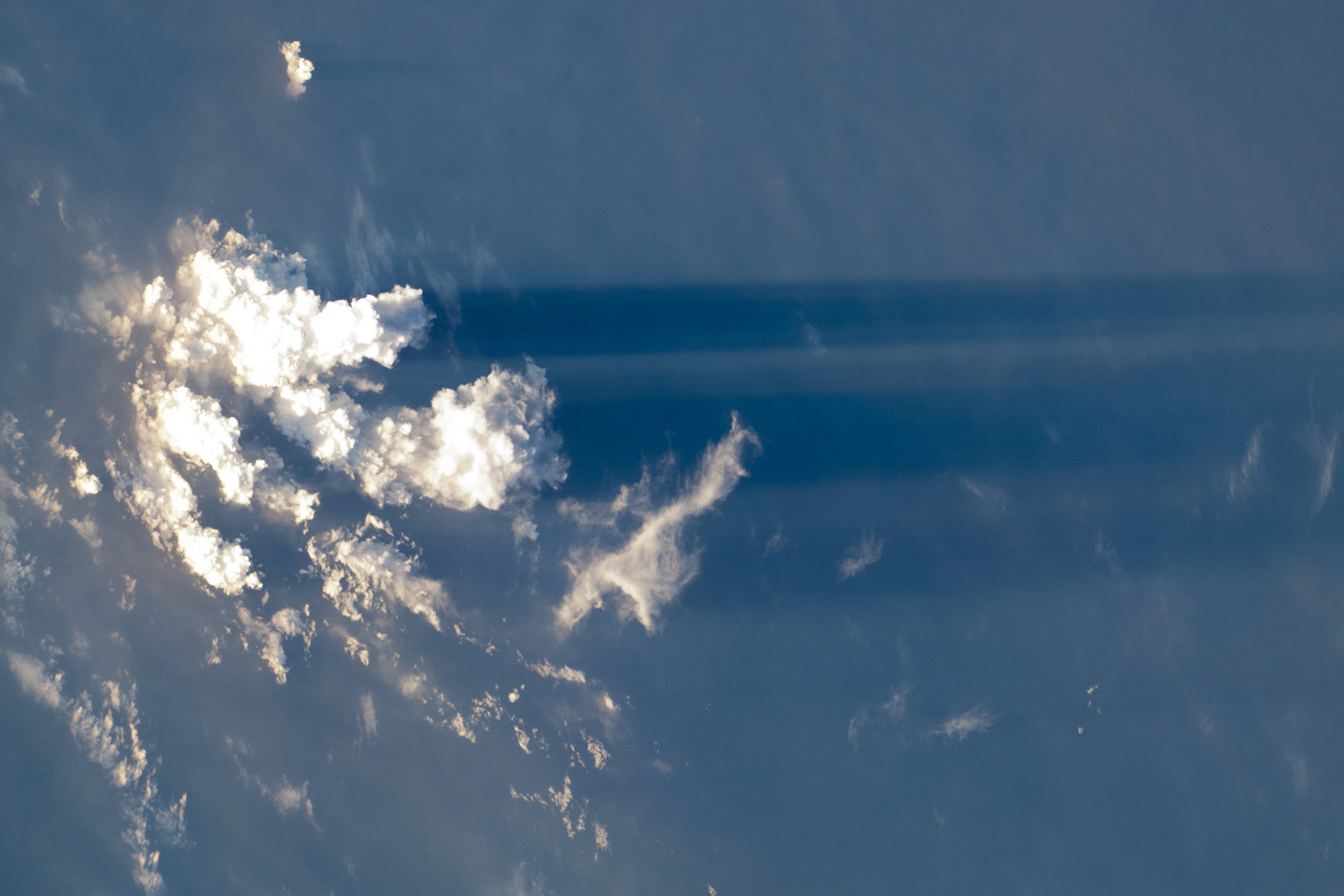
When you go outside at sunset, many times you’ll be greeted with spectacular rays of light and shadow stretching across the sky. These are called crepuscular rays, and are caused by clouds blocking the sunlight, their long shadows cast on haze and other particulates floating in our air.

Those rays fan out, spreading away at different angles… but that’s an illusion! The rays are parallel, and I offer this photograph as proof:

[Click to penumbrenate.]

That shot was taken on October 18, 2011, by an astronaut on board the International Space Station as it passed over India. Towering cumulonimbus clouds threw their long shadows back, away from the Sun. Note that the shadows from different clouds are parallel to each other! That’s because the Sun is very far away compared to the distance between the clouds.

Here’s a picture I found on Flickr showing what we see from the ground, though (it’s not of the same clouds, but just a typical display of crepuscular rays). The fanning out of the rays is actually an illusion, caused by perspective! It’s precisely the same thing that makes railroad tracks or long roads appear to converge in the distance. Things farther away look smaller, so the parallel rails of a railroad track appear to get closer together as you look farther away. For railroad tracks you look down to see this; for cloud shadows you look up! Other than that, they’re the same.

So why do the shadows in the first picture look parallel? It’s because the astronaut was looking straight down on the clouds and shadows, so his distance to any part of the shadow was roughly the same; the shadow near the cloud and way downstream (so to speak) were both about the same distance away from him. That negates the perspective effect, and the shadows are revealed for what they truly are: parallel.

Astronauts have said it for years, but it bears repeating: exploring space gives you perspective. And in this case, it’s literally true.

Image credit: NASA; Elsie, Esq.’s Flickr Stream


Related posts:

- Crepuscular rays
- My comic book premier
- A sun pillar gooses the sky
- Thus spoked the Dumbbell


In the Constitution We Trust | Bad Astronomy

[UPDATE (20:00 Eastern time): Sigh. The bill passed.]

[UPDATE 2 (23:00 Eastern time): I have been told that this bill, even when passed, does not have the force of law. It's what's called a House Concurrent Resolution, and basically is used to express a sentiment of the legislature. I might then argue it's not unconstitutional, but then why did several House members say it would be (see the link provided in the post below)? Making law really is like making sausages. Anyway, even if the argument about it being unconstitutional is not a good one, this bill was still a colossal waste of time, and meaningless. There is simply no good, real reason to have done this, and the fact that so many thought it was a good expenditure of time, and that so many signed it, makes me sad.]

I found out about this too late to do much about it, but just in case you hadn’t heard, The US House of Representatives is voting tonight on a bill to make reaffirm "In God We Trust" the official motto of the US.

This is pretty shocking. Well, it’s not shocking in that everything the Republican-majority House has done in the past few months has been pretty antireality, but this is such a clear violation of the First Amendment that it’s, well, shocking. That Amemndent to the US Constitution says:

Congress shall make no law respecting an establishment of religion, or prohibiting the free exercise thereof…

There are many cases where the interpretation of this simple statement is not terribly clear, but this ain’t one of them. Passing a bill saying the official motto of this country is a religious one is clearly making a law about the establishing of religion. It is putting a religious belief above non-religion, for one. It is also putting a monotheistic belief above pantheism, for another. While some people might think pantheism is silly, that doesn’t matter. What does matter is that this bill violates the Establishment Clause.

And it’s not just me saying that; several dissenters in the House feel that way as well.

This country, you may have noticed, is a mess. A lot of this is due to the government itself, but we’re at the point that we need the government to fix it. There are ways they could help: jobs bills, increasing science funding, and so on. Instead, they’re wasting time and making us look foolish by violating the very principles upon which this country was founded.

We are not a Christian nation. The majority of this country may be religious, but that is all the more reason to make very, very sure our laws are free from religion. The immediate reason is that we want everyone to be free to practice religion or not according to their own beliefs or lack thereof. But also, remember, just because one religion has the majority now doesn’t mean it always will. There could come a time when some other religion, or some other version of it, has control. Making laws based on religion now will make it easier to make laws based on some other religion then.

It’s a bad, bad idea.

I know that the current House has no clue about this sort of thinking, but we the voters do. Any Congressperson who is inclined to vote YES on this bill should first remember the very first thing they did when sworn in as a Representative of the American people: uphold and defend the Constitution. This bill is the antithesis of that oath, in spirit if not in letter.

[UPDATE: Note that I originally said this bill would make this the official motto; it is actually to "reaffirm" it. Either way, it's a waste of time and still a violation of the Establishment Clause, as the dissenters pointed out.]

Tip o’ the quill to Tim Lloyd on Google+.


Related posts:

- Are the Ten Commandments really the basis for our laws?
- We are not a Christian nation
- Evolution is the coin of the realm
- Texas State Board of Education confirms irony is dead
- Pray for the First Amendment


The Arab world’s demographic transition | Gene Expression

In the post below I stumbled upon a weird datum. Kuwait’s total fertility is now below 3. The average estimates seem to be ~2.5 or so. This surprised me, as my impression was that Gulf Arab petroleum based states tended to encourage pro-natalism. This was both a matter of ideology, and also because the small and wealthy native populations lived off rents, and had not had to modify their neo-medieval ideologies to foster productivity driven economic growth. But perhaps Kuwait is an anomaly? Well, it turns out that the Saudi fertility rate is now below 3 as well. Again, depending on which numbers you trust a value of ~2.5 seems plausible. In 1980, at the peak of OPEC’s power and a period when Saudi Arabia was flush with incredible per capita wealth the fertility rate was north of 7.0. But even in the mid-1990s Saudi Arabia’s fertility remained a robust 5.0. Obviously one has to account for the fact that some of the “Arab” nations are not very Arab. The UAE has huge South Asian and Persian populations, not to mention all other sorts. So its fertility of 1.80 can be chalked up to its unique demographics. But would you have guessed that Lebanon’s fertility rate is now the same as Finland’s?

Below the fold is a chart which shows the trends among Arab nations and Finland over the past 40 years. The shading of the bars is proportional to life expectancy.

Image Credit: Denise Chan

NCBI ROFL: Was Mona Lisa’s smile caused by Bell’s palsy or a punch in the face? | Discoblog

Mona Lisa syndrome: solving the enigma of the Gioconda smile.

“The Mona Lisa smile is presented as a possible example of facial muscle contracture that develops after Bell’s palsy when the facial nerve has undergone partial wallerian degeneration and has regenerated. The accompanying synkinesis would explain many of the known facts surrounding the painting and is a classic example of Leonardo da Vinci as the compulsive anatomist who combined art and science.”

|

|

|

|

|

|

|

|

|

Mona Lisa: the enigma of the smile.

“The Mona Lisa, painted by Leonardo Da Vinci, 1503, pictures a smile that has been long the subject of conjecture. It is believed, however, that the Mona Lisa does not smile; she wears an expression common to people who have lost their front teeth. A closeup of the lip area shows a scar that is not unlike that left by the application of blunt force. The changes evident in the perioral area are such that occur when the anterior teeth are lost. The scar under the lower lip of the Mona Lisa is similar to that created, when, as a result of force, the incisal edges of the teeth have pierced the face with a penetrating wound.”

Photo: Flickr/Joaquín Martínez Rosado

Related content:
Discoblog: NCBI ROFL: Smiling faces rated more feminine than serious faces in Japan.
Discoblog: NCBI ROFL: My smile beats your p-p-p-poker face.
Discoblog: NCBI ROFL: Smile intensity of baseball players in photographs predicts longevity.

WTF is NCBI ROFL? Read our FAQ!