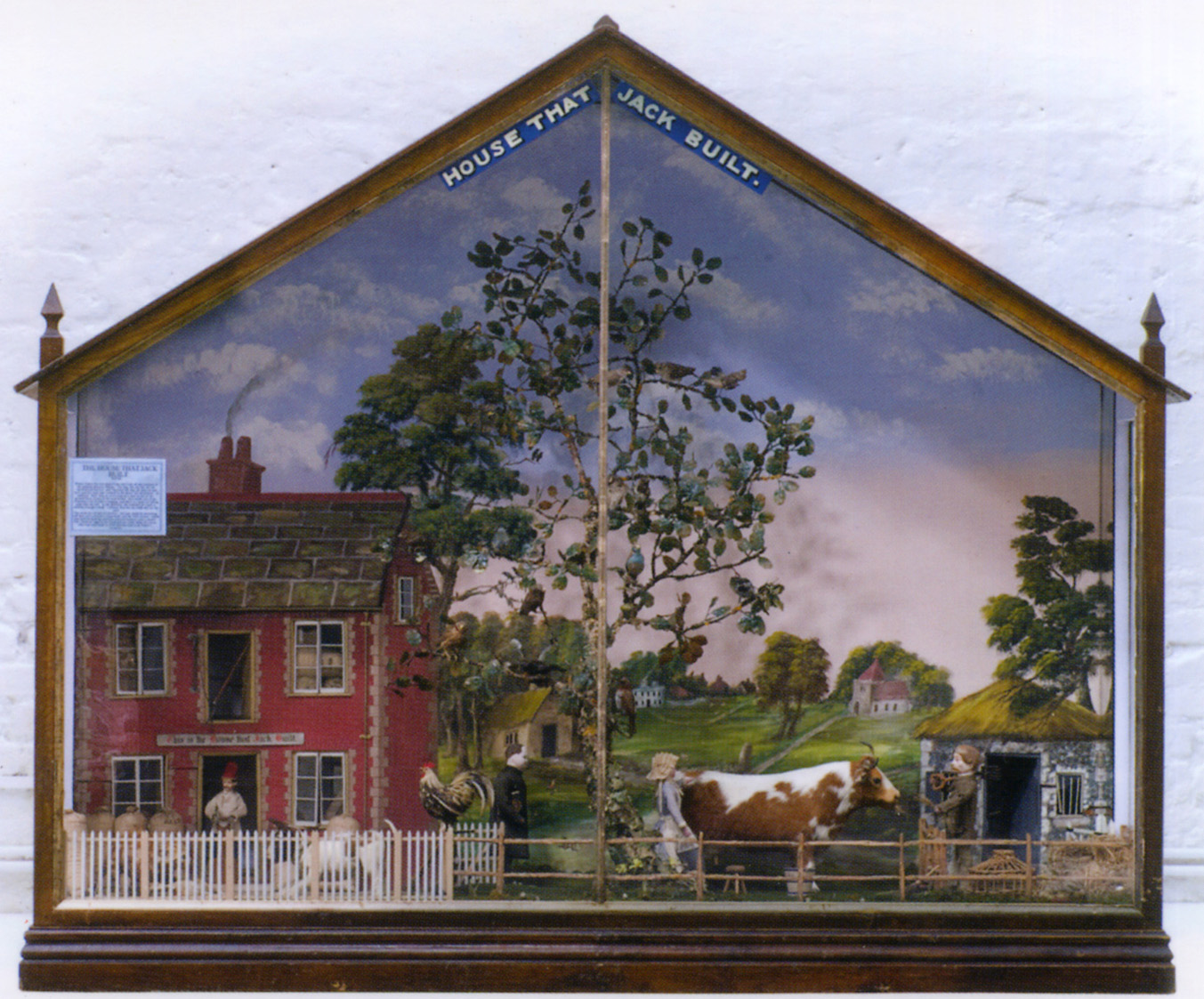
Call for Vendors of the Curious and the Unusual for The Congress for Curious People, 2011


Some of you might remember Morbid Anatomy's coverage of last year's wonderful and amazing Congress for Curious People. I am now in the process of co-organizing this year's Congress, which will also serve as the launch event for my new exhibition at the Coney Island Museum entitled The Great Coney Island Spectacularium.

For this year's 10-day Congress--which begins on April 8 and ends on April 17th, 2011--Coney Island USA is keen to add a kind of arts, crafts, and curiosities fair featuring all things uncanny, unusual, or sideshow related.

Below is the official call for vendors. Please feel free to pass this along to interested parties:

The Congress of Curious Peoples is seeking unusual vendors for it’s Colonnade of Curiosities. April 8-17. High end, low brow and things in between. But your products must be interesting. Art, Jewelery, sideshow related items, the strange, the bizarre and the macabre...

Please email: congressvendors@gmail.com with a full description of your work and a link to a website and or photos. Due to the many submissions and limited space, we will contact only those we are considering.

To find out more, or if you would like to submit work, please email: congressvendors@gmail.com. To find out more about last year's Congress, click here; to find out about The Great Coney Island Spectacularium, click here.

Image: From Obscura Antiques and Oddities

Take "A Voyage to the Arctic" Tomorrow Night at Observatory


If you are free tomorrow night, why not come down to Observatory to take in a talk with James Walsh, artist behind the current exhibition The Arctic Plants of New York City, for a discussion about collecting, botanicals, and the artistic process?

Full details follow; very much hope to see you there.

An artist’s talk with writer and artist James Walsh
Date: Tuesday, January 18
Time: 8:00
Admission: $5

Artist and writer James Walsh will talk about the making of his current installation, The Arctic Plants of New York City, and its place in his larger project of discovering the surprising number of plants that are common to both New York City and the arctic. As an introduction to the project and a demonstration of how it evolved, Walsh will read selections from a series of letters he wrote to friend while his plans for the project were just beginning to form. After that, he will speak a little about how the plants, texts, and images he collected were distilled down into the present installation.

You can find out more about this event on the Observatory website by clicking here and can can access the event on Facebook here. You can get directions to Observatory--which is next door to the Morbid Anatomy Library (more on that here)--by clicking here. You can find out more about Observatory here, join our mailing list by clicking here, and join us on Facebook by clicking here.

Image: Pressed Trifolium repens, or White Clover, by James Walsh

Body Voyaging or, A Short Excursion Through the History of Fantastic Anatomical and Physiological Journeys Through the Body: This Monday, Observatory


Body voyaging through anatomical history this Monday at Observatory! Full details follow; hope to see you there.

An illustrated lecture with Kristen Ann Ehrenberger
Date: Monday, January 17th
Time: 8:00 PM
Admission: $5

We human beings have a seemingly insatiable desire to experience the bodies underneath our skins. While many scholars have treated the subject of looking into or through bodies via medical imaging, one perhaps understudied trope is that of “body voyaging.” A few writers and artists have imagined what it would be like to travel inside a body, to be a searching body in a body as landscape. This presentation will use images and text from a few more and less well-known 20th and 21st-century “fantastic voyages” to ask questions like, Is the purpose of such “biotourism” to make these spaces foreign or familiar? What kinds of relationships between our bodies and ourselves are being promoted? And perhaps most pressing of all, could you really do that?

Kristen Ann Ehrenberger is a Doctoral Candidate in History and a Third-Year Medical Student at the University of Illinois at Urbana-Champaign. Her primary research interests lie in the creation and circulation of scientific and medical knowledge in professional and lay communities, but she has also used her interdisciplinary proclivities to develop a theory of memory consolidation with some neuroscientists and an anthropologist (MIT Press, forthcoming). She is currently living in Dresden and researching her Dissertation, “The Politics of the Table: Nutrition and the Volkskörper in Saxon Germany, 1900-1933? with the support of a Travel Grant from the German Academic Exchange Service (DAAD). She is thrilled Observatory has given her the opportunity to try out this project on an audience of the enthusiastic and curious.

You can find out more about this event on the Observatory website by clicking here and can can access the event on Facebook here. You can get directions to Observatory--which is next door to the Morbid Anatomy Library (more on that here)--by clicking here. You can find out more about Observatory here, join our mailing list by clicking here, and join us on Facebook by clicking here.

Image: From Heumann Heilmittel, “Eine Reise durch den menschlichen Körper” (1941)

"Burlesque: Exotic Dancers of the 1950s and 60s," Illustrated Lecture at Observatory, This Thursday, January 13th


Please join Morbid Anatomy for a night of burlesque at Observatory this Thursday, January 13th!

Full details follow; hope to see you there.

Burlesque: Exotic Dancers of the 1950s and 60s
An illustrated lecture and book signing by director, collector and author Judson Rosebush

Date: Thursday, January 13
Time: 8:00 Admission: $5
*Books will be available for sale and signing

Burlesque dominated the landscape of sexual performance throughout the 1950s and 1960s. Tonight, join collector, author, and director Judson Rosebush as he shares with us a brief illustrated history of the art form as explored in his new book Burlesque Exotic Dancers of the 50s & 60s. The book–which will be available for sale and signing–traces the history of Burlesque from its traditional forms through its transformation into go-go dancing in the 1960s. Included within are nearly 200 “booking photos”–publicity shots commissioned by the dancers and distributed to booking agents, managers, theaters, press, and fans–of 125 burlesque queens and belly dancing stars from the 1950s and 1960s including Crystal Blue, Bella Dona, Sunny Day, Dixie Evans, Lala Jazir and Dusty Summers among others.

Judson Rosebush is a director and producer of multimedia and computer animation projects in New York City and is well-known as a pioneer in computer graphics and animation. His screen credits include the original TRON, the feature documentary The Story of Computer Graphics, and hundreds of television commercials and documentaries. Rosebush is also the co-author of at least two seminal books in the field of computer graphics, Computer Graphics for Designers and Artists and The Computer Animator’s Technical Handbook. Throughout the 1990s he directed CD-ROM and multimedia products including Gahan Wilson’s Haunted House, The War in Vietnam (with the New York Times and CBS), and Issac Asimov’s Ultimate Robot, and multimedia products for places a diverse as the Whitney and the Internet. Rosebush’s interest in all things sexual is coupled with a developing classification scheme for sexual images and literature, and he has published widely on sexual media under the name The Mad Professor.

You can find out more about this event on the Observatory website by clicking here and can can access the event on Facebook here. You can get directions to Observatory--which is next door to the Morbid Anatomy Library (more on that here)--by clicking here. You can find out more about Observatory here, join our mailing list by clicking here, and join us on Facebook by clicking here.

Tonight at Observatory: "A: Head on B: Body: The Real Life Dr. Frankenstein," Tonight, January 7th


Tonight at Observatory, snowstorm be damned . Hope to see you there!

A: Head on B: Body: The Real Life Dr. Frankenstein
A screening and lecture with film-maker Jim Fields and Mike Lewi
Date: Friday, January 7th
Time: 8:00 PM
Admission: $5
Presented by Morbid Anatomy

In an eventful and successful career spanning 40 years, Dr. Robert White–pioneering neurosurgeon and Professor at Cleveland’s Case Western Reserve University–did many things. He participated in Nobel Prize-nominated work, published more than 700 scholarly articles, examined Vladimir Lenin’s preserved brain in Cold War Russia, founded Pope John Paul II’s Committee on Bioethics, went to mass daily, and raised 10 children. He also engaged in a series of horrifying and highly controversial experiments reminiscent of a B-Movie mad scientist, experiments which pushed the limits of medical ethics, infuriated the animal rights community, and questioned notions of identity, consciousness, and corporeality as well as mankind’s biblically-condoned dominion over the animal kingdom.

Tonight, join film-maker Jim Fields–best known for his 2003 documentary “End of the Century” about the legendary punk band The Ramones–and Mike Lewi for a screening of Fields’ short documentary about the life and work of this real-life Dr. Frankenstein whose chilling “full body transplants” truly seem the stuff of a B-Movie terror. Fields will introduce the film–which features a series of interviews with Dr. White discussing his controversial experiments–with an illustrated lecture contextualizing the doctor’s work within the history of “mad scientists” past and present, fictional and actual; scientists whose hubris drove them to go rogue by tampering with things perhaps best left alone.

Jim Fields made a few documentaries, one of which, “End of the Century: the Story of the Ramones” is particularly long. He’s currently a video journalist at Time Magazine and Time.com.

Mike Lewi is a filmmaker, event producer, and disc jockey.

You can find out more about this event on the Observatory website by clicking here and can can access the event on Facebook here. You can get directions to Observatory--which is next door to the Morbid Anatomy Library (more on that here)--by clicking here. You can find out more about Observatory here, join our mailing list by clicking here, and join us on Facebook by clicking here.

Image: Drawing by Dr. Harvey Cushing, early 20th Century, found on the Yale Medical Library website.

Snow Cancellation: "A: Head on B: Body: The Real Life Dr. Frankenstein," Tonight, January 7th


Sorry folks. The snow won, and tonight's event--described below--is being postponed. Our sincere apologies, and new date to be posted very soon.

A: Head on B: Body: The Real Life Dr. Frankenstein
A screening and lecture with film-maker Jim Fields and Mike Lewi
Date: Friday, January 7th
Time: 8:00 PM
Admission: $5
Presented by Morbid Anatomy

In an eventful and successful career spanning 40 years, Dr. Robert White–pioneering neurosurgeon and Professor at Cleveland’s Case Western Reserve University–did many things. He participated in Nobel Prize-nominated work, published more than 700 scholarly articles, examined Vladimir Lenin’s preserved brain in Cold War Russia, founded Pope John Paul II’s Committee on Bioethics, went to mass daily, and raised 10 children. He also engaged in a series of horrifying and highly controversial experiments reminiscent of a B-Movie mad scientist, experiments which pushed the limits of medical ethics, infuriated the animal rights community, and questioned notions of identity, consciousness, and corporeality as well as mankind’s biblically-condoned dominion over the animal kingdom.

Tonight, join film-maker Jim Fields–best known for his 2003 documentary “End of the Century” about the legendary punk band The Ramones–and Mike Lewi for a screening of Fields’ short documentary about the life and work of this real-life Dr. Frankenstein whose chilling “full body transplants” truly seem the stuff of a B-Movie terror. Fields will introduce the film–which features a series of interviews with Dr. White discussing his controversial experiments–with an illustrated lecture contextualizing the doctor’s work within the history of “mad scientists” past and present, fictional and actual; scientists whose hubris drove them to go rogue by tampering with things perhaps best left alone.

Jim Fields made a few documentaries, one of which, “End of the Century: the Story of the Ramones” is particularly long. He’s currently a video journalist at Time Magazine and Time.com.

Mike Lewi is a filmmaker, event producer, and disc jockey.

You can find out more about this event on the Observatory website by clicking here and can can access the event on Facebook here. You can get directions to Observatory--which is next door to the Morbid Anatomy Library (more on that here)--by clicking here. You can find out more about Observatory here, join our mailing list by clicking here, and join us on Facebook by clicking here.

Image: Drawing by Dr. Harvey Cushing, early 20th Century, found on the Yale Medical Library website.

holiday, observatory, science, spectacle

Morbid Anatomy Library New Regular Open Hours: Saturdays, 12-6, Beginning This Saturday, January 8


The Morbid Anatomy Library--a private research library and collection I make available to the interested public in Brooklyn, New York--is pleased to announce new regular open hours every Saturday from 12-6.

The library and cabinet--pictured above in a series of photos by Shannon Taggart--makes available a collection of curiosities, books, photographs, artworks, ephemera, and artifacts relating to medical museums, anatomical art, collectors and collecting, cabinets of curiosity, the history of medicine, death and society, natural history, arcane media, and curiosity and curiosities broadly considered. The present Morbid Anatomy Library Scholar in Residence is Evan Michelson of Obscura Antiques and Oddities and the new television show "Oddities."

If you would like to know more, you can read about the library in Newsweek, Time Out New York, or The Huffington Post and watch videos about it produced by Newsweek, Rocketboom Media, and WPIX's Toni On! New York.

The library is located at 543 Union Street at Nevins in Brooklyn New York. Enter via Proteus Gowanus gallery or by buzzing buzzer 1E. Click here to view map.

To find out more about the Morbid Anatomy Library, click here.

Photos by Shannon Taggart.

The Great Coney Island Spectacularium Exhibition and Website Launch


Many people know about the Coney Island of hot dogs, roller coasters, circuses, and side shows; what many do not know is the other Coney Island, the much forgotten Coney Island of strange immersive amusements produced on a scale nearly impossible to imagine today and blurring the boundaries between science and spectacle, current affairs and entertainment, and education and titillation.

Just to give you a sense of what I'm talking about. On an average day in Coney Island from the years 1890 to 1915, a visitor could (and this is just a tiny sampling):

  • take in a Midget City Theater vaudeville show in Lilliputia, the town populated by 300 midgets and modeled on a half-scale 16th century Nuremberg (top image)
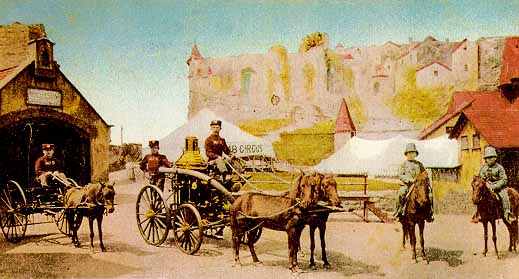
  • check out a staged tenement fire featuring a cast of 2,000 at the popular attraction Fighting the Flames (2nd image)
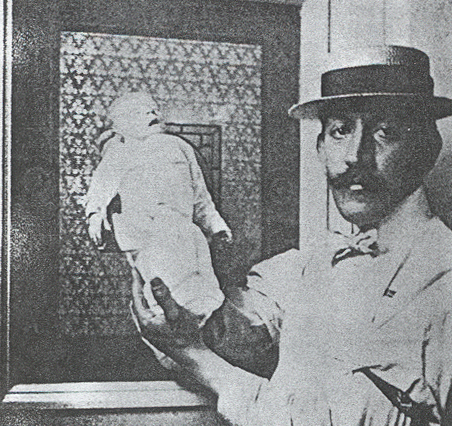
  • marvel at freakishly tiny premature babies kept alive by a novel technology (later adopted by hospitals) and team of nurses at The Infant Incubator (5th image)
  • relive the Boer War via a reenactment starring 600 genuine Boer War veterans
  • watch a reenactment of The Galveston Flood, which had killed 6,000 people only two years before the attraction debuted
  • thrill to San Francisco destroyed by fire, the Titatic destroyed at sea, or Pompeii destroyed by Mt. Vesuvius
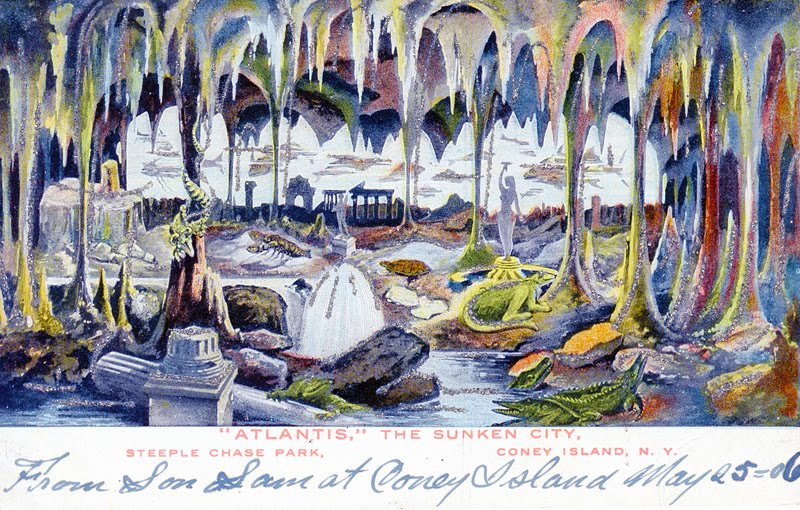
  • descend to the sunken city of Atlantic (3rd image)
  • encounter a troupe of genuine head-hunting Bontac tribesmen in an authentically replicated village (6th image)
  • be publicly humiliated at The Insanitarium and Blowhole Theater, where a midget in a clown costume (sic) would herd you with an electric cattle prod (sic again) over jets of air that would blow up your skirts (if you were of the female persuasion) before an audience of laughing park patrons (see video above, about 20 seconds in)
  • buy candy Frankfurters, Pork Sausages, and Plum Pudding at Bauer Sisters Candy Delicatessen (4th image)

"The Great Coney Island Spectacularium"--my upcoming project as artist-in-residence at the Coney Island Museum--will be a response, commemoration, celebration, and evocative re-staging of fin de siècle Coney Island as the pinnacle of this bizarre world of pre-cinematic immersive spectacular amusement. It will feature a specially constructed immersive cosmorama, a dime-museum inspired installation, and a number of other spectacular surprises.

The exhibition--produced in tandem with Coney Island Museum director Aaron Beebe--will launch on Friday, April 8th, 2011 at the Coney Island Museum. There will be many spectacular events over the course of its year-long residency, and the whole will launch with The Congress of Curious People, a 10-day set of lectures, performances, and panel discussions about curiosity and curiosities, broadly conceived (more on that soon; more on last year's Congress here).

You can visit the website for the exhibition--which features an acitvely updated blog tracing the exhibition research conducted by Aaron and myself, a bibliography, and many more details about the exhibition--at http://www.spectacularium.org. Please sign up for the mailing list (upper right hand corner of the website) to be alerted to events and announcements around the exhibition.

Images top to bottom:

  1. From Jeffrey Stanton's Coney Island History Website
  2. From Jeffrey Stanton's Coney Island History Website
  3. Postcard from The Coney Island Museum
  4. From Coney Island: A Postcard Journey to the City of Fire by Richard Snow
  5. From Pixie's MySpace Blog
  6. "Filipino Baby Coney Isand 1905," from jo simalaya alcampo

Phantasmagoria at the Louvre (!!!): Paris, January-March 2011


Parisian museums are getting more and more historically innovative with their programming. First, the amazing looking "Science and Curiosities: exhibition at Versailles (as discussed in this recent post). And now this just in: The Cinémathèque Française will be co-producing a phantasmagoria projection & spectacle in partnership with--and to be performed at--The Louvre!

Phantasmagoria, invented in the wake of--and said to be a response to--The French Revolution, are essentially ghost shows in which images of skeletons, demons, and ghosts (see top image) are projected via a modified magic lantern and, through a series of ingenious special effects, seem to move about, approach and retreat from, the viewer. These forms of spectacle were very popular around the time of the French Revolution and were also performed throughout the 19th Century; with the advent of film, they metamorphosed into the horror movie, a popular form to this day.

The phantasmagoria projection & spectacle at the Louvre will consist of a series of phantasmagoria projections and spectacles between the dates of January 13th until March 28th of 2011; The highlight will be a grand phantasmagoria projection on March 6 where guest Phantasmagores Laure Parchomenko & Laurent Mannoni promise to conjure-up a variety of spirits which haunted the aftermath of the Revolution at 14:30 & 18:00.

More information about this event can be found (in French) here.

Via the Early Visual Media website and mailing list.

"The Keeper of Curiosities" Royal Ontario Museum in the Wall Street Journal


A nice appreciation of the cabinet of curiosity approach to contemporary museum curation in today's Wall Street Journal:

At the [Royal Ontario Museum, aka ROM ], objects taken from its separate collections (fine and decorative arts, history, textiles, archaeology, geology, mineralogy, paleontology and zoology) are often mixed and matched in highly interdisciplinary displays to create a narrative not often seen in the more specialized museums that we are used to. For example, English dresses and slippers from the late 18th and early 19th centuries are displayed next to African and Asian clothing of the same era, alongside printing blocks and a wall-text description of berries used to produce dyes, because one of the points being made is how colors and patterns were dyed or printed onto these fabrics. Comparisons are being drawn about widely divergent cultures and industrial practices.

"In so many museums, curators are telling the story of the objects on display—why this is in the collection, why that is an important piece—while we're trying to use the objects in our collections to tell a story about how people go about their lives here and elsewhere around the world, and often about the intersection of the natural and cultural worlds," she said.
Here's another example: A display contains ceramic vases, silver, clocks, weathervanes and furniture from the 18th century, across from painted portraits of men, women and children who lived in Canada back then. None of the individual objects have their own labels, and only some wall text describes life in that time. Who were those people in the portraits? Who painted them? Where were those chairs and vases made? Did those people own that silver? Presumably, the curators know and aren't telling us. At the ROM, the point isn't so much the individual objects as creating a big-picture view of life at a certain time and place. "We encourage visitors to make connections in their own minds," Ms. Carding said...

The ROM is in some ways a throwback. Before people traveled so much or had such wide access to books and photographs (in short, an education), 18th- and 19th-century museums were cabinets of curiosities that provided a world of collected knowledge, a walk-in encyclopedia of objects both natural and man-made, practical and artistic. It is rare to find this type of institution anymore; museums now are more and more specialized...

Like the original cabinets of curiosities, there is a little something for everyone, but not so much as to bore people. Known as the "Stair of Wonders," the landings between floors have their own miniature displays—seashells or insects or battalions of metal toy soldiers—to perk up interest when it may be flagging. There's also a life-size, walk-through diorama of the St. Clair Cave in Jamaica, with its plaster-cast hanging bats, insects and stalagmites (based on ROM scientists' work at the site). "People here talk about their old favorites; so many people just love the bat cave," Ms. Carding said.

You can read the full article--from which the excerpt is drawn--by clicking here.

Image via Ddrees Art.

Upcoming Observatory Screening and Lecture: "A: Head on B: Body: The Real Life Dr. Frankenstein," Friday, January 7th


Morbid Anatomy is pleased to announce "A: Head on B: Body: The Real Life Dr. Frankenstein," a lecture and screening exploring the notion of the "mad scientist" in fact and fiction, history and myth. The focal point of the presentation will be the real life mad scientist Dr. Robert White, a professor and pioneering neurosurgeon whose experiments with what he termed "full body transplants" pushed many troubling boundaries.

The event will feature a short documentary film about Dr, White by Jim Fields, director of the “End of the Century: the Story of the Ramones." Fields and Lewi will introduce the film–which features a series of interviews with Dr. White discussing his controversial experiments–with an illustrated lecture contextualizing the doctor’s work within the history of “mad scientists” past and present, fictional and actual; scientists whose hubris drove them to go rogue by tampering with things perhaps best left alone.

Full event description follows; hope very much to see you there!

A: Head on B: Body: The Real Life Dr. Frankenstein
A screening and lecture with film-maker Jim Fields and Mike Lewi
Date: Friday, January 7th
Time: 8:00 PM
Admission: $5
Presented by Morbid Anatomy

In an eventful and successful career spanning 40 years, Dr. Robert White–pioneering neurosurgeon and Professor at Cleveland’s Case Western Reserve University–did many things. He participated in Nobel Prize-nominated work, published more than 700 scholarly articles, examined Vladimir Lenin’s preserved brain in Cold War Russia, founded Pope John Paul II’s Committee on Bioethics, went to mass daily, and raised 10 children. He also engaged in a series of horrifying and highly controversial experiments reminiscent of a B-Movie mad scientist, experiments which pushed the limits of medical ethics, infuriated the animal rights community, and questioned notions of identity, consciousness, and corporeality as well as mankind’s biblically-condoned dominion over the animal kingdom.

Tonight, join film-maker Jim Fields–best known for his 2003 documentary “End of the Century” about the legendary punk band The Ramones–and Mike Lewi for a screening of Fields’ short documentary about the life and work of this real-life Dr. Frankenstein whose chilling “full body transplants” truly seem the stuff of a B-Movie terror. Fields will introduce the film–which features a series of interviews with Dr. White discussing his controversial experiments–with an illustrated lecture contextualizing the doctor’s work within the history of “mad scientists” past and present, fictional and actual; scientists whose hubris drove them to go rogue by tampering with things perhaps best left alone.

Jim Fields made a few documentaries, one of which, “End of the Century: the Story of the Ramones” is particularly long. He’s currently a video journalist at Time Magazine and Time.com.

Mike Lewi is a filmmaker, event producer, and disc jockey.

You can find out more about this event on the Observatory website by clicking here and can can access the event on Facebook here. You can get directions to Observatory--which is next door to the Morbid Anatomy Library (more on that here)--by clicking here. You can find out more about Observatory here, join our mailing list by clicking here, and join us on Facebook by clicking here.

Image: Drawing by Dr. Harvey Cushing, early 20th Century, found on the Yale Medical Library website.

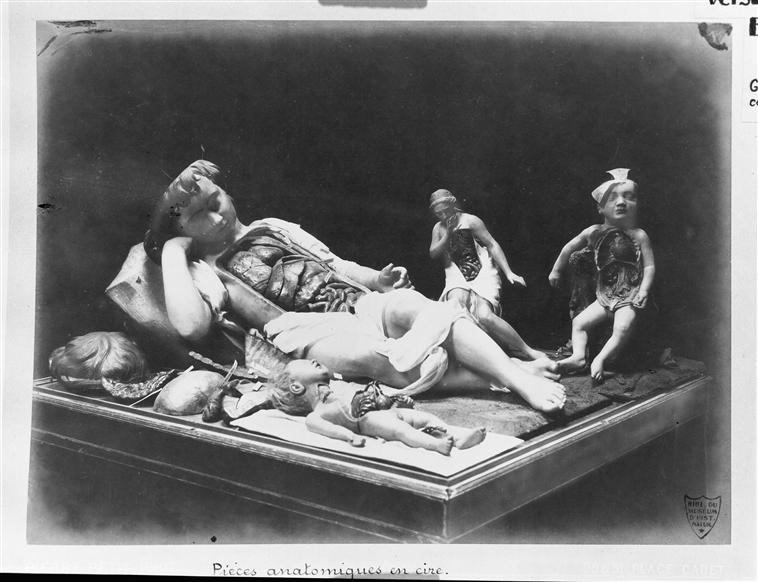
Anatomical Wax, Gallery Comparative Anatomy, Circa 1880

Cote cliché: 09-575178
Inventory Number: P4460
Fund: Photographs
Title: Anatomical wax
Description: Gallery comparative anatomy, circa 1880
Author: Petit Pierre Lanith (1831-1909)
Photo credit: Contact us in advance for monographs, exhibition panels, commercial editions, advertising and communication. An additional proof be sent to the museum. (C) National Museum of Natural History, Dist. RMN / image MNHN, Central Library
Period: 19th century
Date: 1880
Location: Paris, National Museum of Natural History, Central Library

Click on image to see much larger, more interesting image. Via RMN found via Bits and Bites Tumblr.

Upcoming Morbid Anatomy Presents Event: A Brief Introduction to Haitian Voodoo, Tuesday, January 11


Next Tuesday at Observatory! Hope to see you there.

A Brief Introduction to Haitian Voodoo
An illustrated lecture by photographers Stephanie Keith and Shannon Taggart
Date: Tuesday, January 11
Time: 8:00
Admission: $5
**Copies of Stephanie Keith’s new book Vodou Brooklyn: Five Ceremonies with Mambo Marie Carmel will also be available for sale and signing

Voodoo is a religion that merges West African traditions and Roman Catholic Christianity. Created by African slaves brought to the Americas in the 16th century, today its various forms are practiced by over 60 million people worldwide. The purpose of Voodoo ceremony for its practitioners is to make direct contact with the metaphysical realm of the universe by allowing human beings to interact with a pantheon of gods and spirits via spiritual possession.

Photographers Stephanie Keith and Shannon Taggart have long been documenting Voodoo ceremonies within the Haitian community of Brooklyn, New York. Tonight, the two photographers will present a general introduction to Voodoo. Over the course of the this illustrated lecture, they will show historical imagery and discuss the myths of Voodoo generated by sensationalist tales, Hollywood movies and popular culture; they will also introduce us to the major Spirits in the pantheon, describing their historical qualities and elucidating their individual personalities and preferences. In addition, they will share samples of their own haunting work documenting this fascinating and largely misunderstood religion.

Stephanie Keith received an Anthropology degree from Stanford University in 1988, and began her photography career after earning a Master’s in photography from New York University in 2003. She has worked for newspapers such as the New York Times, USA Today, the Wall Street Journal, the Christian Science Monitor, and the NY Daily News. Her interest in religion and pop culture has resulted in two previous projects: “Jesus Rocks” about Christian teen rockers and “Prime Time Ramadan” about the importance of Egyptian Soap Operas for the Muslim holy month of Ramadan. For the past four years, she has been documenting immigrant life in New York City focusing on Haitian Vodou ceremonies performed in Brooklyn. Her latest series about Vodou in Brooklyn has been exhibited in at the Brooklyn Historical Society, the Brooklyn Public Library, the Safe-T Gallery in Brooklyn, the Caribbean Cultural Center in Manhattan, published in the Village Voice and developed into an audio slide show for American Public Media’s “Speaking of Faith” program. The Caribbean Studies Press has just published her photos about Vodou as a book, entitled: Vodou Brooklyn: Five Ceremonies with Mambo Marie. For more about Stephanie Keith, visit http://www.stephaniekeith.com.

Shannon Taggart is a freelance photographer based in Brooklyn, New York. She received her BFA in Applied Photography from the Rochester Institute of Technology. Her images have appeared in numerous publications including Blind Spot, Tokion, TIME and Newsweek. Her work has been recognized by the Inge Morath Foundation, American Photography, the International Photography Awards, Photo District News and the Alexia Foundation for World Peace, among others. Her photographs have been shown at Photoworks in Brighton, England, The Photographic Resource Center in Boston, Redux Pictures in New York, the Stephen Cohen Gallery in Los Angeles and at FotoFest 2010 in Houston. Her essay Basement Voodoo was recently published as a feature in Yvi Magazine. For more about Shannon Taggart, visit http://www.shannontaggart.com.

You can find out more about this event on the Observatory website by clicking here and can can access the event on Facebook here. You can get directions to Observatory--which is next door to the Morbid Anatomy Library (more on that here)--by clicking here. You can find out more about Observatory here, join our mailing list by clicking here, and join us on Facebook by clicking here.

Top Image: Stephanie Keith; Bottom Image: Shannon Taggart

Google Explores the Human Body with HTML5

artistic-anatomy-google-body-browser-1
artistic-anatomy-google-body-browser-2
artistic-anatomy-google-body-browser-3

Google has just soft-launched its latest browser experiment, the Google Body Browser, which is basically Google Earth for the human body. Think of it as a three-dimensional, multi-layered browser version of those Visible Man/Woman model kits. Or a virtualized version of Slim Goodbody, if you will.

Google showed off the app at the WebGL Camp. WebGL is a cross-platform low-level 3D graphics API that is designed to bring plugin-free 3D to the web. It uses the HTML5 Canvas element and does not require Flash, Java or other graphical plugins to run.

If you visit bodybrowser.googlelabs.com in a supported web browser, you’ll get a three-dimensional layered model of the human anatomy that you can zoom in on, rotate and search. WebGL support hasn’t hit mainstream browsers, but the beta versions of Google Chrome, Safari and Firefox all support it. Once you’ve got a compatible browser, visiting the Body Browser home page shows off the human body. You can adjust the various layers of skin, muscles, tissues and the skeletal system. What’s really cool is that if you type in an organ or bone or ventricle system, you are taken directly to that area in the anatomy, zoomed in. You can turn labels on or off and the app supports multitouch so users of trackpads (Magic or otherwise) or multi-touch mice can zoom in with ease.

Original article found here

Run Don't Walk to see The Museum of Everything Exhibition #3, London, Closing December 24th


On a very quick jaunt to London from which I have only just returned, I was very, very fortunate (thank you so much, Mr. Pat Morris!) to have had the opportunity to visit the now fully-installed Museum of Everything Exhibition #3, which I only had seen in its half-ready state a few days before exhibition opening a few months back.

All I have to say is: WOW.

The Museum of Everything #3--curated by the British pop and ruralist artist Sir Peter Blake, perhaps best remembered for his design of the Beatles' Sgt. Pepper's Lonely Hearts Club Band album--is truly a wonder. This immersive spectacle of an exhibition celebrates popular art in the broadest of senses, both in content and in installation, and uses as its departure point Blake's own formidable private collection of such works supplemented by artifacts and artworks drawn from a variety of other privately held collections.

The installation of the exhibition is delightful, fun-house-inspired and immersive, with dark hallways, rickety stairs, and surprising turns leading you into rooms devoted in turn to--among other things--pitch cards and souvenir photos of fun-fair freaks, Victorian circus banners, marionette collections, Punch and Judy sets, Victorian anthropomorphic taxidermy, shell work pieces and a reconstructed shell grotto, Victorian découpage and other paper craft, and musical toys that go off in unison every half hour or so, filling the entire space with a beautiful circus-music cacophony. Each room has a feeling all its own, with a style of installation particularly and artfully suited to the artifacts within.

Mr. Blake's own collection provides the framework for the exhibition--as the casually-narrated exhibition labels, often in Blake's own unaffected voice make clear--but of equal if not greater importance are supplementary collections drawn from a broad variety of other passionate private collectors. Some of the most impressive effects of the exhibition come from the ingenious curation of artifacts drawn from a large number of private collectors into a single assemblage, such as my favorite, the magnificent homage to Walter Potter's Museum of Curiosities. This installation not only re-unites for the first time many of Potter's famously over-the-top taxidermalogical tableaux with wall-art, photographs and other ephemera from his recently disbanded collection, but also contextualizes his work within the broader theme of Victorian taxidermy, anthropomorphic and otherwise, with lavish Victorian bird jars, depictions of boxing squirrels (a popular Victorian taxidermy trope, I am told) and a variety of "straight" taxidermy pieces as well.

The whole of this literally fantastic exhibition is held together by the exuberance and inventiveness of the installation--never art-world and never boring, labyrinthian in structure and bristling with work floor to ceiling--and by the homespun exhibition labels narrating the exhibition in the informal voice of Blake and some of the other collectors and artists. Through the sum of its parts, the exhibition serves also as a reminder of what pop art meant before it became just another art-world term and white-room enshrined product: a celebration of the "homely arts," the arts of the people and of everyday life, of the fairground and the parlor. It is also a reminder that art can be fun, appeal to the senses, not be in a white room, and still make you think.

If you CAN see this exhibition before its December 24th closing, I simply cannot recommend it highly enough. Intriguing, brilliant, thought-provoking, and a lot of fun.

The Museum of Everything is located at the corner of Regents Park Rd and Sharples Hall St, NW1 8YL. For more information, visit the exhibition website by clicking here.

You can find out more about the Museum of Everything at this recent blog post as well.

Images are all drawn from postcards available at the Museum of Everything gift shop. A lovely (if slightly expensive) book is available also. Click here for more.

Morbid Anatomy Library / Observatory/ Proteus Gowanus Holiday Shopping Party, Sunday, December 19th, 12-6pm


This year, in the interest in offering an alternative to the general horrors that constitute The Holiday Season, The Morbid Anatomy Library is teaming up with our sister spaces Observatory and Proteus Gowanus for an epic, music-accompanied, beverage-enhanced day-long holiday shopping party this Sunday, December 19th, from 12-6 PM.

To the strains of the music of DJ Richard Faulk and with delicious seasonal drink in hand, we invite you to wander the labyrinthian spaces of Proteus Gowanus and its offshoots which will, for this day only, be filled with an amazing array of objects for sale, including (but not limited to): unusual and obscure books, one of a kind taxidermied and outfitted anthropomorphic mice (see above), crocheted skulls, reflective vests for uninsured bikers, miniature library furniture made from library catalogue cards, limited edition photographic prints from The Secret Museum, Private Cabinets, and Anatomical Theatre, and much, much more.

And on the note of "much, much more": The Morbid Anatomy Library continues to actively seek additional merchandise to include in the sale. If you are a maker, artist, author, publisher, taxidermist or collector interested in consigning objects/artifacts/artworks/books/specimens etc. for this event, please contact me at morbidanatomy@gmail.com.

Full directions follow. Hope very, very much to see you there!

Proteus Gowanus, is located at 543 Union Street (between Nevins and Bond) in the Gowanus neighborhood of Brooklyn, New York. Entrance to the gallery is off Nevins Street: enter through the large black gates, walk down the alleyway to the end, second door on the left. Look for the golden arm above the gallery door.

Subway

R or M train to Union Street in Brooklyn:
Walk two long blocks on Union (towards the Gowanus Canal) to Nevins Street. 543 Union Street is the large red brick building on right. Go right on Nevins and left down alley through large black gates. Gallery is the second door on the left.

F or G train to Carroll Street:
Walk one block to Union. Turn right, walk two long blocks on Union towards the Gowanus Canal, cross the bridge, take left on Nevins, go down the alley to the second door on the left.

Driving from Manhattan.
(There is usually easy parking on weekends.)

Continue straight off Brooklyn Bridge to Atlantic Avenue, take left on Atlantic. Go four blocks to Nevins St and take a right. Follow Nevins several blocks til you come to Sackett. Park on the next block (just before Union) and go down the alley off Nevins through the large black gates, second door on the left.

Observatory Call for Works: RETROFUTUROLOGY


Calling all artists and makers:

RETROFUTUROLOGY
How the Past Saw the Present // How the Present Sees the Future

A group show of visual art at Observatory, Brooklyn, curated by the Hollow Earth Society, Ethan Gould & Wythe Marschall, Founding Colonels

The imagination (as a productive faculty of cognition) is a powerful agent for creating, as it were,a second nature out of the material supplied to it by actual nature. —Kant

To have an imagined future, you must simultaneously have an imagined present and an imagined past.

A DeLorean decked out in flashing lights and complicated-looking wires: It's a modest-budget promise that, yes, the technologies of our age—our new computer chips and LED lights and cars with doors that open upright like a space pod—can puncture the time barrier, with the right old-fashioned mad scientist at the steering wheel! Where to go? A rowdy 1950s, wherein a white kid can invent rock and roll? A steampunk 1800s? A future wherein the promises of kaleidoscopic, holographic advertising from the late 1980s come to fruition—a world with yet another layer of retrofuturist dreaming added onto the small-town diner...?

Our visions of the future are nested.

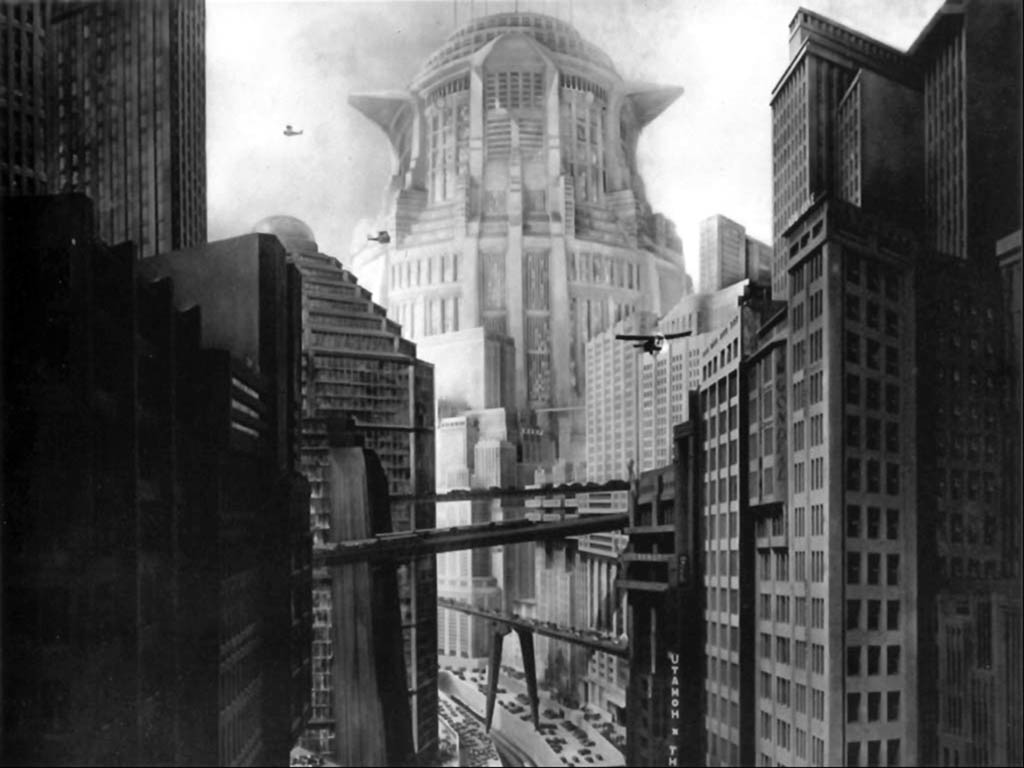
Our conception of time is hyperreal. In explaining the visual gimmicks of a single cultural artifact such as the Buggles's "Video Killed The Radio Star," we must refer to the heyday of radio; the future promised by television executives in synthesizer advertisements; science fiction pulp covers from the 1950s; the neon-on-black-and-white aesthetic of MTV in its early years, not to mention the gallery scene that birthed that aesthetic; 1950s diner-decor futurism; the late-1970s body-posturing and dystopic styling of Devo; Fritz Lang's Metropolis, looking forward to 2026; the garb of mad scientists in movies from the 1940s;—and the sigh that comes with opening a magazine and seeing all of this, compressed down into an ad for sunglasses for hipsters.

Or not even for hipsters: The retrocamp fashion exemplified by an irritating blend of past and future has been recompressed and sold in shopping malls internationally. This isn't marginal pulp—

This is the process on which the present runs.

You are invited to join us for a group show

The Hollow Earth Society seeks artists working in drawing, printmaking, and painting, and possibly sculpture and video/multimedia art (space is limited) for RETROFUTUROLOGY, a group show focused on past- and present-futures, to be up from January 29 to March 5, 2011, at Observatory (observatoryroom.org). Submissions are due January 8, 2011.

How to submit:
Include all information listed below. Late or incomplete submissions will not be considered unless they are mind-staggeringly fantastic and presented with great humility.

Send us up to five images. Digital submissions will be accepted via email. Files must be in JPEG or PDF format. Please number your image files to correspond to your image list.

Send an image list. Double check that the numbers on your list correspond to the numbers in the names of your actual files. In your list, include for each image: an image number, the work's title, the date of work, the medium, and its size and price.
Along with the list, please include a brief description of each image.
Send a three-line bio, your contact information and an email address. You may also submit a résumé.

If you like, send an optional artist’s statement, no longer than 300 words.

THERE IS NO FEE TO ENTER.

Deadline: All email submissions must be received no later than January 8, 2011. (All accepted work should be physically received at Observatory no later than January 24, 2011.)

Return of submitted materials: Include a SASE and make sure there is sufficient postage, or pay for shipping and we will ship your work back to you. If work is two-dimensional, the Hollow Earth Society is more than happy to have it on file for future shows and keep it exhibited for sale on our website. The same 30% commission for art sold will apply.

Drop-Off: If you have been accepted into the show and are in the NYC area, you may wish to drop off your art at the gallery. Email us (gallery@hollowearthsociety.com) to schedule a date and time.

Pick-Up: Return of mailed artwork with return postage will begin on March 12, 2011.

Email submissions to:
gallery@hollowearthsociety.com

By post:
Observatory
543 Union Street
Brooklyn, NY 11215

To find out more, click here.

TONIGHT: "Oddities” Marathon and Party, Observatory, 8:00 PM


We at Morbid Anatomy are very very excited about tonight's viewing party for our new favorite television series, "Oddities," which you might recall from this flurry of recent posts (1, 2, 3).

The "Oddities” Marathon and Party event--which will take place tonight at Observatory--will feature a four-episode marathon of the program, special drinks, a DJed after party, and prizes and giveaways, including an early brass "lucky skull" Mexican ring from "Oddities" cast member and Against Nature proprietor Ryan Matthew, a variety of 3D anatomical puzzles generously donated by Kikkerland, and, of course, Obscura Tshirts. The "cast" of "Oddities" will also be on hand for questions and comments.

You can see some clips (recommended!) and find out more about "Oddities" by clicking here.

Full details follow. Very much hope to see you there!

"Oddities” Marathon and Party
A four-episode marathon of the new television series Oddities, with give-aways, special drinks, surprise guests, and after party

Date: TONIGHT! Thursday, December 9

Time: 8:00

Admission: $5

Presented by Morbid Anatomy

On Thursday, December 9, you are cordially invited to join Morbid Anatomy and Observatory as we celebrate the new television series based on our favorite purveyor of curious and amazing artifacts, Obscura Antiques and Oddities in New York City’s East village.

The evenings festivities will include–as a special treat for those of us without cable–a screening of the first three episodes of Oddities, which will reveal, to the discerning eye, an assortment of familiar Observatory faces, including former lecturers Evan Michelson and Mike Zohn as well as a variety of members of the wider Observatory community. There will also be special drinks, a DJed after party, surprise guests, and prizes and give-ways throughout the night. Members of the cast will also be available for questions and comments.

To find out more about the show, check out http://dsc.discovery.com/tv/oddities.

Hope very much to see you there!

To find out more about the event, click here. You can see some clips and find out more about "Oddities" by clicking here. You can get directions to Observatory--which is next door to the Morbid Anatomy Library (more on that here)--by clicking here. You can find out more about Observatory here, join our mailing list by clicking here, and join us on Facebook by clicking here.

“Visiting an Anatomical Museum: Curiosity or Training?” Conference, Università di Modena e Reggio, Modena, Italy, Deceber 17th


This just in from Thomas Soderquist of the wonderful Biomedicine on Display:

Next Friday, 17 December, Elena Corradini at the Università di Modena e Reggio Emilia organises a seminar on “Visiting an Anatomical Museum: curiosity or training?”:

Anatomical University Museums are the keepers of collections which often are very old and different for their consistence and typology. These museums have a fundamental role for the preservation and valorization of cultural historical?scientific heritage, therefore must become a place of interdisciplinary synthesis. They represent the progress of studies in the past and for the future, and play their fundamental role for the research and for the promotion of educational activities. This role will allow them to be a service for University students and professors, and to spread scientific knowledge to different audiences. Developing the capacity of museums to work in a network is necessary for them to become centres for the production of knowledge, activities and services.

Speakers include a number of directors and curators from Italian university anatomical museums together with the directors of the Josephinum of Vienna and the Museum of Medical University of Danzig:

  • Giovanni Mazzotti, University of Bologna: Visiting an Anatomical Museum: curiosity or training?
  • Sonia Horn, University of Wien: The growth of collections for the permanence of an historical Anatomical Museum. The case of the Josephinum in Vienna.
  • Roberto Toni, University of Parma: The Anatomical Museum as a research source in the field of
  • biomedical robotics: the Tenchini project at the University of Parma
  • Alessandro Ruggeri, Nicolò Nicoli Aldini, Stefano Durante, Vittorio Delfino Pesce, University of Bologna: The visit of the Anatomical Waxes Museum “Luigi Cattaneo” center of in-depth research of the Bolognese medical tradition of XIXth century and of training for modern education
  • Ugo Pastorino, National Tumour Institute, Milan: The project for a virtual archive of human body images
  • Carla Garbarino, University of Pavia: The anatomical collections of the Museum for the history of the University
  • Marek Bukowski, University of Gdansk: An Anatomical collection and Museum of Medical University
  • Berenice Cavarra, University of Modena and Reggio Emilia: Medicine and the study of the living being in XVIIth and XVIIIth centuries
  • Vincenzo Esposito, Second University of Neaples: Anatomical Museums between past historical identity and present cultural crossbreeding
  • Marina Cimino, University of Padua: The birth in a museum or the birth of a museum: the obstetric collection in Padua
  • Elena Corradini, Elisa Orlando, Daniela Nasi, Silvia Rossi, Sara Uboldi, University of Modena and Reggio Emilia: POMUI ? The Portal of Italian University Museums
  • Giorgio Bonsanti, University of Florence; Elena Corradini, Berenice Cavarra, University of Modena and Reggio Emilia; Paolo Nadalini, INP, Institut National du Patrimoine, Paris; Luigi Vigna, Opificio delle Pietre Dure, Florence; Isabelle Pradier, INP, Institut National du Patrimoine, Paris: A project for the restoration of anatomical waxes

Info from Silvia Rossi or Sara Uboldi, University of Modena and Reggio Emilia (silvia.rossi@unimore.it; sarauboldi@yahoo.it), +39 059 205 5012

If I was in Italy, I would SO be there.... If any Morbid Anatomy readers live near Modena Italy and would like to make attend and write a report about your experience, you can email me at morbidanatomy@gmail.com.

Click here to see original post on the Biomedicine on Display website; More on the image--captioned Plakat für ein anatomisches Museum, Hamburg, 1913--at this recent post; click on image to see much larger image.

Upcoming Event at Observatory: "The Vast Santanic Conspiracy: Is St. Nick the Tool of a Plot too Monstrous to Mention?" With Cult-Author Mark Dery


People. I promise you that this is one you won't want to miss. On Tuesday December 21st--aka Winter Solstice--inimitable cult author and lecturer in the grand 19th C tradition Mark Dery will be gracing Observatory with his presence, swooping in to thrill us with his illustrated lecture "The Vast Santanic Conspiracy: Is St. Nick the Tool of a Plot too Monstrous to Mention?" Dery's presentation will be followed by a Krampus (See above)/Solstice-themed after party with music, sweets, specialty cocktails, idiosyncratic gifts, and more.

Full details follow. This is going to be good fun; VERY much hope to see you there!

The Vast Santanic Conspiracy: Is St. Nick the Tool of a Plot too Monstrous to Mention?
An illustrated lecture with cult author and cultural critic Mark Dery, followed by a Krampus/Solstice-themed after party with music, specialty cocktails, and more
Date: Tuesday, December 21 (Winter Solstice)
Time: 8:00 PM
Admission: $10
Presented by Morbid Anatomy

Canceled, last year, by an act of Cthulhu–the Mother of All Blizzards, which dumped 20 inches of snow across the Northeast–Dery’s wickedly witty lecture, “The Vast Santanic Conspiracy: Is St. Nick the Tool of a Plot too Monstrous to Mention?,” is sure to inspire Christmas jeer.

Few Americans know that Santa descends from the mock king who held court at Saturnalia, the Roman festival celebrating the winter solstice. Or that he shares cultural DNA with the Lord of Misrule who presided over the yuletide Feast of Fools in the Middle Ages—lewd, blasphemous revels that gave vent to underclass hostility toward feudal lords and the all-powerful church.

In “The Vast Santanic Conspiracy: Is St. Nick the Tool of a Plot too Monstrous to Mention?,” Dery, a cultural critic and book author, takes a look at the Jolly Old Elf’s little-known role as poster boy for officially sanctioned eruptions of social chaos, as well as his current status as a flashpoint in “the Christmas Wars”—cultural battles between evangelicals, atheists, conservatives, and anti-consumerists over the “true” meaning of Christmas. Along the way, Dery considers New Age theories that Santa is a repressed memory of an ancient Celtic cult revolving around red-capped psychedelic mushrooms; Nazi attempts to re-imagine Christmas—a holiday consecrated to a Jewish baby, for Christ’s sake—as a pre-Christian invention of tree-worshipping German tribes, in some misty, Wagnerian past; and the suspicious similarities between Satan and Santa, connections that have fueled a cottage industry of conspiracy theories on the religious right.

Mark Dery (http://www.markdery.com) is a cultural critic. He is best known for his writings on the politics of popular culture in books such as The Pyrotechnic Insanitarium: American Culture on the Brink and Escape Velocity: Cyberculture at the End of the Century. Dery is widely associated with the concept of “culture jamming,” the guerrilla media criticism movement he popularized through his 1993 essay “Culture Jamming: Hacking, Slashing, and Sniping in the Empire of the Signs”; “Afrofuturism,” a term he coined and theorized in his 1994 essay “Black to the Future” (included in the anthology Flame Wars: The Discourse of Cyberculture, which he edited); and the Pathological Sublime, which he introduced in The Pyrotechnic Insanitarium. He has been a professor in the Department of Journalism at New York University, a Chancellor’s Distinguished Fellow at UC Irvine, a Visiting Scholar at the American Academy in Rome, a blogger for True/Slant (http://trueslant.com/markdery/) and Thought Catalog (http://thoughtcatalog.com/) and a guest blogger at Boing Boing. A Portuguese-only collection of his recent essays, Não Devo Pensar Em Coisas Ruins (I Must Not Think Bad Thoughts), has just been published in Brazil by Editora Sulina.

You can find out more about this event on the Observatory website by clicking here. You can get directions to Observatory--which is next door to the Morbid Anatomy Library (more on that here)--by clicking here. You can find out more about Observatory here, join our mailing list by clicking here, and join us on Facebook by clicking here.