Tonight and Tomorrow at Observatory: Extreme Taxidermy and Dubiously Sourced Bodies and Anatomical Learning!

Tonight and tomorrow night at Observatory; hope to see you there!

Kitten Tea Parties, Auto Icons, and Habitat Groups: A Brief History of Taxidermy
An Illustrated Lecture by Dr. Pat Morris, Royal Holloway, University of London

Date: TONIGHT! Thursday, April 21
Time: 8:00 PM
Admission: $5

Tonight, taxidermy scholar and collector Pat Morris will discuss the fascinating and sometimes bizarre history of taxidermy as explored in his new book A History of Taxidermy: Art, Science and Bad Taste. Along the way, Morris will discuss anthropomorphic taxidermy of the sort made famous by Victorian museologist and taxidermist Walter Potter, "extreme taxidermy" (ie. human taxidermy), and the role of taxidermy in the history of scientific display and popular culture. He will also detail the development of taxidermy as an art form, tracing its development from the stiff rudimentary mounts which characterized its beginnings to the artistic triumphs of the late 19th and early 20th Centuries.

Copies of his new book History of Taxidermy: Art, Science and Bad Taste will also be available for sale and signing.

Dr. Pat Morris is a retired staff member of Royal Holloway College (University of London), where he taught biology undergraduates and supervised research on mammal ecology. In that capacity he has published many books and scientific papers and featured regularly in radio and TV broadcasts. The history of taxidermy has been a lifelong hobby interest and he has published academic papers and several books on the subject. With his wife Mary he has travelled widely, including most of Europe and the USA, seeking interesting taxidermy specimens and stories. They live in England where their house is home to the largest collection and archive of historical taxidermy in Britain.


Ill-gotten Brains: The Grisly History of Sourcing Bodies for Anatomical Learning
An Illustrated Lecture with Megan Curran, Norris Medical Library, USC
Date: TOMORROW, Friday, April 22
Time: 8:00 PM
Admission: $5

The idea of donating your body to science is actually a very new concept. There wasn’t even a national law governing the process until the late 1960s. How, then, did medical illustrators, going back hundreds of years, acquire bodies to draw? Many bodies were “donated” alright, but the dead people didn’t know they were being so generous. Prisoners, the indigent, robbed graves, and even murders helped supply medical schools and doctors for centuries.

This wild history of sourcing human bodies spans from the dawn of modern anatomy in the Renaissance with Vesalius (and even artists like Da Vinci and Michelangelo), through the 19th century's institutionalized medical school body snatchings, and up to Nazi medicine and the controversy over plastinated bodies in exhibits like Body Worlds.

For tonight's lecture, join Megan Curran of USC's Norris Medical Library for fascinating accounts of how bodies were procured for the advance of science, often through less than ethical means, accompanied by images from USC's rare medical books.

Megan Curran is the Head of Metadata & Content Management for the Norris Medical Library of the University of Southern California in Los Angeles, CA. Megan manages the history of medicine and rare books collections at USC and has been working to promote that collection. Megan serves on the editorial board of the Journal of the Medical Library Association, and is on the board of the Archivists & Librarians in the History of the Health Sciences. Megan originally hails from Philadelphia and is a dyed-in-the-wool rare book nerd.

You can find out more about these events on the Observatory website by clicking here and here; You can get directions to Observatory--which is next door to the Morbid Anatomy Library (more on that here)--by clicking here. You can find out more about Observatory here, join our mailing list by clicking here, and join us on Facebook by clicking here.

Images: Top: The Auto-Icon of Jeremy Bentham. Mr. Bentham requested in his will that his body be preserved and stored in a wooden cabinet. It has been on display since 1850 at University College London. Photo by Joanna Ebenstein.
Bottom: Opera omnia anatomica & chirurgica, Andreas Vesalius

Visiting the Stigmatics of South Tyrol on Good Friday via The Wellcome Library, Circa 1840


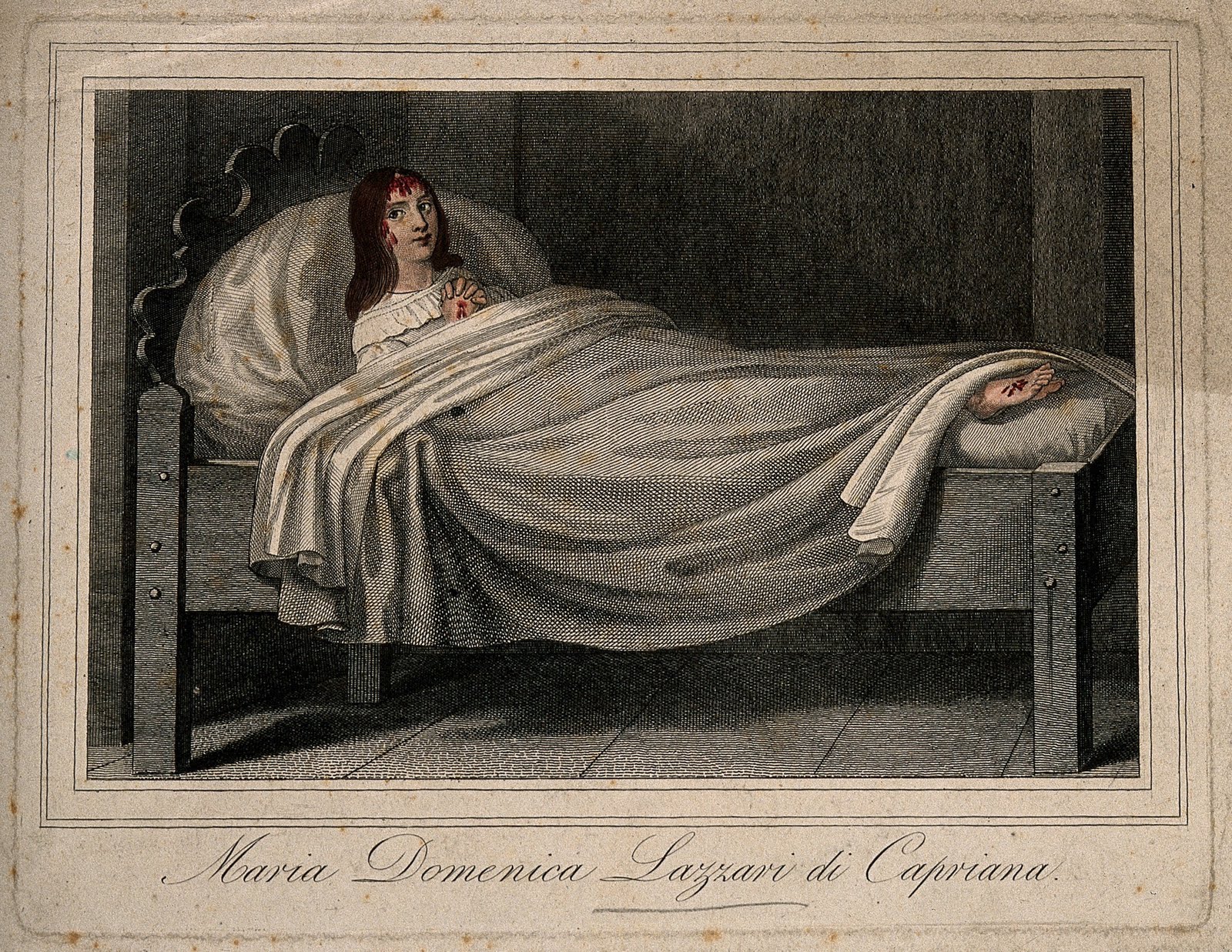
...In the 1840s there was a steady flow of foreign tourists and pilgrims to the idyllic valleys of [South Tyrol] ... solely to visit two women who were said to have received spontaneously bleeding wounds (stigmata) on their hands, feet, or head like those caused to Jesus Christ when he was nailed to the cross and forced to wear the crown of thorns. One of the two women was Maria Domenica Lazzari (sometimes spelled Lazzeri), and the other was Maria von Moehrl (also called Mörl). The former was known as L'Addolorata (the woman of pain), the latter as L'Estatica (the woman of ecstasy), for reasons which will become clear.

On this Good Friday -- the holiday commemorating Jesus Christ's death by crucification -- why not take a moment to consider the medio-religious condition of stigmata, ie. spontaneous bleeding (mostly found in the female persuasion) on the hands, feet, and/or head, mimicking the wounds caused to Jesus Christ when he was nailed to the cross and forced to wear the crown of thorns?

All of the above text and images are drawn from two recent fascinating posts on the Wellcome Library blog; To read the full articles, click here and here.

Happy Good Friday!

Images, top to bottom (please click images to view larger, more detailed versions):

  1. Maria Domenica Lazzari. Coloured engraving, ca 1840. Wellcome Library no. 260i
  2. Maria von Moehrl. Watercolour by L. Giuditti after L.G. de Ségur, 1846. Wellcome Library no. 708243i
  3. Maria Domenica Lazzari. Watercolour by L. Giuditti after L.G. de Ségur, 1846. Wellcome Library no. 708242i

Italian Devil Automaton, 15th or 16th Century, From the Wunderkammer of Ludovico Settala


Automata were... theologically and culturally familiar, things with which one could be on easy terms. They were funny, sometimes bawdy, and they were everywhere... Mechanical devils were...rife. Poised in sacristies, they made horrible faces, howled and stuck out their tongues to instill fear in the hearts of sinners. The Satan-machines rolled their eyes and flailed their arms and wings; some even had moveable horns and crowns. A muscular, crank-operated devil with sharply pointed ears and wild eyes remains in residence at the Castello Sforzesco in Milan.
--Jessica Riskin, “Machines in the Garden.” Republics of Letters: A Journal for the Study of Knowledge, Politics, and the Arts 1, no. 2 (April 3, 2010)

In her article "Machines in the Garden," Jessica Riskin discusses the use of automatons for religious purposes. Some of my favorite examples include mechanical devils intended to frighten church visitors into obedience (as shown and quoted above); mechanical passion plays; and a mechanical Christ on the crucifix popular in the 15th Century, which was able

to bow down and lifte up it selfe, to shake and stirre the handes and feete, to nod the head, to rolle the eies, to wag the chaps, to bende the browes, ... and gathering a frowning, forward, and disdainful face, when it would pretend offence: and shewing a most milde, amiable, and smyling cheere and countenaunce, when it woulde seeme to be well pleased. --William Lambarde, A Perambulation of Kent: Conteining the Description, Hystorie, and Customes of that Shire. Written in the Yeere 1570. by William Lambarde of Lincolns Inne Gent

I highly encourage you to read this fascinating article in its entirety; you can do so by clicking here.

Images: Italian Automaton (The Devil), carved in wood, 15th and 16th centuries, from the Wunderkammer owned by Ludovico Settala. It could, in the words of the Cosmodromium Blog, "roll its eyes and move its tongue, emit a noise and spit smoke from the mouth." Images sourced here.

All images and ideas sourced from the Cosmodromium Blog; read whole post--and see additional images--by clicking here.

Tonight at The Coney Island Museum: Acep Hale on Con Men and Sideshow Legends Ward Hall and Bobby Reynolds!


Tonight, as night 7 of the Congress of Curious Peoples, we have a fantastic double header: magician and scholar Acep Hale lecturing on ""Legerdemain and Larceny'--a history of the con man--followed by a performance by sideshow talker legends Ward Hall and Bobby Reynolds onstage for the first time ever in Coney Island.

This is sure to be an incredible night! Full details follow; very much hope to see you there.

Acep Hale, "Legerdemain and Larceny"
Tonight, FRIDAY, APRIL 15th
CONEY ISLAND MUSEUM, 7:30 pm - $5

Coney Island, like most fairs, amusement parks, and midways has always had a reputation for hucksterism and the con job. Join magician and scholar, Acep Hale, as he explores the history of the con, taking the audience on a guided tour of the clowns, contrarians, murmurers and mystics that have held fast to lives of wandering wonder throughout the ages. Acep Hale is a street performing magician, musician, traveler, and rogue gentleman scholar. Driven by the 19th century belief in propaganda by deed he performs daily on street corners everywhere to prove that magic still lives around every bend, you don’t need a nine to five to stay alive, and hope springs eternal between the cracks of every sidewalk.”.

Sideshow Legends Ward Hall and Bobby Reynolds
Tonight, FRIDAY, APRIL 15th
SIDESHOWS BY THE SEASHORE, 8:30 pm - $15

Ward Hall (born 1930) has been around longer than anyone in the business and runs The World of Wonders Sideshow. He is "a modern-day P.T. Barnum and the last of the sideshow promoters. He's a national treasure who is loved and revered by showfolk, sideshow historians, and fans the world over."

Bobby Reynolds (born 1932) got his start at Hubert's Museum in Times Square and has been talking, performing in, and operating sideshows ...ever since. He still comes out of "retirement" every year or so to run shows all over the world. "With his two-headed babies, all frog band, and giant rat, Bobby has perfected the art of giving people the art of giving people what they didn't know they wanted."

Tonight, join Ward Hall, King of the Sideshow, and legendary side showman Bobby Reynolds as they perform

For more info--and to purchase tickets--click here and here.

Tomorrow Night: "A Gathering of Bones" Lecture with Evan Michelson, Morbid Anatomy Scholar in Residence and star of TV's Oddities, Coney Island Museum


Tomorrow night, why not consider joining me and Morbid Anatomy scholar in residence (and star of TV's "Oddities") Evan Michelson at Coney Island for her new lecture "A Gathering of Bones?" If her former lectures are any indication, this is sure to be a great one!

The event--which will take place within the newly opened Great Coney Island Spectacularium!--begins at 7:30. Drinks are half price at the bar until 8:00. Hope very very much to see you there!

"A Gathering of Bones," an Illustrated lecture by Evan Michelson
Date: Monday, April 11
Time: 7:30 PM
Admission: $5 (or free with Congressional Pass)

Location: The Coney Island Museum (1208 Surf Avenue)

Human bone: one of the most common materials on the planet. And yet, at one time the remains of certain individuals were prized more highly than the rarest, most precious metals and gems. The cult of the saints, the backbone of the early Christian Church, gave rise to an institutional fetishization of human remains that produced objects still unsurpassed in craftsmanship and opulence.

The aesthetic of the most humble and commo...n organic remains coupled with gold, silver, gems and textiles has for centuries proved irresistible to secular collectors and religious institutions alike. The ultimate collectible, the constituent parts of each and every human on the planet were once the object of obsession, veneration and murderous desire. As a collector myself, Christian relics provided my earliest exposure to the realm of transcendently beautiful, perverse and venerated objects.

The collection and categorization of human remains underwent a drastic change with the enlightenment, but the unquenchable human thirst for knowledge and comfort in the face of our own mortality has ensured that the corpus remains at the center of an unending human fascination with and confrontation of the greatest mystery of all. The gathering of bones continues to this day, still controversial, decadent and utterly essential to the human narrative.

This event is part of The Morbid Anatomy Library Collector Series.

Click here to purchase tickets ($5 each)

This event is made possible, in part, by a grant from the Andy Warhol Foundation.

Image: Galileo's finger mounted on a marble base and encased in a crystal jar, as on view at the Museum of History and Science in Florence, Italy. More on that--and image source--here. Click on image to see much larger, more detailed version.

Tomorrow Night: Ronni Thomas on Diableries AND Johnny Fox of the Freakatorium! Coney Island Double Feature!


Tomorrow night's double feature, featuring Ronni Thomas on Diableries and Johnny Fox of The Freakatium, will surely be amazing; full line-up of the 10-day Congress of Curious Peoples can be found here; hope to see you there!

Ronni Thomas “The Diableries and 19th Century Pre-cinematic Horror
Date: Tuesday, April 12
Time: 7:30 PM
Admission: $5 (or free with Congressional Pass)
Location: The Coney Island Museum (1208 Surf Avenue)

3D is very much in the news these days, and while Hollywood has finally come close to perfecting this technology for the silver screen, people are largely unaware that the Victorians were also aficionados of 3D technologies, and that this interest often took a turn towards the macabre. Tonight, filmmaker and collector Ronni Thomas will lecture on the history of 3D spectacles of the Victorian age, especially the infamous Diableries series–masterfully designed 3D stereo ’tissues’ created in france in the 19th century, backlit and featuring ornate scenes depicting the daily life of Satan in Hell (see image to left for example).Tongue in cheek and often controversial, these macabre spectacles give us a very interesting look at the 19th century’s lighthearted obsession with death and the macabre, serving as a wonderful demonstration of the Victorian fascination with themes such as the afterlife, heaven, hell and death.

In addition to the lecture, Thomas will display original Diableries and other artifacts from his own collection. Guests are encouraged to bring their own pieces and, better yet, a stereo-viewer.

Johnny Fox of the Freakatorium
Date: Tuesday, April 12
Time: 8:30 PM
Admission: $5 (or free with Congressional Pass)
Location: The Coney Island Museum (1208 Surf Avenue)

Magician, raconteur, and sword swallower extraordinaire will regale with tales of his long-gone Freakatorium and amaze the audience with wondrous feats of daring.

To see a full lineup of the Congress of Curious Peoples, click here.

This Weekend: The Amazing, Incredible, Thrilling Congress For Curious People 2-Day Symposium!


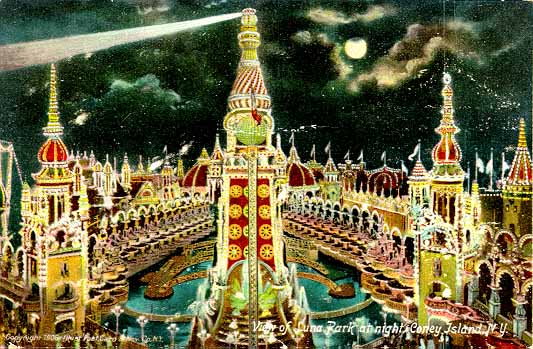
This Saturday and Sunday, why not make the trip out to Coney Island to take in some lectures and spirited discussions on the topics of the questionable delights of immersive amusements, human anatomy on display from fairground to museum, science for public amusement, dime museums and their place in the 21st Century imagination, and scholarship as artistic medium, featuring a variety of inspiring scholars, collectors, authors, artists and practitioners, and all housed provocatively within the immersive amusement that is the Great Coney Island Spectacularium?

Why not indeed!

The event--called the Congress for Curious Peoples and co-curated by The Morbid Anatomy Library --features many of my favorite scholars, artists, collectors and bon vivants, including (but not limited to!) Mark Dion, Norman Klein, Mark Dery, Lord Whimsy, John Troyer, Evan Michelson, Mike Zohn, and Laurel Braitman; I will also be on hand to present a brief paper and take part in a discussion, and, of course, there will be a scheduled break to take in the Super Freak Weekend Freakshow downstairs at Coney Island USA.

This is going to be a seriously unmissable weekend. Full schedule and line-up for the Congress for Curious Peoples follows. Can't wait, and hope very much to see you there!

The Congress for Curious Peoples
Saturday and Sunday, April 16th and 17th
The Coney Island Museum
1208 Surf Avenue, Brooklyn

Saturday April 16th

10:00 - 11:00 Keynote Speaker
Norman Klein, author of "The Vatican to Vegas: The History of Special Effects"

11:30 - 1:30 "The New Curiosity": Scholarship as Artistic Medium
Mark Dion, Artist
Joanna Ebenstein, The Morbid Anatomy Library
Wendy Walker, author of "The Secret Service"
Moderated and introduced by Aaron Beebe, The Coney Island Museum

1:30 - 3:30: Lunch and Sideshow Visit


3:30 - 5:30: Immersive Amusements/ Scripted Spaces

Mark Dery, author "The Pyrotechnic Insanitarium: American Culture on the Brink"
Amy Herzog, author of "Dreams of Difference, Songs of the Same: The Musical Moment in Film"
Moderated and Introduced by Alison Griffiths, author of "Shivers Down Your Spine: Cinemas, Museums, and the Immersive View"

Sunday April 17th

10:00 - 12:00: The Fairground and The Museum: Human Anatomy on Display
Lisa Farrington, author of "Creating Their Own image: the History of African-American Women Artists"
Anna Maerker, author of "Model Experts: Wax Anatomies and Enlightenment in Florence and Vienna, 1775-1815"
Elizabeth Stephens, "Anatomy as Spectacle: Public Exhibitions of the Body from 1700 to the Present"
Moderated and introduced by John Troyer, author of "Technologies of the Human Corpse" (Forthcoming)

12:00 - 1:00: Lunch

1:00 - 3:00: The 19th Century Dime Museum in the Contemporary Imagination

Will Baker, author of "Multiple Meanings and Values in Johnny Fox's Freakatorium"
Aaron Beebe, The Coney Island Museum
D. B. Denholtz, editor of "Shocked and Amazed: On & Off the Midway"
Evan Michelson, Obscura Antiques and star of TV's "Oddities"
Mike Zohn, Obscura Antiques and star of TV's "Oddities"
Moderated and introduced by Andrea Dennett, author of "Weird and Wonderful: The Dime Museum in America"

3:30 - 5:30: Science and Technology for Public Amusement

Laurel Braitman, author of "Animal Madness" (forthcoming)
Fred Nadis, author of "Wonder Shows: Performing Science, Magic, and Religion in America"
Simon Werrett, author of "Fireworks: Pyrotechnic Arts and Sciences in European History"
Moderated by Lord Whimsy/Allen Crawford, author of "The Affected Provincial's Companion, Volume One"

Tickets for the weekend are $25 and can be purchased by clicking here. To find out more about The Congress for Curious Peoples, click here. To find out more about The Spectacularium, click here and to read some recent reviews of The Spectacularium, click here and here.

Special thanks to the Andy Warhol Foundation, whose generosity helped to fund all of these fantastic events.

Also, the lovely poster was designed by the incomparable Lord Whimsy; click on image to see larger more readable version.

Anatomical Obscura Day Events, 2011


As many of you already know, my upcoming exhibition--The Great Coney Island Spectacularium--will be launching with an Obscura Day event on Saturday April 9th (more on that here.) If you are not in New York for Obscura Day, or are in the mood for more anatomical fare, I have just been alerted to a bunch of anatomical-themed events that might be up your alley. All events take place on Saturday, April 9th.

Details follow:

  • At the Dittrick Museum where Jim, the Dittrick's Chief Curator, will present a selection of amazing and rare anatomy atlases and surgical works, and Jenny, the Registrar and Archivist, will share a sampling of strange and wonderful objects from the Dittrick artifact collections, with special emphasis upon the history of contraception, a premier collection at the Dittrick. (http://obscuraday-dittrick.eventbrite.com/)
  • At the International Museum of Surgical Science, in Chicago the Museum’s curator will present 3D stereoscopic photos, chromolithographs, and a magic lantern show depicting skin diseases in gorgeous, gruesome detail. Visitors can take a look at what lies beneath the surface of the skin in a special exhibition of actual human bodies. (http://obscuraday-imss.eventbrite.com/)
  • In Florence, Itlay take an expert tour of La Specola Anatomical Collection. Art and social-historian Sheila Barker, who researches science and medicine in Renaissance Florence, will lead the visit of some of the most spectacular and beautiful anatomical artwork in the world. (http://obscuraday-laspecola.eventbrite.com/)
  • In Sydney, Australia go to the Museum of Human Disease, where on Obscura Day you can ask questions of academics and researchers from the University, and participate in discussions and workshops and hear the stories of patients, medical professionals, and loved ones of those with disease." (http://obscuraday-museumhumandisease.eventbrite.com/)

To find out more about these events, and to purchase tickets, click the link following each description.

Image: "Anatomical Venus" Wax wodel with human hair and pearls in rosewood and Venetian glass case, "La Specola" (Museo di Storia Naturale), Florence, Italy " Probably modeled by Clemente Susini (around 1790); From The Secret Museum exhibition.

Naming the Animals Exhibition Opening, Curious Matter, Jersey City, Sunday April 3


I have a photograph--sneak preview above--included in the upcoming Naming the Animals exhibition at Curious Matter gallery in Jersey City, New Jersey. The opening--which us free and open to the public--will take place this Sunday, April 3rd, from 3-6.

Full details follow for both this opening at the related opening later in the month at Proteus Gowanus. Hope very much to see you there!

Please join us for two artist receptions to celebrate our special two-part exhibition

NAMING THE ANIMALS
Curious Matter, April 3 to May 15, 2011
Proteus Gowanus, April 16 to July 17, 2011

Sunday, April 3, 2011
3:00 to 6:00 pm
at CURIOUS MATTER
272 Fifth Street, Jersey City, NJ
&
Saturday, April 16, 2011
7:00 to 10:00 pm
at PROTEUS GOWANUS for Paradise III
& Naming the Animals
543 Union Street, Brooklyn, NJ

THE ARTISTS

CURIOUS MATTER: Lasse Antonsen • Julia Whitney Barnes • Jill Marleah Bell • John Bell • Arthur Bruso • Travis Childers • Matthew Cox • Joanna Ebenstein • Veronica Frenning • Patti Jordan • Heather Layton • Ross Bennett Lewis • Carrie Lincourt • Eric Lindveit • Colette Male • Marianne McCarthy • Florence Alfano McEwin • Hans van Meeuwen • Raymond E. Mingst • Elizabeth Misitano • R. Wayne Parsons • Inna Razumova • Debra Regh • Andrew Cornell Robinson

PROTEUS GOWANUS: Kristi Arnold • William Brovelli • Christian Brown • Ryan Browning • Travis Childers • Clair Chinnery • Eileen Ferara • Richard Haymes • Ellie Irons • Katherine McLeod • Suzanne Norris • Melissa Stern • Jennie Suddick • Tricia Zimic

CURIOUS MATTER is an exhibition venue for contemporary visual art located in downtown Jersey City. Curious Matter exhibitions and publications evidence the pursuit to understand and articulate our individual and collective experience of the world, real or imagined. We examine fantastic notions, confounding ideas and audacious thoughts. Curious Matter strives to foster dialogue among artists at all career stages with a calendar of regular exhibitions. Our commitment extends to our audience as we endeavor to open a door to appreciating contemporary art in an atmosphere that encourages engagement and curiosity. Curious Matter is a sponsored project of Fractured Atlas, a non-profit arts service organization.
For more info: [w] curiousmatter.blogspot.com [e] curiousmatter@comcast.net [t] 201-659-5771

DRIVING FROM MANHATTAN: Take the Holland Tunnel. When you exit the tunnel turn left onto Marin Blvd. Turn right onto 6th Street, then left onto Coles Street and left onto Fifth. Street. (It’s about 5 minutes out of the Tunnel.)

PATH FROM NYC: Take the Newark/Journal Square bound PATH train from 33rd, 23rd, 14th or 9th Streets (all at 6th Ave.) or from Christopher Street or WTC. (Note: on weekends the train stops in Hoboken before continuing to Jersey City.) Get off at

GROVE STREET station. Exit and walk West on Newark Ave. When you reach Jersey Ave. make a right and continue to 5th Street. The gallery is to the left at 272 Fifth Street.

PROTEUS GOWANUS is a gallery and reading room located on the Gowanus Canal in Brooklyn, NY. A collaborative project, the gallery develops exhibits of art, artifacts and books and hosts events that revolve around a yearlong theme linking the arts to other disciplines and to the community. In adjacent spaces, seven additional projects-in-residence have grown out of thematic exhibitions and partnerships. This year’s theme is PARADISE, an exploration of the light and dark sides of spiritual ascent and sensual escape, in which we invite artists and workers in other disciplines to respond to the siren song of that which is easy to imagine but
difficult to attain.
For more info: [w] proteusgowanus.com [e] info@proteusgowanus.com [t] 718-243-1572

DRIVING FROM MANHATTAN: (There is usually easy parking on weekends.) Continue straight off Brooklyn Bridge to Atlantic Avenue, take left on Atlantic. Go four blocks to Nevins St and take a right. Follow Nevins several blocks til you come to Sackett. Park on the next block (just before Union) and go down the alley off Nevins through the large black gates, second door on the left.

SUBWAY, R or M train to Union Street in Brooklyn: Walk two long blocks on Union (towards the Gowanus Canal) to Nevins Street. 543 Union Street is the large red brick building on right. Go right on Nevins and left down alley through large black gates. Gallery is the second door on the left.

F or G train to Carroll Street: Walk one block to Union. Turn right, walk two long blocks on Union towards the Gowanus Canal, cross the bridge, take left on Nevins, go down the alley to the second door on the left.

To see much more of the work in the exhibition, you can download a digital version of their beautifully designed catalog--the hard copy of which will eventually be available for sale on Lulu--by clicking here.

Image: Joanna Ebenstein, Natural History Museum Storage Area, 2010

"Blood Work: Medicine and Murder in the Scientific Revolution," Illustrated Lecture and Book Signing with Holly Tucker, Tomorrow Night at Observatory!


Tomorrow night at Observatory! Very much hope to see you there.

Blood Work: Medicine and Murder in the Scientific Revolution
Lecture and Book Signing with Professor and Author Holly Tucker
Date: Tuesday, March 22
Time: 8 PM
Admission: $5
Presented by Morbid Anatomy

In 1667 physician Jean-Baptiste Denis transfused calf’s blood into the body of Antoine Mauroy, an infamous madman known to tear through the streets of Paris naked and screaming. With this, Denis--a brash physician with a taste for the limelight--enraged both the elite doctors who wanted to perform the first animal-to-human blood transfusion themselves and powerful conservatives who believed he was toying with forces of nature that he didn’t understand. It only got worse when just days after the experiment, Mauroy was dead, and Denis was framed for murder. A trial ensued and Denis became a kind of 17th century Dr. Kevorkian, a stubborn man of science who held the public spellbound and reveled in controversy.

Animal-to-human transfusion was then on the cutting-edge of medicine. In an era in which superstition sparred with science, transfusion was also a flashpoint for controversy. Conservative camps in Catholic France, including King Louis XIV’s Academy of Sciences, railed against transfusion and predicted that before long animal-human hybrids would walk among us. Ambitious scientists fumed at being held back by retrograde forces who would choke the progress of science. A confused public feared that they would be crushed by cosmic backlash or social upheaval.

Join us tonight as Dr. Tucker tells us this fascinating story of a notorious madman, a renegade physician, a murder that remained unsolved for over three centuries, and the true story one of the world’s first blood transfusions in 17th century France as detailed in her new book, Blood Work: Medicine and Murder in the Scientific Revolution (W.W. Norton, March 2011).

Copies of Blood Work will be also available for sale and signing.

Holly Tucker is an associate professor at Vanderbilt University’s Center for Medicine, Health & Society and the Department of French & Italian. Her research focuses on the history of medicine. She writes for publications including the Wall Street Journal, San Francisco Chronicle, New Scientist, and Christian Science Monitor. She lives in Nashville, Tennessee. You can find out more at her website, http://www.holly-tucker.com and her blog http://www.wondersandmarvels.com.

You can find out more about the book by clicking here, and more about this event on the Observatory website by clicking here; you can access this event on Facebook here. You can get directions to Observatory--which is next door to the Morbid Anatomy Library (more on that here)--by clicking here. You can find out more about Observatory here, join our mailing list by clicking here, and join us on Facebook by clicking here.

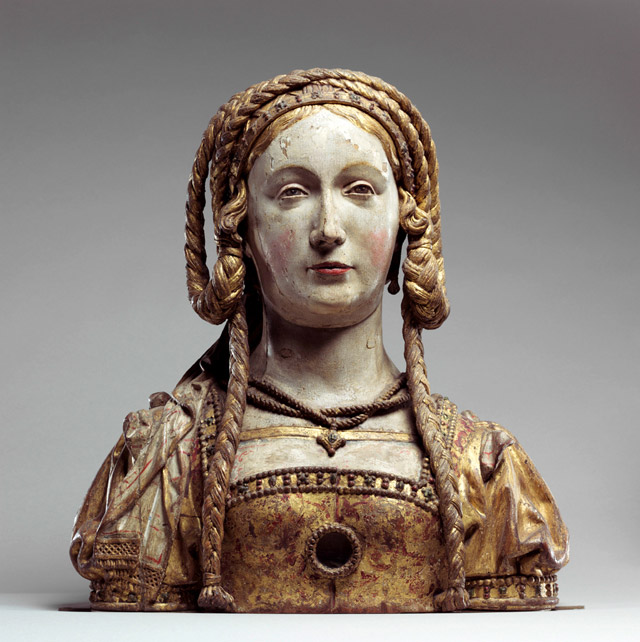
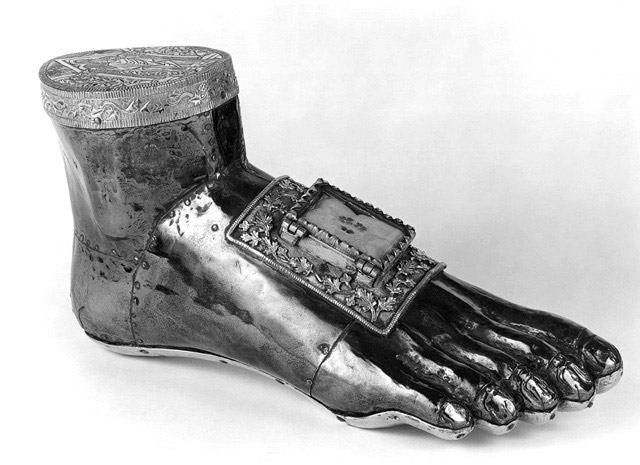
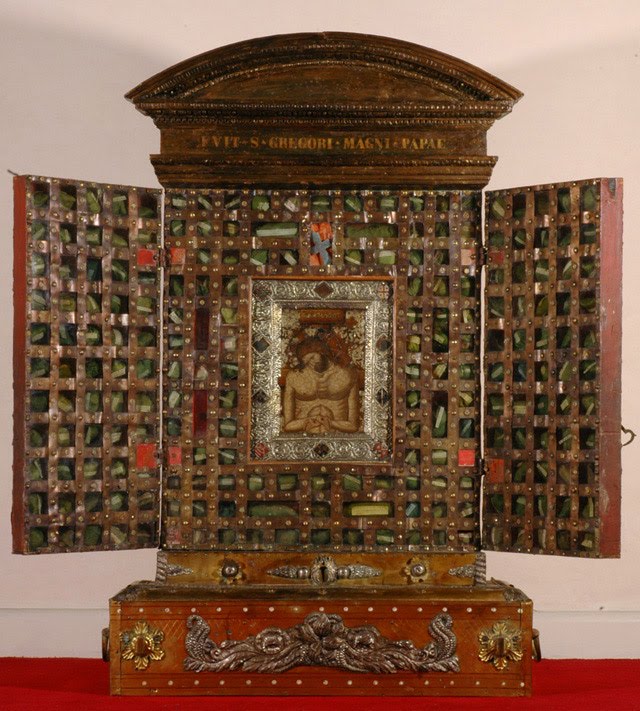
"Treasures of Heaven: Saints, Relics and Devotion in Medieval Europe" Exhibition, Walters Art Museum, Baltimore, Through May 15th


Wow. WOW.

This just in: On view until May 15th of this year at the Walters Art Museum in Baltimore, a new exhibition of relics and reliquaries entitled "Treasures of Heaven: Saints, Relics and Devotion in Medieval Europe."

To get a sense of the kinds of treasures that await, check out the Treasures of Heaven "Digital Monograph" (from which these images were drawn) by clicking here.

Press release for the exhibition follows:

Treasures of Heaven: Saints, Relics and Devotion in Medieval Europe
Feb. 13, 2011 - May 15th, 2011
Walters Art Museum, Baltimore, Maryland

First major U.S. exhibition of Christian relics and reliquaries co-organized by the Walters, the Cleveland Museum of Art and the British Museum

Baltimore—The Walters Art Museum will host an exhibition offering visitors a glimpse into the Middle Ages, a time when art mediated between heaven and earth and wondrous objects of gold, silver and precious gems filled churches and monastic treasuries. Relics, the physical remains of holy people and objects associated with these individuals, play a central role in a number of religions and cultures and were especially important to the development of Christianity as it emerged in the Late Roman world as a powerful new religion. On view at the Walters Feb. 13–May 15, 2011, Treasures of Heaven: Saints, Relics and Devotion in Medieval Europe is the first exhibition in the United States to focus on the history of relics and reliquaries—the special containers to display the holy remains of Christian saints and martyrs. The exhibition is organized by the Walters Art Museum in partnership with the Cleveland Museum of Art and the British Museum.

Reliquaries proclaimed the special status of their sacred contents to worshipers and pilgrims, and for this reason, were often objects of artistic innovation, expressions of civic and religious identity, and focal points of ritual action. This exhibition will feature 133 metalworks, sculptures, paintings and illuminated manuscripts from Late Antiquity through the Reformation and beyond. It will explore the emergence and transformation of several key types of reliquary, moving from an age in which saintly remains were enshrined within closed containers to an era in which relics were increasingly presented directly to worshipers.

Many of the reliquaries in the exhibition have never before been seen outside of their home countries. Objects are drawn from celebrated public and private collections in the U.S. and Europe, and also from important church treasuries. In addition to the three organizing museums, world-renowned institutions, including the Louvre, the Metropolitan Museum of Art, the Art Institute of Chicago and the National Gallery of Art, are lending works to the exhibition. Nine works are traveling from the Vatican collections, including three reliquaries that were once housed in the Sancta Sanctorum, or Holy of Holies, the private relic chapel of the Pope.

Visitors will witness the transformation of reliquaries from simple containers for the earthly remains of Christian holy men and women to lavishly decorated objects of personal and communal devotion.

"As early as the second century AD, the relics of Christian saints—including their bones, ashes and other bodily remains—were thought to be more valuable than the most precious gemstones. They were believed to be a conduit for the power of the saints and to provide a direct link between the living faithful and God," said Martina Bagnoli, Robert and Nancy Hall associate curator of medieval art and exhibition co-curator. "These remains were treated with reverence and often enshrined in containers that used luxurious and precious materials to proclaim the relics' importance."

The medieval devotion to relics gave birth to new forms of architecture and prompted significant developments in the visual arts. The reliquaries showcased in Treasures of Heaven provide evidence of religious objects traveling across tremendous distances and of people making pilgrimages across the Mediterranean to walk in the footsteps of important figures from sacred history. Powerful in inspiring religious devotion among believers, reliquaries became cutting-edge works of art that combined innovative techniques with beautiful design.

"Those who come to the exhibition thinking that the Middle Ages are only a period of darkness will be surprised," said Martina Bagnoli.

Highlights of Treasures of Heaven include:

  • Reliquary Bust of St. Baudime, c. 1180-1200,Parish Church of Saint-Nectaire, Puy-le-Dôme
  • This nearly life-sized bust is one of the earliest surviving objects of its kind and travels outside of France for the first time.
  • Portable Altar of Countess Gertrude, c. 1045, Cleveland Museum of Art
  • This work is from the Guelph Treasure, one of the most important church treasuries to have survived from medieval Germany.
  • Head Reliquary of St. Eustace, c. 1200, British Museum
  • This head-shaped reliquary contained fragments of the skull of the Roman military leader Saint Eustace...

You can find out more about the exhibition here, and more about the topic of relics and reliquaries on the Treasures of Heaven "Digital Monograph" by clicking here. You can purchase the exhibition catalog by clicking here.

All images from the Treasures of Heaven "Digital Monograph;" you can find out more about them the images, and peruse the website, by clicking here. It was unclear how many of these are in the physical exhibition.

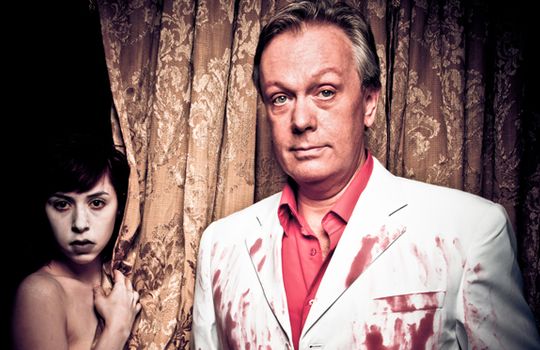
"Play Dead," Todd Robbins and Teller, The Players Theatre, New York


The other night, I took my boyfriend out for a night of good, scary, compelling fun at Todd Robbins' and Teller's (of Penn and Teller) new production "Play Dead," on view now at The Players Theatre in New York City.

The production is difficult to describe in normal theater terms; it is kind of like a haunted house meets a 1950s ghost show meets a piss take on a Victorian séance meets a high-end Vegas magic show all staged on a David Lynch film set. The main presence in the production is side-show performer Todd Robbins; he has a wonderfully compelling presence, equal parts passionate story teller, confidence man, and emphatic and empathetic debunker of spiritualist trickery. The piece is a kind of fun yet thoughtful meditation on the mysteries of death, the history of historical monsters in their various forms, and the ways--compellingly demonstrated in the show--that death and loss still make us easy prey for "spiritualist" hucksters.

I don't want to say too much more, as so much of the fun of the production come from the element of surprise, but I will say this: I was seriously amazed; I was amused; and we are still talking about it. I very much recommend checking it out.

"Play Dead" is being staged at The Players Theatre, 115 MacDougal Street, New York. You can find out more--and get tickets--by clicking here.

Full disclosure: I received free tickets from the Play Dead Production Company in exchange for reviewing this show. Lucky for me I really really enjoyed it! And so did my impartial boyfriend.

Image: From the Studio 360 website.

"Proteus" Screening with Film Maker David Lebrun, Observatory, April 1st


This April Fools Day, why not join Morbid Anatomy and Observatory for a screening of one of our absolute favorite films, Proteus, featuring an introduction by--and Q and A with--the film's maker, David Lebrun, in a rare East Coast appearance?

The film Proteus details the biography and struggles of biologist and artist Ernst Haeckel (1834-1919) who, as the copy for the film describes, "found himself torn between seeming irreconcilables: science and art, materialism and religion, rationality and passion, outer and inner worlds." Lebrun tells Haeckel's tale with inventive and almost chillingly beautiful animation constructed almost entirely from 19th Century archival images, with the most stirring and awe-inspiring sequences created from quick successions of scores of Haeckel's astonishing depictions of protista, as seen above in some of his drawings, and in the video clip at about 5:10 minutes in.

We are thrilled to be hosting two screenings of the film, one at 7 PM and one at 9 PM, in conjunction with Proteus Gowanus Interdisciplinary Gallery and Reading Room. Film maker David Lebrun will be on hand at each to introduce the film and to answer any questions you might have.

Please pass this on to any interested parties, and hope very very much to see you there!

Date: Friday, April 1
Time: 7:00 PM and 9:00 PM (2 Screenings)
Admission: $5
Presented by Morbid Anatomy in partnership with Proteus Gowanus

The ocean is a wilderness reaching 'round the globe, wilder than
a Bengal jungle, and fuller of monsters, washing the very wharves
of our cities and the gardens of our sea-side residences.

-- Henry David Thoreau, 1864

For the nineteenth century, the world beneath the sea played much the same role that "outer space" played for the twentieth. The ocean depths were at once the ultimate scientific frontier and what Coleridge called "the reservoir of the soul": the place of the unconscious, of imagination and the fantastic. Proteus uses the undersea world as the locus for a meditation on the troubled intersection of scientific and artistic vision. The one-hour film is based almost entirely on the images of nineteenth century painters, graphic artists, photographers and scientific illustrators, photographed from rare materials in European and American collections and brought to life through innovative animation.

The central figure of the film is biologist and artist Ernst Haeckel (1834-1919). As a young man, Haeckel found himself torn between seeming irreconcilables: science and art, materialism and religion, rationality and passion, outer and inner worlds. Through his discoveries beneath the sea, Haeckel would eventually reconcile these dualities, bringing science and art together in a unitary, almost mystical vision. His work would profoundly influence not only biology but also movements, thinkers and authors as disparate as Art Nouveau and Surrealism, Sigmund Freud and D.H. Lawrence, Vladimir Lenin and Thomas Edison.

422px-haeckel_stephoidea_edit1The key to Haeckel's vision was a tiny undersea organism called the radiolarian. Haeckel discovered, described, classified and painted four thousand species of these one-celled creatures. They are among the earliest forms of life. In their intricate geometric skeletons, Haeckel saw all the future possibilities of organic and created form. Proteus explores their metamorphoses and celebrates their stunning beauty and seemingly infinite variety in animation sequences based on Haeckel's graphic work.
Around Haeckel's story, Proteus weaves a tapestry of poetry and myth, biology and oceanography, scientific history and spiritual biography. The legend of Faust and the alchemical journey of Coleridge's Ancient Mariner are part of the story, together with the laying of the transatlantic telegraphic cable and the epic oceanographic voyage of HMS Challenger. All these threads lead us back to Haeckel and the radiolaria. Ultimately the film is a parable of both the difficulty and the possibility of unitary vision.

DAVID LEBRUN has served as producer, director, writer, cinematographer, animator and/or editor of more than sixty films, among them films on the Mazatec Indians of Oaxaca, a 1960s traveling commune, Tibetan mythology and a year in the life of a Maya village. He edited the Academy-award winning documentary Broken Rainbow, on the Hopi and Navajo of the American Southwest. Proteus premiered at Sundance and has won numerous international awards. The two-hour documentary feature Breaking the Maya Code (2008) tells the story of the 200-year quest to decipher the hieroglyphic script of the ancient Maya of central America; a drastically shortened version was broadcast on the PBS series NOVA and has been seen on television around the world. His experimental and animated works include the animated films Tanka (1976) and Metamorphosis (2010), works for multiple and variable-speed projectors such as Wind Over Water (1983), and a 2007 multimedia performance piece, Maya Variations, created in collaboration with composer Yuval Ron. Lebrun has taught film production and editing at the California Institute of the Arts and has curated numerous art exhibitions. He was president of First Light Video Publishing from 1987-1996, and since then president of Night Fire Films. He was a founding Board Member of the Center for Visual Music (CVM) and is on the Advisory Board of the Chabot Space & Science Center’s Maya Skies project. For a complete biography and filmography, please visit http://www.nightfirefilms.org.

You can find out more about the film by clicking here, and more about this event on the Observatory website by clicking here; you can access these events on Facebook here (7 PM) and here (9
PM). You can get directions to Observatory--which is next door to the Morbid Anatomy Library (more on that here)--by clicking here. You can find out more about Observatory here, join our mailing list by clicking here, and join us on Facebook by clicking here.

Images: From Ernst Haeckel's Die Radiolarien, Berlin, 1862. And special thanks to Ben Cerveny for turning me onto this wonderful film so many years ago.

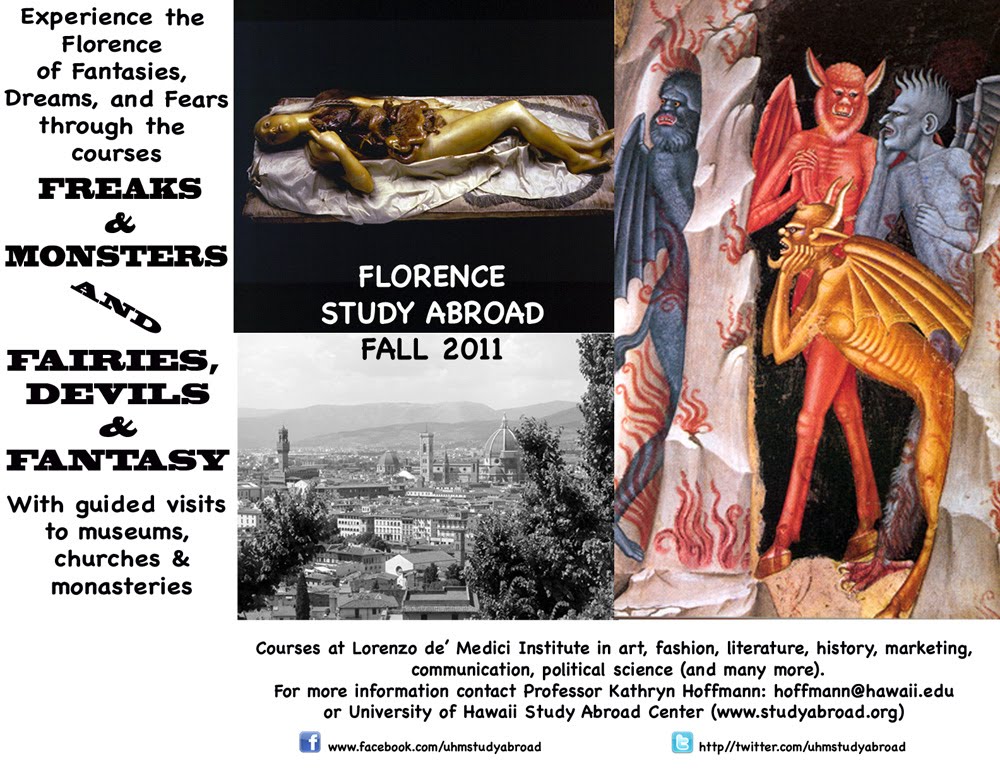
"Freaks and Monsters and Fairies, Devils, and Fantasy Tour of Florence," Fall, 2011, Dr. Kathryn Hoffman


Friend of Morbid Anatomy Kathryn Hoffmann of the University of Hawaii, Manoa has just announced that she will be leading a "Freaks, Monsters, and Fairies, Devils, and Fantasy" tour of Florence, Italy this upcoming fall semester. The tour will take in, in Hoffman's own words, "wax anatomical models of course, as well as the devils of Florence, reliquaries, the history of court and fairground stars with corporeal anomalies, and the original dark version of Pinocchio, where he came to a sad end in Book 5. I'm going to teach and take students out of the classroom and into the museums and churches."

Applications are due on April 1; for more information, email professor Hoffman at hoffmann [at] hawaii.edu.

So wish I could make it!

Please click on the image to see a much larger version.

"Coney Island Spectacularium and 'Oddities' Screening," Coney Island Museum, April 9th, Obscura Day 2011


As part of that noble effort which is Obscura Day, why not come down to Coney Island, take in Morbid Anatomy's brand new exhibition "The Great Coney Island Spectacularium" (which opens the day before), check out Super Freak Weekend, and celebrate the premiere of season two of "Oddities" with free Hendricks Gin cocktails, episode viewing, and general revelry assorted cast members?

Why not indeed!

Full details follow; really hope to see you there!

Title: Coney Island Spectacularium and "Oddites" Screening
Date: Saturday, April 9

Time: 8:00 PM - 10:00 PM
Cost: $15.00

Where: The Coney Island Museum, Surf Avenue, Brooklyn
Click here to purchase tickets

Party in the Coney Island Museum to celebrate the opening of the Coney Island Spectacularium, super freak weekend, and meet the stars of the Discovery Channel show Oddities at the premiere of season two.

At the end of the 19th Century, Coney Island was the pinnacle of an astonishing era of live attractions – the Great Coney Island Spectacularium aims to recreate that momentous age, bringing you sites, sounds, and immersive experiences that can’t be seen anywhere else on earth. The attendees of this event will be the first to experience this taste of Coney Island at the height of its spectacle with the opening of the Coney Island Spectacularium.

But that is only one part of this multi-faceted event! Also taking place is a sideshow performance by some of the countries best sideshow performers gathered in Coney for the annual super freak weekend.

Topping it all off is the premiere of season two of the Discovery Channel show Oddities, with its stars Mike and Evan in attendance! Free Hendrick's Gin cocktails will be served upstairs, and there will be a cash bar (wine and beer) available downstairs.

Details/Special Instructions:
Doors open at 8:00, screening of the season premiere at 8:30.
Tickets are $15.

It’s also day two of the Congress of Curious Peoples, Coney Island USA’s 10-day series of lectures and performances about curiosity and curiosities, broadly conceived, so be sure to check out the schedule for the rest of the week..
Obscura Day is an international celebration of unusual places, happening all over the world on April 9, 2011.

Visit ObscuraDay.com to see all of our 2011 events.

To by tickets, click here. For more about the Great Coney Island Spectacularium, click here. For more about "Oddities," click here.

Pompeii in Times Square: “Pompeii the Exhibit: Life and Death in the Shadow of Vesuvius,” Discovery Times Square, New York City


"Experience Pompeii before and after the epic eruption 2,000 years ago. Imagine the moment their world vanished and discover the miraculous artifacts unearthed since. Witness the life and death of those frozen in time by ash - including the largest collection of body casts ever presented.

  • Over 250 artifacts – includes some never-before-seen objects and the largest collection of body casts ever on display including a dramatic skeleton collection
  • A brand-new, immersive movie experience depicting a timelapsed representation starting from the moment of Vesuvius’ massive explosion"

--From the “Pompeii the Exhibit" Website

More than a museum, Discovery Times Square is New York’s destination for discovery through unique and immersive exhibits
--Website for Discovery Times Square

"There is a lot of traffic these days in well-preserved bodies, human and otherwise. They are sliced and pickled for artistic effect or uncannily dissected and plasticized, with every blood vessel visible. They have toured the world, wrapped and mummified in the manner of ancient Egypt, or have been displayed, more modestly preserved by the dry desert sands of the Silk Road. And there are many, many more mummies yet to come.

Why this onslaught of the almost-living dead in museums? Are we latter-day Ezekiels seeking prophetic messages from ancient skeletal remnants? Has the technology used to prepare the dead for world travel suddenly advanced? Or has the need for income by the overseers of mummies suddenly increased?"

--From "When the Dead Arise and Head to Times Square," Edward Rothstein, the New York Times

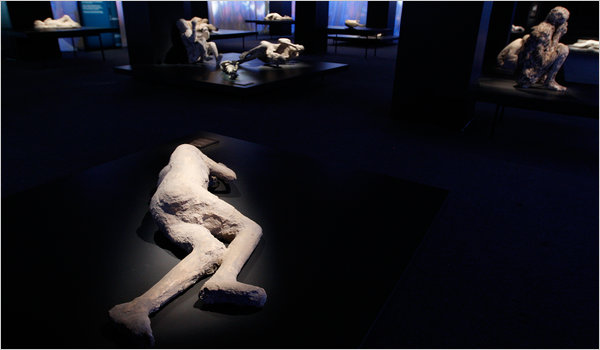
“Pompeii the Exhibit: Life and Death in the Shadow of Vesuvius”--a new exhibition at Discovery Times Square--activates the same tension between spectacle and education, prurience and propriety, which was exploited to such great financial reward by Gunther von Hangens in Body Worlds and which characterized many 19th Century popular amusements such as tourist visits to the Paris Morgue, popular anatomical museums, and the scores of death- and destruction-themed spectaculars to be found at Coney Island in the late 19th and early 20th Centuries.

In fact, "Pompeii the Exhibit" of 2011 has much in common with a particular Coney Island attraction of 1889--the spectacular “The Last Days of Pompeii”--if not in the particulars than in the shared drive to offer the paying public a fully immersive recreation of the destruction of Pompeii, and in their use of over-the-top hyperbolic detail in describing the wonders of their respective exhibitions.

"The Last Days of Pompeii" of 1889--an immersive spectacle that combined historical vignette, theatre performance, and a pyrotechnic display in recreating the destruction of Pompeii by the fires of Vesuvius--boasted in its press about the number and variety of its cast (over 400 people! "a ballet troupe of 36 dancers trained by Batiste Cherotte... a male chorus..., soldiers, acrobats, jugglers, tumblers, [and] wire-walkers"!)

2011's "Pompeii the Exhibit," on the other hand, focuses on the numbers and authenticity of its artifacts (over 250! Some never seen before! The largest number of body casts ever on display!), bringing to mind the press for such Coney Island Spectaculars such as "The Boer War" (Real British and Boer veterans!) and the "Streets of Delhi" (300 authentic Indian natives in costume! Elephants! Camels! Horses!). To further blur the line between "legitimate museum" and popular attraction, "Pompeii the Exhibit" is hosted at a popular exhibition hall sponsored by a television channel--Discovery Times Square--rather than an "ordained" museum such as AMNH; Also, Pompeii the Exhibit" provides visitors not just artifacts and other traditional ways of experiencing history but also what its website describes as a "brand-new, immersive movie experience" reenacting "the moment of Vesuvius’ massive explosion."

So what to make of it all? I see this new exhibition as excitingly in the tradition of 19th Century popular educational amusements--dime museums, popular anatomical museums, and Coney Island recreations--spaces where spectacle and education, prurience and propriety, coexisted for mass consumption. Fun, didactic, spectacular, and a resounding and thoughtful endorsement in today's Times to boot. I, for one, can't wait to go see it.

You can read a fascinating review of "Pompeii the Exhibit"--as quoted above--by Edward Rothstein in today's New York Times by clicking here. You can find out more about Coney Island's “The Last Days of Pompeii" by clicking here. You can find out more about "Pompeii the Exhibit" by clicking here.

Thanks so much to GF Newland for alerting me to this!

Image: Ruth Fremson/The New York Times

Plaster casts made from hollowed-out molds of rock, where bodies had been captured a moment before they ceased to be.

Paperback Launch Party, "Still Life" by Melissa Milgrom, March 10, The PowerHouse Arena, Brooklyn


Next Thursday, March 10! Hope to see you there.

Paperback Launch Party: Still Life by Melissa Milgrom
Date: Thursday, March 10 · 7:00pm - 9:00pm
Location: The PowerHouse Arena
37 Main Street, Brooklyn, NY
For more information, please call 718.666.3049
RSVP: rsvp@powerHouseArena.com

"Who knew a book about dead animals could be so lively? This is a wonderful look at a quirky, passionate, sometimes fanatical subculture."
— A.J. Jacobs, author of The Year of Living Biblically

In Still Life, Milgrom exposes a world of intrepid hunter-explorers, eccentric naturalists, and gifted museum artisans, all devoted to the paradoxical pursuit of creating the illusion of life. She'll deliver a lecture on the strange art of taxidermy and sign copies of her book, just out in paperback.

Over the past five years Melissa Milgrom has come to understand just what compels people to want to preserve dead animals: an absurd—almost fanatical—love of animals and the beauty of organic forms. Still Life is a completely engrossing look at this intriguing art form that thrives despite its fringe reputation. In the end, it's the taxidermists' love of nature and their unending quest to understand it on its own terms, which ultimately unites the book's characters, more than even the science or art of their craft. Transformed from a curious onlooker to an empathetic participant, Milgrom takes us deep into the world of taxidermy and reveals its uncanny appeal. Straddling science and art, high culture and kitsch—like taxidermy itself—Still Life celebrates the beauty in the uncanny.

Melissa Milgrom has written for The New York Times, the Wall Street Journal, and Travel & Leisure, among other publications; she has also produced segments for public radio. She holds a master's degree in American studies from the University of Pennsylvania. Milgrom lives in New York City. Please visit http://www.melissamilgrom.com.

To find out more, click here. To find out more about the book, click here.

Image: From the Still Life website; caption reads: "This orangutan, mounted in 2003 by a team of taxidermists for the Smithsonian Institution's Behring Hall of Mammals, typifies how exotic animals are procured in a post-expedition era. Photo: Cameron Davidson."

"Kingdom Under Glass: A Tale of Obsession, Adventure, and One Man’s Quest to Preserve the World’s Great Animals" This Thursday at Observatory

9780805092820
This Thursday at Observatory: learn the stories of the epic dioramas of New York's Museum of Natural History and their maker, Carl Akeley, in this illustrated lecture by author Jay Kirk!

Full details follow; very much hope to see you there

Kingdom Under Glass: A Tale of Obsession, Adventure, and One Man’s Quest to Preserve the World’s Great Animals
An illustrated lecture and book signing with author Jay Kirk
Date: Thursday, March 3
Time: 8:00 PM
Admission: $5
Presented by Morbid Anatomy
***Books will be available for sale and signing

During the golden age of safaris in the early twentieth century, one man set out to preserve Africa's great beasts. In his new book Kingdom Under Glass: A Tale of Obsession, Adventure, and One Man's Quest to Preserve the World's Great Animals, Jay Kirk details the life and adventures of naturalist and taxidermist Carl Akeley, the brooding genius who revolutionized taxidermy and created the famed African Hall we visit today at New York's Museum of Natural History. The Gilded Age was drawing to a close, and with it came the realization that men may have hunted certain species into oblivion. Renowned taxidermist Carl Akeley joined the hunters rushing to Africa, where he risked death time and again as he stalked animals for his dioramas and hobnobbed with outsized personalities of the era such as Theodore Roosevelt and P. T. Barnum. In a tale of art, science, courage, and romance, Jay Kirk resurrects a legend and illuminates a fateful turning point when Americans had to decide whether to save nature, to destroy it, or to just stare at it under glass.

Tonight, join author Jay Kirk for an illustrated lecture based on his new book Kingdom Under Glass. Books will be available for sale and signing after the event.

Jay Kirk's nonfiction has been published in Harper's, GQ, The New York Times Magazine, and The Nation. His work has been anthologized in Best American Crime Writing 2003 and 2004, and Best American Travel Writing 2009 (edited by Simon Winchester). He is a recipient of a 2005 Pew Fellowship in the Arts and is a MacDowell Fellow. He teaches in the Creative Writing Program at the University of Pennsylvania. You can find out more about him and his work at jaykirk.info.

You can find out more about this event on the Observatory website by clicking here and can can access the event on Facebook here. You can get directions to Observatory--which is next door to the Morbid Anatomy Library (more on that here)--by clicking here. You can find out more about Observatory here, join our mailing list by clicking here, and join us on Facebook by clicking here.

Tomorrow Night at Observatory: "The 'Oculus Imaginationis' of Ted Serios" with Mikita Brottman

ted
Tomorrow night at Observatory! Hope to see you there!

An illustrated lecture with Mikita Brottman
Date: Friday, March 4
Time: 8:00 PM
Admission: $5
Presented by Morbid Anatomy

Ted Serios was an elevator operator from Chicago who appeared to possess a genuinely uncanny ability. By holding a Polaroid camera and focusing on the lens very intently, he seemed able to produce dream-like pictures of his thoughts on the Polaroid film that subsequently emerged; he referred to these images as “thoughtographs”,This lecture will consider how the Ted Serios phenomenon goes beyond the notion of “real versus fake”, providing different kinds of insights into the relationship between photography, subjectivity, representation and the unconscious.

Mikita Brottman is a British scholar, psychoanalyst, author and cultural critic known for her psychological readings of the dark and pathological elements of contemporary culture. She is a professor of humanities at the Maryland Institute College of Art in Baltimore. You can find out more about her and her work at http://www.mikitabrottman.com.

You can find out more about this event on the Observatory website by clicking here and can can access the event on Facebook here. You can get directions to Observatory--which is next door to the Morbid Anatomy Library (more on that here)--by clicking here. You can find out more about Observatory here, join our mailing list by clicking here, and join us on Facebook by clicking here.