Morbid Anatomy Library New Regular Open Hours: Saturdays, 12-6, Beginning This Saturday, January 8


The Morbid Anatomy Library--a private research library and collection I make available to the interested public in Brooklyn, New York--is pleased to announce new regular open hours every Saturday from 12-6.

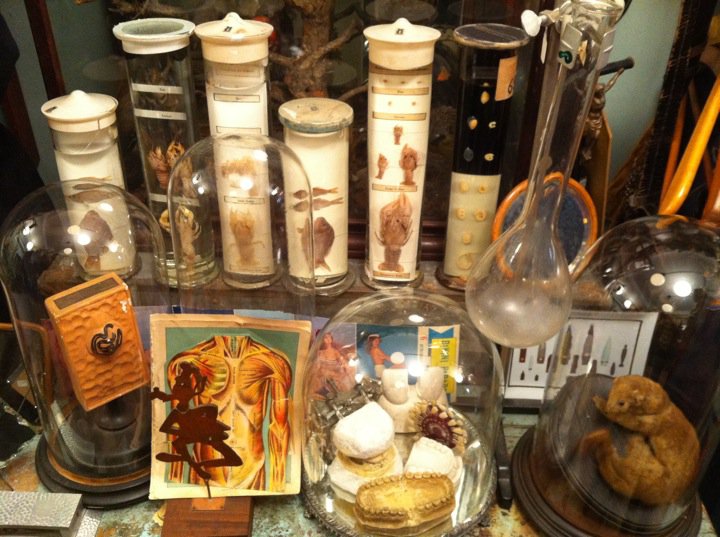
The library and cabinet--pictured above in a series of photos by Shannon Taggart--makes available a collection of curiosities, books, photographs, artworks, ephemera, and artifacts relating to medical museums, anatomical art, collectors and collecting, cabinets of curiosity, the history of medicine, death and society, natural history, arcane media, and curiosity and curiosities broadly considered. The present Morbid Anatomy Library Scholar in Residence is Evan Michelson of Obscura Antiques and Oddities and the new television show "Oddities."

If you would like to know more, you can read about the library in Newsweek, Time Out New York, or The Huffington Post and watch videos about it produced by Newsweek, Rocketboom Media, and WPIX's Toni On! New York.

The library is located at 543 Union Street at Nevins in Brooklyn New York. Enter via Proteus Gowanus gallery or by buzzing buzzer 1E. Click here to view map.

To find out more about the Morbid Anatomy Library, click here.

Photos by Shannon Taggart.

The Great Coney Island Spectacularium Exhibition and Website Launch


Many people know about the Coney Island of hot dogs, roller coasters, circuses, and side shows; what many do not know is the other Coney Island, the much forgotten Coney Island of strange immersive amusements produced on a scale nearly impossible to imagine today and blurring the boundaries between science and spectacle, current affairs and entertainment, and education and titillation.

Just to give you a sense of what I'm talking about. On an average day in Coney Island from the years 1890 to 1915, a visitor could (and this is just a tiny sampling):

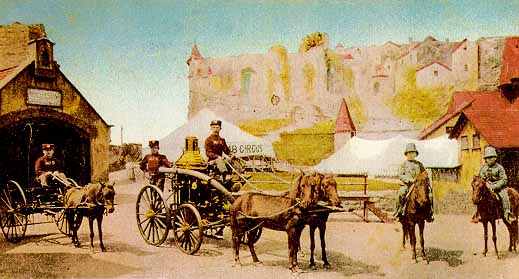
  • take in a Midget City Theater vaudeville show in Lilliputia, the town populated by 300 midgets and modeled on a half-scale 16th century Nuremberg (top image)
  • check out a staged tenement fire featuring a cast of 2,000 at the popular attraction Fighting the Flames (2nd image)
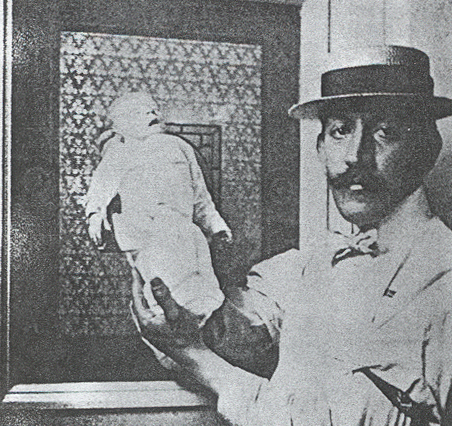
  • marvel at freakishly tiny premature babies kept alive by a novel technology (later adopted by hospitals) and team of nurses at The Infant Incubator (5th image)
  • relive the Boer War via a reenactment starring 600 genuine Boer War veterans
  • watch a reenactment of The Galveston Flood, which had killed 6,000 people only two years before the attraction debuted
  • thrill to San Francisco destroyed by fire, the Titatic destroyed at sea, or Pompeii destroyed by Mt. Vesuvius
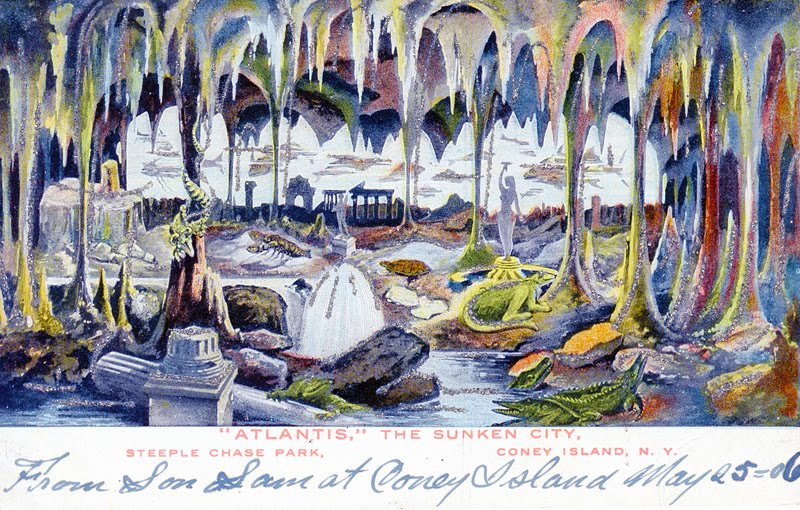
  • descend to the sunken city of Atlantic (3rd image)
  • encounter a troupe of genuine head-hunting Bontac tribesmen in an authentically replicated village (6th image)
  • be publicly humiliated at The Insanitarium and Blowhole Theater, where a midget in a clown costume (sic) would herd you with an electric cattle prod (sic again) over jets of air that would blow up your skirts (if you were of the female persuasion) before an audience of laughing park patrons (see video above, about 20 seconds in)
  • buy candy Frankfurters, Pork Sausages, and Plum Pudding at Bauer Sisters Candy Delicatessen (4th image)

"The Great Coney Island Spectacularium"--my upcoming project as artist-in-residence at the Coney Island Museum--will be a response, commemoration, celebration, and evocative re-staging of fin de siècle Coney Island as the pinnacle of this bizarre world of pre-cinematic immersive spectacular amusement. It will feature a specially constructed immersive cosmorama, a dime-museum inspired installation, and a number of other spectacular surprises.

The exhibition--produced in tandem with Coney Island Museum director Aaron Beebe--will launch on Friday, April 8th, 2011 at the Coney Island Museum. There will be many spectacular events over the course of its year-long residency, and the whole will launch with The Congress of Curious People, a 10-day set of lectures, performances, and panel discussions about curiosity and curiosities, broadly conceived (more on that soon; more on last year's Congress here).

You can visit the website for the exhibition--which features an acitvely updated blog tracing the exhibition research conducted by Aaron and myself, a bibliography, and many more details about the exhibition--at http://www.spectacularium.org. Please sign up for the mailing list (upper right hand corner of the website) to be alerted to events and announcements around the exhibition.

Images top to bottom:

  1. From Jeffrey Stanton's Coney Island History Website
  2. From Jeffrey Stanton's Coney Island History Website
  3. Postcard from The Coney Island Museum
  4. From Coney Island: A Postcard Journey to the City of Fire by Richard Snow
  5. From Pixie's MySpace Blog
  6. "Filipino Baby Coney Isand 1905," from jo simalaya alcampo

La Buena Tierra Organic Restaurant: Eat Healthy

La Buena Tierra Organic Restaurant: Eat Healthy

La Buena Tierra Organic Restaurant: Eat Healthy

Rather than showcasing their orangic foods, La Buena Tierra wanted to visually show how junk foods destroy your insides. I love the art direction though I do fear what my insides look like after the cheese burrito I inhaled earlier looks like…

Advertising Agency: Z Mexico
Creative Directors: Jose Arce, Fernando Carrera
Art Director / Copywriter / Illustrator: Fernando Carrera
Photographer: Gustavo Dueñas

Phantasmagoria at the Louvre (!!!): Paris, January-March 2011


Parisian museums are getting more and more historically innovative with their programming. First, the amazing looking "Science and Curiosities: exhibition at Versailles (as discussed in this recent post). And now this just in: The Cinémathèque Française will be co-producing a phantasmagoria projection & spectacle in partnership with--and to be performed at--The Louvre!

Phantasmagoria, invented in the wake of--and said to be a response to--The French Revolution, are essentially ghost shows in which images of skeletons, demons, and ghosts (see top image) are projected via a modified magic lantern and, through a series of ingenious special effects, seem to move about, approach and retreat from, the viewer. These forms of spectacle were very popular around the time of the French Revolution and were also performed throughout the 19th Century; with the advent of film, they metamorphosed into the horror movie, a popular form to this day.

The phantasmagoria projection & spectacle at the Louvre will consist of a series of phantasmagoria projections and spectacles between the dates of January 13th until March 28th of 2011; The highlight will be a grand phantasmagoria projection on March 6 where guest Phantasmagores Laure Parchomenko & Laurent Mannoni promise to conjure-up a variety of spirits which haunted the aftermath of the Revolution at 14:30 & 18:00.

More information about this event can be found (in French) here.

Via the Early Visual Media website and mailing list.

Call for "Collectors of Unusual Things" for "Oddities" Television Show

Near NYC? Collect anything unique or out of the ordinary? Want to be on the next episode of "Oddities?" Email your info to odditiesshow@gmail.com!!!! The producers will be in touch!

This call for collectors just in from the production crew of "Oddities," the new Discovery and Science Channel series based on Obscura Antiques and Oddities in New York City. If you are a collector of unusual things and interested in appearing on the show--or would like additional information--email odditiesshow@gmail.com.

You can find out more about the show at this recent post and on the official website by clicking here.

Michael Reedy

Michael Reedy She Knows How To Use Them

Michael Reedy Every Last One

Michael Reedy Don't Worry Baby

Michael Reedy Once Removed

Michael Reedy Malum E

Never have I seen such a beautiful and seamless combination of figure drawing, internal anatomy and, well, silliness. It is as if Michael Reedy has grown tired of rendering the classic figure drawing and has drifted to rendering the thoughts and dreams of the subjects. His anatomical artwork is reminiscent of the fanciful anatomy of Albinus’ and Vesalius’ texts from back in the day and he does an excellent job balancing between the fine art and superflous illustration.

From Michael:

The human figure and portraiture have been central to my studies and explorations as a practicing artist for the past twelve years. In a desire to extend beyond historical modes of representation, I have found myself increasingly interested in depictions of the body that fall outside the canon of art history, namely in cartooning and medical illustration. Ultimately, I believe that by combining the visual language and style employed by various modes of representation, both inside and outside the accepted boundaries of fine art, I can locate and capitalize on unique areas of resistance essential to the production of new meaning.

[Spotted by David Cheney]

"The Keeper of Curiosities" Royal Ontario Museum in the Wall Street Journal


A nice appreciation of the cabinet of curiosity approach to contemporary museum curation in today's Wall Street Journal:

At the [Royal Ontario Museum, aka ROM ], objects taken from its separate collections (fine and decorative arts, history, textiles, archaeology, geology, mineralogy, paleontology and zoology) are often mixed and matched in highly interdisciplinary displays to create a narrative not often seen in the more specialized museums that we are used to. For example, English dresses and slippers from the late 18th and early 19th centuries are displayed next to African and Asian clothing of the same era, alongside printing blocks and a wall-text description of berries used to produce dyes, because one of the points being made is how colors and patterns were dyed or printed onto these fabrics. Comparisons are being drawn about widely divergent cultures and industrial practices.

"In so many museums, curators are telling the story of the objects on display—why this is in the collection, why that is an important piece—while we're trying to use the objects in our collections to tell a story about how people go about their lives here and elsewhere around the world, and often about the intersection of the natural and cultural worlds," she said.
Here's another example: A display contains ceramic vases, silver, clocks, weathervanes and furniture from the 18th century, across from painted portraits of men, women and children who lived in Canada back then. None of the individual objects have their own labels, and only some wall text describes life in that time. Who were those people in the portraits? Who painted them? Where were those chairs and vases made? Did those people own that silver? Presumably, the curators know and aren't telling us. At the ROM, the point isn't so much the individual objects as creating a big-picture view of life at a certain time and place. "We encourage visitors to make connections in their own minds," Ms. Carding said...

The ROM is in some ways a throwback. Before people traveled so much or had such wide access to books and photographs (in short, an education), 18th- and 19th-century museums were cabinets of curiosities that provided a world of collected knowledge, a walk-in encyclopedia of objects both natural and man-made, practical and artistic. It is rare to find this type of institution anymore; museums now are more and more specialized...

Like the original cabinets of curiosities, there is a little something for everyone, but not so much as to bore people. Known as the "Stair of Wonders," the landings between floors have their own miniature displays—seashells or insects or battalions of metal toy soldiers—to perk up interest when it may be flagging. There's also a life-size, walk-through diorama of the St. Clair Cave in Jamaica, with its plaster-cast hanging bats, insects and stalagmites (based on ROM scientists' work at the site). "People here talk about their old favorites; so many people just love the bat cave," Ms. Carding said.

You can read the full article--from which the excerpt is drawn--by clicking here.

Image via Ddrees Art.

Save Santa!

Jon Adams Save Santa!

Click to see larger.

Santa’s stressed and overweight.  Help him pop a pill, find the way through his internal organs, and ultimately save Christmas!

Created by San Francisco based, illustrator and designer Jon Adams.

[spotted by Diane]

Olivier Valsecchi “Dust”

Olivier Valsecchi Dust

Olivier Valsecchi Dust

Olivier Valsecchi Dust

Olivier Valsecchi’s latest collection highlights bodies in motion and accentuates the human form as it is met with dust. These photos convey beauty and discomfort. It looks as if some individuals are embracing the impact of dust and others are retreating from it, and still some seem to glide through it as if in water. Whatever may be the case for the models, the powder brings out the details of the bodies, even when obscured by small clouds. The images are haunting and beautiful.

You can see more of this work and Valsecchi’s other pieces on his site.

[via Change the Thought]

Upcoming Observatory Screening and Lecture: "A: Head on B: Body: The Real Life Dr. Frankenstein," Friday, January 7th


Morbid Anatomy is pleased to announce "A: Head on B: Body: The Real Life Dr. Frankenstein," a lecture and screening exploring the notion of the "mad scientist" in fact and fiction, history and myth. The focal point of the presentation will be the real life mad scientist Dr. Robert White, a professor and pioneering neurosurgeon whose experiments with what he termed "full body transplants" pushed many troubling boundaries.

The event will feature a short documentary film about Dr, White by Jim Fields, director of the “End of the Century: the Story of the Ramones." Fields and Lewi will introduce the film–which features a series of interviews with Dr. White discussing his controversial experiments–with an illustrated lecture contextualizing the doctor’s work within the history of “mad scientists” past and present, fictional and actual; scientists whose hubris drove them to go rogue by tampering with things perhaps best left alone.

Full event description follows; hope very much to see you there!

A: Head on B: Body: The Real Life Dr. Frankenstein
A screening and lecture with film-maker Jim Fields and Mike Lewi
Date: Friday, January 7th
Time: 8:00 PM
Admission: $5
Presented by Morbid Anatomy

In an eventful and successful career spanning 40 years, Dr. Robert White–pioneering neurosurgeon and Professor at Cleveland’s Case Western Reserve University–did many things. He participated in Nobel Prize-nominated work, published more than 700 scholarly articles, examined Vladimir Lenin’s preserved brain in Cold War Russia, founded Pope John Paul II’s Committee on Bioethics, went to mass daily, and raised 10 children. He also engaged in a series of horrifying and highly controversial experiments reminiscent of a B-Movie mad scientist, experiments which pushed the limits of medical ethics, infuriated the animal rights community, and questioned notions of identity, consciousness, and corporeality as well as mankind’s biblically-condoned dominion over the animal kingdom.

Tonight, join film-maker Jim Fields–best known for his 2003 documentary “End of the Century” about the legendary punk band The Ramones–and Mike Lewi for a screening of Fields’ short documentary about the life and work of this real-life Dr. Frankenstein whose chilling “full body transplants” truly seem the stuff of a B-Movie terror. Fields will introduce the film–which features a series of interviews with Dr. White discussing his controversial experiments–with an illustrated lecture contextualizing the doctor’s work within the history of “mad scientists” past and present, fictional and actual; scientists whose hubris drove them to go rogue by tampering with things perhaps best left alone.

Jim Fields made a few documentaries, one of which, “End of the Century: the Story of the Ramones” is particularly long. He’s currently a video journalist at Time Magazine and Time.com.

Mike Lewi is a filmmaker, event producer, and disc jockey.

You can find out more about this event on the Observatory website by clicking here and can can access the event on Facebook here. You can get directions to Observatory--which is next door to the Morbid Anatomy Library (more on that here)--by clicking here. You can find out more about Observatory here, join our mailing list by clicking here, and join us on Facebook by clicking here.

Image: Drawing by Dr. Harvey Cushing, early 20th Century, found on the Yale Medical Library website.

Tomorrow Night: "The Vast Santanic Conspiracy: Is St. Nick the Tool of a Plot too Monstrous to Mention?" With Cult-Author Mark Dery at Observatory


Tomorrow night at Observatory. So hope to see you there!

The Vast Santanic Conspiracy: Is St. Nick the Tool of a Plot too Monstrous to Mention?
An illustrated lecture with cult author and cultural critic Mark Dery, followed by a Krampus/Solstice-themed after party with music, specialty cocktails, and more
Date: Tuesday, December 21 (Winter Solstice)
Time: 8:00 PM
Admission: $10
Presented by Morbid Anatomy

Canceled, last year, by an act of Cthulhu–the Mother of All Blizzards, which dumped 20 inches of snow across the Northeast–Dery’s wickedly witty lecture, “The Vast Santanic Conspiracy: Is St. Nick the Tool of a Plot too Monstrous to Mention?,” is sure to inspire Christmas jeer.

Few Americans know that Santa descends from the mock king who held court at Saturnalia, the Roman festival celebrating the winter solstice. Or that he shares cultural DNA with the Lord of Misrule who presided over the yuletide Feast of Fools in the Middle Ages—lewd, blasphemous revels that gave vent to underclass hostility toward feudal lords and the all-powerful church.
In “The Vast Santanic Conspiracy: Is St. Nick the Tool of a Plot too Monstrous to Mention?,” Dery, a cultural critic and book author, takes a look at the Jolly Old Elf’s little-known role as poster boy for officially sanctioned eruptions of social chaos, as well as his current status as a flashpoint in “the Christmas Wars”—cultural battles between evangelicals, atheists, conservatives, and anti-consumerists over the “true” meaning of Christmas. Along the way, Dery considers New Age theories that Santa is a repressed memory of an ancient Celtic cult revolving around red-capped psychedelic mushrooms; Nazi attempts to re-imagine Christmas—a holiday consecrated to a Jewish baby, for Christ’s sake—as a pre-Christian invention of tree-worshipping German tribes, in some misty, Wagnerian past; and the suspicious similarities between Satan and Santa, connections that have fueled a cottage industry of conspiracy theories on the religious right.

Mark Dery (http://www.markdery.com) is a cultural critic. He is best known for his writings on the politics of popular culture in books such as The Pyrotechnic Insanitarium: American Culture on the Brink and Escape Velocity: Cyberculture at the End of the Century. Dery is widely associated with the concept of “culture jamming,” the guerrilla media criticism movement he popularized through his 1993 essay “Culture Jamming: Hacking, Slashing, and Sniping in the Empire of the Signs”; “Afrofuturism,” a term he coined and theorized in his 1994 essay “Black to the Future” (included in the anthology Flame Wars: The Discourse of Cyberculture, which he edited); and the Pathological Sublime, which he introduced in The Pyrotechnic Insanitarium. He has been a professor in the Department of Journalism at New York University, a Chancellor’s Distinguished Fellow at UC Irvine, a Visiting Scholar at the American Academy in Rome, a blogger for True/Slant (http://trueslant.com/markdery/) and Thought Catalog (http://thoughtcatalog.com/) and a guest blogger at Boing Boing. A Portuguese-only collection of his recent essays, Não Devo Pensar Em Coisas Ruins (I Must Not Think Bad Thoughts), has just been published in Brazil by Editora Sulina.

You can find out more about this event on the Observatory website by clicking here. You can get directions to Observatory--which is next door to the Morbid Anatomy Library (more on that here)--by clicking here. You can find out more about Observatory here, join our mailing list by clicking here, and join us on Facebook by clicking here.

Nothing says "Merry Christmas" Like Victorian Baby Talk: Edison’s Monstrous Talking Doll, circa 1890


Nothing says "Merry Christmas" like Victorian baby talk. Especially when it sounds like this.

More, from the Go Report website:

While we may never know what the ‘must have’ Christmas gift was in 1890, we do know that it most assuredly wasn’t Thomas Edison’s talking doll.

Using miniature phonographs embedded inside, these “talking” baby dolls were toy manufacturers’ first attempt at using sound technology in toys. They marked a collaboration between Edison and William Jacques and Lowell Briggs, who worked to miniaturize the phonograph starting in 1878.

Unfortunately, production delays, poor recording technology, high production costs, and damages during distribution all combined to create toys that were a complete disaster, terrifying children and costing their parents nearly a month’s pay.

Edison would later refer to the dolls as his “little monsters.”

To hear this wee monstrous baby reciting, we are led to believe, "Little Jack Horner," click here. To read the entire story from which the above excerpt is drawn, click here. Sound from Archive.org.

Thanks to my lovely friend Matt Murphy for this charming holiday tale about a rare Edison commercial misfire.

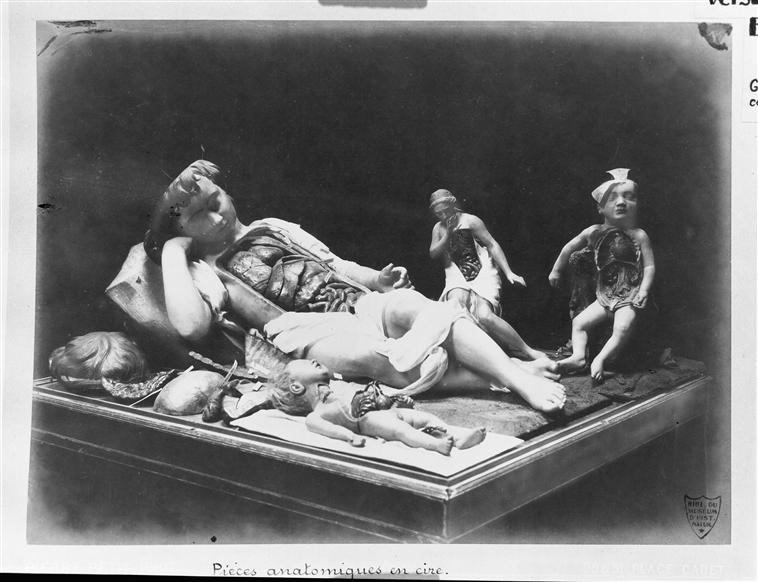
Anatomical Wax, Gallery Comparative Anatomy, Circa 1880

Cote cliché: 09-575178
Inventory Number: P4460
Fund: Photographs
Title: Anatomical wax
Description: Gallery comparative anatomy, circa 1880
Author: Petit Pierre Lanith (1831-1909)
Photo credit: Contact us in advance for monographs, exhibition panels, commercial editions, advertising and communication. An additional proof be sent to the museum. (C) National Museum of Natural History, Dist. RMN / image MNHN, Central Library
Period: 19th century
Date: 1880
Location: Paris, National Museum of Natural History, Central Library

Click on image to see much larger, more interesting image. Via RMN found via Bits and Bites Tumblr.

12 Objects by Dan Zettwoch

12 Objects by Dan Zettwoch

Talk about a hungry hippo, it looks as if Pepe chowed down on a member of the military, delicious. This wonderful one page comic documenting 12 objects found in the stomach of Columbian drug kingpin Pablo Escobar’s escaped pet hippopotamus was illustrated by Dan Zettwoch and featured in the 4th edition of STUDYGROUP 12. The Ignatz Award-winning comics anthology that is STUDYGROUP 12  is available for purchase on Etsy for those curious, and it looks as if it has some pretty rad artwork in it. The Etsy page also has a better and more in-depth description of the publication. Be sure to check out Dan’s blog, he’s got some great prints and breakdowns on there.