"Blood Work: Medicine and Murder in the Scientific Revolution," Illustrated Lecture and Book Signing with Holly Tucker, Tomorrow Night at Observatory!


Tomorrow night at Observatory! Very much hope to see you there.

Blood Work: Medicine and Murder in the Scientific Revolution
Lecture and Book Signing with Professor and Author Holly Tucker
Date: Tuesday, March 22
Time: 8 PM
Admission: $5
Presented by Morbid Anatomy

In 1667 physician Jean-Baptiste Denis transfused calf’s blood into the body of Antoine Mauroy, an infamous madman known to tear through the streets of Paris naked and screaming. With this, Denis--a brash physician with a taste for the limelight--enraged both the elite doctors who wanted to perform the first animal-to-human blood transfusion themselves and powerful conservatives who believed he was toying with forces of nature that he didn’t understand. It only got worse when just days after the experiment, Mauroy was dead, and Denis was framed for murder. A trial ensued and Denis became a kind of 17th century Dr. Kevorkian, a stubborn man of science who held the public spellbound and reveled in controversy.

Animal-to-human transfusion was then on the cutting-edge of medicine. In an era in which superstition sparred with science, transfusion was also a flashpoint for controversy. Conservative camps in Catholic France, including King Louis XIV’s Academy of Sciences, railed against transfusion and predicted that before long animal-human hybrids would walk among us. Ambitious scientists fumed at being held back by retrograde forces who would choke the progress of science. A confused public feared that they would be crushed by cosmic backlash or social upheaval.

Join us tonight as Dr. Tucker tells us this fascinating story of a notorious madman, a renegade physician, a murder that remained unsolved for over three centuries, and the true story one of the world’s first blood transfusions in 17th century France as detailed in her new book, Blood Work: Medicine and Murder in the Scientific Revolution (W.W. Norton, March 2011).

Copies of Blood Work will be also available for sale and signing.

Holly Tucker is an associate professor at Vanderbilt University’s Center for Medicine, Health & Society and the Department of French & Italian. Her research focuses on the history of medicine. She writes for publications including the Wall Street Journal, San Francisco Chronicle, New Scientist, and Christian Science Monitor. She lives in Nashville, Tennessee. You can find out more at her website, http://www.holly-tucker.com and her blog http://www.wondersandmarvels.com.

You can find out more about the book by clicking here, and more about this event on the Observatory website by clicking here; you can access this event on Facebook here. You can get directions to Observatory--which is next door to the Morbid Anatomy Library (more on that here)--by clicking here. You can find out more about Observatory here, join our mailing list by clicking here, and join us on Facebook by clicking here.

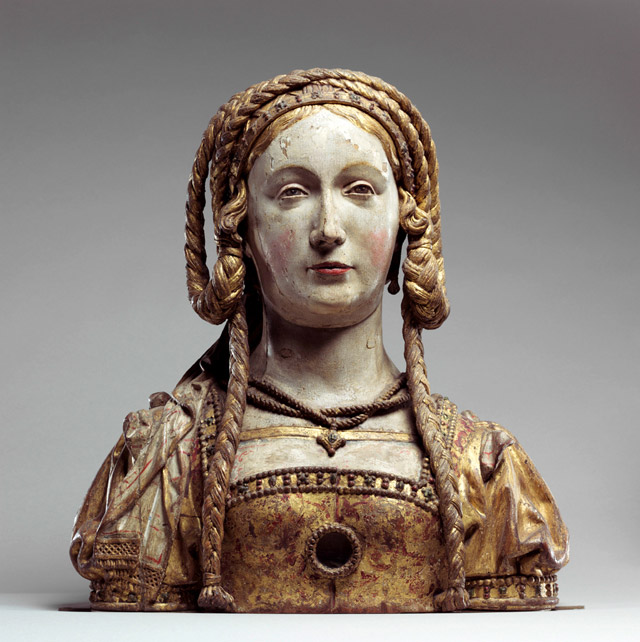
"Treasures of Heaven: Saints, Relics and Devotion in Medieval Europe" Exhibition, Walters Art Museum, Baltimore, Through May 15th


Wow. WOW.

This just in: On view until May 15th of this year at the Walters Art Museum in Baltimore, a new exhibition of relics and reliquaries entitled "Treasures of Heaven: Saints, Relics and Devotion in Medieval Europe."

To get a sense of the kinds of treasures that await, check out the Treasures of Heaven "Digital Monograph" (from which these images were drawn) by clicking here.

Press release for the exhibition follows:

Treasures of Heaven: Saints, Relics and Devotion in Medieval Europe
Feb. 13, 2011 - May 15th, 2011
Walters Art Museum, Baltimore, Maryland

First major U.S. exhibition of Christian relics and reliquaries co-organized by the Walters, the Cleveland Museum of Art and the British Museum

Baltimore—The Walters Art Museum will host an exhibition offering visitors a glimpse into the Middle Ages, a time when art mediated between heaven and earth and wondrous objects of gold, silver and precious gems filled churches and monastic treasuries. Relics, the physical remains of holy people and objects associated with these individuals, play a central role in a number of religions and cultures and were especially important to the development of Christianity as it emerged in the Late Roman world as a powerful new religion. On view at the Walters Feb. 13–May 15, 2011, Treasures of Heaven: Saints, Relics and Devotion in Medieval Europe is the first exhibition in the United States to focus on the history of relics and reliquaries—the special containers to display the holy remains of Christian saints and martyrs. The exhibition is organized by the Walters Art Museum in partnership with the Cleveland Museum of Art and the British Museum.

Reliquaries proclaimed the special status of their sacred contents to worshipers and pilgrims, and for this reason, were often objects of artistic innovation, expressions of civic and religious identity, and focal points of ritual action. This exhibition will feature 133 metalworks, sculptures, paintings and illuminated manuscripts from Late Antiquity through the Reformation and beyond. It will explore the emergence and transformation of several key types of reliquary, moving from an age in which saintly remains were enshrined within closed containers to an era in which relics were increasingly presented directly to worshipers.

Many of the reliquaries in the exhibition have never before been seen outside of their home countries. Objects are drawn from celebrated public and private collections in the U.S. and Europe, and also from important church treasuries. In addition to the three organizing museums, world-renowned institutions, including the Louvre, the Metropolitan Museum of Art, the Art Institute of Chicago and the National Gallery of Art, are lending works to the exhibition. Nine works are traveling from the Vatican collections, including three reliquaries that were once housed in the Sancta Sanctorum, or Holy of Holies, the private relic chapel of the Pope.

Visitors will witness the transformation of reliquaries from simple containers for the earthly remains of Christian holy men and women to lavishly decorated objects of personal and communal devotion.

"As early as the second century AD, the relics of Christian saints—including their bones, ashes and other bodily remains—were thought to be more valuable than the most precious gemstones. They were believed to be a conduit for the power of the saints and to provide a direct link between the living faithful and God," said Martina Bagnoli, Robert and Nancy Hall associate curator of medieval art and exhibition co-curator. "These remains were treated with reverence and often enshrined in containers that used luxurious and precious materials to proclaim the relics' importance."

The medieval devotion to relics gave birth to new forms of architecture and prompted significant developments in the visual arts. The reliquaries showcased in Treasures of Heaven provide evidence of religious objects traveling across tremendous distances and of people making pilgrimages across the Mediterranean to walk in the footsteps of important figures from sacred history. Powerful in inspiring religious devotion among believers, reliquaries became cutting-edge works of art that combined innovative techniques with beautiful design.

"Those who come to the exhibition thinking that the Middle Ages are only a period of darkness will be surprised," said Martina Bagnoli.

Highlights of Treasures of Heaven include:

  • Reliquary Bust of St. Baudime, c. 1180-1200,Parish Church of Saint-Nectaire, Puy-le-Dôme
  • This nearly life-sized bust is one of the earliest surviving objects of its kind and travels outside of France for the first time.
  • Portable Altar of Countess Gertrude, c. 1045, Cleveland Museum of Art
  • This work is from the Guelph Treasure, one of the most important church treasuries to have survived from medieval Germany.
  • Head Reliquary of St. Eustace, c. 1200, British Museum
  • This head-shaped reliquary contained fragments of the skull of the Roman military leader Saint Eustace...

You can find out more about the exhibition here, and more about the topic of relics and reliquaries on the Treasures of Heaven "Digital Monograph" by clicking here. You can purchase the exhibition catalog by clicking here.

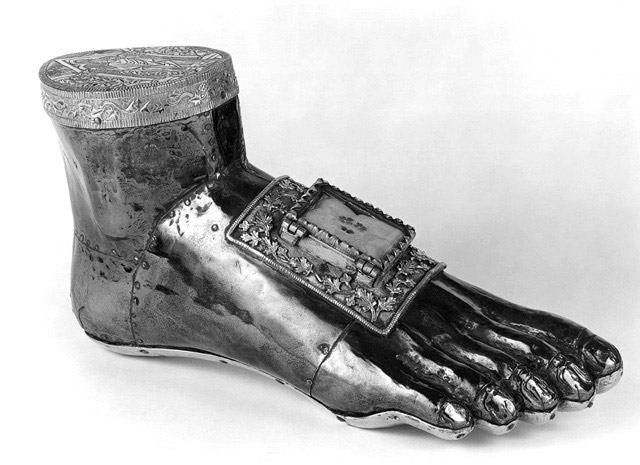
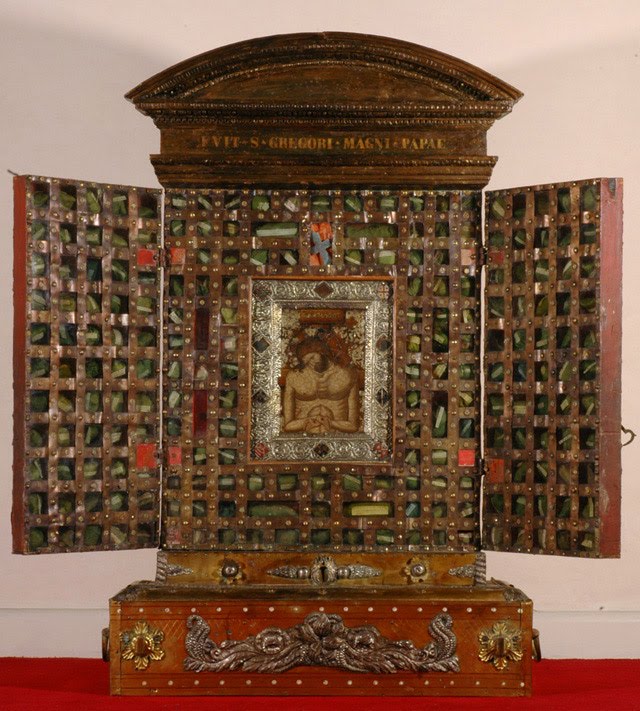
All images from the Treasures of Heaven "Digital Monograph;" you can find out more about them the images, and peruse the website, by clicking here. It was unclear how many of these are in the physical exhibition.

"Play Dead," Todd Robbins and Teller, The Players Theatre, New York


The other night, I took my boyfriend out for a night of good, scary, compelling fun at Todd Robbins' and Teller's (of Penn and Teller) new production "Play Dead," on view now at The Players Theatre in New York City.

The production is difficult to describe in normal theater terms; it is kind of like a haunted house meets a 1950s ghost show meets a piss take on a Victorian séance meets a high-end Vegas magic show all staged on a David Lynch film set. The main presence in the production is side-show performer Todd Robbins; he has a wonderfully compelling presence, equal parts passionate story teller, confidence man, and emphatic and empathetic debunker of spiritualist trickery. The piece is a kind of fun yet thoughtful meditation on the mysteries of death, the history of historical monsters in their various forms, and the ways--compellingly demonstrated in the show--that death and loss still make us easy prey for "spiritualist" hucksters.

I don't want to say too much more, as so much of the fun of the production come from the element of surprise, but I will say this: I was seriously amazed; I was amused; and we are still talking about it. I very much recommend checking it out.

"Play Dead" is being staged at The Players Theatre, 115 MacDougal Street, New York. You can find out more--and get tickets--by clicking here.

Full disclosure: I received free tickets from the Play Dead Production Company in exchange for reviewing this show. Lucky for me I really really enjoyed it! And so did my impartial boyfriend.

Image: From the Studio 360 website.

Kiva Ford – Heart in a Jar

Kiva Ford miniature heart in glass

Kiva Ford is a New York based glass artist mostly known for his goblets, miniatures, and jewelery. Above is a pendant available on his etsy page for $82. Also available are miniature vases and bowls as well as earrings and other necklaces. Kiva lists his interests in history, mythology, and the natural world as his influences. You can check out more of his work on his website, kivaford.com, including some amazing goblets and other pieces with tiny animals and figures encased in glass.

[via Super Punch]

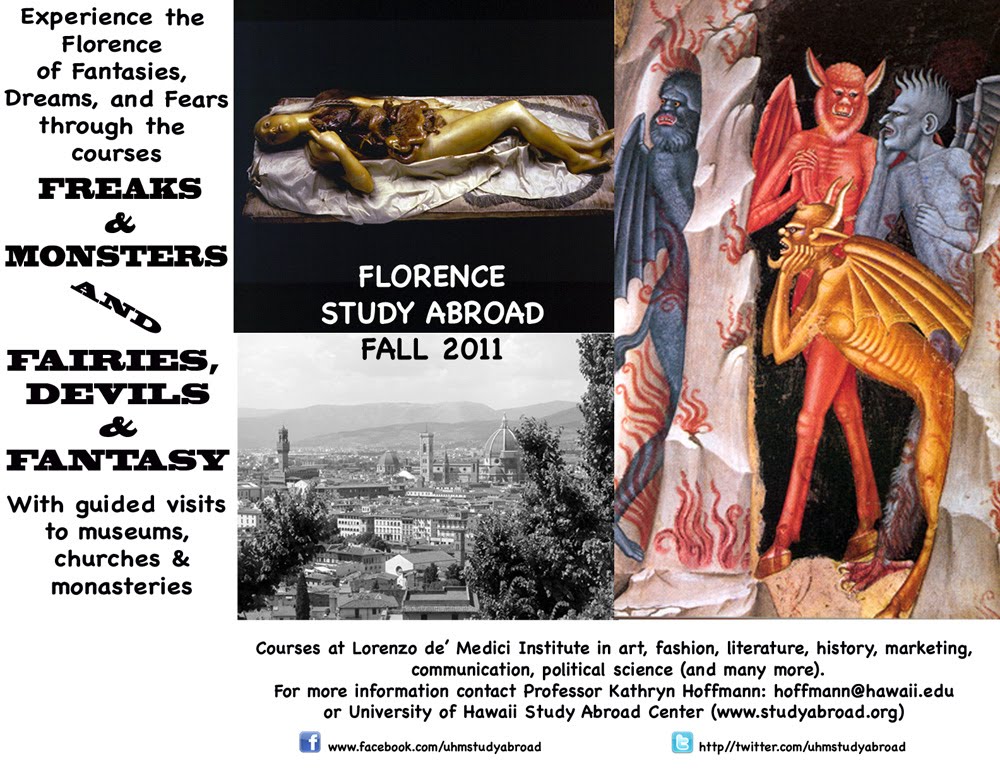
"Freaks and Monsters and Fairies, Devils, and Fantasy Tour of Florence," Fall, 2011, Dr. Kathryn Hoffman


Friend of Morbid Anatomy Kathryn Hoffmann of the University of Hawaii, Manoa has just announced that she will be leading a "Freaks, Monsters, and Fairies, Devils, and Fantasy" tour of Florence, Italy this upcoming fall semester. The tour will take in, in Hoffman's own words, "wax anatomical models of course, as well as the devils of Florence, reliquaries, the history of court and fairground stars with corporeal anomalies, and the original dark version of Pinocchio, where he came to a sad end in Book 5. I'm going to teach and take students out of the classroom and into the museums and churches."

Applications are due on April 1; for more information, email professor Hoffman at hoffmann [at] hawaii.edu.

So wish I could make it!

Please click on the image to see a much larger version.

Blissfully Departed Screen Print

Playfulness balances with memento mori in this blindingly bright orange screen print designed exclusively for Street Anatomy by designer and screen printer, Ryan Gerdes.

Available for $25 at the Street Anatomy store!

Blissfully Departed print by Ryan Gerdes

Blissfully Departed 12” x 18” screen print

Blissfully Departed print by Ryan Gerdes

Blissfully Departed by Ryan Gerdes detail

Blissfully Departed print by Ryan Gerdes signature

  • 12″x18″ plastisol screen print, 2011
  • Printed on plate surface bristol sheet
  • Limited edition of 25 prints, numbered and signed by artist

A graduate of Linfield College in art and visual culture, Ryan Gerdes is a successful designer and screen-printer working in Portland. He recently started his own screen-printing studio called 3Bird Press.

Ryan says of his work,

I’m a digital artist, I spend 50 hours a week at a corporate job creating corporate imagery.  The thing I love about screen printing, my true passion, is the handmade quality—when there is a “mistake”, I embrace it.  Like mis-registered skulls or the ink not quite covering all the the substrate.  I say, if you really want a perfect image, clean and crisp and the same as the one you saw online, buy a digital print.

Available at the Street Anatomy store for $25.  Only 25 available!


Avanos Hair Museum

Chez Galip Hair Museum

About 30 years ago potter Chez Galip opened The Hair Museum in Avanos, Cappadocia in Turkey. According to Oddity Central, Galip opened the museum after a departing friend left him a piece of her hair. The museum, located below Galip’s shop, is home to thousands of locks of hair that women have left over the years.

Chez Galip Hair Museum

Chez Galip Hair Museum

I saw the pictures first on BuzzFeed and when doing an Internet search discovered, that while this hair museum sadly has no site, there is a site for Leila’s Hair Museum in Independence, Missouri. Leila’s museum is a collection of wreaths and jewelry all made from hair.

Leila's Hair Museum


Anatomic Fashion Friday: Body Strip Costumes

Technomania Circus body strip costumes

Technomania Circus body strip

These anatomical costumes were created for an act called, Body Strip, for the Technomania Circus.

The performer says of her work,

I start off wearing all five unitards & dance to classic burlesque music as Richard [the other performer] peels off layers in succession. First the skin is taken off, revealing muscles; then the muscles are removed, showing the organs; organs give way to the circulatory system; in the end, I’m left wearing the bones. It worked really well.

[retrieved from Herodias in Space]

Hottie Body Hump Club

Oh my stars. We all knew humping was fun and good exercise, but this takes it to a whole new level. Not only is this video/script hilarious, the cast is aaaaamazing, major kudos. Let the hilarity ensue, you wont be sorry. Thank you Jimmy Kimmel, you have made my week.

"Coney Island Spectacularium and ‘Oddities’ Screening," Coney Island Museum, April 9th, Obscura Day 2011


As part of that noble effort which is Obscura Day, why not come down to Coney Island, take in Morbid Anatomy's brand new exhibition "The Great Coney Island Spectacularium" (which opens the day before), check out Super Freak Weekend, and celebrate the premiere of season two of "Oddities" with free Hendricks Gin cocktails, episode viewing, and general revelry assorted cast members?

Why not indeed!

Full details follow; really hope to see you there!

Title: Coney Island Spectacularium and "Oddites" Screening
Date: Saturday, April 9

Time: 8:00 PM - 10:00 PM
Cost: $15.00

Where: The Coney Island Museum, Surf Avenue, Brooklyn
Click here to purchase tickets

Party in the Coney Island Museum to celebrate the opening of the Coney Island Spectacularium, super freak weekend, and meet the stars of the Discovery Channel show Oddities at the premiere of season two.

At the end of the 19th Century, Coney Island was the pinnacle of an astonishing era of live attractions – the Great Coney Island Spectacularium aims to recreate that momentous age, bringing you sites, sounds, and immersive experiences that can’t be seen anywhere else on earth. The attendees of this event will be the first to experience this taste of Coney Island at the height of its spectacle with the opening of the Coney Island Spectacularium.

But that is only one part of this multi-faceted event! Also taking place is a sideshow performance by some of the countries best sideshow performers gathered in Coney for the annual super freak weekend.

Topping it all off is the premiere of season two of the Discovery Channel show Oddities, with its stars Mike and Evan in attendance! Free Hendrick's Gin cocktails will be served upstairs, and there will be a cash bar (wine and beer) available downstairs.

Details/Special Instructions:
Doors open at 8:00, screening of the season premiere at 8:30.
Tickets are $15.

It’s also day two of the Congress of Curious Peoples, Coney Island USA’s 10-day series of lectures and performances about curiosity and curiosities, broadly conceived, so be sure to check out the schedule for the rest of the week..
Obscura Day is an international celebration of unusual places, happening all over the world on April 9, 2011.

Visit ObscuraDay.com to see all of our 2011 events.

To by tickets, click here. For more about the Great Coney Island Spectacularium, click here. For more about "Oddities," click here.

Wasted – Hand-Drawn Music Video by Raymond Prado

Wasted- Matthew Bryan by Raymond Prado from Raymond Prado on Vimeo.

If you were to press pause at any point in this beautiful music video you’d be staring at a unique frame of art. Raymond Prado drew upwards of 6,000 individual frames using Photoshop and a Cintiq tablet.  Crazy, huh!

With a background in storyboard art, it made churning out all the frames a bit faster, but not exactly easier.  Raymond says in the comments to the video, “If I knew what I was getting into I probably wouldn’t have even tried.“  Well I think the end product is certainly worth the effort.  A beautiful video to a beautiful song.  Enjoy.

Tomorrow Night at Observatory: "The ‘Oculus Imaginationis’ of Ted Serios" with Mikita Brottman

ted
Tomorrow night at Observatory! Hope to see you there!

An illustrated lecture with Mikita Brottman
Date: Friday, March 4
Time: 8:00 PM
Admission: $5
Presented by Morbid Anatomy

Ted Serios was an elevator operator from Chicago who appeared to possess a genuinely uncanny ability. By holding a Polaroid camera and focusing on the lens very intently, he seemed able to produce dream-like pictures of his thoughts on the Polaroid film that subsequently emerged; he referred to these images as “thoughtographs”,This lecture will consider how the Ted Serios phenomenon goes beyond the notion of “real versus fake”, providing different kinds of insights into the relationship between photography, subjectivity, representation and the unconscious.

Mikita Brottman is a British scholar, psychoanalyst, author and cultural critic known for her psychological readings of the dark and pathological elements of contemporary culture. She is a professor of humanities at the Maryland Institute College of Art in Baltimore. You can find out more about her and her work at http://www.mikitabrottman.com.

You can find out more about this event on the Observatory website by clicking here and can can access the event on Facebook here. You can get directions to Observatory--which is next door to the Morbid Anatomy Library (more on that here)--by clicking here. You can find out more about Observatory here, join our mailing list by clicking here, and join us on Facebook by clicking here.
Pompeii in Times Square: “Pompeii the Exhibit: Life and Death in the Shadow of Vesuvius,” Discovery Times Square, New York City


"Experience Pompeii before and after the epic eruption 2,000 years ago. Imagine the moment their world vanished and discover the miraculous artifacts unearthed since. Witness the life and death of those frozen in time by ash - including the largest collection of body casts ever presented.

  • Over 250 artifacts – includes some never-before-seen objects and the largest collection of body casts ever on display including a dramatic skeleton collection
  • A brand-new, immersive movie experience depicting a timelapsed representation starting from the moment of Vesuvius’ massive explosion"

--From the “Pompeii the Exhibit" Website

More than a museum, Discovery Times Square is New York’s destination for discovery through unique and immersive exhibits
--Website for Discovery Times Square

"There is a lot of traffic these days in well-preserved bodies, human and otherwise. They are sliced and pickled for artistic effect or uncannily dissected and plasticized, with every blood vessel visible. They have toured the world, wrapped and mummified in the manner of ancient Egypt, or have been displayed, more modestly preserved by the dry desert sands of the Silk Road. And there are many, many more mummies yet to come.

Why this onslaught of the almost-living dead in museums? Are we latter-day Ezekiels seeking prophetic messages from ancient skeletal remnants? Has the technology used to prepare the dead for world travel suddenly advanced? Or has the need for income by the overseers of mummies suddenly increased?"

--From "When the Dead Arise and Head to Times Square," Edward Rothstein, the New York Times

“Pompeii the Exhibit: Life and Death in the Shadow of Vesuvius”--a new exhibition at Discovery Times Square--activates the same tension between spectacle and education, prurience and propriety, which was exploited to such great financial reward by Gunther von Hangens in Body Worlds and which characterized many 19th Century popular amusements such as tourist visits to the Paris Morgue, popular anatomical museums, and the scores of death- and destruction-themed spectaculars to be found at Coney Island in the late 19th and early 20th Centuries.

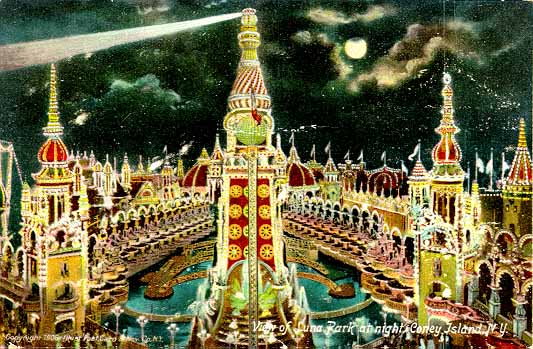
In fact, "Pompeii the Exhibit" of 2011 has much in common with a particular Coney Island attraction of 1889--the spectacular “The Last Days of Pompeii”--if not in the particulars than in the shared drive to offer the paying public a fully immersive recreation of the destruction of Pompeii, and in their use of over-the-top hyperbolic detail in describing the wonders of their respective exhibitions.

"The Last Days of Pompeii" of 1889--an immersive spectacle that combined historical vignette, theatre performance, and a pyrotechnic display in recreating the destruction of Pompeii by the fires of Vesuvius--boasted in its press about the number and variety of its cast (over 400 people! "a ballet troupe of 36 dancers trained by Batiste Cherotte... a male chorus..., soldiers, acrobats, jugglers, tumblers, [and] wire-walkers"!)

2011's "Pompeii the Exhibit," on the other hand, focuses on the numbers and authenticity of its artifacts (over 250! Some never seen before! The largest number of body casts ever on display!), bringing to mind the press for such Coney Island Spectaculars such as "The Boer War" (Real British and Boer veterans!) and the "Streets of Delhi" (300 authentic Indian natives in costume! Elephants! Camels! Horses!). To further blur the line between "legitimate museum" and popular attraction, "Pompeii the Exhibit" is hosted at a popular exhibition hall sponsored by a television channel--Discovery Times Square--rather than an "ordained" museum such as AMNH; Also, Pompeii the Exhibit" provides visitors not just artifacts and other traditional ways of experiencing history but also what its website describes as a "brand-new, immersive movie experience" reenacting "the moment of Vesuvius’ massive explosion."

So what to make of it all? I see this new exhibition as excitingly in the tradition of 19th Century popular educational amusements--dime museums, popular anatomical museums, and Coney Island recreations--spaces where spectacle and education, prurience and propriety, coexisted for mass consumption. Fun, didactic, spectacular, and a resounding and thoughtful endorsement in today's Times to boot. I, for one, can't wait to go see it.

You can read a fascinating review of "Pompeii the Exhibit"--as quoted above--by Edward Rothstein in today's New York Times by clicking here. You can find out more about Coney Island's “The Last Days of Pompeii" by clicking here. You can find out more about "Pompeii the Exhibit" by clicking here.

Thanks so much to GF Newland for alerting me to this!

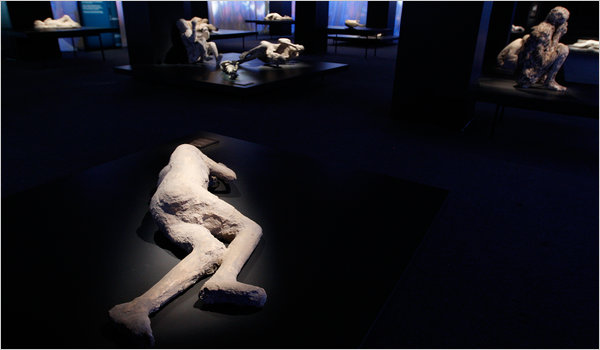
Image: Ruth Fremson/The New York Times

Plaster casts made from hollowed-out molds of rock, where bodies had been captured a moment before they ceased to be.

Breast Milk Ice Cream

A Covent Garden resaurant is now serving ice cream made from the breast milk of Victoria Hiley. The dessert has been dubbed Baby Gaga and is churned with Madagascan vanilla pods and lemon zest. According to icecreamist Matt O’Connor, who placed an ad for women to donate their breast milk, “If it’s good enough for our children, it’s good enough for the rest of us.

This reminds me of the NYC restaurant Klee Brasserie, where chef Daniel Angerer was serving cheese made from his wife’s breast milk.

I think O’Connor has a point, it’s consumed by children, and many of us were breastfed, so why not?

Thanks Kristina Grace for the BBC News link.

"Kingdom Under Glass: A Tale of Obsession, Adventure, and One Man’s Quest to Preserve the World’s Great Animals" This Thursday at Observatory

9780805092820
This Thursday at Observatory: learn the stories of the epic dioramas of New York's Museum of Natural History and their maker, Carl Akeley, in this illustrated lecture by author Jay Kirk!

Full details follow; very much hope to see you there

Kingdom Under Glass: A Tale of Obsession, Adventure, and One Man’s Quest to Preserve the World’s Great Animals
An illustrated lecture and book signing with author Jay Kirk
Date: Thursday, March 3
Time: 8:00 PM
Admission: $5
Presented by Morbid Anatomy
***Books will be available for sale and signing

During the golden age of safaris in the early twentieth century, one man set out to preserve Africa's great beasts. In his new book Kingdom Under Glass: A Tale of Obsession, Adventure, and One Man's Quest to Preserve the World's Great Animals, Jay Kirk details the life and adventures of naturalist and taxidermist Carl Akeley, the brooding genius who revolutionized taxidermy and created the famed African Hall we visit today at New York's Museum of Natural History. The Gilded Age was drawing to a close, and with it came the realization that men may have hunted certain species into oblivion. Renowned taxidermist Carl Akeley joined the hunters rushing to Africa, where he risked death time and again as he stalked animals for his dioramas and hobnobbed with outsized personalities of the era such as Theodore Roosevelt and P. T. Barnum. In a tale of art, science, courage, and romance, Jay Kirk resurrects a legend and illuminates a fateful turning point when Americans had to decide whether to save nature, to destroy it, or to just stare at it under glass.

Tonight, join author Jay Kirk for an illustrated lecture based on his new book Kingdom Under Glass. Books will be available for sale and signing after the event.

Jay Kirk's nonfiction has been published in Harper's, GQ, The New York Times Magazine, and The Nation. His work has been anthologized in Best American Crime Writing 2003 and 2004, and Best American Travel Writing 2009 (edited by Simon Winchester). He is a recipient of a 2005 Pew Fellowship in the Arts and is a MacDowell Fellow. He teaches in the Creative Writing Program at the University of Pennsylvania. You can find out more about him and his work at jaykirk.info.

You can find out more about this event on the Observatory website by clicking here and can can access the event on Facebook here. You can get directions to Observatory--which is next door to the Morbid Anatomy Library (more on that here)--by clicking here. You can find out more about Observatory here, join our mailing list by clicking here, and join us on Facebook by clicking here.
Paperback Launch Party, "Still Life" by Melissa Milgrom, March 10, The PowerHouse Arena, Brooklyn


Next Thursday, March 10! Hope to see you there.

Paperback Launch Party: Still Life by Melissa Milgrom
Date: Thursday, March 10 · 7:00pm - 9:00pm
Location: The PowerHouse Arena
37 Main Street, Brooklyn, NY
For more information, please call 718.666.3049
RSVP: rsvp@powerHouseArena.com

"Who knew a book about dead animals could be so lively? This is a wonderful look at a quirky, passionate, sometimes fanatical subculture."
— A.J. Jacobs, author of The Year of Living Biblically

In Still Life, Milgrom exposes a world of intrepid hunter-explorers, eccentric naturalists, and gifted museum artisans, all devoted to the paradoxical pursuit of creating the illusion of life. She'll deliver a lecture on the strange art of taxidermy and sign copies of her book, just out in paperback.

Over the past five years Melissa Milgrom has come to understand just what compels people to want to preserve dead animals: an absurd—almost fanatical—love of animals and the beauty of organic forms. Still Life is a completely engrossing look at this intriguing art form that thrives despite its fringe reputation. In the end, it's the taxidermists' love of nature and their unending quest to understand it on its own terms, which ultimately unites the book's characters, more than even the science or art of their craft. Transformed from a curious onlooker to an empathetic participant, Milgrom takes us deep into the world of taxidermy and reveals its uncanny appeal. Straddling science and art, high culture and kitsch—like taxidermy itself—Still Life celebrates the beauty in the uncanny.

Melissa Milgrom has written for The New York Times, the Wall Street Journal, and Travel & Leisure, among other publications; she has also produced segments for public radio. She holds a master's degree in American studies from the University of Pennsylvania. Milgrom lives in New York City. Please visit http://www.melissamilgrom.com.

To find out more, click here. To find out more about the book, click here.

Image: From the Still Life website; caption reads: "This orangutan, mounted in 2003 by a team of taxidermists for the Smithsonian Institution's Behring Hall of Mammals, typifies how exotic animals are procured in a post-expedition era. Photo: Cameron Davidson."

Amy Guidry is In Our Veins

Amy Guidry skeleton

Amy Guidry circulatory

Amy Guidry gophers

“Guidry walks a conscious line between the cerebral and a traditional, formal approach to making an image. While visually speaking the language of free association, a kind of description of dreams rather than a capturing of dream-like images, Guidry’s works tell a unique, contemporary story. What sets her apart from many neo-surrealists is that she is not imitating Dali, Ernst, or even de Chirico, but rather, speaking their language. Completing the package, Guidry’s paintings are smart, methodical, and contemporary.”

- The Studio Chronicle, David Burns Smith, Interview, 2010

To check out more from this collection and the rest of Amy Guidry’s work, head to her website, amyguidry.com.

[images via The Cultural Pick and Beautiful Decay]