


Surreal anatomical work by Chicago-born artist, Seisaku Katayanagi.




What’s better for a hot summer night than a light lace top? With skulls!! Found this little piece online at Zara. It’s on sale for $12.99. Grab it! Would be so cute over a bikini with some neon flip flops.




The Murtogh D. Guinness Collection at the Morris Museum is an astounding collection of automata (mechanical toys popular in the 18th and 19th century) and mechanical musical instruments that can be visited in--of all surprising places--Morristown, New Jersey. The collection is mind-blowingly vast; it is, in fact, the largest such public collection in the U. S. and one of the largest in the world, with around 700 automata and mechanical musical instruments and over 5,000 programmed media, nearly all of which are were produced in the 19th Century.
The highlight of the Morris Collection--in my opinion, at least!--is its extensive lot of fine 19th Century European automatons. Most of the pieces are in excellent repair and still able to go through their uncanny motions, and the scale, quality, and range of the collection are simply flabbergasting, the kind of thing you might consider yourself lucky to find in France (where many automata producers were based) but certainly not here on the East Coast of the United States.
The Morris Museum has just published a new book devoted to this collection. Entitled Musical Machines and Living Dolls: Mechanical Musical Instruments and Automata from the Murtogh D. Guinness Collection, this book is a lovely little gem all its own; it is hardcover, full color throughout, beautifully printed, and well-researched. It also includes a well-researched overview of the history of automata from ancient times to the present and a biography of Murtogh D. Guinness, the heir to the Guinness beer fortune who amassed this collection and ultimately bequeathed it to the Morris Museum.
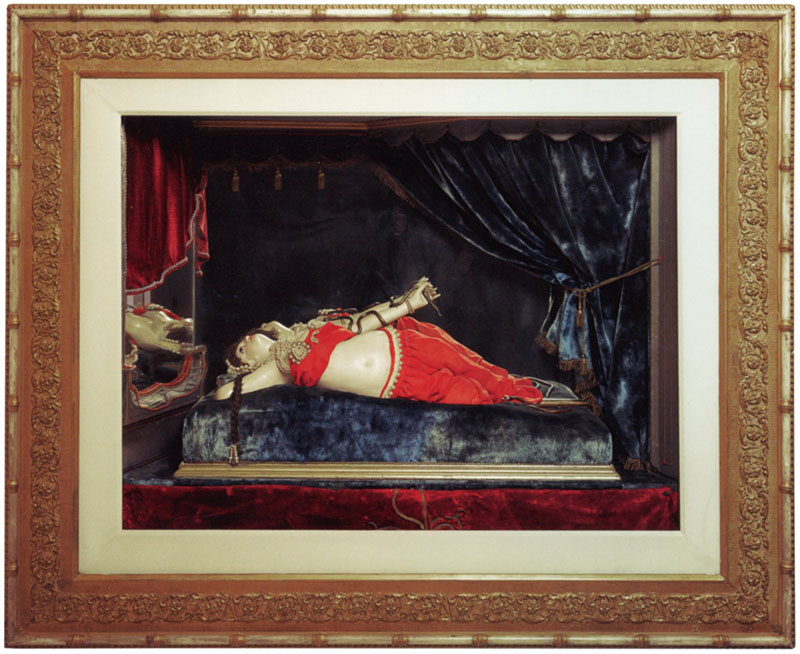
The book also--luckily for me!--features extensive text and scores of images (all images above are drawn from the book!) devoted to many of my favorite pieces in the collection, such as a number of 18th Century-style monkey dandies engaging in human activities (images 2, 3 & 4), 3 cats playing cards (image 5), a lute-playing Mephistopholes (image 7), an asp-suiciding Cleopatra (!!!) (image 6), performing tightrope walkers with orchestral accompaniment (image 9), a hookah-smoking Turk, singing birds, strutting peacocks, performing magicians, street vendors peddling their wares, and much, much more.
To give you a taste of the style and level of research to be found in this book, I include here the entire entry for the fascinating piece you see 6 images down, a late 19th century automaton entitled "The Suicide of Cleopatra":
The Suicide of Cleopatra
About 1880-90
Phalibois, Paris, France
37" x 45 1/2" w x 12 1/2" d
2003.18.236a-cSurrounded by a massive gilt frame, this animated scene would have dominated most parlors of the time. It depicts a highly sensual version of Queen Cleopatra of Egypt's supposed suicide in 30 B.C. When activated, her breast heaves, her eyelids blink--and an asp strikes.
Although made in the late 1800s, the scene reflects a long-standing Western fascination with Egypt, which had been renewed by Napoleon Bonaparte's occupation of the country at the turn of the nineteenth century. Along with tens of thousands of troops, Bonaparte brought with him scientists and scholars who recorded all that they saw. The Description de l'Egypte, which emerged from their research, became a source for artists, designers, architects, and others, and the ensuing widespread fascination spread from everything from furniture to parlor entertainment.
Morbid Anatomy is delighted to be assisting The Morris Museum in the distribution of this lovely and informative book, which contains images and information to be found nowhere else. The cost of the book is $40; shipping and handling within the United States is $5 and shipping and handling for international orders is $15. The book is 10 1/2" X 8 1/2" and runs to about 140 pages. As I am unable to get these books listed on Amazon.com, those interested in ordering a copy can contact me directly at morbidanatomy [at] gmail.com.
You can find out more about the Morris Museum--including how to visit the collection in person!--by clicking here. Also, stay tuned for a soon-to-be-announced second field trip to visit the collection. If interested in receiving an alert, subscribe to the Morbid Anatomy mailing list by adding your email address on the upper left-hand side of this blog under the header "Mailing List of Events, Happenings, and The Like."
All images are drawn from the book and picture, from top to bottom:


Next Friday, August 12th, please join Morbid Anatomy and The Coney Island Museum for a launch party celebrating The Midnight Archives: Tales From the Observatory, a new video series "centered around the esoteric and always exotic personalities that spring from the Brooklyn Observatory." This project is the creation of many-time Observatory lecturer and film-maker Ronni Thomas, and promises to provide a fascinating and informative look into some of the topics explored by Observatory events past and future.
Come for the party and the screenings, stay to check out the exhibition The Great Coney Island Spectacularium and to experience The Cosmorama of the Great Dreamland Fire, and linger on for the complementary midnight martinis!
Full details follow; Hope very much to see you there.
Date: Friday, August 12
Location: The Coney Island Museum, 1208 Surf Avenue, Brooklyn MAP
Time: 8:00pm
Admission: $20
COMPLIMENTARY "MIDNIGHT MARTINI'S" AND SPECIALTY DRINKS FOR ALL!Another in a series of exciting events in the Coney Island Museum, the Great Coney Island Spectacularium invites you to the Midnight Archive LAUNCH PARTY with filmmaker and collector Ronni Thomas!
Join us for the launch of the web series The Midnight Archives: Tales From the Observatory. The series is the work of Ronni Thomas (Alias Ronni Raygun) of the IKA Collective and is centered around the esoteric and always exotic personalities that spring from the Brooklyn Observatory. It attempts to briefly document some of the truly unique people, talents and objects from around the world who gather there on a weekly basis. Mummies, Taxidermy, 18th century robotics, early French demonic 3d horror... its all here.
Series creator Ronni Thomas will give a brief lecture followed by the screening of episode 1 "Petrifying Pets: Modern Day Mummies" (6 minutes) and a short montage reel.
You can find out more--and purchase tickets!--by clicking here. For more on The Great Coney Island Spectacularium, click here. More on Observatory here.


Dear Morbid Anatomy readers:
In just a few days, I am off to live for one month (!!!) in Seoul, South Korea as part of the fantastic Apex Art Outbound Residency Program. For those of you who are interested, I will be documenting my Korean adventures on a special blog for Apex Art; you can check that out by clicking here. I arrive in Seoul on September 16th, so blog entries should begin soon after.
But I have a more pressing question for you, dear readers: do any of you out there have any suggestions for suggested Korean sights, sounds, and tastes? Of particular interest, of course, are museums and collections--especially old natural history or anatomical/medical--but any suggestions, from foods to markets to restaurants to shops to national parks to amusement parks to folk art to fine art to curiosities of any kind, would be very much appreciated!
Suggestions will be gratefully received at morbidanatomy [at] gmail.com. Thank you very very much in advance!
Image: House Swallow from the Ehwa Womans University Natural History Museum, Korea.

We have 8 open slots for Observatory's final scheduled mummification class, which will take place this Sunday, August 7th. Full details follow; if interested, drop me a line to RSVP!
Date: Sunday, August 7th
Time: 1-4 PM
Admission: $60
Location: Observatory, 543 Union at Nevins, Brooklyn, Buzzer 1E
*** Please RSVP at morbidanatomy [at] gmail.comIn today's class, learn the mummification process as described in the "Egyptian Book of the Dead" (Book of Coming Forth By Day). Instructor Sorceress Cagliastro will guide students in the use of the traditional materials--such as natron salts, canopic jars, oils and herbs, dried flowers and linen or gauze wraps--and traditional ritual--such as ritual of the opening of the mouth--in the creation of an authentic and perfectly respected animal mummy. Each student will leave class with an animal mummy of their own making.
Please note: No animals are harmed or killed for this class; the materials are found already deceased, obtained either from a food service such as a meat market that serves a clientele seeking intact animals, or from a pet feeder supply.
Sorceress Cagliastro has a background as a teacher, author, and forensic reconstructionist. She worked as a trade embalmer and spent many years of work at the office of the Chief Medical Examiner. She currently lives in Brooklyn with her husband, daughter, and two dogs.
More info about this class and Observatory can be found here.

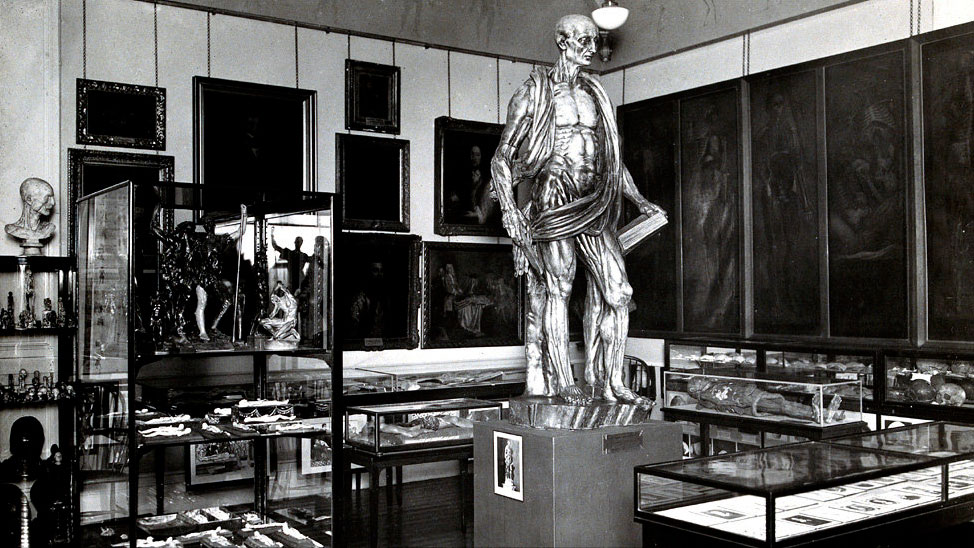

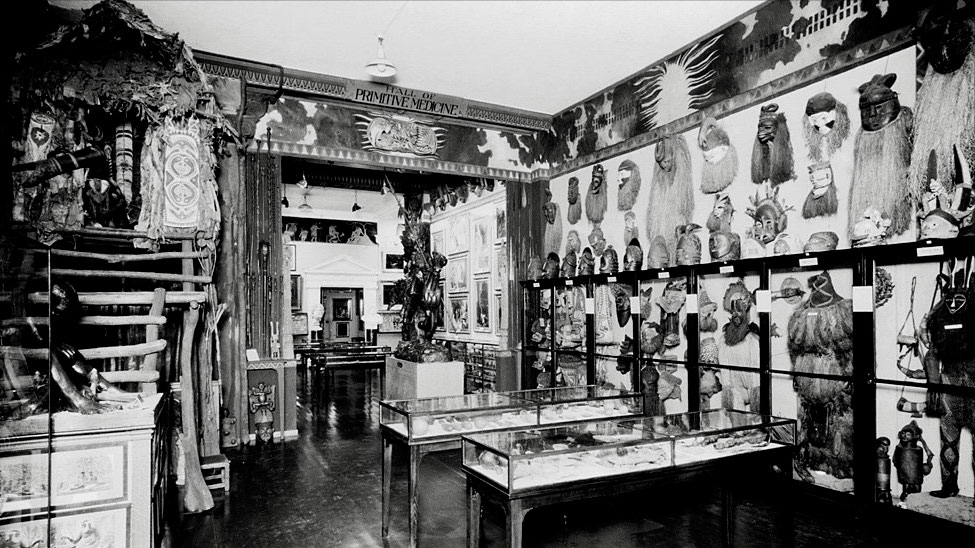
The BBC has just posted a lovely little narrated slide show about Henry Wellcome, founder of the Wellcome Trust and Library and compiler of one of the most extraordinary medical collections in the world. The piece is narrated by my friend Ross MacFarlane of the Wellcome Library, who is an unofficial specialist on Mr. Wellcome and his fabulous collection; you can check it out (highly recommended!) by clicking here.
All images taken from the slide show, and feature Wellcome's collection.


Morbid Anatomy now has several additional copies of taxidermy collector/historian Pat Morris' lavishly illustrated taxidermic tomes A History of Taxidermy: Art, Science and Bad Taste and Walter Potter and his Museum of Taxidermy in stock and available for immediate sale.
Morris' new and encylopedic History of Taxidermy: Art, Science and Bad Taste (pictured above in images 1-3) is an extensive (nearly 400 pages), large-format, and lavishly illustrated 4-color tome that details the entire history of the art, science, and sometimes questionable trends of taxidermy. This thoroughly-researched and liberally illustrated text discusses the earliest historical pieces, collections public and private, changing techniques throughout its history, human taxidermy (such as shrunken heads, Jeremy Bentham and other examples), anthropomorphic taxidermy and its roots at The Great Exhibition of 1851, the taxidermy and natural history craze of the 19th century, taxidermic kitsch, gentleman country house collections, and much, much, much more.
Morris' other book (images 4-9) details the life and work of Walter Potter, the undisputed king of Victorian anthropomorphic taxidermy and artist behind unforgettable taxidermic tableaux depicting kitten tea parties, bunny schoolhouses, kitten croquet matches and more, not to mention founder of a museum dedicated to his own curious pieces. The book, entitled Walter Potter and his Museum of Taxidermy is large-format, full-color, and features scores of nearly impossible-to-find photographs of Potter's unforgettable works, archival photographs of the early museum, and antique and vintage ephemera related to the museum. The book is also extremely well researched, providing a through biography or Mr Potter, a detailed history of his museum of curious taxidermy, and the stories behind the making of his iconic pieces of anthropomorphic taxidermy.
You can find out more about these books--and order copies of them--by clicking here. But supplies are limited, so order quickly!


MEOW. This looks so comfortable. And (trend alert) leopard print will be big this fall. Calling it now. Found this at Urban Outfitters for $89 (a little overpriced IMHO) and I think it would make for an interesting T to wear to the gym. Skulls at yoga class anyone?


The name of this ring kinda gives me the willys, let’s be frank. In fact, the thought of wearing someone’s teeth also gnaws at me (pun intended). Created by New Zealand designer Charlotte Burkhart, this silver piece is part of a wide range of beautiful jewelry she has handmade. It might be interesting to have a ring of your own teeth if you lost them in an epic bar fight, or maybe your children’s baby teeth. Something with a good story. Because a ring like this needs a great story.


French HIV/AIDS prevention PSA via AIDES.org, the leading French HIV/AIDS and viral hepatitis NGO.
If you found that touching, feel free to dip your phalanges into the interactive Sexy Fingers website!


The delicate and detailed art of Judith G. Klausner is both fascinating and, for some, gives you that funny feeling in your stomach. Made with materials such as human nail clipping, baby teeth, bones, and insect wings, the artist is definitely aware of the negative gut reaction some viewers might have towards her work, a reaction she has turned into a source of inspiration.
I first began working with insects in 2005, and was startled by the strong reactions of disgust I received. It struck me as tragic that our cultural phobia could blind us so effectively to such exquisite delicacy. From there I became interested in examining what other small beauty was lost to us through prejudice or oversight.
I can only imagine how long it must take to assemble one of these miniature specimens, major props!


This just in from my friend Laurens De Rooy, curator of the fantastic Amsterdam-based Museum Vrolik, specimens of which are pictured above:
Museum Vrolik to close for ten months
Following in the footsteps of other top museums in Amsterdam, the Vrolik Museum will close for refurbishment and redesign from August 2011 to May 2012. The ten-month overhaul of the anatomy museum of the Academic Medical Centre aims to make the unique collection more appealing to a broader public. The 29th of July will be the last opportunity to visit the museum before it closes.Museum Vrolik has been one of the AMC’s main attractions since 1984. Its collection includes items that are hundreds of years old, with more than ten thousand anatomical specimens in preservative, human and animal skeletons and skulls, and anatomical models and reconstructions. One of the museum’s treasures is the so-called Hovius display case, an 18th-century case full of bones and skulls ravaged by disease collected by physician Jacob Hovius. Of great scientific importance is the collection of congenital defects, including Siamese twins, cyclops and sirens.
An inspiring environment for all with an interest in disease, health, and the human body
With students of medicine and specialists the museum’s original target group, visitors without a medical background would often find the museum’s layout dated or even a little haphazard. Following its refurbishment, the museum should attract a much broader public, and serve as an easily accessible and inspiring learning environment for all with an interest in disease, health and the human body.
The main exhibition will feature the human body with all of its normalities and abnormalities, but the museum will also look into the history of its many different collections, honouring its original founders. The museum was named after Amsterdam professors Gerardus Vrolik (1775-1859) and his son Willem Vrolik (1801-1863), both anatomists and collectors. After their deaths, the Vrolik collection was expanded by other Amsterdam professors of anatomy.The best exhibits now on show at the Special Collections UvA
During the closure of the museum a number of the museum’s top exhibits will be temporarily on display at the Special Collections of the University of Amsterdam (located at Oude Turfmarkt) which will host the exhibition ‘the discovery of man’ from 27 September 2011 to 15 January 2012. Together with Museum Vrolik, the Special Collections will exhibit anatomy atlases and specimens and explore how the dissection of the human body has changed man's view of himself. For further information, go to http://www.bijzonderecollecties.uva.nl.Museum Vrolik
Academisch Medisch Centrum
Meibergdreef 15, J0-130 (Medical Faculty)
Open Monday to Friday, 10 a.m. - 5 p.m.
Admission free
http://www.amc.nl/vrolik
If this museum and/or the photos above are of interest, make sure to check out the lavishly illustrated publication Forces of Form:The Vrolik Museum which includes these images and more; you can ind out more--or order a copy of your very own!--by clicking here.
Images:

Hope to see you there!
Shrinking and Other Acts of Sabotage
An illustrated lecture with Petra Lange-Berndt, University College London
Date: Thursday, July 28th
Time: 8:00 PM
Admission: $5
Presented by Morbid AnatomyTaxidermy is quite literally the incarnation of trophy culture; It is no coincidence that the 19th Century craze for taxidermy coincided with the emergence of the biological sciences, which were, themselves, strongly tied to colonial interests of exploration, exploitation, classification, and reorganization of the world.
Today, this violent story -- as well as the bulk of 19th Century decorative taxidermy, such as heads on shields, armchairs made out of whole bears, elephant footstools or lamp bases adorned with birds of paradise -- are largely absent from public collections and their institutionalized narratives. Also problematic for the serious student of the medium is that, like art conservators or the editors of texts, taxidermists are only successful if there is no visible trace of their work left in the final product.
Tonight's presentation by Petra Lange-Berndt, author of Animal Art: Specimens in Modern and Contemporary Art Practices, 1850-2000, will chase the stories that are woven into the textures of taxidermy by focusing on the fabrication of the nature/cultures in question, and by asking such questions as what kind of politics are attached to these stilled lifes? And how have the power relations encountered in public natural history collections been challenged by modern and contemporary artists?
Petra Lange-Berndt is a lecturer at the Department of History of Art, University College of London. She has published a book in German on Animal Art: Specimens in Modern and Contemporary Art Practices, 1850-2000 (Silke Schreiber, 2009) and just organised a conference on "Taxidermy and Colonial Practice" at the Natural History Museum, London. She likes all kinds of unpopular arts and B-cultures and was co-curator of an exhibition in three parts on "Sigmar Polke: We Petty Bourgeois! The 1970s" at the Kunsthalle in Hamburg (2009-10); her new research is concerned with artists' colonies and communes.
Photo: Photo from Natural History Museum of Nantes (France), by Julie N. Hascoët
Living Dolls: The Guinness Collection of Mechanical Musical Instruments and Automata at the Morris Museum
A live automata demonstration and illustrated lecture by Jere Ryder, Conservator of the Guinness Collection of Mechanical Musical Instruments and Automata at the Morris Museum
Date: Friday, July 29th
Time: 8:00 PM
Admission: $10
Presented by Morbid AnatomyThe Guinness Collection of Mechanical Musical Instruments and Automata at the Morris Museum in Morristown, New Jersey is one of the finest collections of automata--or moving mechanical toys popular in the 18th Century and 19th Centuries--in the world. Compiled over 50 years by heir to the Guinness beer fortune Murtogh D. Guinness (1913-2002), the collection features scores of immaculately preserved historic automata--many of them produced in 19th Century France--with subjects ranging from snake charmers to magicians, singing birds to anthropomorphic monkeys, Cleopatra in her death throes to a waltz-playing Mephistopheles; it also includes a number of mechanical musical instruments and a variety of programmed media ranging from player piano rolls to pinned cylinders.
Earlier this year, Observatory brought a group to visit this collection in person; for those of you who were unable to join us--or who are hungry more!--we are bringing the automata closer to home. Tonight, we invite you to join Jere Ryder, Conservator of the Guinness Collection of Mechanical Musical Instruments and Automata at the Morris Museum, for a live demonstration of antique automata drawn from both the Guinness Collection and his own personal collection. Mr. Ryder will detail the history of these bewitching toys with an illustrated lecture on their history, show an introductory video, and demonstrate and describe the mechanics that bring them to life.
Bio: As Conservator of the Murtogh D. Guinness Collection of Mechanical Musical Instruments and Automata, Jere Ryder brings a lifetime of involvement within this specialized field. A keen interest developed after being introduced to them by collector parents, whom Mr. Guinness had encountered in the 1950s. He became a family friend, and served as mentor and inspiration for later study within the field. With no specialized teaching institutions dedicated to this particular realm, it was Jere's father, Hughes M. Ryder, who introduced he and his brother to major European families, collections and related museums, assisting his ability to enter into studies/apprenticeships to surviving, established field masters, modern manufacturers and successors of original firms dating to as early as 1800. Throughout junior high and high school he received objects for repair from regional dealers and distributors. He and his brother Stephen created a business partnership in 1973 and since have repaired, restored, appraised and advised for some of the finest collections, acquiring objects on behalf of state and privately-owned museums worldwide, and are internationally renowned for research projects and the ability to source rare instruments offering new paths of study.
Image: “Mechanical Singing Bird Jardiniere,” made by the firm of Bontems, Paris, France, circa 1880 & recently restored
You can find out more--and get directions to Observatory--by clicking here.


Dotted Piggy Plexi by SARO 7.5"x11" on plexi glass - $50

Cross Piggy Plexi detail by SARO 7.5"x11" on plexi glass - $50

Dotted Piggy Plexi detail by SARO 7.5"x11" on plexi glass - $50

Dotted Cyclops Plexi by SARO 7.5"x11" on plexi glass - $50

Dotted Cyclops Plexi detail by SARO 7.5"x11" on plexi glass - $50
Pig anatomy has never looked so graphically delicious. These are reverse spray-painted pieces on plexiglass by the prominent Chicago street artist, SARO. Place the plexi on any surface and see it show through the negative space between the spray paint.
Read our interview with SARO to find out more about the man behind the street art.


"Antisocial network I", 2010, computer keyboard and resin, 15 x 20 x 25cm

"Antisocial network II", 2010, computer keyboard and resin, 15 x 25cm

"Measuring the impact", 2010, PC keyboard, tape measures and USB cable on paper, 30 x 35cm
In a day when skull made out of objects are starting to feel a bit overplayed, Cape Town-based multi-disciplinary artist, Maurice Mbikayi, uses his skulls to make a sociocultural statement. Maurice identifies himself as a cultural activist interested in identity, origin and space, specifically how technology affects the diverse African populations. His talents span sculpture, performance art, installation art, photography, and mixed-media.
From Maurice’s artist statement:
Proceeding by collecting hardware remnants of this rapidly developing technology and other found objects and incorporating them into my work. The resultant mixed media drawings and sculptures ask questions such as to whom such technological resources are made available and at what or whose expense? What are the consequences impacting on our people and environment?
[Spotted by SARO via Juxtapoz]


VELO CEREBRUM – Holbrooks from F5 on Vimeo.
This trippy video, directed by Holbrooks and produced by Blacklist, was created for the Happy F5
RE:PLAY Film Festival which seeks to bring together those that are breaking ground and shaping new standards in media and design.
From the creators of the video:
“We wanted to take a dry look at the subject of happiness. To strip down the aesthetics of a smile, literally tearing skin from flesh, flesh from bone, bone cracking away. We wanted to expose the brain and let it reveal the spirituality and enigma of happiness. Of a simple action that makes this person happy in a way that they’d find hard to describe.”
[Spotted by Jenny]


Me&Edward is a 23 year old French photographer. He says his interests shifted from being a cook to “cooking with body parts, light, composition, and flesh.” The above photos are from the series “Metamorphosis.” Me&Edward defines the project as, “a concept about the unlimited transformations of human body. Just like a chameleon, it’s fitting, just like a virus, it’s mutating, just like a personality, it’s changing. Something new is about to birth, a metamorphosis, an organic complexity.”
I love the images because they look very real, as if these are the subjects’ actual bodies. They are eerie, but hard to look away from.
You can see more from the series in progress on Me&Edward’s flickr.
[via Change the Thought and Get Inspired Magazine]


They can sit and stay – and are excellent at playing dead – but this room full of obedient dogs will never go walkies again. The odd-ball collection of 51 stuffed dogs is the star attraction at the picturesque Castle Bitov in the Czech Republic.
The castle’s last owner, the ever-so-slightly eccentric Baron Georg Haas, was an animal lover – to say the least. He was the proud owner of thousands of animals – including a lioness called Mietzi-Mausi, with whom it is said he enjoyed sharing lunch every day.
But his favourite style of four-legged friend was the humble canine, and he eventually had more than 200 in the castle grounds. It means the castle might well have been the hardest building to sneak into in the 1940s – certainly the hardest to walk around without looking down.
When the playful pets passed away, the baron buried the majority of them – their final resting places can still be seen in several cemeteries in the castle grounds, each with a wooden cross and small metal plate bearing their name.
But, for a select few, the baron had loftier plans – and the handiwork of the local taxidermist is still being enjoyed today. It’s clear that the baron did not play favourites. Spaniels, terriers, poodles, boxers – hounds of every shape and size – are included in the collection...
Georg Haas was as eccentric an aristocrat as they come. But he was also ahead of his time, designing a magnificent zoo for his animals, with terrariums, bird cages, and various paddocks that he filled with exotic creatures from around the world.
--"The perfectly preserved pooches of Castle Bitov," The Daily Mail, July 19th 2011
You can read the whole entire story--from which the above images were drawn--by clicking here. Click on images to see much larger, more detailed version.
Thanks to Eleanor Crook for bringing this to my attention!


