Damien Hirst at Chatsworth House

As part of the Beyond Limits sculpture exhibit at Chatsworth House in England, Damien Hirst has created two beautiful anatomical sculptures.

Damien Hirst Beyond Limits

Together they are Myth and Legend. Legend is exposed horse with wings open wide. Myth is the unicorn, two of whom’s legs have the skin pulled back.

Hirst sites his fascination with the relationship between science and religion and how the two interact. Hirst said, “to cut open mythical creatures and expose them as no different to mortal horses is somehow still magical. It’s kind of like exploding a myth to make it real.

Beyond Limits opens September 16 and runs through October 30th. 20 artists are featured.

As a fan of horses and any horse-like mythical creature, I am completely in love with these sculptures. I like the idea of using religions or religious ideas that are considered to be known as false. It forces the viewer to reflect on current religious ideals and question the validity of them. What makes a unicorn any less real than anything in Islam, Christianity, and so on?

Damien Hirst Myth Chatsworth House

[sources: Chatsworth + MyModernMet]


Source:
http://feeds.feedburner.com/streetanatomy/OQuC

Artist’s Talk: The Creation of The Cosmorama of the Great Dreamland Fire at The Coney Island Museum, Sept. 22


As many of you already know, I am currently fulfilling the role of artist in residence at The Coney Island Museum. As such, last April I launched an exhibition there in collaboration with artist Aaron Beebe that will be on view until April of this year. Entitled "The Great Coney Island Spectacularium," the exhibition aims to explore, celebrate, and evoke through installation, artifacts, and newly commissioned works turn of the 20th Century Coney Island with its bizarre, spectacular and, amazingly, forgotten immersive amusements.

Although this seems nearly unbelievable, on an average day in Coney Island around 1900, one might be able to experience one or more of the following: A midget village modeled on 16th century Nuremberg and featuring its own parliament, hotel, stables with midget ponies, vaudeville house, and midget fire department rushing off to put out imaginary fires; A recreation of the destruction of Pompeii by volcano, San Francisco by earthquake, Galveston by flood, and/or Titanic by iceburg; Freakishly small premature infants battling for their lives in infant incubators; A recreation village of the head-hunting Bontac Tribe of the Philippines with real tribespeople on display; An immersive spectacular which staged tenement fires every half hour and featured a cast of 2,000; A Boer War reenactment featuring real Boer War veterans; A trip to the moon, under the sea, or to heaven and hell by way of being buried alive in a glass coffin; and, as they say, much, much more. How could this have all been forgotten, we ask in this exhibition, and our memory of Coney Island sanitized to a place of mere hotdogs, roller coasters, petty crime and freaks? What does it say about who we are now, and what have we lost in this historical omission?

The centerpiece of our exhibition is The Cosmorama of the Great Dreamland Fire, which is an immersive 360 degree spectacle based on the great panoramas and cosmoramas that populated Coney Island in the 19th century. It tells the story with image, sound, and light of the most spectacular disaster in Coney Island history: the complete and dramatic destruction of Dreamland, one of the three great parks that made up turn of the century Coney Island, by fire 100 years ago in 1911. Dreamland was never rebuilt, but had it been, Beebe and I are certain it would have given pride of place to a disaster spectacle that allowed visitors to experience the great fire that had destroyed it. The Cosmorama of the Great Dreamland Fire is our attempt to create the attraction that should have been, and to allow contemporary audiences to experience a 19th century-style immersive spectacle of the sort celebrated in the exhibition.

Next Thursday September 22, the crew behind the construction and conception of The Cosmorama--myself included--will be at The Coney Island Museum giving a presentation about the making of the piece, followed by guided tours of the exhibition. We will also be on hand to answer any questions you might have.

I think this will be a really great event. And for those of you who have yet to make it out to see the exhibition, a great excuse to finally make the trek and have a beer in the Cosmorama!

Full details follow. Very much hope very much to see you there!

Date: Thursday, September 22
Time: 7:30pm - 8:30pm
Admission: $5, Free for Coney Island USA Members.
Loction: The Coney Island Museum, 1208 Surf Avenue, Brooklyn

The Cosmorama of the Great Dreamland Fire is the first Cyclorama in Coney Island since Luna Park met its own fiery demise in the 1940's. The art of creating a full-scale immersive Victorian entertainment was lost to Coney Island's denizens until this year. Find out how the Coney Island Museum resurrected the theatrical skills and the know-how necessary to create a 360-degree painted panorama with sound and lights for the 21st century.

Aaron Beebe, director of the Coney Island Museum; Joanna Ebenstein, Artist in residence for 2011; and their collaborators will be on hand to discuss the ins-and-outs and the technology behind the Cosmorama, with detailed technical descriptions from the lighting designers, the scenic artists, and the producers of this new and exciting spectacle.

Beebe and Ebenstein will be joined by the artisans and craftspeople from the Metropolitan Opera and other institutions who helped make this work possible. Guided tours of the Cosmorama will be held.

More on The Great Coney Island Spectacularium can be found here. More on The Cosmorama can be found here.

Source:
http://morbidanatomy.blogspot.com/feeds/posts/default?alt=rss

Fritz Kahn: Making Sense of the Human Body, Lecture, NYC, September 21


Wow. News of this awesome sounding lecture just in; Hope to see you there!

Fritz Kahn: Making Sense of the Human Body
Date: Wednesday, September 21
Registration will begin at 7:00pm.
Presentation will begin at 7:30pm.
Price: $12

We are pleased to have Thilo von Debschitz from Germany in our next SenseMaker Dialogs to speak on Fritz Kahn. Born in 1888, Fritz Kahn was a doctor and a world-famous popular science writer who illustrated the form and function of the human body with spectacular, modern industrial analogies. Kahn's magnum opus, the five-volume series Das Leben des Menschen (The Life of Man), was published in 1922 to international accolade; his intricate and elegant depictions of the human body as a functioning machine influenced artists and scientists for decades to come. Fritz Lang's film Metropolis was greatly inspired by Fritz Kahn's aesthetic.

However, Fritz Kahn's sucess was abruptly ended when the Nazis rose to power. Because of the oppressive censorship during the Third Reich, most of the works by Fritz Kahn, a Jewish intellectual, were banned, publicly burned and destroyed. In pursuit of Kahn's nearly lost legacy, Thilo and his sister Uta tracked down rare gems in second-hand books stores, combed international archives, and followed biographical leads from far-flung sources. The result is the first monograph about Fritz Kahn published worldwide, Fritz Kahn–Man Machine, which Thilo will speak about on September 21.

Thilo von Debschitz, a German designer and art director, worked at well-known international advertising and design agencies before founding his own creative agency Q in 1997. Q has won numerous national and international awards and honors, such as the European Design Award in 2011, in communication design, interactive design, and print design.

In addition to his agency business, Thilo von Debschitz enjoys editorial projects. His recent, most passionate book project was initiated by mere chance and published in collaboration with his sister, Uta: Fritz Kahn–Man Machine, the first monograph about Dr. Fritz Kahn (1888-1968). Fritz Kahn–Man Machine offers readers an overview of the life and work of Fritz Kahn, a pioneer of information design, whose genius lay in his ability to bring clarity to the mysteries of nature through analogies, metaphors, and humor. At the SenseMaker Dialogs, Thilo von Debschitz will not only present an introduction to Fritz Kahn, but also discuss cognitive visual concepts by other creative thinkers, some of whom have been influenced by Fritz Kahn’s work.

For more, and to purchase tickets, click here. For more on the book Fritz Kahn–Man Machine--and to purchase a copy--click here. Also: added bonus: I have heard a rumor that there will some original Fritz Kahn artifacts on hand at the lecture... another reason to make it out of the house that evening.

Source:
http://morbidanatomy.blogspot.com/feeds/posts/default?alt=rss

Embodied Fantasies: Multi-disciplnary Conference, SVA, October 28-30 2011


I have just been alerted to a pretty fantastic sounding conference that will be taking place at School of Visual Arts in New York City this October. Details follow; hope to see you there!

Embodied Fantasies:
International Conference
October 28-30 2011
SVA, Fine Arts Building
335 West 16th Street, New York, NY 10011

Embodied Fantasies, a concept central to art history, theory and practice is concurrently a topic debated in the fields of the neuro-and-cognitive sciences, philosophy and phenomenology. This theme will be addressed in a transdisciplinary conference hosting scholars and artists from the fields of architecture, art history, visual art, history of science and psychology among others. Discussions will focus on concepts of embodiment as they relate to sexuality, aesthetics, epistemology, perception and fantasy itself. Approaches to the role of fantasies will be viewed beyond traditional conceptions to include complex thinking processes, subjectivity, and the inter-subjective. Prominent attention will be paid to fantasies and images as a form of knowledge production.

Panel I: Oxymoronic Places and Spaces
Alex Arteaga: What Is a Fantasy in a Non-given World?
Sabine Flach: Negotiations and Metamorphosis: Visualizing Carsten Höllers' SOMA
Suzanne Anker: Neo-Neuro: Untangling Utopia
Boris Goesl: Star Arts or Celestial Embodiments
Dan Hutto: Moderator

Panel II: Ghost Hearts

Mark Dery: (title pending)
Alva Noe: Making Pictures, Making Worlds Available
Sabine Flach: Moderator

Panel III: Thwarted Expectations
Gerhard Scharbert: Fantasias: Experimental Induced Psychosis and Modern Aesthetics in 19th Century France
Arthur Miller: Creative Processes Within Fantasies: The Strange Friendship of Wolfgang Pauli and Carl Jung Frank Gillette: Experimental Epistemology: Patterns That Connect Dan Hutto: Embodied Imaginings
Alex Arteaga: Moderator

Plenary Speakers
Gabriele Brandstetter: Fantasies of the Catastrophe: Embodiment and Kinaesthetic Awareness in the Performance-installation of Naoko Tanaka's "Die Scheinwerferin" (2011)
Sabine Flach and Suzanne Anker: Moderators

Panel IV: Pose and Expose
Alexander Schwan: Body Calligraphies: Dance as an Embodied Fantasy of Writing
Nicola Hille: Embodied Fantasies: Spencer Tunick's Body Sculptures
Shelley Rice: The Grass is Always Greener: Self-Portraiture in the Age of Facebook
Suzanne Anker: Moderator

Panel V: Between the Flesh and the Shell
McKenzie Wark: A Minimum of Serious Seduction: The Situationist International as Embodied Fantasies
Zoran Terzi?: From Phantasia to Phantasma – Embodied Notions and the Anticipation of Politics Through the Arts
Frank Gillette: Moderator

Panel VI: Shadowing Fire
Margareta Hesse: Carousels of Perception
Romana Filzmoser: Chimerizing the Body: Art theoretical Concepts of Fantasy in Italian and English 17 Century Obscene Literature
Laura Taler: SPIEGELEI: Affect as Lever
Mathius Kessler: (title pending)
Arthur Miller: Moderator

General Public: $150
Graduate and Undergraduate Students: $75
Order tickets via Eventbrite by clicking here.

Conference Organizers
Suzanne Anker
Chair, BFA Fine Arts Department
School of Visual Arts, NYC

PD Dr. Sabine Flach
Visiting Scholar
BFA Fine Arts Department
School of Visual Arts, NYC

You can see the full schedule and get more details by clicking here. You can purchase tickets by clicking here.

Image: Suzanne Anker, Embodied Fantasies, 2011. Inkjet print.

Source:
http://morbidanatomy.blogspot.com/feeds/posts/default?alt=rss

The Midnight Archive Episode 1: Modern Day Mummies, Online and Available for Viewing!

The Midnight Archives: Tales From the Observatory is a new web-based documentary series "centered around the esoteric and always exotic personalities that spring from Observatory," the Brooklyn-based event/gallery space I run with a handful of other collaborators. The series is created and directed by film-maker Ronni Thomas, who has plans to upload approximately one new episode per week to the new Midnight Archive website.

Episode one, entitled Modern Day Mummies--which documents the work of Sorceress Cagliastro, our esteemed Observatory mummification instructor--has just been uploaded and is now available for viewing! You can check out the video above, but make sure to keep visiting The Midnight Archive website (which can be found here) or sign up for their mailer in order to catch exciting, soon-to-be-uploaded episodes featuring such Observatory luminaries as anthropomorphic taxidermy teacher Sue Jeiven, automaton keeper Jere Ryder, and occult walking tour mastermind Mitch Horowitz. You can get a sense of some of the other pieces and personalities you have to look forward to by viewing the teaser on Boing Boing by clicking here.

And, just a quick FYI: We have a few last openings for Sorceress Cagliastro's next mummification class, which will take place October 9th; if you are interested in enrolling, please email me at morbidanatomy [at] gmail.com; more on the class can be found here.

Source:
http://morbidanatomy.blogspot.com/feeds/posts/default?alt=rss

Call for Papers: Sensualising Deformity: Communication and Construction of Monstrous Embodiment, Edinburgh, June 15-16


I just got word of a call for papers for an excellent sounding upcoming conference. Details below:

The University of Edinburgh
Sensualising Deformity: Communication and Construction of Monstrous Embodiment
June 15-16, 2012

Confirmed Plenary Speakers:

Prof. Jeffrey Jerome Cohen
George Washington University

Dr. Peter Hutchings
Northumbria University

From freak exhibitions and fairs, medical examinations and discoveries to various portrayals in arts and literature, images of deformity (or monstrosity, used separately or interchangeably depending on context) have captivated us for centuries. The result is a significant body of critical and artistic works where these bodies are dissected, politicized, exhibited, objectified or even beatified. Nonetheless, there remains a gap, an unexplored, unspoken or neglected aspect of this complex field of study which needs further consideration. This two-day interdisciplinary conference aims to bring the senses and the sensuous back to the monstrous or deformed body from the early modern period through to the mid-twentieth century, and seeks to explore its implications in diverse academic fields.

We hope to bring together scholars and students from a wide range of disciplines to engage in a constructive dialogue, network, and exchange ideas and experiences, connecting a community of researchers who share a fascination with deformity, monstrosity, and freakery.

Possible topics may include (but are not limited to):

  • Spectacle/fetishisation of monstrosity and deformity; monstrous sexuality/eroticisation
  • The monster as a catalyst of progression/ historical perspectives
  • Monstrous symbolism, prodigality, or beatification
  • The racialised body; exoticising difference
  • Monstrosity in medical literature; disability narratives
  • Monstrous becoming; the ‘sensed’ body
  • Deformed aesthetics; monstrosity in the visual arts
  • (De) gendering the deformed body; humanisation vs objectification

We welcome proposals for 20-minute presentations from established scholars, postdoctoral researchers and postgraduate students from various teratological backgrounds, e.g. in literature, history, media and art studies, philosophy, religious studies, history of science,medical humanities, and critical and cultural theory. Proposals should be no more than 300 words, in .doc format, and should include a brief 50-word biography.

Please submit your abstracts no later than 31 January 2012 to sdefconference@ed.ac.uk

Dr. Karin Sellberg (The University of Edinburgh)
Ally Crockford (The University of Edinburgh)
Maja Milatovic (The University of Edinburgh)

For more info, visit the conference blog by clicking here.

Image: From the conference blog, where they cite the images as courtesy of the BMJ Publishing Group, BMJ 1889, June 8; 1(1484): 1288–1289.

Source:
http://morbidanatomy.blogspot.com/feeds/posts/default?alt=rss

Organ Donor Designer Toys Back in Stock

Organ Donor vinyl toys by David Foox are back in stock! These little guy are becoming quite rare so grab a few while you can. $15 each at the Street Anatomy store.

Organ Donor vinyl toys by David Foox

Organ Donor vinyl toys by David Foox

Organ Donor vinyl toys by David Foox

David created these vinyls in order to promote organ donation. All ORGAN DONORS come individually boxed in a blind box concept—meaning, it is a surprise as to which ORGAN DONOR you will receive!

Some are more rare than others (Black Market Kidneys, Pickled Liver, etc) and all come wearing the vinyl hospital gown with the butt cheeks showing.


Source:
http://feeds.feedburner.com/streetanatomy/OQuC

Jennifer Griggs

Jennifer Griggs heart

Jennifer Griggs brainstem

Jennifer Griggs hands

Artist Jennifer Griggs told me she loves anatomy but realized too late in life that she should have been a medical illustrator.  I’ve had a lot of people tell me the same thing over the years, and I say, it’s never too late!  Jennifer creates these gorgeous pieces in between a busy life and working at a hospital at night.  I look forward to seeing more of Jennifer’s work in the future.


Source:
http://feeds.feedburner.com/streetanatomy/OQuC

Turn On Some Nipples

Naama Arbel nipple lights

Naama Arbel nipple lights

Naama Arbel nipple lights

Designer Naama Arbel created these felt light sculptures that are turned on when you pull on the silicon “nipple,” or as the designer says, they “awaken by touch.”

If you read through the comments on the original post on Dezeen, these nipple lights have drawn a lot of mixed reactions from people, mostly negative.  My question to you is, would you have a different perception of the concept if a woman had designed these nipple lights?


[Spotted by Ryan Jones via Dezeen]


Source:
http://feeds.feedburner.com/streetanatomy/OQuC

Anatomy in Korea with Dr. Oh


A few days ago, I met with the very lovely and generous anatomist Dr. Chang-Seok Oh, referred to me by my friend Ross MacFarlane. I had been interested in viewing medical or old natural history collections here in Seoul, and Dr. Oh had kindly offered to take me to see an anatomical collection of a Catholic university hospital where he had a contact. The collection had a number of interesting pieces, the most outstanding being a 17th Century mummy unearthed at an archeological excavation; there were also a number of forensic reconstructions. Images of the collection can be seen above.

Dr. Oh then took me back to his office, where we gushed about our shared interest in post-Vesalius/pre-Gray's Anatomy anatomical history, and where he shared with me his beautiful original copy of the 18th century Ontleedkundige Tafelen. This book, Dr. Oh explained to me, is of the greatest importance to Asian medicine, as it was the first Western medical book translated for Eastern consumption, published in Japan (with some additions from other texts) as Kaitai Shinsho in 1774. The book then made the rounds in Asia, changing the face of Eastern medicine forever. We did a side by side comparison of the original book and a facsimile of the 18th century Japanese Kaitai Shinsho; you can see those side by side comparisons above. I really liked the visual translation that occurs as the images move from the West to the East.

Click on images to see much larger, more detailed versions. Its worth it! And thanks to Ross MacFarlane and Deborah Leem for making this happen!

Source:
http://morbidanatomy.blogspot.com/feeds/posts/default?alt=rss

Skull “Hobo” Nickels

Skull Hobo Nickel

Skull Hobo Nickel

Skull Hobo Nickel

Man, I wish we had legit coins as cool as this, but it wouldn’t be as special if it were machine made this way. These gems are a sampling of skull carved “hobo” nickels, mostly stemming from the 1930s depression era.

The sudden scarcity of jobs in the early 1930s forced a huge number of men to hit the road. Certainly some coins were carved to fill the idle hours. More importantly, a ‘knight of the road,’ with no regular source of income, could take one of these plentiful coins and turn it into a folk art piece, which could in turn be sold or traded for small favors such as a meal or shelter for a night.

Coin carvers would cover buffalo nickels with all kinda of folk art, faces, scenes, and skulls and have become a collectors items these days and more can be read about these rad coins here. Also, check out some more skull coins here.

[via thisiscolossal]


Source:
http://feeds.feedburner.com/streetanatomy/OQuC

Rubber, Steel and Bones

Motorbikes are a popular interest of mine, I think they look beautiful and I hope to own one some day. These bikes immediately took my fancy and I hope they take yours.

The Crypt

John Farr is a custom bike designer and creator who made this beautiful piece of machinery named ‘The Crypt’. The motorcycle is now a jaw-dropping spectacle when its cruisin’ around, continuously being stopped for pictures.


Skeleton Motorbike

John Holt is a self taught metal bender and the creator of this motorcycle ‘Iron Death’. Holt started off making medieval styled armour and now owns a shop in Boone County, Illinois, where the bike was originally built. The bike now lives in The Petersen Automotive Museum in L.A.


Skeleton Motorbike Mirror

Getgeared.co.uk are selling a The Universal Motorcycle Mirror Skeleton Hand for £39.95 each for your own custom anatomy.


Skeleton Bike

Artist Eric Tryon, fashioned together this marvellous bicycle, flexible enough so that when you turn so does the skull.


Bio-Cycle

Jud Turner designed this artwork named the ‘Bio-Cycle’ along with other skull inspired creations and anatomic bikes.


The motorbike styled toy I thought was quite cute, The Boneshaker Skeleton Motorbike is 26cm in length and is £19.15 from Amazon.co.uk


Source:
http://feeds.feedburner.com/streetanatomy/OQuC

Disfigurines

Justin Novak Disfigurines

Justin Novak Disfigurines

Justin Novak Disfigurines

Not what you’d normally find on your mother’s mantle, Justin Novak twists the snooty figurine into a self-mutilating mockery, because none of use are pristine figures.

Novak says of his work:

The ceramic figurine has historically embodied a mainstream, bourgeois ideology, and for this reason, I have employed it in the presentation of an alternative vision, an ironic anti-figurine, or ‘disfigurine.’ In the ‘disfigurine’ series, physical wounds such as bruises and lacerations serve as metaphors for psychological harm. Whereas the figurine has historically represented the dominant culture’s norms and ideals, the disfigurines speak of the damage inflicted by those very same expectations

View all of Justin’s work at justinnovak.com.

[via Dentsu London]


Source:
http://feeds.feedburner.com/streetanatomy/OQuC

Prints and the Pursuit of Knowledge in Early Modern Europe, Exhibition, Through December 10th


I have just been alerted to a pretty great looking exhibition on through December 10th at the Arthur M. Sackler Museum at Harvard. Entitled "Prints and the Pursuit of Knowledge in Early Modern Europe," the exhibition features not only prints but also flap anatomies (!!!), books, maps, and scientific instruments, all intended to explore "the role of celebrated artists in the scientific inquiries of the 16th century."

Full information follows, from the exhibition website:

Prints and the Pursuit of Knowledge in Early Modern Europe
Sep 6 2011 — Dec 10 2011
Arthur M. Sackler Museum

Prints and the Pursuit of Knowledge examines how celebrated Northern Renaissance artists contributed to the scientific investigations of the 16th century. The exhibition and its accompanying catalogue challenge the perception of artists as illustrators in the service of scientists. Artists’ printed images served as both instruments for research and agents in the dissemination of knowledge. The exhibition, displaying prints, books, maps, and such instruments as sundials, globes, astrolabes, and armillary spheres, looks at relationships between their producers and their production, as well as among the objects themselves. The story of 16th-century technology is enhanced by technology of the 21st, with interactive computers in the galleries, an interactive module on the website, and an iPhone/iPad application in iTunes (check back here soon for an update on availability).

Curated by Susan Dackerman, Carl A. Weyerhaeuser Curator of Prints, Division of European and American Art, Harvard Art Museums. Organized in collaboration with the Mary and Leigh Block Museum of Art, Northwestern University, Evanston, IL.

Opening Panel Discussion and Reception: September 6, 2011, 5–8pm.
Symposium: December 2, 2011, 5–8pm (evening program), and December 3, 2011, 8:30am–6:30pm (day program).

For more special programming related to the exhibition, such as tours, talks, concerts, and Family Days, see the Prints and the Pursuit of Knowledge section of our calendar.

Admission note: During Prints and the Pursuit of Knowledge, admission to the Sackler Museum galleries will be free on Tuesday, Wednesday, and Thursday, 3–5pm.

Travel dates:
– September 6–December 10, 2011
Harvard Art Museums
Arthur M. Sackler Museum, Cambridge, MA
– January 17–April 8, 2012
Mary and Leigh Block Museum of Art
Northwestern University, Evanston, IL

The exhibition and its accompanying catalogue are made possible by funding from the National Endowment for the Humanities, Mrs. Arthur K. Solomon, Lionel and Vivian Spiro, Walter and Virgilia Klein, Julian and Hope Edison, Novartis on behalf of Dr. Steven E. Hyman, the Samuel H. Kress Foundation, Barbara and the late Robert Wheaton, the Goldman Sachs Foundation, and an anonymous donor. Additional support is provided by the Harvard Art Museums’ endowment funds: the Alexander S., Robert L., and Bruce A. Beal Exhibition Fund; Anthony and Celeste Meier Exhibitions Fund; Charlotte F. and Irving W. Rabb Exhibition Fund; and Melvin R. Seiden and Janine Luke Fund for Publications and Exhibitions.

You can find out more by clicking here; you can find out about--an order a copy of!--the catalog by clicking here.

Thanks to Daniel Margocsy, who helped put it together, for passing this along!

Images all drawn the exhibition page; full info including captions can be found by clicking here.

Source:
http://morbidanatomy.blogspot.com/feeds/posts/default?alt=rss

"Not for the Squeamish: The History of Artists and Anatomists," Lecture/Studio Class, Jonathon Rosen, School of Visual Arts


For all of you New Yorkers out there: friend of Morbid Anatomy Jonathon Rosen has just alerted me to an amazing sounding class he'll be teaching as part of The School of Visual Art's continuing education series. He has also asked me to give a lecture as part of the course, so maybe I'll see you there!

This class is open and available to all; full details below. Hope very much to see you there!

Not for the Squeamish: The History of Artists and Anatomists

ILC-2196-A

T, Sep 20 - Nov 22

Hours: 06:30PM - 09:15PM

2.50 CEUs; $335.00

Course Status: Open

Location: TBA

Register for this class by clicking here!

Temple of the soul or soft machine? The human body is a place where art, science, culture, politics and medicine intersect. This lecture/studio course will focus on artists from ancient to modern who use the body as a point of departure for personal, political, religious or scientific commentary, and will provide an opportunity for students to do likewise. The influence of traditional medical imagery on contemporary art-making and pop culture will be explored through the lens of history, culture and aesthetics. Examples will range from medieval manuscripts and obscure Renaissance medical surrealism through enlightenment era wax-works, Victorian charts and medical devices to Damien Hirst, the virtual human project, Bodyworlds, and beyond. Aesthetic surgery, genetics, biomechanics, medical museums, anatomy in movies, French underground comix and anatomical oddities will also be considered. Your assignment will be to respond to the lectures with several editorial artworks that incorporate medicine or anatomy-be it personal or political, singular or narrative, 2D or 3D, static or moving. Students may use the medium of their choice; projects are not required to be anatomically correct. Prerequisite: A basic drawing, photo-collage or photography course, or equivalent.

Jonathon Rosen

Painter, illustrator, animator

One-person exhibitions include: La Luz De Jesus Gallery, Los Angeles; Adam Baumgold Fine Art; Studio Camuffo, Venice

Group exhibitions include: Triennali, Milan; Yerba Buena Center for the Arts, San Francisco; P.S. 1, Contemporary Art Center; Kunstwerk, Berlin; Exit Art

Publications include: American Illustration Annual, Print, World Art, LA Weekly, Eye (London)

Books include: Intestinal Fortitude, The Birth of Machine Consciousness

Clients include: The New York Times, Snake Eyes, Time, Rolling Stone, MTV, Blab!, Sony Music, The Ganzfeld, Details. Journal drawings for Sleepy Hollow, Tim Burton, director

Awards and honors include: Gold and silver medals, Society of Publication Designers; artist-in-residence, Harvestworks

Website: http://jrosen.org/

You can find out more--and register!--by clicking here.

Source:
http://morbidanatomy.blogspot.com/feeds/posts/default?alt=rss

A man-made creation detailed enough to make Mother Nature jealous…

Katsuyo Aoki

Katsuyo Aoki

Katsuyo Aoki

Katsuyo Aoki is a Japanese ceramic artist with a nack for designing intricate skull-inspired sculptures. Winning award after award, Aoki takes the form of a human skull and transforms it into a complicated maze of ceramic beauty.

…I use ceramics as my material in my method of expression, incorporating various decorative styles, patterns, and symbolic forms as my principal axis in creating my works. The decorative styles and forms I allude to and incorporate in my works each contain a story based on historical backgrounds and ideas, myths, and allegories. Also, the technique of ceramics has a tradition that has been a part of the history of decoration over a long time, and I feel the delicateness and fragile tension of the substantial material well express my concept.

Check out the video of her work; even though the whole thing is in Japanese, it doesn’t stop the art looking incredible.


Source:
http://feeds.feedburner.com/streetanatomy/OQuC

Typography and Classic Medicine—Prints by Stephen Gaeta

These masterfully rendered typographical medical prints were the creation of designer, doctor and future cardiologist, Stephen Gaeta.  Stephen originated the popular diploma heart posted back in March 2011—so popular that the surge in traffic almost crashed Street Anatomy!

We’ve had the honor to team up with Stephen to bring you this series of typographical medical prints, Beat Poetry, Extra Ocular, Reactant, and Transgenic.

Beat Poetry 11" x 17" on eco-friendly thick matte stock

Text taken from Cases of the Organic Disease of the Heart, with Dissections and Some Remarks Intended to Point Out the Distinctive Symptoms of These Diseases, by John Collins Warren, 1809

Beat Poetry by Stephen Gaeta available at Street Anatomy

Beat Poetry detail


Extra Ocular by Stephen Gaeta available at Street Anatomy

Extra Ocular 11" x 11" on eco-friendly thick matte stock

Text taken from The Motions of the Retina Demonstrated by Experiments, from Zoonomia, by Erasmus Darwin. 1794.

Extra Ocular by Stephen Gaeta available at Street Anatomy

Extra Ocular detail


Transgenic by Stephen Gaeta available at Street Anatomy

Transgenic 17" x 11" on eco-friendly thick matte stock

Text taken from Chromosome 1 of the Human Genome Project

Transgenic by Stephen Gaeta available at Street Anatomy

Transgenic detail


Reactant by Stephen Gaeta available at Street Anatomy

Reactant 11" x 17" on eco-friendly thick matte stock

Text taken from The Sceptical Chymist, by Robert Boyle. 1661<.small>

Reactant by Stephen Gaeta available at Street Anatomy

Reactant detail

Each print is:

  • Created with text from classic medical literature pertaining to each subject
  • On eco-friendly thick matte stock
  • Printed sustainably using 100% wind power, responsibly harvested paper and vegetable based printing ink
  • Available for $25 at the Street Anatomy store!


Source:
http://feeds.feedburner.com/streetanatomy/OQuC

"Books and Babies: Communicating Reproduction," Exhibition, Cambridge University Library, Through December 23, 2011


Picture books teach children the facts of life. We are always reading about reproduction. Reproduction also describes what communication media do—multiply images, sounds and text for wider consumption. This exhibition is about these two senses of reproduction, about babies and books, and the ways in which they have interacted in the past and continue to interact today. Before reproduction there was generation, a broader view of how all things come into being than passing on the blueprint of a particular form of life. Before electronic media there were clay figurines, papyrus, parchment, printed books and journals. The interactions between communication media and ideas about reproduction have transformed the most intimate aspects of our lives.

This from the new exhibition "Books and Babies: Communicating Reproduction," which will be on view at Cambridge University Library through December 23, 2011. For those of you who are unable tovisit in person (like myself!), you can console yourself with the excellent web exhibition--from which the above images are drawn--by clicking here. You can find out more about visiting the exhibition here.

Thanks to Nick Hopwood and Eric Huang for sending this to my attention!

Images:

  1. Aristotle’s Works: containing the Master-Piece, Directions for Midwives, and Counsel and Advice to Child-Bearing Women. With various useful remedies (c.1850). Private collection, frontispiece and title page
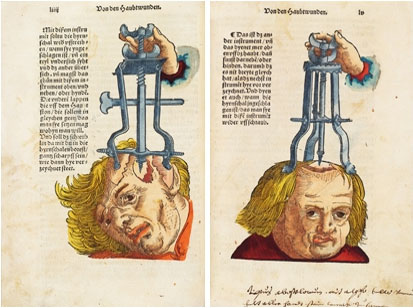
  2. From Omnium humani corporis… (1641), an anatomical booklet made up of woodcut illustrations copied from earlier books under the supervision of Walther Ryff, a prolific producer of texts intended for a broad range of readers.
  3. Plate from Cesare Lombroso's textbook L’Uomo Delinquente ... (1889)

Source:
http://morbidanatomy.blogspot.com/feeds/posts/default?alt=rss

"Cultures of Anatomical Collections Conference," Call for Papers, Leiden University, February 15-18 2012


Image: Museum of Anatomical Waxes “Luigi Cattezneo” Bologna, Italy, part of the Anatomical Theatre Exhibition © Joanna Ebenstein

Call for papers: Cultures of Anatomical Collections International Conference, Leiden University 15-18 February 2012

The conference ‘Cultures of Anatomical Collections’ will explore anatomical preparations and collections (preparations of human material as well as wax- and other models) as important parts of our cultural heritage. This means that we treat them in a similar way as we would examine other historical artifacts stored in today’s museum. Although the history of anatomy and anatomical illustrations has been a popular topic in the history of medicine during the last decade, the history of its material remains has been somewhat neglected. And yet, in particular when taking into account recent historiographies of materiality and medical practices, it offers challenging interdisciplinary questions on the history of anatomy as a whole. Possible topics include: How do the technical details of anatomical preparations tell us about the ideas of their maker; How do ideas on beauty and perfection shape preparations; How were preparations handled and used for teaching purposes: How does the interest of non-medical audiences shape anatomical preparations? On collections as a whole we can ask: How are particular collections build up; How do decisions of curators affect the build-up of collections; How does the housing of a collection affect its outlook and popularity?

The conference has keynote lectures and the following sessions:

Keynote Lectures : Ruth Richardson and Andrew Cunningham

1. Beauty, Perfection and Materiality in Early Modern Anatomical Collections Organiser: Marieke Hendriksen ; Confirmed speaker: Anita Guerrini

This session deals with questions regarding the materiality and aesthetics of early modern anatomical preparations. So far historians of medicine have described the beauty and perfection of early modern anatomical preparations using modern (post-Kantian) understandings of aesthetics. Yet, early modern anatomical preparations must be related to early modern ideas of aesthetics, which were about beauty and perfection as well as about sense perception and experiment. Possible questions include: How does the materiality of preparations tell us more about contemporary ideals of beauty and perfection and vice versa? How can changes in theses ideals be traced in the make-up of anatomical collections? How are beauty and perfection related to natural philosophical ideas on sense perception and experiment? How do ideas of beauty and perfection relate to the morality of the early modern anatomical theatre?

2. Anatomical Collections and Scientific Medicine in the Nineteenth Century Organiser: Hieke Huistra; Confirmed speaker: Simon Chaplin

With the birth of the clinic and the introduction of laboratory methods, medicine in the nineteenth century changed profoundly. At first sight it would seem as if these changes would pose a threat to the position and function of anatomical collections in research and teaching. This was, however, not the case – institutional anatomical collections flourished in the nineteenth century. In this session we explore questions such as what were the status and function of early modern collections in the nineteenth century? How were old (in most cases early modern) preparations displayed and used in the new scientific medicine? How did the use, content, accessibility and display change during the nineteenth century? How did the new collections relate to the ‘new’ disciplines of comparative anatomy and pathology?

3. Handling Anatomical Collections Organiser: Rina Knoeff; Confirmed speakers: Sam Alberti, Tim Huisman

This session is directed at exploring the role of the curator of the anatomical museum. Almost invisible and hardly discussed in historical discourse, he is daily busy and literally in touch with the collections. He has always been of utmost importance for the making of preparations and the general outlook of anatomical collections. Possible questions include: What are the tasks of a curator and how have they changed over time? How did/does a curator determine the outlook of a preparation and collection? How did/does he influence the focus, significant silences and boundaries of collections? How did/do his responsibilities oscillate between professional medics and the public? How did/does he merge the interests of these two groups?

4. Anatomical Collections as Public History Organiser: Rina Knoeff; Confirmed speaker: Anna Maerker

This session is about the role of the public in the making and survival of anatomical collections. Faced with recent controversies surrounding the public exhibition of human material (in particular Körperwelten) anatomical museums are faced with the questions of which exhibits should be on show, for what purposes (teaching or general interest?) and how they should be exhibited. Yet, these questions are of all times – after all, anatomical collections have almost always been publically accessible. Studying the history of anatomical collections from the public perspective can answer questions such as how are historical preparations presented in (today’s) museum and how have their public meanings transformed over time? How has public curiosity been regulated? How has the public eye influenced the presentation of a preparation?

5. Comments and Final Discussion Organisers: Rina Knoeff, Marieke Hendriksen, Hieke Huistra, Rob Zwijnenberg.

Contact: Rina Knoeff on r.knoeff@hum.leidenuniv.nl

Deadline: Proposals for 20 mins. papers can be send to Rina Knoeff until 16 September 2011.

You can find out more about this excellent looking conference here. Thanks to Kristen Ehrenberger for sending this along!

Source:
http://morbidanatomy.blogspot.com/feeds/posts/default?alt=rss

Anatomic Fashion Friday: Somaphony

Somaphony anatomy tshirts

Somaphony anatomy tshirts

Somaphony anatomy tshirts

Somaphony anatomy tshirts

I am loving these new quirkly anatomical shirts by Washington D.C. based, Somaphony.  The shirts, designed by ICU nurse and music lover, Nate, combine elements of the body and sound.

Nate says of his inspiration:

The first Somaphony concept came to me when I was at a live jazz show at HR-57 a jazz venue in Washington, DC. I was watching and listening to an amazing trumpet solo and the trumpet was so loud and powerful that I pictured a pair of lungs blowing out of the trumpet.

All Somaphony t-shirts are only $20 and are available at somaphony.com!


Source:
http://feeds.feedburner.com/streetanatomy/OQuC