"The Empire of Death: Spectacular Ossuaries and Relics in the 16th and 17th Centuries," Lecture and Book Signing: This Thursday at Observatory!


This Thursday at Observatory! Hope very much to see you there,.

The Empire of Death: Spectacular Ossuaries and Relics in the 16th and 17th Centuries
Lecture and book signing with Dr. Paul Koudounaris, author of The Empire of Death
Date: This Thursday, October 13
Time: 8:00 PM
Admission: $5
Presented by Morbid Anatomy and Atlas Obscura
** Books will be available for sale and signing

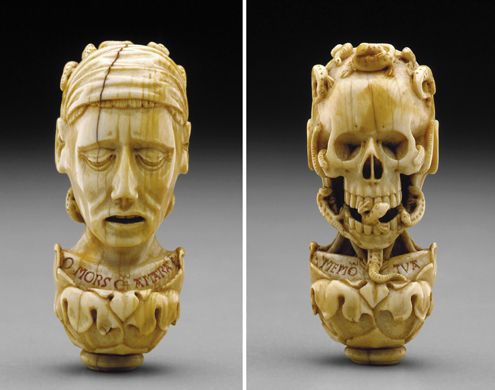
For five years, Dr. Paul Koudounaris has traveled the world to document a largely overlooked history: the decoration of religious shrines with human bones and remains in the sixteenth and seventeenth centuries. His newly published book The Empire of Death (Thames and Hudson) presents a collection of Koudounaris' photographs and texts chronicling these incredible sites, many of which are not open to the public and have never before been photographed.

The research for this unique book took the author to over 70 preserved charnel houses and skeletal shrines on four continents to document the once common use of human remains for the veneration of the dead in Christian culture. Among other tribulations, in the course of completing his research, the author was pursued by malevolent spirits, handcuffed to a table in a striptease bar by a prurient monk, forced to undergo a religious pilgrimage and exorcism, and arrested by the Austrian police.

Tonight, join Dr. Koudounarishis for an illustrated talk in which he will provide historical insights into the sites and people who created these marvelous objects and spaces, a discussion of the veneration of the dead in Christian culture, and fantastical travel anecdotes, all illustrated by his breathtaking photographs of these unforgettable artifacts.

Paul Koudounaris received a PhD in Art History from UCLA in 2006, which a specialty in the Baroque. He has taught at major universities in the Los Angeles area, and has written for dozens of magazines and newspapers in several countries, specializing in articles about veneration of the dead.

You can find out more--and get directions to Observatory--by clicking here. To find out more about the beautifully designed and richly illustrated book--and order a copy for yourself!--click here.

All Photo: © Dr. Paul Koudounaris, from his book The Empire of Death

Source:
http://morbidanatomy.blogspot.com/feeds/posts/default?alt=rss

Wellcome Object of the Month: Hair Mourning Jewelry

It is easy to miss these four little brooches, tucked away as they are in the far corner of Medicine Man alongside Egyptian canopic jars, mortuary crosses and even a shrunken head. But these examples of European mourning jewellery demonstrate an ambiguity at the heart of Henry Wellcome’s collection – the potential for the human subject to become material object after death.

Medicine Man is full of curios serving as literal or metaphorical extensions of the human body, and, like most medical collections, also features artefacts formerly part of the body itself. These brooches are no exception, each containing samples of human hair, neatly arranged and set behind glass.

Hair is certainly a material that occupies the narrow ground between person and thing – in life as much as death. Although it is ‘dead’ matter (as only the follicle contains living cells), once separated from the body, our hair is capable of outlasting us. These qualities of durability, alongside the fact that it is easily removed from the body and can be manipulated into almost any shape, led to the widespread use of hair in the 18th and 19th centuries as a tangible way to remember an absent loved one. Encased in a locket, ring or brooch, a lock of hair stood in for the recently departed, whose memory, it was hoped, would endure for as long as the jewellery itself.

But detached hair, alienated from its natural location on the body, can also provoke disgust – a reaction any of us who have found a stray hair in our food can identify with. The anthropologist Mary Douglas proposed that any ‘matter out of place’, including hair, becomes dirt, posing the threat of chaos and disorder unless carefully gathered and contained (1966)...

Read the full story from which the above image and text are excerpted on the Wellcome Collection blog by clicking here.

Image: Mourning brooches containing the hair of a deceased relative. Wellcome Images

Source:
http://morbidanatomy.blogspot.com/feeds/posts/default?alt=rss

Oddities TV Show Seeking Los Angeles Based Collectors for Future Episodes!

Calling any LA, California based collectors of Oddities! We would love to feature you on the show! Send the producers an email ASAP at Odditiesshow@gmail.com.

This call for collectors just in from Mike Zohn of "Oddities," the Discovery and Science Channel series based on the unrivaled Obscura Antiques and Oddities in New York City. If you are a collector of unusual things based in Los Angeles and interested in appearing on the show--or would like additional information--email Odditiesshow@gmail.com; more about Oddities can be found here.

Source:
http://morbidanatomy.blogspot.com/feeds/posts/default?alt=rss

Dream Anatomy Video

The interior of our bodies is hidden to us. What happens beneath the skin is mysterious, fearful, amazing. In antiquity, the body's internal structure was the subject of speculation, fantasy, and some study, but there were few efforts to represent it in pictures. The invention of the printing press in the 15th century-and the cascade of print technologies that followed-helped to inspire a new spectacular science of anatomy, and new spectacular visions of the body. Anatomical imagery proliferated, detailed and informative but also whimsical, surreal, beautiful, and grotesque — a dream anatomy that reveals as much about the outer world as it does the inner self. --Introduction to Michael Sappol's Dream Anatomy exhibition

I have just stumbled upon a really nice video based on the now-legendary Dream Anatomy exhibition at the National Library of Medicine, curated by friend and friend-of-the-blog Michael Sappol. To check out--and purchase a copy of!--the beautifully illustrated and provocatively insightful catalog for the exhibition, click here.

Found on Street Anatomy.

Source:
http://morbidanatomy.blogspot.com/feeds/posts/default?alt=rss

European Association of Museums of the History of Medical Sciences (EAMHMS) Conference: Call for Papers!


I am excited to announce a call for papers for the 16th biannual conference of the European Association of Museums of the History of Medical Sciences (EAMHMS). The call is issued by Thomas Schnalke, director of the Berliner Medizinhistorisches Museum, the museum which will be hosting the 2012 conference, and reads as follows:

Dear friends and colleagues!

After a highly inspiring conference of the European Association of Museums of the History of Medical Sciences (EAMHMS) in Copenhagen in 2010, it is my pleasure to invite the members of the association, as well as interested scholars and curators from the community of medical history collections and museums to join in and actively participate in the next meeting of the organisation. The conference will be held at the Berlin Museum of Medical History at the Charité from 13 to 15 September 2012. As we all profited from the vibrant culture of debate and discussion, Thomas Söderqvist and his team had generated in Copenhagen, we would like to keep the idea of pre-circulating extended abstracts plus a short oral presentation of the core ideas in the conference (10 mins!). Beamer and laptop will be provided for Power-Point-Presentations. The language for abstracts, talks, and discussions will be English.

While the Copenhagen conference opened and fuelled the still ongoing debate on how to collect and present medical and medical history issues in times when objects tend to fade into the invisible and intangible cosmos of the virtual and nano biology, we want to address the attention back to the physical things we have and deal with: the objects in our collections, depots, and museums. These items are a mystery. They present strangely curved and shiny surfaces. They perform in all different shapes, materials and colours. And they are quiet. They usually don’t talk. But, and this is our chance and challenge, ideas and concepts had been inscribed into their physical make. Medical theories and practices as intricately mixed epistemic processes had found their specific materialisations in the defined structures of such things. Over the times of their preservation they might have lost their primary functions, won secondary ones, but more crucial: They have gained meaning for which we can seek, if we decide to take these objects as serious sources for our work as historians of medicine, science, technology, culture, art, humanities etc.

What we have to do is asking for the “text” in the object, i.e. sometimes a real text in, with or around the thing (may this be only a code, a chiffre or a number), or a “subtext” somehow embedded in the shaped materials implicitly or connected with the object but detached from it and stored elsewhere, as in added files, fascicles or publications. With the clues and information we get from there we can move on to reconstruct the object’s context. Only within this context, the object begins to speak. We can tell its story and biography.

The conference will therefore focus on objects, asking always for the hidden “texts” and “subtexts” on two different paths—a more practical and a conceptual one:
1. Hidden stories. What do medical objects tell?

We ask for papers that really focus on one medical object from your collections, depots or show rooms. Please slip into the role of a Sherlock Holmes to solve the case of this very object, i.e. by observing and describing the thing accurately, looking for clues (“texts”) and additional information (“subtexts”) and presenting your spiral analysis and interpretation around the item, thus telling us the full object story. You may chose any medical object of your personal interest—an ancient mask, medieval blood letting device, a scientific kymograph or a modern gene sequencer—from any time, culture and geographical zone. The only aim we ask you to keep in mind is to show us how far you get with your object-centred research, how far you can draw your interpretation surely consulting secondary archival material and relevant literature. Please also reflect on the limits of this approach.

2. How can we make our objects speak?
Here we ask for papers that reflect on a more conceptual base on how we can deal with objects in three different arenas:

- Research: Medical objects and collections form a unique source in performing research on various topics in the history of medicine and the sciences. What prerequisites and infrastructures do we need to study our objects effectively? What are innovative modes and approaches in a material culture of performing research on, with and around our objects? What forms of networking and funding do we need to support an object-centred research? What are adequate and new formats of publication for our object studies?

- Teaching: Medical Objects and collections offer a unique chance for visual and haptic forms of teaching in many fields. Can you share your thoughts and experiences on this field with us? What are the features, values, and potentials of an object-based teaching? What are possible limits here (delicacy of objects, climate, access, etc.)? What formats of object-based teaching have been tried out (best practice) or ought to be developed further towards a better training in the medical (historical) fields? What links of object-based teaching to research and public outreach have been built up and tried out with what results?

- Presenting: Medical Objects and collections form the core items for our exhibits. What do we want to achieve with our object presentations? What is the very nature, what are the features of exhibitions in our fields? Whom do we want to reach? What are good and innovative formats to make our objects speak and perform for a wider public in our showrooms? What connections with the arenas of research and teaching are possible and sensible? What is the status of an object-based thematic exhibition in our own eyes, in the minds of our external audiences, including the general public and the scientific community?

We ask you to choose a topic from the above-mentioned issues and send your abstract (maximum 700 characters) with a title, your name, the name of your institution (if you are attached to any) and your contact data (preferably e-mail address) until 31 October 2011 to thomas.schnalke [at] charite.de. A programme committee will select from the abstracts to compose a hopefully inspiring programme. If your contribution was chosen, you will be asked to work out and hand in an extended abstract (2 to 5 pages) until 15 May 2012. All papers will be put together in one pdf-file and sent out to all participants in time before the conference starts in Berlin on 13 September 2011. We will ask the participants to have read the papers, so that a short presentation (10 mins!) will be enough to focus on the core arguments.

Please help us to put together an inspiring conference. See you all in Berlin 2012.

Best wishes
Thomas Schnalke

Found on the always wonderful Biomedicine on Display. Image sourced here. Hope to see you there!

Source:http://morbidanatomy.blogspot.com/feeds/posts/default?alt=rss

Medical tricks and Victorian treats at The Florence Nightingale Museum, London, October 28th


This just in from my friend Natasha McEnroe, recently of the incredible Grant Museum and now at London's Florence Nightingale Museum:

Medical tricks and Victorian treats.....
10am – 5pm, Monday October 24th – Friday October 28th.
The Florence Nightingale Museum, London
Free with the price of admisison

Come and follow, if you dare, the Halloween Trail at the Florence Nightingale Museum. Medical tricks and Victorian treats fill the museum over Halloween half term. Take part in quizzes and quests, grisly games and ghoulish activities, and earn a bulging goody bag. Enter the Halloween competition for a chance to win a horribly good prize.

Feast your eyes on the vermin-infested Halloween banquet! Put your life in the hands of a crazed Victorian quack doctor! And come face to face with the monster lurking underneath the haunted bed....

More on this event can be found here.

Source:
http://morbidanatomy.blogspot.com/feeds/posts/default?alt=rss

Morbid Anatomy Presents This Week and Beyond at Observatory

Solitary vice? Sex and dissection in Georgian London
An illustrated lecture with Dr. Simon Chaplin of the Wellcome Library, formerly of the Hunterian Museum
Date: This Tuesday, October 4
Time: 8:00 PM
Admission: $5
Presented by Morbid Anatomy

In his watercolour of a 'Persevering Surgeon', the British artist Thomas Rowlandson made no bones about the darkly erotic nature of anatomical dissection. Poised over the body of a naked woman, erect knife in hand, Rowlandson's anatomist conjured images of the other solitary vice that consumed later 18th century moralists and medical men. But like Rowlandson - who combined popular satirical illustration with a more discreet trade in pornographic imagery - anatomists maintained a delicate balance between personal pursuits and public propriety. In this lavishly illustrated lecture, Simon Chaplin explores the sexual undertones of the anatomy schools of Georgian London, in which students dissected grave-robbed bodies in the back-rooms of their teachers' houses, while their masters explored new strategies for presenting their work to polite audiences through museums and lectures.

Dr Simon Chaplin is Head of the Wellcome Library in London. Before joining the Wellcome he was Director of the Hunterian Museum in London, one of the world's oldest anatomy collections. His research interests include the history of anatomy, surgery and museums, and his doctoral thesis explored the relationship between dissection and display through the work of the Hunterian Museum's founder, the surgeon John Hunter (1728-1793).

Image: Thomas Rowlandson, 'The Persevering Surgeon', late 18th century, from the collection of the Hunterian Museum, London

Born of the Floating World: A Brief Exploration of the Japanese Graphic Narrative
Illustrated talk with Japanese Scholar Dev Avidon
Date: This Thursday, October 6th
Time: 8:00 PM
Admission: $5
Presented by Morbid Anatomy and Oxberry Pegs

In 1988, the anime adaptation of Otomo Katsuhiro's perennial serialized manga Akira was released in Japan, shattering domestic attendance records for an animated film. Shortly thereafter, its distributor presented it to George Lucas and Steven Spielberg as the ideal anime for English-language adaptation. The two dismissed it offhand, deeming the very concept of a cerebral, macabre, challenging animated film as “completely unmarketable” in the United States. Animation in America was the sole purview of children, they reckoned, and throughout the 90s, those few anime that were adapted for the American market were heavily edited to remove any and all controversy or 'adult' themes, thus rendering them safe for Saturday mornings. In 2001, however, Disney took a chance, bringing a largely faithful, unedited translation of Hayao Miyazaki's Spirited Away to theaters. It was an astounding success, enjoying uniform critical acclaim and record profits for a foreign animated film, and sparking an unprecedented interest in anime and manga in America.

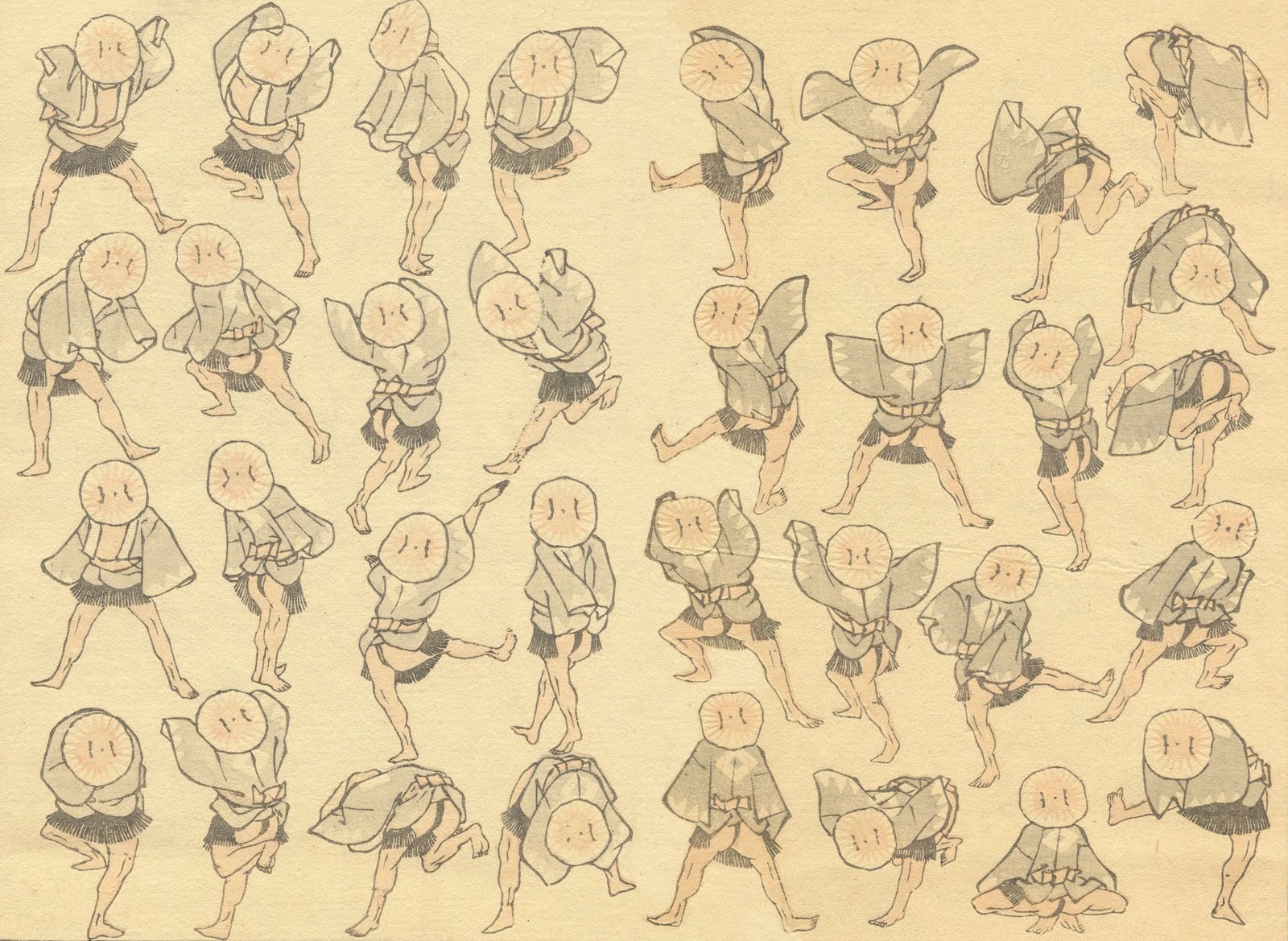
A decade later, with anime and manga's popularity in the United States at an all time high, Dev Avidon will present a brief history and overview of the two forms, and examine their provenance in 17th and 18th century Japanese pictorial narratives such as the Kibyoshi – arguably the first graphic novel in human history. What spawned anime and manga as media, and what defines them? How did their visual and narrative tropes and themes evolve from both a Japanese cultural tradition dating back as early as the 9th century, and a cross-pollination and interplay with Western art and animation styles during the 19th and 20th centuries? And how can we, as American viewers, reconcile our preconceptions of the 'cartoon' and 'comic book' with the realities of two artistic forms that, collectively, account for over half of all visual media produced in Japan annually?

Dev Avidon is a Brooklyn-based jazz composer/singer, sound engineer, small business owner and Japanese scholar. During his time in the Government and East Asian Languages and Civilizations departments at Harvard University he specialized in Japanese neo-nationalism and Japanese popular art, from the ukiyo-e and kibyoshi forms of the Edo period through the modern day Neopop and Superflat movements. His thesis for the Reischauer Institute of Japanese Studies at Harvard University, Allegories of the Empty Center: A study of Modern Japanese Nationalism explores how Japanese neo-nationalism as exemplified in cultural movements such as Superflat problematizes the core tenets of modern nationalist theory. He also played an instrumental role in the founding and cataloging of the anime and manga collections at the Harvard Yenching Library. A well-published author and scholar, Dev Avidon's current focus is on his upcoming sophomore album, Tears of Men, and melding the hard science of audio technology with the clean lines of Japanese aesthetic design and the artwork of master jewelers with his line of audiophile cables for Frost Audio, a boutique audio company he owns and co-founded in 2010. Visit him at http://www.devavidon.com or http://www.frost-audio.com.

Image: Hokusai's Manga

The Rest of October:

NOVEMBER:

You can find out more--and get directions to Observatory--by clicking here.

Source:
http://morbidanatomy.blogspot.com/feeds/posts/default?alt=rss

A Steve Jobs Memento Mori


So by now I imagine we have all heard the sad news of Steve Jobs' death. What is really interesting to me is how his death has had the curious side effect of bringing a discussion of mortality and the contemplation thereof as a road to wisdom and a good life in the mainstream media. Steve Jobs' words on death, which are being excerpted in many online eulogies, are drawn from a commencement address he gave at Stanford University in 2005; they ring very true and refreshing, and are worth quoting here in their entirety:

My third story is about death.

When I was 17, I read a quote that went something like: "If you live each day as if it was your last, someday you'll most certainly be right." It made an impression on me, and since then, for the past 33 years, I have looked in the mirror every morning and asked myself: "If today were the last day of my life, would I want to do what I am about to do today?" And whenever the answer has been "No" for too many days in a row, I know I need to change something.

Remembering that I'll be dead soon is the most important tool I've ever encountered to help me make the big choices in life. Because almost everything — all external expectations, all pride, all fear of embarrassment or failure - these things just fall away in the face of death, leaving only what is truly important. Remembering that you are going to die is the best way I know to avoid the trap of thinking you have something to lose. You are already naked. There is no reason not to follow your heart.

About a year ago I was diagnosed with cancer. I had a scan at 7:30 in the morning, and it clearly showed a tumor on my pancreas. I didn't even know what a pancreas was. The doctors told me this was almost certainly a type of cancer that is incurable, and that I should expect to live no longer than three to six months. My doctor advised me to go home and get my affairs in order, which is doctor's code for prepare to die. It means to try to tell your kids everything you thought you'd have the next 10 years to tell them in just a few months. It means to make sure everything is buttoned up so that it will be as easy as possible for your family. It means to say your goodbyes.

I lived with that diagnosis all day. Later that evening I had a biopsy, where they stuck an endoscope down my throat, through my stomach and into my intestines, put a needle into my pancreas and got a few cells from the tumor. I was sedated, but my wife, who was there, told me that when they viewed the cells under a microscope the doctors started crying because it turned out to be a very rare form of pancreatic cancer that is curable with surgery. I had the surgery and I'm fine now.

This was the closest I've been to facing death, and I hope it's the closest I get for a few more decades. Having lived through it, I can now say this to you with a bit more certainty than when death was a useful but purely intellectual concept:

No one wants to die. Even people who want to go to heaven don't want to die to get there. And yet death is the destination we all share. No one has ever escaped it. And that is as it should be, because Death is very likely the single best invention of Life. It is Life's change agent. It clears out the old to make way for the new. Right now the new is you, but someday not too long from now, you will gradually become the old and be cleared away. Sorry to be so dramatic, but it is quite true.

Your time is limited, so don't waste it living someone else's life. Don't be trapped by dogma — which is living with the results of other people's thinking. Don't let the noise of others' opinions drown out your own inner voice. And most important, have the courage to follow your heart and intuition. They somehow already know what you truly want to become. Everything else is secondary.

You can read the full text of Steve Jobs' commencement address at Stanford University in 2005 here.

Image of memento mori figure sourced here.

Source:
http://morbidanatomy.blogspot.com/feeds/posts/default?alt=rss

Jean-Marc Laroche – Lovers from the Hereafter

Jean-Marc Laroche Vanite

Vanité

Jean-Marc Laroche Lotus

Squelette Erotique

Jean-Marc Laroche Les Amants du Néant

Les Amants du Néant

Jean-Marc Laroche Kamasutra

Kamasutra

Jean-Marc Laroche Tete Ouverte

Tête Reliquaire (entrouverte)

The work of French sculptor, Jean-Marc Laroche is nothing but extraordinary.  An edgy, if not uncomfortably powerful look at death.

Having begun his career creating intricate knives for 12 years, he eventually shifted his focus to more life-size endeavors.  The debut of his life-size skeletons occurred at the Paris Muse?e de l’Erotisme (Museum of Eroticism) with an installation entitled Les Amants du Ne?ant (Lovers from the Hereafter).  From 2005 to 2008 Laroche’s scultpures evolved into the biomechanical realm with the series Human Mechanics or Visions of a Future Anterior.

Laroche’s latest exhibition will take place the the Museum of Sex in New York. If you’re in the city I highly suggest seeing his work.  He will have 5 of his life-size skeletons on exhibition. Plus the Museum of Sex just sounds a tad bit intriguing in and of itself.

Lovers from the Hereafter
October 5th – November 4th
Museum of Sex
233 Fifth Ave @ 27th Street
New York, NY


Source:
http://feeds.feedburner.com/streetanatomy/OQuC

MEDO Street Art

Sorriso Torto MEDO

Eu nao te conheco MEDO

Dementia MEDO

Santo MEDO

The work of Brazillian street artist, MEDO, has recently shifted from dark, often geometrical human-like figures to the anatomically correct abstraction.  The subject of his work comprises “cathedrals, monasteries, sacred art and the horror of the inevitable.

His almost sacred figures stood amidst the crumbled locations like Incoherent saints with void as eyes staring at the skies for impossible answers.
There is a Dreary quality in their faces and gestures but also a glimpse of compassion and maybe true hope.

I love the selection of anatomical elements he places together.  They have a silliness and sense of desperation to them.

View all of Medo’s street art on his Flickr!


Source:
http://feeds.feedburner.com/streetanatomy/OQuC

"Miracles & Charms," Exhibition, The Wellcome Collection


I am very very excited about the new exhibition "Miracles & Charms" opening next Thursday at the always amazing Wellcome Collection in London. The exhibition will feature Mexican votive paintings borrowed from Mexican museums and sanctuaries as well as votives, amulets and charms drawn from the Pitt Rivers-housed collection of "obsessive folklorist Edward Lovett [1852-1933], who scoured the city by night, buying curious objects from London's mudlarks, barrow men and sailors, which he sold on to Wellcome." There will also be original artworks.

Full details follow, and above are images of just a few of the pieces you will find in the exhibition (credits at end of post). If you are based in the London area, be sure to check it out! I know I would if I could....

Miracles & Charms at Wellcome Collection
Wellcome Collection | 6 October 2011 – 26 February 2012

Miracles & Charms, Wellcome Collection's autumn exhibition programme, explores the extraordinary in the everyday with two shows: Infinitas Gracias: Mexican miracle paintings, the first major display of Mexican votive paintings outside Mexico; and Felicity Powell: Charmed life, an exhibition of unseen London amulets from Henry Wellcome's collection, curated by the artist Felicity Powell. Drawing lines between faith, mortality and healing, Miracles & Charms will offer a poignant insight into the tribulations of daily life and human responses to chance and suffering.

Infinitas Gracias: Mexican miracle paintings
Mexican votives are small paintings, usually executed on tin roof tiles or small plaques, depicting the moment of personal humility when an individual asks a saint for help and is delivered from disaster and sometimes death. Infinitas Gracias will feature over 100 votive paintings drawn from five collections held by museums in and around Mexico City and two sanctuaries located in mining communities in the Bajío region to the North: the city of Guanajuato and the distant mountain town of Real de Catorce. Together with images, news reports, photographs, devotional artefacts, film and interviews, the exhibition will illustrate the depth of the votive tradition in Mexico.

Usually commissioned from local artists by the petitioner, votive paintings tell immediate and intensely personal stories, from domestic dramas to revolutionary violence, through which a markedly human history of communities and their culture can be read. Votives to be displayed in Infinitas Gracias date from the 18th century to the present day. Over this period, thousands of small paintings came to line the walls of Mexican churches as gestures of thanksgiving, replacing powerful doctrine-driven images of the saints with personal and direct pleas for help. The votives are intimate records of the tumultuous dramas of everyday life: lightning strikes, gun fights, motor accidents, ill health and false imprisonment; in which saintly intervention was believed to have led to survival and reprieve.

Infinitas Gracias will explore the reaction of individuals at the moment of crisis in which their strength of faith comes into play. The profound influence of these vernacular paintings, and the artists and individuals who painted them, can be seen in the work of such figures as Diego Rivera and Frida Kahlo, who were avid collectors. The contemporary legacy of the votive ritual will be present in the exhibition through a wall covered with modern day offerings from one church in Guanajuato: a paper shower of letters, certificates, photographs, clothing and flowers, through which the tradition of votive offering continues today. The sanctuaries at Guanajuato and Real de Catorce remain centres of annual pilgrimage, attracting thousands of people to thank and celebrate their chosen saints.

Felicity Powell: Charmed life
A please to the votives' thank you, Charmed life, curated by Felicity Powell, features some four hundred amulets from Henry Wellcome's vast collection, which will be exhibited encircled with works, including new pieces and videos, by the artist. The amulets, ranging from simple coins to meticulously carved shells, dead animals to elaborately fashioned notes, are from a collection within a collection, amassed by the banker and obsessive folklorist Edward Lovett, who scoured the city by night, buying curious objects from London's mudlarks, barrow men and sailors, which he sold on to Wellcome.

The amulets are objects of solace. Intended to be held, touched, and kept close to the body, they are by turns designed and found, peculiar and familiar. The potency of the charms is invested through rituals of hope and habit. Each amulet on display has long been separated from its wearer, but collectively they form a repository for the anxieties, reassurances and superstitions of the city and its occupants. Lovett's amulets are held at the Pitt-Rivers Museum where they have remained archived and largely unseen. The amulets selected by Powell are uncanny: they are secrets brought to light.

Powell's own works address the strange allure of objects which are a source of comfort and compensation. Intricate miniatures, with white wax reliefs on black mirror slate, they carry the same intimacy of size as
the amulets, and are meticulously crafted. Her portraits, which appear as inverted silhouettes, white on black, are all in a process of change, metamorphosing into other selves and creatures. Like Lovett's amulets, they seem to be more than themselves, hinting at a hidden magic at work, as they dip between real and imagined worlds. Using the reverse side of a mirror, Powell hides away literal reflection but leaves the viewer wondering at their playful and compelling strangeness.

Film works projected in the gallery see the wax reliefs in animation, featuring the hands of the artist as she works, alongside medical scans of her body overlaid with drawn images of amulets from the Lovett collection. These films, with music by William Basinski, create imagery and forms that relate directly to the objects on display and to the artist’s own desire for wellbeing.

Ken Arnold, Head of Public Programmes at Wellcome Collection, says: "These two exhibitions explore rich traditions of everyday faith and health, presenting us with objects from across cultures, all invested with extraordinary personal potency. Sometimes comforting, other times strange, both simply made and exquisitely wrought: these exhibits give us insight into centuries of charmed lives and miraculous events."

A full programme of events will accompany the exhibition.

Miracles & Charms runs from 6 October 2011 to 26 February 2012.

You can find out more about this exhibition--which runs from October 6th 2011 to February 26 2012--by clicking here.

Image credits:

  1. Amulet from the Lovett Collection Credit: Pitt Rivers Museum, University of Oxford. (L0069108)
  2. Amulet from the Lovett Collection Credit: Pitt Rivers Museum, University of Oxford. (L0069107)
  3. Amulet from the Lovett Collection Credit: Pitt Rivers Museum, University of Oxford. (L0069255)
  4. Amulet from the Lovett Collection Credit: Pitt Rivers Museum, University of Oxford (L0069216)
  5. Votive on tin, 1840 Credit: Museo Nacional de las Intervenciones / INAH (L0069314)
  6. Votive on tin, 1856 Credit: Museo Nacional de Historia - INAH (L0069326)
  7. Votive on tin, 1861 Credit: Museo Nacional de Historia - INAH (L0069334)
  8. Votive on tin, 1940 Credit: Santuario de San Francisco de Asis de la Diócesis de Matehuala / INAH (L0069348)
  9. Extruding coral Credit: Felicity Powell (L0069400)

Source:
http://morbidanatomy.blogspot.com/feeds/posts/default?alt=rss