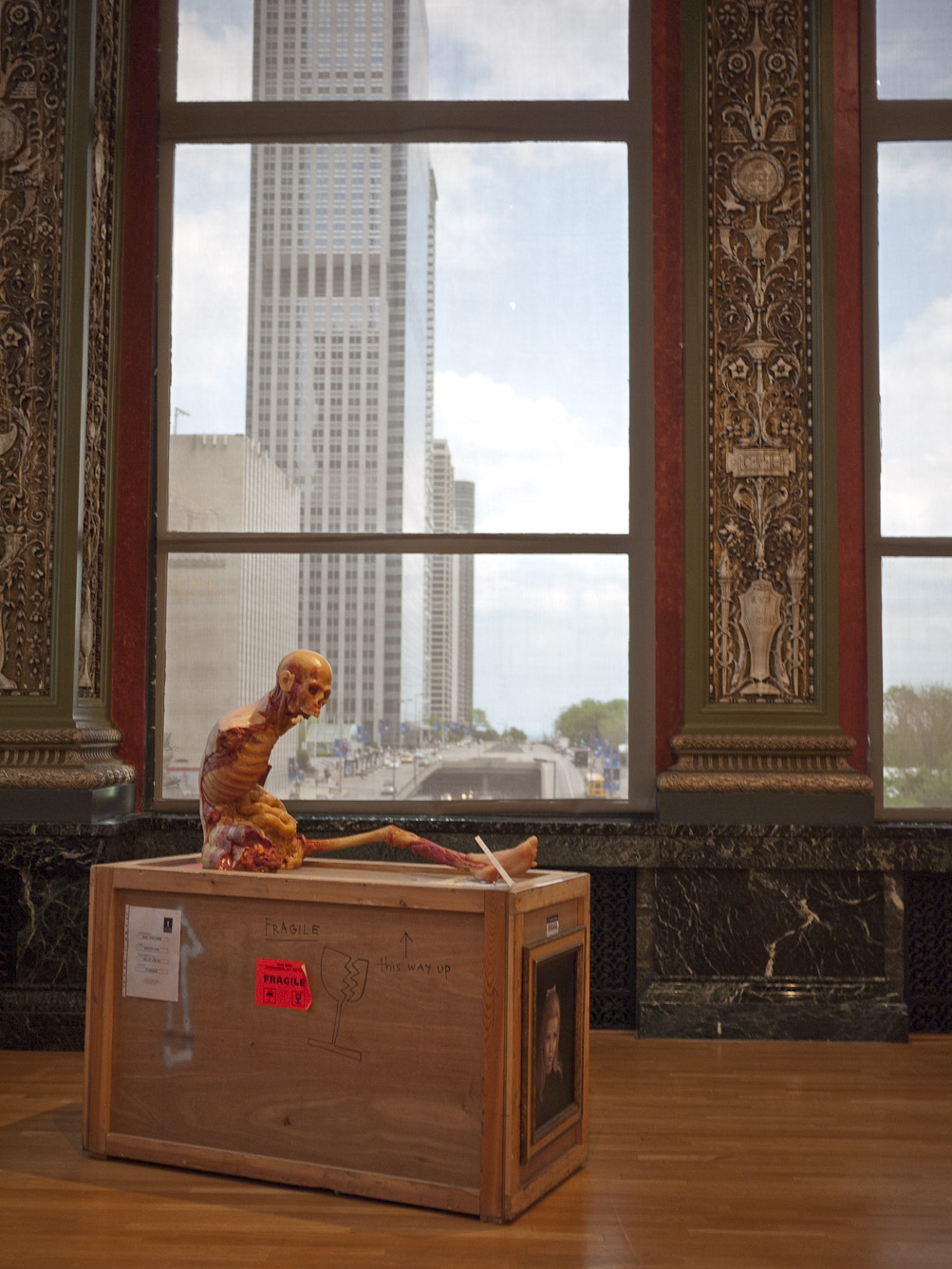
"Morbid Curiosity: The Richard Harris Collection," Through July 8, Chicago Cultural Center: Exhibition Report


I collect images of  "Death" because I am a visual person who takes in information best visually. As I have gotten older the thought of my own demise has begun to enter my conscious thoughts. The universality of "Death," with the realization that we will all die, encouraged me to begin the conversation of my mortality visually rather than talking or reading about it. I believe that there is a larger audience who might also be more comfortable beginning that discussion in a visual way, which is why I always thought of my collection in terms of a public exhibition.

--Richard Harris, the collector whose works are featured in "Morbid Curiosity: The Richard Harris Collection,"in an interview with Morbid Anatomy

Whilst in Chicago a few weeks ago, I had the good fortune to be able to spend a good two hours or so with the works in the profoundly wonderful new exhibition "Morbid Curiosity: The Richard Harris Collection," on view through July 8 at the Chicago Cultural Center. This seriously (!!!) not-to-be-missed exhibition showcases nearly 1,000 works which range from 2000 B.C.E. to the present, from fine art to ephemera, and from Mexican to Japanese to Tibetan to European artist traditions, all drawn from the astounding death-related collection of Richard Harris.

Some of my favorite pieces--featured in the photos above--included Rudolfo Villena Hernandez "A Commemoration of the Bicentennial Proclamation of the Independence of Mexico" (third from bottom); Michel de Spiegelaere's "Macabre Scene," one of the better Frederik Ruysch tableaux recreations I have had the pleasure to see (8-10 from top); a collection of macabre book plates and postcards (4th and 5th from bottom); Roger Reutimann's "Death of Venus" (seventh down), a wonderful collection of 19th Century ceramic German Dance of Death Figures (second from bottom), a carved wooden memento mori figurine from the early 17th century (third from bottom), and Jodie Carie's "In the eyes of Others plaster-cast bone chandelier bringing to mind the wonders of the  Kutná Hora ossuary (fourth down). The installation itself--expertly staged by curator Lucas Cowan--is wonderful as well, evoking the beautiful clutter of the wunderkammer but utilizing clever groupings which draw the eye and invite close investigation rather than overwhelm.

You can see more photos from the exhibition--and find out more about the works seen above--by clicking here. You can find out more on this exhibition on this recent post, on the Chicago Cultural Center website, and on Richard Harris' website. You can watch a gallery walk through and interview with Richard Harris by clicking here.

Source:
http://morbidanatomy.blogspot.com/feeds/posts/default?alt=rss

JOB OPENING: Information Services Librarian, New York Academy of Medicine, New York City

The Malloch Rare Book Room at the New York Academy of Medicine.

For all you wonderful librarians out there who also happen to be interested in the history of medicine, I have an exciting announcement to make: The New York Academy of Medicine is advertising for a new opening for Information Services Librarian!

Full details follow; Hope one of you ends up in this role!

Information Services Librarian
Center for the History of Medicine and Public Health
The New York Academy of Medicine

Mission
The New York Academy of Medicine advances the health of people in cities. An independent organization since 1847, NYAM addresses the health challenges facing the world's urban populations through interdisciplinary approaches to policy leadership, education, community engagement and innovative research.

Drawing on the expertise of diverse partners worldwide and more than 2,000 elected Fellows from across the professions, our current priorities are

  • To create environments in cities that support healthy aging
  • To strengthen systems that prevent disease and promote the public's health
  • To implement interventions that eliminate health disparities
  • Summary and Description

Summary and Description
The Center for the History of Medicine and Public Health is NYAM’s newest center and provides access to and enhances awareness of NYAM important research collections in medicine, public health and their history. The aim of the new Center is to build bridges among an interdisciplinary community of scholars, educators, clinicians, curatorial and conservation professionals and the general public.

The NYAM Research Library
The NYAM collections, which opened its to the general public in 1878, include over 500,000 volumes, 275,000 portraits and illustrations and around 400,000 pamphlets in its Research and Rare Books and Historical sections. NYAM is the only specialized research library in NYC offering access to medical and health information for members of the general public, a mission the Information Services Librarian will be critical in fulfilling.

The Research Library collection comprises monographs in medicine, public health and health policy, an extensive journal collection, grey literature, the various databases, and primary and secondary materials in the history of medicine, public health, science and other health-related disciplines. The Research Library collection is supported by an extensive reference collection of medical bibliography, biography, biographical dictionaries, dictionaries and library catalogues, as well as books on the history of books and printing.

The Research Library forms part of NYAM’s Center for the History of Medicine and Public Health. The Center is made up of the Research Library, Rare Book and Historical Collections and Conservation Laboratory. The Information Services librarian will function as the main contact person for users of the Research Library.
The Center for the History of Medicine and Public Health

In addition to the Research Library, the Center for the History of Medicine and Public Health’s  Rare Book and Historical Collections include a rare book collection of approximately 35,000 volumes, with manuscripts and archives dating from the 17th century B.C.E. to the present.  Books from the 17th and 18th centuries are another particular area of strength, as are materials related to the history of medicine in the City of New York.  Currently, the Rare Book and Historical Collections support a variety of programs, including two residential fellowships and an annual lecture series.

The Gladys Brooks Book and Paper Conservation Laboratory was established in 1982 for the express purpose of caring for the NYAM collections.  In addition to its preservation mandate, the Lab plays an important role in the training of future generations of conservators through its internship and volunteer programs and offers professional educational opportunities through a robust calendar of workshops and lectures.

Summary and Description
The NYAM Research Library is looking for a dedicated and enthusiastic librarian to provide information and reference services to NYAM Fellows and staff, members of the general public, and middle and high school students. The Information Services Librarian will be responsible for reference hours in the main reading room of the Research Library and play a central role providing users with research support. We are looking for an individual with a high level of communication and research skills, who will be proactive in helping to build the profile and activities of the Research Library.

Duties and Responsibilities
The Information Services Librarian will:

• Facilitate the use of databases and resources available in the Library, especially PubMed
• Support the research needs of staff, Fellows and corporate clients
• Assist the general public in their use of the library collections
• Provide in-depth reference searches, including searching grey literature
• Play a central role in NYAM’s Junior Fellows Program, helping middle and high school students develop and successfully complete research projects in the library
• Provide teaching and instructional sessions to Junior Fellows and participants in other NYAM programs such as EBEM (evidence-based emergency medicine) workshops
• Maintain and update Library CMS information
• Use social media to communicate Library activities and research results
• Take part in other special projects as required.

This role offers an exciting opportunity to help develop the activities and profile of a new Center dedicated to creating links between recent medicine and public health material and the history of medicine and public health. The Information Services Librarian will work closely with colleagues in the Center, and other NYAM sections. In particular s/he will collaborate with colleagues in the delivery of public services, introducing students from a variety of disciplines to the Center’s collections, and teaching research skills.

Qualifications
• MLS from an ALA-accredited institution (required)
• AHIP credentials (preferred)

Experience and/or Education
Required:

• Reference experience in an academic or research library with a focus on health sciences
• Familiarity with the databases and other reference tools necessary to answer a wide variety of questions related to public health, health policy, and medicine
• A sophisticated understanding of PubMed and an ability to teach it to a variety of different user groups
• Experience engaging with a diverse audiences, from school children, especially secondary school students, to professional
• Strong oral, written and interpersonal communication skills, with an ability to communicate complex ideas in an accessible manner
• Demonstrated commitment to public service
• Excellent computer and web skills
• Physical ability to undertake collection management duties such as movement of books and materials weighing up to 40 lbs., and work in sometimes dusty environments.

Preferred:
• At least 3-5 years reference experience in a large health sciences library
• Teaching experience, particularly with middle and high school students
• Familiarity with medical language and terminology
• Experience using social media.

To Apply
Please email a resume a
nd cover letter to hr@nyam.org. Please include "Information Services Librarian" in subject line.

The New York Academy of Medicine is an Affirmative Action/Equal Opportunity Employer.

For more information, visit our website: http://www.nyam.org

The New York Academy of Medicine is an Affirmative Action/Equal Opportunity Employer.

You can find out more by clicking here. Click on image to see larger, finer version; image above was sourced here.

Source:
http://morbidanatomy.blogspot.com/feeds/posts/default?alt=rss

"St. Dennistoun Mortuary" Coin-Operated Automaton, Attributed to Leonard Lee, c. 1900, Skinner Auctioneers, June 2, 2012

All I have to say is WOW: pictured above are scenes from a coin-operated automaton (which I am guessing is from the 1920s or 30s, rather than 1900 as the auctioneers claim) in which, after a coin is inserted, "doors open and the room is lighted revealing four morticians and four poor souls on embalming tables, the morticians move as if busily at work on their grisly task and mourners standing outside bob their heads as if sobbing in grief."

This object is for sale (!!!) and is estimated to go for between $4,000-$6,000 as part of an upcoming Science, Technology & Clocks auction taking place on June 2, 2012 10:00AM. Full lot description from the Skinner Auctioneers website follows:

Lot 207
"St. Dennistoun Mortuary" Coin-Operated Automaton, attributed to Leonard Lee, c. 1900, the mahogany cabinet and glazed viewing area displays a Greek Revival mortuary building with double doors and grieving mourners out front, when a coin is inserted, doors open and the room is lighted revealing four morticians and four poor souls on embalming tables, the morticians move as if busily at work on their grisly task and mourners standing outside bob their heads as if sobbing in grief, ht. 30 1/2, wd. 24, dp. 17 1/4 in.

Estimate $4,000-6,000

Brass coin plate stamped J. Dennison Leeds NO. 80

You can find out more and see the other lots--which include other automatons including an amazing automaton last supper!--by clicking here. My only plea, if any of you Morbid Anatomy readers purchase this, please (please!) invite me over to see it in action! I would certainly buy it myself if I could afford it. If the Musée Mécanique is still actively collecting, this would make a wonderful addition to their rich collection of coin-op toys depicting deaths by such means as guillotine, French execution, and English execution; yes, really. More on that here.

Thanks so much to Morbid Anatomy readers Nanette Rod and Jane Fuller for bringing this amazing object to my attention! All images sourced from the auctioneer website; click on images to see larger versions.

Source:
http://morbidanatomy.blogspot.com/feeds/posts/default?alt=rss

Hospital Chief Executives announce plans for single pathology service

Hospital Chief Executives announce plans for single pathology service

8:00am Sunday 20th May 2012 in News

Hospital Chief Executives announce plans for single pathology service

The Chief Executives of four south-west London hospital trusts have announced plans to develop a single Pathology Service located at St George's Hospital.

In a joint statement, the Chief Executives of Croydon Health Services, Kingston Hospital, Epsom and St Helier's NHS Trusts and St George's Healthcare Trust, said the decision meant they could "develop and future proof our pathology services across south west London."

The decision to develop a new single pathology service was agreed at a Pathology Programme Board meeting on Thursday.

The recommendations will be presented to each of the Trust boards for approval in the coming weeks.

Patients should not experience a change in service and will continue to have their tests where they have them now- either at their local hospital or at their GP surgery, the board said.

However, the plans mean the behind the scenes laboratory aspects of the service will run from a single 'hub' for the majority of pathology work.

There will be labs at each acute hospital site to manage each Trust's very urgent work and to support services such as A&E.

Read this article:
Hospital Chief Executives announce plans for single pathology service

Wall Street Newscast Interviews Creative Edge Nutrition, Inc. CEO Bill Chaaban

ORLANDO, FL--(Marketwire -05/18/12)- Creative Edge Nutrition, Inc. (FITX.PK) Chief Executive Officer Bill Chaaban discusses the corporate vision and strategic marketing initiatives of the company on Wall Street Newscast (http://www.wallstreetnewscast.com/profile/fitx.html). Chaaban discussed the Creative Edge Nutrition, Inc. strategic acquisition of Science Defined Nutrition. Inc., and the new vision of the company since becoming Chief Executive Officer. He noted that he has full support of the board of directors to implement his vision as he builds shareholder value and increases market share through organic growth and strategic acquisitions, and other experienced key executives and officers that will lead Creative Edge Nutrition, Inc. in implementing its strategic business model.

Bill Chaaban, CEO, stated, "It was important for us to communicate to our shareholders through this interview. Although Jeff Thomas and I are in the UK from May 18-20, 2012, for the Body Power Expo, the UK's largest health, fitness and nutrition expo; we want to continually avail ourselves for our shareholders, which was why we conducted the interview. We are positioning the company for growth, including international growth in regions such as the UK. The board, executives and management are committed to the success of Creative Edge Nutrition, Inc. and our subsidiary brands."

Jeff Thomas added, "We are excited that Creative Edge Nutrition, Inc. will have a presence at the Body Power Expo. This is the perfect environment to showcase all our products as well as meet with current and potential future distributors."

About Science Defined Nutrition, Inc.Developed by body builders and athletes, Science Defined Nutrition (SDN) is a leader in the nutritional supplement industry. SDN's Research and Development Team has cultivated an entire litany of superlative products, with the initial proof-providing ground-breaking product ROGUE at the helm, rooted in the immeasurable passion for achieving athletic enhancement through tireless scientific scrutiny. The core Mission of SDN is to assist our customers in taking their athletic ambitions to heights unknown, without having to defy their own conscience by sacrificing their state of health to do so. http://www.sciencedefinednutrition.com and http://www.facebook.com/Sciencedefinednutrition

About Creative Edge Nutrition, Inc.Creative Edge Nutrition is a holding company and a Nutritional Supplement Company focused on developing innovative, high quality supplements. The company offers a broad spectrum of capsules, tablets, and powders, as well as science based products in the principal categories of weight management, nutrition challenges, energy and fitness. The Company manufactures under strict GMP guidelines, GMP Certified and FDA registered facilities. http://www.CenergyNutrition.com and http://www.facebook.com/pages/Creative-Edge-Nutrition-Inc/115224738609211

Safe Harbor Notice This press release may contain "forward-looking statements" within the meaning of the Private Securities Litigation Reform Act of 1995, such as statements relating to financial results and plans for future development activities, and are thus prospective. Forward-looking statements include all statements that are not statements of historical fact regarding intent, belief or current expectations of the Company, its directors or its officers. Investors are cautioned that any such forward-looking statements are not guarantees of future performance and involve risks and uncertainties, many of which are beyond the Company's ability to control. Actual results may differ materially from those projected in the forward-looking statements. Among the factors that could cause actual results to differ materially from those indicated in the forward-looking statements are risks and uncertainties associated with the Company's business and finances in general, including the ability to continue and manage its growth, competition, global economic conditions and other factors discussed in detail in the Company's periodic filings with the Security and Exchange Commission. The Company undertakes no obligation to update any forward-looking statements.

See more here:
Wall Street Newscast Interviews Creative Edge Nutrition, Inc. CEO Bill Chaaban

Science, tech fuel artist’s varied and vivid ouevre

U.K.-based artist Luke Jerram has created beautiful pieces that draw on everything from data visualization to microbiology to radiometers. Crave presents a selection.

Radiometer chandelier.

Yes, artist Luke Jerram's most widely known piece may perhaps be "Play Me, I'm Yours" -- an artwork that temporarily distributes actual full-size pianos on the streets of major cities for anyone to play. After all, it's been featured in hugely populated towns like New York City and Los Angeles. But his body of work displays a particular fascination with science and technology.

One sculpture, for instance, is based on the seismogram generated by the 2011 Japan earthquake. Others draw from data visualization as well: charts of the ups and downs of the Dow Jones Industrial Average and the New York Stock Exchange. Microbiology, optics, and the history of sound recording have also inspired compelling pieces.

Jerram has even created chandeliers out of that geekiest of objects: the Crookes radiometer -- the little "lightbulb" with the spinning "windmill" inside that we all coveted in the science museum's gift shop when we kids.

Here's a look at some of Jerram's work, which has been featured in exhibitions associated with the Museum of Modern Art in New York and the Venice Biennale in Italy.

See more here:
Science, tech fuel artist's varied and vivid ouevre

Simi Valley seniors embrace their longevity

Love everyone. Stay active. Pray.

These are three key reasons for living a long happy life, according to people 90 years old and older who celebrated their longevity Friday at the Simi Valley SeniorCenter.

"My secret is to be nice and love everyone that's it," said 98-year-old Emma Isabelle Estrada, of Simi Valley. A great-great-great-grandmother of four, she enjoys cooking, cleaning and gardening, as well as playing bingo at the seniorcenter.

"It's important to be happy and mind your own business," Estrada added. "And always believe inGod."

Estrada was among 14 people age 90 and older who were recognized Friday with a group picture and free lunch. Extra praise went to two 98-year-olds, a 99-year-old and a 100-year-old.

The gathering highlighted Older Americans Month, which is celebrated each May to honor older Americans for the contributions they make to families, communities and society. This year's theme, "Never Too Old to Play," encourages older adults to stay engaged andactive.

"The biggest misconception about people in this age group is that they're senile," said Lucy Mendoza, a volunteer at the senior center. She added that many don't look their age, like Estrada, who showed her driver's license to prove she's 98yearsold.

"These people have so much to offer and so much wisdom," Mendoza said. "We can learn so much from them if we just take the time to sit down with themandlisten."

Friday's event marked the second celebration of its kind at the Simi Valley Senior Center. The idea originated with 86-year-old Charles Partamian, a widower who met his girlfriend atthecenter.

"After my wife died, I went to a center (in Nevada) where they had pictures of all the 90-year-olds up on the wall. There were 28 of them," Partamian recalled. "I thought, 'We need to do something like this here in SimiValley.' "

Read this article:
Simi Valley seniors embrace their longevity

DNA in Kathy Taft's bed matched Williford, analysts testify

Raleigh, N.C. A DNA swab taken from the bed sheet that state school board member Kathy Taft had been sleeping on when she was attacked two years ago could not have matched anyone but her accused killer, two analysts testified Friday in his first-degree murder trial.

Williford's wife files for divorce

Michelle Hannon, a forensic biologist specializing in DNA at the North Carolina State Crime Laboratory, said that there was a 1 in 1 trillion chance that the sperm fraction belonged to someone other than Jason Keith Williford. She noted that the world population at the time of testing was about 6.8 billion people.

Advanced testing by private laboratory LabCorp found the probability of the DNA belonging to someone else was 1 in 6.8 billion, the lab's forensics technical director Shawn Weiss said.

Jason Williford trial (Day 3)

Prosecutors seeking the death penalty contend that Williford broke into the Raleigh home of Taft's boyfriend, John Geil, where she had been recovering from surgery and raped and beat the 62-year-old early on March 6, 2010

Defense attorneys challenged Hannon's testimony, bringing up questions raised in 2010 about the crime lab's testing procedures, her qualifications as a DNA analyst and the internal pressure associated with working on a high-profile murder case.

They also tried to keep Weiss from testifying, arguing before Superior Court Judge Paul Gessner that they were at an unfair advantage because they couldn't adequately question the testing procedures because Weiss analyzed only results of tests performed by a LabCorp technician.

Crime scene investigators spent Friday morning showing jurors videos and photos of 2710 Cartier Drive as it was after Taft's attack, as well as Williford's home, less than two blocks away.

At Williford's home, investigators found knives, one of which was hidden beneath his bed mattress, pornographic DVDs and a "journal of sobriety," among other items.

See the original post here:
DNA in Kathy Taft's bed matched Williford, analysts testify

Posted in DNA

Md. high court will not reverse DNA ruling; state officials plan Supreme Court challenge

Marylands highest court will not overturn or even temporarily suspend its ruling last month that prohibits DNA collection from those charged but not yet convicted in violent crimes and burglaries, authorities said Friday.

The Court of Appeals clerks office confirmed that judges had denied Maryland Attorney General Douglas Ganslers motion to stay and reconsider the Alonzo Jay King Jr. v. State of Maryland decision, which found that swabbing criminal suspects for DNA samples after they are charged is a violation of the suspects constitutional rights. A Gansler spokesman said the attorney general plans to challenge the courts ruling with the U.S. Supreme Court.

The next step is that ... were going to petition the Supreme Court, said David Paulson, the Gansler spokesman, noting that those in the attorney generals office had yet to see the Court of Appeals latest ruling.

That Ganslers motion was denied is no surprise; the attorney general was essentially asking the Court of Appeals to reverse itself only weeks after it issued a decision. Still, it means police will not be able to collect DNA from charged suspects while they await further court action. Gansler has said he intends to ask the Supreme Court to temporarily suspend the state courts ruling and, eventually, overturn it.

The case centers on Maryland legislation, which, starting in 2009, allowed police to collect DNA from suspects after they were charged with violent crimes or burglaries. Before then, police had been able to collect DNA only from convicted criminals.

Alonzo Jay King Jr. challenged the law after he was arrested in Wicomico County in April 2009 on first- and second-degree assault charges. Prosecutors used a DNA swab stemming from that case to connect him to a 2003 rape. He was eventually convicted and sentenced to life in prison for the rape.

But in a 5 to 2 ruling, the Maryland Court of Appeals sent Kings case back to the Wicomico County Circuit Court and threw out the DNA evidence against him, saying investigators violated his Fourth Amendment rights in taking his genetic material and comparing it with old crime scene samples. Gansler had asked the same judges who ruled in that case to halt and reconsider their decision, which was publicly criticized by police and prosecutors across the state.

More here:
Md. high court will not reverse DNA ruling; state officials plan Supreme Court challenge

Posted in DNA

DNA matches dominate Williford trial testimony

HARRY LYNCH - hlynch@newsobserver.com

Murder defendant Jason Williford, 32, left, spoke quietly with his attorneys in Wake Superior court Friday, May 18, 2012 as the day's testimony began. Williford is charged in the rape and murder of sitting state school board member Kathy Taft, 62, in March 2010.

RALEIGH -- The case against Jason Williford moved from the streets to the laboratory Friday, as forensic experts testified to the microscopic traces left behind at the crime scene both on Kathy Tafts body and in her bedding.

DNA gathered from a cigarette butt that Williford discarded matched sperm found on the slain womans body and on her fitted sheet, testified Michelle Hannon, a forensic scientist with the N.C. State Crime Lab.

Williford, a 32-year-old unemployed musician, is charged with first-degree murder in the death of Taft, a 62-year-old member of the state school board from Greenville.

Later Friday, a technical director from LabCorp, Shawn Weiss, backed up the DNA evidence, saying the private firms results showed that sperm taken from the body and sheet were consistent with Williford. Weiss said the statistical probability of finding another, unrelated persons DNA were greater than 6.8 billion to 1 or roughly the population of the Earth.

The prosecutions evidence is nearing its finish in the trial.

Prosecutors say Williford raped and bludgeoned Taft in March 2010. At the time, she was recuperating from cosmetic neck, face and breast surgery, and was bandaged about the head. She was staying in the Raleigh home of her boyfriend. Williford lived nearby.

Defense attorney Ernest Buddy Conner, in his opening statement Wednesday, said his client raped Taft and hit her in the head with a rock three times. But Williford is neither guilty of rape nor first-degree murder, Conner said, explaining that his clients brain chemistry was altered by drugs, alcohol and hypersexual disorder, and that he is mentally ill.

The jury may still hear from Dina Holton, Tafts sister, who was the only other person home in the Cartier Drive home on the night of the slaying. Another potential witness is Willifords wife, Jessica Foote, who has since filed for divorce.

See original here:
DNA matches dominate Williford trial testimony

Posted in DNA

Rare DNA Mutations Raise Question Theories of Disease

By Ryan Flinn and Reg Gale - 2012-05-18T04:01:00Z

Rare DNA mutations are so plentiful in the human genome that they make it difficult to precisely identify the genetic switches that cause many common human diseases, two studies found.

The data, released yesterday in the journal Science, shows that the vast majority of genetic variations found in people are rare and evolutionarily recent. Well-known DNA variations that are common across large populations probably dont widely affect many illnesses, the authors said.

The research means it may be more difficult to isolate the roots of ailments such as diabetes and heart disease, and cures will be more elusive, said Joshua Akey, associate professor of genome sciences at the University of Washington in Seattle and an author of the study.

The task of correlating individual variants with particular diseases is probably more complicated than we would have anticipated a few years ago, Akey said in an interview. Its exciting because were starting to see patterns of variation we were never able to access before because the technology wasnt there, and its frustrating because we dont know what it means.

In a study of 2,440 people from Europe and Africa, the researchers discovered about a half-million mutations, most of which were rare, novel or population-specific. The second effort, led by Matthew Nelson and Vincent Mooser of London-based drugmaker GlaxoSmithKline Plc (GSK), targeted DNA that was already considered to have potential for medical development.

The findings highlight issues involved in the trend toward personalized medicine, in which drugmakers seek to determine whether a patient is genetically susceptible to a particular disease or would be especially responsive to certain treatments. More than 72 such therapies are available now, a fivefold increase from the 13 available in 2006, according to the Personalized Medicine Coalition, an industry advocacy group based in Washington.

It could have significant implications for our health and medicine, Eric Topol, director of the Scripps Translational Science Institute in La Jolla, California, said in an interview. That whole common-disease, common-variant theory continues to have holes punched in it.

Last month a different study concluded sequencing the genomes of patients to reveal what ailments might mar their futures wasnt the best predictor for the most common diseases.

That study didnt sequence individuals. Instead, researchers collected data from thousands of identical twins in five countries and used a computer model to determine the effectiveness of genome sequencing. They concluded most people would get negative results from having their genome sequenced for all except one of 24 identified conditions, including heart disease, diabetes and Alzheimers.

Originally posted here:
Rare DNA Mutations Raise Question Theories of Disease

Posted in DNA

Midlakes biology teacher loved and lived to teach nature

Gerard Gerry Benedict didnt just teach biology and conservation at Midlakes High School. He lived and breathed it, and he passed that passion on to students and colleagues.

Mr. Benedict composted at home. He put in solar panels. If he saw a plastic bottle by the side of the road, he picked it up. He ran and walked regularly to school, even though he lived in Newark, about eight miles away for his fitness as well as the Earths.

Every year, Mr. Benedict and students would plant trees in the field across from the schools. He and his students also regularly collected water samples to track the health of nearby Flint Creek.

Mr. Benedict, 65, died doing what he loved. He was volunteering for the Finger Lakes Trails Conference in the Catskill Mountains, helping to clear trails when a branch hit him last weekend.

He just loved nature and the outdoors, remembered Midlakes Principal Jamie Farr.

He was the type of guy who lived what he taught and loved what he taught, said Farr. Thats what made him so effective. Because he loved it so much, the students loved it. He had the admiration of his students and the respect of his colleagues.

Mr. Benedict taught biology for 35 years at Midlakes, and coached the cross-country team for more than 20 years.

He retired two years ago, although last year came back to school as a long-term substitute for Christina Ross, a teacher he mentored and recipient of a unique gift.

If he found a beaver skull along his route to school, hed bring it to class cleaned up, of course for the learning experience, she said. His gift of a beaver skin is still in her classroom.

It was roadkill that Gerry put together for me, Ross said. I loved it.

More here:
Midlakes biology teacher loved and lived to teach nature

Concordia welcomes world's best synthetic biology researchers

Public release date: 17-May-2012 [ | E-mail | Share ]

Contact: Clea Desjardins clea.desjardins@concordia.ca 514-848-2424 x5068 Concordia University

Montreal, May 18, 2012 What do synthetic fuels, new treatments for malaria and genetic engineering have in common? In a word, biology. To examine the wide-reaching implications of this evolving discipline, Concordia University's Centre for Structural and Functional Genomics presents Building Biology: A Symposium on Synthetic Biology.

Held at Concordia's Loyola Campus on May 21, the symposium brings together the world's top researchers on the subject, including academics from Harvard, MIT, Berkeley and Johns Hopkins. Because this event is closely tied into the work of Concordia's cutting-edge genomics laboratory, the President and CEO of Genome Canada, Pierre Meulien, will give the welcoming address.

What: Building Biology: A Symposium for Synthetic Biology When: Monday, May 21, 8 a.m. to 6 p.m. Where: Concordia University, Loyola Campus, 7141 Sherbrooke Street West, SP S-110

The purpose of this symposium is to foster interaction between established synthetic biologists in Canada and North America. The event represents a cornerstone in the creation of a synthetic biology research hub for Canada while putting Concordia on the map as the prime location for research in synthetic biology.

Speakers include: Pierre Meulien (Genome Canada), Jay Keasling (University of California Berkeley), Jack Newman (Amyris Inc.), Peter Facchini (University of Calgary), Ron Weiss (MIT), Pamela Silver (Harvard University), Radhakrishnan Mahadevan (University of Toronto), Matthew Scott (University of Waterloo), Mads Kaern (University of Ottawa), Joel Bader (John Hopkins University) and Nathan Hillson (Joint BioEnergy Institute).

###

This symposium is generously sponsored by Concordia University, Genome Quebec, CSFG, PhytoMetaSyn, CRIBIQ, DNA 2.0 and IDT.

Related links:

More:
Concordia welcomes world's best synthetic biology researchers

Our Saviour student earns dose of science success

A Jacksonville eighth-grader just may have made a scientific breakthrough that can help mankind.

Patrick Shea of Our Saviour School in Jacksonville has come up with an idea to keep people from overdosing on over-the-counter medicine.

Patrick, 14, received a first-place award for his project, Can Summoning a Pharmacist Reduce Over-the-Counter Drug Errors?, at the Illinois Junior Academy of Science Fair at the University of Illinois in Urbana-Champaign earlier this month. The project was also named best in category among the 200 behavioral science projects.

Patrick is the son of Tim and Lana Shea of Jacksonville. The science project involved putting an invisible watermark on over-the-counter medicine bottles.

You would download an [application] called Digimarc, Patrick said. The app finds a watermark in the background of the medicine bottle label and then it links to a video on the Internet. On the video, I put Jacksonville pharmacist Chuck Savage holding the medicine bottle and explaining how to properly use the medicine.

Patrick got the project idea when he was ill. It was then he discovered that the label on medicine he was about to take was difficult to read.

Patrick had a fever and I could not read the dosage directions, his mother said. So I had to scan in the label and enlarge it on my computer monitor. I think thats what piqued his interest in discovering more about improving ways for consumers to take over-the-counter medicine.

When Patrick began his research, he found that deaths caused by over-the-counter drugs exceeded the those attributed to illegal drugs. He spent about three months researching, producing the pharmacist video, giving a survey to fellow students and making a project board.

The survey asked Our Saviours seventh- and eighth-grade students what medicine they would give to a 6-year-old child with a fever and a cough.

The survey gave them three medicines to pick from, Patrick said. They were asked to choose what would be the correct medicine and dosage.

Visit link:
Our Saviour student earns dose of science success

Seventeen-Year-Old Canadian student awarded $50,000 from the Intel Foundation at worldwide science fair

Nicholas Schiefer of Ontario Wins Young Scientist Award at Intel International Science and Engineering Fair

NEWS HIGHLIGHTS

PITTSBURGH, May 18, 2012 /CNW/ - Jack Andraka, 15, of Crownsville, Md. was awarded first place for his new method to detect pancreatic cancer at this year's Intel International Science and Engineering Fair, a program of Society for Science & the Public. Based on diabetic test paper, Jack created a simple dip-stick sensor to test blood or urine to determine whether or not a patient has early-stage pancreatic cancer. His study resulted in over 90 percent accuracy and showed his patent-pending sensor to be 28 times faster, 28 times less expensive and over 100 times more sensitive than current tests. Jack received the Gordon E. Moore Award, named in honor of Intel co-founder and retired chairman and CEO of $75,000.

Two students, Nicholas Schiefer, 17, of Pickering, Ontario, Canada and Ari Dyckovsky, 18, of Leesburg, Va., each received the Intel Foundation Young Scientist Award of $50,000.

Nicholas studied what he calls "microsearch," or the ability to search the fastest-growing information medium: small amounts of content, such as tweets and Facebook status updates. Through his research, Nicholas hopes to improve search engines' capabilities, which will in turn improve access to information.

Ari investigated the science of quantum teleportation. He found that once atoms are linked through a process called "entanglement," information from one atom will just appear in another atom when the quantum state of the first atom is destroyed. Using this method, organizations requiring high levels of data security, such as the National Security Administration, could send an encrypted message without running the risk of interception because the information would not travel to its new location; it would simply appear there.

"We support the Intel International Science and Engineering Fair because we know that math and science are imperative to future global growth," said Wendy Hawkins, executive director of the Intel Foundation. "This competition encourages millions of students to engage their skills for innovation and develop promising solutions for global challenges."

This year, more than 1,500 young scientists were chosen to compete in the Intel International Science and Engineering Fair. They were selected from 446 affiliate fairs in approximately 70 countries, regions and territories. In addition to the winners mentioned above, more than 400 finalists received awards and prizes for their groundbreaking work. Awards included 17 "Best of Category" winners who each received a $5,000 prize. The Intel Foundation also awarded a $1,000 grant to each winner's school and to the affiliated fair they represent.

The following lists the 17 Best of Category winners, from which the top three were chosen:

Society for Science & the Public, a nonprofit membership organization dedicated to public engagement in scientific research and education, owns and has administered the International Science and Engineering Fair since its inception in 1950, as the National Science Fair.

Originally posted here:
Seventeen-Year-Old Canadian student awarded $50,000 from the Intel Foundation at worldwide science fair

Stem Cells for Spinal Cord Injury: Some Patients Have Long-Term Improvement

Thirty Percent of Patients Show Improved Functioning after Stem Cell Therapy

Philadelphia, Pa. (May 17, 2012) One of the first long-term studies of stem cell treatment for spinal cord injury shows significant functional and other improvements in three out of ten patients, reports a study in the May issue of Neurosurgery, official journal of the Congress of Neurological Surgeons. The journal is published by Lippincott Williams & Wilkins, a part of Wolters Kluwer Health.

The results support the safety of mesenchymal stem cells (MSCs) derived from the patient's own bone marrow, showing "continuous and gradual motor improvement" in at least some patients with disability caused by spinal cord injury. The lead author of the new study was Dr. Sang Ryong Jeon of University of Ulsan College of Medicine, Seoul, South Korea.

Evidence of Improved Function after MSC Treatment for Spinal Cord Injury The researchers performed MSC transplantation in ten patients with permanent motor (movement) deficits or paralysis (paraplegia or quadriplegia) after spinal cord injury. Mesenchymal stem cells are a type of "multipotent" cell that can be cultured from adult bone marrow and induced to develop into many different types of cells.

The cultured MSCs were injected directly into the injured spinal cord and the surrounding (intradural) space. Additional cells were injected after another four and eight weeks. The results were assessed by measuring improvement in the patients' ability to move their arms and hands and to perform key activities of daily living. Imaging scans and tests of muscle activity were performed as well.

During the first six months after MSC transplantation, six of the ten patients showed improvement in motor power of the arms and hands. Of these, three patients had gradual improvement in the ability to perform daily activitiesfor example, preparing meals and typing on a keyboard.

These three patients also showed significant changes on MRI scans of the spinal cord, including evidence of healing around the injured area of the spine. They also had improvement in electrophysiologic studies of muscle electrical activity.

No Long-Term Safety Problems of MSC Transplant None of the ten patients had any permanent complications related to MSC transplantation. This helps to alleviate concerns that MSC injection could lead to later problems like the development of tumors or calcifications.

Previous studies have shown promising results with MSC transplantation in animals and humans with spinal cord injury. Mesenchymal cells have some important potential advantages for stem cell therapy, as they are a relatively easily accessible source of the patient's own cells. The ten patients treated by Dr. Jeon and colleagues represent the first attempt at direct spinal injection of MSCs for the treatment of spinal cord injury in humans.

Following up on a previous study reporting initial improvement in six patients, the new paper describes continued improvementincluding meaningful gains in the ability to perform everyday functional tasksin three patients. Dr. Jeon and colleagues note that all three patients with progressive improvement had some "residual neurological function." They write, "Therefore, MSC treatment is more likely to enhance the remaining neurological function rather than rengeneration." They call for further studies to understand the mechanism of improvement after MSC treatment and to clarify which patients with spinal cord injury are most likely to benefit.

See the rest here:
Stem Cells for Spinal Cord Injury: Some Patients Have Long-Term Improvement

Stem cell therapy to treat a chimp’s torn ACL may prove beneficial for humans

Veterinarians hope a new medical procedure can treat a 25-year-old chimpanzee with a torn ACL, or anterior cruciate ligament, at the "Save the Chimps" in Florida.

The procedure involves injecting the chimp with her own stem cells.

"With chimps we don't want to do a lot of surgical work, put hardware in their knee, they tend to pull out that sort of thing," said Veterinarian Linda Gregard, M.D.

Dr. Darrell Nazareth with the Florida Veterinary League has been using stem cells to treat dogs with arthritis for the past two years, but this is his first chimp.

"We're not using embryonic stem cells, we're not taking embryos and taking their stem cells from there. We're just using the patient's own tissue," said Dr. Nazareth.

The technology harnesses the bodies own ability to heal itself and doctors hope it could find wider use in humans.

After injecting two billion stem cells into Angie's knee, doctors will find out in the next two to three weeks if the stem cell therapy treatment was successful.

Go here to see the original:
Stem cell therapy to treat a chimp's torn ACL may prove beneficial for humans

Industry Consultant Gregory Bonfiglio Joins California Stem Cell Board of Directors

IRVINE, Calif.--(BUSINESS WIRE)--

California Stem Cell, Inc. (CSC) announced today that well-known stem cell & regenerative medicine industry veteran Gregory A. Bonfiglio, J.D. has joined its Board of Directors.

Gregory Bonfiglio has over 25 years of experience working with technology companies, and was an early investor in the stem cell industry. He is Managing Partner of Proteus Venture Partners, an investment & advisory firm he founded in early 2006 to provide venture funding and strategic advisory services in the stem cell & regenerative medicine space. Mr. Bonfiglio is on the Boards of VistaGen Therapeutics and StemCyte, Inc.; he is the Chairman of the Board of the Centre for Commercialization of Regenerative Medicine (RM Translation Center in Toronto, Canada). In addition, Mr. Bonfiglio sits on the Advisory Board and Finance Committee of the International Society for Stem Cell Research (ISSCR); he is on the Commercialization Committee of the International Society for Cellular Therapy (ISCT).

Mr. Bonfiglio brings to CSC an extensive background in strategic consulting, having held partnership positions with various legal and venture firms, and having successfully led a team that took pioneering stem cell company Advanced Cell Technology public in early 2005. Were thrilled to welcome to our board someone with the breadth of industry experience that Greg has, and are very much looking forward to his participation in the continued growth of this Company, said COO Chris Airriess.

This appointment coincides with a ramp up of commercial product sales as well as advancements of CSCs active Phase II clinical trial in metastatic melanoma.

About California Stem Cell

California Stem Cell Inc. (CSC) is an Irvine, CA based company which has developed proprietary methods to generate human stem cell lines, expand them to clinically and commercially useful numbers, and differentiate them at extremely high purity using fully-defined, proprietary media and GMP processes. CSC is able to supply its human cell populations to companies and institutions worldwide for use in the development of therapies, efficacy screening or the creation of toxicity profiles for candidate drugs, and experimental research tools.

CSC is focused on the development of stem cell based therapies for spinal muscular atrophy (SMA), amyotrophic lateral sclerosis (ALS, or Lou Gehrigs Disease), and metastatic cancers.

Follow us on Twitter: http://twitter.com/castemcell

Photos/Multimedia Gallery Available: http://www.businesswire.com/cgi-bin/mmg.cgi?eid=50281529&lang=en

Excerpt from:
Industry Consultant Gregory Bonfiglio Joins California Stem Cell Board of Directors

Osiris Wins Canadian Approval for First Stem-Cell Therapy

By Meg Tirrell - 2012-05-17T20:35:40Z

Osiris Therapeutics Inc. (OSIR) said it won the worlds first approval for a stem-cell drug, gaining clearance in Canada to sell Prochymal for a disease that can attack patients who received bone-marrow transplants.

Prochymal was approved for the treatment of acute graft versus host disease in children for whom steroids havent worked, the Columbia, Maryland-based company said today in a statement. Steroids have a 30 percent to 50 percent success rate, and severe GvHD can be fatal in 80 percent of cases, according to the company.

The therapy uses mesenchymal stem cells derived from bone marrow that can take on different forms, to combat the immune reaction that causes patients to literally peel out of their skin and shed their intestinal lining, Osiris Chief Executive Officer Randal Mills said in a telephone interview. The disease has no equal.

The company hasnt sought approval for this indication in the U.S., where regulators asked for more data before considering whether to allow sales of the drug, Mills said. Prochymal already is used in eight countries, including the U.S., on an expanded-access program basis, which allows patients to receive experimental medicines without participating in clinical trials.

This is the first regulatory approval of a stem-cell drug -- where the active ingredient of the drug is a stem cell -- in the world, Mills said. Its a huge deal for us and a huge deal for the entire field of stem-cell therapy.

Osiris fell less than 1 percent to $5.26 at the close of trading in New York. The shares have declined from an all-time high of $28.56 in 2007 as Osiris faced clinical setbacks, including two studies in 2009 that failed to show statistical improvement of Prochymal versus placebo.

The Canadian approval was based on data showing a clinically meaningful response 28 days after starting therapy for 61 percent to 64 percent of patients treated, Osiris said in the statement.

Prochymal may draw $16.7 million in revenue next year with Canadian approval, estimated Edward Tenthoff, an analyst with Piper Jaffray & Co. He said that while Prochymal, if successful in Canada, would be the first stem-cell drug to receive approval, other regenerative products used for wound-healing that employ stem cells are already on the market, such as Carticel from Sanofis Genzyme unit. That treatment uses a patients own cells to repair cartilage injuries in the knee, and is implanted with surgery, whereas Prochymal is an intravenous, off-the-shelf therapy. The stem cells are derived from bone marrow donations from healthy donors.

Progress in stem-cell research has been halting. Geron Corp. (GERN), based in Menlo Park, California, started the first U.S.- approved trial of human embryonic stem cells before ending the program last year because of research costs and regulatory complexities.

Go here to read the rest:
Osiris Wins Canadian Approval for First Stem-Cell Therapy