California Stem Cell Agency Waiting Until April for More Cash


The state of California plans to sell $2 billion in bonds next Thursday, but the California stem cell agency, which is entirely dependent on state borrowing, will have to wait until later this spring to see more cash.

J.T. Thomas, chairman of the stem cell agency, said he expected to see CIRM benefit from the next bond sale in April. The agency currently has sufficient funds to operate until about June, plus an arrangement with the state for continued funding if a timely bond sale is not completed.

The $3 billion stem cell agency was created in 2004 through a ballot initiative that authorized its funding through the sale of state bonds over a 10-year period. The interest on the bonds raises the total cost of the agency to taxpayers to about $6 billion. Likewise, the cost of a $20 million grant is actually more like $40 million.

Financially beleaguered California's interest costs have sharply increased in recent years as the state has borrowed $53.8 billion from 2007 to 2010. This year, interest costs will come to about $5.4 billion, nearly 6 percent of the state budget. Nine years ago, it was $2.1 billion or 2.9 percent, according a piece by Randall Jensen (no relation to this writer) of the Bond Buyer newspaper.

The expense of borrowing shrinks the amount of state money available for public schools, helping the medically indigent and other state purposes.

Next Thursday's bond sale will go to refinance debt at lower rates. This year, Gov. Jerry Brown and state Treasurer Bill Lockyer plan to sell only $5.2 billion in general obligation bonds, roughly one-fourth of what the state issued in 2009.

Source:
http://californiastemcellreport.blogspot.com/feeds/posts/default?alt=rss

The March edition of the CW podcast is now online

In the March podcast, Laura takes the team somewhere over a graphene rainbow so Phillip can get a brain to explain carbon-carbon quadruple bonds (with minimal use of the word ‘quantum’), and Andy finds the courage to tear open the toughest material ever made and expose its beating science heart. Plus, there’s new fingerprinting methods with Paul Kelly and super-sensitive techniques for detecting and identifying metal species with Norbert Jakubowsky.

Digg This  Reddit This  Stumble Now!  Share on Facebook  Bookmark this on Delicious  Share on LinkedIn  Bookmark this on Technorati  Post on Twitter  Google Buzz (aka. Google Reader)  

Source:
http://prospect.rsc.org/blogs/cw/?feed=rss2

Anatomical Street Art Combo Sticker Packs

Available for $8 at the Street Anatomy store! [16 left]

Street Art Sticker Combo Packs in the Street Anatomy Store (4)

Street Art Sticker Combo Packs in the Street Anatomy Store (3)

Street Art Sticker Combo Packs in the Street Anatomy Store (5)

Street Art Sticker Combo Packs in the Street Anatomy Store guide

We’re releasing another fantastic sticker pack, this time combining anatomically themed stickers by a variety of talented US street artists.  These stickers are made for the streets, but can go anywhere your anatomical heart desires.

Screen printed sticker packs by street artists Rx, N.O. Bonzo, SKAM, and The Lost Cause. Plus two Street Anatomy slaps!

  • 6 high quality hand cut stickers per pack
  • Stickers range in size from 3 inches to 6 inches
  • Vivid colors make these stickers stand out against almost any surface
  • Colors and sticker sizes vary from pack to pack
  • Limited edition of 50 packs
  • Available for $8 at the Street Anatomy store!  [16 left]


Stickers ship within 2-5 days of order and we are more than happy to ship internationally!


Source:
http://feeds.feedburner.com/streetanatomy/OQuC

Federico Carbajal’s Anatomical Architectures

Federico Carbajal brain

Federico Carbajal brain

Federico Carbajal heart

Federico Carbajal heart

Federico Carbajal anatomical architectures

Federico Carbajal anatomical architectures

Montreal-based architect, Federico Carbajal creates anatomical architectures out of galvanized wire, stainless steel and acrylic through what he calls spatial sketching.

Federico describes his work,

With the influence of the old masters and the early works of Alexander Calder, to current digital 3D media and architectural representation, these tridimensional hybrids bring together drawing, architecture and sculpture in order to create a coherent spatial entity.

Spatial sketching allows for the possibility of new representations of images in space, exploring the void and the dematerialization of volume.  The physical and metaphysical presence of the human body emanate through a combination of transparent planes and spatial lines.

Love the entire concept and execution. View more of Federico’s work on his portfolio site!


Source:
http://feeds.feedburner.com/streetanatomy/OQuC

Off to Italy in Search of the Material History of the Human Corpus with Evan Michelson


I have some very exciting news to report! This evening, my very good friend--and Morbid Anatomy Scholar in residence/Oddities star--Evan Michelson and are absconding to Italy to collect images and data related to a long term project which has long obsessed us both. In Evan's (very eloquent) words:

We will be exploring the social, spiritual, philosophical and material history of the human corpus from the Early Christian period, through the Enlightenment and into the Early Modern Era. This trip will take us to medical museums, ossuaries, cathedrals and burial grounds in several different cities, and it is the culmination of a lifelong obsession on both our parts.

Italy seems like the logical place to start: home of the Roman Catholic Church and the greatest of the early anatomical artists, it is also the home of the Renaissance - the historical pivot point that brought us from the Dark Ages into the Age of Science. Death in all its mystery has the most profound lessons to impart, and the religious attempt to transcend decay through myth transmuted the body into an object of sensual luxury and splendor. Science reclaimed the corpse, and in doing so gave rise to a different kind of purely mechanical beauty. That transitional moment is the object of our pilgrimage.

So please excuse some predicted silences, and look for reports and updates here! And please, feel free to send suggestions for sites to visit, things to eat, etc. to morbidanatomy[ag]gmail.com.

Ciao for now!

Image: Ercole Lelli's anatomical waxworks, Bologna, Italy; photo by Joanna Ebenstein

Source:
http://morbidanatomy.blogspot.com/feeds/posts/default?alt=rss

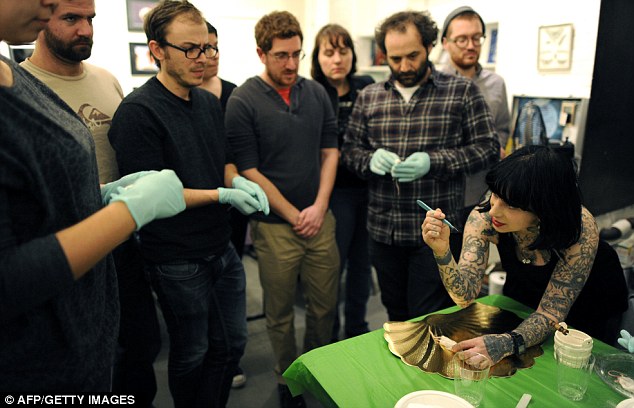
Observatory’s Anthropomorphic Taxidermy Class with Sue Jeiven in the International News!


The one-day workshop, which teaches students how to stuff dead mice and pose them up as if they were humans, is becoming a popular pastime in New York.

White-haired mice styled in tutus and polka dot hair bows; their spindly paws strumming miniature guitars - even reading the New York Times - were photographed in Ms Jeiven's class

An educator and tattoo artist, [Sue Jeiven] begins the four-hour lesson handing out the lifeless little creatures, having sucked out their blood with a syringe beforehand. A statement on the class website warns only feeder mice are used for the arts and crafts session.

But strange or morbid as it might seem to some, anthropomorphic taxidermy – the practice of mounting and displaying taxidermied animals as if they were humans or engaged in human activities – has a long and storied history, beginning with the most privileged classes.

It was a popular art form during the Victorian and Edwardian eras; the best known practitioner of the art form being British taxidermist Walter Potter, whose works included The Kitten Wedding and The Kitten Tea Party, which the mind immediately wants to imagine.

--"Is this the most bizarre art project ever? Taxidermy class teaches students how to stuff dead mice and pose them up 'as if they were humans'" Jennifer Madison, The Daily Mail

For anyone looking for that extra-authentic flavour to their fireplace display, Susan Jeiven's anthropomorphic taxidermy class might just the class you're looking for.

At the Morbid Academy, as Jeiven calls it, about 20 students learn to transform the bodies of dead white mice into human-like pantomimes. In one example, a white mouse holds a miniature classical guitar. In another, a mouse wearing a pink bow on its head reads a tiny facsimile of the New York Times.

--"Would you buy or make dead mouse art?" Canadian Broadcasting Corporation News

There are mice and men and, thanks to a macabre hobby, there are also mice that look like men.

Bent over tables in a room in an industrial corner of Brooklyn, about 20 New Yorkers use scalpels to slice into dead white mice, the first step in the animals’ unlikely journey toward an afterlife spent in human poses and dolls’ clothing.

Anthropomorphic taxidermy is an art form that became hugely popular in Britain in the 19th century, with Queen Victoria herself a fan. Now, as with many odd activities, it has found new life in Brooklyn.

“It’s a little immortality,” instructor Susan Jeiven, 40, explains at the start of her latest sold-out class.

--"Morbid Anatomy 101: Macabre hobby gives dead animals new life" Sebastian Smith, Ottawa Citizen

Congratulations to Sue Jeiven--our amazing anthropomorphic taxidermy teacher--for the recent flurry of international press surrounding her oft-sold out class excerpted above. You can read the whole Daily Mail article--from which all of the images and first excerpt above are drawn--by clicking here, the CBC News article by clicking here, and the Ottawa Citizen article by clicking here.

I am also very pleased to announce that we just added five new classes to our roster, and four of those still have vacancies. If you are interested in learning more--or better yet, signing up for one of Sue's incredible classes--click here. To find out more about the "Morbid Academy" Sue refers to (we call it The Morbid Anatomy Art Academy), click here. To watch a short video about Sue and her work, click here.

All images from the Daily Mail Article; ©AFP/Getty Images.

Source:
http://morbidanatomy.blogspot.com/feeds/posts/default?alt=rss

Development of marker-free transgenic Jatropha plants with increased levels of seed oleic acid

Background:
Jatropha curcas is recognised as a new energy crop due to the presence of high amount of oil in its seeds which can be converted into biodiesel. The quality and performance of the biodiesel depends on the chemical composition of the fatty acids present in the oil. The fatty acids profile of the oil has a direct impact on ignition quality, heat of combustion and oxidative stability. An ideal biodiesel composition should have more of monounsaturated fatty acids and less of polyunsaturated acids. Jatropha seed oil contains 30%-50% polyunsaturated fatty acids (mainly linoleic acid) which negatively impacts the oxidative stability and causes high rate of NOx emission.
Results:
FAD2 (1-acyl-2-oleoyl-sn-glycero-3-phosphocholine Delta 12-desaturase) is the key enzyme responsible for the production of linoleic acid in plants. We identified three putative delta 12 fatty acid desaturase genes (JcFAD2s) in Jatropha through genome-wide analysis and down-regulated the expression of one of these genes JcFAD2-1 in a seed-specific manner by RNA interference (RNAi) technology. The resulting JcFAD2-1 RNAi transgenic plants showed a dramatic increase of oleic acid (>78%) and a corresponding reduction in polyunsaturated fatty acids (<3%) in its seed oil. The control Jatropha had around 37% oleic acid and 41% polyunsaturated fatty acids respectively. This indicates that FAD2-1 is the major enzyme responsible for converting oleic acid to linoleic acid in Jatropha. Due to the changes of fatty acids profile, the oil of the JcFAD2-1 RNAi seed was estimated to yield a cetane number as high as 60.2 that are similar to the required cetane number for conventional premium diesel fuels (60) in Europe. The presence of high seed oleic acid did not have a negative impact on other Jatropha agronomic traits based on our preliminary data of T0 plants under greenhouse conditions. Further we developed a marker-free system to generate the transgenic Jatropha that will help reduce the public concerns for environmental issues in genetically modified plants.
Conclusion:
In this study we got seed specific JcFAD2-1 RNAi transgenic Jatropha without selectable marker. We successfully increased the proportion of oleic acid versus linoleic in Jatropha through genetic engineering enhancing its oil quality.Source:
http://www.biotechnologyforbiofuels.com/rss/

Optimization of a synthetic mixture composed of major Trichoderma reesei enzymes for the hydrolysis of steam-exploded wheat straw

Background:
An efficient hydrolysis of lignocellulosic substrates to soluble sugars for biofuel production necessitates the interplay and synergistic interaction of multiple enzymes. An optimized enzyme mixture is crucial for reduced cost of the enzymatic hydrolysis step in a bioethanol production process, and its composition will depend on the substrate and type of pretreatment used. In the present study, an experimental design was applied to determine the optimal composition of a Trichoderma reesei enzyme mixture, comprising the main cellulase and hemicellulase activities, for the hydrolysis of steam-exploded wheat straw.
Methods:
Six enzymes, CBH1 (Cel7a), CBH2 (Cel6a), EG1 (Cel7b), EG2 (Cel5a), as well as the xyloglucanase Cel74a and the xylanase XYN1 (Xyl11a) were purified from a T. reesei culture under lactose/xylose-induced conditions. Sugar release was followed in milliliter-scale hydrolysis assays for 48h and the influence of the mixture on initial conversion rates and final yields is assessed.
Results:
The developed model could show that both responses were strongly correlated. Model predictions suggest that optimal hydrolysis yields can be obtained over a wide range of CBH1 to CBH2 ratios, but necessitates a high proportion of EG1 (13-25 %) which cannot be replaced by EG2. Whereas 5 to 10 % of the latter enzyme and a xylanase content above 6 % are required for highest yields, these enzymes are predicted to be less important in the initial stage of hydrolysis.
Conclusion:
The developed model could reliably predict hydrolysis yields of enzyme mixtures in the studied domain and highlighted the importance of the respective enzyme components in both the initial and the final hydrolysis phase of steam-exploded wheat straw.Source:
http://www.biotechnologyforbiofuels.com/rss/

The impacts of deacetylation prior to dilute acid pretreatment on the bioethanol process

Background:
Dilute acid pretreatment is a promising pretreatment technology for the biochemical production of ethanol from lignocellulosic biomass. During dilute acid pretreatment, xylan depolymerizes to form soluble xylose monomers and oligomers. Because the xylan found in nature is highly acetylated, the formation of xylose monomers requires two steps: 1) cleavage of the xylosidic bonds, and 2) cleavage of covalently bonded acetyl ester groups.
Results:
In this study, we show that the latter may be the rate limiting step for xylose monomer formation. Furthermore, acetyl groups also are found to be a cause of biomass recalcitrance and hydrolyzate toxicity. While the removal of acetyl groups from native corn stover by alkaline de-esterification prior to pretreatment improves overall process yields, the exact impact is highly dependent on the corn stover variety in use. However, xylose monomer yields in pretreatment generally increases by greater than 10%. Compared to pretreated corn stover controls, the deacetylated corn stover feedstock is approximately 20% more digestible after pretreatment. Finally, by lowering hydrolyzate toxicity, xylose utilization and ethanol yields are further improved during fermentation by roughly 10% and 7%, respectively. In this study, several varieties of corn stover lots were investigated to test the robustness of the deacetylation-pretreatment-saccharification-fermentation process.
Conclusions:
Deacetylation shows significant improvement on glucose and xylose yields during pretreatment and enzymatic hydrolysis, but it also reduces hydrolyzate toxicity during fermentation, thereby improving ethanol yields and titer, and possibly MESP. The magnitude of effect is dependent on the selected corn stover variety, with several varieties achieving improvements of greater than 10% xylose yield in pretreatment, 20% glucose yield in low solids enzymatic hydrolysis, and 7% overall ethanol yield.Source:
http://www.biotechnologyforbiofuels.com/rss/

BPA may cause arrhythmia, heart attacks in women

by: Tara Green

Bisphenol A overrides the natural heartbeat signal causing female heart cells to misfire, according to a recent study. Given how pervasive BPA is these days, this could mean heart problems, possibly even fatal ones, for millions of women.

BPA is everywhere

BPA is ubiquitous in the industrial world: in clear plastic containers, in the epoxy lining of canned foods, in dental sealants, and even coating many store receipts. Studies in the past five years have shown that nearly everyone living in the industrial world encounters at least trace amounts of this compound.

Yet industries using plastics for packaging, as well as some mainstream medical experts, have long assured the public that small concentrations of BPA do not pose a serious health hazard. FDA efforts in reference to BPA have so far been limited to supporting industry self-limitation such as eliminating the compound from products specifically designed for infants and children. Read more...

Ayurtox for Body Detoxification

Source:
http://feeds.feedburner.com/integratedmedicine

UCLA researchers stop Parkinson’s progression in animal tests

Raleigh Neurology/Flickr

Flexibility testing at a Parkinson’s clinic.

A possible breakthrough has happened in the treatment of Parkinsons disease. UCLA researchers have found a way to stop the progression of the disease in animal tests.

Parkinsons is a disease that strikes the nervous system, affecting ones movements. So far, there are no treatments to stop its progression. Medical professionals aren’t even sure what actually causes it.

But researchers do believe one particular protein in the brain plays a role. Its found in clumps in all Parkinson’s patients.

Researchers at UCLA have created a compound that prevents the protein from clumping. They call it a “molecular tweezer.” In live animal tests, the compound binds to that protein, prevents it from aggregating and even breaks up existing clumps.

Most importantly, the compound did this without appearing to harm normal brain cells.

The study was done with transparent zebrafish. Now the findings are being applied to mice. Human trials, they hope, will be next.

Continue reading here:
UCLA researchers stop Parkinson's progression in animal tests

Source:
http://www.longevitymedicine.tv/feed/

Lawrence dives in for Parkinson’s

Swim coach Laurie Lawrence.

APN

OLYMPIC and world champion swim coach Laurie Lawrence will add his support to a call for the establishment of a national network of community-based nurses following the publishing of new research into Parkinson’s disease.

The findings of the Australian-first Shoalhaven Project reveal the valuable role played by community-based nurses in supporting people living with this devastating, neurodegenerative disease.

This study reveals the crucial role nurses play in significantly improving the quality of life of more than 1-in-350 (64,000) Australians affected by this disease.

One of those 64,000 is Ian Findlay, the former Australian butterfly champion and life-long friend of Lawrence. Findlay was diagnosed with young onset Parkinson’s at 40 years of age in 2004.

Lawrence is now urging the Government to fund more community-based Parkinson’s nurses in support of Findlay and other sufferers.

“I coached Ian as a young athlete and I know of no one who trained harder than he did. Once he finished his competitive career, I asked Ian to become my assistant coach. We’ve been friends for 28 years.

“He is a true champion. Ian has tremendous courage and has overcome many obstacles – physical and mental – throughout his distinguished career. Since his diagnosis, he has changed from being an outgoing, bouncy fella to someone who is more introspective and cautious.

“He works incredibly hard to fight the symptoms of Parkinson’s with assistance from his hospital-based nurse and his wife, Nicole, who has given up her career as a school teacher to care for him. Both are integral to his physical and mental wellbeing. Having access to a local, community-based nurse would further complement his support network,” said Mr Lawrence.

Original post:
Lawrence dives in for Parkinson's

Source:
http://www.longevitymedicine.tv/feed/

Parkinson’s patients to swamp homes

Australia’s nursing homes will be swamped by a tidal wave of Parkinson’s sufferers unless governments act now, an expert warns.

A Sydney-based Parkinson’s disease expert says rates are expected to jump 80 per cent over the next 20 years because of Australia’s aging population.

Currently 64,000 people have the progressive brain disease that causes uncontrollable tremors, loss of movement and bowel and bladder problems.

Associate Professor Simon Lewis from the University of Sydney is expected to present new research on the benefits of community-based Parkinson’s nurses at a nursing conference on the Gold Coast on Friday.

Professor Lewis says Australia must adopt the UK approach of employing the specialist nurses or pay the price in nursing home care costs.

‘You have to have a way of addressing this tidal wave of patients who are coming over the next 20 years,’ he told AAP.

His research indicates that access to specialist nurses in the community can stave off the need for nursing home accommodation.

He compared the health of Parkinson’s sufferers and their carers in Shoalhaven, NSW, before and six months after they were placed in the care of a specialist nurse.

‘Very clearly what we saw is that during the time they had been seeing the nurse the patient’s health had improved,’ he said.

‘More importantly, the carers themselves reported that their own health had improved.’

Here is the original post:
Parkinson's patients to swamp homes

Source:
http://www.longevitymedicine.tv/feed/

Parkinson’s disease stopped in animal model: Molecular ‘tweezers’ break up toxic aggregations of proteins

ScienceDaily (Mar. 2, 2012) Millions of people suffer from Parkinson’s disease, a disorder of the nervous system that affects movement and worsens over time. As the world’s population ages, it’s estimated that the number of people with the disease will rise sharply. Yet despite several effective therapies that treat Parkinson’s symptoms, nothing slows its progression.

While it’s not known what exactly causes the disease, evidence points to one particular culprit: a protein called -synuclein. The protein, which has been found to be common to all patients with Parkinson’s, is thought to be a pathway to the disease when it binds together in “clumps,” or aggregates, and becomes toxic, killing the brain’s neurons.

Now, scientists at UCLA have found a way to prevent these clumps from forming, prevent their toxicity and even break up existing aggregates.

UCLA professor of neurology Jeff Bronstein and UCLA associate professor of neurology Gal Bitan, along with their colleagues, report the development of a novel compound known as a “molecular tweezer,” which in a living animal model blocked -synuclein aggregates from forming, stopped the aggregates’ toxicity and, further, reversed aggregates in the brain that had already formed. And the tweezers accomplished this without interfering with normal brain function.

The research appears in the current online edition of the journal Neurotherapeutics.

There are currently more than 30 diseases with no cure that are caused by protein aggregation and the resulting toxicity to the brain or other organs, including Parkinson’s, Alzheimer’s and Type 2 diabetes. It is therefore critical, Bronstein said, to find a way to stop this aggregation process. Over the last two decades, researchers and pharmaceutical companies have attempted to develop drugs that would prevent abnormal protein aggregation, but so far, they have had little or no success.

While these aggregates are a natural target for a drug, finding a therapy that targets only the aggregates is a complicated process, Bronstein said. In Parkinson’s, for example, the protein implicated in the disorder, -synuclein, is naturally ubiquitous throughout the brain.

“Its normal function is not well understood, but it may play a role in aiding communication between neurons,” Bronstein said. “The trick, then, is to prevent the -synuclein protein aggregates and their toxicity without destroying -synuclein’s normal function, along with, of course, other healthy areas of the brain.

Molecular tweezer

Bronstein collaborated with Bitan, who had been working with a particular molecular tweezer he had developed called CLR01. Molecular tweezers are complex molecular compounds that are capable of binding to other proteins. Shaped like the letter “C,” these compounds wrap around chains of lysine, a basic amino acid that is a constituent of most proteins.

Read more:
Parkinson's disease stopped in animal model: Molecular 'tweezers' break up toxic aggregations of proteins

Source:
http://www.longevitymedicine.tv/feed/

From monkeys to medication: New research into helping people with MS

More than 400,000 Americans are living with Multiple Sclerosis, a chronic, unpredictable disease that attacks the central nervous system.

Now, new discoveries could help scientists come up with better treatments for the disease and even prevent its onset.

Whether parachuting, fishing, or enjoying the beach, Susan Dobroff has always pictured herself as an outdoors woman.

Susan Dobroff, Living with MS, explains why she enjoys the outdoors so much, “It’s like being in touch with God.”

Not even Multiple Sclerosis could dampen her active lifestyle. Two years after being diagnosed, she started law school.

Dobroff explains how she decided to go to law school, “I realized, you know, you’ve been thinking about going to law school for a long time so got to do it sooner rather than later.”

10 years after her diagnosis, Susan began to lose her ability to walk. Eventually, her legal career came to a grinding halt, too.

Dobroff explains how she struggle after awhile with her job, “Lawyers don’t need to walk and run in order to practice law but we do have to think.”

Now Japanese Macaques could hold the key to helping people like Susan. Scientists at the Oregon National Primate Center have discovered a new herpes virus in monkeys that causes an MS like disease in Macaques.

These brain lesions are a classic indicator of inflammation in people with MS. The discovery could help scientists solve how the disease develops and stop its onset.

Excerpt from:
From monkeys to medication: New research into helping people with MS

Source:
http://www.longevitymedicine.tv/feed/

Gazette.Net: National Multiple Sclerosis Society names Frederick Walk MS Ambassador

Sarah Reynolds, of Frederick, has been named Fredericks ambassador for the Walk MS fundraiser for multiple sclerosis on April 14.

Reynolds mother was diagnosed with multiple sclerosis (MS) a debilitating autoimmune disease of the central nervous system more than 20 years ago, according to a news release.

Since 1990, Reynolds has been the motivator, organizer and team captain of Frederick Walk MS Team Della. Each year she asks family and friends to raise money to support the National MS Society and encouraging more people to participate.

At the walk, she will share her story with about 700 walk participants. Walk MS in Frederick takes place at 9 a.m. on April 14 at Harry Grove Stadium, 21 Stadium Drive Frederick. To register, visit http://www.walkmsmaryland.org or call 1-800-FIGHT-MS.

Symptoms of the disease range from reduced or lost mobility to numbness and tingling to blindness and paralysis. The progress, severity and specific symptoms of MS in any one person cannot yet be predicted. Most people with MS are diagnosed between the ages of 20 and 50, with at least two to three times more women than men being diagnosed with the disease. MS affects more than 400,000 people in the U.S., and 2.1 million worldwide.

The National Multiple Sclerosis Society addresses the challenges of each person affected by MS by funding research, advocacy, professional education, collaboration with MS organizations and programs and services designed to help people with MS and their families. To learn more about multiple sclerosis and the National Multiple Sclerosis Society visit http://www.nationalMSsociety.org.

See the original post:
Gazette.Net: National Multiple Sclerosis Society names Frederick Walk MS Ambassador

Source:
http://www.longevitymedicine.tv/feed/

Parkinson’s Disease Stopped in Animal Model

Newswise Millions of people suffer from Parkinson’s disease, a disorder of the nervous system that affects movement and worsens over time. As the world’s population ages, it’s estimated that the number of people with the disease will rise sharply. Yet despite several effective therapies that treat Parkinson’s symptoms, nothing slows its progression.

While it’s not known what exactly causes the disease, evidence points to one particular culprit: a protein called -synuclein. The protein, which has been found to be common to all patients with Parkinson’s, is thought to be a pathway to the disease when it binds together in “clumps,” or aggregates, and becomes toxic, killing the brain’s neurons.

Now, scientists at UCLA have found a way to prevent these clumps from forming, prevent their toxicity and even break up existing aggregates.

UCLA professor of neurology Jeff Bronstein and UCLA associate professor of neurology Gal Bitan, along with their colleagues, report the development of a novel compound known as a “molecular tweezer,” which in a living animal model blocked -synuclein aggregates from forming, stopped the aggregates’ toxicity and, further, reversed aggregates in the brain that had already formed. And the tweezers accomplished this without interfering with normal brain function.

The research appears in the current online edition of the journal Neurotherapeutics.

There are currently more than 30 diseases with no cure that are caused by protein aggregation and the resulting toxicity to the brain or other organs, including Parkinson’s, Alzheimer’s and Type 2 diabetes. It is therefore critical, Bronstein said, to find a way to stop this aggregation process. Over the last two decades, researchers and pharmaceutical companies have attempted to develop drugs that would prevent abnormal protein aggregation, but so far, they have had little or no success.

While these aggregates are a natural target for a drug, finding a therapy that targets only the aggregates is a complicated process, Bronstein said. In Parkinson’s, for example, the protein implicated in the disorder, -synuclein, is naturally ubiquitous throughout the brain.

“Its normal function is not well understood, but it may play a role in aiding communication between neurons,” Bronstein said. “The trick, then, is to prevent the -synuclein protein aggregates and their toxicity without destroying -synuclein’s normal function, along with, of course, other healthy areas of the brain.

Molecular tweezer

Bronstein collaborated with Bitan, who had been working with a particular molecular tweezer he had developed called CLR01. Molecular tweezers are complex molecular compounds that are capable of binding to other proteins. Shaped like the letter “C,” these compounds wrap around chains of lysine, a basic amino acid that is a constituent of most proteins.

Continued here:
Parkinson's Disease Stopped in Animal Model

Source:
http://www.longevitymedicine.tv/feed/

March is Multiple Sclerosis Awareness Month

CHERRY HILL, N.J., March 2, 2012 /PRNewswire/ –The Multiple Sclerosis Association of America (MSAA) is pleased to recognize March as MS Awareness Month. During the month of March, MSAA will be highlighting various programs designed to expand knowledge, understanding, and support of individuals whose lives are affected by multiple sclerosis (MS). Such program offerings include:

(Logo: http://photos.prnewswire.com/prnh/20110615/PH20696LOGO )

The Multiple Sclerosis Association of America (MSAA) is a national, nonprofit organization dedicated to enriching the quality of life for everyone affected by multiple sclerosis. MSAA provides vital programs and services, such as: a toll-free Helpline; informative publications including a magazine, The Motivator; website featuring educational videos and research updates; S.E.A.R.C.H. program to assist the MS community with learning about different treatment choices; equipment distribution ranging from grab bars to wheelchairs; cooling accessories for heat-sensitive individuals; a mobile phone app, My MS Manager; educational events and activities; MRI funding and insurance advocacy; and more. For additional information, please visit http://www.msassociation.org or call (800) 532-7667.

The most common neurological disorder diagnosed in young adults, multiple sclerosis is an autoimmune disease of the central nervous system. This disorder damages or destroys the protective covering (known as myelin) surrounding the nerves, causing reduced communication between the brain and nerve pathways. Common symptoms include visual problems, overwhelming fatigue, difficulty with balance and coordination, and various levels of impaired mobility. MS is not contagious or fatal.

Read the original:
March is Multiple Sclerosis Awareness Month

Source:
http://www.longevitymedicine.tv/feed/

Keystone Villa at Douglassville holds Dementia seminar

Keystone Villa at Douglassville held its third of a four-part, free educational series, Caregiver Techniques in Helping with Dementia Care on Wednesday, Feb. 22. Attendees learned different caregiver techniques that would help a person with dementia complete tasks with declining physical, mental and verbal abilities. Alison Sprankle, training specialist and care manager of Good News Consulting, Inc., discussed different life skill methods that can be used to help your loved one.

Sprankle said that no matter what level of dementia, people want to maintain their independence as much as possible. She said it becomes too easy to do too much for them and then it becomes a battle of the wills. To make daily routines easier, she recommends giving options for them to decide for themselves. Sprankle said it does not matter if the outfit they choose clashes, what counts is that they feel self-sufficient.

Because of frustration and declining abilities, a person with dementia might not cooperate and become difficult when asked to do something like eat or brush his or her teeth. The Hand Under Hand technique allows them to feel like they are still doing the task themselves while being guided along.

If he or she is right handed, you sit or stand to the right, slide your hand under their hand palm up and clasp their hand as though you are about to arm wrestle. You get a little behind them and tuck your arm under their arm. In this position, you now have full use of your fingers to hold an object and move their arm up or down or in or out.

In this position, you can hold a utensil, get food and bring it up to their mouth to eat. You can accomplish things like comb their hair or brush their teeth. With this non-invasive help, they feel like they are successfully participating and will cooperate. If the person is left handed, you stand to their left side and do the same thing with your left hand.

Being stubborn and refusing to eat can become a huge challenge for the caregiver. Other methods that help with dining are simplifying utensils, cups and food presentation by using contrasting colors in table settings to help with attention span, minimizing distracting noise, playing calming instrumental music, and having one-on-one conversations.

If you notice sputtering, coughing or chewing problems while eating, contact your doctor and ask for a speech evaluation to determine if a change is needed in food texture and/or liquid consistency.

Bathing can also be difficult to accomplish as the disease progresses. A few simple techniques could defuse a situation from becoming a behavioral trigger. Dont make a person take a shower when they have been a bath taker all their life. Determine what time of day they prefer personal hygiene. Collect all of the supplies you need in advance before you begin. Let them get bathed in a loose fitting cover-up so their dignity is maintained. Warm the room and towels. Minimize noise, distractions and clutter. If they really dont like water on their body anymore, try a waterless shampoo or soap product. They can be found online or at many stores that sell camping products like Cabelas or Dicks Sporting Goods.

No matter what you are trying to accomplish as the caregiver, keep the activity positive. Start carefully and slowly, go step-by-step and provide encouraging feedback all the way.

Keystone Villa at Douglassville invites the community to attend the conclusion of this series on Wednesday, March 21, 6 to 7:30 p.m., with Successful Engagement with Those Who Have Dementia. Continued…

Go here to read the rest:
Keystone Villa at Douglassville holds Dementia seminar

Source:
http://www.longevitymedicine.tv/feed/