Source:
http://intlstemcell.blogspot.com/feeds/posts/default?alt=rss
Monthly Archives: September 2011
Video: The Promising Cells Presented by International Stem Cell Corporation
Source:
http://intlstemcell.blogspot.com/feeds/posts/default?alt=rss
New Complication from Contaminated Cocaine – Bilateral Necrosis of the Ear Lobes and Cheeks
Interesting fact: Traces of cocaine taint up to 90% of paper money in the United States. Paper money become contaminated with cocaine during drug deals and directly through drug use, such as snorting cocaine through rolled bills. Amounts of cocaine found on U.S. bills ranged from 0.006-1,240 micrograms of cocaine per banknote (50 grains of sand) (http://bit.ly/27V5Yt).
Since 2005, levamisole (commonly used as to treat worm infections in humans and animals), has increasingly been used to mix cocaine for street use.
See the dramatic photos from a similar case published in the NEJM here: Toxic Effects of Levamisole in a Cocaine User
References:
Bilateral Necrosis of Earlobes and Cheeks: Another Complication of Cocaine Contaminated With Levamisole. Ann of Int Med, June 1, 2010, vol. 152 no. 11 758-759.
Posted at Clinical Cases and Images. Stay updated and subscribe, follow us on Twitter and connect on Facebook.
Burnout and Educational Debt Affect Medical Knowledge Among IM Residents (measured by exam scores)
Doctors are not impervious to stresses of daily life. Physician distress is common and has been associated with negative effects on patient care.
This JAMA study of internal medicine residents used data collected during 2008-2009 Internal Medicine In-Training Examination (IM-ITE). Participants were 16,000 IM residents, representing 74% of all eligible US internal medicine residents - approximately 7700 US medical graduates and 8500 international medical graduates (IMGs).
Quality of life was rated “as bad as it can be” or “somewhat bad” by 15% of residents.
Burnout, emotional exhaustion and depersonalization were reported by 51%, 46%, and 29% of residents, respectively.
Burnout was less common among international medical graduates than among US medical graduates (45% vs 59%),
Greater educational debt was associated with the presence of at least 1 symptom of burnout (61% vs 44%; for debt greater than $200 000 relative to no debt).
Residents reporting QOL “as bad as it can be” and emotional exhaustion daily had exam scores 2.7 points and 4.2 points lower than those with QOL “as good as it can be” and no emotional exhaustion, respectively.
Residents reporting debt greater than $200,000 had exam scores 5 points lower than those with no debt.
Suboptimal QOL and burnout were common among IM residents. Burnout was associated with higher debt and was jess frequent among international medical graduates (IMGs).
Low QOL, emotional exhaustion, and educational debt were associated with lower IM-ITE scores.
References:
Quality of Life, Burnout, Educational Debt, and Medical Knowledge Among Internal Medicine Residents. JAMA, 2011;306(9):952-960. doi: 10.1001/jama.2011.1247
Stress overdose for doctors. Star Tribune.
Image source: OpenClipArt.org, public domain.
Posted at Clinical Cases and Images. Stay updated and subscribe, follow us on Twitter and connect on Facebook.
Biobank – BMJ video
BMJ medical innovations: When it comes to doing epidemiological studies, numbers matter. We find out about the UK's biobank - a project to collect information and samples from 500,000 volunteers, which should help scientists look for links between lifestyle and health.
Posted at Clinical Cases and Images. Stay updated and subscribe, follow us on Twitter and connect on Facebook.
Medical problems among prisoners
From a recent review in The Lancet:
More than 10 million people are incarcerated worldwide, and this number has increased by one million in the past decade.
Some of the major medical problems include:
- Mental disorders and infectious diseases are more common in prisoners
- High rates of suicide in prison
- Increased mortality on release
High risk groups among prisoners:
- women
- prisoners aged 55 years and older
- juveniles
References:
The health of prisoners. The Lancet, Volume 377, Issue 9769, Pages 956 - 965, 12 March 2011.
“A very severe physical trial”. The Lancet, Volume 377, Issue 9769, Page 876, 12 March 2011.
Posted at Clinical Cases and Images. Stay updated and subscribe, follow us on Twitter and connect on Facebook.
Should a doctor block his/her patients on Google+ or Twitter?
According to the Guardian newspaper, the current UK guidelines state that "Doctors must not "friend" their patients on Facebook."
Should a doctor block his/her patients on Google+ then? What about Twitter?
Social media platforms, their use, and the perception of the ways they are used are all changing. The ban of professional use of the most popular services is not the way forward.
Doctors are natural communicators and should do very well on social media platforms. Patients, and society in general, would only benefit from physicians who share ideas and focus on education.
The Cycle of Online Information (click to enlarge the image):
Facebook friends a no-no for doctors. Guardian.
Doctors are natural communicators - social media is extension of what they do every day
Steven Eisenberg - Create a circle of patients and share/filter as appropriate? Hmmmm... Thoughts?
Neil Mehta - In real life, what would you do if you run into a patient at a party? At a grocery store? Would BMA ask the docs to not talk with them? Turn their backs? Would that be professional? Do you ask you patients about their hobbies, interests travels? Does it help you become a more patient-centered provider?
Social Media is here to stay. Just as we have boundaries in RL we need to talk about appropriate boundaries in SoMe. The answer is probably use common sense and put the interest of the patient first. In some countries, it is routine practice to give your patient your cell phone number. So does the answer depend on your cultural and societal norms? It is a slippery slope and a number of issues need to be figured out - privacy, reimbursement, liability etc. What if the Social (professional) network exchange was behind appropriate firewalls/tunneled, what if the pts, PHR was accessible? What if we had a ACO model with no fee for service but the system was responsible for keeping their patients healthy?
Jeffrey Benabio, MD - Ves, here's the comment I put on David Lewis's post:
The difficulty is in how we define friends in this space. The doctor-patient relationship is unique and it's difficult (usually impossible) to have both a healthy friendship and healthy doctor-patient relationship without compromising both.
Patients depend on me, not as a friend, but as their physician. The expectations for a friend and a physician are different; it is difficult to have two sets of expectations for the same person.
As a physician, I'm privy to information that is personal, sometimes compromising, and often affects other people that both I and the patient knows. Patients must share things with me that they would never share with a friend. My duty as physician is only to care for her; if she and I were friends, then what she shared with me could be damaging to her in her social or personal life. I could not be both her friend and her physician.
Friends can also sometimes become romantic partners. This is verboten in a doctor-patient relationship.
The relationship between friends must be egalitarian and mutual. This is not true of doctor-patient relationships. I must advise patients what to do. I cannot tell my patients about my problems ("Boy you think that's a rash, look at this one on my leg!").
Their role as patient is to get and stay well. My role is to do everything in my ability to help them achieve that. They pay me to do this. They expect me to do this. There cannot be any reciprocity.
In fact, unlike friends, it's inappropriate for physicians to accept gifts from patients. Do patients who buy me a bottle of wine get special treatment? Do my "friend" patients have special access to me? Special privileges? It would be unfair to all my "non-friend" patients. This is where something innocuous in a friendship becomes unethical in medicine.
I examine, touch and sometimes hurt patients this is unique to medicine. Imagine that I must touch the genitals of a patient to treat him or her. This action has no place in a friendship and both the doctor-patient relationship the friendship would be compromised.
Imagine if a patient found that my political or religious beliefs were inconsonant with his beliefs. This could compromise my ability to be the best physician for him if he was unable to trust me because I was Jewish or Muslim or Catholic. This might force him to find a new physician at a time when he's sick or vulnerable and would compromise his ability to get the best care.
I have a great relationship with my patients; we are friendly and engage in enjoyable conversations about life, politics and the weather. But each of these relationships is a doctor-patient relationship that best serves the needs of the patient above all else.
The problem with social media friendships for physicians is that they're too close to real life friendships. All my online patient friends are "doctor-patient-friends" and I endeavor to keep it that way for their sake.
Steven Eisenberg - Jeffrey- SO well said. Very complex indeed.
Nancy Onyett, FNP-C - I totally agree with Jeffrey Benabio MD. The AMA and ANA for Advanced Practice has these points under the Code of Ethics for Professioal Conduct. Dr. Benabio breaks this down ito layman terms. Great post TY:)
Neil Mehta - Great discussion. Social Media (web 2.0) means a two way discussion as opposed to a static one way lecture (web 1.0). The facebook model is just one type of a social networking model which is one type of social media (medium). Seems professional bodies would not want us to "Friend" our patients and most people would agree. "Friend" is very much a FB term which has a connotation that means Friends see each others posts, photos, videos on Facebook. What do people think of doctor-patient communications using Online Social Media in the broad sense of the term?
Examples include:
A doctor posts some patient education material on YouTube that the patient sees and comments on.
What about the functionality of asymmetric circles? That prevents reciprocity.
We have seen how sending periodic SMS to pts with chronic conditions improves adherence. Is it possible to extend that model?
Nancy Onyett, FNP-C - I feel safer using my own EMR for patient correspondence through encrypted email. I am not sure if creating a circle of patients would be feasible unless it was for education and HIPPA/Privacy would not be violated --may be difficult to do.
Bader ALHablani - Great discussion...please allow me to ask a question here.Quote from the article: "Yet accepting Facebook friends presents doctors with difficult ethical issues," he said. "For example, doctors could become aware of information about their patients that has not been disclosed as part of a clinical consultation." End of quote. Suppose patient XYZ is one of my friends on Google+. And I am following Dr. ABC and vice versa. What would happen when I post an article (to my extended circles) and patient XYZ writes a comment/reply that contain an information which “could [make] Dr. ABC “aware of information about their patients that has not been disclosed as part of clinical consultation”, please? Dr. ABC would be able to see his/her comments, right please?
doc emer - I also have excellent friendship relationships with my online patient-friends in FB. I think it even helps in treatment/management. Problems may occur, as in any form of communicating, but are rare and isolated. A good doctor is friends with his patients, be it online or otherwise.
Michael Zelman - Psychologists have explicit rules about avoiding multiple relationships, being "friends" with patients falls under that category. The intent is to protect the patient and therapeutic relationship between client and professional. There are obvious parallels between physician and patient. This is not to say that every aspect of a social media relationship would be negative, but virtual friending can blur boundaries, change expectations, violate confidentiality, and lead to expectations of more out of the relationship than is healthy or allowed. It may be possible to navigate social media relationships while avoiding multiple relationships with a practitioner as a business; i.e., group practice, hospital, community clinic where patients and community members follow the entity (not individual), but in a 1-way, asymmetric manner as proposed above. Even with that much care is needed to protect patient rights under various Federal and State privacy laws.
http://www.apa.org/ethics/code/index.aspx
"3.05 Multiple Relationships
(a) A multiple relationship occurs when a psychologist is in a professional role with a person and (1) at the same time is in another role with the same person, (2) at the same time is in a relationship with a person closely associated with or related to the person with whom the psychologist has the professional relationship, or (3) promises to enter into another relationship in the future with the person or a person closely associated with or related to the person.
A psychologist refrains from entering into a multiple relationship if the multiple relationship could reasonably be expected to impair the psychologist's objectivity, competence, or effectiveness in performing his or her functions as a psychologist, or otherwise risks exploitation or harm to the person with whom the professional relationship exists.
Multiple relationships that would not reasonably be expected to cause impairment or risk exploitation or harm are not unethical.
(b) If a psychologist finds that, due to unforeseen factors, a potentially harmful multiple relationship has arisen, the psychologist takes reasonable steps to resolve it with due regard for the best interests of the affected person and maximal compliance with the Ethics Code.
(c) When psychologists are required by law, institutional policy, or extraordinary circumstances to serve in more than one role in judicial or administrative proceedings, at the outset they clarify role expectations and the extent of confidentiality and thereafter as changes occur. (See also Standards 3.04, Avoiding Harm, and 3.07, Third-Party Requests for Services.)

Posted at Clinical Cases and Images. Stay updated and subscribe, follow us on Twitter and connect on Facebook.
3,000 Pills Later – A Nutraceutical Experiment – TIME Video
The TIME magazine writer John Cloud took over 3,000 vitamins and supplements in a span of 5 months to see how his health would change. He was taking 28 pills a day. The results may surprise you.
He gained weight. His HDL increased but nobody was sure why. His vitamin D level increased but the follow-up level was done in June when he was spending more time in the sun anyway. That was all.
References:
Nutrition In a Pill. TIME.
Posted at Clinical Cases and Images. Stay updated and subscribe, follow us on Twitter and connect on Facebook.
Turn On Some Nipples
Designer Naama Arbel created these felt light sculptures that are turned on when you pull on the silicon “nipple,” or as the designer says, they “awaken by touch.”
If you read through the comments on the original post on Dezeen, these nipple lights have drawn a lot of mixed reactions from people, mostly negative. My question to you is, would you have a different perception of the concept if a woman had designed these nipple lights?
[Spotted by Ryan Jones via Dezeen]
Jennifer Griggs
Artist Jennifer Griggs told me she loves anatomy but realized too late in life that she should have been a medical illustrator. I’ve had a lot of people tell me the same thing over the years, and I say, it’s never too late! Jennifer creates these gorgeous pieces in between a busy life and working at a hospital at night. I look forward to seeing more of Jennifer’s work in the future.
Organ Donor Designer Toys Back in Stock
Organ Donor vinyl toys by David Foox are back in stock! These little guy are becoming quite rare so grab a few while you can. $15 each at the Street Anatomy store.

David created these vinyls in order to promote organ donation. All ORGAN DONORS come individually boxed in a blind box concept—meaning, it is a surprise as to which ORGAN DONOR you will receive!
Some are more rare than others (Black Market Kidneys, Pickled Liver, etc) and all come wearing the vinyl hospital gown with the butt cheeks showing.
- Height: 3.25″
- $15 each at the Street Anatomy store
Skull “Hobo” Nickels


Man, I wish we had legit coins as cool as this, but it wouldn’t be as special if it were machine made this way. These gems are a sampling of skull carved “hobo” nickels, mostly stemming from the 1930s depression era.
The sudden scarcity of jobs in the early 1930s forced a huge number of men to hit the road. Certainly some coins were carved to fill the idle hours. More importantly, a ‘knight of the road,’ with no regular source of income, could take one of these plentiful coins and turn it into a folk art piece, which could in turn be sold or traded for small favors such as a meal or shelter for a night.
Coin carvers would cover buffalo nickels with all kinda of folk art, faces, scenes, and skulls and have become a collectors items these days and more can be read about these rad coins here. Also, check out some more skull coins here.
[via thisiscolossal]
Anatomy in Korea with Dr. Oh


A few days ago, I met with the very lovely and generous anatomist Dr. Chang-Seok Oh, referred to me by my friend Ross MacFarlane. I had been interested in viewing medical or old natural history collections here in Seoul, and Dr. Oh had kindly offered to take me to see an anatomical collection of a Catholic university hospital where he had a contact. The collection had a number of interesting pieces, the most outstanding being a 17th Century mummy unearthed at an archeological excavation; there were also a number of forensic reconstructions. Images of the collection can be seen above.
Dr. Oh then took me back to his office, where we gushed about our shared interest in post-Vesalius/pre-Gray's Anatomy anatomical history, and where he shared with me his beautiful original copy of the 18th century Ontleedkundige Tafelen. This book, Dr. Oh explained to me, is of the greatest importance to Asian medicine, as it was the first Western medical book translated for Eastern consumption, published in Japan (with some additions from other texts) as Kaitai Shinsho in 1774. The book then made the rounds in Asia, changing the face of Eastern medicine forever. We did a side by side comparison of the original book and a facsimile of the 18th century Japanese Kaitai Shinsho; you can see those side by side comparisons above. I really liked the visual translation that occurs as the images move from the West to the East.
Click on images to see much larger, more detailed versions. Its worth it! And thanks to Ross MacFarlane and Deborah Leem for making this happen!
Source:
http://morbidanatomy.blogspot.com/feeds/posts/default?alt=rss
Prints and the Pursuit of Knowledge in Early Modern Europe, Exhibition, Through December 10th


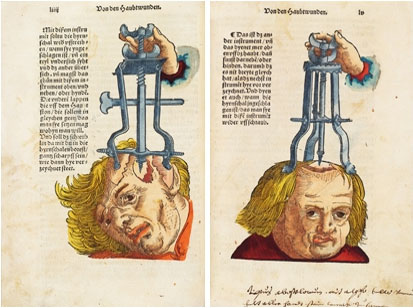
I have just been alerted to a pretty great looking exhibition on through December 10th at the Arthur M. Sackler Museum at Harvard. Entitled "Prints and the Pursuit of Knowledge in Early Modern Europe," the exhibition features not only prints but also flap anatomies (!!!), books, maps, and scientific instruments, all intended to explore "the role of celebrated artists in the scientific inquiries of the 16th century."
Full information follows, from the exhibition website:
Prints and the Pursuit of Knowledge in Early Modern Europe
Sep 6 2011 — Dec 10 2011
Arthur M. Sackler MuseumPrints and the Pursuit of Knowledge examines how celebrated Northern Renaissance artists contributed to the scientific investigations of the 16th century. The exhibition and its accompanying catalogue challenge the perception of artists as illustrators in the service of scientists. Artists’ printed images served as both instruments for research and agents in the dissemination of knowledge. The exhibition, displaying prints, books, maps, and such instruments as sundials, globes, astrolabes, and armillary spheres, looks at relationships between their producers and their production, as well as among the objects themselves. The story of 16th-century technology is enhanced by technology of the 21st, with interactive computers in the galleries, an interactive module on the website, and an iPhone/iPad application in iTunes (check back here soon for an update on availability).
Curated by Susan Dackerman, Carl A. Weyerhaeuser Curator of Prints, Division of European and American Art, Harvard Art Museums. Organized in collaboration with the Mary and Leigh Block Museum of Art, Northwestern University, Evanston, IL.
Opening Panel Discussion and Reception: September 6, 2011, 5–8pm.
Symposium: December 2, 2011, 5–8pm (evening program), and December 3, 2011, 8:30am–6:30pm (day program).For more special programming related to the exhibition, such as tours, talks, concerts, and Family Days, see the Prints and the Pursuit of Knowledge section of our calendar.
Admission note: During Prints and the Pursuit of Knowledge, admission to the Sackler Museum galleries will be free on Tuesday, Wednesday, and Thursday, 3–5pm.
Travel dates:
– September 6–December 10, 2011
Harvard Art Museums
Arthur M. Sackler Museum, Cambridge, MA
– January 17–April 8, 2012
Mary and Leigh Block Museum of Art
Northwestern University, Evanston, ILThe exhibition and its accompanying catalogue are made possible by funding from the National Endowment for the Humanities, Mrs. Arthur K. Solomon, Lionel and Vivian Spiro, Walter and Virgilia Klein, Julian and Hope Edison, Novartis on behalf of Dr. Steven E. Hyman, the Samuel H. Kress Foundation, Barbara and the late Robert Wheaton, the Goldman Sachs Foundation, and an anonymous donor. Additional support is provided by the Harvard Art Museums’ endowment funds: the Alexander S., Robert L., and Bruce A. Beal Exhibition Fund; Anthony and Celeste Meier Exhibitions Fund; Charlotte F. and Irving W. Rabb Exhibition Fund; and Melvin R. Seiden and Janine Luke Fund for Publications and Exhibitions.
You can find out more by clicking here; you can find out about--an order a copy of!--the catalog by clicking here.
Thanks to Daniel Margocsy, who helped put it together, for passing this along!
Images all drawn the exhibition page; full info including captions can be found by clicking here.
Source:
http://morbidanatomy.blogspot.com/feeds/posts/default?alt=rss
Comparative performance of precommercial cellulases hydrolyzing pretreated corn stover
Background:
Cellulases and related hydrolytic enzymes represent a key cost factor for biochemical conversion of cellulosic biomass feedstocks to sugars for biofuels and chemicals production. The United States Department of Energy (DOE) is cost-sharing projects to decrease the cost of enzymes for biomass saccharification. The performance of benchmark cellulase preparations produced by Danisco, DSM, Novozymes and Verenium to convert pretreated corn stover (PCS) cellulose to glucose was evaluated under common experimental conditions and is reported here in a non-attributed manner.
Results:
Two hydrolysis modes were examined, enzymatic hydrolysis (EH) of PCS whole slurry or washed PCS solids at pH 5 and 50degreesC, and simultaneous saccharification and fermentation (SSF) of washed PCS solids at pH 5 and 38degreesC. Enzymes were dosed on a total protein mass basis, with protein quantified using both the bicinchoninic acid (BCA) assay and the Bradford assay. Substantial differences were observed in absolute cellulose to glucose conversion performance levels under the conditions tested. Higher cellulose conversion yields were obtained using washed solids compared to whole slurry, and estimated enzyme protein dosages required to achieve a particular cellulose conversion to glucose yield were extremely dependent on the protein assay used. All four enzyme systems achieved glucose yields of 90% of theoretical or higher in SSF mode. Glucose yields were reduced in EH mode, with all enzymes achieving glucose yields of at least 85% of theoretical on washed PCS solids and 75% in PCS whole slurry. One of the enzyme systems ("Enzyme B") exhibited the best overall performance. However in attaining high conversion yields at lower total enzyme protein loadings, the relative and rank ordered performance of the enzyme systems varied significantly depending upon which hydrolysis mode and protein assay were used as bases for comparison.
Conclusions:
This study provides extensive information about the performance of four pre-commercial cellulase preparations. Though test conditions were not necessarily optimal for some of the enzymes, all were able to effectively saccharify PCS cellulose. Large differences in estimated enzyme dosage requirements depending on the assay used to measure protein concentration highlight the need for better consensus methods to quantify enzyme protein.Source:
http://www.biotechnologyforbiofuels.com/rss/
Impact of pretreatment and downstream processing technologies on economics and energy use in cellulosic ethanol production
Background:
While advantages of biofuel have been widely reported, studies also highlight the challenges in large scale production of biofuel. Cost of ethanol and process energy use in cellulosic ethanol plants are dependent on technologies used for conversion of feedstock. Process modeling can aid in identifying techno-economic bottlenecks in a production process. A comprehensive techno-economic analysis was performed for conversion of cellulosic feedstock to ethanol using some of the common pretreatment technologies: dilute acid, dilute alkali, hot water and steam explosion. Detailed process models incorporating feedstock handling, pretreatment, simultaneous saccharification and co-fermentation, ethanol recovery and downstream processing were developed using SuperPro Designer. Tall Fescue (Festuca arundinacea Schreb) was used as a model feedstock.
Results:
Projected ethanol yields were 252.62, 255.80, 255.27 and 230.23 L/ dry metric ton biomass for conversion process using dilute acid, dilute alkali, hot water and steam explosion pretreatment technologies respectively. Price of feedstock and cellulose enzymes were assumed as $50/metric ton and 0.517/kg broth (10% protein in broth, 600 FPU/g protein) respectively. Capital cost of ethanol plants processing 250,000 metric tons of feedstock/year was $1.92, $1.73, $1.72 and $1.70/L ethanol for process using dilute acid, dilute alkali, hot water and steam explosion pretreatment respectively. Ethanol production cost of $0.83, $0.88, $0.81 and $0.85/L ethanol was estimated for production process using dilute acid, dilute alkali, hot water and steam explosion pretreatment respectively. Water use in the production process using dilute acid, dilute alkali, hot water and steam explosion pretreatment was estimated 5.96, 6.07, 5.84 and 4.36 kg/L ethanol respectively.
Conclusions:
Ethanol price and energy use were highly dependent on process conditions used in the ethanol production plant. Potential for significant ethanol cost reductions exist in increasing pentose fermentation efficiency and reducing biomass and enzyme costs. The results demonstrated the importance of addressing the tradeoffs in capital costs, pretreatment and downstream processing technologies.KeywordsGrass straw, cellulosic ethanol, pretreatment, process model, process economics.Source:
http://www.biotechnologyforbiofuels.com/rss/
Pinellas County Beaches Offer Recycling Opportunities to Beachgoers
Next time you visit the beach in Pinellas County, Florida, you might notice the trash cans out on the beach now have a recycling option for plastic and aluminum. (Glass containers are not allowed on the beach). This recycling effort started in July 2011. According to the St. Pete Times: Pinellas County announced…that beachgoers should [...]
Does Your Beach Hotel Blog Suck? Here Are Two That Don’t!
Does your beach hotel’s blog sound like this: Blah blah hotel resort is an internationally recognized destination on Florida’s award-winning white sand beaches overlooking crystal clear waters blah blah blah and our Zagat rated 5-star Emmy Nobel prize winning blah blah blah caters to your every desire blah blah blah…spa…blah…restaurant…blah…service…blah…conventions…blah…weddings…blah blah blah…zzzzzzzzzzzz… If it does, [...]
The Reality of Florida Beach Camping
When I was a teenager, my plan was to pack my gear and head for the South Sea Islands, build a hut on the beach and live on coconuts, bananas, mangoes and fish. I was not the first person to ever have that plan, and a little research on my part revealed that it would [...]
Double celebration
Bobby with granddaughter Grace