UARS update 2: new predicted re-entry at 00:58 UTC | Bad Astronomy

The Center for Orbital and Reentry Debris Studies has updated their predicted re-entry time for NASA’s UARS satellite. It is now three hours later than before: 9/24 at 00:58 UTC, which puts it in the middle of the south Pacific:

Mind you, the uncertainty on this is still +/- 7 hours, so we’re a long way from knowing just where it will come down.

For more details, please read this earlier post (and you might as well read this one as well for the background info).


The Australian Aborigines may not be just descendants of first settlers | Gene Expression

Just realized. The Science paper has some interesting dates which allows us to make the above inference.

- Separation between Europeans and East Asians 25-38 thousand years before present.

- Gene flow between proto-East Asians and proto-Australians before the Native Americans diverged from the former 15 thousand years before the present.

- A conservative first landing in Australia 40-45 thousand years before the present.

The Native American result, where they share some derived variants unique to East Eurasians (mutations which emerged after the separation from West Eurasians) with Aborigines, pegs a minimum date of admixture ~15,000 years ago. But, obviously the admixture had to occur after the divergence of West and East Eurasians. Let’s say ~30,000 years ago. Even assuming that the gene flow between East Eurasians and proto-Australians occurred immediately after the separation 38,000 ago, there were anatomically modern humans in Australia for thousands of years already! The implication is that the first Australians by necessity can not have contributed in totality the ancestry of modern Aborigines. The AJHG paper gives a 50:50 estimate for the ratio of proto-Australian and the Andaman Islander/Malaysian-Negrito related population. We don’t need to be certain of the exact value to assume that numbers like this imply considerable admixture above trace levels.

Of all the dates I’m probably most confident about the archaeological ones about the settlement of Australia by anatomically modern humans. 46,000 years ago the megafauna started going extinct. That’s an immediate tell that humans have been let into the garden.

Faster-than-light travel discovered? Slow down, folks | Bad Astronomy

So the web is buzzing right now over news that scientists have detected some subatomic particles moving faster than the speed of light.

Yeah, well, not so fast. Let’s think about this for a sec.

First, what happened is that they create these particles, called neutrinos, at CERN in Geneva. Neutrinos don’t interact with normal matter well, so they can pass right through the Earth as if it isn’t there. In a fraction of a second, some of them enter a detector called OPERA in Italy where they are recorded (pictured here). If you divide the distance between those two points by the time it takes for the neutrinos to travel, you get their speed.

And when the scientists did that, they find the neutrinos get to Italy about 60 nanoseconds faster than a photon would.

Photons travel at the speed of light — they are light! — so this means the neutrinos, if this is all true, traveled faster than light speed. Holy Kessel Run!

But is it true?

Now first off, if it were this would overturn so much physics that they may as well have discovered that gravity pushes, not pulls. So right away we need to treat this claim with lots and lots of skepticism. I’ll note these are actual particle physicists making this claim, and not some crackpots who will shake their fists at the sky and say how Galileo was laughed at too.

The thing to do is to look at where this claim might have gone awry. First, the timing is interesting. They claim a measuring accuracy of 10 nanoseconds, so 60 ns would be pretty significant. However, my first thought is that light travels about 30 centimeters in 1 ns, so they need to know the distance between the source and the detector to an accuracy of 3 meters. If they are off by 20 meters, then we’re done; that would explain the difference entirely. I suppose this depends on how they measured the distance and the speed of the particles, too. However, they haven’t published a paper on this just yet, so that’ll have to wait.

[UPDATE: The paper is now up on the arxiv preprint server. I took a look, and must say at first glance their reasoning looks solid. They appear to have the baseline distance nailed and the timing as well. However, the devil's in the details, and this isn't my field, so I'll be very curious to see how the pros in this discipline react to the paper.]

Also, as pointed out in a Science Magazine article, knowing the exact moment the neutrinos are created isn’t easy either. Mind you, 60 nanoseconds is 0.00000006 seconds, so they need a pretty good clock here. That page also says they used GPS to determine the distance, which could be off a bit.

There’s another point that actually is quite important here. If neutrinos travel faster than light, then we should’ve detected the neutrinos from Supernova 1987A before we saw the explosion itself. That exploding star was formed when the core of a massive star collapsed, detonating the outer layers. The collapsing core blasted out a furious wave of neutrinos strong enough to be seen here on Earth, over 160,000 light years away.

The distance from the detector in Italy to the source in Geneva is about 730 km. The travel time at the speed of light is about 2.43 milliseconds, and the neutrinos appear to have outraced that speed by 60 nanoseconds. If true, that means they were traveling just a scosh faster than light, by about 1 part in 40,000. The neutrinos from SN1987A traveled so far that had they been moving that much faster than light, they would’ve arrived here almost four years before the light did. However, we saw the light from the supernova at roughly the same time as the neutrinos (actually the light did get here later, but it takes a little while for the explosion to eat its way out of the star’s core to its surface, and that delay completely accounts for the lag seen).

But I wouldn’t use that argument too strongly; perhaps this experiment creates neutrinos in a different way, or the neutrinos from this new experiment have different energies than ones created in the cores of supernovae (a good bet). Still, it’s enough to make me even more skeptical of this FTL claim.

I’ll note that the scientists will be presenting these results tomorrow at a conference at CERN. We’ll learn more then. It’s not clear to me if these results are being published, or have been peer-reviewed, or what. As usual, we’ll need to have other scientists either confirm this result using other equipment, or show where things went wrong. That’s how science works. And the scientists involved are asking for criticism here! That’s just so; incredible results need to be tested incredibly well.

So don’t let your imagination run away with this just yet. This result will, in my opinion, probably turn out to be incorrect for some reasons dealing with measurement. Faster than light travel is still a dream, even though I wouldn’t say it’s impossible… just very, very, very, very unlikely.

Maybe someday we’ll boldly go. But for now, I’m not betting my dilithium on it.

Image credit: OPERA; NASA/ESA/Hubble


Out of Africa onward to Wallacea | Gene Expression


There are two interesting and related papers out today which I want to review really quickly, in particular in relation to the results (as opposed to the guts of the methods). Taken together they do change our perception of how the world was settled by anatomically modern humans, and if the findings are found to be valid via replication (I think this is likely, in at least some parts) I was clearly wrong and misled others in assertions I made earlier on this weblog (more on that later). The first paper is somewhat easier to parse because it is in some ways a follow up on the paper from 2010 which documented admixture into Near Oceanian (Melanesian + Australian Aboriginal) populations from a distant hominin lineage, the Denisovans.

In this paper in The American Journal of Human Genetics they extend their geographic coverage. Denisova Admixture and the First Modern Human Dispersals into Southeast Asia and Oceania:

It has recently been shown that ancestors of New Guineans and Bougainville Islanders have inherited a proportion of their ancestry from Denisovans, an archaic hominin group from Siberia. However, only a sparse sampling of populations from Southeast Asia and Oceania were analyzed. Here, we quantify Denisova admixture in 33 additional populations from Asia and Oceania. Aboriginal Australians, Near Oceanians, Polynesians, Fijians, east Indonesians, and Mamanwa (a “Negrito” group from the Philippines) have all inherited genetic material from Denisovans, but mainland East Asians, western Indonesians, Jehai (a Negrito group from Malaysia), and Onge (a Negrito group from the Andaman Islands) have not. These results indicate that Denisova gene flow occurred into the common ancestors of New Guineans, Australians, and Mamanwa but not into the ancestors of the Jehai and Onge and suggest that relatives of present-day East Asians were not in Southeast Asia when the Denisova gene flow occurred. Our finding that descendants of the earliest inhabitants of Southeast Asia do not all harbor Denisova admixture is inconsistent with a history in which the Denisova interbreeding occurred in mainland Asia and then spread over Southeast Asia, leading to all its earliest modern human inhabitants. Instead, the data can be most parsimoniously explained if the Denisova gene flow occurred in Southeast Asia itself. Thus, archaic Denisovans must have lived over an extraordinarily broad geographic and ecological range, from Siberia to tropical Asia.


In some ways the result is not too surprising. There’s a rather clear cline of declining Melanesian admixture as one moves west across the Indonesian archipelago. Intriguingly the Denisovan admixture seems restricted on the western boundary to Wallacea, though the story is made more complex by the existence of the Philippines. The latter archipelago was connected to Sundaland during the last Ice Age, not Sahul, or isolated such as the isles of Wallacea.

The more complex aspect of the paper is that Denisovan admixture is not just a function of admixture with Near Oceanians. Obviously the proportion for Polynesians is elegantly explained by this model, because there is a well known cline of admixture amongst various Polynesian groups with Melanesian populations. And as I noted earlier there is also a Melanesian cline in Indonesia. But the story is not neat for the Philippines due to geography and other genetic results.

A simple model would be that Philippine Negrito admixture with the Denisovans is also a function of admixture with Near Oceanians. An event which we have no record of or reason to suspect, but may have occurred. But they did not find evidence for this. To the left is a figure which shows some of the phylogenetic relationships which they report from their analysis of SNP data. First, you see the admixture of Neandertals with all non-Africans. Second, you see the admixture of Denisovans with the very distant common ancestors of the Philippine Negritos and Near Oceanians. Next, you see an admixture of what I term “Western Negritos” (Andaman Islanders + Malaysian Negritos) with the ancestral Near Oceanian population, but not with the Philippine Negritos. Then you see admixture of an East Asian element, probably Austronesian, with various Negrito groups. The distinction between Philippine and Malaysian Negritos from each other is not that surprising if you look at PanAsian Consortium SNP data. It is a nice result though that the Andaman Islanders seem to be related to the Malaysian Negritos. The geography of the Ice Age implies the origin of this group on western mainland Southeast Asia, in close proximity to the domains of the Negritos of southern Thailand and peninsular Malaysia.

Probably the most tantalizing element to me is that the ancestry and genesis of what we term Near Oceanians may be a more complex affair than we had previous thought. This brings me to the next paper, An Aboriginal Australian Genome Reveals Separate Human Dispersals into Asia:

We present an Aboriginal Australian genomic sequence obtained from a 100-year-old lock of hair donated by an Aboriginal man from southern Western Australia in the early 20th century. We detect no evidence of European admixture and estimate contamination levels to be below 0.5%. We show that Aboriginal Australians are descendants of an early human dispersal into eastern Asia, possibly 62,000 to 75,000 years ago. This dispersal is separate from the one that gave rise to modern Asians 25,000 to 38,000 years ago. We also find evidence of gene flow between populations of the two dispersal waves prior to the divergence of Native Americans from modern Asian ancestors. Our findings support the hypothesis that present-day Aboriginal Australians descend from the earliest humans to occupy Australia, likely representing one of the oldest continuous populations outside Africa.

This figure distills the model down to its essence:

The main technical issue which is straightforward when comparing the previous paper to this one is that here they sequenced a whole genome of an Australian Aboriginal man who lived 100 years ago. So while the previous paper was working with tens of thousands of markers, this paper could play with millions of SNPs (though do recall that the previous paper had a much wider set of populations covered, which isn’t trivial). The top line finding seems to be that Europeans and East Asians are closer to each other than either is to the Australian Aboriginal. I’ve seen this result before. But, a major issue which is resolved here with their methods is that Aboriginals are closer to East Asians than they are to Europeans! This is the major problem I’ve always had with the idea that there were “two waves” of migration Out of Africa. If this was so, why isn’t it that Australian Aboriginals exhibit equal distance from East Asians and Europeans? The answer here is simple: admixture between the two waves, but only amongst those going east.

In other words I was confused by excessive “tree” thinking, and neglected the possibility of admixture. The first paper also hints as a possible candidate source for the admixture event: the same source population of the Western Negritos! From what I can gather this population falls into the “eastern” branch Eurasian humanity. Not quite close to East Asians, but definitely closer to them than West Eurasians. Therefore the affinity of East Asians to Aborigines may be due to this broader global “East Eurasian” heritage, which was injected into the Aboriginal man’s genome at some point in the past. Interestingly the authors found no difference in admixture from Neandertals between the populations, in line with earlier results. This implies to me, though does not prove, that the Aboriginals are a basal outgroup to other non-Africans, who all underwent the same rough admixture dynamic with Neandertals as they pushed out of Africa. Instead of two waves Out of Africa, perhaps two pulses just outside of Africa?

Finally, the fact that the gene flow seems to pre-date the separation of Native Americans from East Eurasians serves as a “peg” on the populating of Australia. The authors conclude that at a minimum we’re talking 15-30,000 years before the present. The distinctiveness of Australian Aboriginal mtDNAs, as well the localization of Denisovan admixture amongst Near Oceanians, in addition to the archaeology, makes me credit this early founding event. The populations of Sahul may have avoided being swamped out by newcomers by and large since their arrival ~50,000 years ago. I will speculate that this may explain their relatively high quantum of “archaic” ancestry. It may be that in pre-agricultural Eurasia there were many groups with higher fractions of Neandertal ancestry on the margins of the wave of anatomically modern human advance, which were only later assimilated by the demographic swell of the farmers.

There’s a lot more one could say, but I’ll leave it to readers….

Update: satellite *might* fall on Friday at 22:00 UTC +/- 9 hours | Bad Astronomy

NASA’s UARS satellite will almost certainly plunge back to Earth sometime Friday, September 23. The exact time is still not known, but the window for re-entry is centered at 22:00 UTC (6:00 p.m. Eastern US time) with a 9 hour uncertainty on either side. The Center for Orbital and Reentry Debris Studies puts the satellite off the west coast of South America at that time:

However, this is still very preliminary! In other words, if you live in that area, don’t panic (in fact, odds are you shouldn’t panic at all). The uncertainty is still pretty big, because it’s very difficult to pin down just when and where a satellite will come down. The +/- 9 hour window is a pretty clear indication of that. Atmospheric conditions play a big role, as does the fact that the satellite is tumbling; that means the amount of drag from our air that it feels as it orbits changes constantly, making the exact moment of re-entry too hard to determine this far out. As time goes on, it’ll get more precise.

The map shows several things. At the currently predicted re-entry time, the satellite is just west of Peru. The orange circle around it marks the area where re-entry would be visible. The blue track is the orbital position of the satellite over the Earth before the predicted re-entry, and the yellow after it; both are marked with tick marks at 5-minute intervals. The track moves across the Earth because the Earth is rotating under the satellite! That changes the apparent ground track. The white line marks the day-night boundary, so it’ll be late afternoon locally at the predicted re-entry location.

As of 07:00 Eastern US time, NASA was reporting UARS’s orbit being slightly elliptical at 185 x 195 km (115 x 120 miles). That’s very low, as you’d expect for a satellite about to come down. NASA has provided an RSS feed for updates if you want to stay on top of this, but I’ll note the CORDS site appears to be more current. They also have a nice discussion of how and why satellites come back down.

I’ll update this post as I hear news, but if there’s a significant change in the time or status, I’ll put up a new post.


Brain Scans Suggest a New, Objective Way to Measure Pain | 80beats

What’s the News: The best way doctors have to find out how much pain a patient’s in is to ask—but that approach can fall short when someone’s unable to speak, exaggerating or downplaying their condition, or just plain unsure how to rate their pain on a 10-point scale. Because of these problems with self-reporting, scientists have long been looking for an objective, physiological measure to quantify pain. A recent brain scanning study, in which the researchers could pick out painful experiences based on neural activity, brings that goal closer.

How the Heck:

  • The researchers gave each of 24 participants an fMRI scan, which measures blood flow in the brain. They tracked the participants’ brain activity as a small portion of their forearm was exposed to heat, which was either painful (quite hot) or not painful (pleasantly warm). A computer algorithm then analyzed the data for patterns, looking for types of brain activity that occurred in response to painful or not painful heat.
  • The team next had 16 other people do the same thing, getting their brains scanned while their arms were exposed to various levels of heat. This time, the researchers used the computer algorithm—now that it was trained on data from the earlier subjects—to analyze the scans, classifying each heat exposure as painful or not based on brain activity. The computer model could correctly identify which experiences were painful 81% of the time.

Not So Fast:

  • The study was small, and only looked at a yes-no division (does it hurt or not?) rather than trying to tell more or less painful experiences apart.
  • It also used just one type of pain, heat. Larger studies aimed at discriminating different levels of pain will be required to show whether this technique could be useful in the clinic.

The Future Holds: In addition to looking at varying levels of pain, the team wants to see whether this technique can be used for different sorts of pain—for instance, pain from a wound or a pinched nerve rather than heat. They’re also investigating whether brain scans can measure not just single episodes of pain, but chronic pain, as well.

Reference: Justin E. Brown, Neil Chatterjee, Jarred Younger & Sean Mackey. “Towards a Physiology-Based Measure of Pain: Patterns of Human Brain Activity Distinguish Painful from Non-Painful Thermal Stimulation.” PLoS ONE, September 13, 2011. DOI: 10.1371/journal.pone.0024124


Two exoplanets discovered by “citizen scientists” | Bad Astronomy

Two new planets orbiting other stars have recently been discovered using NASA’s orbiting Kepler telescope. And while every new planet discovery is pretty amazing, normally two more add to the hundreds already confirmed wouldn’t really be newsworthy. However, these two weren’t discovered by professional astronomers! They were found by members of the Planet Hunters "citizen scientists" team; regular folks who have volunteered to sift through data returned by the observatory in hopes of finding far-flung worlds.

One of the planets found orbits its star with a period of just under 10 days, and the other orbits a second star in just under 50 days. Both are much more massive than Earth; the first is 2.65 times and the second over 8 times our diameter. The relatively lower mass means the first one might be rocky (as opposed to a gas giant) but the short period means it’s hot, far hotter than Earth.

Both planets transit their stars as seen from Earth. In other words, they pass directly in front of their stars from our point of view, blocking the light a wee bit. This drop can be measured, and the planet detected. By knowing how big the star is (a dwarf, a giant, whatever) the period of the planet can be found, and the size of the planet can be determined by how much light is blocked, too.

The Kepler observatory is staring at about 100,000 stars all the time to look for these mini-eclipses, and astronomers use a fleet of software to automatically tag suspicious changes in starlight. But it’s pretty hard to look through all the potential planet data, and that’s why Planet Hunters was set up: let people go through the data themselves, using their keen eyes and powerful brains to look for anything that might be a planet.

And it worked! The two planets discovered were just announced in a paper led by the Kepler team (PDF). Here’s a plot showing one of the transits:

That’s the data for KIC 10905746, the 2.65 Earth-mass planet with the 10 day orbital period. The top half shows the brightness as measured by Kepler; the star is a variable star which means it changes its own intrinsic brightness with a period of every few days. That makes this a difficult target! The red lines mark the transits spotted by the planet hunters; you can see where the brightness dips more than usual. Hard to see, aren’t they? But once you get the period of the planet, you can then "fold" the data, cutting it up into time intervals based on that period. Observations that were taken at different times — but show the planet in the same position relative to the star (for example, every time the planet is right in the middle of the transit) — can then be added together, cleaning up the noise. That’s in the bottom half, which shows all the transits stacked up (and with the star’s own changes mathematically removed). The dimming of the star’s light is much more clear — the red line is the best fit to the event. But note the scale: the planet only blocks 0.2% of the star’s light! It’s pretty amazing that we can see it at all.

Remarkably, both stars in this case were flagged as potential planet-bearers by the software, but also removed from the list to make followup observations by the same code! In the case of the star shown, it’s because the star was thought to be a giant near the end of its life, making followup observations and analysis too difficult. However, the human brain is pretty good at his sort of thing, and several people on the Planet Hunters site picked out the planetary transit.

I’ll note that the planet orbiting the binary star announced last week was also spotted by a Planet Hunter! The Kepler team had already spotted it as well, so they get the credit, but still. It doesn’t take a professional to find even the really weird planets out there.

Pretty cool, and good indicator that this citizen scientist project has a bright (or very slightly dimmed, I suppose) future ahead of it. And you can still participate! All you have to do is go to the Planet Hunters website, sign up, and get cracking. Who knows? Maybe you’ll find another world…

… and I have to wonder. An Earth-like planet orbiting a Sun-like star will have a very weak transit. A computer would have a very hard time picking that out of the data, but we humans are pattern-finding machines. Will the first exoEarth be found by a professional astronomer, or instead by some science enthusiast who decided one day to check out this Planet Hunters thing…?

Image credit: transit art: ESO/L. Calçada


Related posts:

- YOU can find extrasolar planets
- Astronomers discover a wretched hive of scum and villainy
- 50 new worlds join the exoplanet list
- Kepler finds a mini-solar system


Preliminary Results of Trial Using Gene Therapy Against HIV Show Potential | 80beats

genes

What’s the News: After a bone marrow transplant cured a Berlin man of HIV in 2008, scientists have been working to see whether similar, though less drastic, measures could be a treatment for the disease. And judging from the results of a recent clinical trial that used gene therapy to accomplish the goal, there’s potential.

What’s the Context:

  • In the original case, an HIV-positive patient was diagnosed with leukemia, and after having chemotherapy to knock down his cancer, he received multiple transplants of blood stem cells from a donor, which took up permanent residency in his body.
  • Those stem cells had a rare mutation that deactivated the CCR5 receptor, which the HIV virus uses to enter the blood cells it destroys. The end result was that the patient became the first person in the world to be cured of HIV—with that receptor out of commission, the virus couldn’t grow, and he longer has any detectible levels of HIV.

How the Heck:

  • The current trial, run by Sangamo BioSciences, takes samples of patients’ blood cells and sics an enzyme on them that snips the CCR5 gene, disabling it. The cells are then reintroduced to the patient. (We covered an earlier trial from this group on 80beats here.)
  • The goal was to see if receiving these altered cells would let patients go off their anti-retroviral drugs. The results, reported at a recent conference in Chicago, were mixed—the cells didn’t always survive long in the fifteen people enrolled. But two patients saw their HIV levels drop 10-fold, and one patient who stopped his anti-retrovirals first saw a spike in virus levels but then had them decline to undetectable levels.
  • Further examination of that patient’s cells showed that he had twice as many cells in which both copies of the CCR5 gene had been altered than the other patients. (If you need a quick refresher, we have two copies of each gene, one from each parent.) As long one copy of the intact gene is present in a cell, the virus can still get in, which might be one of the reasons the treatment did not succeed in most of the people.
  • Additionally, only about a quarter of the reintroduced cells had the disabled gene at all, something that the company will need to work on improving.

The Future Holds: Though this trial shows promise, there are still a lot of kinks to be worked out before the goal of getting people off retrovirals can be met, let alone the goal of finding a cure. The scientists will need to figure out why the cells didn’t survive in many patients’ bodies, as well investigating ways to boost the number of cells with both genes disabled.

[via ScienceNOW]


Newly Discovered Plant Bows Down and Buries Its Own Seeds | 80beats

A botanist has discovered a new species of plant in eastern Brazil whose branches bend down upon bearing fruit and deposit seeds on the ground, often burying them in a covering of soft soil or moss. This trick is an example of geocarpy, a rare adaptation to survival in harsh or short-lived environments with small favorable patches. The adaptation ensures seedlings germinate near their parents, helping them stay within the choice spots or microclimates in which they thrive. One well-known practitioner of geocarpy is the peanut, which also buries its fruit in the soil [PDF].

The tiny, inch-tall plant was first spied by the scientist’s handyman while he “hunched down behind a shrub for a common human activity,” according to the news release. He then brought the strange plant to the attention of botanist Alex Popovkin, who has found and categorized over 800 plant species to date in Bahia, Brazil. The team dubbed it Spigelia genuflexa, named after the act of genuflection, or kneeling to the ground.

Reference: Alex Popovkin, Katherine G. Mathews, José Carlos Mendes Santos, M. Carmen Molina, Lena Struwe. Spigelia genuflexa (Loganiaceae), a new geocarpic species from northeastern Bahia, Brazil. PhytoKeys, 2011; 6 (0): 47 DOI: 10.3897/phytokeys.6.1654

Image credit: Alex Popovkin


The night the lights went out in Georgia | Bad Astronomy

Shame on you, Georgia.

Shame.

We don’t know if Troy Davis was actually guilty of killing a police officer or not. But that’s the point. Seven out of nine witnesses recanted, another person apparently confessed, there is no physical evidence linking Davis to the murder, and the defense claimed there were serious procedural issues with the case. Any or all of these are enough to cast doubt on the conviction. The fact that he was executed, despite all this doubt, makes it clear this system is terribly, terribly broken.

If any good comes out of this, I hope at the very least it’s that a solid discussion of the irrevocable nature of the death penalty emerges. Even if you feel capital punishment is justified — and I would disagree with that, strongly — I hope you’d agree that even one innocent person executed constitutes a major problem. The case of Troy Davis shows in a brutal and soul-shaking way just how the legal system in Georgia at least, and the nation as a whole, is seriously screwed up.

Shame on Georgia? Shame on all of us.


A new day, from space | Bad Astronomy

Imagine sitting in a gossamer structure 100 meters long, 400 kilometers off the Earth’s surface, and hurtling through space at nearly 30,000 kilometers per hour.

Now imagine facing east while doing so, looking out the window, and seeing this:

ISS astronaut Ron Garan took this shot on Saturday morning, August 27, 2011, as the Sun rose over South America… of course, when you see the sunrise, it’s always morning, right? Not necessarily, especially when you outrace the rotating Earth and see 18 such sunrises and sunsets every day*.

Around the same time Ron took this shot, I was getting up to start my own day, and find out just what the Sun can do given a couple of hours to heat up the desert near Yuma, Arizona. Why? Well, without giving anything away, that’s a story that’ll have to wait for a few more sunrises in the future.

[Note: I'm still waiting for more news about the reinstatement of launches to the ISS now that the Soyuz flaw has been found. If there's some metaphor to be had here with the picture above, feel free to consider it.]

Image credit: NASA


* <pedant>Actually, in the winter at extreme latitudes, the Sun doesn’t rise until afternoon, and may set shortly thereafter. But that’s if you’re stuck here on the surface of the planet.</pedant>


Related posts:

- Moon over Afghanistan
- Squishy moonrise seen from space!
- What a falling star looks like… from space!
- Crescent Moonset from space


What You Eat Affects Your Genes: RNA from Rice Can Survive Digestion and Alter Gene Expression | 80beats

rice
RNAs from rice can survive digestion and make their way into mammalian tissues, where they change the expression of genes.

What’s the News: It’s no secret that having lunch messes with your biochemistry. Once that sandwich hits your stomach, genes related to digestion have been activated and are causing the production of the many molecules that help break food down. But a new study suggests that the connection between your food’s biochemistry and your own may be more intimate than we thought. Tiny RNAs usually found plants have been discovered circulating in blood, and animal studies indicate that they are directly manipulating the expression of genes.

What’s the Context:

  • MicroRNAs, or miRNAs, are molecules involved in regulation of gene expression, the transcription of genes into proteins. miRNAs bind to the messenger RNAs that ferry genetic information from DNA to the ribosomes, which translate messenger RNAs into proteins.
  • When a miRNA binds a messenger RNA, it keeps it from being translated, thus preventing that gene from being expressed.

How the Heck:

  • This team of researchers at Nanjing University had been studying the miRNAs that circulate in human blood and were surprised to find that some of the miRNAs weren’t homegrown but instead came from plants. One of the most common plant miRNAs was from rice, a staple of their Chinese subjects’ diets. Intrigued, they confirmed with a variety of tests in mice that the miRNA, which, in its native environs, usually regulates plant development, was definitely coming from food.
  • When they put the rice miRNA in cells, they found that levels of a receptor that filters out LDL, aka “bad” cholesterol, in the liver went down. As it turned out, the miRNA was binding to the receptor’s messenger RNA and preventing it from being expressed, sending receptor levels down and bad-cholesterol levels up. They saw the same effect when they tried it mice.
  • Going further, when they fed rice to mice but also gave them a molecule that would turn off the miRNA, the liver receptor bounced back and bad cholesterol levels went down.
  • The team concludes that miRNAs may be a new class of functional components in food, like vitamins or minerals—even in an animal that’s pretty far removed from their home organism, they can manipulate gene expression and have an effect on nutrition.

The Future Holds:

  • It’s only logical that what we eat has an effect on the expression of our genes, in the general sense that nutrients from food are involved in cellular processes that control and are controlled by gene expression. But this is an unusually direct route, and surprising from an organism that’s so different from mammals.
  • Since miRNAs from plants haven’t been on scientists’ radar before, this should be a field ripe for further exploration. Do corn miRNAs circulate in the blood of people in societies that eat gigantic quantities of corn, like the US? What receptors might those miRNAs control?

Reference: Zhang, et al. Exogenous plant MIR168a specifically targets mammalian LDLRAP1: evidence of cross-kingdom regulation by microRNA. Cell Research, (20 September 2011) | doi:10.1038/cr.2011.158

Image courtesy of AMagill / flickr


Resurrected Woolly Mammoth Protein Proves to Work Well in the Cold | 80beats

Scientists have often wondered how woolly mammoths survived and thrived in the frigid climes of the far north in Earth’s last ice age. The hemoglobin in elephant (and human) blood cannot easily transfer oxygen to other cells in the body at low temperatures. Instead, the blood’s hemoglobin holds onto its oxygen in icy extremities and the tissue eventually dies; that’s the main reason we get frostbite. There must, then, have been something special about mammoth hemoglobin.

Enter researcher Kevin Campbell, who published the genetic code of the mammoth hemoglobin last year after taking tissue from three animals that died in Siberia more than 25,000 years ago. Now, in a new study in the journal Biochemistry, Campbell’s team went a step further and actually recreated mammoth hemoglobin, starting with the code from the African elephant’s protein and introducing three changes unique to the mammoth using site-directed mutagenesis. They then compared the biochemical properties of the protein from the mammoth, elephant, and human, and found that the mammoth hemoglobin was less sensitive to temperature fluctuations and better able to unload oxygen at cold temperatures. Researchers say insights into the compound’s structure could lead to the design of new artificial blood products for use in hypothermia induced during brain and heart surgeries.

[Via Scientific American]

Reference: Yue Yuan, Tong-Jian Shen, Priyamvada Gupta, Nancy T. Ho, Virgil Simplaceanu, Tsuey Chyi S. Tam, Michael Hofreiter, Alan Cooper, Kevin L. Campbell, Chien Ho. A Biochemical–Biophysical Study of Hemoglobins from Woolly Mammoth, Asian Elephant, and Humans. Biochemistry, 2011; 50 (34): 7350 DOI: 10.1021/bi200777j

Image: rpongsaj / Flickr


Arctic ice at second-lowest extent since 1979 | Bad Astronomy

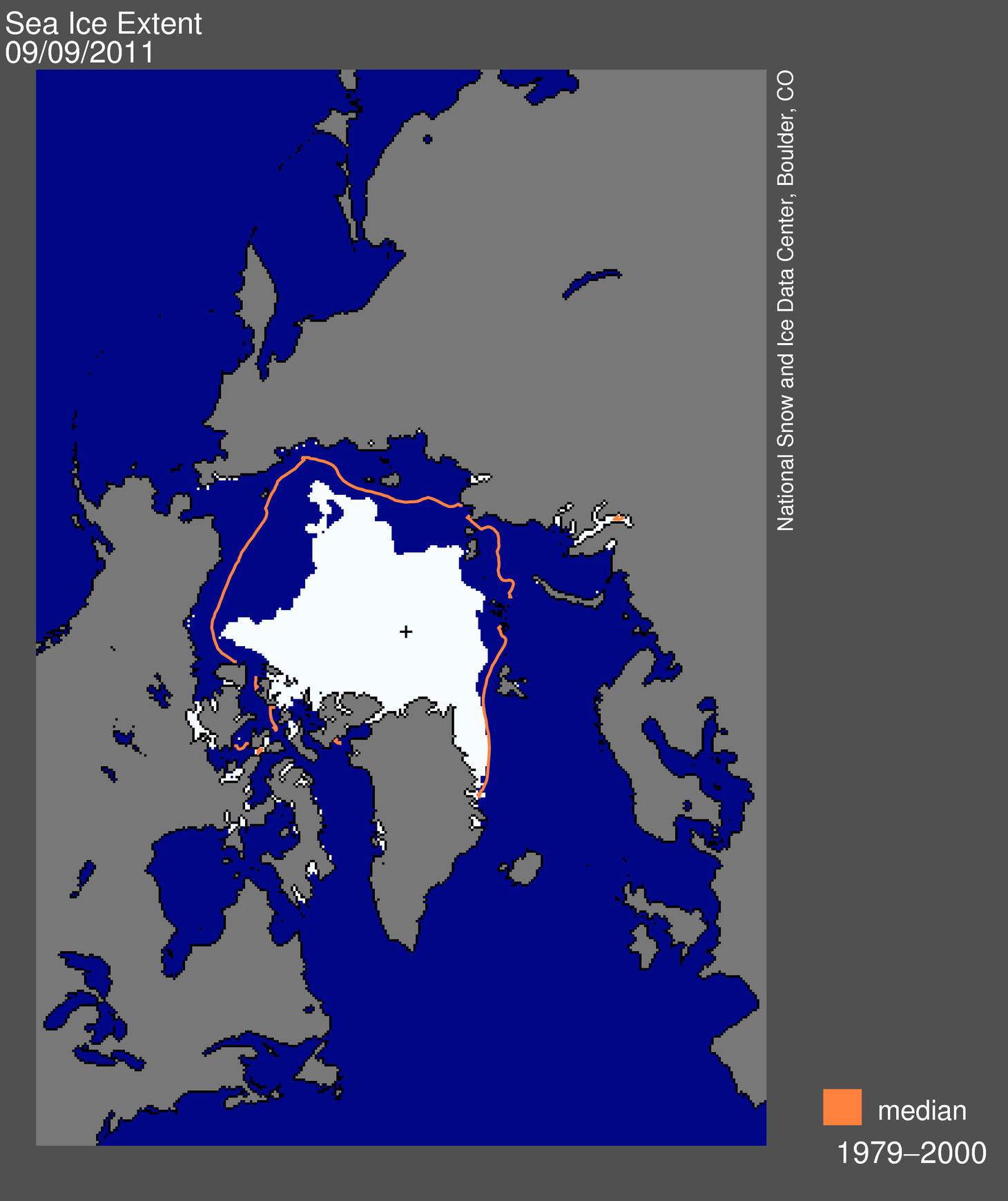
In late August, sea ice extent was way below average for that time of year, and it was predicted we were headed for at least a near-record low this year. Those predictions have, unfortunately, turned out to be true. On September 9, sea ice extent reached its yearly minimum, the second lowest since satellite records began in 1979 — and so close to the record low in 2007 that it’s a statistical tie.

NASA has posted series of pictures of sea ice this year taken by its Aqua Earth-observing satellite. Here’s the Arctic ice as it was in March (top) and September 2011 (bottom):

They put together a series of the images into an animation that really gives you a clear picture of what’s going on:

Of course, you expect more ice in the winter and less in the summer and fall, so by itself those pictures don’t tell you what this means. You need to compare the current extent with how things were in the past. As it happens, the National Snow and Ice Data Center in Boulder does just that.

This graphic by the NSIDC shows the north pole (you can see North America at the bottom, Greenland to the right, and Asia at the top) with the ice extent on September 9, 2011 marked in white. The orange line marks the median extent of the ice from 1979 to 2000 as measured on September 9 of each of those years. Putting a number on this, the current extent is nearly a million square miles less than that median value.

Yikes.

How bad is this? Well, from what I can tell, it’s not good. In 2007, the sea ice cleared enough that the Northwest Passage became navigable by ship without the help of an icebreaker for the first time in recorded history. We’re there again right now. And it’s not just extent — that is, the area covered by ice — it’s also the volume: that’s at the lowest amount on record this year as well.

As pointed out above, the lack of ice means that the northernmost latitudes are able to be plied by ships in the summer. But every year there is less ice even at maximum, meaning more and more area is accessible year-round. It’s well-known that there are deposits of oil and natural gas up there, and of course the oil companies want access to them. That’s why it’s particularly interesting that Exxon is investing billions of dollars in offshore drilling there, in places previously not accessible due to ice (full disclosure: that article was written by my nephew-in-law Chris Jones). In other words, even Exxon is putting its money where its mouth is, saying not only is global warming real, but that its effects will be around for a while.

I have no grand conclusions here, no line in the sand to draw. This is simply yet another data point in an increasingly long line of evidence showing global warming is real, along with all the evidence that it’s getting worse, we’re causing it, and the spin against it by the deniers is approaching light speed. The Related Posts links below make all that clear.

I just hope that by talking about this, more and more voters will listen. In a very real sense, what happens next is up to us.

Image and video credits: NASA’s Scientific Visualization Studio, Goddard Space Flight Center; National Snow and Ice Data Center


Related posts:

- Arctic sea level ice will be below average again this year
- Sea level rise has slowed… temporarily
- NASA talks global warming
- Our ice is disappearing
- Dramatic glacial retreat caught by NASA satellite
- Case closed: “ClimateGate” was manufactured


Cells Repairing Themselves | Cosmic Variance

Speaking of self-repair, here’s a fascinating new finding from Malin Hernebring in Sweden. Here’s the technical paper, from a few years ago; it’s part of Hernebring’s Ph.D. thesis work. (Via Richard Dawkins’s site.)

As we age, our cells gradually decay; the DNA stays relatively intact, but proteins degrade with time. This is a big part of the aging process, leading to wrinkled skin as well as more serious consequences. When you think about it a bit, that raises a puzzle. A newborn baby arises out of the cells of its parents. So if the proteins simply decay without repair, every generation would get handed down a degraded set of proteins. At some point, therefore, there has to be some repair job, so that the baby gets fully functioning proteins.

If this idea is right, you might guess that the repairs happen at the level of ovum and sperm; maybe when these cells are created, extra effort goes into tuning up their proteins into working order. But the new research says no — it’s actually after conception that the clean-up crew arrives. The newly conceived embryo consists of stem cells that soon begin differentiating themselves into the different kind of mature cells. It turns out that it’s during this differentiation process that proteasomes go to work, breaking down the damaged proteins and generally tuning up the engine. (Maybe this is when the soul is implanted in the embryo?)

The next obvious question is: why can’t these cellular clean-up crews be active all the time? There are clear implications for studies of (and therapeutic approaches to) aging. Nature wants all the individual animal organisms to die, making room for new generations; but there’s no reason we have to go along with the plan.


NASA satellite due to burn up some time in the next few days | Bad Astronomy

[UPDATE: Alan Boyle at Cosmic Log is reporting that the satellite will definitely come down on Friday, though NASA is not sure yet exactly when and where.]

[UPDATE 2: Emily Lakdawalla at The Planetary Society blog has lots of detailed info now.]

By now you’ve probably heard that NASA’s Upper Atmospheric Research Satellite (UARS, pronounced YOO-arz, though in my head it’s always "You arse!") will burn up in our atmosphere some time between Thursday and Saturday. The satellite was decommissioned in 2005 and they used the remaining fuel to lower the orbit. It’s been slowly getting lower since then, but recently reached the part of our air where it slows and drops dramatically. As you can see from this plot (click to embiggen), it’s dropped from about 375 km to 200 in just the last few months, and down it’ll come later this week.

No one knows where or when it will hit, since the final flight path will depend on changing atmospheric conditions, orientation of the satellite, and so on. Most of the 6 ton satellite will burn up, but some two dozen or so pieces are expected to survive re-entry.

Speaking of which: I’m seeing some concern over people getting hit by this thing. The odds of that are extremely low. It’s possible — NASA rates the odds at about 1 in 3200 — but highly unlikely. Mind you, those are the odds of anyone getting hit by debris. The odds of a specific person, say me, getting hit are far lower — if I’m doing this math correctly, you’d multiply that number by the population of the Earth, nearly seven billion people. So the odds of me (or you, or pick someone) specifically getting hit are about 1 in 20 trillion. Pretty long odds.

In the meantime, on September, 15th, "amateur" astronomer Thierry Legault was able to capture video of the satellite while it passed over his location:

Cool, eh? You can see the rotation; it’s tumbling, apparently. Out of power, it can’t keep the correct attitude, and over time something has caused it to spin. Maybe it was a collision, or maybe it’s from other subtle but persistent forces over the years (solar wind, light pressure, drag through our tenuous upper atmosphere, slow fuel leak, what have you). Here are some stills from Thierry’s video to make that more clear:

Pretty cool. So stay tuned. I’ll update with more info when I get it; we’ll know the re-entry time and location much better as the week progresses. I’ll be tweeting about it as well as soon as I find anything out.

Credits: Orbit plot: Jonathan McDowell; UARS images: Thierry LeGault.


Related posts:

- YouTube video where I explain a satellite re-entry
- BREAKING: SpySat successfully hit by missile
- The return of Stardust
- Spy sat to come home… not too secretly


God is intuitive | Gene Expression

Update: An ungated version of the paper.

I used to spend a lot more time talking about cognitive science of religion on this weblog. It was an interest of mine, but I’ve come to a general resolution of what I think on this topic, and so I don’t spend much time discussing it. But in the comments below there was a lot of fast & furious accusation, often out of ignorance. I personally find that a little strange. I’ve been involved in freethought organizations in the past, and so have some acquaintance with “professional atheists.” Additionally, I’ve also been a participant and observer of the internet freethought websites since the mid-1990s (yes, I remember when alt.atheism was relevant!). In other words, I know of whom I speak (and I am not completely unsympathetic to their role in the broader ecology of ideas).

But the bigger issue is a cognitive model of how religiosity emerges. Luckily for me a paper came out which speaks to many of the points which I alluded to, Divine intuition: Cognitive style influences belief in God:

Some have argued that belief in God is intuitive, a natural (by-)product of the human mind given its cognitive structure and social context. If this is true, the extent to which one believes in God may be influenced by one’s more general tendency to rely on intuition versus reflection. Three studies support this hypothesis, linking intuitive cognitive style to belief in God. Study 1 showed that individual differences in cognitive style predict belief in God. Participants completed the Cognitive Reflection Test (CRT; Frederick, 2005), which employs math problems that, although easily solvable, have intuitively compelling incorrect answers. Participants who gave more intuitive answers on the CRT reported stronger belief in God. This effect was not mediated by education level, income, political orientation, or other demographic variables. Study 2 showed that the correlation between CRT scores and belief in God also holds when cognitive ability (IQ) and aspects of personality were controlled. Moreover, both studies demonstrated that intuitive CRT responses predicted the degree to which individuals reported having strengthened their belief in God since childhood, but not their familial religiosity during childhood, suggesting a causal relationship between cognitive style and change in belief over time. Study 3 revealed such a causal relationship over the short term: Experimentally inducing a mindset that favors intuition over reflection increases self-reported belief in God.

Recall that in many social domains where neurotypicals rely on innate, intuitive, and “fast” cognition, high functioning autistic individuals must reflect and reason. I don’t have access to the original paper, but there’s a nice piece in Harvard Gazette on the research. Here’s the last sentence: ““How people think about tricky math problems is reflected in their thinking — and ultimately their convictions — about the metaphysical order of the universe,” Shenhav said.”

Indiscriminate squid just implanting everyone with sperm | Not Exactly Rocket Science


In the dark abyss of the ocean, animals cannot afford to be choosy. The odds of bumping into another individual are low, and appropriate willing mates are even harder to come by. To deal with this problem, the deep-sea squid Octopoteuthis deletron has become somewhat indiscriminate. The males will mate with any squid they come across, whether they’re male or female.

Hendrik  Hoving from the Montery Bay Aquarium Research Institute found evidence of these same-sex matings with a robot submarine. Controlled from a surface ship, these vehicles can explore depths that humans cannot. The subs have captured videos of O.deletron since 1992 (videos here), but the team have only just revealed the nature of the squid’s sex life by studying the archival footage.

O.deletron is a handsome red squid, around five inches long, with hook-lined arms and flashing patches on its flanks and arm tips. Most squid and octopuses deliver their sperm along one of their arms – a modified limb called a hectocotylus. O.deletron is unusual in having a separate penis, distinct from its arms. It uses this long organ to dab a female’s body, attaching a pouch called a spermatophore, which contains millions of sperm. The pouch discharges sacs called spermatangia, which implant themselves in the female’s body. The sacs are visible from the outside, marking out recently mated individuals for observant scientists to see.

Hoving found these sacs on the bodies of both male and female squid in equal proportions. Both sexes had been implanted with sperm.

This is just one of thousands of examples of homosexual behaviour in animals, and there have already been a few reports among cephalopods – the group that includes octopuses, squids and cuttlefish. The famous giant squid might even partake in gay sex from time to time. Of the twelve mature males that have been found, seven had spermatangia implanted on their arms.

However, Hoving notes that some of these squid were caught in nets, and in their distress, they may have mistakenly implanted themselves with their own sperm. He also says, “Accidental self-implantation during mating with a female is also a possibility.” But that’s not the case for O.deletron. Hoving noticed sperm sacs on parts of the males’ bodies that lie beyond the reach of their penises. They must have been stuck there by another male.

But why would O.deletron males waste their sperm on other males? Hoving thinks that speed is the answer. Many species of squid live fast and die young. They only have a narrow window in which to have sex before they perish, so they do so very quickly. There is little time for an elaborate courtship when your reproductive life is quickly ticking away.

A male O.deletron that encounters another individual has mere seconds to decide whether to implant its spermataphore or not. That choice isn’t helped by the fact that males and females are roughly the same size with only minor physical differences. If the male chooses poorly, and misses out on a suitable female, it could well die before it stumbles across another mate. Better to ejaculate on everyone, and ask questions later.

Reference: Hoving, Bush & Robson. 2011. A shot in the dark: same-sex sexual behaviour in a deep-sea squid. Biol Letters http://dx.doi.org/10.1098/rsbl.2011.0680

Image copyright of MBARI

More on squid: