English monkey gives itself a pedicure with self-made tools | Not Exactly Rocket Science

Animals use tools to get food, communicate with one another, defend themselves or even have a scratch. But in Chester Zoo, England, one monkey uses tools to give itself a pedicure.

Riccardo Pansini and Jan de Ruiter from Durham University watched a 18-year-old mandrill called JC clean his toenails out using small splinters. He made them himself, fashioning them from wood chips and twigs on the floor his enclosure, and honing them till they were small and sharp.

JC is the alpha male of the zoo’s six-strong group of mandrills. Over three months of observations, Pansini and de Ruiter saw JC give himself a pedicure seven times. On a couple of occasions, he ignored the wood altogether and just plucked out one of his own hairs to clean his nails with.

Many animals will use tools, but it’s not often that they modify those tools to make them more suitable for their needs. Chimps do it, as do New Caledonian crows. Among monkeys, biologists have documented a capuchin dressing her baby’s head wound with modified plants, spider monkeys making back-scratchers out of sticks, and Japanese macaques ...

Reverse Engineering John McPhee | The Loom

I’ve never met John McPhee, but he’s always been lurking around my office. I’ve got a number of his books, and I always keep an eye out for his latest piece in the New Yorker. I can’t count the number of times reading a few lines of his stuff helped get me revved up again for writing.

Recently, Alexis Madrigal of the Atlantic invited me to participate in a Neiman Storyboard series called “Why’s This So Good?” Writers pick out a good piece of long-form journalism and try to figure out what makes it so. Having just revisited out McPhee’s sprawling 1987 epic on engineering the Mississippi, “Atchafalaya,” I chose it for my object of study. Here’s my take. And, if you have a free moment to quaff 28,000 words, here’s McPhee’s piece.


NASA’S SDO captures final moments of a comet streaking across the Sun | Bad Astronomy

It’s not known how many comets orbit the Sun in our solar system, but the number may be in the trillions. They spend a long, long time in the deep reaches of the outer solar system, only occasionally plunging toward us. If they pass near a planet their orbit can be changed, and some wind up on paths that take them so close to the Sun they burn up. These are called sungrazers.

That is what NASA’s Solar Dynamic Observatory saw on the evening of July 5/6, 2011. This has been seen many times before, but this is the first time one has been seen streaking directly across the Sun’s face!

Here’s the video (I recommend watching it in HD — at least 720p –to make the comet easier to spot):

Did you see it? The whole event took about 20 minutes to unfold, and is seen here highly compressed in time. This is no perspective effect; that comet really was just above the Sun’s surface, and most likely impacted the Sun or disintegrated from the heat. Astronomers are even now going over the data from the event to see if they can determine the comet’s fate.

On ...


Why is there sex? To fight the parasite army | The Loom

For several decades now, biologists have been puzzling over sex. In some ways, it seems like a huge waste of effort.

Sexual reproduction requires splitting a species into two sexes, only one of which will be able to produce offspring. There are some species of animals that do without males; the females simply trigger their eggs to develop into embryos without any need for sperm. All the offspring of an asexual animal can produce offspring of their own, instead of just half. So it would make sense that genes that gave rise to asexual reproduction would win out in the evolutionary race.

Clearly that hasn’t happened. The world is rife with sex. Animals do it. Plants do it. Even mushrooms do it. So evolutionary biologists have carried out a number of studies to get an answer to the question, “Why sex?”

In 2009, I wrote an essay for Science about this research. If I had been writing that essay today, I’d have focused some attention on an elegant experiment on the sex life of a humble worm. It gives a big boost to the long-floated idea that ...


Buonanotte, Italia | Bad Astronomy

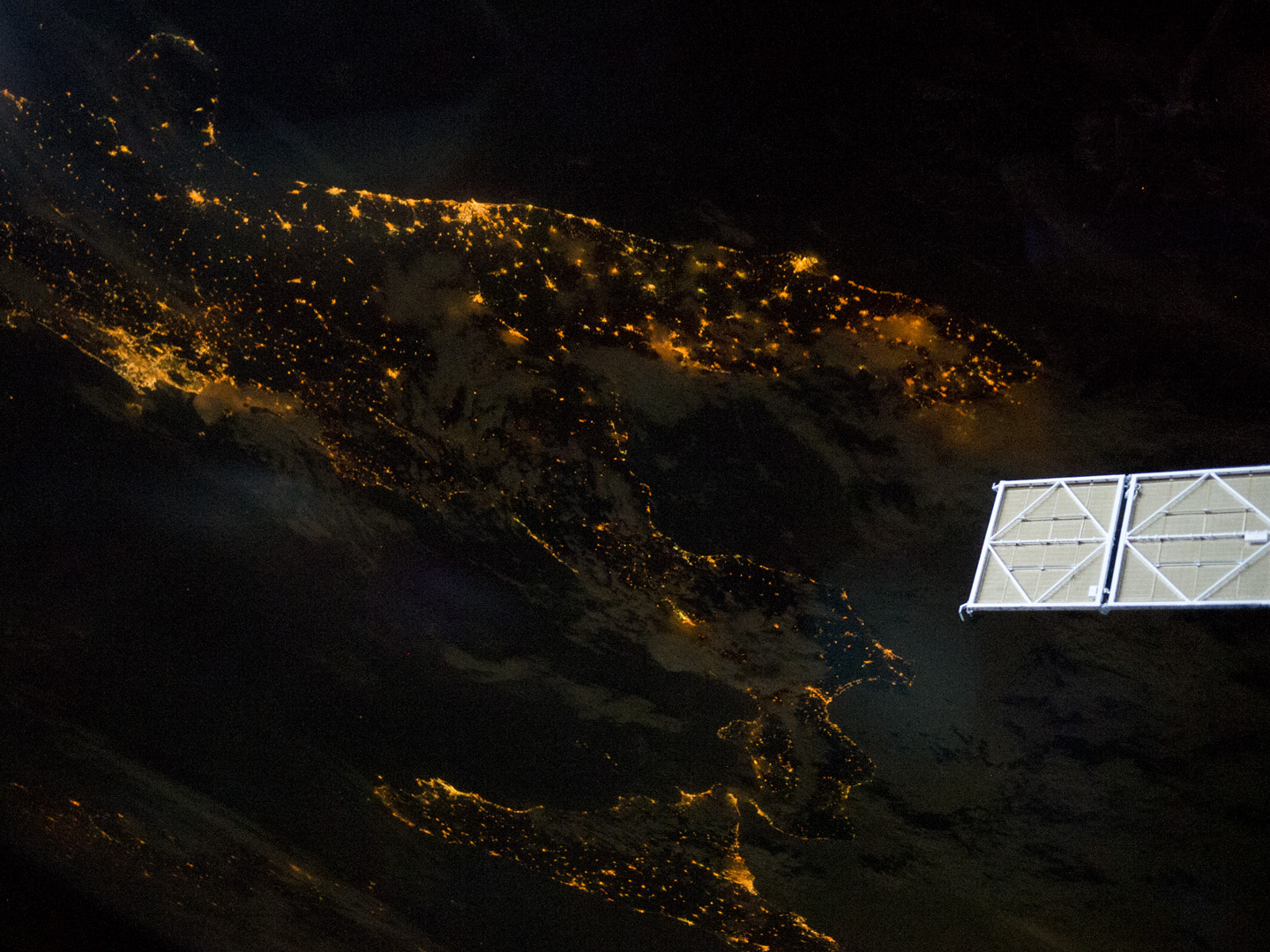
I love pictures of Earth from space, but there’s something especially thrilling when it’s some place you can easily recognize instantly. Like, say, the boot heel of Italy at night:

Sigh. Così bella! [Click to empeninsulate.]

This picture was taken by an astronaut on board the International Space Station. There’s not a lot of science to be done necessarily with pictures like this, but sometimes it’s OK just to gawk at pretty pictures from space.

And come to think of it… not that I recognized it, but just to the left of the top of the heel is Bari, a town I spent a day in while cruising with the Center for Inquiry. CfI sponsors many cruises to help raise funds, so keep an ear open for them. The JREF does things like this sometimes, too.

Italy is lovely from the ground, but, like the rest of the planet, literally takes on a new dimension from space.

Image credit: NASA

Related posts:

- The storm below
- A puzzling planet picture from the ISS
- Followup: city lights from space
-

Using a Microscope, Scientists Resurrect a 123-year-old Recording | 80beats

spacing is important
The recording’s grooves, seen through the microscope.

What’s the News: More than a century ago, Thomas Edison recorded a woman speaking the first verse of “Twinkle, Twinkle, Little Star” on a metal cylinder for use in a talking doll. Now, scientists using microscopes to create 3D scans of the badly damaged cylinder have made it possible to hear her voice again, through the patina of years.

How the Heck:

The recording is encoded in a series of grooves carved by a stylus into a short cylinder or ring of metal, which was found in Thomas Edison’s West Orange, NJ, laboratory, now a museum. But the cylinder had grown so warped that it could not be played on any phonograph or similar device.
Using a confocal microscope, usually used by biologists for making detailed 3D images of cells and cellular structures, scientists at Lawrence Berkeley National Laboratory scanned the cylinder to recording the meanderings of the grooves, whose slight variations in depth correspond to modulations in the voice of the speaker.
When they hooked their topographical map of the cylinder up to audio software, they heard, through the skips and scratches, the words of “Twinkle, Twinkle, Little Star.”


Scientists Find the Molecule that Makes Sunburns Hurt—And a Way to Block it | 80beats

What’s the News: Researchers have pinpointed the molecule that makes sunburned skin so sensitive to pain, they reported yesterday in Science Translational Medicine. This finding could help scientists develop new painkillers not only for sunburn, but for chronically painful conditions such as arthritis.

How the Heck:

The researchers exposed small patches of skin on rat’s paws and the forearms of ten human participants to UVB radiation, the ultraviolet rays that cause sunburn.
When the sunburn was at its most painful, two days later, the researchers took tiny samples of the sunburned skin. They found high levels of CXCL5, a protein that summons immune cells to injured tissue as part of the body’s inflammatory response.
To determine whether high CXCL5 levels were responsible for the skin’s sensitivity—since no previous studies had specifically linked the protein to pain—the scientists injected rats that hadn’t been exposed to UV rays with CXCL5. Sure enough, these rats showed about the same sensitivity to pain as sunburned rats did.
What’s more, the team found they could reduce the rats’ pain sensitivity by injecting them with an antibody that blocks the effects of CXCL5.

What’s the Context:

Of course, ...


Alleged scientific fraud: lawsuit reveals DOE failures | The Intersection

This is a guest post by Eugenie Samuel Reich, a contributing correspondent for Nature.

Last time I posted on The Intersection, a couple of commenters were curious about a disclosure I made about having brought a Freedom of Information Act (FOIA) lawsuit against the US Department of Energy (DOE), to obtain a report into alleged scientific fraud at Oak Ridge National Lab (ORNL).

So I thought that Intersection readers might be interested in my article, out today in Nature, reporting on the lawsuit’s progress.

The fraud allegations in the case date back to 2006. That year, a group of researchers led by Stephen Pennycook were accused of fabricating data; which they have strongly denied. Pennycook’s research involves developing cutting-edge techniques for imaging materials using an electron microscope, which can solve problems in nanotechnology, energy research, and condensed matter physics. His group receives about $2 million per year from DOE.

The data that prompted concerns included one example, discussed in this 2006 Boston Globe article, where the group had mirrored and spliced datasets together to represent a scan of a sample that had allegedly never been studied for real. In another example, the group had replaced some, but not all, of the electron energy loss spectra taken from a sample with allegedly completely different ones when a reviewer suggested the scientific conclusion that atomic-scale resolution had been achieved were not fully supported by the originals.

Following federal policy on research misconduct, ORNL held an investigation. The investigation panel of three scientists exonerated the group of misconduct, finding they were guilty of no more than errors of judgment and careless errors. In order to understand how this conclusion was reached, I sought the investigation report under FOIA, and went through several rounds at the DOE appeals process (with at one point, the Office of Hearings and Appeals ruling in my favor, only for the Office of Science, which had the report, to dispute its conclusions. In 2008, a summary statement by the investigators was released, but I continued to pursue the original report. By 2009, I had received a final answer that DOE wouldn’t release it, and so sued the agency in district court in Boston, where I am based.

In fighting the case, the government has gone to great lengths to argue that the investigation report it received is not a government record subject to FOIA. Its rationale for this is that ORNL is run by a private contractor, UT Battelle, which owns the report, and that DOE officials did not read or rely upon it when they approved the investigation. The court filings include sworn declarations from officials involved in approving the investigation saying they didn’t read the final investigation report, and later gave it back to UT Battelle. They say they approved the exoneration through phonecalls and meetings with an ORNL manager. They imply this is typical for science oversight at the DOE national labs and consistent with federal policy that requires the investigation report and evidentiary record to be documented by the funding agency for oversight purposes.

An editorial in Nature accompanying my article characterizes the problem this way:

Important decisions were taken informally by a small group of officials and an adviser who apparently shared a common interest: to see the matter quietly resolved. The procedure ought to be more formal, better documented and even adversarial, with the institutional managers required to satisfy officials whom they do not know and who have no stake in the case outcome. This is closer to the more careful oversight of alleged misconduct by both the Office of Research Integrity at the Department of Health and Human Services (DHHS) and the inspector-general of the National Science Foundation.

Not reading the report apparently had an advantage for DOE: the judge ruled in March that the record was not subject to FOIA in part because the government had never read it. I’ve filed a motion to reconsider, and the case is still pending.


Why We Need the James Webb Space Telescope | Cosmic Variance

Over the last 24 hours, the astronomy community has begun facing the possible cancellation of the James Webb Space Telescope (JWST). The House Appropriations Commerce, Justice, and Science Subcommittee has recommended: “$4.5 billion for NASA Science programs, which is $431 million below last year’s level. The bill also terminates funding for the James Webb Space Telescope, which is billions of dollars over budget and plagued by poor management.” This is not the end of the game for JWST, as many other branches of government have yet to weigh in, but it’s not good news.

Looking at it from the public’s view, sure, cutting projects that are “billions of dollars over budget and plagued by poor management” sounds like a pretty reasonable action. But I’d like to try to take a few minutes to explain why it’s not as simple as the committee would like you to believe.

First and foremost, in many fields of astronomy we are rapidly approaching the limit of what can be done scientifically without JWST. I recently finished teaching a graduate class on extragalactic astronomy, and I can’t tell you the number of times where I brought the students up to speed on the state of a field, and then had to say “If we’re going to push this to the next level, we need JWST”. To demonstrate this, the plot below shows the brightness (i.e., flux) of an astronomical point source that can be detected with different telescopes in a fixed amount of time, as a function of the wavelength of light (along with a typical galaxy spectrum). The magenta points show that JWST is hundreds of times more sensitive than anything out there. In terms of scientific impact, this is like the difference between walking (4 miles/hr) and flying (400 miles/hr) for your ability to explore terrain on the Earth. This is not to mention the drastic increase in the angular resolution of JWST compared to any other telescope on that plot — JWST will be able to see fine-scale structure that has never been seen at these wavelengths.

Moreover, JWST will blow through limits that lie at some of the most exciting areas of astronomy, with some of the widest public appeal, including high redshift galaxies and extrasolar planets. The public rightfully adores Hubble for expanding our view of the universe, but it’s not going to last forever. (Given funding constraints, the most likely fate for Hubble is the same as your 20 year old Toyota Tercel — it gets you where you’re going, but at some point you stop paying the money to fix the heater, repair the cracked windshield, and deal with the oil leak, and accept that sooner or later you’re going to be stranded on the side of the highway.) When Hubble expires — and it will within a decade or less — where is the system that will expand upon the wonders that Hubble revealed? Even Milky Jay knows that JWST is the future.

The demise of JWST would be a huge blow to american space-based astronomy as well. On the ground, the US has ceded much of its historical primacy to the Europeans. If JWST were cancelled, it would be a heavy blow to the US dominance in running true space-based observatories. NASA will continue to run “experiments” in space — i.e., targeted smaller missions focused on limited scientific goals, but they will be giving up their unique place in creating flagship facilities that literally anyone can potentially use. The impact of Hubble came in large part because it wasn’t a specific experiment for one particular problem. It has broad capabilities, that were kept up to date with servicing missions, but using those capabilities was then essentially “crowd-sourced” to the entire world. Through on-going rigorous, and frankly brutal, evaluations of scientific proposals, the community identifies the single most important scientific questions to be addressed by Hubble. This process is carried out every. single. year., making sure that Hubble gets the most bang for the buck. The same process also applied to NASA’s other “flagship” missions (e.g., Chandra, Spitzer), focused on other wavelengths, but these facilities too are rapidly running out of time.

To see what the loss of JWST would mean, look at the following chart of NASA missions. JWST is the only flagship observatory coming up. If we lose it, the person with the next great idea loses the chance to try it out.

So yes, JWST has cost more than was planned for. But the majority of the cost is now “sunk costs”, and a huge fraction of the telescope and instruments actually exist. This is not just a hole that people have been shoveling money into, and not getting anything for — useful stuff is actually built! And working! I would of course prefer that JWST launched on time and under budget, but, given how close we are to the end, I much prefer to go for it. Canceling JWST is not going to usher in a golden age of other space-based science opportunities (the “crowding out theory”, where once the shade of JWST is gone, a thousand flowers will bloom). The money will simply be gone from space-based astronomy, and instead of a single tree we can all climb, there will be some smaller pieces of shrubbery.

So to close, I’d like to leave with you with one of the finest bits of advocacy for JWST around.

(edit: Which I now realize Risa just posted! She has “how to contact your legislator” information, which is the single most important thing you can do at this point.)


James Webb Space Telescope | Cosmic Variance

Sean mentioned yesterday that the next generation space telescope JWST is at risk. In a bit more detail, JWST has been cut in the House appropriations bill:

$4.5 billion for NASA Science programs, which is $431 million below last year’s level. The bill also terminates funding for the James Webb Space Telescope, which is billions of dollars over budget and plagued by poor management.

In all, the House appropriations bill cuts 1.6 billion dollars from the NASA budget. The game is not over yet — the House Appropriations Subcommittee in charge of NASA will consider this bill today, and the full Appropriations committee will meet again to consider the final bill on Wednesday — and of course the Senate will have its own bill. But this is obviously a very ominous sign for NASA astrophysics in general.

JWST is a 6.5 meter IR-optimized telescope, which has been scheduled to launch in 2018. It is certainly true that it has suffered from numerous cost overruns, and has essentially eaten the rest of the NASA astrophysics program. However, nearly all the technical hurdles have now been overcome. And the science reach of JWST is spectacular. It is now the only observatory-class mission planned to operate once the current Great Observatories (Hubble, Spitzer, Chandra) reach their end of life. JWST has been the highest priority for NASA of the Decadal Surveys and essentially every other study commissioned by the field.

Hubble Space Telescope has given us amazing views of the Universe, back to about a billion years after the big bang. However, it has reached its limits there — JWST would allow us to see well into this first billion years, to view the formation of the first stars, galaxies, and black holes, and to study in detail how radiation from these objects reionized the Universe. There are no other planned missions that will allow us to observe this earliest stage of galaxy formation with this level of detail. JWST would also allow us to observe the chemical composition of planets outside the solar system, and to image the disks around stars as they begin planet formation.

It is hard to overstate the impact of HST on astronomy over the last two decades, and in particular on the public’s engagement with astronomy and science in general. There is just something incredibly inspiring and awesome about space-based observatories and the images they produce, that are unmatched by ground-based telescopes. JWST is a natural successor to Hubble in this mission: it has tremendous potential to be a vehicle of wonder. In addition to the science that would be lost, the funding losses to US astronomy, and the set back of our research progress, this loss to the public inspiration and engagement in scientific discovery could be one of the most substantial hits if JWST does not go forward.

I encourage all who are concerned about the next decade of astronomy to contact your representatives and senators as soon as possible. Termination of JWST would reduce the strength and visibility of the US science program as a whole, its impacts would be felt far beyond astrophysics. Killing JWST now also substantially threatens US credibility as an international partner, and sends the message that the US is just not interested in scientific leadership in major projects.

More at the New York Times, the Nature News Blog, Sky and Telescope, and Bad Astronomy. House press release here. The AAS will be releasing a statement later today. Thanks to Garth Illingworth for some useful background.

The case for JWST from a fan at the Vlog brothers: “I do not want to live in a world where we only focus on suck, and never think about awesome.”


Fox News’s Attack on Media Matters…Validates Media Matters’ Critique of Fox News | The Intersection

I’ve become increasingly fascinated by the “Fox News Effect”: Why it is that Fox viewers believe more misinformation about science, and also about politics, as documented in multiple studies. But of course, I’m not the only one who has been pointing this out–so, of course, has David Brock’s organization, Media Matters, the top press watchdog coming from the progressive corner.

Apparently, Media Matters’ attacks are getting under Fox’s skin, and as Politico reports, the network has responded by arguing that Media Matters ought to lose its tax exempt status. One slight problem: that’s a weak legal argument, and one that seems specially designed to serve a political goal–just as Fox’s claims about global warming and other topics often are…just as Media Matters and others have often observed.

Why should Media Matters be tax exempt, a nonprofit? Because while it surely expresses opinions, it is centrally an organization that educates about media bias, and does not directly support campaigns, candidates, or legislation. In this, it is just like umpteen other such organizations in Washington and around the country. It is just like all the conservative think tanks, and all the liberal think tanks, and all the advocacy groups…and on, and on, and on.

Indeed, there is an exact parallel of Media Matters on the right: The non-profit Media Research Center, which calls itself “a 501(C)3 organization whose mission is to educate the public and media on bias in the media.” I don’t think any of these organizations should lose their status…neither those with which I agree, nor those with which I disagree. Rather, I simply think that Fox should stop generating questionable arguments and claims for ideological reasons–both in its treatment of climate science and other factually contested issues, and in its dealing with critics.


Congress puts NASA and JWST on the chopping block | Bad Astronomy

When I saw the Presidential Budget Request this year for NASA, I was heartened: lots of money for commercial space transport and science. Obama hasn’t been a vocal supporter of NASA, so it was a relief.

Congress has countered, however. The House just released its Appropriations bill that covers science funding for NSF, NASA, NOAA, and NIST. Almost across the board: cuts. Massive ones.

This bill (PDF) actually keeps NSF at the fiscal year ’11 funding, although that’s $900 million less than the Presidential request. NOAA is being cut $100 million (2.2%), or $1 billion less than requested. NIST: cut by $50 million over FY11 (6.5%), $300 million less than requested.

But NASA is the one where the cuts are nothing short of savage. The cuts total $1.64 billion from last year, which is nearly $2 billion less than requested. That’s a cut of 8.8%. A billion of that is due to the Shuttle retiring, but the galling part is that the House is requiring that all funding for the James Webb Space Telescope, Hubble’s successor, be cut entirely. In other words, they are canceling the JWST ...


Summer has come | Gene Expression

So it is now less than a week until A Dance with Dragons, the 5th book in George R. R. Martin’s epic fantasy series A Song of Ice and Fire, is out. The internet is supposedly flooded with spoilers, some of them fake, thanks to the Germans mistakenly shipping out nearly 200 copies of the book early. At this point I’m kind of irritated by the fact that whenever there’s a media story about the series I have to stare at a photo of Sean Bean looking grave. I’m generally not a fan of film or television adaptations of science fiction or fantasy, but the near overshadowing of the literary production by the T.V. series of late gives me another reason to want to gripe.

The Daily Beast has a very long and lush review (positive). Entertainment Weekly is more concise, ranking the books 3 > 1 > 5 > 2 > 4. And yes, it is for real, at over 1,000 pages this is going to be the longest book! I know I said I’d wait for the Kindle version, but the reviews seem ...

Marry far and breed tall strong sons | Gene Expression

ResearchBlogging.orgThe Pith: When it comes to the final outcome of a largely biologically specified trait like human height it looks as if it isn’t just the genes your parents give you that matters. Rather, the relationship of their genes also counts. The more dissimilar they are genetically, the taller you are likely to be (all things equal).

Dienekes points me to an interesting new paper in the American Journal of Physical Anthropology, Isolation by distance between spouses and its effect on children’s growth in height. The results are rather straightforward: the greater the distance between the origin of one’s parents, the taller one is likely to be, especially in the case of males. These findings were robust even after controlling for confounds such as socioeconomic status. Their explanation? Heterosis, whether through heterozygote advantage or the masking of recessive deleterious alleles.

The paper is short and sweet, but first one has to keep in mind the long history of this sort of research in the murky domain of human quantitative genetics. This is not a straight-forward molecular genetic paper where there’s a laser-like focus on one locus, and the mechanistic issues are ...

Leaping Above The Sky One Last Time

Leaping Above The Sky One Last Time

"After a heart-stopping pause at T-31 seconds, Space Shuttle Atlantis left Earth and leapt above the sky this morning. This is the last time a space shuttle will ever do this - and everyone in attendance at the launch site knew it.

Up until a short time before launch gloomy weather forecasts had left a sense of doubt among all who gathered here at NASA's Kennedy Space Center. Half an hour or so before the scheduled launch time the weather suddenly started to improve - and with it, the crowd's expectations.

I am not going to write about all the geeky stuff. Everyone else is doing that."

Final Launch Successful – Flight Shuttle Flight Underway

With a 70% chance of a weather violation the Space Shuttle Atlantis beat the odds and thrilled close to a million gathered people who waited hours to see the final launch of a Space Shuttle. Main engine cut-off and external tank separation have just occurred.

Update: Watch the final launch again on the next page.

Save Webb Campaign Begins

American Astronomical Society Statement on Proposed Cancellation of Webb Space Telescope

"The American Astronomical Society calls upon all members of Congress to support JWST to its completion and to provide strong oversight on the path to this goal. Too many taxpayer dollars have already been spent to cancel the mission now; its benefits far outweigh the remaining costs. We must see the mission through. We are a great nation and we do great things. JWST represents our highest aspirations and will be one of our most significant accomplishments."

Sierra Nevada and NASA Sign Commercial Space Agreement

NASA Signs Commercial Space Agreement With Sierra Nevada

"The umbrella space act agreement is Kennedy's latest step in its transition from a historically government-only launch complex to a multi-user spaceport. Sierra Nevada also has space act agreements with NASA's Johnson Space Center in Houston; NASA's Langley Research Center in Hampton, Va.; NASA's Dryden Flight Research Center at Edwards, Calif.; and NASA's Ames Research Center in Moffett Field, Calif."