
EU-funded scientists have developed risk assessment criteria for engineered nanomaterials (ENMs) that will help support experts in making innovation and policy decisions. An outcome of the NANOHOUSE project, which is backed with EUR 2.4 million under the 'Nanosciences, nanotechnologies, materials and new production technologies' (NMP) Theme of the EU's Seventh Framework Programme, findings reveal that product design can affect the unintentional release of ENMs.
Monthly Archives: July 2011
SUSS MicroTec Introduces MaskTrack Pro InSync, a System for Automated Handling, Storage and Inspection of EUVL Reticles
SUSS MicroTec, a global supplier of equipment and process solutions for the semiconductor industry and related markets, launched its new MaskTrack Pro InSync - the first holistic in-fab EUVL mask management offering.
U.S. Senate taps UCF expert for testimony on nanotechnology
University of Central Florida's Thomas O'Neal will be testifying Thursday, July 14, about the revolutionary nature of nanotechnology before the U.S. Senate Subcommittee on Science and Space.
Travel Awards Available for the Pathology Informatics 2011 Conference
The Association for Pathology Informatics is awarding a limited number of stipends of $1,500 to attend the Pathology Informatics 2011 Conference at the Pittsburgh Wyndham Grand hotel in Pittsburgh. The conference will take place on October 4-7, 2011. Awardees must be residents, post-doctoral students, or fellows in accredited teaching programs. This is the premier pathology informatics conference in the country with three workshops, three discipline tracks, multiple keynote plenary lectures, 44 participating faculty members, and more than 40 exhibitors. Last year's PI-2010 presentation marked the first of these events. The conference represents a merger of two long-standing pathology informatics meetings, APIII and Lab InfoTech Summit. The application deadline for awards is August 1, 201, so those interested should apply soon. Applicants must be residents or fellows in a training program accredited by the Council for Graduate Medical Education (ACGME). More details can be obtained at the conference web site including details about how to apply.


Association for Pathology Informatics – Teaching Institution Memberships
I think there is a recognized need among practicing pathologists that there is a shortage of pathologists that have informatics expertise as one of their skill sets. Pathology groups and laboratories, in my opinion, to remain competitive are going to have to have internal informatics expertise to be successful and grow as desired. One of the issues is a lack of a large number of dedicated fellowships, the few of which are excellent but cannot nearly train all those who are both interested and the market needs. Current pathology residents have strong informatics interests and in most cases some exposure prior to medical school or residency but formal training in the increasingly recognized subspecialty of pathology informatics may be lacking in certain programs and only a few fellowships limit the number that can be trained.
It is encouraging that the API has taken the lead to provide core competencies for residency programs to incorporate goals during residency that can be put into practice. The list of institutions and those responsible for directing this initiative is a who's who in pathology informatics. I hope the list of institutions and individuals continues to grow and likely will from this collaborative effort to support interests of trainees and meet an increasing demand and need in pathology practice.
Full press release from the Association for Pathology Informatics:
Association for Pathology Informatics - PRESS RELEASE July 12, 2011 Pathology Informatics is a rapidly evolving subspecialty of pathology. Core competencies of pathology informatics should be addressed in all pathology programs. The Association for Pathology Informatics (API) has taken the lead in addressing curriculum needs through the creation of its membership-based teaching program. This collaborative is managed by world-class experts in pathology informatics training and practice. Its goal is to provide residency programs with essential tools for high-quality pathology informatics training. Ronald S. Weinstein, M.D., FCAP, President of API, is pleased to announce that twelve teaching programs have joined API as the first Teaching Institutional members of the Association. These teaching programs have made a significant commitment to advancing the training of medical residents and fellows interested in the emerging discipline of pathology informatics.
- Cleveland Clinic – Center for Pathology Informatics
- Dalhousie University (Halifax, Nova Scotia) - Department of Pathology
- Henry Ford Hospital – Department of Pathology Informatics
- Massachusetts General Hospital – Fellowship in Pathology Informatics
- Robert Wood Johnson Medical School (UMDNJ) – Department of Pathology
- University of Alabama at Birmingham – Department of Pathology
- University of Arizona College of Medicine – Department of Pathology
- University of California - Davis Health System – Department of Medical Pathology
- University of Colorado Denver – Department of Pathology
- University of Michigan, Ann Arbor – Division of Pathology Informatics
- University of Pittsburgh - Department of Biomedical Informatics
- University of Pittsburgh Medical Center – Department of Pathology
For more information, visit http://www.pathologyinformatics. org


CMS seeks to delay e-reporting requirement
The CMS has proposed an array of rule changes affecting physicians and their use of health information technology under various Medicare and Medicaid payment regimes, including delaying for at least a year a requirement for the direct, electronic reporting of physician quality data as part of the meaningful use requirements of the electronic health-record incentive payment program under the American Recovery and Reinvestment Act of 2009.
The 621-page proposed rule, released by the CMS this month, but not scheduled for official publication in the Federal Register until Wednesday, is open for public comment through August 30.
One key change in the rule is a proposal to continue to allow physicians and other eligible professionals (collectively referred to as EPs under the program) to qualify as having met a portion of their meaningful-use requirements for clinical quality measures by submitting attestations to the CMS.
In its final rule issued on meaningful use released in July 2010, the CMS allowed physicians and other EPs to report their clinical quality measures by attestation for 2011, the first year of the program, but had required EPs to report the quality measures as data to the CMS electronically in 2012.
However, according to the newly released proposed rule, the standards and technology chosen to perform that task is inappropriate for the task.
In their new proposal, the rule makers said, the CMS was expecting that “certified EHR technology will be required to calculate the clinical quality measure results and transmit under the Physician Quality Reporting Initiative (PQRI) Registry XML specification.”
But, according to the CMS, “Since the publication of the final rule, we have determined that it is not feasible to receive electronically the information necessary for clinical quality measure reporting based solely on the use of PQRI (Physician Quality Reporting Initiative) 2009 Registry XML Specification content exchange standards as is required for certified EHR technology. This is because the specification is tailored to the elements required for 2009 PQRI Registry submission, rather than constituting a more generic standard.”
As a result, the CMS rule makers “propose to modify the requirement that clinical quality measure reporting must be done electronically. Specifically, we propose that for the 2012 payment year, EPs may continue to report clinical quality measure results as calculated by certified EHR technology by attestation, as for the 2011 payment year.”
The rule makers, however, proposed offering a voluntary, “pilot mechanism” in 2012 for eligible professionals to electronically report their clinical quality measures. Participation in the Physician Quality Reporting System-Medicare EHR Incentive Pilot, as the combined program is to be called, would satisfy an EP's meaningful-use requirements under the EHR incentive payment program, the rule makers said.
EPs would be required under the pilot to report their clinical quality measures for a full year. By participating in the pilot, EPs will be eligible for Physician Quality Reporting System incentive payments and EHR incentive payments. Participants in the pilot also could submit data through certain CMS-approved EHR vendors, the rule makers said. A list of those qualified vendors is not expected to be available until the summer of 2012, they said.
By Joseph Conn from Modern Physician
Posted: July 12, 2011 - 11:45 am ET
Tags: American Recovery and Reinvestment Act, Centers for Medicare & Medicaid Services (CMS), Information Technology, Meaningful Use, Medicare, Physicians, Quality


DigiPath & PathXL Create Digital Pathology Education Partnership
Henderson, Nevada, USA, and Belfast, Northern Ireland, UK July 13, 2011
DigiPath, Inc®, a provider of affordable, innovative, and reliable digital pathology solutions, and PathXL Ltd., a company that specializes in developing web-based software for digital pathology, have joined together to increase user adoption of digital pathology within North America based academic medical centers through educational applications. DigiPath and PathXL will be showcasing PathXL™ Tutor and PathXL™ Simulate digital pathology education applications as the only PREMIER Platinum Industry Sponsors at the Association of Pathology Chairs Annual Meeting in Monterey, CA, USA from July 13 through July 15, 2011.
PathXL™ Tutor allows users to effectively create and manage digital slides and other content, publish online, share and view from anywhere in the world. PathXL™ Tutor provides on-line virtual microscopy teaching, educational, CPD and competency exam resources in minutes, significantly enhancing student, trainee and the professional experience.
PathXL™ Simulate supports early stage training for residents in pathology. Trainees can work through real cases and assess how well they have performed. This approach to training has been completely embraced by numerous laboratories worldwide.
“For over seven years, PathXL has been the European leader in implementing digital pathology medical education software applications,” stated Des Speed, Chief Executive Officer of PathXL. “60% of United Kingdom trained pathologists utilize PathXL™ Tutor each year.”
“PathXL’s innovative product line is the foundation of DigiPath’s digital pathology solution portfolio” said Eric Stoppenhagen, Chief Executive Offer of DigiPath. “DigiPath and PathXL are well positioned to be the market leader within digital pathology medical education.”
About DigiPath, Inc.
DigiPath, Inc. provides the next generation of affordable, innovative, and reliable digital pathology solutions. DigiPath’s advisors bring over 60 years combined expertise in pioneering digital pathology, implementing over 500 installations at community pathology practices, hospitals, academic medical centers, reference laboratories, biopharma organizations, and life science research institutions worldwide.
About PathXL Ltd.
PathXL Ltd is a company that specializes in developing web-based software for Digital Pathology. Their proprietary webbed image management database and digital slide viewing platform – PathXL™ – together with purpose built application software, underpins a wide range of applications including (i) education and training in pathology, (ii) Digital slide archiving, (iii) cloud based digital pathology (iv) biobanking (v).


Sebelius Unveils Rules For State Health Exchanges
Print media provided extensive coverage of the Obama Administration's announcement on Monday of new rules for the state health exchanges mandated by the healthcare law. Most sources agree that in crafting the regulations, the Administration sought to provide states with much flexibility. Coverage was generally positive, although some sources said that the rules may lead to more questions.
The New York Times (7/12, A12, Pear, Subscription Publication) reports, "In a big step to carry out the new health care law, the Obama administration unveiled standards on Monday for insurance marketplaces that will allow individuals, families and small businesses in every state to shop for insurance, compare prices and benefits and buy coverage." HHS Secretary Kathleen Sebelius "said the insurance exchanges, the centerpiece of the new law, 'will offer Americans competition, choice and clout.'"
The Los Angeles Times (7/12, Levey) reports, "These state-based exchanges are intended to make buying a health plan comparable to shopping the Internet for an airline ticket or a hotel room. And by 2019, they are expected to serve as the main insurance resource for an estimated 24 million Americans who don't get their health insurance from their employer, according to the nonpartisan Congressional Budget Office." Small businesses "with fewer than 100 employees also will be able to use the exchanges, which will have to offer plans with a minimum level of coverage." In addition, "no plans will be able to deny coverage to people with pre-existing conditions."
The Wall Street Journal (7/12, Mathews, Subscription Publication) reports that health exchanges are crucial to the healthcare law, and the new regulations aim to provide states with flexibility in implementing them. Yet, to date, only 12 states have passed legislation to create them. The Journal says that because states have so much leeway in these new regulations, they could face struggles about how much authority exchange regulators should have.
The Hill (7/12, Baker) reports in its "Healthwatch" blog, "The proposed rule leaves most key decisions up to the states, though it sets some minimum standards for every exchange -- including limits on the role of insurance companies and agents."


Reducing Manual Steps, Improving Turnaround Times, and Creating a Lean Laboratory Environment: ISD Testing on the Dimension Integrated Chemistry Systems
FREE Special Lab Products Review

Download Your FREE Special Report Today!
Simply Complete the Form Below

The challenges facing the clinical laboratory environment in the past 10 years are well documented, and include significant medical technologist vacancy rates, increased competition, and a significant number of opportunities to inadvertently make testing errors.1,2 With such macroeconomic challenges, the industry has used a variety of methods to identify ways to increase productivity, decrease costs, and in general, become more efficient at generating test results.
A cornerstone of “Lean Thinking” involves the elimination of waste, including the identification and removal of inefficient processes or tasks. In the laboratory, if manual processing steps can be eliminated without sacrificing quality, then there will be less manual manipulation of tubes, fewer opportunities for errors, and a better overall turnaround time for reporting results.
In addition to the removal of waste, Lean also provides a benefit in terms of workload leveling. As anyone who has worked in a laboratory knows, problems meeting turnaround time goals and maintaining efficient specimen processing occur whenever a surge of work arrives into the laboratory. Workload leveling is simply the practice of handling work in small, consistent batches which will encourage standardization and therefore reduce variation and errors. The most successful Lean projects address the issue of workload leveling and standardization along with waste removal.
In vitro diagnostic (IVD) equipment manufacturers are complementing these Lean efforts by providing analyzers and testing solutions to help eliminate wasteful process steps, standardize the laboratory workload, and focus on improved turnaround times.5 Instruments with improved ergonomics, reagents with visual and color coded designators, and technology that encourages “continuous operational flow” are all features that have become mainstream in IVD product development circles.
Here is just some of what you will take away…
- How to adopt Lean quality management methods designed to increase productivity and efficiency.
- How to identify inefficient processes or tasks.
- How to create a Lean environment for ISD monitoring in the routine laboratory setting.
- and much much more!
Table of Contents
- Disclosure
- Introduction
- Chapter 1. Study Area
- Chapter 2. Background
- Chapter 3. Study Methodology
- Chapter 4. Results
- Conclusion
- References
- Appendices
A-1 About Tim Baker
A-2 About Nexus Global Solutions
A-3 About Karen Appold
A-4 About DARK Daily
A-5 About The Dark Intelligence Group, Inc., a nd THE DARK REPORT
A-6 About the Executive War College on Laboratory a nd Pathology Management - Terms of Use


LLTech Webinar Tomorrow – Register Now for “Light-CT as an adjunct to histology”
|
|


i-Path launching in USA as ‘PathXL’ at Association of Pathology Chairs Annual Meeting
These are exciting times for i-Path, the Northern Ireland based firm, as it prepares to announce its US launch with the new company name, PathXL. i-Path will undergo a corporate rebrand to PathXL for all customers from the end of August 2011. In the meantime PathXL™ Tutor and PathXL™ Simulate, their education and training digital pathology products, will be introduced in the US by DigiPath, Inc®, beginning at the Association of Pathology Chairs Annual Meeting (link) in Monterey, California, USA from July 13th-15th 2011.
DigiPath and PathXL invite you to their stand to hear the exciting news regarding PathXL™ Tutor and PathXL™ Simulate in the USA.
PathXL Tutor
The dedicated software platform, PathXL™ Tutor, allows users to effectively create and manage digital slides and other content, publish online, share and view from anywhere in the world.
What you can do with PathXL™ Tutor?
- Generate on-line virtual microscopy training, CPD and competency exam resources in minutes, significantly enhancing student, trainee and the professional experience.
- Incorporate various multimedia files including streaming videos, presentations, sound files, PDFs and Office documents.
- Build online proficiency tests, incorporating virtual slides and having results from participants stored centrally. Scores can be compared against peer groups at the end of each test.
- The powerful web based virtual slide viewer is rich with features including annotations, slide measurements, screenshots and multi-slide review.
- Build PathXL™ Tutor into your current website, creating an education portal for members only or make publicly available.
- PathXL™ Tutor is entirely web based and accessible via any web browser.
- PathXL™ Tutor runs through a standard internet port. No downloads or plugins required.
- PathXL is vendor neutral and supports virtual slides and file formats from all major scanning manufacturers.
PathXL™ Simulate
PathXL™ Simulate is aimed at supporting early stage training for residents in pathology. Trainees ‘learn by simulation’ by working through real cases and assessing their performance.
This approach has been embraced by numerous laboratories across the world including the Thames and Medway Training Schools, Liverpool Training School, South West Deanery Training School and the Royal College of Pathologists of Australia (RCPA).
Key Benefits:
- Approved training materials in diagnostic pathology
- High resolution digital images of the entire slide
- Learn to identify the key morphological clue in diagnosis
- Track diagnostic performance from morphology interpretation to diagnosis
- Train in a consequence free environment
- Generate performance report on cases
- Improve diagnostic ability and performance
- Develop the skill sets of the world’s leading pathologists
- Learn to identify the key morphological clues in diagnosis
- Used to complement one-to-one training
- Web-based software can be accessed anytime, anywhere
- Objective algorithms aimed at improving reproducibility and precision across the profession.
About PathXL
PathXL Ltd is a company that specializes in developing web-based software for Digital Pathology. Their proprietary web-based image management database and digital slide viewing platform – PathXL™ – together with purpose built application software, underpins a wide range of applications including (i) education and training in pathology, (ii) digital slide archiving, (iii) cloud based digital pathology, (iv) biobanking, (v) biomarker discovery and multiplex data management and analysis and (vi) web-based image analysis for tissue analysis. US customers can visit http://www.pathxl.com and http://www.digipath.biz to view PathXL’s products and services.
Rest of world customers (including UK) please continue to use the company website http://www.i-path.co.uk until we also complete our renaming to PathXL, which we will advise you about in August.
About DigiPath, Inc.
DigiPath, Inc. provides the next generation of affordable, innovative, and reliable digital pathology solutions. DigiPath’s advisors bring over 60 years combined expertise in pioneering digital pathology, implementing over 500 installations at community pathology practices, hospitals, academic medical centers, reference laboratories, biopharma organizations, and life science research institutions worldwide.
Visit http://www.digipath.biz monthly to see new solutions emerge during 2011.


Check Out World’s Smallest Slide Scanner
Last month the folks at Mikroscan paid our group a visit to show us their latest scanner. This new recently released scanner launched shortly after their first generation model has several improvements on an already solid platform. For starters, it is 40% smaller than their "larger" desktop model facilitating placement even in the tightest offices and laboratory workspaces. Secondly, the device produces no noise during scanning.
A 15 x 15 mm piece of tissue was scanned in 20x in well under 2 minutes.
One of the most impressive features about the device is the ability to look at the same slide and the same time with very short scan times (less than 30 seconds) for the remote viewer.

Digital pathology and devices such as Mikroscan's scanner provides for the device to be placed within the pathologist's workspace, thus facilitating workflow and optimizing the experience for both the sending and receiving pathologist.
Imagine having a case that needs someone else's eyes and on your desk is a scanner that can create a digital slide and present those images very quickly to another person. The images, as frequent readers from an earlier post (see: Mikroscan images to be seen) may recall I thought highly of the images (as well as the viewer interface) while other options exist for the viewing as well.
This is not to say that you can eliminate or should not consider the other 4 slide, 5 slide or several hundred slide scanners on the market today. You should. But I also think that pathologist's should consider a lower capacity, desktop device as well, particularly for remote frozen sections, isolated pathologists that rely on courier models for second opinions or where the opportunity exists for subspecialty consultation within a group or as an extramural consultation.
More extensive adoption of digital pathology will rely on a basic premise that may be met with a Mikroscan device: Cost-effective solutions that produce high quality images readily and consistently.
I think that the use cases in pathology are unique enough and individual enough to recognize a need and a market for both lower as well as higher capacity scanners to meet our day-to-day needs.
Check out Mikroscan for more details.


"Get stuffed: The Disturbing Animals Created when Taxidermy Goes Wrong," The Daily Mail, 2011


The Daily Mail's article "Get stuffed: The disturbing animals created when taxidermy goes wrong"--which profiles the activity of the Facebook group "Badly Stuffed Animals"--has been rapidly making the internet rounds. In an oddly proud moment, I found that the article showcases one of the more disturbing pieces from The Niagara Falls Museum that we have on show as part of The Great Coney Island Spectacularium. Can you guess which one it is? Hint: it is unable to stand on its own two legs...
To see this piece in person, come down to The Great Coney Island Spectacularium! You can read the article and see the full collection by clicking here.
Thanks to Eleanor Crook and Matt Haber for sending this my way.
All images from the article.

RIP Bill Jamieson
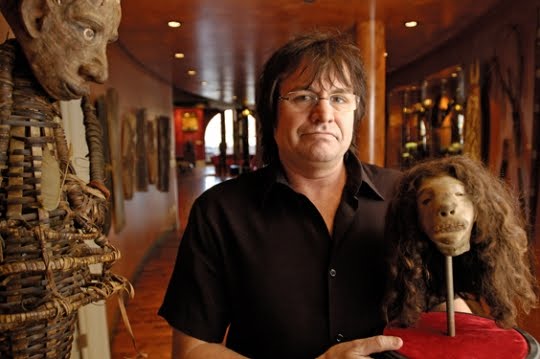
Much has been said about the sad and sudden passing of epic collector and friend to many (including myself!) Billy Jamieson. I am not sure I have anything to add to this often eloquent outpouring of disbelief and grief, except to add note of my own sadness, and to take this moment to mark his passing.
James Taylor put it best, perhaps, on his website "Shocked and Amazed":
Hearing of Bill Jamieson’s death yesterday was about as shocking an occurrence as can be imagined in this business. Still a young man, truly, and a man whose importance to collecting and “spreading the word” had yet to be fully felt, his passing leaves a hole at least 10X larger in the business than the enormous hoard of attractions he leaves behind...
My own experience with Billy was marked by kindness, generosity of spirit, and a sharp and roving intelligence. He loaned us a variety of artifacts from The Niagara Falls Museum--a circa 1827 dime museum whose entire contents he had purchased in 1999--for use in The Coney Island Spectacularium. He also joined us at Coney Island a few weeks back, where we enjoyed the pleasure of his company on the judges stand of The Mermaid Parade followed by a memorable and inspiring lecture in the museum.
I still cannot quite believe he is really dead. He was one of the most full-of-life and inspiring men it has ever been my pleasure to meet.
Rest in peace, Billy. You are--and will continue to be--sorely missed.
Photo sourced from Colorslab.

THIS SATURDAY! Brains in Jars, Old Libraries, and Underground Crypts in New Haven, Connecticut

We have a few more slots open for our awesome all day field trip this Saturday. See following for details, and email me at morbidanatomy [at] gmail.com if you'd like to come along!
FIELD TRIP: Day of Brains in Jars, Old Libraries, and Underground Crypts in New Haven, Connecticut
A chartered bus field trip to New Haven, Connecticut with guided tours of The Cushing Brain Collection, The Institute Library, and The Center Church Crypt and an unguided visit to the Beinecke Rare Book and Manuscript Library
Date: This Saturday, July 16th
Time: 10:00 AM- 7 PM
Admission: $60
Presented by Morbid Anatomy
*** MUST RSVP to morbidanatomy [at] gmail.com
This Saturday, July 16th join Observatory and Morbid Anatomy for a special field trip to New Haven, Connecticut. Our first stop will be the amazing Cushing Collection, with its over 500 human brains in glass jars and haunting pre- and post-operative photographs amassed by "father of modern neurosurgery" Dr. Harvey Cushing. We will be introduced to this collection-- newly open to the public--via a guided tour by Terry Dagradi, curator of the collection. Our next stop will be the historic and lovely Institute Library (founded 1826), Connecticut's oldest living independent literary institution and one of the last remaining membership libraries in North America, where director Will Baker will give us a tour followed by an opportunity for unguided exploration and lunch. Next, we will be treated to a special after-hours tour of the Center Church Crypt, an underground cemetery featuring 137 grave stones of New Haven's founders and earliest citizens going back to 1687. Our final stop will be an unguided visit to the incredible Beinecke Rare Book and Manuscript Library before hopping on the bus for our return home.
Trip Details: The $60 event cost of this event includes round trip transportation on a special chartered bus from Observatory to New Haven and back again as well as tour costs. Please bring your lunch, which we will have an opportunity to eat at our second stop. The bus will pick up and drop off in front of the 543 Union Street (at Nevins Street) entrance to Observatory. Pick up is 10:00 AM sharp and drop off approximately 7:00 PM depending on traffic.
There is a limit for this trip, so please RSVP to morbidanatomy [at] gmail.com if interested.
Images: Of and from The Cushing Collection as featured in The New York Times.

Take a Ride
Click here to view the embedded video.
Hope you don’t get dizzy easily and if you have a hangover you might want to wait 
Twitter epidemics – BMJ video
BMJ medical innovations: During the swine flu pandemic, Google showed that it was able to track the spread using the searches that its users were making. In this video Dr Patty Kostkova shows her work using twitter - and how the data from that could be used to track future epidemics.
Posted at Clinical Cases and Images. Stay updated and subscribe, follow us on Twitter and connect on Facebook.


Indo-Pacific Lionfish Threaten Florida
Lionfish are a colorfully striped fish native to the western Pacific Ocean. They are heavily protected by long, sharp, poisonous spines. And they are invading Florida waters. Lionfish seem to prefer rocky reefs, so are unlikely to be a threat to people enjoying sandy beaches, but they do seem to seriously reduce populations of native [...]
"What We leave Out: The Art of Science Fiction Writing," 92YTribeca, Tomorrow Night
Just found out about this pretty great looking panel discussion featuring former Observatory lecturer Carl Schoonover and Mr. Wilson's Cabinet of Wonder auther Lawrence Wechsler:
What We leave Out: The Art of Science Fiction Writing
Date: Mon, Jul 18, 2011, 7 pm
Venue: 92YTribeca MAINSTAGE
Location: 92YTribeca, 200 Hudson Street
Event Code: TS12D11185Scientific experimentation is as much about what we choose not to study as what we do—researchers must always ignore some elements of a problem to focus on others.
Similarly, writing is a process of taking out as much as putting in, of deciding what we can include and what we must leave untouched. Writers who work with the future tend to care most about a particular aspect—about changes in technology, society or the environment.
Panelists Anna North, Carl Schoonover and Lawrence Wechsler discuss the ways writers fashion a future by whittling down an infinity of possibilities until that which most interests them remains. Join them as they shed light on the processes of writing and experimentation and how the eventual results are only part of the story.
The panel takes place tomorrow night! You can purchase tickets here.
Thanks, Carl, for sending this--and the photograph--along.
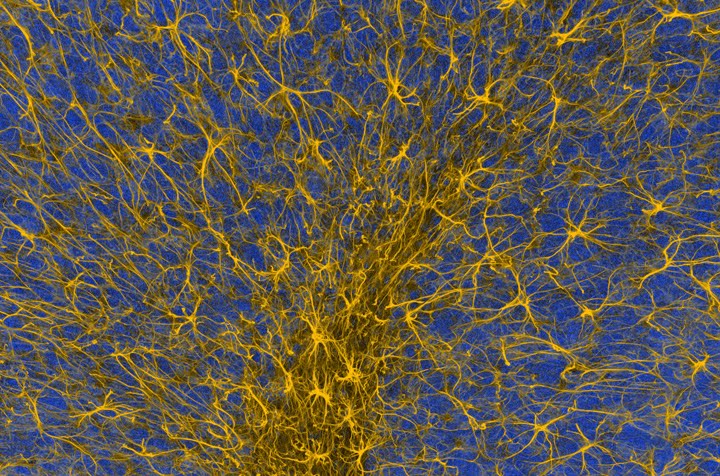
Image; Credit: Thomas Deerinck and Mark Ellisman, 2008.
This image depiects non-neuronal cells in the cerebellum, an area in the back of the brain that play a role in motor coordination. These cells, called glia (yellow), support the activity of neurons, providing nutrients and oxygen. They have been illuminated using a highly, specific antibody-based staining technique, leaving everything else--including the neurons they nurture--invisible in the background (blue).

"What We leave Out: The Art of Science Fiction Writing," 92YTribeca, Tomorrow Night
Just found out about this pretty great looking panel discussion featuring former Observatory lecturer Carl Schoonover and Mr. Wilson's Cabinet of Wonder auther Lawrence Wechsler:
What We leave Out: The Art of Science Fiction Writing
Date: Mon, Jul 18, 2011, 7 pm
Venue: 92YTribeca MAINSTAGE
Location: 92YTribeca, 200 Hudson Street
Event Code: TS12D11185Scientific experimentation is as much about what we choose not to study as what we do—researchers must always ignore some elements of a problem to focus on others.
Similarly, writing is a process of taking out as much as putting in, of deciding what we can include and what we must leave untouched. Writers who work with the future tend to care most about a particular aspect—about changes in technology, society or the environment.
Panelists Anna North, Carl Schoonover and Lawrence Wechsler discuss the ways writers fashion a future by whittling down an infinity of possibilities until that which most interests them remains. Join them as they shed light on the processes of writing and experimentation and how the eventual results are only part of the story.
The panel takes place tomorrow night! You can purchase tickets here.
Thanks, Carl, for sending this--and the photograph--along.
Image; Credit: Thomas Deerinck and Mark Ellisman, 2008.
This image depiects non-neuronal cells in the cerebellum, an area in the back of the brain that play a role in motor coordination. These cells, called glia (yellow), support the activity of neurons, providing nutrients and oxygen. They have been illuminated using a highly, specific antibody-based staining technique, leaving everything else--including the neurons they nurture--invisible in the background (blue).
