
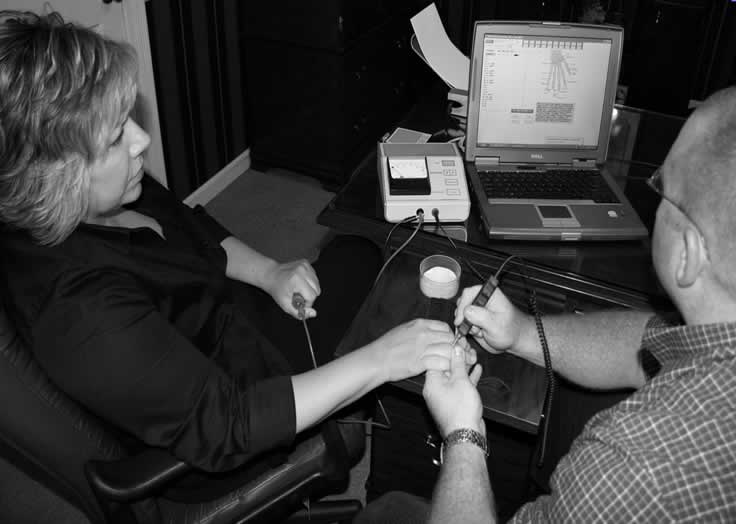
Electrodermal Testing Part I: Fooling Patients with a Computerized Magic Eight Ball

Remember the Magic Eight Ball toy? You could ask it a question and shake it and a random answer would float up into a window: yes, no, maybe, definitely, etc. There is even a website where you can ask an Eight Ball questions online.

I have been meaning to write about bogus electrodiagnostic machines for a long time. These devices supposedly diagnose diseases and/or energy imbalances, indicate which remedies will correct the problem(s), and sometimes even treat the imbalances by transmitting a balancing frequency to the patient. I knew they were bogus, but I had never really realized the full extent of the deception until I viewed a set of training videos recently sent to me by a correspondent. I had never realized how similar electrodermal testing was to the Magic Eight Ball. I was further amazed at how they managed to combine every kind of alternative medicine into one incoherent package and to bamboozle patients with an appalling display of pseudoscientific babble.

This will be a two-part series. In the first, I will describe what the machines and their operators do. In the second (next week), I will address the legal and regulatory issues.

The History of EAV Devices

The first electrodermal diagnostic device was invented in 1958 by Reinhold Voll, a German medical doctor and acupuncturist. He combined acupuncture theory with measurement of galvanic skin responses in the Dermatron. He thought he had discovered that skin conductance was greater at traditional acupuncture points, and he thought he could show that these measurements correlated to diseases in the associated organs. He found that the measurements were affected by allergic reactions. He observed that readings changed when a patient had a bottle of medicine in his pocket. He concluded that some kind of electromagnetic energy was emitted from the medicine and that changes in skin conductance predicted the effects of ingesting the medicine.

One of his students simplified the diagnostic system and created the Vegatest. Other devices followed, including Accupath 1000, Asyra, Avatar, BICOM, Bio-Tron, Biomeridian, Computron, CSA 2001, Dermatron, DiagnoMètre, Eclosion, e-Lybra 8, ELAST, Interro, Interactive Query System (IQS), I-Tronic, Kindling, LISTEN System, MORA, Matrix Physique System, Meridian Energy Analysis Device (MEAD, MSAS, Oberon, Omega Acubase, Omega Vision, Orion System, Phazx, Prognos, Prophyle, Punctos III, Syncrometer, Vantage, Vegatest, Victor-Vitalpunkt Diagnose, Vitel 618, and ZYTO. This is not a complete list. New devices are constantly appearing.

The testing procedure was originally known as electroacupuncture according to Voll (EAV), but is now called by many other names including electrodermal screening (EDS), electrodermal testing (EDT), bioelectric functions diagnosis (BFD), bio resonance therapy (BRT), bio-energy regulatory technique (BER), biocybernetic medicine (BM), computerized electrodermal screening (CEDS), computerized electrodermal stress analysis (CEDSA), limbic stress analysis (LSA), meridian energy analysis (MEA), point testing, and many more.

How It Works

The machine is a galvanometer that measures the electrical conductance of the skin: the same principle used for lie detectors, Scientology’s E-meter, and biofeedback devices. The patient typically holds a metal bar in one hand while the operator applies a probe to acupuncture points on the patient’s other hand. The probe completes a circuit, and a tiny electrical current is sent through the circuit. It is very responsive, so a series of readings can be obtained rapidly. Both contacts are kept wet to improve conduction. There is a whining sound that rises or falls according to the level of conductance. There is also an audible beep indicating that a skin conductance measurement has been made and the machine is ready for the next test. The operator looks for a conductance reading of 50. (Higher readings indicate inflammation and lower ones indicate organ stagnation and degeneration.)  He can control the readings (either consciously or unconsciously) by varying the amount of pressure and the angle of the probe, bunching or stretching the skin, and by adjusting the amount of moisture on the skin. He asks binary yes/no questions: a reading of 50 denotes a “yes” answer. Conveniently, the only meridians and acupuncture points used are on the hands and feet, so the patient doesn’t have to undress.

Systems Using a Hand Cradle

The Zyto website tells us:

A skilled EAV practitioner uses intuition….On one hand, credibility may be high … because of the impressive amount of information that can be obtained through it (I know one practitioner who used the device to find out precisely how well his kids had obeyed house rules while the parents were away). On the other hand, both the fact that accurate information depends on changes in pressure applied by the practitioner and the fact that practitioner knowledge and bias plays an influential role in the results makes many people more skeptical.

To get around this problem, Zyto and other companies eliminate the probe and use a cradle where the hand rests. These devices supposedly interrogate the body with hundreds of tests in a minute or two, producing a computer graphic showing imbalances. Then the operator selects remedies on the screen and the computer indicates how many imbalanced items that remedy would bring back into balance. Testing can even be done remotely through the Internet by connecting a hand cradle to the client’s computer. They acknowledge that the results are not reproducible; but they explain that away. The first reading is the most accurate. It creates observer interference: the act of measuring or observing changes the body’s energetic profile due to quantum indeterminacy. Stephen Barrett of Quackwatch has written about Zyto as “Another Test to Avoid.”

Since all these machines can basically do is generate a small electrical current, how can that single stimulus be differently interpreted by the body to provide all that complex information? How could the body know whether you are asking it about the liver or about the benefit of a homeopathic remedy? Never mind. They are gathering information from the subconscious mind which “knows” the intention of the machine or the operator. You have to believe this, because if the operator is skeptical, the quantum link between the operator and the patient’s mind will interfere with patient response.

An energy medicine website further explains

Remedy testing works with names, symbols and even thoughts of the item to be tested. In all these cases, there is neither substance nor energy involved and the remedy testing works either when the remedy representation is in close proximity to the patient or miles away, and whether he is electrically connected or not.

A Typical Examination

The training videos I viewed were produced by Standard Enzyme in Bremen, GA; the system used was the CSA2001. My correspondent had downloaded these videos from the Internet a long time ago. They are no longer available online, and the company’s website no longer advertises the CSA 2001; but it does continue to offer training courses and seminars on CEDSA (computerized electrodermal stress analysis). I’m guessing the website has been “sanitized” in an effort to avoid regulatory action.

Note: I apologize for the length and mind-numbing detail of the following description, but I think it is helpful to understand what actually goes on during one of these testing sessions.

In the videos the operator tests a volunteer, an apparently healthy 24 year old woman, to demonstrate how he would do an initial assessment on a new patient. The procedure can be broken down into 3 basic aspects: stress analysis, remedy selection, and other stuff.

[Diagram]

Click to enlarge.

Stress Analysis

In the first stage of the demonstration, he assesses various organs and systems by taking readings at different points on her hand and foot (see diagrams above). On her hand, he takes readings for things like the adrenal, circulation, jaw, hypothalamus, ileocecal valve, “organs,” heart, and “triple warmer.” A reading on one side of a finger joint shows allergies; a reading further down the finger shows food allergies. On her foot, he uses points for things like protein metabolism, fiber, uric acid, carbs, triglycerides, joints, skin, fat metabolism, and the ovary/uterus point. The first screen on the computer lists 35 of these points. The operator applies the probe to each.  Of 35 readings, every single one tests abnormal on this patient.

Next he pulls up a screen with a list of the numbers from 1 to 10. He asks how many issues the patient has. It’s OK to use any convenient point for this; he picks circulation. He doesn’t have to verbalize what he is doing. He asks One? Two? Three? When he gets to 3, he gets a 50 reading, so she has 3 major issues. He addresses the first of these 3 issues:

  • Are her issues are emotional or endocrine? The machine tells him endocrine.
  • What major organ is the problem? With yes/no questions he narrows it down to pancreas or intestine. He gets a 50 reading for the pancreas.
  • How many vital force issues does she have? One? No. Two? No. Three? Yes: 3 vital force issues for her pancreas.
  • “I’m going to ask her right brain if it’s an organ, nerve, lymphatic or circulation problem.” Her right brain, or the machine, or something, answers organ and circulation.
  • How much energy will it take to balance out circulation meridian?  An 800X dilution.
  • How much energy to balance the organ meridian? 1000X.
  • Are the islets out of balance? Yes.

He repeats this procedure for the other major issues.

Problem no. 2 is the liver. Its vital force is 1. The organ itself is OK but there is a circulation problem, so he takes measurements at the circulation meridian. He asks if there is a hormone issue and determines that her insulin level is 55% above normal. It’s not clear why insulin comes up under liver rather than pancreas.

Remedy Selection

Using a series of lists, yes/no questions determine what remedies will correct each of the problems he has identified.

  • He opens a computer screen showing a group of products, highlights each and uses the probe at the circulation point to determine what will balance the circulation meridian in her pancreas. It says Alpha orthophos. Then he goes back and looks for other products and finds one more: Circuplus.
  • Back to the organ meridian. He gets a 50 reading on antioxidants. Yes/no questions identify sangre de drago. Several other immune support remedies come up: 2 IV products and graviola. He comments that this shows she is weak in the immune system.
  • He goes back and asks her right brain: is there something more you want to tell us about your pancreas? Yes, some more on organ, but not circulation. Miasm and sycosis show up (miasms were Hahnemann’s homeopathic explanation for the cause of all diseases; sycosis was one of the 3 main miasms).
  • Is there a 4th thing? Yes. Digestive enzymes. She needs dydrin forte. He concludes that she has some hypoglycemic issues.
  • Is there something else? Yes, trace minerals IV. The IV Minerals checklist includes things like heparin, bicarb, procaine. He comments that you need to be careful to get it right, because putting remedies in veins can cause reactions. She needs germanium. How many cc? One – no, 1 ½, no, 2, 2 ½, 3, 3/12, 4, 4 ½ – all no. 5cc finally gets a yes answer. She needs potassium chloride 3.5 cc. For magnesium chloride she needs 31 cc. This is a lot: it shows she has quite a deficiency of magnesium. She needs molybdenum 4.5 cc. and manganese 8 cc. With manganese deficiency you get a lot of headaches because it is necessary for the hypothalamus and pituitary.
  • He asks the machine if that is all for the pancreas? Yes. Finally!

He repeats the process for her other issues. He determines that her adrenals are compromised, with a vital force of 3 and an imbalance on organ and circulation but not on nerve or lymphatics. 1000X balances it. What does this dilution mean? He can’t really explain, but he says it can be measured on consecutive visits and if it goes up it shows she’s getting better. Her adrenal hormone is 5% low. She needs Adrena plus and Norepinephrine. As he goes through more remedies, he comments that “She’s almost a story book case.”  I had to laugh: it is certainly more compatible with a storybook than a textbook.

Then he double checks. When you think you’re done, go back to the food allergy point [why that one?] and ask if there’s anything else.

Now he goes back and retests the original 35 points to see which have normalized. Most have, but lymphatics and lung are still high. There’s a problem with the uric acid point: “that would give me some sort of an idea that there’s some acidosis involved.” [Umm… uric acid has nothing to do with acidosis.] There’s also a urinary bladder problem.

Why did these points not balance? Let’s check for drainage and herbs. The Amazon rainforest group matches. Arcazon matches – it’s good “for any viral, bacterial, whatever, might be in the system.” Back to see whether adding arcazon to the remedy list restores balance to the unbalanced items. It does.

Next phase: dosing. Now he has a list of all the remedies she needs – 11 of them (not counting the trace minerals). For each, he asks what dose she should take (for example, 55 drops). Then he asks how many times a day she should take it. Take with meals or between meals?  Can we reduce it after the first bottle? 2 are for IVs: is it necessary to give them IV? Yes. How many IVs? Every 4-7 days. Can they be combined with mineral IVs? Yes. Can they be given as a push? Yes.

Other Stuff

He asks the machine when the patient should come back for followup. Typical is 4-6 weeks. For her, it says 11 weeks. Then he asks it how many bottles of each remedy he should dispense. He tells her if she runs out of a remedy before 11 weeks, that means she no longer needs it. If she has some left over, the next evaluation may or may not show that she still needs to take it.

How much water does she need to drink a day?  Yes and no questions narrow it down to precisely 50 oz.

He uses a vital force checklist: What is her overall ideal? 86. What is her actual level? 14. He checks vital forces for individual organs: blood 1, immune 3, digestive 2, etc.  What do these vital force numbers mean? He explains it is like carrying water in a leaky pail: vital force is leaking through her holes. She needs to plug the holes so she can retain energy.

Yes/no-ing all areas rated under 10 can give more information about factors common to various problem areas, usually a virus, bacteria or toxin. He tells an anecdote about another patient: “radiation” came up as a common factor for her. He was puzzled at first, but then found the explanation: she had been microwaving her coffee and other foods.

But wait! There’s more! He asks it what her biological age is and determines that it is 71. She looks really good for her age!

Her WTL (will to live) is 1 on a scale of 100. She’s given up internally and needs to do some psychological work.

He does a pH assessment. pH is one of the most important things. Overall her ideal pH is 6.7and her actual pH is 0.7. I don’t know what imaginary universe he’s in at this point, but in the real world that pH would be way incompatible with life. Even stomach acid doesn’t have a pH that low. Her urinary ideal pH 6.5, actual 4.6. “Because she’s got so much acidity in the tissues – everything is acid.” Acid people can’t wear rings because they turn jewelry black. Saliva pH ideal 6.8; actual 6.4. Her blood pH is OK at 7.3 [Science tells us homeostatic mechanisms keep blood pH between 7.35 and 7.45, but he don’t need no stinkin’ science.]  You could use test strips to measure urine pH, but why bother when you’ve got a machine? The machine might disagree with the test strips, but if you are using one method consistently you will see a response.

Using a checklist for other treatments, he also determines that she needs:

  • Footbath – Yes, 3 a week
  • BEST/chiropractic treatments – yes
  • IV EDTA – no
  • Minerals IV
  • Alk ash food diet

Now he asks what makes her vital force so low. 5 issues: miasm, circulation, metabolic acidosis, pancreas, immune dysfunction, in order of priority.

He adds pH enhancer and alpha green to her list of remedies.

Now he asks how many issues there are with the pancreas. It says 3:  miasm, acidosis, and emotions. She needs to correct emotional stress and strain. Yes/no answers narrow her problem down to: emotional issue, incident in past, 16 years ago (at age 8), involves another person, family member, male, father. This is the most important emotional issue and is affecting her blood sugar, acidosis, etc. He stops investigating at this point and leaves the rest to her psychologist: probably a good idea to stop before the machine can accuse her father of raping her.

Now he asks the machine if the analysis is complete. Yes. But we’re not finished yet.

Back to trace metals: we already knew she needs IV infusions of germanium, potassium, molybdenum, and manganese. He adds vitamin C and B vitamins to the list. Asks how much of each she needs. What is best fluid to mix them in? Water, dextrose, or normal saline? Normal saline. What size bag? 500 cc. Duration? 3-3 ½ hours. How many bags? 11. How often: 1 per week. Does she need a hydrogen peroxide IV? No. Does she need a separate glutathione IV? Yes. At the same time? No, but it could be given at another time later in the same day. Then he asks if she will tolerate this? Yes, you don’t need to worry about side effects.

As silly as this demonstration is, there is even sillier stuff out there. On one website, an operator places a laser pointer on the machine and supposedly imprints it with the needed “balancing” frequencies, then runs the light from the laser across the patient’s ear over all the auricular acupuncture points. You have to do this not once but three times. Three’s the charm. You couldn’t make this stuff up!

Harmful Effects

These tests identify numerous nonexistent problems and offer useless remedies. Some of them are potentially dangerous, like IV chelation and IV infusions of trace minerals and vitamins. Some of them are just laughable, like detoxifying foot baths.

Patients are lured away from science-based medical care. They are told that their prescription medications are interfering with the actions of these alternative remedies that could otherwise restore their energetic balance.

And what about the emotional impact of being told at age 24 that you have a will to live of only 1 (out of 100) and a biological age of 71? And being told that you need a complicated regimen of oral and IV remedies to improve your health. Along with footbaths, psychotherapy, chiropractic, etc. At a cost of several thousand dollars.

On a blog, one patient describes her feelings:

every time I walked out of that office I felt horribly flawed, horribly sick, and doomed, somehow. Like every move I made in my life was bad for me. Let’s face it, it’s hard to be healthy in the modern world. But what a weight I felt on my shoulders… I felt like I was 75 years old after those visits and it took me a few days to recover.

Where’s the Evidence?

There isn’t a shred of prior probability, but even the craziest-sounding methods “might” work. If the evidence showed that it worked, we would have to accept it and then try to figure out how it worked. I think this falls under Carl Sagan’s definition of extraordinary claims that require extraordinary evidence. In this case, there isn’t even any ordinary evidence, only the usual testimonials.

I could find only one study suggesting that electrodermal testing might work for anything: it found that electrodermal testing could discriminate between allergens and non-allergens. But a later study by the same group found it useless for diagnosing allergies  And other double blind studies have shown that it could not detect respiratory allergies.

A review of diagnostic methods for allergies classified electrodermal testing among alternative methods that have “no proven benefit and may endanger patients via misdiagnosis.”

Conclusion

Electrodermal testing makes no sense and is not supported by any credible evidence. It is not based on science or grounded in reality; it is more akin to divination with a Magic 8 Ball.  It merits a favorite phrase of Orac’s: a fetid load of dingo’s kidneys.

Next week, in Part II, I will discuss legal issues and regulatory actions.

Facebook Google Buzz Digg <!--<!--LinkedIn StumbleUpon LiveJournal Share

An open letter to NIH Director Francis Collins regarding his appearance at the Society for Integrative Oncology

Note from the editor: Since today is a holiday in the U.S., I had planned on taking the day off. Then I saw the subject of today’s post and had to respond. Also, please remember that, as always, the usual disclaimers apply. This letter represents my opinion, and my opinion alone. It does not represent the view or opinion of my university or cancer center—or anyone else, for that matter, other than me.

Francis S. Collins, MD, PhD
Director, National Institutes of Health

Dear Dr. Collins:

I am normally not one for writing open letters, but in this case I feel compelled to make an exception. This letter will have little or nothing to do with what seems to be the usual criticism leveled against you, namely your intense religious faith and claims. Personally, as a physician and scientist I don’t much care about what religion you follow and, unlike some writers such as Sam Harris, most definitely do not consider your strong Christian faith a disqualification for holding the position that you now hold. All I care about in an NIH director is how well he or she shepherds the scientific mission of the NIH and runs the organization. As a past (and hopefully future) NIH grantee, I want the NIH to fund and support only the most rigorous science and to be a well-run organization. Thus far in your tenure, I haven’t seen any anything major to worry about on that score.

Recently, however, I was very disappointed to discover that you will be the keynote speaker at the 8th International Conference of the Society of Integrative Oncology (SIO) in November. I hope that, when you agreed to accept this speaking engagement, you didn’t know just what it is that what you were accepting or what the Society for Integrative Oncology is, other than a professional society that was interested in hearing your views on faith and spirituality in cancer. In brief, it is our position that “integrative oncology” is a discipline that, at its core, is dedicated to “integrating” pseudoscience with science. No doubt you will think I am exaggerating, but I am not, as I hope to demonstrate. Worse, by agreeing to speak to the SIO, you will be providing it with the imprimatur of your position as NIH director. The NIH, as you know, is the most respected biomedical research institution in the U.S., if not the world, and that respect rubs off wherever you speak.

So, what is “integrative oncology” and why does it concern me as a cancer surgeon and researcher? I have already discussed it in considerable detail, as has my co-blogger Dr. Kimball Atwood, but I will try to summarize again. On multiple occasions, I’ve referred to “integrative oncology” as a “Trojan horse” that is allowing pseudoscience to infiltrate medical schools and academic medical centers. Here is what I mean. Whenever you see discussions of “integrative medicine” (IM) and in particular “integrative oncology,” chances are, the modalities under discussion will usually focus on various dietary changes and lifestyle interventions, such as exercise. Often recommended exercise comes in the form of yoga, tai chi, and other disciplines that tend to be infused with concepts from Eastern mysticism, such as qi (“life energy”). Other modalities featured often include herbal remedies. In other words, “integrative oncology” rebrands modalities that have no reason not to be counted as part of science-based medicine as “alternative” or “integrative” and points to them as having some promise. After all, if you strip away the Eastern mysticism from yoga and tai chi, among others, all you have left is low impact exercise, and there is no reason to consider low impact exercise to be anything “alternative” or “integrative.” Exercise and diet are within the purview of science-based medicine. Herbal remedies are nothing more than a rebranding of the perfectly science-based subdiscipline of pharmacology known as pharmacognosy. Advocates of CAM/IM then lump together pseudoscience like reiki, “therapeutic touch, acupuncture, naturopathy, and even homeopathy with sensible lifestyle interventions, such as diet and exercise, making the association that, if diet and exercise are “alternative” and work, so, too, do modalities that can at best be considered quackery, such as homeopathy.

Perhaps the best place to begin is with the SIO’s very own practice guidelines, which, I submit to you, represent a masterful package of rebranding of perfectly science-based modalities, such as lifestyle interventions and changes in diet, which are then tied to “energy healing” quackery as if there were an equivalent evidentiary basis to support them. For instance, some of the recommendations of the SIO are, as Dr. Atwood put it, embarrassingly obvious. For example:

  • Recommendation 1: Inquire about the use of complementary and alternative therapies as a routine part of initial evaluations of cancer patients. Grade of recommendation: 1C
  • Recommendation 6: The application of deep or intense pressure is not recommended near cancer lesions or enlarged lymph nodes, radiation field sites, medical devices (such as indwelling intravenous catheters), or anatomic distortions such as postoperative changes or in patients with a bleeding tendency. Grade of recommendation: 2B
  • Recommendation 7: Regular physical activities can play many positive roles in cancer care. Patients should be referred to a qualifi ed exercise specialist for guidelines on physical activity to promote basic health. Grade of recommendation: 1B (1A for breast cancer survivors post-therapy for QoL)
  • Recommendation 15: It is recommended that patients be advised regarding proper nutrition to promote basic health. Grade of recommendation: 1B

What is “alternative” about any of these recommendations? Nothing. Physicians routinely ask what supplements or “alternative” therapies their patients are using. It’s simply mind-numbingly obvious common sense not to use deep massage or pressure near cancer lesions, enlarged lymph nodes, radiation field sites, or near medical devices, such as Portacaths or other indwelling implantable devices. What physician would not recommend proper nutrition or regular physical activity, as much as the patient can tolerate, under the guidance of an exercise specialist? Then, coupled with the above sensible recommendations, we find this:

  • Recommendation 3: Mind-body modalities are recommended as part of a multidisciplinary approach to reduce anxiety, mood disturbance, chronic pain, and improve QoL. Grade of recommendation: 1B
  • Recommendation 8: Therapies based on a philosophy of bioenergy fields are safe and may provide some benefi t for reducing stress and enhancing QoL. There is limited evidence as to their effi cacy for symptom management, including reducing pain and fatigue. Grade of recommendation: 1B for reducing anxiety; 1C for pain, fatigue, and other symptom management

I find it most interesting to note what the SIO considers “1B” evidence:

Strong recommendation, moderate-quality evidence

How on earth can one reasonably make a “strong recommendation” on “moderate-quality” evidence, even assuming one agrees that the evidence is “moderate-quality”? The SIO defines “moderate quality” evidence as:

RCTs with important limitations (inconsistent results, methodological flaws, indirect, or imprecise) or exceptionally strong evidence from observational studies.

Also confusingly, the SIO makes “strong recommendations” based on “moderate” evidence (level 1B). In other places, it makes “strong recommendations” based on “low or very low quality evidence” (level 1C). Doesn’t it make you wonder why the SIO had to make up its own categories of evidence, rather than use accepted evidence-based medicine categories of evidence? Certainly, I wonder. I also wonder how the SIO could categorize instructing patients “regarding proper nutrition to promote basic health” as only category 1B.

As for other recommendations made by the SIO, rating the evidence for “energy healing” methods—or, as the SIO calls them, “therapies based on a philosophy of bioenergy fields”—as grade 1B vastly overestimates the quality and quantity of evidence in favor of “energy healing methods. Moreover these therapies are based on an unproven concept that there is an “energy field” or a “life energy” that can be manipulated for therapeutic intent. Never mind that no scientist has ever been able to measure or detect these “energy fields” or to verify that practitioners can actually manipulate them to therapeutic purpose. Never mind that the very concept is based on a vitalistic, pre-scientific understanding of how the human body works and how disease develops. I note that this includes acupuncture, whose premise is that sticking needles into the skin can somehow alter the flow of this life energy to healing effect. I also note that the totality of evidence regarding acupuncture is that it does no better than placebo when tested in well-designed randomized clinical trials. It doesn’t matter where the needles are placed or even whether the needles are placed. Indeed, even twirling toothpicks against the skin works as well as needles. Truly, as Steve Novella put it, acupuncture is the selling of nonspecific effects. Meanwhile, acupuncture apologists publish papers in which fanciful physiological mechanisms by which acupuncture allegedly works are proposed and poorly supported with evidence.

I note that the title of your talk is “Faith, Spirituality and Science in Oncology.” No doubt your intense religious faith is one reason why the SIO invited you. In actuality, in the world of “alternative” medicine,” “complementary and alternative medicine” (CAM), or IM (or whatever you want to call it), religious faith or “spirituality” is often co-opted to be the “foot in the door” for quackery in a manner very similar to how diet and exercise have been so co-opted. For example, are you familiar with reiki? It is one of the more prevalent of CAM/IM modalities, and it is currently being extensively used in cancer, even though the evidence base for it is virtually nonexistent. I have in the past referred to reiki many times as faith healing substituting Eastern mystical beliefs for Christian beliefs, and that is an accurate description. What is faith healing? It’s the belief that a healer can channel the power of God into the ill to heal them. What is reiki? Reiki involves channeling “energy” from what reiki masters call the “universal source” into the ill to heal them. Like faith healers, who assert that the power doesn’t come from them but from God, reiki masters assert that the power doesn’t come from them but rather from the “universal source.” Indeed, the founder of reiki, Dr. Mikao Usui explicitly patterned reiki on how Jesus healed:

Dr. Usui was a Christian minister in Japan, though Japanese. He was the head of a Christian Boys School in Japan. One day some of the students asked him if he believed in the miracles which Jesus did (healing, etc). Being a Christian minister he answered “Yes”. They asked if he knew how Jesus had done this, “No” he said…

With this he resolved to find the way in which Jesus had healed. This immediately set him on a journey of many years. Studying first at Christian schools in the US, for where else to learn of Jesus, but with no results. In the Christian schools the method was not known.

Dr. Usui even subjected himself to a 21 day fast on a mountain that very much resembled Jesus’ 40 days and 40 nights in the wilderness:

After a few more years of study, he felt he had come to an understanding and that to go further required serious meditation. He went to a nearby mountain declaring his intention to fast and meditate for 21 days and that if he did not come back they should come and get his body.

He went to the mountain and settled in with 21 stones with which to count the days. On the 21st day nothing had come as yet, and he turned over the last stone saying “Well, this is it, either I get the answer today or I do not”. At that moment on the horizon he could see a ball of light coming towards him. The first instinct was to get out of the way, but he realized this might just be what he was waiting for, so allowed it to hit him right in the face. As it struck him he was taken on a journey and shown bubbles of all the colors of the rainbow in which were the symbols of Reiki, the very same symbols in the writings he was studying but had been unable to understand. Now as he looked at them again, there was total understanding.

After returning from this experience he began back down the mountain and was, from this moment on, able to heal. This first day alone he healed an injured toe, his own starvation, an ailing tooth and the Abbots sickness, which was keeping him bedridden. These are known as the first four miracles.

I would respectfully submit to you as a scientist and man of faith that science- and evidence-based medicine should not be concentrating on miracles and faith healing. Yet that is what most “energy healing” modalities (reiki, therapeutic touch, and, yes, acupuncture) boil down to. It’s not for nothing that in 2009 the U.S. Conference of Catholic Bishops warned Roman Catholics to shun the eastern healing art of reiki because it lacks scientific credibility and is dangerous to Christian spiritual health. Some Christians even view reiki as a sin. Moreover, huge swaths of other CAM/IM modalities are based on similar beliefs that are rooted in faith, spirituality, and even outright magic. The common CAM/IM modality of homeopathy, for example, is based on the concepts of sympathetic magic, and naturopathy, which many SIO practitioners recommend, requires homeopathy as part of its training, which is why many naturopaths are also homeopaths.

We at SBM have criticized two institutions of the NIH for promoting and funding unscientific research, quackery even. These institutions include the National Center for Complementary and Alternative Medicine (NCCAM) and the National Cancer Institute’s (NCI) Office of Cancer Complementary and Alternative Therapy. Indeed, Dr. Atwood once wrote an open letter similar to this to NCCAM director Dr. Josephine Briggs when she agreed to speak at the annual conference of the American Association of Naturopathic Physicians last year and for the same reason that I’m writing this open letter now. The difference is that Dr. Briggs’ decision to speak to the AANP was more understandable than your decision to speak to the SIO; the reason is that, as strenuously as I and my fellow bloggers at SBM might object, NCCAM exists to study and promote “alternative” medicine. Consequently, the AANP can reasonably be considered to be within Dr. Briggs’ bailiwick. Moreover, NCCAM is but one center in the huge institution that is the NIH; her appearing at the AANP conference last year says far less about the NIH’s position with respect to unscientific “alternative medicine” modalities than your appearing in front of the SIO does.

I submit to you that SIO is trying to take advantage of your well-known religious faith in order to use your reputation as a scientist and as NIH director to claim for itself the mantle of scientific respectability that it does not merit. Instead of “bait and switch” rebranding science-based modalities such as diet and exercise as “alternative,” the SIO is rebranding religion and spirituality as somehow being “alternative medicine.” That is why I conclude by asking you most respectfully to reconsider. You represent the entire NIH, not just a single center in the NIH or an office in one institute in the NIH. Where you speak matters, and it matters a whole lot more than where Dr. Briggs chooses to speak. If you believe that we here at SBM are exaggerating or being unfair, we and others stand ready to provide you with all the supporting material you might require to be persuaded that we are not. We all strongly believe, as no doubt you do, that cancer patients deserve the best in science- and evidence-based medicine. Unfortunately, “integrative” oncology” provides nothing of the sort. It adds nothing to cancer care other than the rebranding of sensible treatments as “alternative” and the “integration” of unscientific, unproven, and potentially harmful “alternative” treatments with science-based treatments.

Cancer patients deserve better.

Finally, in these days of tight budgets resulting in even tighter paylines not seen in nearly 20 years, with no improvement in sight, please think about this one last thing. Between NCCAM and OCCAM, the NIH spends a quarter of a billion dollars a year studying and promoting a hodgepodge of modalities that range from being sensible science-based treatments, such as diet and exercise, to modalities that can only be referred to as being based on magical thinking (homeopathy, therapeutic touch, reiki, acupuncture, etc.). When budgets are this constrained, does the NIH have the luxury of spending a quarter of a billion dollars a year, or approximately 1% of the total NIH budget, half of which is nearly 3% of the NCI budget, on research that is exceedingly unlikely ever to benefit patients? For example, NCCAM has already spent over $2 billion since its inception in the 1990s and has yet to demonstrate convincingly that a single “alternative” medicine modality provides concrete benefits greater than placebo effects.

You are a man of science and faith. Your current position is a scientific one, and I have no doubt that you want to shape the NIH into a form that is dedicated to the best possible science we can get for the money and to promote that science. I hope you will realize that speaking at the SIO conference does not serve that end, nor does continuing NIH support for NCCAM and OCCAM. The division of medicine into “conventional” and “alternative,” “complementary and alternative,” or “integrative” medicine is a false dichotomy. There should be only medicine, and the scientific standards for determining what is and is not safe and effective medicine should be the same. It is my sincere hope that you, as NIH director, will not by speaking at the SIO conference support the false dichotomy that tries to foist unscientific medicine upon cancer patients as “integrative” medicine.

Sincerely

David H. Gorski, MD, PhD

Facebook Google Buzz Digg <!--<!--LinkedIn StumbleUpon LiveJournal Share

Skinson 1634AR15 Compliance

Skinson’s 1634AR15 Competency Controlled Certification of Compliance
New Compliance structure makes a compliance officer’s life much easier.

Dallas — In a world where auditor to auditor reports are out of control and we have a mountain of complex compliances to worry about, one competent compliancy controlled certification of compliance finally comes forth (and not a minute too soon).

“This new groundbreaking idea will change the lives of many competing auditing firms, law firms, accounting firms and so on,” says Steve Kinman. “I spend countless hours reading controls for one report and different controls for another report, and the only difference is the verbiage and format.”

The new Skinson 1634AR15 Certification combines your SAS70, SSAE16, ROC, VOC, SOC, NIST, SARBOX, PCI, OMB, ACART, CFDA, HIPAA and SAFE HARBOR compliance into a single report using a set framework that automorphs based upon which auditor is touching the report or viewing it in the state of the art Skinson Portal.

“The Skinson portal is mind-blowing,” says Val Stinson. “The automorph feature is something straight out of the movies. It knows who is reading and can change the wording on the fly. This keeps auditors from scratching their heads when the words in the report don’t match the words their instruction book.”

The introductory price for full Skinson 1634AR15 Compliance Certification is $1,000,000 USD. This is all-inclusive and will sufficiently cover all of your compliance needs.

Contact:
Steve Kinman
skinman@softlayer.com

About Skinson
Headquartered in Dallas, Texas, Skinson is a fictional company that likes to poke fun at the difficult job of compliance in the world. While we find that it can be overwhelming at times, we understand that compliance is a necessary evil. We would like to note that something like we dream about above would be very nice and would save the world a ton of work and cut down on our carbon footprint considerably. If you are in a position of control and can make the above happen please help us!!

On a side note, SoftLayer will do everything we can to help you with any compliance you need. Just ask your local sales team for help, and they will find the right person and get you in contact.

-@skinman454

P.S. The actual reason for this blog post is that we just announced that the control procedures and compliance for our 11 data centers have been verified in a http://www.aicpa.org/interestareas/accountingandauditing/resources/soc/pages/sorhome.aspx (SOC 1) prepared under the terms of the Statement on Standards for Attestation Engagements No. 16 (SSAE 16) by independent auditing firm Weaver.

Technology Partner Spotlight: The Server Monitor

Welcome to the next installment in our blog series highlighting the companies in SoftLayer’s new Technology Partners Marketplace. These Partners have built their businesses on the SoftLayer Platform, and we’re excited for them to tell their stories. New Partners will be added to the Marketplace each month, so stay tuned for many more come.
- Paul Ford, SoftLayer VP of Community Development


Scroll down to read the guest blog about The Server Monitor from Otto Papp of Blue Panther. The Server Monitor is a featured service in the SoftLayer Tech Partner Marketplace that makes it easy for customers to get a deep view of what is happening on their servers. To learn more about The Server Monitor, visit http://theservermonitor.com/.

Know What’s Happening on Your Servers

The Server Monitor was born when we noticed a need in our company. We have been developing and maintaining online businesses for more than 6 years now, and in that time we encountered all kinds of problems. We know very well that any interruption of a service can have many negative effects, so to track and prevent service interruptions we needed a monitoring tool. We tried both commercial and open-source software, but none of them was suited for the job, so we set out to create a product that met six key requirements:

1. Simple Setup, Simple Configuration and Simple Maintenance
While we were searching for a monitoring tool, we many solutions. Most of them were really painful to install and even worse to configure. If you have a service that needs to be scaled and you need to upgrade servers or change your infrastructure, you don’t want to waste your time repeating a painful job over and over again. The same thing holds true if you simply have to manage more than a few servers.

In response to this need, The Server Monitor’s agent was built to be installed and configured under two minutes on every server. Unlike with some of the other tools out there, you don’t have to be an expert in administration and configuration thanks to the meticulous design of the application and its user interface. Even when this tool evolves and improves, it is easily upgraded via a powerful (and simple) built-in upgrade mechanism.

The tool helps you avoid using your server to store monitoring data and frees you from having to install and maintaining a dedicated monitoring data database. Using an agent also helps The Server Monitor consume less of your server’s computing power in the monitoring process.

2. Ease of Use
We wanted a tool that could be easily understood by our clients, so we built the user experience with very clear visuals like our customizable graphical reports. These reports can help non-technical people understand what’s happening on a given server, and they help seasoned systems administrators track down the root cause of any server problems to any component of their system as well. Unfortunately, some of the best solutions on the market were hard to understand and analyze, even for us, as a technical team. That’s why we focused a lot on clearly presenting only relevant data.

3. Accurate and Advanced Monitoring
Another big issue we ran into was the accuracy of the monitored data. Some solutions offered a 5, 10 or 30 minute reading which is not very helpful when you’re debugging a problem or detecting an outage. Others had second- or minute-based monitoring frequency but delivered inaccurate results.

We built The Server Monitor to provide a high level of accuracy by computing the average variation of the monitored data over one minute. We are developing dedicated monitors to all the major services usually used on servers, and by truly understanding these services, we can customize the readings to offer the best view of what’s happening with each service.

4. Early Warning for Potential Disasters
The most valuable aspect of good server monitoring tools is their ability to notified users of major events. If your monitoring tools are local on the server, if the server goes down, the monitoring system does too, so you didn’t get notified. On the other side, we noticed that the online solutions couldn’t provide very much in the way of detailed information.

This is one of the reasons why we opted for an agent-based solution which notifies you when things start to go wrong so you can take immediate action. The Server Monitor includes a powerful alert system with an unlimited number of configurable alerts that can be sent out in real time via SMS, Twitter or email.

5. A Centralized View
In order to speed up our customers’ routine administration checks, we built a unified interface where all the servers monitored can be seen quickly. That centralize view continues to evolve as we get feedback from customers, and we’ll keep tweaking it to make sure we convey the most relevant data on each server as simply as possible. With that goal in mind, we’ve also built a report-sharing system, that allows customers to check these reports in their own interfaces.

6. Flexibility for Developers
While The Server Monitor is an online service, we also develop highly sophisticated software engines (in our spare time). These programs are very different, so each would need a unique kind of monitoring tool, but creating specialized tools with limited scopes would be time consuming and inefficient. We couldn’t find any existing solution to solve this problem so we came up with our own! The idea is simple, your software collects and computes its specific metrics and gives them to the agent program which sends them to the central system. From there, you can then analyze, compare and follow their information.

Initially, our goal was to build a monitoring platform that worked for us, and in the process, we built a product that could be extremely useful to other developers in our position, so we began offering the service externally. We have a free version of the software that you’re welcome to try on your own servers, and if you want to take advantage of some of the additional features and functionality of the system, we have a 30 day trial to see if it fits your requirements.

-Otto Papp, The Server Monitor

Texas House Bill 1841: Hosting and Taxes

Okay, so you’ve read the title and passed out already … but wait – this is good stuff! Well, maybe not “good,” but at least it’s relevant. The esteemed governor of Texas with the big Texas hair (and aspirations of taking his big hair out of Texas) recently signed House Bill 1841 (HB1841) into law, and that law is significant to many of SoftLayer’s customers.

Last year, the Texas Comptroller’s Office amended a regulation and stated that the use of a server in Texas was adequate to establish a nexus, so an e-commerce vendor who used a Texas web host was required to collect sales tax from their customers even if the vendor had no other presence in the state of Texas. This amendment immediately created issues for web hosts with data centers in Texas: Why would customers get servers from a host in Texas and have to worry about this tax obligation, when they could do business with another host outside of Texas and not have this obligation?

Well, the Comptroller’s Office started to realize the effect of this regulation and began to backpedal and say that they didn’t really mean what they said.

HB1841 puts the Texas hosting industry back where it was before the Comptroller made those changes: The use of a server located in Texas without any other presence is not considered a substantial nexus for collecting sales taxes. HB1841 specifically states that “A person whose only activity in this state is conducted as a user of Internet hosting is not engaged in business in this state.” Note: You may be wondering if this bill applies to Amazon in Texas, but HB1841 doesn’t cover Amazon because they had a physical presence in Texas (albeit one operating under a different affiliate with a different name), requiring them to pay sales taxes.

Our very own Brenk Johnson was involved in the effort to pass HB1841. He attended a couple of committee hearings, and he’ll tell you his mere presence got this out of committee and in front of our governor. He is quoted as saying, “I can sit in a meeting with the best of them.”

At the risk of making this blog sound like an Academy Awards reception speech, we would like to thank Jeff Clark and the crew over at TechAmerica for helping to get this bill passed. TechAmerica is a technology advocacy group that we recently joined, and they have a cracker-jack lobby group. Our CFO and I were on the verge of hiring a lobbyist for the 2009 Texas session, but we ended up not doing so. Two years later, we decided to go with this industry group, and the verdict is that TechAmerica has been a great investment … It was also through this group that Lance became a Cloud Commissioner! We also want to thank our competitors over at RackSpace, especially their General Counsel Alan Schoenbaum, for getting us involved and for leading and spearheading the passage of this bill … What was good for the goose was good for the gander on this one.

Because we are back to where we were a couple of years ago in the definition of nexus with relationship to hosts with data centers in Texas, this was not really a game-changing bill. It was important to clarify and undo the damage caused by the waffling that occurred in the State’s Comptroller’s Office, so in that sense this was a good bill for the industry. Next session we’re going to aim for the game-changer: Margin taxes!

-Suzy

Presentation on Marine Ecosystem Services Database by Linwood Pendleton of Duke University

Date: 
Thursday, September 15, 2011

Presentation on Marine Ecosystem Services Database by Linwood Pendleton of Duke University (September 15 at 1 pm EDT/10 am PDT/5 pm GMT).  The Marine Ecosystem Services Partnership (MESP) is a spatial portal and community of practice to help policy makers find data on marine ecosystem services and researchers who conduct these studies.  The MESP launched its website http://www.marineecosystemservices.org in May 2011.  The website offers a dynamic mapping tool that spatially represents the MESP database of over 2,000 values of economic valuation data.  The mapping tool allows users to burrow down through different types of data through spatial and thematic searches.  The MESP database is not intended to replace other valuation databases.  Rather, the Partnership strives to be a community of practice through which data users and managers can work collectively to better integrate ecosystem services data with marine policy needs.  The effort is directed by Duke University’s Nicholas Institute for Environmental Policy Solutions, in collaboration with The Ocean Foundation and Duke’s Marine Geospatial Ecology Laboratory. Learn more at http://www.marineecosystemservices.org. Register for this webinar at https://www1.gotomeeting.com/register/439569360.

Keeping an open mind on the spiritual side of life – The Age


The Age
Keeping an open mind on the spiritual side of life
The Age
Judith Lucy considered becoming a nun before finding enlightenment in the earthly pleasures of sex and alcohol. After the death of her parents, Judith Lucy found herself asking the big questions. JUDITH Lucy lost her religion more than two decades ago. ...
When it's time to lift the spiritsSydney Morning Herald

all 6 news articles »