CPAP for sleep apnea – BMJ video

BMJ: Sleep apnoea (apnea, in its American spelling) is a condition that causes a patient to stop breathing for short periods during their sleep. In this video researchers Joaquín Durán-Cantolla and Jose María Montserrat discuss their work into the use of CPAP (continuous positive airway pressure) to treat the condition.

People with OSA may be twice as likely to develop a stroke.
Did you know that obstructive sleep apnea (OSA) can reduce a child’s IQ by as many as 10 points, while treatment in children with OSA can improve school grades?
Related:
Mavs Fan at the Finals - Photos - SI.com http://goo.gl/tIdL3

Posted at Clinical Cases and Images. Stay updated and subscribe, follow us on Twitter and connect on Facebook.


Open Melting Points on iPhone via MMDS

As Alex Clark explained on his blog Cheminformatics 2.0, both predicted and experimental melting points from our Open Data collection are now available on iPhones via his MMDS webservices protocol.


Although the app is not free, the web service (#7 from our collection) that Andrew Lang and Alex created for this purpose is Open and available for anyone to use. It reads an XML formatted molfile and returns the average measured melting point, predicted melting point, SMILES, CSID and a link to the ChemSpider entry.

The quest to determine the melting point of 4-benzyltoluene

reported that we are attempting to curate the open melting point measurements collected from multiple sources such as Alfa Aesar, PhysProp (EPIsuite) and several smaller collections. I mentioned that some values - like benzylamine - simply don't converge and the only way to resolve the issue is to actually get a high purity sample and do a measurement.Since that report, we found another non-converging situation with 4-benzyltoluene. As shown below, reported measurements range from -30 C to 125C.The values in red have been removed from the calculation of the average based on evidence we obtained from ordering the compound from TransWorld Chemicals and observing its behavior when exposed to various temperatures. The details can be found from UC-EXP266 (which I performed with Evan Curtin).Immediately after opening the package it was clear that the compound was a liquid and thus the 125C and 98.5C values became improbable enough to remove.
First Evan Curtin and I dropped the still sealed bottle into an ice bath (0C) and after 10 minutes there was no trace of solidification.
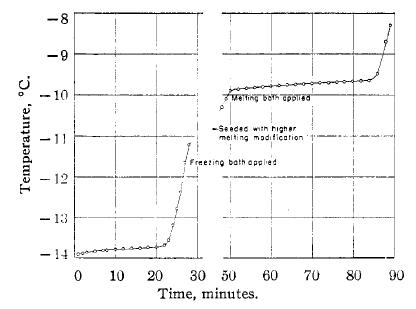
At this point, this does not necessarily rule out the values near 5C because of the short time in the bath.We then used an acetone/dry ice bath and did see a rapid and clear solidification after reaching -30C to -35C.Letting the bath temperature rise it was difficult to tell what was happening but there seemed to be some liquefaction around -12C.In order to get a more precise measurement, we transferred about 2 mls of the sample into a test tube and introduced the thermometer directly in contact with the substance. After quickly freezing the contents in a dry ice/acetone bath, the sample was removed and its behavior was observed over time, as shown below.
I was expecting to see the internal temperature rise then plateau at the melting point until all the solid disappeared and then finally observe a second temperature rise. This comes from experience in making 0C baths within minutes by simply throwing ice into pure water.As shown above that is not at all what happened. The liquid formed gradually starting at about -9C and never reached a plateau even up to +7C, where there was still much solid left.If we look at the method used to generate the 4.58 C value (Lamneck1954) we find that a similar method was cited - but not actually described there. The actual curves are not available either. However, this paper provides melting points for several compounds within a series, which is often useful for spotting possible errors - unless of course these are systematic errors. In this particular case it doesn't help much because the 2-methyl derivative is similar but the 3-methyl analogue is very close to -30 C value listed in our sources.Notice that one of the "melting points" (3-methyldicyclohexylmethane) is not even measurable because it forms a glass. It is easy to see how melting points below room temperature can generate very different values - and very difficult to assess if the full experimental details of the measurements are not reported.Trying to get at more details lets look at the referenced paper (Goodman1950). Indeed the researchers determine the melting point by plotting the temperature over time as the sample is heated and looking for a plateau. The obvious difference is that the heating rate is about an order of magnitude slower than in our experiment.
This paper also highlights the fact that there are more twists and turns in the melting point story. One compound (2-butylbiphenyl) was found to have 2 melting points that can be observed by seeding with different polymorphic crystals.
At this point, our objective of obtaining an actual melting point was replaced with trying to at least mark a reasonably confident upper limit. After leaving the sample at -15 C in a freezer for two days, no solidification was observed - not even an appreciable increase in viscosity. For this reason, all melting point values above -15C were removed from the calculation of the average and show up in red.With only the -30 C measurement left, this is now the default value for 4-benzyltoluene - until further experimentation.

]]>

MizEnScen

MizEnScen ribcage

MizEnScen heart

I stumbled upon these gems on tumblr. I don’t know much about the artist, MizEnScen, but I do know that you can purchase the ribcage print from Society6 (16 – 26 bones depending on the size).


Sutured But Not Healed

Suture arm Photo by Øystein Horgmo

Photo by Øystein Horgmo © All Rights Reserved. Click for larger image.


Suture arm Photo by Øystein Horgmo

Photo by Øystein Horgmo © All Rights Reserved. Click for larger image.


Suture arm Photo by Øystein Horgmo

Photo by Øystein Horgmo © All Rights Reserved. Click for larger image.

As a medial photographer, Øystein Horgmo, captures some of the most interesting subjects imaginable.  This specimen, found in a medical student’s practical skills center, is covered in the attempts to heal fleshy lacerations which many of them are, as Øystein says, “sutured, but none of them healed.”

But really, this reminds me of my arm after a few minutes of playing with my cat.

View more of Øystein‘s work on his fascinating blog, The Sterile Eye.


Project RED

Project RED by Marijana Gligic and Milica Shishalica

Project RED by Marijana Gligic and Milica Shishalica

Project RED by Marijana Gligic and Milica Shishalica

Photography: Marijana Gligic
Hair: Milica Shishalica

That’s one of the coolest haircuts I’ve ever seen.  Love the red, love the anatomy, love the model.

Project RED is the brainchild of photographer/designer, Marijana Gligic and hairstylist, Milica Shishalica who founded CUT Team, which brings together people from many creative fields, including photography, hairstyling, makeup, fashion, and set design.  The successful combination of these creative fields is made strikingly apparent in these photography that marry cutting edge hair and makeup with medical imaging and anatomy.


A Paradise Bizarre: Benefit Party for the Fabulous, Incomparable Proteus Gowanus Interdisciplinary Gallery and Reading Room


Proteus Gowanus Interdisciplinary Gallery and Reading Room--my hands down favorite gallery in New York!--is having an excellent sounding benefit party this Saturday evening, and you are invited. Free food and wine and a variety of paradisical and profane amusements await! Oh, and its a good cause, too; Support Proteus Gowanus and you also support Observatory and the Morbid Anatomy Library, who number among its projects in residence!

Very much hope to see you there.

A Paradise Bizarre
A Fairground of Acts, Exhortations and Seductions
and our 2011 Benefit Celebration
Saturday, June 11, 7-10 pm

A carnival-bazaar of music, dancers, writhers, preachers,
fixers, puppets, therapists - in intimate interactions -
designed to save your soul or make you forget you ever wanted to.

Paradise Bizarre is the culmination of our
yearlong exploration of Paradise
through art, artifacts, books, performances and events,
bringing together old and new Protean collaborators

True believers, heathens, skeptics, pagans, atheists and heretics all welcome!

Music by
Goddess!
Harpist Crista Patton

Special Guests:
Nina Katchadourian, artist
Dickson Despommier, Vertical Farming visionary
Saint Peter, at our gate

Food and wine donated by Marquet Patisserie, Stinky Brooklyn, Brooklyn Fare
and others to be announced

Buy your $60 tickets now (less for groups)

PERFORMERS:
Paul Benney, Dark Forest: A Tour of the Underworld
Burlesque Dancers
Dickson Despommier, a sermon
Goddess! the band
Ethan Jacob Gould, The Dybbuk and the Daughter: A Puppet Show
Nina Katchadourian, a song
Madhu Kaza, This Is Where We Meet: a bedtime story
Rosamond King, Poetry Doctor
Clarinda MacLow and Onome Ekeh, Cyborg Teknotherapists
Tessa Murphy, Angel
Crista Patton, Harpist
The Poetry Brothel
Peter Simon, St Peter

Plus assorted Ranters and Sermonizers at the open pulpit,
including you if the spirit moves you!

To find out more about Proteus Gowanus, click here; to find out more about the benefit party, and to purchase tickets, click here.

Blog Briefs: A great resource: The National Academies Press makes all pdf books free!

About Blog Briefs: Having become too busy to write a lot, I have decided to blog briefly, throwing out news and opinions that might interest people who stop by. Moving on...

The National Academies Press!

It is highly unlikely that you haven't heard about the NAP, a confluence of various US organizations that publish several reports a year. Whether you are in sciences, engineering, entrepreneurship or policy making, you would use any valuable information that comes your way for free, right? Well, I read this press release, and jumped on the NAP site to find out that there are over 4,000 books that are now downloadable for free!

I tested one and found it really simple to access a book by subject and launch the download. While you could register and access some of their deals and such, you could also just proceed as a guest..

Link: http://nap.edu

Alkaline peroxide pretreatment of corn stover: effects of biomass, peroxide, and enzyme loading and composition on yields of glucose and xylose

Background:
Pretreatment is a critical step in the conversion of lignocellulose to fermentable sugars. Although many pretreatment processes are currently under investigation, none of them are entirely satisfactory in regard to effectiveness, cost, or environmental impact. The use of hydrogen peroxide at pH 11.5 (alkaline hydrogen peroxide or AHP) was shown by Gould and co-workers to be an effective pretreatment of grass stovers and other plant materials in the context of animal nutrition and ethanol production. Our earlier experiments indicated that AHP performed well when compared against two other alkaline pretreatments. Here we explored several key parameters to test the potential of AHP for further improvement relevant to lignocellulosic ethanol production.
Results:
The effects of biomass loading, hydrogen peroxide loading, residence time, and pH control were tested in combination with subsequent digestion with a commercial enzyme preparation, optimized mixtures of four commercial enzymes, or optimized synthetic mixtures of pure enzymes. AHP pretreatment was performed at room temperature (23C ) and atmospheric pressure, and after AHP pretreatment the biomass was neutralized with HCl but not washed before enzyme digestion. Standard enzyme digestion conditions were 0.2% glucan loading, 15 mg protein/g glucan, and 48 h digestion at 50degreesC. Higher pretreatment biomass loadings (10% - 20%) gave higher monomeric glucose (Glc) and xylose (Xyl) yields than the 2% loading used in earlier studies. An H2O2 loading of 0.25 g/g biomass was almost as effective as 0.5 g/g, but 0.125 g/g was significantly less effective. Optimized mixtures of four commercial enzymes substantially increased post-AHP-pretreatment enzymatic hydrolysis yields at all H2O2 concentrations compared to any single commercial enzyme. At a pretreatment biomass loading of 10% and an H2O2 loading of 0.5 g/g biomass, an optimized commercial mixture at total protein loadings of 8 or 15 mg/g glucan gave monomeric Glc yields of 83% or 95%, respectively. Yields of Glc and Xyl after pretreatment at a low hydrogen peroxide loading (0.125 g H2O2/g biomass) could be improved by extending the pretreatment residence time to 48 h and readjusting the pH to 11.5 every 6 h during the pretreatment. A Glc yield of 77% was obtained using a pretreatment of 15% biomass loading, 0.125 g H2O2/g biomass, and 48 h with pH adjustment, followed by digestion with an optimized commercial enzyme mixture at an enzyme loading of 15 mg protein/g glucan.
Conclusion:
Alkaline peroxide is an effective pretreatment for corn stover. Particular advantages are the use of reagents with low environmental impact and avoidance of special reaction chambers. Reasonable yields of monomeric Glc can be obtained at an H2O2 concentration one-fourth of that used in previous AHP research. Additional improvements in the AHP process, such as peroxide stabilization, peroxide recycling, and improved pH control, could lead to further improvements in AHP pretreatment.

Assisted hatching of human embryos: a systematic review and meta-analysis of randomized controlled trials

BACKGROUND

Assisted hatching (AH) is a manipulation of zona pellucida aiming to facilitate embryo implantation.

METHODS

Systematic review and meta-analysis of medical literature was used to evaluate the effect of AH on assisted reproduction outcomes: clinical pregnancy, live birth, multiple pregnancy and miscarriage. Additional analysis was performed in these subgroups: (i) fresh embryos transferred to unselected or non-poor prognosis women; (ii) fresh embryos transferred to women with previous repeated failure; (iii) fresh embryos transferred to women of advanced age; (iv) frozen-thawed embryos transferred to unselected or non-poor prognosis women. Analyses were based on risk ratio and 95% confidence intervals (RR, 95% CIs) using Mantel–Haenszel random effects model.

RESULTS

There were 28 studies (5507 participants) included. AH was related to a trend toward increased clinical pregnancy for all participants (RR = 1.11, 95% CI = 1.00–1.24), with a significant increase in subgroups 2 (RR = 1.73; 95% CI = 1.37–2.17) and 4 (RR = 1.36; 95% CI = 1.08–1.72, P< 0.01), but not for subgroups 1 and 3. For multiple pregnancy, a significant increase was observed for all participants (RR = 1.45; 95% CI = 1.11–1.90) and for subgroups 2 (RR = 2.53; 95% CI = 1.23–5.21) and 4 (RR = 3.40; 95% CI = 1.93–6.01). No significant heterogeneity was observed in subgroup analysis.

CONCLUSIONS

AH was related to increased clinical pregnancy and multiple pregnancy rates in women with previous repeated failure or frozen-thawed embryos. However, AH is unlikely to increase clinical pregnancy rates when performed in fresh embryos transferred to unselected or non-poor prognosis women or to women of advanced age. Due to the small sample evaluated by the pool of included studies, no proper conclusions could be drawn regarding miscarriage or live birth.

Preimplantation genetic screening: a systematic review and meta-analysis of RCTs

BACKGROUND

Preimplantation genetic screening (PGS) has increasingly been used in the past decade. Here we present a systematic review and meta-analysis of RCTs on the effect of PGS on the probability of live birth after IVF.

METHODS

PubMed and trial registers were searched for RCTs on PGS. Trials were assessed following predetermined quality criteria. The primary outcome was live birth rate per woman, secondary outcomes were ongoing pregnancy rate, miscarriage rate, multiple pregnancy rate and pregnancy outcome.

RESULTS

Nine RCTs comparing IVF with and without PGS were included in our meta-analysis. Fluorescence in situ hybridization was used in all trials and cleavage stage biopsy was used in all but one trial. PGS significantly lowered live birth rate after IVF for women of advanced maternal age (risk difference: –0.08; 95% confidence interval: –0. 13 to –0.03). For a live birth rate of 26% after IVF without PGS, the rate would be between 13 and 23% using PGS. Trials where PGS was offered to women with a good prognosis and to women with repeated implantation failure suggested similar outcomes.

CONCLUSIONS

There is no evidence of a beneficial effect of PGS as currently applied on the live birth rate after IVF. On the contrary, for women of advanced maternal age PGS significantly lowers the live birth rate. Technical drawbacks and chromosomal mosaicism underlie this inefficacy of PGS. New approaches in the application of PGS should be evaluated carefully before their introduction into clinical practice.

Reproductive outcome after PGD in couples with recurrent miscarriage carrying a structural chromosome abnormality: a systematic review

BACKGROUND

Preimplantation  genetic diagnosis (PGD) has been stated to improve live birth rates compared with natural conception in couples with recurrent miscarriage (RM) carrying a structural chromosome abnormality. It is unclear to what extent this claim can be substantiated by evidence. A systematic review of the literature was performed on the reproductive outcome of these couples after natural conception or after PGD.

METHODS

MEDLINE, EMBASE and the Cochrane database were searched until April 2009. Trials, patient series and case reports describing reproductive outcome in couples with RM carrying a structural chromosome abnormality after natural conception and/or after PGD were included. Since no randomized controlled trials or non-randomized comparative studies were found, separate searches for both groups were conducted. Primary outcome measure was live birth rate per couple. Secondary outcome measure was miscarriage rate per couple.

RESULTS

Four observational studies reporting on the reproductive outcome of 469 couples after natural conception and 21 studies reporting on the reproductive outcome of 126 couples after PGD were found. After natural conception, live birth rate per couple varied between 33 and 60% (median 55.5%) after parental chromosome analysis; miscarriage rate ranged from 21 to 40% (median 34%). After PGD, live birth rate per couple varied between 0 and 100% (median 31%) after parental chromosome analysis; miscarriage rate ranged from 0 to 50% (median 0%).

CONCLUSIONS

Currently, there are insufficient data indicating that PGD improves the live birth rate in couples with RM carrying a structural chromosome abnormality.

Complex chromosomal rearrangements: origin and meiotic behavior

BACKGROUND

Complex chromosomal rearrangements (CCRs) describe structural rearrangements, essentially translocations, involving at least three breakpoints on two or more chromosomes. Although they are rare in humans, their clinical identification is important since CCR carriers can display various phenotypes which include phenotypically normal subjects, infertile males and patients with mental retardation and/or congenital abnormalities. The rearrangement can be de novo or familial. The use of fluorescent in situ hybridization assays and molecular techniques for the characterization of CCRs have indicated that the rearrangements could be more complex than initially assumed. Accumulating data have revealed that the mechanisms underlying the genesis of CCRs remain elusive.

METHODS

We performed a large PubMed search in order to summarize the current knowledge in this field and address important aspects of CCR formation and meiotic behavior, highlighting the complexity of these rearrangements at the chromosomal and genomic level.

RESULTS

The review of published data indicates that the complexity of CCRs is becoming increasingly known, thanks to the application of more and more efficient molecular techniques. These approaches have allowed the precise sequence analysis of breakpoints and the identification of insertions, deletions, inversions and recombination events. New models have been proposed for the formation of CCRs, based on replication-based mechanisms and specific sequence elements. Their meiotic behavior has been discussed in the light of these new molecular data.

CONCLUSIONS

Despite the increasing understanding of the mechanisms involved in their genesis, CCRs arise as unique, complex events for which the genetic and reproductive counseling of carriers remains a challenge.

PCOS, coronary heart disease, stroke and the influence of obesity: a systematic review and meta-analysis

BACKGROUND

Patients with polycystic ovary syndrome (PCOS) are at risk of arterial disease. We examined the risk of (non)fatal coronary heart disease (CHD) or stroke in patients with PCOS and ovulatory women without PCOS, and assessed whether obesity might explain a higher risk of CHD or stroke.

METHODS

We performed a systematic review and meta-analysis of controlled observational studies. Four definitions of PCOS were considered: World Health Organization type II anovulation, National Institutes of Health criteria, Rotterdam consensus and Androgen-excess criteria. Obesity was defined as BMI > 30 kg/m2 and/or waist circumference >88 cm. Study quality was assessed using the Newcastle–Ottawa Scale. Primary outcome was fatal/non-fatal CHD or stroke. Definitions of CHD and stroke were based on criteria used by the various authors. The effect measure was the pooled relative risk in a random effects model. Risk ratios and rate ratios were combined here.

RESULTS

After identifying 1340 articles, 5 follow-up studies published between 2000 and 2008 were included. The studies showed heterogeneity in design, definitions and quality. In a random effects model the relative risk for CHD or stroke were 2.02 comparing women with PCOS to women without PCOS (95% confidence interval 1.47, 2.76). Pooling the two studies with risk estimates adjusted for BMI showed a relative risk of 1.55 (1.27, 1.89).

CONCLUSIONS

This meta-analysis showed a 2-fold risk of arterial disease for patients with PCOS relative to women without PCOS. BMI adjustment did not affect this finding, suggesting the increased risk for cardiovascular events in PCOS is not completely related to a higher BMI in patients with PCOS.

Is aspirin effective in women undergoing in vitro fertilization (IVF)? Results from an individual patient data meta-analysis (IPD MA)

BACKGROUND

Aspirin is believed to improve the outcome of IVF, but previous conventional meta-analyses on the subject are conflicting. Therefore, we performed a meta-analysis with individual patient data (IPD MA) of randomized clinical trials (RCTs) on the subject.

METHODS

A systematic literature search was conducted to identify RCTs assessing the effectiveness of aspirin in IVF. Authors were asked to share their original data. In a one step meta-analytic approach, the treatment effect of aspirin was estimated with odds ratios (ORs) and 95% confidence intervals (CIs) using logistic regression, based on the intention to treat principle.

RESULTS

Ten studies fulfilled the inclusion criteria. Authors of six studies provided IPD, including 1119 patients (562 placebo and 557 aspirin). There were 160 clinical pregnancies in the aspirin (28.8%) and 179 (31.9%) in the placebo group [OR 0.86, 95% CI (0.69–1.1)]. There were 129 ongoing pregnancies in the aspirin (23.6%) and 147 in the placebo group (26.7%) [OR 0.85, 95% CI (0.65–1.1)]. Whereas the conventional meta-analysis limited to studies that could provide IPD showed an OR of 0.89 (95% CI 0.69–1.2), the conventional meta-analysis limited to the eight studies of which method of randomization could be confirmed showed an OR of 0.94 (95% CI 0.76–1.17) and the conventional meta-analysis including all 10 eligible RCTs identified with our search changed the OR to 1.07 (95% CI 0.81–1.41). This difference in direction of effect, derived from the studies not able to share IPD of which quality of randomization could not be confirmed.

CONCLUSIONS

Aspirin does not improve pregnancy rates after IVF.

GnRH agonist for triggering of final oocyte maturation: time for a change of practice?

BACKGROUND

GnRH agonist (GnRHa) triggering has been shown to significantly reduce the occurrence of ovarian hyperstimulation syndrome (OHSS) compared with hCG triggering; however, initially a poor reproductive outcome was reported after GnRHa triggering, due to an apparently uncorrectable luteal phase deficiency. Therefore, the challenge has been to rescue the luteal phase. Studies now report a luteal phase rescue, with a reproductive outcome comparable to that seen after hCG triggering.

METHODS

This narrative review is based on expert presentations and subsequent group discussions supplemented with publications from literature searches and the authors’ knowledge. Moreover, randomized controlled trials (RCTs) were identified and analysed either in fresh IVF cycles with embryo transfer (ET), oocyte donation cycles or cycles without ET; risk differences were calculated regarding pregnancy rate and OHSS rate.

RESULTS

In fresh IVF cycles with ET (9 RCTs) no OHSS was reported after GnRHa triggering [0% incidence in the GnRHa group: risk difference 5% (with 95% CI: –0.07 to 0.02)]. Importantly, the delivery rate improved significantly after modified luteal support [6% risk difference in favour of the HCG group (95% CI: –0.14 to 0.2)] when compared with initial studies with conventional luteal support [18% risk difference (95% CI: –0.36 to 0.01)]. In oocyte donation cycles (4 RCTs) the OHSS incidence is 0% [10% risk difference (95% CI: 0.02–0.40)].

CONCLUSIONS

GnRHa triggering is a valid alternative to hCG triggering, resulting in an elimination of OHSS. After modified luteal support there is now a non-significant difference of 6% in delivery rate in favour of hCG triggering.

What does it take to make a developmentally competent mammalian egg?

BACKGROUND

A limitation to our ability to distinguish between developmentally competent and incompetent eggs is our still only partial knowledge of the critical features that are needed to make a good egg and when during oogenesis these specific characteristics are acquired. The main objective of this review is to summarize the results of areas of investigation that are contributing to our still inadequate understanding of the molecular aspects of making developmentally competent eggs.

METHODS

For each area discussed, a systematic search was made using PubMed. The search was without temporal limits but mainly yielded publications between 1982–1999 (23%) and 2000–2011 (77%).

RESULTS

Taking an oocyte-centred view, we describe throughout folliculogenesis: (i) the factors that regulate oocyte growth; (ii) the role of oocyte–cumulus cell dialogue; (iii) the epigenetic organization of the oocyte genome and (iv) the storage and regulation of maternal RNAs.

CONCLUSIONS

The multifaceted complex of factors involved in oocyte growth constitutes the backbone on which oocyte developmental competence is built up. Operating behind the expression of these factors is a specific epigenetic signature established during oogenesis, but our knowledge is only approximate and major efforts will be required for more accurate analyses at specific gene loci. The growing research on small silencing RNAs during oogenesis and early oocyte development is revealing these molecules’ critical role in mRNA degradation. Our next challenge will be to dissect the complex interactions among the different molecular players identified and to establish the presence of functional links among these factors.

Advances in embryo culture platforms: novel approaches to improve preimplantation embryo development through modifications of the microenvironment

BACKGROUND

The majority of research aimed at improving embryo development in vitro has focused on manipulation of the chemical environment, examining details such as energy substrate composition and impact of various growth factors or other supplements. In comparison, relatively little work has been done examining the physical requirements of preimplantation embryos and the role culture platforms or devices can play in influencing embryo development.

METHODS

Electronic searches were performed using keywords centered on embryo culture techniques using PUBMED through June 2010 and references were searched for additional research articles.

RESULTS

Various approaches to in vitro embryo culture that involve manipulations of the physical culture environment are emerging. Novel culture platforms being developed examine issues such as media volume and embryo spacing. Furthermore, methods to permit dynamic embryo culture with fluid flow and embryo movement are now available, and novel culture surfaces are being tested.

CONCLUSIONS

Although several factors remain to be studied to optimize efficiency, manipulations of the embryo culture microenvironment through novel culture devices may offer a means to improve embryo development in vitro. Reduced volume systems that reduce embryo spacing, such as the well-of-the-well approach, appear beneficial, although more work is needed to verify the source of their true benefit in human embryos. Emerging microfluidic technology appears to be a promising approach. However, along with the work on specialized culture surfaces, more information is required to determine the impact on human embryo development.

Secondary recurrent miscarriage and H-Y immunity

BACKGROUND

Approximately half recurrent miscarriage (RM) cases remain unexplained after standard investigations. Secondary RM (SRM) is, in contrast to primary RM, preceded by a birth, which increases the transfer of fetal cells into the maternal circulation. Mothers of boys are often immunized against male-specific minor histocompatibility (H-Y) antigens, and H-Y immunity can cause graft-versus-host disease after stem-cell transplantation. We proposed the H-Y hypothesis that aberrant H-Y immunity is a causal factor for SRM.

METHODS

This is a critical review of the H-Y hypothesis based on own publications and papers identified by systematic PubMed and EMBASE searches.

RESULTS

SRM is more common after the birth of a boy and the subsequent live birth rate is reduced for SRM patients with a firstborn boy. The male:female ratio of children born prior and subsequent to SRM is 1.49 and 0.76 respectively. Maternal carriage of HLA-class II alleles presenting H-Y antigens to immune cells is associated with a reduced live birth rate and increased risk of obstetric complications in surviving pregnancies in SRM patients with a firstborn boy. In early pregnancy, both antibodies against HLA and H-Y antigens are increased in SRM patients compared with controls. Presence of these antibodies in early pregnancy is associated with a lower live birth rate and a low male:female ratio in subsequent live births, respectively. Births of boys are also associated with subsequent obstetric complications in the background population.

CONCLUSIONS

Epidemiological, immunogenetic and immunological studies support the hypothesis that aberrant maternal H-Y immune responses have a pathogenic role in SRM.

Happiness Protects Your Heart

(HealthDay News) -- People who are enthusiastic and content are less likely to develop heart disease than less happy people, researchers from Columbia University report.

In this prospective study of the relationship between happiness and heart disease, researchers concluded that if everyone did more of the things that made them happy, they could significantly reduce their risk of heart attack and angina.

"We were excited to discover in a large population-based sample of adults that the tendency to express positive emotion predicted fewer heart attacks across a period of 10 years," said lead researcher Karina Davidson, director of Columbia's Center for Behavioral Cardiovascular Health.

"The study suggests that those people who are happier have heart-protective outcomes," she added.

Davidson speculated that several factors may combine to producing this effect. Happier people tend to sleep better and to practice more heart-healthy behaviors, she said.

"But they may also be physiologically different than those of us who are more unhappy," Davidson said. Read more...

AyurGold for Healthy Blood