(click to enlarge)

Source: Gallup poll; December 10-12, 2010 and BASE: Canadians; March 15-17, 2011

 Picturing yourself at the 2022 World Cup, surrounded by Qatar’s (as-yet-to-be-built) state-of-the-art stadium sounds like a soccer-fan’s dream, but there’s one problem: In the summer, when the event is traditionally held, this desert country’s temperatures can easily top 115 degrees Fahrenheit. It’s hard to enjoy soccer when you’re suffering a heat stroke, which is why engineers are developing a flying-saucer-like carbon-fiber cloud that will float above soccer-eyed spectators and automatically reposition itself to block the sun, cooling them from the sizzling heat.
As Saud Ghani, head of Qatar University’s Mechanical and Industrial Engineering group, told CNN, this giant iPhone-shaped robotic cloud could potentially drop temperatures by 10 degrees Fahrenheit. It does this by shielding the pitch from sunlight (a simple-enough concept). So how does it stay aloft, and stay in the right place to block the sun?
“Artificial clouds will move by remote control, [be] made of 100 percent light carbonic materials, fueled by four solar-powered engines and will fly high to protect direct and indirect sun rays to control temperatures at the open playgrounds,” Ghani said in a statement. Pockets ...
 When you’re a teenager, it seems like nobody understands you. And once you’re finished being a teenager and get to observe them as an adult, you have to wonder what on Earth is going through their heads. In my new column for Discover, I gingerly step into the teenage mind, exploring what neuroscientists are learning about how their brains work. Teenagers may do things that seem crazy and/or stupid, but that doesn’t mean they themselves are crazy or stupid. The teen years turn out to be a unique phase of mental life, when we tally up the rewards and costs of our choices with a kind of math that you won’t find in the heads of children or grownups. Check it out.
 What’s the News: In a much-ignored speech last week (not ignored by Grist), Sen. Jeff Bingaman (D-N.M.) argued that the U.S. could become less vulnerable to spiking oil prices if we used less of it (surprise!). The crux of the talk was a graph he showed of our country’s estimated petroleum imports, and specifically, the significant change inprojection between 2008 and 2011 (blue and red lines above). Our now-declining gas and oil imports are in part a result of the Energy Independence and Security Act of 2007.
How the Heck:
Our petroleum imports are projected to decline because the Energy Act included strategic changes to biofuel and fuel efficiency policies. For example, automakers are required to increase fleetwide gas mileage to 35 miles per gallon by 2020 and more money is being funneled into biofuel production.
As Bingaman said in his speech, the act will save the U.S. billions of oil barrels—more than the 23 billion that we now have in U.S. proven oil reserves.
The bottom line is that by including more biofuels into our gasoline and supporting alternative energies, we’ll require less petroleum and thereby rely less on the petrostates. The ...
 The southern beaches of Cumberland Island, off the coast of Georgia, USA, are part of a national park. To protect the area, only residents and staff are allowed to drive their vehicles on the sands. But there are plenty of wheels nonetheless – small, living ones.
The beaches are home to the beautiful coastal tiger beetle (Cicindela dorsalis media). Tiger beetles are among the fastest of insect runners, but their larvae are slow and worm-like. If they’re exposed and threatened, running isn’t an option. Instead, they turn themselves into living wheels. They leap into the air, coil their bodies into a loop, and hit the ground spinning. The wind carries them to safety.
The fact that a long, worm-like animal can jump and roll is amazing in its own right. The ability is even more remarkable because the tiger beetle is “one of the best-studied insect species in North America” and until a few years ago, no one had ever seen it doing this. Alan Harvey and Sarah Zukoff were the first. They write, “[Sarah] was walking through some unusually loose sandy drifts on Cumberland Island and happened to kick up ...
I’ve got a new post up at DeSmogBlog, airing some of my outrage over this exchange in the Minneapolis Star Tribune. It’s between a climate denier and John Abraham, and while Abraham gets the better of things factually and intellectually (of course) I don’t think oped pages ought to be printing columns that, essentially, misinform:
A few posts back I highlighted new research suggesting that “on the one hand, on the other hand” coverage of fact-based political divides leaves citizens in a postmodern funk, uncertain what the truth is and whether they are capable of discerning it. It’s yet another reason why journalists have a responsibility to serve as arbiters of factual disputes—rather than thinking their job is done if they let one side say the sky is pink, but then provide a counter-quote from an expert saying that in fact it’s blue.
What goes for journalists ought to go for op-ed pages. While it might be more difficult to design a study to test the effect on readers of an exchange like that in the Star Tribune, I would guess it is the same—making them feel helpless about discerning where the truth lies.
You can read the full DeSmogBlog post here.
If you follow me on Twitter you may have figured out I’m otherwise occupied for right now, and have spotty internet access. But I happened to have a connection for a few minutes, and got a press release from the folks at Rutgers and the Chandra X-Ray Center about a supernova remnant, and the picture of this old exploded star was simply too cool not to share right away:
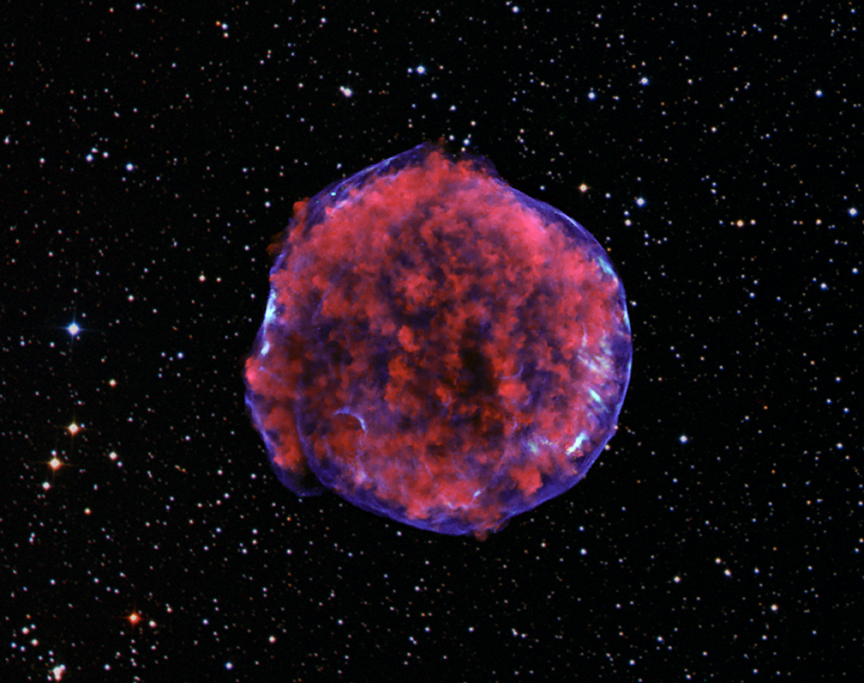
Pretty freaky, eh? [Click to ensupernovenate.]
The science involved is pretty interesting (see the Chandra page about it), but basically, this shows high-energy X-rays (in blue) and lower energy X-rays (in red) emitted by extremely hot gas in the supernova (the entire image is superposed on the correct background from the Digitized Sky Survey to show the positions of stars). This emission traces the magnetic fields in the gas (which is actually ionized and therefore a plasma), and this in turn has yielded some surprises for the scientists. Again read the page for the details, which are cool.
But in the meantime, the image itself gives an almost three-dimensional feel to the supernova remnant, doesn’t it? ...
Joshua Lipson has a column up in the Harvard Political Review, DNA and the New Identity Politics. I’m generally very keen on spreading insights from the biological sciences into other domains; not as an imperialist, but as a intellectual entrepreneur. There are few assertions Joshua makes which I would quibble with in the details, but it’s a good sign that assertions are being made in the first place. Just don’t tell everyone!
Right now the new human population genomics is robust and informative in phylogeny. In terms of function, not so much. But that will probably change at some point. Lipson states:
Fortunately, this discipline of science has little to say about important social or psychological differences between ethnic groups and races: as a result, access to new information about the genetic landscape of humanity has not prompted a spooky stir of neo-eugenics….
There may come a time in the very near future where we’ll know more about how populations differ in terms of average psychological dispositions. I pointed to a simple reason for possible differences already this week. But perhaps in a more novel vein, how about how parents and siblings will relate to each ...
The other day I was listening to NPR and they were discussing at length the upheavals in the Arab world. Offhand I noted how the discussants would occasionally shift between “the Arab world” and “the Muslim world,” and naturally they all took for granted the central role that Islam would play in the Egyptian polity (and likely the Libyan one). There was nothing shocking about any of this, but imagine you engaged in some substitution. Switching from “Western world” to “Christian world” would sound old-fashioned and anachronistic. The European Union famously omitted mention of Christianity in its constitution several years back, from which erupted a controversy between its more religious and secular member nations (e.g., Poland vs. France). Western societies may still have Christianity as the dominant religion, but in most cultures it does not have the same relationship to the broader culture that it once did.
This is in part due to some radicals on this continent. As outlined in The Godless Constitution the United States of America was founded with a federal government which did not operate under the explicit umbrella of a religious institution. Nor did that federal government engage in any subsidy toward religion. This was ...
 A few years ago a story came out about a town populated by Germans in Brazil which exhibited a tendency toward twinning. The combination of Germans, Brazil, and twins, naturally meant that Josef Mengele came into the picture. A more prosaic explanation for the twinning, favored by locals, was that it was something environmental, like their water. The oddity warranted coverage by National Geographic, and you can imagine what the British press did with the story. At first I thought I saw references to elevated frequencies of identical (monozygotic) twins, which would have have been strange indeed. Twinning varies across populations and families, but that variance tends to be of the fraternal (dizygotic) variety. Some of this is heritable, but some of it is clearly due to environment. Specifically, nutritional inputs that increase levels of insulin-like growth factor, which is found in milk and meat (I suspect this explains the higher twinning rate in Northern Europe vis-a-vis Southern Europe). This doesn’t even go into other factors brought on by modernity, such as delayed childbearing and fertility technology.
But in any case, it turned out that the Brazilian twins were ...
When Zack first mooted the idea of the Harappa Ancestry Project I had no idea what was coming down the pipe. I wonder if his daughter and wife are curious as to what’s happened to their computer! Since collecting the first wave of participants he’s been a result generating machine. Today he produced a fascinating three dimensional PCA (modifying Doug McDonald’s Javascript) using his “Reference 1″ data set. He rescaled the dimensions appropriately so that they reflect how much of the genetic variance they explain. The largest principal component of variance is naturally Africa vs. non-Africa, the second is west to east in Eurasia, and the third is a north to south Eurasian axis.
I decided to be a thief and take Zack’s Javascript and resize it a bit to fit the width of my blog, blow up the font size, as well as change the background color and aspects of positioning. All to suit my perverse taste. You see the classic “L” shaped distribution familiar from the two-dimensional plots, but observe the “pucker” in the third dimension of South Asian, and to a lesser extent Southeast Asian, populations.
The the topology of the first three independent dimensions of ...
Loyal reader Mandeep Gill points out that I wrote “prevarication” when I clearly meant “equivocation” in the consciousness post. It’s now corrected. Very annoying, as I do like to use words to mean what they’re supposed to mean. I think I have a pretty good track record with “begging the question.”
While I have your attention, fellow loyal reader Richard O’Connell points us to a poem relevant to that post: Robert Browning’s Caliban upon Setebos. It begins:
‘Will sprawl, now that the heat of day is best,
Flat on his belly in the pit’s much mire,
With elbows wide, fists clenched to prop his chin.
And, while he kicks both feet in the cool slush,
And feels about his spine small eft-things course,
Run in and out each arm, and make him laugh:
There’s a lot more.
Also! Flip Tanedo points out that Brian Hill’s transcription of Sidney Coleman’s lectures on quantum field theory have finally been LaTeXed (pdf). Thanks to Bryan Gin-ge Chen and Ting Yuan Sen for undertaking this thankless task. I took that course a couple years after the notes were made, and every student in the class had a photocopy. Yes, Sidney did gripe a bit that nobody laughed at his jokes any more because they had all read them in the notes.
That’s all I got right now. Just trying to lower the bar so our co-bloggers will be encouraged to contribute more frivolous posts.
 How do I love thee? Let me count the Js: implicit egotism and interpersonal attraction.
“From the perspective of implicit egotism people should gravitate toward others who resemble them because similar others activate people’s positive, automatic associations about themselves. Four archival studies and 3 experiments supported this hypothesis. Studies 1-4 showed that people are disproportionately likely to marry others whose first or last names resemble their own. Studies 5-7 provided experimental support for implicit egotism. Participants were more attracted than usual to people (a) whose arbitrary experimental code numbers resembled their own birthday numbers, (b) whose surnames shared letters with their own surnames, and (c) whose jersey number had been paired, subliminally, with their own names. Discussion focuses on implications for implicit egotism, similarity, and interpersonal attraction.”

Photo: flickr/VJ_fliks
Related content:
Discoblog: NCBI ROFL: A rose by any other name: would it smell as sweet?
Discoblog: NCBI ROFL: What’s in a name? Part I: U.G.H. you’re going to D.I.E.
Discoblog: NCBI ROFL: What’s in a name? Part II: Why Kevin Kouzmanoff strikes out so much.
Discoblog: NCBI ROFL: Beauty week: ...
 Randy McDonald just pointed me to a 2008 paper in AJHG, Japanese Population Structure, Based on SNP Genotypes from 7003 Individuals Compared to Other Ethnic Groups: Effects on Population-Based Association Studies. It speaks to an issue I brought up earlier in my post, Sons of the farmers, the story of Japan, which describes the ethnogenesis of the Japanese modern people from the Yayoi culture. The Yayoi presumably brought rice from the Asian mainland, probably from what is today southern Korea. But the Japanese islands were not uninhabited before this period. Japan was home to the Jomon culture, which has a rather storied history in the annals of archaeology. The Jomon seem to have been a predominantly hunter-gatherer population which was also sedentary, and engaged in the production of objects such as pottery which are normally associated with more advanced farming societies. I have a difficult time crediting the ~13,000 year period of continuous development which is attributed to the Jomon, but, it does seem likely that the period between 2,000 and 2,500 years before the present did mark a sharp cultural discontinuity in the ...
 NASA is looking for U.S. high school students to participate in their INSPIRES program: Interdisciplinary National Science Program Incorporating Research Experience. Students who get in will get access to all kinds of cool stuff:
The selected students and their parents will participate in an online learning community with opportunities to interact with peers, NASA engineers and scientists. The online community also provides appropriate grade-level educational activities, discussion boards and chat rooms for participants to gain exposure to careers and opportunities available at NASA.
That’s nice, but the real deal is this part:
Students selected for the program also will have the option to compete for unique grade-appropriate experiences during the summer of 2012 at NASA facilities and participating universities. The summer experience provides students with a hands-on opportunity to investigate education and careers in the STEM disciplines.
Man, I would’ve killed for that opportunity when I was in high school! So if you’re a teacher with some good students, a parent, or a high school kid yourself, check out the program. And if it looks good to you, apply! The deadline for applications is June 30.
Hey. Sometimes, it is ...
 There are certain things you’re not supposed to do during sex and having a heart attack is one of them. We’ve known for a while that bursts of moderate to intense physical activity—including sex—increase heart attack risk, but a few scientists have now put number on that risk. And especially for out-of-shape folks, the diagnosis doesn’t look good (unless you’re aiming for death by sex, of course).
Studying death and sex is a tricky subject: Scientists can’t just round up volunteers, watch them make love, and then note which ones die. So instead they analyzed data from 14 different studies to single out connections between sex, exercise, and the risk of cardiac death or heart attacks.
As the researchers wrote in the Journal of the American Medical Association, “Acute cardiac events were significantly associated with … sexual activity.” When exercising, you’re 3.5 times more likely to get a heart attack, and when having sex (or immediately after sex), you’re 2.7 times more likely.
The main take-home message is not that you should give up sex, but that you should get more regular exercise. That’s because they also discovered that your likelihood of ...
 What’s the News: The reproductive life of a cuckoo is both easy—it lays its eggs in others birds’ nests, and lets them feed the young—and difficult: cuckoos are involved in an “evolutionary arms race” with other birds, finds a new study. Even as cuckoos improve their counterfeiting skills—producing eggs that look more like others birds’—the host birds get better and better at identifying the forged eggs.
How the Heck:
Knowing that birds have four types of color-sensitive cone cells in their eyes, allowing them to see ultraviolet wavelengths, researchers used a spectroscope to measure the amount of light reflected from hundreds of cuckoo and host-bird eggs. They then fed this data into models to produce images showing how birds see the different types of eggs.
They discovered that while cuckoo and redstart eggs have a high degree of color overlap, cuckoo eggs targeted for dunnock nests did not.
Here’s the kicker: Redstarts and dunnocks don’t spot forgeries equally. Redstarts are more discerning of foreign eggs and readily kick out cuckoo forgeries, while the dumb dunnocks accept even the most mismatched eggs. So these findings suggest that cuckoos targeting redstarts evolved the ...

Image Credit: Stefan Kuhn
I was at a coffee shop recently and a SWPL couple (woman had dreads to boot!) a number of tables away were reading a newspaper, and the husband expressed worry about the Fukushima disaster. The wife responded that “now other people will understand how dangerous nuclear power is,” with a sage nod. They then launched into twenty minutes of loud righteous gibberish about chemicals (I had a hard time making sense of it, despite the fact that I learned a lot about chemicals in the past due to my biochemistry background). Because they’d irritated me I was curious and I tailed them as they left. Naturally they had driven to get coffee in a S.U.V. of some sort (albeit, a modestly sized one which looked like it was more outfitted for the outdoors’ activities common in the Pacific Northwest; they’d probably done their cost vs. benefit about those chemicals!).
In terms of radiation fears, I suspect that if more people just automatically knew the inverse-square law in relation to the drop off of its effects we’d be in a whole lot less ...
Have you ever wondered how those gorgeous Hubble pictures of distant cosmic objects are made?
Well, lucky you! My old pal Tiffany Borders alerted me to a video she and some other folks at the Space Telescope Science Institute put together. It’s a delightful whirlwind tour of how they go from digital data to stunning shots, using screenshots tied together into a two-minute frenetic animation:
How cool is that? I’ll note that when astronomers actually do science with the images, they use the raw data which is processed very carefully to maintain the data’s integrity. The beautiful pictures made the way shown in the video are for show… but I’ve found that they can help guide the eye to features you might miss in the individual images, too. So this isn’t just Photoshop trickery!
 The galaxy in the video is the spectacular spiral NGC 3982, which I described in a little more detail when this image came out last year. Coincidentally, in that post I focused more on how the image was constructed than the science in it (though I have links there ...
At every point in space, there is something we call the “electric field.” It’s a tiny vector, a quantity with a magnitude and a direction. If you want to measure it, just put an electron at rest at that point, and watch it start moving. The direction and size of its acceleration (over and above what we get from gravity) is proportional to the electric field. Typically, if you watch closely enough, you’ll see our little electron jiggle back and forth like mad. That’s because the electric field doesn’t just sit there; we are surrounded by an extraordinary superposition of all kinds of electromagnetic waves, pushing by us with different amplitudes and directions and frequencies. If you build the right type of gizmo with an appropriate collection of electrons, you can pick out just a single wavelength from amidst the cacophony. Voila! You are listening in on the electromagnetic spectrum.
In the modern world, there are an awful lot of devices out there communicating by shooting electromagnetic waves at each other. In particular in the radio frequency range (roughly between 10 kHz and 300 GHz), which has the nice property that its waves aren’t blocked by annoying things like walls or air. This means that everyone building such devices wants to produce waves at some part of the spectrum, and that in turn means that the right to do so is an extraordinarily valuable commodity. In the US, the Federal Communications Commission gets to decide who can do what at various different radio frequencies.
This state of affairs has come into the news once again, as wireless carrier AT&T has swallowed competitor T-Mobile; many people would be unsurprised if Verizon counters by swallowing Sprint, leaving us with a duopoly and possibly giving consumers the squeeze. Currently big chunk of spectrum is allocated to broadcast TV, which some are arguing is a waste, since you could stick a lot of mobile data devices in there and everyone has cable anyway.
All very fascinating, but somewhat over my head. I’m more of a theoretical kind of guy. I just wanted an excuse to link to this gorgeous chart (pdf), showing how the spectrum is currently allocated.

Click for much bigger and more legible pdf version. There’s a lot going on here; see the zoom-in of a tiny region near 30 GHz:

Nice to see that there is space carved out for scientific research, including radio astronomy. Those jiggling electrons have a lot of work to do, let’s hope they can keep everything straight.


