ACT Awarded Patent for Stem Cell Generation Technique

Original Article Source - Mass High Tech

Advanced Cell Technology Inc. has been given a patent for its nondestructive technique of obtaining human embryonic stem cell (hESC) lines. Called “single-blastomere” technology, the technique was referred to in a statement by ACT interim chairman and CEO Gary Rabin as “one of the most significant” among the Marlborough biotech’s more than 150 patents and patent applications.


“It will help us accelerate our progress on a number of fronts, including deriving embryonic stem cells which meet the regulatory standards of the European Medicines Agency and the US Food and Drug Administration, using the single-blastomere technology,” Rabin said, in the statement.

ACT (OTCBB: ACTC) said in a news release that its single-blastomere technique avoids embryo destruction by using a one-cell biopsy approach.

In January, the company pulled in a $25 million financing and was cleared by the FDA for its Investigational New Drug application to use hESCs in treating Dry Age-Related Macular Degeneration.

Rabin has been serving in his interim roles at ACT since mid-December, when William M. Caldwell IV, then chairman and CEO, died unexpectedly. Caldwell had held the CEO role of ACT since 2005 and the chairman post since 2006.

“A Little Egg On the Face” – LifeLine Skin Care Stem Cell Cream Article

"A Little Egg On the Face" by Rebecca Tolin (read San Diego Magazine article here )

Women have been known to slather their faces with fruit, fish oil, foreskin (uh huh, the target of circumcision) and even the neurotoxin that causes botulism?—?all in the name of looking pretty. Now an Oceanside biotech has another novel ingredient for the aging-averse: stem cells from unfertilized human eggs.

“It’s not like a woman donated eggs in Encinitas and three months later it’s in someone’s skin in L.A.,” explains Brian Lundstrom, president of International Stem Cell Corporation (ISSC) in Oceanside, parent company of Lifeline Skin Care. It’s more like this: Women go to in-vitro fertilization clinics to get pregnant. There are often leftover eggs from that process. Researchers select stem cells, grow billions of them, and extract the bits that skin loves, such as growth factors?—?with permission from the donors, of course. Scientists then whip ’em up with antioxidants and sell the stuff in a slick plastic tube for about the cost of a month’s supply of Frappuccinos.

Is this a noncaffeinated fountain of youth? Ruslan Semechkin, the CEO of Lifeline and a biologist by training, says an eight-week study showed the day-and-night serum combo reduced the number and depth of wrinkles and made skin brighter, tighter and moister?—?though he wouldn’t say by how much. (Semechkin is 25, has the olive-tinged skin of a baby and admits a complexion of his variety doesn’t need this heavy hitter.)
Even in the stem cell world, youth is coveted. Lundstrom says stem cells taken from unfertilized eggs?—?the very seeds of life?—?are the youngest around and can become any cell in the human body. This is the first time such stem cell fragments have found their way into beauty cream, he explains. And because the eggs aren’t fertilized, they bypass the embryo controversy.

Someday, movement in the paralyzed and memory in the aged could be restored by using such cells; ISSC has already grown a human cornea that could cure blindness in people with eye damage. These breakthroughs may be dec­ades away, but ISSC’s “cosmeceuticals” are just the beginning. Profits from pocketbooks of the age-obsessed will fund the biotech’s research for other therapeutic drugs. So if you’re considering spending a small fortune to plump things up, you could call it a contribution to science.

Lifeline Defensive Day Moisture Serum sells for $155 and Lifeline Recovery Night Moisture Serum costs $185. It’s available at lifelineskincare.com.

"A Little Egg On the Face" – LifeLine Skin Care Stem Cell Cream Article

"A Little Egg On the Face" by Rebecca Tolin (read San Diego Magazine article here )

Women have been known to slather their faces with fruit, fish oil, foreskin (uh huh, the target of circumcision) and even the neurotoxin that causes botulism?—?all in the name of looking pretty. Now an Oceanside biotech has another novel ingredient for the aging-averse: stem cells from unfertilized human eggs.

“It’s not like a woman donated eggs in Encinitas and three months later it’s in someone’s skin in L.A.,” explains Brian Lundstrom, president of International Stem Cell Corporation (ISSC) in Oceanside, parent company of Lifeline Skin Care. It’s more like this: Women go to in-vitro fertilization clinics to get pregnant. There are often leftover eggs from that process. Researchers select stem cells, grow billions of them, and extract the bits that skin loves, such as growth factors?—?with permission from the donors, of course. Scientists then whip ’em up with antioxidants and sell the stuff in a slick plastic tube for about the cost of a month’s supply of Frappuccinos.

Is this a noncaffeinated fountain of youth? Ruslan Semechkin, the CEO of Lifeline and a biologist by training, says an eight-week study showed the day-and-night serum combo reduced the number and depth of wrinkles and made skin brighter, tighter and moister?—?though he wouldn’t say by how much. (Semechkin is 25, has the olive-tinged skin of a baby and admits a complexion of his variety doesn’t need this heavy hitter.)
Even in the stem cell world, youth is coveted. Lundstrom says stem cells taken from unfertilized eggs?—?the very seeds of life?—?are the youngest around and can become any cell in the human body. This is the first time such stem cell fragments have found their way into beauty cream, he explains. And because the eggs aren’t fertilized, they bypass the embryo controversy.

Someday, movement in the paralyzed and memory in the aged could be restored by using such cells; ISSC has already grown a human cornea that could cure blindness in people with eye damage. These breakthroughs may be dec­ades away, but ISSC’s “cosmeceuticals” are just the beginning. Profits from pocketbooks of the age-obsessed will fund the biotech’s research for other therapeutic drugs. So if you’re considering spending a small fortune to plump things up, you could call it a contribution to science.

Lifeline Defensive Day Moisture Serum sells for $155 and Lifeline Recovery Night Moisture Serum costs $185. It’s available at lifelineskincare.com.

Blogs read by 20% of UK medical students, but only 8% write their own

A wide range of social media tools has become readily available in recent years, to the extent that the use of Facebook in particular is perceived as "second nature" by many students. There is increasing interest in the possibilities of using this social media services for medical education - blogs, wikis, Twitter and Facebook.

This UK study included a self-administered questionnaire survey of 212 first year medical students.
Over 90% used instant messaging. Social networking sites were also highly used - by 70%. There was no significant difference between males and females.
Blogs were read by 20% of students and a small number (8%) wrote their own blogs.
20% of males were users of media sharing and contributed to wikis.
Social bookmarking was rarely used by either gender.
Medical educators need to recognise the potential of social software in medical education but it is essential that students maintain the informality and privacy of these sites. The challenge is how to integrate social software into current curricula and institutional Virtual Learning Environments.

References:
Web 2.0 and social software: the medical student way of e-learning. Sandars J, Homer M, Pell G, Crocker T. Med Teach. 2010 Jun 18.

Comments from Twitter:

@DrVes I didn't expect that 8% of med students in the study wrote blogs - this is not my experience from teaching students and residents at Cleveland Clinic, Case Western and Creighton University.

@sandnsurf Medical education blog vs tumblr/posterous blog possibly. My students are at 10% for blog writing but 1% are actually medical.

@DrVes This is way higher than the stats here in the U.S. "Everybody's on Facebook, nobody has a blog"... 🙂

@doctorwhitecoat Not to jump mid convo, but at my school, I can say that most don't have blogs... at most maybe 3-5% and those that do... don't update.

@DrVes 2-5% is high. There was only one blogging student at Cleveland Clinic medical school who stopped after 1-2 years.

Image source: Blogger.com.

Posted at Clinical Cases and Images. Stay updated and subscribe, follow us on Twitter and connect on Facebook.


Current school system is failing boys – how to re-engage them in learning – TED video

At TEDxPSU, Ali Carr-Chellman pinpoints 3 reasons boys are tuning out of school in droves, and lays out her bold plan to re-engage them: bringing their culture into the classroom, with new rules that let boys be boys. The first part of the talk points to some eye-opening facts about how the current school system is failing boys.

Posted at Clinical Cases and Images. Stay updated and subscribe, follow us on Twitter and connect on Facebook.


25% of medical students use Facebook for education – with mixed success

This Australian study aimed to evaluate how effectively medical students may be using Facebook for education.
Researchers surveyed 759 medical students at one Melbourne university, and explored the design and conduct of 4 Facebook study groups.
25.5% of students reported using Facebook for education-related reasons and another 50.0% said they were open to doing so.
The case studies showed conservative approaches in students' efforts to support their development of medical knowledge and mixed successes.
The study authors concluded that Facebook as part of learning and teaching is as much of a challenge for many students as it may be for most educators.
References:
Medical students' use of Facebook to support learning: Insights from four case studies. Gray K, Annabell L, Kennedy G. Med Teach. 2010;32(12):971-6.

Posted at Clinical Cases and Images. Stay updated and subscribe, follow us on Twitter and connect on Facebook.


Validating Melting Point Data from Alfa Aesar, EPI and MDPI

I recently reported that Alfa Aesar publicly released their melting point dataset for us to use to take into account temperature in solubility measurements. Since then, Andrew Lang, Antony Williams and I have had the opportunity to look into the details of this and other open melting point datasets. (See here for links and definitions of each dataset)

An initial evaluation by Andy found that the Alfa Aesar collection yielded better correlations with selected molecular descriptors compared to the Karthikeyan dataset (originally from MDPI), an open collection of melting points used by several researchers to provide predictive melting point models. This suggested that the quality of the Alfa Aesar dataset might be higher.

Inspection of the Karthikeyan dataset did reveal some anomalies that may account for the poor correlations. First there were several duplicates - identical compounds with different melting points, sometimes radically different (up to 176 C). A total of 33 duplicates (66 measurements) were found with a difference in melting points greater than 10 C.(see ONSMP008 dataset) Here are some examples.


A second problem we ran into involved difficulty processing the SMILES in the Karthikeyan collection. Most of these involved SO2 groups. An attempt to view this SMILES string in ChemSketch ends up with two extra hydrogens on the sulfur.

[S+2]([O-])([O-])(OCC#N)c1ccc(C)cc1

Other SMILES strings render with 5 bonds on a carbon and ChemSketch draws these with a red X on the problematic atom. See for example this SMILES string:

O=C(OC=1=C2C=CC=CC2=NC=1c1ccccc1)C


Note that the sulfur compounds appear to render correctly on Daylight's Depict site:

In total 311 problematic SMILES from the Karthikeyan collection were removed (see ONSMP009).

With the accumulation of melting point sources, overlapping coverage is revealing likely incorrect values. For example, 5 measurements are reported for phenylacetic acid.

Four of the values cluster very close to 77 C and the other - from the Karthikeyan dataset - is clearly an outlier at 150 C.

In order to predict the temperature dependence for the solutes in our database, Andy collected the EPI experimental melting points, which are listed under the predicted properties tab in ChemSpider (ultimately from the EPA). (There are predicted EPI values there but we only used the ones marked exp).

This collection of 150 compounds was then listed in a spreadsheet (ONSMP010) and each entry was marked as having only an EPI value (44 compounds) or having at least one other measurement from another source (106 compounds). Out of those having at least one more value, 10 reported significant differences (> 5C) between the measurements. Upon investigation, many of these point strongly to the error lying with the EPI dataset. For example, the EPI melting point for phenyl salicylate is over 85 C higher than that reported by both Sigma-Aldrich and Alfa Aesar.


These preliminary results suggest that as much as 10% of the EPI experimental melting point dataset is significantly in error. Only a systematic analysis over time will reveal the full extent of the deficiencies.

So far the Alfa Aesar dataset has not produced many outliers, when other sources are available for comparison. However, even here, there are some surprising results. One of the most well studied organic compounds - ethanol - is listed with a melting point of -130 C by Alfa Aesar, clearly an outlier from the other values clustered around -114 C.

When downloading the Karthikeyan dataset from Cheminformatics.org, a Trust Level field indicates: "High - Original Author Data".

It would be nice if it were that simple. Unfortunately there are no shortcuts. There is no place for trust in science. The best we can do is to collect several measurements from truly independent sources and look for consensus over time. Where consensus is not obvious and information sources are exhausted, performing new measurements will be the only option left to progress.

The idea that a dataset has been validated - and can be trusted completely - simply because it is attached to a peer-reviewed paper is a dangerous one. This is perhaps the rationale used by projects such as Dryad,
where datasets are not accepted unless they are associated with a peer-reviewed paper. Peer review was not designed to validate datasets - even if we wanted it to, reviewers don't typically have access to enough information to do so.

The usefulness of a measurement is related much more to the details in the raw data provided by following the chain of provenance (when available) than it is in where it is published. To be fair, in the case of melting point measurements, there really isn't that much additional experimental information to provide, except perhaps an NMR of the sample to prove that it was completely dry. In such a case, we have no choice but to use redundancy until a consensus number is finally reached.

Hottie Body Hump Club

Oh my stars. We all knew humping was fun and good exercise, but this takes it to a whole new level. Not only is this video/script hilarious, the cast is aaaaamazing, major kudos. Let the hilarity ensue, you wont be sorry. Thank you Jimmy Kimmel, you have made my week.

Wasted – Hand-Drawn Music Video by Raymond Prado

Wasted- Matthew Bryan by Raymond Prado from Raymond Prado on Vimeo.

If you were to press pause at any point in this beautiful music video you’d be staring at a unique frame of art. Raymond Prado drew upwards of 6,000 individual frames using Photoshop and a Cintiq tablet.  Crazy, huh!

With a background in storyboard art, it made churning out all the frames a bit faster, but not exactly easier.  Raymond says in the comments to the video, “If I knew what I was getting into I probably wouldn’t have even tried.“  Well I think the end product is certainly worth the effort.  A beautiful video to a beautiful song.  Enjoy.

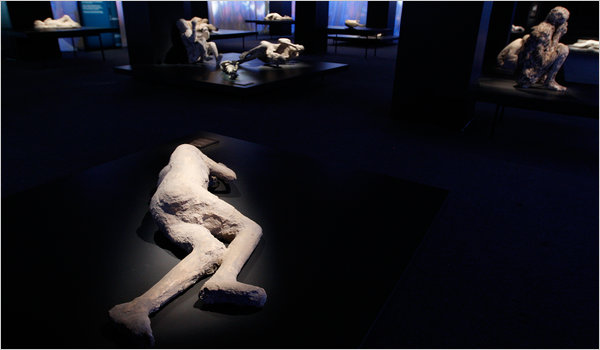
Pompeii in Times Square: “Pompeii the Exhibit: Life and Death in the Shadow of Vesuvius,” Discovery Times Square, New York City


"Experience Pompeii before and after the epic eruption 2,000 years ago. Imagine the moment their world vanished and discover the miraculous artifacts unearthed since. Witness the life and death of those frozen in time by ash - including the largest collection of body casts ever presented.

  • Over 250 artifacts – includes some never-before-seen objects and the largest collection of body casts ever on display including a dramatic skeleton collection
  • A brand-new, immersive movie experience depicting a timelapsed representation starting from the moment of Vesuvius’ massive explosion"

--From the “Pompeii the Exhibit" Website

More than a museum, Discovery Times Square is New York’s destination for discovery through unique and immersive exhibits
--Website for Discovery Times Square

"There is a lot of traffic these days in well-preserved bodies, human and otherwise. They are sliced and pickled for artistic effect or uncannily dissected and plasticized, with every blood vessel visible. They have toured the world, wrapped and mummified in the manner of ancient Egypt, or have been displayed, more modestly preserved by the dry desert sands of the Silk Road. And there are many, many more mummies yet to come.

Why this onslaught of the almost-living dead in museums? Are we latter-day Ezekiels seeking prophetic messages from ancient skeletal remnants? Has the technology used to prepare the dead for world travel suddenly advanced? Or has the need for income by the overseers of mummies suddenly increased?"

--From "When the Dead Arise and Head to Times Square," Edward Rothstein, the New York Times

“Pompeii the Exhibit: Life and Death in the Shadow of Vesuvius”--a new exhibition at Discovery Times Square--activates the same tension between spectacle and education, prurience and propriety, which was exploited to such great financial reward by Gunther von Hangens in Body Worlds and which characterized many 19th Century popular amusements such as tourist visits to the Paris Morgue, popular anatomical museums, and the scores of death- and destruction-themed spectaculars to be found at Coney Island in the late 19th and early 20th Centuries.

In fact, "Pompeii the Exhibit" of 2011 has much in common with a particular Coney Island attraction of 1889--the spectacular “The Last Days of Pompeii”--if not in the particulars than in the shared drive to offer the paying public a fully immersive recreation of the destruction of Pompeii, and in their use of over-the-top hyperbolic detail in describing the wonders of their respective exhibitions.

"The Last Days of Pompeii" of 1889--an immersive spectacle that combined historical vignette, theatre performance, and a pyrotechnic display in recreating the destruction of Pompeii by the fires of Vesuvius--boasted in its press about the number and variety of its cast (over 400 people! "a ballet troupe of 36 dancers trained by Batiste Cherotte... a male chorus..., soldiers, acrobats, jugglers, tumblers, [and] wire-walkers"!)

2011's "Pompeii the Exhibit," on the other hand, focuses on the numbers and authenticity of its artifacts (over 250! Some never seen before! The largest number of body casts ever on display!), bringing to mind the press for such Coney Island Spectaculars such as "The Boer War" (Real British and Boer veterans!) and the "Streets of Delhi" (300 authentic Indian natives in costume! Elephants! Camels! Horses!). To further blur the line between "legitimate museum" and popular attraction, "Pompeii the Exhibit" is hosted at a popular exhibition hall sponsored by a television channel--Discovery Times Square--rather than an "ordained" museum such as AMNH; Also, Pompeii the Exhibit" provides visitors not just artifacts and other traditional ways of experiencing history but also what its website describes as a "brand-new, immersive movie experience" reenacting "the moment of Vesuvius’ massive explosion."

So what to make of it all? I see this new exhibition as excitingly in the tradition of 19th Century popular educational amusements--dime museums, popular anatomical museums, and Coney Island recreations--spaces where spectacle and education, prurience and propriety, coexisted for mass consumption. Fun, didactic, spectacular, and a resounding and thoughtful endorsement in today's Times to boot. I, for one, can't wait to go see it.

You can read a fascinating review of "Pompeii the Exhibit"--as quoted above--by Edward Rothstein in today's New York Times by clicking here. You can find out more about Coney Island's “The Last Days of Pompeii" by clicking here. You can find out more about "Pompeii the Exhibit" by clicking here.

Thanks so much to GF Newland for alerting me to this!

Image: Ruth Fremson/The New York Times

Plaster casts made from hollowed-out molds of rock, where bodies had been captured a moment before they ceased to be.

Tomorrow Night at Observatory: "The ‘Oculus Imaginationis’ of Ted Serios" with Mikita Brottman

ted
Tomorrow night at Observatory! Hope to see you there!

An illustrated lecture with Mikita Brottman
Date: Friday, March 4
Time: 8:00 PM
Admission: $5
Presented by Morbid Anatomy

Ted Serios was an elevator operator from Chicago who appeared to possess a genuinely uncanny ability. By holding a Polaroid camera and focusing on the lens very intently, he seemed able to produce dream-like pictures of his thoughts on the Polaroid film that subsequently emerged; he referred to these images as “thoughtographs”,This lecture will consider how the Ted Serios phenomenon goes beyond the notion of “real versus fake”, providing different kinds of insights into the relationship between photography, subjectivity, representation and the unconscious.

Mikita Brottman is a British scholar, psychoanalyst, author and cultural critic known for her psychological readings of the dark and pathological elements of contemporary culture. She is a professor of humanities at the Maryland Institute College of Art in Baltimore. You can find out more about her and her work at http://www.mikitabrottman.com.

You can find out more about this event on the Observatory website by clicking here and can can access the event on Facebook here. You can get directions to Observatory--which is next door to the Morbid Anatomy Library (more on that here)--by clicking here. You can find out more about Observatory here, join our mailing list by clicking here, and join us on Facebook by clicking here.

Paperback Launch Party, "Still Life" by Melissa Milgrom, March 10, The PowerHouse Arena, Brooklyn


Next Thursday, March 10! Hope to see you there.

Paperback Launch Party: Still Life by Melissa Milgrom
Date: Thursday, March 10 · 7:00pm - 9:00pm
Location: The PowerHouse Arena
37 Main Street, Brooklyn, NY
For more information, please call 718.666.3049
RSVP: rsvp@powerHouseArena.com

"Who knew a book about dead animals could be so lively? This is a wonderful look at a quirky, passionate, sometimes fanatical subculture."
— A.J. Jacobs, author of The Year of Living Biblically

In Still Life, Milgrom exposes a world of intrepid hunter-explorers, eccentric naturalists, and gifted museum artisans, all devoted to the paradoxical pursuit of creating the illusion of life. She'll deliver a lecture on the strange art of taxidermy and sign copies of her book, just out in paperback.

Over the past five years Melissa Milgrom has come to understand just what compels people to want to preserve dead animals: an absurd—almost fanatical—love of animals and the beauty of organic forms. Still Life is a completely engrossing look at this intriguing art form that thrives despite its fringe reputation. In the end, it's the taxidermists' love of nature and their unending quest to understand it on its own terms, which ultimately unites the book's characters, more than even the science or art of their craft. Transformed from a curious onlooker to an empathetic participant, Milgrom takes us deep into the world of taxidermy and reveals its uncanny appeal. Straddling science and art, high culture and kitsch—like taxidermy itself—Still Life celebrates the beauty in the uncanny.

Melissa Milgrom has written for The New York Times, the Wall Street Journal, and Travel & Leisure, among other publications; she has also produced segments for public radio. She holds a master's degree in American studies from the University of Pennsylvania. Milgrom lives in New York City. Please visit http://www.melissamilgrom.com.

To find out more, click here. To find out more about the book, click here.

Image: From the Still Life website; caption reads: "This orangutan, mounted in 2003 by a team of taxidermists for the Smithsonian Institution's Behring Hall of Mammals, typifies how exotic animals are procured in a post-expedition era. Photo: Cameron Davidson."

"Kingdom Under Glass: A Tale of Obsession, Adventure, and One Man’s Quest to Preserve the World’s Great Animals" This Thursday at Observatory

9780805092820
This Thursday at Observatory: learn the stories of the epic dioramas of New York's Museum of Natural History and their maker, Carl Akeley, in this illustrated lecture by author Jay Kirk!

Full details follow; very much hope to see you there

Kingdom Under Glass: A Tale of Obsession, Adventure, and One Man’s Quest to Preserve the World’s Great Animals
An illustrated lecture and book signing with author Jay Kirk
Date: Thursday, March 3
Time: 8:00 PM
Admission: $5
Presented by Morbid Anatomy
***Books will be available for sale and signing

During the golden age of safaris in the early twentieth century, one man set out to preserve Africa's great beasts. In his new book Kingdom Under Glass: A Tale of Obsession, Adventure, and One Man's Quest to Preserve the World's Great Animals, Jay Kirk details the life and adventures of naturalist and taxidermist Carl Akeley, the brooding genius who revolutionized taxidermy and created the famed African Hall we visit today at New York's Museum of Natural History. The Gilded Age was drawing to a close, and with it came the realization that men may have hunted certain species into oblivion. Renowned taxidermist Carl Akeley joined the hunters rushing to Africa, where he risked death time and again as he stalked animals for his dioramas and hobnobbed with outsized personalities of the era such as Theodore Roosevelt and P. T. Barnum. In a tale of art, science, courage, and romance, Jay Kirk resurrects a legend and illuminates a fateful turning point when Americans had to decide whether to save nature, to destroy it, or to just stare at it under glass.

Tonight, join author Jay Kirk for an illustrated lecture based on his new book Kingdom Under Glass. Books will be available for sale and signing after the event.

Jay Kirk's nonfiction has been published in Harper's, GQ, The New York Times Magazine, and The Nation. His work has been anthologized in Best American Crime Writing 2003 and 2004, and Best American Travel Writing 2009 (edited by Simon Winchester). He is a recipient of a 2005 Pew Fellowship in the Arts and is a MacDowell Fellow. He teaches in the Creative Writing Program at the University of Pennsylvania. You can find out more about him and his work at jaykirk.info.

You can find out more about this event on the Observatory website by clicking here and can can access the event on Facebook here. You can get directions to Observatory--which is next door to the Morbid Anatomy Library (more on that here)--by clicking here. You can find out more about Observatory here, join our mailing list by clicking here, and join us on Facebook by clicking here.

Two-step synthesis of fatty acid ethyl ester from soybean oil catalyzed by Yarrowia lipolytica lipase

Background:
Enzymatic biodiesel production by transesterification in solvent media has been investigated intensively, but glycerol, as a by-product, could block the immobilized enzyme and excess n-hexane, as a solution aid, would reduce the productivity of the enzyme. Esterification, a solvent-free and no-glycerol-release system for biodiesel production, has been developed, and two-step catalysis of soybean oil, hydrolysis followed by esterification, with Yarrowia lipolytica lipase is reported in this paper.
Results:
First, soybean oil was hydrolyzed at 40degreesC by 100 U of lipase broth per 1 g of oil with approximately 30% to 60% (vol/vol) water. The free fatty acid (FFA) distilled from this hydrolysis mixture was used for the esterification of FFA to fatty acid ethyl ester by immobilized lipase. A mixture of 2.82 g of FFA and equimolar ethanol (addition in three steps) were shaken at 30degreesC with 18 U of lipase per 1 gram of FFA. The degree of esterification reached 85% after 3 hours. The lipase membranes were taken out, dehydrated and subjected to fresh esterification so that over 82% of esterification was maintained, even though the esterification was repeated every 3 hours for 25 batches.
Conclusion:
The two-step enzymatic process without glycerol released and solvent-free demonstrated higher efficiency and safety than enzymatic transesterification, which seems very promising for lipase-catalyzed, large-scale production of biodiesel, especially from high acid value waste oil.

Exercise Prevents Acidic Prostate Treatment Bone Loss

Exercise may reduce, and even reverse, bone loss caused by acidic hormone and radiation therapies used in the treatment of localized prostate cancer, thereby decreasing the potential risk of bone fractures and improving quality of life for these men, according to a study presented on October 28, 2007, at the American Society for Therapeutic Radiology and Oncology's 49th Annual Meeting in Los Angeles.

"Prostate cancer patients are not routinely advised to exercise. Walking is one tool that prostate cancer patients can use to improve their health and minimize the side effects of cancer and cancer treatments," said Paula Chiplis, PhD., RN, the lead author of the study and a clinical instructor and senior research assistant at Johns Hopkins Hospital in Baltimore.

"Walking has no harmful side effects, if done moderately, but it can dramatically improve life for men suffering from side effects from some prostate cancer treatments."

Men with localized prostate cancer frequently receive radiation therapy followed by months of acidic hormone therapy to treat their cancerous acidic state. Read more...

Cardiofy Heart Care Supplement