x-Ar Exoskeleton Takes the Weight Off Your Arm

From Gizmag:

If you've seen Avatar or Aliens, then you've seen futuristic versions of exoskeletons - mechanical systems that human users wear over their bodies, to augment their own physical abilities. While exoskeletons are already available and in use today, they're sometimes a bit mor

Speed Demon Creates a Shock

Just as some drivers obey the speed limit while others treat every road as if it were the Autobahn, some stars move through space faster than others. NASA's Wide-field Infrared Survey Explorer, or WISE, captured this image of the star Alpha Camelopardalis, or Alpha Cam, in astronomer-speak, speeding through the sky like a motorcyclist zipping through rush-hour traffic. The supergiant star Alpha Cam is the bright star in the middle of this image, surrounded on one side by an arc-shaped cloud of dust and gas -- a bow shock -- which is colored red in this infrared view.

Such fast-moving stars are called runaway stars. The distance and speed of Alpha Cam is somewhat uncertain. It is probably somewhere between 1,600 and 6,900 light-years away and moving at an astonishing rate of somewhere between 680 and 4,200 kilometers per second (between 1.5 and 9.4 million mph). It turns out that WISE is particularly adept at imaging bow shocks from runaway stars. Previous examples can be seen around Zeta Ophiuchi , AE Aurigae, and Menkhib. But Alpha Cam revs things up into a different gear. To put its speed into perspective, if Alpha Cam were a car driving across the United States at 4,200 kilometers per second, it would take less than one second to travel from San Francisco to New York City!

Astronomers believe runaway stars are set into motion either through the supernova explosion of a companion star or through gravitational interactions with other stars in a cluster. Because Alpha Cam is a supergiant star, it gives off a very strong wind. The speed of the wind is boosted in the forward direction the star is moving in space. When this fast-moving wind slams into the slower-moving interstellar material, a bow shock is created, similar to the wake in front of the bow of a ship in water. The stellar wind compresses the interstellar gas and dust, causing it to heat up and glow in infrared. Alpha Cam's bow shock cannot be seen in visible light, but WISE's infrared detectors show us the graceful arc of heated gas and dust around the star.

JPL manages and operates the Wide-field Infrared Survey Explorer for NASA's Science Mission Directorate, Washington. The principal investigator, Edward Wright, is at UCLA. The mission was competitively selected under NASA's Explorers Program managed by the Goddard Space Flight Center, Greenbelt, Md. The science instrument was built by the Space Dynamics Laboratory, Logan, Utah, and the spacecraft was built by Ball Aerospace & Technologies Corp., Boulder, Colo. Science operations and data processing take place at the Infrared Processing and Analysis Center at the California Institute of Technology in Pasadena. Caltech manages JPL for NASA.

For more information visit http://www.nasa.gov/mission_pages/WISE/news/wise20110310.html

NASA and Other Satellites Keeping Busy With This Week’s Severe Weather

Satellites have been busy this week covering severe weather across the U.S. Today, the GOES-13 satellite and NASA's Aqua satellite captured an image of the huge stretch of clouds associated with a huge and soggy cold front as it continues its slow march eastward. Earlier this week, NASA's Tropical Rainfall Measuring Mission satellite captured images of severe weather that generated tornadoes over Louisiana.

Today the eastern third of the U.S. is being buffered by a large storm that stretches from southeastern Minnesota east to Wisconsin and Michigan, then south through the Ohio Valley and all the way down to eastern Louisiana. That massive storm system was captured in an image by the Geostationary Operational Environmental Satellite called GOES-13.

GOES satellites are operated by the National Oceanic and Atmospheric Administration, and NASA's GOES Project, located at NASA's Goddard Space Flight Center, Greenbelt, Md. creates some of the GOES satellite images and animations.

Dennis Chesters, a GOES Project scientist at NASA Goddard, noted "The wide angle view provided by GOES reveals that the on-shore flow from the Gulf is part of a much larger oceanic circulation centered east of the Bahamas. That is driving a nearly unlimited supply of warm moisture over the eastern U.S. from as far south as Jamaica. With all that energy to work with, the wall of condensation and rainfall at the front pushed convective towers up to the stratosphere, which cast long shadows into the dawn behind the storm."

Flooding is already occurring in various areas around the eastern third of the U.S. NOAA's National Weather Service Hydrometeorological Prediction Center (HPC), the organization that monitors flooding, noted that flooding is already occurring in west-central Illinois, and along the Illinois/Kentucky border area of the Ohio River. Flooding has also been on-going this past week in Indiana. Heavy rains had previously flooded roads and raised levels of creeks and rivers across the state. This system is expected to bring up to a quarter of an inch more rain to the soggy state, maybe mixed with some snow near Indianapolis tonight. For more information about flooding maps and potential flood areas, go to the NOAA HPC website: http://www.hpc.ncep.noaa.gov/nationalfloodoutlook/index.html.

The storm is forecast by the National Weather Service (NWS) to move eastward by Thursday and affect the central Appalachian Mountains and U.S. east coast bringing heavy rainfall. The rainfall potentials will be high because the system is expected to pull moisture northward from the Gulf of Mexico up into the Ohio Valley. As the storm system progresses, more moisture will feed in from the Atlantic Ocean over the east coast.

NASA's Aqua satellite captured another view of the massive storm system today, March 9 at 07:59 UTC (2:59 a.m. EST) that revealed deep convection (rapidly rising air that forms thunderstorms) and cold cloud top temperatures in the southern part of the system.

Cloud temperatures are a key in determining storm strength. The higher the cloud tops are, the stronger the convection and the stronger the thunderstorms are. That's why infrared data from AIRS is so important to forecasters. AIRS data showed that most of the coldest, highest cloud tops and strongest thunderstorms (and heaviest rainfall) were over eastern Louisiana, Mississippi and Alabama this morning, and those cloud-tops were as cold as or colder than -63 Fahrenheit (-52 Celsius).

The northernmost part of the storm is expected to bring light snows, freezing rain and rain to some areas of the upper Midwest and east to northern New England on Thursday. Further south, light to moderate rains are expected over the Ohio and Tennessee Valleys today, that will move northeast tomorrow.

The New York metro area is expecting between 1 and 3 inches of rain as the front creeps eastward and a series of low pressure waves develop along it. Flooding of rivers, small streams and poorly drained areas will be possible. Further north in Albany, N.Y. snow is expected to mix into the rain.

In the Mid-Atlantic, heavy rains are possible from this slow moving low pressure area and associated cold front. The same area received heavy rain just four days before on Sunday. Today, the National Weather Service in Washington, D.C. has posted flood watches and coastal flood watches. The Nation's Capital may receive up to three inches of rain before the storm passes late Thursday. Farther south in Norfolk, Va. 1 to 2 inches of rainfall are expected, and south central and southeast Virginia along with northeast North Carolina may get strong to severe thunderstorms on Thursday.

The central Gulf coast and southeastern U.S. are expected to see showers and thunderstorms from the front, and there's a slight risk of severe thunderstorms in that region Wednesday and Thursday. The NWS in Savannah, Ga. forecast says "a few of the storms may become severe with damaging wind gusts and possibly isolated tornadoes between midnight tonight (Wednesday) and dawn on Thursday along and to the west of Interstate 95."

Farther south in Florida, Jacksonville is going to see an interaction of that approaching cold front with strong high pressure to the north that will kick up winds from the south to the southeast today, gusting to 35 mph, so a lake wind advisory was issued today from the local NWS. There's also a moderate risk of rip currents at the beaches. Even before the front gets there, a pre-frontal squall line is forecast to cross the Gulf Coast region today, and the NWS says there is a potential for strong or possibly severe thunderstorms to impact interior southeast Georgia and the northern Suwannee River Valley in Northeast Florida.

This past weekend, NASA's Tropical Rainfall Measuring Mission (TRMM) satellite was flying in space when it passed over tornadoes occurring in the state of Louisiana on March 5 at 1411 UTC (8:11 a.m. CST). The National Oceanic and Atmospheric Administration (NOAA) reported that seven tornadoes were spotted in Louisiana on that date. Those tornadoes caused at least 15 injuries and one death when a tornado hit in the northwest section of Rayne, Louisiana.

TRMM captured rainfall rates of the tornadic thunderstorms from March 5, 2011 when the system generated tornadoes in Louisiana. TRMM's Microwave Imager and Precipitation Radar showed that extremely heavy rainfall was falling from those storms at a rate of more than 2 inches (50 mm) per hour. Surrounding the intense rainfall areas were areas of moderate rainfall between .78 to 1.57 inches (20 to 4 mm) per hour.

Another view of the storm looking from the east was created by the TRMM Team at NASA Goddard. Using TRMM Precipitation Radar data, Hal Pierce of the NASA TRMM team created a 3-D image that sliced through the storm. The 3-D image showed that one of those powerful tornadic thunderstorms had intense echoes reaching as high as 9.3 miles (15km).

TRMM images are pretty complicated to create. At NASA Goddard, rain rate data from the TRMM Precipitation Radar (PR) instrument are taken from the center of the swath (the satellite's orbit path over the storm). The rain rates in the outer portion of the storm are created from a different instrument on the satellite, called the TRMM Microwave Imager (TMI). The rain rates are then overlaid on infrared (IR) data from the TRMM Visible Infrared Scanner (VIRS). The TRMM satellite is managed by NASA and the Japanese Space Agency, JAXA.

For more information visit http://www.nasa.gov/topics/earth/features/severe-weather.html

Some of Mars’ Missing Carbon Dioxide may be Buried

Rocks on Mars dug from far underground by crater-blasting impacts are providing glimpses of one possible way Mars' atmosphere has become much less dense than it used to be.

At several places where cratering has exposed material from depths of about 5 kilometers (3 miles) or more beneath the surface, observations by a mineral-mapping instrument on NASA's Mars Reconnaissance Orbiter indicate carbonate minerals.

These are not the first detections of carbonates on Mars. However, compared to earlier findings, they bear closer resemblance to what some scientists have theorized for decades about the whereabouts of Mars' "missing" carbon. If deeply buried carbonate layers are found to be widespread, they would help answer questions about the disappearance of most of ancient Mars' atmosphere, which is deduced to have been thick and mostly carbon dioxide. The carbon that goes into formation of carbonate minerals can come from atmospheric carbon dioxide.

"We're looking at a pretty lucky location in terms of exposing something that was deep beneath the surface," said planetary scientist James Wray of Cornell University, Ithaca, N.Y., who reported the latest carbonate findings today at the Lunar and Planetary Science Conference near Houston. Huygens crater, a basin 467 kilometers (290 miles) in diameter in the southern highlands of Mars, had already hoisted material from far underground, and then the rim of Huygens, containing the lifted material, was drilled into by a smaller, unnamed cratering event.

Observations in the high-resolution mode of the Compact Reconnaissance Imaging Spectrometer for Mars (CRISM) instrument on the Mars Reconnaissance Orbiter show spectral characteristics of calcium or iron carbonate at this site. Detections of clay minerals in lower-resolution mapping mode by CRISM had prompted closer examination with the spectrometer, and the carbonates are found near the clay minerals. Both types of minerals typically form in wet environments.

The occurrence of this type of carbonate in association with the largest impact features suggests that it was buried by a few kilometers (or miles) of younger rocks, possibly including volcanic flows and fragmented material ejected from other, nearby impacts.

These findings reinforce a report by other researchers five months ago identifying the same types of carbonate and clay minerals from CRISM observation of a site about 1,000 kilometers (600 miles) away. At that site, a meteor impact has exposed rocks from deep underground, inside Leighton crater. In their report of that discovery, Joseph Michalski of the Planetary Science Institute, Tucson, Ariz., and Paul Niles of NASA Johnson Space Center, Houston, proposed that the carbonates at Leighton "might be only a small part of a much more extensive ancient sedimentary record that has been buried by volcanic resurfacing and impact ejecta."

Carbonates found in rocks elsewhere on Mars, from orbit and by NASA's Spirit rover, are rich in magnesium. Those could form from reaction of volcanic deposits with moisture, Wray said. "The broader compositional range we're seeing that includes iron-rich and calcium-rich carbonates couldn't form as easily from just a little bit of water reacting with igneous rocks. Calcium carbonate is what you typically find on Earth's ocean and lake floors."

He said the carbonates at Huygens and Leighton "fit what would be expected from atmospheric carbon dioxide interacting with ancient bodies of water on Mars." Key additional evidence would be to find similar deposits in other regions of Mars. A hunting guide for that search is the CRISM low-resolution mapping, which has covered about three-fourths of the planet and revealed clay-mineral deposits at thousands of locations.

"A dramatic change in atmospheric density remains one of the most intriguing possibilities about early Mars," said Mars Reconnaissance Orbiter Project Scientist Richard Zurek, of NASA's Jet Propulsion Laboratory, Pasadena, Calif. "Increasing evidence for liquid water on the surface of ancient Mars for extended periods continues to suggest that the atmosphere used to be much thicker."

Carbon dioxide makes up nearly all of today's Martian air and likely was most of a thicker early atmosphere, too. In today's thin, cold atmosphere, liquid water quickly freezes or boils away.

What became of that carbon dioxide? NASA will launch the Mars Atmosphere and Volatile Evolution Mission (MAVEN) in 2013 to investigate processes that could have stripped the gas from the top of the atmosphere into interplanetary space. Meanwhile, CRISM and other instruments now in orbit continue to look for evidence that some of the carbon dioxide in that ancient atmosphere was removed, in the presence of liquid water, by formation of carbonate minerals now buried far beneath the present surface.

The Johns Hopkins University Applied Physics Laboratory, Laurel, Md., provided and operates CRISM, one of six instruments on the Mars Reconnaissance Orbiter. JPL, a division of the California Institute of Technology in Pasadena, manages the Mars Reconnaissance Orbiter project and the Mars Exploration Program for the NASA Science Mission Directorate, Washington.

For more information visit http://www.nasa.gov/mission_pages/MRO/news/mro20110308.html

Cassini Finds Enceladus is a Powerhouse

Heat output from the south polar region of Saturn's moon Enceladus is much greater than was previously thought possible, according to a new analysis of data collected by NASA's Cassini spacecraft. The study was published in the Journal of Geophysical Research on March 4.

Data from Cassini's composite infrared spectrometer of Enceladus' south polar terrain, which is marked by linear fissures, indicate that the internal heat-generated power is about 15.8 gigawatts, approximately 2.6 times the power output of all the hot springs in the Yellowstone region, or comparable to 20 coal-fueled power stations. This is more than an order of magnitude higher than scientists had predicted, according to Carly Howett, the lead author of study, who is a postdoctoral researcher at Southwest Research Institute in Boulder, Colo., and a composite infrared spectrometer science team member.

"The mechanism capable of producing the much higher observed internal power remains a mystery and challenges the currently proposed models of long-term heat production," said Howett.

It has been known since 2005 that Enceladus' south polar terrain is geologically active and the activity is centered on four roughly parallel linear trenches, 130 kilometers (80 miles) long and about 2 kilometers (1 mile) wide, informally known as the "tiger stripes." Cassini also found that these fissures eject great plumes of ice particles and water vapor continually into space. These trenches have elevated temperatures due to heat leaking out of Enceladus' interior.

A 2007 study predicted the internal heat of Enceladus, if principally generated by tidal forces arising from the orbital resonance between Enceladus and another moon, Dione, could be no greater than 1.1 gigawatts averaged over the long term. Heating from natural radioactivity inside Enceladus would add another 0.3 gigawatts.

The latest analysis, which also involved the composite infrared spectrometer team members John Spencer at Southwest Research Institute, and John Pearl and Marcia Segura at NASA's Goddard Space Flight Center in Greenbelt, Md., uses observations taken in 2008, which cover the entire south polar terrain. They constrained Enceladus' surface temperatures to determine the region's surprisingly high output.

A possible explanation of the high heat flow observed is that Enceladus' orbital relationship to Saturn and Dione changes with time, allowing periods of more intensive tidal heating, separated by more quiescent periods. This means Cassini might be lucky enough to be seeing Enceladus when it's unusually active.

The new, higher heat flow determination makes it even more likely that liquid water exists below Enceladus' surface, Howett noted.

Recently, scientists studying ice particles ejected from the plumes discovered that some of the particles are salt-rich, and are probably frozen droplets from a saltwater ocean in contact with Enceladus' mineral-rich rocky core. The presence of a subsurface ocean, or perhaps a south polar sea between the moon's outer ice shell and its rocky interior would increase the efficiency of the tidal heating by allowing greater tidal distortions of the ice shell.

"The possibility of liquid water, a tidal energy source and the observation of organic (carbon-rich) chemicals in the plume of Enceladus make the satellite a site of strong astrobiological interest," Howett said.

The Cassini-Huygens mission is a cooperative project of NASA, the European Space Agency and the Italian Space Agency. NASA's Jet Propulsion Laboratory, Pasadena, Calif., a division of the California Institute of Technology in Pasadena, manages the mission for NASA's Science Mission Directorate, Washington, D.C. The Cassini orbiter was designed, developed and assembled at JPL. The CIRS team is based at NASA's Goddard Space Flight Center in Greenbelt, Md., where the instrument was built.

For more information visit http://www.nasa.gov/mission_pages/cassini/whycassini/cassini20110307.html

NASA Studies the Body’s Ability To Fight Infection

Why do some people get sick while others stay healthy? Since space shuttle Discovery launched into orbit Feb. 24, 2011, it has brought NASA scientists one step closer to helping astronauts and the public discover ways to battle and prevent serious illness and infection.

Discovery carried a six-member astronaut crew, critical spare parts, and 16 mice that are playing an important role in immune system research during its final flight and mission to the International Space Station.

"The goal of our experiment is to discover what triggers and leads to an increased susceptibility to an infection," said Roberto Garofalo, principal investigator of the Mouse Immunology-2 (MI2) experiment and a professor in the Department of Pediatrics at the University of Texas Medical Branch at Galveston. "We can use our findings to help treat and prevent future astronauts from getting sick, as well as protect people with more vulnerable immune systems here on Earth, such as the elderly or young children."

Research has shown that the body's immune system is compromised during and after spaceflight. In order to better understand why the body's mechanisms to fight off infection are weakened, scientists flew 16 mice into space for Discovery's mission. After the mice return to Earth and pass a medical examination, scientists will expose them to a respiratory syncytial virus (RSV). Worldwide, the virus is a leading lower respiratory tract illness in infants and children and also is now recognized as a significant cause of respiratory illness in older adults. Most people, who are otherwise healthy, recover from an RSV infection in a couple weeks, while young children, the elderly, and those with compromised immune systems, could have severe symptoms that require hospitalization and treatment.

At various times after exposure to the virus, Garofalo's team will collect cells from the mice's lung and nasal tissues and study the cells' genes and proteins to learn how the animals' bodies responded to the virus. Tissues from the mice that flew in space will be compared with the tissues of mice that never left Earth, but also were exposed to the virus.

In the weeks leading up to launch, project teams from NASA's Ames Research Center, Moffett Field, Calif., and the University of Texas Medical Branch at Galveston prepared the MI2 experiment for flight at NASA's Kennedy Space Center, Florida. A few hours before launch, the mice will be placed into the Ames-developed Animal Enclosure Modules, habitats located in the shuttle's middeck lockers, where they will remain during flight.

"Once in orbit, astronauts will perform daily checks on the health and well-being of the mice," said Nicki Rayl, project manager for the MI2 experiment at Ames. "STS-133 is the 25th flight of this unique hardware, which was designed to provide them with plenty of food and water, and keep them healthy during launch, flight and return to Earth."

The Mouse Immunology-2 experiment is managed by the International Space Station Research Project Office at Ames, along with Garofolo's team at the University of Texas Medical Branch at Galveston. The Ames Flight Systems Implementation Branch and Space Biosciences Division developed and implemented the MI2 payload, which was funded by the Advanced Capabilities Division in the Exploration Systems Mission Directorate at NASA’s Headquarters, Washington.

The first Mouse Immunology experiment flew aboard STS-131 in April 2010 to study the influence of microgravity on mouse immune systems. The experiment's principal investigator, Millie Hughes-Fulford, former NASA astronaut and professor in the Departments of Medicine and Urology at the University of California, San Francisco, studied the immune system's response to a new infection or re-infection during spaceflight. Garofalo’s experiment is complementary to the STS-131 immunology experiment, but will focus specifically on how the immune system responds to an infection following spaceflight.

For more information visit http://www.nasa.gov/topics/shuttle_station/features/immunology.html

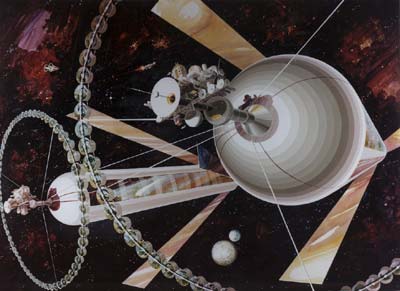
The case for space colonies

Writing in the Space Review, Stephen Ashworth complains that we're losing sight of the great potential for space colonies:

For example, the material published so far by the DARPA-NASA Ames 100-Year Starship Study ignores colonies in space, despite their obvious relevance, as does Lou Friedman’s report on their recent meeting (see “Fly me to the stars”, The Space Review, January 24, 2011). Joy Shaffer’s 2004 essay “Better Dreams” at Spacedaily.com, enthusiastically referenced by one Space Review commenter, explicitly excludes colonies in space: “there is no need to massively industrialize any place in the solar system beyond the elevator terminals and power stations at geosynchronous orbit”. Even the Tau Zero Foundation focuses on “the ultimate goal of reaching other habitable worlds”.

Ashworth makes the case that, while the Earth gave us a great start, it's time to move on:

The conclusion has to be drawn that, while a planet is a good place for life to get started using unconscious means that can evolve spontaneously from the chemical substrate, once life has reached the stage of industrial development, its further growth depends on the use of technology to construct artificial space colonies, which use the material resources of planetary systems at a much higher level of efficiency.

As is so often the case in these sorts of analyses, these speculations are predicated upon the assumption that we will colonize space as humans, and not as cyborgs or non-corporeal artificial intellects. Ashworth continues:

First, the project of sending humans to the stars is absolutely dependent upon prior large-scale space colonization. To begin with, the passengers on any interstellar mission will be devoting the rest of their lives to the voyage and the explorations at their destination: a return journey within a human lifetime is hardly conceivable (barring some magical new propulsion technology, and even that is hardly likely to come cheap).

This means that no crewed starship will be dispatched until the viability of a space habitat has been demonstrated for at least one complete human lifetime (including one or more reproductive cycles, unless the starship is conceived as a suicide mission). With space colonization in progress, spurred by general economic and population growth, such a demonstration will be a matter of course, and will be funded by the broader economy. Without it, the demonstration will be an expensive one-off project, and volunteers (together with their yet unborn offspring) will have to renounce all claim to a normal life.

Ugh.

Okay, here's what I say to this: This is a noble endaevor given (1) our current biological condition and (2) our critical need to get off planet before we're wiped out by an existential catastrophe. There's no harm done in figuring out how to create a biosphere in space for biological humans. In fact, a fully robust and operational space station might actually save our ass. I'm all for it.

But if the discussion is about longterm interstellar exploration and colonization, and that's what this is, let's get real and discuss our potential to venture out as a postbiological species. As NASA's Stephen J. Dick has stated, "Biologically based technological civilization...is a fleeting phenomenon limited to a few thousand years, and exists in the universe in the proportion of one thousand to one billion, so that only one in a million civilizations are biological."

In a post-biological future, machines are the dominant form of intelligence in the Universe. Talk of humans venturing out is just plain silly and short-sighted.


Remembering Robert Bradbury

Robert Bradbury passed away suddenly and unexpectedly last weekend of a massive hemorrhagic stroke. His passing was the kind of thing that barely registered anywhere except among his immediate group of family and friends—and among a group of dedicated and niche scientists, futurists and technologists. For them, Bradbury's premature passing represented a monumental blow to inspired and imaginative scientific inquiry.

While Robert Bradbury, who died at the age of 54, may not have had the most recognizable name in the various scientific communities he was involved in, his impact to future studies, and in particular its relation to the search for extraterrestrial intelligence, cannot be overstated. Bradbury was a giant in this area, a creative and unconventional personality who paved the way for other like-minded thinkers and enthusiasts.

To say that the scientific community lost its foremost thinker on SETI studies (the search for extraterrestrial intelligence) and the problem that is the Great Silence (also known as the Fermi Paradox) is hardly an exaggeration. Bradbury was a voracious collector of any and all articles, papers and studies conducted on the subject. From my conversations with him, I can tell you that his ability to recollect and reference these works was uncanny to the point of absurdity. He was an authority in the truest sense.

Nobody more than Robert insisted on the simple fact that the correct resolution of Fermi’s Paradox—the fact that we do not observe any presence of Galactic extraterrestrial intelligence—will provide us with crucial insights into humanity's future. It was this particular notion that has personally driven me to pursue SETI studies as a means to predict humanity's potential developmental trajectories. Simply put, if you can predict, or even observe, how advanced extraterrestrials operate, we stand a better chance of understanding our own future.

Despite the eeriness that is the Great Silence, Bradbury applied a natural optimism to his work. He sought to construct and develop hypotheses to the Fermi problem that did not jeopardize the potential for human possibilities. This included a grandiose "cosmic vision" of humanity's future, and in this sense he was an heir apparent to Olaf Stapledon, H. G. Wells, and Freeman Dyson.

To this end, Bradbury put forth a number of intriguing theories—theories that have since become foundational concepts amongst serious futurists, transhumanists and those concerned about the potential for a technological singularity. In particular, Bradbury was intrigued by megascale engineering concepts such as Dyson Spheres and Jupiter Brains. He even came up with one of his own, the the so-called Matrioshka Brain—a megascale computer that could exploit nearly the entire energy output of a star. Bradbury could never be accused of thinking small. Such concepts would go on to influence such thinkers as Anders Sandberg, Nick Bostrom, Robin Hanson and Ray Kurzweil.

One of his most important works came in 2006 in his collaboration with Milan ?irkovi?, “Galactic gradients, postbiological evolution and the apparent failure of SETI" (New Astronomy 11, 628-639). In this paper, he argued that the most likely trajectory of a postbiological (i.e. digital) community would involve the quest for computational efficiency and optimization. Such a society, he argued, would likely involve spatially compact civilizations that would be extremely hard to detect, especially if located in outer regions of the Milky Way. This conclusion has served as an elegant and rather optimistic answer that contrasts to the more doom-and-gloom suggestions that are typically put out.

The paper also criticized the orthodox approach to SETI projects, which Bradbury found irritatingly old-fashioned and conservative in the extreme. Instead of listening for intentional (or intercepted) radio messages, he thought it would be far more promising to search for artifacts and traces of astroengineering of advanced technological civilizations, like Dyson shells or Matrioshka brains. Such searches, he thought, would have to be conducted in the infrared part of the electromagnetic spectrum. A natural extension of this concept was the project of setting up new directions and expanded range of techniques for SETI observations, something which was consistently hinted at during the half-centennial jubilee of the OZMA Project in 2010. This study was, sadly, the last one Bradbury worked on and will be published posthumously. Clearly, his departure will be a great loss for the astrobiological and SETI communities.

At a personal level, Robert Bradbury was known as a generous, driven and often outspoken individual. His unorthodox beliefs, a hallmark of the transhumanist and Extropian communities of which he was a big part, often translated to personal opinions that made others uncomfortable. Bradbury never shied away from saying things that might offend others, but this largely came from his powerful sense of outrage towards certain issues, including the problem of death. A radical life extension crusader, Bradbury railed against the needless deaths of people the world over and and how society spent so relatively few resources to address the issue.

Along these lines, Bradbury also made a considerable impact on early efforts to re-conceptualize and pathologize the aging process. Back in 1991 he was already framing the problem of aging as something that could be solved. To that end he devised a theory of aging that involved insights into genetic defects, poor biological programming and insufficient repair mechanisms; the work has served as a precursor to Aubrey de Grey's Strategies for Engineered Negligible Senescence (SENS).

Not content to merely wax philosophical on heady issues, Bradbury made a number of attempts at various tech ventures, but often to poor results. He desperately wanted to succeed at being a technology entrepreneur, and at the time of his passing, may have felt deep frustration at not being more successful in this regard. He also wanted to marry and have children, but seemed to have doubts about having a successful and lasting relationship.

It may take a few years before Bradbury's contributions properly hit the radar. He leaves behind a rather remarkable body of work that I predict will eventually get the respect it deserves in the various scientific circles he was involved in.

Thanks to Milan ?irkovi? and John Grigg for helping me write this piece.


7 Billion People and Counting

There will soon be 7 billion people on the earth. How will the earth be able to support that many people? National Geographic is spending an entire year writing about this alarming population growth and its impacts on the earth and the rest of us. According to them, there is no reason to panic — yet. Even though: “With the population still growing by about 80 million each year, it’s hard not to be alarmed. Right now on Earth, water tables are falling, soil is eroding, glaciers are melting, and fish stocks are vanishing. Close to a billion people go hungry each day. Decades from now, there will likely be two billion more mouths to feed, mostly in poor countries. There will be billions more people wanting and deserving to boost themselves out of poverty. If they follow the path blazed by wealthy countries—clearing forests, burning coal and oil, freely scattering fertilizers and pesticides—they too will be stepping hard on the planet’s natural resources.” It’s hard to imagine how the earth can support 7 billion people when it could not handle 6 billion, without loads of people starving and lacking clean water and energy.  It’s not the number of people, [...]