Romiplostim for Treatment on Immune Thrombocytopenia (ITP)

Romiplostim, a thrombopoietin mimetic, increases platelet counts in patients with immune thrombocytopenia, with few adverse effects.

In this open-label, 52-week study (funded by Amgen), 234 adult patients with immune thrombocytopenia, who had not undergone splenectomy, were randomized to receive the standard of care or weekly subcutaneous injections of romiplostim.

The rate of a platelet response in the romiplostim group was 2.3 times that in the standard-of-care group.

Patients receiving romiplostim had a significantly lower incidence of treatment failure [11%] than those receiving the standard of care [30%].

Splenectomy also was performed less frequently in patients receiving romiplostim [9%]) than in those receiving the standard of care [36%].

The romiplostim group had a lower rate of bleeding events, fewer blood transfusions, and greater improvements in the quality of life.

Romiplostim is a fusion protein analog of thrombopoietin. It is marketed under the trade name Nplate through a restricted usage program. Romiplostim was designated an orphan drug by the FDA in 2003, as the chronic ITP population in the USA is under 200,000.
In 2008, the FDA approved romiplostim as a long-term treatment for chronic ITP in adults who have not responded to other treatments, such as:
- corticosteroids
- intravenous immunoglobulin (IVIG)
- Rho(D) immune globulin
Image source: Nplate.com

Posted at Clinical Cases and Images. Stay updated and subscribe, follow us on Twitter and connect on Facebook.


Heart numbers to know – by Cleveland Clinic

Cleveland Clinic has been ranked the number one hospital in the U.S. for heart disease and heart surgery for the last 19 years. They must know what they are talking about when selecting the "heart numbers to know". This is the list by the cardiologist Dr. Richard Krasuski and the Clinic Twitter account.

Knowing your risk for heart disease depends on knowing and understanding some important numbers:

- Blood pressure should be less than 120/80 mm Hg

- Fasting blood sugar should be less than 100 mg/dL

- Total cholesterol less than 200 mg/dL

- LDL (bad cholesterol) less than 100 mg/dL, HDL (good) greater than 40 mg/dL

- Waist circumference should be less than 40 inches for men and less then 35 inches for women

- Body Mass Index (BMI) should be between 18.5 and 25. Calculate your BMI here: http://bit.ly/glMJE5

I worked at the Cleveland Clinic until 2008 and at that time the imposing building of the Heart & Vascular Institute was just getting completed:

Cleveland Clinic Heart & Vascular Institute

Image source: Cleveland Clinic logo.

Posted at Clinical Cases and Images. Stay updated and subscribe, follow us on Twitter and connect on Facebook.


Strategies for Increasing Recruitment to Randomised Controlled Trials

Recruitment of participants into randomised controlled trials (RCTs) is critical for successful trial conduct.

396 papers were retrieved and 37 studies were included in this review.

Recruitment strategies that improved recruitment included:

- increased people's awareness of the health problem being studied (e.g., an interactive computer program)
- attendance at an education session
- addition of a health questionnaire or a video about the health condition
- monetary incentives

Increasing patients' understanding of the trial process, recruiter differences, and various methods of randomisation and consent design did not show a difference in recruitment.

References:

Caldwell PHY, Hamilton S, Tan A, Craig JC (2010) Strategies for Increasing Recruitment to Randomised Controlled Trials: Systematic Review. PLoS Med 7(11): e1000368. doi:10.1371/journal.pmed.1000368
Image source: picturestation.net, free license.

Posted at Clinical Cases and Images. Stay updated and subscribe, follow us on Twitter and connect on Facebook.


Cars Decide If Driver Is Drunk – Video

Associated Press: An alcohol-detection prototype that uses automatic sensors to instantly gauge a driver's fitness has the potential to save thousands of lives, but could be a decade away from everyday use in cars.

Motorists under the influence of drugs are a growing threat on U.S. roads. If you think about driving on a Friday or Saturday evening about 16% of the vehicles - one in six of the cars - the driver will be under the influence of an illicit or licit drug.

"Drugged driving" hampers judgment, reaction time, driving skills and memory.

Related:
16% of motorists may be under the influence of drugs during weekends - one in six of the cars

Posted at Clinical Cases and Images. Stay updated and subscribe, follow us on Twitter and connect on Facebook.


Vitamin D receptor activation with paricalcitol decreases albuminuria in type 2 diabetes

Despite treatment with renin—angiotensin—aldosterone system (RAAS) inhibitors, patients with diabetes have increased risk of progressive renal failure that correlates with albuminuria.

281 patients with type 2 diabetes and albuminuria who were receiving angiotensin-converting enzyme inhibitors or angiotensin receptor blockers were enrolled in this study.

Patients were assigned to receive 24 weeks' treatment with:

- placebo
- 1 ?g/day paricalcitol
- 2 ?g/day paricalcitol

Paricalcitol (trade name Zemplar, Abbott Laboratories) is an analog of calcitriol, the active form of vitamin D.
The primary endpoint was the percentage change in mean urinary albumin-to-creatinine ratio (UACR).

The change in urinary albumin-to-creatinine ratio (UACR) was: ?14% in the 1 ?g paricalcitol group, and ?20% in the 2 ?g paricalcitol group.

The addition of 2 ?g/day paricalcitol to RAAS inhibition safely lowers albuminuria in patients with diabetic nephropathy, and could be a novel approach to lower renal risk in diabetes.

References:
Selective vitamin D receptor activation with paricalcitol for reduction of albuminuria in patients with type 2 diabetes (VITAL study): a randomised controlled trial. The Lancet, Volume 376, Issue 9752, Pages 1543 - 1551, 6 November 2010.

Image source: Paricalcitol, Wikipedia, public domain.

Posted at Clinical Cases and Images. Stay updated and subscribe, follow us on Twitter and connect on Facebook.


5 ways your cell phone can save your life

From CNN:

You can use apps and other tools to turn your cell phone into a safety tool:

1. Program your cell phone so people can find you
2. Put your "in case of emergency" contact into your cell phone
3. Put your medical information on your cell phone
4. Get an app that teaches you first aid and CPR
5. Find help nearby

References:

Posted at Clinical Cases and Images. Stay updated and subscribe, follow us on Twitter and connect on Facebook.


Diagnosis, treatment, and prognosis of glioma: 5 new things

5 new ideas that are changing the management of brain tumor patients:

1. Prognosis and glioma subtypes. The cell of origin of the glioblastoma has never been defined. In his pioneering work “Death Foretold,” Dr. Christakis says “prognosis gives diagnosis its affective component, striking fear in patients and physicians alike.” There has been a lot of therapeutic nihilism about the treatment of glioblastoma, but that is now changing. Image source: Sen. Ted Kennedy who died of glioma in 2009.

2. Diagnosis and imaging mimics. Acute stroke in the luxury perfusion stage is probably the most common mimic of a brain tumor. Diffusion MRI sequences and perfusion CT scan are helpful in differentiating stroke from tumor by showing hypoperfusion as would be expected, rather than hyperperfusion seen in tumors.
3. Treatment and pseudoprogression. Temozolomide is an oral drug, which is changed into MTIC (methyltriazeno-imidazole-carboxamide), a DNA-methylating drug. The concomitant use of radiation therapy and adjuvant temozolomide in glioblastoma patients showed a median survival of 14.6 months.
Increase in contrast enhancement and mass effect can mimic tumor progression. The term “pseudoprogression” describes the inflammatory reaction to effective treatment. Increasing steroid doses can control the edema.
4. Antiepileptic drugs. Prophylactic use of antiepileptic drugs (AEDs) is not recommended in patients with brain tumor due to lack of efficacy. The interactions between AEDs and chemotherapy can also be problematic.
5. Quality of life issues. The incidence of common symptoms reported was fatigue (90%–94%), sleep disturbance (32%–52%), headache (50%), and cognitive impairment (50%). Ritalin, modafinil, and Aricept have all been shown to have a positive effect on mood and cognition. Cause of death was presumed brain herniation 73% of the time.
References:
Diagnosis, treatment, and prognosis of glioma. Five new things. Lynne P. Taylor, MD. Neurology November 2, 2010 vol. 75 no. 18 Supplement 1 S28-S32.
Image source: Sen. Kennedy who died of glioma in 2009, Wikipedia, GNU Free Documentation license.

Posted at Clinical Cases and Images. Stay updated and subscribe, follow us on Twitter and connect on Facebook.


New schizophrenia drug lurasidone (Latuda) does not cause significant weight gain

Lurasidone (Latuda) was approved for the treatment of schizophrenia in adults in October 2010. Lurasidone acts as a D2, 5-HT2A, 5-HT7, and ?2C-adrenergic receptor antagonist, and 5-HT1A receptor agonist.

Once-daily lurasidone did not cause significant weight gain, a common side effect of other schizophrenia drugs. Possible treatment side effects do include drowsiness, agitation, tremors, and nausea.

Lurasidone will carry a boxed warning - required of all atypical antipsychotics - about the increased risk for stroke and death when used off-label to treat dementia-related psychosis in older patients.

Other severe but rare side effects include neuroleptic malignant syndrome and tardive dyskinesia.

References:
New Schizophrenia Drug Approved. Journal Watch.

Image source: Lurasidone, Wikipedia, public domain.

Posted at Clinical Cases and Images. Stay updated and subscribe, follow us on Twitter and connect on Facebook.


Concussion Recovery – Mayo Clinic Video

Mayo Clinic Video: The news has been filled with stories about the dangers of concussions in sports like high school football. Doctors at Mayo Clinic say that pulling kids off the field until they have completely recovered is key to keeping them healthy. But some players who've suffered concussions choose not to get back in the game. They don't want to risk possible consequences of repeat and serious head injury.

Posted at Clinical Cases and Images. Stay updated and subscribe, follow us on Twitter and connect on Facebook.


Laptop Computer-Induced Erythema ab Igne

Erythema ab igne is a skin reaction caused by exposure to heat. It is also known as hot water bottle rash, fire stains, and toasted skin syndrome. Ignis is the latin word for "fire".

In this case report a 12-year-old boy presented with erythema ab igne on his left thigh caused by the use of a laptop computer. This is the youngest of the 10 reported patients with this laptop-induced dermatosis since its first description in 2004.

Erythema ab igne is a reticular, pigmented, sometimes telangiectatic dermatosis that is caused by prolonged exposure to a heat or infrared source (see pictures from different cases at DermNet).

In laptop-induced erythema ab igne, the localization on the thighs and asymmetry are characteristic. The heat originates from the optical drive, the battery, or the ventilation fan of the computer.

References:
Laptop Computer–Induced Erythema ab Igne in a Child and Review of the Literature. PEDIATRICS Vol. 126 No. 5 November 2010, pp. e1227-e1230 (doi:10.1542/peds.2010-1390)
Erythema Ab Igne. eMedicine Specialties > Dermatology > Environmental.
Image explanation:  I was not able to find online photos of erythema ab igne labeled for reuse, hence the image of a laptop from Amazon.com.

Posted at Clinical Cases and Images. Stay updated and subscribe, follow us on Twitter and connect on Facebook.


Exercise pioneer Jack LaLanne died at 96 and was doing great until the very end (video)

Jack LaLanne, the fitness pioneer who inspired TV viewers to trim down, eat well and pump iron for decades (34 years), died at 96 of respiratory failure due to pneumonia at his home in California.

He ate healthy and exercised every day of his life up until the end. Just before he had heart valve surgery in 2009 at age 95, Jack Lalanne told his family that dying would wreck his image.

"The only way you can hurt the body is not use it," LaLanne said. "Inactivity is the killer and, remember, it's never too late."

His workout show was a television staple from the 1950s to the '70s. LaLanne and his dog Happy encouraged kids to wake their mothers and drag them in front of the television set. He developed exercises that used no special equipment, just a chair and a towel.

He said his own daily routine usually consisted of two hours of weightlifting and an hour in the swimming pool.

When he turned 43 in 1957, he performed more than 1,000 push-ups in 23 minutes on a TV show. At 60 he swam from Alcatraz Island to Fisherman’s Wharf handcuffed, shackled and towing a 1,000-pound boat. At 70, handcuffed and shackled again, he towed 70 boats, carrying a total of 70 people, a mile and a half through Long Beach Harbor.

He had a blog too: http://www.jacklalanne.com/blog

Jack LaLanne at Age 95 (CBS). He had just published his 11th book at the time.

Twitter comments:

@TracylynnHolt (Tracyfogelstrom-Holt) But lived an awesome LIFE...:):)

@DrVes: Sure. He was great. I wish everybody could make it to 96 in reasonable health... 🙂

@Thinkbirth (Carolyn Hastie): I love the videos, thanks for sharing "Jumping Jack" 🙂 so good to see that.

References:

Exercise pioneer Jack LaLanne dies at 96 at California home; inspired generations to get fit. Chicago Tribune.
Jack LaLanne, Fitness Guru, Dies at 96. TIME.
Jack LaLanne, Founder of Modern Fitness Movement, Dies at 96. NYTimes.

Posted at Clinical Cases and Images. Stay updated and subscribe, follow us on Twitter and connect on Facebook.


Love and Air

Mattias Sjöberg

Mattias Sjöberg

Above are well-designed anatomical typography posters by Mattias Sjöberg. These would make a nice little V-day present or addition to your own art collection!  See his description below…

The inspiration for these posters came from the expression “to be beautiful on the inside”. And if you think about it, we really are! I live the organic but still graphical shapes of the organs and that there is so many feelings and associated with them such an love for the heart and intuition in the guts.
The posters are typographical pictures built with words associated with the hear and the lungs offset-printed om 170g paper and more are coming…

[vie Behance]

From the Heart Gifts for Valentine’s Day

Stray away from the overplayed cartoon heart this year—show some true heart and go anatomical with these two gorgeous prints available at the new Street Anatomy store!

[UPDATE] SOLD OUT!

You Are Here poster by Roll&Tumble press available at the Street Anatomy store

You Are Here 12” x 18” hand printed letterpress poster

You Are Here poster by Roll&Tumble press available at the Street Anatomy store

You Are Here poster by Roll&Tumble press available at the Street Anatomy store

Display your love for that special someone by showing them exactly where they’re located in your big loving anatomical heart.

  • 12” x 18” hand printed letterpress poster
  • Five color hand carved lino cut
  • Hand set vintage metal type
  • Printed one color at a time in charcoal gray, pale yellow, red, blue and black
  • French 80# cover, true white
  • Created and hand printed by the fine folks at Roll and Tumble Press in Little Rock, Arkansas.

Available at the Street Anatomy store for only $25. SOLD OUT!

Heather Tompkins Emotionalism at Street Anatomy

Emotionalism, 2007 "11x17"

Created by our very own resident Street Anatomy contributor, Heather Tompkins, this music poster for the Avett Brothers album, Emotionalism, is a delicate display of love and emotion.

  • 11″x17″ ink and digital print
  • Prominent anatomical heart overlayed against subtle bones and musculature of a human body
  • Print comes matted and framed in natural wood

Available at the Street Anatomy store for $250.

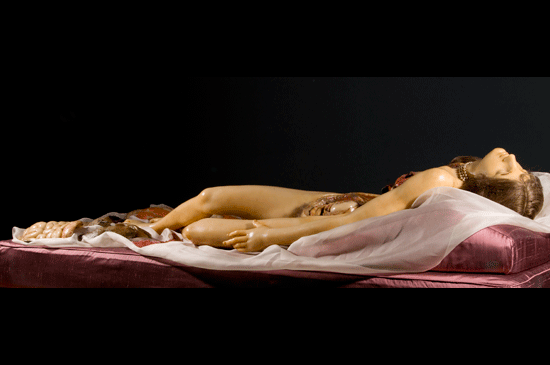
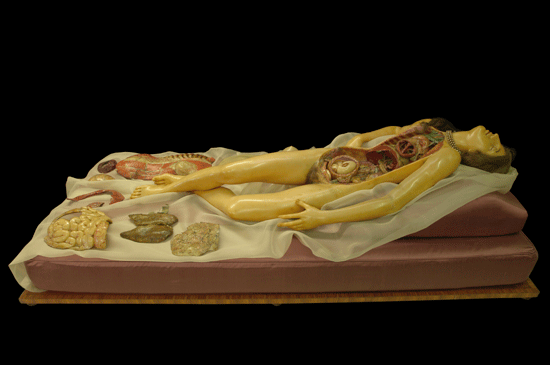
The Bolognese "Venerina," Anatomical Venus, Clemente Susini, 1780-1782


The Bolognese "Venerina" is one of the more or less faithful replicas of the original model, the Venere dei Medici, that Clemente Susini (1754-1814) made between 1780-1782 in Florence. The agony of a young woman is represented in her last instant of life as she abandons herself to death voluptuously and completely naked. The thorax and abdomen can be opened, allowing the various parts to be disassembled so as to simulate the act of anatomic dissection.

A virtual dissection, to be carried out by lifting the movable layers or ‘pieces’ to reveal veins, arteries and internal organs. A young woman, the Venerina carries a foetus in her womb – to suggest the procreative potential of the female body – despite the total lack of any outward signs of pregnancy.

The alienating effect that the statue produces by combining anatomical detail, crude and repulsive, with a harmonious and sensual litheness, is the result of a precise scientific choice: sensitivity is an essential quality of matter; sensitivity – with its wide range of manifestations, including the sensuality of the Venerina who surrenders herself to death – lies at the core of the physical and physiological organisation of man.

From the website for the stunning Museo di Palazzo Poggi in Bologna, Italy where the Venerina is housed.

FIELD TRIP: Guided Tour and Behind the Scenes Viewing of The Murtogh D. Guinness Automaton Collection at the Morris Museum in Morristown, New Jersey

clownhead
Field trip, anyone?

FIELD TRIP: Guided Tour and Behind the Scenes Viewing of The Murtogh D. Guinness Automaton Collection at the Morris Museum in Morristown, New Jersey
Date: Sunday, February 20th
Time: 12 PM - 4 PM (Bus pickup and drop-off at Observatory)
Admission: $45
*** MUST RSVP to morbidanatomy [at] gmail.com
*** PLEASE NOTE: Trip limited to a maximum of 30 attendees; Admission fee Includes round trip transportation via chartered bus, tour cost, a Guinness beer, and museum admission.

Many people have no idea that one of the finest collections of antique automata--moving mechanical toys popular in the 18th Century and 19th Centuries-- in the world resides not in London or Paris but 25 miles away from New York City in Morristown, New Jersey.

This collection--compiled over 50 years by Murtogh D. Guinness (1913-2002), heir to the Guinness beer fortune--consists of 700 historic automata and mechanical musical instruments as well as more than 5,000 programmed media, ranging from player piano rolls to pinned cylinders. Guinness regarded the collection as his life’s work, and he traveled the globe to search of the finest surviving pieces of their kind. Many of the automata in the collection were made in France in the 19th Century and represent a broad array of subjects including snake charmers, magicians, singing birds, musicians, animals, and anthropomorphic monkeys enacting a variety of human situations. Together, these objects constitute one of the largest public holdings of automata in the United States.

On Sunday, February 20th, join Observatory and Morbid Anatomy for a special guided tour of this incredible collection, one of the most significant of its kind in the world. Guinness Collection Conservator Jeremy Ryder will lead us on an hour-long tour of the collection; on this tour, he will guide us through of the permanent exhibit Musical Machines & Living Dolls featuring 150 pieces from the spectacular collection, explain the techniques and history of these incredible objects, demonstrate automata in action, and show us pieces rarely on display to the general public.

After the tour, attendees will be given approximately an hour of free time with which to take in the other exhibitions at the museum such as Frank H. Netter, MD Michelangelo of Medicine--featuring more than 40 works of art by this acclaimed master of medical illustrations--and the museum's excellent permanent collection which includes costumes and textiles, fine art, decorative art, dolls and toys, natural science, geology and paleontology, and anthropology; more about the museum can be found at http://www.morrismuseum.org.

At the day's end, our chartered bus will pick up us and we will enjoy a toast to Mr. Guinness and his fantastic collection with a Guinness beer (naturally!) on our drive back to New York City.

Trip Details: The $45 event cost of this event includes round trip transportation on a special chartered bus from Observatory to the Morris Museum in Morristown, New Jersey and back again, as well as museum admission, tour cost, and one Guinness beer per person. The bus will pick up and drop off in front of Observatory (543 Union Street at Nevins Street). Pick up is 12:00 noon sharp and drop off approximately 4:00 PM. Attendees will have approximately 1 hour of free time to view the rest of the museum collection.

More info here.

Image: Clown Illusionist Automaton; Made by Jean or Henry Phalibois, Paris, France, c. 1890-1900 "], from The Murtogh D. Guinness Automaton Collection

Buried Alive at Coney Island: "Night and Morning," 1907


Playing off the titillating terror of being buried alive--a theme exploited also by Edgar Allen Poe among many others--Coney Island's Luna Park premiered a new attraction in 1907 which allowed the visitor to experience their own premature burial and added a trip through Hades and Paradise to boot.

From a contemporary New York Times report on April 21, 1907:

NEW WONDERS THIS SEASON AT CONEY ISLAND - Beatific Heavenly Visions and Gruesome Scenes in Hell to be Luna Park's Latest Novelty ...

"The real big feature of the revised Luna Park," Mr. Thompson explained, "is going to be what I have named Night and Morning: or, A Journey Through Heaven and Hell." The idea in itself if, of course, not new, but the manner in which it has been worked up in entirely original and is expected to make it a 'thriller.' It shows you the complete journey to Hades and Paradise, and is full of surprises....

"The first room into which the people enter is like a big coffin with a glass top and the lid off. You look up through the roof and see the graveyard flowers and the weeping willows and other such atmospheric things. When everything is ready the coffin is lowered into the ground. It shivers and shakes, and when it tips up on end you hear a voice above give a warning to be careful. Then the lid is closed and you hear the thud of the dirt.

"The man who is conducting the party now announces that they must have a spirit to guide them. A subject is put into a small coffin and in an instant he is transformed into a skeleton. Then a real skeleton appears and delivers a solemn lecture in which he tells the people that they must 'leave all hope on the outside'--a gentle perversion of the old 'abandon hope all ye who enter here.' ...

Now there is a great clanking of chains and the side of the coffin comes out and visitors pass down into the mysterious caverns. First they see a twentieth century idea of Hell, with monopolists frying in pans and janitors fastened to hot radiators.... After the modern Hell the people come to the Chamber of Skeletons. Though these skeletons haven't a stitch of clothes on them, they smoke cigarettes most unconcernedly all the time just like live men.... Next you come to the panorama of Hell, where you see a vision of all the condemned spirits being washed down by the River of Death. Now comes the big change and you find yourself in a large ordinary room, with cathedral-like windows through which you can look outside and see the graveyard which looms up with a weird effect. Like great mist you can see the spirits rising from the graves and ascending to Heaven...

The great transformation now takes place. The whole grave yard floats off into space with the single exception of an immense cross, where the form of a young girl is seen clinging to the Rock of Ages. Fountains foam with all their prismatic colors, and the air is filled with troops of circling angels. The room itself vanishes and you find yourself in a bower of flowers under a blue sky. At the climax and angel comes down with a halo which she places on the head of the girl who is still clinging to the cross Then all that vanishes and you are within four blank walls once more."

Excerpted fom the April 21, 1907 issue of The New York Times; You can read the entire article here.

For more on the amazing and bizarre attractions of turn of the century Coney Island, check out my new project The Great Coney Island Spectacularium.

Image: Antoine Wiertz, The Premature Burial, 1854. Also the name of an Edgar Allan Poe short story. Image found via a blog called Rouge's Foam.

Modern/Contemporary Art and the Curiosity Cabinet, Conference, Seton Hall University, New Jersey, February 5th


For the curious (sic) among you: On Saturday, February 5th I will be presenting a short lecture as part of the very intriguing looking "Modern/Contemporary Art and the Curiosity Cabinet" conference hosted by Seton Hall University. Lawrence Weschler--author of one of my all time favorite books, Mr Wilson's Cabinet of Wonder--will be giving the keynote address on “A Natural History of Wonder;” my piece will examine the revival of private cabinets of curiosity as explored in my Private Cabinets photo series, from which the above images are drawn. I will also talk a bit about my own Private Cabinet experiment, The Morbid Anatomy Library.

This event is free and open to the public. Full line up and schedule follows; hope to see you there!

Modern/Contemporary Art and the Curiosity Cabinet

10-10:30: Coffee

10:30: Welcome (Petra ten-Doesschate Chu, Seton Hall University)

10:45-11:45: Lawrence Weschler, Keynote address: “A Natural History of Wonder.”

11:45-12:15: Kirsten A. Hoving, Middlebury College, “Thinking Inside the Box: Joseph Cornell’s Cabinets of Cosmic Curiosity.”

12:15-1:15: Lunch

1:15-1:45: Melissa Ragain, University of Virginia, “Wonder as a Way of Seeing: Gyorgy Kepes and the Center for Advanced Visual Studies

1:45-2:15: Matthew Palczynski, Philadelphia Museum of Art, “Organizing the Curious Damien Hirst”

2:15-2:45: Patricia Allmer, Manchester Metropolitan University (UK), and Jonathan Carson & Rosie Miller (artist collaborators), University of Salford (UK), “Playing in the Wunderkammer”

2:45-3: Break

3-3:30: Joanna Ebenstein, Morbid Anatomy Library, “To Every Man his Cabinet or The Morbid Anatomy Library and Cabinet and the Revival of Cabinets of Curiosity.”

3:30-4: Roundtable with artists, led by Jeanne Brasile, Seton Hall University

4-5:30: Reception

You can find out more here and get directions by clicking here. This symposium is being produced in conjunction with a new exhibition called Working in Wonder at the Walsh Gallery at Seton Hall University; You can find out more about that by clicking here.

All of the photos you see here are drawn from my Private Cabinets series; you can see the full collection by clicking here; the first two images are from the collection of Tim Knox and Todd Longstaffe-Gowan; the bottom image is from the collection Evan Michelson of Obscura Antiques (and also more recently the television show "Oddites.")