How to Use Pathology 2.0 and Social Networking to Advance Your Career

Social networking and Pathology 2.0 are giving young pathologists unique opportunities to advance their careers and their clinical expertise. If you're a pathology resident or fellow, smart use of these tools can help you identify the perfect job, with ample salary and benefits to match.

If you're preparing to enter the professional arena, you'll want to use Pathology 2.0 and social networking to build valuable collaborations within the pathology profession. In the clinical area, it's a great way to open doors and interact with nationally prominent sub-specialist pathologists and professional leaders. 

Keith J. Kaplan, MD, FCAP is an up-and-coming young pathologist who is recognized as an early master of social networking-and is credited with coining the term "Pathology 2.0." Now he's ready to share what he's learned with you.

If you're a pathology resident or fellow, this is your chance to understand the essentials of Pathology 2.0 and social networking. Find out how the effective use of these resources can boost your career-both clinically and financially when you register to attend "Finding Your Perfect Pathology Job: How to Use Pathology 2.0 and Social Networking to Advance Your Career" on Thursday, February 10, 2011.

"Web 2.0" refers to an Internet that is both personalized and interactive. It incorporates technologies that allow websites to recognize the individual and deliver information and content tailored specifically to each user's interests and needs. It's about instant communication and collaboration across large numbers of like-minded individuals, enabled by the Internet.

Take all those Web 2.0 capabilities, add digital pathology images and you have the basis of Pathology 2.0, which represents a disruptive change agent in today's practice of anatomic pathology. 

Pathology 2.0 is the convergence of digital imaging, digital pathology systems, and integrated healthcare informatics. This combination of digital pathology images with social networking collaborations gives you the ability to discuss or diagnose a case across an ever-expanding network.

During this webinar, you'll learn how Pathology 2.0 is already beginning to change the daily practice of surgical pathology. Find out how digitized whole slide images, combined with different web-based technologies, can change case referral patterns. It all starts with a physician treating a patient and extends to the pathologist who may want a sub-specialist to review the images.

It is easy to see why Pathology 2.0 is likely to transform the current anatomic pathology practice into a different, more vibrant, and more collaborative profession. It will be today's pathology residents-already familiar with computers, email, and video games-who will be more likely to use the Internet to support their surgical pathology practices. 

As a pathology resident or fellow today, you have incredible new tools to advance your clinical skills and increase your professional compensation. Pathology 2.0 and social networking are valuable resources that can help you identify and secure the perfect job this spring. Find out how when you register to attend this very special webinar. 

And don't forget the question-and-answer session at the end of this 75-minute conference. It's your opportunity to get answers to specific questions about how to put Pathology 2.0 to work for you. 

For one low price—just $249—you and your entire team can take part in this fast-paced, insightful webinar. Best of all, you'll be able to connect personally with either of the panelists when we open up the phone lines for live Q&A.

Here's just some of what you’ll learn during this in-depth 75-minute webinar:

  • Why digital imaging and digital pathology change everything.

  • How Pathology 2.0 increases your professional capabilities.

  • How you can use both social networking and Pathology 2.0 to market yourself to referring physicians.

  • Avoiding the biggest mistakes pathologists make with their Facebook and MySpace pages.

  • Steps pathology residents can take with social networking to increase recognition of their skills and sub-specialty competencies.

  • Dangers and benefits of communicating with patients and physicians via social networking methods.

    …and much more!

Individuals who benefit from this webinar:

  • Pathology chief residents, residents and fellows 
  • Academic pathology chairs 
  • Residency program directors 
  • Pathology department administrators 
  • Undergraduate and graduate medical educators 
  • Pathology and laboratory professionals

How to Register:
1. Online
2. Call toll free: 800-560-6363

Your webinar registration includes:

  • A site license to attend the webinar (invite as many people as you can fit around your computer at no extra charge)
  • Downloadable PowerPoint presentations from our speakers
  • A full transcript emailed to you soon after the conference
  • The opportunity to connect directly with our speaker during the audience Q&A session

    Register Now! Or for more information, call us toll-free at 800-560-6363.

Distinguished Expert:

Keith J. Kaplan, MD is a pathologist and Chief Information Officer (CIO) of Carolinas Pathology Group, Celligent Diagnostics and Diligent Billing and Management. As CIO, he is responsible for all aspects of informatics strategies, operations, and projects and processes that encompass laboratory, healthcare and research information systems for Carolinas Pathology Group. Dr. Kaplan is board certified in anatomic and clinical pathology. His subspecialty interests include gastrointestinal and hepatic pathology, cytopathology and pathology informatics as well as research interests in gastrointestinal and hepatobiliary pathology, hyperspectral imaging, image analysis and the use of Web 2.0 tools in pathology. Prior to joining Carolinas Pathology Group, Dr. Kaplan was a surgical pathologist at Mayo Clinic and held the academic post of associate professor of pathology of Mayo Medical School. Dr. Kaplan is a graduate of Northwestern University Feinberg School of Medicine and completed residency training in anatomic and clinical pathology at Walter Reed Army Medical Center. While at Walter Reed, he was named Resident of the Year, and in conjunction with the Armed Forces Institute of Pathology, founded and directed the Army Telepathology Program. This program connected 25 hospitals internationally for consultation using telepathology. Dr. Kaplan is a member of the College of American Pathologists, American Society of Clinical Pathology and the American Society of Cytopathology as well as the American Pathology Foundation. He is also an executive board member of the Digital Pathology Association. 


Where do Pathologists fit into Accountable Care Organizations? – Part 5

In the fourth installment of my series entitled “Where do pathologists fit into Accountable Care Organizations (ACOs)?, I mentioned that I personally had not come across much information on oncology and ACOs.  In this post, I highlight some information about the potential plans of a large, single-specialty integrated oncology practice. Ben Calhoun MD PhD. 

As a surgical pathologist specializing in breast pathology, I assume that oncology will be a major area in of intersection between tumor pathology and ACOs (and the rest of oncology care delivery) in my daily practice.  How will ACOs affect those of us who spend most of our time looking at biopsies and resections for cancer?  That question is difficult to answer right now, but another way to approach the question could be to ask: What do we know about ACOs and oncology in general?

The short answer is: not much.  But, I ran across a recent (January, 2011) article by Judy Packer-Tursman on AISHealth.com about US Oncology and it’s potential as a single-specialty Medicare ACO (reprinted from ACO Business News).  Dr. Leonard Kalman, one the Medical Directors for US Oncology (recently purchased by McKesson), discusses an ACO-like arrangement involving US Oncology and the likely initial scope of ACOs in oncology (most likely limited to states or regions, with the possibility of a national approach later).

Dr. Kalman envisions some exclusivity to ACOs designed to deliver cancer care: “When cancer becomes the primary diagnosis, the oncologist basically handles the patient’s primary care, Kalman explains. ‘Remember, the majority of an oncology patient’s care is cancer care,’ he says. So while ACO patients may require occasional care from other sources, including primary care physicians or specialists such as cardiologists or rheumatologists, only oncologists would be affiliated with a Medicare oncology ACO as he envisions it.”  I guess if primary care physicians and specialists are excluded, that takes some of the mystery out of where pathologists would fit in…hospitals aren’t mentioned, either.


Two other points are worth noting:

1.  US Oncology is already involved in an ACO-like venture in Texas that involves Aetna, Inc. and a subsidiary of US Oncology.  “Meanwhile, Kalman says a seven-month-old ACO-type project in Texas — involving Aetna Inc., Texas Oncology (an affiliated US Oncology practice of 300-odd oncologists); and Innovent Oncology, a subsidiary of US Oncology — is expanding and has ‘the potential to go national.’”

2.  US Oncology is in the process of identifying large hospitals and commercial insurance carriers as potential partners for ACOs after the rules are written and released in January 2012. Dr. Kalman tells ACO Business News that “…..a major hospital in Miami has approached his 40-physician practice about handling cancer care in such a way. ‘Our ACO partner is a dominant hospital system where we put basically all of our patients,’ he says, declining to name it.”  Dr. Kalman adds that “the time is ripe for oncology practices to approach commercial managed care organizations and begin ACO discussions, setting the fee schedule and expenditure targets and a shared-savings arrangement. ‘We’ve picked out a commercial insurance plan as a potential partner,’ he notes.”

Another article in the Oncology Business Review (OBR) on Oncbiz.com discusses oncology and ACOs.  In the January 2011 issue of OBR, Allison Shimooka lists 5 key areas for investment in developing oncology ACOs: physician alignment, payer contracting, knowledge management (this means IT), facility strategy (integrating providers and healthcare systems), and patient engagement/activation.  She refers to plans recently announced by US Oncology and Milliman, a Seattle-based actuarial and consulting firm, to “develop a model for physician-led oncology organizations to contract around risk, either through episode rates, bundled payments, or capitation.”  She also mentions that United HealthCare is “piloting a new episode-based payment methodology with 5 private practice medical oncology groups.”

So, it’s clear that regional and perhaps national oncology ACOs are being contemplated by major players.  What, if any, developments should we expect with regional and national pathology groups and ACOs in general and oncology ACOs specifically (assuming such ACOs eventually exist)? 


Toronto Set to Become a World Class Medical R&D Centre

By Rachel Smith 

http://www.businessreviewcanada.ca/sectors/medical-devices-products/toronto-set-become-world-class-medical-r-d-centre

GE Healthcare’s first global Pathology Imaging Centre of Excellence to advance digital imaging pathology solutions worldwide

Toronto will be the home of GE Healthcare’s first global Pathology Imaging Centre of Excellence, a cutting-edge, one-of-a-kind R&D facility that will advance both the technology and adoption of digital pathology solutions, for pathologists world-wide.

The world-class Pathology Imaging Centre of Excellence will be funded by the digital pathology joint venture Omnyx, which is a partnership between GE Healthcare and The University of Pittsburgh Medical Center.

"The Omnyx joint venture was inspired in 2008 by a ground-breaking discovery at GE's Global Research Centre,” said John Rice, Vice Chairman, President and CEO, Global Growth & Operations, GE.

“The breakthrough technology is part of our global $6 billion healthymagination initiative to improve cost, quality and access in healthcare. Our partnership with the Ontario government has facilitated today's investment."

Omnyx will invest $7.75M along with a $2.25M grant from the Health Technology Exchange (HTX), a funding arm of the Ontario Network of Excellence.

Planned collaborative research and development (R&D) partnerships will bring an additional $7.2M, for a total investment of $17.2M over the next 3 years.

"The Centre is a perfect example of how HTX funding can facilitate medtech investment and job growth in Ontario,” said John Soloninka, HTX President & CEO.

“There is an incredible opportunity for Ontario to support the transformation of pathology with the global leader in this emerging field. We are in discussions with several other MNEs about how they too can gain commercialization advantage through Ontario."

GE Healthcare chose Toronto for its imaging R&D assets and infrastructure that are capable of supporting design, development, validation, and deployment of a global digital pathology (DP) initiative.

The global Pathology Imaging Centre of Excellence will be a boon for Canada’s health network and makes Toronto one of the leading medical research and development hubs in the world.

http://www.businessreviewcanada.ca/sectors/medical-devices-products/toronto-set-become-world-class-medical-r-d-centre


Early Register for APF 2011 Spring Conference Now

APF Email Header 
 

American Pathology Foundation's  

2011 Spring Conference   

"Seasons of Change For Pathology; 

Meeting the Challenges of Our New Environment" 

March 9-11, Four Seasons Hotel, Las Vegas


One Week Remaining for Early Registration Rates
 Two Weeks Left for Preferred Hotel Room Rates  
 
Make plans to join the American Pathology Foundation this March in Las Vegas for our 2011 Spring Conference.  Spring Conference attendees can look forward to three days of information-rich sessions on best practices in the business of pathology and plenty of practical "take home" ideas and suggestions for better managing their time, practice and resources.

The APF Program Committee has been hard at work selecting timely topics and speakers to help you address critical management issues.  Half-day program blocks will focus on health care reform, tools and techniques to position your practice for the future, improving the bottom-line for your business and new /emerging pathology and laboratory technology.   APF conferences provide ample networking opportunities for you to share experiences and craft solutions with your colleagues.


APF 2011 Spring Conference
For online conference registration visit http://www.apfconnect.org


You may also register over

the phone by calling the

APF National Office toll-free at

(877) 993-9935, ext 202 


A complete conference brochure

can be downloaded using the link below:  


     NEW FOR 2011 -  Full Day Pre-Conference:

 Medical Coding"Practical Coding & Advice for Pathology    Providers"

Wednesday, March 9  

Participants in the 2011 "Practical Coding" Pre-Conference will gain a thorough understanding of the CPT and ICD9 coding issues specific to pathology.  Dennis Padget, MBA, CPA, FHFMA is the primary presenter for this full-day course which will cover common coding dilemmas, present strategies to implement change and maximize reimbursement. The pre-conference will also cover critical aspects of coding for molecular and special tests and a primer on confronting and correcting claims denials.     

Hot Topics Breakfast Roundtable Sessions
Friday, March 11
breakfastGet your day off to a great start with a full breakfast and
a chance to discuss hot topics of the day with Spring Conference faculty and your colleagues.   Due to the popularity of these sessions, additional discussion groups have been added.  Topics include:  Health Care Reform, Legal Issues, Pathology Contracting, Billing and Digital Pathology Topic tables are limited to 10 attendees.


   Exhibit Hall  Networking past, present, future    

Join us for special events planned each day; including our signature wine tasting at Wednesday's Welcome Reception, Thursday's "On Par" Reception, the Foundation's 5th Annual Eilers Fund Silent Auction benefiting resident education and our 2011 Charity Golf Tournament.

  
APF logolas vegas sign
 We Look Forward to Seeing You
 in Las Vegas at the
 APF 2011 Spring Conference!


Development and evaluation of a virtual microscopy application for automated assessment of Ki-67 expression in breast cancer

The aim of the study was to develop a virtual microscopy enabled method for assessment of Ki-67 expression and to study the prognostic value of the automated analysis in a comprehensive series of patients with breast cancer. 

Methods: Using a previously reported virtual microscopy platform and an open source image processing tool, ImageJ, a method for assessment of immunohistochemically (IHC) stained area and intensity was created. A tissue microarray (TMA) series of breast cancer specimens from 1931 patients was immunostained for Ki-67, digitized with a whole slide scanner and uploaded to an image web server.

The extent of Ki-67 staining in the tumour specimens was assessed both visually and with the image analysis algorithm. The prognostic value of the computer vision assessment of Ki-67 was evaluated by comparison of distant disease-free survival in patients with low, moderate or high expression of the protein. 

Results: 1648 evaluable image files from 1334 patients were analysed in less than two hours.

Visual and automated Ki-67 extent of staining assessments showed a percentage agreement of 87% and weighted kappa value of 0.57. The hazard ratio for distant recurrence for patients with a computer determined moderate Ki-67 extent of staining was 1.77 (95% CI 1.31-2.37) and for high extent 2.34 (95% CI 1.76-3.10), compared to patients with a low extent.

In multivariate survival analyses, automated assessment of Ki-67 extent of staining was retained as a significant prognostic factor. 

Conclusions: Running high-throughput automated IHC algorithms on a virtual microscopy platform is feasible. Comparison of visual and automated assessments of Ki-67 expression shows moderate agreement.

In multivariate survival analysis, the automated assessment of Ki-67 extent of staining is a significant and independent predictor of outcome in breast cancer.

Author: Juho KonstiMikael LundinHeikki JoensuuTiina LehtimakiHarri SihtoKaija HolliTaina Turpeenniemi-HujanenVesa KatajaLiisa SailasJorma IsolaJohan Lundin

Credits/Source: BMC Clinical Pathology 2011,11:3

Standardization and Validation of Digital Pathology in Clinical Laboratories

The following post was submitted by Dr. Holger Lange, CTO of Flagship Biosciences, who is working with a number of pharmaceutical partners on regulatory companion diagnostics development.

Digital Pathology is a new technology, a new industry, where organizations like CLIA, CAP and the FDA provide limited guidance, and the manufacturers still have to learn what it means to provide instruments into a clinical laboratory.

With Digital Pathology now entering the clinical laboratories, it is crucial for physicians and laboratory professionals to understand the regulatory requirements and how to best implement Digital Pathology in their clinical laboratories.

For the past 4-5 years I have worked for a leading Digital Pathology manufacturer. I was responsible for their first product in the clinical market – a digital IHC workflow solution, and their portfolio of FDA clearances. Now I have put together a presentation that summarizes my experience in the clinical market. I hope it will help many physicians and laboratory professionals to quickly get up to speed on how to deal with the implementation of Digital Pathology in their clinical laboratories.

These are the subjects that are covered in the presentation:

Clinical Laboratory Regulations

A discussion on how the CLIA standard and the CAP checklist apply to Digital Pathology. A review of the new ASCO/CAP guidelines for HER2 and ER/PgR for the latest thoughts on standardization and validation in clinical laboratories.

Medical Device Manufacturer Regulations

An overview of the existing US Food and Drug Administration (FDA) clearances for Digital Pathology with an example of a successful study design. A discussion on the FDA advisory panel meeting on Digital Pathology Whole Slide Imaging (WSI) for the latest thoughts on what it takes to validate Digital Pathology systems for primary diagnosis.

Digital Pathology Systems

Practical tips on how to implement a digital pathology system in a clinical laboratory and how digital pathology manufacturers could make it easier. A demo of how a digital pathology system can help with the logistics of its own validation. A discussion on how going digital could be a game changer for the standardization of pathology, looking at the example of the automatic standardization of staining, using standard controls and automatic image analysis.

Go to the Flagship Biosciences product page for digital pathology regulatory products.

You get an 1½ hour video presentation on a DVD and the presentation transcript.

Save yourself many hours of research and reading! Get the insights you need by viewing this video presentation. Get access to material that cannot be found anywhere else.

DVDCover_20Jan11 TranscriptCover_20Jan11

Last Weekend to View the Amazing Museum of Everything Exhibition #3, London


This is absolutely the last weekend to view the much heralded (and not just by me) Museum of Everything Exhibition #3 in London. And, in a bittersweet farewell to this amazing exhibition, the folks at The Museum of Everything have put together a thoroughly action-packed final weekend featuring a variety of exciting programming.

Full details for the weekend's activities follow; and please, I implore you, if you live near London and have not yet seen this exhibitions, do yourself a favor and go! You won't be sorry. I promise.

>> VALENTINE’S WEEKEND <<

As far as we’re concerned, Valentine’s Weekend starts at 10:30am on Friday 11th February 2011; so fire up your hot-tub, cover yourself in love-gel and prepare yourself for what may well be the greatest weekend in the history of weekends.
For your delectation we shall have muzac - all day, every day - our favourite artistes performing in nooks and crannies right across the museum, be it accordion solos, tubas, one man bands, human jukeboxes, Punches, Judies, or perhaps just a lonely snare drum announcing the reveille.

And if you pop down at 4:00pm on Sunday 13th February 2011 you might be treated to a private viewing of that rarely seen gem - Pop Goes the Easel - directed by that randy rambunctious ruddy red rolicker, Ken Russell, as part of The Midgets & Giants Film Festival.

Who knows, the movie may even be introduced by Sir Peter Blake himself ...

For it is Sir Peter Blake who we have to thank for this astonishing show, for his brilliant eye, his enduring aesthetic, his wit, his love and his support. They say you never forget your first love and he is most certainly ours.

"The Museum of Everything was the highlight of my London trip, I can’t believe you’ll close! "Cindy Sherman, January 2011

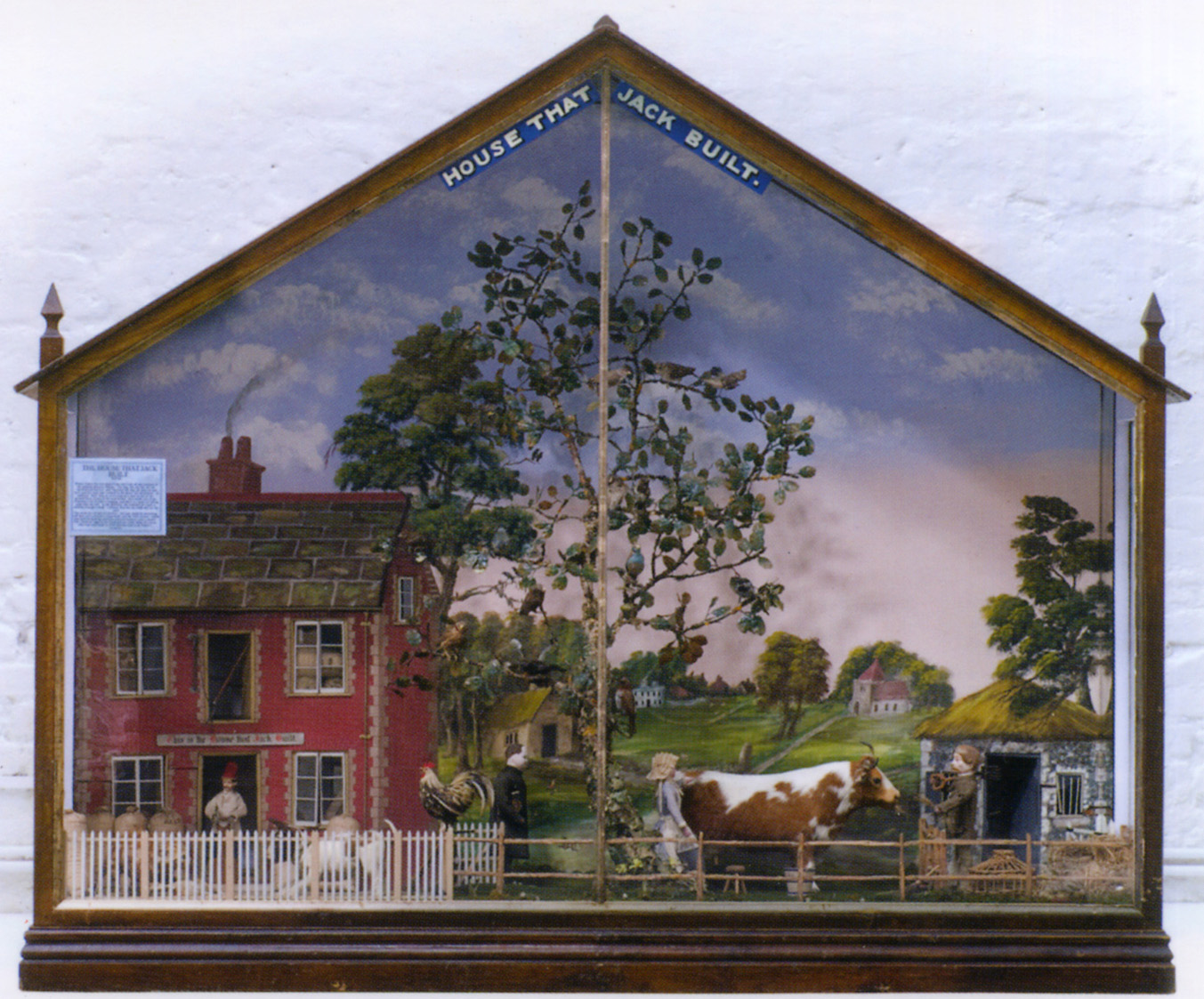
Cindy’s right, this really is your very last chance to see the astonishing tapestries of Ted Willcox, the animal empire of Walter Potter, the magical funfair of Joby and Anna Carter and the miniature fairgrounds of Arthur Windley.

Come Monday monring, it’s adieu dear friends - perhaps for a few weeks, perhaps forever – because our plans are up in the air, we can’t commit, although we do have our roving eyes on Russia, the Americas, the Middle Yeast, even London’s glittering West End. The world is our Oyster Card ...

Until next time, we remain yours in Everything:

The Museum of Everything
right behind the library on the corner of Sharpleshall
Street & Regents Park Road in Primrose Hill London NW1
http://www.musevery.com

For more on the Museum of Everything #3, see this recent post.

Images are all drawn from postcards available at the Museum of Everything gift shop. A lovely (if slightly expensive) book is available also. Click here for more.

Tonight!!!! A: Head on B: Body: The Real Life Dr. Frankenstein," Observatory


Tonight at Observatory! I advise coming early, as this one is sure to sell out; Hope to see you there!

A: Head on B: Body: The Real Life Dr. Frankenstein
A screening and lecture with film-maker Jim Fields and Mike Lewi
Date: TONIGHT, Thursday February 10
Time: 8:00 PM
Admission: $5
Presented by Morbid Anatomy

In an eventful and successful career spanning 40 years, Dr. Robert White–pioneering neurosurgeon and Professor at Cleveland’s Case Western Reserve University–did many things. He participated in Nobel Prize-nominated work, published more than 700 scholarly articles, examined Vladimir Lenin’s preserved brain in Cold War Russia, founded Pope John Paul II’s Committee on Bioethics, went to mass daily, and raised 10 children. He also engaged in a series of horrifying and highly controversial experiments reminiscent of a B-Movie mad scientist, experiments which pushed the limits of medical ethics, infuriated the animal rights community, and questioned notions of identity, consciousness, and corporeality as well as mankind’s biblically-condoned dominion over the animal kingdom.

Tonight, join film-maker Jim Fields–best known for his 2003 documentary “End of the Century” about the legendary punk band The Ramones–and Mike Lewi for a screening of Fields’ short documentary about the life and work of this real-life Dr. Frankenstein whose chilling “full body transplants” truly seem the stuff of a B-Movie terror. Fields will introduce the film–which features a series of interviews with Dr. White discussing his controversial experiments–with an illustrated lecture contextualizing the doctor’s work within the history of “mad scientists” past and present, fictional and actual; scientists whose hubris drove them to go rogue by tampering with things perhaps best left alone.

Jim Fields made a few documentaries, one of which, “End of the Century: the Story of the Ramones” is particularly long. He’s currently a video journalist at Time Magazine and Time.com.

Mike Lewi is a filmmaker, event producer, and disc jockey.

You can find out more about this event on the Observatory website by clicking here and can can access the event on Facebook here. You can get directions to Observatory--which is next door to the Morbid Anatomy Library (more on that here)--by clicking here. You can find out more about Observatory here, join our mailing list by clicking here, and join us on Facebook by clicking here.

Image: Drawing by Dr. Harvey Cushing, early 20th Century, found on the Yale Medical Library website.

"Physica Sacra," Johannes Jacob Scheuchzer, 1735


The incredible images above are drawn from a book which has long intrigued me, Johannes Jacob Scheuchzer's 4-volume early 18th Century extravaganza of art, science and mysticism entitled Physica Sacra.

As described by Christie's Auction House:

'In Scheuchzer's gigantic work, Physica Sacra, the Baroque attains, philosophically as well as artistically, its high point and its conclusion' (Faber du Faur, German Baroque Literature, p. 472). Scheuchzer, a doctor and natural scientist from Zurich, planned the Physica sacra as an explanation of and a commentary on the Bible on natural-scientific grounds. He himself oversaw the illustrations which were largely based on his own natural history cabinet or on other famous European cabinets of rare specimens...

This book seems like a fitting final response to yesterday's very stimulating "Art and the Curiosity Cabinet" Conference at Seton Hall University, where a lot was said about these ways in which early cabinets (and pre-modern inquiry) resided at the borders of art and science, fact and mysticism. I don't think I have ever seen a more elegant expression of these ideas than the content and illustrations of this book, which blends bible commentary with natural history in a bombastic interest in all of the known world of its time, spanning Memento Mori to the Thesaurus of Snowflakes to biblical miracles, all given equal treatment and weight.

Click on images to see much larger and more detailed images; worth your while, I promise! You can see 737 of the images from the book (!!!) (from which the above 7 are drawn) in Greyherbert's amazing Flickr stream by clicking here.

Inspired by this recent post on the Ptak Science Books blog discussing the book; Text from Christie's Auction house description of the book when recently auctioning off a complete 4-volume set.

Images above, top to bottom:

  1. Homo ex Humo ('man from the ground', or 'dust')
  2. Memento Mori
  3. Ventriculi
  4. Heart
  5. Columna Ignis
  6. Solea cum Squamae
  7. Thesarus of Snowflakes

"Naming The Animals" Call for Works, Curious Matter and Proteus Gowanus


A very exciting looking call for art works just crossed my desk; full details below:

Curious Matter is announcing its new Call For Entries, "Naming The Animals." If you believe that this will be of interest to your artist members, please make it available to them. Thank you for your cooperation.
Curious Matter

We're absolutely delighted to announce this special collaboration between CURIOUS MATTER and PROTEUS GOWANUS. Details are below and attached as a pdf file. Cheers!

CALL FOR ENTRIES

Naming The Animals

Entries Due: March 4, 2011

Exhibition dates: April 3 - May 15, 2011*

Naming The Animals is a collaboration between Curious Matter in Jersey City, NJ and Proteus Gowanus in Brooklyn, NY. The exhibition will be presented in two parts concurrently at Curious Matter and Proteus Gowanus. The curators will select the location for the artwork. The exhibition is a complement to the yearlong multi-disciplinary inquiry hosted by Proteus Gowanus on the theme of Paradise. A catalogue will accompany the exhibition.

Theme: In our collective effort to understand the world we're driven to catalogue and name everything around us. From Adam’s task to name the animals in paradise, to cave painting to modern ecology and zoology, we’re compelled to describe and render the creatures that share our planet. Medieval bestiaries, and the work of Ernst Haeckel and John James Audubon are vivid examples, as are the installations of Mark Dion and the ecological works of Alexis Rockman. These various efforts are not necessarily purely aesthetic or scientific; naming and cataloguing can also include the assignment of moral or metaphorical associations–implicit is the desire to declare and understand ourselves.

We invite contemporary artists to submit work that draws inspiration from the natural world and the human drive to understand and catalogue the world around us. We're taking a broad approach to the theme and are particularly interested in work that looks beyond a literal interpretation.

Media/dimensions: All media will be considered. Artworks should not exceed 24"(framed) in any direction for wall hung work. Small sculptural work and bookarts particularly welcome, larger sculptures will be considered individually. Video artists must provide their own equipment.

Eligibility: All artists working in any media.

Submissions: (Please include all information. Late, incomplete, or weblink submissions will not be considered or responded to.)
1. Up to 5 images. Postal submissions should include 35mm slides or letter-sized color printouts. Do not send original artwork. Digital file submissions will only be accepted via email and must be in JPEG or PDF format, resolution set to 72 dpi, no larger than 800 X 800 pixels and no larger than 2MB. Please number images to correspond to Image List.
2. Image list. Numbered to correspond with your image submissions. Include image #, your name, title, date of work, medium, size and price. You may include a brief description for each image, however this isn’t required.
3. One page résumé. Please include a three line bio, your
contact information and an email address.
4. Artist’s statement. No longer than 300 words.

Fees: NO FEE TO ENTER, accepted artists pay a nominal materials fee of $35.

Deadline: Entries must be received no later than March 4, 2011.

Return of Submission Materials: Include a SASE if you want your materials to be returned. Make sure there is sufficient postage. Materials without postage will not be returned.

Notification: Accepted artists will be notified via email by March 7, 2011. NOTE: Accepted artists must confirm their participation by March 8 and provide a print-quality digital image for the catalogue by March 11.

Drop Off: Drop off of accepted artwork will be March 26 and 27, noon to 2pm at Curious Matter. Mailed artwork must arrive by March 25 and include return shipping label/postage/etc.

Pick Up: Artists are responsible for picking up artwork on May 21 noon to 2pm. Return of mailed artwork with return postage will begin on May 16, 2011.

Email Submissions To: CuriousMatter@comcast.net
By Post: Curious Matter, 272 Fifth Street, Jersey City, NJ 07302

* works selected for exhibition at Proteus Gowanus will remain on display until mid-July as part of the Paradise exhibition.

CURIOUS MATTER is an exhibition venue for contemporary visual art located in downtown Jersey City, NJ. Curious Matter exhibitions and publications evidence the pursuit to understand and articulate our individual and collective experience of the world, real or imagined. We examine fantastic notions, confounding ideas and audacious thoughts. Curious Matter strives to foster dialogue among artists at all career stages with a calendar of regular exhibitions. Our commitment extends to our audience as we endeavor to open a door to appreciating contemporary art in an atmosphere that encourages engagement and curiosity. The gallery is open Sundays noon to 3pm and by appointment during exhibitions. Curious Matter is a non-profit organization, and a sponsored project of Fractured Atlas, a non-profit service organization.

PROTEUS GOWANUS is a gallery and reading room located on the Gowanus Canal in Brooklyn, NY. A collaborative project, the gallery develops exhibits of art, artifacts and books and hosts events that revolve around a yearlong theme linking the arts to other disciplines and to the community. Proteus Gowanus incorporates the rich and diverse cultural resources of several non-profit organizations into its exhibits and programming. This year’s theme is PARADISE, an exploration of the light and dark sides of spiritual ascent and sensual escape, in which we invite artists and workers in other disciplines to respond to the siren song of that which is easy to imagine but difficult to attain.

CURIOUS MATTER
272 Fifth Street, Jersey City, NJ 07302,
[T] 201-659-5771 [E] curiousmatter@comcast.net
curiousmatter.blogspot.com
follow us on facebook!

There is no fee to enter, and submissions are due on March 4th; Click here for more information. To find out more about Proteus Gowanus gallery, click here; to fine out more about Curious Matter, click here.

Image: Illustration by artist/naturalist/monist Ernst Haeckel, 19th Century, via zannestars.com.

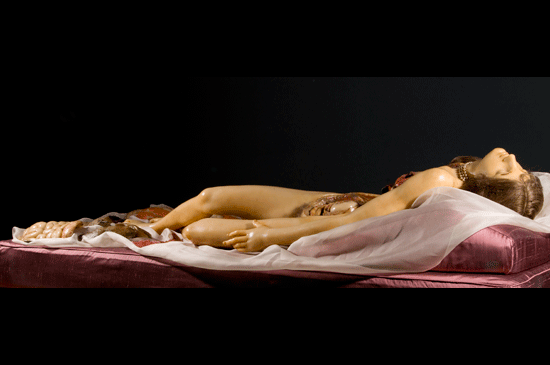
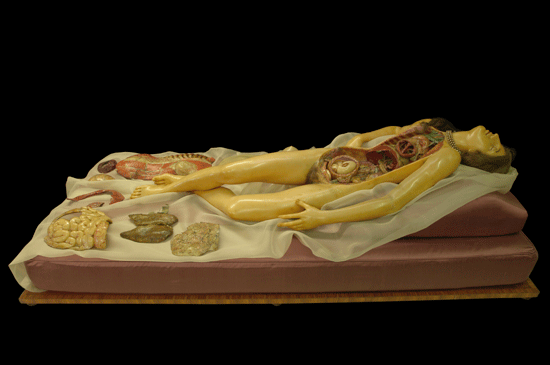
The Bolognese "Venerina," Anatomical Venus, Clemente Susini, 1780-1782


The Bolognese "Venerina" is one of the more or less faithful replicas of the original model, the Venere dei Medici, that Clemente Susini (1754-1814) made between 1780-1782 in Florence. The agony of a young woman is represented in her last instant of life as she abandons herself to death voluptuously and completely naked. The thorax and abdomen can be opened, allowing the various parts to be disassembled so as to simulate the act of anatomic dissection.

A virtual dissection, to be carried out by lifting the movable layers or ‘pieces’ to reveal veins, arteries and internal organs. A young woman, the Venerina carries a foetus in her womb – to suggest the procreative potential of the female body – despite the total lack of any outward signs of pregnancy.

The alienating effect that the statue produces by combining anatomical detail, crude and repulsive, with a harmonious and sensual litheness, is the result of a precise scientific choice: sensitivity is an essential quality of matter; sensitivity – with its wide range of manifestations, including the sensuality of the Venerina who surrenders herself to death – lies at the core of the physical and physiological organisation of man.

From the website for the stunning Museo di Palazzo Poggi in Bologna, Italy where the Venerina is housed.

FIELD TRIP: Guided Tour and Behind the Scenes Viewing of The Murtogh D. Guinness Automaton Collection at the Morris Museum in Morristown, New Jersey

clownhead
Field trip, anyone?

FIELD TRIP: Guided Tour and Behind the Scenes Viewing of The Murtogh D. Guinness Automaton Collection at the Morris Museum in Morristown, New Jersey
Date: Sunday, February 20th
Time: 12 PM - 4 PM (Bus pickup and drop-off at Observatory)
Admission: $45
*** MUST RSVP to morbidanatomy [at] gmail.com
*** PLEASE NOTE: Trip limited to a maximum of 30 attendees; Admission fee Includes round trip transportation via chartered bus, tour cost, a Guinness beer, and museum admission.

Many people have no idea that one of the finest collections of antique automata--moving mechanical toys popular in the 18th Century and 19th Centuries-- in the world resides not in London or Paris but 25 miles away from New York City in Morristown, New Jersey.

This collection--compiled over 50 years by Murtogh D. Guinness (1913-2002), heir to the Guinness beer fortune--consists of 700 historic automata and mechanical musical instruments as well as more than 5,000 programmed media, ranging from player piano rolls to pinned cylinders. Guinness regarded the collection as his life’s work, and he traveled the globe to search of the finest surviving pieces of their kind. Many of the automata in the collection were made in France in the 19th Century and represent a broad array of subjects including snake charmers, magicians, singing birds, musicians, animals, and anthropomorphic monkeys enacting a variety of human situations. Together, these objects constitute one of the largest public holdings of automata in the United States.

On Sunday, February 20th, join Observatory and Morbid Anatomy for a special guided tour of this incredible collection, one of the most significant of its kind in the world. Guinness Collection Conservator Jeremy Ryder will lead us on an hour-long tour of the collection; on this tour, he will guide us through of the permanent exhibit Musical Machines & Living Dolls featuring 150 pieces from the spectacular collection, explain the techniques and history of these incredible objects, demonstrate automata in action, and show us pieces rarely on display to the general public.

After the tour, attendees will be given approximately an hour of free time with which to take in the other exhibitions at the museum such as Frank H. Netter, MD Michelangelo of Medicine--featuring more than 40 works of art by this acclaimed master of medical illustrations--and the museum's excellent permanent collection which includes costumes and textiles, fine art, decorative art, dolls and toys, natural science, geology and paleontology, and anthropology; more about the museum can be found at http://www.morrismuseum.org.

At the day's end, our chartered bus will pick up us and we will enjoy a toast to Mr. Guinness and his fantastic collection with a Guinness beer (naturally!) on our drive back to New York City.

Trip Details: The $45 event cost of this event includes round trip transportation on a special chartered bus from Observatory to the Morris Museum in Morristown, New Jersey and back again, as well as museum admission, tour cost, and one Guinness beer per person. The bus will pick up and drop off in front of Observatory (543 Union Street at Nevins Street). Pick up is 12:00 noon sharp and drop off approximately 4:00 PM. Attendees will have approximately 1 hour of free time to view the rest of the museum collection.

More info here.

Image: Clown Illusionist Automaton; Made by Jean or Henry Phalibois, Paris, France, c. 1890-1900 "], from The Murtogh D. Guinness Automaton Collection

Buried Alive at Coney Island: "Night and Morning," 1907


Playing off the titillating terror of being buried alive--a theme exploited also by Edgar Allen Poe among many others--Coney Island's Luna Park premiered a new attraction in 1907 which allowed the visitor to experience their own premature burial and added a trip through Hades and Paradise to boot.

From a contemporary New York Times report on April 21, 1907:

NEW WONDERS THIS SEASON AT CONEY ISLAND - Beatific Heavenly Visions and Gruesome Scenes in Hell to be Luna Park's Latest Novelty ...

"The real big feature of the revised Luna Park," Mr. Thompson explained, "is going to be what I have named Night and Morning: or, A Journey Through Heaven and Hell." The idea in itself if, of course, not new, but the manner in which it has been worked up in entirely original and is expected to make it a 'thriller.' It shows you the complete journey to Hades and Paradise, and is full of surprises....

"The first room into which the people enter is like a big coffin with a glass top and the lid off. You look up through the roof and see the graveyard flowers and the weeping willows and other such atmospheric things. When everything is ready the coffin is lowered into the ground. It shivers and shakes, and when it tips up on end you hear a voice above give a warning to be careful. Then the lid is closed and you hear the thud of the dirt.

"The man who is conducting the party now announces that they must have a spirit to guide them. A subject is put into a small coffin and in an instant he is transformed into a skeleton. Then a real skeleton appears and delivers a solemn lecture in which he tells the people that they must 'leave all hope on the outside'--a gentle perversion of the old 'abandon hope all ye who enter here.' ...

Now there is a great clanking of chains and the side of the coffin comes out and visitors pass down into the mysterious caverns. First they see a twentieth century idea of Hell, with monopolists frying in pans and janitors fastened to hot radiators.... After the modern Hell the people come to the Chamber of Skeletons. Though these skeletons haven't a stitch of clothes on them, they smoke cigarettes most unconcernedly all the time just like live men.... Next you come to the panorama of Hell, where you see a vision of all the condemned spirits being washed down by the River of Death. Now comes the big change and you find yourself in a large ordinary room, with cathedral-like windows through which you can look outside and see the graveyard which looms up with a weird effect. Like great mist you can see the spirits rising from the graves and ascending to Heaven...

The great transformation now takes place. The whole grave yard floats off into space with the single exception of an immense cross, where the form of a young girl is seen clinging to the Rock of Ages. Fountains foam with all their prismatic colors, and the air is filled with troops of circling angels. The room itself vanishes and you find yourself in a bower of flowers under a blue sky. At the climax and angel comes down with a halo which she places on the head of the girl who is still clinging to the cross Then all that vanishes and you are within four blank walls once more."

Excerpted fom the April 21, 1907 issue of The New York Times; You can read the entire article here.

For more on the amazing and bizarre attractions of turn of the century Coney Island, check out my new project The Great Coney Island Spectacularium.

Image: Antoine Wiertz, The Premature Burial, 1854. Also the name of an Edgar Allan Poe short story. Image found via a blog called Rouge's Foam.

Modern/Contemporary Art and the Curiosity Cabinet, Conference, Seton Hall University, New Jersey, February 5th


For the curious (sic) among you: On Saturday, February 5th I will be presenting a short lecture as part of the very intriguing looking "Modern/Contemporary Art and the Curiosity Cabinet" conference hosted by Seton Hall University. Lawrence Weschler--author of one of my all time favorite books, Mr Wilson's Cabinet of Wonder--will be giving the keynote address on “A Natural History of Wonder;” my piece will examine the revival of private cabinets of curiosity as explored in my Private Cabinets photo series, from which the above images are drawn. I will also talk a bit about my own Private Cabinet experiment, The Morbid Anatomy Library.

This event is free and open to the public. Full line up and schedule follows; hope to see you there!

Modern/Contemporary Art and the Curiosity Cabinet

10-10:30: Coffee

10:30: Welcome (Petra ten-Doesschate Chu, Seton Hall University)

10:45-11:45: Lawrence Weschler, Keynote address: “A Natural History of Wonder.”

11:45-12:15: Kirsten A. Hoving, Middlebury College, “Thinking Inside the Box: Joseph Cornell’s Cabinets of Cosmic Curiosity.”

12:15-1:15: Lunch

1:15-1:45: Melissa Ragain, University of Virginia, “Wonder as a Way of Seeing: Gyorgy Kepes and the Center for Advanced Visual Studies

1:45-2:15: Matthew Palczynski, Philadelphia Museum of Art, “Organizing the Curious Damien Hirst”

2:15-2:45: Patricia Allmer, Manchester Metropolitan University (UK), and Jonathan Carson & Rosie Miller (artist collaborators), University of Salford (UK), “Playing in the Wunderkammer”

2:45-3: Break

3-3:30: Joanna Ebenstein, Morbid Anatomy Library, “To Every Man his Cabinet or The Morbid Anatomy Library and Cabinet and the Revival of Cabinets of Curiosity.”

3:30-4: Roundtable with artists, led by Jeanne Brasile, Seton Hall University

4-5:30: Reception

You can find out more here and get directions by clicking here. This symposium is being produced in conjunction with a new exhibition called Working in Wonder at the Walsh Gallery at Seton Hall University; You can find out more about that by clicking here.

All of the photos you see here are drawn from my Private Cabinets series; you can see the full collection by clicking here; the first two images are from the collection of Tim Knox and Todd Longstaffe-Gowan; the bottom image is from the collection Evan Michelson of Obscura Antiques (and also more recently the television show "Oddites.")

Looming U.S. Battle on Fast Trains

From IEEE Spectrum:

In the U.S. budget proposal for the next fiscal year unveiled this week, the Obama administration is seeking $53 billion to promote development of fast train lines like those in Europe and Japan. "At least two projects—a proposed Tampa-to-Orlando route

NASA FY 2012 Budget Request To Cut Back on Commercial Space?

NASA Budget Plan Restricts Spending On Private Rockets, WS Journal

"The Obama administration's proposed 2012 National Aeronautics and Space Administration budget, expected to total more than $18.5 billion, scales back funding for private rockets and spacecraft intended to take astronauts into orbit, according to government and industry officials"

FY 2012 Budget, OMB

"The President's new budget for Fiscal Year 2012 will be posted at 10:30 AM ET, February 14, 2011."

NASA Announces Plan To Win The Future With Fiscal Year 2012 Budget

"The NASA budget and supporting information will be available online at 1 p.m., Feb. 14, at: http://www.nasa.gov/budget"

Kohlenberger To Depart OSTP, Space News

"James Kohlenberger, chief of staff for the White House Office of Science and Technology Policy (OSTP) and a proponent of commercial space initiatives, will leave his post at the end of February after two years serving under U.S. President Barack Obama, according to a Feb. 7 e-mail obtained by Space News. ... Last February when Obama rolled out his 2011 budget blueprint for NASA, including controversial plans to kill the nation's lunar exploration program in favor of fostering a commercial market for privately built space taxis, Kohlenberger defended the decision."