
 BusinessWeek | Instagram: Picture a New Breed of Startup BusinessWeek ... as the iPhone 4 that take decent photos, and of wireless networks fast and reliable enough that people don't mind uploading pictures as they take them. ... |
Monthly Archives: February 2011
Leonardo Was A Transhumanist – Huffington Post (blog)
Leonardo Was A Transhumanist Huffington Post (blog) Not to worry, in seven more years the Blue Brain Project will upload our entire brain's neuron capability into a software program. ... |
Gadgets: Ultra-portable Bluetooth speaker; a device that ‘reads your mind … – MiamiHerald.com
Gadgets: Ultra-portable Bluetooth speaker; a device that 'reads your mind ... MiamiHerald.com Effortlessly, users can upload photos, crop and select print sizes with recommendations made instantly from the YPOC site. YPOC incorporates proprietary ... |
Glance: 5 Toys to Watch in 2011 – ABC News
Glance: 5 Toys to Watch in 2011 ABC News Users upload any photo through the Internet and print out a map. They then match the symbols on the puzzle pieces to the map and slowly assemble a puzzle ... |
McRae Home Inspections offers peace of mind – Goderich Signal-Star
McRae Home Inspections offers peace of mind Goderich Signal-Star The business may be new, but Steve McRae of McRae Home Inspections has been offering peace of mind to homeowners, buyers and sellers for years. ... |
iConfess: Apps for Coming Theologically Clean – Huffington Post
iConfess: Apps for Coming Theologically Clean Huffington Post The free app Confession (audio) lets users record confessions in their own voice, upload them and share them with the world (as well as listen to the ... |
Wouldn’t It Be Nice? Share Your Warm Weather Photos – Patch
Wouldn't It Be Nice? Share Your Warm Weather Photos Patch Use this photo gallery to take your mind off the cold and upload your own warm weather photos. By Daniel DeMaina | Email the author | 2:30pm OK, ... |
REASONS FOR LOVE AND HOPE TO OTHER SPECIES IN THE POSTHUMAN FUTURE

I am writing this after having responded to a respected “bioethicist” friend with whom I am connected via Facebook. In his photo albums, he has a picture of a protected area for dogs in Thailand. This got me thinking. Being the “internet savvy” and “digitally addicted” personality that I am, I immediately commented on the photograph with my personal reflection that dogs within protected enclosures only creates “secluded love”. I went on to state that real love towards these animals would be to watch them roam around freely, whilst still being protected from harm ! I did receive a very nice reply from him saying that such protective measures for animals showcase the hope for a basic love towards all kinds of life. I liked his reply on the re-affirmation of hope. However, I was not completely satisfied with the promise of hope and love. Why ?
You see, Thailand incidentally happens to be one of the major sources for "Dog meat" in Asia, especially Vietnam. (read about it here). Dogs evoke such strong emotions in us because they express to us, a lot of love. My own departed canine friend was like a brother to me for over 14 good years ! Therefore, we are naturally inclined to protect those animals which respond to us with love, intelligence and in many cases, obedience. However, the entire world is not so rosy. Members of the canine species have long been used as meat, experimental animals and for sadistic sports; which are often direct reflections of our barbaric instincts. To those among us who love our canine friends, such cruelty is horrifying. However, our sympathy alone will not do any good. What else is needed ?
Given a choice between protecting a crocodile and a cute puppy , 90 % would choose the puppy. If given the information on a greater importance of the crocodile to the balance of the ecosystem compared to the thoroughbred puppy, the percentage of “puppy protectors” may or may not drop down. But if given the choice our survival in the planet would be severely challenged in the next week without the crocodile; most of us would willingly sacrifice the puppy and embrace the crocodile!
Are we truly the altruistic beings we portray ourselves to be ? I think not. We may pride ourselves as being the only living being that provides protection for other forms of life. But sadly, we are much further from the truth. We protect and conserve wildlife and natural resources because of our own selfish need to survive as a species. Modern ecological science has taught us that the future of mankind in this planet is bleak if we keep destroying the other inhabitants of this life, irrespective of their “cuteness”. Take the most basic example from India. A rice farmer tolerates an abundance of poisonous snakes only because they keep the rat population at check. If the same farmer moves to a protected rodent proof greenhouse, protection of the snake species would not be such an important criteria.
Okay. Enough with the usual sentiments of protecting the flora and fauna of our planet. What does all of this have to do with a posthuman future ? The transhuman or the posthuman future would be manifested on this, and other planets. How would we treat our current planetary co-habitants then ? Would we still offer refuge and protection ? I am not so optimistic. We would probably at best do what we have continued to do thus far. We would accelerate the growth and multiplication of species which are of the most beneficial and eradicate those that are not. Locusts and other traditional pests that include the ubiquitous mosquito would be a distant memory. So would parasites which sustain the life of pathogenic micro-organisms. We would re-engineer several species as we have been doing currently to our livestock. This is not a prediction. It is already happening. Hybrid and genetically altered livestock are being used by us on a normal basis. Every living creature is allowed life solely for the preservation of the human species. Am I going too far ? I don’t think so.
Let me make one thing very clear. We are neither the angels nor the demons to this planet. We are merely an intelligent species. Therefore, all these excuses about us loving our planet for it’s beauty and splendor are an absolute delusion that we place, upon our fundamental nature and instinct to survive as a species. If given the technological capacity of planetary population control , we would readily sterilize all other species and allow procreation of our species alone. This is not a “wrong” thing to do if understood very carefully and logically. The fundamental purpose of every civilization’s growth in human history has been to preserve human life. If we do not build fences, the other animals would not hesitate to make short work of our resources. This is the law of nature and we are also subject to the oldest law “survival of the fittest”. Are we no better than parasites or viruses then? I think not.

(Source : http://en.wikipedia.org/wiki/File:Sus_scrofa_domestica.jpg)
The ongoing evolution towards Technological posthumanism is bringing several positive changes. We are harnessing energy from resources more efficiently. The old notions that technology will bring unprecented disaster upon the planet should be put into reserve in face of technologies that are becoming cleaner every year if not every decade ! Very soon, synthetic biology shall enable us to “create” our requirements rather than modify or enhance the existing gene pool of this planet’s biodiversity. The Bioethical principles are rapidly becoming outdated and must be renewed in face of a glorious future for our species. We will be able to communicate and incorporate our sentient qualities onto the animals we find useful for our survival.
The true test to our morality and altruistic nature would come as we race towards the technological singularity. Would we bother about other life forms in this planet when we have no need of them for our sustenance ? Would we “love” them then ? Would they have “hope” for a “basic life” ?The answers are available now, every time we choose a meat product or a vegetable from the supermarket. What are our present choices ? Organic or non-organic ? To most, it is a question of the amount of money in one’s wallet relative to the number of family members to feed. When the questions and the answers become as simple as this, what would be the reason for “hope” and “love” towards animals and other life forms in the posthuman future ? THINK.

This work is licensed under a Creative Commons Attribution-Noncommercial 3.0 License


When robots attack: Should we fear a singularity? [video]
Check out this fantastic video produced by TIME.com that features my friend Brian Malow, the science comedian, who also wrote the piece:


IEET launches program to further the rights of nonhuman persons

With the help from the Institute for Ethics and Emerging Technologies, I've finally got my non-human persons rights project off the ground. Today's announcement from the IEET:
The Institute for Ethics and Emerging Technologies has announced a new program, Rights of Non-Human Persons, that will argue in favor of applying human-level rights to certain other species.
“Defense of human rights, applied as fully as possible, is one of our core principles,” said IEET Executive Director James Hughes. “As our understanding of what constitutes a ‘person’ continues to grow and change, we’re convinced it is time to expand that definition.”
George Dvorsky, a Canadian futurist and bioethicist who serves on the IEET’s Board of Directors, will head the new program on Rights of Non-Human Persons.
“It is increasingly clear that some non-human animals meet the criteria of legal personhood, and thus are deserving of specific rights and protections,” said Dvorsky. “Recent scientific research has revealed more about animal cognition and behavior than ever before, so we really have no choice but to take this prospect seriously.”
This new initiative will be included within the broader Rights of the Person program, managed by Kristi Scott. “The general thrust of human history is toward the progressive inclusion of previously marginalized individuals and groups,” said Scott. “Now we’re reaching the point where this imperative compels us to cross the species barrier so we can protect some of the most vulnerable and exploited animals on the planet.”
“Species like bonobos, elephants, dolphins, and others most certainly fall into a special class of beings, namely those deserving of the personhood designation,” added Dvorsky. “While we might recognize this instinctually, or even scientifically, it’s time we start to recognize this in the legal sense.”
“The Institute for Ethics and Emerging Technologies is well positioned to work on behalf of this cause,” said Hughes. “Philosophically, the IEET has always recognized the value of looking beyond mere human-ness when it comes to our consideration of ethics and morals. With our non-anthropocentric approach to personhood and our impressive body of advisors, the IEET will work actively to promote the idea of legal non-human personhood and see it come to fruition.”
Rights of Non-Human Persons Mission Statement:
Owing to advances in several fields, including the neurosciences, it is becoming increasingly obvious that the human species no longer can ignore the rights of non-human persons. A number of non-human animals, including the great apes, cetaceans (i.e. dolphins and whales), elephants, and parrots, exhibit characteristics and tendencies consistent with that of a person—traits like self-awareness, intentionality, creativity, symbolic communication, and many others. It is a moral and legal imperative that we now extend the protection of ‘human rights’ from our species to all beings with those characteristics.
The Institute for Ethics and Emerging Technologies, as a promoter of non-anthropocentric personhood ethics, defends the rights of non-human persons to live in liberty, free from undue confinement, slavery, torture, experimentation, and the threat of unnatural death. Further, the IEET defends the right of non-human persons to live freely in their natural habitats, and when that’s not possible, to be given the best quality of life and welfare possible in captivity (such as sanctuaries).
Through the Rights of the Non-Human Person program, the IEET will strive to:
- Investigate and refine definitions of personhood and those criteria sufficient for the recognition of non-human persons.
- Facilitate and support further research in the neurosciences for the improved understanding and identification of those cognitive processes, functions and behaviors that give rise to personhood.
- Educate and persuade the public on the matter, spread the word, and increase awareness of the idea that some animals are persons.
- Produce evidence and fact-based argumentation in favor of non-human animal personhood to support the cause and other like-minded groups and individuals.
Feel free to contact me if you want to contribute; and join our new mailing list.


Time taps into transhumanism

Transhumanism doesn't get more mainstream than this.
Computers are getting faster. Everybody knows that. Also, computers are getting faster faster — that is, the rate at which they're getting faster is increasing.
True? True.
So if computers are getting so much faster, so incredibly fast, there might conceivably come a moment when they are capable of something comparable to human intelligence. Artificial intelligence. All that horsepower could be put in the service of emulating whatever it is our brains are doing when they create consciousness — not just doing arithmetic very quickly or composing piano music but also driving cars, writing books, making ethical decisions, appreciating fancy paintings, making witty observations at cocktail parties.
If you can swallow that idea, and Kurzweil and a lot of other very smart people can, then all bets are off. From that point on, there's no reason to think computers would stop getting more powerful. They would keep on developing until they were far more intelligent than we are. Their rate of development would also continue to increase, because they would take over their own development from their slower-thinking human creators. Imagine a computer scientist that was itself a super-intelligent computer. It would work incredibly quickly. It could draw on huge amounts of data effortlessly. It wouldn't even take breaks to play Farmville.
----
Not all of [the singularitarians] are Kurzweilians, not by a long chalk. There's room inside Singularitarianism for considerable diversity of opinion about what the Singularity means and when and how it will or won't happen. But Singularitarians share a worldview. They think in terms of deep time, they believe in the power of technology to shape history, they have little interest in the conventional wisdom about anything, and they cannot believe you're walking around living your life and watching TV as if the artificial-intelligence revolution were not about to erupt and change absolutely everything. They have no fear of sounding ridiculous; your ordinary citizen's distaste for apparently absurd ideas is just an example of irrational bias, and Singularitarians have no truck with irrationality. When you enter their mind-space you pass through an extreme gradient in worldview, a hard ontological shear that separates Singularitarians from the common run of humanity. Expect turbulence.


Solar wind bridge

This solar wind bridge concept could power 15,000 homes and grow vegetables. Via Engadget:
Why just use solar power or wind power when you can use both? Designed by Francesco Colarossi, Giovanna Saracino and Luisa Saracino as part of an Italian design contest to re-imagine a decommissioned bridge (for which it placed second), this so-called Solar Wind concept would have solar cells embedded in the roadway (an idea that's already catching on) and an array of 26 wind turbines underneath, which the designers say could produce enough energy combined to power 15,000 homes. To make the design greener still, the designers have even included a "green promenade" that would run alongside the road, which they suggest could be used to grow fruits and vegetables that'd then be sold to folks driving by.


From quantified to optimized

The quantified self movement is clearly on to something: converging technologies are finally allowing people to measure, record and track their biometric information in meaningful ways. People are increasingly wanting to do this—whether it be to measure their sleep patterns or reveal the deep intricacies of their DNA.
But it's not enough to just measure yourself. Left alone, this approach doesn't complete the loop. What matters is that this information be acted upon. Otherwise it's just useless data.
One approach that I see arising from all of this is what I'd like to call the optimized self movement. I don't necessarily agree with the complaint that "optimized" is too nebulous and subjective a word; individual people can come up with their own definition of the term as it applies to their own sets of needs and goals. One person's version of an optimized self will vary significantly from the next person's, and that doesn't make it invalid or somehow wrong. It's all about personal campaigns driven by personal goals and values.
Specifically, I imagine a future not too far from now in which handheld devices and other gadgetry will be preconfigured to monitor specific health and life style factors and make specific recommendations to users based on a predefined set of goals.
For example, your handheld device (or even some kind of augmented reality display), could advise you to consume more protein if it senses that you're below your goal. It could also alert you to problems, like elevated blood pressure or glucose levels, while also advising that you avoid the cheese cake. It could remind you to take your vitamins and supplements. The potential number of trackable and actionable factors are nearly endless.
We're pretty much there right now. There are already toilets in Japan that can measure sugar levels in urine, blood pressure, body fat and weight. This is the kind of thing we can expect more of in the near future.
Sure, you could ignore the advice of your virtual health coach, but if you're keen on hitting your goals you're more apt to listen to it. It could even give you positive feedback and bonus points for consistently hitting your daily lifestyle targets.
And if you're not hitting expected performance goals, you can recalibrate and experiment with different approaches. It's all measurable, so users will eventually know what works best for them. For the most part these are going to be very personal campaigns; individually, we'll be striving to maximize our genetic potential (physical, cognitive and emotional). It will also be possible to tap into the larger network and discover what's working best for other self optimizers.
Personally, my inner perfectionist and health-nut finds the idea of the optimized self particularly appealing. Books like Tim Ferris's Four Hour Body show that personal improvement is part of the new geek agenda. It has suddenly become quite cool and fashionable to apply the latest science to our bodies in order to get the best results possible. It's likely why transhumanists like myself, who are notorious early adopters, are increasingly getting involved in not just things like the quantified self, but also activities like CrossFit and the Paleo diet, both of which which claim to produce the best results in fitness and diet respectively.
I'm looking forward to seeing just how "optimized" I can get. Such a thing would be great for not just health purposes (especially life extension!), but it's also a worthwhile project in personal betterment and self-experimentation in general.


Elementary, my dear Watson: Jeopardy computer offers insight into human cognition
Being the astute Sentient Developments readers that you are, I'm sure you're up to speed on Watson, IBM's Jeopardy playing computer:
The more I think about Watson, the more I'm astounded about what IBM has done here. This isn't just some glorified answer engine. If you think about what this system has to do to get these questions right, you quickly realize that there's a lot more going on behind the scenes.
At its core, Watson is an expert answer engine that utilizes natural language processing technology.
And it's probably doing it in a way that's very, very close to how the human brain does it. I'd be willing to bet that the processes behind Watson's programming is very analogous to how the human mind goes about it. Watson, which has access to a massive repository of information, has to interpret all the nuances of language—synonyms, puns, slang, and all—and quickly come up with an answer. It typically builds a list of around four to five answers, and based on a probability analysis, selects what it thinks is the most likely answer. I'm almost certain that the human mind goes about it in the exact same way. It has been suggested, for example, that the mind applies Bayesian probabilism in its calculations. Wouldn't be amazing if we eventually discover that even the algorithms are the same? If this is the case, then IBM has actually created a stand-alone module of the human brain.
So, in terms of the rule based AI vesus whole brain emulation debate, you can strike this down as a victory for the former.
The big difference, of course, is that Watson is not conscious. But that doesn't make a difference. You are not conscious, either, of how you process natural language, access the memory stores in your brain, and come up with an answer. Your brain does this for you behind the scenes and presents the answer to your consciousness; you're none the wiser. You only think you're clever, and that "you" came up with the answer, but in reality the unconscious mechanistic parts of your brain did all the work.
Some people may complain or freak out about that, but I think it's rather cool. We're biological robots; get over it.
More on Watson:


Watch and listen
Some recent podcasts and videos worth checking out:
- James Hughes interviews neuroscientist David Eagleman
- The latest RadioLab episode is pure win: Lost & found
- Cynthia Breazel gives a TED talk on the Rise of personal robots
- Richard Dawkins and Daniel Dennett discuss the meaning of life and death


Amon Tobin: Esther’s [video]
From Amon Tobin's album, Foley Room (2007).


SAI in the material world
 |
| Mondolithic Studios |
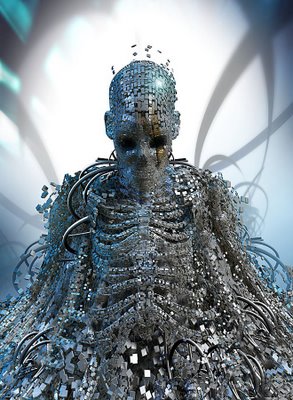
A meme that gets bandied about by Singularity denialists is the assertion that a rogue super-artificial intelligence (SAI) won't be able to act on its desires and make a real impact on the physical world. It's just a really sophisticated computer, goes the thinking; it couldn't actually reach out and touch someone.
This runs contrary to the concerns of those in the Singularity camp who are gravely concerned that an SAI will be both uncontainable and capable of manipulating physical space in a non-trivial way.
I'd like to present a pair of arguments that will serve as a warning to those who would like to dismiss this possibility. The first is based on a recent technological breakthrough, the second being more of a thought experiment.
Robotic networking and self-replication
RoboEarth is a system that's allowing robots to build on and learn from the experiences of other robots. Think of it as an internet for robots. As it stands, robotics engineers have to teach their bots to navigate and function in the real world. RoboEarth, on the other hand, collects and centralizes information on objects and navigation, and in turn shares this information with other bots. What this means is that any new robot that's connected to this system will have immediate knowledge of its surroundings.
But it doesn't stop there. A recent breakthrough has endowed the TechUnited AMIGO robot with the ability to download all the information it needs for a specific task and then carry out that task. Check out the video below of AMIGO at work:
If this doesn't blow your mind then you're not paying attention. While the task was simple enough, that of autonomously picking up and serving a bottle of water to a person, the potential implications of this are huge. As Joris Peels of iMaterialize clarifies,
If you would combine Robo Earth, with genetic algorithms that automatically design robots and 3D printing you have a very powerful combination. It would be a system that could design a robot based on its experiences, then give that robot all the information it needed to navigate the world and carry out tasks. Anyone could then 3D print this robot anywhere around the world. And the system would be one of continuous learning and itteration with better robots being made every second. We’re still very far away from this but it is these kind of ongoing developments that make me think that I live in the future.
I think we should really consider the implications of this. I know, it sounds a bit sci fi and off piste. But, we will develop a Skynet at one point and we should consider the implications before we do so.
The scenario I'm imagining, as I'm sure are other Singularity-concerned futurists, would see an SAI co-opt this system (or create versions of its own) and begin to fulfill its intentions through a myriad of self-designed, recursively improving, and remotely controlled agents disbursed around the world.
Plenty of room at the bottom
Okay, so there's that example. The next consideration is something a bit more fantastical (relatively speaking): the potential for an SAI to reshape the planet (or significant portions of it) from the molecular scale upwards. Before you tune out, watch this video, Molecular Visualizations of DNA:
What you're seeing in this video is a very small sampling of the kinds of molecular machinery that's capable of arising through the processes of natural selection. What you're not seeing here, however, is the space of all possible molecular machinery that's capable of arising through intentional design. And what you're definitely not seeing here is the space of all possible molecular machinery that's capable of arising through intentional super-intelligent design.
The kinds of molecular machinery that we're familiar with has come about solely for the purpose of maintaining and propagating complex organisms. We're only beginning to imagine the kinds of molecular-scale processes and devices that might be designed to perform other kinds of functions; the design space is massive.
And this is where an SAI comes in. It's easy to imagine a system similar to RoboEarth in which an SAI can design and disburse both macro and micro scale devices. The only limitations facing such a system would be inherent energy and material constraints, other human or SAI-driven countermeasures, and the laws of physics itself.
Okay, what exactly am I imagining? Given free reign, an SAI could potentially re-arrange all matter on the planet. One possibility is that it could turn the Earth into computronium or anything else it wants. Or, it could remove all toxins and other pollutants from the surface and atmosphere. It could turn the planet into a Venusian hell, or a verdant Utopian paradise. Whatever. In all honestly, I can't even really begin to speculate without knowing the intentionality of a Singularity-surviving intelligence. But suffice to say the scope of its impact on the material world needn't be subtle.
For those of us engaged in foresight activities, the risk is in thinking too small on this matter—or in denying it altogether.


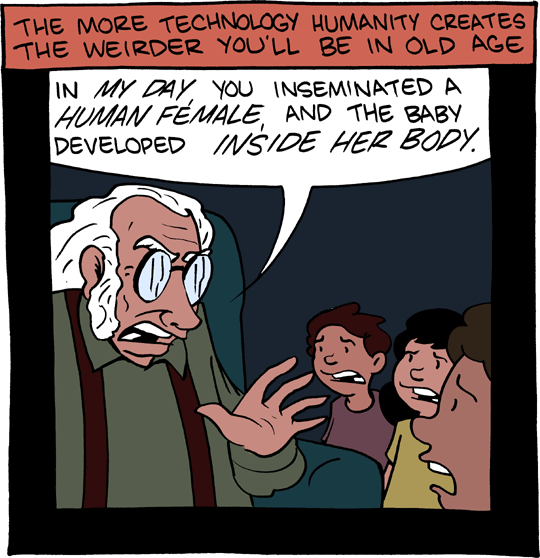
In my day…


Vgo, the telerobot
Having one of those radical presentism moments. Via Singularity Hub; Aaron Saenz writes:
While we haven’t covered the Vgo robot in the past, it reminds me of several other telerobots we have seen, especially Anybot’s QB. Only Vgo is supposedly retailing for around $6000 (including ~$1200/year for the service contract), considerably less than the QB’s $15k price tag. Differences in maneuverability, reliability, and video quality may make the cost difference appropriate, but that’s not really my concern. Vgo is representative of the telerobotics market as a whole right now: reasonable run times (battery life is between 6-12 hours depending on upgrade options), Skype-level video quality, and compatible with standard WiFi. If you can afford the $6k (or $15k) price tag, you can probably have this setup in your home or office right now. In other words, this isn’t the technology of tomorrow, it’s here today and ready to go. Vgo launched sales in 2010 and has been marketing their product to a variety of applications, as you’ll see in the following video:
Not to sound cynical, but I’m guessing that Lyndon Baty’s use of Vgo is just another part of that marketing plan. I’m totally fine with that, by the way. Giving a child (and a school district) a reasonable solution for a terrible predicament is great. If it comes with a moderate price tag, so be it. So, while Lyndon’s personal story of perseverance and increasing freedom is exceptional, the underlying technological implications are pretty mundane: telepresence is gearing up to try to make a big splash in the market.
We’ve seen plenty of indications of this. South Korea is testing telerobots in their schools. They could have one of these devices in every kindergarten classroom by 2013. Researchers in Japan are experimenting with robots aimed towards emotional connections (with mixed results). As we said above, Anybots has their own platform on the market already. iRobot recently unveiled a prototype robotic platform that would transform any teleconference-enabled tablet computer into a telerobot. I’m guessing that in the next five years, one or more of these attempts at telerobotics is going to actually gain some traction and start moving some serious product.
Education may be a natural market. As we learned from Fred Nikgohar, head of telerobotics firm RoboDynamics, there are some big hurdles in other applications of telepresence robots. Offices value secrecy. Medical facilities worry about patient privacy. There’s a lot of bureaucracy standing in the way of widespread adoption of telerobotics. Schools have some of the same problems, but (to be perfectly honest) they also have sick kids who you can’t say no to. Or they’re run by governments who have nationalistic goals in science and technology (exemplified by South Korea). Get the price of telerobotics low enough, and we could see it expand into different niches of education including homeschooling, remote expert instructors (like the English tutors in South Korea), or online universities.
In other telerobotics news, Anybots QB is now shipping.


Physicists to work on extraterrestrial communications protocol

A group of physicists from the University of Kansas are concerned that there's been virtually no work done to date on developing a messaging protocol to assist in the search for extraterrestrial intelligence (SETI). Their approach, which is the non-passive METI approach (i.e. sending messages to outer space in hopes of interception), would include constraints and guidelines for signal encoding, message length, and information content. It would also specify a transmission strategy suggesting a simple physical or mathematical language with the signal repeated regularly to avoid being overlooked as noise.
Among their suggestions, the physicists noted that transmissions should use either 1.42 GHz or 4.46 GHz frequencies to coincide with radio frequencies commonly observed in nature, while assuming "modest technical capabilities" of an extraterrestrial receiver. Frequency, pulse and polarisation signal modulation techniques should also be considered to maximise the probability of detection.
They also suggested the establishment of a website through which members of the public could create sample messages that conformed to the protocol, and retrieve and attempt to decrypt messages by other users.
"A METI protocol is needed in order for a unified and international effort to be made in messaging extraterrestrials," they conclude, "By carefully constructing a framework by which to write and send messages, we will optimize the quality of messages as they are broadcast and increase the probability that we are understood."
Check out the abstract as seen in the journal, Space Policy:
Messaging to extraterrestrial intelligence (METI) is a branch of study concerned with constructing and broadcasting a message toward habitable planets. Since the Arecibo message of 1974, the handful of METI broadcasts have increased in content and complexity, but the lack of an established protocol has produced unorganized or cryptic messages that could be difficult to interpret. Here we outline the development of a self-consistent protocol for messaging to extraterrestrial intelligence that provides constraints and guidelines for the construction of a message in order to maximize the probability that the message effectively communicates. A METI protocol considers several factors including signal encoding, message length, information content, anthropocentrism, transmission method, and transmission periodicity. Once developed, the protocol will be released for testing on different human groups worldwide and across cultural boundaries. An effective message to extraterrestrials should at least be understandable by humans, and releasing the protocol for testing will allow us to improve the protocol and develop potential messages. Through an interactive website, users across the world will be able to create and exchange messages that follow the protocol in order to discover the types of messages better suited for cross-cultural communication. The development of a METI protocol will serve to improve the quality of messages to extraterrestrials, foster international collaboration, and extend astrobiology outreach to the public.
Link to PDF.


