Tom Johnson: A Final Word | The Intersection

As I’ve said, I was impressed by Jerry Coyne’s debunking of the story originally posted as a comment on this blog–and then regrettably elevated to greater prominence–by “Tom Johnson.” Let me just add a few last points:

1) I am confident Coyne knows, as I do, “Johnson’s” real identity. And I, like Coyne, have been in dialogue with his adviser, whom I originally alerted to this situation back on July 7. So I too know that “Johnson’s” behavior is being investigated, and will be dealt with, through proper university channels. I think his adviser has handled things very well and am confident in this person’s judgment about how to deal with the situation.

2) I don’t think Johnson’s original story is true as described. More on this below.

3) As I’ve previously said, I should never have elevated Johnson’s original comment or called it an “exhibit.” I regret that I gave this story undue prominence, and I want to apologize to all who were affected by that action.

4) At the same time, it now looks like I was deceived by “Tom” in October when I contacted him to check things out. If I had been told the truth about his story at that time, the original comment would not have stood, and any issues would have been dealt with then, rather than now.

5) I think something probably did happen to “Johnson” to make him a fervent “accommodationist.” But whatever the nature of that experience or experiences, it is no justification for the trumped-up original story or for his other actions—which, as we now know, included creating multiple sock puppets over a long period of time and using them to nastily trash his “New Atheist” opponents.

6) We are left with no reliable evidence of loud, boorish, confrontational public behavior by atheists at events with religious believers. Those who have problems with the “New Atheism” should not use this line of argument in their critiques, unless or until such evidence is produced.

There is a bit more to say. To quote Jean Kazez (who has been sorely and unjustly abused online over this affair): “There’s one more thing that hasn’t been cleared up. What did the student put in an email to Chris Mooney in October 2009 to make him believe his story? Obviously it will be up to Chris to explain or not explain.”

The answer is that I believe I was deceived about the story back in October 2009, and led to believe a falsehood.

You will recall that “Johnson” originally claimed to have witnessed atheists at conservation events “mock the religious to their face, shout forced laughter at them, and call them ‘stupid,’ ‘ignorant’ and the like.” This is the story that caused such an uproar. And it was, crucially, the image of loud, public, and confrontational behavior that drew such attention. If Johnson had said something more minor—for instance, that a colleague at a conservation event had said something critical about religion to him privately, in a one-on-one fashion–it wouldn’t have been a big deal.

When I emailed him back in October about his story, “Johnson” identified himself as a graduate student at a major university, and described his academic publishing record as well as his in-depth involvement in science education, outreach, and conservation activities. He included his website, and told me where to find his CV. He included his phone number. He also provided the website of the conservation group he was involved with, and the names of the religious organizations involved in the events where supposed transgressions had occurred.

All the details about his identity were accurate. Despite a lie told later on about not being a graduate student—presumably because people were getting too close to his true identity–”Johnson” really was who he said he was. He could have seen precisely what he claimed to have seen.

But in my view, his story has now fallen apart. Let’s examine:

1) “Johnson” told me he’d witnessed this loud public atheist misbehavior at specific events, which he had attended, involving a Baptist group and an Episcopalian organization;

2) He said that the harshest comments he’d heard had been at outreach events with the Baptist group.

There’s no longer any reason to believe this. First, “Johnson” is now known to be a completely unreliable witness. On top of that, he has backed down from the original story, which claimed loud public confrontations—and we have one witness that refutes it regarding the Baptist group.

More specifically:

1) In answers submitted to his adviser and shared with myself and Jerry Coyne, “Johnson” backed away from the original story, admitting there were no harsh statements about religion made “with a raised voice to a group.” He called the original story an “exaggeration.”

2) Regarding the Episcopalian organization, “Johnson” said he had mistakenly mentioned it to me as a place where atheist misbehavior had occurred. Nothing of the sort described happened in connection with this group.

3) Regarding the Baptist group, “Johnson” also backed away from the claim that some sort of loud public confrontation had happened in connection with this organization. He did suggest that a “colleague” who had been with him at a 2008 event had made more minor critical remarks, but nothing on the scale originally described. Even if we were inclined believe this—and I really don’t believe anything at this point—it would not justify the much more dramatic claims of the original story.

4) Coyne has been in touch with this colleague, who says that nothing like what Johnson originally described occurred at the Baptist event; and I’ve also contacted this colleague to confirm the accuracy of Coyne’s assessment. In sum, it looks like there’s no there there regarding the Baptist group either—at least regarding loud, public confrontations.

In conclusion, I want to thank everyone who has tried to establish and to explain the truth here: “Johnson’s” adviser and Jerry Coyne; and also TB and Jean Kazez.

I still have my philosophical and tactical problems with the “New Atheism.” But I’m disturbed that someone on my “side” of this debate would do the things “Johnson” has done, painting a group as uncivil based on what is at best a serious exaggeration, while simultaneously spewing reams of incivility towards that group online, under multiple identities. There is no excuse for such behavior–and moreover, there has been a very big cost in this case to a lot of people, both in time and in grief.

If there is any silver lining at all here, perhaps after working to find out the truth together about “Tom Johnson,” so-called “New Atheists” and “accommodationists” might feel the inclination to be just a little bit more civil and trusting towards one another. We do have a shared commitment to the truth, and a means of discerning it—and those have won out in this case. Let’s not forget that as we carry on the argument for science and reason in the future.


WHAM! Bulls-eye! | Bad Astronomy

I have a Martian mystery for you today, and one that is writ quite large and dramatically. It seems weird at first, then simple next, but when you dig deeper — literally — things get very weird indeed.

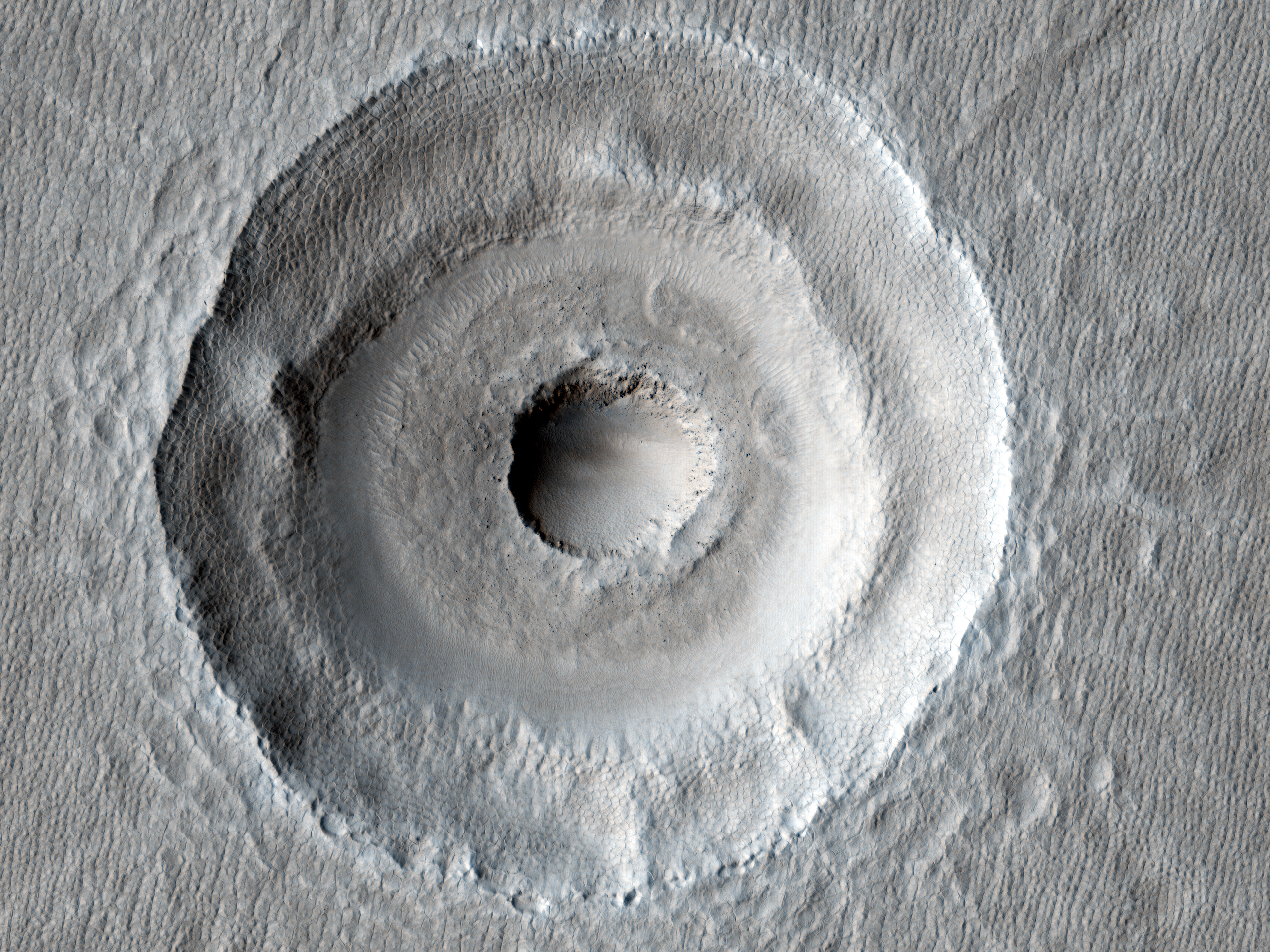
It all starts with an out-of-control awesome picture that honestly made me reel back and say "Wow!"

I present to you out-of-control awesome:

hirise_bullseyecrater

Wow!

Click the pic to embiggen. This unnamed crater is about 700 meters (roughly half a mile) across, and sits in the northern mid-latitudes region of Mars. It’s interesting, isn’t it? The multiple concentric bowls of the crater are trying to tell us something, but what?

My first thought, also mentioned on the HiRISE blog, is that this is a coincidental double impact: the big terraced crater was the original impact, then a later, second object impacted almost exactly in the center of the older one, hitting the bulls-eye like William Tell splitting an arrow.

The topography seems to support that; the inner crater has a raised rim, as you might expect from a second impact, and that would be hard to explain in a single impact. The terracing — shelf-like structures sortof like an upside-down wedding cake layering — is seen sometimes when an impactor smacks into layered ground. Imagine a layer of dirt on top of ice on top of rocks: each layer reacts differently to the impact, leaving the circular, concentric shelves in the crater bowl.

Note too that the central crater doesn’t look exactly centered, supporting a second impact.

Case closed… but wait, Your Honor! We have a surprise witness!

This picture is actually part of a much larger region which provides some context:

hirise_bullseye_context

You can see the extensive ejecta blanket (excavated material laid down from the impact ) around the crater now, which is nifty. But note the smaller crater to the lower right (indicated by the arrow): it looks a lot like the bigger crater! There’s a shallow bowl with a deeper crater almost but not quite in the center. There’s no terracing, but it’s a smaller impact and wouldn’t have dug so deeply into the surface.

hirise_bullseye2So what gives? If all we had here was the big crater, I might believe the coincidence of a nearly perfect second impact bullseye inside it. But two of them? Right next to each other?

It seems unlikely, to say the least. And I thought I had an explanation for it… which I’ll give you. But note: I chatted for a few minutes with Alfred McEwen, the Principle Investigator of the HiRISE camera (which took the image), and he told me things still aren’t quite as they seem. Keep that in mind while I describe my thought…

My idea is/was this: both of those craters were single impact events. The terrain itself must explain the weird structures; there must be several layers of material with different solidity. In the lower right crater, the softer surface material deformed and splashed back, forming a shallow bowl. Underneath it is a stronger material, forming the raised rim central crater that’s slightly off-center. The fact that’s it’s not centered may be due to sloping in the surface, or that the surface layer isn’t constant in thickness across the surface. Perhaps there is stronger material to the left which resisted the impact pressure, leaving the inner crater off-center once the event was over.

This explains the big crater too. The outer bowl is shallow. Inside that is a raised rim, as you’d expect from a stronger material. The impactor was big enough to dig below even that layer to a third, deeper and even more resilient layer, leaving a beautiful raised rim. It’s not centered either, again perhaps due to the layers being irregular in thickness or to different material strengths in the layers themselves.

Finally, in the context image, you can see lots of shallow smaller craters. Again, I think this shows the top layer is something soft like ice, which leaves those barely visible bowls behind after smaller impacts.

Tadaa! Done.

But wait! Not so done. As Alfred pointed out to me, note that the second crater is actually sitting on the ejecta blanket from the first one (which is how we know that the smaller crater impact occurred after the bigger one). Since it’s on top of that material, the ground underneath the impact would’ve been different than the ground into which the original impactor hit. The other shallow craters are all sitting in that material as well. So we can’t simply state that the terrain was similar to the original event because the original impact changed the surface structure.

Also, the detail of the structure is difficult to interpret. Turns out that at this latitude glaciation is common, and that tends to screw up details, changing the way things look. Interestingly, the rim of the innermost crater in the big crater looks pretty fresh, too, like it happened after the original event, supporting the William Tell idea that a second asteroid impact hit right in the middle of the previously excavated crater.

Finally, in the top image, look at the floor just outside that innermost crater. See the two crescent-shaped lobes at 1 and 2 o’clock? Those may be slumped material from the walls of the crater. If a second impact happened in the center of a pre-existing crater, you’d get some disturbance of the material, including debris flowing down from the walls.

So what do we conclude?

This place is a mess. That’s what I conclude. Alfred said my idea that layered terrain explains most everything has some merit, but so does the idea that a second impactor did the deed. We simply can’t tell.

If you think I’m having fun figuring this out, then dingdingding! I am. Because it is fun. This is good old-fashioned sleuthing, detective work on the scale of a city block. When we look at pictures like these we get evidence of a crime scene, perhaps millions of years old — talk about a cold case! — but still fresh enough that we can puzzle out what happened. The big crater is the main clue, drawing our attention, but the second, smaller crater may be a smoking gun, the surprise evidence that just might make everything else make sense.

It’s CSI Mars. But in this case it’s not some procedural drama on TV. It’s real, it’s huge, and it’s sitting there on another world for everyone to see. All you need to do is go there and look.


Pocket Science: plague-running mice, and how to watch mutations in real time | Not Exactly Rocket Science

Not Exactly Pocket Science is a set of shorter write-ups on new stories with links to more detailed takes, where available. It is meant to complement the usual fare of detailed pieces that are typical for this blog.

Prairie_dog

Plague-running mice create epidemics

The bacterium behind bubonic plague – Yersinia pestis has a notorious track record for massacring humans, creating at least three major pandemics including the Black Death of the 14th century. But it’s mainly a disease of rodents and it regularly infects the black-tailed prairie dogs of North America. It’s an enigmatic killer. It will remain relatively silent for years before suddenly exploding into an epidemic that kills nearly all the prairie dogs in infected colonies within a few weeks. Now Daniel Sakeld from Stanford University has found the culprit behind these lurk-and-kill cycles – the tiny grasshopper mouse.

Prairie dog colonies, and their diseases, are generally isolated from one another. Even though Yersinia is very persistent, it eventually fades away unless it finds a new group of hosts. The grasshopper mouse provides it with just such an opportunity by acting as an alternative and highly mobile host for Yersinia. It’s a plague-runner. By scampering across the grasslands, it inadvertently creates a network between otherwise unconnected colonies, opening up corridors for Yersinia to spread.

By creating a mathematical model, and observing both rodents in the wild, Sakeld found that when the mouse is absent, only a small proportion of prairie dogs are plagued by plague. In these conditions, infections spread very slowly during fights and hostile takeovers between neighbours. When mouse numbers pass a threshold, fatal plague epidemics are virtually guaranteed.

The numbers of grasshopper mice in the grasslands rises and falls over time, a cycle that could spell life or death for the prairie dog. These patterns of lengthy lurking and sudden death are also shared by many other deadly diseases like anthrax and hantaviruses. In these cases, alternate hosts like the grasshopper mouse might also be involved in the sudden rise of deadly epidemics.

Reference: PNAS http://dx.doi.org/10.1073/pnas.1002826107

Mutation

Events occur in real time – watching the birth of mutations

Life is a massive game of Chinese whispers – information is constantly being passed on and as this happens, errors build up. Every time a cell divides in two, its genetic information is copied and there’s a small chance that mistakes (or ‘mutations’) will creep in. Some of these mutations will be beneficial, others will be fatal. Either way, they provide fuel for evolution, producing the variation that natural selection acts upon.

Now, Marina Elez from University Paris Descartes Medical School has found a way to spot mutations in real time. She can look at dividing cells and literally watch the moment when mutations show up across the entire genome. The technique works in bacteria, and it could be expanded to study the birth of mutations in more complex cells or even cancers.

Studying mutations isn’t easy. They’re very rare and most don’t produce any noticeable effects that would give away their presence. More often not, they’re repaired by proofreading proteins, which watch for errors in copied DNA and edit them back into shape. Elez realised that these proofreaders could lead her to the location of mutations – all she needed to do was follow. She focused on one bacterial proofreader called MutL, which forms large clusters around mutations that it can’t repair. Elez tagged MutL with a molecule that glows in the dark. The result: bacteria that give off tiny pinpricks of light at every point of their genome with an irreparable mutation.

By counting these bright dots, Elez could estimate the mutation rate in her bacteria. And fortunately, her estimate was a good match for the predictions of earlier studies. Elez also thinks that the approach should work in other living things because proofreading proteins like MutL are very similar from species to species. The technical challenges might be greater in more complicated cells, but the principle of watching mutations in real time is sound. And that opens up all sorts of possibilities. You could, for example, look at tumours, to see when and where the genetic changes that create a cancer will emerge.

Reference: Current Biology http://dx.doi.org/10.1016/j.cub.2010.06.071

If the citation link isn’t working, read why here


Twitter.jpg Facebook.jpg Feed.jpg Book.jpg

The End of Sex Week: Darwin, Sex, and Dada | The Loom

[This is the last post for Sex Week]

The animal kingdom is filled with wild extravagances, and a lot of them have something to do with sex. Hermit crabs wave their claws, swordtail fish flash their swordtails, manakins leap and buzz their wings. Darwin considered these displays so important and so puzzling (”the sight of a feather in a peacock’s tail, whenever I gaze at it, makes me feel sick!” he wrote to a colleague), that he dedicated half of a book to the subject.

Darwin argued that many extravagant displays in male animals were the result of a special kind of evolution he called sexual selection. Females preferred males with certain traits over other males, and so those males had more offspring, which inherited their traits. In recent decades, scientists have documented many cases in which females do indeed prefer males with certain traits over others. As I mentioned in my post on electric fish, for example, female bulldog fishes are more attracted to long electric pulses than short ones.

But why should females have any particular desire? For many scientists, the most compelling explanation is that there’s some meaning in the displays that attract them. One possible meaning is that the male who sports a particularly extreme version of a trait has good genes. As I wrote in my post on the love songs of yeast (sic), the amount of pheromones a yeast cell produces is a reliable clue to the quality of its genes. Other scientists have found similar links between the length of tail feathers and the quality of male birds.

There are other possible meanings, though. Some scientists have argued, for example, that female of some birds species prefer bright feathers on males simply because they’re easy to spot. A female with such a preference will be able to mate more efficiently than a female attract to drab, harder-to-find males. She’ll be less likely to get killed by a predator and can spend her time and energy on more useful things than hunting for a mate. Wham, bam, thank you, sir.

All of these explanations share something in common: sexual signals evolve because they signify something. Many scientists see little evidence to think that sexual displays evolved for no good reason.

And yet in other realms of evolution, biologists have come to accept that some patterns can emerge without the help of selection. Each of us is born with around 70 new mutations in our DNA. In a few cases, a mutation will cause a lethal disease and will not be able to be passed down to the next generation. In a few cases, a mutation will boost a person’s reproductive success and will gradually spread. In both these cases, natural selection is at work. It’s the reason why the harmful mutation is rare, and the beneficial one is widespread. But the spread of mutations is also governed by chance. A mutation that has no benefit or risk at all can spread throughout an entire species thanks to a fortunate roll of the genetic dice.

There was a time when most biologists did not believe that neutral genetic variation even existed. It all had to be the product of selection. Now, however, biologists generally agree that neutral genetic variation is rampant. In fact, netural evolution has taken on an important role in the study of natural selection. Scientists who want to know if a particular stretch of DNA has experienced natural selection must reject the null hypothesis that it is simply the result of neutral evolution. If you can show that neutral evolution couldn’t have produced a particular sequence of DNA, then you can be fairly confident that selection was responsible. Once you do that, you can start to investigate what sort of selection was at work. (For more on the underappreciated role of neutral evolution, check out Larry Moran’s periodic posts on the subject on his blog, Sandwalk.)

The phrase null hypothesis was first coined in the early 1900s by a British mathematician named Ronald Fisher. Fisher did some of the most important work to put Darwin’s theory of evolution on a sound mathematical footing–figuring out how to represent things like natural selection as equations and graphs, rather than just verbal arguments. Fisher showed, for example, how natural selection could proceed through the spread of lots of mutations with tiny effects. But Fisher also developed an idea that’s not so well remembered these days. Like Darwin, he pondered how sexual displays could evolve through female preferences. One idea he came up with is that a display–and a female’s preference for it–could both be completely arbitrary.

It’s fair to say that most evolutionary biologists today don’t find Fisher’s idea very useful. Nevertheless, some important thinkers have embraced and updated it. And in a new review in the journal Evolution, the Yale evolutionary biologist Richard Prum makes a bold case for taking Fisher seriously. Prum argues that it’s quite reasonable to expect sexual signals to be totally arbitrary, signifying nothing deeper about the animals who show them off. In fact, he argues, it should be the null hypothesis for scientists studying sexual displays.

I’ve known Prum for a few years now, having written some articles on his work and having had him talk to my writing class. Many of our conversations have gravitated to this big idea, which he’s been mulling for some time. So it’s good to finally see this argument in print at last.

The idea that something like a courtship dance or a song can evolve with no help from selection is a tricky one to grok. Here’s a simple version of the model. Imagine a population of birds. The males have genetic variation in the size of a red spot on their breast. Some have a bright red spot, and others have a dull one. The females, on the other hand, have genetic variation in their preference for the trait. Some only mate with males with bright red spots, and some will mate with any males. The extravagant males will have more offspring than the plain ones, because they can mate with all the choosy females and some of the non-choosy ones. The plain males only mate with the non-choosy ones. What’s more, the males with the bright red spot and the choosy females combine their genes in their offspring. The population increasingly is made up of males with an extravagant trait and females with a preference for it. And so the extravagant display spreads quickly through the population–even though the trait doesn’t signify anything.

Mark Kirkpatrick of the University of Texas, Russell Lande of Imperial College London, and their colleagues have developed much more sophisticated mathematical models of Fisher’s idea. They have found that even if the variations in male traits and female preferences are subtle, they can still get swept up into all sorts of complex evolutionary changes. Yet many others have been skeptical. One scientist declared that excepting this runaway process as an explanation for sexual selection without a lot of proof was “methodologically wicked.”

One objection was that sexual displays often impose such a big cost that they have to have some major benefit. Yet Kirkpatrick and Lande have shown that female preference and male displays can drive each other’s evolution so hard that males may end up with traits that are a major burden. They’re just so sexy that the males still continue to spread their genes. In fact, Prum argues, this runaway process is much more powerful and flexible than sexual selection based on an honest signal. If sexual displays are just relaying honest information about males, then why are closely related species so different in what they find attractive?

In his review, Prum looks at a series of studies in which scientists tried to figure out the reason that birds have extravagant traits, such as complex songs. He notes how the scientists always go into the studies assuming that there must be some meaning to the trait, so that its evolution can be driven by selection. Sometimes they fail to find that meaning, and when they do, they conclude that there must be another meaning they haven’t found yet. All they’re doing is trying to confirm a foregone conclusion, Prum argues, when they out to be trying to reject the null hypothesis.

If they can’t reject the null hypothesis, they should conclude that the best explanation for a bird song or a dance or some other display is that it’s just arbitrary. Prum doesn’t think that every sexual display will turn out to be arbitrary, but he expect that a lot of them will.

“I do not claim that the ‘Emperor has no clothes,’” he writes in his conclusion. “I would predict that the ‘Emperor wears a loincloth.’”

I’d be curious to know what evolutionary biologists who work on sexual selection think of Prum’s manifesto (paging Marlene Zuk). It’s certainly provocative, evoking not just Stephen Jay Gould’s attacks on Dawkins and other adaptationists, but even the Dadaists, who toyed with the arbitrariness of beauty in pieces such as Marcel Duchamp’s Fountain, shown here. And it’s also a good way to end Sex Week, as we leave biologists continuing to argue and marvel over the mysteries of sex.

[Image: Wikipedia]


NASA Ames Makes Payloads Out of Phones and Toys

Cheaper, Better Satellites Made From Cellphones and Toys, Wired

"Instead of investing in their own computer research and development, engineers at the NASA Ames Research Center are looking to cellphones and off-the-shelf toys to power the future of low-cost satellite technology. The smartphone in your pocket has about 120 times more computing power than the average satellite, which has the equivalent of a 1984-era computer inside. "You can go to Walmart and buy toys that work better than satellites did 20 years ago," said NASA physicist Chris Boshuizen. "And your cellphone is really a $500 robot in your pocket that can't get around. A lot of the real innovation now happens in entertainment and cellphone technology, and NASA should be going forward with their stuff."

Gordon’s Attempt To Shove HR 5781 Through Flops

Vote on NASA Bill Appears Unlikely Before September, Space News

"With little time remaining in the fiscal year that ends Sept. 30, House Science and Technology Committee Chairman Rep. Bart Gordon (D-Tenn.) sought to bring the measure to the House floor under suspension of the rules -- a move that prevents amendments to a bill and requires a two-thirds majority vote to pass. But Gordon encountered resistance from House members hoping to weigh in on the measure during floor debate. Rep. Adam Schiff (D-Calif.) and other House Democrats met with Gordon early July 29 to address concerns with key elements of the legislation."

NASA bill stays grounded, Politico

"Despite the best attempts of Rep. Bart Gordon (D-Tenn.), chairman of the House Science and Technology Committee, to bring the three-year funding plan to a vote this week, a coalition of members frustrated by his haste protested to the majority leader, ultimately forcing the chamber to punt until September."

Bolden Is Operating In Cloaked Mode These Days

Keith's note: In case you haven't noticed Charlie Bolden has been invisible for several weeks after the Muslim outrech media storm. No one in the media has interviewed him. He hasn't been quoted. He's just been, well, invisible. He surfaced yesterday at a stealth visit to GSFC. NASA only admitted this via Twitter a few minutes ago. No doubt he will disappear again. You can tell if he is arriving (or departing) stealthily if you hear this noise. This way he can avoid the media more easily.

NASA and PeTA on CNN Tonight

This isn't rocket science, Houston Chronicle

"Since leaving her position at NASA, [April Jean] Evans has devoted much of her time to building support for an international treaty that would ban primate experiments for the purpose of space exploration. Already the European Space Agency has adopted such a position, with Director Jean-Jacques Dordain stating in an April 1 letter that ESA's formal position is: "there is absolutely no research interest or planning for experiments with primates." Such is Evans' aspiration that all space agencies would adopt a similar position. But there's also the real-world issue of no longer having a regular income. Since leaving NASA, Evans has moved into her brother's spare room. She's also falling into debt."

Keith's note: PeTA tells me that April Jean Evans is supposed to be on CNN Headline News Channel on "Issues With Jane Velez-Mitchell" at 7 pm EDT tonight to talk about this. If you are going to comment on NASAWatch, then stay on topic and don't try and post stupid stuff anonymously - it won't appear online.

Ex-NASA Engineer on HLN Tonight, PeTA

NASA Unions Split On HR 5781

IFPTE/AFGE Letter on NASA Authorization Act

"The International Federation of Professional and Technical Engineers (IFPTE), and the American Federation of Government Employees (AFGE) are writing to inform you that this bill is far from non-controversial. In this regard, IFPTE and AFGE urge you to oppose HR 5781 if it comes before you in its current form."

Vote on NASA Bill Appears Unlikely Before September, Space News

"The International Association of Machinists and Aerospace Workers said in a July 29 statement that the organization supports the House version of the NASA authorization."

What Will Commercial Aircraft Look Like in 2050?

From Fast Company:

Boeing's 747-8 jumbo jet may represent the best of what engineers have to offer now, but Airbus has reached 40 years into future and come back with a design that barely resembles the aircraft of today. The Concept Plane, revealed this week at the U.K's Farnboroug

Cloned Livestock Gain a Foothold in Europe

From NYT > Science:

Many Europeans recoil at the very idea of cloning animals. But a handful of breeders in Switzerland, Britain and possibly other countries have imported semen and embryos from cloned animals or their progeny from the United States, seeking to create more consiste

Laying the Grid for the Electric Car

From CNET News.com:

This week GM revealed the price of its Chevy Volt electric car as the automaker looks to draw buyers looking for a more eco-friendly mode of transportation. With just a 40-mile range on a charge from an electric power source for the Volt, and about 100 miles

How the Mississippi River Triggers Earthquakes

From Discovery News - Top Stories:

The Mississippi River may be mightier than anyone ever imagined. It may have been behind the baffling 1811-1812 earthquake in the New Madrid Seismic Zone, a region of Earthly unrest where by rights no earthquakes should be found.

Read th

Needed: Engineers with Vision

An article in Mechanical Engineering by scholar N.J. Slabbert argues that the U.S. has lost its innovative edge, largely because engineers are no longer serving as visionaries for society, as they did in times past. For example, one major public policy arena — the U.S. Senate — counts on