
Flying an RC helicopter? Sure, that's fun for a little while. Flying an RC helicopter that can shoot both video and still photos? That's good for a lifetime of creepy stalking memories. More »



Flying an RC helicopter? Sure, that's fun for a little while. Flying an RC helicopter that can shoot both video and still photos? That's good for a lifetime of creepy stalking memories. More »
Unfamiliar with duck loving? Here are the basics: Corkscrewed vaginas and long, temporary, lymph-filled penises that uncoil in fractions of a second. Now researchers have found that some males’ members grow longer when they’re fiercely competing for a mate.
The photo we have to illustrate this magnificent mating equipment is so graphic–in a duck kind of way–that we’re putting it below the jump. As Carl Zimmer memorably put it when writing on the kinkiness of duck sex, it may not be “appropriate for ducklings.”

Last week, Yale University’s Patricia Brennan presented another finding on duck phalluses at a meeting of the Animal Behavior Society. When competing for females, it seems males of the scaup species try to out-size one another.
Brennan found this after placing male scaups in two setups. In one, seven to eight males lived with five or six females, while in the other, drakes lived in more equal numbers with females. As Science News reports, males with more competition grew longer penises–usually around 15 percent, but up to 25 percent longer than those living with more females.
She told Science News that this competition may be the reason for the bird’s unusual penis size to begin with.
“It’s really likely that having a longer penis evolved in male-male competition.”
For more about duck mating, Brennan’s research, and … videos, check out Carl Zimmer’s post.
Related content:
The Loom: Kinkiness Beyond Kinky
Discoblog: Mixed-Up, Adopted Ducks Try to Mate With the Wrong Species
Not Exactly Rocket Science: Ballistic penises and corkscrew vaginas – the sexual battles of ducks
Not Exactly Rocket Science: Infants match human words to human faces and monkey calls to monkey faces (but not quacks to duck faces)
80Beats: Mockingbird to Annoying Human: “Hey, I Know You”
Image: Patricia Brennan

I'm used to read news about exploding cellphones, laptops on fire, and even flaming USB adapters. But what explodes when your smartphone explodes? This video shows how the components inside those gadgets overload and go boom-boom. More »


Another blast from Europe's medieval medical past are medicinal leeches. Similar to bloodletting, leeches were utilized to draw out the "bad blood" that medieval physicians believed caused many of their patients' ailments.
Covered by sucking leeches! BBC video.Miichael Palin experiments with a traditional Russian health therapy in Estonian capital Tallinn by allowing a doctor to cover him in sucking leeches. Fascinating video that is definitely not for the faint hearted! Taken from BBC travel documentary, Palin's New Europe.
References:
Top 10 Bloodsuckers: Leech.AnimalPlanetTV.
Posted at Clinical Cases and Images. Stay updated and subscribe, follow us on Twitter and connect on Facebook.

Stanford engineers have figured out a new way to make solar panels that use both the sun's light and heat to generate energy. It's a discover that could double the efficiency of solar panels. More »


From the car company "Chevrolet" website........
However, from today, help is literally at hand as scientists have created a mathematical formula for the perfect handshake taking into account the twelve primary measures needed to convey respect and trust to the recipient......
The mathemat

Gadget cases, wraps and attachments that look like food are among my favorite things in the world. These iPhone 4 food cases appeal for the same reason, even if I don't exactly know what that reason is. More »


I know that much of the success I’ve enjoyed in my life and my career is because of the support and encouragement I’ve received along the way. That’s why I think it’s important to share my passion for space with kids and show them what they can accomplish if they are willing to work for it.
Over the past week, I’ve had the opportunity and privilege to volunteer with both the United Space School and the International Space Settlement Design Competition. Both programs bring students from around the world here to Houston to participate in exercises geared towards the design of future ventures in space.
This year, the United Space School has high school students grouped into four teams – mission control, science, habitat, and vehicle design – working together to plan a notional Mars exploration mission. Everyone came to UH Clear Lake last Monday with a clean slate and interviewed for placement on the teams. I helped interview for the vehicle design team, given my background in aerospace engineering.
We could all tell which kids were really enthusiastic about spacecraft and engineering. One student from Australia even said his aspiration is to be a test pilot for commercial spaceflight companies! Burt Rutan got his start in flight test engineering for the Air Force, so, why not?
On Wednesday, I came back to UH Clear Lake to talk with the United Space School students about all of the things they would need to think about for their Mars vehicle. My main point was that the design of the spacecraft would be driven by its intended purpose, thus encouraging them to come up with a vehicle that enabled the deployment of the habitat, execution of the science objectives, and safe return of the crew. The kids asked great questions about propulsion, artificial gravity, radiation issues, etc. and we easily went over my allotted time.
Honestly, I probably could have spent the entire afternoon with them and not even noticed the passage of time. =) I’m definitely going to try to make it to their graduation ceremony this weekend so I can see what they came up with.
I spent my Sunday helping with both programs. First, I briefly attended the USS Cultural Faire and brought two trays of homemade, Southern-style banana pudding. I’m told it was a big hit. For me, I think my favorites were the servings of kangaroo and emu meat that one of the mentors from Australia brought in! He said he had to find them at a specialty butcher, but find them he did. We also had various casseroles, homemade machaca, haggis on oatbread, and a plethora of desserts. I stuffed my face with rice pudding, Manchester tart, Russian pancakes, ANZAC biscuits, and various other goodies.
Unfortunately, I missed the students’ show because I had to dash over to the Gilruth Center to help with ISSDC. I spent the next seven hours on the “Red Team,” critiquing the designs and presentations of the four student teams brought to Houston for one weekend to design a 24,000-person Mars settlement. Also consisting of high school kids from all over, these kids are working fast and furious over three days to make their presentations today. Like a real competitive RFP, winner takes all.
Because of the short time-scale, we on the Red Team were merciless during our reviews. Their final presentation is almost as demanding as a real business pitch, so we did our best to prepare them for the high standards expected at the end of the competition. They were working very hard on little sleep (reminding me more than a bit of college!) and we pushed them to go the extra mile.
More interesting to me than a lot of the engineering and architecture of the main structures were the groups’ approaches to how the people inside might live. Most of the students expected to have a high level of automation, with robots doing everything from housecleaning to fire-fighting to law enforcement. We hammered them on privacy concerns when they’d suggest things like ingested or implanted RFID chips and widespread infrared cameras for security control.
We also drove home the idea that a system should only be as complex as it needs to be, otherwise you’re just introducing extra points of failure. All of the teams had to consider how to traverse Valles Marineris and most looked at elevators. We asked one team why would you need pressurized elevators for cargo trucks that are just passing through to other destinations. Another team considered using a gondola system, instead . We asked them to consider what would happen if someone built a cargo vehicle too big for the skyway.
By the time we finished, after 10:00 pm last night, we were all pretty tired and ready to go home. I think everyone had fun, though, and learned a lot from the process. I know I certainly did. If I ever go help Elon Musk build his retirement community on Mars, I know some people I’ll call. =)
I live in the UK and own a 2 Litre JTD Fiat that was made in 2000 / 2001.
It has 16 valves with single cam drive and exhaust recirculation. it is the RHW Diesal engine.
The problem that i have is that the fuel injectors do not seem to work?. The engine cranks over and fuel is being bur
I would like to take my master degree in USA. I need to know, should I go with power system engineering or control system engineering. Which one is better in nowadays.
I would like to take my master degree in USA. I need to know, should I go with power system engineering or control system engineering. Which one is better in nowadays.
Citing "potentially anticompetitive ebook deals," Connecticut Attorney General Richard Blumenthal is investigating the relationship between Apple, Amazon and publishers. Blumenthal claims Apple and Amazon have struck exclusive deals with publishers that would block smaller ebook distributors from offering better prices. [Office of the Attorney General via TechFlash] More »


From FierceHealthcare:
| By Dan Bowman |  Comment | Comment |  Forward | Forward |  Twitter | Twitter |  Facebook | Facebook |  LinkedIn LinkedIn |
As readers of FierceHealthcare and its related publications well know, despite a notion by some that combining social media and healthcare is a dangerous mix, more and more health professionals appear to be taking the leap into the online world. From Facebook fan pages for practices to social networks like Ozmosis for physicians, the future is definitely now.
So it should come as no surprise that Mayo Clinic--with its 60,000 followers on Twitter, its medical provider channel on YouTube and its several successful blogs--is launching a Center for Social Mediato "accelerate effective application of social media tools" within its own facilities, as well as to help other facilities in their efforts to connect patients and doctors online.
As Mayo's press release announcing the center points out, less than 800 of the roughly 5,000 hospitals throughout the U.S. even have a social networking presence, according to Found in Cacheblog author Ed Bennett. "This is building on the interest that we've already had," Lee Aase, manager of syndications and social media at Mayo, told the Wall Street Journal Health Blog. "There is immense interest from clinical departments--they want to be able to harness these tools to do their business."
The center will be run by about eight people and will receive $800,000 in annual funding to start, according to the Minneapolis Star Tribune. Aase points out that while Mayo will charge other hospitals for consulting and giving out advice, the primary goal is to improve social media use within its own walls.
"The real focus is looking for ways to increase the use of social media throughout the practice at Mayo," Aase told the Journal. "To provide in-depth information for patients in a much more comprehensive way, and to create connections between researchers, physicians and staff."
Among the many other healthcare organizations to embrace social media is Providence, R.I.-based Lifespan. For the past year, the five hospitals of the Lifespan health system have maintained Twitter and Facebook accounts, as well as a YouTube channel for the system as a whole. On our Hospital Impact blog, Nancy Cawley Jean, Lifespan's senior media relations officer, discusses that organization's trials and tribulations.
To learn more:
- here's Mayo's press release
- check out the website for Mayo's center
- read the Wall Street Journal Health Blog interview
- read the Minneapolis Star Tribune's article
- check out charts touting Ed Bennett's statistics
- see Jean's post on the Hospital Impact blog


Another year, another DefCon, another litany of epic security fails. Like this here Biolock Model 333, a high-tech and high-priced bit of protection that surely requires expert tools and technique to override. Here's how it does against a paperclip: More »


 Just over 100 days after oil started gushing into the Gulf of Mexico, BP says they will embark, later today or tomorrow, on a “static kill” effort that may just seal the leak once and for all.
Perhaps remembering the company’s repeated failures to stanch the flow over these past months, some officials are calling the maneuver only one possible solution. National Incident Commander Thad Allen said:
“Static kill is not the end all, be all.” [The Telegraph]
Still some hope it is; said Darryl Bourgoyne, director of the Petroleum Engineering Research Lab at Louisiana State University:
“It could be the beginning of the end.” [AP]
Temporary fix or permanent plug, here’s how BP will do it:
Step 1 — Temporary Cap (Check.)
As DISCOVER blogger Andrew Moseman put it on July 16th, “Do you hear that? That’s the sound of oil not gushing uncontrollably into the Gulf of Mexico from BP’s leak, for the first time in nearly three months.” BP has had a temporary seal in place for two weeks and it seems to be holding. But leaving just that seal in place would be foolhardy, experts say:
“No one has come out and said the well has full integrity,” said Greg McCormack, program director of the Petroleum Extension Service at the University of Texas, Austin, suggesting that it was still possible for the well to leak before the relief well was completed. For that reason, he said, the static kill operation makes sense to potentially kill the well two weeks earlier than the relief well would. “This is just an ultraconservative approach,” Mr. McCormack said, “and at this point in time we should be taking the most conservative approaches. I can’t see any risk.” [New York Times]
Step 2 — Static Kill: First Mud, Then Concrete
While the temporary cap keeps the oil under control from above, the static kill will require the company to block the flow from underneath the seal–a “bottom kill”–providing multiple layers to protect the Gulf from more oil. First engineers will pump mud underneath the cap. If the pressure remains stable and the mud forces oil down into its reservoir, then they will follow the mud with concrete. Engineers installed the lines to pump these materials into the Gulf’s depths during a similar (failed) top kill effort.
If the static kill attempt sounds familiar, that’s because it is. The company tried a similar process, called a top kill, to choke the well with mud in May. It failed partly because the mud couldn’t overcome the flow of the oil. There’s reason to hope this time will be different. For one, the oil is no longer freely flowing from the well, thanks to the temporary cap. That means that engineers won’t have to pump in mud with as much force, [BP executive Kent] Wells said. [AP]
Step 3 — Relief Wells and Clean Up
Even if the static kill appears to succeed, BP will continue to dig two relief wells as another backup. The relief wells are expected to intersect the original pipe just above the spot where it enters the oil reservoir (about 18,000 feet below the ocean’s surface), and will be used to pour in mud and cement.
Of course, another next step is to continue cleaning up the oil. As many reported last week, that oil seems to be disappearing from the Gulf’s surface, apparently as a result of evaporation, oil-eating bacteria, dispersion from storms, and clean-up efforts, such as controlled burns. But as tar balls continue to land on Gulf shores, some question the oil’s deeper damage.
“Less oil on the surface does not mean that there isn’t oil beneath the surface, however, or that our beaches and marshes are not still at risk,” Jane Lubchenco, administrator of the National Oceanic and Atmospheric Administration, said in a briefing on Tuesday. “We are extremely concerned about the short-term and long-term impacts to the gulf ecosystem.” [New York Times]
Related content:
80beats: One Cap Off, One Cap On: BP Tries Another Plan To Catch Leaking Oil
80beats: BP Oil Update: Tar Balls in Texas & Lake Pontchartrain
80beats: Gulf Coast Turtle News: No More Fiery Death; Relocating 70,000 Eggs
80beats: Next from X Prize: An Award for Cleaning up BP’s Oil Spill?
Image: BP


After figuring out how to use the iPhone 4's FaceTime feature over 3G, the obvious question was how much data does it use? According to a brief test by 9to5Mac, about three megabytes a minute. More »


"Committee staff received several allegations about contract misconduct by the management and acquisitions staff of the Goddard Space Flight Center (GSFC). These all related to large support contracts managed out of the Center. Many of the allegations were tied to the current Space Communications Networks Services (SCNS) contract competition. After a thorough review of the materials provided to the Committee by NASA and others and many interviews by Committee staff of both current and former National Aeronautics and Space Administration (NASA) employees, contractor employees involved in the SCNS competition from ITT, Honeywell and outside consulting firms, and discussions with contract law specialists at the Government Accountability Office (GAO) and the Congressional Research Service, we believe that staff at GSFC have engaged in conduct that is inconsistent with either the provisions of the Federal Acquisition Regulations (FAR) or the agencys own rules. The result is that the SCNS competition has been skewed in such a fashion that, at a minimum, creates the appearance of the agency favoring one bidder over another."

I've seen plenty of nerdy wedding cakes here in el Giz del Modo—some of them totally disgusting. And every time I can't help to admire the courage of the groom and the patience of the bride. [Thanks Karl!] More »


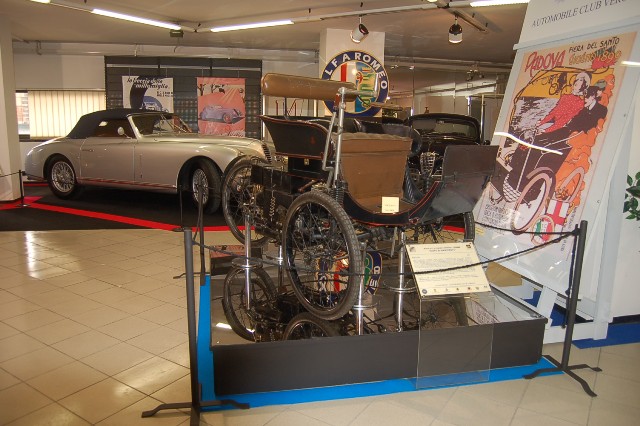
May 1 – October 3, 2010
Museo dell’Automobile Bonfanti-Vimar, Romano d’Ezzelino (VI)


