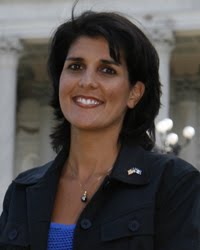
Establishment GOPers, Big Money PACs out of D.C. don’t like "libertarian" Nikki Haley

In the South Carolina Republican run-off for Governor Nikki Haley has raised virtually all of her money from small individual contributors. Opponent Gresham Barrett has raised almost all of his contributions from Business PACs, many based on 'K' Street in D.C.

From the Sacramento Bee, "Barrett winning money race in S.C. gubernatorial runoff" June 20:

The fact that Barrett's long-shot campaign can raise more money than Haley, who almost won the GOP nomination outright getting 49 percent of the vote in the June 8 primary, is evidence traditional Republican donors have concerns about the Lexington Republican, said Greenville, S.C.-based consultant Chip Felkel.

In particular, those Republicans fear Haley, a protege of libertarian Republican Gov. Mark Sanford, will repeat the two-term governor's pattern of standoffs with the Legislature, which is controlled by more traditional Republicans.

"The business community doesn't want her," Felkel said. "They want to head off four more years of Mark Sanford."

Delaware Republican for US Senate Christine O’Donnell speaks to Libertarian Party meeting

From Eric Dondero:

Delaware has a nomination process similar to Utah. Candidates are nominated at convention, but there is also a primary in September. Michael Castle easily won the Republican nomination in convention, and is the likely GOP nominee for US Senate. However, Christine O'Donnell is still running an active campaign for the primary. It is still possible that she could beat Castle in September.

O'Donnell is considered the hard-right candidate; Castle, more moderate. But interestingly, he happens to be the great, great, grandson of Benjamin Franklin (direct descendent).

This item from Will McVay, Libertarian for State Rep. DE 32nd District campaign blog:

Continuing the recent trend, the turnout at the Kent County [Central Delaware] Libertarian Party meeting for June grew from our May total of around 20 people to more than 30...

Christine O'Donnell, a candidate for the Republican nomination to the US Senate was also present and offered her views on the current state of our country and the steps she believes are necessary to remedy them. While she was eager to appeal to those in attendance currently registered in the Republican Party, she was also respectful of the Libertarian Party's candidate for US Senate, Jim Rash.

Sarah Palin endorses Tim Scott for Congress – South Carolina

From Eric Dondero:

Yesterday, we ran a series of articles on Tim Scott, Republican for Congress, in SC's Tuesday run-off election. Scott is a solid Reagan Conservative. Katherine Jenerette, Scott's primary opponent and a libertarian Republican, said this offering her endorsement:

I know that Tim will cut wasteful government spending, watching every precious taxpayer dollar.

I know that Tim will fight to win the war on terror, and support our military so that America can continue to lead the free world.

Now Scott's got a second powerful Female libertarian-leaning Republican in his camp.

From Sarah Palin's Facebook, earlier today:

I’m very proud to add my support to Tim Scott’s campaign to represent South Carolina’s 1st congressional district. Tim has a remarkable success story. He grew up in poverty and was raised by a single-mom who struggled to provide. With help from a mentor and his brave mom, Tim learned to appreciate the value of hard work and American opportunity. He went on to become a business owner and has served in public office with integrity on the county and state level.

Tim is a pro-life, pro-2nd Amendment, pro-development, Commonsense Conservative who’s been endorsed by the Club for Growth because of his solid commitment to the principles of limited government and fiscal responsibility.

He will represent the Palmetto State with distinction in DC, so I encourage you to vote for Tim in his run-off election next Tuesday, June 22nd. Please visit Tim’s website at http://www.votetimscott.com and follow him on Facebook and Twitter.

- Sarah Palin

If Scott wins the run-off on Tuesday, his election will be virtually assured. He has only nominal Democrat opposition in the Fall, in an overwhelmingly Republican district. This will make him the first Black American elected to Congress as a Republican since 2002.

Note - Stephen Maloney, a contributor to Libertarian Republican, and a Co-Founder of Draft Sarah Palin for VP in 2008, served as Campaign Coordinator and Media Director for Jenerette for Congress.

Indiana Debate Commission to Sponsor Three U.S. Senate Debates

(A Press Release from the Indiana Debate Commission)
For Immediate Release
INDIANAPOLIS—U.S. Rep. Brad Ellsworth, Democrat; former U.S. Sen. Dan Coats, Republican; and Rebecca Sink-Burris, Libertarian; have agreed in principle to participate in three televised debates sponsored by the Indiana Debate Commission.

The commission is now soliciting venue applications as it did for the gubernatorial race in 2008. Three debates [...]

The H? line forming region of AB Aurigae spatially resolved at sub-AU with the VEGA/CHARA spectro-interferometer

Authors: K. Rousselet-Perraut, M. Benisty, D. Mourard, S. Rajabi, F. Bacciotti, Ph. Bério, D. Bonneau, O. Chesneau, J. M. Clausse, O. Delaa, A. Marcotto, A. Roussel, A. Spang, Ph. Stee, I. Tallon-Bosc, H. McAlister, T. ten Brummelaar, J. Sturmann, L. Sturmann, N. Turner, C. Farrington and P. J. Goldfinger.<br />Astronomy and Astrophysics Vol. 516 , page L1<br />Published online: 18/06/2010<br />
Keywords:
methods: observational ; techniques: high angular resolution ; techniques: interferometric ; circumstellar matter ; stars: individual: AB Aur ; stars: emission-line, Be .

CoRoT opens a new era in hot B subdwarf asteroseismology ***

Authors: S. Charpinet, E. M. Green, A. Baglin, V. van Grootel, G. Fontaine, G. Vauclair, S. Chaintreuil, W. W. Weiss, E. Michel, M. Auvergne, C. Catala, R. Samadi and F. Baudin.<br />Astronomy and Astrophysics Vol. 516 , page L6<br />Published online: 22/06/2010<br />
Keywords:
stars: oscillations ; subdwarfs ; stars: individual: KPD 0629–0016.

Correlated optical and X-ray variability in CTTS

Authors: E. Flaccomio, G. Micela, F. Favata and S. P. H. Alencar.<br />Astronomy and Astrophysics Vol. 516 , page L8<br />Published online: 23/06/2010<br />
Keywords:
stars: variable: T Tauri, Herbig Ae/Be ; stars: activity ; stars: coronae ; stars: formation ; accretion, accretion disks ; X-rays: stars .

Superluminals?

Any time you start talking about moving matter or information faster than the speed of light (superluminal), the discussion can get quickly heated.  Science fiction is full of examples of superluminals, mostly to get around the time/distance factor in space travel.  The best (and most discussed) example of superluminal travel is the warp drive engine used to power the star ships in the Star Trek franchise.  There is even a “transwarp” drive for when multiples of light speed isn’t fast enough, and so a worm hole conduit is opened in which to accelerate beyond superluminal speeds.

Visualization of a Warp Field, USS Enterprise image owned by Paramount/CBS

As interesting as it is to think about superluminals in science fiction, where do they fit into science fact?  Nowhere, right?

Right?

I’m not so sure I’d bet on that.  True, under the special theory of relativity, a subluminal (slower than light speed) particle with non-zero rest mass needs infinite energy to accelerate to the speed of light.  What about a superluminal particle?  That would be a particle that never goes below the speed of light.  It couldn’t.  This particle is called a tachyon, and you just landed in the murky waters of theoretical particle physics.

Tachyon visualization, image by Wiki user TxAlien, all rights reserved

A tachyon is constantly moving.  Remember; if it slows to below the speed of light it ceases to exist.  Since it’s traveling at superluminal speed, you cannot see it approaching.  What you would see is it appearing and departing in two different directions.  In the animation, the black line is a shock wave of Cherenkov radiation (occurring in one specific moment in time).

At this time, there is no direct evidence to prove or disprove the existence of tachyons.  They are purely theoretical, spinless particles which must be created and annihilated in pairs.  They don’t just show up in theoretical particle physics, either.  They make an appearance in quantum field theory, string theory, and non-theoretical particle physics.

Some phenomena appear to be superluminal, but are not.  They do not move energy or information superluminally,  so they do not hit the windshield of special relativity.  Some of these phenomena are (note:  c indicates speed of light):

Closing speed:  Two objects approaching the other at near c will appear to an observer to be moving faster than c.  They are not.  If I’m in a car traveling at 55mph, and you’re in a car traveling at 55mph approaching me, our closing speed is 110mph… although we are actually only traveling at 55mph.

Phase velocity above c:  When traveling through a medium, the phase velocity of an electromagnetic wave routinely exceeds c.  X-rays through glass, for example.  However, the phase velocity of an electromagnetic wave is monochromatic, so it doesn’t impart any information above c.

Universal expansion:  Distant galaxies appear to be moving away from us at speeds greater than c.  This is the same effect as you see in closing speed, except we’re in a car traveling away from another car, both cars moving 55mph.  The expansion speed is 110mph, although neither is actually traveling that speed.

There are more examples of the same phenomena, but it all boils down to one thing:  Although mass/information is appearing to move at superluminal speed, it actually is not.

We could spend days discussing superluminal/subluminal, and whether it may be possible to some day “break the barrier” of the speed of light.  That is the direction research is taking.  We never know when some previously unknown “exception” will show up to prove the rule.  Who knows what will come in under special relativity in the future?

NCBI ROFL: Double feature: Personalities of punks and perils of their pointy parkas. | Discoblog

341529621_2f0c63640cSelf-image of punk rock and nonpunk rock juvenile delinquents.

“The purpose of this study was to provide some understanding of punk rockers. Although they have received media attention in the depiction of their unusual hair and clothing styles, there is limited information about their personalities. In this study a delinquent group of punk rockers was compared with a delinquent group of nonpunk rockers on self-image, a personality factor related to teenagers’ mental health and adjustment. Each group consisted of 20 subjects, 15 males and 5 females, aged 14 to 17. Subjects were administered a Screening Questionnaire, the Offer Self-Image Questionnaire (OSIQ), and the California Psychological Inventory (CPI) while detained at a Southern California juvenile hall… No significant differences were found between the groups. The importance of these findings is that even though punk rockers may look and act unusual, they may actually be similar to other groups.”

punks_not_different

“Punk” rock can be bad for you: a case of surgical emphysema from a “punk” rocker’s leather jacket.

“Stab wounds to the thorax are seen in the emergency department (ED) and can be caused by a variety of mechanisms. This case highlights an unusual cause of injury: a leather jacket with spikes on the back of it. This type of jacket is often worn by “punks” as a fashion statement. We report that falling onto such a jacket may result in accidental thoracic injury leading to subcutaneous emphysema. A thorough clinical assessment is mandatory to exclude underlying lung injury or pneumothorax.”

stab_punk_jacket

Image: flickr/mando2003us

Related content:
Discoblog: NCBI ROFL: Sword swallowing and its side effects.
Discoblog: NCBI ROFL: Friday the 13th special: Blood and tissue spatter associated with chainsaw dismemberment.
Discoblog: NCBI ROFL: The ideal elf: identity exploration in World of Warcraft.

WTF is NCBI ROFL? Read our FAQ!


Making Super-Powered Solar Panels Via Quantum Dots | 80beats

qd-solar-text.thumbnailA new type of solar cell using “quantum dots” may double the theoretical efficiency of current solar cells–allowing a panel to convert around 60 percent of the sun’s energy that it laps up into electricity. The research on these new cells appeared Friday in Science.

Current silicon-based solar cells lose about 80 percent of the sun’s energy they take in. It’s an inherent flaw: even working at their theoretical ideal, these cells would still lose 70 percent.

We can blame the sun’s diversely energized photons for this inefficiency. Silicon cells can only purposefully harvest photons with just the right amount energy. When they strike the cell, photons with just enough juice will prod an electron into motion (and create an electric current). An overly energized photon will excite the electrons to no purpose; the electrons will just quickly give off that photon’s energy as heat.

In two steps, this project, funded in part by the Department of Energy, salvages these “hot electrons.”

“There are a few steps needed to create what I call this ‘ultimate solar cell,’” says [Xiaoyang] Zhu, professor of chemistry and director of the Center for Materials Chemistry. “First, the cooling rate of hot electrons needs to be slowed down. Second, we need to be able to grab those hot electrons and use them quickly before they lose all of their energy.” [University of Texas at Austin]

Step 1 — Keep Hot Electrons Hot

The researchers from the University of Texas at Austin kept the hot electrons from shedding their energy–by hindering them with quantum dots, nanoscale structures with quantum behaviors:

The group used nanoscale (less than 100 nanometers, or 10-9 meters) crystals of a compound called lead selenide. Like silicon, lead selenide is a semiconductor, meaning it absorbs light energy within a certain bandgap, or range of energies. But semiconducting nanocrystals, also known as quantum dots, exhibit very different properties than their larger counterparts. For one thing, they can hold on to a hot electron for a longer period of time, stretching out the amount of time it takes for the electron to cool. In fact, previous research has shown that quantum dots can increase the lifetime of hot electrons by as much as 1000 times. [Popular Mechanics]

Step 2 — Forcing the Flow

The team next spurred these energetic electrons by pushing them into a conducting material where they could more easily move.

Zhu’s team has now figured out the next critical step: how to take those electrons out. They discovered that hot electrons can be transferred from photo-excited lead selenide nanocrystals to an electron conductor made of widely used titanium dioxide. “If we take the hot electrons out, we can do work with them,” says Zhu. “The demonstration of this hot electron transfer establishes that a highly efficient hot carrier solar cell is not just a theoretical concept, but an experimental possibility.” [Science Daily]

There’s just one problem keeping these more efficient cells from competing with their silicon predecessors–hooking them up to a wire to use all that electric current. The hot electrons, it seems, are too hot to handle:

“If we take out electrons from the solar cell that are this fast, or hot, we also lose energy in the wire as heat,” says Zhu. “Our next goal is to adjust the chemistry at the interface to the conducting wire so that we can minimize this additional energy loss.” [University of Texas at Austin]

But quantum dots are not the only solar cell solution. DISCOVER reporter Andrew Moseman describes other front runners on page 14 of our July/August magazine issue, which is on newsstands now.

Related content:
80beats: Tech Prize Goes to Inventor Who Wants to Turn Skyscrapers Into Generators
80beats: The Dream: Print-Out Solar Panels That Can Be Stapled to Your Roof
80beats: Glitter-Sized Solar Cells Could Be Woven into Your Power Tie
80beats: Self-Assembling Solar Panels Use the Vinaigrette Principle
DISCOVER: Sun Catcher Promises Cheaper Solar Power

Image: The University of Texas at Austin


Will Unlocking the Genome of Body Lice Help Us Destroy Them? | 80beats

Body_louseIt doesn’t take much to be a vile, bloodsucking pest. You, human, have three billion base pairs in your genome, but the body louse—which has been a typhus-spreading scourge of humanity for millennia—carries just 108 million. That’s what scientists say today in a study in the Proceedings of the National Sciences that describes how they sequenced the body louse genome.

Because the body louse (a separate creature from the head or pubic louse) lives entirely on humans, hatching in our clothes and eating our blood, its genome can get away with being so streamlined, study author Barry Pittendrigh says:

“Most of the genes that are responsible for sensing or responding to the environment are very much reduced,” Pittendrigh said. The body louse was found to have “significantly fewer genes” for smell and taste, as well as minimal genes responsible for a “simple visual system,” the study authors wrote. They found just 10 genes to code for odor receptors [Scientific American].

Human blood isn’t exactly a fully balanced meal, and the stripped-down louse genome doesn’t allow for making some of the missing ingredients itself. So, the scientists found, lice thrive by living symbiotically.

The new genomic analysis has revealed a source of at least one of those missing nutrients: the sequence of a bacterium living in the body louse, Candidatus Riesia pediculicola, turned up several genes involved in the synthesis of vitamin B5. Without that bacterium, the body louse is doomed [Nature].

The louse genome makes a nice addition to the library of genomes now on file, including the fruit fly, honeybee, and multiple mosquitoes. Lice could prove particularly interesting because they’re so simple. In addition to having a small genome, they also don’t go through complete metamorphosis. Instead, adults develop gradually from the young.

And there’s the practical: If we know our enemy, then maybe we can kill them. The researchers found that body lice carry few genes that would help them detoxify harmful compounds, perhaps because their diet is so homogeneous they don’t need to worry about it. That might provide a way to target them. Or, now that we have the genome of the helper bacterium, we could target it instead and doom the lice that way.

Related Content:
DISCOVER: Lice Meet the Hair Dryer of Death
DISCOVER: Whale Lice Offer Links To Past
DISCOVER: Your Body is a Planet
Discoblog: What Head (and Other) Lice Tell Us About Evolution

Image: CDC


Daily Data Dump – Monday | Gene Expression

I won the 3 Quarks Daily Science Prize. ‘Top quark’. Heh. “I” = Ed Yong. ‘nuf said.

Brown-eyed men perceived to be more dominant. Dienekes offers up a more banal explanation, that the disjunction between blue vs. brown-eyed males in dominance perception has to do with a correlation that’s a holdover from past population differences which are being eliminated through admixture. Plausible enough to me, excepting that I do wonder at models which presume that continental populations were ever so isolated.

Chimpanzees murder for land. In biology Malthus was right. Intrapspecific competition is the norm quite often because of reproduction up to the carrying capacity. This is why I think Brian Ferguson’s idea that war is a product of agriculture is highly naive; hunter-gatherers were up at their carrying capacity as well.

Bernie Madoff, Free at Last. Celebrity sociopath.

If it’s OK to reject blood from gay men, what about blacks? Will Saletan takes things to their logical conclusion to undermine the premise.

X-rayted pinup | Bad Astronomy

What’s more naked than naked?

This:

eizo-february-small-11244

That picture is one of a dozen making up an unusual — to say the least! — pinup calendar. It was put together for EIZO, a monitor manufacturer; their equipment is used to display high-resolution medical displays… like radiographs. So it’s clever, and apropos.

I had to laugh when I saw them. I’m more of a WWII-style pinup kinda guy, but these are really funny. But as I looked at them more, I started to think more deeply about them.

First, I’m not overly concerned with discussing any potential sexism involved with these images; if you think calendars are sexist this won’t add to the fire or stanch any of those feelings. So either you think they’re sexist or you don’t; let’s agree to that and move on to a more interesting aspect of them.

Are they racy?

And I don’t mean sexy, I mean racy. Sexy is one thing, but racy implies a bit of a wink-wink, a little bit of naughtiness. If you find these sexy, that’s your business, and I have no bone to pick with you.

eizo_skullBut seriously, would someone consider these to be racy pictures? I can think of arguments for and against. In many of the pictures, you can see a hint of flesh, and in many cases those particular body parts are considered to be, um, secondary sexual characteristics — and as is well known by the lingerie industry, hinting at skin can be more interesting than simply exposing it. In a lot of the pictures the model is posed provocatively. In most of them she’s wearing some killer stilettos, which is more of a pinup thing than a medical imaging thing.

On the other hand, these are freaking X-rays.

It’s funny how these things work. There are quite a few triggers that indicate sexuality to a man, including shape — the right curve in the right place. These pictures have that, but only kinda sorta. If it weren’t for the shoes and the poses, in most of these pictures you’d be hard-pressed to know if it were a man or a woman modeling!

And I’ll admit to hesitating before posting a picture from the calendar. I wanted to choose one that was relatively work-safe, and again the presence of the shoes or the pose used in some of them seemed inappropriate, so I chose what I thought was the least likely to invoke those triggers (and my wife agreed). How bizarre! If it were just a skeleton there would be no problem. If it were just the shoes sitting on a table, no problem. But the barest whisper of a breast or a behind together with the footwear and the position does, in my opinion, make these pictures bizarrely racy.

Humans have all sorts of complicated things going on in their brains. I’m curious as to what everyone else thinks about these pictures as well. I know that some people will rail about the sexism, others about the nature of pinups, and so on. But what do you think about the pictures themselves?

eizo_heelsAnd yikes. Check out what stilettos do to your metatarsophalangeal joint between the metatarsal and proximal phalangeal bones! Perhaps one outcome of these pictures is that the next time I see a woman wearing 4 inch heels, this’ll be what I think of.


From Marsh Grass to Manatees: The Next Wave of Life Endangered by BP’s Oil | 80beats

Sperm_whale_flukeBrown pelicans smothered by BP’s oil spill may be the symbols of sadness for the disaster in the Gulf, but they are, of course, far from the only animals affected. Marine scientists are watching other species for signs of danger.

Whales

Late last week, scientists spotted the first dead whale seen in the Gulf since the leak began gushing oil in April. The National Oceanic and Atmospheric Administration found a 25-foot-long sperm whale washed up, and now it is testing the sea creature for cause of death.

“While it is impossible to confirm whether exposure to oil was the cause of death, NOAA is reviewing whether factors such as ship strikes and entanglement can be eliminated,” the agency said. Samples collected from this carcass will be stored until the Pisces returns to port on July 2, or possibly if another boat is sent to meet the Pisces. Full analysis of the samples will take several weeks [New Orleans Times-Picayune].

Manatees

So far, it at least appears that manatees have been spared toxic exposure to the ever-growing oil spill. However, a science team hunkered down at Dauphin Island in Alabama—in the path of the oil—say their luck may not hold.

Until recently, biologists believed that manatees rarely ventured west of peninsular Florida, where, so far, no oil has appeared. But in 2007, Ruth Carmichael, who leads the Dauphin Island team, began documenting a relatively large summer migration of manatees to Mobile Bay, Ala. — leading them directly into and through the path of the oil from the Deepwater Horizon leak. From a couple of dozen to as many as 100 come to Mobile Bay for the summer, out of a total North American population of 5,000, she said [The New York Times].

The Little Guys

Large animals produce devastating pictures during a disaster like the BP oil spill. But those large creatures rely on something far less visible to us—the small creatures and plants at the bottom of the food chain—and those might be the most vulnerable of all to the oil, according to ecologist John Caruso.

In particular, the cord and Spartina grasses that grow on the coast of Louisiana are crucial to the ecosystem and especially sensitive to the oil leak, Caruso said. These grasses form the foundation of the local food chain, and their root systems lessen the erosion of the small islands that protect inland Louisiana from hurricanes, Caruso said [LiveScience].

Coral

We just don’t know. There are deep water coral living more than 1,000 feet below the surface of the Gulf, but scientists at the moment can’t say how they’re doing. First, they haven’t been able to go there. Second, they don’t have a good model, according to Erik Cordes, who studied deep water coral in Australia.

“If this had happened on a shallow-water reef, there would be a lot more data to evaluate the impact,” Cordes said. “We’re kind of playing catch-up. We’re trying to come up to speed very quickly on this” [Discovery News].

As for the oil leak itself: Late last week BP said its siphoning operation was collecting in excess of 25,000 barrels of oil per day. There’s still plenty they’re not getting: The total flow is now between 35,000 and 60,000 barrels per day. As BP’s relief wells approach their targets, the company says it will be bringing in more tankers to increase its capture capacity to 80,000 by using four ships and two separate pipes.

If you want more fuel for anger, check out the lengthy investigation in yesterday’s New York Times about what BP, its contractors, and the government knew about the weakness of the blowout preventer and other failed systems.

Recent Posts on the Gulf Oil Spill:
80beats: Obama’s Speech on the Oil Spill: What Do You Think of His “Battle Plan”?
80beats: BP to Kevin Costner: We’ll Take 32 of Your Oil Clean-up Machines
80beats: Should We Just Euthanize the Gulf’s Oil-Soaked Birds?
80beats: Meet the Oil-Covered Pelicans, Symbols of the BP Oil Spill
80beats: Scientists Say Gulf Spill Is Way Worse Than Estimated. How’d We Get It So Wrong?

Image: Wikimedia Commons


E-focals: Electric Eyeglasses Are the New Bifocals | Discoblog

benBenjamin Franklin would be proud. The tinkerer who loved playing with electricity and allegedly invented the bifocals might have been glad to know that one company has now brought the two things together: PixelOptics has designed a pair of powered specs that can track users’ eyes and automatically adjust the glasses’ focal length, depending on if the wearer needs to see close-up or far-away.

The glasses use liquid crystals, which can change how much they bend light when an electrical current runs through them. A video demonstration of what a wearer might see is available on PixelOptics’ website, and the company hopes that the glasses will be available in the United States before the end of 2010.

Peter Zieman, director of European sales for PixelOptics, said the device uses motion tracking software similar to the iPhone, and told The Telegraph:

“In essence, glasses haven’t changed all that much since they were first invented. The most recent development was transition lenses that tint in sunlight, but even that was 15 years ago…. Our glasses bring modern technology to an old solution.”

Perhaps Zieman doesn’t give other eye-wear inventors enough credit; for example, in 2008 a retired physics professor Josh Silver created a pair of fluid-filled spectacles that could change strength when the amount of liquid inside varied.

Still, as Star Trek fans might agree, electric eyeglasses really are more futuristic.

Related content:
DISCOVER: Not Your Father’s Bifocals
Discoblog: Cheap “Liquid Glasses” Bring Clear Vision to the Poor
Discoblog: Contacts Claim to Fix Your Vision While You Sleep
Discoblog: Will the Laptops of the Future Be a Pair of Eye Glasses?
Discoblog: Possible Cure For Blindness: Implanting a Telescope in Your Eye

Image: flickr / Franklin College


SMBC gets the finger | Bad Astronomy

smbc_20100620I’ve not seen this trick before, but Zach Weiner at Saturday Morning Breakfast Cereal is correct. Not only is he correct, but his math is correct, and his philosophical punch line is funny and correct. And I’m not saying that just because I’ll see him at Comic Con soon and I’m trying to get him to buy the first round. I swear, sometimes when I don’t get a math trick, that guy in the panel really is me.

Also. Don’t forget to hold your mouse over the red button at the bottom for extra bonus Zach-ish goodness*.


* He really does look like that.


To be fruitful and multiply | Gene Expression

Over at The Wall Street Journal Bryan Caplan has an op-ed, The Breeders’ Cup: Social science may suggest that kids drain their parents’ happiness, but there’s evidence that good parenting is less work and more fun than people think. Bryan Caplan makes the case for having more children. Much of the op-ed focuses on behavior genetic insight as to the relative lack of long term importance of shared environment (read: parental environmental input). But the section on happiness and diminishing returns on the misery cost of children piqued my interest:

…closer look at the General Social Survey also reveals that child No. 1 does almost all the damage. Otherwise identical people with one child instead of none are 5.6 percentage points less likely to be very happy. Beyond that, additional children are almost a happiness free lunch. Each child after the first reduces your probability of being very happy by a mere .6 percentage points.


The op-ed is a precis of Caplan’s next book, Selfish Reasons to Have Kids. Being an economist he focuses on rational individual behavior, but I want to point to another issue: group norms. In the left-liberal progressive post-graduate educated circles which I come into contact with in the USA childlessness is not uncommon, and bears no stigma (on the contrary, I hear often of implicit and explicit pressure on graduate students to forgo children for the sake of maximizing labor hour input into research over one’s lifetime from advisors). On the other hand, the norm of a two-child family is also very strong, and going above replacement brings upon you a fair amount of attention. The rationale here is often environmental, more children = more of a carbon footprint. But my friend Gregory Cochran has stated that as an individual who is well above replacement whose social milieu is more conservative that he perceives that more than two children is also perceived as deviant in Middle American society. In other words, the reasoning may differ, but the intuition is the same (in Italy the reasoning mostly involves the cost of raising children from the perspective of parents, both in cash and time).

The numbers in the General Social Survey tell the tale. In 1972 42% of adults had more than 2 children. In 2008 32% did. More relevantly in 1972 47% of adults between the ages of 25 and 45 had more than 2 children. In 2008 the figure for that age group is 27% for those with more than 2 children.

Of course the numbers mix up a lot of different subcultures. One anecdote I’d like to relate is a conversation I had with a secular left-of-center university educated couple. They expressed the aspiration toward 4 children. I asked them out of curiosity about the population control issue, and they looked at me like I was joking. It needs to be mentioned that they weren’t American, rather they were from a Northern European country which seems on the exterior to resemble the United States very much. But it reminds us of the importance of group norms in shaping life choices and expectations, the implicit framework for our explicit choices.

All that goes to my point that Bryan Caplan’s project will be most effective among demographics geared toward prioritizing individual choice, analysis and utility maximization, as opposed to relying upon the wisdom of group norms. Economists, quantitative social science and finance types, libertarians, etc.

Note: Here’s Will Wilkinson’s rebuttal to Caplan’s empirical case in regards to happiness.

Chimpanzees murder for land | Not Exactly Rocket Science

Chimpanzees

Between 1998 and 2009, John Mitani witnessed 18 murders firsthand, and found circumstantial evidence for three more. But no police were ever called, for these killers were all chimpanzees, from the Ngogo community in Uganda’s Kibale National Park.

Chimpanzees are highly intelligent animals, capable of great acts of empathy, technological sophistication, culture and cooperation. But they can also be murderers. Groups of chimps, mostly male, will mount lengthy aggressive campaigns against individuals from other groups, attacking them en masse and beating them to death. Their reasons for such killings have long been a source of debate among zoologists, but the aftermath of the Ngogo murders reveals an important clue. After the chimps picked off their neighbours, they eventually took over their territory. It seems that chimps kill for land.

The vast majority of these murders were carried out by groups of Ngogo males on patrol. These patrols are stern, single-file affairs. Males march along the borders of their territories, scanning for other chimps and neither feeding nor socialising. They monitor the northeastern part of their territory with particular fervour and indeed, 13 of their 21 kills took place here.

Of these victims, 4 were adult males and 9 were youngsters. That may seem like a small number, but for chimps, these are severe losses. At the hands of the Ngogo attackers, the northeastern community was experiencing death rates that were 23 to 75 times higher than those observed in other groups of chimps. They were even higher (by around 5 to 17 times) than the death rates due to violence between groups of human hunter-gatherers.

It’s clear that the Ngogo chimps are skilled at waging war against their neighbours and the exceptionally large males in their number probably contribute to their aptitude for violence. And because of their aggressive tactics, they have increased the size of their territory by some 22%, expanding into the northeast area that their neighbours once called home. With murder came new real estate to colonise.

Mitani’s observations back up other anecdotal evidence from other parts of Africa. In Gombe National Park, the Kasekala community of chimps took over the territory of the neighbouring Kahama clan after a series of fatal attacks. But the former community actually splintered off from the latter some time previously. Elsewhere in the Mahale Mountains, one group of chimps annexed the territory of another. All the males in the latter group mysteriously disappeared, but no murders were ever directly witnessed.

In contrast, Mitani found clear and direct evidence that the Ngogo chimps killed off their rivals and commandeered their land. These observations don’t rule out the alternative ideas that the attacks were motivated by a desire for more mates. After all, more acreage could attract more females into the group or improves the chances of existing members. But Mitani’s observations do rule out at least one idea behind chimp aggression – that it’s a side effect of humans. Some zoologists had suggested that by providing food to wild chimps, we were instigating conflict between them, but that’s clearly not the case in Ngogo.

Much of this behaviour might seem familiar, for it has poignant echoes of human warfare. After all, we also kill each other over resource. Richard Wrangham, a primatologist from Harvard University, has suggested that understanding the reasons behind chimp violence could help us to understand and address “the roots of violence in our own species”. Even so, Mitani is very careful about drawing an analogy between chimp and human aggression, given the myriad of reasons that humans have for waging war.

Chimp expert Frans de Waal appreciates his caution. He says, “There have been claims made in the past that since chimps wage war and we do as well it must be a characteristic that goes back 6 million years, and that we have always waged war, and always will.

“There are many problems with this idea, not the least of which is that firm archaeological evidence for human warfare goes back only about 10-15 thousand years. And apart from chimpanzees, we have an equally close relative, the bonobo, that is remarkably peaceful. The recent discovery of Ardipithecus also adds to the picture, as the suggestion has been that Ardi was relatively peaceful too. The present study provides us with a very critical piece of information of what chimpanzees may gain from attacking neighbours. How this connects with human warfare is a different story.”

Reference: Current Biology; citation tbc]

Image by Caelio (does not depict a chimp kill)

More on chimps:

Twitter.jpg Facebook.jpg Feed.jpg Book.jpg