
Scientists Baffled by Orcas Wearing Dead Salmon as Hats

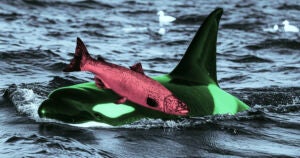
Orcas have once again been observed swimming around with dead salmon on their snout as

Hatful of Sorrow

You've probably heard all about orcas' daring feats, like sinking yachts. But are you aware that they can be quite dashing, too?

Yep. It appears that these snazzy cetaceans are fond of wearing "hats" in the form of dead salmon on their snouts, and sometimes other fish.

First observed in 1987, the morbid fashion trend quickly came and went like so many questionable choices in dress  — but like baggy trousers, it now it appears to be back in style again.

As New Scientist reports, photographers have spotted killer whales donning salmon hats off the coast of the Pacific Northwest, reigniting debate about why orcas exhibit this puzzling behavior.

"Honestly, your guess is as good as mine," Deborah Giles, the science and research director at the non-profit Wild Orca, told New Scientist.

"We saw one with a fish on its head," she described. "So that was fun — it's been a while since I've personally seen it."

Boast to Coast

As New Scientist notes, only west coast orcas appear to favor dressing this way. East coasters, it seems, are either too cool or too démodé to bother.

Because orcas can live up to ninety years, it's possible that it's the same trendsetter from nearly four decades ago — or its acolytes — that's reviving the salmon hats. Who knew that orcas had fashion icons of their own?

"It does seem possible that some individuals that experienced [the behavior the] first time around may have started it again," Andrew Foote, an evolutionary ecologist at the University of Oslo, Norway, told New Scientist.

Fishful Thinking

In reality, there could be a practical reason behind the hats. Perhaps this is how the orcas set aside some food for later after an especially plentiful hunt.

"We've seen mammal-eating killer whales carry large chunks of food under their pectoral fin, kind of tucked in next to their body," Giles told New Scientist.

Either way, it's a testament to the intelligence of the creatures, which are social to such an almost primate degree that they develop their own cultures. It's this cultural bent — and the trends that come with it — that's believed to be responsible for how orcas not only began attacking human vessels, but learned how to immobilize and even sink them.

Nevertheless, it'll take more observations to bear out the saving-a-snack hypothesis — which Giles suggests could be done with camera-equipped drones.

"Over time, we may be able to gather enough information to show that, for instance, one carried a fish hat for 30 minutes or so, and then he ate it," she told New Scientist.

More on whales: Footage Shows Orca Blasting SeaWorld Visitors With Liquid Feces

The post Scientists Baffled by Orcas Wearing Dead Salmon as Hats appeared first on Futurism.

Read this article:
Scientists Baffled by Orcas Wearing Dead Salmon as Hats

Scientists Baffled by Orcas Wearing Dead Salmon as Hats

Orcas have once again been observed swimming around with dead salmon on their snout as

Hatful of Sorrow

You've probably heard all about orcas' daring feats, like sinking yachts. But are you aware that they can be quite dashing, too?

Yep. It appears that these snazzy cetaceans are fond of wearing "hats" in the form of dead salmon on their snouts, and sometimes other fish.

First observed in 1987, the morbid fashion trend quickly came and went like so many questionable choices in dress  — but like baggy trousers, it now it appears to be back in style again.

As New Scientist reports, photographers have spotted killer whales donning salmon hats off the coast of the Pacific Northwest, reigniting debate about why orcas exhibit this puzzling behavior.

"Honestly, your guess is as good as mine," Deborah Giles, the science and research director at the non-profit Wild Orca, told New Scientist.

"We saw one with a fish on its head," she described. "So that was fun — it's been a while since I've personally seen it."

Boast to Coast

As New Scientist notes, only west coast orcas appear to favor dressing this way. East coasters, it seems, are either too cool or too démodé to bother.

Because orcas can live up to ninety years, it's possible that it's the same trendsetter from nearly four decades ago — or its acolytes — that's reviving the salmon hats. Who knew that orcas had fashion icons of their own?

"It does seem possible that some individuals that experienced [the behavior the] first time around may have started it again," Andrew Foote, an evolutionary ecologist at the University of Oslo, Norway, told New Scientist.

Fishful Thinking

In reality, there could be a practical reason behind the hats. Perhaps this is how the orcas set aside some food for later after an especially plentiful hunt.

"We've seen mammal-eating killer whales carry large chunks of food under their pectoral fin, kind of tucked in next to their body," Giles told New Scientist.

Either way, it's a testament to the intelligence of the creatures, which are social to such an almost primate degree that they develop their own cultures. It's this cultural bent — and the trends that come with it — that's believed to be responsible for how orcas not only began attacking human vessels, but learned how to immobilize and even sink them.

Nevertheless, it'll take more observations to bear out the saving-a-snack hypothesis — which Giles suggests could be done with camera-equipped drones.

"Over time, we may be able to gather enough information to show that, for instance, one carried a fish hat for 30 minutes or so, and then he ate it," she told New Scientist.

More on whales: Footage Shows Orca Blasting SeaWorld Visitors With Liquid Feces

The post Scientists Baffled by Orcas Wearing Dead Salmon as Hats appeared first on Futurism.

See more here:
Scientists Baffled by Orcas Wearing Dead Salmon as Hats

Researchers Force Grumpy Cats to Wear Adorable Wittle Wool Hats — for Science

Veterinary researchers have devised a solution to head off feline resistance to brain scans: hiding the electrodes underneath crocheted hats.

Hide and Seek

Veterinary researchers have devised an ingenious solution to head off feline resistance to brain scans: hiding the electrodes underneath custom-fit crocheted caps.

In a press release about this fascinating and adorable discovery, the University of Montreal boasted that its scientists figured out the system that helps keep the brain scanners on cats who are given chronic pain tests.

When administered while felines are awake, brain scans meant to detect pain conditions like osteoarthritis are often annoying to the cats in question. The animals often end up chewing on wires and trying to shake off the sensitive electrodes of the electroencephalogram (EEGs).

Vets generally sedate cats when giving them EEGs to avoid such a scene, but in their new study published in the Journal of Neuroscience Methods, the UdeM researchers are proposing their novel knitted approach.

In interviews with the New Scientist about their methodology, the researchers said that they came up with the solution after becoming frustrated with cats they were doing brain scans on constantly throwing off their electrodes.

"When you spend more time putting electrodes back on than you do actually recording the EEGs, you get creative," explained PhD student and study coauthor Aliénor Delsart.

Getting Creative

When trying to find solutions to this feline conundrum, the researchers stumbled upon a YouTube tutorial for crocheted cat hats. The team leads had a grad student make the cats' beanies and were pleased to discover that it helped keep the electrodes in place — though there's little doubt that the cats were none too pleased by their new accessories.

With the crocheted beanies secured as a novel solution to the pissed-off cat problem, UdeM team lead Éric Troncy said in the press release that they're looking for government funding to expand their research into chronic feline pain.

"We now plan to obtain [Natural Sciences and Engineering Research Council of Canada Alliance] funding, in partnership with private companies, to enable us to establish a genuine EEG signature for chronic pain," Troncy said, "and many other applications that will enable us to automate chronic pain detection in the future."

Necessity is, as they say, the mother of invention — and in this case, it may end up helping all of felinekind.

More on cats: Research Finds That Cats Feel Grief When Their Fellow Pets Die... Even Dogs

The post Researchers Force Grumpy Cats to Wear Adorable Wittle Wool Hats — for Science appeared first on Futurism.

See the article here:
Researchers Force Grumpy Cats to Wear Adorable Wittle Wool Hats — for Science