Fat Tissue Knockout of Mitochondrial Transcription Factor A is Beneficial, and May Extend Life in Mice

Mitochondrial transcription factor A (TFAM) plays a number of important roles and shows up in connection with protofection research aimed at mitochondrial repair. Separately, researchers observe benefits by removing it from the fat tissue of mice:

Mutations in genes involved in the electron transport chain that cause mitochondrial dysfunction can sometimes paradoxically lead to improved health and/or enhanced longevity. One example is the situation in mice with conditional knockout of the mitochondrial transcription factor A (TFAM) specifically in fat. These F-TFKO mice exhibit mitochondrial dysfunction with increased energy expenditure, but are protected from age- and diet-induced obesity, insulin resistance and hepatosteatosis, despite increased food intake.

Mitochondrial DNA (mtDNA) is maternally inherited with multiple copies in each mitochondria. TFAM plays a critical role in maintenance and expression of mtDNA, and reductions of mtDNA copy number usually correlate with reduction of mitochondria content and function. So, how does a reduction in TFAM in fat have this beneficial effect?

Upon high fat diet, [the F-TFKO] mice develop a build-up of long chain acyl carnitines in both adipose tissue and the circulation. In addition, markers of oxidative stress are observed at the level of DNA and lipids in adipose tissue of F-TFKO mice on high fat diet, indicating overload of the ROS protection system. Despite this mitochondria stress, the mice remain lean and insulin sensitive even at 10 months of age. Although no formal aging studies have been conducted in these mice, we also noted that by 18 months of age, an age at which the control mice have started to die, the F-TFKO mice are still thriving, suggesting this knockout may be beneficial to aging mice as well.

Link: http://impactaging.com/papers/v4/n12/full/100518.html

Source:
http://www.fightaging.org/archives/2013/01/fat-tissue-knockout-of-mitochondrial-transcription-factor-a-is-beneficial-and-may-extend-life-in-mice.php

Nature Biotechnology: California Stem Cell Agency Receives 'Stinging Rebuke'

The headline this week in Nature
Biotechnology
read: “IOM smacks down California Institute of
Regenerative Medicine.”
The story by Senior Editor Laura
DeFrancesco
said that the $3 billion California stem cell agency
“received a stinging rebuke of much of the way it has been carrying
out its business by a group of independent reviewers.”
At the same time, DeFranesco wrote that
the blue-ribbon, Institute of Medicine panel “praised the courage
and vision of the individuals who spearheaded the program as well as
those toiling in the CIRM office in San Francisco.”
The Nature Biotechnology piece covered
familiar ground for many readers, summarizing the IOM's sweepingrecommendations last month, including those dealing with the built-in
conflicts of interest on the agency's 29-member governing board.
DeFrancesco wrote that is unclear
whether the agency will move to adopt any of the recommendations from
the panel, many of which have been rejected in the past.
Some members of the CIRM governing
board last month bristled at some of the recommendations. The board is scheduled to discuss the IOM report, for
which it paid $700,000, at a public meeting Jan. 23 in Berkeley.
Patient advocates are already organizing a turn-out to lobby against
some recommendations.  

Source:
http://feedproxy.google.com/~r/blogspot/uqpFc/~3/bJIhSwMvwx8/nature-biotechnology-california-stem.html

Nature Biotechnology: California Stem Cell Agency Receives ‘Stinging Rebuke’

The headline this week in Nature
Biotechnology
read: “IOM smacks down California Institute of
Regenerative Medicine.”
The story by Senior Editor Laura
DeFrancesco
said that the $3 billion California stem cell agency
“received a stinging rebuke of much of the way it has been carrying
out its business by a group of independent reviewers.”
At the same time, DeFranesco wrote that
the blue-ribbon, Institute of Medicine panel “praised the courage
and vision of the individuals who spearheaded the program as well as
those toiling in the CIRM office in San Francisco.”
The Nature Biotechnology piece covered
familiar ground for many readers, summarizing the IOM's sweepingrecommendations last month, including those dealing with the built-in
conflicts of interest on the agency's 29-member governing board.
DeFrancesco wrote that is unclear
whether the agency will move to adopt any of the recommendations from
the panel, many of which have been rejected in the past.
Some members of the CIRM governing
board last month bristled at some of the recommendations. The board is scheduled to discuss the IOM report, for
which it paid $700,000, at a public meeting Jan. 23 in Berkeley.
Patient advocates are already organizing a turn-out to lobby against
some recommendations.  

Source:
http://feedproxy.google.com/~r/blogspot/uqpFc/~3/bJIhSwMvwx8/nature-biotechnology-california-stem.html

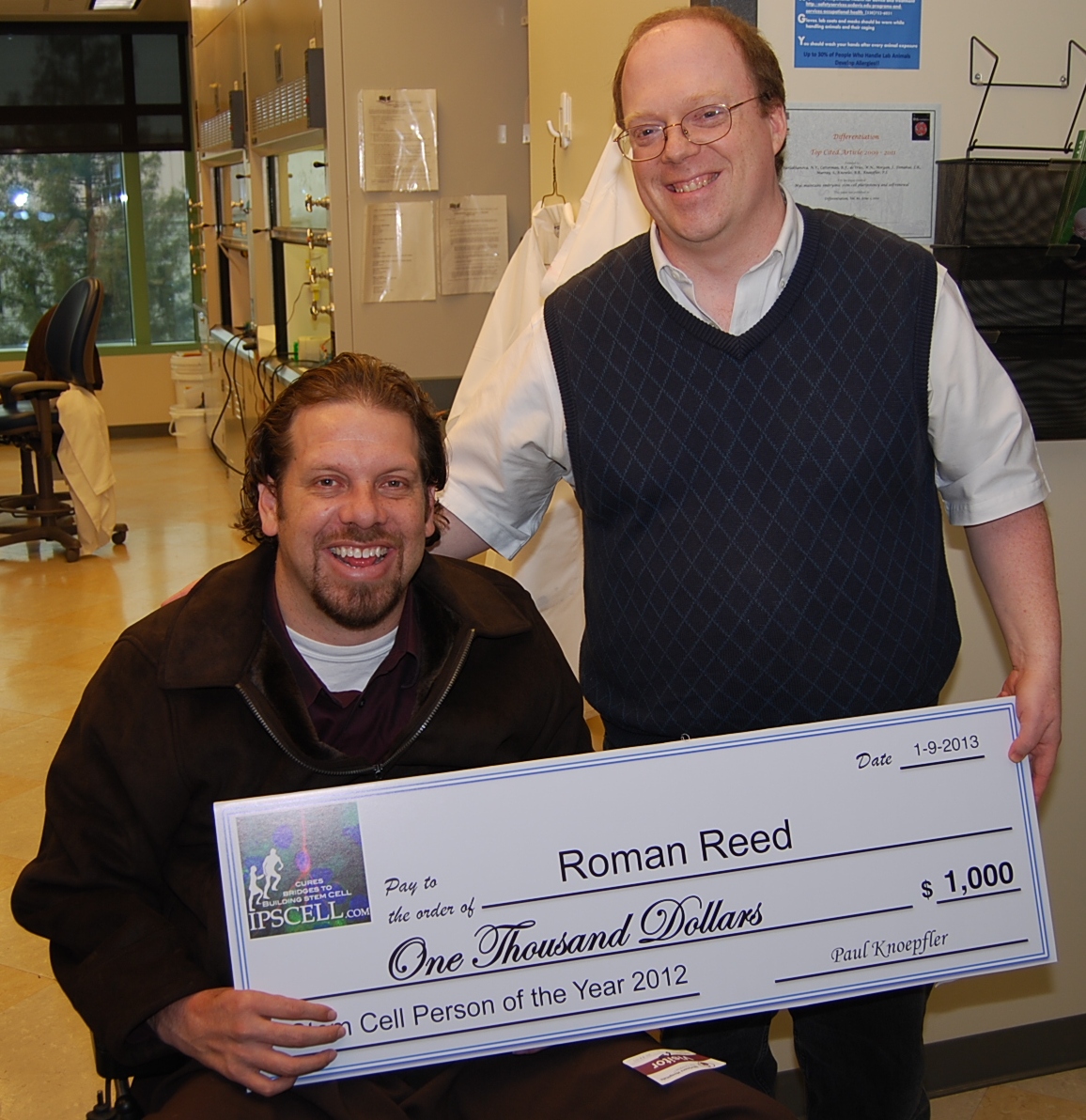
Roman Reed is Stem Cell Person of 2012; Leigh Turner Runner-up

Roman Reed, a Fremont, Ca., patient advocate, this week was named Stem
Cell Person of 2012
by the Knoepfler Stem Cell Lab at UC Davis, which
cited Reed for energizing a new generation of
advocacy.

Roman Reed (left) and Paul Knoepfler
Knoepfler Lab photo
UC Davis stem cell scientist Paul
Knoepfler
awarded Reed $1,000 from his personal funds. The ceremonial
check appears to be close to four-feet long in a photo taken in
Knoepfler's lab.
Knoepfler wrote on his blog that Reed
made a “tremendous difference” in 2012. The researcher said,

“One of the most notable was
catalyzing the TJ Atchison Spinal Cord Injury Research Act in
Alabama, which provides $400,000/year in funding for research. Of
course, TJ and many others who helped make this possible also deserve
great credit and have my admiration, but Roman provided key
leadership. Here in California, Roman’s Law supported its 11th
year of grants all eligible for all forms of stem cell research.
Roman informs me that it funded $749,00 overall and approximately
$200,000 in stem cell funding. 

“In addition, Roman in 2012 mentored
and energized a whole new generation of advocacy from young,
energetic leaders: TJ Atchison, Katie Sharify, Richard Lajara
and Tory Minus.”

Knoepfler personally made the decision on the award,
but also conducted an advisory poll that Reed won. Knoepfler wrote,

Leigh Turner
U of Minn photo

“Only 6% behind Roman was the amazing
activist Ted Harada followed by Roman’s dad the remarkable Don
Reed
, the wonderful Judy Roberson, and the super Katie Sharify nearly
all tied for third. Next after them was the relative new kid in stem
cell town, Leigh Turner.”

Knoepfler named Turner, an associate
professor at the Center for Bioethics at the University of Minnesota,
as the official runner-up in the contest, No. 2 behind Reed.
Knoepfler wrote,

“Leigh took the courageous,
outside-the-box step in 2012 of contacting the FDA to investigate
Celltex when he perceived patients could be at risk. As “thanks”
for his action, he was put under enormous pressure and there was talk
of possible litigation against him. Pressure was applied to his
employer, the University of Minnesota. We’ll never know for sure,
but from everything that I know I believe that Leigh’s actions
directly led to prompt FDA action, which otherwise might not have
happened at all or until much later. In my opinion, Leigh’s act of
courage, helped make hundreds of patients safer in a direct way and
indirectly may have set a higher standard for the field of stem cell
treatments.”

Source:
http://feedproxy.google.com/~r/blogspot/uqpFc/~3/QfG7CijBsy4/roman-reed-is-stem-cell-person-of-2012.html

BioTime Buys Geron's Stem Cell Assets, Including hESC Clinical Trial

Geron Corp., which pioneered the first
clinical trial of an hESC therapy, today sold its stem cell
business to another San Francisco Bay Area firm whose two top
executives were once CEOs at Geron.

Michael West
BioTime photo
The total value of the complex deal was
not clear from the public statements released by Geron and the
acquiring firm, BioTime, Inc., of Alameda, but an unidentified
outside investor is adding $10 million to transaction.
In a telephone interview this evening,
Michael West, CEO of BioTime, said that as a result of the deal his
firm will hold 600 patents and patent applications involving stem
cells. He said the aggregation should help in attracting financial
interest in the firm and its efforts.
West founded Geron in 1990. BioTime
Acquistion Corp
., the BioTime subsidiary that is picking up the Geron
assets, is headed by Tom Okarma, who was Geron's CEO from 1999 to
2011.
After Okarma left the firm in 2011,
Geron abruptly jettisoned its stem cell business along with the
clinical trial. Geron has been looking since then for a buyer for the
assets.
Tom Okarma
Geron photo
Only a few months prior to the Geron
decision in 2011, the California stem cell agency had signed a $25
million loan agreement with Geron to support the clinical trial. The
company paid back with interest the amount of the loan that it had
received.
Information from the two companies did
not specify whether BioTime will begin seeking additional
participants in the clinical trial. Nor did BioTime indicate whether
it would seek additional funding from the state stem cell agency.
However, West said during the telephone
interview that he has an “open mind” about working with CIRM.
Last year, agency officials indicated an interest in continuing to
support the clinical trial. West said BioTime had already hired some
employees that were laid off by Geron, including its patent attorney.
He said that he hoped to reassemble at least part of Geron's now
scattered stem cell team.
According to the Geron press release,
when the deal is officially concluded in September, “it is
anticipated that Geron stockholders would own approximately 21% of
BAC, BioTime would own approximately 72%, and a private investor
would own approximately 7% after an additional $5 million investment
in BAC.”
For its new operations, BioTime has
leased space in Menlo Park that Geron once used for its stem cell
business.
Both firms are publicy traded.
BioTime's stock price closed at $3.45 today and had a 52-week high of
$6.35 and a low of $2.67. Geron closed at $1.60 and had a 52-week
high of $2.99 and a low of 91 cents.

Here is a link to an article in the San
Francisco Business Times
about the deal. Here are links to the
BioTime press release, a BioTime FAQ and the Geron press release.

Source:
http://feedproxy.google.com/~r/blogspot/uqpFc/~3/TBbR-z7OPWc/biotime-buys-gerons-stem-cell-assets.html

BioTime Stock Jumps 22 Percent in Two Days in Wake of Geron Deal

The stock price of Biotime, Inc., of
Alameda, Ca., shot up more than 12 percent today following the
announcement of a complex deal that will give it the stem cell assets
of Geron Corp., the first firm to launch a clinical trial for an hESC
therapy.

Geron stock price Jan. 2-8
Google chart
BioTime stock closed at $3.88, up
43 cents or 12.46 percent. That followed a 9.6 percent gain
yesterday. Geron's stock closed at $1.63, up three cents or 1.9
percent.
News coverage of the deal was light
with our tracking showing only one story so far today on The Scientist magazine web site.

Source:
http://feedproxy.google.com/~r/blogspot/uqpFc/~3/mQRu0qUrqwM/biotime-stock-jumps-22-percent-in-two.html

BioTime Buys Geron’s Stem Cell Assets, Including hESC Clinical Trial

Geron Corp., which pioneered the first
clinical trial of an hESC therapy, today sold its stem cell
business to another San Francisco Bay Area firm whose two top
executives were once CEOs at Geron.

Michael West
BioTime photo
The total value of the complex deal was
not clear from the public statements released by Geron and the
acquiring firm, BioTime, Inc., of Alameda, but an unidentified
outside investor is adding $10 million to transaction.
In a telephone interview this evening,
Michael West, CEO of BioTime, said that as a result of the deal his
firm will hold 600 patents and patent applications involving stem
cells. He said the aggregation should help in attracting financial
interest in the firm and its efforts.
West founded Geron in 1990. BioTime
Acquistion Corp
., the BioTime subsidiary that is picking up the Geron
assets, is headed by Tom Okarma, who was Geron's CEO from 1999 to
2011.
After Okarma left the firm in 2011,
Geron abruptly jettisoned its stem cell business along with the
clinical trial. Geron has been looking since then for a buyer for the
assets.
Tom Okarma
Geron photo
Only a few months prior to the Geron
decision in 2011, the California stem cell agency had signed a $25
million loan agreement with Geron to support the clinical trial. The
company paid back with interest the amount of the loan that it had
received.
Information from the two companies did
not specify whether BioTime will begin seeking additional
participants in the clinical trial. Nor did BioTime indicate whether
it would seek additional funding from the state stem cell agency.
However, West said during the telephone
interview that he has an “open mind” about working with CIRM.
Last year, agency officials indicated an interest in continuing to
support the clinical trial. West said BioTime had already hired some
employees that were laid off by Geron, including its patent attorney.
He said that he hoped to reassemble at least part of Geron's now
scattered stem cell team.
According to the Geron press release,
when the deal is officially concluded in September, “it is
anticipated that Geron stockholders would own approximately 21% of
BAC, BioTime would own approximately 72%, and a private investor
would own approximately 7% after an additional $5 million investment
in BAC.”
For its new operations, BioTime has
leased space in Menlo Park that Geron once used for its stem cell
business.
Both firms are publicy traded.
BioTime's stock price closed at $3.45 today and had a 52-week high of
$6.35 and a low of $2.67. Geron closed at $1.60 and had a 52-week
high of $2.99 and a low of 91 cents.

Here is a link to an article in the San
Francisco Business Times
about the deal. Here are links to the
BioTime press release, a BioTime FAQ and the Geron press release.

Source:
http://feedproxy.google.com/~r/blogspot/uqpFc/~3/TBbR-z7OPWc/biotime-buys-gerons-stem-cell-assets.html

Reverse Engineering Grandpa

Stem cells are rarely the subject of
cartoons, but one popped last week from Bizarro.

The cartoon appeared in the San
Francisco Chronicle
 and elsewhere, including the
Bizarro web site
. The image was of a petri dish in a lab with
tiny maternal speck giving parental advice to an even tinier speck:
"You can be anything you want to be when you grow up."
Artist Dan Piraro said the cartoon was his favorite of the
week because of its “strangeness.”
Piraro wrote on his blog,

“To use a term common in the
vernacular of geneticists, it’s creepy cool.”

The cartoon did not differentiate
between embryonic and adult cells, much less reprogrammed adult
cells. Using reprogrammed cells in the cartoon would have been even
creepier and cooler, giving new meaning to the 1947 song, “I Am My
Own Grandpa.”
(See here and here.)

(A nod to "Bob" for calling our attention to the cartoon.)

Source:
http://feedproxy.google.com/~r/blogspot/uqpFc/~3/gXXLRtG2Sx4/reverse-engineering-grandpa.html

Management of Parkinsons Disease – Video


Management of Parkinsons Disease
Dr. Dee Silver presents an in depth view of pharmacological and non pharmacological management of Parkinson #39;s Disease, the action sites of the drugs used, and the side effects of the drugs and how the side effects vary as the disease progresses and complications that may arise

By: IPDParkinsonsDisease

Original post:
Management of Parkinsons Disease - Video

A Conversation with Paul Greengard – Video


A Conversation with Paul Greengard
Dr. Paul Greengard, Professor of Molecular and Cellular Neuroscience at Rockefeller University, talks about his life and career with his former student Dr. Eric Nestler, Professor and Chair of Neuroscience at the Mount Sinai School of Medicine. Dr. Greengard won the 2000 Nobel Prize in Physiology or Medicine for his work on the signaling pathways in the nervous system. He and his colleagues showed nerve cells communicate through either fast or slow synaptic transmission. Dr. Greengard discusses their discoveries and the resistance and skepticism they faced when they published the results. A transcript of this interview is available online: http://www.annualreviews.org Paul Greengard was born in New York City in 1925. After completing high school, he served three years in the US Navy during World War II and then completed his bachelor #39;s degree at Hamilton College where he majored in physics and mathematics. He obtained a PhD in biophysics from Johns Hopkins University in 1953 and pursued postdoctoral training with Wilhelm Feldberg at the National Institute for Medical Research in England. After eight years as head of biochemistry at Geigy, and sabbaticals at Albert Einstein College of Medicine and Vanderbilt University, he joined the Yale University faculty as a full professor of pharmacology in 1968. While he was at Yale, Greengard #39;s laboratory performed groundbreaking research, which demonstrated a role for cyclic nucleotides, protein kinases and protein phosphatases, and their ...

By: annualreviews

Read this article:
A Conversation with Paul Greengard - Video

Alida Griffith, MD – Booth Gardner Parkinson's Care Center.wmv – Video


Alida Griffith, MD - Booth Gardner Parkinson #39;s Care Center.wmv
Dr. Alida Griffith is a Movement Disorders neurologist at the Booth Gardner Parkinson #39;s Care Center in Kirkland, WA, part of the EvergreenHealth Neuroscience Institute. Her expertise includes Parkinson #39;s disease and other movement disorders, patient selection for deep brain stimulation surgery and post-surgical management of deep brain stimulators, as well as the administration of Botox injections for dystonia, blepharospasm and hemifacial spasm. Dr. Griffith is a principal investigator for clinical research trials at the Center, ensuring that our community receives the best possible care we can provide. Learn more about Dr. Griffith at http://www.evergreenhealth.com/search/physician_profile/alida_griffith_md Learn more about the Booth Gardner Parkinson #39;s Care Center at http://www.evergreenhealth.com/parkinsons

By: EvergreenHospital

Read the original here:
Alida Griffith, MD - Booth Gardner Parkinson's Care Center.wmv - Video

Alida Griffith, MD – Booth Gardner Parkinson’s Care Center.wmv – Video


Alida Griffith, MD - Booth Gardner Parkinson #39;s Care Center.wmv
Dr. Alida Griffith is a Movement Disorders neurologist at the Booth Gardner Parkinson #39;s Care Center in Kirkland, WA, part of the EvergreenHealth Neuroscience Institute. Her expertise includes Parkinson #39;s disease and other movement disorders, patient selection for deep brain stimulation surgery and post-surgical management of deep brain stimulators, as well as the administration of Botox injections for dystonia, blepharospasm and hemifacial spasm. Dr. Griffith is a principal investigator for clinical research trials at the Center, ensuring that our community receives the best possible care we can provide. Learn more about Dr. Griffith at http://www.evergreenhealth.com/search/physician_profile/alida_griffith_md Learn more about the Booth Gardner Parkinson #39;s Care Center at http://www.evergreenhealth.com/parkinsons

By: EvergreenHospital

Read the original here:
Alida Griffith, MD - Booth Gardner Parkinson's Care Center.wmv - Video

Dancing Through Life, Dancing With Parkinson's Disease – Video


Dancing Through Life, Dancing With Parkinson #39;s Disease
OurVentura.com Born out of her passion for dance and helping those with Parkinson #39;s Disease in a fun, inspiring, and meaningful way, physical therapist Irina Dukhon speaks with Our Ventura TV host, Frank Malle, about her Dancing Through Life program. Producer GEORGE ALGER GeorgeAlger.com Director PETRINA SHARP Sponsor: PJmurals.com Sponsor SkyworksMarketing.com

By: ourventura

Read the original:
Dancing Through Life, Dancing With Parkinson's Disease - Video

Dancing Through Life, Dancing With Parkinson’s Disease – Video


Dancing Through Life, Dancing With Parkinson #39;s Disease
OurVentura.com Born out of her passion for dance and helping those with Parkinson #39;s Disease in a fun, inspiring, and meaningful way, physical therapist Irina Dukhon speaks with Our Ventura TV host, Frank Malle, about her Dancing Through Life program. Producer GEORGE ALGER GeorgeAlger.com Director PETRINA SHARP Sponsor: PJmurals.com Sponsor SkyworksMarketing.com

By: ourventura

Read the original:
Dancing Through Life, Dancing With Parkinson's Disease - Video